
The Tank Museum
Published 10 Jun 2022Want to learn more about Bulldog? Check out David Willey’s Tank Chat on this infantry transport vehicle this week.
(more…)
October 17, 2022
Tank Chat #156 | FV432 Bulldog | The Tank Museum
Comments Off on Tank Chat #156 | FV432 Bulldog | The Tank Museum
October 16, 2022
Zaporizhzhia! – WW2 – 216 – October 15, 1943
World War Two
Published 15 Oct 2022The Allies begin an aerial bombing campaign against the Japanese base at Rabaul. It has big success, though Allied bombing in Europe this week achieves big failure. The Allied advance in Italy is slowing down to a crawl, but in the USSR the advance across the Dnieper continues, specifically at the Zaporozhe bridgehead.
(more…)
Comments Off on Zaporizhzhia! – WW2 – 216 – October 15, 1943
October 14, 2022
That time that H.G. Wells fell afoul of Muslim sentiments
In the New English Review, Esmerelda Weatherwax recounts an incident from the 1930s where Muslim protestors took to the streets of London in reaction to a recent Hindustani translation of H.G. Wells’ A Short History of the World:
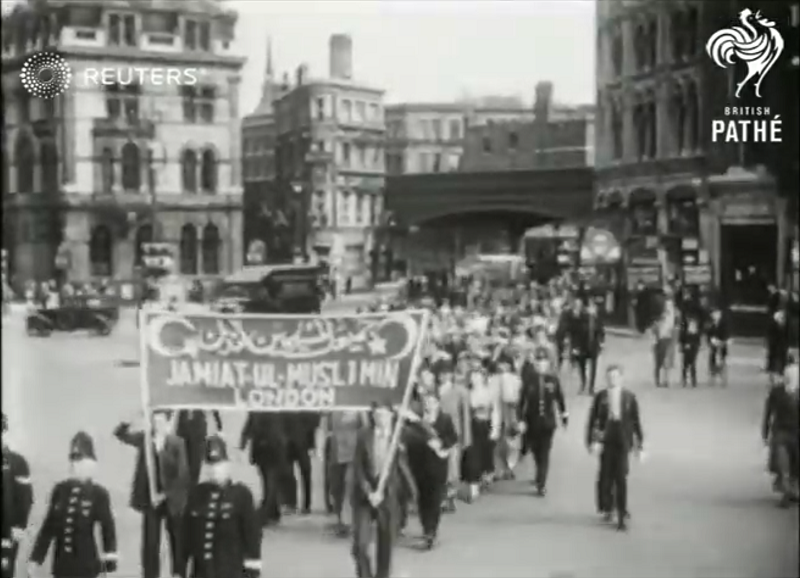
Screen capture of the 1938 Muslim protest march in London from a British Pathé newsreel – https://www.youtube.com/watch?v=ADausiEe4pM
… my husband was at the Museum of London and spotted a very brief mention of this protest in 1938 on a list of 20th century London events. I did some research.
The book they objected to was HG Wells’ A Short History of the World. This was originally published in 1922 but in 1938 an abridged version was tranlated into Hindustani and published in India. His observations about the Prophet Mohammed did not find favour with Indian Muslims (and as you know pre-partition the area called India covered what is now Pakistan and Bangladesh). There were protest meetings in Calcutta and Mumbai (then transliterated as Bombay) and the consignments of the books that WH Smith the booksellers sent to Hyderabad mysteriously never arrived. Investigation showed that the Sind government banned its import. Protests spread to east Africa and were reported in Nairobi and Mombasa.
The paragraphs concerned said “He seems to have been a man compounded of very considerable vanity, greed, cunning, self-deception, and quite sincere religious passion”. Wells concludes, not unfavourably, that “when the manifest defects of Muhammad’s life and writing have been allowed for, there remains in Islam, this faith he imposed upon the Arabs, much power and inspiration”.
There had been a number of Muslims living in east London for some years, sailors who came through the docks, retired servants, some professional men and in 1934 they formed a charitable association for the promotion of Islam called Jamiat-ul-Muslimin; they met on Fridays at a hall in Commercial Road.
On Friday 12th August 1938 a copy of A Short History of the World was, as apparently reported in the Manchester Guardian the following day “ceremoniously burned”. The main Nazi book burnings were over 5 years previously but I can’t but be reminded of them. I can’t access the Guardian on-line archive for 1938 as I don’t have a subscription, but I have no reason to doubt what they reported.
A few days later Dr Mohammed Buksh of Jamiat-ul-Muslimin attended upon Sir Feroz Khan Noon, the high commissioner for India. Sir Feroz tried to explain that in Britain we could (or could then) freely criticise Christianity, the Royal family and government as a right. He reminded Dr Buksh that Muslims were “a very small minority in England, and it would do them no good to try and be mischievous in this country, no matter how genuine their grievances were”.
Comments Off on That time that H.G. Wells fell afoul of Muslim sentiments
October 13, 2022
The Nazis’ Justification for the Genocide – October 9, 1943 – WAH 081
World War Two
Published 12 Oct 2022This week the Nazis go on the record about their genocide of the Jews. Meanwhile the Jews in Denmark are coming closer to safety, and the Roman Jews are again at peril.
(more…)
Comments Off on The Nazis’ Justification for the Genocide – October 9, 1943 – WAH 081
October 12, 2022
History’s Real Macbeth
Tasting History with Max Miller
Published 11 Oct 2022
(more…)
Comments Off on History’s Real Macbeth
October 10, 2022
Look at Life — Trouble Shooters (1964)
PauliosVids
Published 20 Nov 2018
From the comments:
David Mills
1 year ago
We never wore berets but jungle hats. This is an honest attempt to illustrate their role but so obviously, painfully stage managed. In reality, it was a hot, sweaty, stinking environment with constant tensions. Contacts were few and far between. Going into the IBAN long houses and chatting with the headman (Kampong Ketua) was fascinating, useful and, for the short period, relaxing. Between June 1965 and Aug 1982 I had four tours in the area. Learning Malay was essential and welcomed by the indigenous population.Iolis
1 year ago
The late Paddy Ashdown at 6.36. Later in life he would becone leader of Britain’s Liberal Democrat Party. He sadly died on 22 December 2018.
Comments Off on Look at Life — Trouble Shooters (1964)
October 9, 2022
The Nanny State’s manifold failings
Christopher Snowden scoffs at the pro-Big Nanny maunderings of Matthew Parris in the Spectator recently:
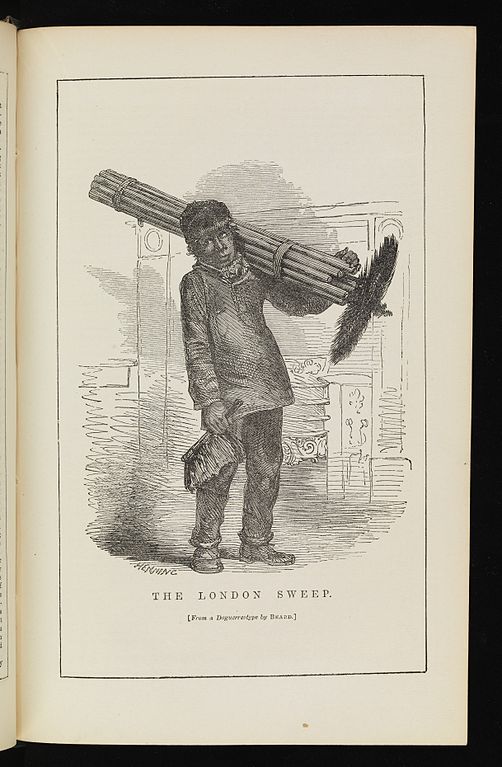
The London Sweep (from a Daguerreotype by BEARD).
Image from London labour and the London poor: a cyclopaedia of the condition and earnings of those that will work, those that cannot work, and those that will not work, 1851, via the Wellcome Collection.
A few years ago I was on the panel at the Battle of Ideas in London. I can’t remember what the topic was exactly, but it was something like the sugar tax or e-cigarette regulation. Rather than deal with the merits of these policies directly, I noticed that my opponents talked in general terms about the good that government can do, referencing the abolition of slavery and the ban on children going up chimneys.
Given all the regulation of recent decades, I found it telling that they had to go back 200 years to find laws that everyone can agree were jolly good. If I had been presenting the case for anarchism, their arguments might have landed, but since I was making the more modest case that perhaps there might be one or two laws in existence that are unnecessary and illiberal, their approach looked more like a diversionary tactic.
Matthew Parris did the same thing in last week’s Spectator. Thanks to the Royal Mail strike, it only landed on my doormat today, but you can read it here. It is titled “Maybe Nanny does know best”. Confusingly, Parris does not use the term “nanny state” in the conventional sense meaning lifestyle paternalism, but as a catch-all term for any government regulation whatsoever.
His target is Liz Truss whom Parris dislikes even more than he disliked Brexit and Boris Johnson. Unless Rory Stewart or Nick Clegg somehow become Prime Minister, I suspect that Parris will be demanding the head of whoever is in charge of the government until his dying day. He is not impressed by Truss’s “dash for growth”.
Parris’s argument is that Big Government is the friend of economic growth, not its foe. He confesses that he, like Truss, once held the view that the “dead hand of the state” stifled growth and led to inefficiencies but that he has grown out of all that stuff now and, with two gin-scented tears trickling down the sides of his nose, he welcomes his bureaucratic overlords.
Why? Because, a hundred years ago, the government gave women the vote and allowed them to work.
There was a time not so long ago when a certain group – half our potential workforce – were all but disqualified from contributing to Britain’s GDP. This group were called “women”. Women were generally unable to own property, or to play much more than a menial role in business (let alone politics, where they could not vote). So who helped unleash women’s potential, gave them rights in the workplace, stopped employers throttling their potential by restricting them to mindless occupations? Was it free trade? Was it big business? Was it competition? Was it Adam Smith’s “Invisible Hand”? No. Step forward Nanny. Nanny it was – legislation, the House of Commons, the first world war, the state – who commanded these things, driven in part by the forces of democracy.
The idea that women only started “contributing to Britain’s GDP” — i.e. working for pay — after the First World War is historically illiterate. It may have been true of the upper class and some of the middle classes, but for all other households it was a financial necessity for women to work, whether in agriculture, textiles, domestic service, pubs or whatever. It is true that more men were employed than women, but women were pregnant a lot of the time and had an enormous amount of unpaid work to do. They were certainly never “all but disqualified” from working, except in a few sectors such as the police force.
And who was it who banned women from owning property and voting in the first place? It wasn’t Adam Smith. It was the government, or, as Parris, would have it, the “nanny state”. So which nanny state are we supposed to be thankful for — the one that gave women the vote for a hundred years or the one that denied them the vote for hundreds of years?
Nanny had been busy since the 18th century, when in the Papists Act of 1778 she decreed that Catholics should not be excluded from key parts of the economy. She was still busy in the 20th century, starting with the Sex Disqualification (Removal) Act 1919, and later the 1944 Education Act outlawing the barring of married women from teaching.
Again, who excluded Catholics from key parts of the economy in the first place? Who barred married women from teaching? That’s right, it’s our old friend Big Government, the arsonist that Parris treats like a fireman.
Comments Off on The Nanny State’s manifold failings
QotD: The Paras in peacetime … the “Millwall of the British Army”
Part of the mythos surrounding the Parachute Regiment is its near legendary “bad behaviour” – it is not seen as a gentlemanly and affable club, it is, arguably, the Millwall of the British Army infantry units. Their role is simple – to leap from the air, and land in the most difficult and demanding of circumstances, probably at night, probably amid confusion, disarray and destruction, and then fight until relieved. It calls for a uniquely aggressive and determined mindset, and a willingness to go on long after others would have stopped.
The Regimental history is littered with gallantry awards and tales of valour that are both inspirational and humbling to read. There is no doubt that within their world, the airborne infantryman can, when deployed on operations, be a ferocious foe, who few would wish to tangle with. The problem is that this aggression and drive is not something that is commonly needed outside of military operations, and the chances of these occurring are in ever shorter supply.
After a period when there were opportunities for deployments and kinetic action in Afghanistan and Iraq, the call for missions for Paratroopers is, currently, slim. Designed as a force intended to be ready to go when called, their leadership have to balance off maintaining an aggressive “ready for anything” mentality, coupled with trying to keep the behaviour of their people under manageable control.
Sir Humphrey, “Values, Standards, and Leadership in the Internet Age”, Thin Pinstriped Line, 2022-06-18.
Comments Off on QotD: The Paras in peacetime … the “Millwall of the British Army”
October 8, 2022
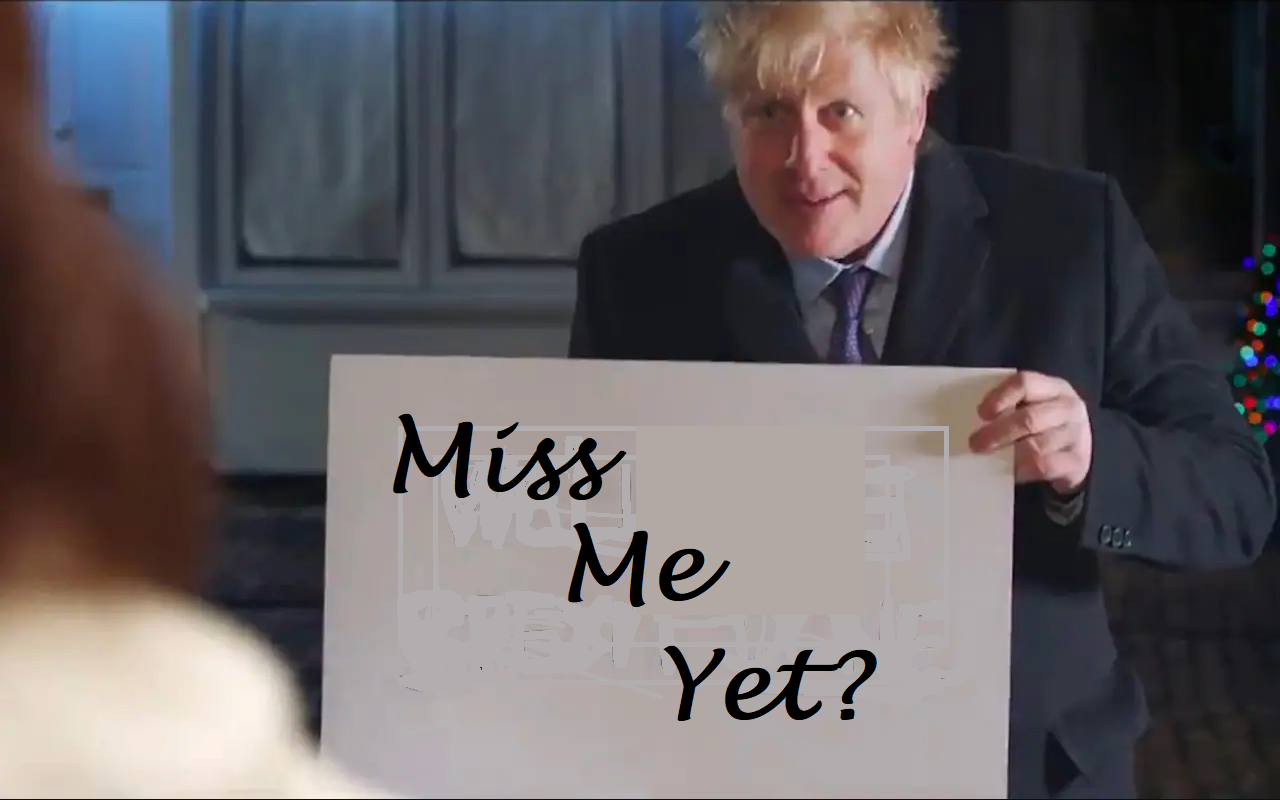
First BoJo “Miss me yet?” meme time?
Dominic Sandbrook on the terrible, awful, very bad start to Liz Truss’s Premiership:
If you believe the mainstream media, it has been yet another cosmically dire week for the Conservatives. But let’s stop going on about all the little things that went wrong, and concentrate instead on what went right. Nobody died. Liz Truss got through her speech without losing her voice, losing her mind or falling off the stage. The pound is back up to its level before Kwasi Kwarteng’s Fiscal Event. And maybe, just maybe, things are going to come right after all.
The winter energy crisis won’t be as bad as everybody fears. Inflation will start to come down. By the spring, that enormous Labour poll lead will be a fading memory. And as the next election approaches, ordinary people across the land will throw their caps in the air and cheer the name of Good Queen Liz …
No. No, I can’t do it. Tempting as it is to tilt against the conventional wisdom, sometimes you just have to face facts. The conference was awful. The speech was awful. This has been the worst start to any premiership, I think, in recent history — perhaps even in all British history.
Perhaps some readers will think this very harsh. But one close Truss ally, speaking off-the-record to the Financial Times, didn’t seem to think so. “I just went back to my hotel room and cried,” he said. “It’s a total disaster.” That’s pretty much what the general public think, too. In focus groups this week, the words that came up again and again were “incompetent”, “useless”, “untrustworthy”, “dangerous” and “clueless”. The punters aren’t always right, of course. But this time they are right, aren’t they?
“Our policy is great,” Penny Mordaunt told a fringe conference audience a couple of days ago, “but our comms is shit.” But if your comms really is shit, then who cares about the policy? Who even knows about it? Communicating your policy is the very essence of politics. If you can’t do it, you’ll never win another election.
I watched Truss’s speech through my fingers, embarrassed not just by the sheer lack of content, but the comically wooden and childlike delivery. It speaks volumes that in their desperation to find something, anything, nice to say about it, sympathetic papers applauded her for staying calm after she was interrupted by hecklers. Only somebody who had never heard of Harold Wilson, Margaret Thatcher or Tony Blair — all of whom were brilliant at dealing with interruptions — could have possibly thought this worth applauding.
For although academics and activists often prefer to talk about the abstractions of ideology or the nuts and bolts of policy, performance really, really matters in politics. To some extent, in fact, performance is politics. Even in a parliamentary system, you need a messenger who embodies the message, a leader who can charm and explain. Watch Thatcher talking to Robin Day in 1984, or Jim Callaghan being interviewed by Thames TV’s This Week in 1978, and it’s like entering a different world. Whatever their ideological differences, Thatcher and Callaghan are seasoned, accomplished performers, at the top of their respective games. They think about the questions. They talk in complete sentences, even complete paragraphs. They give long, considered, serious answers. They seem like impressive, well-informed, formidable people. Then watch Truss again, and try not to weep.
Comments Off on First BoJo “Miss me yet?” meme time?
Tank Chat #155 | Warthog | The Tank Museum
The Tank Museum
Published 3 Jun 2022David Willey is back with another Tank Chat. This week join David as he chats about the armoured vehicle Warthog — the Viking successor.
(more…)
Comments Off on Tank Chat #155 | Warthog | The Tank Museum
October 7, 2022
The Combat Dogs of World War Two – WW2 Special
World War Two
Published 6 Oct 2022Where man goes, so does man’s best friend. Across the globe, tens of thousands of dogs are called up. They play their part in tales of heroism and joy. But without any agency over their own lives, they also experience fear, death, and cruelty.
Comments Off on The Combat Dogs of World War Two – WW2 Special
Churchill and the Queen
In The Critic, Andrew Roberts outlines the relationship between Prime Minister Winston Churchill and Queen Elizabeth II:
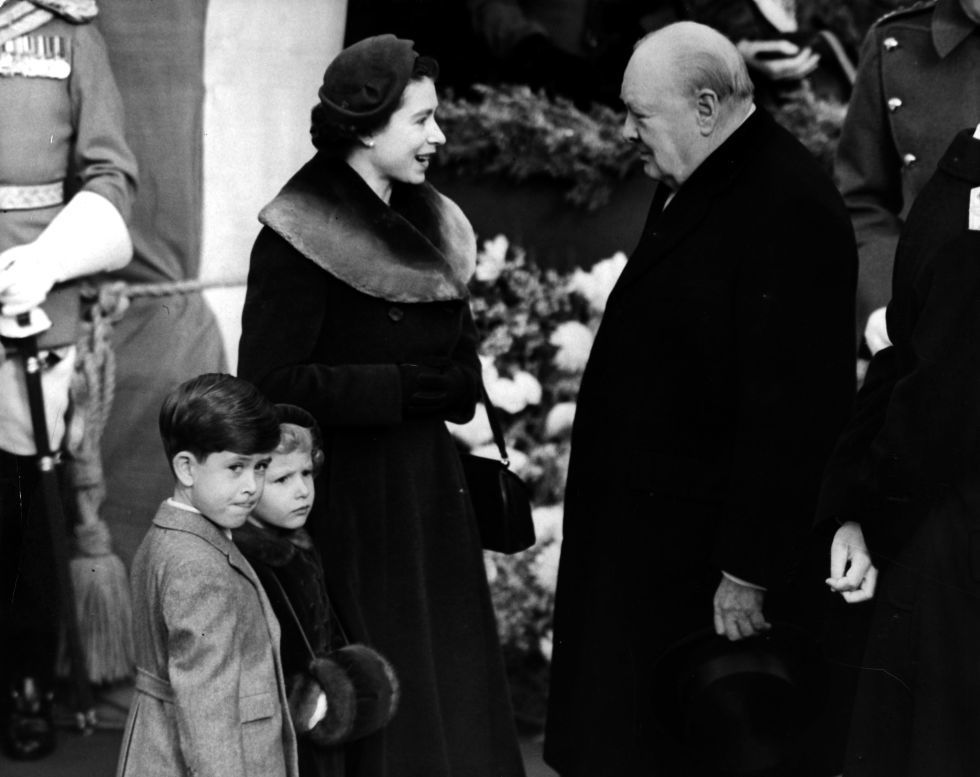
Queen Elizabeth II and Sir Winston Churchill, with Prince Charles and Princess Anne in the foreground, 10 Februrary 1953.
Official photograph via Wikimedia Commons.
Winston Churchill was besotted with Queen Elizabeth II: the word is precise. He worshipped and adored her. His relations with some other members of the royal family were, on occasion, complicated — not least when King Edward VII was sleeping with his mother. But for the late Queen he had nothing but an almost puppy-dog love.
[…]
When King George VI died unexpectedly on 6 February 1952, aged only 56, Churchill was devastated, weeping copiously both on hearing the news and at the funeral. Of the new monarch he told his private secretary, Jock Colville, that “he did not know her and that she was only a child”.
Nonetheless he saw an opportunity of romanticising the country’s situation. “Famous have been the reigns of our queens,” he said in his BBC broadcast on the King’s death. “Some of the greatest periods in our history have unfolded under their sceptre. Now that we have the second Queen Elizabeth, also ascending the Throne in her twenty-sixth year, our thoughts are carried back nearly 400 years to the magnificent figure who presided over and, in many ways, embodied and inspired the grandeur and genius of the Elizabethan Age.”
Although she was his sixth sovereign, Churchill was the new Queen’s first prime minister and old enough to be her grandfather. For all the 51-year age difference — or perhaps because of it — Churchill quickly grew devoted to her. “There was one lady by whom, from 1952 onward, Churchill was dazzled,” noted Colville. “That was the new Queen. Here was a woman whom he respected and admired more than any man.”
[…]
On 24 January 1965, 70 years to the day after the death of his father Lord Randolph Churchill, Sir Winston died. The Queen waived all custom and precedent to attend his funeral at St Paul’s Cathedral. She added a message in her own handwriting to the wreath of white flowers that was placed upon his coffin: “From the Nation and the Commonwealth. In grateful remembrance, Elizabeth R.” It echoed that which Churchill had placed on her father’s coffin, simply saying “For Valour”, the motto of the Victoria Cross, and a reference to the late king’s moral and physical courage during the Second World War, and perhaps also at the battle of Jutland in 1916.
[…]
The Queen decided Churchill should have a State funeral following his stroke in 1953. Once he had recovered, she told him so. The plans had to be rewritten several times over the next 12 years because, as Lord Mountbatten joked, Churchill kept on living but the pallbearers kept on dying.
There is a powerful symmetry to the friendship of monarch and premier that the next State funeral after Churchill’s was to be the Queen’s own, a full 57 years later.
Comments Off on Churchill and the Queen
Pease Pudding – Weird Stuff In A Can #74
Atomic Shrimp
Published 28 May 2018This is Pease Pudding — A sort of spreadable paste made from yellow split peas, and with a very long history as a staple food in England.
Here’s the link to the article on Atomic Shrimp (includes a recipe, of sorts): http://atomicshrimp.com/post/2007/01/…
Comments Off on Pease Pudding – Weird Stuff In A Can #74
October 5, 2022
“The centre ground on domestic policy and public services is Corbynism with a union flag on it and the word ‘British'”
Ed West on the decidedly conservative cast of many British voters’ core beliefs:

Jeremy Corbyn, then-Leader of the Labour Party speaking at a Rally in Hayfield, Peak District, UK on 25th July 2018 in support of Ruth George MP.
Photo by Sophie Brown via Wikimedia Commons.
It wasn’t until I was a fairly grown up that I learned just how conservative many Labour voters were. My parents’ Labour-supporting friends had mostly belonged to what Ken Livingstone called ‘the party of the metropolitan pervert’, London types who worked in creative industries or the public sector and held ultra-liberal views (at least for the 90s). But out there in the real world there were all these Labour supporters who were even more Right-wing than my dad, whether on crime, immigration, Europe, sexual relations or pretty much any social issue. They just wanted, in Blackadder’s words, a few less fat bastards eating all the pie.
That is pretty much where the public are now. As Aaron Bastani put it: “The centre ground on domestic policy and public services is Corbynism with a union flag on it and the word ‘British'”.
Although Jeremy Corbyn lost decisively in 2019, many have forgotten the political lesson of the Corbyn era — that it wasn’t his economic policies that put people off, but his lack of patriotism. He came from that long line of Quaker-Unitarian radicals who have always been seen as too sympathetic to Britain’s enemies, whether it was Robespierre, Napoleon, the USSR, Irish republicans or Islamic radicals.
Corbynomics is certainly more popular than what the current Tory Party is offering, especially that served up in the recent mini-budget, after which it could be said that things are developing not necessarily to the Government’s advantage.
I don’t have strong opinions on the aborted 45% tax cut; it didn’t seem very wise, or fair, but I’m not sure how drastic it was; Robert Colvile in The Sunday Times suggests that the proposal was not as bold as people make out. Yet it seems to be hugely unpopular, except with the Institute for Economic Affairs.
But I’m not convinced that makes it bad.
The IEA’s Kristian Niemietz has repeatedly pointed out that free-market economics is generally quite unpopular, and during the depths of the Brexit dispute he wrote a piece opposing what he called “Bregalitarianism”:
The Bregalitarian loves to wallow in faux-indignation every time an opponent – which can be a Remainer, but it can also just be a more cautious, less enthusiastic Brexiteer – mentions the possibility that not everyone who cast a vote on 23 June 2016 was fully aware of all the possible ramifications. “How DARE you suggest that 17.4 million voters are stupid!”, cries the Bregalitarian. “How DARE you be so patronising and insulting!”
I find this Bregalitarian rhetoric deeply disingenuous – and never more so than when free-marketeers engage in it … Here’s a little home truth: if you are a free-marketeer in Britain in 2018, you are part of a small and unpopular minority. The vast majority of the British public disagree with you on virtually everything. There is majority support for a (re-) nationalisation of energy companies, the railways, water and bus companies. There is majority support for rent controls and various price controls.
As a free-marketeer, you probably want, if not fully privatised, then at least mixed systems of healthcare and education, with much greater private sector involvement. If so, you are almost alone in Britain with that view. There is also majority support for a lot more government regulation, a lot more government interference with private business decisions, higher taxes and a larger state.
Indeed, public opinion on economic issues is quite eye-watering: a full 28 per cent of British adults want banks to be run by the state, and 30 per cent even want internet providers nationalised. A quarter want travel agents nationalised.
Comments Off on “The centre ground on domestic policy and public services is Corbynism with a union flag on it and the word ‘British'”
The Amusing Inspiration Behind Dire Straits Classic 70s Hit | Professor of Rock
Professor of Rock
Published 16 Jun 2021The story of the 1979 classic “Sultans of Swing” by Dire Straits. Mark Knopfler was inspired to write the song after witnessing a band playing Dixieland Jazz in a dive bar.
Hey music junkies and vinyl junkies Professor of Rock always here to celebrate the greatest artists and the greatest 70s vinyl songs of all time for the music community and vinyl community.
If you’ve ever owned records, cassettes and CD’s at different times in you life or still do this is your place Subscribe below right now to be a part of our daily celebration of the rock era with exclusive stories from straight from the artists and click on our patreon link in the description to see our brand new show there.
Mark Knopfler was performing in London’s pub scene in the mid 70s, living on next to nothing in a flat with aspiring bassist John Illsley. Knopfler’s younger brother, David, introduced him to Illsley, following the dissolution of Mark’s first marriage. Mark, John, and David teamed up with “Pick” Withers, another London area musician, to form a group they aptly named Dire Straits.
The 4 members all had day jobs, but they lived a “hand to mouth” existence — struggling to pay their utilities bill. One rainy evening, Mark & a few friends decided to go to a nearby pub for a couple of pints in a dilapidated (dih-lap-ih-dated) section of South London. The pub was nearly empty, except for a couple of guys playing pool. In a corner of the bar, a band was playing — seemingly unaffected by the lack of an audience.
The band was “blowing Dixie — double-four time” as Knopfler would later transcribe. “Dixie double” is a performance style that was popularized by Django (jang-go) Reinhardt (rain-hart), and in the early days of Les Paul — where the guitar, bass, and drums are played harmoniously at a very fast pace.
If you’re playing “Dixie double-four time” as Knopfler describes in “Sultans of Swing”, you are playing twice the speed of the normal 4/4 time, and the drummer is working extra hard to keep up with the tempo. Knopfler remembered asking the hapless Dixie outfit to play “Creole Love Call” or “Muskrat Ramble”, much to the band’s delight, because they were undoubtedly shocked that someone in the pub actually knew some of the songs in their repertoire.
At the end of the band’s performance, the leader announced triumphantly to the 3-4 people in attendance … “We are the Sultans of Swing!”, as if they were playing in front of a packed house of ardent fans. Mark found the irony of the scene very amusing; a frumpy looking band playing a hole in the wall pub in a dodgy part of town, declaring themselves “the sultans of swing”.
To be a “sultan” would be to rule over a country, or hold a dynasty over people. The term originated from the Arabic language meaning to have “authority” or “rulership” over others. The true “Sultans of Swing” would’ve been the “swing” genre’s originator Fletcher “Smack” Henderson in the late 20s & 30s, or one of his revered disciples, Duke Ellington & Benny Goodman.
Babe Ruth and the Yankees legendary murderers row of the 20s if you’re talking baseball.
(more…)
Comments Off on The Amusing Inspiration Behind Dire Straits Classic 70s Hit | Professor of Rock


