
Tasting History with Max Miller
Published 31 May 2022
(more…)
October 4, 2022
The History of the Wine Glass
Comments Off on The History of the Wine Glass
QotD: “The world bought British and British was best”
So much has been promised in the past, so much has come to nothing, no wonder they are sceptical. And impatient. Already I can hear some of them saying: “The Conservatives have been in five months. Things do not seem to be that much better. What is happening? Do you think the Conservatives can really do it?” We say to them this: Yes, the Conservatives can do it. And we will do it. But it will take time. Time to tackle problems that have been neglected for years; time to change people’s approach to what Governments can do for people, and to what people should do for themselves; time to shake off the self-doubt induced by decades of dependence on the state as master, not as servant. It will take time and it will not be easy.
The world has never offered us an easy living. There is no reason why it should. We have always had to go out and earn our living — the hard way. In the past we did not hesitate. We had great technical skill, quality, reliability. We built well, sold well. We delivered on time. The world bought British and British was best. Not German. Not Japanese. British. It was more than that. We knew that to keep ahead we had to change. People looked to us as the front runner for the future.
Our success was not based on Government hand-outs, on protecting yesterday’s jobs and fighting off tomorrow’s. It was not based on envy or truculence or on endless battles between management and men, or between worker and fellow worker. We did not become the workshop of the world by being the nation with the most strikes.
I remember the words written on an old trade union banner: “United to support, not combined to injure”. That is the way we were. Today we still have great firms and industries. Today we still make much of value, but not enough. Industries that were once head and shoulders above their competitors have stumbled and fallen.
It is said that we were exhausted by the war. Those who were utterly defeated can hardly have been less exhausted. Yet they have done infinitely better in peace. It is said that Britain’s time is up, that we have had our finest hour and the best we can look forward to is a future fit for Mr Benn to live in. I do not accept those alibis. Of course we face great problems, problems that have fed on each other year after year, becoming harder and harder to solve. We all know them. They go to the root of the hopes and fears of ordinary people — high inflation, high unemployment, high taxation, appalling industrial relations, the lowest productivity in the Western world.
People have been led to believe that they had to choose between a capitalist wealth-creating society on the one hand and a caring and compassionate society on the other. But that is not the choice. The industrial countries that out-produce and outsell us are precisely those countries with better social services and better pensions than we have. It is because they have strong wealth-creating industries that they have better benefits than we have. Our people seem to have lost belief in the balance between production and welfare. This is the balance that we have got to find. To persuade our people that it is possible, through their own efforts, not only to halt our national decline, but to reverse it and that requires new thinking, tenacity, and a willingness to look at things in a completely different way. Is the nation ready to face reality? I believe that it is. People are tired of false dawns and facile promises. If this country’s story is to change we the Conservatives must rekindle the spirit which the socialist years have all but exhausted.
Margaret Thatcher, “Speech to Conservative Party Conference”, 1979-10-12.
Comments Off on QotD: “The world bought British and British was best”
October 2, 2022
Smolensk and Naples Liberated! Both in ruins – WW2 – 214 – October 1, 1943
World War Two
Published 1 Oct 2022Major prizes are taken by the Allies this week on two fronts — Naples in Italy and Smolensk in the USSR, but they are advancing all over the Eastern Front, across the Italian peninsula, and in the South Seas, but the enemy is leaving a trail of destruction as he pulls back.
(more…)
Comments Off on Smolensk and Naples Liberated! Both in ruins – WW2 – 214 – October 1, 1943
October 1, 2022
Johann Hari’s unlikely career resurrection
I have to admit that Johann Hari was pretty much just a British media personality I had a vague awareness of, but I hadn’t paid much attention to him (his Wikipedia sockpuppeting came to my attention in 2011, and I quoted from an article he wrote for the Los Angeles Times in 2019). As this post by Ben at Ben’s Comedy News outlines, I’d largely missed the rest of his fall and rise:
Nowadays, Johann Hari is known as a pop psychology expert. He does TED talks and writes books with simplistic messages like:
- your smartphone is ruining your attention span! (Stolen Focus)
- you should cure your depression by throwing away your medication and joining a book club! (Lost Connections)
- the war on drugs is bad! (Chasing the Scream)
His books get positive blurbs from distinguished thinkers, such as the comedian and twink admirer Stephen Fry, the listicle entrepreneur Arianna Huffington, the feminist and sex offender’s wife Hillary Clinton, the comedian and fake revolutionary Russell Brand, and the TV doctor Doctor Rangan Chatterjee.
But when you look at how actual experts assess his work, it’s not so positive. The neuroscientist Dean Burnett responded to an extract of Lost Connections in his Guardian column, under the title Is everything Johann Hari knows about depression wrong? Burnett points out that:
despite Hari’s prose suggesting he’s uncovered numerous revelations, pretty much everything he “reveals” is well known already
Hari, in pursuit of an anti-anti-depressant narrative, makes the claim that you can be diagnosed with depression and put on medication immediately after a traumatic event like losing a child, which Burnett (who teaches psychiatry) describes as:
at best a staggering exaggeration, at worst an active fabrication to support a narrative.
But this article isn’t about what Johann Hari has been doing recently. It’s about what Hari was up to before he reinvented himself as some kind of expert, back when he was a journalist who ended up being disgraced.
It’s about how Hari has somehow rounded allegations of serious fabrication down to a record of minor plagiarism. It’s about how in trying to attack his critics, he seems to have inadvertently revealed his penchant for little brother incest fantasies with a troubling racial dimension. It’s about how I tried to fix the record on Wikipedia, and ran into trouble as Wikipedia’s policies collided with the sorry state of British journalism.
Back in 2010, Johann Hari was a star newspaper columnist (if you’re a millennial that means he wrote hot takes that got lots of clicks; if you’re Gen Z, think of him as a viral TikTok star but with words on paper).
In 2011 he was disgraced and kicked out of the profession.
Now if you look at the articles that were written about his comeback, like this New Statesman piece or this Guardian piece you’d conclude that he was disgraced for two things:
plagiarism – specifically, taking quotes from text someone had written in a book or article, and pretending that the person had said it directly to him
abuse of Wikipedia – in particular, using a fake identity to edit the pages of professional rivals with false allegations
I followed the whole Hari affair pretty closely at the time (I didn’t like him because he had been a cheerleader for the Iraq War, so I enjoyed watching his career go down in flames).
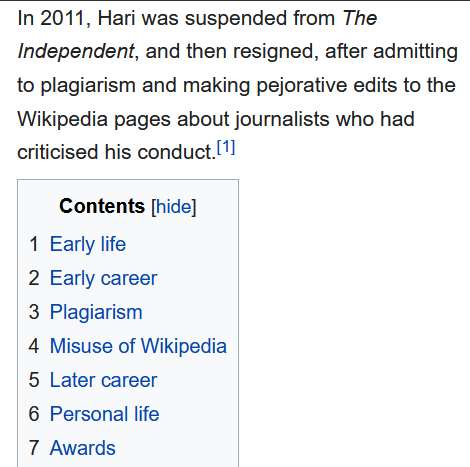
When his latest book came out a month ago, I looked at his Wikipedia entry. Wikipedia saves the history of all the different versions of each page, so here is a link to what I saw when I did that.
And here’s part of the summary and the table of contents:
The whole article struck me as weird because it didn’t mention two things I clearly remembered:
- Hari got in trouble, not just for minor plagiarism, but for allegedly making things up completely.
- Even more memorably, the fake identity he used to edit Wikipedia, “David Rose”, was also used to author an incest kink porn story with a hilarious title.
You can see why Hari (and whatever reputation management consultants he has working for him) would want to focus on the “plagiarism” angle. It’s not good to pass off a quote you got from someone’s book as something they told you directly, but it’s not as serious as completely inventing something. I suppose technically it’s plagiarism because you’re pretending you elicited the quote in an interview and you’re not citing the original book; but it’s a lot better than the typical case of plagiarism that involves passing off someone else’s work as your own. Hari’s defence is that he was “cutting corners” because he was under so much pressure due to his meteoric success at young age, etc. etc.
Comments Off on Johann Hari’s unlikely career resurrection
Tank Chat #154 | Valentine DD | The Tank Museum
The Tank Museum
Published 27 May 2022We’re back with another Tank Chat this week! Catch up with Historian David Fletcher as he chats in detail about the Valentine DD tank.
(more…)
Comments Off on Tank Chat #154 | Valentine DD | The Tank Museum
September 27, 2022
Sarah Hoyt on how Americans are mis-understanding the TV show Bridgerton
I don’t watch TV, so I haven’t seen the show myself, but apparently a lot of Blacks in the US are taking away the multi-racial casting of a parallel-universe TV show set in the Regency period as being a true representation of British history:

Anyway, all this came to a head with my watching the Bridgerton series. As other people know, it bothers the living daylights out of me to cast well-known historical figures as another race. Not because there can’t be decent actors of another race, but because I know there is a percentage of the population who takes fictional movies and shows as revealing “the truth”.
My mom, who is better educated (alas) than most American high school graduates is one of those. She will adapt her vision of the past according to some crazy movie she just watched. (The number of arguments I’ve had.)
For those who haven’t watched Bridgerton (bog standard regency romances, with gorgeous, if not period-accurate clothing) they cast a certain number of noblemen as black or indian or other “races” and the English Queen in Bridgerton is black.
The buried history in the mini-series (suggested and Heinleined in) is that black and white people coexisted in England side by side, until the king married a black Queen, and then suddenly mixed marriages were allowed.
This is obviously a fantastic parallel world history. Yes, there were black people in England in the regency. I’m sorry to tell you there were very few and 99% of them were slaves or servants brought by people who had lived in Africa.
There was no “black nobility” and no system of apartheid.
HOWEVER as we found out, American people absolutely believe this nonsense. They believe Queen Charlotte (mostly German, honestly) was “black” based on a very bad portrait and rumors of a Moorish ancestress. (Note this rumor was almost certainly political slander. Also that Moor at that time in the peninsula depending on whether in the South or the North might mean slim, small and tan, but did not mean AFRICAN.) Weirdly the best debunking I found was from Quora.
HOWEVER I also found endless pages of well-educated black-Americans celebrating Queen Charlotte for “Black history month”.
Let me also point out that both the Queen and her husband (Yes, mad King George) were ardent abolitionists and that did she have any legitimate hint of African blood ALL the opposition would have fixated on this, and the caricatures would have been next level. However this never happened. Queen Charlotte was and looked German, even if a portrait can imply “stereotypical” African features … As long as you remember that those features exist in a lot of other races, and that a lot of them are also Neanderthal.
Sure, if you go with the one drop theory, Queen Charlotte was black. So is everyone else. EVERYONE else, even those whose 23andme swears they’re pure Scandinavian. Because sometime in the last two thousand years all of us got an African ancestor, somewhere, on one of the many, many lines that fed into our family. (Note genealogy is also a lie to some extent, since it’s impossible to follow every single female (if you’re tracking the male. Vice versa otherwise) line that dropped into your family, and everyone who fed into every other of those lines.)
The problem is that it was the rats in the head of the American black producers of the series that led them to create this entire parallel universe which they THINK IS TRUE on the basis of “well the queen was black”. WITHOUT LOOKING.
And now those rats are reproducing everywhere, but most notably in black American heads, who now believe that “Well, the king married a black queen, so it must be true that the Americans rebelled to keep enslaving the black people”.
This is all not just arrant nonsense, but poisonous bullshit, and has no contact whatsoever with reality.
What can we do about it?
Correct it, ruthlessly, whenever we come across it. And keep pointing out that a queen who was blond and blue eyed was not in fact “black” unless everyone is. And that reading racial tea leaves is a pseudo-science, like phrenology.
I would very much appreciate if we could put this behind us so may family doesn’t keep getting asked “what is your racial background” by complete strangers. (And not just census takers, whom I like to answer with “human”.)
Look, in the end, the darkest African and the lightest Scandinavian have more in common with each other than not. To pretend otherwise is arrant nonsense.
Yes, our far-distant ancestors developed racism as a necessary survival tool (along with the uncanny valley discomfort) because you could fall into the hands of another hominin band and become “food”. (The chimps are less discriminating and will also eat babies of their own band.)
We are now past that, and I would like it not to return. Yes, there are physical characteristics that go with certain character traits, but it’s harder to track than you think, and they’re often things that have nothing to do with race, let alone racial stereotypes.
We all have one drop of slaves and enslaved, or saints, sinners, murderers, murder victims, kings and peasants, ascetics and whores. And we all have all the inclinations of all of mankind in varying degrees.
It’s what you make of it and with it that determines whether you can wear “human” as a crown, or in fact get cast out of the human race for shoving in line.It’s time to stop with the nonsense.
Comments Off on Sarah Hoyt on how Americans are mis-understanding the TV show Bridgerton
QotD: The Poor Law Reform Act of 1834
One of the law’s architects, Edwin Chadwick — a man who made Mr Gradgrind [Wiki] look like one of the Cheeryble brothers [Wiki] — infamously commented that it was vital that the inmates of workhouses should be given the coarsest food possible. William Cobbett, a leading opponent of the bill, gleefully seized on this, nicknaming the Whigs, who pushed the legislation hardest, the “Coarser Food Party”. The idea of all this — rooted in the principles of utilitarianism, political economy and Malthusianism — was, as future Archbishop of Canterbury John Bird Sumner put it, to encourage the labouring poor to do everything they could to avoid the “intemperance and want of prudent foresight” that creates poverty, the “punishment which the moral government of God inflicts in this world upon thoughtlessness and guilty extravagance”.
In the 1830s, these ideas were at the very vanguard of progressive thinking. They were promoted by the metropolitan liberal elite of the age, men such as James Mill, Jeremy Bentham and David Ricardo, the forward-thinking “Philosophic Radicals” who spewed out reforming and “improving” ideas through their famous organ The Westminster Review. Other contributors included happy-go-lucky eugenicist pioneer and social Darwinist Herbert Spencer, as well as Harriet Martineau, the sort of woman who would cheerfully have put her “enlightened benevolence” into practice by personally taste-testing workhouse food to ensure it was sufficiently coarse.
These ideas were gleefully leapt upon by a large swathe of the Church leadership, who endorsed the grim dogmas of political economy with an alacrity that would only surprise anyone unfamiliar with the long history of our episcopacy’s lamb-like submission to secular liberal orthodoxies. As E.R. Norman pointed out many decades ago, the Church of England’s leaders have, again and again since at least the eighteenth century, “readily adopted the progressive idealism common to liberal opinion within the intelligentsia, of which they were a part”. They have “always managed to reinterpret their sources in ways which have somehow made their version of Christianity correspond to the values of their class and generation”, a process intimately connected to the fact that bishops are nearly always tied (by personal links, economic interests and a desire to conform) to their secular peers who set the broader cultural and political agenda.
Capel Lofft, “The closing of the Episcopal mind”, The Critic, 2022-06-21.
Comments Off on QotD: The Poor Law Reform Act of 1834
September 26, 2022
Did D-Day win WW2? – a WW2 expert discussion
World War Two
Published 25 Sep 2022WW2 historians Indy Neidell, Spartacus Olsson, and Paul Woodadge moderated by Ryan Socash discuss the meaning and significance of D-Day from historical, current, and future perspectives. Recorded on the road while shooting in Normandy for TimeGhost’s 24-hour documentary on the events of June 6, 1944.
(more…)
QotD: “Comrades of proven worth”
So too they didn’t have to line up for the scraps of whatever rotting junk the ration stores had. The KGB, for example, had its own commissary just around the back of Lubyanka – I know, I’ve shopped in it. And higher ranks simply never needed to go shopping at all, the nomenklatura had the government delivery service. Ocado for commies but only really important commies.
This all came under the rubric of comrades of proven worth…
Tim Worstall, “Emma Thompson Is A Comrade Of Proven Worth To Extinction Rebellion”, Continental Telegraph, 2019-04-19.
Comments Off on QotD: “Comrades of proven worth”
September 25, 2022
Red Army Reaches the Dnieper – WW2 – 213 – September 24, 1943
World War Two
Published 24 Sep 2022Benito Mussolini proclaims a new fascist republic in Italy, but this time it is a full puppet state to Germany. There is scattered fighting around Italy and the Dodecanese — including a massacre of Italian POWs, but the big Allied advances this week are the Australians in New Guinea and the Soviets retaking their own territory. They take ground, in fact, from near Smolensk all the way south to the Sea of Azov.
(more…)
Comments Off on Red Army Reaches the Dnieper – WW2 – 213 – September 24, 1943
200 Medals Won in an Hour – The Raid on Zeebrugge, 1918
Historigraph
Published 11 May 2022
(more…)
Comments Off on 200 Medals Won in an Hour – The Raid on Zeebrugge, 1918
September 24, 2022
PayPal shuts down the Free Speech Union’s account for some reason
Ellie Wheatley on PayPal’s arbitrary decision to cut off the Free Speech Union’s account without notice:

The irony of the Free Speech Union’s PayPal account being shut down is that it proves we are in need of the union more than ever.
The online payment company shut down the FSU’s account (thus making it more difficult for people to donate) without any clear explanation as to why it did so. The same was done to its founder, Toby Young, and his online newspaper, the Daily Sceptic.
The shame is, PayPal is an innovative tech company that has made transferring money almost seamless for millions across the world. You can donate money to an organisation within seconds; there’s no faff trying to find your credit card, or having to re-type your details for the twentieth time that week. It’s a brilliant service that has made life easier for many people, businesses and charities. PayPal is not a political company, it’s a tech company worth over $102bn, so why have they been banning other organisations from using their services?
Although PayPal said they couldn’t comment on the decision, they did proclaim that they “weren’t discriminatory”, but is this really true?
Is it unclear whether they shut down these accounts simply because they disagreed with what the FSU and Toby Young stand for. Although PayPal hasn’t clarified what exactly FSU and Toby Young did wrong, it appears that they must have breached their acceptable use policy. This includes myriad of things but the most prominent are hate speech and “misinformation” on topics such as the COVID vaccine.
Hate speech is one thing (although it seems that anything can be deemed offensive and hateful now) but “misinformation” about topics being a breach of policy takes us down a dark and sinister path.
Misinformation is a term that is often used to label content that goes against the elite or prevailing “groupthink” point of view. Questioning mainstream thought is unacceptable, and it breaches Big Tech’s policy, thus you can (and often will) be shut out.
Comments Off on PayPal shuts down the Free Speech Union’s account for some reason
QotD: The evolution of the domestic corridor
But certain features of a 200 year old apartment remain constant. There are bedrooms. There is a privy (now a flushing toilet). There is a kitchen. There is a living room. And there is a corridor.
This apartment was built around 1820, for the builder of the tenement it’s part of: he was a relatively prosperous Regency working man and his family would have included servants as a matter of course in those days. And where one has servants, one perforce has corridors so that they may move about the dwelling out of sight of the owners. But it was not always so.
Rewind another 200 years and look around a surviving great house, such as Holyrood Palace, also in Edinburgh. Holyrood largely dates to the 16th and 17th century, and reflects the norms of that earlier era, and if you tour it one thing is noteworthy by its absence: corridors. The great houses of that period were laid out as a series of rooms of increasing grandeur, each leading to the next. Splendid wide main doors in the centre of each wall provided access for nobility and people of merit: much smaller, unadorned doors near the corners allowed servants to scuttle unobtrusively around the edges of the court. Staircases ascended through grand halls at the centre of such houses (accessible from doors leading to the main function rooms around the periphery): servants’ areas such as the kitchen, stores, and pantry might boast their own staircases, and the master apartments of a great house had their own stairs leading to privy or ground floor.
But the corridor in its modern, contemporary sense seems to have started out as a narrowing and humbling of the grand halls and assembly rooms of state, reduced in scope to a mere conduit for the workers who kept things running — before, of course, they later became commonplace.
Charles Stross, “Social architecture and the house of tomorrow”, Charlie’s Diary, 2019-04-29.
Comments Off on QotD: The evolution of the domestic corridor
September 23, 2022
A Short History of Ships Cats – Floating Felines, Maritime Moggies and Kleptomaniac Kittens
Drachinifel
Published 26 Feb 2020A quick look at the origins of a vital part of the ship’s maintenance crew, and some notable examples.
(more…)
Comments Off on A Short History of Ships Cats – Floating Felines, Maritime Moggies and Kleptomaniac Kittens
September 22, 2022
RAF Coastal Command vs U-Boats
The History Guy: History Deserves to Be Remembered
Published 5 Oct 2020The contest between aircraft and U-Boats during the Second World War was one of competing technological innovations, culminating with a decisive struggle in the summer of 1943. The History Guy tells the forgotten story of the development of anti-submarine warfare and the contest between the aircraft of RAF Coastal Command and U-Boats of the Kriegsmarine in the Bay of Biscay.
(more…)
Comments Off on RAF Coastal Command vs U-Boats


