
Polyus Studios
Published 14 Jul 2018The Velvet Glove was a semi-active guided missile system developed by the Canadian Armament Research and Development Establishment. Its successor, the Sparrow II, was developed by Canadair in association with the US Air Force. This is the story of the development of the missiles in the context of contemporary weapons systems.
(more…)
September 9, 2022
The Velvet Glove and Sparrow II missiles; A Beginners Guide To Post-War Bomber Interception Tactics
Comments Off on The Velvet Glove and Sparrow II missiles; A Beginners Guide To Post-War Bomber Interception Tactics
September 8, 2022
Queen Elizabeth II (21 April, 1926 – 8 September, 2022)
It was inevitable that the Queen would die, yet the news was still an unwelcome surprise and a shock. I shared the news on social media, and as you’d expect, the very first response was from someone clearly looking for a fight over the monarchy and the bugaboos of his current obsessions. Thank goodness for the “mute” function. Prince Charles is now the King, although I understand he plans to choose a different regnal name.
In The Critic, Ben Sixsmith looks at the Queen’s reign in retrospect:
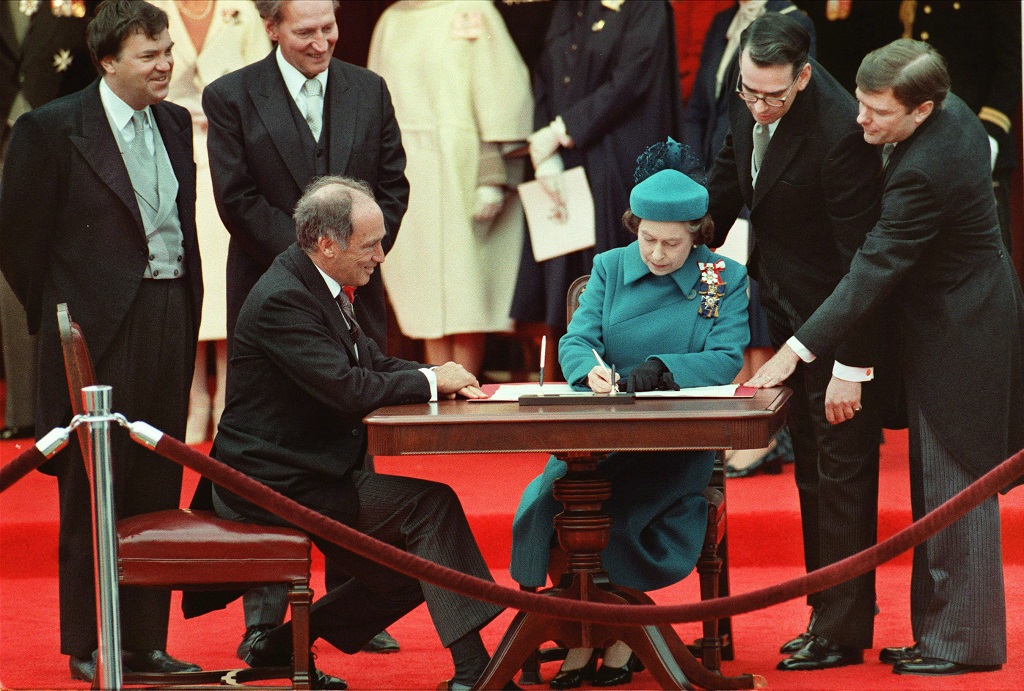
Queen Elizabeth II signs Canada’s constitutional proclamation in Ottawa on April 17, 1982 as Prime Minister Pierre Trudeau looks on.
The Canadian Press/Stf-Ron Poling
For years, Queen Elizabeth II was a link to another age — an age of tradition, and respect, and restraint. Did that age ever exist in an ideal form? Of course not. But we still admire its echoes, which surrounded our conception of the Queen.
She was crowned in 1953, looking rather vulnerable at the age of 25. Winston Churchill was Prime Minister. Man had only just reached the top of Everest and was more than fifteen years away from reaching the Moon.
The Empire was crumbling but the young, elegant, stoical Queen kept alive a sense of British importance and stability. Her personal calmness and courage as she toured dangerous regions was noted (and would be later tested when Michael Fagan, a disturbed socialist, snuck into her bedroom).
Her popularity never faltered. Governments, institutions, actors, athletes et cetera have risen and fallen in their popular esteem but Her Majesty was always loved. Was this in part because our exposure to her was so limited? Of course. But there is something special in that. She never imposed herself upon the public. She was committed to the tiring, traditional, constitutional, life-affirming, often rather modest and unheralded duties that she had inherited. The monarchy is a lot more than one person, of course, but it took a special person to embody it.
All the way back in the 1950s, Malcolm Muggeridge warned that elevating royals to the status of celebrities would kill the institution. Who could deny that he was onto something? Princess Diana was drowned in prurience and sentimentality, and some of the Queen’s own descendants have disgraced themselves, to greater and lesser degrees, by embracing the sordid lifestyles and the haughty status of the rich and the famous. Throughout it all, Queen Elizabeth maintained her dignity and grace, and her focus on her own responsibility.
The CBC posted an obituary for Her Majesty as soon as the news was confirmed:

HRH Princess Elizabeth as a junior officer in the Auxiliary Territorial Service in April 1945.
Queen Elizabeth, Canada’s head of state and the longest-reigning British monarch, has died.
She died on Thursday afternoon at Balmoral Castle in Scotland, Buckingham Palace said in a short statement. She was 96.
“The Queen died peacefully at Balmoral this afternoon. The King and The Queen Consort will remain at Balmoral this evening and will return to London tomorrow,” the palace said, in reference to the Queen’s son Charles, who automatically became king upon her death, and his wife, Camilla.
Her husband, Prince Philip, died in April 2021.
Elizabeth became Queen in 1952, at the relatively tender age of 25, and presided over the country and the Commonwealth, including Canada, for seven decades. Those 70 years as monarch were recognized during this year’s Platinum Jubilee events, which reached their height in London in early June.
In her time as monarch, Elizabeth bore witness to profound changes at home and abroad, including the decline of the British Empire and decolonization of many African and Caribbean countries, along with the end of hostilities with Irish republicans.
As one of the most famous women in the world, she was also under great public scrutiny during some of the most painful moments of her life, including the death of her father, King George VI, the marriage breakups of three of her four children and the death of her former daughter-in-law, Diana, Princess of Wales.
But Elizabeth always had a keen sense of her role.
“I cannot lead you into battle, I do not give you laws or administer justice,” she said during her first televised Christmas address in 1957. “But I can do something else: I can give you my heart and my devotion to these old islands and to all the peoples of our brotherhood of nations.”
In the National Post, Araminta Wordsworth points out the Queen’s fondness for Canada during her reign:
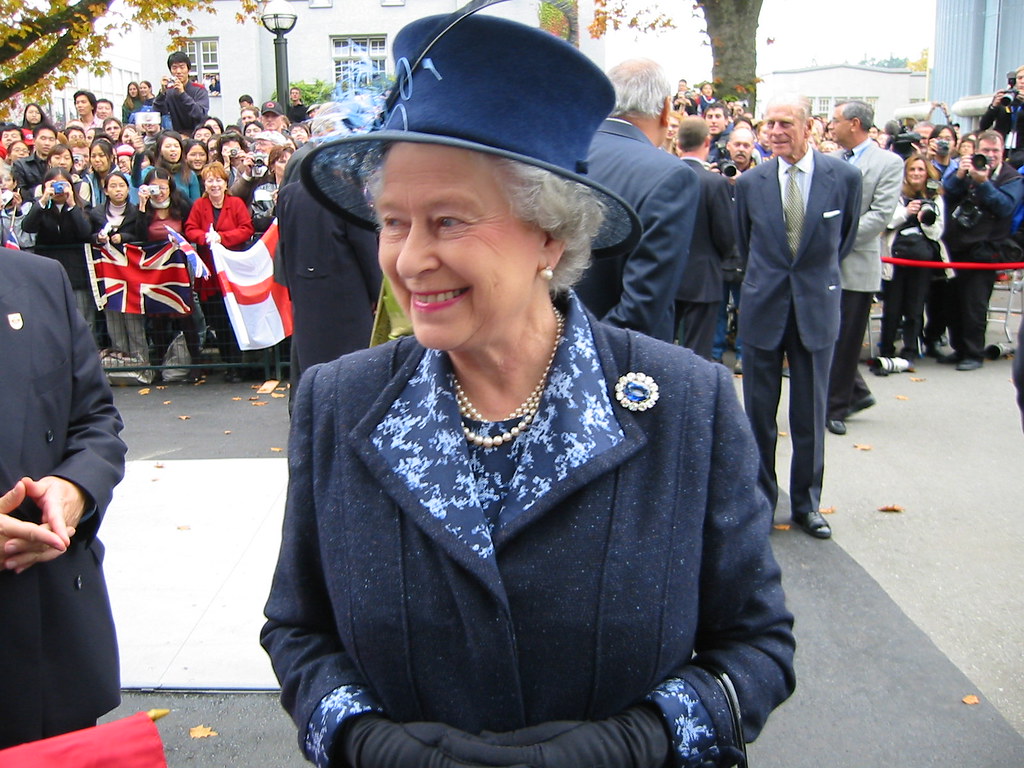
“Her Majesty Queen Elizabeth II” by Tinker Sailor Soldier Spy is licensed under CC BY-NC-ND 2.0 


 .
.
After a record-breaking reign of 70 years Her Majesty Queen Elizabeth died on Sept. 8, 2022.
She was the longest-ruling British monarch, outpacing her great-great-grandmother, Queen Victoria. However, Louis XIV of France still holds the absolute record, with 72 years, 100 days.
For most Canadians, the 96-year-old is the only sovereign they have ever known, but whether the country will sustain the connection after her death remains to be seen.
Certainly, Canada was the country she chose to visit most often. She was also here at one of the pivotal moments in our history when then-prime minister Pierre Elliott Trudeau brought home the Constitution in 1982. As sovereign, she signed the document in a rain-spattered and windy ceremony on Parliament Hill in Ottawa, the capital chosen by Queen Victoria.
But her connection to Canada had begun decades earlier. In 1939, Princess Elizabeth was reportedly the first British royal to make a transatlantic phone call: the recipients were her parents, then the Duke and Duchess of York, who were on a North American tour.
In 1951, the princess spent almost five weeks in Canada, filling in for her ailing father, George VI.
Winston Churchill, then in opposition, had wanted the princess and her husband, Prince Philip, the Duke of Edinburgh, to travel by boat, arguing air travel was unsafe.
But he was overruled and the royal couple became the first to embark on such a tour by air. With an action-packed schedule, they crossed the country from the Atlantic to the Pacific, including a side trip to Washington, D.C., greeted all the way by rapturous crowds. The royal pair square-danced, attended a hockey game and accepted countless bouquets.
Comments Off on Queen Elizabeth II (21 April, 1926 – 8 September, 2022)
Surprise! Liz Truss can successfully locate Canada on a map!
In UnHerd, Marshall Auerback details some of the Canadian connections of Britain’s new PM:

British Prime Minister Liz Truss, 1 May 2022.
Official portrait via Wikimedia Commons.
Faced with soaring costs of living, increased collateral damage from the war in Ukraine, and widening national inequality, Liz Truss seemed curiously optimistic in her first speech as Prime Minister. What could possibly be driving such bullishness? Absent any sign of a coherent plan of action, we might find her motivation in an Instagram post from 2018, where Truss cited the time she spent in Canada as a teenager as “the year that changed my outlook on life … #pioneercounty #optimism #maplespirit”.
As profound an impact as that year might have had on Truss’s optimistic psyche, she would do well to look more closely at Canada’s faltering “success story” in recent years. Today, the country is no longer the land of milk and honey (even if it does still produce a fair amount of maple syrup), but suffers many of the same problems as the UK, and a number that are significantly worse: rising inflation, profound income inequality, the challenges posed by climate change, and an increasing host of social problems — not least the mass stabbing spree last weekend in Saskatchewan that left 10 people dead.
However, to the extent that the Trudeau Administration has attempted to remedy some of these problems, there are clear lessons for Truss. Unlike in the UK, many of Canada’s energy problems are largely self-inflicted, a result of a progressive government ignoring its comparatively resource-rich environment, even as its European allies (including the UK) suffer severe consequences of being cut off from Russian gas supplies and the corresponding rise in energy prices.
A few weeks ago, German Chancellor Olaf Scholz visited Canada to secure more gas for his country. This being Canada, the German Chancellor was treated politely, but the underlying plea for Ottawa to increase liquefied natural gas (LNG) production to offset the loss of Russian gas was given short shrift. The Canadian government, one of the biggest producers of natural gas in the world, has misgivings about whether becoming an even bigger producer and exporter would actually be profitable.
Leaving aside the broader debate as to whether the dangers of man-made climate change have been confounded with natural weather and climate variability, natural gas, although a fossil fuel, emits roughly half the amount of carbon dioxide when combusted in a new, efficient natural gas power plant. This would suggest that Canada’s absolutist stance is not only a major geopolitical mistake, but also an economic own goal. The country is foregoing a major growth opportunity, which would both alleviate global inflationary pressures by increasing the supply of natural gas to the global markets, while simultaneously enhancing the prospect for a plethora of new high-paying jobs that would buttress Canada’s declining middle class.
Canada is also home to substantial supplies of copper, nickel, lithium, and cobalt — all of which will be essential to producing the infrastructure required to transition from fossil fuels to greener sources of energy, such as wind and solar. But mining itself remains a “brown” industry, one that creates substantial carbon emissions and environmental degradation. It seems conceivable, then, that the Trudeau government’s green energy purity could soon discourage the increased mining activity needed to facilitate this energy transition.
[…]
Yet in many respects, Canada’s problems are more easily resolved, given that so many are self-inflicted. And not only are there ample natural resources to offset the current energy crisis, but also broad institutional mechanisms to alleviate regional inequalities. Canada, then, cannot provide all the solutions that Truss needs. For all her boosterism, Britain remains a country fatigued by her party’s ongoing political churn and the non-stop travails still emanating from Brexit. If she is to succeed, Truss must begin by removing her rose-tinted view of Canada. The Great White North can certainly serve as an inspiration — but that is all. Canada may have changed Truss’s “outlook on life”. But if Britain is to “ride out the storm”, as she suggested yesterday, an entirely new approach is needed.
Comments Off on Surprise! Liz Truss can successfully locate Canada on a map!
September 4, 2022
Who was reading during Plague Year Two, and what format did they prefer?
In the latest edition of the SHuSH newsletter, Kenneth Whyte summarizes some of the findings of the most recent Booknet survey:

H/T to Marc Adkins who shared this meme at the perfect moment for me to steal it, file off the serial number and repost it here.
A few months ago, BookNet Canada, which does a lot of valuable research into the book market, released the 2021 edition of its annual survey of Canadian leisure and reading habits. It’s always an interesting study. I was slow getting to it this year because there’s been so much else going on. Here are the ten most interesting findings.
- Canadians have had plenty of time on their hands: 81 per cent report having enough or more than enough leisure. Pre-COVID, about 25 per cent of respondents said they had more-than-enough; during COVID, that jumped to about 35 per cent. The pandemic wasn’t all bad.
- Canadians read books more than they listen to radio or play video games but less than they shop or cook; 42 per cent of us (led by 58 per cent of the 65-plus crowd) read books daily; 35 per cent of the 18-29 age group read daily and 57 per cent of that cohort read at least once a week. Young people are no more likely to read books less than once a month than any other under-65 segment, which bodes well for the future of the industry.
- The statement “books are for enjoyment, entertainment, or leisure” received a ‘yes’ from 62 per cent of respondents, and a ‘sometimes’ from 34 per cent; the statement “books are for learning or education” received a ‘yes’ from 41 per cent of respondents and a ‘sometimes’ from 50 per cent.
- The top reasons for selecting a book to read are the author (40 per cent), the book’s description (30 per cent), recommendations (25 per cent), the main character or the series (20 per cent), its bestselling status (14 per cent), and reference needs (13 per cent). “Recommendations and the impact of bestseller lists have trended down from 2019 to 2021.”
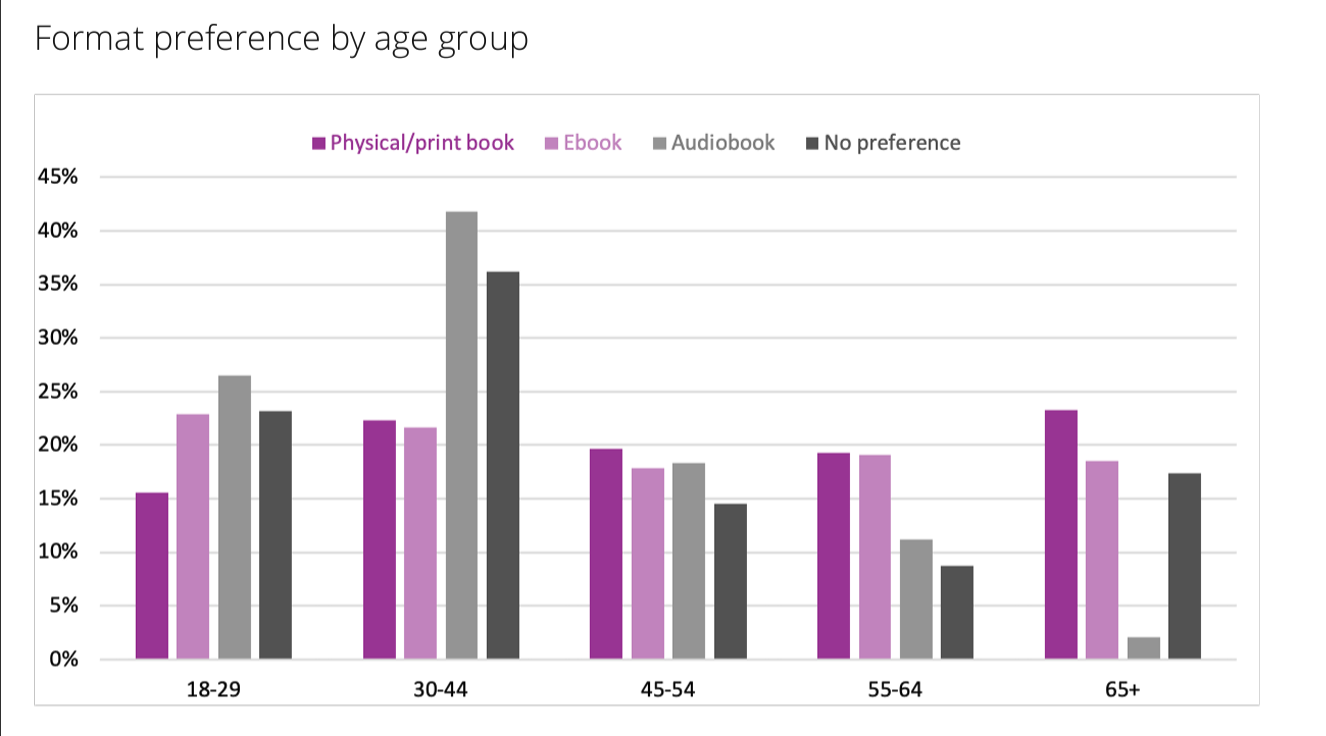
- The love affair with print continues with 68 per cent of readers citing hard copies as their preferred format. Ebooks came in at 16 per cent and audiobooks at 10 per cent Interestingly, readers had a marked preference for paperbacks over hardcovers. Format preferences differ from age group to age group, with some evidence that the kids might not be keen on physical books:
I was interested in that apparent rejection of physical books by the 18-29 cohort so I looked back at the last two years of the survey […] The results are quite different, suggesting a methodological shortcoming (the survey sample is 1,282 adults so the margin of error will be large when you eliminate those who don’t read a given format, those without format preferences, and break the remainder down into five age groups).
Comments Off on Who was reading during Plague Year Two, and what format did they prefer?
September 2, 2022
QotD: Historical parallels between the British and American empires
… let us compare the US imperial experience to its British model. A whimsical exercise in comparative dates.
England was colonised by the Norman Empire (a tribe that spread across France, Britain, Italy, and the Middle East can be referred to as an empire I believe), in 1066. After some initial fierce resistance, they settled well, integrated with the local economy, and started developing a more advanced economic society.
North America was colonised by the British Empire (and Spanish and French of course), in the sixteenth century. After some initial fierce resistance, they settled well, integrated with the local economy, and started developing a more advanced economic society.
Norman England spent the next few centuries gradually taking out its neighbours. Wales, Ireland, and eventually Scotland (though the fact that the Scottish King James I & VI actually inherited England confuses this concept a bit). The process was fairly violent.
The North American “English” colonies spent the next few centuries taking out their neighbours. Indian tribes, Dutch, Spanish and French colonists, etc. The process was fairly violent.
England fought a number of wars over peripheral areas, particularly the Hundred Years war over claims to lands in France.
The North American colonies enthusiastically joined (if not blatantly incited) the early world wars, with the desire of taking over nearby French and Spanish colonies
The English fought a civil war in the 1640s to 50s over the issue of how to share power between the executive government, the oligarchs, and the commons. It appears that the oligarchs incited the commons (which was not very common in those days anyway). It was extremely bloody, and those on the periphery — particularly the Scots and Irish — came out badly (and with a long term bad taste for their over-mighty neighbour).
The Colonies fought their first civil war over the issue of how to share power between the executive, the oligarchs and the commons in the 1770s to 80s. It is clear that the oligarchs incited the commons (who in the US were still not very common — every male except those Yellow, Red or Black. An improvement? Certainly not considering the theoretical philosophical base of the so-called Revolution!). It was not really so bloody, but those on the periphery — particularly the Indians and slaves (both of which were pro-British), and the Loyalists and Canadians — came out badly. (60-100,000 “citizens” were expelled or forced to flee for being “loyalists”, let alone Indians and ex-slaves). Naturally the Canadians and their new refugee citizens developed a long term bad taste for their over-mighty neighbour — who attempted to attack them at the drop of a hat thereafter.
The British spent the next century and a half accumulating bits of empire — the Dominions, the Crown Colonies, and the Protectorates — in a haphazard fashion. Usually, but not always, troops followed traders and settlers.
The United States spent the next century and a half accumulating bits of empire — conquests from the Indians, purchases from France and Russia, conquests from Mexico and Spain, annexations of places like Hawaii, etc. — in a haphazard fashion. Usually, but not always, troops followed traders and settlers.
Nigel Davies, “The Empires of Britain and the United States – Toying with Historical Analogy”, rethinking history, 2009-01-10.
Comments Off on QotD: Historical parallels between the British and American empires
August 29, 2022
“What did you do in the Covid War, Daddy?”
Janice Fiamengo hopes that the future isn’t female, for the sake of all of us:

If Covid was a war, as it was frequently depicted as being, it was one in which none of the typical masculine virtues required by war were in evidence. Gone was the valorization of stoicism, courage, forgetfulness of self, rational risk assessment, and the curtailment of emotionalism. In their place came generalized anxiety, self-righteous vindictiveness, and the longing for (an unattainable) safety at all costs.
In his book United States of Fear: How America Fell Victim to a Mass Delusional Psychosis, American psychiatrist Mark McDonald noted the disappearance of men from the Covid state as a key factor in our descent into social psychosis. Of course men remained in existence, but their roles were reduced to enthusiastic compliance with even the most trivial of health rules.
As a psychiatrist with extensive clinical experience, McDonald was uniquely positioned to diagnose some of the underlying causes of Covid panic. He notes in the book that women, evolved to be hyper-attentive to the needs of infants and simultaneously aware of their own vulnerability as maternal caregivers, tend to be far more susceptible to anxiety disorders than men. Women evolved over millennia to look to men for protection of themselves and their children (p. 30-31), and men evolved to provide it.
Yet as Covid experts encouraged us all to worry about the safety of our families, with daily case counts and endless updates on (de-contextualized) death numbers, “men failed […] dismally in their duty to provide a sense of safety and security for the women in their lives” (p. 41). When some women insisted fearfully on rules to protect themselves and their loved ones — even irrational rules such as outdoor masking and limitations on how children played together — men, whose traditional role has been to “calm and ground women’s fears” (p. 39), either did nothing or went along. Some men, of course, led the charge.
The emasculation of men had been prepared for a long time, and under Covid it came to fruition. Men could not reassure the women in their lives or stand up to the infantilizing Mother State. They could not speak out to put the Covid threat in perspective. Most of them couldn’t even decide independently whether to go to work in the morning. McDonald is well aware of the social forces that have contributed to the feminization of men — he notes especially how “healthy expressions of masculinity […] have all been redefined as universally unhealthy” (p. 52) — but even he does not fully understand the depth of the anti-male attack that prepared the ground for Covid-enforced male passivity.
For decades now, with the advent of no-fault divorce, mother-favoring custody laws, the determination to stamp out (subjectively defined) alleged sexual harassment, and the mandate to “Believe Women”, it has been made clear to men that their lives and careers remain intact entirely at the pleasure of feminist ideologues or potentially vengeful ex-wives. One wrong move, an inappropriate comment, a gaze that is too intense, a tone-deaf request for a date, a sexual encounter where the woman is left unhappy, or merely having married the wrong woman, can lead — and too often does lead — to the ruination of a man’s reputation, a forced psychiatric evaluation, the garnisheeing of his wages, imprisonment on false charges, and the judicial kidnapping of his children. Scholar Stephen Baskerville has extensively documented the injustices in his devastatingly compendious Taken Into Custody: The War Against Fathers, Marriage, and the Family and his more recent The New Politics of Sex: The Sexual Revolution, Civil Liberties, and the Growth of Governmental Power. For a heartbreaking and fully researched personal account, see Greg Ellis’s The Respondent: Exposing the Cartel of Family Law.
For well over 20 years, it has been made more and more difficult for men to respond as men once did, firmly and unplacatingly, because many men now know that everything they have built in their lives — and their ability to continue to build, to contribute their gifts, to live a normal life, to be a father to their children — now hinges on their avoiding the fury of a state-supported complaining woman. It is this bedrock vulnerability, the reality that even guiltless men can be imprisoned on a woman’s word and can lose their life savings and children, that more than anything else has silenced and paralyzed many decent and brave men.
Comments Off on “What did you do in the Covid War, Daddy?”
August 26, 2022
Bristol/Magellan CRV7 Ground Attack Rockets; Simply The Best
Polyus
Published 19 Aug 2022Sometimes a weapon is produced that no one can ignore. Something so much better than anything else on the market that it becomes the de facto standard. Winnipeg, Manitoba’s Bristol Aerospace created such a weapon in the early 1970s. It combined high speed and long range with a powerful knockout punch. It was the CRV7 rocket and it would eventually become ubiquitous among western aligned armed forces.
(more…)
Comments Off on Bristol/Magellan CRV7 Ground Attack Rockets; Simply The Best
August 24, 2022
A Floating Airfield Made of Ice – WW2 Newsflash
World War Two
Published 23 Aug 2022In 1943, the British are working on a radical plan which could revolutionize the Allies’ productive capacity. It might sound crazy, but ice might be the magic material they need.
(more…)
Comments Off on A Floating Airfield Made of Ice – WW2 Newsflash
August 21, 2022
Sicily Liberated; Italy in the Firing Line – WW2 – 208 – August 20, 1943
World War Two
Published 20 Aug 2022The British and Americans race for Messina to complete the conquest of Sicily — who will reach it first? On New Guinea, the Allies destroy a substantial Japanese air force; there are several major Allied air raids over Europe, the fighting in the USSR around Kharkov is brutal and costly for both sides, and a secret Allied leadership conference in Quebec begins to determine the course of the war. Busy week.
(more…)
Comments Off on Sicily Liberated; Italy in the Firing Line – WW2 – 208 – August 20, 1943
August 19, 2022
Why Quebec rejected the American Revolution
Conrad Black outlines the journey of the French colony of New France through the British conquest to the (amazing to the Americans) decision to stay under British control rather than join the breakaway American colonies in 1776:

Civil rights were not a burning issue when Canada was primarily the French colony of New France. The purpose of New France was entirely commercial and essentially based upon the fur trade until Jean Talon created industries that made New France self-sufficient. And to raise the population he imported 1,000 nubile young French women, and today approximately seven million French Canadians and Franco-Americans are descended from them. Only at this point, about 75 years after it was founded, did New France develop a rudimentary legal and judicial framework.
Eighty years later, when the British captured Québec City and Montréal in the Seven Years’ War, a gentle form of British military rule ensued. A small English-speaking population arose, chiefly composed of commercial sharpers from the American colonies claiming to be performing a useful service but, in fact, exploiting the French Canadians. Colonel James Murray became the first English civil governor of Québec in 1764. A Royal proclamation had foreseen an assembly to govern Québec, but this was complicated by the fact that at the time British law excluded any Roman Catholic from voting for or being a member of any such assembly, and accordingly the approximately 500 English-speaking merchants in Québec demanded an assembly since they would be the sole members of it. Murray liked the French Canadians and despised the American interlopers as scoundrels. He wrote: “In general they are the most immoral collection of men I ever knew.” He described the French of Québec as: “a frugal, industrious, moral race of men who (greatly appreciate) the mild treatment they have received from the King’s officers”. Instead of facilitating creation of an assembly that would just be a group of émigré New England hustlers and plunderers, Murray created a governor’s council which functioned as a sort of legislature and packed it with his supporters, and sympathizers of the French Canadians.
The greedy American merchants of Montréal and Québec had enough influence with the board of trade in London, a cabinet office, to have Murray recalled in 1766 for his pro-French attitudes. He was a victim of his support for the civil rights of his subjects, but was replaced by a like-minded governor, the very talented Sir Guy Carleton, [later he became] Lord Dorchester. Murray and Carleton had both been close comrades of General Wolfe. […]
The British had doubled their national debt in the Seven Years’ War and the largest expenses were incurred in expelling the French from Canada at the urgent request of the principal American agent in London, Benjamin Franklin. As the Americans were the most prosperous of all British citizens, the British naturally thought it appropriate that the Americans should pay the Stamp Tax that their British cousins were already paying. The French Canadians had no objection to the Stamp Tax, even though it paid for the expulsion of France from Canada.
As Murray and Carleton foresaw, the British were not able to collect that tax from the Americans; British soldiers would be little motivated to fight their American kinfolk, and now that the Americans didn’t have a neighboring French presence to worry them, they could certainly be tempted to revolt and would be very hard to suppress. As Murray and Carleton also foresaw, the only chance the British would have of retaining Canada and preventing the French Canadians from rallying to the Americans would be if the British crown became symbolic in the mind of French Canada with the survival of the French language and culture and religion. Carleton concluded that to retain Québec’s loyalty, Britain would have to make itself the protector of the culture, the religion, and also the civil law of the French Canadians. From what little they had seen of it, the French Canadians much preferred the British to the French criminal law. In pre-revolutionary France there was no doctrine of habeas corpus and the authorities routinely tortured suspects.
In a historically very significant act, Carleton effectively wrote up the assurances that he thought would be necessary to retain the loyalty of the colony. He wanted to recruit French-speaking officials from among the colonists to give them as much self-government as possible while judiciously feeding the population a worrisome specter of assimilation at the hands of a tidal wave of American officials and commercial hustlers in the event of an American takeover of Canada.
After four years of lobbying non-stop in London, Carleton gained adoption of the Québec Act, which contained the guaranties he thought necessary to satisfy French Canada. He returned to a grateful Québec in 1774. The knotty issue of an assembly, which Québec had never had and was not clamoring for, was ducked, and authority was vested in a governor with an executive and legislative Council of 17 to 23 members chosen by the governor.
Conveniently, the liberality accorded the Roman Catholic Church was furiously attacked by the Americans who in their revolutionary Continental Congress reviled it as “a bloodthirsty, idolatrous, and hypocritical creed … a religion which flooded England with blood, and spread hypocrisy, murder, persecution, and revolt into all parts of the world”. The American revolutionaries produced a bombastic summary of what the French-Canadians ought to do and told them that Americans were grievously moved by their degradation, but warned them that if they did not rally to the American colours they would be henceforth regarded as “inveterate enemies”. This incendiary polemic was translated, printed, and posted throughout the former New France, by the Catholic Church and the British government, acting together. The clergy of the province almost unanimously condemned the American agitation as xenophobic and sectarian incitements to hate and needless bloodshed.
Carleton astounded the French-Canadians, who were accustomed to the graft and embezzlement of French governors, by not taking any payment for his service as governor. It was entirely because of the enlightened policy of Murray and Carleton and Carleton’s skill and persistence as a lobbyist in the corridors of Westminster, that the civil and cultural rights of the great majority of Canadians 250 years ago were conserved. The Americans when they did proclaim the revolution in 1775 and officially in the Declaration of Independence on July 4, 1776, made the British position in Canada somewhat easier by their virulent hostility to Catholicism, and to the French generally.
Comments Off on Why Quebec rejected the American Revolution
August 18, 2022
MAID in Canada
In The Critic, Ben Woodfinden discusses the maple-flavoured slippery slope we’re gaining speed on: what’s known as “Medical Assistance In Dying (MAID)”:

Toronto General Hospital in 2005.
Photo via Wikimedia Commons.
Canada is widely seen as one of the world’s most progressive nations in the world, “leading the way” (depending on where you stand) on a variety of social issues. But in recent months, Canada has been garnering some less than savoury international attention because of the dark side of one of its recent progressive accomplishments, namely the assisted suicide regime that has been created since the Supreme Court struck down prohibitions on assisted suicide in 2015. The tragic situation that has developed in Canada offers a warning to Britain and other countries considering going down a similar path, both to be cautious about opening the assisted suicide floodgates and about empowering judges to decide whether such things should be allowed.
When Canada’s enlightened judicial philsopher kings and queens overturned criminal prohibitions on assisted suicide in Carter v. Canada, they overturned their own precedent. In 1993 a majority of the Supreme Court found that the criminal code provisions that prohibited assisted suicide did not ultimately violate the Canadian Charter. In 2015 the Court changed its mind. The law didn’t change, of course, but the court decided that “the matrix of legislative and social facts” surrounding the case had changed. Thus the interpretation of constitutional rights must change with them.
Plenty of the same people who were outraged that the United States Supreme Court would overturn precedent on seminal abortion decisions, seemingly had no problem with the overturning of precedent in this Canadian case. This is because implicit in the view of rights and judicial review that many progressives hold, is that it is perfectly acceptable to overturn precedent in the name of expanding or establishing some newly discovered right — but once this is done, the debate is settled and there can be no reasonable dissent or change of heart. History, it seems, only marches in one direction.
An important part of the Carter decision, where the court determined that relevant social facts had changed, was essentially a blithe dismissal of exactly what has come to pass in Canada less than a decade after the decision. The court rejected the concern that once assisted suicide was allowed in some rare cases, there would be a “slippery slope” from helping terminally ill people end their lives, to a system in which vulnerable people like the disabled were caught in a euthanising net.
Evidence presented in the case by a medical expert from Belgium that this might be possible, was dismissed by the court because “the permissive regime in Belgium is the product of a very different medico-legal culture”. Unlike those barbaric Belgians, enlightened Canada could avoid sliding down this slippery slope in which safeguards are easily gotten around. They would avoid the creeping expansion of eligibility by setting up a “carefully regulated scheme” that would keep its application narrow and exceptional.
Spoiler: No. No, we didn’t.
Comments Off on MAID in Canada
August 17, 2022
“It’s weird what happens when you choke off people’s ability to make a living”
Elizabeth Nickson offers to decode the latest war cry from the great and the good, the well-meaning, the deluded, and the modern-day fellow travellers (who are still useful idiots):
The political circus is gripping, the play before us hypnotic. Audience members drop in, forswear the brutalism of it and go back to their lives, refusing engagement, refusing to look. That’s what it’s for, to alienate you from the real stuff that goes on in the middle of nowhere, where I live.
[…]
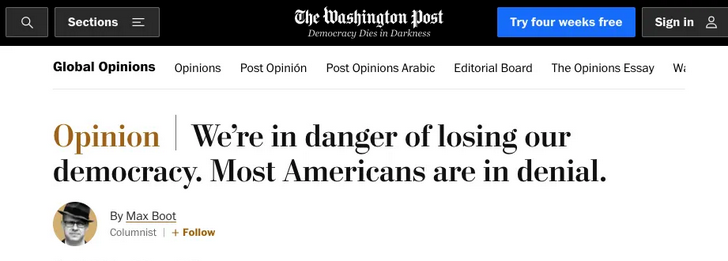
This is a slogan that has been picked up by every operative in every western democracy. State legislators appear on MSNBC frantic with fear, wall-eyed, saying the right is stealing democracy.
Expect to hear this ceaselessly for the next three years. Every hour of every day.
This is what they really mean:
When I moved to the middle of nowhere twenty years ago, I became fascinated with local politics. It seemed that there were a lot of little groups, attached like sucker fish to the giant tax eating behemoth that slid through our lives. Their aims were simple and seemingly good hearted, more waterbird protection, more water protection, more tree protection, more protection of the other sexed, more goodness towards and immigration of the huddled masses in South and Central America, more legislated feminist demands, endless demands of the schools by advocacy groups funded by teachers unions, and of course, stopping all development and industrial production because of climate change. They all had groups, they all lived on little bits of money, they were always harried and despairing. They fought a tight game. Small advances, lots of setbacks. Mostly innocent, though the enviro people had deep-buried terrorist groups who created lovely fires for any developer who particularly crossed them. But otherwise, you could invite them to tea with the Queen.
Twenty years on, they flourish with budgets of seven or eight figures, most of which they receive from the various governments they lobby, but also from the world’s greatest foundations, not to mention substantial funding from the EU, the WEF and the UN. And they are in every capital, waking up every morning for one reason: to force the government to cave to their needs. They are always attached to the bigger of the left-wing parties, who fund them big time. In the US it is the Democrats. In Canada, the Liberal Party. They are paid to act as political action committees, while posturing as neutral advocacy groups. They write legislation. And boy, have they written legislation. They developed a thousand, thousand committees which have methodically re-written laws from the extreme local to national.
The ones I met were upper-middle-class, from nominally Christian households, who had been captured by the socialist dream. They called what they did a new iteration: participatory democracy. Leaders were from Britain or the US. Those seemed the most aggressive. More connected. Very little work has been done on their unnerving connectedness. Most reporters agree with their task, don’t want to dig.
The reason they called it participatory democracy was because they were participating. It seemed no one else was, other than business needing a rule change or permit, so they had free rein. And, to give them credit, they did change the culture. It is rare to find a soul who does not support equality of the sexes, the protection of the environment, acceptance of the other-sexed, pity for the huddled masses in the south and an anxious wish for people of colour to do well.
But then … the German Malthusian Eugenicists at the WEF realized they could fund them and bend them to their purpose. With 100x the power, the good kids went rogue. The goal was to break the power of the American middle class in order to save the climate. To disenfranchise them, to de-legitimize them, to identify them as racist, sexist, homophobic and patriarchal. To de-pluralize them. To drive them to the margins. It was, frankly, an adoption of evil, an adoption of kill-to-save.

Comments Off on “It’s weird what happens when you choke off people’s ability to make a living”
To understand Justin Trudeau, you need to look at his relationship with his mother
Janice Fiamengo on how a lot of Justin Trudeau’s personal quirks may be directly traced to his upbringing and particularly his relationship with Margaret Trudeau:

Malia and Sasha Obama talk with Prime Minister Trudeau and his mother Margaret Trudeau during a reception on the Truman Balcony, 10 March, 2016.
Official White House photo by Pete Souza via Wikimedia Commons.
Cue the popularity of Justin Trudeau, who at first seemed all sincerity, even to the point of public spectacles of tearfulness and child-like ebullience. He was the first Canadian leader to march in the Gay Pride Parade as if it were his natural milieu, not merely a vote-seeking opportunity. His enthusiasm for Bollywood-style gyving, Hindu fancy dress, and participation in Islamic prayer, though heavily criticized, seemed genuine, at least in a high-school drama teacher way.
When he refused to give a real answer to the question of why it was necessary to appoint a gender-equal cabinet as one of his first actions upon assuming office in 2015, his insouciant quip “Because it’s 2015” suggested an unstudied feminist commitment. His comments after the Boston bombings emphasized that empathy rather than harshness was the appropriate response to murderous acts of terror.
But there has always been a harsher side to Trudeau, a fondness for dictators, an attraction to brute power, and an inability (or unwillingness) to hide his contempt for political opponents. Perhaps his empathy for the Boston bombers was respect or even admiration for their willingness to use violence. Many were shocked by his open admission that one of the countries he most admired was the “basic dictatorship” of China. When churches burned across Canada in the summer of 2021 in response to the alleged discovery of “mass” graves at a residential school (a discovery that has not yet yielded a single body), Trudeau condemned the arson but hastened to say it was “understandable”. About Canadians who chose not to take the Covid-19 vaccines, he could not control his impatience, unleashing a volley of stigmatizing, scapegoating rhetoric. For the truckers who camped out in Ottawa amid a sea of Canadian flags and bouncy castles demanding vaccine mandates be revoked, he had a brutal contempt.
Which is he: the soft feminist with the fancy socks, joy in Gay Pride, and empathy for the marginalized? Or the hard, contemptuous leader who could oversee without flinching a violent RCMP crackdown on the Convoy protest that saw an Indigenous woman trampled under the hoofs of a police horse?
The answer is: both. A clue to his doubleness may be found in his relationship with his mother.
I recently watched an old interview with Margaret Trudeau that offers some illuminating glimpses into the character of the woman who mothered Justin. The interview took place in 1979, after Margaret had left Pierre Trudeau, Justin’s father, who was Prime Minister of Canada from 1968 until 1982. Pierre had primary custody of their three young children.
The interview shows a very beautiful woman whose consciousness of her attractiveness is a paramount part of her identity. She is not, as has sometimes been claimed, stupid; many of her answers to the interviewer are clever in the manner of a wayward adolescent convinced she can get away with nearly anything so long as she charms. At times she flirts openly, smiling suggestively, tongue protruding through her lips, confident in her sexual power.
The overall impact of her answers is horrifying for a viewer who fails to be enchanted. This is a woman who takes herself seriously but evidently does not take seriously her position as a mother to three young sons (all of them under 10 years old at the time) — and certainly not her position as estranged wife to the leader of the country.
She boasts girlishly about smoking marijuana, listening to psychedelic music, and giving up guilt over failing to meet others’ expectations. Spouting feminist rhetoric about being true to herself, she makes clear that she is more interested in having lovers than in looking after her children. She dismisses her husband’s shock at her unfaithfulness as owing to “old-fashioned principles of fidelity”, and indicates that Canadian society would be better off if more people heeded their “feelings” rather than stodgy moral precepts.
I cringe to think of Justin Trudeau, even today, watching this interview. The woman who presented herself therein — self-preoccupied, proudly promiscuous — must also have been evident to the son who watched her flamboyantly “find herself”, feminist-style, as his parents’ marriage crumbled.
H/T to Brian Peckford for the URL.
Comments Off on To understand Justin Trudeau, you need to look at his relationship with his mother
August 16, 2022
Nimble, Sleek, And Almost Useless In A Real Fight; the story of the Canadair CF-5 Freedom Fighter
Polyus Studios
Published 8 May 2021Don’t forget to like the video and subscribe to my channel!
Support me on Patreon – https://www.patreon.com/polyusstudiosThe multi-role CF-5 was intended to replace the nuclear-armed CF-104 Starfighter and CF-101 Voodoo squadrons with a conventional warfighter. However, as an air superiority fighter, it was useless against all but the oldest relics in the Warsaw Pact arsenal. It fared little better as a close air support tactical fighter, thanks to its short range, relatively small weapons load, lack of all-weather navigation, and its inability to survive in a sophisticated, integrated air defense environment. Despite this, 240 were built in Canada and served with the Canadian Armed Forces for 27 years, not as a replacement for the existing fleet, but as an addition to them no one in the military seemed to really want. So why did Canada operate the CF-5? As you might well have assumed, the story behind the acquisition and operation of the CF-5 is a complicated one.
(more…)
Comments Off on Nimble, Sleek, And Almost Useless In A Real Fight; the story of the Canadair CF-5 Freedom Fighter
August 13, 2022
Mysterious Home Features No Longer Used
Rhetty for History
Published 22 Apr 2022Home designs have changed a lot over the years and so have the features. In this video we will take a look at some of the mysterious features no longer used in new homes. You may run across these if you purchase an old home or you visit one.
(more…)
Comments Off on Mysterious Home Features No Longer Used


