
canmildoc
Published 4 Sep 2011Canadian war news reel.
August 12, 2022
Canadian Army Newsreel – Allies take Sicily
Comments Off on Canadian Army Newsreel – Allies take Sicily
The 1983 “Gimli Glider” Incident
TheHistoryGuy
Published 27 Apr 2022Captain Sully’s US Airways Flight 1549 lost its engines almost immediately after takeoff, after reaching an altitude of only 2,800 feet. In 1983, a very different flight lost power at a staggering 41,000 feet, and the pilots had no choice but to try to land the plane without engines.
(more…)
Comments Off on The 1983 “Gimli Glider” Incident
August 11, 2022
“Carbine” Williams’ Battle Rifle: The Winchester G30R
Forgotten Weapons
Published 8 Jan 2018The Winchester G30R is the final iteration of David Marshall Williams’ work on a full power .30 caliber military rifle. The project began with a design by Ed Browning (John Browning’s half brother) using a tilting bolt and annular gas piston, manufactured for US military trials by Colt. It moved to the Winchester company, which assigned Williams to the project when Browning died in 1939. Williams first replaced the annular gas piston with his gas tappet system, creating the G30M rifle. This performed poorly in trials, and the next iteration was the replacement of the tilting bolt with a Garand-type rotating bolt, creating the Winchester M2 rifle.
The US military was not interested in the M2 in .30-06, but thought the concept could be ideal for the Light Rifle trials then underway, and Winchester scaled it down to .30 carbine, and won the Light Rifle trials with it. That weapon would go on to become the M1 Carbine. Once it was in mass production, Winchester returned to the M2 design and improved it into this G30R. It was tested by the Marine Corps, but not adopted. The Canadian military also expressed an interest, but the US government opted to not allow any exports, and so Canada never tested it.
The US Army was quite satisfied with the M1 Garand, but suggested that this rifle might be made into a replacement for the BAR if it were redesigned a bit for greater sustained fire capacity. Winchester did so, creating the Winchester Automatic Rifle (WAR), which was on track for adoption until World War Two ended and immediate arms development became a much less important priority for the military.
Thanks to the Institute of Military Technology for allowing me to have access to this rifle so I can bring it to you! Check out the IMT at:
Comments Off on “Carbine” Williams’ Battle Rifle: The Winchester G30R
August 9, 2022
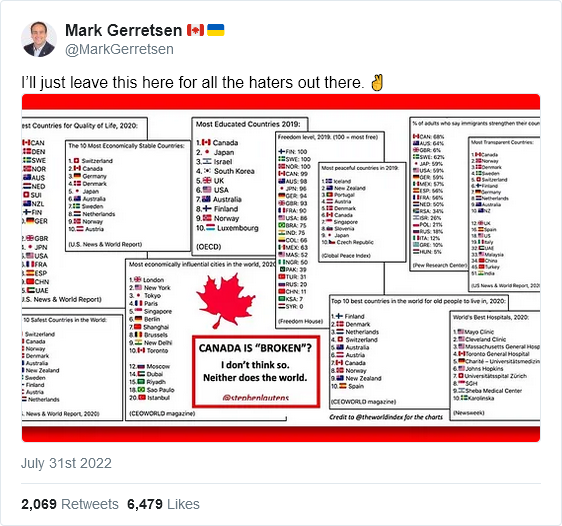
“Canada’s not broken: here’s a set of totally arbitrary social media listicles to prove it, h8rs!”
Meant to post this on the weekend, but another lengthy Rogers internet outage got in the way. From the most recent weekly Dispatch from The Line:
We try to avoid spending too much time on Twitter nowadays, but we’ve noticed a trend emerge on the site that irks us. It’s not new, exactly, but it seems to have become a favoured rhetorical tactic among Liberals and their apologists. And as it touches on virtually all of the blurbs above, it’s worth noting.
We’ll call it Rebuttal by Listicle, and it works a little like this: rather than actually engage with critiques of the country or the government, partisans will simply post random rankings that show Canada is at the top of some subjective set of metrics like “freedom” or “quality of life”.
To wit:
And this:
Because these listicles look impressive and official, the partisans in question can treat them with the weight of proven scientific truth. Canada’s great! Look, the list proves it! Them’s the facts!
We have three major problems with this rhetorical tactic.
The first is optics: Please tell the couple priced out of the housing market in every major urban centre, the one that is now worried about the grocery bill, can’t fill the car with gas, and frets about heating costs next winter, that none of these problems really matter. That they should just be grateful and happy with this definitely not-broken country because Canada scored well in a ranking compiled by an intern at an American newspaper. Show the lists to the person suffering a lingering illness, with no family doctor, in a town where the ER is closed, and wait patiently for their enthusiastic high five.
You want to guarantee Prime Minister Poilievre, this is the way to go about it: smarmily dismissing legitimate grievances and concerns by tweeting a list and calling it a day.
And, of course that’s presuming the ranking was subject to even a moderate degree of fact checking, logic, or scientific scrutiny goes into these rankings at all.
Let’s look a little more carefully at the ones posted by former Trudeau senior aide Gerry Butts, shall we?
He has a whole thread devoted to cherry picking Canada-topping rankings compiled by something called The World Index. What is The World Index? Well, we don’t know, Bob. The Twitter bio says: “Know the world. Focus on economics, art & culture, science, technology, sports, travel, politics and military affairs.” Okay. The only website listed takes us to an Instagram account with 37 followers.
The list above, in which Canada hits #1 for Best Countries for Quality of Life, 2021, is from U.S. News & World Report, an American media company. We checked out their methodology for the 2021 survey, and this is what we found: it’s a survey of 17,000 people, run by an academic. What’s being surveyed? Glad you asked! “Participants assessed how closely they associated an attribute with a nation.” You’ll be thrilled to note that these 17,000 people around the globe gave Canada near perfect scores on being “not bureaucratic”, and having a “well developed public health system”, “well-distributed political power”, and “transparent government practices”. (Lol, *dies inside*.)
Hey, it’s great that people associate Canada with being awesome, but we hope that when Liberals talk about “evidence-based policies”, they are using actual, you know, evidence, not just rankings by survey participants.

Comments Off on “Canada’s not broken: here’s a set of totally arbitrary social media listicles to prove it, h8rs!”
August 6, 2022
“Follow the science” or just make it up, whatevs
The Canadian government has squandered vast amounts of moral capital pushing “the science” to intimidate Canadians to follow their directives, but in another stop-me-if-you’ve-heard-this surprise … there was no actual science to follow:
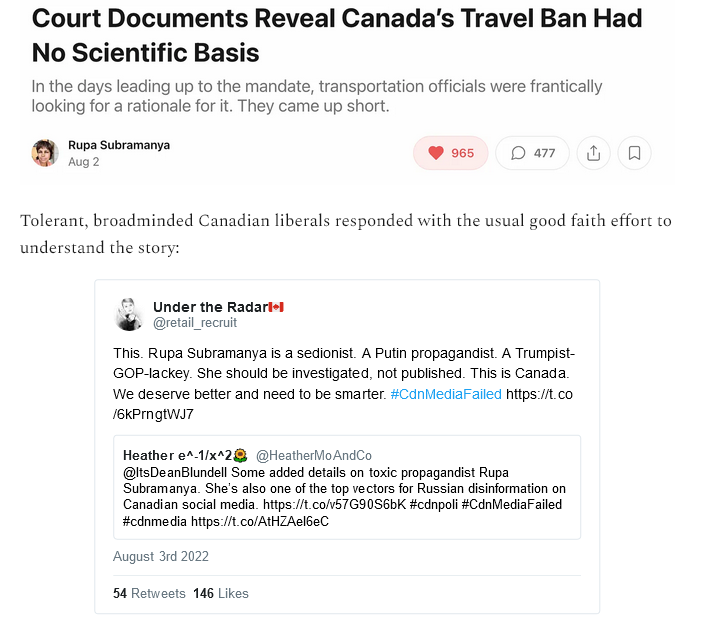
A year ago, the Canadian government was preparing to implement travel restrictions that made the rest of the world look sane, trapping the filthy bodies of the unvaxxed — who hadn’t received the sacrament of the mRNA injections, giving them the “freedom to be safe” — in a societal cage. Litigation followed, and plaintiffs got their hands on government communications showing that officials spent the weeks leading up to the travel ban trying (without success) to figure out a basis for implementing it. This week, the independent Canadian journalist Rupa Subramanya obtained those documents, and reported on them:
Putin Putin Putin! TRUMP! Sedition!
Here, for comparison, is a highly educated policy analyst in the United States, offering his thoughtful response to critics of the mRNA injections:
This is a societal wildfire, or at least it aspires to be. We’ve trained people to not discuss; we’ve taught people — “liberals” and “intellectuals” — that disagreement means that someone is being a Nazi, or working for Putin.
“It looks to me like the available evidence suggests that Current Thing is not correct.”
“YOU NAZI SCUM DID PUTIN TELL YOU TO SAY THAT WHITE SUPREMACY TRUMP FOX NEWS SEDITION NAZI”

Comments Off on “Follow the science” or just make it up, whatevs
Canada’s New Warship
Frontline Pros
Published 12 Feb 2022The Type 26 Frigate will become the first dedicated warship Canada has built in decades. Soon the Royal Canadian Navy will take ownership of 15 of these vessels, making them the largest owner of the Type 26 in the world.
(more…)
Comments Off on Canada’s New Warship
August 2, 2022
The Last Battle in the West – How The Allies Crossed The Rhine 1945
Real Time History
Published 30 Jul 2022Get CuriosityStream + Watch Rhineland 45 on Nebula: https://curiositystream.com/realtimeh…
The Rhine river was the last major natural obstacle on the Western Front of WW2 in early 1945. The Allied armies needed to cross the symbolic river to enter the heart of Nazi Germany. While General Patton’s 1st Army crossed the river at Remagen first, the actual set-piece battle of the Rhine took place further north and involved the biggest airborne operation in a single day in the entire war.
(more…)
Comments Off on The Last Battle in the West – How The Allies Crossed The Rhine 1945
August 1, 2022
The fertilizer front in Justin Trudeau’s renewed war on Canada’s farmers
In The Line‘s weekly dispatch, one of the items discussed was the Trudeau government’s decision to follow the Netherlands and Sri Lanka down the path of ensuring that millions may be at risk of starvation to mollify the global warming lobby and the WEF:

In 2020, the federal government announced a plan to reduce greenhouse gas emissions arising from fertilizer application by 30 per cent below 2020 levels within the next decade. The targets, then fairly vaguely spelled out, have been a subject of considerable consternation among farmers in the wheat belt ever since. However, as the feds moved into a consultation process, set to end by the end of August, it’s now become clear that those targets are a little more set in stone than they had previously feared. Further, the “consultation” process is looking increasingly tokenistic.
“The commitment to future consultations are only to determine how to meet the target that Prime Minister Trudeau and Minister Bibeau have already unilaterally imposed on this industry, not to consult on what is achievable or attainable,” according to a press release sent out jointly by the Alberta and Saskatchewan agriculture ministers last week.
Why does this matter? Well, firstly because these emissions targets are coming on top of tariffs placed on chemical precursors to fertilizer coming out of Russia. And further because according to industry lobbyists and many farmers themselves, it’s not going to be possible to meet these kinds of emissions targets without significantly reducing fertilizer use — which is already efficiently applied owing to the fact that the stuff is expensive.
The meat of it (ha!) is that if we reduce fertilizer use further, there is significant fear that we will cut into food yields, just as the world’s growing population is facing a possible famine thanks to war. It’s not like these concerns are temporary, either. In the long run, climate change is only going to add to food insecurity; and Canada may be well-positioned in a changing climate to address the global food supply.
And, yeah, all of this is very ironic. Of course we should be doing all we can to cut emissions, but, perhaps — just hear us out, here — given the broader geopolitical realities, agriculture is not the most obvious or well-placed target for those emissions cuts. Especially considering Canada still accounts for a very small fraction of global greenhouse emissions overall. (Yes, we know our per-capita emissions are high. That’s the unfortunate consequence of living in a very cold, poorly populated expanse. However, our actual population remains low. These two facts are not coincidences!)
Now, if we were going to give the federal government some benefit of the doubt, we’d point out that we’re still in a consultation process. We’d also further point out that if the government wanted to reduce agriculture emissions, there are probably some smarter ways to go about it — equipment upgrades, for example. Investments in soil testing could go a long way to helping farmers apply nitrogen more efficiently, which could help them increase yields while maintaining profits. Win-win!
Yet, from what we’ve seen from this government since the last election, we’re not betting on sensible, win-win solutions. Farmers in the Netherlands have been so put out by similar climate-change inspired emissions cuts that they’ve engaged in convoy-like protests themselves. Further, we suspect the Trudeau government salivates at the prospect of a bunch of another round of spitting-mad, truck-driving farmers rolling into Parliament to protest climate change policies. Every pissy article in the Federalist is a win to this cabinet.
If you’re angering the right people, you’re winning, right?
And how do we imagine arcane policies like this are going to play out internationally in the next three to nine months, if we witness more and more developing countries closing borders to grain exports and significant swathes of the developing world look set to starve? How well are these climate-change policies going to sit against real, hard geopolitical realities like a frozen Europe in winter or significantly curtailed industrial production in Germany, leading to further supply chain issues and economic recession?
If this government is not careful, they’re going to drag a lot of the progressive movement — and its genuinely very noble ideals — along with it. This is a government that appears to have said “fuck it,” retreating ever deeper into self-reinforcing ideological bubbles as the world decides it has much bigger problems than those that the Trudeau government seems able to address. To put it bluntly, how are pious climate-change goals going to look if they have to be measured against piles of emaciated bodies in the developing world? Because that’s the danger. Nobody in Canada is going to starve.
Comments Off on The fertilizer front in Justin Trudeau’s renewed war on Canada’s farmers
July 30, 2022
Beartrap: The Best Way To Land A Big Helicopter On A Small Ship At Sea
Polyus Studios
Published 29 Jul 2022Don’t forget to like the video and subscribe to my channel!
Support me on Patreon – https://www.patreon.com/polyusstudiosToday, navies across the world use an ingenious system to land helicopters on the rolling deck of a ship at sea. It enabled the powerful helicopter-destroyer combination that has become the dominant form of at sea anti-submarine warfare. It’s the “helicopter haul down and rapid securing device”, more commonly known as Beartrap. This device may be little known to the public, but it stands as one of the greatest contributions Canada has ever made to naval aviation, and ushered in the age of helicopters at sea.
(more…)
Comments Off on Beartrap: The Best Way To Land A Big Helicopter On A Small Ship At Sea
July 29, 2022
Nightmare Fuel For Soviet Submarines; the story of the Canadair CP-107 Argus
Polyus Studios
Published 4 Dec 2020Don’t forget to like the video and subscribe to my channel!
Support me on Patreon – https://www.patreon.com/polyusstudiosIn its day the Argus was the most formidable anti-submarine warfare platform fielded by any NATO country. Canadair adapted the Bristol Britannia into a highly effective low and slow sub hunter. This gave Maritime Air Command the edge in the North Atlantic. It served on the front-line of the Cold War and kept the Soviet submarine threat in check for almost 25 years.
(more…)
Comments Off on Nightmare Fuel For Soviet Submarines; the story of the Canadair CP-107 Argus
July 26, 2022
Is Trudeau channelling Caligula? – “Let them hate me as long as they fear me”
Spencer Fernando, writing for the National Citizens Coalition:
When trying to ascertain where the Trudeau Liberals are trying to take the country, it’s important to look at the foundations of Justin Trudeau’s worldview.
Clearly, he was heavily influenced by his father, someone who continuously expanded the power of the state.
Justin Trudeau’s father was well known as a Communist-sympathizer, being a big fan of both Fidel Castro and Communist China.
Note, the version of the CCP that existed in Pierre Trudeau’s era was even more brutal than the CCP as it exists today. At the time, it was not far removed from the time of Mao’s Great Leap Forward, a government-imposed “reshaping of society” that led to roughly 45 million deaths.
To look at that, and still be a fan of the Chinese Communist Party, is to show a deep ideological commitment to authoritarian socialism and a deep aversion to human freedom.
The apple clearly didn’t fall far from the tree, as Justin Trudeau praised China’s “basic dictatorship” (AKA the centralized power structure that enables horrific crimes).
Trudeau also sought to move Canada closer to China’s orbit, only giving up on that when public opinion – and a subtle revolt among some backbench Liberals – rendered it politically unfeasible.
We can see how the authoritarian socialism that Trudeau praised in China (and let’s not forget his fawning eulogy for Fidel Castro), lines up with the fear and contempt he and the Liberals have for many Canadians.
Now, let’s also note this essential point:
The Liberals continuously target the same individuals that authoritarian socialists and communists have targeted:
Rural Conservatives.
Private Enterprise.
Religious Groups.
Freethinkers.
Individualists.
Private Farmers.
Rural Gun Owners.
Independent Press Outlets.
Historically, those are all groups that the far-left has targeted when given the opportunity.
We only need to look at how the Liberal approach to Covid was modelled after the approach taken by Communist China, and how both the Liberals and the CCP have been largely unwilling to move on.
While the Liberals are more constrained than the CCP by the fact that Canada maintains some freedoms, do we have any doubt that they would be far more severe if they could get away with it?
Remember, the moment he feared losing the 2021 election, Justin Trudeau used very divisive and disturbing rhetoric (especially disturbing when seen in a historical context), and purposely sought to direct hatred and blame towards those who resisted draconian state orders.
Since then, the Trudeau Liberals – even in the face of criticism by a few courageous Liberal MPs who were quickly “put back in their place” – have almost gleefully abused their power, purposely creating an “Us vs Them” narrative designed to pit Canadians against each other.
At the same time, they’ve continued their efforts to gain control over social media, silence dissenting views, and turn the establishment media into an extension of the state propaganda apparatus.
This is all being done because they fear those who have the intelligence and strength of character to see through their agenda.
They fear you, and have contempt for you.
Comments Off on Is Trudeau channelling Caligula? – “Let them hate me as long as they fear me”
July 24, 2022
Still no actual evidence of unmarked graves for Residential School children
In Quillette, Jonathan Kay updates the year-old sensational stories about First Nations children being buried in unmarked (in more unhinged reporting it might have been “mass”) graves on the grounds of former Residential Schools in Canada:
Canada’s unmarked-graves story broke on May 27th, 2021, when the Tk’emlúps te Secwépemc First Nation reported the existence of ground-penetrating radar (GPR) data that indicated regularly spaced subterranean soil disturbances on the grounds of a former Indigenous Residential School that had operated in Kamloops, BC between 1893 and 1978. In addition, the First Nation’s leaders asserted their belief that these soil disturbances corresponded to unmarked graves of Indigenous children who’d died while attending the school.
The story became an immediate sensation in the Canadian media; and remained so for months, even after the GPR expert on whom the First Nation relied, Sarah Beaulieu, carefully noted that the radar survey results didn’t necessarily indicate the presence of graves — let alone graves that had been unmarked, graves of Indigenous people, or graves of children. Contrary to what many Canadians came to believe during that heady period, GPR survey data doesn’t yield X-ray-style images that show bodies or coffins. What it typically shows are disruptions in soil and sediment. Investigators then need to dig up the ground to determine what actually lies underneath.
An explanatory image posted by GeoScan, a Canadian Ground-Penetrating-Radar service provider, showing how mapped GPR data can indicate the possible presence of graves.
Image via Quillette.But those details were swept aside during what, in retrospect, appears to have been a true nation-wide social panic. As other Indigenous groups announced that they’d be conducting their own GPR surveys, media figures confidently asserted that the original Canadian Residential-School student death-toll estimate of 3,201 would soon double or even triple. One op-ed writer went so far as to declare that “the discovery of the graves of the children in Kamloops may be Canada’s Holocaust moment.” Dramatic, tear-drenched acts of public atonement unfolded everywhere, with many July 1st Canada Day celebrations being either cancelled or transformed into opportunities for morose self-laceration.
I was one of many Canadians who initially got swept up with all of this — in large part because it seemed as if everyone in the media was speaking with one voice, including journalists I’d known and respected for many years. Looking back on the coverage, I note that headline writers mostly skipped over the technical bits about soil dislocations and such, and went straight to “bodies” and “graves”. And the stories often were interspersed with credulous recitations of dubious tales featuring live babies being thrown into furnaces or buried alive.
The whole mission of Canada’s church-run Residential School system was to assimilate Indigenous people into white Canadian society, usually against their will, while forcing children to leave their families and communities for months or even years at a time. No one disputes that many students were subject to cruel (and sometimes even predatory) treatment and substandard medical care. Certainly, the death rate for Indigenous children attending these schools was much higher than that for children in the general population. No, I never bought into the idea that there was any kind of mass-murder plot going on at these schools. But it hardly seemed far-fetched that some victims of mistreatment and neglect had been buried in unmarked graves — “off the books”, so to speak—by malevolent white teachers, school administrators, and priests seeking to evade responsibility for their actions.
The other important aspect to mention is that — like most other Canadians, I’m guessing — I believed we were only a few days or weeks from seeing real physical evidence plucked from the earth. So it didn’t much matter to me that early commentators were temporarily playing fast and loose with the distinction between GPR data and actual corpses.
Canadians were being told that the old orchard in Kamloops where the GPR data had been collected was a crime scene — a site of mass murder, and the final resting place of 215 child homicide victims. As I’ve reasoned elsewhere: If you told Canadians that, say, 215 murdered white children were buried somewhere in Toronto, or Ottawa, or Vancouver, there’d be investigators and police crawling all over the place, looking for remains that could be tested and identified. And so I naturally assumed the same thing soon would be happening in Kamloops.

But … no. Not at all, in fact.
As I wrote over a year ago, the way the story swept the media was as if the whole Residential School history was somehow new and previously unknown:
Despite being Canadian, my interest in Canadian history centres mostly on economic, naval, and military aspects, but I was certainly aware that the residential school system was a black mark on Canada’s historical dealings with First Nations and that the general outline of events — if not the gruesome details — had been known for many years. The first time I found out about it was in middle school, through what we’d now call a “Young Adult” novel about a young First Nations boy escaping from the residential school he’d been sent to and his attempts to travel hundreds of miles to get home. I read it in the early 70s and it may have been published up to a decade before then (I no longer remember the author’s name or the title of the book, unfortunately).
If I, as a schoolchild, knew something of this fifty years ago, why have people younger than me been shocked and appalled to be hearing about this widespread tragedy for the first time now?
Comments Off on Still no actual evidence of unmarked graves for Residential School children
July 21, 2022
Prime Minister Look-At-My-Socks shocked to discover that betraying an ally has consequences
In The Line, Andrew Potter outlines why the Ukrainian government is unhappy with Prime Minister Photo-Op’s decision to break the sanctions on Russia as a favour to Germany:
Well, one thing is for certain: There isn’t going to be a “Justin Trudeau Lane” anywhere in Ukraine any time soon.
In case you missed the drama last week, Trudeau found himself on Ukraine president Volodymyr Zelenskyy’s shit list after Canada announced, on July 9, that it would allow Siemens to return to Germany up to six gas turbines for the Nord Stream 1 pipeline that were being repaired in Montreal. Russia was threatening to shut down the pipeline and cut off the flow of gas to Germany, which is facing a very serious energy crisis.
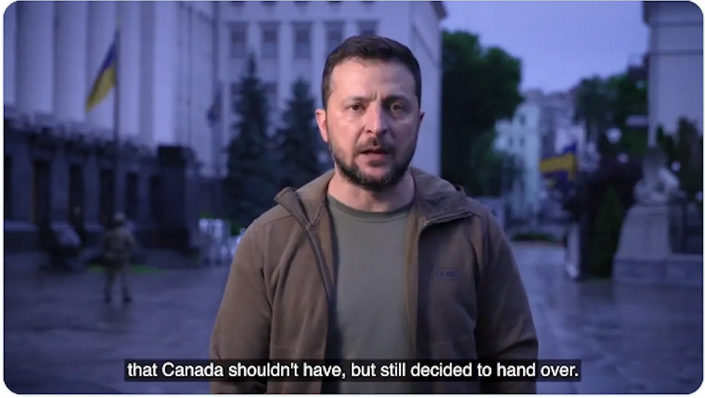
In response, a furious Zelenskyy summoned Canada’s ambassador to Ukraine for what one presumes was a solid chewing out, after which the Ukrainian president posted a video in which he lit into Trudeau for “an absolutely unacceptable exception to the sanctions regime against Russia”. As Zelenskyy put it, the problem isn’t just that Canada handed some turbines back to Russia, via Germany. It is that it was a direct response to blackmail by Russia. And if Canada is willing to bend when its sanctions become politically uncomfortable, what is to stop other countries from carving out their own exceptions to their own sanctions, when it suits? Furthermore, Zelenskyy added, it isn’t like this is going to stop Russia from shutting down the supply of gas to Europe — the turbines were always just a pretext, an opportunity to cause strife and stir dissension amongst the countries allied with Ukraine against Russia.
Trudeau — who spent the weekend flipping pancakes at the Calgary Stampede — must have woken up on the Monday wondering what had gotten into his old buddy in Kyiv. After all, hadn’t Trudeau, along with other members of his cabinet, made it clear through their many, many tweets on the subject that Canada stood by Ukraine? Hadn’t Canada sent enough money, arms and humanitarian aid to Ukraine? Hadn’t Trudeau himself paid a visit to Kyiv in May, to re-open our embassy and to underscore just how seriously Zelenskyy should understand Canada’s commitment?
[…]
Ultimately, the problem here is a serious failure by Canada to manage Ukrainian expectations, brought about by the profound mismatch between the level of our rhetoric and the clear limits of our commitment. For Ukrainians, there is a moral clarity to the Russian invasion of Ukraine that, from a Western perspective, has not been present in any other conflict since the Second World War. Zelenskyy assumed that Canadians saw that. He assumed that if Ukrainians were going to be slaughtered, the least we could do would be to stick to our principles, even if it meant asking the population to suffer economic harms and the government to manage genuine political discomfort.
He assumed wrong.
Five months into their war for survival against the genocidal Russian regime, the Ukrainians have learned something important about Canadians: When it comes to our foreign affairs, we don’t mean what we say. When we say we stand with a country, that we fully support them, that we will help defend them or hold their enemies to account, there’s always a “but” or an “until” or an “unless”. We will stand with you, unless it’s politically difficult. We will help you, but not if it means genuine sacrifice. We will support you, until the costs get too high. Then, all bets are off.
The bigger point is this: Canada doesn’t do moral clarity anymore. Whether it is our business dealings with China, our arms sales to Saudi Arabia, or sending a diplomat to a garden party at the Russian embassy in Ottawa, we are always and everywhere hedging our bets, fudging our principles, letting down our allies.
The Railrodder (1965)
NFB
Published 15 May 2015This short film from director Gerald Potterton (Heavy Metal) stars Buster Keaton in one of the last films of his long career. As “the railrodder”, Keaton crosses Canada from east to west on a railway track speeder. True to Keaton’s genre, the film is full of sight gags as our protagonist putt-putts his way to British Columbia. Not a word is spoken throughout, and Keaton is as spry and ingenious at fetching laughs as he was in the old days of the silent slapsticks.
Directed by Gerald Potterton – 1965
Comments Off on The Railrodder (1965)
July 19, 2022
Drawing the proper lessons from the massive Rogers outage earlier this month
In The Line, Matt Gurney explains the really important lesson that seems to have escaped a lot of the critics who covered the Rogers internet/cell/TV outage that took a third of the country offline for 24 hours or more:

Most of the conclusions reached after the Rogers telecommunication outage two weeks ago are wrong. Millions of people lost home internet, television and cellphone service for the better part of a day (some for much longer). For those who had all their services bundled with Rogers, this meant being entirely cut off, including from access to emergency services. It was a big deal, both in terms of lost economic productivity and for those Canadians who needed help and could not access it.
The problem isn’t with Rogers, though. The problem is with everyone else.
I don’t want to be misunderstood. Rogers is bad. It did have a big problem. I am not a fan. Their customer service is generally awful. Their reliability and performance is decidedly meh and the meh costs a fortune. So don’t take this column as some sort of apologia for Rogers. I am one of their customers, but I’m only one of their customers because none of the other options are much better.
But still. The lesson of two Fridays ago shouldn’t be that Rogers is bad. It also shouldn’t be that the CRTC is bad or that our politicians are spineless and that our regulators are thoroughly captured. All of those things are true, but they’re not the lesson. That wasn’t the failure of two Fridays ago. The failure of two Fridays ago was that when one of our telecom companies went down, a pretty horrifying cross-section of Canadian society had no back-up plan.
Let’s imagine an alternate universe where things in Canada simply functioned better. Close your eyes and just dream it up. You’re in a different Canada now. The CRTC is awesome. Our politicians are terrific. Rogers is an incredibly good company that is masterful at delivering services that are overwhelmingly reliable and affordably priced. Even in this increasingly far-fetched parallel timeline, no telecom company is going to bat a thousand. You will never have 100 per cent service reliability. This alternate Canada still has outages — maybe they’re rare and brief, but they’re not unheard of or impossible.
And that’s why we can’t look at what happened two weeks ago as a failure at Rogers. Obviously Rogers failed. But the real failure was a failure of imagination and planning on the behalf of millions of individuals, and a worryingly diverse set of institutions, that did not have a back-up plan.
Comments Off on Drawing the proper lessons from the massive Rogers outage earlier this month


