
Overly Sarcastic Productions
Published 22 Jul 2022Colonial-era North America was a busy place, so let’s take a quick look through some of the major players from the perspective of the lands & cities they inhabited.
SOURCES & Further Reading: Lectures from The Great Courses: “1759 Quebec – Battle For North America” from The Decisive Battles of World History by Gregory Aldrete, “The American Revolution” from Foundations of Western Civilization II by Robert Bucholz, “North American Peoples and Tribes” from Big History of Civilizations by Craig Benjamin, “The Iroquois and Algonquians Before Contact” from Ancient Civilizations of North America by Edwin Barnhart, “Iroquoia and Wendake in the 1600s”, “Indian-European Encounters 1700-1750”, “The Seven Years War in Indian Country” and “The American Revolution Through Native Eyes” from Native Peoples of North America by Daniel M. Cobb, Britannica articles “New York” & “Boston” https://www.britannica.com/place/New-… & https://www.britannica.com/place/Bost…
(more…)
November 21, 2022
City Minutes: Colonial America
November 20, 2022
Printing books in China is economical, but also allows China to censor what you print
In the latest SHuSH newsletter, Kenneth Whyte explains why some of Sutherland House’s books are now being printed in China … and illustrates some of the risks of having them printed there:
We decided last spring to offshore some of our book printing to China (see “The Crisis in Book Publishing”, SHuSH 138). It was not a difficult decision. The difference in price is enormous.
For instance. Next week we’re releasing a book called The Prison Lady: True Stories and Life Lessons from Both Sides of the Bars by Phyllis Taylor. Presales have been strong. We need to print more copies. We can’t go back to the original Chinese printer, which charged us $2.08/copy, because it takes months to get books from Guangzhou to Toronto. We need the books now. So we shopped around. The best North American price we could find is $4.39/copy.
Why is that a problem? The book is a paperback priced at $22.95. The retailer takes half that, leaving us $11.50. After our distributor and sales agent take their fees and we pay the author her royalty, we’re left with $6.32 out of which we pay for editing, cover art, design, overhead, and shipping. And printing. If the printing bill comes to $4.39 a copy, we make no money.
Those of the economics of a straightforward paperback. A friend of mine recently called about a quote from a Canadian printer for a full-color illustrated book that came in at $15.31/copy. It seemed steep, so I sent the exact same specs to a Chinese printer who quoted $5.27/copy.
[…]
Our initial plan was to print four of our spring books in China (we’re also using printers in Turkey and India). The files for the first two of the four were delivered last month. On Nov. 7, we received the following email from the printer:
After more detailed review of some of the written content of these two books, there are some significant censorship concerns related to certain references to Taiwan, Hong Kong, and China.
As you may be aware, China vehemently enforces a “one China” principle in which Hong Kong and Taiwan are part of the “one China”. Therefore, China censorship will not allow any reference to either Hong Kong or Taiwan as its own country.
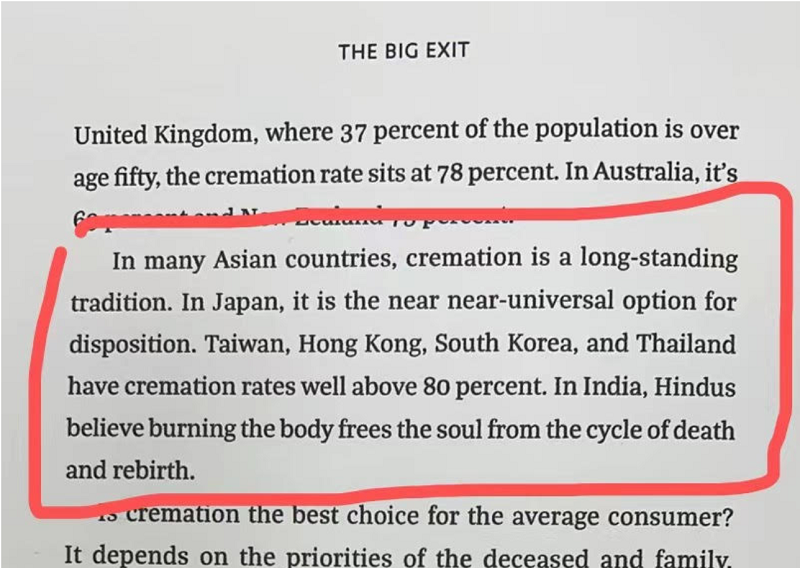
With this in mind, there is some “sensitive wording” on page 46 of The Big Exit that would not be possible to print in China due to it implying that Hong Kong and Taiwan are “countries”.
The Big Exit isn’t about politics. It’s a book about end-of-life choices or, more particularly, how we can dispose of the remains of a billion boomers over the next several decades without wrecking the planet (conventional burial and cremation are both environmentally reckless). The censorship issue arose in this paragraph, which the printer helpfully circled in bright red:
I grant that while Hong Kong still shows up in a lot of data as its own country, it is technically an administrative region of China. Taiwan’s independence is also disputed by China. Against China’s claims, we have the Frank Zappa rules of diplomacy which recognize as “a real country” any place with its own beer and its own airline. Taiwan and Hong Kong both qualify.
In any event, we are now printing The Big Exit in India.
November 19, 2022
“But actually, vat ve haf to confront is ze deep, systemic, and structural restructuring of our world”
Because, as Chris Bray points out, there’s no point in restructuring the non-structural structures or something…
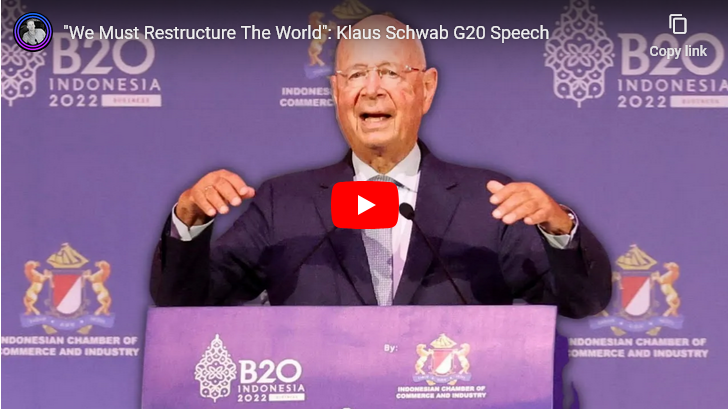
The G20 leaders flew to Bali this week to cosplay social repulsiveness and to hear from Klaus Schwab, who has no government position or formal place in the G20, making the G20 gathering a kind of executive committee meeting for something that rhymes with “Morld Meconomic Morum”.
The terrifyingly vacuous Bond villain said that ve must fundamentally restructure ze vorld, flattering the geniuses like Justin Trudeau and Joe Biden who will now use their personal wisdom and strength to do the restructuring.
(That’s an excerpt — the whole thing is here, if you want to punish your mind.)
There’s so much to love in this babbling, starting with the fact that the wealthiest and most powerful nations in the world can’t manage to deliver decent audio. But listen to what the man says:
1.) Looking out into an audience of the world’s major national leaders, he says that we face a global “multi-crisis”, made up of “economic, political, social, and ecological, and institutional crisis”.
Accepting the premise for the sake of argument, who caused all that crisis? Hello, leaders of the ruined world, I honor your wisdom and clarity, and turn to you to fix your broken countries that you’ve been leading.
2.) “But actually, vat ve haf to confront is ze deep, systemic, and structural restructuring of our world. Und zis vill take some time! Und ze vorld vill look differently, after ve haf gone through zis transition process.”
This is all of Klaus Schwab in three sentences: We must do structural restructuring, see, not non-structural restructuring. And after we have completely, deeply, systematically restructured literally everything in the entire world, the world will look — wait for this, because this is insight from the most renowned of all the experts, a deep mind who you may struggle to follow — different. Yes, changing things a lot makes them not be the same. Und zis is vy Klaus Schwab receives ze big bucks! You and I could not think at this level! Stand at attention!
3.) “Politically, the driving forces for this political transformation, of course, is the transition into a multipolar world, which has a tendency to make our world much more fragmented.”
Political fragmentation, then — the transition into multipolarity — causes fragmentation. The fragmentation into multipolarity makes the world fragmented, thereby, you see, fragmenting it. Careful, Klaus, you’ll accidentally write a whole Thomas Friedman column with your mouth.
The man is like a novelty gift with a pop-up clown inside it: You press the button, and it makes nonsensical streams of word-sounds. Fortunately, however, Klaus was speaking to an audience of Joe Biden, so I’m sure it sounded deep in the room.
QotD: Canada from the American Revolution to the Riel Rebellion
A significant number of Americans who were loyal to Britain and despised the American Revolution moved to Canada during and in the decades after the Revolutionary War. And as the number of English Canadians steadily increased along the Great Lakes and west of the Ottawa River, [Sir Guy] Carleton created what became the province of Ontario, Upper Canada, in 1791. The first lieutenant governor, John Graves Simcoe, devised and implemented an ambitious program of enticing Americans to Canada by effectively giving them rich farmland. The population of English Canada rose swiftly toward parity with the French. In 1792, Simcoe took it upon himself to abolish slavery in Upper Canada, 42 years before this was done in the British Empire, and 71 years before the United States. It was an admirable and pioneering endeavour in the principal area of civil rights controversy in North America in the coming century.
Unfortunately, as the Revolutionary and Napoleonic wars unfolded, the British could not resist the temptation to employ their mastery of the high seas to impose blockades and harass the shipping of neutral powers. The young United States did not have the military force to deter such treatment, and in 1812 those countries went to war. Canada was the blameless focal point of most of the fighting. Canada with the continuing solidarity of the French-Canadians, was able to mount a very solid defense. The many thousands of recently arrived Americans did not support the United States and the generous policy of enticing settlement from the United States was completely vindicated. There were pressures to expel them, monitor them, disqualify them from holding local offices and positions. But it was soon agreed that they could become citizens after eight years of residency. This affected about 40 percent of English-Canadians and this must count as another very successful chapter in Canada’s early record of respect for civil and human rights.
As reasonably successful wars do, considerable national sentiment was created and encouraged by the successful joint struggle to avoid American occupation. Out of these experiences came increased ambitions for democratic self-rule in domestic matters as the British and Americans enjoyed, instead of autocratic rule by British governors. Canada’s position was complicated by the fact that it could not agitate for home rule too energetically or the British would lose patience and sell Canada to the United States for cash or other territory or for a comprehensive alliance. Outright rebellion was not an option for Canada as it had been for the Americans, as the United States would seize Canada if it were not under British protection.
The Canadian solution for agitating but not completely exasperating Great Britain was the Gilbert and Sullivan rebellions of 1837 led by William Lyon Mackenzie in Ontario and Louis-Joseph Papineau in Québec. The Ontario uprising was just a rowdy group of malcontents who became disorderly and were easily chased off, and the French-Canadian group were essentially pamphleteers, though there were some exchanges of fire and small rebel and military units marched to and fro in poor winter weather. A total of about 300 people died, there were 14 executions and 92 people were transported as prisoners to Australia. The rebel leaders fled but were eventually pardoned and returned.
There was enough commotion to get Britain’s attention, but the loyalty of most of the population gratified the British, and they determined to put things right. London sent the well-known reformer Lord Durham to Canada in 1840 to make recommendations. After a year of research by a couple of biased examiners, Durham came to the insane conclusion that the source of Canadian discontent was that the French-Canadians wanted to be relieved of the intolerable burden of being French. Durham proposed uniting Upper and Lower Canada and assumed that the slight resulting English majority would assimilate the French in about 10 years. Of course, this was precisely what the French feared, and the English-Canadians had no desire for it either. But after several years of rearguard action by British governors, the movement for autonomous government succeeded, after the 25-year-old Queen Victoria sent Lord Elgin to Canada as governor to give the Canadians what they wanted. Elgin and Robert Baldwin and Louis-Hippolyte LaFontaine achieved this and secularized a great deal of territory owned by the principal churches so that they could be more easily settled and made the principal universities officially nondenominational. These were again great and non-violent steps in the civil rights of Canadians who now numbered over two million people.
All of North America was now walking on eggshells over the immense problem of American slavery. Slavery was abolished throughout the British Empire in 1834. In practice, there had not ever been more than a couple of hundred slaves in Canada, apart from the natives enslaving each other. Slaves had been imported to the southern states because of their efficiency at harvesting tropical crops such as cotton, so Canada was effectively spared that horrible institution, because of its climate more than its virtue. Canada consistently had a fine record in accepting about 40,000 fugitive slaves that reached the Canadian border in the thirty years before the U.S. Civil War. The leading American anti-slavery advocates Harriet Tubman and John Brown, and Josiah Henson, the model for the chief character in Harriet Beecher Stowe’s novel Uncle Tom’s Cabin, which sold an unheard-of two million copies in the 1850s, all lived in Canada for years. There were at least 11 black Canadian doctors who were fugitive slaves or sons of fugitive slaves who served in the Union Army in the Civil War, and the white Canadian anti-slavery activist, Dr. Alexander Ross, at the request of President Lincoln, assisted in breaking up a Confederate spy ring in Montréal. Escaped slave Joseph Taper, of St. Catharine’s, wrote this letter back to his former and still putative owner in 1839: “I now take this opportunity to inform you that I’m in a land of liberty, in good health … In the Queen’s dominions, man is as God intended he should be; all are born free and equal, not like the southern laws, which put man on a level with brutes. All the coloured population is supplied with schools. My boy Edward, who will be six years next January, is now reading and I intend keeping him at school until he becomes a good scholar. My wife and self are sitting by a good comfortable fire, happy, knowing that there are none to molest us or make us afraid. God save Queen Victoria.”
As many as 40,000 Canadian volunteers served in the Union Army in the Civil War and Canada was thanked on several occasions by President Lincoln for infiltrating Confederate exile organizations. This was an issue in which all Canadians were united and is a legitimate matter of national pride.
The next major civil rights challenge that Canada had to face was that of the Métis — the mixed white and indigenous people on the Great Plains of Canada. The territory of the natives had been steadily reduced by white settlement and the nutritious content of their diet had been reduced by the heavy depletion of the herds of plains Buffalo. There were also many other grievances and undoubtedly a number of violations of the Indian treaties and of the Indian Act and a flamboyant Metis lawyer, Louis Riel, led an uprising on the western plains in 1878. This was eventually suppressed with little violence, as Prime Minister John A. Macdonald dispatched an adequate military force under Field Marshal Garnet Wolseley, Gilbert and Sullivan’s “very model of the modern major general”. Riel fled to the U.S. and the Canadian government made a number of useful concessions to the aggrieved natives. But in 1885, Riel returned and led a rebellion in northwest Saskatchewan. At the same time, the Canadian Pacific Railway ran out of money and was about to flounder into bankruptcy. Macdonald brilliantly sent Canadian forces West on the railway and they surprised and defeated the insurgents and captured Riel. By emphasizing the railway’s role in saving the country (as Riel was making both annexationist and secessionist noises), Macdonald won passage of a bill to finance completion of the railway. Macdonald also gave the natives the right to vote and rewarded his allies among the native leaders. However, he created a lasting grievance by allowing the execution of Riel. Although 15 people died in the uprising, he should have commuted the sentence for insanity — Louis Riel was delusional.
Conrad Black, “Canada’s excellent history of civil and human rights”, New English Review, 2022-08-18.
November 18, 2022
“There are no solutions. There are only trade-offs.”
Parenting babies and toddlers, as Jen Gerson can tell you in disturbingly graphic detail, requires a totally revamped view of what an acceptable level of hygiene and cleanliness might be compared to those blissful days pre-parenthood … and that was before Canada’s public healthcare system began sinking under the weight of the pandemic:

“Covid 19 Masks” by baldeaglebluff is licensed under CC BY-SA 2.0


Ask any parent of a small child right now and you’ll get much the same tale of woe. We’re in the trenches, man. The illnesses have been utterly relentless since school began. We’ve seen nothing like it before; it’s as if three years of sicknesses are being crammed into three months.
So while we’re stressed out, grumpy, and annoyed, we’re not surprised that the shelves are bare of basic children’ medications, and the hospitals are overwhelmed. This was all entirely predictable — and was, in fact, predicted.
That’s why Moore’s advice, to mask up in the Stage 4 biohazard that is my own home, was responded to with an instant eye roll. It was the type of well-intentioned advice that I completely discounted as out of touch and impractical — which is how we used to regard quite a lot of public health advice in the Before Times. “This is a very fine sentiment, but has no relationship to the world in which people actually live.”
Sorry, my little girl just coughed into my mouth.
Moore’s announcement felt like a trial balloon for the return of mask mandates in Ontario in the hope of offsetting the effects on pediatric ICUs, which are currently being overrun by sick children. (The government has thus far not imposed a mandate or even hinted that it may, but you know Ford and his sudden reversals.) Federal public-health officer Theresa Tam has already suggested we mask indoors — but has also stopped short of mandates.
I admit, seeing this from afar, I was struck by two entirely contradictory emotions, neither of them positive.
The first, as better articulated by one of my good friends and fellow mom-in-arms was: “Jesus, we shut down the entire world for two years to save the lives of the elderly, and now that the kids are getting sick, it’s like pulling teeth to get anyone to accept even the most moderate, least intrusive measure — masking.”
The other emotion, equally intense and angry, is the exact opposite of this sentiment: My daughter needs to build an immune system. She needs to be exposed to germs, bacteria, bugs and illnesses. That can’t be avoided. It can only be further delayed.
If the current wave of extraordinary pediatric illnesses is the entirely predictable result of three years of social isolation, lockdowns, school cancellations and, yes, masking, then how will more of any of this help matters in the long run? All we’ll be doing is spreading out the pain over a longer period of time. Non-Pharmaceutical Interventions are sometimes necessary, but truer words were never spoken than these: “There are no solutions. There are only trade-offs.”
Both of these sentiments are rooted in the same, bone-deep mommy anger. This pandemic, and our response to it, has revealed a profound intergenerational inequity that demands redress. Once again, our kids are paying the bills, literally, figuratively, and physically.
November 11, 2022
Mark Knopfler – “Remembrance Day”
Bob Oldfield
Published on 3 Nov 2011A Remembrance Day slideshow using Mark Knopfler’s wonderful “Remembrance Day” song from the album Get Lucky (2009). The early part of the song conveys many British images, but I have added some very Canadian images also which fit with many of the lyrics. The theme and message is universal… “we will remember them”.
Canada, the Great War, and Flanders Fields
The History Guy: History Deserves to Be Remembered
Published 3 May 2021Canadians would distinguish themselves in the Great War, and the words of Canadian John McCrae would come to, perhaps more than any other, encapsulate the sacrifices of the soldiers of that war. The story of one of the most important poems about war ever written deserves to be remembered.
(more…)
November 9, 2022
Macaroni & Cheese from 1845
Tasting History with Max Miller
Published 8 Nov 2022
(more…)
Liberal political fortunes ride “especially women in the suburbs of the Greater Toronto Area” … and those women are angry right now
In The Line, Ashley Csanady has some advice for Justin Trudeau in the lead-up to the next federal election that he really needs to pay attention to:
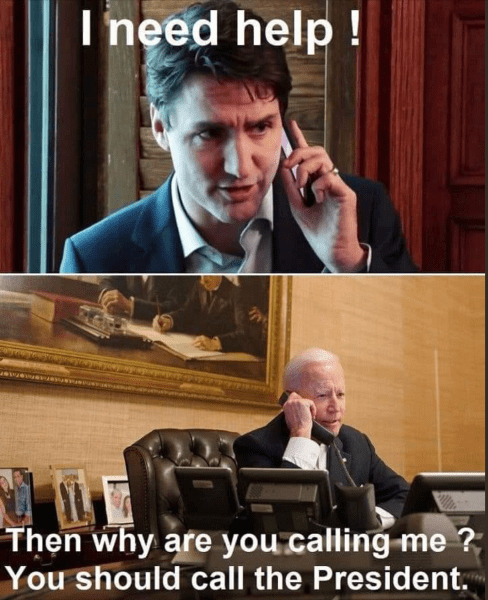
Poll after poll has told us the Liberals lost white male voters a long time ago, and their electoral fortunes, especially in Quebec and suburban Ontario, rely on women, especially women in the suburbs of the Greater Toronto Area. This isn’t to say dads and other caregivers aren’t angry. Families take many shapes and anyone with small people at home has faced the same indignities over the past nearly three years. However, politically and demographically, it’s the Ontario moms who are going to make or break the next election. And when folks are angry, it doesn’t matter who the incumbent is, they are wont to vote them out.
Nor is it not just about the children’s pain meds.
It’s about the fact we can’t find antibiotic eye drops over-the-counter either (a shortage one pharmacist told me is even worse than the one for pain and fever meds for the wee ones). Another shortage that means we must then turn to an already over-burdened health-care system to get a prescription for a medicine that may or may not be in stock.
Oh, and if that respiratory virus going around turns nasty, we aren’t even certain there will be a hospital bed for our babies when they need it most.
Then there is the infuriatingly slow roll-out of affordable childcare in this province. Parents once again caught between the feds and the province in a battle that may drag out the process so long that many expecting relief will see their kids off to junior kindergarten before it arrives.
Grocery bills are skyrocketing, and while I admit I’m privileged enough to absorb the eye-popping increases, so many families simply cannot. Imagine telling a picky toddler they can’t have their favourite snack because you can’t afford the crackers.
Now, Ontario moms had to deal with yet another disruption to their kids’ schooling, which threw their work lives into chaos once again. More disruptions are possible should bargaining fail again. This just after many women who left the workforce or took a step back from their careers during the pandemic were just getting back into the swing of things.
I made this point — that Ontario moms are angry and much of that anger is directed at political leaders, but I don’t expect it to fall on Ontario Doug Ford — on Twitter a couple weeks back. For this, I was “reminded” — more like chided — that many of these challenges are Mr. Ford’s fault. Or global challenges no logical person could blame the prime minister for. The partisans in my mentions were right on both counts. But here’s what they got wrong:
It doesn’t matter if I’m being “unfair” to Mr. Trudeau, because politics is unfair.
And as for Mr. Ford’s share of the blame, voters punish who’s up next at the ballot box, especially in a crisis. They had a chance to take out their rage on the PCs in June. They didn’t. So who does that leave up next?
November 8, 2022
The inevitable next act of the media subsidy game – “Before long we will be back for more”
In The Line, Peter Menzies outlines the state of play in the continued efforts of the federal government to pass C-18, a bill that will massively benefit certain media outlets … or convince the “tech giants” to pull out of the Canadian market altogether rather than pay the blackmail:
News Media Canada’s persistent campaigning finally produced its Holy Grail — Bill C-18. All might have been well for Torstar, Postmedia and Le Devoir except that once the flesh was thrown on the bones of the Act, broadcasters that aren’t facing economic peril heard the dinner bell and came running.
The result, according to the Parliamentary Budget Officer, is that Bill C-18 is expected to produce $329 million in annual revenue for Canadian media (for context, that’s less than the Calgary Herald, Edmonton Journal, Edmonton Sun and Calgary Sun were bringing in between them 20 years ago). Of that, $249 million will go to broadcasters, few of whom are on a fiscal ledge and a good many of whom have contributed to the demise of local newspapers. Remarkably, the CBC, already receiving $1 billion in taxpayer funding, will get the most of that cash, followed by CTV (Bell), Rogers, Videotron and others. The newspapers and start ups will have $80 million (a little more than what the Edmonton Journal and Edmonton Sun used to make in combined annual profit) to fight over.
And very few of those previously mentioned startups — run by mostly young and often female innovators — trying to find a sustainable business model for good journalism can expect anything more than a token pay off. No. They will have to go to the little kids table and see what they can find on the children’s menu of subsidies.
It is distressingly obvious that while so many were tricked into believing this was the most progressive Canadian government ever, it is in fact, a slave to the status quo; as staunch a defender of the corporate establishment as the Toronto Club could wish for. With the 21st century and all its opportunities staring it in the face, Justin Trudeau’s government has not only turned its back on innovation, it has put its thumb on the scale in favour of failed business models that long ago ran out of ideas.
Yet there may be a final twist in this tale.
Bill C-18’s particulars are, as Meta/Facebook’s Kevin Chan put it to a Parliamentary committee last week “globally unprecedented”. For all its sins — and for all we know there are a few more skeletons rattling around in its closet — Meta is unlikely to pay up. Sure, it can cover the Canadian shakedown; what it can’t afford though is to pay every other country in the world that makes the same demand. So Meta says it may simply stop serving up news links which, when you think about it, is a better idea in the long run than permanently entrenching its dominant market position
So while the publishers of those blank pages appear to have bullied even the Conservatives into supporting this travesty, they are still left to ponder:
“Imagine if Facebook wasn’t there.”
Freeland to NATO? Almost certainly not
CDR Salamander explains why, despite her having good qualities that match some of what the job requires, we shouldn’t be betting any money on Deputy PM Chrystia Freeland taking over the role of Secretary General of NATO:
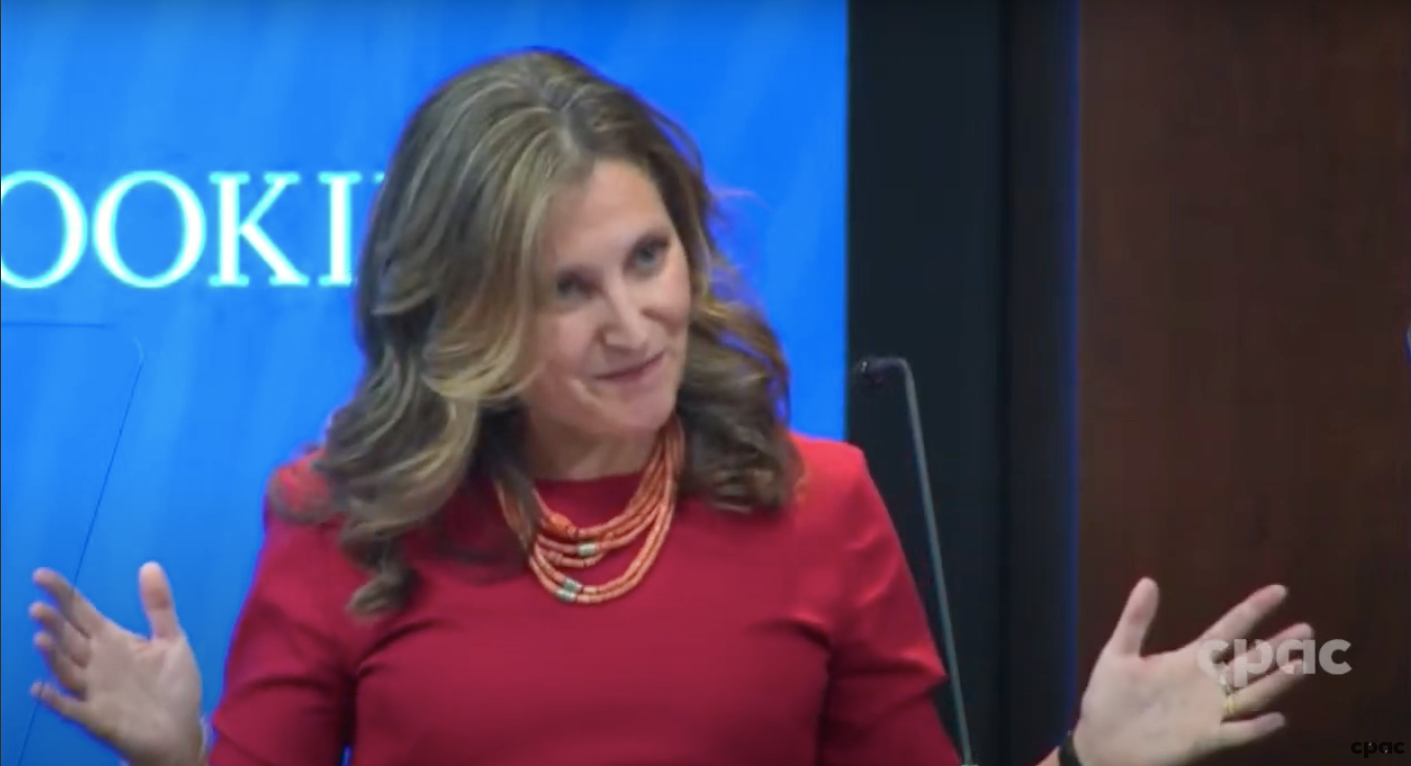
Screencap from a CPAC video of Chrystia Freeland’s speech at the Brookings Institution in October, 2022.
So, via NYT, as a war wages in Eastern Europe and NATO is looking for a new Secretary General, what is the focus?
The behind-the-scenes jockeying for who should succeed Jens Stoltenberg has begun in earnest, with a focus on women.
Here’s the CV:
While the officials cautioned that these are early days, and very often the names that surface first do not survive the bargaining among NATO’s 30 members, they said one prime candidate has surfaced in Washington: Chrystia Freeland, 54, the Canadian-Ukrainian deputy prime minister and finance minister of Canada.
Ms. Freeland, 54, a former journalist (who is married to a reporter for The New York Times), has also been Canada’s foreign minister. Her advantages are considerable: she speaks English, French, Italian, Ukrainian and Russian; she has run complicated ministries; she is good at news conferences and other public appearances; and she would be the first woman and first Canadian ever to run NATO.
The fact that word is on the street that the primary filter here is if someone is XX vs XY would be laughable if not so destructive. There is absolutely nothing wrong with a woman being Secretary General, but that should have nothing to do with the decision. The fact is leading with that as the first criteria, any woman selected as Secretary General this round, would — rightly — always have a shadow over them for this simple fact that they did not get the position on merit — but simply an attempt to signal virtue to … well … fellow members of the woke left in the West, I guess. NATO’s potential enemies will only be encouraged by such an act.
This does nothing for NATO or women — and it degrades both by the process.
That being said, as her name is being floated, let’s look at Freeland. Many US citizens may recognize her from her very undiplomatic interactions with the Trump Administration. It wasn’t just Trump, but something worse that seeps out. Even during the Biden Administration, her not-so-subtle sniffs of standard issue leftist Canadian anti-Americanism crops up on a regular basis. It only gets worse when she deals with Americans to the right of Bernie Sanders.
In NATO, you need someone who is a subtle politician — again with experience working in a vigorous multi-party coalition with highly different views, priorities, and goals. That is why Europeans make such good Secretary Generals. While Canada also has a parliamentary system, it and its parties are VERY different than the European model. Freeland only gets partial credit here.
There is also the issue of temperament. Read the links above. Freeland likes to pick fights, often in public. Worse, she seems to enjoy — again as most standard-issue Canadian leftists do — in making snide comments about the government and people of the alliance’s largest monetary and troop contributing nation — the United States of America.
The Secretary General of NATO has to be someone by temperament and habit seen as a non-partisan person toward the USA so that they can work with American administrations from all political parties. Freeland has significant issues with the American Republican Party in general and American conservatives in particular. That alone should be enough for serious alliance nations from Poland to Great Britain to be against her as a possible candidate. In summary; Freeland does not possess the skills or temperament for the position.
Now is not the time for such frivolity.
The last reason — and the most important reason for me — that Freeland should not be the Secretary General will be recognizable to regular readers here. It has nothing to do with her as a person, but her nation, Canada.
I love Canada and Canadians — but this is not personal, this is business. Serious alliance business. Simply by the numbers, Canada has not earned the position.
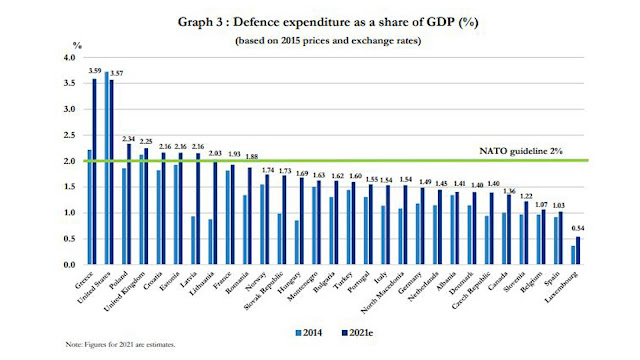
Review my post from September if needed, but Canada spends ~1.3% of her GDP on defense. This is WELL below NATO’s 2% minimum. Only Slovenia, Belgium, Spain and Luxembourg spend less.
We are well past being polite to alliance members who refuse to pull their fair share of the burden. Canada simply has not put herself in the position to reward any of her political elite with the position of Secretary General, man or woman.
November 6, 2022
The ArriveCAN farce as the poster child for Canada’s vastly diminished state capacity
In The Line, Andrew Potter considers the expensive, ineffective ArriveCAN app the government tried to impose on international travellers as a symptom of Canada’s decreasing state capacity:

There is perhaps no clearer poster child for the current crisis of state capacity than the ArriveCAN app, which was a bad policy initiative, poorly implemented, at great cost, and whose ultimate effect was not to keep Canadians safe and healthy, but rather to annoy users and generate a great deal of hostility towards the government.
The question of state capacity (or more frequently, its absence) became an issue of popular concern during the COVID-19 pandemic when governments, both in Canada and elsewhere, struggled to accomplish basic tasks of pandemic management. Whether it was sourcing enough PPE for the health-care system, scaling up testing or contact tracing, securing the borders, properly staffing long-term-care facilities, taking care of temporary foreign workers, and so on … the authorities struggled to get their act together. This is a well-documented story.
But this all came at a time when we had already started a national conversation about whether Canada had become a place where it was impossible for government to get anything done. Pipelines were the big issue, but we seemed to have turned into a country where crumbling infrastructure and slow and ineffective public services had become simply accepted as a fact of life. “State capacity” just put a name to something that had been in the air for a long while.
And so the pandemic served to both exacerbate and accelerate the concern over state capacity, for two main reasons. First, it raised the stakes. Before the pandemic, the failure of state capacity manifested itself as a slow-motion and genteel sort of generalized decline. With the arrival of COVID-19, it quickly became a matter of life and death. But second, the gusher of money the government printed during the pandemic helped put a point on the problem: the problem didn’t originate in a lack of funds. Indeed, what transpired during the pandemic was a bit of a spin on the old Woody Allen joke about the restaurant with terrible food and such small portions: There was so much government, and so much of it was bad.
So what is state capacity anyway? And why is it so important?
As I’ve said many times, the more the government tries to do, the less well it does everything. More government is worse government … and I’m not even being a pedantic libertarian here, I’m talking objectively about the outcomes of pretty much every new government action.
November 4, 2022
Ontario parents brace for yet more school disruption as CUPE threatens a Friday walkout
Matt Gurney, writing in Toronto Life, recounts a fairly typical Ontario parent’s concerns at the latest stand-off between the Ontario government and the non-teaching educational workers represented by the Canadian Union of Public Employees (CUPE):
It’s one thing to watch the news as a journalist and wonder how to cover it. Over the last week or so, though, I’ve just been another parent wondering if my young kids are going to be out of school for an extended period. Again.
It’s all very familiar by now, of course. Can I shuffle my deadlines? Should we get rotating playdates going with neighbours so we can have some quiet in the house when we have an important Zoom call? Do we still have the number of that tutor we used during Covid, and should we call her again if this drags on? Anyway, there’s always the grandparents, right?
This is stress we don’t need — a kick in an already tender spot. I remind myself that, all things considered, others have it way worse: people on shift work, single parents, parents of kids with special needs, those for whom a missed shift means a missed rent payment or a skipped meal. But, even among the affluent and privileged, the frustration, the sense of weariness at more of this, is strong.
[…]
Let me repeat that: my son, now in the third grade, has never had a normal year of school. Preschool and JK? Sure. But then Covid struck mid-senior-kindergarten, in a year already disrupted by job actions from teachers during contract negotiations with the province. (Once the pandemic began, deals were quickly reached.) Schools closed and didn’t reopen. The next year, his first grade, was a complete fiasco, with schools opening and closing as the virus surged and waned. The second grade was better but still had a lot of shifting rules and a relatively brief shutdown after Christmas. This year was the first shot for my son to know a normal school year.
And there are thousands of other kids like him out there, each with a parent (or two) who worries that their child has already lost too much.
Don’t discount the guilt parents feel. We spent years telling our kids, “No, you can’t do this.” Denying them birthday parties, family trips, sports and activities, even just playdates. If you aren’t a parent and don’t understand why people might get so passionate about whether their kids stay in a classroom, don’t make the mistake of thinking it’s all about the lesson plan or just a desire to ship them off so that the house is quiet for a few hours. Those both matter, but the bigger concern for many is that we’re tired of saying no to our kids. We’re tired of telling them that they can’t do things. We’re tired of having things taken away from them.
We knew that measures to limit the spread of Covid were important. We went along, for the most part. We waited. We got our jabs. Many of us got our kids jabbed. In exchange, we want normalcy back. Not for us but for them.
The Ford government’s treatment of CUPE is undeniably heavy handed — probably on purpose, to send a signal to other unions. It’s also unnecessarily nasty. Ford could have struck a better deal with education workers, like imposing a short-term contract with a higher wage boost to help them ride out inflation, as I proposed weeks ago. That might have eased the concerns of parents out there who, though worried about their kids, don’t like Ford or what he’s doing.
I think Jen Gerson has it right here:

November 2, 2022
Bill C-18’s scheme to force payment for online links threatens freedom of expression
Michael Geist considers the ways that the federal government’s Bill C-18 will suppress online freedom of expression in Canada:

“Automotive Social Media Marketing” by socialautomotive is licensed under CC BY 2.0
The study into the Online News Act continues this week as the government and Bill C-18 supporters continue to insist that the bill does not involve payment for links. These claims are deceptive and plainly wrong from even a cursory reading of the bill. Simply put, there is no bigger concern with this bill. This post explains why link payments are in, why the government knows they are in, and why the approach creates serious risks to the free flow of information online and freedom of expression in Canada.
[…]
Why is the government suspending the fair dealing rights of Internet platforms in the bill? Because it knows that the platforms don’t typically use the news in a manner that would be compensable. For example, the platforms may link to the news, feature a headline with the link or sometimes offer a one-or-two sentence summary or quote from the article. These uses are generally permitted under Canada’s fair dealing copyright law rules and do not require a licence or compensation. In other words, claiming that links might qualify for compensation requires setting aside the platforms’ copyright rights which places Canada in breach of its obligations under the Berne Convention, the international treaty that governs copyright law.
The government’s intervention into the final arbitration process is further evidence that it recognizes the weakness of the argument for payments for links. Bill C-18 mandates final offer arbitration, which encourages the parties to provide their very best final offer as part of the process since the arbitrator must select one or the other. Yet Section 39 gives the arbitration panel the right to reject an offer on several policy grounds. Why would such a provision be necessary in a final arbitration system that encourages submitting your best offer? It is only necessary if you fear one side will examine the evidence and proffer a low offer on the grounds that it does not believe that there has been a demonstration of compensable value. That is a real possibility in this case given that there should be no need to compensate for links and there is little else of value. In light of that risk, the government gives the arbitration panel the power to reject offers that do not meet the government’s policy objectives.
[…]
Aside from the obvious unfairness, the broader implications of this policy are even more troubling. Once government decides that some platforms must pay to permit their users to engage in certain expression, the same principle can be applied to other policy objectives. For example, the Canadian organization Journalists for Human Rights has argued that misinformation is akin to information pollution and that platforms should pay a fee for hosting such expression much like the Bill C-18 model. The same policies can also be expanded to other areas deemed worthy of government support. Think health information or educational materials are important and that those sectors could use some additional support? Why not require payments for those links from platforms. Indeed, once the principle is established that links may require payment, the entire foundation for sharing information online is placed at risk and the essential equality of freedom of expression compromised.
To be clear, supporting journalism is important. But Bill C-18’s dangerous approach ascribes value to links where there isn’t any, regulates which platforms must pay in order to permit expression from their users, and dictates which sources are entitled to compensation. This is an unprecedented government intervention into the media and freedom of expression. If the government believes that Facebook and Google should be paying more into Canada, tax them and use the funds for journalism support. If that isn’t enough, create a fund for participation in the news system with mandated contributions similar to the Cancon broadcast world. That may not be ideal, but it would at least keep the system arms length, remove the qualification issues, and reduce the market intervention.
I suspect the government fears that Canadians would easily recognize the risks associated with mandated payments for links and fundamental unfairness with the system envisioned by Bill C-18. It is why it has misled on the inclusion of link payments, rejected the Parliamentary Budget Officer’s estimates on who benefits, and sought to frame Facebook’s concerns as a threat, when the real threat lies in the bill itself. But despite those efforts, make no mistake: Bill C-18 is a law about forcing some platforms to pay for links. It gives the government the power to regulate who pays and which expression is worthy of payment. In doing so, it creates a threat to freedom of expression for all Canadians.
October 29, 2022
The Canadian government, despite committing billions to replace old equipment, is still not serious about the Canadian Armed Forces
In The Line, Matt Gurney explains why — despite big-ticket items getting a few headlines — the Canadian Armed Forces need far more than what any government has been willing to provide since the start of the Cold War:

Objectively speaking, there has been progress. Canada has committed billions to replacing the CF-18 fighter jets with F-35s — 88 of them. (That’s still way too small an air fleet for a country our literal size — it’s not a lot of planes for such a big place, folks — but it’s something.) Billions more have been committed to modernizing NORAD’s early warning systems. And, miracle of miracles, we finally got around to replacing the goddamned Second World War-era pistols!
These are real, tangible things. These things matter. They will leave the Canadian Armed Forces better off, our soldiers better protected and our continent more secure. This is good news.
It’s also the bare minimum.
Even these big spending announcements, and even the itty bitty pistol one, don’t actually add capabilities to the Canadian military. They replace existing ones. They maintain our capabilities. Sure, we can quibble about “maintain” or “replace” — the F-35 will give Canada a stealth capacity it has never had before, and all that jazz. Fine. Fair. But it isn’t really adding to the overall list of missions we are capable of conducting. It’s fleshing out capabilities that, due to advanced age and wear-and-tear for our critical equipment, were starting to exist only on paper. The government deserves credit for this, but only a really small amount of credit. Getting the urgently necessary basics done, many years after they should have been handled, is good, but it’s not worth a pat on the back. It is the bare minimum the country deserved and that the military needed to function, so that’s how far I’ll go in my praise: congratulations, Liberals, on responding to a massive change in our geopolitical order by accomplishing the bare minimum that was already overdue.
If that sounds scathing, here’s the worst part: that’s me being sincere. Thanks for the bare minimum! I wasn’t sure we’d get even that
So yeah. Good, but … you see the problem here, no? In a new era of global instability and geopolitical turmoil, the Canadian response, thus far, has been to get caught up to where we should have been 10 years ago. At the latest. And it’s far from clear that, if not for Russia kicking off the largest conflict we’ve seen in Europe since 1945, we’d have even bothered to do these necessary, long-overdue things.
And this is all shaping up to be just the latest iteration of a little game both Liberals and Conservatives like to play with the Canadian Armed Forces (and, come to think of it, most policy files). They’ll point to specific investments or particular accomplishments when defending their record. And the investment and accomplishment may well be excellent indeed! But they won’t speak to the full, broader picture. And the full, broader picture of the Canadian Armed Forces is grim, and some new F-35s and 9mm pistols isn’t going to change that.
There was a little story last month you might have seen. After Hurricane Fiona wrecked big parts of several Atlantic provinces, the feds sent in the military. This is right and proper. The troops would have made a welcome sight in those communities, of course. What you might not have noticed, though, was that Nova Scotia had to go public with its desire for more troops. It asked for a thousand. It got 500. It kept asking for more. It got the 500. And most of those 500 were troops already stationed in Nova Scotia; only about 200 were actually sent in from elsewhere. The government never really commented on this, but it’s not hard to suss out the problem: the military couldn’t scrape together any more troops.


