
Navy Lookout
Published 31 Dec 2022The Type 26 frigates being built for the Royal Navy [and Royal Canadian and Royal Australian navies] are specialist submarine hunters but with a range of other capabilities. This video provides a primer on the overall warship design, its weapons, sensors and decoys.
(more…)
January 2, 2023
An in-depth look at the Type 26 frigate design
Comments Off on An in-depth look at the Type 26 frigate design
How much of the media coverage of the Bosnian War was fake news?
Kate at Small Dead Animals linked to this rather disturbing collection of intelligence cables from the Canadian peacekeeping force in Bosnia to NDHQ in Ottawa during the conflict, which contradicts the media narrative of the time:
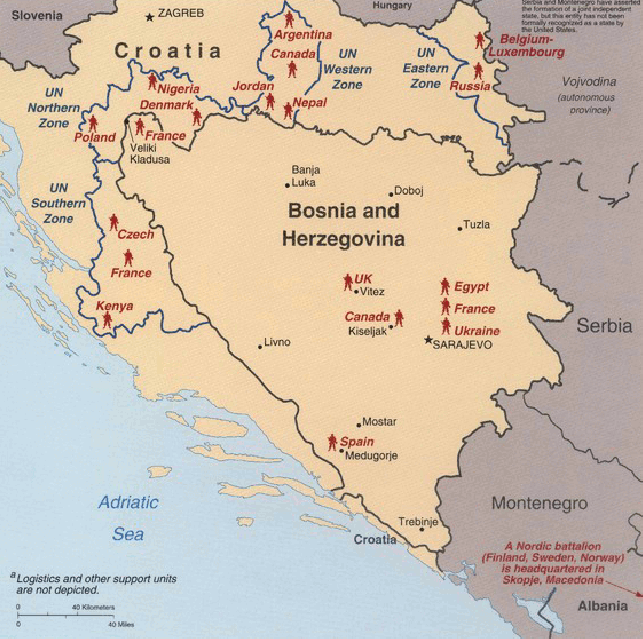
Map of deployment of National Battalions in UN Forces in Croatia and Bosnia and Herzegovina – Early 1993 (Balkan Battlegrounds Map I)
Balkan Battlegrounds: A Military History of the Yugoslav Conflict, 1990-1995 author credit: Central Intelligence Agency.
A trove of intelligence files sent by Canadian peacekeepers expose CIA black ops, illegal weapon shipments, imported jihadist fighters, potential false flags, and stage-managed atrocities.
The established mythos of the Bosnian War is that Serb separatists, encouraged and directed by Slobodan Milošević and his acolytes in Belgrade, sought to forcibly seize Croat and Bosniak territory in service of creating an irredentist “Greater Serbia”. Every step of the way, they purged indigenous Muslims in a concerted, deliberate genocide, while refusing to engage in constructive peace talks.
This narrative was aggressively perpetuated by the mainstream media at the time, and further legitimized by the UN-created International Criminal Tribunal for the former Yugoslavia (ICTY) once the conflict ended. It has become axiomatic and unquestionable in Western consciousness ever since, enforcing the sense that negotiation invariably amounts to appeasement, a mentality that has enabled NATO war hawks to justify multiple military interventions over subsequent years.
However, a vast trove of intelligence cables sent by Canadian peacekeeping troops in Bosnia to Ottawa’s National Defence Headquarters, first published by Canada Declassified at the start of 2022, exposes this narrative as cynical farce.
The documents offer an unparalleled, first-hand, real-time view of the war as it developed, with the prospect of peace rapidly degrading into grinding bloodshed that ultimately caused the painful death of the multi-faith, multi-ethnic Yugoslavia.
The Canadian soldiers were part of a wider UN Protection Force (UNPROFOR) dispatched to former Yugoslavia in 1992, in the vain hope tensions wouldn’t escalate to all-out-war, and an amicable settlement could be reached by all sides. They stayed until the bitter end, long past the point their mission was reduced to miserable, life-threatening failure.
The peacekeepers’ increasingly bleak analysis of the reality on the ground provides a candid perspective of the war’s history that has been largely concealed from the public. It is a story of CIA black ops, literally explosive provocations, illegal weapon shipments, imported jihadist fighters, potential false flags, and stage-managed atrocities.
Read the complete Canadian UNPROFOR cables here.
See key excerpts of the files referred to in this article here.
Comments Off on How much of the media coverage of the Bosnian War was fake news?
January 1, 2023
Canadians Take Little Stalingrad – WW2 – 227 – December 31, 1943
World War Two
Published 31 Dec 20221943 reaches its end with no end in sight for the war. In Italy, the Canadians take Ortona after bloody close fighting, the US Marines advance on New Britain, and a new Soviet offensive makes huge gains in the USSR. This isn’t enough for the Allies, though, who have a big shake up in their European Command to help prepare for future attacks.
(more…)
Comments Off on Canadians Take Little Stalingrad – WW2 – 227 – December 31, 1943
December 28, 2022
The Twitter Files – “How does anyone run a business under these conditions?”
Chris Bray on the sheer magnitude of government(s) meddling in Twitter’s business (even though, yes, Twitter’s management was totally on-board politically with most or all of this meddling):

[…] Twitter has been constantly flooded with requests from at least dozens of separate federal entities, all of them needy and pushy and consuming the company’s time and energy: CENTCOM wants a meeting this week and CDC wants a meeting this week and NIH wants a meeting this week and the FBI wants a meeting this week and the White House wants a meeting this week and DHS wants a meeting this week and DOD wants a meeting this week even though CENTCOM already has one, and several members of Congress have some concerns they want the senior team to address this week, and …
Now: Twitter is a global platform. I would bet a kidney that there’s a Twitter Files equivalent for the Ottawa Police Department during the Freedom Convoy, and an RCMP file, and a Trudeau government file, and that Chrystia Freeland had some thoughts to share about some tweets she didn’t like. I would bet the other kidney that Twitter has equivalent files, in dozens of languages, from multiple government agencies in Iran and New Zealand and Australia and the Netherlands and the UK and Brazil and on and on an on.
As for my third kidney — just go with it, and we’ll clean up the biological metaphors later — state and local governments also expect Twitter to act on their content concerns and complaints about disinformation, which means fifty governors and attorneys general and state directors of public health and state police commanders picking up the phone, and 3,243 sheriffs and district attorneys and public health directors expecting to be able to reach out to their partners at Twitter, and close to 20,000 mayors and police chiefs, and thousands of state legislators and tens of thousands of city councilmembers, and on and on and on. “You tell this Jack Dorsey that I’m the damn mayor pro tem here in Glendale, and I want my concerns to be dealt with.”
And so, if we accept the premise that governments have special rights to demand content moderation, if the staff director of a legislative committee in the Arkansas state legislature and a sheriff in Maryland and the flag officers at all the MACOMS and Jen Psaki’s deputy assistant and a member of a county board of supervisors in Oregon and the chief of staff to the governor of Rhode Island, being Very Important People, all expect to by God get a direct meeting with Twitter executives because @buttchug623 is saying some things that they do not like at all, and oh by the way the prime minister of the Democratic Republic of the Congo is holding on line 6 and he’s pissed and when can you pencil in a half-hour with Turkmenistan’s finance minister, then how much does it cost to manage all of those relationships?
The regulatory affairs staffing buries the business — you can’t pay for that much face time with that many self-important officials. We need to schedule the senior management team for a meeting with the White House this week, ’cause they don’t like Alex Berenson. How does anyone run a business under these conditions? “Before you cook that cheeseburger for order number seven, the deputy assistant secretary for sustainable agriculture would like to share some thoughts on the environmental trajectory of industrial protein cultivation. And about that milkshake …”
In addition to the free speech problem and the pathologies of gleichschaltung, the Twitter files are about the way government without boundaries consumes resources from every entity it touches.
Twitter’s path to bankruptcy runs through the premise that every government official who doesn’t like a tweet deserves a meeting.
Comments Off on The Twitter Files – “How does anyone run a business under these conditions?”
December 27, 2022
Whatever government touches, it makes worse – book publishing as a prime example
The Canadian government has always claimed to want to encourage Canadian book publishers and many, many speeches and press conferences and announcements and gestures have been produced over the years (not just by the Liberals, but usually by the Liberals). The actual results of all that political performance? “Meh” at the very best:
Another of my favorite SHuSHs of 2022 was no. 168, “It Started as Polite Talk”, in which my colleague Dan Wells of Biblioasis complained of the dominance of foreign publishers in the Canadian book market. “I don’t think there’s a literate nation in the world whose native industry makes up a small percentage of its overall market”, he said. “This, perhaps, is the real crisis of Canadian publishing.”
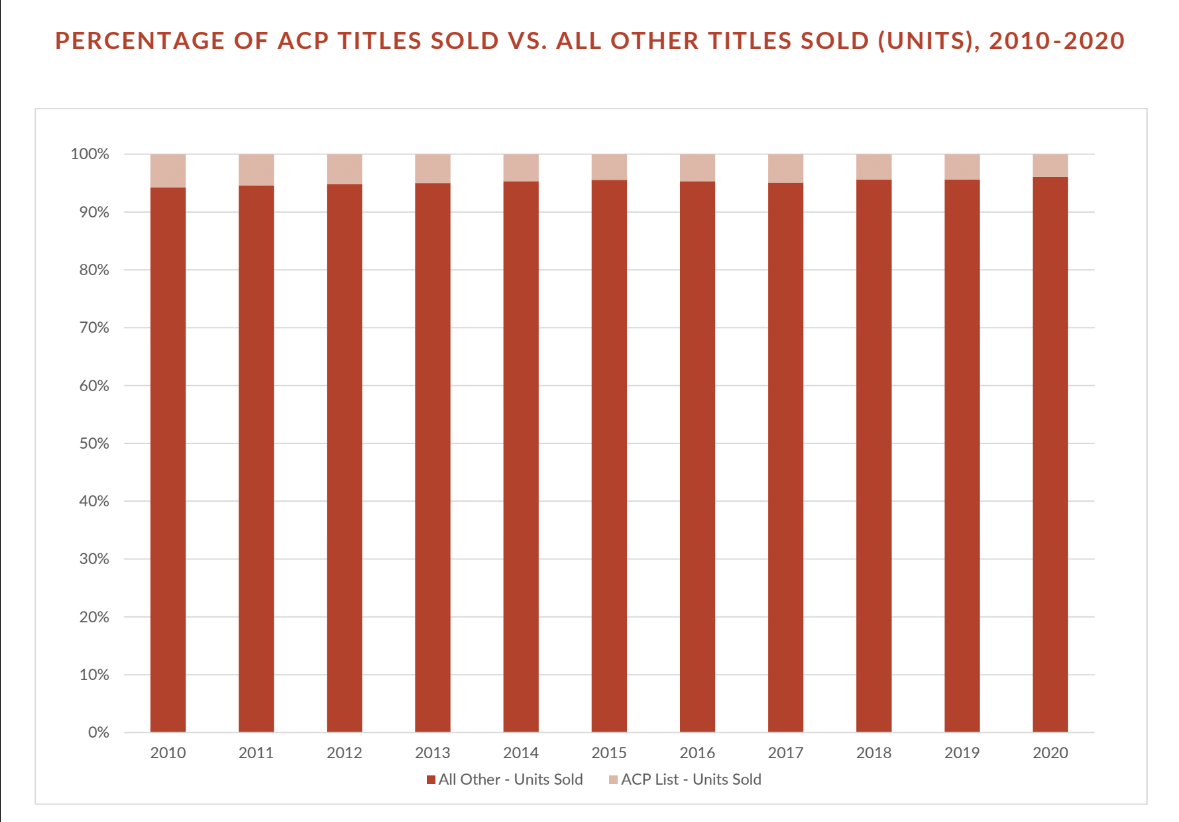
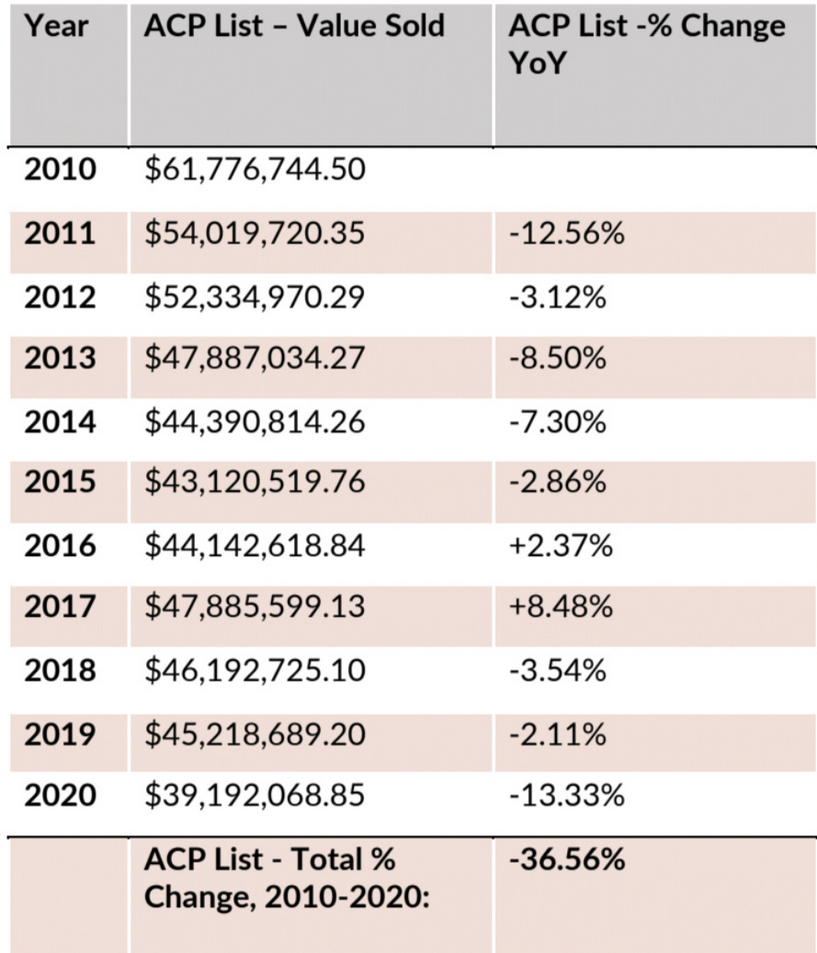
The astonishing thing to me is that the stated policy of the federal government for more than half a century has been to foster and protect a Canadian-owned publishing sector to avoid outsourcing our intellectual life to New York and London. Acres of policy written. Billions spent. The results are risible. Here’s a visual representation of Dan’s point. The 113 members of the Association of Canadian Publishers, representing the vast majority of English-language book publishers in Canada, produce $34 million in annual sales against the $1.1 billion of foreign firms:
If you read the self-congratulatory reports from the Department of Canadian Heritage and the Canada Council, everything is fine: “The Canadian book publishing industry consistently demonstrates a high degree of resilience.”
Does this look resilient to you?
I’ve never been much of a Canadian nationalist and, all things considered, I’d prefer less of a government presence in our arts sector, but government is now so deeply entrenched in book publishing and has made such a hash of the industry that there’s really no way out that doesn’t involve better government policy.
What, exactly, better policy might look like is next year’s project.
Comments Off on Whatever government touches, it makes worse – book publishing as a prime example
December 26, 2022
The Battle of Ortona with Jayson Geroux
OTD Canadian Military History
Published 21 Dec 2022Join me as I welcome Jayson Geroux to the OTD channel to discuss the Battle of Ortona. We will be discussing the urban combat that took place in Ortona in December 1943. [The discussion of the actual battle begins around the 6 minute mark.]
(more…)
Comments Off on The Battle of Ortona with Jayson Geroux
2nd Canadian Infantry Brigade Christmas celebrations in Ortona, 1943
The folks at the World War Two channel on YouTube posted this to their community page on Christmas Day:
On Christmas Day, 25 December 1943, the 1st Canadian Infantry Division is still engaged in brutal urban combat against the 1. Fallschirmjäger-Division for control over the town of Ortona. But among the rubble of the “Italian Stalingrad”, soldiers of the Seaforth Highlanders of Canada, along with other units [of the 2nd Canadian Infantry Brigade], manage to keep the Christmas spirit alive.
Colonel S. W. Thomson will recount this most unusual Christmas celebration many years later:
“I knew that we would be fully engaged with the enemy on Christmas day. However our most enterprising Quartermaster, Captain Bordon Cameron, was anxious to provide something special for the men at Christmas. Three companies were in the line with one in reserve, often the norm. We decided to feed the reserve company first and feed the remaining companies in relays. as one company finished it would go forward some 300 or 400 yards and relieve the next. Tables, linen, chinaware and candles were scrounged by the reserve company. The tables were set up in rows in our great church Santa Maria with four foot thick walls and my rear H.Q. What a picture, what an appropriate setting for a Christmas dinner on Dec. 25.
“Soup, roast pork, vegetables and Christmas pudding along with a bottle of beer for each of the tattered, scruffy, war weary soldiers was served by HQ and B echelon staff. The Q.M. boys excelled themselves, the impossible had happened. There was a spirit of good-fellowship throughout the church. The signals officer Lieutenant Wilf Gildersleeve played the organ, and our much loved padre Roy Durford led the carol singing. Pipe Major Esson played his pipes several times during the meals drowning out the odd enemy shell burst outside.
“Christmas in Ortona, the meal, yes, but the spirit of the occasion, the look on the faces of those exhausted, gutsy men on entering the church is with me to-day and will live forever.”
To all our followers, readers, and viewers: We wish you a Merry Christmas!
From: Canadian Military History, Vol. 2 (1993)
Picture: Canadian soldiers celebrate Christmas in Ortona, Italy
Source: Canadian Armed Forces

Comments Off on 2nd Canadian Infantry Brigade Christmas celebrations in Ortona, 1943
December 25, 2022
Stalin’s Christmas Surprise – Major Offensives to Come – WW2 – 226 – December 24, 1943
World War Two
Published 24 Dec 2022Twas the night before Christmas and the war was grinding on. The Moro River Campaign continues in Italy with Canadian infantry pushing past the Gully and into “Little Stalingrad”. Generally, the Allied advance to Rome is turning into a stalemate though, but Winston Churchill still believes an amphibious landing is the way to break this. Joseph Stalin also has some pretty big plans to bring the USSR back to its pre-Barbarossa borders. In the Pacific, there is attrition over Rabaul and stalemate on Bougainville.
(more…)
Comments Off on Stalin’s Christmas Surprise – Major Offensives to Come – WW2 – 226 – December 24, 1943
December 22, 2022
It may have taken most of the year, but Canada finally figured out its Ukraine position
In The Line, Andrew Potter theorizes that the Canadian government finally “got it right” on Ukraine, but only after having exhausted all the other possibilities:

Operation Unifier shoulder patch for Canadian troops in Ukraine.
Detail from a photo in the Operation Unifier image gallery.
When Russia started massing troops on the border in Ukraine this time last year, Canada was one of the first Western countries to close its embassy in Kyiv, moving everyone to Lviv on February 12. Hours after Russia launched its illegal, insane, nihilistic, genocidal full invasion of Ukraine on February 24, all non-Ukrainian employees of our embassy scooted across the border into Poland.
For months after the invasion, that highly risk-averse attitude infected every aspect of Canada’s approach to helping Ukraine. Whether it was diplomacy (hesitant), military aid (slow and limited), financial support (inadequate) or straight-up moral fortitude (lacking), the Trudeau government made it clear that it would do the least amount necessary, while taking the most credit possible, in supporting Ukraine.
[…]
The weird thing about Canada’s foot-draggy-as-she-goes approach to helping Ukraine is how little sense it made politically, for both domestic and international audiences. Canada has one of the largest Ukrainian diaspora populations in the world. We were the first Western country to recognize Ukrainian independence in 1991. The deputy prime minister of Canada is half Ukrainian and has been a loud supporter of the country for years. Privately and publicly, our allies were pleading for us to do more.
Who knows what it was that finally shook some sense into the Trudeau government. Maybe it was Freeland, maybe it was a call from Uncle Joe Biden, maybe it was just a sense in the PMO that, having exhausted all other options, the only thing left to do was the right thing. Whatever it was, over the last three or four months, Canada is finally punching its weight on the global stage on the Ukraine file. In particular, we seem to have finally figured out that the best way to help is to provide the sorts of support that draws on our strengths.
So for example, while the handful of M777 howitzers we sent were certainly useful (and the ammunition we’re continuing to supply will be well spent) we’re never going to compete with the Americans or Brits when it comes to heavy arms supplies. That’s why, back in October, it was probably more helpful for us to send 400,000 pieces of winter gear and to provide a few million dollars worth of satellite communications to the Ukrainians through Telesat. And it was great to see Canada re-engage with its training commitments to the Ukrainian armed forces through the deployment of 40 combat engineers to train Ukrainian sappers in Poland, to complement our ongoing training of recruits in the U.K.
Comments Off on It may have taken most of the year, but Canada finally figured out its Ukraine position
December 19, 2022
“[T]he major promoter of the ‘Canada is broken’ thesis over the past few years has been … Justin Trudeau”
In the free-to-cheapskates exerpt from this week’s Dispatch from The Line, they set up the possible lines of attack for the next federal election:
What was more interesting to us this week were the comments made by Prime Minister Justin Trudeau to thousands of Liberals at a large in-person Christmas party. As one does at any good Christmas party, the PM took the chance to, uh, savage his rivals. To wit: “Canada is not broken … Mr. Poilievre might choose to undermine our democracy by amplifying conspiracy theories. He might decide to run away from journalists when they ask him tough questions. That’s how he brands himself. That’s his choice. But, when he says that Canada is broken, that’s where we draw the line.” (Full video of the speech is available via CTV News).
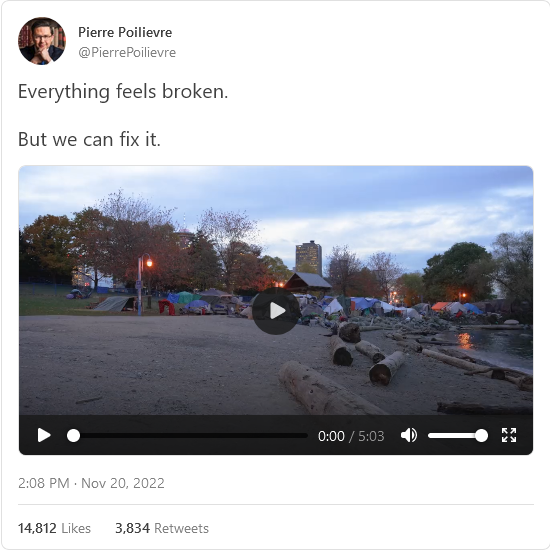
The PM was responding, of course, to a recent line of attack favoured by the Conservatives: that Canada is broken, and we need the Conservatives to fix it.
There are three comments we’ll make in response to this.
The first is strictly an analysis: Trudeau is staking out some interesting rhetorical ground. We aren’t sure this will be the ground on which the next campaign is fought over — God only knows what’ll happen between now and whenever we are next headed to the polls. But if this is the subject of our next “ballot question”, well, that’s just fascinating. “Sunny Ways” vs. “Everything Is Broken and It’s Your Fault.”
How fun! Both men would be able to make an honest pitch for their case. As we’ve written before, the Liberals seem exhausted and spent. They’ve accumulated baggage since their first smiley-faced win back in 2015, and the country has been thoroughly battered by events since then. That suggests that Poilievre, who is at his best when on the attack, could mop the floor with Trudeau.
That said, we don’t take that outcome as a given. First, Trudeau is a damned good politician, better than the Conservatives still give him credit for, and though we are starting to wonder if Trudeau is past the point of no return, we will never count him out. We also think that if the Conservatives make “Things are terrible” the centrepiece of their next campaign, may find that Canadians recoil. Canadian pride is a fragile, brittle thing, and while many of us may feel like things are bad, it’s not clear to us that Poilievre saying so won’t rub a lot of voters the wrong way.
But we honestly don’t know. That’s why it’s fascinating.
The second point is a bit of a reminder: It is worth noting that the major promoter of the “Canada is broken” thesis over the past few years has been … Justin Trudeau. We don’t think we — your Line editors, the media, Canadians in general — should let him take such casual re-occupation of the “Sunny Ways” position, since he’s spent the last five years absolutely dumping on Canada, its history (genocide), its symbols (the flag), and its institutions (the military, amongst others). No one has done more to proclaim Canada broken than Justin Trudeau. Is he now claiming that he’s fixed all the problems he’s spent the last half decade making political hay over?
We mean … the guy won’t even fix his house.
The third point is our own view: of course Canada is broken. And Trudeau has done nothing to fix it.
Now, we have to define our terms here. “Broken” isn’t “destroyed”. We don’t think we’re descending into some kind of post-apocalyptic wasteland. It remains undeniably true that Canada is, in global terms, a nice place to live. Safe. Lots of food. No one is firing missiles at us. Sweet! But, like, gosh, folks. Look around. If the PM really wants to assert that Canada isn’t broken, we’ll agree insofar as it’s not so broken that the average person fears starvation and violent death. Sure. But that average person also probably can’t get a passport, or a family doctor, or timely care in an emergency room, or a house in a big city where the jobs are clustering, or Tylenol for their kids.
Comments Off on “[T]he major promoter of the ‘Canada is broken’ thesis over the past few years has been … Justin Trudeau”
December 18, 2022
Euthanasia, Canadian-style
In the free-to-cheapskates portion of his Weekly Dish, Andrew Sullivan considers the alarming growth of euthanasia in Canada:

Front view of Toronto General Hospital in 2005.
Photo via Wikimedia Commons.
I mention all this as critical background for debating policies around euthanasia or “assisted dying” (a phrase that feels morbidly destined to become “death-care”.) Oregon pioneered the practice in the US with the Death with Dignity Act in 1997. At the heart of its requirements is a diagnosis of six months to live. Following Oregon’s framework, nine other states and DC now have laws for assisted suicide. Public support for euthanasia has remained strong — 72 percent in the latest Gallup.
But this balance could easily get destabilized in the demographic traffic-jam to come. In 2016, euthanasia came to Canada — but it’s gone much, much further than the US. The Medical Assistance in Dying (or MAID) program is now booming and raising all kinds of red flags: there were “10,000 deaths by euthanasia last year, an increase of about a third from the previous year”. (That’s five times the rate of Oregon, which actually saw a drop in deaths last year.) To help bump yourself off in Canada, under the initial guidelines, there had to be “unbearable physical or mental suffering that cannot be relieved under conditions that patients consider acceptable”, and death had to be “reasonably foreseeable” — not a strict timeline as in Oregon. The law was later amended to allow for assisted suicide even if you are not terminally ill.
More safeguards are now being stripped away:
Gone is the “reasonably foreseeable” death requirement, thus clearing the path of eligibility for disabled individuals who otherwise might have a lifetime to live. Gone, too, is the ten-day waiting requirement and the obligation to provide information on palliative-care options to all applicants. … [O]nly one [independent witness] is necessary now. Unlike in other countries where euthanasia is lawful, Canada does not even require an independent review of the applicant’s request for death to make sure coercion was not involved.
This is less a slippery slope than a full-on, well-polished ice-rink. Several disturbing cases have cropped up — of muddled individuals signing papers they really shouldn’t have with no close relatives consulted; others who simply could not afford the costs of survival with a challenging disease, or housing, and so chose death; people with severe illness being subtly encouraged to die in order to save money:
In one recording obtained by the AP, the hospital’s director of ethics told [patient Roger Foley] that for him to remain in the hospital, it would cost “north of $1,500 a day”. Foley replied that mentioning fees felt like coercion and asked what plan there was for his long-term care. “Roger, this is not my show”, the ethicist responded. “My piece of this was to talk to you, (to see) if you had an interest in assisted dying.”
It’s hard to imagine a greater power-dynamic than that of a hospital doctor and a patient with a degenerative brain disorder. For any doctor to initiate a discussion of costs and euthanasia in this context should, in my view, be a firing offense.
Then this: in March, a Canadian will be able to request assistance in dying solely for mental health reasons. And the law will also be available to minors under the age of 18. Where to begin? How do we know that the request for suicide isn’t a function of the mental illness? And when the number of assisted suicides jumps by a third in one year, as it just did in Canada, it’s obviously not a hypothetical matter.
Comments Off on Euthanasia, Canadian-style
A Super Bomber to Break Japan – WW2 – 225 – December 17, 1943
World War Two
Published 17 Dec 2022This war has now lasted as long as the Great War did, but there’s no signs of it slowing. The Soviets have three offensives going on on the Eastern Front, in Italy the Allies are attacking at San Pietro and over the Moro River, in the Pacific there are Allied landings on New Britain, but in Pacific Command, the big talk is all about a new super bomber.
(more…)
Comments Off on A Super Bomber to Break Japan – WW2 – 225 – December 17, 1943
December 17, 2022
Canada’s consciously anemic foreign and military policies
In The Line, Matt Gurney explains why Canada consistently fails to “punch above their weight” in foreign and military matters and that it’s not at all accidental:

Canadian politicians have an inputs problem. Maybe that’s actually the wrong way to describe it — the problem is with the outputs. But it’s the inputs they love talking about.
If that all sounds a little vague, maybe this sounds familiar: “Hey there, citizen. Alarmed about Troubling Issue X? Well, don’t worry. We’re pledging $300 million over the next six years to Troubling Issue X. Oh, and Annoying Irritant Y? We’re announcing a task force to report back on that.”
Does Troubling Issue X get solved? Does Annoying Irritant Y get less annoying and irritating? Eh. We probably don’t collect enough stats to even know. The purpose of the announcement isn’t to solve the problem. It’s to announce something and hope people stop paying attention.
Canadian politicians — especially the current federal government — are notorious for announcing the same “new thing” in as many ways and in as many different contexts as they can. They get several hundred dollars of positive press coverage for every actual dollar spent on whatever the announced spending is supposed to be devoted toward. If they can recycle announcements from months past into a new set of announcements, you’re pretty much guaranteed they’ll do it. Announcing spending is, one must assume, what gets people to cast their votes for the party announcing the spending.
A lot of what looks like policy failure in Canadian foreign and military affairs only looks like a failure when you forget that accomplishing something wasn’t the point. Being photographed and videotaped saying you’ll accomplish something was the point. And the announcement itself accomplishes that!
This was true even before the Trudeau government started handing out bushel baskets of money to various Canadian newspapers, TV networks, magazines, and other legacy media entities. What was once merely praise is now bought sychophancy from the (literally) paid media.
On the military side of things, the Canadian Armed Forces are an organization the government grudgingly funds, but only enough to look good for the self-same media:
It’s not that Canada accomplishes nothing on the world stage. We accomplish things. Sometimes we even play an outsized role — Canada did, for instance, perform well and above expectations in Kandahar. The odd exception aside, though, when it comes to foreign policy generally and especially with defence policy, successive Canadian governments have set a very clear target: we will do, technically, more than nothing. We won’t often do much more than that. But we’ll do enough to not get kicked out of the club of allied nations.
Why do we want to be in the club? Not because we feel any sense of duty or obligation to lead and take on any real burden. But because being in the club makes us safer, and it would, after all, be embarrassing to get kicked out.
It’s important to remember that Canada is, by any standard, a rich country. We could be an actual force for good and stability on the world stage if we wanted to. We could build a bigger fleet and patrol more places, more often — we’d be welcome! We could have a bigger army and lead more peacekeeping missions, or contribute more to NATO. A bigger air force, likewise, could contribute more to our allies, especially in Europe in these unsettled times. In a parallel universe where we did these things, we’d then be able to say with a straight face that the purpose of Canada’s navy was contributing to the safety and security of the seas, the purpose of our army was to assist allies and provide peacekeepers to help end international crises, and the purpose of our air force was to project power and bring support to threatened allies.
In the world we actually live in, though, the purpose of the navy is to technically have a navy that technically does things, the purpose of the army is to technically have an army that technically does things, and the purpose of the air force … you see where this is going, right?
Our navy does things! It shows up places, and patrols areas. But only as much as necessary to technically tick that box. The army is in much the same condition; with a growing number of domestic commitments sapping its strength and budget, even its ability to assist with disasters at home is largely maxed out, but we send a few hundred soldiers here and there, thereby allowing ourselves to proclaim that we’ve … sent soldiers somewhere. The air force, as was just reported this week, can’t even really do even that much this year. The exhausted force is skipping the very modest — a half-dozen fighter jets — annual mission to Europe. The air force is just too burnt out to sustain even that tiny mission.
This is a big and growing problem. Canada, again, is rich enough to make a difference in global security affairs, if we chose to make different choices with how we spend our money. We have made the opposite choice. We field just enough of a military to be able to make just enough difference to avoid being accused of being total deadbeats, and no more.
Can it fight? Eh, maybe a bit. Can it make a difference? Depends how you define “difference”, I guess. Does it make the world and our allies safer? In a way? Can it keep Canadians safe at home? Sort of.
This isn’t a failure of our policy. This is our policy. We show up with as little as possible for as brief a time as possible, but gosh, do we ever talk about the showing up.
Comments Off on Canada’s consciously anemic foreign and military policies
December 16, 2022
The Online News [Shakedown] Act passes the House of Commons
Michael Geist summarizes the farcical progress of Justin Trudeau’s legalized theft from the “tech giants”:
Later today, the House of Commons will vote to approve Bill C-18, the Online News Act, sending it to the Senate just prior to breaking for the holidays. While Canadian Heritage Minister Pablo Rodriguez and media lobbyists will no doubt celebrate the milestone, it should not go unremarked that the legislative process for this bill has been an utter embarrassment with an already bad bill made far worse. The government cut off debate at second reading, actively excluded dozens of potential witnesses, expanded the bill to hundreds of broadcasters that may not even produce news, denigrated online news services as “not real news”, and shrugged off violations of international copyright law. All the while, it acknowledged that mandated payments for links are the foundation of the bill with officials stating that individual Facebook posts accompanied by a link to a news story would be caught by the law. As for the purported financial benefits, the government’s own estimates are less than half those of the Parliamentary Budget Officer, who also concluded that more than 75% of the revenues will go to broadcasters such as Bell, Rogers, and the CBC. The end result is a bill that will undermine competition and pose a threat to freedom of expression, while potentially leading Facebook to block news sharing in Canada and Google to cancel dozens of existing agreements with Canadian news outlets.
As I’ve chronicled for months, Bill C-18 is the product of an intense lobbying campaign from some of Canada’s largest media companies. While the Globe and Mail broke from the pack at the last minute, years of one-sided editorials — even devoting full front pages to the issue — had its effect. Indeed, Canadian newspapers would be exhibit #1 for how government intervention in the media space has a direct impact on an independent press. From the moment of its introduction, the consequences were immediately obvious as payments for links serves as the foundation for a law that treats “facilitating access to news” as compensable. Canadians can be forgiven for thinking the bill is about compensating for reproduction of news stories. It is not, since the platforms don’t do that. Instead, it is about requiring payments for links, indexing or otherwise directing traffic to the news organizations who are often the source of the link itself. In most circumstances, recipients pay for the benefits that come from referral traffic. With Bill C-18, the entities providing the referrals pay for doing so.
Further, the bill is about far more than struggling Canadian newspapers as it expands eligibility into broadcasters such as the CBC, foreign news outlets such as the New York Times, and hundreds of broadcasters licensed by the CRTC that are not even required to produce news. The end goal is negotiated payments for links, backed by the threat of a one-sided arbitration process overseen by the CRTC in which the arbitration panel can simply reject offers if it believes it fails to meet the government’s policy objectives. That isn’t a commercial deal, it is a shakedown.
I’ve been operating on the assumption that the government is betting that the big internet companies won’t do the obvious and ban linking to any Canadian media outlet on their respective platforms, but the feds don’t have a great track record of predictions in recent years …
In a later post, Michael Geist illustrated the literal misinformation that was pushed by government MPs during Bill C-18’s path through to final reading by quoting some of Liberal MP Lisa Hepfner’s contributions:
Last month, Liberal MP Lisa Hepfner shocked Canadian online news outlets by stating that “they’re not news. They’re not gathering news. They’re publishing opinion only.” The comments sparked instant criticism from news outlets across the country, leading Hepfner to issue a quick apology. In the aftermath of the comments, Hepfner said nothing for weeks at Heritage committee studying Bill C-18. That bill passed third reading yesterday – I posted on the embarrassing legislative review – and Hepfner was back at it. Rather than criticizing online news outlets, this time she targeted the Internet platforms, saying the bill would make it “harder for big digital platforms like Facebook and Google to steal local journalists’ articles and repost them without credit.”
[…]
Hepfner’s comment not only provide a troubling example of an MP engaging in misinformation about links who has effectively labelled her own Facebook posts as theft, but strikes at the heart of the problem with Bill C-18. As government officials have acknowledged, the entire foundation of the bill is based on paying for links. In fact, when a proposal to remove links from the bill was raised at committee, government MPs described the change as a loophole and voted against it. In the case of the CBC links, the government confirmed that Hepfner could write about the availability of children’s medications (ie. “Great news! CBC reports a million bottles of pain medication are on the way”) but once she added a link to provide a source for the claim, Bill C-18 is triggered.
These examples highlight the absurdity of a law that treats links as compensable and MPs who equate those links to theft. To be clear, there is nothing wrong with Hepfner or anyone else providing a link to a story on greater availability of children’s medicine. In fact, the CBC story has effectively already been paid for by the public and should be shared widely without the government creating barriers to sharing that information. What is wrong that is ill-informed MPs have voted for Bill C-18, creating a framework in which the government is imposing a mandatory payment scheme for some platforms for hosting links. The bill is now headed to the Senate which will hopefully make the necessary amendments to set Hepfner’s mind at ease that her own Facebook posts do not make her an accomplice to theft.

Comments Off on The Online News [Shakedown] Act passes the House of Commons
December 14, 2022
PayPal channels its inner Justin Trudeau
Canada’s current Prime Minister found a neat work-around to punish peaceful protestors and their small-scale financial backers by getting Canada’s chartered banks to freeze their bank accounts and credit cards. He didn’t bother getting a law or even an Order-in-Council to do this. He merely had the Finance Minister have a friendly chat with the banks’ CEOs and it was a done deal at least for a few hundreds or thousands of Canadians. PayPal clearly admires Justin Trudeau’s forthright moves to crush dissent and — being a financial institution itself — has been doing similar things to wrongthinking individuals and organizations who (used to) use PayPal’s services:

If you’re one of the lucky ones and your account has just been suspended, you can go to customer service, explain your situation and hope that someone gets back to you. If you’ve been banned, you’ll need an attorney to file a subpoena for the internal PayPal documents — simply to learn why you’ve been banned. (Good luck getting unbanned.)
These are entrepreneurs, writers, academics, activists — the very same people PayPal, whose mission is “democratizing financial services”, was meant to empower.
PayPal won’t say how many of them it has suspended or banned. In June 2021, the Electronic Frontier Foundation and other civil-liberties groups wrote a letter to PayPal and Venmo, calling on them to open up. So far, they have not, said Aaron Terr, director of public advocacy at the Foundation for Individual Rights and Expression.
The people who founded PayPal — the so-called PayPal Mafia — include Peter Thiel, Elon Musk, David Sacks and Max Levchin. All are champions of free speech. All have expressed shock and dismay at what is happening to the company they created. Several founders agreed to talk with The Free Press for this article.
“If the online forms of your money are frozen, that’s like destroying people economically, limiting their ability to exercise their political voice”, Thiel told me. “There’s something about destroying people economically that seems like a far more totalitarian thing.” [Justin Trudeau smiles]
When they launched PayPal, in December 1998, the founders imagined themselves connecting people to the global economy by sidestepping the hefty fees charged by credit-card companies and the inflationary policies of poorly run governments. Early PayPal users had Palm Pilots, and they would beam money from their devices to anyone with an email address. It was especially popular among eBay users.
“PayPal will give citizens worldwide more direct control over their currencies than they ever had before”, Thiel said at a company meeting, in late 1999. “It will be nearly impossible for corrupt governments to steal wealth from their people through their old means, because if they try the people will switch to dollars or pounds or yen, in effect, dumping the worthless local currency for something more secure.”
Since those early heady days, PayPal has amassed 429 million active accounts. Fifty-eight percent of Americans use PayPal, and in 2021, there were 19.3 billion PayPal transactions. It now has a market valuation of $84 billion.
But the company that was meant to liberate countless individuals is becoming something else.
Increasingly, it is becoming a police officer. It is deciding what is right and wrong, who gets to be heard, who is silenced. It is locking out of the financial system those people or brands that have slipped outside the parameters of acceptable discourse, those who threaten the consensus of the gatekeepers. The consensus is hard to articulate; it is an ideology lacking clearly defined ideological contours. But the tenets of that consensus are unmistakable: the new progressive politics around race and gender are a force for good, the Covid lockdown was just, the war in Ukraine is noble, and an unfettered exchange of ideas and opinions is an unacceptable threat to all of the above.
A cynic might say that the original idea, “democratizing financial services”, has been implemented with a capital “D” which makes it all make sense in an American political context.
Comments Off on PayPal channels its inner Justin Trudeau


