Quotulatiousness

April 5, 2023

Justin Trudeau chooses the Argentinian model over the Canadian model

In The Line, Matt Gurney considers the proposition that “Canada is broken”:

To the growing list of articles grappling with the issue of whether Canada is broken — and how it’s broken, if it is — we can add this one, by the Globe and Mail‘s Tony Keller. I can say with all sincerity that Keller’s is one of the better, more thoughtful examples in this expanding ouevre. Keller takes the issue seriously, which is more than can be said of some Canadian thought leaders, whose response to the question is often akin to the Bruce Ismay character from Titanic after being told the ship is doomed.

(Spoiler: it sank.)

But back to the Globe article. Specifically, Keller writes about how once upon a time, just over a century ago, Canada and Argentina seemed to be on about the same trajectory toward prosperity and stability. If anything, Argentina may have had the edge. Those with much grasp of 20th-century history will recall that that isn’t exactly how things panned out. I hope readers will indulge me a long quote from Keller’s piece, which summarizes the key points:

    By the last third of the 20th century, [Argentina] had performed a rare feat: it had gone backward, from one of the most developed countries to what the International Monetary Fund now classifies as a developing country. Argentina’s economic output is today far below Canada’s, and consequently the average Argentinian’s income is far below that of the average Canadian.

    Argentina was not flattened by a meteor or depopulated by a plague. It was not ground into rubble by warring armies. What happened to Argentina were bad choices, bad policies and bad government.

    It made no difference that these were often politically popular. If anything, it made things worse since the bad decisions – from protectionism to resources wasted on misguided industrial policies to meddling in markets to control prices – were all the more difficult to unwind. Over time the mistakes added up, or rather subtracted down. It was like compound interest in reverse.

And this, Keller warns, might be Canada’s future. As for the claim made by Pierre Poilievre that “Canada is broken”, Keller says this: “It’s not quite right, but it isn’t entirely wrong.”

I disagree with Keller on that, but I suspect that’s because we define “broken” differently. We at The Line have tried to make this point before, and it’s worth repeating here: we think a lot of the pushback against the suggestion that Canada might be broken is because Canada is still prosperous, comfy, generally safe, and all the rest. Many, old enough to live in paid-off homes that are suddenly worth a fortune, may be enjoying the best years of their lives, at least financially speaking. Suggesting that this is “broken” sometimes seems absurd.

But it’s not: it’s possible we are broken but enjoying a lag period, spared from feeling the full effects of the breakdown by our accumulated wealth and social capital. The engines have stopped, so to speak, but we still have enough momentum to keep sailing for a bit. Put more bluntly, “broken” isn’t a synonym for “destroyed”. A country can still be prosperous and stable and also be broken — especially if it was prosperous and stable for long enough before it broke. The question then becomes how long the prosperity and stability will last. Canada is probably rich enough to get away with being broken for a good long while. What’s already in the pantry will keep us fed and happy for years to come.

But not indefinitely.

April 1, 2023

The fastest growing demographic in Canada might be the “Pretendians”

Filed under: Cancon, History, Media, Politics — Tags: , , , , , — Nicholas @ 04:00

In Quillette, George Case outlines the fraught topic of claimed First Nations heritage among Canadians:

“The Pretendians”, a CBC documentary – https://www.cbc.ca/passionateeye/episodes/the-pretendians

Many North Americans have cited such extraction as a conversation piece, an exotic mark of character, or just an intriguing bit of genealogy: among them are singers Cher and Beyoncé, actor Johnny Depp, rockers Jimi Hendrix and Robbie Robertson, baseball great Johnny Bench, and numerous others.

That such backgrounds are both perfectly plausible and difficult to verify tells us something about the history of the human species since 1492. Consensual or coerced relations between Europeans, Africans, and Indigenous people throughout the Americas — even when socially deplored or officially prohibited—must have happened countless times to generate the populace we are today. Most of us, by some measure, are mini-melting pots. And consider, too, today’s routine unions of partners whose great-grandparents might have been horrified at the prospect of “marrying out”: Protestants with Catholics, Jews with Gentiles, Asians with Anglos, and a rainbow of other combinations. Indeed, to oppose such relationships, and the products thereof, is now usually seen as a small-minded prejudice of the ignorant and intolerant.

Unless the opponent happens to be a Native person. In Canada, over the last few years, a rash of scandals have erupted over prominent figures whose claims of Aboriginal heritage have been heatedly disproved, like novelist Joseph Boyden, actress and filmmaker Michelle Latimer, academic Carrie Bourassa, and former judge Mary Ellen Turpel-Lafond. The uproar around “Pretendians” has raised uncomfortable questions around race and politics that the angriest Aboriginals may not have intended in their denunciations. Métis lawyer Jean Teillet has called the phenomenon “the ultimate step in colonialism”, while on The Indigenous Foundation website, Neegahnii Madeline Chakasim has asserted, “To claim Indigenous ancestry and/or claim to be a member of a Nation without any evidence, or claiming Indigeneity for the fun of it, is a complete slap to the face of any existing Indigenous person.” And Ojibwe writer Drew Hayden Taylor explained the message of his 2022 documentary, The Pretendians, by remarking, “In past centuries, the dominant culture has tried to take so many things from us, leaving behind the one thing most important to us: who we are.”

Yet just who are “we”? As with so much else in conventional Canadian wisdom around Native issues, the jealous guarding of authentic Native identity has its logical terminus in a separate-but-equal regime that contradicts the universal impartiality promised to all citizens: sanctioned racial essentialism for Aboriginals, mandatory multiculturalism for everyone else. Never discriminate against, but always discriminate in favor. In principle, all people are to be treated interchangeably, but in practice, one subset of people must be impermeably sealed off from others. At its creepiest, the Pretendian problem has echoes of the one-drop standards that obtained in Nazi Germany and the Jim Crow American South, insofar as sorting the real Natives from the fake ones is determined in part by a biological purity that few other cultures attempt to preserve, much less openly endorse.

It’s also ironic that in many episodes of exposed Pretendians, the purported disadvantage of a Native background — statistically, Canadian Natives are poorer than non-Natives, suffer higher rates of addiction and suicide, and have long been overrepresented in prisons and as victims of crime — is used as a bonus credential in academia or the arts. Schools and other institutions eager to boast of their ameliorative “Indigenization” programs have hired, commissioned works by, or otherwise granted special recognition to applicants based on unchecked claims of Aboriginal ancestry.

Eventually — and inevitably — some of those claims turn out to be flimsy: a vague personal biography here, a tenuous adoption record there, suspicious gaps in government documentation (Canadian Natives are entitled to hold a “Status Indian” card issued by federal or provincial agencies) somewhere else. This has happened across Canada, from Vancouver’s Emily Carr University of Art and Design, where faculty member Gina Adams’s Native lineage was called into question in 2021, to Kingston Ontario’s Queen’s University, where no less than six instructors and staff had their Native self-identification doubted in an anonymous report that came out the same year.

Complicating these situations, however, is that few of these cases seem to have been deliberate frauds. Even the famous imposter Archie Belaney (1888–1938), an Englishman whose Scottish-Apache persona of “Grey Owl” was wholly invented, parlayed his imaginary Native status into genuinely progressive campaigns for wilderness conservation in the early 20th century.

March 31, 2023

Bill C-11 should properly be called the “Justin Trudeau Internet Censorship Bill”

In The Free Press, Rupa Subramanya explains why the federal government’s Bill C-11 is a terrible idea:

Canada’s Liberals insist the point of Bill C-11 is simply to update the 1991 Broadcasting Act, which regulates broadcasting of telecommunications in the country. The goal of the bill, according to a Ministry of Canadian Heritage statement, is to bring “online broadcasters under similar rules and regulations as our traditional broadcasters”.

In other words, streaming services and social media, like traditional television and radio stations, would have to ensure that at least 35 percent of the content they publish is Canadian content — or, in Canadian government speak, “Cancon”.

The bill is inching toward a final vote in the Canadian Senate as soon as next month. It’s expected to pass. If it does, YouTube CEO Neal Mohan said in an October blog post, the same creators the government says it wants to help will, in fact, be hurt.

[…]

If you’re confused by all this — if you’re wondering why the Liberal Party and its allies in these quasi-governmental organizations are suddenly so worried about Canada’s national identity — that’s understandable.

In a 2015 interview with The New York Times, Trudeau proudly declared, “There is no core identity, no mainstream in Canada.” Canada, he explained, is “the first postnational state”. The authorized, two-volume biography of Trudeau’s father, former prime minister Pierre Trudeau, is called Citizen of the World. Pablo Rodriguez maintains dual citizenship — in Canada and in Argentina, where he was born.

So why is Trudeau, of all people, championing this legislation? There’s an easy explanation — and it has nothing to do with borders or culture.

“Bill C-11 is a government censorship bill masquerading as a Canadian culture bill,” Jay Goldberg, a director at the conservative Canadian Taxpayers Federation, told me. Referring to the Canadian Radio-television and Telecommunications Commission, Goldberg said, “The government is intending to give the power to the CRTC to be able to filter what we see in our news feeds, what we see in our streaming feeds, what we see on social media.”

Supporters of Bill C-11 emphasize it would affect only YouTube, Netflix, Amazon, TikTok, and other Big Tech platforms; the Heritage Ministry statement notes “the bill does not apply to individual Canadians”. But the language is so vague that it’s unclear how it would actually be implemented.

For example, it would be up to CRTC regulators to decide what constitutes “Canadian” content. The singer The Weeknd was born in Toronto but now mostly lives in Los Angeles. Does he still count as Canadian? What about rock n’ roller Bryan Adams, who was born in Kingston, Ontario, and spends a great deal of time in Europe?

Canada’s not-so-secret ruling class – the Laurentian elite

Filed under: Cancon, Government, History — Tags: , , , — Nicholas @ 03:00

Yuan Yu Zhu explains why Canada, despite its huge geographical spread, is ruled almost exclusively by people drawn from a very small, very incestuous ruling class:

University College, University of Toronto, 31 July, 2008.
Photo by “SurlyDuff” via Wikimedia Commons.

Unlike many countries’ socio-political elites, the Laurentians are not readily identifiable on sight. They have long abandoned their differentiated mid-Atlantic drawl; their houses do not have moats.

What distinguishes them above all else is the uniformity in their outlook. Britain is often said to be run by a consensus blob; but its Canadian equivalent make the Westminster blob seem positively anarchical.

As John Ibbitson, the great chronicler of the Laurentian elite, has written:

    Although they often disagree among themselves, they share a common set of assumptions about Canada: that it’s a fragile nation; that the federal government’s job is to bind together a country that would otherwise fall apart; that the biggest challenge is keeping Quebec inside Confederation; that the poorer regions must forever stay poor, propped up by the richer parts of the country; that the national identity — whatever it is — must be protected from the American juggernaut; that Canada is a helpful fixer in the world, a peacekeeper, a joiner of all the best clubs.

Latterly they have added to this list the belief that Canada is a genocidal state built on stolen land, which should atone for its past through part-performative truth and reconciliation – without, however, actually giving any of the stolen land back. It is perhaps unnecessary to add that they are almost all small-l and/or big-L liberals.

This is not to say that their class background (in a country whose official ideology denies the existence of such a thing) is not highly homogenous. They are generally to be found in the two or three large cities of Ontario and Quebec. They tend to be from the upper-middle class families and be secularized.

Many will have been educated in the same private secondary schools; most will have attended a smattering of universities in Ontario and Quebec: the University of Toronto, Queen’s, and McGill (which Johnston headed when Trudeau was a student there).

A large number of them are bilingual, in a country where real bilingualism remains the exception.

Many have post-graduate degrees, often from abroad; something like a quarter of Mr Trudeau’s cabinet ministers have degrees from Oxbridge alone, a shocking figure given how uncommon they are among the population at large.

They then tend to gravitate into the same professional occupations, and they even live in the same few neighbourhoods in the same few cities. Sometimes, like the prime minister and his special rapporteur, they even end up sharing adjoining vacation cottages literally in the Laurentians region.

March 30, 2023

“Food insecurity” – one of the neat new benefits of our over-regulated economy

Filed under: Bureaucracy, Cancon, Environment, Food, Government, Politics — Tags: , , , , , , — Nicholas @ 04:00

Elizabeth Nickson on how western governments (in her case, the provincial government of British Columbia) are working hand-in-glove with environmental non-governmental organizations to create “food insecurity”:

Original image from www.marpat.co.uk

In Canada, the British Columbia government in order to increase “food security” is handing out $200,000,000 to farmers in the province. Food insecurity, which means crazy high food prices, comes to us courtesy of the sequestration of the vast amounts of oil and gas in the province and the ever increasing carbon tax, which (like a VAT in Europe), as you probably know, is levied at every single step in food production. Add the hand-over-fist borrowing in which the government has indulged for the last 20 years, and you have created your own mini-disaster.

Ever since multinational environmental non-governmental organizations (ENGOs) took over public opinion in the province, our economy has been wrenched from resource extraction to tourism. Tourism is, supposedly, low-impact. The fact that it pays $15 an hour instead of $50 an hour and contributes very much less to the public purse than forestry, mining, farming, ranching, oil and gas, means we have had borrow to pay for health care and schooling. This madness spiked during Covid, and, as in every “post-industrial” state, has contributed to making food very, very much more expensive, despite the fact that British Columbia where I live, is anything but a food desert. We could feed all of Canada and throw in Washington State.

Inflation comes from a real place, it has a source, it is not mysterious and arcane. Regionally, it comes from “green” government decisions. I pay almost 70 percent more for food now than I did five years ago. Of course one cannot know with any confidence how much the real increase is. The Canadian government was caught last week hiding food price statistics and well they might. The Liberal government leads with its “compassion”, blandishing the weak and foolish, hiding the fact that in this vast freezing country they are trying to make it even colder by starving and freezing the lower 50 percent of the population.

Even the Wasp hegemony that ran this country pre-Pierre Elliot Trudeau knew not to try that. But not this crew! It doesn’t touch them. They don’t see and wouldn’t care if they did, about the single mother working in a truck stop on the Trans-Canada Highway, who steals food for her kids because all her money is going towards keeping them warm.

[…]

The region in which I live used to grow all the fruit for the province, now, well good luck with that buddy. Last year under the U.N. 2050 Plan, local government tried to ban farming and even horticulture. That was defeated so hard that the planner who introduced it was fired and the plan scrubbed from the website. Inevitably it will come again in the hopes that citizens or subjects, as we in Canada properly are, have gone back to sleep. U.N. 2050, an advance on 2030, locks down every living organism, and all the other elements that make up life, assigns those elements to multinationals, advised by ENGOs, which can “best decide” how to use them.

If the only tool you have is a hammer, it’s tempting to treat everything as if it were a nail. It is only the most arcane and numerate think tanks who bang on and on about over-regulation and how destructive it is. Regulation is so complex that most people would rather do anything than think about it, much less deconstruct it.

March 27, 2023

The war against fertility

Filed under: Britain, Cancon, Media, Politics, USA — Tags: , , , , , , , — Nicholas @ 03:00

Chris Bray:

The effacement of women’s bodies is changing from a cultural signal to a battlefield maneuver. The acceleration of the presence of men as dominant participants in women’s sports, the growing intensity of casually monstrous blue zone attacks on families and parenting, the emergence of drag queens — men playacting as women, burlesque cartoons about sexual identity — as The Most Important Symbol Ever (and something children should definitely see) …

… and now this:

That’s footage from a Let Women Speak event in Auckland, New Zealand, where women arguing that “women” are “adult human females” were physically attacked by a mob of “transwomen” — by men — and their allies. It’s very progressive when men dressed as women silence women and hurt them. More here, also linked above.

In the opening paragraph of this post, you may have thought that one of the things I mentioned was different than the other things — that the blue state assault on families and parenting isn’t specifically gendered, and is equally an assault on the role of mothers and fathers. And it is. But.

It seems to me that the very very strange thing breaking out all over the world — or all over the Anglosphere, because I don’t see Nigeria and Peru and Singapore going all-in on transgendered everything — is loaded with subtext about a febrile loathing for fertility. In policy, we’re incentivizing childlessness, and disincentivizing childbearing. Birthrates are declining sharply, and were declining even before the mRNA injections, while blue state governments work on laws that tell would-be parents their children can vanish from their custody on political pretexts. Who has the future children while the state says that hey, nice family you have there, be a shame if something were to happen to it?

I suspect the reason so much hate and rage is being directed at women is that their bodies can produce babies, which means that the hate and rage is being directed at the future. Peachy Keenan, who’s all over this stuff in multiple forums, wrote recently about Hicklibs on Parade, describing “how deeply the postmodern, anti-human gender ideology has penetrated into what we used to call ‘middle America'”:

    In Plano, Texas last fall, an “all-ages” drag brunch attracted some unwanted attention from people who thought they lived in a conservative state. At the brunch — which was held at Ebb & Flow, an eatery in an upscale strip mall — a buffoonish man in a dress wearing cat ears sings, “My p*ssy good, p*ssy sweet, p*ssy good enough to eat”, while flashing his underwear.

    In the video from the event, a four-year old girl stares in shock as the “drag” performer twerks and grinds for the ladies in attendance.

    The people in the crowd watching this man systematically strip away a little girl’s innocence look like nice friendly Texans; plump grandmas and families and the types you’d run into at the local Costco. They are not hipsters; they are not edgy. They look normal!

    This is what makes all of this so striking. These slightly downmarket Texan and Midwestern prairie home companion women have, historically, been the only thing holding this rickety old country together.

March 25, 2023

Canada’s ChiCom influence scandal – “All of the damage has been self-inflicted”

Filed under: Cancon, China, Government, Media — Tags: , , , , , — Nicholas @ 05:00

The Trudeau government has been expending a lot of time, effort, and political capital trying to avoid an open scandal. So much, so typical. What isn’t typical for the federal Liberals is just how badly they’re going about doing everything all of a sudden:

None of this ought to have been a shock, and none of it needed to put the Prime Minister’s Office in its current state of calcified pickle. After all, rumours and off-the-record chats about this stuff have been going around for literally years.

No, how this crew has chosen to handle these stories at every single step has made the scandal worse for themselves. Every. Single. Step. All of the damage has been self-inflicted.

This government is the epitome of an organization that is tactically smart and strategically dumb. Not only has their damage control mirrored the response of the SNC scandal (that ended so well for them), but every misstep has had the result of slowly backing the prime minister into rhetorical traps he has set for himself. This is a government that knows how to win the daily news cycle by losing the game. One that can’t distinguish between legitimate criticism and bad-faith partisan attack — probably because it is so insular and bunker-bound that it sees the world before it divided between loyalists and blood enemies. It’s symptomatic of leadership that is in its final stages of terminal fatigue, and doesn’t yet realize it. These guys cannot help but win themselves to death.

[…]

Imagine, as more stories hit the wire, the government had skipped all of those unnecessary weeks of obfuscation and deflection and simply appointed a special rapporteur to examine the need for a public inquiry. In this counterfactual, let’s also assume that the person he picked isn’t a long-time personal friend. What if Trudeau took allegations of interference seriously at the outset, and his party avoided stunts like skipping committee meetings and filibustering to prevent the testimony of his chief of staff, Katie Telford?

Where would they be today if they hadn’t squandered every iota of credibility and goodwill with the press, the NDP, and his own intelligence services? To put it more directly, what if they hadn’t spent the past few weeks acting as if they had something to hide?

Would they be better off? Maybe?

As an aside, I notice that many of the Liberal proxies are out in force on social media attacking the media and CSIS in an effort to defend the sitting government. I have to ask: how’s that working for y’all? Are you getting the sense that Global News and Sam Cooper and the Globe and Mail have been successfully cowed? Have their CSIS sources stopped leaking? Has Jagmeet Singh been brought to heel?

I’m going to put something out for consideration: Perhaps the denials, obfuscations and attacks are only making the scandal worse. They’re convincing journalists that there’s a real story here while prompting an already pissy collection of national security sources to leak harder.

March 20, 2023

“It amounts to nothing less than a declaration of all-out war between the government and the Big Tech companies”

Filed under: Business, Cancon, Government, Liberty, Media, Politics, Technology — Tags: , , , — Nicholas @ 05:00

The editors of The Line have strong opinions on the federal government’s decision to batter Google, Facebook, and other online “giants” over their opposition to the proposed internet legislation in bills C-11 and C-18:

As a result of C-18, both Google and Meta have considered dropping news distribution from their platforms, or have outright promised to do so. To which we have responded: “Well, no shit, Sherlocks.” We have, in fact, warned all of the parties involved with this misguided bill that that’s exactly what was going to happen.

Nonetheless, the dim-witted government officials and corporate media barons who have pinned their hopes of survival to the apparent money spigot of Big Tech didn’t believe us. So when Meta came right out and said it would drop news last week, the ashen-faced Minister of Heritage accused them of using “intimidation and subversion” tactics. And, thus, these demands for private correspondence appear to have been drafted.

It amounts to nothing less than a declaration of all-out war between the government and the Big Tech companies — and, by extension, the many independent media creators like ourselves.

Well. Okey Dokey then.

*cracks knuckles*

Let’s start with two very obvious points: firstly, we at The Line don’t object to forcing these tech companies to disclose funding to third parties for the purpose of opposing C-18 et al. That is perfectly reasonable, in our minds. Further, if these companies are being accused of anything illegal, by all means, investigate away — after you get a warrant.

The rest of these demands are nothing short of banana crackers; it’s an extraordinary interpretation of the committee’s mandate. It’s the kind of overbroad dragnet that will necessarily create privacy breaches for the unknown numbers of ordinary citizens, dissidents and journalists who have corresponded with these companies about these bills.

We will remind the government that private citizens and private companies do not owe the government a full accounting of their private business or communications. The government is subject to this kind of transparency and disclosure because the government works for us. Not the other way around.

We will also point out the irony. The government is demanding years worth of correspondence from private entities within a very short time frame: this is a level of transparency that no government department would subject itself to. Don’t believe us? Just try to draft a similar ATIP request to any ministry; it would take years to get such a request fulfilled, and half if it would come back redacted.

McKinsey, in the backrooms, with a masterplan

Elizabeth Nickson suggests that the vast disruption of life in western societies, the transformation of governments from barely competent to actively tyrannical, and the economic undermining of middle class prosperity may all be linked to one management consulting firm:

The brutalism of government during the last three years was anomalous in western democracies. First of all, it was irrational, it contravened common sense, which almost everyone possesses, and it destroyed millions of household economies and small businesses. It impoverished and starved a billion people in the developing world. It killed the old, brutally, refusing them affection in their last days. It divided us and is still dividing us. The virus was engineered by the government and paid for by the people it was unleashed upon. And then the fiends forced injections upon anyone with a job and a family to feed, via relentless propaganda, where it too contravened basic reason (acquired immunity, tiny effect on people under 70), and then the shot started to kill. And the deaths were ignored, records hidden, and the press was quiescent.

Who did this? This wasn’t normal government behavior. Government is usually just incompetent. At the very least it pretends compassion, is generally well-meaning, its check the voting booth. But now, it’s full-on Satanic. And the voting booth is essentially gone, corrupted by cartels, the CCP, the international left, the profiting UniParty.

But this niggled at me. Who drew up the plan, instituted it in every country, bullied every citizenry, devised the advertising, instituted the protocols? What operation has that level of power, of discipline?

Only one answer: McKinsey. McKinsey innovated and executed the whole damned thing. Mr Google is quite clear. In France, in Canada, in the U.S., in Australia and New Zealand. The cruelty, the ruthless crushing of millions, it was all them. In Canada alone they made $100 million “transitioning” government’s duty of care into a brutal suppression of anyone without elite status.

McKinsey is the international consultancy that lands everywhere that owners want to maximize their income. It is profoundly efficient. It privileges the predator class and institutes a brutal Darwinian system for everyone else.

“We don’t do policy,” said Richard Elder, DC Mckinsey chief. “We do execution.” Sure, buddy, you aren’t at the meeting where they tabletop ICE budgets, game the Chicago Health bureaucracy by Kaiser or how to sell more opioids to teens?

Trudeau had to have taken McKinsey advice when he set planeloads of anonymous black Kevlar-clad mercenaries on Canadian truckers and their supporters. He simply doesn’t have the nerve to do it alone. That action was unprecedented in Canadian history. Even the poodle press thinks McKinsey runs Canada. It has contracts across ministries, its former CEO, Dominic Barton, is Trudeau’s ambassador to China, and he is likely guiding some of the election theft that has been taking place under Trudeau. Whether McKinsey games immigrant ballot harvesting remains to be seen, but it bears its fingerprint.

March 19, 2023

Disagree with the Canadian government’s attempt to take over significant parts of the internet? Get ready for administrative punishment, citizens!

Michael Geist, who often seems like the only person paying close attention to the Canadian government’s growing authoritarian attitudes to Canadians’ internet usage, shows the utter hypocrisy of the feds demanding access to a vast array of private and corporate information on a two-week deadline, when it can take literally years for them to respond to a request for access to government information:

Senator Joe McCarthy would be in awe of the Canadian government’s audacious power grab.
Library of Congress photo via Wikimedia Commons.

The government plans to introduce a motion next week requiring Google and Facebook to turn over years of private third-party communication involving any Canadian regulation. The move represents more than just a remarkable escalation of its battle against the two tech companies for opposing Bill C-18 and considering blocking news sharing or linking in light of demands for hundreds of millions in payments. The motion – to be introduced by the Parliamentary Secretary to the Minister of Canadian Heritage (yes, that guy) – calls for a series of hearings on what it describes as “current and ongoing use of intimidation and subversion tactics to avoid regulation in Canada”. In the context of Bill C-18, those tactics amount to little more than making the business choice that Heritage Minister Pablo Rodriguez made clear was a function of his bill: if you link to content, you fall within the scope of the law and must pay. If you don’t link, you are out of scope.

While the same committee initially blocked Facebook from even appearing on Bill C-18 (Liberal MP Anthony Housefather said he was ready for clause-by-clause review after just four hearings and no Facebook invitation), bringing the companies to committee to investigate the implications of their plans is a reasonable approach. But the motion isn’t just about calling executives before committee to answer questions from what will no doubt be a hostile group of MPs. The same motion sweeps in the private communications of thousands of Canadians, which is a stunning disregard for privacy and which could have a dangerous chilling effect on public participation. Indeed, the intent seems fairly clear: guilt by association for anyone who dares to communicate with these companies with an attempt to undermine critics by casting doubt on their motivations. Note that this approach is only aimed at those that criticize government legislation. There has been a painfully obvious lobbying campaign in support of the bill within some Canadian media outlets, but there are no efforts to uncover potential bias or funding for those that speak out in favour of Bill C-18, Bill C-11, or other digital policy initiatives.

It is hard to overstate the broad scope of the disclosure demands. Canadian digital creators concerned with Bill C-11 who wrote to Youtube would find their correspondence disclosed to the committee. So would researchers who sought access to data from Google or Facebook on issues such as police access to social media records or anti-hate groups who contacted Facebook regarding the government’s online harms proposal for automated reports to law enforcement. Privacy advocates focused on how Google administers the right to be forgotten in Canada would ironically find their correspondence disclosed as would independent media sites that wrote to Facebook about the implications of Bill C-18.

Inside An M4 Sherman Tank With Historian James Holland

Filed under: Britain, Cancon, History, Military, USA, Weapons, WW2 — Tags: — Nicholas @ 02:00

History Hit
Published 21 Nov 2022

‘Inside An M4 Sherman Tank With Historian James Holland’

In this video, military historian James Holland gets inside the most iconic tank of the Second World War — the ubiquitous US M4 Sherman Tank.

With over 50,000 having produced between 1942 and 1945, the Sherman was the most widely used medium tank by the United States and Western Allies in World War II.

Easily produced, maintained and equipped with a 75mm gun as well as a single hatch-mounted .50 caliber machine gun (plus two lighter .30 cals positioned in the turret and forward hull), the Sherman proved extremely effective against soft targets. It still lacked the range and firepower of the German Panther and Tiger tanks, but its speed, manoeuvrability and fast rate of fire made it ideal wartime workhorse.

More recently, the M4 Sherman has risen to stardom with the release of Hollywood blockbuster Fury (2014), starring Brad Pitt and Shia LaBeouf.
(more…)

March 12, 2023

“Indigo is no longer a bookseller but a general merchandiser with a sideline in books”

Filed under: Books, Business, Cancon — Tags: , , — Nicholas @ 05:00

In the latest edition of the SHuSH newsletter, Ken Whyte looks at the dismal financial (and technological) picture for Indigo in the Canadian market:

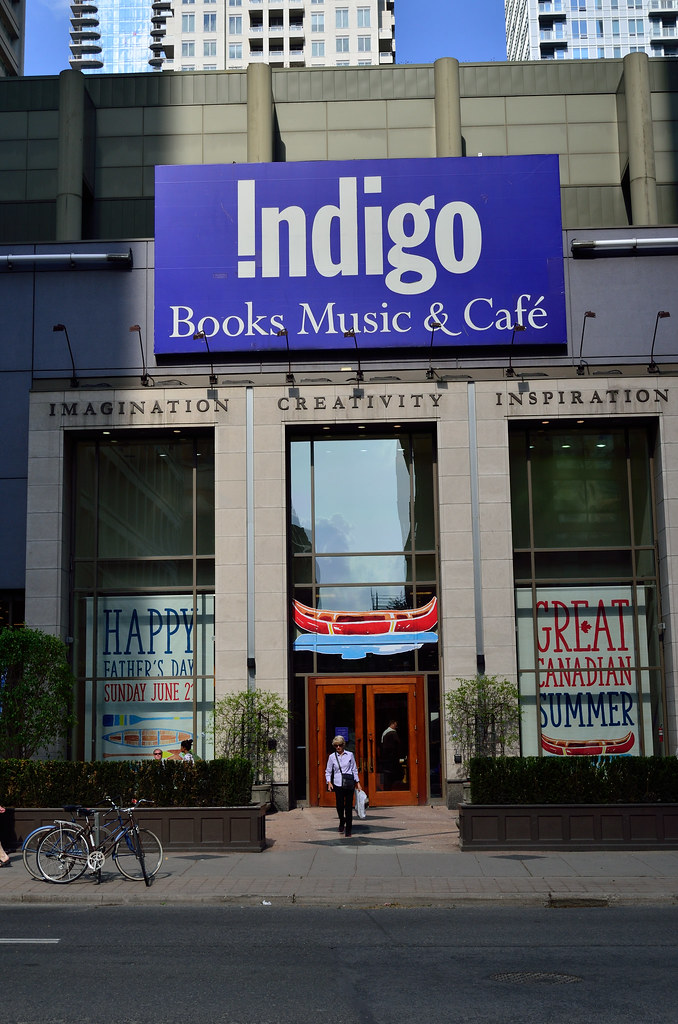
“Indigo Books and Music” by Open Grid Scheduler / Grid Engine is licensed under CC0 1.0

As you’ve heard, the bookselling chain was hacked, its employment records held for ransom. Indigo (rightly) refused to pay and the hackers are now expected to release the employees’ personal data on the dark web.

This all started a month ago. The company’s website went down along with its in-store credit and debit systems. The payment systems came back after about ten days. A new website was built and launched at the beginning of March. It is a much-reduced site with a much reduced catalog of books.

The repercussions will be enormous for both Indigo and the publishing community.

One of the things overshadowed by the hacks was the release of Indigo’s third-quarter results, covering the crucial holiday season. As we’ve noted before, the company’s finances are unsettling. It lost $37 million in 2019, $185 million in 2020, and $57 million in 2021. Things looked somewhat better in 2022 with a $3 million profit, but the first two quarters of 2023 (Indigo has a March 28 year-end) showed a loss of $41.3 million, about $10 million worse than in the first two quarters of the previous year.

The hope was that a blockbuster holiday season would get Indigo’s year back on track.

It didn’t happen. Revenue for Q3 2022 came in at $423 million, down $8 million from last year, with pre-tax profits of $36 million, down from $45 million last year.

After three quarters, Indigo now stands at an $8 million loss. The company’s fourth quarter, covering the first three months of the calendar year, is usually terrible (all retail suffers in the deep of winter). If this fourth quarter goes like the last, Indigo will be looking at a $30 million loss for its full year. But this fourth won’t go like the last because of the hack. I have no idea what it will cost in terms of lost sales and unexpected expenditures (or what will be covered by insurance). It’s hard to imagine the company not doing worse than $30 million after such a catastrophic event.

Most of Canada’s mid-size to large publishers sell somewhere between 25 percent and 60 percent of their books through the chain. The outage will hurt revenue for both publishers and authors. If there’s a silver lining here, it’s that it occurred in a dead season. But the knock-on effects will be substantial. I’m told Indigo has no visibility into its store sales or current stock levels across the chain. It’s being very cautious about bringing in new books apart from the most in-demand titles. Publishers I’ve spoken to say sales to Indigo are down and they expect returns to be large and late. (Booksellers send unsold inventory back to publishers for full refunds and the bulk of these come in the months after the holidays).

By the way, the latest results showed that Indigo is no longer a bookseller but a general merchandiser with a sideline in books. Blankets and cheeseboards accounted for more than 50 percent of the company’s total revenue over the holidays. Print was 46 percent, down from 54 percent earlier in 2022 and 67.4 percent eight years ago. The movement away from bookselling is picking up steam. I hope you like Amazon because it and the few independent bookstores Chapters/Indigo hasn’t manage to kill will be all that’s left of Canadian bookselling before very long.

March 8, 2023

Perhaps the Prime Minister ran out of glitterbomb distractions?

Filed under: Cancon, China, Government, Media, Politics — Tags: , , — Nicholas @ 05:00

In The Line, Matt Gurney speculates on why the federal government needed to be “punched in the face” for literally weeks before finally taking (some) action:

Let’s acknowledge something right at the top: no one really knows what the hell the prime minister proposed yesterday. Not in any specific policy sense, at any rate. But boy, did we ever learn something about how the Liberals are viewing this politically.

After weeks of bobbing and weaving and throwing out fistfuls of increasingly ridiculous chaff, Justin Trudeau has belatedly agreed to a series of actions to probe Chinese electoral interference in Canada. And maybe other interference? We don’t know. We do know it’ll involve NSICOP, which is an acronym in desperate need of an agreed-upon pronunciation, if Monday’s press conference was any guide. NSICOP is a joint House-Senate committee that reviews various matters relating to Canada’s national security and intelligence (read this on its website and you’ll know more than 99.9 per cent of Canadians do about NSICOP). There’s also going to be a splash of the National Security and Intelligence Review Agency (NSIRA), plus a special rapporteur. The special rapporteur will apparently be given broad powers and, should they recommend a full public inquiry, the PM will accept that.

Hell of an endorsement for someone who hasn’t been selected yet. It’s almost like the PM decided he had to make an announcement before he was ready to actually share many details about that announcement, for some reason. Like the announcement itself was the point. Weird, eh? Wonder what that was about. In any case, all we know is it’ll be an eminent Canadian.

Shoutout to all you eminent Canadians out there, I guess. Brush up those cover letters.

Winston Churchill frequently has this attributed to him: “You can depend upon the Americans to do the right thing. But only after they have exhausted every other possibility.” Our Canadian version might be that you can depend on Prime Minister Trudeau to do something, but only after he’s exhausted all of his glitterbombs on distracting public attention.

The way that the Liberals responded wasn’t shocking. They only have a few plays left in their playbook, and we’ve seen something just like this only a few weeks ago. (Which is why I’m wondering if they actually only have the single play left, come to think of it.) The Liberals have responded to the barrage of news stories over Chinese interference exactly the way they did over their controversial gun-control amendments from the fall. First, deny there’s a problem. Then accuse anyone saying there’s a problem of being Donald Trump 2.0 or somesuch. Then just cut right to the chase and call them racist. When that doesn’t work, wait a few days to see if the problem goes away. When it doesn’t — indeed, when it gets worse — that’s when you finally admit that you can’t just yell “DISINFORMING MAGA BIGOTS!” at people and watch as your problem magically evaporates.

With guns, after everything else failed, they withdrew the amendments (though I imagine they’ll try again, though probably with no better luck). With China interference, it was agreeing to some kind of process. All the unfilled blanks notwithstanding, even the fact that something is being agreed to shows a dawning of political reality in the PMO: ignoring this and hoping the leaks stop if you called enough people racist Trumpers wasn’t going to work. Clearly, sometime in the last few days, the PM and his staff reached the acceptance stage, and concluded that either they had to admit that there was enough here to warrant some kind of serious process, or they could just start randomly talking about abortion in the hopes that people fell for that.

No, no, wait. They tried that anyway.

It would be fascinating to know what specifically led to the mental breakthrough that enabled Monday’s announcement. Weeks of denials, evasions and counterattacks, a day of performatively fretting about abortion, and then, zap!, we’re getting an rapporteur — an eminent one! — and a process. Maybe they looked at some internal polling. Maybe they’re worried about a big scoop that’s yet to land. Or maybe they’re just tired of being on the defensive and figured that the proposals would stand a decent chance of smothering the issue to death with pillows stuffed with bureaucracy and abbreviations.

March 5, 2023

The clear drawbacks of depending too much on oral history

In The Line, Jen Gerson explains why you need to exercise caution when dealing with oral traditions:

Lac La Croix Indian Pony stallion – Mooke (Ojibway for – he comes forth), October 2008.
Photo by Llcips09 via Wikimedia Commons.

A BBC travel feature published several weeks ago had the hallmarks of a classic progressive narrative. It was the tale of the “endangered Ojibwe spirit horse; the breed, also known as the Lac La Croix Indian pony, is the only known indigenous horse breed in Canada.”

The spirit horse was reduced to near extinction by European settlers who treat these magical creatures, deemed “guides and teachers”, as a mere nuisance to be culled and eliminated in favour of more profitable animals like cattle, or so the telling goes. A native breed of a beloved animal struggling to survive in the face of voracious colonial settlers.

Someone call James Cameron.

Unless you know a little evolutionary history, that is. In which case, you will already be aware that this story is pure pseudoscientific hokum.

Look, no one likes to be disrespectful about sensitive matters where the legitimately oppressed and aggrieved claims of First Nations peoples are concerned. This is a nation that is struggling to come to terms with its own horrific colonial past. This process is taking on many forms: witness the applause granted to singer Jully Black, who recently amended the national anthem “our home on native land”. Or, perhaps, the calls by one NDP MP to combat residential school denialism by passing new laws on hate speech — which would make questioning certain narratives not only an act of heresy, but also a literal crime.

Listening to stories, and respecting lived experiences and oral histories Indigenous people at the core of Canadian history and identity has given a new credibility to the traditional knowledge of First Nations people in academia, media, and in society at large.

But the story of the Ojibwe spirit horse is a clear example of the limits of oral history.

The horses now roaming the plains of North America are not a native species. The horse did evolve on this continent before migrating to Asia and Europe. However, the North American breed is believed to have been extirpated about 10,000 years ago (or thereabouts) during a mass extinction event that wiped out almost all large land mammals.

There is some evidence that isolated pockets of a native horse breed may have survived in North America much later than this, but the horses roaming about today are descended from those that were brought from Europe after the 15th century.

Of course, science is always evolving, but the overwhelming bulk of genetic and archeological evidence to date supports this theory. The native North American horse is long, long gone. The bands of horses freely wandering the backcountry are not wild, but feral; they’re the product of escaped or abandoned horse stock of distant European origin.

March 1, 2023

If the Freedom Convoy “actually was what it has often been portrayed as on social media — a horde of thousands of literal Nazis and Confederates set on violently overthrowing our democratically elected government — then [we’d] be living in the Confederate Republic of Nazi Canada by now”

In The Line, Matt Gurney explains how going through Justice Paul Rouleau’s Public Order Emergency Commission report in detail leads to some uncomfortable realizations about Canadian goverment and policing — at all three levels — failed to meet minimal expectations of competency and capacity:

A screenshot from a YouTube video showing the protest in front of Parliament in Ottawa on 30 January, 2022.
Photo via Wikimedia Commons.

The convoy crisis — and I’m mostly speaking here about the events in Ottawa, though the situation at the border crossings fit the same general pattern — forced Canadian police and political leaders to respond quickly to evolving circumstances. And Rouleau’s report is just a relentlessly brutal catalogue of the ways they failed.

Is it really necessary at this point to recap the failure of the Ottawa police? We at The Line have long maintained that the complete failure of the Ottawa police to plan for and control the protest not only allowed the convoy to entrench itself, but also established the psychological paradigm that would define the crisis for weeks: the convoyers held the initiative (not to mention the capital) and the Canadian state was befuddled and adrift. From that, a national crisis was born. Rouleau is just devastating. “The OPS [Ottawa Police Service]’s planning challenges,” he notes on page 56 of the first volume, “were compounded by a general breakdown of command and control.” Super.

He’s even more brutal on page 185 of the second volume: “The influx of Freedom Convoy vehicles and the disruptive behaviour by some protesters threw the OPS operational command at the NCRCC [a command centre] into a state of dysfunction. OPS Inspector Lucas described the atmosphere at the NCRCC as chaotic and explained that he and his team had neither the capacity to process the incoming information nor the resources to respond to the needs it was facing. In the late afternoon of January 29, the OPP’s [Ontario Provincial Police] representative at the NCRCC, Inspector Dawn Ferguson, reported to OPP Superintendent Abrams that OPS members in the NCRCC were panicked and were swearing and yelling orders at each other and at partner agencies.”

Huh.

Moving up a level of government, much has already been written about the cowardice of the Ford government. If any agency performed semi-well, it was the Ontario Provincial Police. The OPP was the force that was generating most of the critical intelligence used (or ignored) during the crisis. It was quick to realize that command-and-control had collapsed in Ottawa (see above), and to begin working with the RCMP on a plan — eventually a series of plans — to restore order. You can’t read POEC and conclude the OPP performed perfectly. Far from it. It was probably the best we had, though, but because Ford took a gander at the mess in Ottawa and decided to mosey on off to the cottage, it couldn’t do much.

Huh.

And that leaves us with the feds. I have maintained since last year that the federal government hasn’t received nearly enough attention in our understanding of what the hell went wrong last year. This has caused a fair degree of pushback, especially from Liberal supporters who read any reference to the “federal government” as “our beloved prime minister”. But no — while I don’t think the prime minister or the federal cabinet did particularly well during the crisis, the real federal failures were in the officials that supported the PM and his ministers.

Among the many other failures, the inability of the various government and police organizations to organize and properly share the information they were handling is perhaps the most disturbing:

If you want to see it yourself, check out pages 38 and 39 of the third volume. For those in a hurry, though, it turns out that even within the government, the flow of information was so bad that the clerk of the privy council, and the prime minister, noted that staff were learning about the convoy not via internal reports, but social media. The federal government had, as Juneau and Rigby have noted, “intelligence gaps” that “hampered the government’s ability to understand, anticipate, and respond to the situation, and to reconcile conflicting information such as contradictory reports about the size of the convoy”. The federal government didn’t have the software to process and analyze online posts, even public ones.

And then there was this (my emphasis added):

    [National Security and Intelligence Advisor] Thomas also described an information-sharing gap between law enforcement and government. Assistant Secretary to the Cabinet, Security and Intelligence, Michael MacDonald recalled a significant delay in receiving updates from the RCMP, due to the RCMP’s obligation to consult with each intelligence agency that has provided the RCMP with information prior to sharing that information further (known as the “third party rule”). The NSIA’s office did not receive situation reports, project reports, or other forms of information, such as Project Hendon reports, that the RCMP obtained from other law enforcement agencies. Prior to the events of the convoy, the NSIA was not aware of Project Hendon. …

    NSIA Thomas further stated that it was sometimes difficult to know how to interact with law enforcement agencies. She recognized that government must not interfere in operational matters, but thought that there was nonetheless useful information that could have been provided to decision makers without encroaching upon police independence. However, senior officials were uncertain how to obtain that information, and were concerned about “crossing the line” both in requesting information and in discussing solutions.

… huh.

And that doesn’t even cover our now-outgoing national commissioner of the RCMP being so clueless she decided to just not mention germane information during a critical meeting because … well, we never really got a good explanation for that one. Oh well. Enjoy your retirement, Commissioner Lucki!

« Newer PostsOlder Posts »

Powered by WordPress