CGP Grey
Published 24 Nov 2019Join my email list: http://www.cgpgrey.com/email
Follow me on Twitter: https://twitter.com/cgpgrey


CGP Grey
Published 24 Nov 2019Join my email list: http://www.cgpgrey.com/email
Follow me on Twitter: https://twitter.com/cgpgrey
Alistair Dabbs describes most office kitchens I’ve encountered over my career:

Talking of timeslip, there is a wormhole in every shared office kitchen. I’ve experienced it at each of my clients’ premises so I guess it may be true everywhere.
When I arrive early in the morning, non-specific-gender-fascist swot that I am, I stride past the kitchen or kitchenette, admiring how spotless and twinkly it is from the deft attentions of the overnight cleaning contractors. Not for long.
It only takes a few seconds to pick my hot-desk location for the day since it’s always the same one, i.e. the only hot-desk not already baggsied by someone else the night before by leaving a spare jacket/cardigan/set of false teeth hanging on the back of the chair, i.e. the shitty desk next to the fire exit door that doesn’t quite shut properly and lets the weather in.
Pausing only a moment to brush away the mini snowdrift that has accumulated next to the power block, I put down my backpack and head straight back to the kitchen to brew up some chai.
When I get there, barely a minute after I passed it earlier, the kitchen has transformed into a disaster zone. Spilt milk, coffee and various puddles of water cover every level surface. Brown liquid of different shades are splattered artistically across the walls. The floor is carpeted with a layer of granulated sugar and broken mug handles which crunch unpleasantly underfoot.
Torn cardboard boxes and heaps of scrunched sheets of kitchen towel are arranged around the edge of the vast but glaringly empty dustbin. A cupboard door is swinging open on its only remaining hinge. The cutlery drawer has been pulled out and is now face-down in the sink. The kettle is on its side. The microwave is on fire. Where the dishwasher used to be is now a smouldering hole in the floor.
No worries, the cleaners will be back overnight to put it all shipshape again, wipe down the surfaces and shovel away any charred body parts.
As I have mused in this column on previous occasions, it makes one wonder what people’s houses must be like if their workplace kitchen etiquette extends to the personal domicile as well. This isn’t meant as a “bah dropping standards etc” whinge but a genuine interest in what the otherwise sane and talented individuals I meet in offices get up to in the privacy of their own homes.
In the (US) Spectator, Bridget Phetasy reports on her visit to the factory where Realdolls are made:

One of the sex dolls on offer at Aura Dolls in Mississauga, the first “sex doll brothel” in the Toronto area.
Photo originally published by BlogTO – https://www.blogto.com/city/2019/11/sex-doll-brothel-mississauga/.
The floor is slippery. I guess I shouldn’t be surprised, I’m taking a tour of Abyss Creations, the factory where the “Ferraris of love dolls”, RealDoll and Realbotix, are made. A thin layer of silicone coats almost every surface. A (real) woman in her late twenties, the PR coordinator, Catherine, shows me round. She has the attitude of a hostess at a theme-park restaurant: bored or stoned or maybe both. I’m sure she’s given hundreds of these tours, heard the same dumb jokes a million times and watched us all slap the ass of a doll reluctantly yet instinctively.
[…]
The employees look at the “love dolls” as more than just sexbots. They know their customers want a couch buddy. They want someone to cuddle at night. Perhaps they’ve lost a spouse and don’t feel like dating.
Whitney Cummings logged on to a forum for men who own the sex robots and monitored their conversations for months. “I thought they were going to be creeps, psychopaths,” she says. “I don’t know what to tell you. They’re very lovely men. They’re lovely. They adore their dolls. They marry their dolls. That is happening.”
What strikes me amid the body parts, the rows of eyes, the wall of nipples and the robot “brains”: these aren’t your weird uncle’s sex dolls. With the introduction of AI, these dolls are offering something their predecessors couldn’t: intimacy and affection.
“I always looked at them as art and I always found it funny that because it’s a sexually usable thing, it’s disqualified as art in the higher sense in a lot of people’s minds. They go, ‘Oh that’s not art, that’s just nasty'”, says McMullen. “And what’s funny about that is now we’re doing this serious engineering, artificial intelligence and robotics and now people aren’t so quick to dismiss it.”
Realbotix is the natural evolution of Abyss Creations, the company McMullen started in 1997 (in fact, Abyss Creations made the doll for Lars and the Real Girl). What began as just “real dolls” now has a robotic component, an AI team and an app.
McMullen talks about how he’s always wanted to break free of the sex toy stigma. “Yes people use them sexually, but they also get this huge sense of companionship from having a doll and a robot.”
The poor understanding of economic and political institution that Marx did so much to promote remains widespread today. “Progressive” and hard-left opponents of markets hold mistaken – or, at the very least, questionable – presumptions about reality, which include:
- Wealth is either fixed in amount, or, while it might be destroyed or diminished by certain human activities (such as war), if wealth grows this growth occurs largely independently of human ideas, choices, actions, and institutions;
- trade and commerce, therefore, are largely zero-sum – that is, each exchange situation pits a party who will win against one who will lose;
- trade and commerce, in turn, involve activities are thus, at best, suspect; trade and commerce too often reward greediness and duplicity while penalizing generosity and honesty;
- the “distribution” of wealth – whether conceived as financial flows or assets, or as access to real goods and services – is determined largely by power;
- prices set on markets are largely arbitrary; prices seldom play any role beyond determining how much one party “wins” from trade and how much the other party “loses.”
- each of a handful of large groups of people, mostly as conceptualized by intellectuals with no understanding of economics, has its own “interests” – interests that are shared by all members of the group and that are at odds with the interests of other groups; for example, “labor” has interests that are are shared by all workers and that are at odds with the interests of “employers”;
- while the state can be captured by ill-intentioned people, the state – especially under unlimited majoritarian rule – is also the only possible savior of the powerless against the predations and frauds of the powerful;
- absent vigorous state intervention, ordinary people – people whose main asset is the value of their own labor – lack both the power to get their fair share of society’s wealth and the intelligence or self-discipline to use wisely whatever share of wealth they do manage to secure;
- social progress is achieved by the powerless grabbing power under the leadership of men and women of singular vision, intelligence, and courage; “the People” will be led to the Promised Land – can be led to the Promised Land – only if they faithfully follow their caring messiahs;
- those who argue in favor of free markets are either soulless mercenary cronies for the powerful propertied class or they are ideologically blinded dupes for this class; no intelligent and decent person could possibly deny the enormous benefits available to “the People” when the state is empowered to work on their behalf against the propertied few.
Don Boudreaux, “Some Links”, Café Hayek, 2017-10-08.
[…]
OK, the most consistent mistake … not mistake, but inefficiency of business writing — and it was very consistent — is the absolute refusal on the part of the writer to tell you right away what message he or she is trying to deliver. I used to say to them, “The most important thing you have to say should be in the first sentence.” And “Oh, no, you can’t. I’m an engineer. We did a 10-year study, this is way too complicated.”
And inevitably, they were wrong. Inevitably, if they really thought about it, they were able to, in one sentence, summarize why it was really important. But they refused to do that because the way they found out was by spending 10 years of study and all this data and everything, and that’s the way they wanted everyone to look at what they did. They wanted their supervisors to go plowing through all they had done to come to this brilliant conclusion that they had come to.
COWEN: Through their history, through their thought patterns.
Drag everybody through it. And it was the one thing the newspaper people were taught to do that made more sense. You don’t have your reader’s attention very long, so get to the point. I found it was very difficult to get even really smart businesspeople to get to the point. Sometimes it was because they really couldn’t tell you what the point was.
What I wanted to say, but rarely felt comfortable saying, was, “If you don’t know what the point is, then you can’t really write this report.” But it was always too complicated for a layperson like me to understand. That was the way they did it. I was being hired by their bosses to tell them, “No, we want you to write clearly, and we want you to get to the point.”
COWEN: And why were they, at this meta level, resistant to your message?
Because nobody else was doing it. When I would start the class, I’d have 32 people in the class typically, and when they would turn in all their samples of writing, every one of them wrote the same way. They all wrote business-ese writing. This is my parody of it, but it was, “Enclosed please find the enclosed enclosure.” That kind of formal, nonsensical, meaningless flow of words. Somewhere in there would be something important, something significant, or maybe not.
Dave Barry, interviewed by Tyler Cowan in “Dave Barry on Humor, Writing, and Life as a Florida Man”, Medium, 2017-08-16.
As a socially anxious introvert with a lot of bespoke workplace rituals (I can’t write without aromatherapy), I used to think I was simply a weirdo for finding modern offices insufferable. I’ve been working from my cozy home office for more than a decade, and now, when I go to the Times‘ headquarters in New York — where, for financial reasons, desks were recently converted from cubicles into open office benches — I cannot for the life of me get anything done.
But after chatting with colleagues, I realized it’s not just me, and not just the Times: Modern offices aren’t designed for deep work. […]
The scourge of open offices is not a new subject for ranting. Open offices were sold to workers as a boon to collaboration — liberated from barriers, stuffed in like sardines, people would chat more and, supposedly, come up with lots of brilliant new ideas. Yet study after study has shown open offices to foster seclusion more than innovation; in order to combat noise, the loss of privacy and the sense of being watched, people in an open office put on headphones, talk less, and feel terrible.
Farhad Manjoo, “Open Offices Are a Capitalist Dead End”, New York Times, 2019-09-25.
Forgotten Weapons
Published 21 Oct 2019http://www.patreon.com/ForgottenWeapons
Cool Forgotten Weapons merch! http://shop.bbtv.com/collections/forg…
Courtesy of the Paul Mauser Archive, we have a very cool opportunity to look at the documentation and paperwork behind a production pistol design, from beginning to commercial sales. This sort of documentation is rare for pre-WW1 German small arms in general, and the Mauser Model 1910 pistol is a very rare example of a complete set of archival papers surviving. So, what we can look at is the whole development process from behind the scenes at Mauser. Initial design drawings, blueprints, glass-plate photography, internal assembly instructions, costing, corporate-level final approval, marketing, and final print manuals. Thanks to Mauro Baudino for supplying these original documents for me to show you!
The Paul Mauser Archive (http://www.paul-mauser-archive.com/in…) is a wealth of information for researchers, and make sure to check out the recent book on Mauser coauthored by Mauro Baudino and Gerben van Vlimmeren:
Contact:
Forgotten Weapons
6281 N. Oracle #36270
Tucson, AZ 85704

Colby Cosh discusses the moral squalor, cowardice, avarice, and reflex appeasement gesturing of the NBA and finds a Canadian angle to the whole mess:
The National Basketball Association has spent the week trying to control the effects of a tweet by Daryl Morey, general manager of the Houston Rockets, who jeopardized his job on Friday when he told readers “Fight for freedom, stand with Hong Kong.” The tweet winked out of existence quickly, but it had prodded a sore spot. Morey faced immediate criticism from the Rockets’ owner and from the Chinese consul in Houston. Steps were taken within China to declare the Rockets personae non gratae and to cancel some NBA broadcasts.
[…]
Which leads to us to the true Canadian angle, copyright Colby J. Cosh 2019 (all rights reserved). Daryl Morey’s tweet was the 21st century’s “Vive le Quebec libre.”
All right, Morey isn’t a statesman, as de Gaulle was — but the NBA itself wants us to believe that it is a force for international harmony, and Morey is a prominent figure in the NBA. There is an amusing subplot here in that Morey has traditionally been regarded as an outsider in the league, a computer nerd who barged his way in by using technical analytics to improve team performance both on the court and at the gate. The natural assumption of a person who went to university in the 1990s is that he would be perfectly free as a matter of course to blurt out a political opinion — one that is in no way remotely controversial in the free world — on Twitter. Well, we are all learning to revise such assumptions.
When General de Gaulle uttered the 1967 version of an ill-advised, impulsive tweet, it created a small spasm of anger in English Canada, as Morey’s endorsement of an increasingly separatist protest movement in Hong Kong has. (Chinese sovereignty in Hong Kong is supposed to be as much an accepted fact as Canadian sovereignty in Quebec, and from the Party point of view, the Hong Kong protests are internal civil disorder. The same, of course, would go for China’s re-education camps full of Uyghurs, who represent the fate that pro-democracy Hong Kongers are trying to avert.)
But it was the Canadian political establishment that de Gaulle really provoked to rage with his sly, ambivalent remark. It was seen as an offence against hospitality. Canada’s mandarins — pardon the inadvertent pun — knew that de Gaulle’s resounding “liiibre” would give, above all, moral impetus to the enemies of Confederation. This proved to be the case, as far as history can tell. Et donc — vive Hong Kong! Vive Hong Kong libre!
Many who agree with me here will nevertheless scold me for using, à la Bastiat, the provocative word “plunderers.” But I stick to my choice of words.
“Plunderers” is descriptive, for plunder is in fact what trade restrictions are all about. For two and a half centuries now we proponents of free trade have played mostly on the rhetorical turf of protectionists. On this turf there are language biases galore, such as “trade deficit,” a lowering of home-country tariffs described as “concessions” to foreign countries, the arrival in the home country of especially low-priced imports condemned as “dumping,” and, indeed, the word “protection” itself. Also, don’t forget the constant, clanking parade of inapposite military and sports metaphors.
For two and a half centuries now we proponents of free trade have typically treated the efforts of rent-seekers and rent-dispensers to portray their use of the state to enrich themselves at the expense of others with intellectual and moral respect. Why?
No one attempts to intellectually rationalize the theft and violence committed by street gangs. No one attempts to rationalize shoplifting, vandalism, armed robbery, arson, or rape. (It would, do note, be child’s play for a competent economics graduate student to develop a coherent theory of “optimal gang violence” that shows that, under just the right set of circumstances, there is an “optimal” amount of gang violence that improves the national welfare.) We call these destructive exercises of theft, coercion, and violence “theft,” “coercion,” and “violence.” We call these predatory activities what they really are.
By calling protectionism what it really is – the plunder of the many by the politically powerful few – we more vividly and widely expose protectionism’s ugly and cruel reality.
Don Boudreaux, “Quotation of the Day…”, Café Hayek, 2019-08-04.
When the government institutes price gouging laws in an emergency, the supply-demand mismatch that leads to the rising prices isn’t magically eliminated. First, without higher price incentives, all the incentives to get more supply into the area are lost. Supply and demand under these regulations can only be matched by rationing demand, and typically this is through queuing and increasing search costs (e.g. driving around all over the place looking for a station that is open and has gas). People who gain the limited supplies in this regime are thus those with a lot of time on their hands, where the marginal cost of queuing and driving around does not impose a lot of cost. Think about a roofer scrambling to repair roofs after the a storm — do they have time to have their trucks and crews sitting dormant in gas lines? Thus, price gouging laws tend to ensure that scarce goods in an emergency flow to those with the least use for them.
Warren Meyer, “Price Gouging Laws: Allocating Goods in An Emergency To People Who Have Nothing Much Valuable to Do”, Coyote Blog, 2017-08-26.
Sarah Hoyt on the increasing “green-ness” of her appliances — and the increasing uselessness of same:
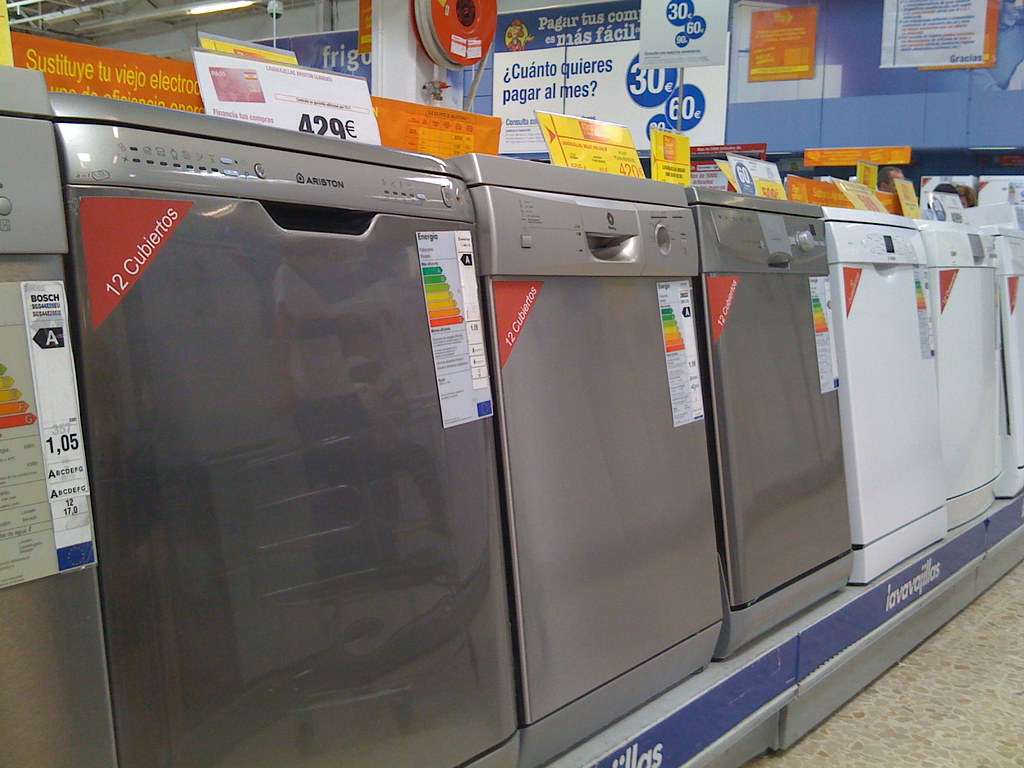
“A-rated energy appliances” by Tom Raftery is licensed under CC BY-NC-SA 2.0


For years we got expensive front loaders, and yet our clothes kept smelling, there were stains that would not come out, and these things seemed to last only 5 years, on the outside. And I knew it wasn’t our problem, as such, because at the same time we started noticing we couldn’t get our clothes clean, the detergent aisle of the supermarket sprouted an entire section of odor removing things, Febreeze got added to detergents, and, in general, people smelled odd …
Then the washer broke while we were also very, very broke (we were paying mortgage and rent in the run up to buying this. I saw an ad for, I THINK a $300 washer, and we went to look. What we found, instead, was a $200, not advertised washer. As we’re looking at it the saleswoman hurries over and tells us we don’t want it. This washer, she says, uses lots of water. For those who don’t know I suffer from an unusual form of eczema. While it’s triggered mostly by stress with a side of carbs, it can also, out of the blue, take offense at a slight trace of detergent left on the clothes. I’ve found that the eczema got markedly worse the less water the washer used. And it required me to run the washer three times, once with soap and two without to avoid major outbreaks. The idea of using lots and lots of water was great, so I was all excited. Which shocked the poor saleswoman halfway to death. I will point out, though, though that this washer washes well enough I can get away with only one extra rinse cycle and if I forget it it’s usually survivable. Also, our clothes don’t smell. Unfortunately, we’ve not found that [type] of washer any of the times we’ve walked through the appliance aisle, so I think that choice has been eliminated.
Certainly the choice of dishwashers that use “lots” (i.e. what they used 20 years ago) of water and electricity was never offered to us. And since we seemed to have really lousy luck with dishwashers, I found every time we replaced one over the last 20 years, they had less space for dishes (more insulation, to allow for less electricity) to the point that I needed to do 3 or even 4 loads for a family of four. I mean, I cook from scratch, but I really don’t use that much stuff. And it ran slower than before. Right now our dishwasher actually washes (a bonus) but it takes four hours to run a cycle. I rarely do more than one wash a day, though, because it’s just Dan and I, and we … well … the kids used a lot more glasses and little plates, and frankly meals get more complicated for four people.
All the same, there was a time there, for like 10 years, where we were running all this “green” approved stuff, and not only was I running the washer and drier more or less continuously, but to make things more “interesting” I was using MORE water and electricity, in the sense that I was running the appliances a ton more.
This of course is what I also found with the “low flush” toilets. We had them in our previous house, and we found that we spent an inordinate amount of time flushing the toilet. Also, since it took four or five flushes to do the job or one, the fact we were actually only using half the water per flush didn’t save any water. We spent instead twice to three times the amount of water the “high flush” toilets had spent.
All this, btw, to appease Paul Ehrlich — the prophet of wrong. As in, if he foresees something it will be wrong — and his ridiculous idea we’d run out of potable water in 1978. Apparently none of these people have noticed that 1978 has come and gone with no problems. And as for electricity, if they stop their idiocy about nuclear, it’s not even a consideration. (And no, Chernobyl isn’t a caution about nuclear energy. It’s a caution about stupid communist regimes. They can’t run anything — not even a nuclear plant — without destroying it.)
Lightbulbs are another favourite … several years back, our provincial government was pushing us all to get rid of our old incandescent bulbs and replace them with these great new energy-efficient compact fluorescent bulbs. The new CFLs cost roughly ten times as much as the old bulbs, but we were assured up and down that they’d last twenty times longer, so we’d not only save money on electricity, but also have to replace the bulbs so infrequently. Of course, the CFL bulbs were pathetically bad — not only were they expensive, the light they gave was (at best) marginal and they didn’t even last as long as typical incandescent bulbs.
So now, of course, we’re being encouraged to use LED bulbs. Sure, they’re more expensive than the old incandescent bulbs, but they save on electricity and last many times longer! Except, of course, they don’t. The old incandescent bulbs in my office started to fail one after another, so when I was down to only one working bulb, I gave in and bought four replacement LED bulbs … they were on sale for only 2-3 times as much as the old bulbs! That was in March. I’ve already had to replace two of the LED bulbs. This is starting to feel familiar…
On the bright side (pun unintentional), the LED bulbs don’t provide the entertainment of a toxic waste cleanup in your home the way the CFL bulbs did when they were broken.
Dylan Gibbons reports on a recent finding from the Harvard Business Review:

A new study published by the Harvard Business Review shows that in addition to men’s growing fears about women in the workforce and potentially being falsely accused, women are becoming more aware of the backlash and are actually less likely to hire certain women, specifically attractive women.
“Most of the reaction to #MeToo was celebratory; it assumed women were really going to benefit,” said Leanne Atwater, a management professor at the University of Houston. However, Atwater was skeptical. Rather than seeing an endless trail of steps forward before her, she and her colleagues forecasted a backlash.
“We said, ‘We aren’t sure this is going to go as positively as people think — there may be some fallout.'” And so, they tested their hypothesis.
The study began in early 2018. Two surveys were created, one for men and one for women. These surveys were then distributed to workers in various professional fields. In the end, they collected a large amount of data from 152 male and 303 female responders.
According to the study, 74% of women now say they are more willing now to speak out against harassment, while 77% of men anticipated being more careful about potentially inappropriate behaviour.
As for the idea that men do not know what constitutes harassment, the researchers found the opposite was true. Both genders appear to both know what constitutes harassment, and women may be more lenient with some of their own definitions of what constitutes harassment.
According to the report, “The surveys described 19 behaviors — for instance, continuing to ask a female subordinate out after she has said no, emailing sexual jokes to a female subordinate, and commenting on a female subordinate’s looks — and asked people whether they amounted to harassment.”
“Most men know what sexual harassment is, and most women know what it is,” Atwater says. “The idea that men don’t know their behavior is bad and that women are making a mountain out of a molehill is largely untrue. If anything, women are more lenient in defining harassment.”
Another recent action intended to increase the number of women in STEM subjects at an Australian university — by selectively lowering academic standards for admission — will almost certainly not achieve its stated goals, but will work to increase negative views of those women in the working world:
[A female engineer] also rightly points out that this lowering the bar for women is unfair to men losing the university places to women with lesser qualifications.
She points out that male students will notice that women are struggling more with the course material — the women allowed in because the bar was lowered.
She feels this is a net negative for women in the engineering sector in general, and I have to agree.
How, she asks, can employers be expected to see a woman’s engineering degree the same as a man’s if the employer knows the women got a break getting into the program?
She uses the term “positive discrimination” to describe the leg-up practices, and I really prefer that to “affirmative action” to describe it because the word “discrimination” is plain in it. And that’s exactly what it is. Discrimination against qualified people that will ultimately harm women who are qualified.
As she puts it, the only way to ensure that a woman’s qualifications mean as much as a man’s is to have equal hurdles for women.
I’m completely with her.
[…]
Which is where we get to see the pay deal matter in the raw. At the auto companies (well, absent those in and near bankruptcy problems) it was indeed possible to start shouting “But what about the workers?” Why should they get less generous pay or terms just so that the capitalists can make out like bandits? But here we’ve got exactly the same problem. And there are no capitalists, there are no profits. The income into NPR is pretty much exclusively used to pay the employees of NPR. There are no leakages to the capitalists so, in the absence of more money, what can be done?
[…]
You can see NPR’s finances here and it becomes obvious that they have available only two of the traditional three ways of dealing with a higher wage bill. In for profit companies there is that possibility of reducing the profit to pay the workers more. In the absence of profiteering this cannot of course happen. Thus, in order to accommodate higher wages they can either raise prices to stations which carry the programs or NPR can employ fewer people at those higher wages. They’re restricted to only two of those ways normally put forward. Something which does rather aid in highlighting why and how companies, for profit ones, react the way they do to forced pay rises.
That NPR is a non-profit aids in highlighting exactly the problems that all organisations have with demands for higher wages. With no profits to cut they can either charge more or employ fewer people, nothing else.
Tim Worstall, “NPR’s Problems – Isn’t It Fun When Workers At A Non-Profit Seek To Strike?”, Forbes, 2017-07-15.

Update: Apparently the Thread Reader App only picked up the first couple of entries (it worked fine when I queued it up for publication yesterday). Here’s the text version:
I just listened to the entire ethics commissioner’s report on the SNC-Lavalin scandal while driving back from Maine. I loaded up the text in my VoiceAloud app, hit play, and the audio kept me going for 3 hours, all the way into central New York State, along the I-90….
As with any narrative, you begin to identify with certain characters. In my case, it was @Puglaas. I found it especially maddening the way everyone around her kept babbling about finding a “solution,” which was their settled euphemism for bullying her into helping SNC…
The level of condescension exhibited by everyone in and around the PMO toward @Puglaas was breathtaking. These Liberal dudes always kept pretending that they just wanted to make sure she had enough “information,” as if she were a law student, not the AG of a G7 nation …
At the same time, it was breathtaking the way SNC Lavalin was essentially able to turn the entire PMO, and major ministries, into its personal lobbying operation. Texts, emails, calls, in-person visits… it was like SNC-Lavalin had Trudeau’s PMO on retainer, like a law firm ….
I hadn’t realized SNC was able to mobilize, or attempted to mobilize, not one, not two, but THREE former SC of Canada justices on its behalf. This is the sort of blurring between corporate & govt operations that u expect in banana republics (or in the Irvings’ New Brunswick)…
The fact trudeau & those around him still pretend this is about “jobs” is…I don’t even know the word for it. The ethics comm essentially called it a lie. This was about partisan politics. How can JT say he “accepts” the report without coming to terms with this core finding?
When this scandal & election is done, we need an inquiry that gets to the bottom of the larger issue here: how a single quebec corp, one heavily impugned by its own action, was able to essential create legislation to help itself, got trudeau to ram it thru on a budget omnibus…
And then spent weeks pulling every lever in ottawa to try to override our constitutional system of govt so they could get off the hook for alleged crimes, culminating in the actual reconstitution of cabinet. SNC turned our govt into a joke. And trudeau still sez it’s about “jobs”
If yr attitude is that u dont want to educate yourself about this scandal, bcuz the only thing that matters is hating @AndrewScheer (an attitude some ppl have candidly expressed) pls reconsider. Even if u vote Liberal, the scandal exposed problems in our system that need fixing
Conservative governments have no doubt been equally solicitous to big well-connected firms. Leftists *especially*, the same ones dismissing this scandal bcuz it interferes with their elxn narrative, should be horrified that corporations are treating @Bill_Morneau & PMO as puppets
The fact that all of these Libs can bleat “jobz jobz jobz” with a straight face isnt just a symptom of the amoral cynicism of politics (tho it is that). It reflect the fact that we canadians expect that big corps will get coddled like this. We need to end it
If youre @AndrewScheer or @theJagmeetSingh, it’s fine to rake the Libs over the coals for lying to us. But all politicians lie. Tell us how you’d fix the system structurally to ensure that the PMO isn’t acting as a pro bono hanger-on to a major corporation
And if you’re a progressive activist of a certain age, go back & look at all the things @NaomiAKlein @Sheila_Copps Judie Rebick etc warned us about during the free trade battles…corporations dictating terms to elected govts. Well, guess what ? That’s what’s on display here…
In fact, one of the most tragicomic subplots here is the Libs running around in full panic bcuz SNC was about to have a board meeting the next day… Yes, that’s right: Trudeau’s PMO prioritized important legal decisions on the basis of some company’s board meeting.
Because Jobz.What’s more, the full-court press on @Puglaas in the shadow of these meetings was itself based on another lie: Libs knew SNC HQ couldnt abandon quebec (till 2024) bcuz of representations made to Caisse in regard to purchase of a UK sub. Bullshit layered on bullshit
#BecauseJobzI keep coming back to @Puglaas, & how she must have felt. How many cdns have been in a job where yr boss & his minions tried to pressure u to find an unethical “solution,” to help the boss keep his own job? then when u did what was right, u get turfed 4 not being a “team player”
This isnt just about Trudeau. One galling episode described is a meeting in which @Bill_Morneau pontificates to @Puglaas about how she doesnt have enuf “information” about econ effects of possible SNC crim conviction. @Puglaas asks Morneau if he’s done a study on it. Answer: no.
We talk a lot about toxic workplaces for women. hard not to see how the dudes who Trudeau assigned to push @Puglaas around on this file aren’t guilty of this. Their strategy was to make her feel ignorant bcuz she did the right thing. The PMO gaslit their own justice minister
There are several female Liberal MPs whom I have come to know and respect, such as @juliedabrusin @cafreeland @JulieDzerowicz. It is mortifying to watch them being forced to line up in defence of this.
As for SNC itself, I don’t really blame it for doing what it did. If u were running a company and knew you could dictate terms to a govt, why not? The lesson to other CEOs would be that if youre accused of a crime, just threaten to lay ppl off and move your HQ. Problem solved.
final note…u can see y the Libs are going hard with demagoguery about @AndrewScheer being white supremacist-adjacent. A traditional leftist claim was that Tories would sell out to corporate interests. That’s a hard claim for Libs to make now. bcuz the Libs have already done it
It’s been a day since I wrote this thread, & some commenters are saying the SNC scandal shows Trudeau & the Libs are unscrupulous people. But I dont think that’s it. I have met some of these protagonists, and have found them to be *more* public-minded than the average citizen…
As noted in a response to @staceylnewman, the problem is that politics changes ppl. There’s a chilling quote in the report, from a meeting, where a Lib says to @Puglaas (paraphrasing here) “It doesn’t matter how great our policies are. We need to get re-elected to implement them”
To me, that sums everything up: The means justifies the ends, bcuz the ends (the “good” side wins power, & the “bad” side loses) are taken to have existential importance. That’s the myth that leads all politicians astray. If JT just admitted this, I bet many would forgive him



Powered by WordPress