
Feral Historian
Published 2 Sept 2022A quick look at a minor and neglected detail of Cixin Liu’s Three Body Problem series. I trust that everyone has done the reading.
September 17, 2025
Dark Forest Deterrence: Bureaucrats are Destroying the Universe
Comments Off on Dark Forest Deterrence: Bureaucrats are Destroying the Universe
September 13, 2025
QotD: The Peter Principle in football, the military, and life in general
There needs to be a word for that inflection point where the “player” and “coach” levels don’t just diverge, but actually seem to become opposites. Is that an organizational thing, a cultural thing, or what? It’s all “football”, and you probably don’t want guys who have never taken a snap to suddenly be calling plays from the sidelines, but it seems like rising to the top of one side almost by definition precludes you from doing well on the other side (for every great player who was a terrible coach, there’s a great coach who was a terrible player. I don’t think there’s any doubt that Bill Belichick is the best coach currently in the NFL, and he’s got to be a strong contender for best coach of all time, but his playing career topped out at Wesleyan University in Middletown, CT).
Is that true in other jobs where you need a combo of a certain physique, a certain IQ, and a certain attitude? The military, say, or the police? Would the average platoon sergeant be a better lieutenant than the average lieutenant? (I’m seriously asking, even though I know that the average corporal’s opinion of the average butterbar lieutenant and vice versa makes the town-gown split in college look like a friendly rivalry). What about the best NCO — would he make a good general? How about the best patrolman vs. the best detective?
And of course this is complicated by the outliers. SWAT guys generally don’t become police chiefs, Special Forces guys don’t become generals (that McChrystal bastard being an unfortunate exception), and so on, but those are extreme outliers, like quarterbacks — physical freaks with fast-firing heads; they don’t want desk jobs, I imagine.
The reason I’m rambling on about this (other than “I’m jet lagged and I have the flu”) is that our whole society seems to have fucked up its competence sorting mechanism, and that flaw seems to be structural. You don’t want a coach who never played, or a general who never fought, but at the same time there’s fuck-all relationship between “being good at playing / fighting” and “being good at coaching / strategizing” that I can see. The same applies in all bureaucracies, of course, we call it the “Peter Principle” — the guy who was good at answering phones in the call center might or might not be any good at supervising the call center, but there’s only one way to find out …
… or is there? Football is interesting in that there’s only one metric for success, and it’s easy for everyone to see. There’s absolutely zero question that So-and-So was a good player, in the same way that there’s zero question So-and-So was a good coach. You can always find nerds and lawyers to niggle around the edges — oh, So-and-So is overrated, and here’s my charts and graphs to prove it — but we all know what that’s worth. Figuring out a better way to sort talent in a binary system like football would go a long way to help us figure out how to fix our society’s fucked-up competence sorting mechanism.
Severian, “Friday Etc.”, Founding Questions, 2022-02-04.
September 12, 2025
Canada’s temporary foreign worker programs
At Acceptable Views, Alexander Brown calls for the end to the Canadian federal temporary immigration scam programs:
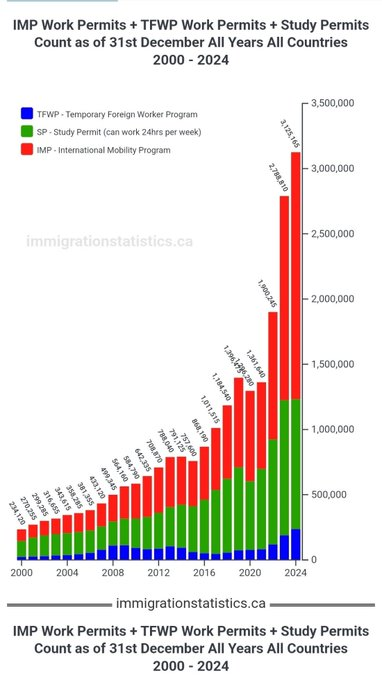
It’s not hyperbole to say that Canada has built an entire economy on exploiting cheap, foreign labour through TWFP, as well as the International Mobility Program (IMP). These are two slightly different programs that allow foreign nationals to work in Canada, with most going to Ontario. But contrary to its name, there is nothing “temporary” about the TFWP. Its original purpose was to remedy proven labour shortages while Canadians were hired and trained to eventually do the jobs in question. Meanwhile, the IMP allows international students to work—with or without a proven labour shortage—while they’re studying in Canada.
Between 2019 and 2023, the TFWP increased by 88 percent and the IMP increased 126 percent. They account for close to 1.58 million work permit holders, equal to roughly 7 percent of Canada’s labour force.
Taken together, the results of the TFWP and IMP are deplorable. The TFWP allows foreign nationals to be recruited abroad in vast numbers, brought to Canada, housed in degrading conditions, paid the minimum wage, forced to work long hours, pressured into not joining a union, and required to work for only one employer. Yes, the IMP is more flexible, but it’s more pernicious because it does not even pretend to address labour shortages.
Both schemes are also of course bad for Canadians themselves. The problem is especially grievous for young Canadians trying to get started in the labour market. Canada lost 40,800 jobs this past July, the unemployment rate is now 6.9 percent, and youth unemployment (those between 15 and 24 years old) is now 14.6 percent.
Both the TFWP and IMP are used as business models. Hiring foreign nationals at minimum wage keeps prices low and profits high—most notoriously in the hospitality and trucking sectors, but no industry seems untouched now.
Addicted to cheap foreign labour
The use of the TFWP in the healthcare sector, for example, has grown by an appalling 1,700 percent since 2000. That dramatic rise has no doubt been abetted by the absence of uniform standards and credential recognition among Canadian provinces. If medical personnel could move easily from one province to another, shortages could be filled by Canadians. But historically this has not been possible, and so medical institutions have had to turn to the TFWP. Ontario’s recent determination to solve this problem by speeding up recognition of 50 “in-demand” professions from other provinces is a step in the right direction, and hopefully not too little too late.
Meanwhile, the IMP is a vehicle for outright fraud, ranging from fake acceptance letters from bogus “colleges” to elaborate human-trafficking schemes. Not long ago, nearly 50,000 holders of foreign student visas were working and attempting to settle here, rather than studying at any Canadian university or college. Most were migrants from India, and some were trying to cross the border illegally into the United States. The RCMP is now working with Indian law-enforcement to investigate alleged links between dozens of “colleges” in Canada and two “entities” in India allegedly facilitating passage into the U.S. When we reflect that an astounding 4.9 million temporary visas are set to expire this year, we have reason to believe that this abuse, exploitation, and fraud are on a much larger scale that we understand.
The consequences for young Canadians
Both the TFWP and the IMP serve to keep wages artificially low and profits high, and to price Canadians out of the job market. It wouldn’t be wrong to view these programs as distortionary government subsidies or welfare for unproductive businesses. The effects disproportionately harm younger Canadians who are priced out of the labour market, given that temporary workers overwhelmingly earn less than the median wage. And yet, we’re constantly hectored about labour shortages, Canadians’ “unwillingness” to do certain jobs, and the need for foreign workers.
It shouldn’t take much intellectual effort to see that the use of foreign labour and the difficulties of employing younger Canadians are two sides of the same ugly coin. Foreign workers are more cooperative because they are bound to their employers like serfs. They face normally insurmountable barriers to joining unions and have no attachment to the community in which they’re expected to work. In comparison, the domestic population is generally better educated and rooted in the local community.
Young Canadians can afford to be discriminating and should rightly expect higher wages than foreign nationals. Employers should instead work harder to invest in and reward their domestic workforce. In any other era, this would have been obvious. But now there is little incentive for businesses to look beyond cheap, foreign labour.
To get an idea of the magnitude of our collective failure here, consider the following fact. A 2024 study by RBC Economics revealed that Canadian businesses are sitting on a stockpile of cash worth almost a third of our country’s GDP. In other words, Canadian companies have the means to invest in hiring and training Canadians, but simply refuse to do so. The results of this refusal are stagnant wages, structural unemployment, and a de-skilling of the domestic population.
Comments Off on Canada’s temporary foreign worker programs
September 9, 2025
Employers insist that there are lots of high-paying “entry level” jobs that Canadians won’t do
Canada’s insanely out-of-control temporary foreign worker program hinges on employers being honest about the jobs on offer being impossible to fill with Canadian citizens or legal immigrants. The huge numbers of these jobs — often listed at much higher than minimum wage in areas with very high unemployment — strongly implies that employers are systematically gaming the system:

A selection of jobs subject to active Labour Market Impact Assessments (LMIA), meaning that an employer has applied for a temporary foreign worker on the grounds that no Canadian is available to fill the position.
Photo by Government of Canada Job Bank.
If public sentiment is turning against the TFW system, it’s partially because of a greater awareness of the conditions under which employers are claiming they cannot find Canadians for their jobs.
Any hiring of a temporary foreign worker has to first be preceded by a “Labour Market Impact Assessment”. It’s effectively a job posting laying out the basic details of the position, and carrying the disclaimer “the employer could not find a Canadian worker for this job and applied for a Labour Market Impact Assessment (LMIA) to hire a temporary foreign worker”.
What’s made many of these LMIAs so controversial is that they often describe quite desirable jobs with minimal qualifications. There are also noticeably high numbers of them being submitted in cities with high unemployment.
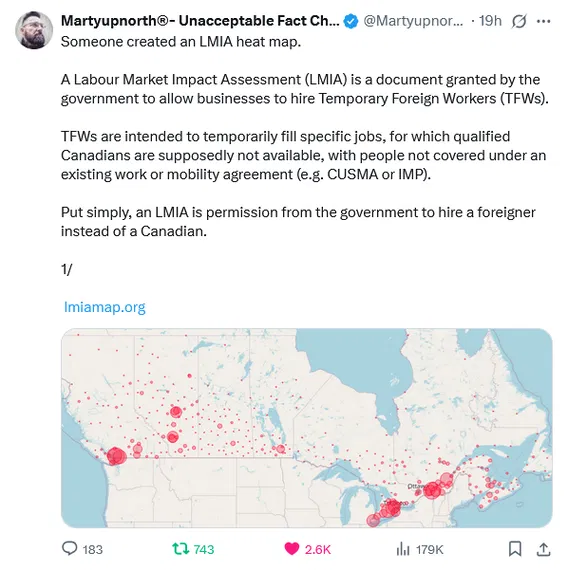
Last year, a viral Reddit post featured a heat map of all the Toronto-area employers who had been approved for temporary foreign workers after claiming to find no Canadian applicants. More recently, the website JobWatchCanada has launched a searchable database of active LMIAs, complete with interactive maps and guides to which employers are the heaviest users.
What really bothers a lot of Canadians about the program is the high number of jobs posted with few or no qualifications at well-above market rates at the same time that young Canadians are finding it impossible to get hired no matter how many positions they apply for:
In June, a Calgary auto shop submitted an LMIA for a “motor vehicle mechanic helper”. The job is to essentially act as a “gofer”. The starting wage for the helper job is $36.50 per hour, the employer promises to cover relocation costs, and the “experience” category contains only the words “will train”.
A Langley, B.C., drywall contractor said it can’t find any Canadian drywall installers at $36.75 per hour. A vape shop in Lloydminster, Sask., has filed an LMIA to fill a $36.05 per hour shift supervisor job in which the educational requirement is a high school diploma.
In Woodbridge, Ont., a homeowner filed an LMIA for a $38 per hour housekeeper in which the only qualification is that the applicant has to speak English. “No degree, certificate or diploma”, is listed in the space for educational requirements, and the requirement for work experience is just “will train”.
The useful site fakejobs.ca currently shows three LMIA positions in my small town each paying at least $35 per hour that supposedly can’t be filled by local applicants. The jobs — two food service supervisors and a marketing co-ordinator — can’t possibly have such exotic required qualifications that nobody in the area can match, which is why I strongly suspect they’re fakes.
Comments Off on Employers insist that there are lots of high-paying “entry level” jobs that Canadians won’t do
September 6, 2025
The federal government’s foreign worker program is set up for abuse
Dan Knight discusses Canada’s deliberately two-track job system, which severely disadvantages unemployed Canadians and favours temporary foreign workers instead:
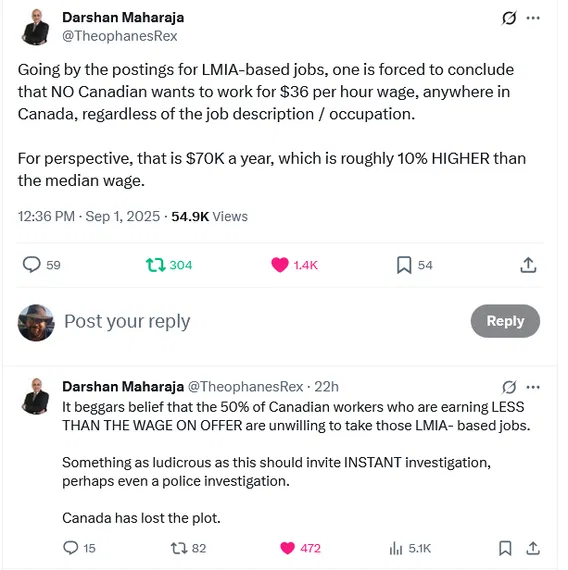
Canada now has a two-track employment system. On one track, you’ve got over 1.6 million Canadians unemployed the official rate just jumped to 7.1%, the worst since 2016 outside the COVID crash. Youth joblessness? 14.5%. Alberta, supposedly an economic engine, bleeding at 8.4% unemployment. And those folks are drawing EI, funded by your tax dollars.
On the other track? The Temporary Foreign Worker pipeline. In 2024 alone, Ottawa issued over 162,000 TFW permits by October. And they’ve already budgeted another 82,000 entries in 2025. Think about that: while Canadians are struggling to find work, Ottawa is busy handing out golden tickets to foreign workers.
And let’s be honest about how this program actually works. It’s sold as a way to “fill labor shortages”. In practice, it often looks like a backdoor family reunification scheme. Business owner Abdul suddenly needs a “specialized” worker conveniently, his cousin in India just happens to fit the bill. So instead of waiting in line under the normal visa system, he comes in the side door through the TFW program. Legal? Sure. Exploitative? Absolutely. It undercuts the immigration rules that everyone else has to follow, and it keeps wages low for Canadians who should be first in line.
Here’s the part that makes you wonder if Ottawa is even trying: we’ve got two federal departments, Employment and Social Development Canada (who runs EI) and Immigration, Refugees and Citizenship Canada (who runs TFW permits). Wouldn’t a functioning government have these two agencies talk to each other? One department says, “Hey, we’ve got 1.6 million people sitting on EI“. The other says, “We’ve got 162,000 employers asking for TFWs“. The obvious solution? Connect the dots. Fill Canadian jobs with Canadian workers first.
But that would require coordination and “coordination” is a foreign concept in Ottawa. These are the same geniuses who can’t keep escalators running in Parliament Hill without a three-year feasibility study. You expect them to line up two departments, EI and Immigration … and have a five-minute conversation? Forget it. Imagine the radical idea: one arm of government saying, “Hey, we’ve got 1.6 million Canadians unemployed and drawing EI …” and the other saying, “Oh great, we’ve got 162,000 employers begging for workers. Maybe, just maybe, we could match those two groups up“. That’s not rocket science. That’s not even science. That’s called basic competence. And Ottawa can’t even spell it.
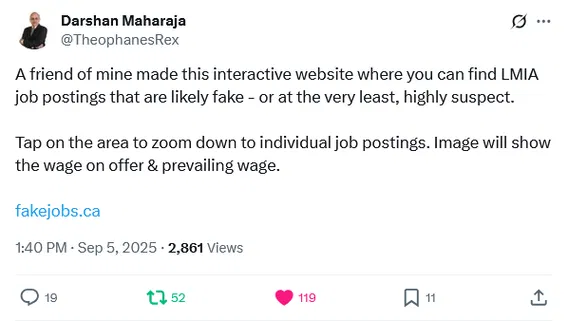
Using the fakejobs.ca website, I found three LMIA postings in my small town on the edge of the GTA … all paying well over median for pretty ordinary retail management jobs.
Comments Off on The federal government’s foreign worker program is set up for abuse
September 5, 2025
End the “temporary” foreign worker scam!
In the National Post, Chris Selley explains why Pierre Poilievre and the federal Conservatives should be hammering their demand to eliminate the much-abused temporary foreign worker program:
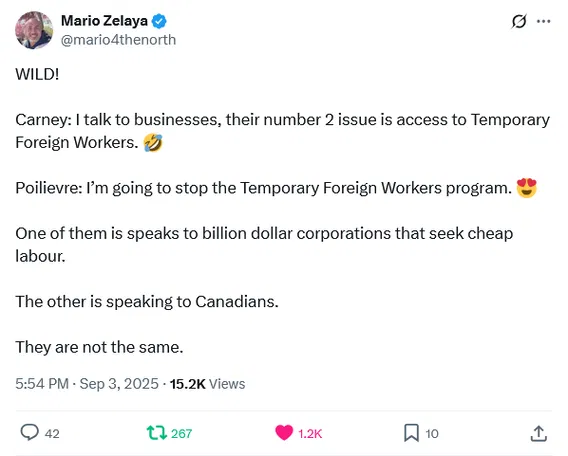
Youth unemployment stands at 14.6 per cent, according to Statistics Canada’s latest release. That’s the highest non-pandemic July figure since 2009 (15.9 per cent), at the nadir of the Great Recession. It makes nothing but good sense that Conservative Leader Pierre Poilievre would position himself, as he did on Wednesday, foursquare athwart bringing in any more temporary foreign workers to fill positions that certain employers swear blind they cannot fill with younger Canadians at any conceivable price.
“Why is (the government) shutting our own youth out of jobs and replacing them with low-wage temporary foreign workers from poor countries who are ultimately being exploited?” Poilievre asked, rhetorically, on Wednesday. By rights it ought to be a solid populist pitch to Canadians, and no-brainer policy besides.
Companies who use TFWs will insist it’s not about finding “cheaper” help, but about finding any help. Tim Hortons defended itself Wednesday noting that less than five per cent of its national workforce were TFWs — which seems like a very high number, right? It’s not just me? — and those hires tended to be clustered “in small towns and communities where local candidates are not available”.
But an odd sort of small town or community, surely, that can’t live without a Timmy’s, but that doesn’t have enough people to work at it. And it’s an odd sort of remedial program, surely, to bring in employees not from other parts of Canada but rather from halfway around the world. Especially since groups like the Canadian Federation of Independent Business (CFIB) swear blind they’re not after an hourly wage discount, just anyone who’s willing and able to fill the position. It was certainly a very odd kind of fishing resort, it struck me, that claimed this summer it couldn’t find any Canadian employees and needed the TFW program instead.
Didn’t kids used to flock en masse cross-country to take outdoorsy jobs every summer? Have I not read 150 tiresome baby-boomer op-eds on the topic?
The special pleading sometimes beggars belief. And unemployed young Canadians aren’t free to you and me, after all — whoever’s fault it is, if anyone’s, they’re an anchor on the economy. A Deloitte study commissioned by the King’s Trust Canada, published in November, estimated “that under the right conditions, overall real GDP could increase by $18.5 billion by 2034 — more than Canada’s entire arts, entertainment and recreation sector — and (Canada could) add an additional 228,000 jobs in the process” if “youth engagement in the workforce” significantly increased.
Comments Off on End the “temporary” foreign worker scam!
September 3, 2025
Dad’s Army caricatures capture life in Britain today
At The Daily Skeptic, Guy de la Bédoyère wonders why everything in modern Britain emulates an episode of the 70s sitcom Dad’s Army:

Dad’s Army, a BBC sitcom that ran from 1968 to 1977, starring Arthur Lowe as Captain Mainwaring, John Le Mesurier as Sergeant Wilson, and Clive Dunn as Lance Corporal Jones.
There are plenty of natural laws, but here’s one unique to Britain:
Every organisation, committee, scenario, initiative and government-backed and corporate project in Britain will inevitably degenerate into a scene from Dad’s Army.
That of course is the celebrated sitcom Dad’s Army, based on the world of Britain’s Home Guard in the Second World War, which ran for nine series in the 1970s. Every character is caricature, and sometimes not even as much as that.
Just think about it. Captain Mainwaring, the prickly bank manager and obsessed with status – the ultimate incompetent management figure, forever frustrated by his own paltry military service in the Great War and now strutting around like a dumpy cockerel as commanding officer of the platoon.
Sgt Wilson, a complacent, dozy and lazy member of the establishment, effortlessly imbued with a sense of privilege and world-weary detachment. Persistently given to undermining Mainwaring.
Lance-Corporal Jones, the panic-stricken jobsworth stifling initiative at every turn and floundering haplessly around to demolish every project with his matchless ability to overcomplicate anything and everything. He has a special skill for wasting inordinate amounts of time with ludicrously impenetrable explanations, usually based on fantasy.
Private Frazer, the miserable doom-laden pessimist and undertaker, forever raining down scorn and stirring up opposition and discontent in the ranks, his own ambitions in the platoon thwarted.
Private Walker, the skiving skimmer who dodged regular military service. Forever on the take but essentially harmless and even with some good characteristics.
Private Godfrey, the embodiment of the well-intentioned but largely hopeless pensioner whose presence relies usually on everyone else. Constantly called away to relieve himself.
Private Pike, the idiotic mummy’s body excused military service. Today he would have a certificate excusing him from any form of employment for anxiety, ADHD and anything else his mother or the system could come up with.
Then there’s the ARP Warden Hodges, whose sole purpose in life is feuding with Mainwaring, finding fault with the platoon’s men and triumphantly announcing their infractions. Hodges is the confrontational and dispute-loving trade union leader to Mainwaring’s shambolic management. His only mission in life is to create conflict and throw his weight about.
To these we can add various other characters, all comic figures (like the vicar and the verger) but essential props that amplify the authenticity.
The reason the sitcom lasted so long is very simple. Every single organisation in Britain is in home to some of or all these personality types, whether it’s the parish council, a local arts society, a corporation or the government.
Almost every problem the Home Guard platoon is confronted with results in bickering, chaos and wasted time, based mostly on posturing, obstinacy, incompetence, obsession with status and a lack of foresight, common sense and lateral thought. If the outcome is a good one, it’s invariably the result of chance.
Sounds familiar? It doesn’t matter what you think about the boats, climate change, the welfare state or the NHS. Every one of Britain’s current problems is being dealt with as if each was an episode of Dad’s Army.
Update, 5 September: Welcome, Instapundit readers! Please do have a look around at some of my other posts you may find of interest. I send out a daily summary of posts here through my Substack – https://substack.com/@nicholasrusson that you can subscribe to if you’d like to be informed of new posts in the future.
September 2, 2025
QotD: “Fixers” and “minders” for foreign visitors
Ted Campbell, “A new front in Cold War 2.0”, Ted Campbell’s Point of View, 2020-06-26.
Comments Off on QotD: “Fixers” and “minders” for foreign visitors
September 1, 2025
QotD: The Ivy League
The Ivies are now what they’ve pretty much always been — the equivalent of those Higher Party Academies in Moscow. They’re finishing schools for the Apparat. Oh sure, you can probably find a graduate of Ohio State or some such place at Quantico or Foggy Bottom … but I promise you, he hears about it every single day of his life. If they don’t actually teach classes called “How to be a Toady in the DOJ” and “Catching a Senator’s Farts” at Dartmouth, they might as well.
Take your Basic College Girl, make her unisex, crank her up way past eleven on meth and steroids, and that’s the typical Ivy League grad. And they all go directly into Government. Just in case you still cherished some vague hope we could vote our way out of this, remember that guys like Robert McNamara and McGeorge Bundy were the absolute best the Ivy League has produced in the modern era. The Democratic People’s Republic of Vietnam says hi!
Severian, “First Mailbag of the New Year”, Founding Questions, 2022-01-07.
Update, 2 September: Welcome, Instapundit readers! Please do have a look around at some of my other posts you may find of interest. I send out a daily summary of posts here through my Substack – https://substack.com/@nicholasrusson that you can subscribe to if you’d like to be informed of new posts in the future.
August 27, 2025
QotD: A critical bureaucratic talent
Someone nudged the Archchancellor of Unseen University, who had nodded off.
“Eh? What?” said the wizard, startled into wakefulness.
“We were wondering,” said the Patrician loudly, “what you were intending to do about this dragon of yours?”
The Archchancellor was old, but a lifetime of survival in the world of competitive wizardry and the byzantine politics of Unseen University meant that he could whip up a defensive argument in a split second. You didn’t remain Archchancellor for long if you let that sort of ingenuous remark whizz past your ear.
“My dragon?” he said.
“It’s well known that the great dragons are extinct,” said the Patrician brusquely. “And, besides, their natural habitat was definitely rural. So it seems to me that this one must be mag—”
“With respect, Lord Vetinari,” said the Archchancellor, “it has often been claimed that dragons are extinct, but the current evidence, if I may make so bold, tends to cast a certain doubt on the theory. As to habitat, what we are seeing here is simply a change of behavior pattern, occasioned by the spread of urban areas into the countryside which has led many hitherto rural creatures to adopt, nay in many cases to positively embrace, a more municipal mode of existence, and many of them thrive on the new opportunities thereby opened to them. For example, foxes are always knocking over my dustbins.”
He beamed. He’d managed to get all the way through it without actually needing to engage his brain.
Terry Pratchett, Guards! Guards!, 1989.
Comments Off on QotD: A critical bureaucratic talent
August 26, 2025
“One of the top tips for having a decent country is never, ever, allow the fuckwits to gain power”
If you need to drop someone off at London’s Gatwick Airport, you’ll find yourself facing a £7 charge for the privilege, no matter what day of the week or time of day you choose. Tim Worstall explains why:

“Gatwick Airport, North Terminal” by Martin Roell from Berlin, Germany is licensed under CC BY-SA 2.0 

 .
.
It’s sod all to do with congestion and everything to do with the tractor production statistics the fuckwits have imposed upon the airport.
The conditions attached by the transport secretary included national landscape provisions as per the Levelling Up and Regeneration Act 2023, more consideration for sustainability in buildings design and additional pollution-related mitigation measures.
The government said in its formal response to the Planning Inspectorate’s recommendations on the Gatwick DCO that it wanted more detail on how it would achieve its commitment of 54% of passengers arriving at the airport via rail within the first year of dual runway operations, which could be by the end of this decade.
The government has a target. That 54% of the arrivals at an airport — yes, an airport, where people get on jet planes — must be by public transport. Therefore the airport is charging for car drop offs in order to decrease the number of car drop offs. There is no more reason than that. Or, as up at the top, the reason there’s a £7 drop off charge at Gatwick Airport is because we are ruled by the fuckwits who have a target for public transport to an airport where people then get on jet planes.
London Gatwick has also accepted a requirement to have 54% of passengers using public transport prior to bringing the Northern Runway into operation and has reiterated the need for third parties, including the Department for Transport, to support delivery of the necessary conditions and improvements required to meet this target. This would include, for example, reinstating the full Gatwick Express train service.
Given the reliance on other parties to achieve this 54% target, should it not be achieved then London Gatwick has also proposed an alternative cars-on-the-road limit to be met before first use of the Northern Runway to address concerns about possible road congestion. Furthermore, if neither the 54% transport mode share or the cars-on-the-road limit are met, then use of the Northern Runway would be delayed until £350m of road improvements have been completed. This would make sure any additional road traffic flows can be accommodated and any congestion avoided.
It’s all fuckwit targets set by fuckwits.
Of course, there are those who think that fuckwit targets set by fuckwits are a good idea. For one of the problems of life is that there are always fuckwits:
When we talk about airport expansion, we often focus on runways, terminals, and the physical infrastructure. But what about how people actually get to the airport?
The journey begins long before passengers step foot in a terminal, and their choices about transport can have a significant impact on congestion, carbon emissions, and overall passenger experience.
One of the conditions set for Gatwick’s expansion is a legally binding guarantee that 54% of passengers will travel by public transport, up from today’s 44%. On the surface, it sounds like a simple shift. But transport isn’t just about availability — it’s about behaviour, convenience, and incentives.
One of the top tips for having a decent country is never, ever, allow the fuckwits to gain power. But we have done so therefore there is this £7 charge for a drop off at Gatwick Airport. That’s it, there is no other reason. There are fuckwits buried in the belly of the British state and they’re making the rules now.
Comments Off on “One of the top tips for having a decent country is never, ever, allow the fuckwits to gain power”
QotD: Problem-solving in large organizations
… except no, now Accounting chimes in, that looks like it might be a violation of some codicil to some sub-paragraph of an addendum to a regulation, better check with Compliance. But before you can do that, the Division Managers get into it, because hotshot has called his Department Supervisor over and said look, Dave, I brought in seventy gorillion dollars last fiscal year, you owe me this one …
… and so forth. Everybody with me? No one is corrupt in this scenario. Nobody’s trying to pull a fast one on anybody else. Indeed, everybody’s on the same page, and everybody has every incentive to find a solution, because all our Christmas bonuses are going to look a little nicer if the firm lands this fat client. All we’re trying to do is add one task to the existing Customer Service workflow, but it’s going to take at least a Division Manager-level meeting, if not the direct input of the Big Boss himself, to get it hammered out. It’s an exponential increase in energy expenditure.
And of course it ramifies, and of course that’s true no matter what solution you come up with. Make an exception to the workflow for this one client, and pretty soon you’re going to be making exceptions for every client — every wannabe-hotshot up in Sales is going to demand the works for every little podunk potential client. Same deal if you designate one guy from Customer Service as the dedicated exception-handler. Same deal if you create a whole new sub-unit inside Customer Service (but a lot faster). And so forth.
I’m sure everyone has had that experience, too: Watching your company lose out on a potential big client because the various Departments couldn’t get on the same page for whatever reason.
And that’s just around the office! Meaning: yeah, it’d be nice if we could land that big client, maybe see an extra hundred bucks on our Christmas bonus, but nobody’s losing any sleep over it. Well, ok, Hotshot up in Sales probably is, but even the best salesman loses far more often than he wins. He’ll get over it in a day or two, or he won’t be a salesman much longer.
But the same thing happens when it comes to stuff that matters, which is why complex societies collapse.
Severian, “Collapse II”, Founding Questions, 2021-12-09.
Comments Off on QotD: Problem-solving in large organizations
August 25, 2025
QotD: The rise of the state … the rise of the egregore
Peasantries with long experience of on-the-ground statecraft have always understood that the state is a recording, registering, and measuring machine. So when a government surveyor arrives with a plane table, or census takers come with their clipboards and questionnaires to register households, the subjects understand that trouble in the form of conscription, forced labor, land seizures, head taxes, or new taxes on cropland cannot be far behind. They understand implicitly that behind the coercive machinery lie piles of paperwork: lists, documents, tax rolls, population registers, regulations, requisitions, orders — paperwork that is for the most part mystifying and beyond their ken. The firm identification in their minds between paper documents and the source of their oppression has meant that the first act of many peasant rebellions has been to burn down the local records office where these documents are housed. Grasping the fact that the state saw its land and subjects through record keeping, the peasantry implicitly assumed that blinding the state might end their woes. As an ancient Sumerian saying aptly puts it: “You can have a king and you can have a lord, but the man to fear is the tax collector”.
This “state as egregore” language recurs throughout the book. Scott writes that the state “arises by harnessing the late Neolithic grain and manpower module as a basis of control and appropriation”. It “battens itself” on the concentration of grain and manpower to “maximiz[e] the possibilities of appropriation, stratification, and inequality”, and with its birth “thousands of cultivators, artisans, traders, and laborers [are] … repurposed as subjects and … counted, taxed, conscripted, put to work, and subordinated to a new form of control”.1 But it’s vital to remember that this metaphor is just a metaphor: the state isn’t actually an alien brainworm or a memetic infohazard that will hijack your neocortex the moment you set eyes on a triumphal arch and force you to spend the rest of your life making lists of things and renaming roads with numbers;2 it’s just an institution that people have invented, because hierarchy and inequality are inescapable facts of life in a society of any scale and the state is a particularly effective bundle of social technologies to leverage those hierarchies. There’s a reason that, after states had their “pristine” invention at least three separate times, they’ve proliferated across every part of the world that can support them!
But more interesting than “are we better off with the state?” is to ask ourselves, as Ronald Blythe does in Akenfield, what has been lost. Here Scott offers some fascinating musings on the way not merely the state but the entire agriculturalist life-world limits us:
We might … think of hunters and gatherers as having an entire library of almanacs: one for natural stands of cereals, subdivided into wheats, barleys and oats; one for forest nuts and fruits, subdivided into acorns, beechnuts, and various berries; one for fishing, subdivided by shellfish, eels, herring, and shad; and so on. … one might think of hunters and gatherers as attentive to the distinct metronome of a great diversity of natural rhythms. Farmers, especially fixed-field, cereal-grain farmers, are largely confined to a single food web, and their routines are geared to its particular tempo. … It is no exaggeration to say that hunting and foraging are, in terms of complexity, as different from cereal-grain farming as cereal-grain farming is, in turn, removed from repetitive work on a modern assembly line. Each step represents a substantial narrowing of focus and a simplification of tasks.
The Neolithic Revolution, he argues, was like the Industrial Revolution, a great boost to human productivity and social complexity but at the same time a de-skilling. The surface area of our contact with the world shrank from hundreds of plants and animals, used in different ways at different times of year, to a mere handful of domesticates whose biological clocks became the measure of our lives. Of course, the modern contact area is smaller still — dimensional lumber purchased from a store in place of felling and milling your own trees, natural gas at the turn of a knob with nary a need to build a fire — and is sometimes reduced all the way to your fingertip on a smooth glass screen. The ease and efficiency are undeniable, and I’m sure a forager or premodern farmer would kill for Home Depot and seamless pizza delivery (I certainly wouldn’t want to give them up). But there has been “a contraction of our species’ attention to and practical knowledge of the natural world” because that knowledge and attention is no longer necessary, and I think that Scott is right to suggest that there is something richer about a more extensive involvement with the world. That said, Scott’s case is somewhat overstated: after all, even hunter-gatherers have specialized craftsmen who engage deeply with particular materials at the expense of other endeavors, and farmers3 have a far more intimate relationship with their animals than a hunter does with his many different kinds of prey. Similarly, farmers may be on one particular bit of land but (especially in a preindustrial context) all that plowing and hedging and draining and spiling, not to mention the gathering of various woodland foodstuffs, can rival forager familiarity when it comes to their bit of landscape. (My new favorite poem is Kipling’s “The Land“, on just this idea.)
Scott closes the book with an elegy for the “late barbarians”, who had the best of both worlds: healthier and longer-lived than farmers, and with greater leisure, they were “not subordinated or domesticated to the hierarchical social order of sedentary agriculture and the state” but were still able to benefit tremendously from lucrative trade with those states. Unfortunately, much of that trade was in weaker non-state peoples whom they captured and sold as agricultural slaves, thereby “reinforc[ing] the state core at the expense of their fellow barbarians”, and much of the rest was in their own martial skills as mercenaries (which of course also served to protect and expand the influence of the state). It’s a salutary reminder for the aspiring modern barbarian: the best place to be is just outside the purview of the state, where you can reap its benefits4 without being under its control. But beware, because in a world of states even those “outside the map” must fill niches created by the state. It’s great to have a cushy work-from-home laptop job that lets you live somewhere nice, with trees and no screaming meth-heads on your subway commute, but more land comes under the plow every year, and your time, too, may come.
Jane Psmith, “REVIEW: Against the Grain, by James C. Scott”, Mr. and Mrs. Psmith’s Bookshelf, 2023-08-21.
- And of course Scott argues that the state is a parasite in the most literal way, since the word derives from the Greek παρά “beside” + σῖτος “grain.”
- Although this would be a pretty sweet novel, sort of a Tim Powers alt-history: anarcho-primitivist occultists go back in time to ancient Mesopotamia to destroy the me of kingship and render the state metaphysically impossible. Someone write this.
- Like Scott, in fact, who keeps sheep on 46 acres of Connecticut. There’s a funny little aside in the book where he complains about people using “sheeplike” in a derogatory sense, given that we’ve spent several millennia selectively breeding sheep to behave that way.
- Better yet, wait for the peasants to do the reaping then ride in on your shaggy little ponies and take it all. Uh, metaphorically.
Comments Off on QotD: The rise of the state … the rise of the egregore
August 20, 2025
California’s ever-receding High Speed Rail dream
Chris Bray provides an on-the-ground update of California’s ultra-expensive high speed rail project which still has yet to deliver a single passenger from one station to another after nearly 20 years of funding:

Start with a description: “In 2008, California voters approved $9.95 billion of state bond funding as seed money to build an 800-mile high-speed rail (HSR) network connecting Los Angeles and San Francisco, and the Central Valley to coastal cities, at speeds of up to 220 miles per hour, with an expected completion date of 2020.”
Construction started in 2015. Pause for a moment and really notice the date.
Ten years later, the project has consumed $18 billion, and an effort to connect Los Angeles and San Francisco has turned into a much more modest “Phase One” plan to connect the cities of the Central Valley, well east of the coast. The modest declared cost of the proposed LA-to-SF bullet train now looks like this for the much shorter line: “a cost range of $89 billion to $128 billion.” The Trump administration has declined to provide more federal funding for the project, but California is suing to try to keep the federal spigot open.
[…]
Famously, the California High-Speed Rail Authority has been posting pictures of its huge construction successes on social media:
See, that’s … almost a whole rail line for a bullet train. Obviously!
So!
If you ever find yourself in Fresno, and I sincerely hope you don’t, the structures that have been built for “high-speed rail” are surprisingly easy to access. There are several places where those structures aren’t fenced in or guarded. At all. […] So when you see this:
…it’s not that hard to just head up onto the thing. It’s also very dangerous, legally dubious, and something you definitely shouldn’t do. Since it’s an elevated construction site, there are a lot of places without guardrails where you can just fall off the thing, and it’s a long way down.
Everyone see this part: Don’t go up there. It’s dangerous. You can fall and die. […] But if you were to climb up onto the thing, which you absolutely should never do, you would see a whole bunch of this:
That’s a section at the northern end of Fresno, looking south.



Of course, California isn’t the only jurisdiction struggling to complete big infrastructure projects: Toronto’s long-awaited Crosstown LRT project got started in 2007 and still has no confirmed completion date, although a faint possibility exists that a portion of the line may open later in 2025.
Comments Off on California’s ever-receding High Speed Rail dream
August 19, 2025
Bad laws in Canada must be challenged in court
At Rigid Thinking, Damian Penny says — and I wholeheartedly agree — that it’s a good thing for laws to be challenged in the courts, but especially when it’s called an “emergency”:

[Retired Canadian veteran Jeff] Evely, with the help of some conservative/libertarian-ish legal organizations, plans to challenge the woods ban in court as a violation of the Canadian Charter of Rights and Freedoms. This is not a popular position here in Nova Scotia (in online discussions, the phrases “Maple MAGA” and the venerable “American-style” come up a lot) and I am not sure he’ll be successful.
But, honestly, I give him credit for trying. In fact, I’d argue his Charter challenge is win-win for everyone in Nova Scotia, whether one supports, opposes or remains indifferent to the policy.
That’s not despite the pressing emergency posed by the forest fire threat, but because of it.
When we’re faced with a crisis, that’s precisely when governments are tempted to seize as much power and authority as possible – and, more importantly, when the public is more inclined to go along with it.
Hence, Trudeau I imposing War Measures Act provisions during the 1970 October crisis, the PATRIOT Act debate after 9/11, COVID-19 restrictions during the pandemic, Trudeau II using the Emergencies Act when the “Freedom Convoy” set up shop in downtown Ottawa, and now Premier Houston (whom I support, despite some misgivings about this issue) using sweeping measures to tramp down the forest fire risk.
And sometimes such powers are justified under the circumstances. Even self-professed libertarians will admit as such when the emergency is something they’re personally worried about, and when a leader from the “good” team is in power.1
But they aren’t always justified. And governments definitely can’t be trusted to handle such power responsibly the longer the “emergency” goes on.
- The rise of Trump has allowed many “libertarians” to reveal themselves as authoritarians, but that’s for another post.
Comments Off on Bad laws in Canada must be challenged in court


