
… in the early twentieth century, women that made it to positions of prominence, where they became known for professional excellence, had to be GOOD at it. Amazing, in fact.
And even then, they might hit a glass ceiling, because they were the nail that stuck up. Everything conspired to bring them down.
Female liberation was played against this. People looked at these women, knew what they’d achieved against what obstacles, and dreamed that “if only women were allowed to be on an even footing with men, they’d be the best at everything. Every woman would be a leader.”
[…]
Having gone the full ride on the hormonal roller coaster, being a woman built mostly by nature to make more humans, let me tell you, it ain’t easy. The hormonal ramp up of puberty is probably worse for boys, but the monthly ride of women is … interesting. I had years of having really bad pains, which meant if I had a test on one of those days I had to work DESPITE it. How bad? well, neither of my giving-birth experiences were worse, and in fact the second was much milder, until they gave me pitosin (the second started out with pitosin) and then with the ramping up of pain of pitosin, and giving birth in one and a half hours (long story. Let’s say they believed the report on the first birth, which had been doctored (ah!) and should never have given me the d*mn thing) was about the same as I used to endure for two or three days straight. And yes, I studied and took finals under that kind of pain, with no pain killers because most of them just make me more ill and woozy.
Then there were my middle years where I’d get unreasonably angry and borderline-violent for about a week before. It took a lot of engineering my own brain and knowing “this isn’t real, it’s hormonal” to stop myself being hell to live with. And sometimes I didn’t manage it. I’d be in the back of my brain, watching the rest of me rage and go “what the heck? Why am I doing that.”
And then there were various dysfunctions. We won’t go there, because most women don’t get those. But menopause … well … it’s special. I seem to have elided most of it, because I went into it surgically and with a hammer, having everything removed and having to cope, which at least was over in a few months. But I’ve seen relatives and friends go through it: it can stretch to five years of having NO discernible mind. You forget everything, lose everything, can’t sleep, can’t keep commitments, etc. And we still haven’t come up with a replacement that has no bad effects and makes actual sense. We’re trying.
Anyway, so yeah, women are running with their feet in a sack. But most of them are about average for normal human beings. So, yeah, they can do jobs and perform well, despite all of that. What you’re never going to get is “every woman excels”. Even if you stop the hormonal side effects, most women will lack the drive, the brain or the NEED to excel.
Men’s testosterone makes them more competitive, and so in a way gives them a bit more drive, but most of them are still unfocused/not ambitious enough to SACRIFICE to be the best. Because, guess what, success always requires sacrifice. And human beings don’t like to sacrifice.
So, women entered the workforce and most of them became … average. Which of course they would.
But feminist insanity required every woman to be exceptional. And so theories to explain it came up, including seeing patriarchy and oppression in ever-smaller things, including “she’s bossy” and “boys will be boys.”
Sarah Hoyt, “Bad Crazy”, Libertarian Enterprise, 2019-01-20.
November 18, 2021
QotD: Hormones, puberty, and menopause
November 17, 2021
QotD: From Theda Bara to Lady Gaga
In 1933, the critic I.A. Richards, writing about “The Waste Land”, spoke of T.S. Eliot’s “persistent concern with sex, the problem of our generation, as religion was a problem of the last.” After the first world war, sexual experimentation and titillating smart talk became the hallmark of the emancipated new woman, who smoked, drank, bobbed her hair and danced the antic Charleston. Hollywood discovered that sex was great box office — leading to pressure from civic and religious groups for a production code, which movie-makers found ingenious ways to evade.
We are approaching the 100-year anniversary of Hollywood sex: Theda Bara’s incarnation as The Vamp in A Fool There Was (1915), a lurid femme fatale who slew overnight the lingering Victorian ideal of the pure, saintly woman-child, portrayed on screen by Mary Pickford and Dorothy and Lilian Gish. Theda Bara, like Lady Gaga, was a manufactured personality; although the studio publicity department claimed she was born in the Sahara to a French artist and Arabian princess, she was actually Theodosia Goodman, the daughter of a Jewish tailor in Cincinnati.
The sexual icon of 1920s Hollywood was Clara Bow, a madcap flapper who was probably falsely rumoured to have bedded the entire University of Southern California football team. Lithe Louise Brooks, with her signature bobbed hair, made landmark films of decadent eroticism in Germany. Wicked Mae West and lushly buxom Jean Harlow began the tradition of the sex bomb, which continued through Hedy Lamarr to Jane Russell and Marilyn Monroe, whose influence endures around the globe. But the cardinal sexual pioneer was Marlene Dietrich, who exploded on the international scene in 1930 as the heartless cabaret singer of The Blue Angel. In her subsequent films with the director Josef von Sternberg, Marlene toyed with transvestism (based on the drag balls of Weimar Berlin) and created the sophisticated look of hard glamour that remains a staple of fashion magazines.
Marlene was Madonna Louise Ciccione’s idol; the seductive, commanding Marlene permeates Madonna’s brilliant videos of the 1980s and the early ’90s, with their dominatrix, transvestite and bisexual motifs. Madonna wanted to play Marlene on film, but the idea was overruled by Marlene herself, who (as the proud daughter of a Prussian officer) decreed Madonna “too vulgar”.
Weimar cabaret was recreated in the 1972 film Cabaret, based on Christopher Isherwood’s Berlin stories. Bob Fosse’s dazzlingly aggressive choreography in that blockbuster film was adopted by Madonna for her videos and stage shows — all of which have been doggedly imitated by Lady Gaga. Gaga has borrowed so heavily from Madonna (as in her latest “Alejandro” video) that it must be asked, at what point does homage become theft? But the main point is that the young Madonna was on fire. She was indeed the imperious Marlene Dietrich’s true heir. Madonna’s incandescence is still on view in videos like “Open Your Heart”, “Vogue” and “Express Yourself”. However, for Gaga, sex is mainly decor and surface; she’s like a laminated piece of ersatz rococo furniture. Alarmingly, Generation Gaga can’t tell the difference. Is it the death of sex? Perhaps the symbolic status that sex had for a century has gone kaput; that blazing trajectory is over.
Camille Paglia, “Lady Gaga: The Death of Sex”, Sunday Times, 2010-09-12.
November 16, 2021
Bettie Page: The Queen of Pinup
Biographics
Published 4 Mar 2019Visit our companion website for more: http://biographics.org
Credits:
Host – Simon Whistler
Author – Shannon Quinn
Producer – Jennifer Da Silva
Executive Producer – Shell HarrisBusiness inquiries to biographics.email@gmail.com
Source/Further reading:
https://www.youtube.com/watch?v=MJhop…
https://www.pbs.org/video/history-det…
https://nces.ed.gov/pubs93/93442.pdf
http://news.bbc.co.uk/2/hi/americas/7…
https://www.biography.com/news/bettie…
https://www.celebritynetworth.com/ric…
https://www.forbes.com/sites/zackomal…Secondary Sources/Photos/Videos:
(Hey guys- You technically can’t see any of her private parts in these videos, so it’s not really porn, but I still would not call this safe for work. Your wives, co-workers, or people on public transportation may give you really dirty looks if they see these over your shoulder. You have been warned.)
https://en.wikipedia.org/wiki/Bettie_…Dancing video
https://www.youtube.com/watch?v=_Pndr…
The “Striporama” scenes with Bettie Page
https://youtu.be/ZDypKx8c1TM

November 10, 2021
Wives – What Soldiers Left Behind – WW2 – On the Homefront 012
World War Two
Published 9 Nov 2021With men away at the front, couples have to separate and manage the struggle of war on their own. For women who stay at home, this is not any easier than for the man: worry, longing, loneliness, meaningless sex, the temptation of falling in love with others – it is an emotional rollercoaster.
(more…)
October 27, 2021
QotD: China’s single child policy
Another effect is legions of older people with not enough of a younger population to support them, a social security problem that dwarfs any such in the West.
The Chinese solution is likely to be simplicity itself: shoot the punks and let the geezers starve. Either way, it means social upheaval.
J.R. Dunn, “The Myth of China as Superpower”, American Thinker, 2019-01-09.
October 19, 2021
The Wertham effect “… produces evidence-free moral panics and demands for government crackdowns”
In City Journal, John Tierney evaluates the evidence for the claims of psychological damage inflicted on young women through social media (specifically Instagram):

Contrary to what you’ve heard from the press and Congress, the internal documents leaked by former Facebook product manager Frances Haugen do not prove that that the company’s Instagram platform is psychologically scarring teenagers. But the current furor does clearly demonstrate another psychological phenomenon: the Fredric Wertham effect, named for a New York psychiatrist who, like Haugen, starred at a nationally televised Senate hearing about a toxic new media menace to America’s youth.
Wertham testified in 1954 about his book, Seduction of the Innocent, which he described as the result of “painstaking, laborious clinical study.” After reciting his scientific credentials, Wertham declared: “It is my opinion, without any reasonable doubt and without any reservation, that comic books are an important contributing factor in many cases of juvenile delinquency.”
The hearing made the front page of the New York Times, one of many publications (including The New Yorker) to give Wertham’s book a glowing review. Others featured his warnings under headlines like “Depravity for Children” and “Horror in the Nursery”. During the great comic book scare, as the historian David Hajdu calls it, churches and the American Legion organized events across the country where schoolchildren tossed comics into bonfires. Wertham’s recommendation “to legislate these books off the newsstands and out of the candy stores” inspired dozens of state and municipal laws banning or regulating comic books, and many people in the industry lost their jobs.
There was never any good evidence that comic books hurt children. Wertham’s work was a jumble of anecdotes about troubled youths and unsupported conjectures about comic books inspiring violent crimes. He fretted, as today’s Instagram critics do, that the unrealistic images of curvaceous bodies were psychologically damaging girls and claimed that superheroes were promoting everything from homosexuality (Batman and Robin, Wonder Woman) to fascism (Superman). Contemporaries like the sociologist Frederic Thrasher lambasted Wertham’s work as “prejudiced and worthless”, and it was later exposed as fraudulent.
As we’ve learned repeatedly, scientific rigor doesn’t matter to journalists and politicians eager to blame children’s problems on any new trend in media or entertainment, whether it’s television, rock and roll, Dungeons and Dragons, heavy metal music, cell phones, rap lyrics, or video games. That’s the Fredric Wertham effect, which produces evidence-free moral panics and demands for government crackdowns.
The villain du jour is Facebook, which is being compared with Big Tobacco because its own confidential research supposedly proves how dangerous its product is. The research was revealed in a Wall Street Journal article, “Facebook Knows Instagram Is Toxic for Many Teen Girls, Company Documents Show,” which cited a survey finding that 32 percent of teenage girls who were experiencing body-image issues said that Instagram made them feel worse about their problem. But most of the girls surveyed said that Instagram either had no effect (46 percent) or made them feel better (22 percent). And the issue of body image was the subject of just one of the survey’s 12 questions. On the other 11 (covering problems like loneliness, anxiety, sadness, and social comparison), the girls who said Instagram made them feel better outnumbered those who said it made them feel worse. The teenage boys in the survey skewed heavily positive on all the questions.
October 7, 2021
Houses and Herms: Private Life in Classical Athens
Thersites the Historian
Published 6 Oct 2021In this video, I look private life in classical Athens with a focus on material culture.
Patreon link: https://www.patreon.com/thersites
PayPal link: paypal.me/thersites
Discord: https://discord.gg/QCaXXFr
Brave Browser: https://brave.com/noa557
Twitter link: https://twitter.com/ThersitesAthens
Minds.com link: https://www.minds.com/ThersitestheHis…
Steemit/dtube link: https://steemit.com/@thersites/feed
BitChute: https://www.bitchute.com/channel/jbyg…

October 1, 2021
QotD: Raising your daughter to be “premium dating fodder”
Which is surprising, because for the last twenty years or so, American girls have been raised from birth to be premium dating fodder, primed from the first whiff of puberty to be Available for Sex on Saturday Night. So why are they being ghosted in droves? Abandoned and left to die alone, clutching their pets and Warren for President signs?
You’d think these girls would be experts at snagging a mate. Years of sex ed, birth control pills, and permission to date early and often with no judgement from the grownups should have guaranteed they’d have suitors dangling from their every finger, lines outside the door, dates every night, so many engagement rings shoved under their noses they’d be blinded by the shimmering sight of all those diamonds nestled against black velvet.
What happened?
Parenting: The New Sex Trafficking
Munchausen by proxy is a mental illness in which the mother (it’s almost always the mother) injures or sickens her own child on purpose for attention and sympathy. Grooming is a crime in which an adult nurtures a child over a long period of time to be open to receiving sexual advances.
American parenting is starting to resemble a terrifying combination of both.
How else to explain why girls are being turned out — groomed for extreme antisocial sexual behavior from a young age — not by pimps, but by their parents and teachers?
When it comes to sex ed, I believe in the screenwriting theory known as Chekhov’s gun: if you show a gun in the first act, it must be fired by the third. If you show kids the sex toys (and worse) in the first grade, the sex toys will be used by high school.
Recently, NPR published “What Your Teen Wishes You Knew About Sex Education”. In the article, we meet Electra McGrath-Skrzydlewski, who made a point of telling her fourth-grade daughter Lily, well, everything. “She was very open from the get-go, even before those were things that I needed to know about,” her daughter recounts.
Lily came out as pansexual at age 12.
At an institutional level, we are creating a cursed generation of females expert at every imaginable permutation of sex with an infinite number of partners, while largely shunning the other thing, the main thing, the only thing still emitting any heat in the cold, merciless hearth of contemporary life: the dream of forming a family.
Because the shocking truth is: No one wants to wife a sex expert.
Peachy Keenan, “Big Pimping: How American Parents Turn Their Daughters Out”, The American Mind, 2020-03-05.
September 29, 2021
If you squint carefully, you can pretend this is a “win” for equal rights …
In Tuesday’s NP Platformed newsletter, Colby Cosh “celebrates” the elimination of another barrier to American women achieving truly equal rights with American men:

“Soldiers complete a 5K in preparation for a jungle operations training course at Schofield Barracks, Hawaii, May 12, 2021”
US Army photo by Spc. Jessica Scott.
Congratulations to the women of the United States, who took a big step toward full equality before the law last week. The punchline, if you want to call it that, is that this step was: “At long last, the ladies are eligible for military conscription.” Both houses of Congress have now passed versions of the annual military appropriations bill, which open the U.S. Selective Service System to females as well as males.
Conservative diehards on the Republican side were outnumbered nearly three to one in Thursday’s House vote, and while the House and Senate bills still have to be matched up for presentation to the president, the day of inverse liberation for young women seems imminent.
The whole thing is one of those mysteries of American tradition that naturally confuse citizens of other countries. Most of the European countries that require military service (or some substitute for conscientious objectors) are still unapologetically all-male. Israel, where military conscription is continuous and urgent and the armed services are perhaps the world’s most co-ed, actively drafts both sexes; the requirements are a touch more rigorous for the men. Norway registers both sexes for “mandatory” military service, but the instructional programs and the military generally are lightly funded at best, so only a fraction of the draftees are put to any trouble.
[…]
The minimum of debate that female draft registration has received is mostly concerned with the vague social implications of the hitherto existing one-sex policy. It’s perhaps a little awkward that boys have to undergo the weird rite of Selective Service passage — whether or not they are capable, physically or ethically, of fighting — and that girls don’t. Tough Republican-type women soldiers advocated for removing the sex discrimination because young females ought to know that they share responsibility for national defence and that the military is open to them. Oddly, no one (apart from Reason magazine) seems to concern themselves much with the social implications of the state being able to subject everybody to servitude and danger, and having a giant apparatus that exists to remind them of this subjection.
The way Reason magazine has been tacking hard to the left over the last five years means I’m actually mildly surprised that they bothered to point out the minor issue that conscription is a form of slavery …
September 19, 2021
QotD: Gender stereotypes
Apparently, it is more to do with the content of your character than the content of your underpants.
Fraser Orr, commenting at Samizdata, 2018-12-08.
September 5, 2021
QotD: Cavemen
H.L. Mencken, In Defense of Women, 1918.
August 25, 2021
Louisa May Alcott’s childhood experiences in a utopian socialist commune
At the Foundation for Economic Education, Lawrence W. Reed recounts the author’s family’s time in one of the many utopian settlements of the early United States:

The original farm house of Fruitlands farm community in Harvard, Massachusetts, founded by Bronson Alcott and Charles Lane in 1843. Now a museum to the experiment.
Photo by Midnightdreary via Wikimedia Commons.
Alcott was just 11 when her father moved the family to the experimental village of Fruitlands in Massachusetts. It was not a promising place. Elizabeth Dunn at History.com writes,
Fruitlands was founded in Harvard, Massachusetts, as a self-sufficient farming community by Charles Lane and Bronson Alcott, two men with no practical experience in either farming or self-sufficiency … Settlers were forbidden to eat meat, consume stimulants, use any form of animal labor, create artificial light, enjoy hot baths or drink anything but water. Lane’s ideas later evolved to include celibacy within marriage, which caused no small amount of friction between him and his most loyal disciple, Bronson Alcott, who had relocated his wife and four daughters [Louisa being one of them] to Fruitlands in a characteristic fit of enthusiasm.
At least 119 utopian, communal or socialist settlements were founded in the early 1800s in America. As most of the country reveled in newly won freedoms and a market economy that allowed the enterprising to create wealth, a few malcontents sought a different life. They spurned private property in favor of sharing material things in common. They preferred a “planned” community over the supposed “chaos” of the market’s spontaneous order. They thought if they just worked out on paper what their preferred society would look like, everything and everybody would just fall into place.
Like many idealists, Alcott’s father and many others believed that it was possible to “plan” everything successfully so that nothing was wasted and there was no economic inequality. Like many others since then, they quickly discovered that human nature does not work that way:
Lofty pledges of equality that fell far short of reality. Women, for instance, were promised they would have to work no harder or longer than men, but the Alcott girls were among the Fruitlands women who were stuck with most of the labor.
Goofy, fringe notions about life. At Fruitlands, these notions included a general abstinence not only from sex but from most of what its architects regarded as “worldly activities” — like most commerce and trade, the raising of livestock, and the planting of vegetables that grow down (like turnips and carrots) instead of up (like lettuce and tomatoes).
A weird disdain for private property. The mere desire to acquire property for oneself (even by serving others as customers) was regarded as repugnant. Lane and Alcott once visited a nearby settlement of Shakers and while admiring the Shakers’ practice of property held “in common”, they condemned them for engaging in commerce by selling their homemade furniture.
August 18, 2021
The Conscripts and Conscientious Objectors of World War Two – WW2 Special
World War Two
Published 17 Aug 2021In keeping with their ideals of personal liberty, Britain and the United States have historically maintained relatively small armies made up of volunteer soldiers. When Germany and Japan mobilize huge numbers of well-trained conscripts and sweep across Europe and Asia, the democratic allies devote huge resources to closing the gap, while respecting the rights of those who object to fighting on moral grounds.
(more…)
July 31, 2021
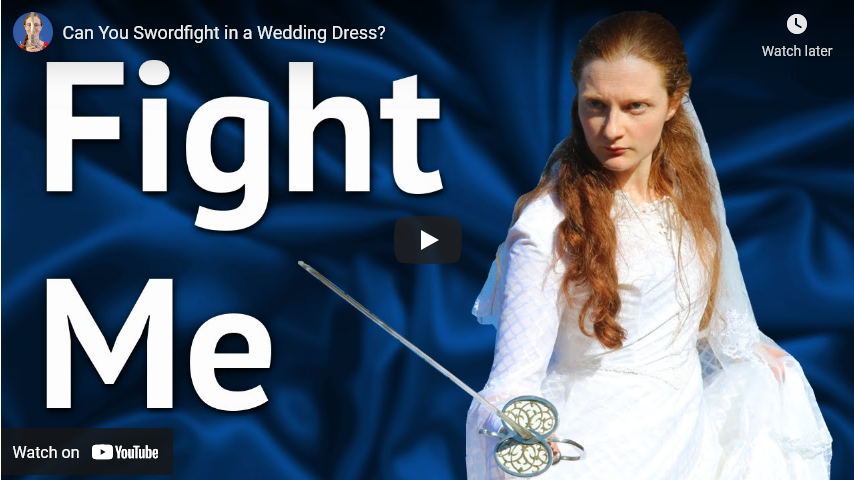
Can You Swordfight in a Wedding Dress?
Jill Bearup
Published 17 May 2021If you’re anticipating sword-wielding baddies at your wedding, you may well need these handy tips on the best way to sword fight in your wedding dress, or other big-skirted ballgown.
Live your best dark royaltycore life, who am I to tell you not to.
Contains very little actual fighting, because … who am I even going to fight?
Still, maybe people will be available for more fight shenanigans soon.
Music from epidemicsound.com
“Oceanic Adventure” – Bonnie Grace
“Rendezvous in D Minor” – Trevor Kowalski
“Faith Arise” – Edgar Hopp
July 13, 2021
QotD: Girls and witchcraft
Witchcraft fascinated me. When girls reach that liminal time between child and woman, our bodies transform — and, with them, our sense of control. It’s a strange thing to go from being cosseted and encouraged to desired and despised. It feels a little like dark magic — though not the kind one can control. Unless, of course, you are a witch.
Like the magical artifacts Harry Potter is always stumbling upon, witchcraft offers power. It promises a way to re-shape the world to a girl’s advantage, to gain freedom from parents, to toy with boys’ hearts while numbing one’s own. Male magic fantasies tend to be centred around power and combat — with lightning perpetually emanating from wands and fingertips into the chests of adversaries blown backwards. However, the sort of witchcraft that interests me is more subtle, and sometimes passes unseen. (In real life, such powers originate in sex — but it takes time for a girl to learn that.) It’s no coincidence that the world of witchcraft becomes a dark mirror of our society, reflecting the dispositions and paranoias of our times. When times are good, the witch is portrayed as a benign, bubbly figure; when they are not, the witch becomes malevolent and dark, in line with medieval lore.
Jen Gerson, “Sabrina the Woke Witch is a Disgrace to Baphomet”, Quillette, 2018-11-26.


