
World War Two
Published 1 Jul 2021During the occupation of South-East Asia, Japan builds a large system of institutionalised rape to “keep their soldiers happy”. Meanwhile, Allied refugees from Burma find a safe haven in India, but for some, hardship continues.
(more…)
July 2, 2021
Japan’s Institutionalization of Rape – WAH 037 – June 1942, Pt. 2
Comments Off on Japan’s Institutionalization of Rape – WAH 037 – June 1942, Pt. 2
June 28, 2021
QotD: Urbanization
The environmentalist aesthetic is to love villages and despise cities. My mind got changed on the subject a few years ago by an Indian acquaintance who told me that in Indian villages the women obeyed their husbands and family elders, pounded grain, and sang. But, the acquaintance explained, when Indian women immigrated to cities, they got jobs, started businesses, and demanded their children be educated. They became more independent, as they became less fundamentalist in their religious beliefs. Urbanization is the most massive and sudden shift of humanity in its history.
Stewart Brand, “Environmental Heresies”, Technology Review, 2005-05
Comments Off on QotD: Urbanization
June 21, 2021
Etruscans: Italian Civilization Before Ancient Rome
Kings and Generals
Published 20 Feb 2020Our new animated historical documentary talks about the Etruscans. Their origins, culture, religion, lifestyle and how they influenced the Roman Republic and through it the world.
Support us on Patreon: http://www.patreon.com/KingsandGenerals or Paypal: http://paypal.me/kingsandgenerals
We are grateful to our patrons and sponsors, who made this video possible: https://docs.google.com/document/d/1_…
The video was made by our friend András Szente-Dzsida while the script was researched and written by Leo Stone
This video was narrated by Officially Devin (https://www.youtube.com/user/OfficiallyDevin)
✔ Merch store ► teespring.com/stores/kingsandgenerals
✔ Podcast ► Google Play: http://bit.ly/2QDF7y0 iTunes: https://apple.co/2QTuMNG
✔ Twitter ► https://twitter.com/KingsGenerals
✔ Instagram ► http://www.instagram.com/Kings_GeneralsProduction Music courtesy of Epidemic Sound: http://www.epidemicsound.com
#Documentary #Etruscans #KingsandGenerals

Comments Off on Etruscans: Italian Civilization Before Ancient Rome
June 18, 2021
Boob Armor: 4 Things You Need to Know
Jill Bearup
Published 1 Mar 2021Designing some armour for ladies? Female torso armour specifically? Welcome. Get a year of streaming some of your favourite creators and HQ documentaries for under $15 at http://curiositystream.com/jillbearup
Boob armour, or boob plate, or lady armour. Or fantasy lady armour, come to that: how does it work then? Let’s have a look at Wonder Woman, The Mandalorian, Warhammer 40K and various examples of historical armour, as well as costume considerations, which will make designing a look for your female fighters that is practical and looks awesome a breeze.
TIMESTAMPS!
00:00 So you need some lady armour?
00:37 1. You don’t need boob plate
02:23 Alternate options
03:14 2. Divots are a disadvantage
03:56 Muscle cuirasses
04:35 Boob shelf designs
05:11 Cleavage divots
05:39 Wasp waist armor
06:44 Sticky weapons
08:02 Codpieces
08:40 3. Consider mobility (including experiments)
09:35 Two handed weapons and giant swords
10:29 Underlayers and materials used in experiments
11:03 Low guards and power generation in boob plate
11:46 Not painting a ‘look, a lady!’ target on yourself with your armor
12:17 4. Breathing is important
13:44 Corsets are not like armor, and scifi armor with flex
15:44 Fencing chest protectors are not armor, extra content on Nebula, this video is sponsored by Curiosity Stream
16:49 Lightning round#boobplate #femalearmor #armor
Music by epidemicsound.com
“Meet Me in the Hills” – Howard Harper-Barnes
“To Begin” – Raymond Grouse
“Honorable Salute” – Sage Orsler
“Plains of Illeyneth” – Dragon Tamer
“Sparkle and Swirl” – Raymond Grouse
“Sergeant Wise” – Stationary Sign
“Optimist At Heart” – Jerry Lacey
“Fluz de la Riviere” – Howard Harper-Barnes
“Sailing for Gold” – Howard Harper-Barnes
“Endless Flirtation” – Jerry Lacey

Comments Off on Boob Armor: 4 Things You Need to Know
June 9, 2021
QotD: Failing to account for mere “women’s work”
Elli Quinn quirked an eyebrow. “How odd. On other worlds, people seem to come in floods, and they’re not necessarily impoverished, either.”
Ethan, diverted, said, “Really? I don’t see how that can be. Why, the labor costs alone of bringing a child to maturity are astronomical. There must be something wrong with your accounting.”
Her eyes screwed up in an expression of sudden ironic insight. “Ah, but on other worlds the labor costs aren’t added in. They’re counted as free.”
Ethan stared. “What an absurd bit of double thinking! Athosians would never sit still for such a hidden labor tax! Don’t the primary nurturers even get social duty credits?”
“I believe,” her voice was edged with a peculiar dryness, “they call it women’s work.”
Lois McMaster Bujold, Ethan of Athos, 1986.
Comments Off on QotD: Failing to account for mere “women’s work”
June 1, 2021
QotD: The evolutionary origin of male aggressiveness
Were we humans the entirely separate creations, quite unlike mere animals, that old-school Christians used to say we were, then for our minds to be entirely different from those of animals might make more sense. As it is, given that we are products of the same evolutionary process that made all the others animals, the “blank slate” notion of the human mind makes no sense at all.
One thing I did — not “learn” exactly — but hear for the first time from a scientist of human evolution, concerned the aggressiveness of the human male. Many human masculine characteristics have evolved not so much because human females like them, but more because other human males are intimidated by them. Males who defeat other males in competition achieve high status, and high status and the resources that accompany it are what human females especially like, rather than necessarily liking the particular characteristics that achieve that high status. Male aggressive characteristics are, metaphorically speaking, deer antlers more than they are peacock tails. They are at least as much for making human males into top dogs, so to speak, as they are for directly impressing the ladies. I can’t help noticing that some human females are impressed, directly, by male aggression. They like to watch men fighting, for instance. But others are very put off by such behaviour, and especially, of course, if it is ever directed against them.
Brian Micklethwait, “What Steve Stewart-Williams said”, Brian Micklethwait’s New Blog, 2021-02-26.
Comments Off on QotD: The evolutionary origin of male aggressiveness
May 19, 2021
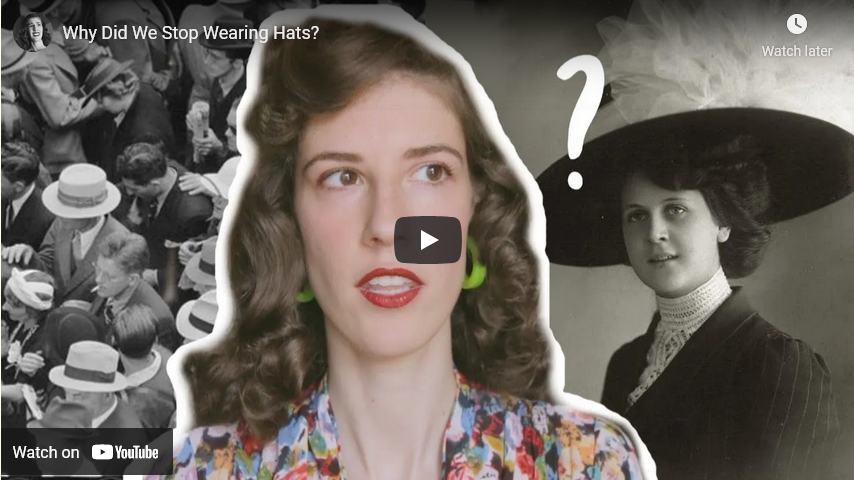
Why Did We Stop Wearing Hats?
Karolina Żebrowska
Published 28 Apr 2020should we bring hats back? what do you think?
_____________
My Instagram: https://bit.ly/2Qo9rrI
My nudes: https://bit.ly/2UHHY6N
My merch: bit.ly/2CCq5jE
Comments Off on Why Did We Stop Wearing Hats?
May 12, 2021
The World’s First Lady – Eleanor Roosevelt – WW2 Biography Special
World War Two
Published 11 May 2021She is much more than the wife of President Franklin D. Roosevelt and once she tasted political life, she soon followed her own interests, changing what it means to be a politician’s wife.
(more…)
Comments Off on The World’s First Lady – Eleanor Roosevelt – WW2 Biography Special
May 11, 2021
QotD: The (disappointing) sex lives of the rich and famous
Severian, “Junkies”, Rotten Chestnuts, 2021-01-18.
Comments Off on QotD: The (disappointing) sex lives of the rich and famous
April 12, 2021
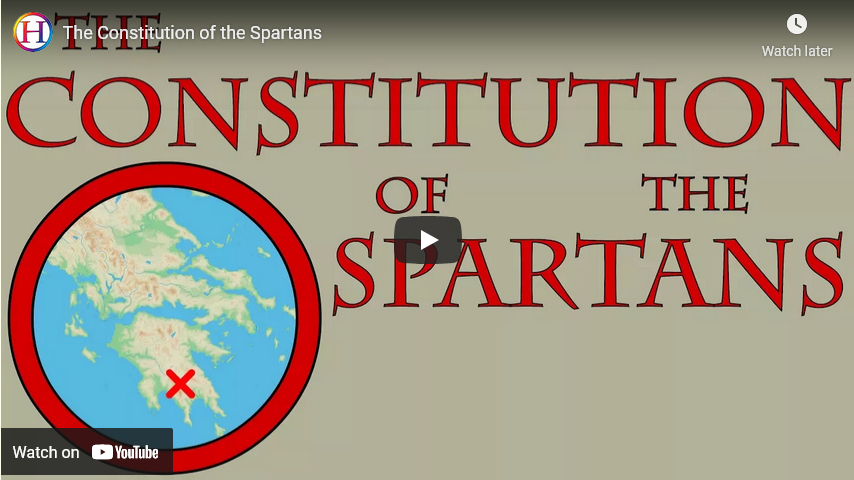
The Constitution of the Spartans
Historia Civilis
Published 11 Sep 2017Patreon | http://historiacivilis.com/patreon
Donate | http://historiacivilis.com/donate
Merch | http://historiacivilis.com/merch
Mailing List | http://historiacivilis.com/mailinglist
Twitter | http://historiacivilis.com/twitter
Website | http://historiacivilis.comSources:
The Constitution of the Spartans, by Xenophon: http://amzn.to/2j7JXTB
The Moralia, by Plutarch: http://amzn.to/2gNMYHU
Parallel Lives: The Life of Lycurgus, by Plutarch: http://amzn.to/2xS29nI
Politics, by Aristotle: http://amzn.to/2wMq5ss
Rhetoric, by Aristotle: http://amzn.to/2xS3niO
Laws, by Plato: http://amzn.to/2wLpsiN
On the Republic, by Cicero: http://amzn.to/2j7Flgg
The Histories, by Herodotus: http://amzn.to/2xdH4a7
The Spartan Regime, by Paul A. Rahe: http://amzn.to/2vPmRqS
Property and Wealth in Classical Sparta, by Stephen Hodkinson: http://amzn.to/2xdV7MS
The Rise of Athens, by Anthony Everitt: http://amzn.to/2j69uMS
Persian Fire, by Tom Holland: http://amzn.to/2vPyCxEWe are a participant in the Amazon Services LLC Associates Program, an affiliate advertising program designed to provide a means for us to earn fees by linking to Amazon.com and affiliated sites.
Music:
“Air Hockey Saloon,” by Chris Zabriskie
“Candlepower,” by Chris Zabriskie
“CGI Snake,” by Chris Zabriskie
“Heliograph,” by Chris Zabriskie
“Hallon,” by Christian Bjoerklund
From the comments:
Temporary Fakename
3 years ago
You know, i thought the Roman political system was pretty odd and arcane. But the Spartans have a dual monarchy that has absolute power, except when it doesn’t, an elected Senate that is chosen partially randomly that can pass whatever the hell they want with a public assembly and punish kings, except when an all-male aristocracy decided no, a female aristocracy that is overwhelmingly rich but can’t vote, and a population so terrified of its own slaves that it ritually committed atrocities against them. Compared to that Roman politics look simple and elegant.
I found the presentation quite interesting and informative, but I felt that some discussion of the differences between the terrible plight of the Helots and the not-quite-free status of the Perioikoi was merited. I also felt that the final segment on the eventual decline of Sparta missed a major factor — Spartan military defeats in the Battle of Leuctra in 371 BC and the Battle of Mantinea in 362 BC — but reading down in the comments, I saw someone else had already brought this up:
xelena
2 years ago (edited)
This is a good video, but is missing a super important point at the end: The cause for the decline of Spartan power was its defeat by Epaminondas of Thebes and his freeing of Messenia (the land of the Helots). He also founded Messene in Messenia and Megalopolis in Arcadia for the Helots, which became a powerful check to Sparta. Spartan power never recovered from this death blow to its slave economy and continued to wither away into the nothingness you describe.Epaminondas is mostly forgotten today, but he was one of the greatest men of antiquity. It was him and Pelopidas who put to bed the myth of Spartan invincibility and freed an entire people who had been enslaved for centuries. So in a way, the crippling blow did come from other Greeks, and the Helots did participate in it.
Comments Off on The Constitution of the Spartans
April 2, 2021
QotD: Sex and the grad student lifestyle
- Show up; and
- Bring beer.
For 75-90% of women under 40, step 2 is optional. It would’ve been for Chloe. Especially in a bar full of grad students, who despite their extensive academic training on “the rhetorics of hegemony” and whatnot, still aren’t quite sure how the naughty bits fit together. She might’ve had to draw the guy a map, but surely that’s no problem for someone so assertively in control of her own sexuality as was Chloe …
And that’s just normal people, who know what pronouns to use and never hesitate when choosing a public restroom. The real freakazoids actually have it much easier, since loudly proclaiming a deviant sexuality is a status symbol in the ivory tower. Perhaps your deepest, most secret fetish involves cocktail onions and a Shop-Vac … and let me stop you right there, I do NOT wanna know, I’m only bringing this up to say that hey, I sympathize, love is real and you’re having a hard time finding yours.
You should consider academia, my friend, where not only are such things not shameful, but they’re positively celebrated. If you’ve actually got video of yourself doing the nasty under those conditions, they’ll pretty much hand you a PhD in Performance Art on the spot …… and yet, nobody does.
I’m not saying people don’t have sex in grad school. If I myself wasn’t getting my ashes hauled every day in the ivory tower, I assure you it wasn’t for lack of trying. What I am saying is that academia is the only place on earth where not only is your fetish — whatever it is — not shameful, but easily satisfied. Those of us who actually enjoy the missionary position with committed partners of the opposite-sex used to joke that ours was the only sexual deviancy so perverse, you’d be shunned by all your colleagues if you admitted to it. These people, on the other hand, talk like their gonads rule their lives, but they never actually do anything about it.
I have no idea why, but finding out would tell us a lot about the psychology of the average Leftist.
Severian, “Gettin’ Busy in College Town”, Rotten Chestnuts, 2020-12-04.
Comments Off on QotD: Sex and the grad student lifestyle
March 29, 2021
Requiring only men to register for the draft isn’t the real problem — the problem is the draft itself
Kerry McDonald fears that the current challenges to the gender inequality of the US draft may end up making the underlying problem worse:
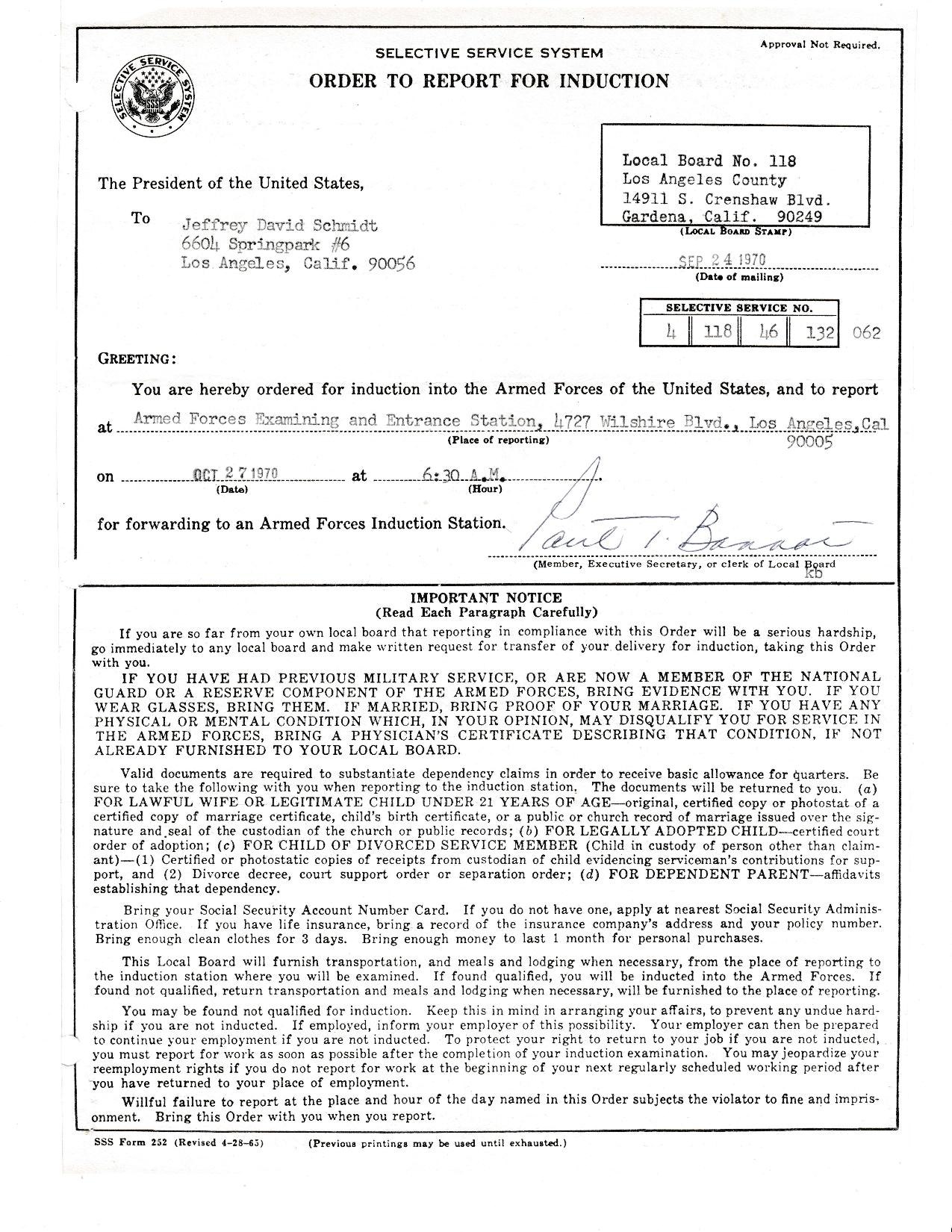
US Selective Service draft notice for J.D. Schmidt, dated 24 September, 1970.
Wikimedia Commons.
Currently, all American men are required to register for the draft through the Selective Service System when they turn 18, and could be forced into military service if the draft was activated. As a mom with young sons, I shudder at this prospect.
Lawyers with the American Civil Liberties Union (ACLU) have filed a petition asking the Supreme Court to rule the current military draft registration unconstitutional because it requires only men to register, not women. As a mom with young daughters, I shudder at this prospect.
While draft registration does involve unequal treatment of men and women, and women have been ably serving in the military for years, including in full combat, the larger issue is Selective Service registration itself. Current draft registration may be unconstitutional, but it shouldn’t exist at all.
Forcing citizens into any kind of non-voluntary work or action is antithetical to the principles of a free society.
Some contend that conscription is necessary to defend those principles if there were not enough volunteers to serve in a wartime effort, but is slavery ever justifiable? Who decides? If there are not enough soldiers to willingly fight a war, should the war be fought?
Nobel-Prize-winning economist Milton Friedman was one of the key figures who succeeded in persuading the US to move to an all-volunteer army in 1973, arguing against military conscription. Friedman wrote that “any system involving compulsion is basically inconsistent with a free society.” He went on to argue: “The continued use of compulsion is undesirable and unnecessary. We can and should man our armed forces with volunteers.”
In place of conscription, Friedman advocated for a voluntary military guided by free-market ideas. “The appropriate free market arrangement is volunteer military forces; which is to say, hiring men to serve,” Friedman wrote in his book, Capitalism and Freedom. “There is no justification for not paying whatever price is necessary to attract the required number of men. Present arrangements are inequitable and arbitrary, seriously interfere with the freedom of young men to shape their lives, and probably are even more costly than the market alternative.”
Friedman’s advocacy against conscription came to a climax in testimony with Army Chief of Staff, General William Westmoreland. The general disagreed with Friedman by claiming that the economist’s free-market approach would be akin to leading an army of mercenaries. Friedman replied: “General, would you rather command an army of slaves?”
Comments Off on Requiring only men to register for the draft isn’t the real problem — the problem is the draft itself
March 27, 2021
QotD: The best bar in the world
Steve Stewart-Williams, “Keeping It Casual”, Quillette, 2018-10-14.
Comments Off on QotD: The best bar in the world
March 11, 2021
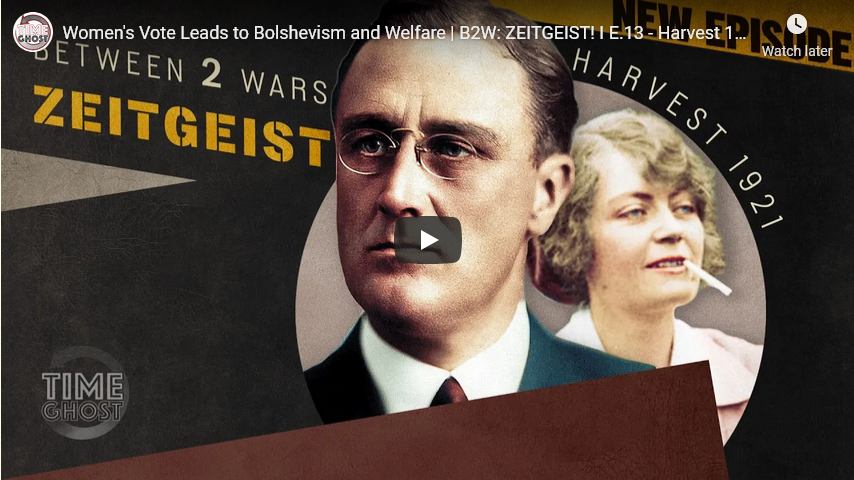
Women’s Vote Leads to Bolshevism and Welfare | B2W: ZEITGEIST! I E.13 – Harvest 1921
TimeGhost History
Published 10 Mar 2021This season not only marks the birth of the American welfare state, but it will also see women make great strides towards universal suffrage. But as you can imagine, none of these things come without significant opposition.
Join us on Patreon: https://www.patreon.com/TimeGhostHistory
Hosted by: Indy Neidell
Written by: Francis van Berkel
Director: Astrid Deinhard
Producers: Astrid Deinhard and Spartacus Olsson
Executive Producers: Astrid Deinhard, Indy Neidell, Spartacus Olsson, Bodo Rittenauer
Creative Producer: Maria Kyhle
Post-Production Director: Wieke Kapteijns
Research by: Francis van Berkel
Edited by: Michał Zbojna
Sound design: Marek KamińskiColorizations:
Daniel Weiss – https://www.facebook.com/TheYankeeCol…
Mikołaj Uchman
KlimbimSources:
Some images from the Library of CongressIcons from The Noun Project:
Birth by Adrien Coquet
dead by AomAm
mother by Fahmihorizon
United States Capitol by József Balázs-Hegedüs
noun_House of Representatives
House of Representatives Full by Sarah LawrenceSoundtracks from Epidemic Sound:
“Epic Adventure Theme 3” – Håkan Eriksson
“You’re Trouble” – Rich in Rags
“I’d Rather Be Alone” – Franz Gordon
“Redefine” – Megan Wofford
“Age Of Men” – Jo WandriniArchive by Screenocean/Reuters https://www.screenocean.com.
A TimeGhost chronological documentary produced by OnLion Entertainment GmbH.
From the comments:
TimeGhost History
2 days ago
America has so far been a pretty big topic in this season, and it again takes center stage in this episode. Considering its monumental role in twentieth-century history, this is only natural. Still, we like to give an international history as possible, so it’s exciting to also introduce Sweden here. It is a small country but historically significant for a number of reasons. It is a pioneer in social democracy, a country that has consistently stayed neutral in world affairs since 1814, and last but not least, the home of Indy Neidell.
Comments Off on Women’s Vote Leads to Bolshevism and Welfare | B2W: ZEITGEIST! I E.13 – Harvest 1921
March 3, 2021
Geishas: World War Two Prostitutes or Entertainers? – WW2 – On the Homefront 007
World War Two
Published 2 Mar 2021The geisha class has long been a feature of Japanese society. In the 1920s, they were caught between the struggle for women’s liberation and the rising sexual demand of powerful men. This crossfire only becomes more intense as war sweeps the Pacific.
Join us on Patreon: https://www.patreon.com/TimeGhostHistory
Or join The TimeGhost Army directly at: https://timeghost.tvFollow WW2 day by day on Instagram @ww2_day_by_day – https://www.instagram.com/ww2_day_by_day
Between 2 Wars: https://www.youtube.com/playlist?list…
Source list: http://bit.ly/WW2sourcesHosted by: Anna Deinhard
Written by: Spartacus Olsson and Fiona Rachel
Director: Astrid Deinhard
Producers: Astrid Deinhard and Spartacus Olsson
Executive Producers: Astrid Deinhard, Indy Neidell, Spartacus Olsson, Bodo Rittenauer
Creative Producer: Maria Kyhle
Post-Production Director: Wieke Kapteijns
Research by: Fiona Rachel
Edited by: Karolina Dołęga
Sound design: Marek KamińskiPortrait Colorizations by:
Mikołaj UchmannSources:
– Metropolitan Museum of Art
– Rijksmuseum
– Narodowe Archiwum Cyfrowe
– Library of Congress
– National Archives NARA
– Nationaal Archief
– The Burns Archive
– Woman and Child in Kimono courtesy of Vintage Japan-esque from Flickr
– Five musicians courtesy of Adolfo FarsariSoundtracks from Epidemic Sound:
– “Paths of a Samurai” – Mandala Dreams
– “Across the Sea of Japan” – Mandala Dreams
– “Secrets Of A Geisha” – Mandala Dreams
– “Watchman” – Yi Nantiro
– “The Unexplored” – Philip Ayers
– “Heavenly Feathers” – Deskant
– “Ode To The Moon” – Joseph Beg
– “Moving to Disturbia” – ExperiaArchive by Screenocean/Reuters https://www.screenocean.com.
A TimeGhost chronological documentary produced by OnLion Entertainment GmbH.
From the comments:
World War Two
17 hours ago (edited)
With this rather dramatic topic, we are happy to revive the On the Homefront series! Considering the popular opinion on geisha in America after the Second World War, it is not surprising at all, that the first association with the word is sex. But when we looked a little further into the topic, it got clearer and clearer that originally the job of a geisha meant no such thing. Still, with the social and political tension of the early 20th century, the job of the geisha evolved further and further to prostitution. This shows once again how the war influenced many different aspects of life and how important it is to shed light on these side stages of the war in order to understand its full impact. What would interest you to know about the different Homefronts of World War II?Cheers, Fiona

Comments Off on Geishas: World War Two Prostitutes or Entertainers? – WW2 – On the Homefront 007


