Quotulatiousness

July 8, 2019

QotD: Orwell on capitalism versus socialism

Filed under: Books, Britain, Europe, History, Quotations — Tags: , , , , — Nicholas @ 01:00

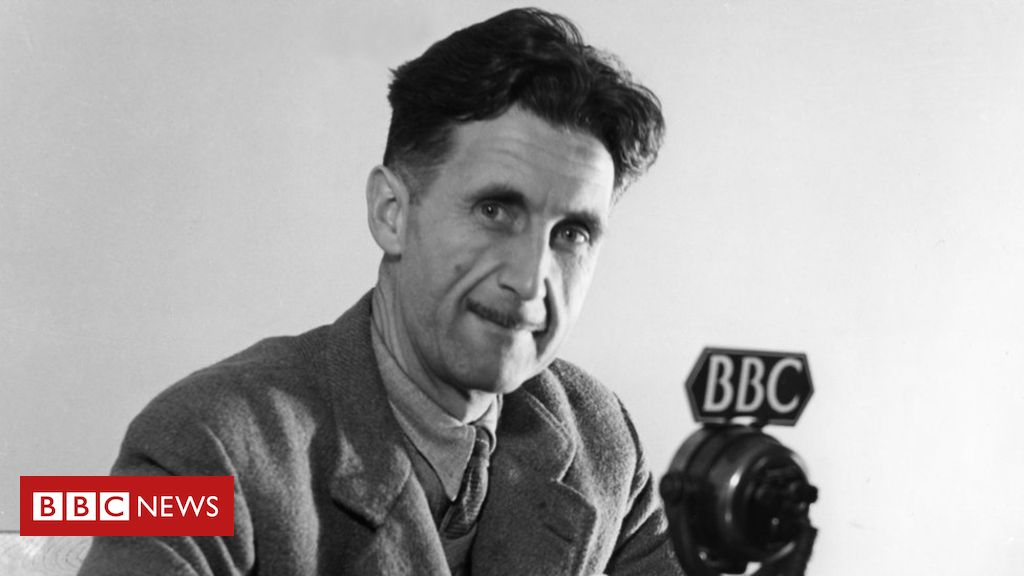
Orwell’s press card portrait, 1943

No one can question the dirtiness of international politics from 1870 onwards: it does not follow that it would have been a good thing to allow the German army to rule Europe. It is just possible that some rather sordid transactions are going on behind the scenes now, and that current propaganda “against Nazism” (cf. “against Prussian militarism”) will look pretty thin in 1970, but Europe will certainly be a better place if Hitler and his followers are removed from it. Between them these two books sum up our present predicament. Capitalism leads to dole queues, the scramble for markets, and war. Collectivism leads to concentration camps, leader worship, and war. There is no way out of this unless a planned economy can somehow be combined with the freedom of the intellect, which can only happen if the concept of right and wrong is restored to politics.

Both of these writers are aware of this, more or less; but since they can show no practicable way of bringing it about the combined effect of their books is a depressing one.

George Orwell, “The Road to Serfdom by F.A. Hayek / The Mirror of the Past by K. Zilliacus”, Observer, 1944-04-09.

June 22, 2019

Cuban socialism still gets good press from western progressives

Filed under: Americas, History, Politics, USA — Tags: , , , — Nicholas @ 03:00

Unlike most other socialist states that have fallen out of the good graces of western progressives, Cuba is still frequently treated as a kind of “true socialist state” by those who want western culture to move further in a socialist direction. Why has Cuba maintained its lustre? Kristian Niemietz discusses Cuba’s progressive halo for the IEA:

A billboard in Havana, showing Camilo Cienfuegos, Ernesto “Che” Guevara, and Fidel Castro, 4 November 2014.
Photo by Tumpatumcla~commonswiki via Wikimedia Commons.

Last week, Shadow Chancellor John McDonnell gave a speech at the Rail and Maritime Transport (RMT) Union’s “Garden Party for Cuba” event, attended, among other luminaries, by the Cuban ambassador. McDonnell made the following pledge:

    “We’re here in solidarity with the Cuban revolution […] I want to say this to our Cuban comrades. When […] a Labour government is elected, not if, we will be your staunchest allies to support the Cuban revolution. And that means the support, the political support of course, but it means also the support, financial and on trade […] We stand with you comrades.”

This was greeted with chants of “Viva Cuba” and “Viva socialismo“. Just two weeks earlier, when asked about the poor track record of socialism in Cuba, Venezuela and the former Soviet Union, McDonnell had declared that “it was never socialism”.

So which one is it? Is Cuba socialist now, or not? Did it suddenly become socialist in the last two weeks, after 60 years of faux-socialism? Is it an on-and-off kind of socialism, which alternates between the real thing, and the fake version? Is it a Schrödinger’s socialism?

June 12, 2019

High Hitler! – Nazis on Crystal Meth Part 1 – WW2 SPECIAL

Filed under: Germany, Health, History, WW2 — Tags: , , , , , — Nicholas @ 04:00

World War Two
Published on 11 Jun 2019

You might have heard he a was vegetarian. You might have heard that he shunned alcohol. You might have heard he was anti-tobacco. Then you might think he was against hard drugs as well, but you’d be wrong…

Join us on Patreon: https://www.patreon.com/TimeGhostHistory
Or join The TimeGhost Army directly at: https://timeghost.tv

Follow World War Two on Instagram @World_war_two_realtime https://www.instagram.com/world_war_t…
Join our Discord Server: https://discord.gg/D6D2aYN.
Between 2 Wars: https://www.youtube.com/playlist?list…
Source list: http://bit.ly/WW2sources

Written and Hosted by: Indy Neidell
Produced and Directed by: Spartacus Olsson and Astrid Deinhard
Executive Producers: Bodo Rittenauer, Astrid Deinhard, Indy Neidell, Spartacus Olsson
Creative Producer: Joram Appel
Research by: Spartacus Olsson
Edited by: Wieke Kapteijns
Sound design: Joakim Brodén

Colorisations by Julius Jääskeläinen https://www.facebook.com/JJcolorization/

A TimeGhost chronological documentary produced by OnLion Entertainment GmbH.

From the comments:

World War Two
2 hours ago (edited)
This is the first of our specials on drug use in the Third Reich, and this episode is about the drug addiction of Adolf Hitler himself. As Indy mentions in the video, YouTube regularly demonetises our content. Instead, we fully rely on our Patreon supporters to finance these series and this special. What doesn’t help, is that YouTube algorithm recommends demonetised episodes less, even further limiting our efforts. So, please share this video with your brothers and sisters, your friends, neighbours, your grandma and your history teacher. And make sure to turn on your notifications! And if you really like what we do – please consider supporting us on https://www.patreon.com/TimeGhostHistory or at https://timeghost.tv.

June 10, 2019

The intended message of George Orwell’s Nineteen Eighty-Four

Filed under: Books, History, Liberty, Politics — Tags: , , , , , — Nicholas @ 03:00

There are few novels which have been so enthusiastically claimed by partisans of both the right and the left — sometimes simultaneously — for misunderstood reasons. Orwell wasn’t warning us about technology (although he brilliantly illustrated how technology can be harnessed in service of the state), nor was he somehow warning us about the evils of current or recent politicans (Reagan, Bush, Trump). Orwell, a dedicated life-long socialist, was warning us of the dangers of totalitarianism, particularly the communist style of totalitarianism:

June 8, 2019, marks the 70th anniversary of George Orwell’s dystopian novel 1984. There will be no shortage of think pieces that will misinterpret its legacy. They will focus on social media, security cameras, data collection, and “fake news.” The problem? The novel was not a commentary on the downside of technology. It was meant to warn against the growing spread of communism.

In the decades since the time of its publication, the context of Orwell’s magnum opus has been lost. What remains in the cultural memory are simply fragments of the larger picture: government censorship, ubiquitous surveillance cameras, and Orwell’s clever neologisms (Newspeak, doublethink, and thoughtcrime, among others). This selective recall has led to a widespread misreading of the book’s original warning.

[…]

From the left, most present-day articles and blog posts project the character “Big Brother” onto President Donald Trump, like Eliot Namay’s column in the May 6 edition of the Charleston Gazette-Mail. They typically focus on Trump’s fevered populism and his penchant for impulsive speech, which can lead him to play fast and loose with facts.

Sales of 1984 spiked dramatically after his inauguration in 2017 when White House Press Secretary Sean Spicer (incorrectly) touted the “largest audience ever to witness an inauguration.” Trump advisor Kellyanne Conway later defended the claim on Meet the Press, blurting out the now infamous phrase, “alternative facts.” Scores of news stories compared her gaffe to Orwell’s “Newspeak” and “doublethink.” It’s also fairly common to read comparisons of Trump’s rallies to the “Two Minutes Hate” depicted in 1984.

Comparisons from the right, on the other hand, generally focus on the politically correct speech codes of colleges and universities or on the massive data gathering of big tech companies like Facebook and Google, warning readers that “Big Brother is Watching You.” Kalev Leetaru explores both of these issues in his May 6 column in Forbes, where he compares the social media de-platforming trend to Orwell’s “unperson” status. Notably, sales of 1984 also spiked in 2013 after Edward Snowden leaked details of the NSA’s mass collection of internet and phone records. A slew of articles followed, asserting that 1984 had arrived.

A certain amount of hyperbole is a characteristic of today’s reporting and commentary, but current comparisons to 1984 are inappropriate. Again, George Orwell was writing about a specific regime. Big Brother was an obvious reference to “Uncle Joe” Stalin, a uniquely evil dictator. Trump has his shortcomings, but he is no Stalin. A president who is prone to exaggeration does not equal a government-controlled press (which the Soviet Union had). The “Two Minutes Hate” recalled Stalin’s public demonization of Trotzky, who dared to criticize Stalin’s tactics. Data collection is a growing concern, to be sure, but it doesn’t precede a terrifying knock on the door from the KGB.

May 25, 2019

107 Abandoned French Soldiers Killed for Propaganda – WW2 on Location – France 1940 – 02

Filed under: France, Germany, History, Military, WW2 — Tags: , , — Nicholas @ 04:00

World War Two
Published on 23 May 2019

After the German army breaks through the French lines at Sedan, the left flank of the moving army has to be secured. The French Ouvrage la Ferté, part of the Maginot Line defense works, is subject to this consolidation. But the Germans move with ulterior motives, as them capturing a Maginot Line fort in the first week of the offensive has a huge propaganda value. Tour guide Richard Tucker shows Indy the grounds of a modern tragedy, where 107 French soldiers gave their lives.

Check out (and book!) Richard Tucker here: https://www.tripadvisor.nl/Attraction…

Join us on Patreon: https://www.patreon.com/TimeGhostHistory
Or join The TimeGhost Army directly at: https://timeghost.tv

Follow WW2 day by day on Instagram @World_war_two_realtime https://www.instagram.com/world_war_t…
Join our Discord Server: https://discord.gg/D6D2aYN.
Between 2 Wars: https://www.youtube.com/playlist?list…
Source list: http://bit.ly/WW2sources

Written and Hosted by: Indy Neidell
Produced and Directed by: Spartacus Olsson and Astrid Deinhard
Executive Producers: Bodo Rittenauer, Astrid Deinhard, Indy Neidell, Spartacus Olsson
Creative Producer: Joram Appel
Research by: Indy Neidell
Edited by: Wieke Kapteijns

Thumbnail Colorisation by Joram Appel

Eastory’s channel: https://www.youtube.com/channel/UCEly…
Archive by Screenocean/Reuters https://www.screenocean.com.

A TimeGhost chronological documentary produced by OnLion Entertainment GmbH.

April 30, 2019

The Neurology of Hate – WW2 – WaH SPECIAL EPISODE

Filed under: Europe, Germany, History, Science, WW2 — Tags: , , , , — Nicholas @ 04:00

World War Two
Published on 27 Apr 2019

In this special episode of War Against Humanity, we take a look at the underlying neurological functions that allow us to hate another group of people. Maybe it helps us to understand the ultimate question about WW2; how on earth could all of this happen?

Join us on Patreon: https://www.patreon.com/TimeGhostHistory
Or join The TimeGhost Army directly at: https://timeghost.tv

Written and Hosted by: Spartacus Olsson
Produced and Directed by: Astrid Deinhard
Executive Producers: Bodo Rittenauer, Astrid Deinhard, Indy Neidell, Spartacus Olsson
Creative Producer: Joram Appel
Post Production Director: Wieke Kapteijns
Research by: Spartacus Olsson
Edited by: Spartacus Olsson

Archive by Screenocean/Reuters https://www.screenocean.com

A TimeGhost chronological documentary produced by OnLion Entertainment GmbH.

April 7, 2019

George Orwell BBC Arena Part 4 The Lion and the Unicorn

Filed under: Books, Britain, Europe, History — Tags: , , , , — Nicholas @ 04:00

Alan Ruben
Published on 29 May 2013

Part 4 of an in-depth 5 part series about George Orwell made in 1983.

April 6, 2019

QotD: Truth and propaganda in the Spanish Civil War

Filed under: Europe, History, Military, Quotations — Tags: , , , , — Nicholas @ 01:00

The struggle for power between the Spanish Republican parties is an unhappy, far-off thing which I have no wish to revive at this date. I only mention it in order to say: believe nothing, or next to nothing, of what you read about internal affairs on the Government side. It is all, from whatever source, party propaganda — that is to say, lies. The broad truth about the war is simple enough. The Spanish bourgeoisie saw their chance of crushing the labour movement, and took it, aided by the Nazis and by the forces of reaction all over the world. It is doubtful whether more than that will ever be established.

I remember saying once to Arthur Koestler, ‘History stopped in 1936’, at which he nodded in immediate understanding. We were both thinking of totalitarianism in general, but more particularly of the Spanish civil war. Early in life I have noticed that no event is ever correctly reported in a newspaper, but in Spain, for the first time, I saw newspaper reports which did not bear any relation to the facts, not even the relationship which is implied in an ordinary lie. I saw great battles reported where there had been no fighting, and complete silence where hundreds of men had been killed. I saw troops who had fought bravely denounced as cowards and traitors, and others who had never seen a shot fired hailed as the heroes of imaginary victories; and I saw newspapers in London retailing these lies and eager intellectuals building emotional superstructures over events that had never happened. I saw, in fact, history being written not in terms of what happened but of what ought to have happened according to various ‘party lines’. Yet in a way, horrible as all this was, it was unimportant. It concerned secondary issues — namely, the struggle for power between the Comintern and the Spanish left-wing parties, and the efforts of the Russian Government to prevent revolution in Spain. But the broad picture of the war which the Spanish Government presented to the world was not untruthful. The main issues were what it said they were. But as for the Fascists and their backers, how could they come even as near to the truth as that? How could they possibly mention their real aims? Their version of the war was pure fantasy, and in the circumstances it could not have been otherwise.

The only propaganda line open to the Nazis and Fascists was to represent themselves as Christian patriots saving Spain from a Russian dictatorship. This involved pretending that life in Government Spain was just one long massacre (vide the Catholic Herald or the Daily Mail — but these were child’s play compared with the Continental Fascist press), and it involved immensely exaggerating the scale of Russian intervention. Out of the huge pyramid of lies which the Catholic and reactionary press all over the world built up, let me take just one point — the presence in Spain of a Russian army. Devout Franco partisans all believed in this; estimates of its strength went as high as half a million. Now, there was no Russian army in Spain. There may have been a handful of airmen and other technicians, a few hundred at the most, but an army there was not. Some thousands of foreigners who fought in Spain, not to mention millions of Spaniards, were witnesses of this. Well, their testimony made no impression at all upon the Franco propagandists, not one of whom had set foot in Government Spain. Simultaneously these people refused utterly to admit the fact of German or Italian intervention at the same time as the Germany and Italian press were openly boasting about the exploits of their’ legionaries’. I have chosen to mention only one point, but in fact the whole of Fascist propaganda about the war was on this level.

This kind of thing is frightening to me, because it often gives me the feeling that the very concept of objective truth is fading out of the world. After all, the chances are that those lies, or at any rate similar lies, will pass into history. How will the history of the Spanish war be written? If Franco remains in power his nominees will write the history books, and (to stick to my chosen point) that Russian army which never existed will become historical fact, and schoolchildren will learn about it generations hence. But suppose Fascism is finally defeated and some kind of democratic government restored in Spain in the fairly near future; even then, how is the history of the war to be written? What kind of records will Franco have left behind him? Suppose even that the records kept on the Government side are recoverable — even so, how is a true history of the war to be written? For, as I have pointed out already, the Government, also dealt extensively in lies. From the anti-Fascist angle one could write a broadly truthful history of the war, but it would be a partisan history, unreliable on every minor point. Yet, after all, some kind of history will be written, and after those who actually remember the war are dead, it will be universally accepted. So for all practical purposes the lie will have become truth.

George Orwell, “Looking back on the Spanish War”, New Road, 1943 (republished in England, Your England and Other Essays, 1953).

March 25, 2019

The Boston Massacre – Snow and Gunpowder – Extra History

Filed under: Britain, History, Military, USA — Tags: , , , , , — Nicholas @ 04:00

Extra Credits
Published on 23 Mar 2019

Boston, 1770. A frigid winter night. A British sentry strikes a local citizen. Civilians begins to gather. Reinforcements arrive to back up the young sentry. Insults and snowballs escalate. Then out of the darkness comes a shout: “FIRE!”

The Boston Massacre didn’t come out of nowhere — resentment between the early US colonies and the British army had been brewing for some time over the Stamp Act. A propaganda war ensued between the loyalists and the radicals. John Adams would get his revolutionary start as he worked to resolve this injustice…

Join us on Patreon! http://bit.ly/EHPatreon

March 14, 2019

How Hollywood Helped Hitler | Between 2 Wars | 1926 Part 2 of 2

Filed under: Germany, History, Media, USA — Tags: , , , , , , — Nicholas @ 06:00

TimeGhost History
Published on 13 Mar 2019

The rise of the media superstar and the rise of Naziism had a lot to do with each other. The early death of one of the first media superstars, Rudolph Valentino in 1926 shows us exactly how and why.

Join us on Patreon: https://www.patreon.com/TimeGhostHistory

Hosted by: Indy Neidell
Directed by: Astrid Deinhard
Written by: Spartacus Olsson
Produced by: Astrid Deinhard
Executive Producers: Bodo Rittenauer, Astrid Deinhard, Indy Neidell, Spartacus Olsson
Creative Producer: Joram Appel
Post Production Director: Wieke Kapteijns
Edited by: Wieke Kapteijns
Research by: Spartacus Olsson

Colorized Pictures by Olga Shirnina
https://klimbim2014.wordpress.com

Video Archive by Screenocean/Reuters http://www.screenocean.com

A TimeGhost chronological documentary produced by OnLion Entertainment GmbH.

From the comments:

TimeGhost History
2 hours ago
After a week of radio silence, we’re back with another Between Two Wars episodes. We’re continuing in the spirit of where we left off, and enter the crazy and hyped-up world of superstars. We hope that you like our video! If you do, please consider supporting us on Patreon or via our website timeghost.tv. We are still only just managing to cover the minimum that is required to produce this content. Every dollar truly counts. -> https://www.patreon.com/TimeGhostHistory

March 9, 2019

Old posts (from the old blog) about Chinese official economic statistics

Filed under: China, Economics, Media — Tags: , , , , , — Nicholas @ 03:00

This post at Continental Telegraph a few days back reminded me I wanted to get around to gathering some of my older posts about the reasons to take the official GDP numbers from the Chinese government with more than just a pinch of salt. Here’s my very first rant on the topic from 10 August, 2004 (original expired URL – http://bolditalic.com/quotulatiousness_archive/000323.html):

On my way in to work this morning, I heard a stock advisor doing his best to make reasonable assumptions about what the average listener needed to know about the economy. This guy has been pretty level-headed in the past, but this morning’s talk just got my head ready to explode.

The topic of discussion was the Chinese economy and how the Chinese central bank was having to take greater efforts to rein in economic expansion. He talked about how many different sectors of the North American economy were, to greater or lesser degree, depending more and more on Chinese growth to increase their own investments and output. The idea that the Chinese economy was "overheating" was bandied about. He closed by indicating that a slight drop in the official growth rate from 9.8% to 9.6% showed that the Chinese central bank was seeing some results from their intervention in the economy.

There are so many things wrong here that I’m almost at a loss where to start. While there is no doubt that China is a fast-growing economy, the most common mistake among both investors and pundits is to assume that China is really just like South Carolina or Ireland … a formerly depressed area now achieving good results from modernization. The problem is that China is not just the next Atlanta or Slovenia. China is still, more or less, a command economy with a capitalist face. One of the biggest players in the Chinese economy is the army, and not just in the sense of being a big purchaser of capital goods (like the United States Army, for example).

The Chinese army owns or controls huge sectors of the economy, and runs them in the same way it would run a division or an army corps. The very term "command economy" would seem to have been minted to describe this situation. The numbers reported by these "companies" bear about the same resemblance to reality as those posted by Enron or Worldcom. With so much of their economy not subject to profit and loss, every figure from China must be viewed as nothing more than a guess (at best) or active disinformation.

Probably the only figures that can be depended upon for any remote accuracy would be the imports from other countries — as reported by the exporting firms, not by their importing counterparts — and the exports to other countries. All internal numbers are political, not economic. When a factory manager can be fired, he has his own financial future at stake. When he can be sentenced to 20 years of internal exile, he has his life at stake. There are few rewards for honesty in that sort of environment: and many inducements to go along with what you are told to do.

Under those circumstances, any growth figures are going to be aggregated from all sectors, most of which are under strong pressure to report the right numbers, not necessarily corresponding with any real measurement of economic activity. So, if the economic office wants to see a drop in the economy, that’s what they’ll get.

Basing your own personal financial plans on numbers like this would quickly have you living in a cardboard box under a highway overpass. Companies in the soi-disant free world have shareholders or owners to answer to. Companies in China exist in a totally different environment.

I returned to the same topic on October 25, 2004, triggered by yet another talking head on the radio under the heading “More Economic Voodoo — or is that Feng Shui?” (original URL – http://www.bolditalic.com/quotulatiousness_archive/000580.html):

Again this morning, I was listening to my local jazz radio station on the way in to work. As usual, they had a broker from CIBC Wood Gundy giving portfolio advice at about 9:20 a.m. Today’s talk was about investing in China, and how the markets have been reacting to the recent small drop in the official GDP growth figures released by the Chinese central bank.

This time, the emphasis was on the idea that in spite of the breathtaking growth figures, Chinese firms still are not particularly profitable and that therefore there are better ways of investing your money to benefit from all that growth. Unlike the last time I addressed this issue, this time I thought that the advisor was actually making pretty good sense. The incredible transformation of China from a pure command-driven economy to a mixed economy will certainly provide lots of opportunities for people to get rich; it will also provide even more opportunities to lose big money.

Much of the problem is that even now, the Chinese economy is not particularly free: the official and unofficial controls on the economy provide far too many opportunities for rent-seeking officialdom to play favourites and cripple antagonists (and for once, "cripple" is not just a bit of hyperbole). Any numbers provided by the Chinese authorities cannot be depended upon, and should probably only be viewed as an indication of what the Chinese government wants the outside world to believe.

Even in a relatively free economy like Canada, the underground economy can be huge, with plenty of economic activity happening out of reach of the taxman. In China, where everybody was raised in an environment where providing the "wrong" answer to your leader could get you imprisoned (or executed) as an economic criminal, the numbers upon which the bankers and financial officials depend can only be described as extremely unreliable.

Update 26 October: The Last Amazon asks a highly pertinent and pointed question:

    In the past week, the Globe and Mail has been featuring the economic engine that China has become. Its economy is thriving so much so that Chinese government owned companies like China Minmetals Corp (which had revenues in 2003 of USD$11.7 billion) is currently negotiating to buy outright 100% of the stock of the Canadian mining corporation, Noranda Inc. The total stock is estimated at approximately CDN$6.7 billion.

    If the Chinese government can afford to buy Noranda Inc. why hasn’t anyone asked when China will reimburse the overburdened Canadian taxpayers of this fair land for the Cdn$65.4 million that has been given to China as foreign aid?

I managed to stay away from the topic until April 13, 2007, when I posted “The Chinese Economy”, which largely quoted from my first two posts (old URL – http://bolditalic.netfirms.com/quotulatiousness_archive/003649.html):

Everyone must have heard many different variations on how incredible the Chinese economy is: spectacular growth, innovations galore, etc., etc. And there’s much truth to it — China has been industrializing at a mind-croggling pace. At least, the visual evidence says so. The economic data coming out of China is, to be kind, not as dependable as similar data from most other countries. […]

Three years on, I must retract a tiny bit there … Enron’s and Worldcom’s figures, while deliberately misleading, were refutable (and the culprits taken to court). […]

Samizdata links to a brief Tyler Cowen post which includes this quote:

    …of the 3,220 Chinese citizens with a personal wealth of 100 million yuan ($13 million) or more, 2,932 are children of high-level cadres. Of the key positions in the five industrial sectors – finance, foreign trade, land development, large-scale engineering and securities – 85% to 90% are held by children of high-level cadres.

That’s even higher than I expected. But it’s an excellent example of what I originally wrote about back in 2004: the economy isn’t free, and the beneficiaries are disproportionally those who are politically well-connected. Caveat investor.

And that was when I discovered that my “full” backup of files from the old site is actually missing nearly a year of posts from May 2008 to May 2009 (when I moved to the current site). I vaguely recall that Jon (my former virtual landlord) was having problems with limited storage on that site — I was just a freeloading guest — so perhaps one of the things we lost was the auto-archiving after we reached a certain capacity.

Thanks to the Wayback Machine, I found a couple of other entries but they were often just rehashes of the first two posts interspersed with quotations from articles I felt were being too Pollyanna-ish about the Chinese economic numbers, like this one from May 2, 2008:

Those untrustworthy Chinese economic numbers

Regular readers will know that I’ve been a long-term skeptic about the economic figures reported by the Chinese government (for example, here and here back in 2004). As a result, this post at the Economist is not very surprising:

    As China’s importance in the global economy increases, investors are paying more attention to its economic numbers. Yet the country’s official statistics are notoriously ropy. Some commentators accuse China’s government of overstating GDP growth for political reasons, others complain that the official inflation rate is fraudulently low. So which data can you trust?

    One reason to be suspicious of GDP figures is that China is always one of the first countries to report them, usually only two weeks after the end of each quarter. Most developed economies take between four and six weeks to produce them.

However, The Economist still feels that the Chinese economy is larger than reported. My sense of distrust in the figures argues for it being neither as big nor as robust as the reported figures indicate. They’re professional economic reporters … I’m a guy typing a blog entry. I wonder what the long-term odds are for either of us to be closer to the truth?

It’s tough to disagree with this, though:

    The prize for the dodgiest figures goes to the labour market. The quarterly urban unemployment rate is meaningless because it excludes workers laid off by state-owned firms as well as large numbers of migrant workers, who normally live in urban areas but are not registered. Wage figures are also lousy. There has recently been much concern about the faster pace of increase in average urban earnings. But this series does not cover private firms, which are where most jobs have been created in recent years.

    Now that China is such an engine of global growth, it urgently needs to improve its economic data. Only a madman would drive a juggernaut at full speed with a faulty speedometer, a cracked rear-view mirror and a misty windscreen.

By this point, Jon was referring to my obsession with bogus Chinese economic statistics as my “hobby horse” … yet it wasn’t unknown for him to send me links to articles on that very topic. Here’s another post, courtesy of the Wayback Machine, from January 23, 2009:

China’s economic situation

There’s an article at The Economist today that shows a touching belief in the magic of the Chinese economy. The reported Gross Domestic Product has fallen to “only” 5.8%. The Economist‘s writer spends much of the article worrying about this gloomy report:

    New figures show that China’s GDP growth fell to 6.8% in the year to the fourth quarter, down from 9% in the third quarter and half its 13% pace in 2007. Growth of 6.8% may still sound pretty robust, but it implies that growth was virtually zero on a seasonally adjusted basis in the fourth quarter.

    Industrial production has slowed even more sharply, growing by only 5.7% in the 12 months to December, compared with an 18% pace in late 2007. Thousands of factories have closed and millions of migrant workers have already lost their jobs. But there could be worse to come. Chinese exports are likely to drop further in coming months as world demand shrinks. Qu Hongbin, an economist at HSBC, forecasts that exports in the first quarter could be 19% lower than a year ago. 2009 may well see the first full-year decline in exports in more than a quarter of a century.

    Economists have become gloomier about China’s prospects, with many now predicting GDP growth of only 5-6% in 2009, the lowest for almost two decades.

I’ve blogged about the Chinese economy on a few occasions (most recently here), generally with the same concern: that the numbers reported cannot be relied upon. The same is true here. Interestingly, the Economist article I linked to back in May makes this point quite well, yet today’s article appears to treat the Chinese government’s numbers as solid.

China has changed substantially from twenty years ago, and in many ways for the better. Most ordinary Chinese today are more free — economically anyway — than they were a generation ago, and there is a lot more opportunity for individuals to set up businesses and to succeed without needing Party connections. All this is indisputable … yet vast swathes of the Chinese economy are a legacy of the worst command-and-control period. It’s not an exaggeration to say that we can expect to discover the “official numbers” have absolutely no relationship to reality, because the numbers are compiled from various sources including both free-r quasi-capitalist companies and tottering government-owned (and often People’s Liberation Army-owned) conglomerates which cannot be depended upon to report anything accurately.

An example from this article: “a fall in electricity output of 6% in the year to the fourth quarter, down from average annual growth of 15% over the previous five years.” That’s not just a reduction in the rate of growth, that’s a reported drop in output of 6%. Imagine what the state of a European or Japanese/Korean economy running at only 94% of electricity … it’d be something you’d only see at times of severe economic contraction, not as a sign of a slow-down in growth.

Finally, on May 22, 2009, a final post on the topic at the old blog:

Official Chinese statistics

If you’ve read the blog for a while, you’ll know that I’m pretty skeptical about how believable the official statistics coming from the Chinese government may be. The Economist is somewhat undecided on the matter … sometimes publishing articles that treat the official numbers as legitimate and other times, showing more doubt:

    Part of the recent optimism in world markets rests on the belief that China’s fiscal-stimulus package is boosting its economy and that GDP growth could come close to the government’s target of 8% this year. Some economists, however, suspect that the figures overstate the economy’s true growth rate and that Beijing would report 8% regardless of the truth. Is China cheating?

    Economists have long doubted the credibility of Chinese data and it is widely accepted that GDP growth was overstated during the previous two downturns. In 1998-99, during the Asian financial crisis, China’s GDP grew by an average of 7.7%, according to official figures. However, using alternative measures of activity, such as energy production, air travel and imports, Thomas Rawski of the University of Pittsburgh calculated that the growth rate was at best 2%. Other economists reckon that Mr Rawski was too pessimistic. Arthur Kroeber of Dragonomics, a research firm in Beijing, estimates GDP growth was around 5% in 1998-99, for example. The top chart, plotting the official growth rate against estimates by Dragonomics, clearly suggests that some massaging of the government statistics may have gone on. The biggest adjustment seems to have been made in 1989, the year of political protests in Tiananmen Square. Officially, GDP grew by over 4%; Dragonomics reckons it actually declined by 1.5%.

Of course, The Economist doesn’t want to lose sales in China, so the last paragraph of the article blithely re-assures readers that things are improving and that the official numbers are much harder to fudge now than they used to be. That may well be true (I rather hope it is), but in the same way that you can get much more impressive growth from a very small base, you can become much more honest with your numbers when you’re starting from pure fiction.

[…] Let’s just say that I’m still unconvinced.

After that, my hobby-horse rides can be found by searching for “china economy” (or just click this link) on the current blog, or you can just peruse the China category.

March 7, 2019

Outbreak of the War Against Humanity – WW2 – WaH 001 – 5 March 1940

World War Two
Published on 6 Mar 2019

When the Second World War breaks out, it is at first largely a war between one side of totalitarian aggressors against a portion of the democratic countries of the world defending other totalitarian states. From the first day of the war in Poland, as it already is in China, this will be a war against humanity.

Join us on Patreon: https://www.patreon.com/TimeGhostHistory
Or join The TimeGhost Army directly at: https://timeghost.tv

Follow WW2 day by day on Instagram @World_war_two_realtime https://www.instagram.com/world_war_t…
Between 2 Wars: https://www.youtube.com/playlist?list…
Source list: http://bit.ly/WW2sources

Written and Hosted by: Spartacus Olsson
Produced and Directed by: Astrid Deinhard
Executive Producers: Bodo Rittenauer, Astrid Deinhard, Indy Neidell, Spartacus Olsson
Creative Producer: Joram Appel
Post Production Director: Wieke Kapteijns
Research by: Spartacus Olsson
Edited by: Spartacus Olsson and Wieke Kapteijns

Archive by Screenocean/Reuters https://www.screenocean.com

A TimeGhost chronological documentary produced by OnLion Entertainment GmbH.

From the comments:

World War Two
47 minutes ago (edited)
READ THIS AND OUR RULES BEFORE COMMENTING Here it is with some slight delay – the first episode of War Against Humanity, written and hosted by Spartacus Olsson. Due to the delay, this video went public on YouTube and was not in Preview for the TimeGhost army – we apologise for this – the next WaH video will be given in advance. To be clear it is the support of the TimeGhost army that enables us to continuously expand and improve our coverage – if you haven’t already, consider signing up on timeghost.tv or https://www.patreon.com/TimeGhostHistory – Now, we have age-restricted this video of our own accord because of the extremely graphic content in some sections. While we are of the opinion that it should be available for anyone over the age of 15, YouTube does not offer us that possibility. We apologise to our viewers that are in that bracket, but we felt that it was more important to protect children from exposure to this kind of violence without the help of an adult to digest it.

March 3, 2019

Fake News in the Radio Age | Between 2 Wars | 1926 Part 1 of 2

Filed under: Europe, History, Media, Technology, USA — Tags: , , , , , — Nicholas @ 04:00

TimeGhost History
Published on 28 Feb 2019

Modernization caused a communication revolution in the 1920’s with the mass adaptation of the radio, with all sorts consequences for the entertainment industry as well as the political game.

Join us on Patreon: https://www.patreon.com/TimeGhostHistory

1919 Between Two Wars Episodes on post war technology: https://www.youtube.com/edit?o=U&vide…

Hosted by: Indy Neidell
Directed by: Spartacus Olsson
Written by: Spartacus Olsson
Produced by: Astrid Deinhard
Executive Producers: Bodo Rittenauer, Astrid Deinhard, Indy Neidell, Spartacus Olsson
Creative Producer: Joram Appel
Edited by: Wieke Kapteijns
Research by: Spartacus Olsson

Credits for this episode: Bundesarchive | Old Time Radio Researchers Group | Library of Congress

Colorized Pictures by Olga Shirnina and Norman Stewart
Thumbnail by Klimbim/Olga Shirnina: https://klimbim2014.wordpress.com
Norman’s pictures https://oldtimesincolor.blogspot.com/

Video Archive by Screenocean/Reuters http://www.screenocean.com

A TimeGhost chronological documentary produced by OnLion Entertainment GmbH

March 2, 2019

Rommel, German Press and Polish Resistance – WW2 – OOTF 001

Filed under: Europe, Germany, History, Military, Russia, WW2 — Tags: , , , , , , — Nicholas @ 06:00

World War Two
Published on 28 Feb 2019

This is the very first episode of Out of the Foxholes, in which we answer questions from the community. In this first edition, we’ll talk about the early-war career of Erwin Rommel, German press on the invasion of Poland and the birth of Polish resistance movements after the German occupation in 1939.

Join us on Patreon: https://www.patreon.com/TimeGhostHistory

Or join The TimeGhost Army directly at: https://timeghost.tv

Between 2 Wars: https://www.youtube.com/playlist?list…

Written and Hosted by: Indy Neidell
Produced and Directed by: Spartacus Olsson and Astrid Deinhard
Creative Producer: Joram Appel
Executive Producers: Bodo Rittenauer, Astrid Deinhard, Indy Neidell, Spartacus Olsson
Research by: Joram Appel and Spartacus Olsson
Edited by: Joram Appel and Spartacus Olsson

A TimeGhost chronological documentary produced by OnLion Entertainment GmbH

From the comments:

World War Two
20 hours ago
Hey all! We are here with the very first episode of Out of the Foxholes in which we answer YOUR questions. Because we would like to be a little more reactive, Spartacus and Joram will also occasionally answering the questions, but rest assured, we’ll never replace Indy. Do you have a question on your own? Don’t just write it in the comments, but submit it on our community Forum by adding it as a topic (read the instructions first please) -> https://community.timeghost.tv/c/Out-of-the-Foxholes-Qs

Cheers,
Joram

QotD: Big Brother

Filed under: Government, Media, Quotations — Tags: , , — Nicholas @ 01:00

Actually, it seems that Orwell was mistaken. Oppression does not have to mean dismal living conditions, horrible food, telescreen propaganda and rusty rationed razor blades. Big government can control people far more effectively by giving them a small slice of comfort and domesticity. Allow them a modest home. Encourage them to accumulate trinkets and toys and the occasional status symbol. Allow commercial marketing to develop the propaganda that shapes opinion and mood and sets people on the desired path.

Commercial marketing is far more effective than state propaganda — “Drivers Wanted” has recruited more people than any poster featuring a stern and serious Uncle Sam. Keep them somewhat comfortable, keep them acquisitive rather than inquisitive, keep them entertained rather than informed — and no-one will be seriously tempted to pursue an alternative.

Jonathan Piasecki, private e-mail, 1999-07-07. (Republished with permission)

« Newer PostsOlder Posts »

Powered by WordPress