… any observer of that British class system will know that it is indeed a little different from that in other places.
The aristocracy have always looked down upon the middle class. That gross and inelegant disdain for trade for example. The insistence that actually doing something for a living – even professionally – just isn’t as good as doing nothing off a rent roll.
From the other end we’ve that very bolshie – in the colloquial sense – insistence that the middle class are just parasites upon the toil of the workers. This being what also informs – misinforms – that idea that we’d be better off if we had much more manufacturing. Men in flat caps doing something physical etc.
That is, much of the society dislikes the very existence of the middle class. Actually, more than dislikes, from above they’re – we’re – despised and from below hated to the point that we bourgeoisie should be eliminated as a class.
The surprise that fewer claim to be of that section of the hierarchy than are is thus, well, it’s a surprise, right?
Tim Worstall, “Sociologist Can’t Do Sociology”, Continental Telegraph, 2021-01-19.
April 23, 2021
QotD: Why the British despise the middle class
April 21, 2021
“The error in Western thinking was to view CCP officials as civilised counterparts”
In Quillette, Aaron Sarin traces the last twenty years of successful diplomacy, industrial espionage, and ever-increasing CCP media influence in China’s relationships with western nations:

President Donald Trump and PRC President Xi Jinping at the G20 Japan Summit in Osaka, 29 June, 2019.
Cropped from an official White House photo by Shealah Craighead via Wikimedia Commons.
By the end of 2020, China’s relationships with the US and Australia had reached their lowest point in living memory, while Sino-British relations weren’t far behind. Yet the European Commission chose this moment to sign a major new investment treaty with Beijing. The deal appeared to have been rushed to completion just before Joe Biden’s inauguration, as if to avoid the fuss that a new American administration would be sure to make. Indeed, incoming National Security Adviser Jake Sullivan felt sore enough to send a pointed tweet: “The Biden-Harris administration would welcome early consultations with our European partners on our common concerns about China’s economic practices.”
The truth is that Brussels has been drifting further and further from Washington ever since the election of Donald Trump, and there are few signs the winds will change now that Biden has taken office. In 2017, Merkel said that Europe could no longer rely on America. By 2020, it seemed truer to say that Europe would rely on China from now on. Indeed, diplomats like Emmanuel Bonne (Macron’s foreign policy adviser) have been most enthusiastic about “France’s readiness to step up strategic communication with China.” In his gushing deference, Bonne can sometimes sound like a man with a gun to his head: “France respects China’s sovereignty, appreciates the sensitivity of Hong Kong-related issues, and has no intention of interfering in Hong Kong affairs.” There are times when the language of neutrality reveals with painful clarity that a side has been chosen.
Brussels officials talk of “strategic autonomy,” of course. They hope to carve out a path to self-sufficiency while at the same time enjoying mutually beneficial relationships with partners like Beijing. The problem is that mutually beneficial relationships are not possible with predators. As successive American administrations have found, those who maintain close connections with the Communist Party will eventually suffer large-scale intellectual property theft and the loss of millions of manufacturing jobs.
Brussels can hardly expect that Beijing will respect this new agreement. Recall the various promises that were made regarding Hong Kong: all of them were broken. Party officials may have signed a legal document recognising the city’s special administrative status, but this was purely for show. In 2017, having apparently now ascended to a position above the law, they declared that the document had “no practical significance.” Remember how Barack Obama was given firm assurance that Beijing would never militarize the South China Sea? There were handshakes and smiles all round, and then Beijing proceeded to militarize the South China Sea.
Indeed, some of the commitments included as part of the new deal echo those made 20 years ago, when China first joined the World Trade Organisation. It was agreed in 2001 that prices in every sector would be determined by market forces; that state-owned enterprises would begin operating free of state influence; that international norms regarding intellectual property would be respected; and so on. After two decades, we can see that the Communist Party has kept not one of its promises.
The error in Western thinking was to view CCP officials as civilised counterparts. We failed to see that we were dealing with a pack of thugs and grifters — men for whom the rule of law is neither reality nor ideal, but façade. This lesson has now been learned in some quarters, but clearly not in the upper echelons of the European Union. This new investment deal even includes a reference to “commitments on forced labour,” which is little short of an insult when we consider the hundreds of thousands of Uyghurs who have been made to toil all day till dusk in the cotton fields of Xinjiang. The truth is that the EU has been fooled. There will be no “win-win situation.” Not when dealing with the Communist Party, which has always viewed geopolitics as a zero-sum game. In the words of Bilahari Kausikan, once Singapore’s top diplomat, “only the irredeemably corrupt or the terminally naïve take seriously Beijing’s rhetoric about a ‘community of common destiny.'”
April 18, 2021
America Strikes Back – Tokyo in Flames – WW2 -138 – April 18 1942
World War Two
Published 17 Apr 2021The Doolittle Raid is just a little bombing raid over Tokyo that doesn’t do that much physical damage. It does, however, have big repercussions — partly in terms of future offensive plans for the Japanese fleet, and partly in terms of the thousands of Chinese lives taken in reprisals for allowing the US bombers to land in China. There is small scattered action on the Eastern Front, more Japanese advances in Burma, and a French VIP escapes captivity in Germany and heads for Switzerland and freedom.
Join us on Patreon: https://www.patreon.com/TimeGhostHistory
Or join The TimeGhost Army directly at: https://timeghost.tvFollow WW2 day by day on Instagram @ww2_day_by_day – https://www.instagram.com/ww2_day_by_day
Between 2 Wars: https://www.youtube.com/playlist?list…
Source list: http://bit.ly/WW2sourcesWritten and Hosted by: Indy Neidell
Director: Astrid Deinhard
Producers: Astrid Deinhard and Spartacus Olsson
Executive Producers: Astrid Deinhard, Indy Neidell, Spartacus Olsson, Bodo Rittenauer
Creative Producer: Maria Kyhle
Post-Production Director: Wieke Kapteijns
Research by: Indy Neidell
Edited by: Iryna Dulka
Sound design: Marek Kamiński
Map animations: Eastory (https://www.youtube.com/c/eastory)Colorizations by:
– Mikołaj Uchman
– Norman Stewart – https://oldtimesincolor.blogspot.com/Sources:
– Stan S. Katz
– IWM: IND 3595
– Image of ‘The Fortress of Königstein from the North-West’ by Bernardo Bellotto, © National Gallery of Art, WashingtonSoundtracks from the Epidemic Sound:
– Rannar Sillard – “Easy Target”
– Howard Harper-Barnes – “London”
– Jo Wandrini – “Dragon King”
– Dream Cave – “The Beast”
– Reynard Seidel – “Rush of Blood”
– Wendel Scherer – “Out the Window”
– Brightarm Orchestra – “On the Edge of Change”
– Gunnar Johnsen – “Not Safe Yet”
– Johan Hynynen – “Dark Beginning”
– Philip Ayers – “Trapped in a Maze”Archive by Screenocean/Reuters https://www.screenocean.com.
A TimeGhost chronological documentary produced by OnLion Entertainment GmbH.

April 14, 2021
QotD: Emmanuel Goldstein, the Enemy of the People
Goldstein was delivering his usual venomous attack upon the doctrines of the Party — an attack so exaggerated and perverse that a child should have been able to see through it, and yet just plausible enough to fill one with an alarmed feeling that other people, less level-headed than oneself, might be taken in by it …
The sight or even the thought of Goldstein produced fear and anger automatically … But what was strange was that although Goldstein was hated and despised by everybody, although every day and a thousand times a day, on platforms, on the telescreen, in newspapers, in books, his theories were refuted, smashed, ridiculed, held up to the general gaze for the pitiful rubbish that they were — in spite of all this, his influence never seemed to grow less. Always there were fresh dupes waiting to be seduced by him. A day never passed when spies and saboteurs acting under his directions were not unmasked by the Thought Police.
George Orwell, Nineteen Eighty-Four, 1949.
April 13, 2021
Was it REALLY the WAR of NORTHERN AGGRESSION?!?!?!
Atun-Shei Films
Published 28 Apr 2020Checkmate, Lincolnites! Debunking the Lost Cause myths that Abraham Lincoln was a tyrant, that nobody in the North cared about slavery or abolitionism, and that the warmongering Union invaded the South without provocation or just cause during the Civil War. Featuring some special guest appearances from your favorite kooky historical characters!
[Update, 8 Feb, 2023: Here’s a Vlogging Through History reaction video that amplifies several of the points Atun-Shei makes – https://www.youtube.com/watch?v=rTQzXG15QsU]
(more…)
QotD: The Hundred Years’ War and information velocity
… at least in the early phases of the war. Low information velocity meant that even big changes at the top — the capture of the King at Poitiers, say — didn’t have much impact out in the sticks. By the time you found out about it, you’d been “subjects” of “England” for months, years, decades. Whatever, it didn’t matter, since the whole thing worked like loan sharking in Mob movies. Does it matter if it’s Rocco or Vito who’s collecting the vig this week? Maybe the Godfather got rubbed out, and now all the under-bosses from the Solozzo family report to the new capos of the Corleone family. None of that matters to you. All you know is, the new guy is going to break your legs if you don’t pay, same as the old guy would’ve done.
By the war’s later phases, though, the velocity of information had dramatically increased. Necessity is the mother of invention, and the French have always had a knack for cultural propaganda. Joan of Arc wasn’t worth much, militarily, but it’s one hell of a story, the kind that rallies troops. Nobody cares who the legal King of France is — that is, the guy whose name the lawyers finally hack out of the undergrowth of however-many family trees. The guy who is divinely anointed, though, by a prophet, in person? That’s a big deal. That’s the kind of story that spreads like lightning; the kind of story that makes “France” far more than just the name at the top of the org chart.
Moreover, the new guy — the divinely ordained guy — is competent. You can tell, because he’s winning. Your average feminist scholar knows as much about strategy as she does about heterosexuality, so we can ignore all their claims about Joan’s military genius. There are times when total incompetence is, in fact, a virtue, and this was one of them. Joan’s military strategy didn’t make any sense, because she wasn’t thinking in military terms — which is why it worked. Victory followed victory, until the English got wise … by which point it didn’t matter, because the Dauphin had been crowned as Charles VII and had solidified power behind him. In fact, you don’t have to be Machiavelli to see that Joan’s capture and execution by the English were all to Charles’s benefit — Charles gained a martyr to his cause, but only after Henry VI finally managed to beat a little girl. Information velocity guaranteed that both stories were all over France almost from the minute they happened.
Over in England, meanwhile, it was their turn to have an insane, incompetent king, and we know how that turned out. The point is, you can have a bad king. You can have a mad king. You can even have a bad, mad king and things can still work out ok — see Charles VI, who remained King of France for 42 years of the Hundred Years’ War despite believing he was made of glass — provided your mad, bad king reigns in a period of low information velocity. Not that things were hunky-dory in France from 1380-1422 — you know, Agincourt and all that — but the Charles VII who was anointed by God via Joan of Arc was the mad, bad guy’s direct lineal descendant. Charles VII’s main antagonist, Henry VI, was also a mad, bad king, and his successor, Henry Tudor … well, you know. I don’t think it’s an accident that the printing press was invented in the 1440s and made its first appearance in England in 1476, in the nastiest part of the Wars of the Roses.
Severian, “Crises”, Rotten Chestnuts, 2020-12-25.
March 30, 2021
Caesar in Britain II: There and Back Again (54 B.C.E.)
Historia Civilis
Published 21 Mar 2017Patreon | http://historiacivilis.com/patreon
Donate | http://historiacivilis.com/donate
Merch | http://historiacivilis.com/merch
Mailing List | http://historiacivilis.com/mailinglist
Twitter | http://historiacivilis.com/twitter
Website | http://historiacivilis.comMusic is:
“Day Bird,” by Broke For Free
“Drums of the Deep,” by Kevin MacLeod
“Flood,” by Jahzzar

March 29, 2021
Caesar in Britain (55 B.C.E.)
Historia Civilis
Published 22 Feb 2017Patreon | http://historiacivilis.com/patreon
Donate | http://historiacivilis.com/donate
Merch | http://historiacivilis.com/merch
Mailing List | http://historiacivilis.com/mailinglist
Twitter | http://historiacivilis.com/twitter
Website | http://historiacivilis.comMusic is:
“Light Thought var 2,” by Kevin MacLeod
“Bird Day,” by Broke For Free
“Drums of the Deep,” by Kevin MacLeod
“Thinking Music,” by Kevin MacLeod
“Flood,” by Jahzzar
“Hallon,” by Christian Bjoerklund

The Bayeux Tapestry – all of it, from start to finish
Lindybeige
Published 18 Oct 2017A complete guide to the story as depicted on the famous Bayeux Tapestry. There is a lot more to it than just the Battle of Hastings.
Support me on Patreon: https://www.patreon.com/Lindybeige
Other than The Adventures of Stoke Mandeville, this is the longest editing job I have ever done. It took eleven very long days of work to put this together from the opportunist footage I snatched when changing trains near the museum where it is on display. The shoot was not without its problems, one of which was the fact that because the tapestry is behind glass, and the museum has many illuminated displays, the reflections in the glass were a bane, and I didn’t manage to get rid of them all. Another was that my stills camera refused to work after taking a small number of pictures. It had always worked fine before, and has always worked fine since. It wasn’t the battery and it wasn’t the SD card. It was a mystery.
For the curious, the edit involved seventeen tracks on the timeline, and has twenty-two animated scenes. Unfortunately, the main animation software I was using could not handle full HD images, and so there is a slight loss of picture quality during most of the animated scenes. You will notice that the close-ups have a better picture quality than the wide shots. This is because they were taken with the camera pushed up against the glass, which improved focussing, and got rid of almost all of the haze and reflections caused by the glass.
It is important to understand that this ‘tapestry’ is a piece of propaganda, and does not tell an accurate version of events. The story I tell here is the one depicted, not what actually happened.
I have enough material for more videos on the tapestry, but am in no great hurry to spend many more days editing this difficult footage. Trying to match the writing and speaking of narration to panning camerawork that had no notion when shot of what might need to be said about some passing scene, was a nightmare, and many editing compromises had to be made, with some scenes skipped past quickly, and others drawn out.
Clarification on the nudity: I said that the figure under the mysterious Cleric and woman was the the only figure displaying genitals on the tapestry. This was misleading. Several animals clearly are pictured with genitals, and on the tapestry in Bayeux today it looks as though a couple of other human figures have genitals. Some of these may have been added later, and these are not being ‘displayed’ as the displaying figure is clearly doing, but look more incidental.
I describe the tall figure emerging from the building with a lance and pennant, being brought his horse, as “William”. It occurred to me after making the video that all the sources I consulted describe this figure as William, but the text does not name him as William, so possibly he is just a Norman knight, representing any and all of the knights setting out for the battle, and that this figure is meant to be “William” could be a modern tradition that has become accepted fact just by repetition.
Buy the music – the music played at the end of my videos is now available here: https://lindybeige.bandcamp.com/track…
Lindybeige: a channel of archaeology, ancient and medieval warfare, rants, swing dance, travelogues, evolution, and whatever else occurs to me to make.
▼ Follow me…
Twitter: https://twitter.com/Lindybeige I may have some drivel to contribute to the Twittersphere, plus you get notice of uploads.
website: www.LloydianAspects.co.uk

March 20, 2021
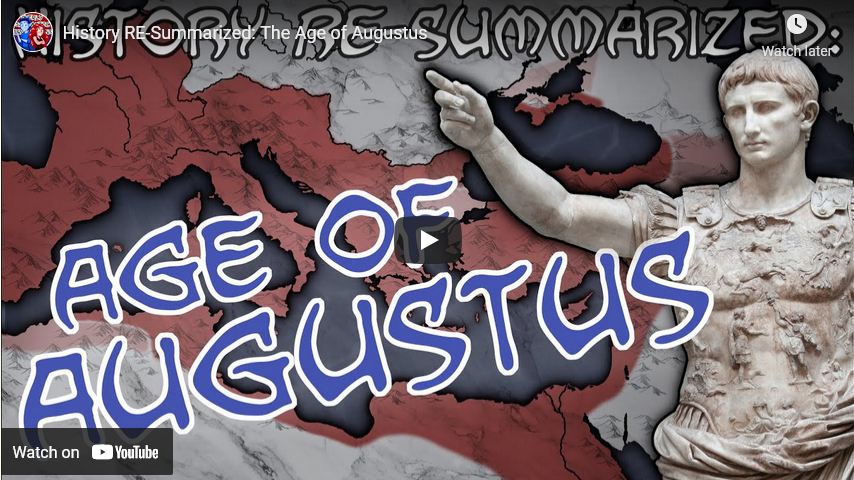
History RE-Summarized: The Age of Augustus
Overly Sarcastic Productions
Published 19 Mar 2021Many Romans had conquered the Republic, but nobody could keep it, until Augustus. In the half century after the assassination of Caesar, his adoptive son would fundamentally transform the Roman state: expanding it, reforming it, and bringing it under the control of one man. The Age of Augustus found Rome a Republic and left it an Empire.
This video is a Remastered, Definitive Edition of three previous videos from this channel — History Summarized: “Augustus Versus The Assassins”, “Augustus Versus Antony”, and “How Augustus Made An Empire”. This video combines them all into one narrative, fully upgrading all of the visuals and audio. If you want more Histories to be Re-Summarized, please comment and let me know!
SOURCES & Further Reading: The Age of Augustus by Werner Eck, Augustus and the Creation of the Roman Empire by Ronald Mellor, Cleopatra: A Life by Stacy Schiff, Virgil’s Aeneid, Polybius’ Histories, Livy’s Ab Urbe Condita, Plutarch’s Parallel Lives, SPQR by Mary Beard, Rome: A History in Seven Sackings by Matt Kneale, (and also my degree in Classical Studies).
SECTION TIME-CODES:
0:00 1 — Octavian V. the Assassins
07:40 2 — Octavian V. Antony
17:36 3 — Augustus as EmperorOur content is intended for teenage audiences and up.
PATREON: https://www.Patreon.com/OSP
PODCAST: https://overlysarcasticpodcast.transi…
DISCORD: https://discord.gg/osp
MERCH LINKS: http://rdbl.co/osp
OUR WEBSITE: https://www.OverlySarcasticProductions.com
Find us on Twitter https://www.Twitter.com/OSPYouTube
Find us on Reddit https://www.Reddit.com/r/OSP/
March 15, 2021
Loaded For War — The Santa Fe Railroad In World War II
PeriscopeFilm
Published 24 May 2020Want to support this channel and help us preserve old films? Visit https://www.patreon.com/PeriscopeFilm
Visit our website www.PeriscopeFilm.comSanta Fe presents, Loaded for War. This WWII era color film presents the power of the Santa Fe railroad. While speaking of the mighty effort the trains and its myriad workers achieved during wartime, the footage is all modern and in color. The film does a great job of showing how integral our railroad system has been to the growth of these United States. “With grateful appreciation to the Office of Defense Transportation, the Army, Navy, Maritime Commission, and the shipping and traveling public, for the cooperation and genuine understanding which has made the service record here presented possible …” The film opens with a steam locomotive bearing down on the camera 1:03. The narrator speaks as the train crosses a trestle 1:10. News headlines of December 7, 1941 11:25. Steam and diesel locomotives are transformed into machines of war 1:40. Smoke fills a train yard as trains enter and are washed 2:08. A train signal shows a green light 2:25. Workers are seen in the factory 2:36. Civilians exit trains volunteering for service 2:45. A telegram is shown stating that the trainmen should, “move all available equipment to military stations without delay” 2:54. Four locomotives are shown 3:03. Crews are assigned and men work double shifts 3:45. Rail equipment is loaded by military personnel, ready to move 4:13. Flatcars are loaded with tanks and military trucks 4:52. Divisions of fighting men aboard the trains 5:09. The tanks roll down the tracks on flatcars 5:35. The wheels of war are rolling 6:14. The day by day mass movement of freight is shown at the train yard 6:48. Trains crossing country on railroad tracks 7:40. Trains service the shipyards as men work building military ships 8:00. A ship is launched 8:15. Cattle and pigs are delivered throughout the 48 states 8:37. Potatoes are tilled in the field with heavy equipment 9:00. Oranges are picked and packed in southern states 9:13. Military bombers soar through the air 9:23. Heavy machinery workers in the factories 9:48. Factories and men building artillery shells 9:55. Tanks roll off the product line and onto the railroad tracks 10:10. Locomotive struggles up a hill 10:25. Miners and their lamp hats head down the tunnels by rail 10:38. Oil fields are shown 11:15. Oil is loaded onto railway tankers 11:38. Machines digging the copper mines 12:08. The big diggers pick up 8 cubic yards of copper at a time 12:18. The railroad moves the copper to the smelters 12:31. Sulfur mines using forced steam 12:50. Sulfur is moved by train to the gunpowder makers 13:25. Logging industry is served with the railroads 14:00. Cotton and scrap metal industries are also served by rail 14:18. Old cars are being called back into use for the war effort 15:30. Locomotive number 3723 comes out of retirement by the trainmen 15:48. Various train parts are marked and taken away for repair or replacement 16:07. Men work in factories with fine-tuned machines to retool and refine old parts for new use 16:26. Old firebrick is removed and replaced 16:43. Acetylene torches are used inside the huge boilers 16:49. Huge wheels are cleaned and dipped and sprayed ready for use 17:08. Heat is used to expand the metals 17:18. Locomotive number 3723 is fully refurbished and ready for the tracks 18:05. All types of equipment need to be refurbished for the war effort 18:46. The men use heat and molten metal to reshape old parts for new use 19:00. Gears are ground with precision 19:13. The railroads motto, “let’s keep ‘em rolling” 19:24. The men work on building new track 19:35. Men using hammers to straighten out tracks 19:53. The towermen, bridge crews, conductors, station men, ticket men, dispatchers, signalmen and to the other thousands of men – give the railroad men their due 20:44. Women are also an integral part of the success of the railroad 21:07. The women work in offices but also in factories with heavy machinery and molten metal 21:21. Two women wash down a train 21:30. The wheels of war are rolling 21:40. Military men march in unison 21:47. Train caboose pulls away from the camera 22:52. A flag with 8057 turns into the American flag and waves in the breeze 23:06. The End. Santa Fe.
We encourage viewers to add comments and, especially, to provide additional information about our videos by adding a comment! See something interesting? Tell people what it is and what they can see by writing something for example: “01:00:12:00 — President Roosevelt is seen meeting with Winston Churchill at the Quebec Conference.”
This film is part of the Periscope Film LLC archive, one of the largest historic military, transportation, and aviation stock footage collections in the USA. Entirely film backed, this material is available for licensing in 24p HD, 2k and 4k. For more information visit http://www.PeriscopeFilm.com

February 24, 2021
Disney’s Best Propaganda Cartoon
J.J. McCullough
Published 21 Nov 2020A review of Education for Death, a WW2 propaganda film. This video was sponsored by the Great Courses Plus! Start your free trial today by clicking here: http://ow.ly/az9m30rkCKF
Check out Three Arrows here: https://www.youtube.com/channel/UCCT8…
During the World War II, Disney made a number of cartoons to boost public support for the Allies and denounce Germany. This one, about Little Hans, has always been my favorite.
FOLLOW ME:
🇨🇦Support me on Patreon! https://www.patreon.com/jjmccullough
🤖Join my Discord! https://discord.gg/3X64ww7
🇺🇸Follow me on Instagram! https://www.instagram.com/jjmccullough/
🇨🇦Read my latest Washington Post columns: https://www.washingtonpost.com/people…
🇨🇦Visit my Canada Website http://thecanadaguide.comHASHTAGS: #propaganda #history #germany

February 2, 2021
The History of Hollywood
The Cynical Historian
Published 3 Sep 2020This episode is about the history of Hollywood, and it’s quite a long one. This is part 9 in a long running series about California history.
————————————————————
references:
Bernard F. Dick, Engulfed: The Death of Paramount Pictures and the Birth of Corporate Hollywood (Lexington: The University Press of Kentucky, 2001). https://amzn.to/3f2Yb0SHollywood’s America: United States History Through its Films, eds. Mintz, Steven and Randy Roberts (St. James, N.York: Brandywine Press, 1993). https://amzn.to/2tZIoJT
Richard Slotkin, Gunfighter Nation: The Myth of the Frontier in Twentieth-Century America (New York: Atheneum Books, 1992). https://amzn.to/2KX0jI2
Kevin Starr, Inventing the Dream: California through the Progressive Era, (Oxford, U.K.: Oxford University Press, 1985). https://amzn.to/2VPTbVX
————————————————————
Support the channel through PATREON: https://www.patreon.com/CynicalHistorian
or by purchasing MERCH: teespring.com/stores/the-cynical-hist…LET’S CONNECT:
Twitch: https://www.twitch.tv/cynicalhistorian
Discord: https://discord.gg/Ukthk4U
Twitter: https://twitter.com/Cynical_History
Subreddit: https://www.reddit.com/r/CynicalHistory/————————————————————
Wiki: By 1912, major motion-picture companies had set up production near or in Los Angeles. In the early 1900s, most motion picture patents were held by Thomas Edison’s Motion Picture Patents Company in New Jersey, and filmmakers were often sued to stop their productions. To escape this, filmmakers began moving out west to Los Angeles, where attempts to enforce Edison’s patents were easier to evade. Also, the weather was ideal and there was quick access to various settings. Los Angeles became the capital of the film industry in the United States. The mountains, plains and low land prices made Hollywood a good place to establish film studios.
Director D. W. Griffith was the first to make a motion picture in Hollywood. His 17-minute short film In Old California (1910) was filmed for the Biograph Company. Although Hollywood banned movie theaters — of which it had none — before annexation that year, Los Angeles had no such restriction. The first film by a Hollywood studio, Nestor Motion Picture Company, was shot on October 26, 1911. The H. J. Whitley home was used as its set, and the unnamed movie was filmed in the middle of their groves at the corner of Whitley Avenue and Hollywood Boulevard.
The first studio in Hollywood, the Nestor Company, was established by the New Jersey–based Centaur Company in a roadhouse at 6121 Sunset Boulevard (the corner of Gower), in October 1911. Four major film companies – Paramount, Warner Bros., RKO, and Columbia – had studios in Hollywood, as did several minor companies and rental studios. In the 1920s, Hollywood was the fifth-largest industry in the nation. By the 1930s, Hollywood studios became fully vertically integrated, as production, distribution and exhibition was controlled by these companies, enabling Hollywood to produce 600 films per year.
Hollywood became known as Tinseltown and the “dream factory” because of the glittering image of the movie industry. Hollywood has since become a major center for film study in the United States.
————————————————————
Hashtags: #history #Hollywood #California
Well, it is a very, very cunning plan …
In the latest Libertarian Enterprise, Sarah Hoyt explains why the progressives’ cunningest of cunning plans may not be cunning enough:
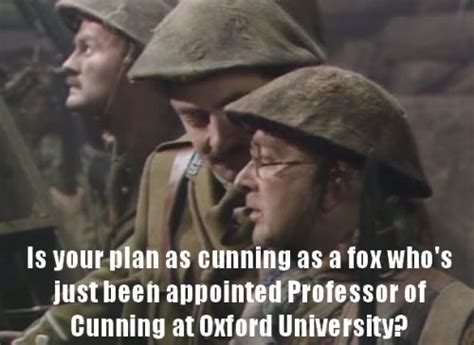
The left has a plan so cunning that if it were a person, it would be teaching cunningology at Oxford. And the ones who get the reference will also know that their plan is about to go pear shaped in all sorts of interesting ways, and at the end of it there might very well be a turnip or two involved, but not as the only item available in the shelves of the grocery store.
Look, someone pointed out in the comments the left are trying to follow the “plan” for other communist revolutions round the world.
He’s right. They’re trying to follow it to the letter. Partly because it’s worked before, and partly, because to be fair, they’re a cult, and cults don’t know the reason for the ritual, they just follow it.
… but it’s already going wrong. And it’s only going to get worse.
You see, part of the problem is that the cult of communism and the procedures for “the revolution” were set in the early twentieth century. And it’s designed for the early twentieth century. To the extent they worked in places like Venezuela, it is because the underlying structures of the society were still very much “early twentieth century.”
The US? Well, not so much. In fact we never were much like the early twentieth century in Europe, which is why they’ve had a hell of a time getting a foothold here.
The communist revolution is designed to work in a country that is mostly urban, with a vast urban underclass that can’t rise above for reasons both internal and external despite working unreasonable hours. It’s designed for a country with a firm aristocracy of the hereditary sort (even if that aristocracy is often from trade), it is designed for a country with a conscript army where the plum assignments go to the “good families” as a matter of course, it is designed to work — most of all and very importantly — in a country where they ABSOLUTELY control all the means of mass communication and do so without the vast majority of the people being aware of it.
The last time they could have pulled that off in the US was in the mid seventies. And my guess, honestly, is that they tried. I don’t know for sure, since the news of the time were all reported by biased sources, and besides I’m too lazy and too busy […] to spend my day chasing down hints. I bet they did try, though. I bet they gave it a sporting try. And I bet part of the issue back then — as now, btw — is that they were pinning their hopes on a race war, having both not realized how much of a minority people of African descent are in the US (last estimate is what? 14%? Sizeable, sure, but not a large minority and certainly not a majority. Also, and seriously, a lot of that minority is middle class and whatever they voice from the mouth-out as uninterested as the rest of us in having the apple cart overturned. Apples are tasty. Genocide not so much.) Mostly because that sh*t was so successful in Africa, and again the left doesn’t think. It ritualistically applies “what worked” without being able to account for changed conditions.
Anyway, that was the last time they could have MAYBE credibly have followed their little red map to revolution and have it work. And even then Americans were just too darn contrarian. Why everyone and their parents were telling us that Republicans were so dangerous, that they were going to start the nuclear war, that — And we went and voted Reagan in. (Well, not me. I only worked towards it. I didn’t vote. I wasn’t a citizen and I’m not a democrat.)
In fact, America could have engraved on its door lintel “authorities can go f*ck themselves.” The left keeps forgetting that. And sometimes justifiably. Take their Covid-psy-ops. It worked. And it was all run on the “experts” and how important it was.
Uh uh. So, they think their control is back! They’re golden again, baby!
January 29, 2021
Ancient Aryans: The History of Crackpot N@zi Archaeology
Atun-Shei Films
Published 22 Nov 2019Thanks to Indiana Jones, everybody knows that German archaeologists in the 1930s were searching for occult ancient artifacts … but that’s just the tip of the iceberg. In this educational video, I explore how the N@zis turned the discipline of prehistoric archaeology into a cog in their propaganda machine, and how their crazy conspiracy theories about lost civilizations continue to haunt us to this day.
Support Atun-Shei Films on Patreon ► https://www.patreon.com/atunsheifilms
Leave a Tip via Paypal ► https://www.paypal.me/atunsheifilms (All donations made here will go toward the production of The Sudbury Devil, our historical feature film)
Buy Merch ► teespring.com/stores/atun-shei-films
#WW2 #Archaeology #History
Reddit ► https://www.reddit.com/r/atunsheifilms
Twitter ► https://twitter.com/atun_shei