The worship of Napoleon has always been a French mystery. Is it spontaneous, reflecting nostalgia for empire, or something organized by the state, which has inherited from that period a matchless taste for authority? French schoolchildren are taught only the benefits of the emperor’s reign. According to our textbooks, Napoleon is supposed to have endowed France with a perfect legal system that still governs us today and to have caused the winds of freedom to blow across Europe. Each year, a dozen more books are published in France touting Napoleon’s glory. He has been represented more often than Christ on film, always as a positive hero.
Other Europeans see him very differently. While French historians amplify the myth that Napoleon himself created by dictating his idealized Memoires on St. Helena, English, German, Russian and Spanish authors count up the massacres and the destruction of their cities and their civilization.
Napoleon began shaping his reputation while he was still alive. He commonly wrote reports of his victories before the battles had even begun, which makes him the founding father of fake news. Certain disasters, such as the Battle of Eylau (now in Poland) against the Russians and Prussians, for example, are still inscribed in the walls of the Arc de Triomphe in Paris as if they were victories, since that is how they were first announced.
Since France is now part of Europe — rather than Europe becoming part of France, as Napoleon wished — what should we commemorate? French victories, such as Austerlitz, were defeats for the Russians and Austrians. Waterloo, a day of mourning for the French, is a symbol of liberation for the British, Germans, and Dutch. In any case, since the return of Napoleon’s ashes, our view of history has changed; the fate of people concerns us more than the fate of armies. Napoleon’s stature does not benefit from this change of perspective. To finance his wars, he ruined Europe, banning international commerce (only smugglers got rich), conscripting peasants, ravaging harvests, and confiscating horses. How should we commemorate the Russian and German campaigns of 1812 and 1813, when the Grand Army left in its wake not the liberation of peoples, but famine and epidemic? Worst still, how should we commemorate the restoration of slavery in the French Antilles, Guadeloupe, and Santo Domingo (Haiti), where the deputies of France’s Revolutionary Convention had abolished it in 1794?
Guy Sorman, “Which Napoleon?”, City Journal, 2021-05-14.
September 15, 2021
QotD: The cult of Napoleon
September 14, 2021
QotD: “In 1918 it was statistically safer for a British soldier to fight in the trenches of the Western Front than be a prisoner in Germany”
On and on the German outrages went: the sinking of the Lusitania, the execution of Nurse Cavell. Of course, the Allies were not saints, but the fashionable fallacy of moral equivalence — that all sides in the Great War were as bad as each other — founders on the rocks of Germany’s treatment of prisoners of war, who became slave labourers.
This was the main substance of the British agenda at Leipzig. Almost 165,000 British soldiers were taken prisoner on the Western Front between 1914-18; by the end of 1916, almost 80% were forced into labour for the Second Reich. Prisoners were literally worked to death in salt mines. And conditions in many camps were inhuman: in Wittenberg, two water taps served 17,000 Allied PoWs. When typhus struck the camp, the German staff abandoned it and left the prisoners to die. Some 13,000 Brits perished in the Kaiser’s camps — the vast majority because of brutality, disease, malnutrition or exhaustion. But 500 British soldiers were summarily shot or beaten to death at the Kaiser’s pleasure during their detention.
Of all the German PoWs held in Britain during the Great War, 3% died; of the British PoWs held in Germany, more than 10% perished. In 1918 it was statistically safer for a British soldier to fight in the trenches of the Western Front than be a prisoner in Germany. That year, 5.8% of British PoWs in Germany died, compared to 4% of British soldiers on the battlefield.
John Lewis Stempel, “Germany’s First World War Guilt”, UnHerd, 2021-05-25.
September 6, 2021
QotD: Torturing the English language for “antiracist” ends
Orwell had Kendi’s number: “The appropriate noises are coming out of his larynx, but his brain is not involved as it would be if he were choosing his words for himself. If the speech he is making is one that he is accustomed to make over and over again, he may be almost unconscious of what he is saying, as one is when one utters the responses in church. And this reduced state of consciousness, if not indispensable, is at any rate favourable to political conformity.” And that conformity is proven by the gawking, moneyed, largely white, Atlantic subscribers hanging on every one of this lightweight’s meaningless words — as if they really were in church.
The most dedicated abusers of the English language, of course, are the alphabet people. They have long since abandoned any pretense at speaking English and instead bombard us with new words: “cisheteropatriarchy”, “homonormativity”, “fraysexuality”, “neutrois”, “transmasculine”, “transmisogynoir”, and on and on. To give you a sense of the completely abstract bullshit involved here, take a style guide given out to journalists by trans activists, instructing them on how to cover transgender questions. (I’m wondering how Orwell would respond if given such a sheet of words he can and cannot use. Let’s just say: not like reporters for the Washington Post.) Here’s the guide’s definition of “gender nonconforming”: “[it] refers to gender presentations outside typical gendered expectations. Note that gender nonconforming is not a synonym for non-binary. While many non-binary people are gender nonconforming, many gender nonconforming people are also cisgender.”
This is a kind of bewildering, private language. But the whole point of the guide is to make it our public language, to force other people to use these invented words, to make the entire society learn and repeat the equivalent of their own post-modern sanskrit. This is our contemporary version of what Orwell went on to describe as “newspeak” in Nineteen Eighty-Four: a vocabulary designed to make certain ideas literally unthinkable because woke language has banished them from use. Repeat the words “structural racism” and “white supremacy” and “cisheteropatriarchy” often enough, and people come to believe these things exist unquestioningly. Talk about the LGBTQIA2S+ community and eventually, people will believe it exists (spoiler alert: it doesn’t).
Andrew Sullivan, “Our Politics and the English Language”, The Weekly Dish, 2021-06-04.
August 24, 2021
Bloody Victories – The Battles For Metz | GLORY & DEFEAT Week 6
realtimehistory
Published 19 Aug 2021Support Glory & Defeat by sponsoring an illustration: https://realtimehistory.net/adoptanar…
The French Army of Marshal Bazaine was hoping to reach Verdun or even Paris after the first engagements around Metz. But the French troops were exhausted which allowed the Germans to catch up. With the Battle of Gravelotte and the Battle of Mars-la-Tour, the fate of the French Rhine Army is sealed; they are trapped in Metz.
» THANK YOU TO OUR CO-PRODUCERS
John Ozment
James Darcangelo
Jacob Carter Landt
Thomas Brendan» OUR PODCAST
https://realtimehistory.net/podcast – interviews with historians and background info for the show.» LITERATURE
Arand, Tobias: 1870/71. Die Geschichte des Deutsch-Französischen Krieges erzählt in Einzelschicksalen. Hamburg 2018
Bourguinat, Nicolas/Vogt, Gilles: La Guerre franco-allemande de 1870. Une histoire globale. Paris 2020
Buk-Swienty, Tom: Feuer und Blut. Hauptmann Dinesen. Hamburg 2014
Roux, Georges: La Guerre de 1870. Paris 1966» SOURCES
Braun, Lily (Hrsg.): Kriegsbriefe aus den Jahren 1870/1 von Hans von Kretschman. Berlin 1911
Engels, Friedrich: Der Deutsch-Französische Krieg. Sechzig Artikel aus der “Pall Mall Gazette”. Berlin (Ost) 1957
Fontane, Theodor: Der Krieg gegen Frankreich. Bd. 1. Berlin 1873
Geschichte des Krieges 1870–1871, Union Deutsche Verlagsanstalt, Stuttgart 1895
N. N. (Hrsg.): Bismarcks Briefe an seine Gattin aus dem Kriege 1870/71. Stuttgart, Berlin 1903
Seigneur, Daniel: Carnets d’un infirmier d’une guerre oublié. Bière 2014» OUR STORE
Website: https://realtimehistory.net»CREDITS
Presented by: Jesse Alexander
Written by: Cathérine Pfauth, Prof. Dr. Tobias Arand, Jesse Alexander
Director: Toni Steller & Florian Wittig
Director of Photography: Toni Steller
Sound: Above Zero
Editing: Toni Steller
Motion Design: Philipp Appelt
Mixing, Mastering & Sound Design: http://above-zero.com
Maps: Battlefield Design
Research by: Cathérine Pfauth, Prof. Dr. Tobias Arand
Fact checking: Cathérine Pfauth, Prof. Dr. Tobias ArandChannel Design: Battlefield Design
Contains licensed material by getty images
All rights reserved – Real Time History GmbH 2021
July 27, 2021
QotD: Walter Duranty’s Pulitzer
He won the Pulitzer Prize in 1934 for his reporting, but ever since 1990, when a biography of him was published that emphasized the extent of his mendacity, there have been efforts to have the prize symbolically rescinded (Duranty died in 1957).
A man may be honestly mistaken, but Duranty had knowingly and persistently lied about matters of world importance. At the very least he deserved the sack rather than a prestigious award, but was never called to account during his lifetime; and the Pulitzer committee has twice decided that the award should not be withdrawn.
I can see the argument for rescinding the prize because Duranty’s conduct was truly despicable, and the prize had been for what, morally, was a great crime.
But there is also an argument for not rescinding it, for the posthumous withdrawal of an award can look like an attempt to rewrite the history of the awarding authority by an act of auto-absolution. An admission that the Pulitzer committee had made a terrible error of judgment might have been sufficient.
Theodore Dalrymple, “Richard Dawkins Punished for Inviting Us to Think”, The Iconoclast, 2021-04-24.
July 13, 2021
Is the PRC really a paper dragon?
Sarah Hoyt is tired of finding posts on MeWe that fluff up the ChiComs as a way of “conservatives” scoring points against “progressives” in the US political context:
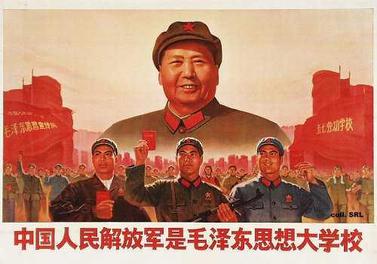
“The Chinese People’s Liberation Army is the great school of Mao Zedong Thought”, 1969.
A poster from the Cultural Revolution, featuring an image of Chairman Mao, published by the government of the People’s Republic of China.
Image via Wikimedia Commons.
What bilge? Oh, memes extolling the Chinese in relation to us. And all conservatives pick this crap up and echo it, because it happens to “side rail” against things they hate (and which it’s valid to hate.)
But the memes are crap. The aggrandizing of the Chinese bastards is crap. They’re either outright lies or laughable lies. And the memes, somehow, never hit the Chinese where it hurts: the fact their economy is so f*cked most of their people live like Medieval peasants; the fact their army of little emperors cried when they went up against India; the fact that they are having trouble feeding their own population; the crumbling empty cities they think are “investments”; their population collapse; Xi’s pretensions to world leadership; their slave camps. Which you know, tells you exactly where the meme factory is and who is propagating it.
The problem being when conservatives seize the memes and distribute, they are actively collaborating in the aggrandizing of China and putting down the US. They are also convincing the Chinese their victory over us will be easy. (This is good and bad, but if you have friends and relatives in large cities, think about the chances of it ending up with one of those catching a nuke because the idiots get cocky, okay?)
Chinese are masters of propaganda and psychological warfare, while Americans are so bad at it that it hurts. If you loved 2020 keep collaborating with the enemy.
If not, listen up:
Yeah, sure, the fact that the usurpers of our governmental institutions are making our armed forces participate in inclusivity and CRT training, and prioritizing bullshit SJW goals over preparedness IS a problem. But that doesn’t mean we’re not still the best fighting force in the world. Sure, it’s damning with faint praise, but comparing us to China and saying they’re “prepared for war” and “will win” is bullshit. You know it’s bullshit, I know it’s bullshit. It’s bullshit so rank I can smell it through the internet.
The Chinese have Little Emperors — single descendants of multiple families — who are no more prepared to risk themselves in war than I’m prepared to fly unassisted. Their army is bullshit.Why is it bullshit? Because they don’t have a fighting force. The only fighting strength they ever had was the ability to submerge any enemy in a wave of people. But they can’t. Because the communists destroyed that too.
Their weapons are bullshit. I’d like independent confirmation of their “achievements in space”. Why? Because, well, the USSR achievement in space was a) what they could steal from us b) flimsy and c) mostly trumped up. In the sense that they only publicized their wins, while it might be one in ten that succeeded.
Look, by definition an authoritarian regime sucks at tech. I’m not saying anything about “capabilities of the people” (duh) but seriously? If you can’t report failed experiments, failed assemblies or builds that need to be improved, you’re going to have crappy tech. And you can’t report any of that, because in a centralized authoritarian regime you’ll be punished for failure, even if it’s not your fault. And you might get accused of doing it on purpose.
When nothing less than 100% success is allowed, the process is corrupt and the result is excrement. (Look at our “science” right now. No, seriously. We’re sliding that way.)
So, no matter how made you are at what the army and our government is doing, stop echoing Xi’s bullshit. And counter it every time you see it. This is war by other means, or in the ancient Chinese tradition, softening the enemy so they’ll surrender at first attack.
June 13, 2021
QotD: Defending the undefendable – Brutalist architecture
The newly-gained attractivity [of architectural brutalism] is growing by the day. In troubled times where societal divides are stronger than ever around the globe and in a world where instantaneous rhymes with tenuous, brutalism offers a grounded style. It’s a simple, massive and timeless base upon which one can feel safe, it’s reassuring.
It is rather difficult to argue with, let alone refute, the vague propositions of such a paragraph, which nevertheless intends (I imagine) to connote approval and judgment based upon sophisticated, wide, and deep intellectual considerations. But what exactly is a “grounded style” in contrast to a “world where instantaneous rhymes with tenuous”? This is verbiage, if not outright verbigeration, though it might serve to intimidate those with little confidence in their own judgment. The idea that brute concrete could create any kind of security rather than unease or fear is laughable.
When defenders of or apologists for brutalism illustrate their articles with supposed masterpieces of the genre, it is hardly a coincidence that they do so with pictures of buildings utterly devoid of human beings. A human being would be about as out of place in such a picture, and a fortiori in such a building, as he would be in a textbook of Euclidean geometry, and would be as welcome as a termite in a wooden floor or a policeman in a thieves’ kitchen. For such defenders and apologists of brutalism, architecture is a matter of the application of an abstract principle alone, and they see the results through the lenses of their abstraction, which they cherish as others cherish their pet.
Theodore Dalrymple, “The Brutalist Strain”, Taki’s Magazine, 2019-11-02.
June 6, 2021
QotD: The Soviet Union in the Cold War, China today
Needless to say, it was gibbering nonsense. The late ’80s Soviet collapse revealed that the USSR was never any kind of power at all – an economy that didn’t produce, weapons that didn’t work, a populace addicted to drink and overwhelmed with despair. “Bulgaria with nukes” is how someone characterized it, and truer words were never spoken. That remains the case today, despite Vlad Putin’s chest-beating, and it’s likely to remain the case as far ahead as anyone can see.
The same trope is being repeated regarding China. China, we are told, is the coming nation. The second largest economy on Earth, soon to be the first. A billion and a half people, each more educated than any American; a military power second to none, with advanced weapons of a nature that we can only gape at. A country exercising its power over vast reaches of the Pacific and moving into the Indian Ocean, Africa, and the Mideast with no one to oppose it.
We hear this from the likes of Thomas Friedman, who has spent much of his career looking for his personal Mussolini. It’s repeated by deeper figures across the political spectrum. In fact, it can be said without exaggeration to have become received wisdom.
There’s no point in asking how true this is. The proper question to ask is whether it embodies any truth at all.
J.R. Dunn, “The Myth of China as Superpower”, American Thinker, 2019-01-09.
June 2, 2021
How Hitler Manipulated Germany into Committing Genocide – WW2 Special
World War Two
Published 1 Jun 2021In the wrong hands, propaganda is a powerful tool that can trick whole countries into supporting a dictator, go to war, or even commit genocide.
(more…)
May 13, 2021
Were There Really BLACK CONFEDERATES???!!!
Atun-Shei Films
Published 24 Dec 2020Checkmate, Lincolnites! Debunking the Lost Cause myth that tens of thousands of black men served as soldiers in the Confederate army during the American Civil War.
Support Atun-Shei Films on Patreon ► https://www.patreon.com/atunsheifilms
Leave a Tip via Paypal ► https://www.paypal.me/atunsheifilms
Buy Merch ► teespring.com/stores/atun-shei-films
#CheckmateLincolnites #CivilWar #AmericanHistory
Original Music by Dillon DeRosa ► http://dillonderosa.com/
Reddit ► https://www.reddit.com/r/atunsheifilms
Twitter ► https://twitter.com/atun_shei~REFERENCES~
[1] “Black Confederate Movement ‘Demented'” (2014). AmericanForum https://youtu.be/fYFIWlGJhjM
[2] Sam Smith. “Black Confederates: Myth and Legend.” American Battlefield Trust https://www.battlefields.org/learn/ar…
[3] “25th USCT: The Sable Sons of Uncle Abe.” National Park Service https://www.nps.gov/articles/25-usct.htm
[4] Justin A. Nystrom. New Orleans After the Civil War (2010). Johns Hopkins Press, Page 20-27
[5] Kevin M. Levin. Searching for Black Confederates (2019). University of North Carolina Press, Page 45
[6] James Parton. General Butler in New Orleans (1864). Mason & Hamlin, Page 516-517
[7] Levin, Page 12-15
[8] Levin, Page 34-35
[9] Myra Chandler Sampson & Kevin M. Levin. “The Loyalty of ‘Heroic Black Confederate’ Silas Chandler” (2012). HistoryNet https://www.historynet.com/loyalty-si…
[10] Levin, Page 82-83
[11] James G. Hollandsworth, Jr. “Looking for Bob: Black Confederate Pensioners After the Civil War” (2007). The Journal of Mississippi History, Vol. LXVIX, Page 304-306
[12] Lewis H. Steiner. An Account of the Operations of the U.S. Sanitary Commission During the Campaign in Maryland, September 1862 (1862). Anson D. F. Randolph, Page 19-20
[13] Levin, Page 32-33
[14] Charles Augustus Stevens. Berdan’s United States Sharpshooters in the Army of the Potomac (1892). Price-McGill Company, Page 54-55
[15] Levin, Page 44
[16] Andy Hall. “Frederick Douglass and the ‘N*gro Regiment’ at First Manassas” (2011). Dead Confederates Blog https://deadconfederates.com/2011/07/…
[17] Jaime Amanda Martinez. “Black Confederates” (2018). Encyclopedia Virginia https://www.encyclopediavirginia.org/…
[18] Levin, Page 58-61
[19] Levin, Page 39
[20] Levin, Page 46

May 7, 2021
The Nazi Invasion of Canada?! – WW2 – On the Homefront 009
World War Two
Published 6 May 2021What would happen if Nazi Germany invaded Canada? You don’t need to imagine. In 1942, the government of Mackenzie King launched a propaganda effort that simulates Canada falling under Hitler’s yoke. Why? For the war economy of course!
Join us on Patreon: https://www.patreon.com/TimeGhostHistory
Or join The TimeGhost Army directly at: https://timeghost.tvFollow WW2 day by day on Instagram @ww2_day_by_day – https://www.instagram.com/ww2_day_by_day
Between 2 Wars: https://www.youtube.com/playlist?list…
Source list: http://bit.ly/WW2sourcesHosted by: Anna Deinhard
Written by: Fiona Rachel Fischer and Spartacus Olsson
Director: Astrid Deinhard
Producers: Astrid Deinhard and Spartacus Olsson
Executive Producers: Astrid Deinhard, Indy Neidell, Spartacus Olsson, Bodo Rittenauer
Creative Producer: Maria Kyhle
Post-Production Director: Wieke Kapteijns
Research by: Fiona Rachel Fischer
Edited by: Miki Cackowski
Sound design: Marek Kamiński
Map animations: Miki Cackowski and Eastory (https://www.youtube.com/c/eastory)Colorizations by:
Adrien Fillon – https://www.instagram.com/adrien.colo…
Daniel WeissSources:
IWM Art.IWM PST 18495, CH 27, CH 3231, CH 6831, HU 88386, HU 104482
nationaal archief
Photo Album of F.V. Light (1923-2000)Soundtracks from the Epidemic Sound:
Howard Harper-Barnes – “London”
Johannes Bornlof – “The Inspector 4”
Howard Harper-Barnes – “Prescient”
Max Anson – “Ancient Saga”
Howard Harper-Barnes – “Sailing for Gold”
Philip Ayers – “Please Hear Me Out”
Jo Wandrini – “Puzzle Of Complexity”
Reynard Seidel – “Deflection”
Rannar Sillard – “March Of The Brave 4”
Phoenix Tail – “At the Front”Archive by Screenocean/Reuters https://www.screenocean.com.
A TimeGhost chronological documentary produced by OnLion Entertainment GmbH.
From the comments:
World War Two
1 day ago
As you can see in the video, the efforts to raise money to pay for the war were extremely high. But when we read about the stuff that was going on in Winnipeg on “If-Day”, we were really surprised — talk about “playing” war! Of course, this top-notch high-effort propaganda had quite the impact on the citizens of Winnipeg, because — let´s be honest — who wouldn´t be frightened by any kind of Nazi invasion? And they did not spare any effort to get the details right, too. What is your impression of If-Day? Have you heard of it before? Please let us know in the comments!Cheers, Fiona
P.S. If you want to watch the short film starring Donald Duck which Anna mentions in the video, click right here: https://www.youtube.com/watch?v=XNMrMFuk-bo&ab_channel=8thManDVD.com%E2%84%A2CartoonChannel
May 6, 2021
Cold War 2: Electric Dumbaloo
Seva Gunisky at Hegemon has some thoughts on the undeclared-but-real new Cold War between the Peoples’ Republic Of China and what remains of the “west”:
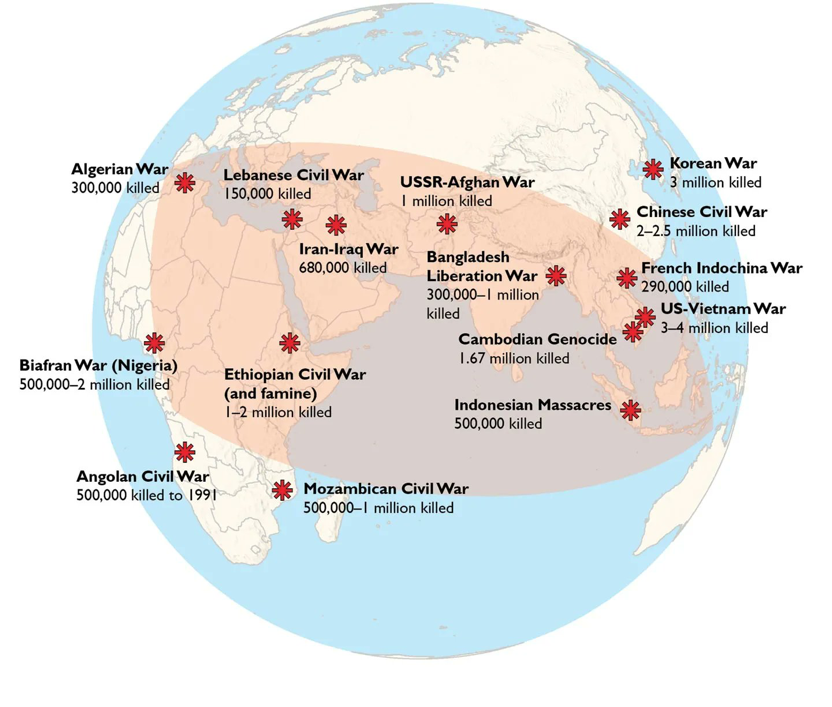
Approximate casualties of the many separate “hot” conflicts of the first Cold War.
Last week I discussed some reasons for and against the label of “Cold War” to describe US-Chinese relations, but mostly ignored the ethical implications of this debate. Since then I’ve encountered some genuinely terrible takes on the subject, so I wanted to expand on the idea just a bit.
One thing I failed to mention is how the presence of Chinese-Americans in the US — something largely missing during the first Cold War — complicates the debate. If you’re a China dove, one argument might be that any criticism of China’s regime amounts to racism against Chinese-Americans …
I’ve worked with many people with Chinese ancestry and people who came to Canada quite recently (in the software business it’d be hard to avoid working with folks from former and current communist countries), so I’ve always tried to be as careful as possible to couch my criticism of China — the PRC — to ensure that even a casual reader is clear that I’m against the government and their system, not individual people from China. It doesn’t always work, because for too many people these days, everything has to be viewed through a racist lens and anything that might possibly look or sound like racism must therefore absolutely be racism.
I think this argument can be taken too far, and used as a cheap way to shield China’s regime from legitimate criticism. As Alex Hazanov points out, it’s the same patronizing conflation people make when arguing that any criticism of Israel must be an attack on American Jews.
The doves are right, however, that the presence of nearly four million Chinese-Americans makes cold war discourse more fraught than the first time around, when the Soviets were “white” and safely far away. Official statements and attitudes will have to take special care, but in general the US does not have a great history in this regard. I fully expect reactionary cranks to demand that Chinese-Americans publicly and ritualistically denounce the Chinese government. Still, I hope it should be obvious that characterizing any critique of China’s government as “imperialist” or “sinophobic” is silly.
But brace yourselves for the shitstorm of dumb that will accompany this (hopefully cold) geostrategic conflict:
Take first Cold War discourse, add a dash of racism, filter it through social media, and you are beginning to get a sense of how dumb the debates are going to be.
[…]
And if we are going to pick a cold war “doctrine”, we should consider that neither Russia or China is looking great in the medium run. It seems that despite its supposed efficiency the Chinese regime is unable to resolve the information problem common in closed regimes, that regime personalization under Xi has worsened the problem, and that this, combined with structural/demographic problems, means the Chinese regime has a rough road ahead in the next 10-30 years.
If so, the best policy for US is certainly to avoid head-on confrontation in favor of something like neo-containment. But that’s another conversation.
H/T to Colby Cosh for the link.
Il Duce and the Fascist Abuse of History | B2W: ZEITGEIST! I E.17 – Harvest 1922
TimeGhost History
Published 5 May 2021The modern age is an age of modern things. But it is also an age when people yearn for times past. One of the main men to weaponize this yearning is Benito Mussolini, and this season, he moves to recreate the Roman Empire in his fascist image.
Get your own Indy Neidell Tie here: https://www.youtube.com/channel/UC4Mi…
Join us on Patreon: https://www.patreon.com/TimeGhostHistory
Hosted by: Indy Neidell
Written by: Francis van Berkel
Director: Astrid Deinhard
Producers: Astrid Deinhard and Spartacus Olsson
Executive Producers: Astrid Deinhard, Indy Neidell, Spartacus Olsson, Bodo Rittenauer
Creative Producer: Maria Kyhle
Post-Production Director: Wieke Kapteijns
Research by: Francis van Berkel and Timothy Smith
Image Research by: Lucas Aimo
Edited by: Lucas Aimo
Sound design: Marek KamińskiColorizations:
– Daniel Weiss
– Mikołaj UchmanArchive by Screenocean/Reuters https://www.screenocean.com.
A TimeGhost chronological documentary produced by OnLion Entertainment GmbH.
From the comments:
TimeGhost History
2 days ago (edited)
The only thing more interesting than learning about history is learning about how people in history learned about history.For starters, it is just interesting in itself. Anyone with a passion for history will want to hear about the circumstances of how a new discovery was made or how certain historical narratives were preserved over time. But more analytically, looking at how a society understood its history can tell you a lot about that society understood itself and the contemporary world around it. That second point is particularly true of the modern age. Ironically, it is a very modern “thing” to be so aware of history. Indeed, the modern age saw the birth of the museum, of nationalist histories, and even the concept of what “History” itself was (note the capital H).
It’s such a massive topic and one that perhaps isn’t suited to a single pinned comment. Interested in learning more? Maybe we’ll do another video on it someday. In the meantime, you can read up the works of Reinhart Koselleck … that should keep you occupied.

April 29, 2021
“Tokyo Rose” – WW2 Traitor or Victim?
Mark Felton Productions
Published 28 Apr 2021This is the story of “Tokyo Rose”, a Japanese-American from LA who broadcast propaganda for the Japanese during WW2. Was she a traitor or a victim?
Dr. Mark Felton is a well-known British historian, the author of 22 non-fiction books, including bestsellers Zero Night and Castle of the Eagles, both currently being developed into movies in Hollywood. In addition to writing, Mark also appears regularly in television documentaries around the world, including on The History Channel, Netflix, National Geographic, Quest, American Heroes Channel and RMC Decouverte. His books have formed the background to several TV and radio documentaries. More information about Mark can be found at: https://en.wikipedia.org/wiki/Mark_Fe…
Visit my audio book channel ‘War Stories with Mark Felton’: https://youtu.be/xszsAzbHcPEHelp support my channel:
https://www.paypal.me/markfeltonprodu…
https://www.patreon.com/markfeltonpro…Disclaimer: All opinions and comments expressed in the “Comments” section do not reflect the opinions of Mark Felton Productions. All opinions and comments should contribute to the dialogue. Mark Felton Productions does not condone written attacks, insults, racism, sexism, extremism, violence or otherwise questionable comments or material in the “Comments” section, and reserves the right to delete any comment violating this rule or to block any poster from the channel.

April 23, 2021
Taiwan Under Occupation, Axis Solidarity, and U-Boats in the Med – WW2 – OOTF 022
World War Two
Published 22 Apr 2021Ever wonder what life was like in Taiwan during the Second World War? Or if German U-Boats were active in the Mediterranean? You can find out the answers in this episode of Out of the Foxholes!
Join us on Patreon: https://www.patreon.com/TimeGhostHistory
Or join The TimeGhost Army directly at: https://timeghost.tvFollow WW2 day by day on Instagram @ww2_day_by_day – https://www.instagram.com/ww2_day_by_day
Between 2 Wars: https://www.youtube.com/playlist?list…
Source list: http://bit.ly/WW2sourcesHosted by: Indy Neidell
Written by: Ian Sowden, Lewis Braithwaite, Timothy Smith
Director: Astrid Deinhard
Producers: Astrid Deinhard and Spartacus Olsson
Executive Producers: Astrid Deinhard, Indy Neidell, Spartacus Olsson, Bodo Rittenauer
Creative Producer: Maria Kyhle
Post-Production Director: Wieke Kapteijns
Research by: Ian Sowden, Lewis Braithwaite, Timothy Smith
Edited by: Miki Cackowski
Sound design: Marek Kamiński
Map animations: Miki Cackowski and Eastory (https://www.youtube.com/c/eastory)Sources:
David Rumsey Map Collection, David Rumsey Map Center, Stanford Libraries
Chapman University Digital CommonsSoundtracks from the Epidemic Sound:
Yi Nantiro – “Watchman”
Max Anson – “Ancient Saga”
Skrya – “First Responders”Archive by Screenocean/Reuters https://www.screenocean.com.
A TimeGhost chronological documentary produced by OnLion Entertainment GmbH.