
Obviously it is not desirable that a Government department should have any power of censorship (except security censorship, which no one objects to in wartime) over books which are not officially sponsored. But the chief danger to freedom of thought and speech at this moment is not the direct interference of the M.O.I. [Ministry of Information] or any official body. If publishers and editors exert themselves to keep certain topics out of print, it is not because they are frightened of prosecution but because they are frightened of public opinion. In this country, intellectual cowardice is the worst enemy a writer or journalist has to face, and that fact does not seem to me to have had the discussion it deserves.
Any fair‐minded person with journalistic experience will admit that during this war official censorship has not been particularly irksome. We have not been subjected to the kind of totalitarian “co-ordination” that it might have been reasonable to expect. The press has some justified grievances, but on the whole the Government has behaved well and and has been surprisingly tolerant of minority opinions. The sinister fact about literary censorship in England is that it is largely voluntary. Unpopular ideas can be silenced, and inconvenient facts kept dark, without the need for any official ban. Anyone who has lived long in a foreign country will know of instances of sensational items of news — things which on their own merits would get the big headlines — being kept right out of the British press, not because the Government intervened but because of a general tacit agreement that “it wouldn’t do” to mention that particular fact. So far as the daily newspapers go, this is easy to understand. The British press is extremely centralized, and most of it is owned by wealthy men who have every motive to be dishonest on certain important topics. But the same kind of veiled censorship also operates in books and periodicals, as well as in plays, films and radio. At any given moment there is an orthodoxy, a body of ideas which it is assumed that all right thinking people will accept without question. It not exactly forbidden to say this, that or the other but it is “not done” to say it, just as in mid‐Victorian times it was “not done” to mention trousers in the presence of a lady. Anyone who challenges the prevailing orthodoxy finds himself silenced with surprising effectiveness. A genuinely unfashionable opinion is almost never given a fair hearing, either in the popular press or in the highbrow periodicals.
At this moment what is demanded by the prevailing orthodoxy is an uncritical admiration of Soviet Russia. Everyone knows this, nearly everyone acts on it. Any serious criticism of the Soviet regime, any disclosure of facts which the Soviet Government would prefer to keep hidden, is next door to unprintable. And this nation-wide conspiracy to flatter our ally takes place, curiously enough, against a background of genuine intellectual tolerance. For though you are not allowed to criticize the Soviet Government, at least you are reasonably free to criticize our own. Hardly anyone will print an attack on Stalin, but it is quite safe to attack Churchill, at any rate in books and periodicals. And throughout five years of war, during two or three of which we were fighting for national survival, countless books, pamphlets and articles advocating a compromise peace have been published without interference. More, they have been published without exciting much disapproval. So long as the prestige of the U.S.S.R. is not involved, the principle of free speech has been reasonably well upheld. There are other forbidden topics […] but the prevailing attitude toward the U.S.S.R is much the most serious symptom. It is, as it were, spontaneous, and is not due to the action of any pressure group.
The servility with which the greater part of the English intelligentsia have swallowed and repeated Russian propaganda from 1941 onward would be quite astounding if it were not that they have behaved similarly on several earlier occasions. On one controversial issue after another the Russian viewpoint has been accepted without examination and then publicized with complete disregard to historical truth or intellectual decency. To name only one instance, the B.B.C. celebrated the twenty-fifth anniversary of the Red Army without mentioning Trotsky. This was about as accurate as commemorating the battle of Trafalgar with out mentioning Nelson, but evoked no protest from the English intelligentsia. In the internal struggles in the various occupied countries, the British press has in almost all cases sided with the faction favored by the Russians and libeled the opposing faction, sometimes suppressing material evidence in order to do so. A particularly glaring case was that of Colonel Mihailovich, the Jugoslav Chetnik leader. The Russians, who had their own Jugoslav protégé in Marshal Tito, accused Mihailovich of collaborating with the Germans. This accusation was promptly taken up by the British press: Mihailovich’s supporters were given no chance of answering it, and facts contradicting it were kept out of print. In July, 1943, the Germans offered a reward of 100,000 gold crowns for the capture of Tito, and a similar reward for the capture of Mihailovich. The British press “splashed” the reward for Tito, but only one paper mentioned (in small print) the reward for Mihailovich; and the charges of collaborating with the Germans continued. Very similar things happened during the Spanish civil war. Then, too, the factions on the Republican side which the Russians were determined to crush were recklessly libeled in the English leftwing press, and any statement in their defense, even in letter form, was refused publication. At present, not only is serious criticism of the U.S.S.R. considered reprehensible, but even the fact of the existence of such criticism is kept secret in some cases. For example, shortly before his death Trotsky had written a biography of Stalin. One may assume that it was not an altogether unbiased book, but obviously it was saleable. An American publisher had arranged to issue it and the book was in print — I believe the review copies had been sent out — when the U.S.S.R. entered the war. The book was immediately withdrawn. Not word about this has ever appeared in the British press, though clearly the existence of such a book, and its suppression, was a news item worth a few paragraphs.
George Orwell “The Freedom of the Press”, 1945 (written as the introduction to Animal Farm, but not published in Orwell’s lifetime).
August 1, 2020
QotD: Voluntary self-censorship
July 25, 2020
Walter Duranty, Stalin’s tame “journalist”
Francis X. Maier makes the case that the Holodomor — the Soviet Union’s deliberate starvation of millions of its own people in Ukraine and surrounding regions — killed even more than the better-known Nazi Holocaust, then identifies one of the key apologists who lied serially and deliberately to hide the genocide:
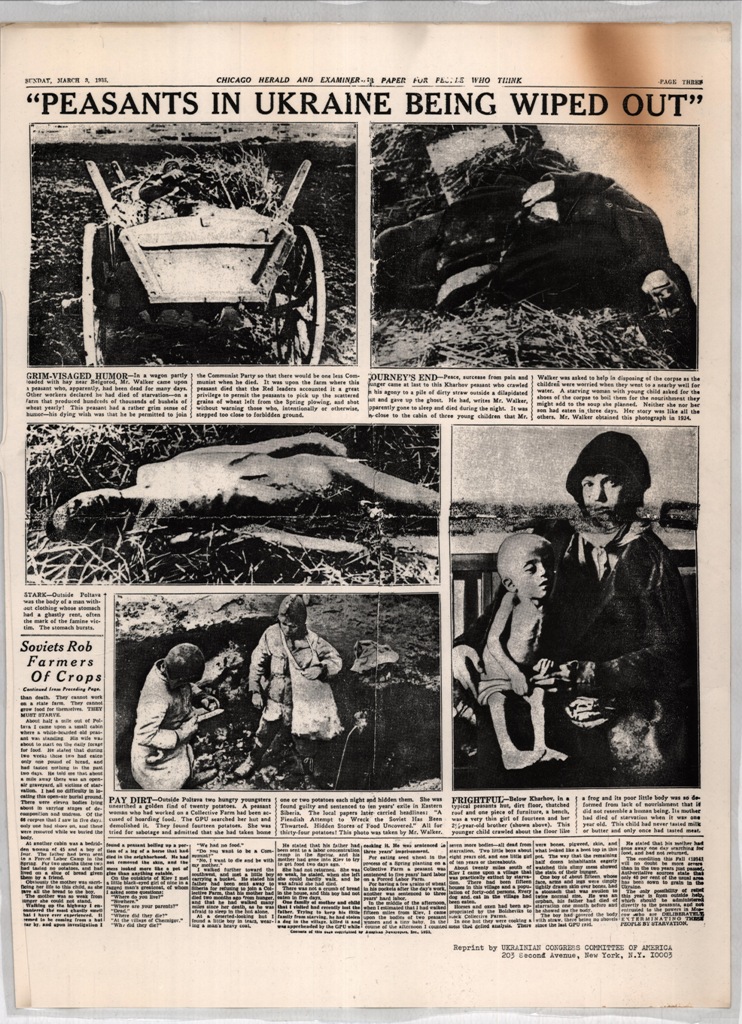
A page from the Chicago Herald and Examiner from 3 March, 1935.
Wikimedia Commons.
[S.J.] Taylor’s 1990 article was timed to the release of Stalin’s Apologist, her withering biography of journalist Walter Duranty. A Pulitzer Prize winner, celebrated political analyst, and Moscow correspondent for the New York Times during the 1930s, Duranty interviewed Stalin twice. He also played a significant role in securing American diplomatic recognition for the Soviet regime. Less publicly, he was a prodigious womanizer, longtime opium buddy of Satanist Aleister Crowley, compulsive exploiter of friends, a spendthrift, occasional drunk, and an inventive, always-reliable flack for the Soviet regime.
One of Duranty’s lifelong memories involved his religious grandmother who, after catching the adolescent Duranty in a lie, had warned him that “liars go to hell.” He never forgot or forgave the correction. As an adult, he simply erased all family ties and falsely claimed in his autobiography that he’d been orphaned at age ten. Massaging the truth became one of his core skills. Brilliant, engaging, and widely respected at the time, he was, in the words of Malcolm Muggeridge, who also reported from Moscow and saw Duranty in action, “the greatest liar of any journalist I have met in 50 years of journalism.”
Committed to protecting his own influence and to a future “greater good” promised by the Soviet regime, Duranty at first dismissed rumors of the Ukrainian Famine. Then he downplayed them. Then he claimed that Ukraine’s “food shortages” were the result of local mismanagement and the work of “wreckers” and “spoilers” intent on undermining Soviet progress. He repeatedly denied the mass starvation in his reporting. But he did suggest that “you can’t make an omelet without breaking eggs” … especially when the omelet is the task of modernization, and the cooks are tough-minded Bolsheviks intent on a better tomorrow.
As Taylor notes in her book, Western powers struggling with the Great Depression and the rise of Hitler in Germany had little interest in rumors from Ukraine that might antagonize Stalin as a potential ally. Muggeridge had arrived in Russia in 1932 to string for the Manchester Guardian. A convinced socialist at the time, he intended to stay in Russia and renounce his British passport for Soviet citizenship. Reality interfered. By March 1933, he was reporting on Ukraine’s famine as “one of the most monstrous crimes in history,” and his disillusionment with the Soviet paradise was complete. But back in England, thanks in part to Duranty’s counter-reporting and Soviet propaganda, Muggeridge’s work was dismissed as “a hysterical tirade.” Muggeridge himself was slandered, vilified, and unable to find employment. And that might have buried the Holodomor story successfully, except for one man.
Welshman Gareth Jones was a young Russian Studies graduate of Cambridge and a former secretary to British Prime Minister Lloyd George. Stringing for the same Manchester Guardian as Muggeridge, he eluded Soviet press controls and spent three weeks on his own, walking through the hellish conditions of a starvation-ravaged Ukraine. Then he wrote about it in the spring of 1933, confirming and compounding the impact of Muggeridge’s recent work. Walter Duranty led the ferocious, Soviet-prodded attack on Jones’s credibility. He also bullied most other Moscow-based Western journalists — to their enduring disgrace — into doing the same, lest they lose their visas. Jones, however, had a spine. He did not back off. He continued writing and speaking about the famine in Ukraine with lasting effect, until his death under suspicious circumstances two years later.
July 13, 2020
“The Richard of Richard III is often regarded as a caricature, a cardboard-cutout villain rather like the Sweeney Todd of Victorian melodrama”
Theodore Dalrymple discusses two Shakespeare characters, the protagonists of Richard II and Richard III:
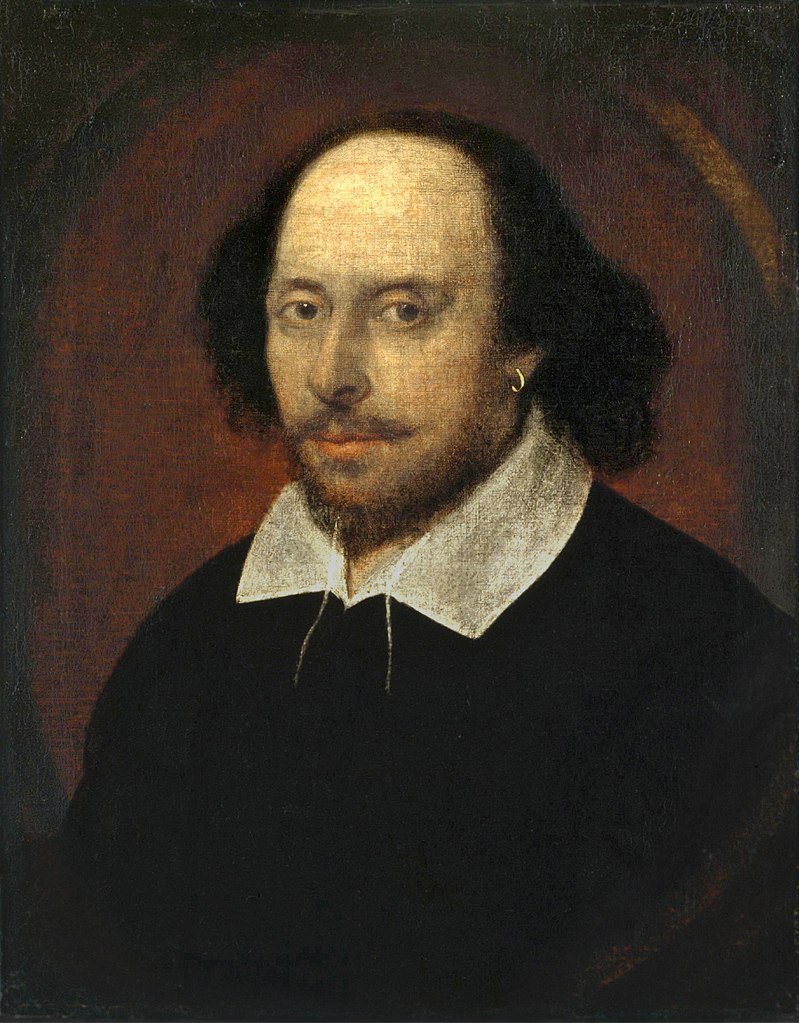
This was long thought to be the only portrait of William Shakespeare that had any claim to have been painted from life, until another possible life portrait, the Cobbe portrait, was revealed in 2009. The portrait is known as the “Chandos portrait” after a previous owner, James Brydges, 1st Duke of Chandos. It was the first portrait to be acquired by the National Portrait Gallery in 1856. The artist may be by a painter called John Taylor who was an important member of the Painter-Stainers’ Company.
National Portrait Gallery image via Wikimedia Commons.
… if we cannot know Shakespeare’s positive thoughts about any major question, as Nutall puts it, we can at least surmise some of the things that he did not believe. No one, I think, could imagine that Shakespeare romanticized the common man or was impressed by a crowd’s capacity for deep reflection. If there is one thing that he was not, it is a utopian.
Apart from the absence of direct evidence, one reason that it is so difficult to know what Shakespeare thought is that he seemed uniquely able to imagine himself into the minds of an almost infinite number of characters, so that he actually became them. He was, in a sense, like an actor who has played so many parts that he no longer has a personality of his own. A chameleon has many colors, but no color. What is perhaps even more remarkable is that, by some verbal alchemy, Shakespeare turns us into a pale version of himself. Through the great speeches or dialogues, we, too, enter a character’s world, or even become that character in our minds. I know of no other writer able to do this so often and across so wide a spectrum of humanity.
Included in this spectrum are the two King Richards, the Second and the Third. Shakespeare wrote the two plays in reverse historical order, about four years apart. The usurpation of Richard II’s throne in 1399 by Henry Bolingbroke, Henry IV, led to political instability and civil war in England that lasted until the death of Richard III in battle in 1485. Because everyone loves an unmitigated villain, Richard III is said to be the most frequently performed of all Shakespeare’s plays, but its historical verisimilitude is much disputed. It is clearly an apologia for the Tudor dynasty, for if Richard III were not the absolute villain he is portrayed as having been (and such is the power of Shakespeare’s play that everyone’s image of the king, except for those specially interested, derives from it), then Henry VII, whose dynastic claims to the throne were meager, to say the least, was not legitimately king — in which case neither was Henry VIII, Queen Elizabeth’s father, nor, therefore, was Queen Elizabeth legitimately queen: a dangerous proposition at the time Shakespeare wrote. So reminiscent of sycophantic Soviet historical apologetics does a Soviet emigré friend of mine find the play that he detests it. In 1924, a surgeon in Liverpool, Samuel Saxon Barton, founded what became the Richard III Society, which now has several thousand members globally, to rescue the reputation of the king from the Bard’s calumnies.
If Richard III were merely a propaganda play on behalf of the Tudors, however, it would hardly have held its place in the repertoire. It does so because it tackles the perennially fascinating, and vitally important, question of evil in the most dramatic manner imaginable; its historical inaccuracy does not matter. Richard III may not have been the dark figure Shakespeare portrays, but who would dare to say that no such figure could ever have existed?
The two plays offer a contrast between different political pathologies: that of ambitious malignity and that of arrogant entitlement, both with disastrous results, and neither completely unknown in our time. They share one rather surprising thing in common, however: before reaching the throne, both usurpers — Richard III, when still Duke of Gloucester; and Henry IV, when still Duke of Hereford — felt obliged to solicit the good opinion of the common people. This is perhaps surprising, in view of the extremely hierarchical nature of society in both the age depicted in the plays and the age in which they were written, and suggests a nascent populism, if not real democracy. However powerful the king or nobility, the Peasants’ Revolt of 1381, early in the reign of Richard II (as much a revolt of merchants as of peasants), must have alerted them to the need to keep the populace at least minimally satisfied.
Update: Fixed broken link and mis-placed image.
July 1, 2020
British Railways: Goodbye To Steam aka Railway Modernisation (1958) | British Pathé
British Pathé
Published 13 Apr 2014This archive footage from 1958 depicts British Railways’ journey to modernisation and the transition away from steam-powered trains.
For Archive Licensing Enquiries Visit: https://goo.gl/W4hZBv
#BritishPathé #History #Railway #Trains #BritishRailways
(FILM ID:1549.07)
Full title reads: “Goodbye To Steam”Intertitle reads: “British Railways meet the challenge of the age of abundant power”
Angle shot, railway engine going past camera. GV Outside one of the large London Railway stations showing railway lines and train coming out of station. CU Man in signal box, pan to show him pulling levers. CU Signal going up. GV Train coming towards camera. GV Steam train. GV Aerial shots steam train. CU Man filming from plane. CU man in plane fitting equipment and then giving thumb’s up sign. GV Aerial shot, railway lines. CU Man filming from plane. Steam train going along line. SV Draughtsmen in office. CU Men looking through magnifier at a plan. CU Magnified picture of plan, zoom to show Railway chiefs seated round table with plan, among them is Sir Philip Warter. SV Elevated, railway chiefs looking at plan. CU One of the railway executives. SV Man with model of section of railway line which he places on the table and the railway executives study it. CU Sign reading “Kent Coast Electrification Widening to Provide Four Tracks”, pan to show railway line with only two tracks. GV Kent Coast line with men on bridge. SV Bridge with surveyor. CU Surveyor looking through theodolite. GV Tracking shot of men working. GV Men working at side of railway line with clouds of smoke coming from wood. CU New diesel engine. CU Sir Brian Robertson talking to train driver. CU People watching. CU Sir Brian Robertson blowing whistle. CU Int. diesel engine with driver operating controls. SV Diesel train moving out of station. CU Driver of diesel train. CU. Sir Brian Robertson sitting in carriage. LV Through window of diesel cab as train enters tunnel. SV Three engines on lines. CU Front of one of the engines with plate reading “Cornish Riviera Express”. CU Driver. SV Cornish Riviera Express in station. SV Woman taking in washing because smoke is billowing up from railway lines beside her garden. GV Cornish Riviera Express coming towards camera.
CU Front of steam train “The Bristolian”. SV along top of engine as blows off steam. CU Hand pulling chain. CU valve. GV Platform. CU shovelling coal. GV As train goes along. CU Driver of train. CU Driver. CU Fireman. CU Fire with coal being shovelled. SV Looking over coal tender. SV From driver’s cab of train going under bridge and out the other side. CU Driver. GV From driver’s cab of railway lines with another steam train. SV Int. class for instruction of diesel engine drivers. CU Lecturer talks about metal object. CU Men looking at machinery. SV Royal Scot in station. CU Driver of Royal Scot. GV Activities on platform in which Royal Scot is standing. GV Royal Scot leaving station. GV Building with sign, “English Electric Co. Ltd. Preston”. GV Int. of workshop showing men working on armatures. GV Ext. of building with “Vulcan Locomotives” painted on wall. GV Int. of workshop showing men working on railway engines. CU Man working inside railway engine. GV Workshop. SV Diesel train in station. CU Driver of diesel. GV railway lines in front of train as it moves along. SV Int. dining car in diesel train with attendant pouring coffee. GV Looking through cab window of railway lines in front of train as it goes under bridge and straight past station. CU Glass panel in door with “York Signal Box, Strictly Private”, door opens. SV Man sitting at control panel of box, he reaches over to controls. CU Man’s hands working controls. CU Plan on wall showing different lines and points. CU Hand pushing buttons. CU Signals. CU Point on lines. GV Steam train along lines. CU Train in museum. CU Compartment of old train. SV Ancient train “Locomotion 1828”. SV Diesel Locomotive. CU “Deltic” written on side. GV Deltic. GV Train in station. Various shots in Deltic carriage. SV Coal trucks. SV Railway worker attaching pipe to train. GV Calder Hall Nuclear / Atomic Power station. GV Electrical pylons and cables. GV Diesel train “Sir Brian Robertson” in platform with crowds. GV Crowds. SV “Sir Brian Robertson” unveiled by Mr Grand, General Manager of the Western Region of British Railways. SV Crowd. SV Sir Brian Robertson by train. CU Sign “Sir Brian Robertson”. GV The “Sir Brian Robertson” leaving Paddington Station. SV Steam train letting out smoke. CU Signals. GV Steam train. CU Train over the points. GV steam train leaving clouds of smoke.
BRITISH PATHÉ’S STORY
Before television, people came to movie theatres to watch the news. British Pathé was at the forefront of cinematic journalism, blending information with entertainment.
June 27, 2020
Canada’s “Gang of 19” urges abject surrender and hostage exchange with China
As Canadian political life continues to revolve more and more around the Chinese model, we now have our very own political “gang”, just like China did!
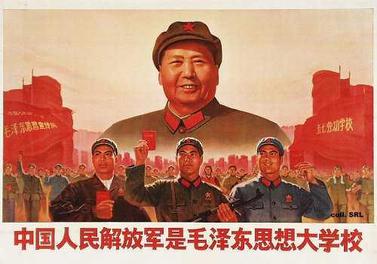
“The Chinese People’s Liberation Army is the great school of Mao Zedong Thought”, 1969.
A poster from the Cultural Revolution, featuring an image of Chairman Mao.
Image via Wikimedia Commons.
A former leader of the New Democratic Party of Canada. A former Conservative foreign minister. Two former Liberal foreign ministers. Four former Canadian ambassadors to the United Nations, under Liberal and Tory governments. Two former Canadian ambassadors to the United States, under Liberal and Tory governments. A former Supreme Court justice. A former Liberal justice minister. A former Conservative senator. A flock of name-brand diplomats. Former CBC host Don Newman, for some reason.
This is the panoply of 19 elite opinion-makers that gathered in the Laurentian Boardroom at an online hotel and drafted a letter, released Wednesday, calling on Prime Minister Justin Trudeau to intervene in the extradition process, set Huawei CFO Meng Wangzhou free, and thereby secure the release of Canadians Michael Kovrig and Michael Spavor.
China, last seen denying the two men’s detention had anything to do with Meng, had changed its tune just hours earlier on Wednesday: Freeing her might “open up space for resolution to the situation of the two Canadians,” foreign ministry spokesman Zhao Lijian said.
And who stands in the way? A prime minister who was perfectly happy to stick his thumb on the scales of justice to save a cherished member of Quebec Inc. from the indignity of prosecution for rather flamboyant alleged corporate malfeasance in and concerning Gaddafi-era Libya (or to “save jobs,” if you prefer, although it emerged no one in Justin Trudeau’s government had bothered to inquire how many jobs might actually be lost if SNC-Lavalin were convicted).
You can hardly blame China for noting the precedent. And it’s sorely fitting that the Gang of 19 addressed their letter to Trudeau rather than to the fellow who would actually have to give the order: Justice Minister David Lametti. We all know who calls the shots in that particular relationship. Perhaps it’s best we just admit it.
Colby Cosh also finds the advice proffered to the Prime Minister to be … less than admirable:
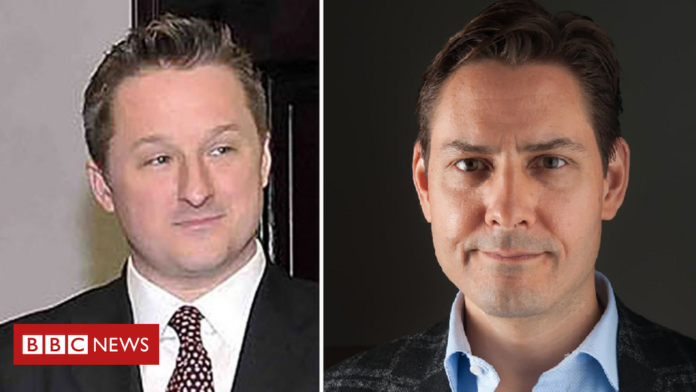
Screen capture of a BBC News report on Canadians Michael Kovrig and Michael Spavor facing espionage charges in China.
I wanted to discuss the letter written by the 19 geriatric Canadian worthies who encouraged the Prime Minister to trade Huawei executive Meng Wanzhou, in Canadian custody fighting extradition to the U.S., for the “two (Canadian) Michaels” detained on ill-defined espionage charges in China. Colleague Chris Selley has gone over the ground, but that’s show biz for you. Selley concluded his overview by pointing out that the letter argues perversely for “surrender, then victory.” With the Meng-Michaels standoff out of the way, the various ex-diplomats and superannuated politicians argued, Canada could use the opportunity for a fresh foreign-policy start, deciding what “tough steps” ought to be taken against China. If any.
The letter, part of a campaign on the two Michaels’ behalf led by ex-Supreme Court Justice Louise Arbour and ex-justice minister Allan Rock, is self-refuting in parts. Yielding “to bullying or blackmail” is “repugnant,” the authors admit, while advising just that. But “resisting China’s pressure is no guarantee that it will never be applied again in the future … China might well decide that next time it will need to escalate by detaining more than two Canadians.”
The implication, if this argument is to have any force, is that actively rewarding China’s abduction of our citizens is a jim-dandy way of making sure it never happens again. The problem with this reasoning is obvious, but the authors are also careful not to define victory too precisely. They say that letting Meng go and getting Michael Kovrig and Michael Spavor back would permit Canada to “declare its position on Huawei’s involvement in the deployment of 5G technology in Canada,” a decision “that has been postponed time and again.”
Sooo … the authors think we should slam the door on Huawei, whose CEO is Meng’s father? They don’t say so! They only say that settling this quarrel would make it easier for us to decide. And they are only slightly clearer on issues of human rights in China and Hong Kong, which our current government and foreign service are allegedly being shy about “so as not to make the situation worse for the Canadian prisoners.”
June 26, 2020
Progressive hate for nuclear power
In Quillette, Michael Shellenberger discusses the demands of some climate activists who also reject the best solutions to the problems they foresee:
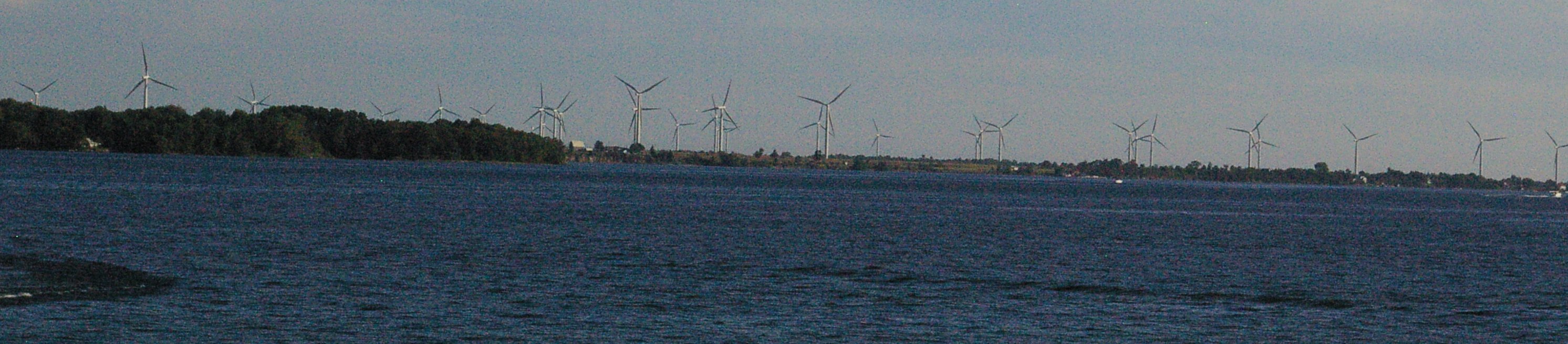
For the last decade I have been obsessed with a question: Why are the people who are the most alarmist about environmental issues also opposed to all of the obvious solutions?
Those who raise the alarm about food shortages oppose expanding the use of chemical fertilizers, tractors, and GMOs. Those who raise the alarm about Amazon deforestation promote policies that fragment the forest. And those who raise the alarm about climate change oppose nuclear energy, the largest source of zero-emissions energy in developed nations. Why is that?
It is not an academic question for me. I have been a climate activist for 20 years and an energy expert for 10 of them. I was adamantly against nuclear energy until about a decade ago when it became clear renewables couldn’t replace fossil fuels. After educating myself about the facts, I came to support the technology.
Over the last five years, I have campaigned, as founder and president of my small and independent nonprofit research organization, Environmental Progress, to expand the use of nuclear energy. During that time our main opponents have not been climate skeptics or even the fossil fuel industry but rather other climate activists.
This is the case around the world. It is climate alarmist Democrats and Greens who are seeking to shut down nuclear plants in the US and Europe. Greta Thunberg last year condemned the technology as “extremely dangerous, expensive, & time-consuming,” which is false. And Green New Deal architect Rep. Alexandria Ocasio-Cortez (AOC) has advocated closing the Indian Point nuclear plant in New York, which is now being replaced with natural gas.
In nearly every situation around the world, support for nuclear energy from climate activists like Thunberg and AOC would make the difference between nuclear plants staying open or closing, and being built or not being built. Had Thunberg spoken out in defense of nuclear power she likely could have prevented two reactors in her home nation of Sweden from being closed. Had AOC advocated for Indian Point rather than condemned it as dangerous, it could likely keep operating, for at least 40 years longer.
That’s because the main problem facing nuclear energy is that it’s unpopular — and far more among progressives than conservatives, and far more among women than men. There are no good technical or economic reasons that nations from the US and Japan to Sweden and Germany are closing their nuclear plants. Center-left governments are closing them early in response to the demands of progressives and Greens — the very same people who are claiming climate change will kill billions of people.
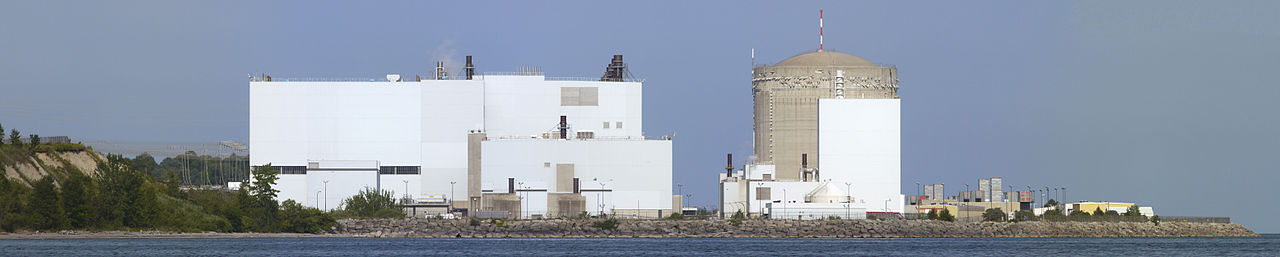
Darlington Nuclear Generating Station in Clarington, Ontario.
Photo by Óðinn via Wikimedia Commons.
Some prominent environmental groups have a pecuniary interest in replacing existing nuclear generating stations with natural gas and “renewable” energy sources, but money isn’t the only reason for the widespread opposition to nuclear power:
Sierra Club, NRDC, and EDF have worked to shut down nuclear plants and replace them with fossil fuels and a smattering of renewables since the 1970s. They have created detailed reports for policymakers, journalists, and the public purporting to show that neither nuclear plants nor fossil fuels are needed to meet electricity demand, thanks to energy efficiency and renewables. And yet, as we have seen, almost everywhere nuclear plants are closed, or not built, fossil fuels are burned instead.
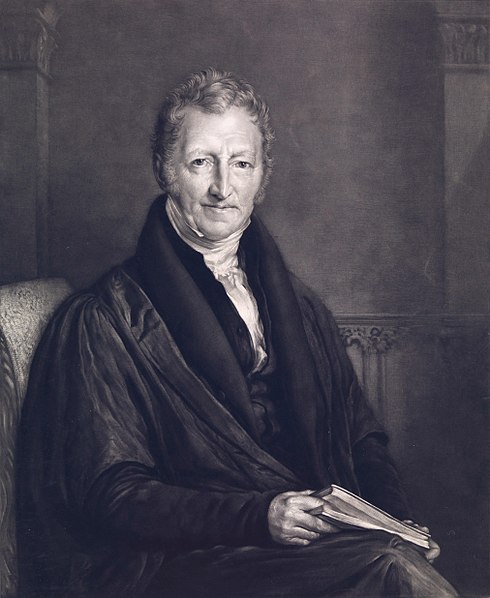
Thomas Malthus.
Portrait by John Linnell, 1834, via Wikimedia CommonsBut it’s not just about money. It’s also about ideology. Anti-nuclear groups have long had a deeply ideological motivation to kill off nuclear energy.
Policymakers, journalists, conservationists, and other educated elites in the ’50s and ’60s knew that nuclear was unlimited energy and that unlimited energy meant unlimited food and water.
We could use desalination to convert ocean water into freshwater. We could create fertilizer without fossil fuels, by harvesting nitrogen from the air, and hydrogen from water, and combining them. We could create transportation fuels without fossil fuels, by taking carbon dioxide out of the atmosphere to make artificial hydrocarbons, or by splitting water to make pure hydrogen gas.
Nuclear energy thus created a serious problem for Malthusians — followers of widely-debunked 18th-century economist, Thomas Robert Malthus — who argued that the world was on the brink of ecological collapse and resource scarcity. Nuclear energy not only meant infinite fertilizer, freshwater, and food but also zero pollution and a radically reduced environmental footprint.
In reaction, Malthusians attacked nuclear energy as dangerous, mostly by suggesting that it would lead to nuclear war, but also by spreading misinformation about nuclear “waste” — the tiny quantity of used fuel rods — and the rapidly decaying radiation that escapes from nuclear plants during their worst accidents.
There is a pattern: Malthusians raise the alarm about resource depletion or environmental problems and then attack the obvious technical solutions. In the late 1700s, Thomas Malthus had to reject birth control to predict overpopulation. In the 1960s, Malthusians had to claim fossil fuels were scarce to oppose the extension of fertilizers and industrial agriculture to poor nations and to raise the alarm over famine. And today, climate activists reject nuclear energy in order to declare a coming climate apocalypse.
June 20, 2020
Soviet Gender Equality Was a Scam – WW2 – On the Homefront 004
World War Two
Published 19 Jun 2020The future looks bright for soviet women in the 1910s, they have the right to vote and they’re on track for social emancipation. Yet this doesn’t last long. Soon, the demands of the nation will rob them of these promises.
Join us on Patreon: https://www.patreon.com/TimeGhostHistory
Or join The TimeGhost Army directly at: https://timeghost.tvFollow WW2 day by day on Instagram @World_war_two_realtime https://www.instagram.com/world_war_two_realtime
Between 2 Wars: https://www.youtube.com/playlist?list…
Source list: http://bit.ly/WW2sourcesHosted by: Anna Deinhard
Written by: Isabel Wilson
Director: Astrid Deinhard
Producers: Astrid Deinhard and Spartacus Olsson
Executive Producers: Astrid Deinhard, Indy Neidell, Spartacus Olsson, Bodo Rittenauer
Creative Producer: Joram Appel
Post-Production Director: Wieke Kapteijns
Research by: Isabel Wilson
Edited by: Karolina Dołęga
Sound design: Marek KamińskiColorizations by:
Klimbim
Carlos Ortega Pereira, BlauColorizations, https://www.instagram.com/blaucoloriz…Visual Sources:
Library of Congress
Adam Jones from Flickr: https://www.flickr.com/photos/adam_jo…Icons from The Noun Project: Sandhi Priyasmoro, Sarah Rudkin, Andrew Doane, Vectors Market, Adrien Coquet, ProSymbols, Luke Anthony Firth, Russia Woman & Gan Khoon Lay
Music:
“March Of The Brave 10” – Rannar Sillard
“Disciples of Sun Tzu” – Christian Andersen
“Deviation In Time” – Johannes Bornlof
“Other Sides of Glory” – Fabien Tell
“The Inspector 4” – Johannes Bornlöf
“Sailing for Gold” – Howard Harper-Barnes
“London” – Howard Harper-Barnes
“Split Decision” – Rannar SillarResearch sources:
– Lenin On the Emancipation of Women (1965), pp. 63–4. First Published July 1919, as a pamphlet
– Selected Writings of Alexandra Kollontai, Allison & Busby, 1977, First Published 1921, as a pamphlet, trans Alix Holt.
– Wendy Goldman, “Recasting the vision: The resurrection of the family”. In Women, the State and Revolution: Soviet Family Policy and Social Life, 1917–1936, (Cambridge Russian, Soviet, and Post-Soviet Studies, (1993) pp. 296-336), p.310Archive by Screenocean/Reuters https://www.screenocean.com.
A TimeGhost chronological documentary produced by OnLion Entertainment GmbH.
June 15, 2020
The Battle that Saved an Army | Arras 1940 | The Tank Museum
The Tank Museum
Published 17 May 2020Encircled by the Germans in North-West France, the Battle of Arras, 21st May 1940, was a successful Allied counter-attack which allowed French and British troops to be evacuated at Dunkirk. Curator David Willey, presents his talk on the WW2 Battle of Arras from home.
For more on the Blitzkrieg see David’s Tank Story Hall tour https://www.youtube.com/watch?v=eysQa…
Support the work of The Tank Museum on Patreon: ► https://www.patreon.com/tankmuseum
Visit The Tank Museum SHOP & become a Friend: ► https://tankmuseumshop.org/Twitter: ► https://twitter.com/TankMuseum
Instagram: ► https://www.instagram.com/tankmuseum/
Tiger Tank Blog: ► http://blog.tiger-tank.com/
Tank 100 First World War Centenary Blog: ► http://tank100.com/

May 13, 2020
Rudolf Hess – Nazi Pacifist, Traitor or Madman? – WW2 Special Episode
World War Two
Published 12 May 2020In a series of events, Hitler’s second in command Rudolf Hess decides to fly to Britain to enter peace negotiations with the Allies. But the true reasons behind and effects of his action remain ambiguous at best.
Join us on Patreon: https://www.patreon.com/TimeGhostHistory
Or join The TimeGhost Army directly at: https://timeghost.tvFollow WW2 day by day on Instagram @World_war_two_realtime https://www.instagram.com/world_war_t…
Between 2 Wars: https://www.youtube.com/playlist?list…
Source list: http://bit.ly/WW2sourcesHosted by: Indy Neidell
Written by: Joram Appel
Director: Astrid Deinhard
Producers: Astrid Deinhard and Spartacus Olsson
Executive Producers: Astrid Deinhard, Indy Neidell, Spartacus Olsson, Bodo Rittenauer
Creative Producer: Joram Appel
Post-Production Director: Wieke Kapteijns
Research by: Joram Appel
Edited by: Mikołaj Cackowski
Sound design: Marek Kamiński
Map animations: Eastory (https://www.youtube.com/c/eastory)Colorizations by:
Norman Stewart, https://oldtimesincolor.blogspot.com/
Carlos Ortega Pereira, BlauColorizations, https://www.instagram.com/blaucoloriz…
Jaris Almazani (Artistic Man), https://instagram.com/artistic.man?ig…
Olga Shirnina, https://klimbim2014.wordpress.com
Adrien Fillon, https://www.instagram.com/adrien.colo…Bibliography:
– Balfour, Michael, Propaganda in War, 1939–45: Organizations, Policies, and Publics in Britain and Germany (London, 1979).
– Fox, Jo. “Propaganda and the Flight of Rudolf Hess, 1941-45”. In: The Journal of Modern History 83:1 (March 2011) 78-110.
– Gorodetsky, Gabriel, “The Hess Affair and Anglo-Soviet Relations on the Eve of ‘Barbarossa'”. In: The English Historical Review 101:399 (Apr 1986) 405-420.
– Görtemaker, Manfred, “The Bizarre Mission: Rudolf Hess in Britain,” in Britain and Germany in the 20th Century, ed. M. Görtemaker (Oxford, 2006), 75–101.
– Heiden, Konrad, “Hitler’s Better Half”. In: Foreign Affairs 20:1 (Oct 1941) 73-86.
– Kettenacker, Lothar, “Mishandling a Spectacular Event: The Rudolf Hess Affair,” in Flight from Reality: Rudolf Hess and His Mission to Scotland, ed. David Stafford (London, 2002) 19–38.
– Schmidt, Rainer, “The Marketing of Rudolf Hess: A Key to the ‘Preventative War Debate’?” War in History 5 (1998) 62-83.Sources:
Bundesarchiv
Portraits of Douglas Douglas-Hamilton, duke of Hamilton and Duff Cooper, MP, courtesy National Portrait Gallery
Narodowe Archiwum Cyfrowe
Zentralbibliothek Zürich
Portrait of Max Aitken, Lord Beaverbrook, courtesy Nationaal Archief
IWM D 8987Soundtracks from the Epidemic Sound:
Rannar Sillard – “March Of The Brave 4”
Reynard Seidel – “Deflection”
Andreas Jamsheree – “Guilty Shadows 4”
Johannes Bornlof – “The Inspector 4”
Johannes Bornlof – “Deviation In Time”Archive by Screenocean/Reuters https://www.screenocean.com.
A TimeGhost chronological documentary produced by OnLion Entertainment GmbH.

May 2, 2020
Gabriel Over the White House – “the most unapologetic celebration of fascism ever put on film”
Jack Cashill found this “gem” while watching Turner Classic Movies during the Wuhan Coronavirus lockdown and was amazed:
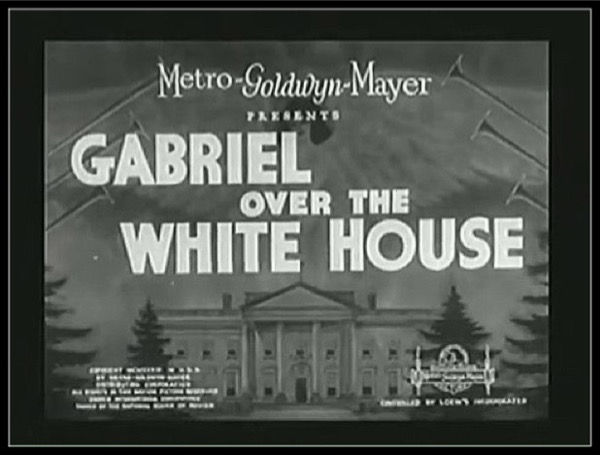
By now, I have seen most of TCM’s movies, but one aired this past week I had not even heard of. On a whim, I DVR’ed it. Good move. Called Gabriel Over the White House, this 1933 liberal wet dream proved to be the most unapologetic celebration of fascism ever put on film.
I watched it wide-eyed. The movie opens with the inauguration of Jud Hammond. A laissez-faire back-slapper, Hammond sees the White House as a way to enrich himself and reward his cronies, Depression be damned. The audience assumes Hammond is a Republican.
Out joyriding one day, Hammond crashes his car and lapses into coma. While still comatose, the Angel Gabriel visits Hammond and turns him into a committed and caring progressive. Is there another kind?
Upon waking, Hammond convenes his cabinet of corrupt self-servers and rejects their plea that the party must come first. Instead, Hammond insists their first priority be the American people. He refuses to use the U.S. Army against a marching mass of the unemployed and fires the secretary of state when he objects.
“I suggest you read the Constitution of the United States. You’ll find the President has some power,” Hammond warns his cabinet members. Some power? Fully indifferent to the Constitution, Hammond grabs all the power that can possibly be grabbed.
When the cabinet objects to his usurpation of power, Hammond fires the cabinet. When Congress threatens to impeach Hammond, he declares martial law and dispenses with Congress. When accused of being a dictator, Hammond argues that his is a dictatorship based on some imagined Jeffersonian principle of Democracy, namely the greatest good for the greatest number of people.
Now with total power, Hammond enacts a national banking law, stops foreclosures, provides direct aid to some 55 million farmers, circumvents private industry and launches his own “Army of Construction.”
A young aide, Hartley Beekman, and his female counterpart, Pendie Molloy, serve as something of a progressive chorus. “The way he thinks is so simple and honest that it sounds a little crazy,” says Beekman of Hammond.
“He’s doing the things you wanted,” Molloy answers. “And If he’s mad, it’s a divine madness. Look at the chaos and catastrophe sane men have brought about.”
The divine madness includes the creation of a Federal Police force, a subset of the Army, with young Beekman at its head. When the nation’s chief racketeer refuses to go back to his unnamed home country, Hammond warns him that the government is about to “muscle in on his racket” and federalize the sale of alcohol.
The racketeer fights back, and Beekman employs a legion of tanks Waco-style against the racketeers. When captured, the racketeers are all hauled before a three-man court martial headed by Beekman, promptly declared guilty, and executed en masse by a firing squad.
Several years ago, the movie was brought to my attention and I found this clip on YouTube that I suspect captures the essence of the film:
James Lileks describes it as “a remarkable movie. And I don’t mean ‘astonishingly good, technically superb, visually ingenious.’ I mean utterly insane.”
April 29, 2020
Curator’s Tour of The Tank Museum | Blitzkrieg | WW2: Part 1
The Tank Museum
Published 25 Apr 2020Join Curator David Willey as he takes you on a tour of The Tank Museum’s Tank Story Hall, which houses over 30 key vehicles from Little Willie to Challenger 2. In this section he looks at early Second World War vehicles and gives you a potted history of the Blitzkrieg.
Support the work of The Tank Museum on Patreon: ► https://www.patreon.com/tankmuseum
Visit The Tank Museum SHOP & become a Friend: ► https://tankmuseumshop.org/Twitter: ► https://twitter.com/TankMuseum
Instagram: ► https://www.instagram.com/tankmuseum/
Tiger Tank Blog: ► http://blog.tiger-tank.com/
Tank 100 First World War Centenary Blog: ► http://tank100.com/
#tankmuseum #tanks #MuseumFromHome

April 12, 2020
Minimum alcohol pricing – a policy so good you have to lie about it
Scotland has had legal minimum prices for alcoholic beverages since mid-2018. If you read a random selection of mainstream media coverage, you’d know that it’s been a huge success, with vastly improved public health results at a price to consumers measured in mere pennies. As with all propaganda efforts, if you tell the lies often enough, people may believe you:
There has been all sorts of rubbish written about minimum pricing since it was introduced in Scotland in May 2018. Nicola Sturgeon has lied about in the Scottish Parliament. The BBC has gone to extraordinary lengths to spin the policy as a success. The public have been told that alcohol-related hospital admissions have gone down when they have gone up. We have seen the media fall for blatant cherry-picking. We have been told that rates of problem drinking have gone down when we don’t have any evidence either way.
One of the few solid facts — that there were more alcohol-related deaths recorded in Scotland in 2018 than in 2017 — has been sidelined. Instead, the media have focused on a disputed, and relatively small, decline in alcohol sales as if that were an end in itself. Any port in a storm (fortified wine sales have definitely benefited from minimum pricing).
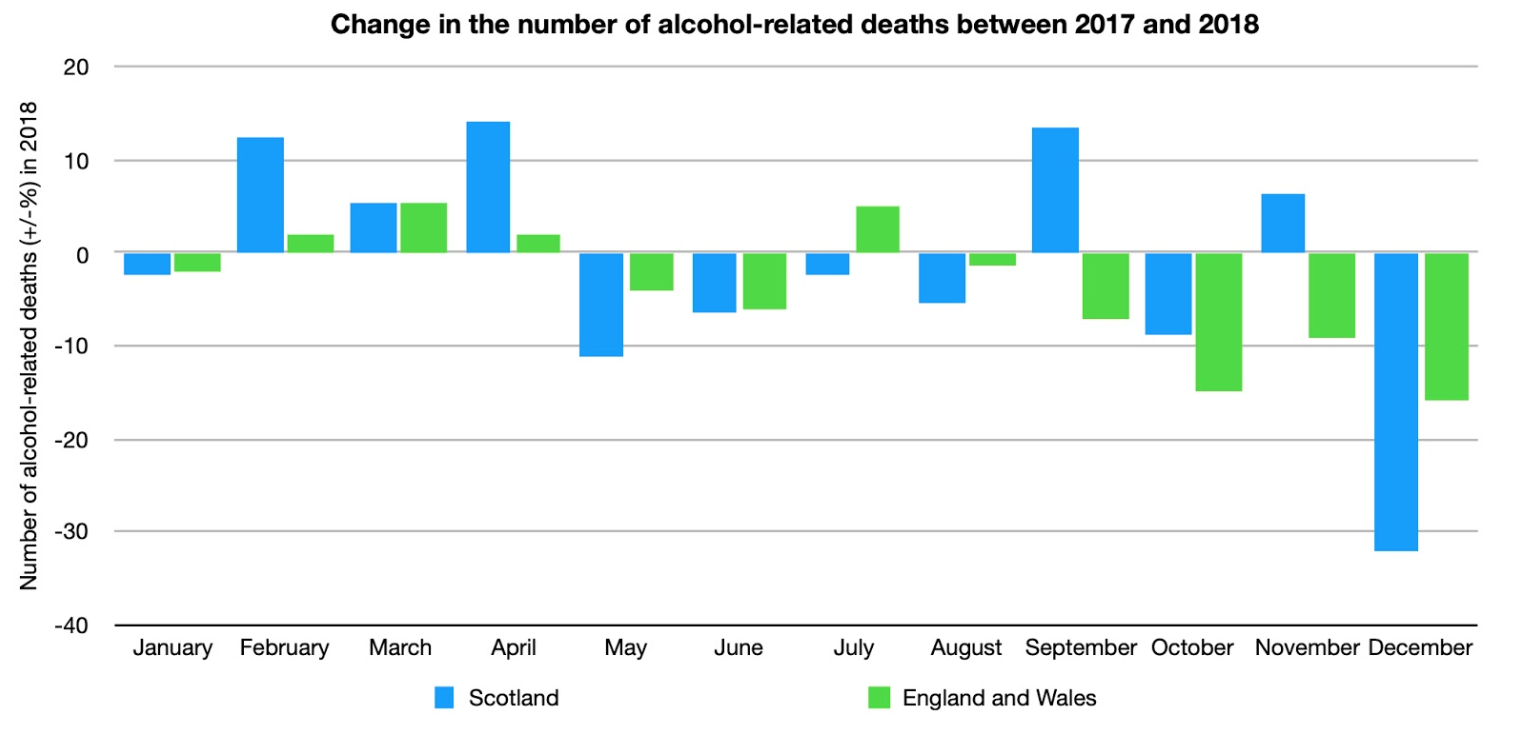
Figures from the calendar year of 2018 are of limited use because minimum pricing didn’t begin until May 1st. Today, for the first time, I can reveal the monthly mortality figures for Scotland, England and Wales. They show that there was no difference between the change in annual death rates from alcohol-related causes, regardless of whether the country had minimum pricing in place. Both England/Wales and Scotland saw a decline between May and December of seven per cent (compared to the previous year).
This graph is published in a new briefing paper I have written for the IEA. It summarises all the evidence gathered to date on deaths, hospitalisations and sales, plus exclusive new data.
Importantly, it contains estimates of the costs to consumers. Among the more outlandish claims made by the Sheffield modellers was the idea that moderate and low income consumers would be barely affected by minimum pricing. They predicted that a low income moderate drinker would only pay an extra 4p a year! This was never realistic, not least because it was based on the minimum price being set at 45p and they defined a moderate drinker as someone consuming the equivalent of just two pints of lager a week, but it worked from a PR perspective because it quelled politicians’ fears about the policy being regressive.
April 7, 2020
Leopold II of Belgium: The Biggest Coverup In European History
Biographics
Published 26 Sep 2018Credits:
Host – Simon Whistler
Author – Shannon Quinn
Producer – Jack Cole
Executive Producer – Shell Harris

March 12, 2020
The Road to the Holocaust – Kristallnacht | BETWEEN 2 WARS I 1938 Part 3 of 4
TimeGhost History
Published 11 Mar 2020After years of gradually increasing persecution, the Nazis institute a nationwide pogrom on the night of November 9, 1938. It will signal the end of Jewish life in Germany.
Join us on Patreon: https://www.patreon.com/TimeGhostHistory
Hosted by: Indy Neidell
Written by: Francis van Berkel
Directed by: Spartacus Olsson and Astrid Deinhard
Executive Producers: Bodo Rittenauer, Astrid Deinhard, Indy Neidell, Spartacus Olsson
Creative Producer: Joram Appel
Post-Production Director: Wieke Kapteijns
Research by: Francis van Berkel
Edited by: Daniel Weiss
Sound design: Marek KamińskiSources:
Bundesarchiv_Bild:
102-04051A, 102-14469, 102-16475, 119-03-16-06,
119-04-29-36, 119-04-29-38, 119-2671-07, 119-5592-03A,
133-075,_Worms, 146-1970-041-46, 146-1970-061-65,
146-1979-046-22, 146-1982-174-26, 146-1982-174-27,
146-1984-092-26, 146-1988-078-07, 146-1989-071-05,
152-64-25A,_Wien, 152-64-29A,_Wien, 152-65-04,_Wien,
183-1982-0809-502, 183-1987-0703-514, 183-2006-0429-502,
183-R99542, 183-S21437, 183-S72707, 183-86686-0008,From the Noun Project:
noun_Government by Adrien Coquet,
noun_jail by Strongicon,
noun_Death by Icon Island,Colorizations by:
– Daniel WeissSoundtracks from Epidemic Sound:
– “The Inspector 4” – Johannes Bornlöf
– “Not Safe Yet” – Gunnar Johnsen
– “Last Point of Safe Return” – Fabien Tell
– “Guilty Shadows 4” – Andreas Jamsheree
– “Imperious” – Bonnie Grace
– “Death And Glory 1” – Johannes Bornlöf
– “Deviation In Time” – Johannes Bornlof
– “Dark Beginning” – Johan Hynynen
– “An Ancient Dome” – Trabant 33
– “Death And Glory 3” – Johannes Bornlöf
– “First Responders” – SkryaA TimeGhost chronological documentary produced by OnLion Entertainment GmbH.

March 7, 2020
KidLit is woke, woke, woke
Ed West on the amazing amount of propaganda that has been pumped into books for children:

“New Spin on YA” by Salem (MA) Public Library is licensed under CC BY-NC-ND 2.0


When my daughters were around six and seven, they started French classes at a children’s library in our borough; I had been to our local library countless times but had mainly confined myself to the infant section, and older children’s books were something of a revelation. The entire front desk area was made up of hagiographies of Barack Obama and Nelson Mandela.
And hagiography is the most accurate term: these books were just like the ones I used to read in church. Here Blessed Nelson forgave his jailors, here St Barack healed America of its racial sins – and these are just a couple of examples.
It was a bit of a surprise — learning just how much the tone of kids’ books had changed since I was young and we wore onions on our belts. Nowadays, progressive politics is ever-present in children’s books. Which is fine, if you’re a believer; but if you’re a conservative, you’re faced with raising your children in a culture which is filled with messages you disagree with — sometimes misleading, sometimes anecdotally true but not representative, often just anti-wisdom, giving children the worst possible advice in life. And it’s becoming worse: since about 2016, children’s books have grown way more explicitly political.
Last month, a friend went to Tate Modern and took a picture of the young children’s section. Among the books on display are biographies of Greta Thunberg, something called Queer Heroes, another work called The Rainbow Flag, books about refugees, the bestselling Good Night Book for Rebel Girls — and its countless imitators. Whether you support it or not, this is propaganda; the aim is to raise a generation of progressives just as those Lives of the Saints were designed to bring forth young Christians.
And it works. Conservative ideas are very much in retreat, the subject of a brilliant new book I recently read (which, admittedly, I also wrote).
From a very young age, children are read books and shown films that teach them the core progressive messages: that we are all basically good and only behave badly because of circumstances; that borders and barriers are bad, stereotypes are wrong and girls ought to adopt traditional male gender roles if they want to be respected.
Stereotype inaccuracy is a popular idea — and a false one; in so many kids’ stories the unusual stranger or alien or wild animal who turns up in the neighbourhood will defy the small-minded pessimist who expects the worst. When it comes to gender politics, no self-respecting children’s book in the 21st century has girls aspiring towards being a princess and living happily ever after; to the post-ironic upper-middle-class parents who are the publishers’ main audience, that would just be lame.


