The war in China already started in 1931 when Japan invaded Manchuria. Early resistance was small and was met by heavy Japanese retaliations. But throughout the 30’s, the movement started to grow.
Hosted by: Spartacus Olsson
Written by: Francis van Berkel
Produced and Directed by: Spartacus Olsson and Astrid Deinhard
Executive Producers: Bodo Rittenauer, Astrid Deinhard, Indy Neidell, Spartacus Olsson
Creative Producer: Joram Appel
Post-Production Director: Wieke Kapteijns
Research by: Francis van Berkel
Edited by: Mikołaj Cackowski
Map animations: Eastory (https://www.youtube.com/c/eastory)
Sources:
Library of Congress
Narodowe Archiwum Cyfrowe
Chinese anti-Japanese posters, courtesy of pictoright
SHANGHAI, CHINA-1921
Soundtracks from the Epidemic Sound:
Johan Hynynen – “Dark Beginning”
Yi Nantiro – “Watchmen”
Yi Nantiro – “A Single Grain of Rice”
Reynard Seidel – “Deflection”
Fabien Tell – “Last Point of Safe Return”
Andreas Jamsheree – “Guilty Shadows 4”
Rannar Sillard – “Split Decision”
There is no more evocative phrase to emerge from World War II than Afrika Korps. The name conjures up a unique theater of war, a hauntingly beautiful empty quarter where armies could roam free, liberated from towns and hills, choke points and blocking positions, and especially those pesky civilians. It calls forth a war of near-absolute mobility, where tanks could operate very much like ships at sea, “sailing” where they wished, setting out on bold voyages hundreds of miles into the deep desert, then looping around the enemy flank and emerging like pirates of old to deal devastating blows to an unsuspecting foe. Finally, it implies a bold hero, in this case Field Marshal Erwin Rommel, a noble commander who fought the good fight, who hated Hitler and everything he stood for, and who couldn’t have been farther away from our stereotyped image of the Nazi fanatic. Everything about him attracts us — the manly poses, the out-of-central-casting good looks, even the goggles perched just so. Placing Rommel and his elite Afrika Korps to the fore allows us to view the desert war as a clean fight against a morally worthy opponent. It was war, yes, but almost uniquely in World War II, it was a “war without hate.”
It’s an attractive image all around, and it is unfortunate that practically all of it is false. The desert was hardly a haven of beauty or romance. It was a pain, and fighting in it was a nightmare for both sides. Far from letting the respective tank fleets roam free, the desert chained them irresistibly to their supply lines, and a single failed supply convoy or a lost column of trucks could stop an entire offensive dead in its tracks. Contrary to the alleged mobility of desert warfare, both sides would spend far more time in static defensive positions, often quite elaborate, then they would launching tank charges.
That leaves us with Rommel. Here, too, we should challenge the mythology. He was hardly apolitical. His entire career had been based on Hitler’s favor, and we might reasonably describe his attitude toward the Führer as worshipful. He was Hitler’s fair-haired boy, a young officer repeatedly promoted over more senior candidates. He was a media creation. Nazi propaganda painted him not only as a garden-variety hero, but as a model National Socialist and Aryan, a man who could overcome stronger enemies through the sheer force of his will. He was not merely a passive bystander to the hype; he was an active accomplice. He loved nothing better than having a camera crew along with him on campaign, and he would regularly order scenes to be reshot if his posture was insufficiently heroic or the lighting had not shown him to best advantage. As is often the case, his relationship to the media was both self-serving and self-destructive. During the years of victory, the German propaganda machine used him as an example to the nation. When things went sour, he became a diversion from the increasingly bad news on other fronts. Finally, when he was no longer useful for any purpose at all, the regime dropped him altogether and eventually killed him.
The Nazi economy appears to do well during the 1930s. But this is largely myth, as the German economy under Hitler is based on a self destructive, ideologically or selfishly fuelled irrationality driven by conquest and criminal practice.
Soundtracks from Epidemic Sound:
– “Document This 1” – Peter Sandberg
– “March Of The Brave 10” – Rannar Sillard – Test
– “Ominous” – Philip Ayers
– “The Inspector 4” – Johannes Bornlöf
– “Disciples of Sun Tzu” – Christian Andersen
– “Guilty Shadows 4” – Andreas Jamsheree
– “Last Point of Safe Return” – Fabien Tell
– “Death And Glory 1” – Johannes Bornlöf
– “Easy Target” – Rannar Sillard
– “Split Decision” – Rannar Sillard
– “First Responders” – Skrya
– “The Charleston 3” – Håkan Eriksson
A TimeGhost chronological documentary produced by OnLion Entertainment GmbH.
From the comments:
Spartacus Olsson
1 day ago
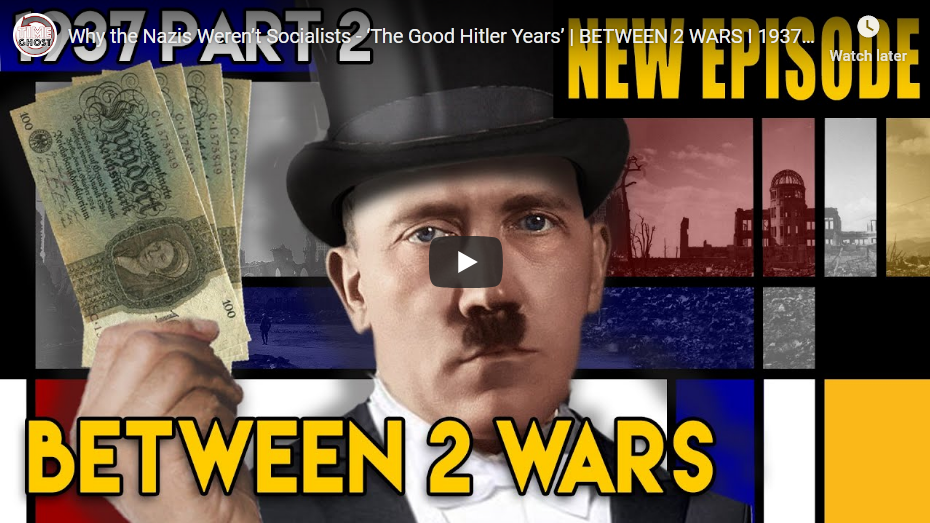
From an intellectual viewpoint, this is perhaps the most challenging episode I have written in this series. First of all it’s hard to make economic policy interesting, even when it’s about the Nazis. It tends to get, well … grey. Second of all it’s not that easy to simplify things without completely losing the essence of what was going on. Third of all, I’m fighting an uphill battle against a post truth, political talking point based on … let’s just call it less than ingenious purposes.
Obviously that’s the idea that the Nazis were Socialists. And perhaps that is not so far fetched when you think of the name of their party, the way they framed their anti-semitic rhetoric in a way that it would sound friendly to the working class, and their absolute disregard for telling the truth about anything, and everything. But although we have painstakingly showed you the facts, I am painfully aware that it won’t make a difference to stop the nonsense out there and in here — some pundits will religiously stick to their ideas, because if they don’t, they might have to face that some of the ideas they have are mutual with the people they so desperately want to distance themselves from. The same happened with the far left between the 1930s and 1970s, when they tried with cramped desperation to frame Stalinism as a right wing, Fascist movement — Red Fascism was the term — obviously as much nonsense as the alt-right idea that Naziism is Socialism.
And is it important? Well yes and no — the dumbos will probably get worn out at some point, it’s after all quite challenging to look for ways to distort the record over, and over again. I don’t really care if the extremists try to push their mutual garbage in each other’s lap — as a supporter of democracy and humanism, I have no regard for either end. I do however have an incredible amount of respect for conservatives, liberals, and progressives who are equally dedicated to democracy and human rights — and there is where it matters.
When the far left tries to frame Stalinism as right wing, and the far-right tries to frame Naziism is left-wing, they are trying to co-opt a position of less extremism. It’s an invasive attempt for Communists and (real) Socialists to just look like regular Progressives, and Fascists and Nazis to just look like regular Conservatives. And that my friends is dangerous, to all of us, regardless of our nationality, creed, political affiliation, or opinion — because it is specifically our individual rights and democracy that is at stake in this game. That’s what they want to take away, or in some places stop from developing.
Comments Off on Why the Nazis Weren’t Socialists – ‘The Good Hitler Years’ | BETWEEN 2 WARS I 1937 Part 2 of 2
Did you know that “Three Billionaires Have More Wealth Than Half of America”!!!???!!! Are you angry now? You’re supposed to be, because this factoid was concocted specifically to make people irrationally angry. Daniel C. Jensen explains how this sound bite was created:
Amazon’s Jeff Bezos, Microsoft’s Bill Gates, and Berkshire Hathaway’s Warren Buffet. Fox Business.
People between 0 and 24 years of age account for about 32 percent of the United States population of 320 million. Almost all of them are going to be in the bottom half of the wealth distribution for reasons including diaper rash and puberty. That means they account for about 63 percent of the “bottom half of the wealth distribution.” Should it surprise us that some kid fresh out of college does not “hold any stocks or bonds”? Or a kid fresh out of the womb?
Then we must consider people with mental and physical disabilities. They will also tend to be in the bottom half of the wealth distribution because they face greater challenges to building wealth. “About 56.7 million people — 19 percent of the population — had a disability” at last count, according to the United States Census Bureau. But there is overlap between the disabled 19 percent and the young 32 percent of the population. If we assume disabilities are evenly distributed in the population, then young people and non-young disabled people account for 45 percent of the population. So we have now accounted for 90 percent of the “160 million Americans in the bottom half of the wealth distribution.”
Next, we must think about other groups who have had limited wealth-building opportunities. What about the 2.2 million people in jail and prison? What about people in their late twenties who pursued PhDs, law degrees, medical residencies, etc., and are just beginning their careers? Now we are close to accounting for 100 percent of the “bottom half of the wealth distribution.” But this wealth distribution is not what any sensible person would expect it to be.
Maybe the factoid is true. Maybe Jeff Bezos, Bill Gates, and Warren Buffet have more wealth than all of the infants, children, students, handicapped, prisoners, and postgrads combined. But you don’t need a PhD to figure out that’s not useful knowledge. Even if the factoid is true, it’s deceitful. Whoever created it was obviously trying to manipulate people. And we uncovered this deception with nothing but some simple knowledge of the US population.
Next time you encounter an economic factoid, remember that it might be pitting a bunch of newborns against Jeff Bezos, and that hardly seems fair. Thankfully, you can save those babies from certain defeat simply by knowing some basic statistics about your country.
Comments Off on Here’s a deceptive factoid … time for you to get angry to suit someone’s political agenda
I’ve only heard of the show because my grand-niece is a huge fan, so I can’t say anything one way or another about these heresy allegations:
Six adorable, daring puppies and their whiz kid leader, ten-year-old Ryder, rescue people in the community of Adventure Bay. You would have to be a fool to not love Paw Patrol. And that’s where the Canadian state broadcaster CBC comes in!
A new article by Rebecca Zandbergen explores the groundbreaking new theory by Canadian university professor Liam Kennedy that loveable Nickelodeon show Paw Patrol is an insidious tool of capitalism. Kennedy, from King’s University College, has penned a vital new piece of research called “Whenever there’s trouble. Just yelp for help”: Crime, Conservation and Corporatization in Paw Patrol” in the peer-reviewed journal Crime Media Culture. His child isn’t allowed to watch the show, but Kennedy spent countless hours watching it in his office.
In the show, Ryder is the ring-leader of the pups, each of whom has a job to do as part of their team. There’s Chase, the police dog, Marshall, the fire chief dog who can never quite get control of his hose, Rubble, the builder, Skye, who flies a plane for some reason and is the girl pup, Everest, the extreme outdoor adventuring pup, Rocky, the rescue dog, and Zuma, the pup who drives a boat.
Together, they are the Paw Patrol, and they even have a headquarters, because all kids love a home base. Inexplicably, the grown-ups in town depend on Ryder and the pups to help them when they’re in a jam. Probably because it’s a show for kids, so it’s kid-centric. Kids like that.
Kennedy posits that “Paw Patrol, as a private corporation, is used to help provide basic social services in the Adventure Bay community. That’s problematic in that the Paw Patrol creators are sending this message that we can’t depend on the state to provide these services.”
Kennedy was angry that elected officials are not portrayed as heroes: “Mayor Humdinger and Mayor Goodway — kind of the representatives of the state or the government — are portrayed negatively,” Kennedy argued.
Kennedy also pointed out that, at the age of ten, Ryder should be in school, not saving the world. CBC did not bother to ask Kennedy how he feels about real-life school-skipper and saviour Greta Thunberg. We guess some do-gooders are more equal than others.
Comments Off on “… loveable Nickelodeon show Paw Patrol is an insidious tool of capitalism”
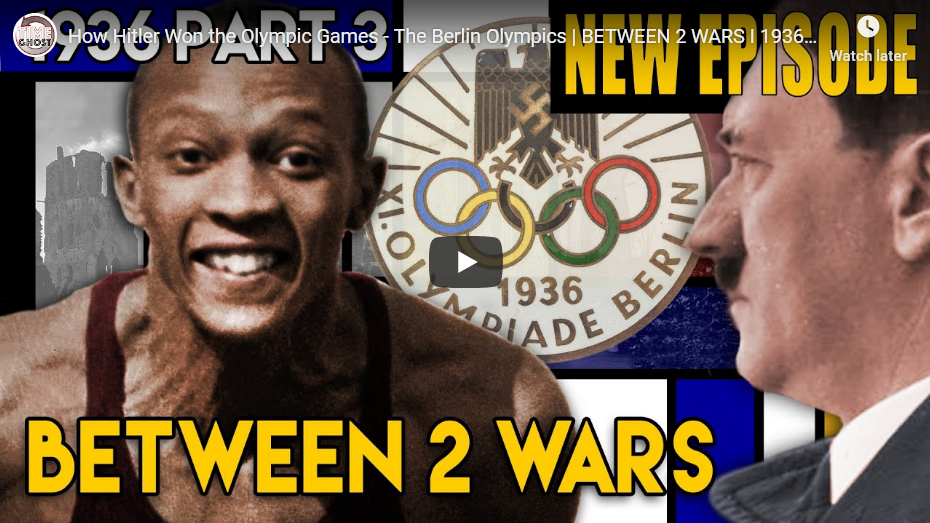
The Berlin Olympics in 1936 were a masterfully played piece of Nazi propaganda, where they framed their race as physically superior and their ideology as modern, organised and cultured while also ostensibly downplaying their anti-internationalism racism and anti-semitism. But the Germans didn’t embrace sports for friendly competition. They did so for something very different.
Hosted by: Indy Neidell
Written by: Joram Appel
Directed by: Spartacus Olsson and Astrid Deinhard
Executive Producers: Bodo Rittenauer, Astrid Deinhard, Indy Neidell, Spartacus Olsson
Creative Producer: Joram Appel
Post-Production Director: Wieke Kapteijns
Research by: Joram Appel
Edited by: Daniel Weiss
Sound design: Marek Kaminski
Sources:
Bundesarchiv_Bild:
183-G00372, 102-08105, 145_Bild-P017100, 183-R96374, 146-
1998-020-00A, 146-1976-033, 183-G00978, 183-1992-0421-500,
146-2005-0017, 183-G00352, 146-1976-116-08A, 146-1988-106-
29, 146II-728, 8076_Bild-0008
Modern Olympic Photos:
Photo from illang https://www.flickr.com/photos/ilan_sr…,
Photo by Agência Brasil http://agenciabrasil.ebc.com.br/rio-2…
Colorizations by:
Daniel Weiss
Norman Stewart
Joram Appel
Soundtracks from Epidemic Sound:
– “First Responders” – Skrya
– “The Inspector 4” – Johannes Bornlöf
– “Heroes On Horses” – Gunnar Johnsén
– “Split Decision” – Rannar Sillard
– “Not Safe Yet” – Gunnar Johnsen
– “Thunder Storm 01” – Fredrik Ekstrom
– “Dawn Of Civilization” – Jo Wandrini (1)
– “March Of The Brave 4” – Rannar Sillard
– “Magnificent March 3” – Johannes Bornlöf
– “Imperious” – Bonnie Grace
– “The Charleston 3” – Håkan Eriksson
A TimeGhost chronological documentary produced by OnLion Entertainment GmbH.
From the comments:
TimeGhost History
2 days ago (edited)
The 1936 Berlin Summer Olympics and Garmisch-Partenkirchen Winter Olympics were the first true modern Olympic games. Many of the now staples of the Olympic games were introduced for the first time by the Nazis. But magnificent as they might have been, the intent of the Germans was not really to advance the vision of the internationalist and pacifist goals of the Olympic games. And while we do realise that many of the characteristics of the 1936 Olympics – how it was used to push a certain national image or to strengthen nationalism, could be said of more recent editions of the Olympics as well. And while sports and international institutions are still today being used to push alternate agendas, we’d rather not discuss them in the comment section here as this is a history channel – not a current affairs channel.
Cheers, Joram
Comments Off on How Hitler Won the Olympic Games – The Berlin Olympics | BETWEEN 2 WARS I 1936 Part 3 of 3
Talk about a golden oldie! Does anyone else remember the portentious “Doomsday Clock”? It was devised shortly after WW2 as a handy visual and rhetorical prop for various unilateral disarmament, Soviet agitprop, and general anti-Western civilization groups to use. It’s apparently still being used to pretend we’re facing yet another potentially world-ending crisis:
Remember the Doomsday Clock? It’s a symbolic clock created by a group of scientists in the 1940s, supposedly indicating how close the human race is getting to Armageddon. Originally the clock was set to seven minutes to midnight, and when the clock strikes 12, we’re all dead. That’s the idea, anyway. This corny propaganda tool reached its pop-culture zenith in the ’80s, when everybody from Midnight Oil and Iron Maiden and Sting to DC Comics’ Watchmen were predicting catastrophe by referencing the Doomsday Clock. People love to be scared about the end of the world, and a lot of artists made a lot of money by exploiting that. Nobody ever lost a buck fearmongering.
But you’re reading this right now, which means we’re all still here. Doomsday hasn’t come. So of course, that must mean … it’s just that much closer!
[…]
And this means as much as it’s meant for the past 70-odd years: nothing. Real clocks are instruments of science; the Doomsday Clock is an instrument of the arbitrary whims of some scientists. It might as well be the Doomsday Dartboard. Do you really think we’re any closer to planetary doom than we were during the Cuban Missile Crisis, or the Chernobyl disaster, or the premiere of MTV’s The Real World? You’ve got all those brainiacs gathered in one place, and not one of them has read “The Boy Who Cried Wolf.”
We scoff at Jim Jones and Marshall Applewhite and other doomsday cult leaders, but at least they had the courage of their convictions. If these scientists really believe we’re all doomed, why are they sticking around? If Al Gore actually believes all hope is lost, why is he still living in huge mansions and jetting off to Davos? As the great Glenn Reynolds says: “I’ll believe it’s a crisis when the people who say it’s a crisis start acting like it’s a crisis.”
Comments Off on “Sorry, Boomers. Just because you’ve been told your entire lives that you’re killing the planet, that doesn’t mean it’s true”
… a Canadian Journalist’s main job is to smooth over any rough spots and shush away worries as the Liberal government plunders the public purse to pay for technocratic solutions to problems we didn’t know we had while adopting a laissez-faire attitude to the problems we do have. If the Opposition has a point, it falls to a Canadian Journalist to correct the record and say that, well, actually, no they don’t.
Strategic bombing was used to destroy the popular support for their governments war effort, and the British boosted that their resistance to bombing was an unique trait. But both are false, based on lies and propaganda.
Hosted by: Spartacus Olsson
Written by: Joram Appel and Francis van Berkel
Produced and Directed by: Spartacus Olsson and Astrid Deinhard
Executive Producers: Bodo Rittenauer, Astrid Deinhard, Indy Neidell, Spartacus Olsson
Creative Producer: Joram Appel
Post-Production Director: Wieke Kapteijns
Research by: Francis van Berkel and Joram Appel
Edited by: Karolina Dołega
Sources:
– Imperial War Museum: D2168, D1623, D2956, 36206, D1587, D2154, D2157, HU36143, HU 36199
– Deutsche Fotothek, 0000436
– Noun Project: Natural Disasters 1674928 By Claudia Revalina, ID
noun_prisoner 63221 By carlotta zampini, IT, Bomb by P Thanga Vignesh
– Toni Frissell, Abandoned boy, London, 1945
– Battle of Britain, film from United States Holocaust Memorial Museum
A TimeGhost chronological documentary produced by OnLion Entertainment GmbH.
From the comments:
World War Two
7 hours ago (edited)
Having spoken to many British people while researching this episode, I realised that many in the United Kingdom still grow up with the idea that the perseverance in the face of constant bombing was something uniquely British, and that the so-called “Blitz Spirit” caused people to proudly face Hitlers bombs and transcend class-differences, and that bombing actually boosted their morale. However, research – half of which was done by Francis who is from Britain as well, shows that this idea is mainly based on propaganda. Furthermore, it is still considered controversial to doubt Churchill’s war cabinet’s policy of mass bombing German cities to force them out of the war. However, the effectiveness of this too has been proven to be based on falsehoods and lies. The true effectiveness of strategic bombing was already known to Churchill’s advisors during the war. Feel free to enter discussion about this in the comment section, but keep it civil and back up your arguments with examples and sources wherever possible.
Cheers,
Joram
Comments Off on The British Blitz Spirit is a Myth – WW2 – War Against Humanity 005
Robert Reilly reviews Judgement in Moscow: Soviet Crimes and Western Complicity by Vladimir Bukovsky, which has recently been republished in English:
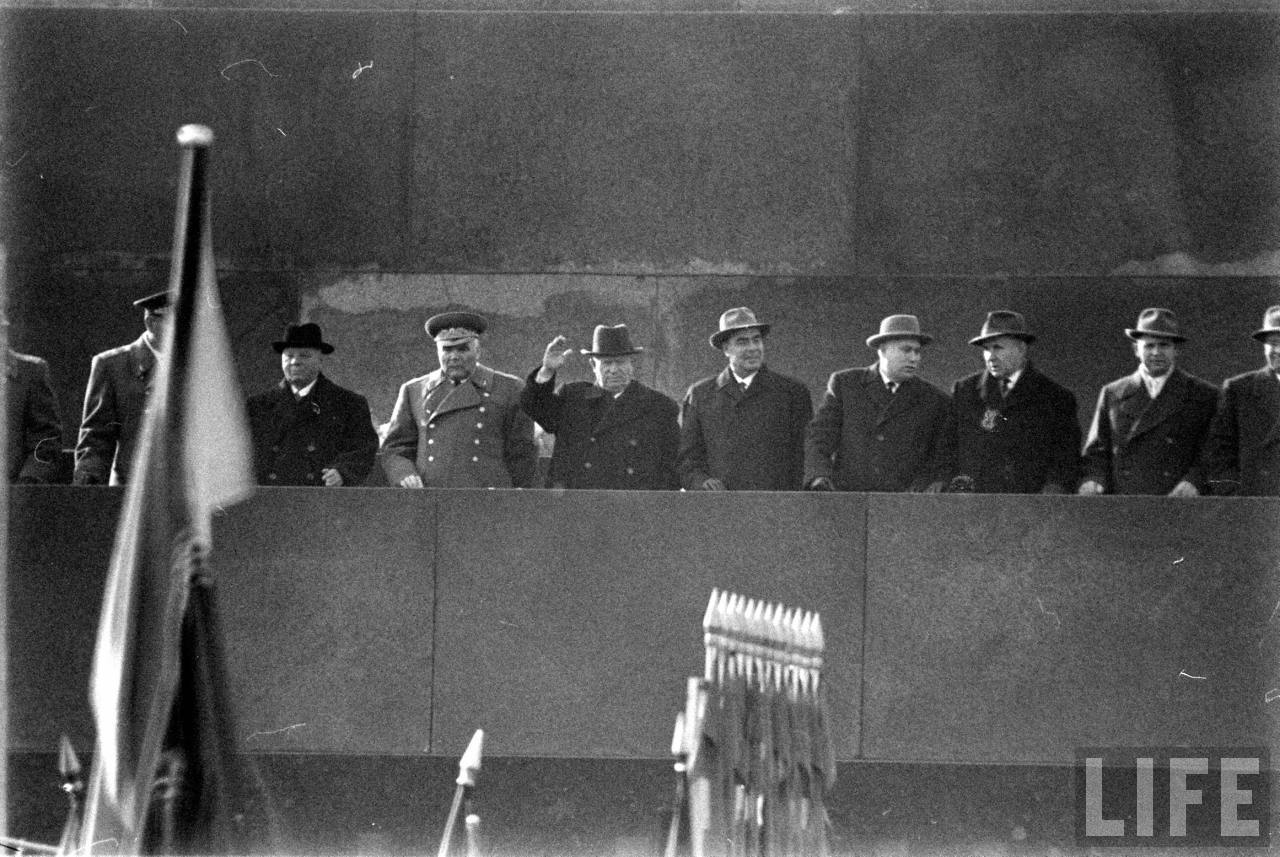
Krushchev, Brezhnev and other Soviet leaders review the Revolution parade in Red Square, 1962. LIFE magazine photo by Stan Wayman.
Judgment In Moscow contains autobiographical elements but is principally concerned with providing and analyzing documentary evidence for what should have been the USSR equivalent of what the Nuremberg Trials had been for Nazi Germany. In 1991, Bukovsky returned to the Soviet Union to take part in the “trial of the communist party” that was held in 1992. In an audacious move the Communist Party had sued then-President Boris Yeltsin to get its property back. To prepare a defense, Yeltsin ordered that the secret Central Committee archives be opened to Bukovsky. The order was obeyed, but only partially and for a short time. The trial fizzled, but Bukovsky, with the aid of a hand-held scanner, was able to gather many thousands of pages of top-secret Central Committee and Politburo documents and get them out of Russia. Some of these key documents are what we have in this priceless book. They are eye-opening.
During the Cold War, we had to speculate as to why, for instance, the Soviet Union invaded Afghanistan and how the decision was made. Now we know for certain. Bukovsky provides the minutes of the Politburo meetings in which the invasion was decided. The Reagan administration was highly skeptical of détente and was therefore criticized for war-mongering. The skepticism was well-placed because, as the documents reveal, détente was simply a façade for advancing Soviet power and manipulating Western publics and governments against the Reagan plan to place Pershing IIs and cruise missiles in Europe to defend it against burgeoning Soviet power, including the SS-20s.
The revelations of the extent to which the Soviet Union manipulated the “peace” movement in the West should be an embarrassment to its participants, who may have been too naïve at the time to know how they were being used. Others, of course, acceded to being used, or even cravenly sought to be used. The names of some of these useful idiots are in the documents.
Another thing these documents disclose, much to the embarrassment of many American Sovietologists, is that there were no “hawks” and “doves” in the Kremlin — a premise on which they had banked their academic careers. The unanimity of the Politburo decisions reveals that the senior Soviet leaders were all of one stripe. It was to their advantage to create the impression that there were hawks and doves so that they could game the policies of Western governments and the opinions of its publics. For instance, providing Western credits to the USSR — it was thought by many so-called Russian experts in the West — would strengthen the doves in the Kremlin, whereas denying credits would empower the hawks. By buying this line of thought, the West was induced to keep the Soviet Union on life-support for more than a decade past what would have been its earlier collapse, according to Bukovsky.
No one was a greater master of this deception than Mikael Gorbachev. The minutes from many Politburo meetings chaired by Gorbachev show that glasnost and perestroika were façades constructed to ensure the continued existence of the Soviet Union through even more Western subsidies. And it worked to the extent that credits and subsidies ballooned under the Western illusion that Gorbachev had to be supported to ensure his success — ignorant of the fact that Gorbachev conceived of success in ways inimical to Western freedom.
William of Orange masterminds a coup d’état known here as the “Glorious Revolution” (1688), and installs himself as King of England. My teachers made it sound as if the English elite suddenly decided one day that they wanted a different king, found William of Orange in a mail order catalogue, liked the look of him and had him delivered the next day, in a state of great amazement and gratitude. In fact, William bossed the entire operation, albeit with plenty of English support. It is worth noting that William achieved a successful cross-Channel invasion of England, so all that stuff about England not having been invaded since 1066 is quite wrong.
The trick to this is not only to give [the people] a fake history. Every tinpot dictator does that. The trick is to give them a fake history starting in kindergarten, that is painted in primary hues and comic-book complexity. There are good guys (the oligarchs who would design society to be more fair) and bad guys (usually capitalists and greedy, they want to “exploit” everyone, which only works if you believe in fixed pie economics and that everyone gets a share at birth, an economic idea so stupid you have to be indoctrinated from birth to believe it.) And everything is explained by “laws” and top down action. Though this history talks about mass movements, and “the people” they don’t actually take THE PEOPLE into account, not with any depth and complexity. The people in this narrative, the entire culture, in fact, is moldable, like butter to the sculpting knife of the powerful.
Societies don’t work that way. Culture doesn’t work that way. In fact culture is so persistent, so stubborn, it leads people to think it’s genetic. (It’s not. A baby taken at birth to another culture will not behave as his culture of origin.) It changes, sure, through invasions and take overs, but so slowly that bits of older cultures and ideas stay embedded in the new culture. It has been noted that the communist rulers of Russia partook a good bit of the Tsarist regime, because the culture of the people was the same and that came through. (They just dialed up the atrocities and lowered the functionality because their ideology was dysfunctional. They blame their failure on Russia itself, but considering how communism does around the world, I’ll say to the extent countries survive it’s because of the underlying culture.)
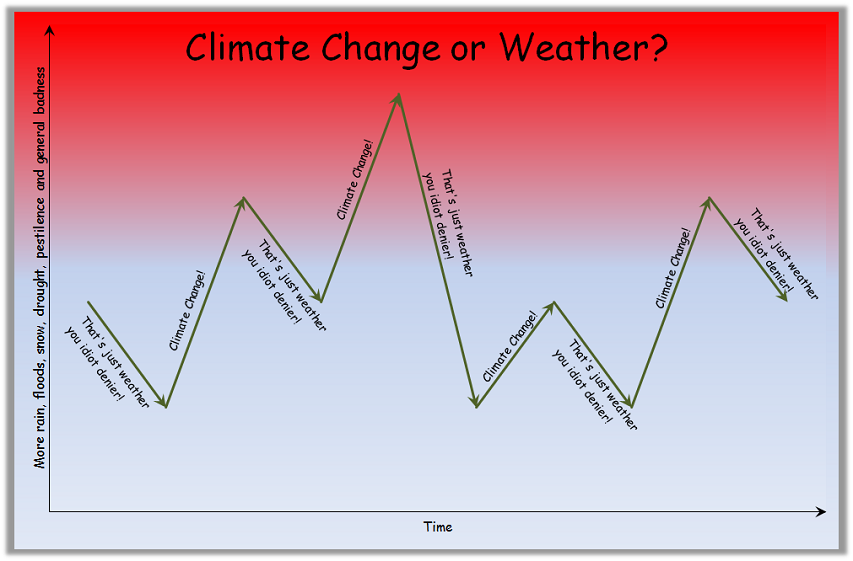
… it’s long since stopped being a joke and become all but the state religion, as Barbara Kay notes on the tenth anniversary of “climategate”:
Rayne pointed out that a cursory perusal of the Environment Canada Adjusted and Homogenized Canadian Climate Data database would illustrate that the daily summer maximum temperatures in Toronto showed no upward trend whatsoever. She further noted that a database for the WMO-certified Pearson Airport site demonstrated there was “absolutely no temporal correlation” for extreme July or August maximum temperatures between 1938 (when the database was initiated) and 2012.
In fact, there was no source in Canada then — and still isn’t — from which CAP could have plucked that ludicrous figure. University of Guelph economics professor Ross McKitrick had at that time just created his invaluable site, yourenvironment.ca, which sets out a complete temporal record of officially recorded air and pollution levels everywhere in Canada. The data for the site is culled from provincial environment and natural resources ministries, or from Environment Canada. Over many decades, no matter where you look in Canada, the graph trends remain resolutely horizontal with tiny upward and downward spikes indicating extreme weather blips.
Every layperson who identifies as an alarmism skeptic has his or her own pivotal moment, and that idiotic “news” story in the Globe was mine. When reporters and editors act like deer in the headlights in the reception and dissemination of demonstrably impossible “information,” it’s clear evidence that they have been gripped by a socially contagious virus. These are the people who in the 19th century would have believed tulip bulb prices were never going to peak, even if every single family on the planet had enough tulip bulbs to fill a half-acre garden.
The late writer Michael Crichton, author of the best-selling 2004 techno-thriller, State of Alarm, was one of the first independent students of environmentalism to define environmentalism as a “religion,” and to observe that its principal characteristic was to cater to the state of alarm he believed is an inherent human need. Its dogmatists act as though they have been appointed Morals Police. And they do not take kindly to dissent.
Al Gore, whose 2006 documentary film An Inconvenient Truth was received with uncritical awe, (one of my friends, normally very brainy, described it as a “religious experience”) was later found by a UK court to contain “nine key scientific errors.” It was deemed rife with “serious scientific inaccuracies, political propaganda and sentimental mush” and the judge ruled that the “apocalyptic vision” presented made it not an impartial scientific analysis, but a “political film.” He continues to hector the world as though that never happened from the depths of a home whose electricity kilowatt hours exceed twenty times the national average.
In 2007, environmental guru David Suzuki stormed out of a Toronto radio station interview when the host suggested global warming was not yet a “totally settled issue.” The incident revealed the mindset of the enviro-ayatollahs. (We see its 16-year-old version in little Pied Piper leader of the Children’s Crusade Greta “how-dare-you” Thunberg.) Suzuki perceived the radio host as a blasphemer, unworthy of his rational rebuttal. Suzuki actually felt enviro-infidels should be literally suppressed, and even opined that politicians who aren’t on board with his views should go to prison. You’d think a guy that far down the rabbit hole would be minding his own enviro P’s and Q’s, but like Al Gore, his real estate portfolio is humongous and his carbon footprint immense.
Comments Off on To think we used to joke about environmentalism as a substitute religion…
STV and History channel documentary to coincide with the 70th anniversary of the sinking of HMS Royal Oak at Scapa Flow in Scotland. With harrowing eye witness accounts from survivors. Narrated by oor Alex Norton. We will remember them.
On 14 October 1939, Royal Oak was anchored at Scapa Flow in the Orkney Islands, Scotland, when she was torpedoed by the German submarine U-47. Of Royal Oak‘s complement of 1,234 men and boys, 833 were killed that night or died later of their wounds. The loss of the old ship – the first of the five Royal Navy battleships and battlecruisers sunk in the Second World War – did little to affect the numerical superiority enjoyed by the British navy and its allies, but the sinking had considerable effect on wartime morale. The raid made an immediate celebrity and war hero out of the U-boat commander, Günther Prien, who became the first German submarine officer to be awarded the Knight’s Cross of the Iron Cross. Before the sinking of Royal Oak, the Royal Navy had considered the naval base at Scapa Flow impregnable to submarine attack, and U-47‘s raid demonstrated that the German navy was capable of bringing the war to British home waters. The shock resulted in rapid changes to dockland security and the construction of the Churchill Barriers around Scapa Flow.