
… the basic ideas of “alternative facts” and “fake news” — our updated, revved-up forms of disinformation — were not foreign to Orwell. Working at the BBC as a news producer — a fancy term for war propagandist — he heard some of the Axis powers’ propaganda as well as that of his own side (even if he kept his own hands fairly clean). He justifiably feared that the very concept of objective truth was fading from the modern world. Winston Smith’s job at the Ministry of Truth is to rewrite or “rectify” history, so that it follows the current party line, whatever it may be at that moment.
Orwell himself saw all this happen when he read Catalan newspapers as well as British ones during the Spanish Civil War, several years before joining the BBC. Condemning press distortions, above all how several English newspapers reported the war, he wrote: “I saw great battles where there had been no fighting and complete silence where hundreds of men had been killed … I saw, in fact, history being written not in terms of what happened but what ought to have happened according to various ‘party lines.'” Given the gridlock in American politics, and the never-ending verbal warfare between news outlets on the Right such as Fox News and on the Left such as MSNBC, Orwell appears all too accurate in his “predictions.”
One of the features of the world of Oceania reflecting Orwell’s prescience is its official language, Newspeak, an argot resembling a kind of Morse code that satirizes advertising norms, political jargon, and government bureaucratese. The purpose of Newspeak is to limit thought, on the view that “you can’t think what you lack the words for.” Ultimately, this impoverished language seeks to narrow and control human thought. (Does Twitter represent a step in that direction?) Purged of all nuance and subtlety, denuded of variety, and reduced to a few hundred simple words, Newspeak ultimately promises to render all independent thought (or “thoughtcrime”) impossible. If it cannot be expressed in language, it cannot be thought. And anything can fill the vacuum, such as 2 + 2 = 5. That is the equation — a perfect example of “doublethink” — which O’Brien indoctrinates Winston to accept in Room 101 and which marks the final step of the latter’s brainwashing. As the Party defines it, “doublethink” consists in holding “two contradictory beliefs in one’s mind simultaneously, and accepting both of them.” In 2018, Trump’s lead lawyer, former New York mayor Rudy Giuliani, declared in a TV interview: “Truth isn’t truth.” A few months later, a talking head defended a critical news report on the grounds that, just because it is “not accurate doesn’t mean it’s not true.”
It testifies both to the brilliance of Orwell’s vision and to the bane of our times that Nineteen Eighty-Four retains so much relevance.
John Rodden and John Rossi, “George Orwell Warned Us, But Was Anyone Listening?”, The American Conservative, 2019-10-02.
November 6, 2019
QotD: “Fake news” is nothing new
November 3, 2019
QotD: The theocratic Anabaptist State of Münster
After two months of unremitting propaganda, combined with threats and terror against those who disobeyed, the private ownership of money was effectively abolished in Münster. The government seized all the money and used it to buy goods or hire workers from the outside world. Wages were doled out in kind by the only employer: the theocratic Anabaptist State.
Food was confiscated from private homes, and rationed according to the will of government deacons. Also, to accommodate the host of immigrants, all private homes were effectively communized, with everyone permitted to quarter themselves everywhere; it was now illegal to close, let alone lock, one’s doors. Compulsory communal dining halls were established, where people ate together to the readings from the Old Testament.
The compulsory communism and reign of terror was carried out in the name of community and Christian “love.” This communization was considered the first giant step toward egalitarian communism, where, as Rothmann put it, “all things were to be in common, there was to be no private property and nobody was to do any more work, but simply trust in God.” Somehow, the workless part never seemed to arrive.
[…]
Totalitarianism in Münster was now complete. Death was now the punishment for virtually every independent act. Capital punishment was decreed for the high crimes of murder, theft, lying, avarice, and quarrelling. Death was also decreed for every conceivable kind of insubordination: the young against the parents, wives against their husbands, and, of course, anyone at all against the chosen representative of God on earth, the government of Münster. Bernt Knipperdollinck was appointed high executioner to enforce the decrees.
The only aspect of life previously left untouched was sex, and this deficiency was now made up. The only sexual relation now permitted by the Bockelson regime was marriage between two Anabaptists. Sex in any other form, including marriage with one of the “godless,” was a capital crime.
But soon Bockelson went beyond this rather old-fashioned credo, and decided to enforce compulsory polygamy in Münster. Since many of the expellees had left their wives and daughters behind, Münster now had three times as many marriageable women as men, so that polygamy had become technically feasible. Bockelson convinced the other, rather startled preachers by citing polygamy among the patriarchs of Israel, reinforcing this method of persuasion by threatening any dissenters with death.
Compulsory polygamy was a bit much for many of the Münsterites, who launched a rebellion in protest. The rebellion, however, was quickly crushed and most of the rebels put to death […]
The rest of the male population also began to take enthusiastically to the new decree. Many of the women reacted differently, however, and so the Elders passed a law ordering compulsory marriage for every woman under (and presumably also over) a certain age, which usually meant becoming a compulsory third or fourth wife.
Since marriage among the godless was not only invalid but also illegal, the wives of the expellees became fair game, and they were forced to “marry” good Anabaptists. Refusal of the women to comply with the new law was punishable, of course, with death, and a number of women were actually executed as a result.
Murray N. Rothbard, “Karl Marx as Religious Eschatologist”, Mises Institute, 2009-10-09.
November 2, 2019
When entertainment morphs into propaganda
One of the key elements aiding Hitler and the NSDAP to take power and stay in power in Germany in the 1930s was the constant, ongoing propaganda campaign orchestrated by Joseph Goebbels. Hitler and the Nazi party were lauded as the perfect Germanic solution to every problem and Jews, socialists, homosexuals, and other undesireable elements were belittled and used as targets of hate. A big part of Goebbels’ propaganda revolved around one idea, the “Big Lie”:
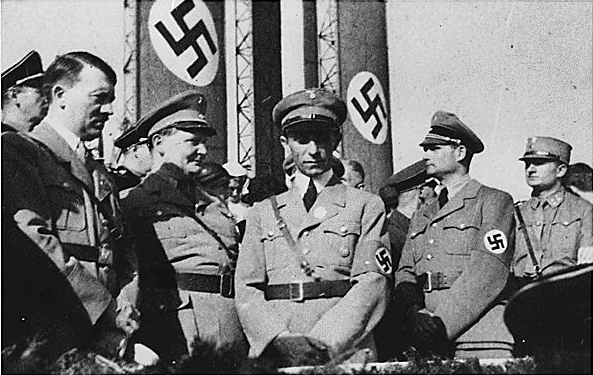
Hitler, Göring, Goebbels and Hess.
Photo via Wikimedia Commons.
If you tell a lie big enough and keep repeating it, people will eventually come to believe it. The lie can be maintained only for such time as the State can shield the people from the political, economic and/or military consequences of the lie. It thus becomes vitally important for the State to use all of its powers to repress dissent, for the truth is the mortal enemy of the lie, and thus by extension, the truth is the greatest enemy of the State.
By suppressing competing voices and having all the methods of reaching the people repeating the same story, the Nazis solidified their control on power in Germany that lasted until 1945, and was only demolished by massive military effort by the United States, the Soviet Union, and the British Commonwealth. Propaganda is a very powerful tool that works distressingly well to implant and nurture evil ideas in a subject population.
Modern propagandists in the west generally don’t have the power of the state aiding them, but if they get enough of the channels of communication — especially the entertainment channels — to co-ordinate the message, the effects can be very strong:
… I perfectly understand the legitimacy of feminist concerns regarding the portrayal of women in the media as consistently demure, retiring, and subservient to men. I grant that, in most of the action/adventure movies that I saw growing up, women would typically twist an ankle or get captured and then require rescuing by the swashbuckling male hero — and I realize how galling this must have been to generations of women. And therefore, a certain correction was undoubtedly in order. But what is problematic now is the Nietzschean quality of the reaction, by which I mean, the insistence that female power has to be asserted over and against males, that there is an either/or, zero-sum conflict between men and women. It is not enough, in a word, to show women as intelligent, savvy, and good; you have to portray men as stupid, witless, and irresponsible. That this savage contrast is having an effect especially on younger men is becoming increasingly apparent.
In the midst of a “you-go-girl” feminist culture, many boys and young men feel adrift, afraid that any expression of their own good qualities will be construed as aggressive or insensitive. If you want concrete proof of this, take a look at the statistics contrasting female and male success at the university level. And you can see the phenomenon in films such as Fight Club and The Intern. In the former, the Brad Pitt character turns to his friend and laments, “we’re thirty year old boys;” and in the latter, Robert De Niro’s classic male type tries to whip into shape a number of twenty-something male colleagues who are rumpled, unsure of themselves, without ambition — and of course under the dominance of an all conquering female.
It might be the case that, in regard to money, power, and honor, a zero-sum dynamic obtains, but it decidedly does not obtain in regard to real virtue. The truly courageous person is not threatened by another person’s courage; the truly temperate man is not intimidated by the temperance of someone else; the truly just person is not put off by the justice of a countryman; and authentic love positively rejoices in the love shown by another. And therefore, it should be altogether possible to hold up the virtue of a woman without denying virtue to a man. In point of fact, if we consult the “all conquering female” characters in films and TV, we see that they often exemplify the very worst of the traditional male qualities: aggression, suspicion, hyper-sensitivity, cruelty, etc. This is what happens when a Nietzschean framework has replaced a classical one.
My point is that it is altogether possible — and eminently desirable — to say “you go boy” with as much vigor as “you go girl.” And both the boys and the girls will be better for it.
November 1, 2019
Why All Germans Were Nazis – How Hitler Created the Third Reich | BETWEEN 2 WARS I 1934 Part 1 of 4
TimeGhost History
Published 31 Oct 2019After Hitler seized power in Germany in January 1933, he rapidly transformed the Democratic Weimar Republic into a repressive, totalitarian and racist state. In 1934, Germany became Nazi Germany.
Join us on Patreon: https://www.patreon.com/TimeGhostHistory
Subscribe to our World War Two series: https://www.youtube.com/c/worldwartwo…
Hosted by: Indy Neidell
Written by: Spartacus Olsson and Francis van Berkel
Directed by: Spartacus Olsson and Astrid Deinhard
Executive Producers: Bodo Rittenauer, Astrid Deinhard, Indy Neidell, Spartacus Olsson
Creative Producer: Joram Appel
Post-Production Director: Wieke Kapteijns
Research by: Francis van Berkel and Spartacus Olsson
Edited by: Wieke Kapteijns
Sound design: Marek KamińskiImage sources: Bundesarchiv, Bundesarchiv, Bild 102-15282A / Georg Pahl, Heinz Bergschicker Deutsche Chronik 1933-1945 – Ein Zeitbild der faschistischen Diktatur
Icons from the Noun Project: Police by IconTrack, soldier by Simon Child, police man by Gregor Cresnar, hello by Universal Icons.
A TimeGhost chronological documentary produced by OnLion Entertainment GmbH.
From the comments:
Spartacus Olsson
2 hours ago
Now, this episode explains the measures that the Nazis used to gain control over the German people. It is not an attempt to justify, or be apologetic of the responsibility for the horrors committed during the Nazi regime. But it is also not a blanket condemnation of Germans. What happened in Germany starting in 1933 should serve us all as a warning to what can happen when you let loose authoritarian power, normalize lies as an acceptable part of political discourse, and make mainstream the disregard of basic human values. We should all think of that although the Nazis were especially efficient in their implementation of an authoritarian system, they are by far not the only ones that have succeeded in seducing whole a nation into blind hatred and acceptance of the suffering and death of others to forward an ideology. We should remember that freedom and democracy is essential, but also that words matters. The beginning of oppression starts with an endless stream of lies that confuse public discourse to the point that facts don’t matter anymore and truth becomes fiction. This video shows us what can happen next. Our mantra as a channel is to focus on the facts, not our opinions, not our ‘truth’ — just the facts m’am — and that is what we have presented here, for better or worse.
October 11, 2019
Germany Never Elected Hitler | BETWEEN 2 WARS I 1933 Part 1 of 3
TimeGhost History
Published 10 Oct 2019Hitlers rise to power, also known as the Machtergreifung, was riddled with physical and mental manipulation, political games and an exploitation of the Democratic system. This episode follows the events leading up to the Nazi takeover of Germany.
Join us on Patreon: https://www.patreon.com/TimeGhostHistory
Hosted by: Indy Neidell
Written by: Spartacus Olsson
Directed by: Spartacus Olsson and Astrid Deinhard
Executive Producers: Bodo Rittenauer, Astrid Deinhard, Indy Neidell, Spartacus Olsson
Creative Producer: Joram Appel
Post-Production Director: Wieke Kapteijns
Research by: Spartacus Olsson
Edited by: Daniel Weiss
Sound design: Iryna Dulkaimage source:
Deutsche BundesarchivA TimeGhost chronological documentary produced by OnLion Entertainment GmbH.
From the comments:
Spartacus Olsson
18 minutes ago
Hi, for those of you that don’t know me yet, I’m the lead author of this series and the author of this episode. Now, as you will, or have just seen, this episode covers an event of earth-shattering magnitude in human history. An event that is often misunderstood and glossed over. The reason for that is not that there is anything controversial, or stupendously new with what we’re documenting here. The simple fact is that its just too detailed and too complicated to cover in general history studies, especially in secondary school. The level we get into here is usually only covered in specialized lectures at college or university level. Tons and tons of books have been written on the topic and yet, many misconceptions remain. It was my goal to dispel some of the many misunderstandings that abound about how Hitler finally seized power. One of the chief myths is that Hitler was elected. As the video shows, that is not what happened. So you might ask yourself; how come the vast majority of Germans finally rallied behind him? Because they did, there’s no question. But you see, that happens after he seizes power and it will be the topic of our next episode on Germany that covers the Nazi consolidation of power.It was also my goal to cast some more light on a topic that has been weaponized in political debate in recent years: the level of Socialism in the German National Socialist Worker’s Party. I hope that I have laid the latter one to rest, but I fear that the comment section will still be full of politically biased nonsense on this topic. It’s quite tiring for our community managers to answer that misrepresenting alt-right trope over and over again. And we won’t stop you from posting it, even if it’s nonsense. Instead we will try to patiently answer, but think fifteen times about posting ‘Nazis were Socialists, duh!’ or “Dude, Nazis are left-wing, duh!’ out of respect for us. What we will not tolerate is that you post links to any of the clown videos by non-historians that try to perpetuate that myth. We are a team of actual historians. We have no interest in ‘pinning’ Naziism on anyone. We also have no interest in ‘pinning’ Socialism on anyone. Nor should you, if you have any interest whatsoever in understanding history. Revolutionary Socialism, Communism, Fascism and Nazism have all brought down a lot of suffering on humanity – if we are supporters of freedom and democracy we need to learn from that. Throwing them all in one bucket and dumping it on our perceived political opponents is not learning, it’s obfuscation, confusion, and destruction of education. So respect humanity, respect history and don’t take part in that kind of nonsense.
October 2, 2019
QotD: Senator Joe McCarthy
Pretty early on in the reading, it has occurred to me that the collusion between Democrat politicians, government departments and agencies, and liberal press to cover up the official sins of commission and omission, derail McCarthy’s investigations thereof, blacken his name, and destroy him personally and politically runs according to a very familiar script. It’s essentially what the progressive political and cultural elites have done to any number of conservative politicians and activists seen as a threat to their power and reputation. Donald Trump is merely the latest in a long and distinguished line.
To paraphrase Shakespeare’s Marc Antony, I came here not to praise Donald but to see how the left is trying to bury him. Until reading Evans’s book, I have not quite realised how similar and similarly underhand, vicious and persistent the campaign against Joe McCarthy had been. The “Swamp” is real; it was real in the 1940s and 1950s, and it is just as real now and just as committed to destroying any outside threats to its continuing position and influence. This is not a conspiracy theory; this is simply how power structures work to protect and perpetuate themselves. The viciousness is a function not just of the unshakable self-belief in one’s intellectual and moral rightness and superiority but also of a certain form of snobbery directed by the members of the “in-crowd” – what once used to be known as the Liberal or the East Coast Establishment and now more broadly, among many other names and designations, as the “coastal elites” – against outsiders who don’t share their sophisticated social, educational or professional background. The Swamp managed in the end to defeat McCarthy and turn him in the historical and popular memory into one of the great villains of American history; the book is still open on Trump’s ultimate fate and legacy. None of this is to suggest that McCarthy or Trump are flawless human beings and faultless political figures; quite the contrary. But the campaigns of destruction they are subjected to ultimately have little to do with their specific failings and mistakes. It’s a total war.
Arthur Chrenkoff, “Before there was Trump, there was Joe McCarthy”, Daily Chrenk, 2019-09-30.
September 29, 2019
An Axis of Evil is Complete – WW2 – 057 – September 28 1940
World War Two
Published 28 Sep 2019This week, the factions of World War Two begin to crystallise as the Japanese join the Axis powers.
Join us on Patreon: https://www.patreon.com/TimeGhostHistory
Or join The TimeGhost Army directly at: https://timeghost.tvFollow WW2 day by day on Instagram @World_war_two_realtime https://www.instagram.com/world_war_t…
Join our Discord Server: https://discord.gg/D6D2aYN.
Between 2 Wars: https://www.youtube.com/playlist?list…
Source list: http://bit.ly/WW2sourcesWritten and Hosted by: Indy Neidell
Produced and Directed by: Spartacus Olsson and Astrid Deinhard
Executive Producers: Bodo Rittenauer, Astrid Deinhard, Indy Neidell, Spartacus Olsson
Creative Producer: Joram Appel
Post-Production Director: Wieke Kapteijns
Research by: Indy Neidell
Edited by: Iryna Dulka
Map animations: EastoryColorisations by Norman Stewart and Julius Jääskeläinen https://www.facebook.com/JJcolorization/
Eastory’s channel: https://www.youtube.com/channel/UCEly…
Archive by Screenocean/Reuters https://www.screenocean.com.Sources:
– USHMM
1. Accession Number: 1992.252.1 | RG Number: RG-60.0621 | Film ID: 302
2. Photograph Number: 74565
– IMW:
IWM (A 1378)
IWM (A 1376)
IWM (CH 1429)
IWM (C 1819)TimeGhost chronological documentary produced by OnLion Entertainment GmbH.
August 2, 2019
Doug Ford’s sudden onset “Winegate” scandal
Ontario premier Doug Ford is now taking flak for promoting an Ontario winery after his party accepted what some Toronto media reports characterized as a “generous” donation from the winery’s owner. How generous? Are we talking millions? Tens of millions? A thousand dollars. Toronto media considers $1,000 to be enough money to sway the provincial government and at least one local media outlet encouraged its readers to boycott the winery. But that turned out to be only the tip of the iceberg from a media investigation point of view: Ford’s ultra-cheesy “Ontario News Now” party propaganda channel had given Ford’s endorsement to at least four other mega-corporations whose political contributions may have gone as eye-wateringly high as $2,000! Torontonians may never have heard of these corporate puppet-masters who clearly now control Premier Ford’s every waking moment, but as Canadians have never seen corruption on this scale before — nearly ten thousand dollars in political contributions!! — they’re demanding all the usual things that media-ginned-up protests tend to demand.

“Pelee Island winery”by John Kannenberg is licensed under CC BY-NC-ND 2.0


At the National Post, Chris Selley wonders why the Ontario Progressive Conservatives are acting just as badly as the Liberals they replaced:
When it comes to Canadian politicians and money, it might be difficult to explain to a foreign visitor exactly what’s kosher and what’s not. Ontario Premier Doug Ford got some bad press this week for having promoted the Pelee Island Winery in one of his impossibly cheesy “Ontario News Now” propaganda videos, just weeks after the winery’s owner, Walter Schmoranz, donated $1,000 to Ford’s Progressive Conservatives. In isolation, it didn’t look great. If it’s a coincidence, as the premier claims, then it’s the sort of coincidence a government wishing to claim moral rectitude should endeavour to avoid.
Viewed in the broad landscape of Canadian politics, however, it all seems rather overblown. Politicians regularly stump for certain products and businesses, after all, implicitly at the expense of others. More to the point they routinely give businesses free money without asking us, and not out of the goodness of their hearts.
According to David Akin’s indispensable @ottawaspends Twitter feed, the federal government doled out $723,000 to wineries and winery associations this year and last. The Nova Scotia Winery Association hoovered up $522,000 of the total, plus another $175,000 back in 2012. Perhaps it would be cynical to observe that the riding of West Nova, home to the Annapolis Valley wineries, is notorious for changing hands between the Liberals and Conservatives. Whoops — too late.
Here in Ontario, meanwhile, between 2013 and 2018, the province and feds collectively gave away at least $1.1 million to wineries and $1.5 million to breweries, plus $140-odd million more to an endless queue of cap-in-hand distillers, mushroom farmers, meat processers, goat dairies, sugarmakers and bakeries. Pelee Island Winery isn’t on that list, incidentally, which might put the premier’s non-financial contribution — quid pro quo or not — in perspective.
All that taxpayer dough got handed out under a program called Growing Forward 2, which was an “initiative that encouraged innovation, competitiveness and market development, adaptability and industry sustainability in Canada’s agri-food and agri products sector.” That’s a fancy way of saying “corporate welfare,” which can be unpopular in Canada when it comes to bailing Bombardier out of its latest fiasco or buying the Weston clan new freezers, but which is entirely uncontroversial when it comes to smaller, less obviously villainous businesses — especially if they happen to be farms.
July 21, 2019
QotD: History in a totalitarian age
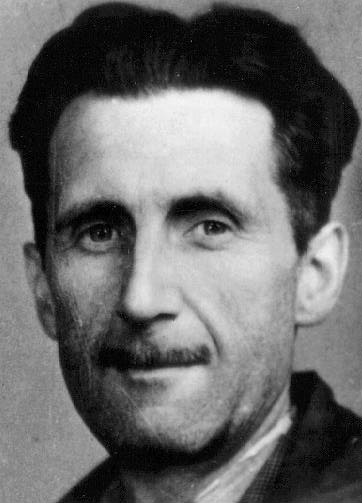
Orwell’s press card portrait, 1943
I know it is the fashion to say that most of recorded history is lies anyway. I am willing to believe that history is for the most part inaccurate and biased, but what is peculiar to our own age is the abandonment of the idea that history could be truthfully written. In the past people deliberately lied, or they unconsciously coloured what they wrote, or they struggled after the truth, well knowing that they must make many mistakes; but in each case they believed that “facts” existed and were more or less discoverable. And in practice there was always a considerable body of fact which would have been agreed to by almost everyone. If you look up the history of the last war in, for instance, the Encyclopaedia Britannica, you will find that a respectable amount of the material is drawn from German sources. A British and a German historian would disagree deeply on many things, even on fundamentals, but there would still be that body of, as it were, neutral fact on which neither would seriously challenge the other. It is just this common basis of agreement, with its implication that human beings are all one species of animal, that totalitarianism destroys. Nazi theory indeed specifically denies that such a thing as “the truth” exists. There is, for instance, no such thing as “Science”. There is only “German Science”, “Jewish Science”, etc. The implied objective of this line of thought is a nightmare world in which the Leader, or some ruling clique, controls not only the future but the past. If the Leader says of such and such an event, “It never happened” — well, it never happened. If he says that two and two are five — well, two and two are five. This prospect frightens me much more than bombs — and after our experiences of the last few years that is not a frivolous statement.
But is it perhaps childish or morbid to terrify oneself with visions of a totalitarian future? Before writing off the totalitarian world as a nightmare that can’t come true, just remember that in 1925 the world of today would have seemed a nightmare that couldn’t come true. Against that shifting phantasmagoric world in which black may be white tomorrow and yesterday’s weather can be changed by decree, there are in reality only two safeguards. One is that however much you deny the truth, the truth goes on existing, as it were, behind your back, and you consequently can’t violate it in ways that impair military efficiency. The other is that so long as some parts of the earth remain unconquered, the liberal tradition can be kept alive. Let Fascism, or possibly even a combination of several Fascisms, conquer the whole world, and those two conditions no longer exist. We in England underrate the danger of this kind of thing, because our traditions and our past security have given us a sentimental belief that it all comes right in the end and the thing you most fear never really happens. Nourished for hundreds of years on a literature in which Right invariably triumphs in the last chapter, we believe half-instinctively that evil always defeats itself in the long run. Pacifism, for instance, is founded largely on this belief. Don’t resist evil, and it will somehow destroy itself. But why should it? What evidence is there that it does? And what instance is there of a modern industrialized state collapsing unless conquered from the outside by military force?
Consider for instance the re-institution of slavery. Who could have imagined twenty years ago that slavery would return to Europe? Well, slavery has been restored under our noses. The forced-labour camps all over Europe and North Africa where Poles, Russians, Jews and political prisoners of every race toil at road-making or swamp-draining for their bare rations, are simple chattle slavery. The most one can say is that the buying and selling of slaves by individuals is not yet permitted. In other ways — the breaking-up of families, for instance — the conditions are probably worse than they were on the American cotton plantations. There is no reason for thinking that this state of affairs will change while any totalitarian domination endures. We don’t grasp its full implications, because in our mystical way we feel that a regime founded on slavery must collapse. But it is worth comparing the duration of the slave empires of antiquity with that of any modern state. Civilizations founded on slavery have lasted for such periods as four thousand years.
When I think of antiquity, the detail that frightens me is that those hundreds of millions of slaves on whose backs civilization rested generation after generation have left behind them no record whatever. We do not even know their names. In the whole of Greek and Roman history, how many slaves’ names are known to you? I can think of two, or possibly three. One is Spartacus and the other is Epictetus. Also, in the Roman room at the British Museum there is a glass jar with the maker’s name inscribed on the bottom, “Felix fecit“. I have a mental picture of poor Felix (a Gaul with red hair and a metal collar round his neck), but in fact he may not have been a slave; so there are only two slaves whose names I definitely know, and probably few people can remember more. The rest have gone down into utter silence.
George Orwell, “Looking back on the Spanish War”, New Road, 1943 (republished in England, Your England and Other Essays, 1953).
July 16, 2019
QotD: Wartime atrocities
Orwell’s press card portrait, 1943
I have little direct evidence about the atrocities in the Spanish civil war. I know that some were committed by the Republicans, and far more (they are still continuing) by the Fascists. But what impressed me then, and has impressed me ever since, is that atrocities are believed in or disbelieved in solely on grounds of political predilection. Everyone believes in the atrocities of the enemy and disbelieves in those of his own side, without ever bothering to examine the evidence. Recently I drew up a table of atrocities during the period between 1918 and the present; there was never a year when atrocities were not occurring somewhere or other, and there was hardly a single case when the Left and the Right believed in the same stories simultaneously. And stranger yet, at any moment the situation can suddenly reverse itself and yesterday’s proved-to-the-hilt atrocity story can become a ridiculous lie, merely because the political landscape has changed.
In the present war we are in the curious situation that our “atrocity campaign” was done largely before the war started, and done mostly by the Left, the people who normally pride themselves on their incredulity. In the same period the Right, the atrocity-mongers of 1914-18, were gazing at Nazi Germany and flatly refusing to see any evil in it. Then as soon as war broke out it was the pro-Nazis of yesterday who were repeating horror stories, while the anti-Nazis suddenly found themselves doubting whether the Gestapo really existed. Nor was this solely the result of the Russo-German Pact. It was partly because before the war the Left had wrongly believed that Britain and Germany would never fight and were therefore able to be anti-German and anti-British simultaneously; partly also because official war-propaganda, with its disgusting hypocrisy and self-righteousness, always tends to make thinking people sympathize with the enemy. Part of the price we paid for the systematic lying of 1914-17 was the exaggerated pro-German reaction which followed. During the years 1918-33 you were hooted at in left-wing circles if you suggested that Germany bore even a fraction of responsibility for the war. In all the denunciations of Versailles I listened to during those years I don’t think I ever once heard the question, “What would have happened if Germany had won?” even mentioned, let alone discussed. So also with atrocities. The truth, it is felt, becomes untruth when your enemy utters it. Recently I noticed that the very people who swallowed any and every horror story about the Japanese in Nanking in 1937 refused to believe exactly the same stories about Hong Kong in 1942. There was even a tendency to feel that the Nanking atrocities had become, as it were, retrospectively untrue because the British Government now drew attention to them.
But unfortunately the truth about atrocities is far worse than that they are lied about and made into propaganda. The truth is that they happen. The fact often adduced as a reason for scepticism — that the same horror stories come up in war after war — merely makes it rather more likely that these stories are true. Evidently they are widespread fantasies, and war provides an opportunity of putting them into practice. Also, although it has ceased to be fashionable to say so, there is little question that what one may roughly call the “whites” commit far more and worse atrocities than the “reds”. There is not the slightest doubt, for instance, about the behaviour of the Japanese in China. Nor is there much doubt about the long tale of Fascist outrages during the last ten years in Europe. The volume of testimony is enormous, and a respectable proportion of it comes from the German press and radio. These things really happened, that is the thing to keep one’s eye on. They happened even though Lord Halifax said they happened. The raping and butchering in Chinese cities, the tortures in the cellars of the Gestapo, the elderly Jewish professors flung into cesspools, the machine-gunning of refugees along the Spanish roads — they all happened, and they did not happen any the less because the Daily Telegraph has suddenly found out about them when it is five years too late.
George Orwell, “Looking back on the Spanish War”, New Road, 1943 (republished in England, Your England and Other Essays, 1953).
July 14, 2019
The only WW2 battle with its own – fanatical – volunteer PR department
The 1943 battle of Kursk has been called “the most overhyped battle in history”. I’ve read many, many books and articles about the events of World War 2, I’ve generally avoided reading much about Kursk, because reasons. As I wrote nearly a decade back:
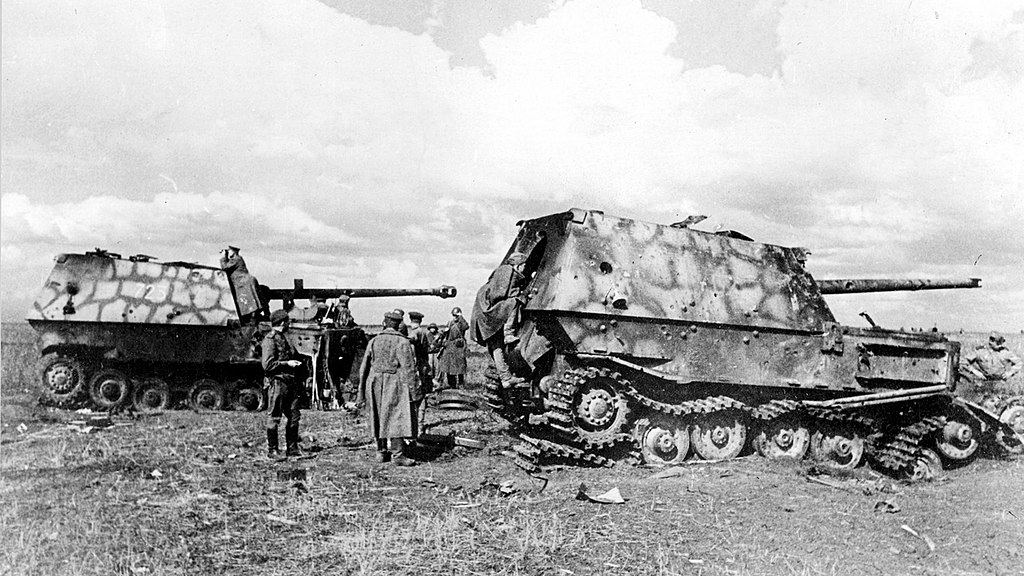
Советские бойцы и командиры осматривают немецкие САУ «Фердинанд», подбитые на Орловском участке фронта (“Soviet fighters and commanders examine German self-propelled guns Ferdinand, shot down on the Orel front”).
Photo by Pavel Troshkin, July 1943 via Wikimedia Commons.
Although I’ve read much about World War II, I haven’t read much about arguably the most critical part of the entire war: the gargantuan battles pitting the Soviet Red Army against Hitler’s Wehrmacht. Some of that is just sheer pig-headedness: I used to work for the biggest wargame store in Toronto, back when wargames meant cardboard counters, vast paper hexagonal maps, and charts and tables galore. The hardest of the hard-core gamers seemed to be either Napoleonic grognards (down to the secret stash of sabres and shakos in the gaming room) or even more dedicated junkies of the “Great Patriotic War”/”Operation Barbarossa”. Some of the latter were genuinely crazy, right down to the barely contained hints that “Hitler was just misunderstood”.
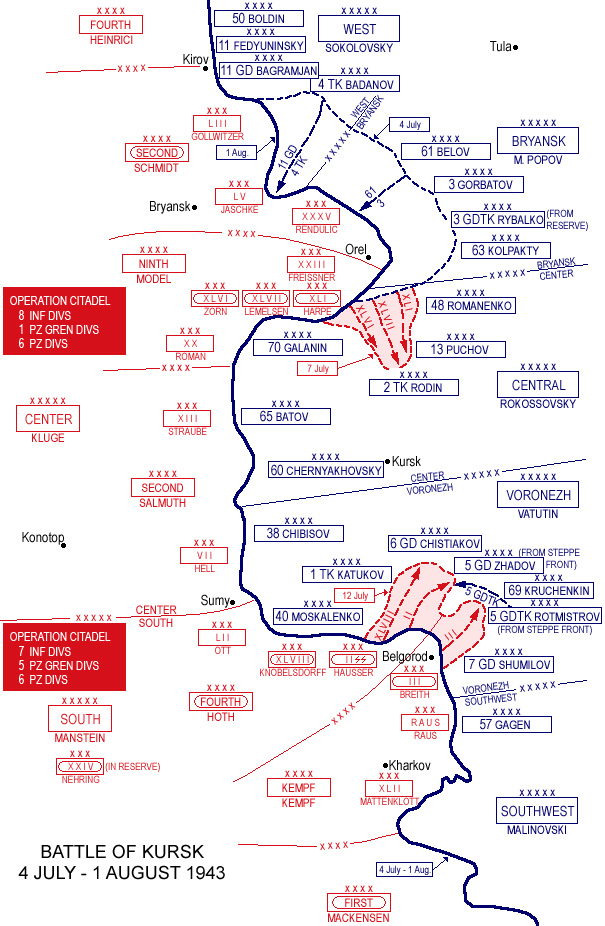
Battle of Kursk – 4 July-1 August 1943
Map drawn by Frank Martini for the Department of History at the United States Military Academy (http://www.dean.usma.edu/history/web03/atlases/ww2%20europe/ww2%20europe%20pages/ww2%20europe%20map%2027.htm), via Wikimedia Commons.On the assumption that certain forms of craziness are contagious, I avoided most of the latter as much as I could, consistent with my duty to sell them the latest and greatest game involving their particular passion.
One day, perhaps in a fit of weakness, I allowed myself to get lectured by one of the fanatics about the details of the Battle of Kursk. The fan who felt the need to bend my ear was eager to impart information about some “famous battle” that turned out to have been a serious tactical miscalculation by a Soviet officer. The story, as he told it, had a very large formation of Soviet tanks “taking a shortcut” through a major minefield, resulting in many disabled/destroyed tanks and wounded or dead men. In the telling, this kind of thing could not be admitted as having happened without some enemy contact, so it was propagandized as being a major tank battle involving significant formations of German panzer troops and/or SS units (of whom, of course, the glorious defenders of the Motherland took a greater toll than they suffered themselves).
The twitchy-eyed Panzertruppe fanboys helped keep my interest firmly directed away from much of the WW2 Eastern Front aside from the initial 1941 German invasion. A post at Blazing Cat Fur included a link to a BBC article discussing furious Russian reaction to an article recently published in Die Welt, but also indicates that there was actually some factual basis for the lecture I endured all those years ago:
The wider Battle of Kursk – from 5 July to 23 August 1943 – was indeed a turning-point in World War Two. Soviet forces thwarted a huge Nazi counter-attack, after Adolf Hitler’s troops had suffered a colossal defeat at Stalingrad in the winter of 1942-43.
But recently a British historian, Ben Wheatley, analysed German Luftwaffe aerial photos of the Prokhorovka battlefield, taken on 14-16 July, when the area was still in German hands. The photos were found in the US National Archives at College Park, Maryland.
T-34/85 at musée des blindés de Saumur (via Wikipedia)
Wheatley’s assessment, backed by detailed study of battle reports and historical archives, is that on 12 July the Germans lost just five Panzer IV tanks at Prokhorovka, but decimated “kamikaze” Soviet tank formations, turning more than 200 Soviet tanks into smouldering wrecks.
He writes that dozens of Soviet T-34 tanks tumbled into an anti-tank ditch 4.5m (15ft) deep, dug by Soviet infantry, and when the Red Army realised its mistake other T-34s started queuing up to cross a bridge. German tanks were easily able to pick them off at the bridge.
Wheatley and a German military historian, Karl-Heinz Frieser, were cited in a feature in the German daily Die Welt, which hit a Russian raw nerve.
The writer, Sven Felix Kellerhoff, argued that the evidence of Soviet humiliation at Prokhorovka was so convincing that Russia ought to tear down its memorial there, which celebrates the heroism of Soviet tank crews on 12 July.
[…]
War photographer Anatoly Yegorov was in the thick of the fighting at Kursk. His nephew Mikhail Yegorov spoke to the daily Moskovsky Komsomolets, recalling what Anatoly told him about his work there.
“Most of those photos were not published. ‘Do you know why no panoramic photos of the Prokhorovka battlefield were ever shown in our country?’ my uncle asked me. ‘Because for every burning Tiger there were 10 of our smashed up T-34s! How could you publish such photos in the papers?'”

BCF also linked to this artice from a few years ago at The National Interest:
Kursk is the Santa Claus and Easter Bunny of World War II battles, whose popular history was constructed from German and Soviet propaganda, and based on early accounts lacking vital information buried in Russian archives until after the fall of the Soviet Union. Kursk was indeed an epic battle, that pitted 3 million German and Soviet soldiers and 8,000 tanks, all crammed into a small portion of southern Russia.
[…]
Top commanders such as Erich Von Manstein wanted to attack in May, before the Soviets had time to dig in and reinforce the salient. But a nervous and indecisive Hitler decided to postpone Operation Citadel until July, to allow time to deploy his vaunted new Panther, Tiger and Elefant tanks. While the big cats lumbered off the railroad cars near the front lines, the Germans managed to amass nearly 800,000 men, 3,000 tanks, 10,000 guns and mortars, and 2,000 aircraft. It would be the last time the Germans could concentrate such an attack force (by comparison, at the Battle of the Bulge, the Germans had 400,000 men and 600 tanks). Yet as usual, the Germans were outnumbered. They faced 1.9 million Soviet soldiers, 5,000 tanks, 25,000 guns and mortars and more than 3,000 aircraft.
Citadel was a prophetic name for the German offensive. The Soviets used the extra time to build an incredibly dense defense system of multiple layers of fortifications, including trenches, bunkers, tank traps and machine gun nests 25 miles deep, as well as minefields that averaged more than 3,000 mines per kilometer.
Kursk was not an imaginative battle. The Germans attacked an obvious target, the Soviets fortified the obvious target, and the German offensive on July 4, 1943 was a traditional pincer move against the north and south base of the salient to cut off the defenders inside. Despite support by 89 Elefants (a Porsche version of the Tiger that the German army rejected), the northern pincer quickly bogged down after advancing just a few miles. But the southern pincer, led by the II SS Panzer Corps, managed to advance 20 miles to the town of Prokhorovka, until its advance was checked by the Soviet Fifth Guards Tank Army.
The article then goes on to address many of the myths and legends that have grown up around the battle, including:
- The Tigers didn’t burn. Soviet tanks did
- Kursk was not a turning point of the war
- Prokhorovka was not the Greatest Tank Battle in History
- The Red Army was still not as good as the German Army
- It was the Soviet counteroffensive that bled the Germans
- Soviet tanks didn’t ram German tanks at Kursk
- Kursk was an Anglo-American victory as well as a Soviet one
July 12, 2019
NEW VERSION – 107 Abandoned French Soldiers Killed for Propaganda – France 1940 – 02
World War Two
Published on 11 Jul 2019We stumbled on some of the propaganda footage shot by the Wehrmacht film teams during the actual attack at the Ouvrage de La Ferté, and we figured that it would do the topic justice to make an improved version of this video.
After the German army breaks through the French lines at Sedan, the left flank of the moving army has to be secured. The French Ouvrage la Ferté, part of the Maginot Line defense works, is subject to this consolidation. But the Germans move with ulterior motives, as to them capturing a Maginot Line fort in the first week of the offensive has a huge propaganda value. Tour guide Richard Tucker shows Indy the grounds of a modern tragedy, where 107 French soldiers gave their lives.
Join us on Patreon: https://www.patreon.com/TimeGhostHistory
Or join The TimeGhost Army directly at: https://timeghost.tvCheck out (and book!) Richard Tucker here: https://www.tripadvisor.nl/Attraction…
Follow WW2 day by day on Instagram @World_war_two_realtime https://www.instagram.com/world_war_t…
Join our Discord Server: https://discord.gg/D6D2aYN.
Between 2 Wars: https://www.youtube.com/playlist?list…
Source list: http://bit.ly/WW2sourcesWritten and Hosted by: Indy Neidell
Produced and Directed by: Spartacus Olsson and Astrid Deinhard
Executive Producers: Bodo Rittenauer, Astrid Deinhard, Indy Neidell, Spartacus Olsson
Creative Producer: Joram Appel
Research by: Indy Neidell
Edited by: Iryna Dulka
Map animations: EastoryColorisations by Norman Stewart and Julius Jääskeläinen https://www.facebook.com/JJcolorization/
Eastory’s channel: https://www.youtube.com/channel/UCEly…
Archive by Screenocean/Reuters https://www.screenocean.com.A TimeGhost chronological documentary produced by OnLion Entertainment GmbH.
From the comments:
World War Two
1 hour ago
Some of you might be getting flashbacks seeing this episode pop up. We published a version of this video already, but since we did that, we found some great footage depicting the actual fighting at Ouvrage de la Ferté. As we love history, we also love how this footage brings the story and the memorial to life. We wanted to share this experience with you, and decided to upload an improved version with new archive footage. We hope you like it as much as we do!Cheers,
Joram

QotD: Warmongers, propaganda, and the intelligentsia
Orwell’s press card portrait, 1943
Our memories are short nowadays, but look back a bit, dig out the files of New Masses or the Daily Worker, and just have a look at the romantic warmongering muck that our left-wingers were spilling at that time. All the stale old phrases! And the unimaginative callousness of it! The sang-froid with which London faced the bombing of Madrid! Here I am not bothering about the counter-propagandists of the Right […]; they go without saying. But here were the very people who for twenty years had hooted and jeered at the “glory” of war, at atrocity stories, at patriotism, even at physical courage, coming out with stuff that with the alteration of a few names would have fitted into the Daily Mail of 1918. If there was one thing that the British intelligentsia were committed to, it was the debunking version of war, the theory that war is all corpses and latrines and never leads to any good result. Well, the same people who in 1933 sniggered pityingly if you said that in certain circumstances you would fight for your country, in 1937 were denouncing you as a Trotsky-Fascist if you suggested that the stories in New Masses about freshly wounded men clamouring to get back into the fighting might be exaggerated. And the Left intelligentsia made their swing-over from “War is hell” to “War is glorious” not only with no sense of incongruity but almost without any intervening stage. Later the bulk of them were to make other transitions equally violent. There must be a quite large number of people, a sort of central core of the intelligentsia, who approved the “King and Country” declaration in 1935, shouted for a “firm line against Germany” in 1937, supported the People’s Convention in 1940, and are demanding a Second Front now.
As far as the mass of the people go, the extraordinary swings of opinion which occur nowadays, the emotions which can be turned on and off like a tap, are the result of newspaper and radio hypnosis. In the intelligentsia I should say they result rather from money and mere physical safety. At a given moment they may be “pro-war” or “anti-war”, but in either case they have no realistic picture of war in their minds. When they enthused over the Spanish war they knew, of course, that people were being killed and that to be killed is unpleasant, but they did feel that for a soldier in the Spanish Republican army the experience of war was somehow not degrading. Somehow the latrines stank less, discipline was less irksome. You have only to glance at the New Statesman to see that they believed that; exactly similar blah is being written about the Red Army at this moment. We have become too civilized to grasp the obvious. For the truth is very simple. To survive you often have to fight, and to fight you have to dirty yourself. War is evil, and it is often the lesser evil. Those who take the sword perish by the sword, and those who don’t take the sword perish by smelly diseases. The fact that such a platitude is worth writing down shows what the years of rentier capitalism have done to us.
George Orwell, “Looking back on the Spanish War”, New Road, 1943 (republished in England, Your England and Other Essays, 1953).
July 8, 2019
QotD: Orwell on capitalism versus socialism
Orwell’s press card portrait, 1943
No one can question the dirtiness of international politics from 1870 onwards: it does not follow that it would have been a good thing to allow the German army to rule Europe. It is just possible that some rather sordid transactions are going on behind the scenes now, and that current propaganda “against Nazism” (cf. “against Prussian militarism”) will look pretty thin in 1970, but Europe will certainly be a better place if Hitler and his followers are removed from it. Between them these two books sum up our present predicament. Capitalism leads to dole queues, the scramble for markets, and war. Collectivism leads to concentration camps, leader worship, and war. There is no way out of this unless a planned economy can somehow be combined with the freedom of the intellect, which can only happen if the concept of right and wrong is restored to politics.
Both of these writers are aware of this, more or less; but since they can show no practicable way of bringing it about the combined effect of their books is a depressing one.
George Orwell, “The Road to Serfdom by F.A. Hayek / The Mirror of the Past by K. Zilliacus”, Observer, 1944-04-09.
June 22, 2019
Cuban socialism still gets good press from western progressives
Unlike most other socialist states that have fallen out of the good graces of western progressives, Cuba is still frequently treated as a kind of “true socialist state” by those who want western culture to move further in a socialist direction. Why has Cuba maintained its lustre? Kristian Niemietz discusses Cuba’s progressive halo for the IEA:
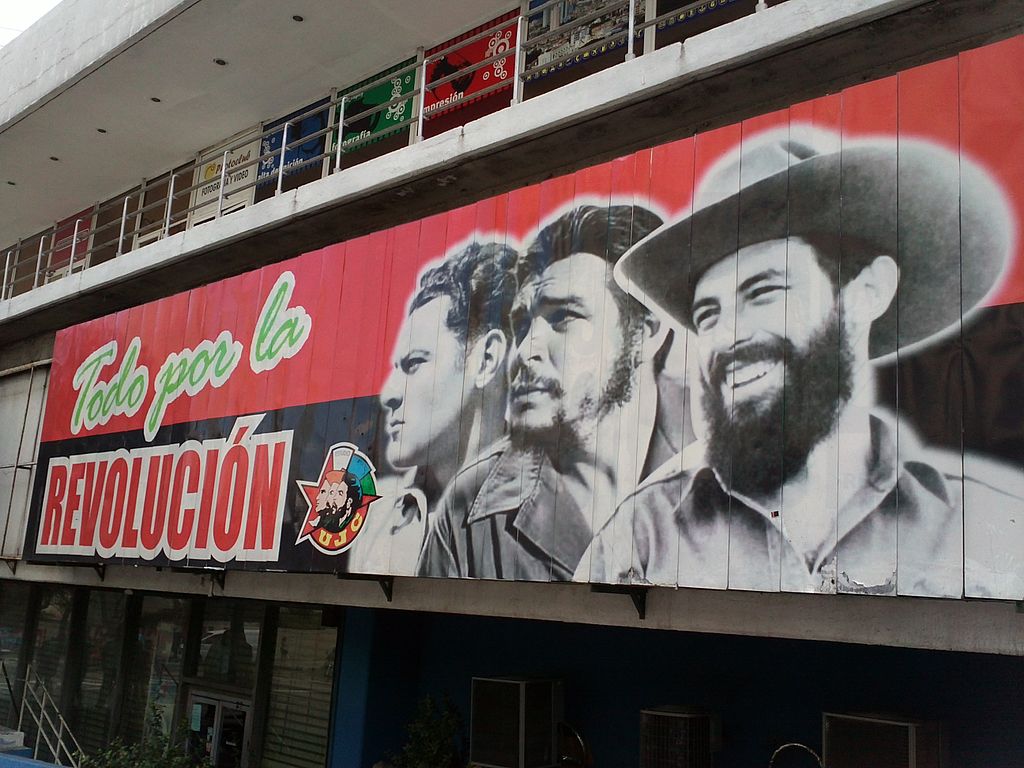
A billboard in Havana, showing Camilo Cienfuegos, Ernesto “Che” Guevara, and Fidel Castro, 4 November 2014.
Photo by Tumpatumcla~commonswiki via Wikimedia Commons.
Last week, Shadow Chancellor John McDonnell gave a speech at the Rail and Maritime Transport (RMT) Union’s “Garden Party for Cuba” event, attended, among other luminaries, by the Cuban ambassador. McDonnell made the following pledge:
“We’re here in solidarity with the Cuban revolution […] I want to say this to our Cuban comrades. When […] a Labour government is elected, not if, we will be your staunchest allies to support the Cuban revolution. And that means the support, the political support of course, but it means also the support, financial and on trade […] We stand with you comrades.”
This was greeted with chants of “Viva Cuba” and “Viva socialismo“. Just two weeks earlier, when asked about the poor track record of socialism in Cuba, Venezuela and the former Soviet Union, McDonnell had declared that “it was never socialism”.
So which one is it? Is Cuba socialist now, or not? Did it suddenly become socialist in the last two weeks, after 60 years of faux-socialism? Is it an on-and-off kind of socialism, which alternates between the real thing, and the fake version? Is it a Schrödinger’s socialism?


