
The foundation for most modern thinking about this topic begins with Mao Zedong’s theorizing about what he called “protracted people’s war” in a work entitled – conveniently enough – On Protracted War (1938), though while the Chinese Communist Party would tend to subsequently represent the ideas there are a singular work of Mao’s genius, in practice he was hardly the sole thinker involved. The reason we start with Mao is that his subsequent success in China (though complicated by other factors) contributed to subsequent movements fighting “wars of national liberation” consciously modeled their efforts off of this theoretical foundation.
The situation for the Chinese Communists in 1938 was a difficult one. The Chinese Red Army has set up a base of power in the early 1930s in Jiangxi province in South-Eastern China, but in 1934 had been forced by Kuomintang Nationalist forces under Chiang Kai-shek to retreat, eventually rebasing over 5,000 miles away (they’re not able to straight-line the march) in Shaanxi in China’s mountainous north in what became known as The Long March. Consequently, no one could be under any illusions of the relative power of the Chiang’s nationalist forces and the Chinese Red Army. And then, to make things worse, in 1937, Japan had invaded China (the Second Sino-Japanese War, which was a major part of WWII), beating back the Nationalist armies which had already shown themselves to be stronger than the Communists. So now Mao has to beat two armies, both of which have shown themselves to be much stronger than he is (though in the immediate term, Mao and Chiang formed a “United Front” against Japan, though tensions remained high and both sides expected to resume hostilities the moment the Japanese threat was gone). Moreover, Mao’s side lacks not only the tools of war, but the industrial capacity to build the tools of war – and the previous century of Chinese history had shown in stark terms how difficult a situation a non-industrial force faced in squaring off against industrial firepower.
That’s the context for the theory.
What Mao observed was that a “war of quick decision” would be one that the Red Army would simply lose. Because he was weaker, there was no way to win fast, so trying to fight a “fast” war would just mean losing. Consequently, a slow war – a protracted war – was necessary. But that imposes problems – in a “war of quick decision” the route to victory was fairly clear: destroy enemy armed forces and seize territory to deny them the resources to raise new forces. Classic Clausewitzian (drink!) stuff. But of course the Red Army couldn’t do that in 1938 (they’d just lose), so they needed to plan another potential route to victory to coordinate their actions. That is, they need a strategic framework – remember that strategy is the level of military analysis where we think about what our end goals should be and what methods we can employ to actually reach those goals (so that we are not just blindly lashing out but in fact making concrete progress towards a desired end-state).
Mao understands this route as consisting of three distinct phases, which he imagines will happen in order as a progression and also consisting of three types of warfare, all of which happen in different degrees and for different purposes in each phase. We can deal with the types of warfare first:
- Positional Warfare is traditional conventional warfare, attempting to take and hold territory. This is going to be done generally by the regular forces of the Red Army.
- Mobile Warfare consists of fast-moving attacks, “hit-and-run”, performed by the regular forces of the Red Army, typically on the flanks of advancing enemy forces.
- Guerrilla Warfare consists of operations of sabotage, assassination and raids on poorly defended targets, performed by irregular forces (that is, not the Red Army), organized in the area of enemy “control”.
The first phase of this strategy is the enemy strategic offensive (or the “strategic defensive” from the perspective of Mao). Because the enemy is stronger and pursuing a conventional victory through territorial control, they will attack, advancing through territory. In this first phase, trying to match the enemy in positional warfare is foolish – again, you just lose. Instead, the Red Army trades space for time, falling back to buy time for the enemy offensive to weaken rather than meeting it at its strongest, a concept you may recall from our discussions of defense in depth. The focus in this phase is on mobile warfare, striking at the enemy’s flanks but falling back before their main advances. Positional warfare is only used in defense of the mountain bases (where terrain is favorable) and only after the difficulties of long advances (and stretched logistics) have weakened the attacker. Mobile warfare is supplemented by guerrilla operations in rear areas in this phase, but falling back is also a key opportunity to leave behind organizers for guerrillas in the occupied zones that, in theory at least, support the retreating Red Army (we’ll come back to this).
Eventually, due to friction (drink!) any attack is going to run out of steam and bog down; the mobile warfare of the first phase is meant to accelerate this, of course. That creates a second phase, “strategic stalemate” where the enemy, having taken a lot of territory, is trying to secure their control of it and build new forces for new offensives, but is also stretched thin trying to hold and control all of that newly seized territory. Guerrilla attacks in this phase take much greater importance, preventing the enemy from securing their rear areas and gradually weakening them, while at the same time sustaining support by testifying to the continued existence of the Red Army. Crucially, even as the enemy gets weaker, one of the things Mao imagines for this phase is that guerrilla operations create opportunities to steal military materiel from the enemy so that the factories of the industrialized foe serve to supply the Red Army – safely secure in its mountain bases – so that it becomes stronger. At the same time (we’ll come back to this), in this phase capable recruits are also be filtered out of the occupied areas to join the Red Army, growing its strength.
Finally in the third stage, the counter-offensive, when the process of weakening the enemy through guerrilla attacks and strengthening the Red Army through stolen supplies, new recruits and international support (Mao imagines the last element to be crucial and in the event it very much was), the Red Army can shift to positional warfare again, pushing forward to recapture lost territory in conventional campaigns.
Through all of this, Mao stresses the importance of the political struggle as well. For the guerrillas to succeed, they must “live among the people as fish in the sea”. That is, the population – and in the China of this era that meant generally the rural population – becomes the covering terrain that allows the guerrillas to operate in enemy controlled areas. In order for that to work, popular support – or at least popular acquiescence (a village that doesn’t report you because it supports you works the same way as a village that doesn’t report you because it hates Chiang or a village that doesn’t report you because it knows that it will face violence reprisals if it does; the key is that you aren’t reported) – is required. As a result both retreating Red Army forces in Phase I need to prepare lost areas politically as they retreat and then once they are gone the guerrilla forces need to engage in political action. Because Mao is working with a technological base in which regular people have relatively little access to radio or television, a lot of the agitation here is imagined to be pretty face-to-face, or based on print technology (leaflets, etc), so the guerrillas need to be in the communities in order to do the political work.
Guerrilla actions in the second phase also serve a crucial political purpose: they testify to the continued existence and effectiveness of the Red Army. After all, it is very important, during the period when the main body of Communist forces are essentially avoiding direct contact with the enemy that they not give the impression that they are defeated or have given up in order to sustain will and give everyone the hope of eventual victory. Everyone there of course also includes the main body of the army holed up in its mountain bases – they too need to know that the cause is still active and that there is a route to eventual victory.
Fundamentally, the goal here is to make the war about mobilizing people rather than about mobilizing industry, thus transforming a war focused on firepower (which you lose) into a war about will – in the Clausewitzian (drink! – folks, I hope you all brought more than one drink for this …) sense – which can be won, albeit only slowly, as the slow trickle of casualties and defeats in Phase II steadily degrades enemy will, leading to their weakness and eventual collapse in Phase III.
I should note that Mao is very open that this protracted way of war would be likely to inflict a lot of damage on the country and a lot of suffering on the people. Casualties, especially among the guerrillas, are likely to be high and the guerrillas own activities would be likely to produce repressive policies from the occupiers (not that either Chiang’s Nationalists of the Imperial Japanese Army – or Mao’s Communists – needed much inducement to engage in brutal repression). Mao acknowledges those costs but is largely unconcerned by them, as indeed he would later as the ruler of a unified China be unconcerned about his man-made famine and repression killing millions. But it is important to note that this is a strategic framework which is forced to accept, by virtue of accepting a long war, that there will be a lot of collateral damage.
Now there is a historical irony here: in the event, Mao’s Red Army ended up not doing a whole lot of this. The great majority of the fighting against Japan in China was positional warfare by Chiang’s Nationalists; Mao’s Red Army achieved very little (except preparing the ground for their eventual resumption of war against Chiang) and in the event, Japan was defeated not in China but by the United States. Japanese forces in China, even at the end of the war, were still in a relatively strong position compared to Chinese forces (Nationalist or Communist) despite the substantial degradation of the Japanese war economy under the pressure of American bombing and submarine warfare. But the war with Japan left Chiang’s Nationalists fatally weakened and demoralized, so when Mao and Chiang resumed hostilities, the former with Soviet support, Mao was able to shift almost immediately to Phase III, skipping much of the theory and still win.
Nevertheless, Mao’s apparent tremendous success gave his theory of protracted war incredible cachet, leading it to be adapted with modifications (and variations in success) to all sorts of similar wars, particularly but not exclusively by communist-aligned groups.
Bret Devereaux, “Collections: How the Weak Can Win – A Primer on Protracted War”, A Collection of Unmitigated Pedantry, 2022-03-03.
December 6, 2022
QotD: Mao Zedong’s theory of “Protracted War”
December 2, 2022
Bombing Berlin with Ed Murrow of CBS – War Against Humanity 089
World War Two
Published 1 Dec 2022Ed Murrow accompanies the RAF on a bombing raid on Berlin, and files one of his most iconic broadcasts with CBS. In Teheran, Winston Churchill walks out on a dinner with Joseph Stalin, after the USSR Premiere suggests mass murdering German officers.
(more…)
November 27, 2022
The Biggest Lie of WWII? The Myth of the Norden Bombsight
Flight Dojo
Published 16 Jun 2022I think most of us, at some point, have had someone say to us “You know, we went to the moon with less computing power than your iPhone” or something to that effect. What you may not know, though, is that less than a century ago, a 2000-piece mechanical computer that lacked a single transistor or chip was the most closely guarded military secret of the Allied war effort. Or, at least, the second most.
Before being overshadowed by the Manhattan Project, the U.S. Navy spent billions helping Carl Norden develop a mechanical computer with one job and one job only: to determine the point at which a level-flying bomber would need to drop its bombs to achieve “pinpoint accuracy” on an intended target.
When it was completed, Mr. Norden famously claimed that the sight was so accurate that it was capable of putting a bomb inside a pickle barrel. And if it could, then war would be revolutionized, or so the powers-at-be thought. The idea was simple: fly your bombers above the enemy’s air defenses, above the reach of their flak batteries, faster than their fighters could fly, and drop your bombs, with pinpoint accuracy, on crucial industrial sites, robbing the enemy of their ability to manufacture the equipment they need to wage a war in the first place.
The only problem was that everything about the Norden Bombsight turned out to be a myth. Not just the obviously mythical bits, like the fact that the crosshairs in the site itself were actually webs from a Black Widow, or that, instead, the reticle was made from the strands of hair of a young Midwestern girl, but everything, the accuracy, the secrecy, and even the fact that it was the only bombsight used in the war.
So how can this be? Until two weeks ago, I believed that the Norden Bombsight was an ingenious piece of equipment that more than any other singular device, changed the tides of WWII in favor of the allies. So why do we still believe in the Norden Bombsight?
Because, as it turns out, myths are useful, not just to the Army Air Corps, the Carl Norden Company, and Hollywood, but to us, the public. As it turns out, they can help us swallow hard truths about the war we’d prefer to avoid.
(more…)
November 18, 2022
“WOLLT IHR DEN TOTALEN TWEET?“
When German public TV is willing to invoke literal Nazi imagery, you know the Twitter situation has gotten out of hand:
After Germany’s “first” public television network, ARD, compared Elon Musk reducing Twitter censorship to “letting rats out of their holes”, Germany’s “second” public television network, ZDF, has now compared Musk to Nazi Propaganda Minister Joseph Goebbels! (The network’s name Zweites Deutsches Fernsehen literally means “Second German Television”.)
Thus, last Friday, ZDF’s would-be comedy program, the “Heute Show”, posted the below tweet and photoshop.
The Tweet reads: “Thanks to Elon Musk, you’re allowed to say anything again on Twitter! Total freedom of speech! #heuteshow.” The caption, whose color scheme and font invoke Nazi-era propaganda, reads “Do you want total tweet?” It is an allusion to Goebbels’s 1943 speech at the Berlin Sportspalast, in which the Nazi Minister of Propaganda famously shouted, “Do you want total war?” – in response to which audience members leapt to their feet shouting “Yes!” and raising their arms in the Hitler-salute.
The background image appears to show a Nazi Party rally with the swastikas replaced by the Twitter bird logo. Two smaller swastikas are still visible in the lower left-hand corner of the full-size image.
Leaving aside the extreme mental contortionism required to associate freedom of speech with Nazi Germany, if ever there was a don’t-throw-stones-in-glass-houses moment, this was it. For, as so happens, during the Second World War, the founding director of ZDF, Karl Holzamer, himself served in one of the propaganda units that none other than Goebbels’s Ministry of Propaganda embedded with the different divisions of the Germany military.
Holzamer served in a propaganda unit of the Luftwaffe or German air force. As noted in a 2012 article titled “Goebbels’s Soldiers” in the German daily Die Frankfurter Rundschau, Holzamer was embedded with the Luftwaffe during its April 1941 bombing of Belgrade and was “the first” to report on the German subjugation of the Yugoslav capital.

November 5, 2022
Psyops in theory and practice
Theophilus Chilton on the development of psyops and some examples of their use in US civilian contexts in recent years:
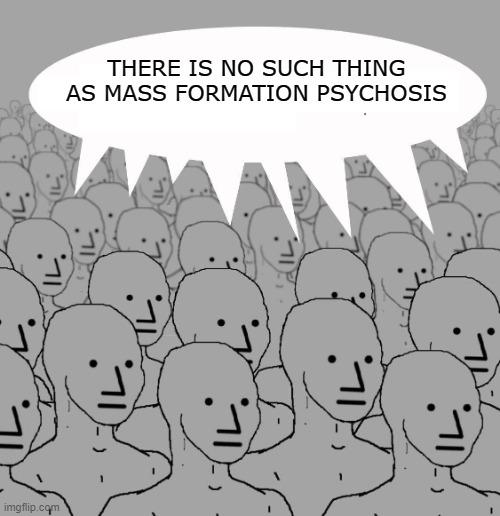
I trust that most readers are familiar with the concept of a “psyop”, a psychological operation designed to sway its targets in certain desired directions. Many of the mechanics of psyops were pioneered by the CIA and other intelligence agencies during the Cold War but have now been turned against civilian populations in the USA and elsewhere in an effort by the Regime to maintain control and minimise opposition to its various agendas. However, I’d like to make the point that psyops qualitatively differ from standard, run-of-the-mill propaganda such as governments have used for millennia.
The difference is primarily that of the time preferences involved. Whether it’s designed to whip up a population against an enemy or to try to obfuscate the truth about some particular event that has occurred, propaganda tends to operate on a shorter timescale and with more limited and simple policy goals in mind. It’s not surprising that modern propaganda techniques share a lot in common with commercial advertising designed to induce an “impulse buy” response in potential customers. Propaganda generally operates the same way — create a monodirectional response to a particular stimulus.
Psyops, on the other hand, are quite a bit more complex and generally involve the building of a narrative memeplex over the course of months, years, or even decades. Psyops are, of course, also fake but theirs is a fakeness that builds upon constant, repetitious narrative-building that lays out a foundational lens through which any individual incident or act can be systematically interpreted, adding them to the overall saga being told.
With conventional propaganda, the aim is to communicate Regime diktat to the average citizen. However, it does not necessarily expect the recipients to believe the propaganda, but merely comply with the goals. The Powers That Be in such cases don’t care why Havel’s greengrocer puts the sign up in his window, but merely that he does so. The primary purpose of psyops, on the other hand, is to ensure compliance by convincing the target to self-comply, rather than it having to be done by outside force or persuasion. It’s always touch and go when you’re making someone outwardly comply but inwardly they’re dissident. When the mark can be convinced to willingly self-police, this makes the government’s job easier since they don’t have to worry about this closet dissidence. The true believer is the best believer.
In essence, propaganda aims for immediate reactive persuasion while psyops seek long-term groundlaying that gives more all-inclusive means of maintaining overarching narrative control.
Now, a lot of people out there like to think they’re immune to psyops because “hurr durr I don’t beleeb da media!!” But they’re not. Indeed, a lot of these boomercon types are just as susceptible to psyops as anyone else when the right buttons are pushed. This is because they’ve been primed for it by the systematic, society-wide preparation of the psychological battle space without their ever realising it. In many cases, the foundations for a psyop are so culturally systematic that people don’t even realise what is happening.
For example, there are a ton of people out there who would pride themselves on being independent thinkers who nevertheless believed everything that was peddled during the covid and vaccine psyops. The reason for this is because they want to think of themselves as smart, knowledgeable about science, etc. Smart People believe the Right Things, after all. That, in turn, is the result of decades of psyops that have ensconced “science” as the arbiter of morality and truth in post-Christian America. So even when the science is fake or wrong, it is still accorded a moral authority that it does not deserve.
October 31, 2022
“If The Regime doesn’t have their canned narrative ready to go, it’s real news”
At Founding Questions, Severian offers some preliminary thoughts on the new field of “Brandonology”, specifically how to determine whether what’s in the legacy media is news or propaganda:
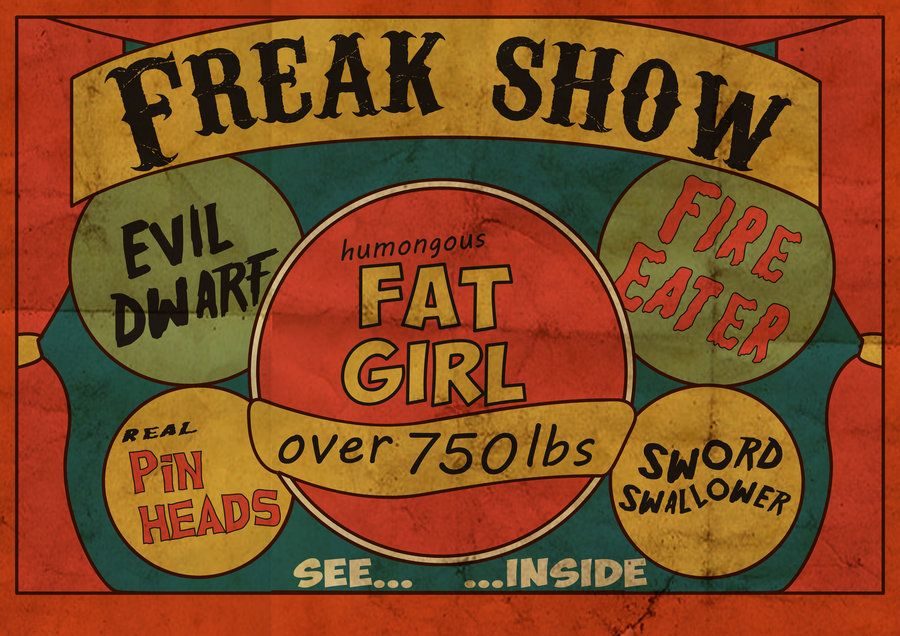
I’m throwing this out there now, because it’s shaping up to be a long-term project and I think we can all contribute to it as needed. But as Brandonology / FNGology is such a new discipline, it’ll help to lay in the foundations.
The first step in analyzing the “news” is determining whether or not it is, in fact, news. “News” here being defined as “an unplanned event — or catastrophic fuckup of a planned event — to which The Regime is forced to react in more or less real time”. Lot of that going around recently, such that we’re spoiled for choice. Pick pretty much any of the shenanigans in Ukraine: The botched assassination of Alexander Dugin; the Nordstream sabotage; the Ukrainian dirty bomb false flag. Those clearly fall into the “catastrophic fuckup of a planned event” category …
… or do they? Because as Z Man pointed out in great detail on his last podcast, all of that stuff seemed to catch The Regime flatfooted. Yeah, somebody planned those things, but that somebody wasn’t Brandon, or anyone close to Brandon, or anyone in position to prop up Brandon. Which is the surest tell for actual news (as defined above) right there: If The Regime doesn’t have their canned narrative ready to go, it’s real news.
The necessity of the canned narrative also allows the keen Brandonologist to anticipate the “news”. For instance, it has obviously started to dawn on The Regime that they’re going to get walloped in the midterms, so they’re trying out narratives as we speak. Z Man identified one I hadn’t seen, something about Brandon “inadvertently” saying something about the debt ceiling that’s supposed to give the Republicans all kinds of ammunition against him. I’m not so sure. I’ll have to look into it, but the fact that it squarely blames Brandon — who The Regime still insists is the very picture of mental acuity and vigor — pings my radar a bit. I think the stuff Her Nibs is rolling out is much likelier the Narrative being developed — she’s outright stating that “the Republicans” are going to engage in massive voter fraud.
Which to normal people is chutzpah beyond belief, but that’s how The Regime rolls. The 2016 election was, of course, full of Russian Hacking™. The 2020 election, by contrast, was the cleanest canvass in human history, and you’re an insurrectionist, a domestic extremist, and of course a racist if you dare to suggest the mere possibility of an American election being tampered with. But wouldn’t you know it, those dastardly Russians are going to rally here in 2022, because you can’t keep a Russian Hacker™ down. They might even hire a few prostitutes to pee on a bed for good measure; that’s how evil they are.
Further complicating the task, though, is that “botched op” thing. We’ve got Brandon et al. on record threatening Nordstream, so you know that was an American caper gone bad … but gone real, real bad, because if The Regime had been fully in the know, there’d have been a whole bunch of Tier Four Stoyak about lousy maintenance on the pipelines for months in advance.
Why aren’t you as angry and afraid as the media wants you to be?
Chris Bray on the unrelenting din of fear porn you get if you pay any attention to the legacy media:
It’s like a magic act where the door to the secret compartment moves slowly and has a spotlight pointed at it, and the audience sees the illusion every time, because it’s literally not an illusion, being right out there in the open, but the magician still pretends that everyone watching is shocked and baffled by the trick.
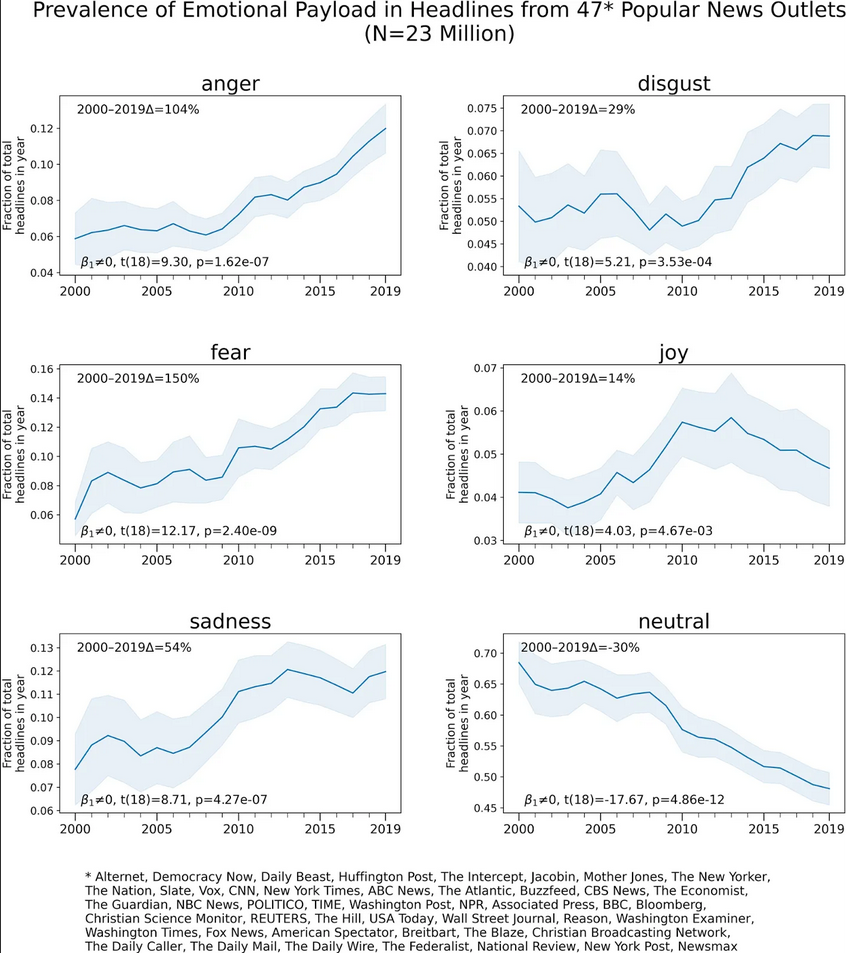
So. Via Nellie Bowles, writing at Common Sense, this summary of findings from a recent study of the American news media:
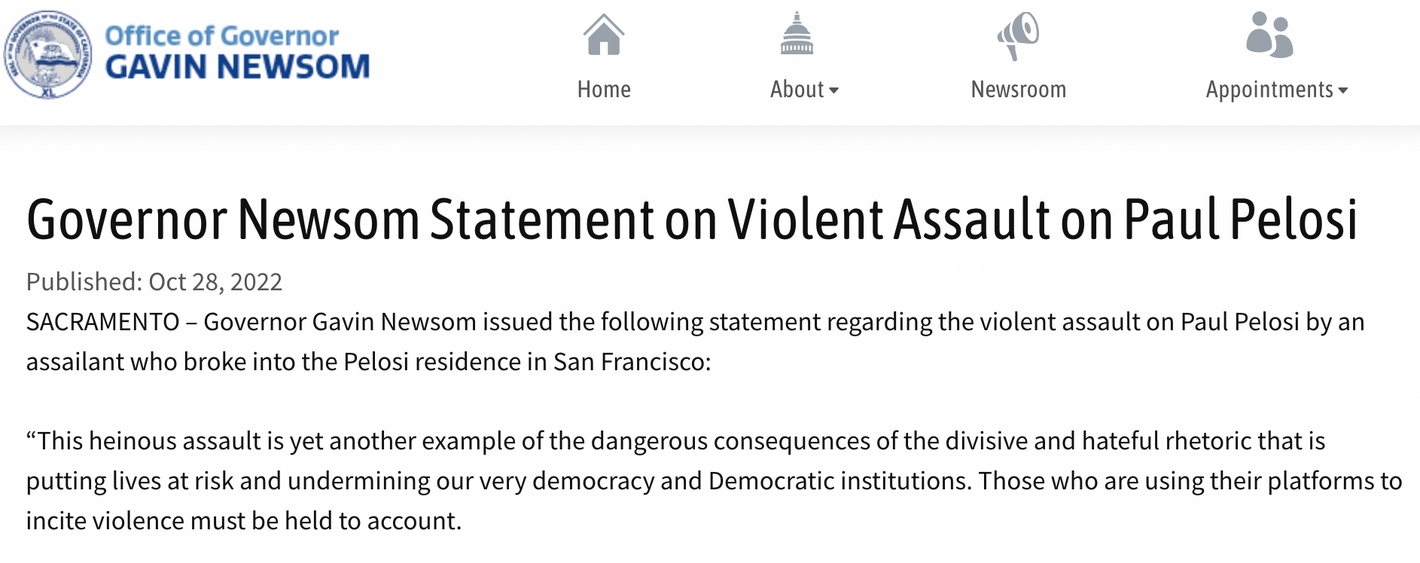
Today’s Standard-Issue Explanatory Line™ on Paul Pelosi being attacked in his home is that TRUMP TRUMP TRUMP, toxic far-right rhetoric!!!!! Ten minutes after the shabby break-in at the Katie Hobbs for Governor office was omfg literally Watergate before it evaporated into nothing much, a uniquely strange Berkeley nudist is a far-right puppet with an opening at the bottom for Donald Trump’s hand, steered by hateful rhetoric that incites violence:
[…]
Wouldn’t it be refreshing if the news media focused on a clear description of what happened before they got to the blame and politicization?
There are a dozen obvious things to say about all of this, even if you aren’t Steve Scalise — the double standard, the depiction of ordinary political criticism as “demonization”, the discarding of contradictory evidence to make round pegs fit square holes — and I’m mostly not going to bother saying them in any detail.
But the thing that has to be said is that the people who increasingly hold the attention of their audiences with hyperemotional clickbait, with the obvious manipulation of negative emotions, are warning us about the dangerous effects of hyperemotional rhetorical manipulation in the public sphere.
Ohhhhh, we’re about to LOSE OUR VERY DEMOCRACY! We tremble on the edge of a FASCIST TAKEOVER! And also, toxic rhetoric is bad.
October 23, 2022
QotD: Sparta’s military reputation in the Peloponnesian War
That reputation was already deeply held even by the early stages of the Peloponnesian War, such that Thucydides notes that “Nothing that happened in the war so shocked the Greeks so much as” the surrender of 120 Spartiates at Pylos/Sphacteria, instead of dying with their weapons in their hands (Thuc. 4.40.1). The Athenians had, in the event, managed to trap a force of Spartans – Spartiates and other Laconians – on an island and harassed them with arrow fire from a distance, never closing with them, until the Spartans surrendered. This is, I must stress, in the context of a war that obliterated entire poleis, shredded the diplomatic fabric of Greece and was by far the largest war between Greeks that any of them knew of. But this, the shattering – if just for a moment – of the Spartan reputation, that was what shocked people. The image of Sparta – whatever the reality – was that deeply set.
Thucydides, amusingly, relates that some Greeks were so shocked that they couldn’t believe it, and one ally of Athens inquired to the Spartiates – then held as captives in Athens – if perhaps what had happened was that all of the brave men (you know, the real Spartiates) had been felled by the arrows, to which the Spartans responded, “an arrow would be worth a great deal if it could pick out noble and good men from the rest, in allusion to the fact that the killed were those whom the stones and the arrows happened to hit” (Thuc. 4.40.2).
Bret Devereaux, “Collections: This. Isn’t. Sparta. Part VI: Spartan Battle”, A Collection of Unmitigated Pedantry, 2019-09-20.
October 7, 2022
The “two movies on the same screen” effect: most Canadians see impending collapse but our “elites” think everything’s peachy
Tara Henley contrasts the reality many Canadians are facing day-to-day with the out-of-touch “laptop elites” who, as a class, did great through the last two and a half years and who have no clue at all why anyone would see the state of the country as anything like a collapse:

Pierre and Ana Poilievre at a Conservative leadership rally, 21 April, 2022.
Photo by Wikipageedittor099 via Wikimedia Commons.
There has been much discussion lately about the state of our nation — and whether or not we, as a society, are in decline.
Former journalist and Justin Trudeau speechwriter (and current Substacker) Colin Horgan published a provocative essay at The Line last month, arguing that our country is vulnerable to extremists who believe that “the current system of liberal democracy is inherently corrupt and corrupted, verging on collapse, and that, in the extreme, its downfall can and should be hastened by acts of violence”.
Horgan worries that Conservative leader Pierre Poilievre — who’s been actively speaking to this ambient vibe of distress and dissatisfaction — could accelerate such destabilization.
Poilievre does not say extreme things, Horgan concedes, but Poilievre’s message is “still poison” because “what he telegraphs is the vision of a social order at a tipping point, with the suggestion that it can be easily pushed over”.
In short, Poilievre has tapped into “an Internet language of decline”.
There’s a thriving cottage industry in the Canadian legacy media doing everything they can to tar Poilievre as a Canadian Hitler and to continue the re-typing and re-phrasing of government talking points for the mass market. The government subsidies to “approved” media outlets will help keep the lights on a bit longer as they continue to lose audience share — and trust.
Our quality of life has been eroded for some time now. Wages have been stagnant for decades. Precarious work is the order of the day, both for the working class and professionals. Rents and property prices are through the roof; according to the Globe and Mail, since 2000, domestic home prices have increased by 420 percent. Inflation is high. Gas is expensive. Food costs are up. We are coping with a crisis of social isolation. Our opioid epidemic rages on.
Meanwhile, pandemic policy has benefited the laptop class and harmed the most vulnerable among us. (See lockdowns and school closures, for starters.)
Indeed, there has been extreme winners and losers during the COVID era, which saw a massive transfer of wealth upwards. Billionaires in this country, in fact, saw their wealth increase 68 percent during the pandemic.
Should we be surprised that those on the losing end are expressing their frustration?
[…]
Things have only gotten worse as the pandemic has dragged on and citizens have been hit with high inflation and rising interest rates (while also staring down other looming financial catastrophes).
According to an Angus Reid poll out this week, nine out of ten Canadians have cut their household budgets due to inflation and high prices. And 46 percent of Canadians say their personal finances are worse off now than they were at this time last year.
But if the material conditions in this country are dire, so too is the national mood.
In fact, there is a gaping wound at the centre of our national psyche.
Essential workers have laboured throughout the COVID crisis, endangering their health and that of their families, in order to keep society running. In return for their heroic efforts, the unvaccinated among them — many of whom previously contracted COVID and have natural immunity — have seen themselves ostracized and smeared as racists and misogynists. Their fundamental values have been mocked in the public square, and their basic rights and freedoms, including freedom of expression, have been compromised. Some have lost jobs, social lives and more for declining vaccination.
To comprehend the human toll this has taken, one need only look to the grassroots #TrudeauMustGo campaign on Twitter.
The consequences of vaccine mandates should have been covered in great depth by our national press. But instead, the Canadian media largely fell down on this story, often generating coverage that uncritically reproduced the Liberal party line.
Trust in the Canadian news media is now at its lowest point in seven years.
And judging from the reader mail I get, the Liberals’ decision to turn vaccine mandates into a wedge issue has had significant social consequences — tearing apart families, communities, and workplaces in ways that may take years to recover from.
All told, what we are witnessing is not merely a state of decline. It is a form of collapse. A collapse of the social contract. A collapse of the expectations we grew up with — that if you worked hard and respected the law, you could have a home, a family if you chose, and, crucially, a say in our democracy.
What we are living through is a collapse of life as we knew it in Canada.
What was once a stable, prosperous, diverse democracy is now a nation divided, rife with fear and anger, and financial and social instability.
Not only has our Prime Minister failed to grasp this, but he’s actively stoked tensions.
The Combat Dogs of World War Two – WW2 Special
World War Two
Published 6 Oct 2022Where man goes, so does man’s best friend. Across the globe, tens of thousands of dogs are called up. They play their part in tales of heroism and joy. But without any agency over their own lives, they also experience fear, death, and cruelty.
October 3, 2022
“We’re one breaking news alert from seeing a day’s work dramatically reduced in importance, if not rendered obsolete forever”
It’s a very weird moment in time, as The Line‘s weekly editorial wrap-up notes:
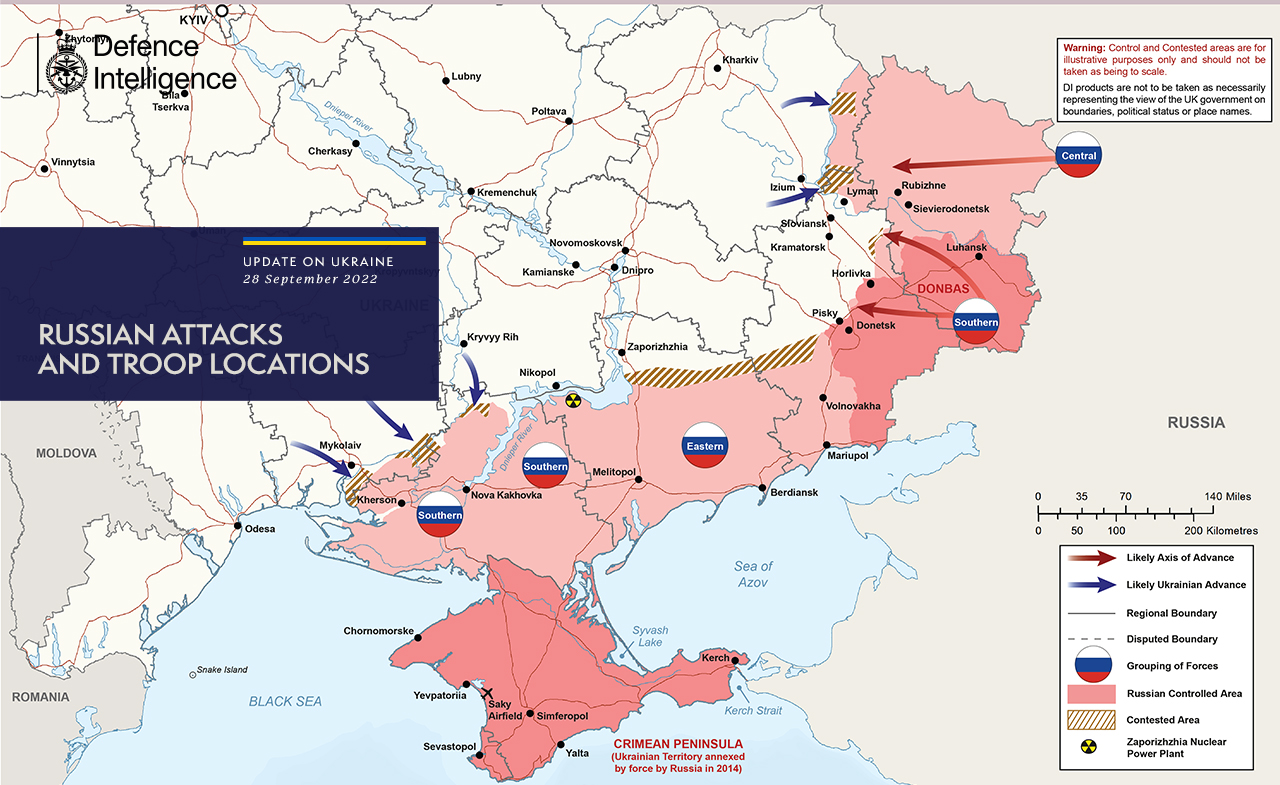
This is perhaps the strangest dispatch we’ve ever written. It is a fact of life in the news business that top headline can change in an instant. We’re one breaking news alert from seeing a day’s work dramatically reduced in importance, if not rendered obsolete forever. Every journalist has known that frustration. And today, as Western officials remain concerned about the risk of nuclear attack, this seems more true than usual. All our little insights into Canadian politics and cultural issues would make a weird second and third item in a dispatch where the lead item was Kyiv going up in a mushroom cloud.
So yes. This is where our minds are. As discussed at some length in our podcast and video this week, your Line editors have been closely watching developments in the war between Ukraine and Russia, and indeed take very seriously threats by the Russians to use nuclear weapons. We understand fully that it is very possible that all of Putin’s talk of nukes is a bluff, intended to rattle the West and encourage Ukraine to accept Russian gains and negotiate.
Neither seems likely — Ukraine is motivated and Western support, though imperfect, remains strong. We also see little indication that Putin could win the war in which he has stranded himself and his country, and we believe that things will only get worse for him. His attempt to mobilize 300,000 has turned into an item of mockery abroad, as pictures of old men and rusted equipment spread across social media. The “annexation” of occupied areas into Russia clearly didn’t deter either Ukraine or its Western backers; Ukraine’s forces remain on the move, with more Western weapons arriving all the time. And meanwhile, on the battlefield, the Ukrainian Armed Forces grow ever stronger: in just the last few hours, they have handed the Russians another embarrassing defeat in the city of Lyman. That city, a local rail junction, was important for Putin’s logistical efforts in the region, and fell into Ukrainian hands with a shocking lack of resistance.
See what we mean? This isn’t going well for Russia, and everything he tries is just stranding Putin deeper in the shit. He could have de-escalated this war at several points. At every juncture he has chosen escalation instead, and that has only made his problems worse — more deaths, more unrest, more humiliation. All of his efforts to intimidate the West or crush the Ukrainians have failed. What can he do? How can he get himself out of this problem? What will happen to him if he can’t?
These are the questions keeping us up at night. Seeing the conflict through his eyes, it’s not hard for us to imagine that Putin will come to view some kind of nuclear use as his only remaining chance to escape this war with his power still in place, or perhaps even simply with his life. After all, all this talk about whether Putin is “rational” depends entirely on how he understands his own circumstances. What may seem insane to us may, in fact, make perfect sense to him, and we suspect one’s definition of reason undergoes a radical re-evaluation when one feels a noose getting ever-tighter around the throat.
So that’s why we think it’s possible. Let’s talk what we think is possible. There are a few different ways he could use nuclear weapons. We are not the experts on this, but your Line editors are, if nothing else, reasonably well read on the topic, and we have spent the last few weeks talking with genuine experts. If we do see the use of a nuclear weapon, Putin could use a single small device on a minor target in Ukraine (or perhaps over the Black Sea) in hopes of shocking NATO and the world through his sheer willingness to break the nuclear taboo. We would expect him to go a bit further, and hit Ukraine with a series of small strikes intended to disrupt its military and seize some kind of conventional military advantage on the ground, on top of the political shock.
Or hey: he could go fully insane and try to terrorize the world into bending to his will by, for instance, attacking NATO directly, or using one of his larger nuclear weapons to utterly destroy a city in Ukraine.
September 26, 2022
Did D-Day win WW2? – a WW2 expert discussion
World War Two
Published 25 Sep 2022WW2 historians Indy Neidell, Spartacus Olsson, and Paul Woodadge moderated by Ryan Socash discuss the meaning and significance of D-Day from historical, current, and future perspectives. Recorded on the road while shooting in Normandy for TimeGhost’s 24-hour documentary on the events of June 6, 1944.
(more…)
September 25, 2022
QotD: Sparta’s military reputation as “the best warriors in all of Greece”
That reputation could be a real military advantage. Greek hoplite armies arranged themselves right-to-left according to the status of each polis‘ army (poleis almost always fight in alliances). Since Sparta was always the leader of its alliance, the Spartan king and his force always took the right – opposite the weakest part of the enemy army. You may easily imagine the men facing the Spartans – they know the Spartan reputation for skill (and do not have the advantage of me telling them it is mostly hogwash) and by virtue of where they are standing know that they do not have the same reputation. Frequently, such match-ups resulted in the other side running away before the Spartans even got into spear’s reach (e.g. Thuc 5.72.4).
There’s a story in Xenophon, embedded in the larger Battle of Lechaeum, which I think illustrates the point well. Early on, the Argives (the men of Argos, always the enemy of Sparta) meet and rout a group of Sicyonians (who are allies of Sparta). A passing Spartan cavalry company under a Pasimachus sees this and rushes in; getting off their horses, they grab the Sicyon shields (marked with the city’s sigma) and advance against the Argives. But whereas later in the battle the arrival of the Spartans will trigger panic and retreat, here the Argives do not know they are fighting Spartans (because of the shields) – and so they advance with confidence; Pausimachus with his small force is crushed. As he attacks Pausimachus declared (according to Xenophon), “By the two gods, Argives, these Sigmas will deceive you” (Xen. Hell. 4.4.10; the “two gods” or “twin gods” here are Castor and Pollux).
I rather think that Pausimachus was deceived by the lambda his own shield may have carried (there is debate about if Spartan shields always had the lambda device, I tend to think they did not). Pausimachus expected to surprise the Argives with his Spartan skill. Instead, he found out – fatally – that the magic was never in the Spartan, it was in the image of Sparta that lived in the mind of his opponent.
Bret Devereaux, “Collections: This. Isn’t. Sparta. Part VI: Spartan Battle”, A Collection of Unmitigated Pedantry, 2019-09-20.
September 18, 2022
Forget #GamerGate already, here’s #NAFO!
At Samizdata, Perry de Havilland briefly recaps the story of #gamergate and the incomprehension of the “official” gaming press and PR departments of gaming companies that their actions to ridicule and shutdown the “racist/sexist/homophobe” #gamergate activists not only failed but drew more attention to the #gamergate issue, and compares it to a new instance of the same phenomenon:
Fast forward to 2022 and behold #NAFO: the North Atlantic Fellas Organisation.
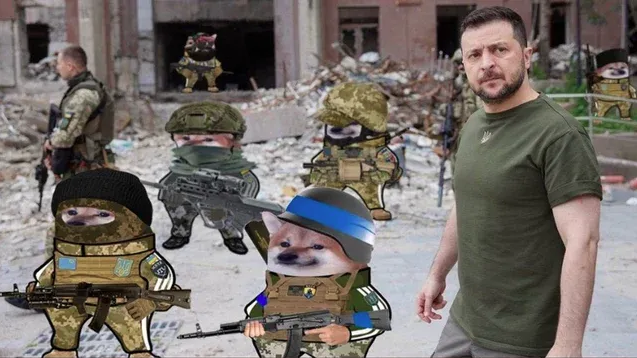
And who are “the fellas”? A large and growing online pack of attack dogs countering, dare I say smothering, official Russian troll factory output, as well as other pro-Kremlin talking heads online. And their mascots are daft cartoon dogs (variations of a Shiba Inu to be precise). If journalistic collusion was a constant target of #GamerGate, the Russian troll farms are the modern analogy to that, constantly targeted and smothered by NAFO posting either pro-Ukrainian counter-narratives or just ridiculing or flagging up pro-Russian ones.
Many people, particularly those operating within institutions, don’t understand #NAFO for same reason PR departments of various video games companies & press outlets didn’t (and still don’t) understand #GamerGate.
Is #NAFO engaged in “information warfare”? Absolutely. They even get a shout out from the Ukrainian Ministry of Defence. But they are not managed out of an office in Langley, Virginia nor by some adjunct of the Ukrainian intelligence services. #NAFO is a hashtag, a phenomena, it isn’t “run” by anyone, because it doesn’t need to be. Like GamerGate, NAFO is a confluence of the motivated willing in every timezone on the planet.
And just as GamerGate had a single original trigger, which was then largely forgotten as the “movement” grew and started attacking larger more juicy prey, NAFO started as a fund raising effort for the Georgian Legion (a now battalion sized unit of about 600 within the Ukrainian army made up mostly of Georgian volunteers). At blinding speed, NAFO rapidly morphed into a wider distributed online effort supporting Ukraine in the “information space”.
Jailbreak! Mussolini on the Loose Again! – WW2 – 212 – September 17, 1943
World War Two
Published 17 Sep 2022
(more…)


