I truly believe that Tim Pool is absolutely right about where the political poisoning of our National culture comes from.
Shows like Saturday Night Live, the Daily Show, late night television …
They take the news, spin it through a comedy filter, and present it to the masses. This presents an easily digestible, and thus easily believable, simplified and polarized view of events, that their viewers are then encouraged to apply to the news that is coming from real news sources. Anyone who objects to this is “overreacting, or doesn’t have a sense of humor” and thus is dismissed as irrelevant.
And thus the culture of lies continues, and gets ramped up as it spreads.
It’s sickening.
James Resoldier, posting to MeWe‘s “Hoyt’s Huns” group, 2022-06-16. (private group, so no public URL available)
September 18, 2022
QotD: Late night TV’s negative impact on US national culture (aka “Clown nose on, clown nose off”)
September 17, 2022
Is it still a conspiracy theory if more than 50% of Canadians believe it?
Chris Selley posted a link to this rather eye-opening Abacus Data poll summary by Bruce Anderson and David Coletto:
We recently completed nationwide surveying among 1500 Canadians. The focus was on the levels of trust people have in institutional sources of information, and belief in conspiracy theories. This is the first in a series called “Trust & Facts: What Canadians Believe”
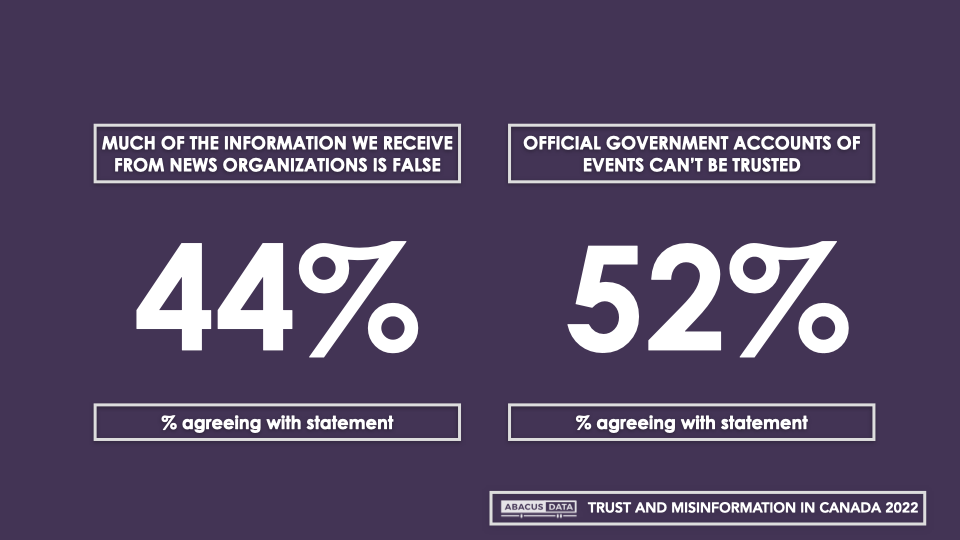
44% THINK MUCH OF THE INFORMATION FROM NEWS ORGANIZATIONS IS FALSE
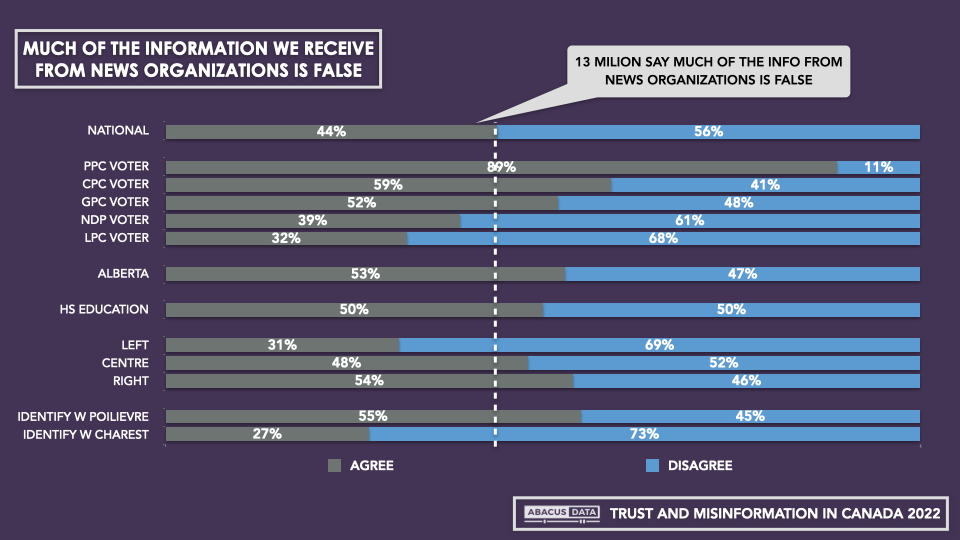
Almost half of those interviewed found themselves agreeing with the statement “much of the information we receive from news organizations is false”.
While this means a majority of Canadians have some trust in news organizations, more than 13 million adults (extrapolating 44% to an adult population of 29.5 million) don’t.
Those with no post-secondary education, Alberta residents and those on the right show greater mistrust. But by far the biggest differences are visible when we look at party affinity. The vast majority of People’s Party supporters don’t trust news organizations and a (smaller) majority – 59% – of Conservative voters feel the same way.
Among those who think Pierre Poilievre is the Conservative leadership candidate who best reflects their views, 55% don’t trust media information, while among those who identify with Jean Charest the proportion is much lower, at 27%.
52% THINK OFFICIAL GOVERNMENT ACCOUNTS OF EVENTS CAN’T BE TRUSTED
More than half of those interviewed found themselves agreeing with the statement “official government accounts of events can’t be trusted”
As with trust in news organizations, those with no post-secondary education, Alberta residents and those on the right showed markedly higher levels of mistrust in government.
Majorities of People’s Party, Conservative and Green Party voters indicate mistrust. Those on the left and Liberal voters show higher levels of trust.
September 15, 2022
The promise of grand “green” plans versus the reality when the plans are implemented
Elizabeth Nickson on the contrast between how things like the “Green New Deal” are represented by their proponents and the media and what their actual real-world outcomes are like:
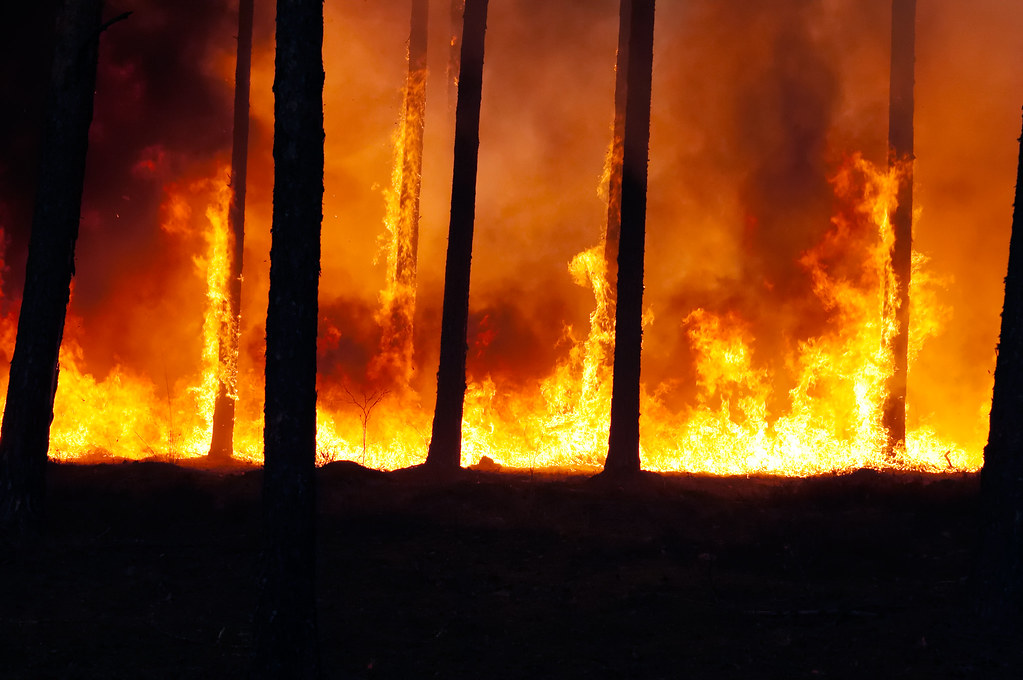
“Forest fire” by Ervins Strauhmanis is licensed under CC BY 2.0 
 .
.
Ever wonder what happens to a region once it is “preserved”? Right now, all through the US and Canada, governments are taking giant bites of land, and locking them down under the guidance of the UN’s Agenda 2030, which means a full 30% of the land and waters will be “saved”. If anyone notices, the local media preens and praises itself. Aren’t we all so wonderful and enlightened and caring, the PR says, and the newspapers copy it line-for-line.
No, it’s terrible. It is possibly the very worst thing ever. Set-aside land degrades. There aren’t enough bureaucrats in the world to take care of it. Besides out in the forest or up on the ranges is decidedly not where a civil servant wants to be. As a result none of them know what they have done. It’s a loop, politicians, stupid women and beta males, civil servants engaged in a masturbatory celebration of their goodness and triumph over commerce. From hipster neighborhoods all over North America a song of self-praise rises like smoke into the air.
Except now, right now, I sit in a smoke haze courtesy of the set aside forests in Washington State which are burning. Look, this is simple to think through. In the early 90’s Clinton ratified the spotted owl preservation plan and hundreds of millions of acres of forest were left to themselves, no cutting, no grazing, no firewood collection, no thinning, no fire breaks, no removal of dead trees, especially not beetle-killed trees. In fact, no touch.
What happens when a formerly industrial forest is left to itself? A thousand tiny trees start to grow right up against each other. They grow like carrots that haven’t been thinned. They grow so thick they can’t get light. They draw all the water from the ground, they end up like tinder. Around them brush grows — it too cannot get light or much water so it too is desiccated. It grows up the trees, trying to get at the water in the trees, and acts as a fire ladder
Boom.
Massive canopy fires, which, since they decommissioned the roads into the forest, are very very difficult to either brake or put out.
On every single environmental metric, in every single system, these people destroy the land. What they do is exactly the opposite of what they claim. They take massive amounts of tax money to “save” land and then they destroy the resource. And the towns in the resource area. And the families, and the tax base.
I could go through every environmental goal, and tear it apart. None of them use science that is provable. It can’t be duplicated, its assumptions are wrong, its statistics fiddled. Tens of thousands of papers are used to create these policies, written by the environment movement through its NGOs, funded by rich morons from old families, most of whose ancestors created environmental devastation themselves. I can refute the math and assumptions of EVERY SINGLE ONE OF THEM given a maximum of four hours and one phone call. No one challenges these studies, and these abominations then become law. Law that destroys the water and land.
September 4, 2022
Extreme Ultra-MAGA terrorist Trump voters are endangering “our” democracy!!!1!
Perhaps I exaggerate a tiny bit in my headline … but events here in Clown World metastasize so quickly that parodists and satirists are becoming an endangered species because it’s nearly impossible to come up with more incredibly stupid stuff than the political class do for real:
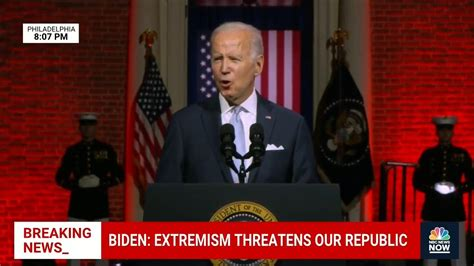
Over the past couple of weeks, it seems that the Regime has really been ramping up its rhetoric against its political and ideological enemies. In a coordinated rollout, talking heads across the media have been stating that “MAGA Trump voters” are “threats to democracy”, “trying to take away our freedoms”, “stochastic terrorists”, and so forth. This all has been timed to culminate with the pResident himself going on national television to explicitly state that the entire half of the country that didn’t vote for him are mortal enemies of the state. This takes on a somewhat more ominous tone when we remember that just a few days previous, this same pResident essentially threatened to use F-15s to bomb patriotic Americans who believe in the Constitution.
While these could be dismissed as the senile ramblings of a doddering old dementia patient, the thing to keep in mind is that Biden himself is merely a sock puppet. What he says reflects the words put into his mouth by the progressive theatre kids who staff his administration, as well as other elements within the Regime. Indeed, all of the huffinpuffery about how “your hillbilly AR-15 can’t take on tanks and fighter jets hurr durr!!” is basically the sort of thing you’d have heard on Reddit for years. But the fact that official channels are now openly talking about using the military against their own people for mere ideological purposes suggests that there is an acceleration going on in the Left’s subversion of this country.
I’ve said it before and I’ll say it again — if there is to be an open civil war in the USA, it will almost assuredly be instigated and started by the Left. However, it is not one that they are likely to win, for a number of reasons that I will elaborate briefly below. They are ones that I suspect the Regime itself knows, which makes the current trajectory they seem to be setting appear all the more desperate. Common sense would dictate that they should try to keep the repression at just a high enough level to intimidate the citizenry into compliance without actually provoking a broad response, even if not a violent one. Yet, the Left is dynamiting what is left of the social contract because once they’ve got started down this path there’s no stopping.
So briefly, let’s talk about why the Regime would not win a war against Red America, despite the hopes and expectations of thousands of redditards across the country. First and foremost there is the unreliability (from the Regime’s perspective) of the current military. Simply put, most military personnel below the O-4 or O-5 levels are not ideologically indoctrinated into woke progressivism and are unlikely to be willing to wage war on their own countrymen. They’re especially not likely to go along with wokester fever dreams of bombing Red cities into oblivion and turning the heartland into ashes just to stick it to those Trumpsters. So there would be deep fractures, mutinies, fragging incidents galore.
Of course, that’s why the Regime is trying to wokify the military to be more ideologically compatible with the Left. In a sense, for the Left the drastic recruiting shortfall that the military is currently experiencing is a feature, not a bug, since it provides them with the justification to make up the difference by recruiting foreigners with no connexion to the American people (and thus no compunctions about shooting at them). Which then introduces a further competency factor in that when you recruit a third world army, you … have a third world army, so you’re sacrificing competency for reliability. Nevertheless, as it currently stands most enlisted men and lower-level officers are not going to be inclined to incinerate their buddy’s parents for believing in the second amendment.
As Severian posted right after the “Triumph of the Shrill” speech by Biden:
I’d like to address the “they’re going in for the kill” argument, eloquently argued by MBlanc46 and others. I agree, there is exactly as much, if not more, evidence for this thesis then there is for my “they’re panicking” thesis. And whatever else they thought Brandon was doing last night, there’s definitely a “throw down the gauntlet” aspect to it.
The reason I favor “panic” over “going in for the kill” is that as hard as it is to believe, the Left always see themselves as the heroic underdog, struggling against a rigged system. Even when they’re throwing you into boxcars, they’re bewailing the fact — and in what passes for their minds it IS a fact — that you forced them to do it.
They cry out in pain as they strike you, as another demented shitbag collectivist said about a different group in an eerily similar context.
What all this — Biden’s big “My Struggle” speech (hereafter to be known, as Mmack put it, as “the Triumph of the Shrill”), the hiring of a zillion new IRS agents, the works — is designed to do is: provoke a reaction. To put it bluntly, there is no “domestic extremism”. Of course there really are some retards out there doing retard shit, but as we all know, the typical “Klan” meeting is an ATF agent trying to entrap a DEA agent who’s trying to entrap an FBI agent who is trying to entrap his own informant. Hello, fellow patriots!
But they keep failing to do roll-the-tanks-level shit. Which is a problem for the Apparat, because the ATF agent can’t get permission from the DEA to provide enough guns to the FBI agent to really kick things off (not least because he’s going to be foiled by the other undercover FBI agent who’s trying to entrap the other DEA agent and so on).
So they just keep upping the ante, hoping that maybe this time, finally, somebody will do a terrorism.
If they’re confident enough to put Brandon in a Darth Vader suit on national TV, in other words, they long ago passed the point where anyone not crippled by the psychological compulsion to see himself as a victim would’ve said “fuck it, drop the hammer”. We wore diapers on our faces for two fucking years, for Christ’s sake, and shot ourselves up with mystery goop because the same evil little goblin who turned AIDS from an easily containable plague of deviants into a legit public health crisis told us to.
September 2, 2022
Alliance For Peace (1951) North Atlantic Treaty Organization Promo Film
PeriscopeFilm
Published 14 May 202sProduced by NATO and the Signal Photographic Service of the U.S. Army, this black & white film is about the formation of NATO and its importance in the defense of the free world. Copyright 1951. The film features a score by William Alwyn. The film dates from the time when Gen. Dwight Eisenhower was supreme commander of NATO (1950-52), a post he left in order to run for President of the United States.
(more…)
August 30, 2022
A cynical (or realistic) view of the fighting in Ukraine
Severian put up a guest post at Founding Questions from “Pickle Rick” analyzing a recent article in the Marine Corps Gazette on the Russo-Ukrainian War so far:
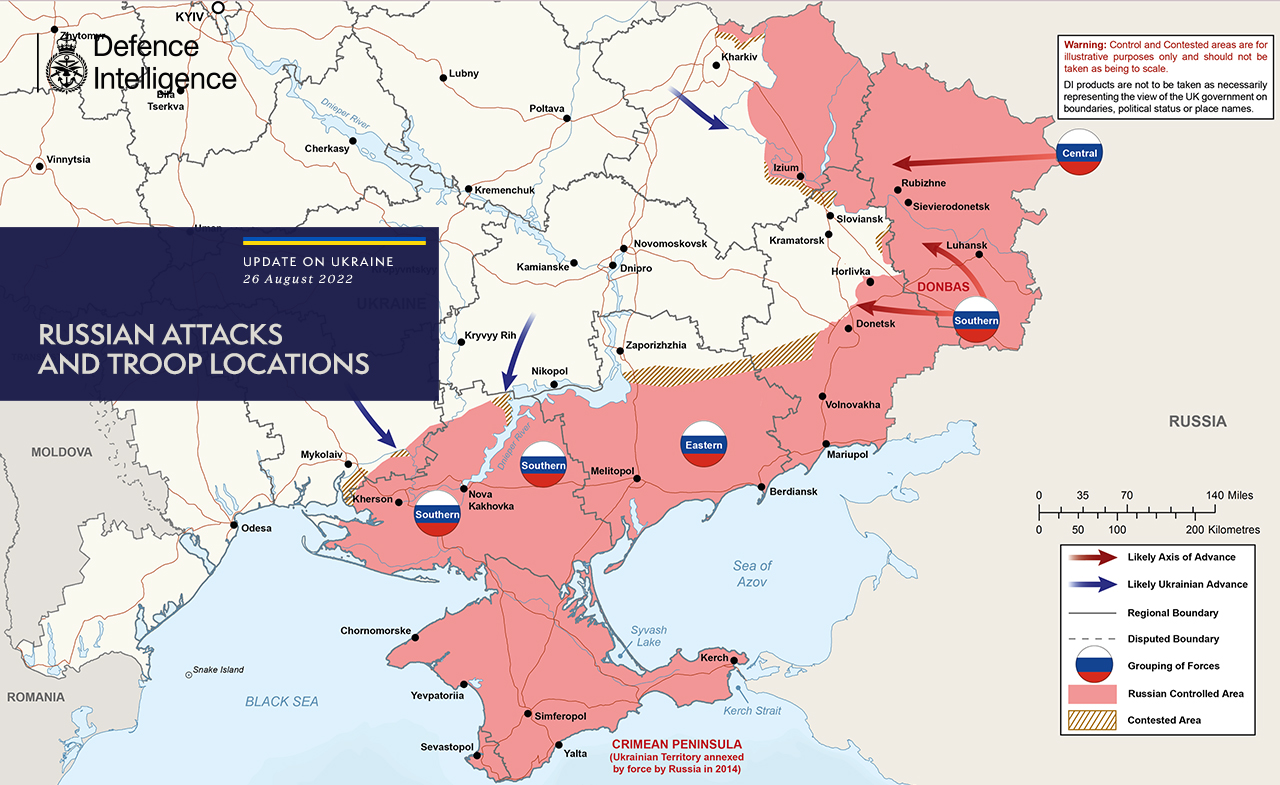
Marinus divides Russian operations, and operational goals, thus tactics, into three discrete geographic parts. Northern Raiding and feints realized through mobile warfare, Southern Occupation through clear and hold, and Central Attrition operations through artillery firepower.
1. Northern operation. Marinus’s central thesis is that the Northern operation was a giant raid, intended to fix Ukrainian commanders’ attention on the threat to Kiev, and prevent them from reinforcing their defenses in the south. In this, mobile warfare, using the battalion tactical group, was the main strategy used. Marinus posits that taking and holding Kiev was never a goal in this operation. Left unsaid in his assessment were two key points that go beyond his narrower operational focus.
First, I’m sure that the Ukrainian Army’s top command was likely not in complete control of defensive strategy or deployment. Zelensky, the Ukrainian Auto Parts King — (“I make politics for the Ukrainian working man, because that’s who I am, and that’s who I care about!”), and his American “advisors” were. Note that we have no idea who Ukrainian General Marshall is, who his Supreme Commander Eisenhower is, or his battlefield Patton is, even if one existed. I mean, we got fawning coverage of President Comedian, looking tough in his cammies on TV, a lot — by which I mean every fucking day, a mythical fighter ace, the “Ghost of Keeeeeev”, but nobody wanted to manufacture a real hero Uke general, steadfastly leading his troops with steely eyed resolve from the front?
C’mon, that’s Propaganda 101. Shit, even Big Red let Marshal Zhukov ride a white horse at the Victory Parade.
I don’t think that is inadvertent. The goons at State and the Clown Intelligence Agency, having engineered one coup, sure as fuck don’t want an actual no shit popular hero, ethnically Ukrainian general to be a viable political alternative to the UAPK they handpicked and installed after this clown folds the Big Top. (Francisco Franco, Kemal Ataturk, or Wladislaw Sikorski say hi from history!). To hear it from the Ministry of Propaganda, Zelensky is commanding the troops himself, and that’s for once likely not far from the truth. It’s Zelensky being “advised” by whatever retards from [Washington DC] who are actually commanding the Ukes, which brings me neatly into my next point — Putin and his generals initiated this feint to Kiev precisely because they correctly predicted that Zelensky and his American masters would expect it and react to it as they did, regardless of anything the Ukrainian generals said.
Why is that, you might ask? Because that is the only strategy that AINO’s Very Clever Boys, Girls and Trannies can conceive of, and the only way they conduct war. Send in the Air Force to blow up everything in an enemy capital, launch a blitzkrieg style invasion aimed at cutting off the enemy army, encircling it, forcing the unmotivated piss poor enemy conscripts to surrender in place or die trying to pull back, and driving on to the capital to pull down the statues of the recently deceased or deposed Dear Leader who was The Next Hitler, declare victory, then institute Regime Change and Operation Endless Occupation. Putin and the rest of his generals are just stupid vodka fueled gopnik Ivans, and couldn’t possibly be headfaking us and outsmarting us. We went to West Point and Harvard, and are automatically the Best and Brightest. Remember when the MoP and the Fistagon were squeeing like little girls at those incompetent Ivans floundering about within artillery range of Keeeev, and the 100 mile long convoy that everyone saw “stuck” on the road to the Sacred Capital, that was so visible and obvious you could see the fucker from space, that just sort of disappeared, along with the great and decisive Battle of Keeeeev that was going to be a bloody defeat for the evil Russians?
You’ll never hear anyone ever admit it, but they just got posterized because their hubris and arrogance was exactly the thing [Putin] used against them.
маскировка (Maskirovka), you stupid fucks, is a Russian MILITARY CONCEPT, and you forgot it. Check yo self before you wreck yo self, as von Clausewitz wrote. Master P didn’t fight your war, he fought a modern Kabinettskreige and that is fought for an entirely different set of objectives, as we will see below.
2.Southern operation. This is the forgotten stepchild of the war so far, but quietly could be the one front with the longest lasting strategic effects. Marinus disposes of this front relatively quickly, noting that it really is operationally the bread and butter of traditional warfare, take ground and hold ground, move on to the next objective. Strategically, this is different from ground taken in the northern front or even parts in the central, however.
The object here is permanent occupation and Russification to deny the rump state of Ukraine any coastline and landlock it. This, unlike territory in the north or even in the Donbass, is not a bargaining chip on the table at the peace talks. Denying this to the Ukrainians after the war prevents them from ever “inviting” any US Navy ships into the Black Sea to base themselves at a Ukrainian port and serve as a potential casus belli, hamstrings Ukraine from seaborne economic activity with Turkey across the Black Sea, thus making sure whatever left of Ukraine is unable to function without massive land route economic as well as military aid, making it a drain, not an asset, to Globohomo and AINO.
[…]
3. Central operation. Marinus here details the real decisive front in the war, calling it “Stalingrad in the East” (Clunky, since Stalingrad was a very different kind of battle, but it has name recognition as a byword for the Eastern Front and the Russian way of war). Honestly, it is far more like a giant Battle of Verdun, but only for one side.
Here is where I’m going to proclaim how happy my artilleryman’s heart is […] because Marinus says that in the Russian way of winning wars, you can’t spell PARTY without ARTY. Not Special Operations Operating Operationally, not drone warfare “fought” by fatass pimply nerds in some air conditioned room half a world out of danger, not bombs away from 30,000 feet, or armored divisions imitating Rommel. Fucking old school howitzers, chucking metric tons of high explosive on infantry, dropping regimental sized TOT and Shake and Bake when they get in the open. I predicted that here in the beginning of the war and a lot of you can look that shit up if you don’t believe me. Guess we ain’t obsolete anymore, assholes.
Everything the Russians are doing in the Donbass and Central front, operationally and tactically, hinges around artillery as the decisive arm, the fulcrum that the other arms orbit around, which is very, very different than the American way of war. Again, as in the north, the Americans “advising” the Ukes had never, literally never in living memory, faced an enemy with air superiority and firepower superiority, much less both combined. They have absolutely no answer for it.
August 20, 2022
Yes, you will end up owing your conspiracy theorist friend an apology at this rate …
Chris Bray re-enacts a few of the minor erasures, walk-backs, and out-and-out lies coming from organizations who’ve spent the last two-plus years spreading a line of medical “truth” that, day-by-day, appears a bit less “truth-y” all the time:
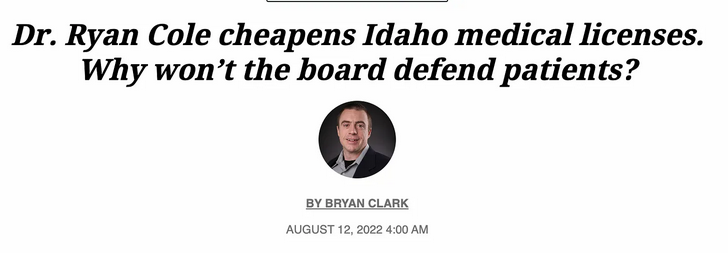
I can’t get this attack on Dr. Ryan Cole out of my head:
What’s becoming very clear is that the narrative is going to shift by inches, eventually ending up at the place where mRNA dissenters started, but. Let’s get through the first part, and I’ll get to that but in just a moment. Look at, for example, the recent stealth-edit on the CDC website that quietly removed the assurance about the spike protein from mRNA injection leaving your body in a hurry. So on Monday it’s disinformation to falsely claim that the spike protein lingers in your body, and you’re a dangerous extremist if you say it; on Tuesday, the simple fact of lingering spike protein was always known and never contested. That’s DISINFORMA— hold on, I’ve just been handed a new memo.
This is going to keep happening, in little pieces that move toward reality. There are ZERO mRNA deaths, you lying idiots, and you need to stop spreading disin— uh, hold on, it says here that, uh …
In a year, or in five years, the things that Ryan Cole and Clare Craig and Peter McCullough and Tracy Beth Hoeg and Robert Malone and all the other MONSTERS have been saying will be validated and acknowledged. We’ll know that the mRNA injections caused heart damage and a cancer spike, and we’ll know that mRNA-injected people get sick more often than the dirty unvaccinated. Look at the matter-of-factness with which Deborah Birx says that oh yeah, I always knew these vaccines — vaccines! — weren’t going to prevent infection. A year before she shrugged and said she’d always known that, you would have lost your social media accounts for saying exactly what she just said. Yesterday’s idiotic conspiracy theory disinformation nonsense is today’s “yeah, we always knew that”.
Now, here’s my big but: The narrative is going to turn, in a long series of tiny and unacknowledged shifts, until it matches what the heretics have always been saying — but my bet is that the heretics will not be rehabilitated. Ryan Cole, to stick with the opening example, will be proven correct, but he will not be vindicated. The YOU CAN’T SAY THAT, IT’S DISINFORMATION oh wait it’s totally true maneuver doesn’t rehabilitate the crimethinkers. You can think X when it’s time to think X; if you think X too early, you remain a thought criminal.
The truthtellers in medicine will be proved correct, but they’ll still be resented and excluded.
August 17, 2022
Amazing Money Heist by Polish Resistance – WAH 073 – August 14, 1943
World War Two
Published 14 Aug 2022The reality of war finally seeps through to the majority of Germans, and it didn’t match up with the propaganda. Meanwhile resistance is increasing, and part of that is a classic money carriers when the Polish Home Army robs a money transport.
(more…)
August 10, 2022
Raising a generation to emulate Pavel Morozov
Theodore Dalrymple on the dangers of a culture that welcomes and supports denunciation as a political mechanism:

Believed to be the only photograph of Pavel “Pavlik” Morozov (centre, wearing cap), circa 1930.
… a culture of denunciation is an important step in the direction of totalitarianism. Is there anyone whose life is such that the discreditable things done or said by him or her could not be woven into a reason for public execration or worse? The habit of denunciation was a powerful weapon in the hands of every totalitarian dictator.
In the Soviet Union, for example, the story of Pavel Morozov — little Pavlik — was used to inculcate the habit of denunciation as a social duty into Soviet children. Little Pavlik denounced his own parents and grandparents as kulaks, that is to say as rich and exploitative peasants, to the Soviet authorities, and was thereafter “martyred” for his truthfulness. Soviet children were encouraged to emulate lovely little Pavlik by snitching on all around them. There were posters in school of heroic children denouncing their fellows for something that they had done wrong. This was the Soviet version of truth-telling.
We should not complacently suppose that it couldn’t happen here — wherever here is. In Britain recently, which is suffering from a shortage of water because of unusually hot weather, residents of some areas have been prohibited from using hosepipes to water their garden — and have been encouraged to denounce neighbors or others to the authorities who flout the prohibition.
One can just hear the arguments in favor of such denunciations. It’s only fair and right, for example, that everyone should share the hardship caused by the shortage of water. It’s almost psychopathic of some not to obey the rules while most do so: Who do they think they are, that they are not obliged to obey? Moreover, we live in such times that, if you approach such a person directly, he’s likely to become furious and violent. It’s safer to call the authorities and let them deal with him.
This overlooks how easily the culture of denunciation can establish itself, and lead to a society in which everyone fears everyone else. Such is the way in which people are constituted that for many, at least, it’s a pleasure to bring harm to others in the name of doing good for society. That was the justification of denunciation in Nazi Germany, Soviet Russia, and Maoist China, as well as in a host of other totalitarian fiefdoms. And Maugham — he who actively solicits denunciations of Nick Cohen — even admits, perhaps without really meaning to, the pleasure he would derive from passing on any denunciations he receives in a kind of meta-denunciation, as it were.
This is authentically disgusting, but it has the merit of reminding us that totalitarianism did not land on earth like an asteroid but had its origins in the human heart, and that no society can be immune from the temptations of totalitarianism once and for all. Totalitarianism has its pleasures, chief of which is doing harm to others, albeit that today’s denouncer tends to become tomorrow’s denounced.
August 9, 2022
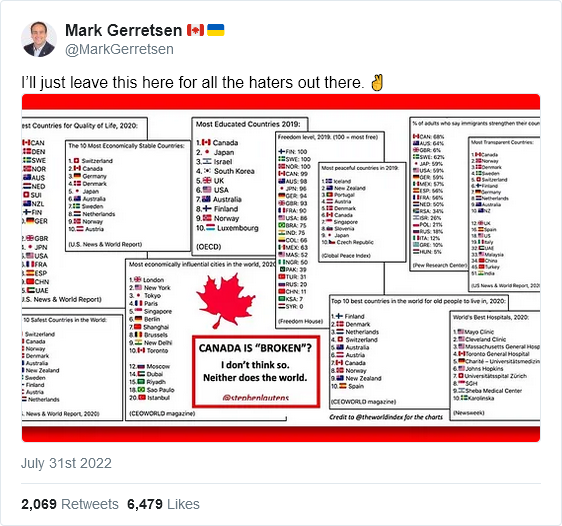
“Canada’s not broken: here’s a set of totally arbitrary social media listicles to prove it, h8rs!”
Meant to post this on the weekend, but another lengthy Rogers internet outage got in the way. From the most recent weekly Dispatch from The Line:
We try to avoid spending too much time on Twitter nowadays, but we’ve noticed a trend emerge on the site that irks us. It’s not new, exactly, but it seems to have become a favoured rhetorical tactic among Liberals and their apologists. And as it touches on virtually all of the blurbs above, it’s worth noting.
We’ll call it Rebuttal by Listicle, and it works a little like this: rather than actually engage with critiques of the country or the government, partisans will simply post random rankings that show Canada is at the top of some subjective set of metrics like “freedom” or “quality of life”.
To wit:
And this:
Because these listicles look impressive and official, the partisans in question can treat them with the weight of proven scientific truth. Canada’s great! Look, the list proves it! Them’s the facts!
We have three major problems with this rhetorical tactic.
The first is optics: Please tell the couple priced out of the housing market in every major urban centre, the one that is now worried about the grocery bill, can’t fill the car with gas, and frets about heating costs next winter, that none of these problems really matter. That they should just be grateful and happy with this definitely not-broken country because Canada scored well in a ranking compiled by an intern at an American newspaper. Show the lists to the person suffering a lingering illness, with no family doctor, in a town where the ER is closed, and wait patiently for their enthusiastic high five.
You want to guarantee Prime Minister Poilievre, this is the way to go about it: smarmily dismissing legitimate grievances and concerns by tweeting a list and calling it a day.
And, of course that’s presuming the ranking was subject to even a moderate degree of fact checking, logic, or scientific scrutiny goes into these rankings at all.
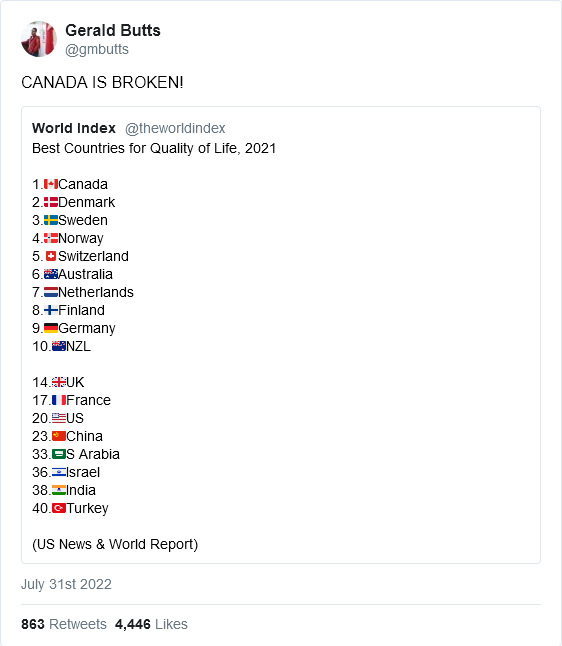
Let’s look a little more carefully at the ones posted by former Trudeau senior aide Gerry Butts, shall we?
He has a whole thread devoted to cherry picking Canada-topping rankings compiled by something called The World Index. What is The World Index? Well, we don’t know, Bob. The Twitter bio says: “Know the world. Focus on economics, art & culture, science, technology, sports, travel, politics and military affairs.” Okay. The only website listed takes us to an Instagram account with 37 followers.
The list above, in which Canada hits #1 for Best Countries for Quality of Life, 2021, is from U.S. News & World Report, an American media company. We checked out their methodology for the 2021 survey, and this is what we found: it’s a survey of 17,000 people, run by an academic. What’s being surveyed? Glad you asked! “Participants assessed how closely they associated an attribute with a nation.” You’ll be thrilled to note that these 17,000 people around the globe gave Canada near perfect scores on being “not bureaucratic”, and having a “well developed public health system”, “well-distributed political power”, and “transparent government practices”. (Lol, *dies inside*.)
Hey, it’s great that people associate Canada with being awesome, but we hope that when Liberals talk about “evidence-based policies”, they are using actual, you know, evidence, not just rankings by survey participants.
July 28, 2022
“… this time it will be worldwide”
Elizabeth Nickson recounts her journey from dedicated environmentalist to persecuted climate dissident and explains why so many of us feel as if we’re living on the slopes of a virtual Vesuvius in 79AD:

A screenshot from a YouTube video showing the protest in front of Parliament in Ottawa on 30 January, 2022.
Photo via Wikimedia Commons.
I was experiencing a time-worn campaign to shut down a voice that conflicted with an over-arching agenda. And in the scheme of things, I was nothing. But in fact, I was almost the only one, everyone else had been chased out. I was an easy kill, required few resources. It was personal, it was vicious beyond belief, and it had nothing to do with truth. If I had continued my work in newspapers, they would have attacked my mother and my brothers, two of the three of whom were fragile.
As of now, this has happened to hundreds of thousands of people in every sector of the economy. The chronicles of the cancelled are many and varied, and they all start with the furies, unbalanced, easily triggered and marshalled to hunt down and kill an enemy. These programs, pogroms, are meticulously planned, they analyze you, find your weakness, and attack it. In my case, it was my solitude, my income, my need to look after my family that made me an easy sacrifice.
I was such an innocent. I thought with my hard-won skills, my ability to reason, to number crunch, to apply economic theory and legit charting, and report, the truth would be valuable, useful.
Every single member of the cancelled has had their faith in the culture badly shaken. They all thought, as I did, that we were in this together, we needed the truth in order to make good decisions, decisions that would promote the good of all.
Not now. Not anymore.
The truth I found behind the fields and forests of the natural world is animating people on the streets in Europe today, the Dutch, French and German farmers. It animated the revolution in Sri Lanka.
Because what I and hundreds of others had found was censored, the destructive agenda has advanced to the point where their backs are against the wall. They don’t have a choice. They have to win. And they are in the millions.
Same with Trump’s people. They aren’t mindless fans or acolytes or sub-human fools. Their backs are against the wall. They have no choice but to fight.
But because I and the many like me, who know what happened, were shut down, disallowed from writing about it, cancelled and vilified, no one understands why this is happening in any depth. City people mock and hate rural people. My photographer colleague/best friend in New York: “racists as far as the eye can see”. My old aristocratic bf London: “Pencil neck turkey farmers”. No city person can take on board that they have allowed legislation and regulation which is destroying the rural economy because they have been brainwashed by the hysteria in the environmental movement. This destruction is not the only reason but it is the fundamental reason for our massive debts and deficits. The base of the economy has been destroyed. We have lost two decades of real growth.
And we did it via censorship.
There is a truism about revolutions in China. All of a sudden, across this great and massive country with its five thousand year culture, people put down their tools and start marching towards the capital, hundreds of millions all at once.
We are almost there. But this time it will be worldwide.

July 23, 2022
QotD: “The New Journalism” and “narrative journalism”
This is the news cycle in a nutshell. There is very little news. It has been at least a generation since the major news outlets in America have done reporting. Most of it is just stenography. The “journalist” copies what a government spokesbot has sent to them and dresses it up with some commentary. Then there are the narratives that are designed to give the public a way to repeat the official truth that sounds convincing to them and their acquaintances.
The source of this is the “new journalism” that emerged in the 1960’s. The late British reporter Chris Munnion chronicled this in his book Banana Sunday. He spent most of his life covering Africa for the Telegraph. In the 1960’s he noticed Americans showing up with pre-written narratives. They would seek out quotes and pictures to fill out the story they had prepared for the trip. Even if the facts contradicted the narrative, they stuck with the narrative because that was the new journalism.
Narrative journalism is just accepted these days. The “news” has always been a form of passive-aggressive political activism so its evolution into story telling on behalf of powerful interests seems natural. When you think of the New York Times, Washington Post and Wall Street Journal as propaganda arms of their respective clients in the managerial elite, it all makes sense. Instead of the Ministry of Truth we have the mainstream media “speaking truth to power”.
That last bit gets mocked by normal people on this side of the great divide because they have woken up to the reality of this age. As if often the case, however, there is a kernel of truth locked in this media fabrication. The people inside these disinformation operations genuinely fear the public. When they say “speak truth to power” they mean broadcast their truth to you in the hopes that you will buy it. Modern mass media is mostly a defensive weapon of the elites.
The Z Man, “The Lying Liars”, The Z Blog, 2022-04-20.
July 20, 2022
The Myth of Rosie the Riveter – On the Homefront 016
World War Two
Published 19 Jul 2022With American men going off to fight the war, there are concerns about a labor shortage. Enter Rosie the Riveter. The women who answered the “We Can Do It” call and entered the factories. But did she really exist?
(more…)
July 12, 2022
“Misrepresentation, exaggeration, cherry picking or outright lying … in support of the theory of imminent catastrophic global warming”
Y’know, the folks at The Daily Sceptic really need to tell us what they think instead of cloaking their opinions in euphemisms:
Two top-level American atmospheric scientists have dismissed the peer review system of current climate science literature as “a joke”. According to Emeritus Professors William Happer and Richard Lindzen, “it is pal review, not peer review”. The two men have had long distinguished careers in physics and atmospheric science. “Climate science is awash with manipulated data, which provides no reliable scientific evidence,” they state.
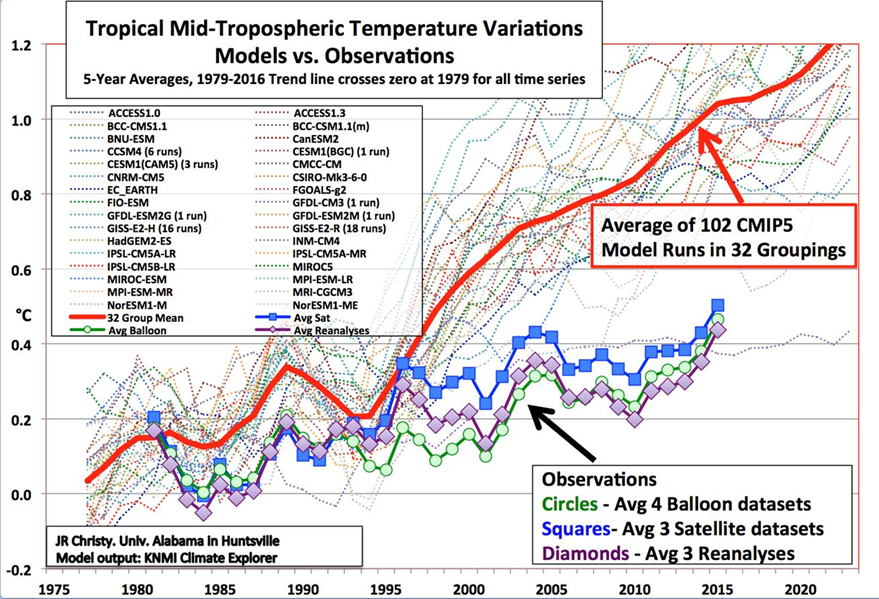
No reliable scientific evidence can be provided either by the Intergovernmental Panel on Climate Change (IPCC), they say, which is “government-controlled and only issues government dictated findings”. The two academics draw attention to an IPCC rule that states all summaries for policymakers are approved by governments. In their opinion, these summaries are “merely government opinions”. They refer to the recent comments on climate models by the atmospheric science professor John Christy from the University of Alabama, who says that, in his view, recent climate model predictions “fail miserably to predict reality”, making them “inappropriate” to use in predicting future climate changes.
The “miserable failure” is graphically displayed below. Since the observations cut-off, global temperatures have again paused.
Particular scorn is poured on global surface temperature datasets. Happer and Lindzen draw attention to a 2017 paper by Dr. James Wallace and others that elaborated on how over the last several decades, “NASA and NOAA have been fabricating temperature data to argue that rising CO2 levels have led to the hottest year on record”. The false and manipulated data are said to be an “egregious violation of scientific method”. The Wallace authors also looked at the Met Office HadCRUT database and found all three surface datasets made large historical adjustments and removed cyclical temperature patterns. This was “totally inconsistent” with other temperature data, including satellites and meteorological balloons, they said. Readers will recall that the Daily Sceptic has reported extensively on these issues of late and has attracted a number of somewhat footling “fact checks”.
Happer and Lindzen summarise: “Misrepresentation, exaggeration, cherry picking or outright lying pretty much covers all the so-called evidence marshalled in support of the theory of imminent catastrophic global warming caused by fossil fuels and CO2.”
July 6, 2022
The ongoing protests by Dutch farmers demand your attention
Protests in many countries in the western world can get violent and even be claimed (by the targets of the protest) to be “insurrections”, but protests in the Netherlands always have more of an edge to them than elsewhere, because when the Dutch really get angry they have, in the past, gone so far as to kill AND EAT their prime minister. The current protests haven’t gone that far yet, but politicians should keep in mind that Dutch farmers can react primally to being treated in the way the Soviets treated the kulaks:
This is really important – you know, on the level of “pay attention or your food supply is next”.
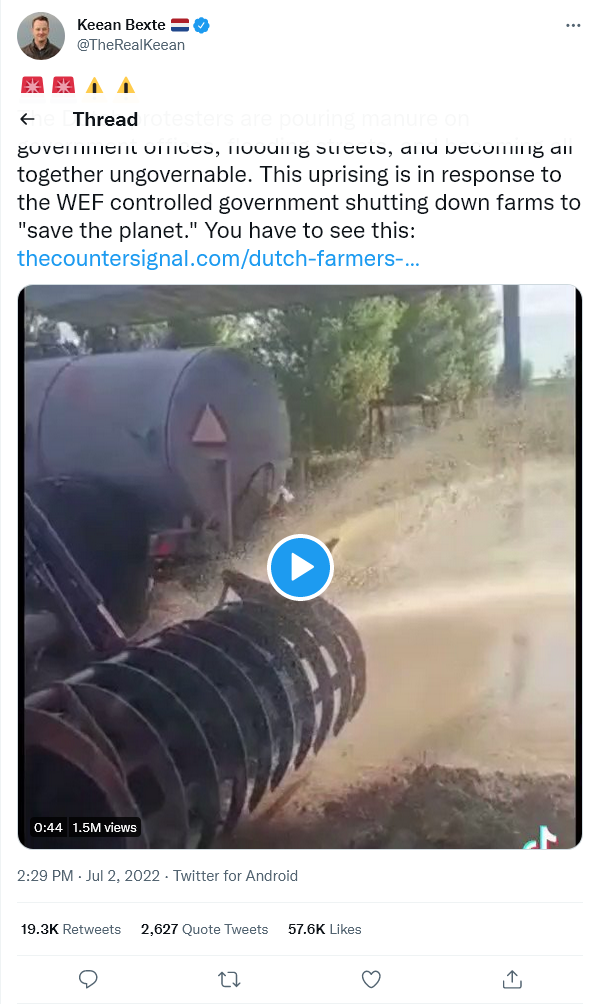
We reported last week that Dutch farmers were attacking government vehicles, blocking roads, and dumping manure on government buildings in response to a new “climate” policy that shut down numerous family farms because their cows were farting too much.
These farmers are now banned from working their own land to feed their families.
Let me explain what’s happening and why it is of the utmost importance as I randomly drop in videos of what the Dutch farmers are doing to keep your attention.
Unelected elites at the World Economic Forum, World Bank, United Nations, and BlackRock think us little people are rodents that are polluting the Earth, and that it’s their job to cull us and tame us so we can follow their smartypants amazingness into what is obviously a glorious future.
These elites get corporations to fall in line by promoting “Environmental-Social-Governance” metrics (a scorecard, if you will) that shows how many woke policies a company is adopting. Do they have a climate pledge? Are they hiring based on skin color, gender, and sexual fetish? Do they fly a rainbow flag over their headquarters? Do they have at least a few dozen “equity” executives to make sure everyone is a good little Marxist?
Companies lose customers by joining this radical, perverse cult, but they get access to the trillions of dollars represented by the elites and the corrupt organizations, from the WEF to the WHO to the mega-investment firms. They don’t care if you boycott them because they are expecting to simply outlast you.
The elites then get governments to fall in line by lobbying, pushing big money into local elections, and taking over school boards and classrooms to ensure good little disciples are being churned out to vote for the right people. They get young people riled up, telling them the planet is burning and that unarmed black men are yelling “Hands up, don’t shoot!” while being gunned down by racist white cops in the streets. Good people watch as their cities burn and politicians bail out the rioters.