
Overly Sarcastic Productions
Published 16 Sept 2022
The plot twist of Rome is that it was always a mess, now sit back and enjoy the marble-covered mayhem.This video is a Remastered, Definitive Edition of three previous videos from this channel — “History Summarized: The Roman Empire”, “History Hijinks: Rome’s Crisis of the Third Century”, and “History Summarized: The Fall of Rome”. This video combines them all into one narrative, fully upgrading all of the visuals and audio, with a substantially re-written script in parts 1 and 3.
(more…)
September 30, 2022
History Re-Summarized: The Roman Empire
Comments Off on History Re-Summarized: The Roman Empire
July 15, 2022
QotD: Modern and historical multiculturalism
For history’s rare multiracial and multiethnic republics, an “e pluribus unum” cohesion is essential. Each particular tribe must owe greater allegiance to the commonwealth than to those who superficially look or worship alike.
Yet over the last 20 years we have deprecated “unity” and championed “diversity”. Americans are being urged by popular culture, universities, schools and government to emphasize their innate differences rather than their common similarities.
Sometimes the strained effort turns comical. Some hyphenate or add accents or foreign pronunciations to their names. Others fabricate phony ethnic pedigrees in hopes of gaining an edge in job-seeking or admissions.
The common theme is to be anything other than just normal Americans for whom race, gender and ethnicity are incidental rather than essential to their character.
But unchecked tribalism historically leads to nihilism. Meritocracy is abandoned as bureaucrats select their own rather than the best-qualified. A Tower of Babel chaos ensues as the common language is replaced by myriad local tongues, in the fashion of fifth century imperial Rome. Class differences are subordinated to tribal animosities. Almost every contentious issue is distilled into racial or ethnic victims and victimizers.
History always offers guidance to the eventual end game when people are unwilling to give up their chauvinism. Vicious tribal war can break out as in contemporary Syria. The nation can fragment into ethnic enclaves as seen in the Balkans. Or factions can stake out regional no-go zones of power as we seen in Iraq and Libya.
In sum, the present identity-politics divisiveness is not a sustainable model for a multiracial nation, and it will soon reach its natural limits one way or another. On a number of fronts, if Americans do not address these growing crises, history will. And it won’t be pretty.
Victor Davis Hanson, “Things That Can’t Go on Forever Simply Don’t”, PJ Media, 2019-04-17.
Comments Off on QotD: Modern and historical multiculturalism
June 21, 2022
“Schlimmbesserung is a lovely German word which means making something worse by trying to improve it”
In the New English Review, Armando Simón considers some of the oddities of American worldview that seem so often to make worse the very things they try to “fix”:
Americans’ ignorance of other countries, their cultures, their history and their geography is legendary and world renowned and the subject of countless anecdotes and jokes by foreigners. This ignorance is inexplicable, as it is not found in America’s northern or the southern neighbors, so it cannot be due to geographical isolation. It is also a fact that foreigners know more about America than Americans know of their countries. Or even their own.
It is also a paradox. One would expect logically that a country that is principally composed of immigrants and the descendants of immigrants would have an encyclopedic knowledge of other countries, as is the case with Britain, which had a world-wide empire. Not so.
And this may explain America’s unintentional policy of schlimbesserung, the worsening of something that it is trying to improve, or as Greene described it so aptly of an American character in one of his novels, “armored in his ignorance and good intentions”.
As an aside, let me also say that this naïve optimism — to put it charitably — has enabled foreign governments to easily steal diplomatic and military secrets with little trouble, according to Gordievsky’s KGB: The Inside Story of Its Foreign Operations from Lenin to Gorbachev. John Walker, an American traitor who spied for the Russians for 17 years once said in a public interview that Walmart guards a tube of toothpaste better than the Navy guards its secrets. He should know.
Many individual American philanthropists and government bureaucrats go energetically out in the world upon hearing of some terrible condition in some part of the world through the television, convinced that they, yes they, can personally correct the situation when in reality they have no idea of what the hell they’re doing, who they are dealing with, or what is really going on in that part of the world, nor of the cultural, historical, and geographical circumstances. Nor can they even speak the local language! They are simply confident that they will solve the problem. And so they will feel good about themselves (for example, there is no question in my mind that some dirt-poor African doctors, upon learning that some idiot Americans, obsessed with AIDS, were going to send millions upon millions of dollars in their countries “to combat AIDS”, and having very few actual cases of infected patients, simply falsified the statistics. Or worse.). It is as if they were hopscotching across a cultural minefield with an idiotic grin.
The cultural values that one takes so much for granted that one is not conscious of may not be present elsewhere. For example, Americans do not understand that many countries e.g., Greece, Ireland, tend to explain their present problems by blaming other countries (Turkey, Germany, England) over what happened centuries ago instead of actually solving the problems. People in other countries are backward looking in that their sights are rigidly focused on their past, whereas Americans’ eyes are always on the future (and which might explain why Americans are addicted to science-fiction) while being generally ignorant about their past.
Also, it is a general truism that the majority of persons who run for office in North America and various European countries do so because they sincerely want to help and improve their communities/countries. However, in all of Africa and most of Asia, persons who seek public office do so for one purpose, and one purpose only: to steal everything that they can get away with. So when some ignorant, naïve, American shows up with buckets full of money, oblivious of the culture and the longstanding, entrenched, corruption, and with an announced intention to make the local community more like an American community, they are welcomed with open arms while suppressing their snickering. This also explains something where Americans exhibit willful blindness: other cultures don’t play fair. Honesty is seen as the trait of fools. Fools are to be taken advantage of. Especially in trade and diplomacy. Just look at China.
Comments Off on “Schlimmbesserung is a lovely German word which means making something worse by trying to improve it”
June 17, 2022
Oikophobia run rampant
In the New English Review, Theodore Dalrymple considers the prevalence of oikophobia in western culture:
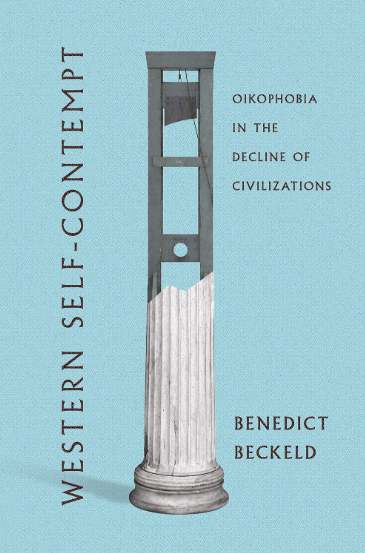
In an article for the American Mind, Daniel Mahoney draws our attention to a recent book on the phenomenon of oikophobia, the dislike or even hatred of one’s own country or culture, which now seems so prevalent in western academic and intellectual circles as to be almost an orthodoxy or requirement for acceptance into the intellectual class. Of course, no social trend or phenomenon is entirely new or has an indisputable starting point: for example, George Orwell drew attention to English self-hatred many years ago. But the spread of oikophobia has been of epidemic proportion in late years.
It seems to me that Mr. Mahoney’s analysis can be extended. The first question to ask is why oikophobia should now be so prevalent. To this, I should tentatively reply that it is because of the mass intellectualization of society consequent upon the spread of tertiary education. Intellectuals have an inherent tendency to be oppositional to all received opinion or feeling, for there is no point in going to the trouble of being an intellectual if one ends up thinking and feeling what the great mass of the people around one think and feel. Love of country and inherited custom is so commonplace as to appear almost normal or natural, and much of it, of course, is unreflecting.
But intellectuals are supposed to reflect. That is their function, and they are inclined to reject received opinion, not because it is wrong but because it is received. It goes without saying that received opinion can be wrong and even wicked or evil, in which case the strictures of intellectuals are necessary and salutary; but intellectuals themselves may promote wrong or even wicked opinions, partly from the a priori need to distinguish themselves from the run of mankind.
The phobia in oikophobia is the fear of being taken for one of the common run of mankind.
The second question about oikophobia is the old one of cui bono? Again, one must not confuse the psychological or social origin or function of an opinion with its justification or correctness in the abstract, but once one has decided that an opinion is mistaken or deleterious in its effect, it is natural to ask where it comes from and what interests it serves.
In my opinion, oikophobia is generally bogus, that is to say insincere, as is its cognate, multiculturalism. The oikophobe and the multiculturalist are not really interested in other cultures, except as instruments with which to beat their fellow citizens. The reason for their lack of real interest in other countries is not difficult to find and is of very common application. The fact is that it is very difficult genuinely to enter into a culture, or subculture, other than one’s own, even when that culture or subculture is close to or adjacent to one’s own.
Comments Off on Oikophobia run rampant
June 14, 2022
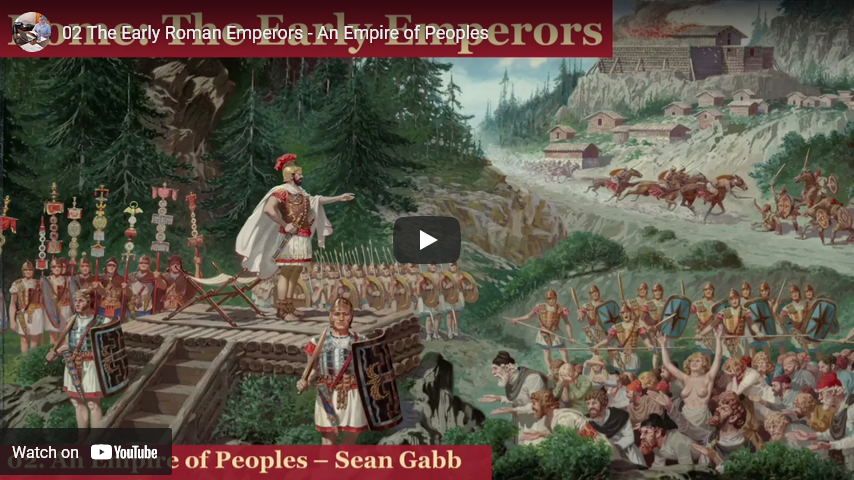
The Early Roman Emperors – Part 2: An Empire of Peoples
seangabb
Published 4 Oct 2021The Roman Empire was the last and the greatest of the ancient empires. It is the origin from which springs the history of Western Europe and those nations that descend from the Western Roman Empire. It is the political entity within which the Christian faith was born, and the growth of the Church within the Empire, and its eventual establishment as the sole faith of the Empire, have left an indelible impression on all modern denominations. Its history, together with that of the ancient Greeks and the Jews, is our history. To understand how the Empire emerged from a great though finally dysfunctional republic, and how it was consolidated by its early rulers, is partly how we understand ourselves.
Here is a series of lectures given by Sean Gabb in late 2021, in which he discusses and tries to explain the achievement of the early Emperors. For reasons of politeness and data protection, all student contributions have been removed.
More by Sean Gabb on the Ancient World: https://www.classicstuition.co.uk/
Learn Latin or Greek or both with him: https://www.udemy.com/user/sean-gabb/
His historical novels (under the pen name “Richard Blake”): https://www.amazon.co.uk/Richard-Blake/e/B005I2B5PO
Comments Off on The Early Roman Emperors – Part 2: An Empire of Peoples
March 3, 2022
QotD: Diversity was Rome’s strength … as is true of almost every empire in history
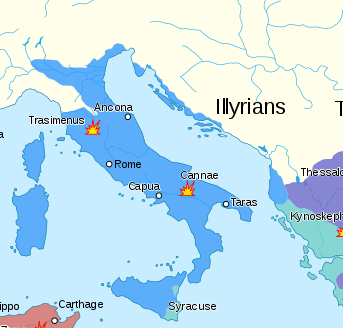
Quite a few people look at a map like that, classify most of Rome’s territories as “Italian” and assume there is a large, homogeneous ethnic core there (except, I suspect, anyone who has actually been to Italy and is aware that Italy is hardly homogeneous, even today!). But Roman Italy in 218 B.C. was nothing like that.
Peninsular Italy (which doesn’t include the Po River Valley) contained a bewildering array of cultures and peoples: at least three distinct religious systems (Roman, Etruscan, Greek), half a dozen languages (some completely unrelated to each other) and many clearly distinct cultural and ethnic groups divided into communities with strong local identities and fierce local rivalries (if you want more on this, check out Salmon, The Making of Roman Italy (1982), Fronda, Between Rome and Carthage (2010), and Keaveney, Rome and the Unification of Italy (2005)).
The Roman army was by no means entirely Roman – it was split between Roman citizens and what the Romans called the socii (lit: “allies”) – a polite term for the communities they had subjugated in Italy (a periphery!). Rome demanded military service – this was the resource they would extract – from these communities; the socii pretty much always made up more than half of the army. Diversity was literally the Roman strength, in terms of total military force. Without it, Rome would have remained just one city-state in Italy, and not a particularly important one besides.
(As an aside: while citizenship is extended to nearly all of Italy in the 80s B.C., by then Rome is making extensive use of non-Italian troops in its armies. by the early empire, half of the army – the auxilia – were non-Roman citizens recruited from the provinces. Roman armies were essentially never majority “Roman” in any period, save possibly for the third century. And before anyone asks what about even earlier than my snapshot – it is quite clear – both archaeologically and in the Romans’ own foundation myths – that Rome was a fusion-society, culturally diverse from the city’s foundation. Indeed, sitting at the meeting point of Latin and Etruscan cultural zones as well as upland and coastal geographic zones was one of the great advantages Rome enjoyed in its early history, as near as we can tell.)
Outside of Italy, narrowly construed, the diversity only increases. Sicily’s population included Greeks, Punic (read: Carthaginian) settlers, and the truly native non-Greeks. Sardinia and Corsica had their own local culture as well. Cisalpine Gaul – the Po River Valley – was, as the name implies, mostly Gallic! As the Romans expended into Spain during the Second Punic War, they would add Iberians, Celt-Iberians, and yet more Punic settlers to their empire. And even those descriptions mask tremendous diversity – Iberians and Celt-Iberians were about as diverse among themselves as the Italians were; a quick read of Strabo reveals a wonderful array of sub-groups in all of these regions, with their own customs, languages, and so on.
Even if the Romans didn’t raise military force directly from any one of these groups, they do need to raise revenue from them – remember, the entire point of having the empire is to raise revenue from it, to make other people do the farming and mining and other labor necessary to support your society from the proceeds of their tribute. To keep that revenue flowing – revenue that, as the Roman army professionalized in the late second century B.C., increasingly paid for Roman military activity which held the empire together – you need to be good at managing those groups. Empires that are bad at handling a wide array of different cultures/religions/languages do not long remain empires.
Bret Devereaux, “Collections: Why Are There No Empires in Age of Empires?”, A Collection of Unmitigated Pedantry, 2019-11-22.
Comments Off on QotD: Diversity was Rome’s strength … as is true of almost every empire in history
November 22, 2021
QotD: Canadian values
Robert Fulford, quoted in “Canada takes a new look at ‘fable’ of its image”, New York Times, 2005-05-25. (Link updated thanks to MILNEWS.ca in the comments.)
May 8, 2021
QotD: That time the global elites were against diversity
See, in those days, the elites believed in keeping people in their own damn land. Hard as that might be to fathom now, that used to be a mantra of the progressive internationalists. There was a die-hard belief that the key to world peace was the separation of people, the segregation of populations by race, religion, and ethnicity. That was the entire point of the Greek/Turkish population exchange of 1923, overseen by the League in the name of keeping Greek Christians and Turkish Muslims separated for the sake of peace. As UNC Chapel Hill history professor Sarah Shields wrote in her 2016 essay in the Journal of the History of International Law, the prevailing belief at that time was that “Muslims and non-Muslims could not live together peacefully, and modernity required rejecting a diverse past in favor of a nation-state along European (unmixed) lines.”
Separation was the future, diversity was the past. Damn near 1.6 million Greeks and Turks were sent from the land of their birth to the land where they could live with those of a similar faith. Many of the other population transfers and redrawn boundaries that followed World War I were based on that same concept of giving people their “own” homeland based on characteristics like religion or ethnicity. It was simply taken as fact back then that nations function better with some level of homogeneity. That was canon back then. By the time the U.N. came around, that notion was still very much a guiding principle, as the internationalists realized that a vision of a multireligious, multiethnic Palestine was unrealistic and unattainable. And the Jews and the Arabs realized that too, which is why they started slaughtering each other, because they couldn’t bear to live in a partitioned state. Being separate but equal was not enough. They wanted to be separate and separated.
David Cole, “When Refugees Were Conquerors”, Taki’s Magazine, 2018-10-29.
Comments Off on QotD: That time the global elites were against diversity
December 13, 2020
Islamism and the French Republic
Niccolo Soldo talks to Pascal-Emmanuel Gobry about the rise of Islamism in France and the dangers it poses:

Brigitte Macron and Emmanuel Macron, 11 November, 2018.
Photo from the office of the President of Ukraine via Wikimedia Commons, CC-BY-4.0.
Islamism presents an existential threat to the French Republic. Statements are being made, positions are being taken, and the smell of action is in the air to counter this threat. Will we see a follow through from Macron?
Your guess is as good as mine. Macron is hard to predict. Although there are many reasons to be pessimistic, from French elites’ general lack of follow-through to Macron’s own (I believe, sincere and deeply-held) commitment to so-called “liberal values”, I will note that it hasn’t been all talk. BarakaCity (the biggest Muslim NGO in France) whose leaders happen to think ISIS is misunderstood, was shut down by executive decree. CCIF, a prominent “anti-islamophobia” organization, dissolved itself after the government announced its intent to shut it down. So an important Rubicon has been crossed, at least in principle: the French government has rhetorically and legally committed itself to combating not just those who engage in Islamist violence, but those who engage in Islamist advocacy and activism.
Can France’s secularism hold on in light of this challenge? Islamism is rather dynamic, and secularism lacks the ingredients for fanaticism that only the irrational are able to muster. In many countries it seems that only the elites are strongly-wedded to secularism.
I’ll let you in on a little secret we don’t share with foreigners: nobody in France believes in “laïcité“, it’s all a code to say we don’t like Islam. We have a freaking concordat, for crying out loud!
The entire notion that there is this specific French culture of “laïcité” that goes beyond institutional separation of church and state was a retcon invented in the 1980s when the Muslim population became too big to ignore. Nobody — nobody — is fooled that banning the hijab in public schools as well as “large ostentatious crosses” is a neutral secularist measure.
Today some people are claiming that wearing religious garb in the National Assembly is a breach of laïcité, but after the War the Canon Kir sat as a member of Parliament in his cassock for twenty years and nobody had any problem with it. (My favorite Kir story: during a late-night parliamentary session, a Communist deputy asked him “How come you believe in God, even though you’ve never seen him?” “What about my asshole? You’ve never seen it, yet you know it exists!”)
The fig leaf of laïcité was useful, and perhaps still is, as politically correct cover for defending French identity, but over time it will have to be discarded. There are signs that it’s beginning.
The bottom line is that France has always been assimilationist. The idea is that assimilation was invented by the Republic, but it’s not true. When Louis XIV invaded a province, he would create schools with scholarships for poor, talented youth from those places to “turn them into Frenchmen.” The self-conscious project of the French Kings was to restore the Roman Empire, and this bequeathed to us the Roman concept of citizenship: laws, language, and culture. This is what is behind “laïcité.” This assimilationism therefore has deep roots, and it is perfectly legitimate that we demand of immigrants that they assimilate into our culture, which is inescapably Judeo-Christian.
H/T to Colby Cosh for the link.
Comments Off on Islamism and the French Republic
November 20, 2020
QotD: Tolerance
Tolerance represents a mutual compact to which the state itself is a party. And its minimalism is an important feature. Tolerance does not ask you to approve of gay people, or to like atheists, or to appreciate a jaunty Sikh turban, or to trust a redhead. It insists only that you treat them as humans and fellow citizens — equal to yourself in legal endowments and social entitlements, and most particularly in the right to be left alone.
Tolerance means you do not persecute; you do not abuse; you do not commit or threaten violence. It is a restriction on behaviour, above all, or, more broadly, on conduct: it is not a test of one’s disposition, private opinions or feelings.
Colby Cosh, “‘Can we stop talking about tolerance?’ Lord, I hope not”, National Post, 2018-08-23.
Comments Off on QotD: Tolerance
October 20, 2020
The watchful algorithms of the Nanny State’s AI tools
David Warren considers the evolution of the Nanny State’s arsenal of technological surveillance (supplemented by the Karenstapo):

While it is not in my interest, currently, for gentle reader to get off the Internet, the idea must have occurred to him. In times like these, why put yourself under watch from Big Brother (or, Big Sibling, as he might prefer)? Why surround yourself with his electronic eyes, the way I am presently surrounded by jackhammers?
Granted, Nanny State was devising ways to track its citizens, and to exercise “crowd control,” long before the Internet was invented. But we had the advantage with them, for they were incompetent, often laughably inept. However, Internet-plus-meejah-plus-activists-plus-Guvmint makes a more capable adversary.
I am not recommending a systematic withdrawal from the world. That is for people with a religious calling, or some grave eccentricity. Rather I am thinking of self-defence, in the spirit of buying a gun. Of course, I am writing from Canada, one of the countries where owning a gun is more-or-less illegal; as is any other form of self-defence. (“When seconds count, the police will be here in minutes.”) Though I have noticed that, upcountry, the “No Hunting” signs tend to be used for target practice.
The “other side,” as I see it, which always worked on numbers, now has algorithms. “Artificial Intelligence” can home right in. The Nanny State never took the individual seriously, except when he was offering a threat. Now it is threatened by anything human. It is, as it were, utilitarian in outlook — “the greatest good for the greatest number” — along with other fatuous concepts, unamenable to reason. By its nature, it is positivist, nominalist, relativist, and “idealistic” in a very abstract way.
Whereas we, so far as we are human, take ourselves quite personally. In a clinch, we often prefer our own survival, and the survival of family and friends, to the requirements of a bureaucratic “policy.” That this is “selfish” should be immediately affirmed.
Because the masses are now deprived of a Christian education, they misconstrue the “selfishness” of Christian teaching, which tells us that we ought selfishly to become saints. Our intention should be to get ourselves to Heaven, along with any we know who can be taken with us. But charity is not “selfish,” in ways they understand. Under modern tenets of “multiculturalism,” even fidelity to the old Christian view is decried as a form of selfishness, calling out for persecution. For this is because it is “cultural,” not “multi” — for all the many languages it speaks.
Our enemy wants us to eschew uniqueness, and become instead “diverse” — by which it means homogenized and narrowly interchangeable. Increasingly, this adversary has the means to enforce its arbitrary will.
Comments Off on The watchful algorithms of the Nanny State’s AI tools
July 6, 2019
History Summarized: Hong Kong
Overly Sarcastic Productions
Published on 5 Jul 2019Sometimes small corners of the map can have outsized effects on the surrounding world. Hong Kong is undoubtedly one of History’s greatest examples of big things coming from small beginnings. If you’re curious about Hong Kong’s current political situation, there’s no better place to start than at the beginning.
LEARN MORE about Hong Kong’s current events:
China is Erasing its border with HK: https://www.youtube.com/watch?v=MQyxG…
HK’s huge protests, explained: https://www.youtube.com/watch?v=6_Rdn…Further Historical Reading:
A Modern History of China — Steve Tsang https://www.amazon.com/Modern-History…PATREON: https://www.Patreon.com/OSP
Comments Off on History Summarized: Hong Kong
July 3, 2019
A sneak peak at the new “History of Diversity” course outline at Woke State University
At Rotten Chestnuts, Philmon gives us a taste of the new mandatory American history program to be introduced this Fall at WSU:
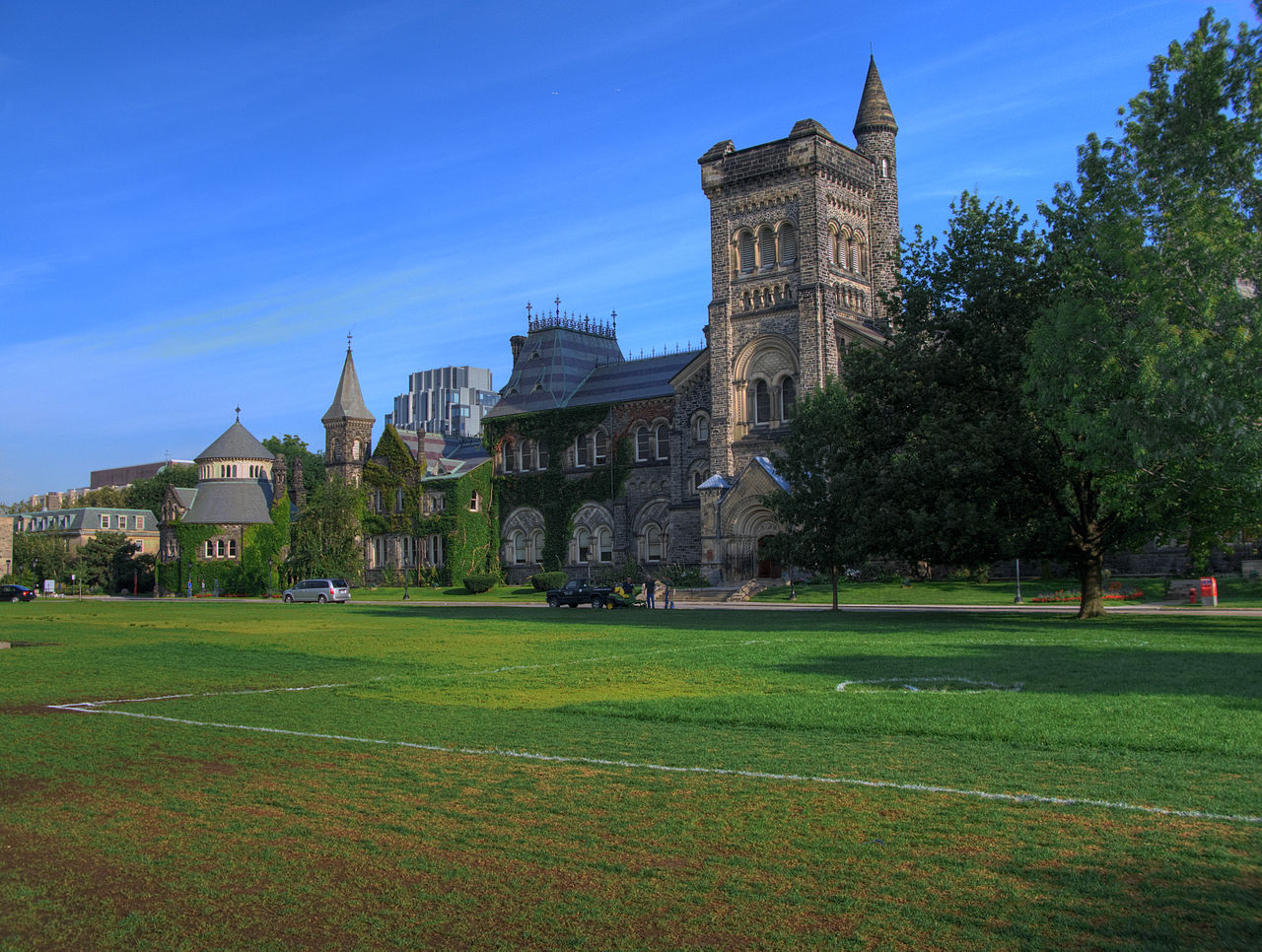
Photo by “SurlyDuff” via Wikimedia Commons.
… people from other parts of the world had heard about this wonderful place where they, too, could come and be diverse, and they started coming … from China, from Japan, from Mexico, and the Middle East, with only the distant dream of Diversity™ on their minds.
We also created great UniDiversities to increase our knowledge and awareness of Diversity™ (especially after the Democrats freed the slaves!)
But in 1972, the Republican (aka, “Nazi”) Party was founded by Richard Nixon specifically to ban Diversity™ and put to everybody who wasn’t white into concentration camps. Fortunately, the Democrats came roaring back with Jimmy Carter in 1976, who created the Department of Education that has vastly improved Education in the United States by teaching us all to be more Diverse™. Since then our education has become the best in the world! And! he graciously let 52 Americans be the guests of some nice Iranian students for more than a year just so they could become more diverse.
But then Ronald Reagan inexplicably won the election of 1980 (due to a clerical error at Trump, Inc*) and he immediately started a nuclear war with Russia. This was because he was not diverse and they were … well never mind, but it greatly reduced the Diversity™ in the world. Plus, Toxic Masculinity. Which is not Diverse™. Everyone should be more like women. That would be Diverse™.
After 12 years of cruel, oppressive Republican rule during which Reagan coerced some Germans to vandalize an historic, diverse wall, the great Bill Clinton was elected the First Black President™, which Americans thought finally ushered in Diversity™ once and for all.
But alas, it wasn’t to be, because G.W. Bush (aka “Hitler”) stole the election 8 years later by cleverly winning a majority of the votes in the Electoral College (like that was even legal!) and had the CIA fly planes into the World Trade Center and Pentagon so that he could attack Iraq. This was clearly because they were brown and he hated Diversity™, and also for oil. The United Nations had asked Saddam Hussein nicely 17 times to stop killing his own people, but it turned out he was doing it to reduce Iraq’s carbon footprint. Well this was the last straw (before California bravely banned them). Bush viciously attacked and removed Hussein from office because racism. And also blood for oil. Halliburton!!!! By the time he left office he personally had 100% control of all Iraqi oil, which he quickly lost to Dick Cheney (aka “Darth Vader”) in a drunken bet at a bar the night before the next election (Cheney then poured the oil all over Grand Teton National Park just so it could be drilled up again — also because he hates nature and especially fly-fishing).
After that, America came to its senses and elected Barack Obama, Savior of the Universe™, to be the Second First Black President™. Under his wise and kind rule, Americans began to get along Diversely like never before. Some people in Ferguson, Missouri even burned and looted a bunch of minority owned business just so they could get insurance money which they were owed by their former oppressors, who were now forever banished. It was almost the Paradise that Michael Moore proved Iraq was before G.W. Bush (aka “Hitler”) went in and started terrorism as we know it today (and stole all their oil).
Comments Off on A sneak peak at the new “History of Diversity” course outline at Woke State University
August 15, 2018
Maxime Bernier on sensible limits to “unlimited” diversity
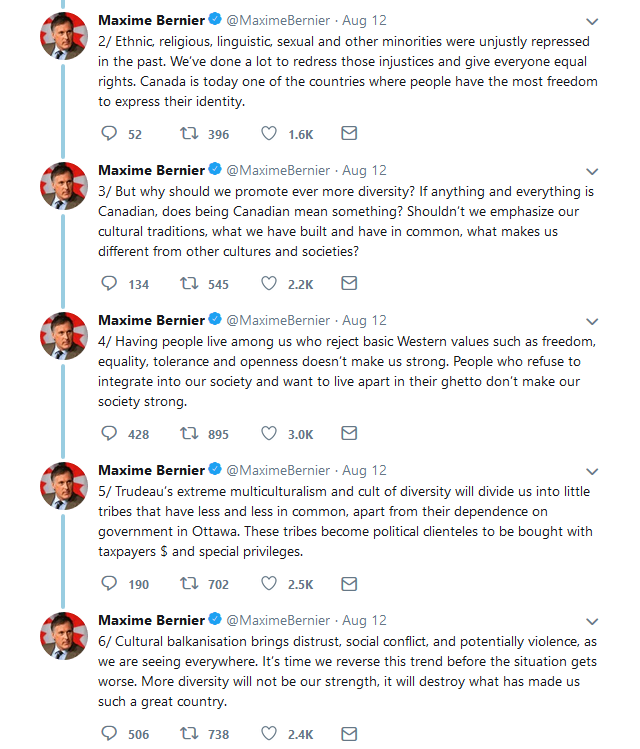
Maxime Bernier responds to Prime Minister Trudeau’s apparently unlimited desire for more and more diversity in Canada:
1/ Trudeau keeps pushing his “diversity is our strength” slogan. Yes, Canada is a huge and diverse country. This diversity is part of us and should be celebrated. But where do we draw the line?
Diversity is what makes Canada strong: Trudeau https://t.co/dZmCffRBFY
— Maxime Bernier (@MaximeBernier) August 13, 2018
The following tweets as a screencap, to avoid slowing down the whole page loading (as often happens with multiple tweet embeds):
Comments Off on Maxime Bernier on sensible limits to “unlimited” diversity
May 20, 2018
“I grew up in one of the most progressive societies in the history of humanity”
At Quillette, Konstantin Kisin discusses the differences between the utopian ideal and reality:
I grew up in one of the most progressive societies in the history of humanity. The gap between the rich and poor was tiny compared to the current gulf between the ‘haves’ and the ‘have-nots’ we find across much of the West. Access to education was universal and students were paid to study and offered free accommodation. Healthcare was available to all and free at the point of use. Racial tensions were non-existent, with hundreds of different ethnic groups living side by side in harmony under the mantra of ‘Friendship of the Peoples.’ Women’s equality was at the very heart of Government policy. According to the prevailing ideology “all forms of inequality were to be erased through the abolition of class structures and the shaping of an egalitarian society based on the fair distribution of resources among the people.”
You are probably wondering whether the idyllic nation from which I hail is Sweden or Iceland. It was the Soviet Union. In modern Britain the top 10 percent earn 24 times as much as the bottom 10 percent but in the Soviet Union the wealthy and powerful barely made 4 times as much as those at the bottom. The illiteracy rate in late Soviet times was just 0.3 percent compared to 14 percent of the US adult population who cannot read today. University students were paid an allowance to study and those from working class backgrounds were often given preferential treatment to facilitate better access to higher education. Free accommodation was available for students studying outside their home town.
The Soviet Union was a huge country populated by hundreds of ethnic and religious groups that had been slaughtering each other for centuries. In this shining example of a successful multicultural state, Armenians, Azerbaijanis, Ukrainians, Russians, Tatars, Moldovans, Belarussians, Uzbeks, Chechens, Georgians, Kazakhs, Tajiks, Turkmens, Lithuanians, Estonians, Latvians, and dozens of others all lived side-by-side as friends and neighbours.
The USSR actively promoted women’s equality in order to get more women into the workforce, with some of Vladimir Lenin’s first steps after the 1917 Revolution including simplifying divorce and legalising abortion with the stated goal of “freeing women from the bondage of children and family.” Maternity leave was generous and the state provided ample childcare centres, one of which I myself attended.
Unfortunately, despite these facts and the lofty ideals from which they were derived, the reality of life in the Soviet Union was rather different.
Comments Off on “I grew up in one of the most progressive societies in the history of humanity”


