
seangabb
Published 31 Jan 2026This section confronts the social realities of Greek civilisation that are often ignored or idealised.
It examines the position of women, the central role of slavery, ritualised violence against children, infant exposure, and what we would now describe as widespread paedophilia. Drawing on ancient sources such as Plutarch, Demosthenes, and Aristotle, it shows that these practices were not marginal, but embedded in Greek social norms and justified as rational policy.
Victorian and modern idealisations of Greece are critically dismantled in favour of historical evidence.
The aim is not moral condemnation, but historical clarity.
May 10, 2026
The Ancient Greeks: 01 – What Made Them Special? (b) Slavery, Violence, and the Reality of Greek Life
Comments Off on The Ancient Greeks: 01 – What Made Them Special? (b) Slavery, Violence, and the Reality of Greek Life
May 7, 2026
QotD: The loss of male spaces led to today’s epidemic of male loneliness
Before men were lonely, there were places.
Places where men showed up without an agenda. Where conversation happened sideways, not face-to-face. Where no one asked men to perform vulnerability, explain themselves, or justify their presence.
Those places didn’t disappear because men rejected connection. They disappeared because our culture decided male-only spaces were no longer acceptable. And once they were gone, men were told that their resulting loneliness was a personal failure.
There has been a noticeable shift in recent months. A growing number of articles now
acknowledge male loneliness and even gesture toward men’s emotional needs. On the surface, this looks like progress — and in one narrow sense, it is. For decades, male loneliness was either ignored or mocked.But many of these pieces commit the same quiet betrayal.
After briefly acknowledging that men are lonely, many articles abandon subtlety altogether and place responsibility squarely on men themselves. Men don’t open up enough. Men don’t try hard enough. Men don’t build friendships properly. Men resist emotional growth.
What is missing is the most obvious factor of all: our culture systematically dismantled the spaces where men and boys once formed friendships.
Men Did Not “Forget” How to Connect, They Lost the Places Where Connection Happened
Male friendships have never primarily formed through structured emotional disclosure. They formed through shoulder to shoulder shared activity, regular presence, and low-pressure companionship. Men bonded by working alongside one another, not by facing one another across a table and “processing”.
For generations, this happened naturally in male-only spaces:
- Service clubs
- Fraternal organizations
- Trade guilds and apprenticeships
- Male sports leagues
- Scout troops
- Men’s religious groups
- Informal gathering places like barbershops and workshops
These environments weren’t about exclusion. They were containers — places where boys learned how to be men from men, and where adult men maintained connection without self-consciousness or surveillance.
Now consider what has happened.
- Barbershops are co-ed and transactional.
- Service clubs are now largely co-ed, and the informal freedoms that supported male bonding in male-only environments have largely disappeared.
- Community sports are co-ed or heavily regulated.
- Even the Boy Scouts are co-ed.
One by one, male spaces disappeared — not because men abandoned them, but because our culture increasingly viewed male-only environments as suspicious, outdated, or morally problematic.
The Asymmetry No One Wants to Name
At the same time male spaces were dismantled, female-only spaces proliferated.
- Women-only gyms are accepted.
- Women-only scholarships are celebrated.
- Women-only commissions exist at every level of government.
- Women-only networking events, parking, subway cars, retreats, and support groups are commonplace.
“Women-only” is understood as necessary, protective, and empowering.
“Men-only”, by contrast, is treated as exclusionary at best and dangerous at worst.
The result is an unspoken rule that everyone knows but few admit:
Women may gather without men. Men may not gather without women.
This is not equality. It is a double standard — and it has consequences.
Tom Golden, “The Quiet Lie Behind Male Loneliness”, Men Are Good, 2026-01-05.
Comments Off on QotD: The loss of male spaces led to today’s epidemic of male loneliness
May 4, 2026
Our genetic heritage and our culture
On Substack, Helen Dale and Lorenzo Warby look at our genetic inheritance and how it continues to shape our culture:
From Wikipedia:
The Neolithic Y-chromosome bottleneck refers to a period around 5000 BC where the diversity in the male y-chromosome dropped precipitously across Africa, Europe and Asia, to a level equivalent to reproduction occurring with a ratio between men and women of 1:17. Discovered in 2015, the research suggests that the reason for the bottleneck may not be a reduction in the number of males, but a drastic decrease in the percentage of males with reproductive success in Neolithic agropastoralist cultures, compared to the previous hunter gatherers.
The development of farming and then animal herding greatly increased the number of humans — which continued to have evolutionary consequences for our species — and created productive assets (farms and animal herds) worth fighting over. Successful male teams (typically organised as clans) wiped out unsuccessful male teams and took their women as spoils.
Hence, there is a dramatic bottleneck in male lineages but not in female lineages. This pattern stopped with the development of chiefdoms and especially states, though not so much on the Steppes, whose states were more like super-chiefdoms and where intense competition over resources (and women) continued.1
This had consequences. A major one is that the male expression of human genes became dramatically better at forming and maintaining teams — as there was drastic selection pressure for that — but the female expression of human genes did not.
This is why young schoolboy sporting teams regularly crush adult women’s national teams in team sports such as soccer. It is not that schoolboys have the strength advantage over women associated with adult men (they are often not particularly advantaged around age 14-15). It’s simply that human males are much more likely to “get” teamwork at a visceral level.
At least some of the differences in the statistical distribution of cognitive traits between men and women comes from this genetic bottleneck’s intense selection pressure differences. This is particularly clear in social patterns. For instance, men readily form hierarchies — often using physical cues such as height to do so.
Men focus on roles, suppressing or otherwise managing their emotions to do so. They regularly test each other — hence ragging each other, making appalling jokes, etc. Such mechanisms generate trust, as they test whether you will fold under pressure, whether one can say outrageous things and still get support. Hence the popular quip:
Men insult each other but they don’t mean it. Women compliment each other but they also don’t mean it.
Men roast each other as tests because so much male interaction is about teamwork, and the roles and reliability that requires, while women typically look to emotional connection. Given that the latter requires a lot of interaction to build up trust, yes, female friendships can be quite intense, but relations between human females can also be viciously unstable and fissile.
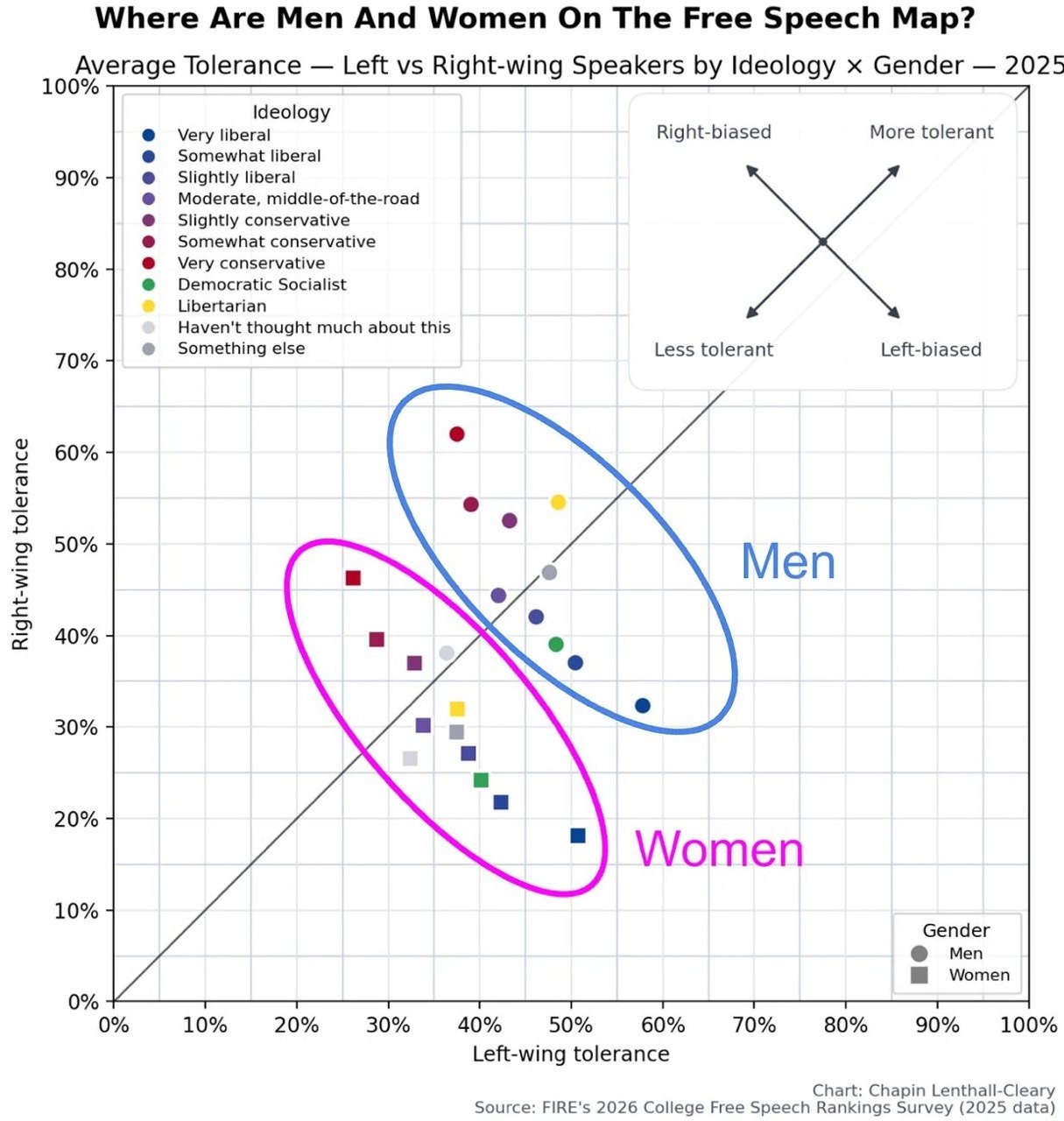
These differences have other social consequences. Men are notably more positive about free speech than women, because men often see speech as a test while women are more likely to see it as a threat. As universities have feminised, the male-female differences on free speech among students have become more pronounced. Men are systematically more tolerant of alternative points of view than are women.
Orwell’s famous comment in his novel 1984:
It was always the women, and above all the young ones, who were the most bigoted adherents of the Party, the swallowers of slogans, the amateur spies and nosers-out of unorthodoxy.
Was a great novelist doing what great novelists do: noticing.
As part of the teamwork focus, men tend to be the social solidarity sex while women are not. Women are much less likely to have friends of lower socio-economic status than are men. For women, such friends are much less likely to be worth the emotional investment. For men, they may be useful members of a future team.
As institutions, occupations and public discourse become more feminised, there has been a shift in patterns of language. A massive study of patterns of language use found a dramatic shift since the 1980s, such that:
our results suggest that over the past decades, there has been a marked shift in public interest from the collective to the individual, and from rationality toward emotion.
All this means that male-dominated institutions and spaces will be generally better, often much better, at generating and managing feedback than female-dominated spaces. When people note that feminising institutions and occupations have a strong tendency to become less functional, it is precisely because they are worse at generating and managing feedback, and at generating and maintaining trust.
- This paper attempts to explain the extreme narrowing of surviving male lineages by the adoption of patrilineal systems and polygyny. While the shift to patrilineal systems in itself does increase unequal lineage success—as does polygyny—much of the point of the shift to patrilineality was precisely that warriors who grow up together are better warrior teams.
Moreover, there is considerable evidence of violence after the shrinkage of male lineages dramatically slowed — and then reversed — with the development of chiefdoms, and especially states. These suppressed violence, but not patrilineality or polygyny. In many societies, polygyny actually intensified with the rise of states.
The bottleneck effects continued to echo down populations. The extraordinary reproductive success of particular male lineages is associated either with pastoralist violence and conquest and/or early state creation. Further, the notion that the majority of male lineages just passively accepted their reproductive exclusion flies in the face of a huge amount of evidence — especially as the examples of very successful pastoral lineages occurred in societies with notoriously high levels of violence, including as raiders, such as across the Steppes and in Ireland.
Moreover, polygyny is associated with higher rates of violence, single-spouse marriage with higher social cohesion. Nor was the creation and maintenance of states typically a peaceful process: periodic violent peaks in Chinese history, for example, were extraordinary. It was precisely the creation of a reproductively-excluded underclass that provided so much of the impetus for the banditry and mass peasant revolts that are such a feature of Chinese history. So, while patrilineality and polygyny were definitely factors in the wildly differentiated success rates of male lineages, considerable levels of violence and contestation over resources and women — that selected in favour of male teamwork — were clearly also very much in play.

May 3, 2026
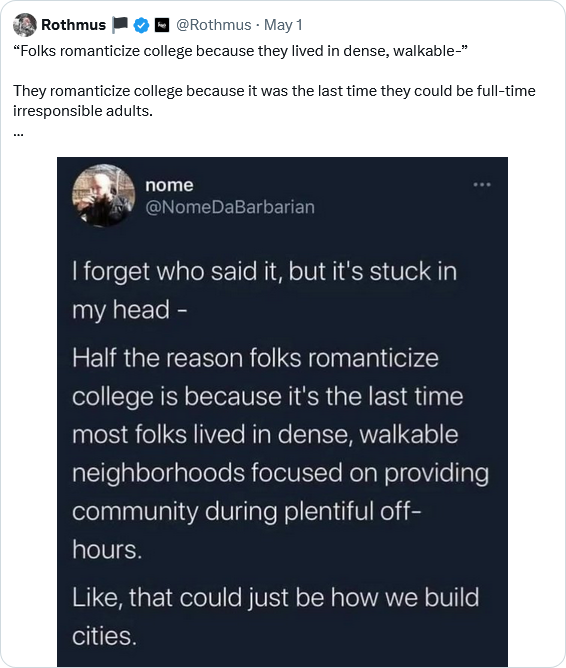
Reasons people romanticize their college experience
On the social media site formerly known as Twitter, Devon Eriksen responds to comments about people wanting the world to be like they remember their time at college:
People romanticize college because for four years of their lives they:
1. Had all the rights of adults but none of the responsibilities.
2. Lived in a closed community with sealed borders that kept out low IQs and anti-socials.
3. Were young, energetic, healthy, and attractive.
4. Were thrown together with a bunch of similar people who had no predefined power- or need-based relationship with them, which is how friendships form.
This last is the important one, especially as fertility rates decline.
People with children transition to making friends with other parents of children in the same age group, because events and networks centered around those children throw them together with other parents in the same way.
But childless people have few or no opportunities to make friends after college. So they are left with a slow dwindling circle of college based relationships, remembering the days when it was all easy, and they weren’t so isolated, and they didn’t have to work so hard.
Couple that with having to complete with infinity immigrants in the job market, so they can pay taxes to support infinity boomers and government bureaucrats, while being passed over for the best jobs and careers in favor of infinity DEI incompetents, who they also have to support …
Well, for a lot of people born into what was once the American middle class, college was their first and last experience of an adult life wherein they weren’t being systematically and deliberately routed into the formation of a new underclass.
A special form of underclass who are still expected to be productive enough to materially support all the non-producing people who were positioned as their social superiors despite being their intellectual inferiors.
So, yeah, they wish they could go back to college.
Is anyone surprised by this?
Comments Off on Reasons people romanticize their college experience
April 29, 2026
QotD: The battlefield role of the general in pre-modern battles
So instead of assessing a battle plan – which they cannot observe – soldiers tend to assess battle commanders. And they are going to assess commanders not against abstract first principles (nor can they just check their character sheet to see how many “stars” they have next to “command”), but against their idea of what a “good general” looks like. And that idea is – as we’re about to demonstrate – going to be pretty dependent on their culture because different cultures import very different assumptions about war. As I noted back in the Helm’s Deep series, “an American general who slaughtered a goat in front of his army before battle would not reassure his men; a Greek general who failed to do so might well panic them.” An extreme example to be sure, but not an absurd one. In essence then, a general who does the things his culture expects from him is effectively performing leadership as we’ve defined it above.
But the inverse of this expectation held by the soldiers is that generals are not generally free to command however they’d like, even if they wanted to (though of course most generals are going to have the same culturally embedded sense of what good generalship is as their soldiers). Precisely because a general knows his soldiers are watching him for signs that he is their idea of a “good general”, the general is under pressure to perform generalship, whatever that may look like in this cultural context. That is going to be particularly true because almost all of the common models of generalship demand that the general be conspicuous, be available to be seen and observed by his soldiers. As a result, cultural ideals are going to heavily constrain what the general can do on the battlefield, especially if they demand that the general engage personally in combat.
Different sorts of generals
We can actually get a sense of a good part of the range simply by detailing the different expectations for generalship in ancient Greek, Macedonian and Roman societies and how they evolved (which has the added benefit of sticking within my area of expertise!).
On one end, we have what we might call the “warrior-hero general”. This is, for instance, the style of leadership that shows up in Homer (particularly in the Iliad), but this model is common more broadly. For Homer, the leaders were among the promachoi – “fore-fighters”, who fought in the front ranks or even beyond them, skirmishing with the enemy in the space between their formations (which makes more sense, spatially, if you imagine Homeric armies mostly engaging in longer range missile exchanges in pitched battle like many “first system” armies).
The idea here is not (as with the heroes of Homer) that the warrior-hero general simply defeats the army on his own, but rather that he is motivating his soldiers by his own conspicuous bravery, “leading by example”. This kind of leadership, of course, isn’t limited to just Homer; you may recall Bertran de Born praising it as well:
And I am as well pleased by a lord
when he is first in the attack,
armed, upon his horse, unafraid,
so he makes his men take heart
by his own brave lordliness.On the opposite end of the spectrum, there is the pure “general as commander” ideal, where the commanding general (who may have subordinates, of course, who may even in later armies have “general” in the name of their rank) is expected to stay well clear of the actual fighting and instead be a coordinating figure. This style […] is fairly rare in the pre-gunpowder era, but becomes common afterwards. Because in this model the general’s role is seen primarily in terms of coordinating various independently maneuvering elements of an army; a general that is “stuck in” personally cannot do this effectively. And it may seem strange, but violating these norms with excessive bravery can provoke a negative response in the army; confederate general Robert E. Lee attempted to advance with an attack by the Texas Brigade at the Battle of the Wilderness (May 6, 1864) only to have his own soldiers refuse to advance until he retired to a more protected position. Of course this sort of pure coordination model is common in tactical video games which only infrequently put the player-as-general on the battlefield (or even if the “general” of the army is represented on the battlefield, the survival of that figure is in no way connected to the player’s ability to coordinate the army).
In practice, pre-modern (which is to say, pre-gunpowder) generals almost never adopt this pure coordination model of generalship. The issue here is that effective control of a gunpowder army both demands and allows for a lot more coordination. Because units are not in melee contact, engagements are less decisive (units advance, receive fire, break, fall back and then often reform to advance again; by contrast a formation defeated in a shock engagement tends not to reform because it is chased by the troops that defeated it), giving more space for units to maneuver in substantially longer battles. Moreover, units under fire can maneuver, whereas units in shock generally cannot, which is to say that a formation receiving musket or artillery fire can still be controlled and moved about the field, but a unit receiving sword strikes is largely beyond effective command except for “retreat!”
In between these two extremes sits variations on what Wheeler terms a “battle manager”, which is a bit more complex and we’ll return to it in a moment.
What I want to note here is that these expectations are going to impact where the general is on the battlefield and thus what he can do to exert command. A general in a culture which expects its leaders to be at the front leading the army has the advantage of being seen by at least some of his soldiers (indeed that is the point – they need to see him performing heroic leadership), but once engaged, he cannot go anywhere or command anyone. This is also true, by the by, in cultures where the general is expected to be on foot to show that they share in the difficulties and dangers of the infantry; this is fairly rare but for much of the Archaic and Classical periods, this was expected of Greek generals. Even if a general on foot isn’t in combat directly, their ability to see or move about the battlefield is going to be extremely limited.
On the flipside, a general who is following the “commander” ideal is likely to be in the rear, perhaps in an elevated position for observation. The obvious limitation here is that such a commander is going to struggle to display leadership because no one can see them (everyone is facing towards the enemy, after all). But that also impacts their ability to command – no one is looking at them so if they want to change their plans on the fly they need to send word somehow to subordinate officers who are with or in front of the battle line who can then use their visibility to communicate those orders to the troops.
Bret Devereaux, “Collections: Total Generalship: Commanding Pre-Modern Armies, Part II: Commands”, A Collection of Unmitigated Pedantry, 2022-06-03.
Comments Off on QotD: The battlefield role of the general in pre-modern battles
April 28, 2026
QotD: The cultural history of the Tidewater and Deep South regions of the United States
This may not seem like a huge difference — does it really matter if you’re growing wheat or tobacco, if you’re farming someone else’s land? — but it had profound implications for what happened after the indenture. In theory, the formerly-indentured should have taken on the role of either the English tenant farmer (think Emma‘s Robert Martin) or yeoman/freeholder (a small-time landowner but not of the scale or social class to be a “gentleman”). In practice, though the colony was a plantation economy exporting a cash crop: there was very little local manufacturing, since it was so easy for a ship from London or Bristol to sail right up to some great landowner’s dock on the river and unload whatever he might have ordered. Independent small-scale farmers simply couldn’t compete for tobacco export with their larger neighbors, and especially not if they also had to pay rent. But luckily for them, they had something no Englishman had had for centuries: empty land nearby. Or, you know, sort of empty. (Several of the rebellions in early Virginia were fought over the colonial government’s refusal to drive the Indians off the land former servants wanted to settle.) They could just leave.
The obvious solution for the Tidewater elites — the clear way for gentlemen to maintain an aristocratic lifestyle without a peasantry tied to the land — was African slaves. And here’s the important difference between Tidewater and it neighboring nation, the Deep South: Tidewater turned to slavery in the hopes of perpetuating their social structures, while the Deep South was envisioned from the first as a slave society.
The Deep South had been founded in the 1670s by Barbados sugar planters who ran out of room on their tiny island and were now exporting their particularly brutal combination of slave gangs and sugarcane to the coastal lowlands around Charleston Harbor. (Like the Tidewater gentry, the Barbadians had originally experimented with indentured servants from Britain, but they were worked to death so rapidly that the authorities objected.) The planter class quickly became phenomenally wealthy — by the American Revolution, per capita wealth in the Deep South was four times that of Tidewater and six times either New York or Philadelphia, and the money was much more concentrated than anywhere else in the colonies — but unlike the manorial idyll of Tidewater, with its genteel pursuits and colonial capitals all but abandoned when the legislature was out of session, the Deep South planters spent as much time as possible in the city.
Charles Town (later Charleston), South Carolina, modeled on the capital of Barbados, was filled with theaters, taverns, brothels, cockfighting rings, private clubs, and shops stocked with goods imported from London. Life in the city was a constant churn of social engagements, signalling, and status competition: in 1773, a pseudonymous correspondent wrote in the South Carolina Gazette that “if we observe the Behavior of the polite Part of this Country, we shall see, that their whole Lives are one continued Race; in which everyone is endeavouring to distance all behind him, and to overtake or pass by, all before him; everyone is flying from his Inferiors in Pursuit of his Superiors, who fly from him with equal Alacrity …” The planters of the Deep South had no interest in being lords of their estates, which were managed by overseers, or indeed in their land or the people who worked it. Certainly there existed poor whites in the colonies of the Deep South, but they never entered into the conversation: where Tidewater imagined agricultural labor performed by the English “salt of the earth” but had to fall back on slaves, the Deep South always planned on slaves.
This may not seem like an important difference, especially if you’re a slave,1 but it matters a great deal for national character. Culture, after all, lives as much in a people’s values and ideals as in their daily routines: a culture that praises loyalty to clan and family will behave very differently from one that lauds fair dealing with strangers. And the Deep Southern ideal, the nation’s vision of how life ought to be, was more or less Periclean Athens: a tremendous efflorescence of wealth, art, and personal distinction for the great and the good, with no consideration whatsoever for the slaves and metics who made up the bulk of the population. A good life meant leisure and luxury, wealth and freedom, the full exploration of personal capacity for the few and who cares about the many. The Tidewater ideal, on the other hand, was basically the Shire: bucolic, rural, politically dominated by a cousinage of great families who shared a profound sense of noblesse oblige and populated by a virtuous, hardworking yeomanry who knew their place but were worthy of their betters’ respect.
Did that world actually exist? Of course not, neither here or in its English model,2 any more than the Puritans’ commonwealth in Massachusetts Bay was a new Zion inhabited by saints. But a culture’s picture of how life ought to be determines its reaction to changing circumstance, and Tidewater pictured an enlightened rural gentry ruling benevolently over lower orders who nevertheless mattered. In contrast to the aggressively middle class northern nations, the fiercely independent Appalachians, and the elite-centric Deep South, Tidewater imagined itself as an aristocracy. And it was the only one among the American nations.
Tidewater had a disproportionate influence on the early United States, contributing far more than its fair share of early statesmen and generals as well as a healthy dose of the philosophical underpinnings for many of our founding documents. Unfortunately for the lowland Virginia gentlemen, however, they were hemmed in to the west by the hill people of Greater Appalachia: when the other nations began to expand deeper into the continent after 1789, Tidewater was stuck in its starting position. Soon the nation that had been “the South” on the national stage was dwarfed by Greater Appalachia (more than doubled between 1789 and 1840) and especially by the Deep South (ten times larger). When the young United States began to polarize over the issues of slavery, Tidewater — by then a minority in Maryland, Delaware, North Carolina, and even Virginia3 — had to retreat to the political protection of the Deep South and began to lose its cultural distinctiveness. It never really emerged again as its own ideological force.
Jane Psmith, “REVIEW: American Nations, by Colin Woodard”, Mr. and Mrs. Psmith’s Bookshelf, 2024-02-19.
- Though it actually mattered a great deal to slaves, who were imported to the Deep South in great waves only to be worked to death; the enslaved population of Tidewater, by contrast, increased steadily over the entire antebellum period.
- Though I will point out that Akenfield suggests the total immiseration of the tenant farmers in the early 20th century has something to do with the land being owned by rich farmers and implies that the local gentry are more generous employers.
- West Virginia’s eventual secession back to the Union would put Tidewater back in the majority there.
Comments Off on QotD: The cultural history of the Tidewater and Deep South regions of the United States
April 27, 2026
Abstract Expressionism “… wasn’t even real art … just a psyop”
When I first got married, we had several friends in the Toronto arts community, and while I enjoyed their company, for the most part I heartily disliked their art. Everything seemed to be consciously designed to be unpleasant to look at: jagged, rusty metallic edges, weird proportions, bilious colour choices, and so on. I was assured more than once that this was what “art” was meant to be: if it didn’t evince a strong reaction, it wasn’t doing its job. On Substack, Celina discusses the claim that modern art was actually a psyop sponsored by, inter alia the CIA:
Abstract Expressionism is arguably the most famous American art movement of the 20th century.
There’s a 95% chance you’ve seen a painting by Jackson Pollock, Willem de Kooning, or Mark Rothko, even if you didn’t know their names.
And if you’ve spent any time online, you’ve probably heard the rumours:
They were funded by the CIA.
It was all propaganda.
It wasn’t even real art … just a psyop.That sounds absurd.
Except … there is a large, large grain of truth behind it.
Jackson Pollock, Number 1A, 1948, The Museum of Modern Art, New York, NY, USA.
Manufacturing Consent
After the First World War, the journalist Walter Lippmann helped pioneer the view that the control of information and, more importantly, the control of public response, had become essential to the stability of modern democracy. This was especially true in moments when the state required certain reactions from the public, as it did during wartime. Lippmann, who famously popularised the phrase “the manufacture of consent“, argued that representative government could no longer function without the deliberate use of mass communication in the supposed service of the public good:
That the manufacture of consent is capable of great refinements, no one, I think, denies. The creation of consent is a very old act, which was supposed to have died out with the appearance of democracy, but it has not died out. It has, in fact, improved enormously in technique, because it is now based on analysis rather than on rule of thumb. And so, as a result of psychological research, coupled with the modern means of communication, the practice of democracy has turned a corner. A revolution is taking place, infinitely more significant than any shifting of economic power.1
Lippmann’s ideas about the “manufacture of consent” would not remain theoretical for long. After the Second World War, they were tested on an unprecedented scale by the American establishment.
Poets, philosophers, critics, and intellectuals became participants in it. They were recruited, funded, and mobilised to form the cultural front line of a struggle against the Soviet Union. But this was not a conventional war. There were no trenches, no battlefields, no declarations.
Instead, it was a war of ideas, fought in publishing houses, universities, art galleries, and across the airwaves. At the centre of this effort stood the Congress for Cultural Freedom.
And its story reveals just how far a democracy was willing to go in shaping what its citizens and the world would come to believe.
- Lippmann, W. (1922). Public opinion. Harcourt, Brace and Company.

Tolerance
On the social media site formerly known as Twitter, InfantryDort explains why tolerating people who want to kill you is a fatal mistake:
There is no such thing as coexistence in a scenario where people want to murder you.
The side that is the least tolerant of the other, wins. Every time.
Intolerance is the mindset of the victor.
Therefore the leftist ideologue will win in this scenario, barring some renewed resolve.
You see the signs every day.
> Their “politicians” dog whistle for murder and jail
> Their “media” dog whistles for murder and jail
> Their “protestors” will scream DEATH TO TYRANTS at you while you’re fleeing an active assassination attempt against youYou forget, we all seem to forget, that THIS ideology during the Spanish Civil War in 1936, caused people to dig up the bodies of dead nuns for very public desecration.
You can’t comprehend the level of hate that it takes to do something like that. None of us can. But they can.
So they will win, because we tolerate it.
And tolerance is a poisonous virtue when intolerance is pointing a gun at your head.
Tolerance is a noble thing among the civilized. Against the butcher, it is only a prettier name for death. When violence enters the room, tolerance becomes surrender.
We get what we tolerate. And we tolerate everything.
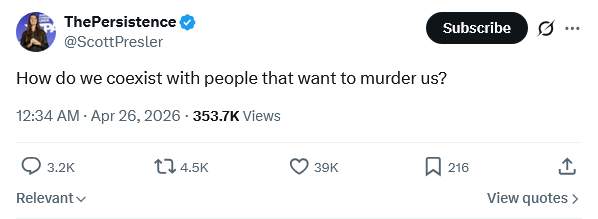
He’s quite right about the exhumation and desecration of the bodies of nuns during the Red Terror in Spain:

Pillaging and desecration of Catholic church institutions by supporters of the Republicans; the corpses of nuns from a monastery in Barcelona were ripped out of graves and displayed on a wall.
Celina wrote about the Red Terror recently.
Comments Off on Tolerance
April 26, 2026
South Korea’s switch from an exporting heavyweight to a cultural juggernaut
In the latest SHuSH newsletter, Kenneth Whyte looks at the importance of a South Korean government report to changing the structure of the South Korean economy and making the country far more visible culturally on the world stage:

South Korea, in the latter half of the twentieth century, was building its economy almost entirely by exporting manufactured goods, everything from home electronics to ships to automobiles. That changed, as the story goes, when the country’s Presidential Advisory Board on Science and Technology released a report on digital technology in May 1994. It noted that a single Hollywood film, Jurassic Park, with its computer-generated dinosaurs, generated the same amount of foreign sales as 1.5 million Hyundai cars. The darling of Korean industry, Hyundai was exporting 640,000 cars a year in 1994. So one film was worth more than two years of heavy industrial production requiring enormous plant, equipment, capital investment.
The report stunned Koreans — “literally sent shock waves across the country”, writes Doobo Shim, a Seoul-based professor of media and communication. At the time, culture and entertainment were viewed as ephemeral and unlikely to contribute to Korea’s core mission of “improving the material conditions of the people”. The country decided it needed to change its game in order to thrive in the twenty-first century economy.
It wasn’t a straight line from the Presidential Advisory Report to Parasite, Squid Game, BTS, Blackpink, and Han Kang’s Nobel prize, but it’s straighter than you might think. Seoul is now a top-five world cultural center, and arguably top two if we’re talking pop culture and anything that appeals to under-thirties. How it happened tells us a great deal about Canada’s relative failure to develop home-grown cultural and entertainment industries.
The Presidential Advisory Board report alone did not alter Korea’s strategy. The country was starting from way behind. First came democratic reforms and media deregulation. That birthed new commercial TV channels and a variety of independent publications. Now with an independent (from government) domestic media sector, Korea tried to protect it by limiting the amount of foreign cultural product in its market. That didn’t work. In 1993, 90 of the top 100 video rentals in the country were from Hollywood; only five were domestic. Sound familiar, Canada?
Protection wasn’t going to work, anyway. Another factor at play was the Uruguay Round, an international accord negotiated between 1986-1994 that decisively liberalized the global economy, forcing all 123 signatory countries to open their markets for a vast range of goods and services, including communications services and entertainment product. It was clear to Korea that efforts to protect heritage and culture by shutting out the world had no future. It needed to upgrade its efforts in the cultural sphere if it wanted to avoid being swamped by content from multinational companies, and not just American ones. Satellite television services out of Japan and Hong Kong were already making inroads in Korea.
Another thing: Korea had noticed that Japan, its nearest rival in the home electronics sector, was making investments in content. Sony had bought Columbia pictures and CBS records. It was the nineties, the age of synergy, or vertical integration. Companies making devices — video players, portable music players — also wanted to own what played on them. Korean firms such as Samsung and Daewoo, makers of TVs and VCRs, felt a need to be vertically integrated, too.
So the Presidential Advisory Report landed on fertile ground. Korean businesses felt an imperative to pay attention to content. The Korean government felt itself under siege from foreign cultural and entertainment product. “Gone are the days”, said one expert interviewed in the newspaper Dong-A Ilbo, “when the government could appeal to the people to watch only Korean programs out of patriotism”.
All that notwithstanding, the report mostly resonated because it presented culture as an opportunity. It asked Koreans to recognize the potential of arts and entertainment to improve the material conditions of the people. Instead of resisting the emerging global marketplace, the power of multinational corporations and platforms, and the free movement of talent, it needed to master this new system, compete commercially, and take Korean culture to the world.
April 24, 2026
The Mailbox Test
On the social media site formerly known as Twitter, Devon Eriksen responds to a thread about the ethics of setting up a trap that will only be effective if someone attempts to destroy it:
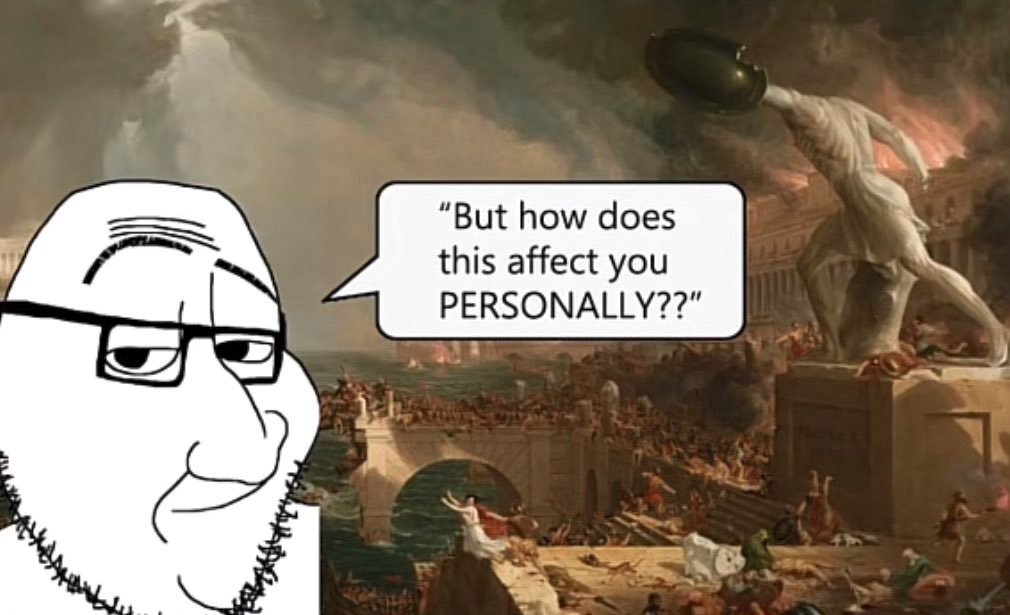
The Mailbox Test, like the breakfast test, is an excellent way to tell who you can allow to wield power in your society.
Goes like this:
If someone is hurt trying to destroy someone else’s stuff in order to take pleasure from their pain, do you sympathize with …
The aggressor because he got hurt?
Or with the guy who owns the stuff, because he wasn’t the aggressor?
You can have people in your society who fail the Mailbox Test. That’s okay … they can work at hospices, or shelters for orphaned kittens, or something.
But you cannot allow them to vote, or otherwise wield political power. Because if you do, they will open the gates of the city to the enemy.
I am personally tired of everyone pretending that people who enjoy ruining things for random strangers are just kewt smol beans who are only aggressive because of all the complex socioeconomic factors and lack of resources.
They knew someone would be hurt by what they did. They knew that someone had done literally nothing harmful to them. And those two ideas, in combination made them feel pleasure. And they went and did it.
That is the sign of a rotten soul.
Defending ourselves and our property is not just a right, it’s a moral obligation. Otherwise, we just kick the can down the road for someone else to deal with, someone who may not be able to defend herself.
I don’t care if a vandal breaks his arms trying to destroy my stuff. Because I value my stuff more than a vandal’s arms. And the fact that he tried to destroy somebody else’s stuff shows that he, too, values his arms less than the opportunity to hurt somebody.
We cannot allow such people inside the city, and we cannot give the keys to those who would open the gates for them.
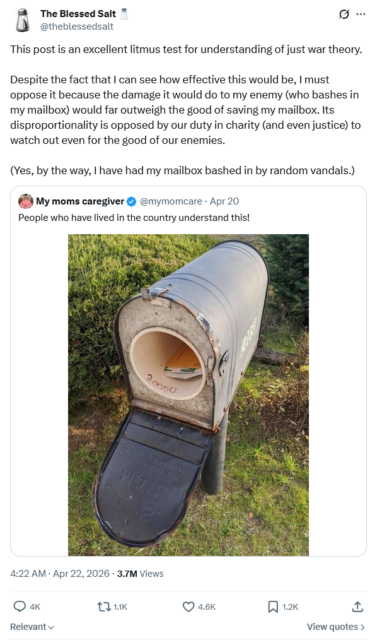
Another response to the original post from Kit Sun Cheah:
Sure, this adheres to a strict interpretation of Just War Theory.
However … we’re talking about a mailbox.
A mailbox is not a weapon. It does not serve any military purpose. Its existence is entirely inoffensive.
That is why it is an easy target.
A reinforced mailbox is purely defensive. Do not meddle with it and it will leave you alone. Strike it, and Newton’s Third Law kicks in.
Poke it and nothing will happen to you. Try to smash it and you risk smashing your own arm. It does not amplify an incoming force, it merely resists and returns it. Thus it is inherently proportionate.
No law or theory of war requires that you advertise your capabilities. Concealment may feel wrong to a certain type of personality, but openness is not always a social good.
Yes, you can fortify the mailbox in a blatantly obvious fashion. Some ne’er do well will notice it, then decide to pick another easier mark.
You have deterred an attack on your own property by redirecting attention to someone else’s.
Now suppose the mailbox were covertly fortified. A vandal strikes it and is injured. He passes along word to his friends, and their friends. Then they will start to wonder: are all the mailboxes reinforced?
They can’t tell, so they must assume every mailbox is fortified.
Thus, covert reinforcement does more to deter aggression than overt reinforcement. And ultimately, we want to see an end to mailbox destruction.
This post is not about just war theory or mailboxes.
Update, 25 April: Welcome, Instapundit readers! Have a look around at some of my other posts you may find of interest. I send out a daily summary of posts here through my Substack – https://substack.com/@nicholasrusson that you can subscribe to if you’d like to be informed of new posts in the future.
April 20, 2026
Civilization-building is gendered, sorry ladies
On Substack, Janice Fiamengo explains why the very different strengths and weaknesses of men and women will always lead to what appear to be unequal results, and fighting against biology is always a bad idea:
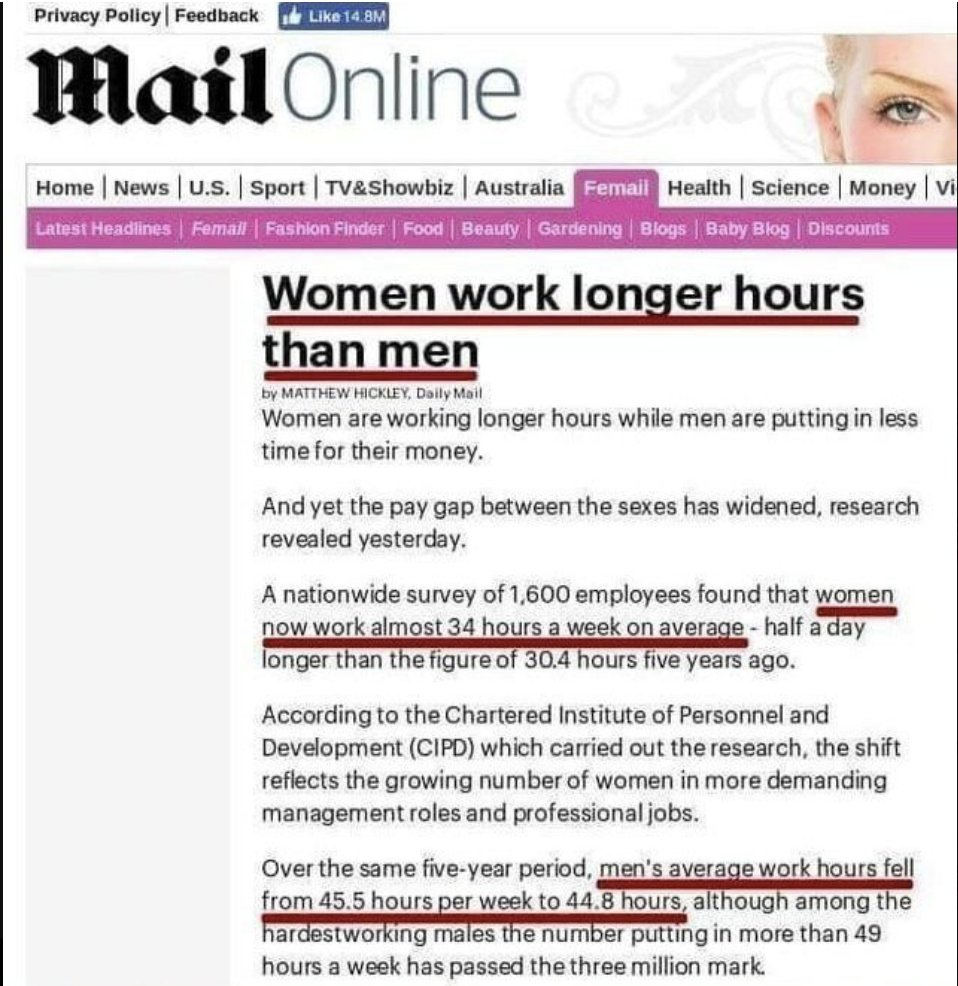
Even if the numbers don’t back it up, women feel that this is so true.
Social psychologist Roy Baumeister explored the relevant research in Is There Anything Good About Men (2010), a cautiously non-feminist book in which the author readily asserted that he, like most everyone else, prefers women to men. Women are more lovable, he claimed, and more pleasant to be around.
But he was not quite willing to accept the now-mainstream thesis that women can replace men in all areas of society.
His thesis is summed up in the book’s sub-title: How Cultures Flourish By Exploiting Men. Men are the foot soldiers of civilization as well as its leaders. They are the ones who make things work or make new things.
Men are the ones who must prove their utility to society. Their drive to be useful has powered centuries of back-breaking work, risk-taking, tool-building, self-sacrifice, and outstanding performance of a sort that has never been expected of women (and still isn’t).
Women in the main tend not to work as hard as men to succeed because they don’t have to. Women developed different strengths and tendencies.
Women’s strength, for good and ill, is in the inter-personal arena: not only in caring for those who are weaker but also in being cared for by those who are stronger. Women are good at reading people’s emotions and desires, and at expressing their own.
Men are not rewarded for expressing emotions and desires; men are oriented to acting, often under pressure to perform competently, in large groups and systems.
“The female brain,” according to Baumeister, “tends to be geared toward empathy, which includes emotional sensitivity to other people and deep interest in understanding them and their feelings. In contrast, the male brain is oriented toward understanding systems, which means figuring out general principles of how things operate and function together, and this applies to inanimate objects as much as social systems” (p. 85).
Baumeister supports his argument in a book-length exploration of men’s system-building. He shows how men are driven to work with, and in competition with, other men to make it possible for large numbers of human beings to live together in complex, efficient networks. The large social institutions that have characterized western cultures, from the army to churches, from corporations to unions, and from market places to police forces, give evidence of men’s system-building.
Women can work well within the systems that men devise, but they rarely devise new systems on their own. This is not because women are, on average, less intelligent than men (except at the very highest levels). It is because women’s motivations and sources of satisfaction are generally different from men’s.
Women’s contribution to culture in nurturing children, providing companionship, and looking after the family home has been a crucial one. But it does not drive innovation or invent new technologies.
Even the most intelligent women are rarely compelled, as highly intelligent men often are, to pursue scientific and other breakthroughs with the single-minded focus necessary for greatness. Often, as in the case involving Matt Taylor discussed above, many women do not seem to value or understand the nature and importance of such breakthroughs.
Women’s main contribution in the male civilizational sphere has been to lobby for admission and then to complain about, and work to undermine, the male culture of competitive excellence.
April 11, 2026
Declining educational standards are now “a civilizational catastrophe”
On the social media site formerly known as Twitter, Brandon Zicha points out that the declining educational standards across the west are now to the point of “a civilizational catastrophe”:
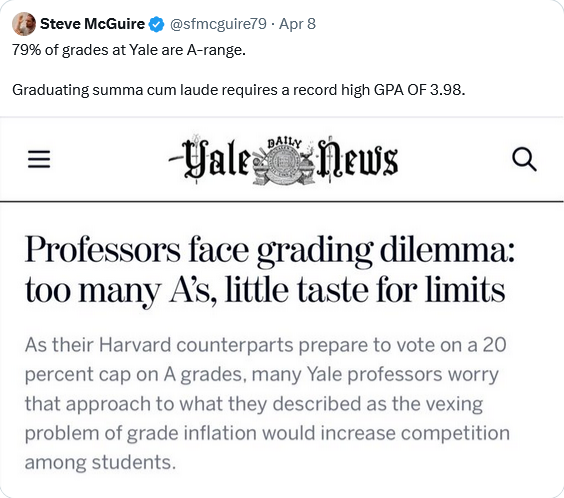
A student today at my elite university admitted to me today that she took a class so she could work on reading for more than 20 minutes at a time. She can’t read. She mainly skims and summarizes, she says and still gets A’s.
This student is, by professional standards, illiterate. Gonna have high GPA when she graduates.
This conversation was had after 6 of 22 students dropped my course because the maximum reading per week in one week was over 100 pages.
What people aren’t grasping is that this is literally *dangerous*. These people are going to be come doctors, engineers, etc. They are — by any metric — vastly less capable than prior generations. These effects are cumulative over a lifetime.
This grade inflation is part of the problem, but not even close to the entirety. And the problem obviously starts in K-12.
Students don’t know history because, you can’t actually become historically literate on the advice of “never assign more than 30 pages a week”. You can’t develop any of the skills that came with literacy. This is, quite honestly, a civilizational catastrophe.
Another student who seemed really interested in history … confirmed he was … but doesn’t read. He watches Youtube …
… which explained how the conversation went after when I pressed further.
I coteach a class with a colleague … but I am lead … for the past 15 years. I was discussing complaints from students and he pointed out that we have reduced the difficulty and load every 3 years or so since the beginning, and we probably have to stop.
I agreed. But, the students were absolutely irate, and complained about how it left them no time to “reflect” … a load about 30% less than when the course started.
That is an objective decline in ability.
Honestly, I hadn’t even noticed until he pointed it out. It was just incremental.
Changed how I approach teaching.
A good colleague is worth a thousand teaching development seminars.
(quick note … most of those 6 dropped for this reason … not each one … there was a double booking or two)
I feel like I need to point out that the student in the original tweet is a model of *what to do*.
This student is the hero of my tale, but is overcoming something they should not have to, and that is disasterous if it is as widespread as it seems it may be, and they aren’t all similarly driven.
This student? The hero.
Not a dunk.
Another clarification:
I’m a small account here … Didn’t expect the affection.
The student is literate. Not a professional university level (or what it’s ever been).
It was hurried poor phrasing.
The student seems aware that their reading retention and scope is not what it should be … And is addressing it!
Summarizing:
The concern isn’t my (actually heroic) student, but the trend that student is tackling under her own steam …
I routinely here professors complaining about students who:
1.) Can’t or won’t read at levels we have never seen.
2.) When they do, their ability to connect between texts and evaluate is poor. Indeed, grasping the text is not great. It’s increasingly the norm, and it used to be the opposite.
3.) They struggle to reason, honestly.
4.) Most weirdly, we struggle to talk about “reflecting on ones ideas”. They often struggle to understand *what that means*. This suddenly started where students didn’t understand what this meant.
5.) They have declining writing skills.
6.) They have lower interest in ideas
7.) They are less sophisticated in their ability to manipulate ideas
8.) They are much worse on many of the metrics associated with high level reading ability.At the same time
1.) Study times have declined.
2.) Assigned workloads have declined a great deal
2.) Hiring employer complaints about graduate quality hasdeclinedincreased continually.
3.) Grades have remained the same or gone up.… in the past decades, but particularly the last decade to an alarming degree. This is not about one student’s situation, or whether or not one should be “readmaxxing” in college, reading 500 pages plus.
… and just look at the examples cited in this thread.
We have a major issue to address here, folks. Civilizational level issues. And, I genuinely don’t feel we are having the conversation we need to be having yet.
Update, 12 April: Welcome, Instapundit readers! Have a look around at some of my other posts you may find of interest. I send out a daily summary of posts here through my Substack – https://substack.com/@nicholasrusson that you can subscribe to if you’d like to be informed of new posts in the future.
April 7, 2026
“The Eight Hundred Years of Oppression”
On Substack, Upper Canadian Cavalier examines “The Irish Question”:
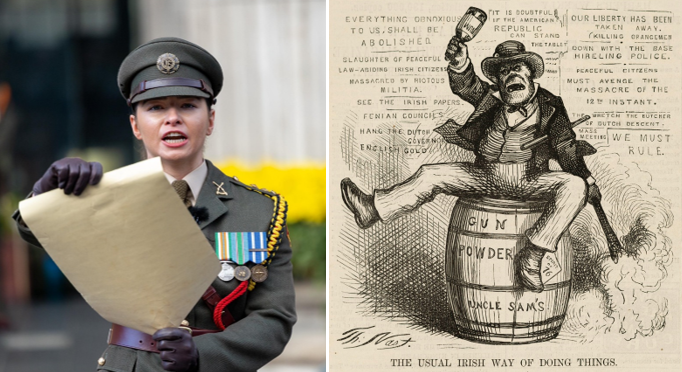
Every confidence scheme requires three things. A mark who is sympathetic. A grievance real enough to be credible. And an operator whose entire livelihood depends on ensuring the grievance is never actually resolved. Resolution ends the game. The operator does not want justice. He wants the next fundraising dinner.
Irish nationalism, in its mature institutional form, is one of the longest-running confidence schemes in the history of democratic politics. This is not to say the underlying grievances were invented. English rule in Ireland produced genuine catastrophes, and anyone who tells you otherwise has not read much history. The point is not that the wounds were fake. The point is that a very specific class of people discovered, sometime in the nineteenth century, that a bleeding wound is worth considerably more than a healed one, and they have been salting it professionally ever since.
The operators of this scheme are not a conspiracy in any tidy sense. They do not meet in a room. They are, rather, an ecosystem: the Sinn Féin political class, the Irish-American fundraising establishment, the Gaelic cultural bureaucracy with its language boards and arts councils and grant committees, and undergirding all of it for most of its history, the Catholic Church, which managed the remarkable trick of positioning itself as the spiritual soul of Irish resistance while simultaneously running the country’s schools, hospitals, orphanages, and laundries with the administrative efficiency of a medium-sized colonial power. They share no common mailing list. They share something considerably more durable: a common interest in a people who define themselves entirely by what was done to them, because such a people will always need someone to explain what it means.
That someone, naturally, has a salary. Sometimes several.
Part One: The Invoice That Never Clears
The foundational text of Irish identity is not a poem or a legal document or a philosophical treatise. It is an invoice. The Eight Hundred Years of Oppression, presented at every available occasion, never stamped paid, accruing interest at a rate that defies actuarial calculation. It is invoked at pub tables and university seminars and Boston fundraisers and Sinn Féin press conferences with the solemn regularity of a liturgical response, which is appropriate, since it has become one.
Eight hundred years. Let us sit with that number for a moment, because it deserves scrutiny rather than reverence.
The Poles were partitioned entirely out of existence for a hundred and twenty-three years, absorbed simultaneously by three empires, had their language banned, their nobility liquidated, their clergy persecuted, and their country removed from the map of Europe with a finality that the Irish situation never approached. They rebuilt it. They were then invaded again from both sides at once within living memory, occupied by The Nazis and Soviets losing somewhere between five and six million citizens in six years. They do not, as a general rule, organize their entire national identity around the experience. They built things instead.
The Armenians experienced something so total it required the coinage of an entirely new word to describe it. The Acadians were physically deported. The Welsh had their language suppressed for centuries by a state apparatus that regarded Welsh-speaking children as candidates for corrective intervention, which is considerably more systematic than anything the Penal Laws produced. The Greeks spent nearly four centuries under actual Ottoman administration, not the notional suzerainty that characterized much of the Anglo-Irish relationship, and emerged and got on with being Greeks.
None of them made Eight Hundred Years into a brand.
What distinguishes the Irish accounting of oppression is not the severity of the oppression, which was real but not historically singular, but the extraordinary care with which it has been packaged, maintained, and exported. The Famine, which ended in the 1850s, is still discussed in certain Irish-American circles as a recent bereavement requiring ongoing condolences and, more usefully, ongoing donations. The emotional statute of limitations has never been permitted to run. Each generation receives the invoice freshly printed, as though the debt were personally owed to them and personally owed by someone who can still be made to feel bad about it.
Comments Off on “The Eight Hundred Years of Oppression”
NATO’s sudden-onset existential crisis
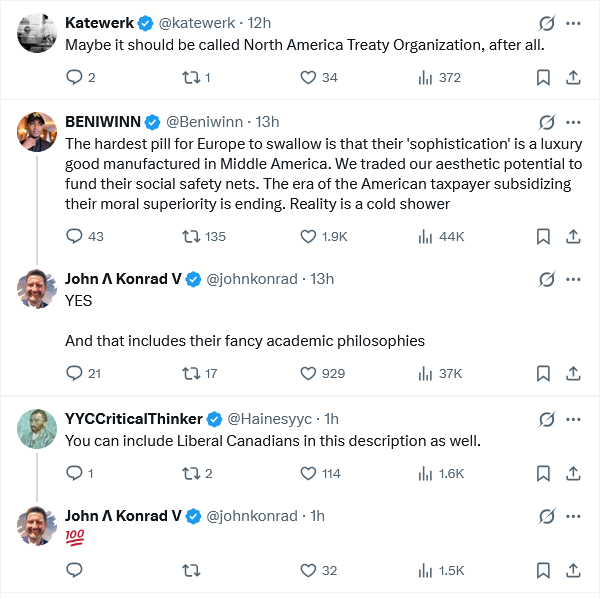
On the social media site formerly known as Twitter, John Konrad explains that the sudden crisis facing the European NATO allies has been building un-noticed for decades:

NATO is in far bigger danger than anyone realizes. And the reason has nothing to do with defense budgets.
The real danger is psychological. It’s cultural.
Europeans didn’t just free-ride on American security for 80 years. They built an entire identity around the idea that they evolved past the Americans protecting them.
That identity is now the single biggest obstacle to Western survival. And the darkest irony is: we helped build it. After World War II, Europe wasn’t just economically shattered. Its culture was in ruins. The cities, the universities, the concert halls, the museums. Rubble.
The Marshall Plan rebuilt the economy. But culture wasn’t a priority. Not at first. Then the Iron Curtain dropped. And suddenly culture became a weapon.
American diplomats, academics, artists & scholars flooded Western Europe. We funded their universities. Supported their orchestras. Rebuilt their museums. Promoted their intellectual life.
Not because European culture needed saving for its own sake.Because Eastern Europeans were struggling for Maslow’s mist basic needs.
We needed the view from the other side of that Wall to be intoxicating.
So America built Western Europe into a showcase of self-actualization. Art. Philosophy. Cafe culture. Long vacations. Universities where people studied literature instead of surviving. We were manufacturing jealousy.
And it worked. The Wall came down.
But here’s what no one accounted for.
When you give a society self-actualization on someone else’s tab long enough, they forget it was a gift. They start believing it was organically theirs.
And when they look at the country that funded it all, a country busy building aircraft carriers and semiconductor fabs and shale fields instead of reaching the Maslow’s pinnacle.
An overweight American in a ball cap who can’t tell Monet from Pissarro. Who eats fast food. Who drives a truck. Who builds strip malls instead of piazzas.
And to a culture trained in aesthetics but stripped of strategic awareness, that American looks uncivilized.
So the arrogance takes root. And once a culture decides another is beneath them, they stop listening.
Americans say wars are sometimes necessary: crude.
Oil is the backbone of prosperity: unsophisticated.
Kids build companies in garages that reshape the planet: crass.
Wall Street finances the global economy: vulgar.
Europe has no world-class technology sector. No military capable of strong defense. No energy independence. No AI capacity.
What Europe has is culture. The culture we paid for at the expense of us reaching Maslow’s pinnacle.
For decades that was fine. We funded the museums, protected the sea lanes, and tolerated the sneering because the arrangement worked.
Then Europeans stopped keeping the contempt private. They started saying it to our faces. In their media. In their parliaments. At every international forum. “Americans are stupid. Americans are violent. Americans are a threat to democracy.”
We could have moved the Louvre to NY. We could have built a Venice here. We could have stolen your best artists, designers, philosophers and more … like your conquering armies did for centuries.
Instead we funded them. And all we asked for in return was to let us visit.
You don’t have the military to defend your borders. You don’t have the technology to compete. You don’t have the energy to heat your homes without begging dictators.
What you have is an 80-year superiority complex FUNDED BY AMERICANS, protected by American soldiers, and built on the false belief that self-actualization is civilization.
It isn’t. Civilization is the ability to sustain itself. By that measure, Europe isn’t a civilization at all. It’s a dependency with better wine.
That’s not a threat. It’s a weather report.
Build a Navy. Or don’t. But stop lecturing the people who made you “better than us”
Our “crudeness” our “stunted liberal education” our “ugly strip malls” are because we sacrificed our culture to support yours.
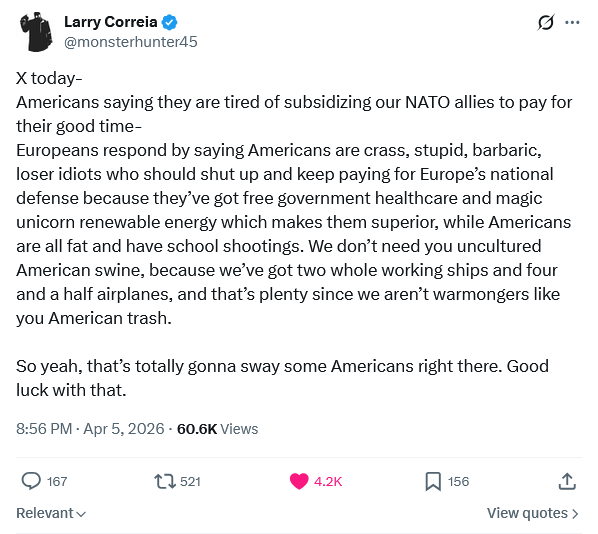
From the comments on that post:
Larry Correia chimes in:
Update, 8 April: Welcome, Instapundit readers! Have a look around at some of my other posts you may find of interest. I send out a daily summary of posts here through my Substack – https://substack.com/@nicholasrusson that you can subscribe to if you’d like to be informed of new posts in the future.
April 4, 2026
If we think that “ordinary criticism and disagreement are bullying, then we have an infantilized and feminized culture”
Chris Bray finds a highly accurate label for the pearl-clutching “elites” who — to a persyn — believe that your words are violence, but their violence (delivered through third parties, of course) is merely emphatic communication to the distasteful lower orders:
Donald Trump is a mean man. He’s a bully!
Oh no SCARY, he’s trying to BULLY the Supreme Court! I wrote at the Federalist this week about the stupidity of this argument — what is he implying he can do to the life-tenured justices, for crying out loud? — but I suspect I undersold the underlying sickness. Adults don’t use the word “bully” to talk about other adults, arguably outside of a few very narrow spaces involving things like domestic violence. It’s a preschool word. The easy recourse to toddler language at the New York Times is a sign of cultural regression. But it’s also a sign of habitual and persistent dishonesty. They’re pretending. I suspect they’ve pretended so much that they’ve forgotten they’re pretending, and the mask has become the face, but at root, they’re pretending.
We have fictional characters like Willie Stark and Frank Underwood because no one on the planet is dumb enough to think that politics is nice. The federal government spends $7 trillion a year, and the lure of that bucket of money brings out a bunch of throatcutters. This is possibly one of the most obvious realities of human existence. Politics is a knife fight. […]
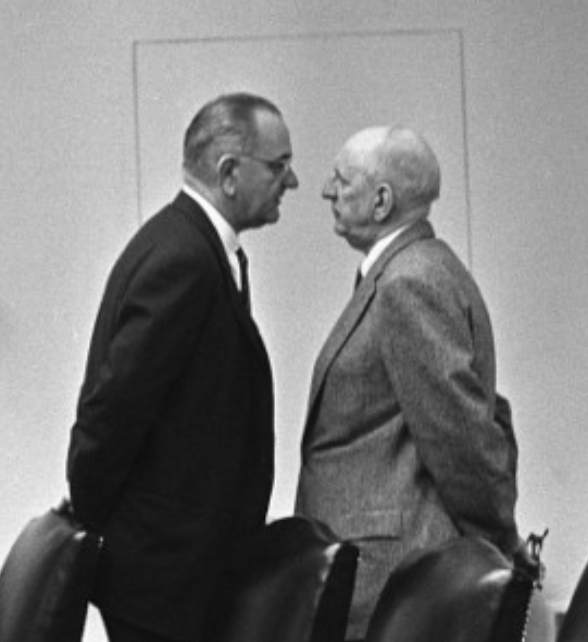
Quite famously, members of Congress who suggested that they would oppose the legislative priorities of President Lyndon Johnson would get phone calls in the middle night from the man himself, waking them up and letting them know that they were dead men. He’s supposed to have said things like, “I’m gonna cut your balls off, you cocksucker”, though it’s not like anyone had a stenographer on the calls to nail the quotes. He was threatening and nasty on all days ending in -y, and got bills passed by, among other things, actually, physically intimidating people who didn’t roll over. He was a leaner. He got in faces, constantly and openly.
You gonna pass my bill [insert string of highly personal threats and profanity], or is your political career over? Pressure, threats, and horsetrading are the default behaviors, the normal stuff. Andrew Jackson got the Indian Removal Act through Congress by handing out government sinecures. The premise that I can take care of you or I can go to war with you, and it’s your choice which one happens is … politics. The make-believe story about Mean Donald Trump bullying the Supreme Court by tweeting at them or sitting in a chair where they could see him is playtime, clutching at Fisher-Price pearls. Somewhat remarkably, Trump appears to bully institutional opponents quite a bit less than the historical norm, and Lisa Murkowski can do whatever she wants without consequence. I am personally calling for Donald Trump to start actually bullying some people who have it coming, but be sure to have a fainting couch ready in the newsroom at Times Square.

Update, 6 March: Welcome, Instapundit readers! Have a look around at some of my other posts you may find of interest. I send out a daily summary of posts here through my Substack – https://substack.com/@nicholasrusson that you can subscribe to if you’d like to be informed of new posts in the future.


