
Some UK expressions just work better than their American equivalents. When I’m exhausted, I’m not just tired anymore, I’m properly knackered. Or shattered, which I reserve for those soul-deep levels of tiredness that only a long week of work and braving British traffic can induce.
The surprised expressions caught me off guard at first. “Blimey!” and “Crikey!” initially felt theatrical coming out of my mouth, as if I were performing in a period drama. But they’ve grown on me. There’s something deeply satisfying about a good “blimey” when you’ve just discovered the cost of your heating bill (although, if I’m honest, my partner would be far more expletive about it).
Then there are the words that capture concepts and objects I didn’t even know I needed:
Faff — The act of fussing around with something, whether it’s organizing (like a “bag faff” when you’re rearranging everything in your bag) or just messing about when you should be just getting on with it. [NR: “Faffing about” is a regular bit of my vocabulary — I picked it up from my wife’s uncle on our first trip back after we got married.]
Cheeky — That delightful word for something (or someone) playfully impudent. A cheeky pint. A cheeky biscuit. A cheeky comment from a cheeky child. Americans don’t have an equivalent that carries the same affectionate mischief. [NR: I use the word occasionally, but only in the “cheeky comment” sense. I suspect the other usages developed after we came to Canada.]
Chinwag — A chat or conversation, usually informal and friendly. “Having a chinwag over tea.”
Wheelie bin — A bin with wheels, which is exactly how I explained it to my sister-in-law when she asked what one was. Somehow it sounds less depressing than “trash can” when you’re dragging it to the kerb in the rain, though I can’t explain why. [NR: My cousin in Edinburgh used this term and we laughed ourselves silly … but it’s a useful phrase as wheelie bins are much more common here now.]
Bits and bobs — Covers all those miscellaneous things better than any American phrase. “I need to pick up some bits and bobs” is so much more charming than “I need to run errands”. [NR: I use this phrase all the time, also referring to accessories, jigs or associated “bits”.]
Picky bits — Those yummy nibbles you put out before a meal or during drinks. Americans would say “appetizers” or “snacks”, but “picky bits” is somehow more fun and less formal.
Lashings — A generous amount of something, usually used with food. “Lashings of butter” sounds so much more indulgent than just “a lot of butter”.
A lie in — Sleeping in, staying in bed late. “I had a lovely lie in this morning” sounds so much more luxurious than “I slept in”.
When I’m pleased about something, I’m chuffed to bits. It’s the British equivalent of my American “tickled pink”, though somehow “chuffed” sounds a bit less old-fashioned. When something’s gone wrong, I’m gutted — which is just more emotionally accurate than “disappointed” when your team loses or your train’s been cancelled. When someone’s being ridiculous, they’re a pillock (an insult that somehow sounds almost friendly).
Daft has replaced “stupid” in most contexts because it’s softer, more affectionate, somehow. Posh carries weight that “fancy” just doesn’t. And I’ve learned that “taking the mick” means teasing someone, though I’m still not entirely confident I’m using it right.
Pants can mean trousers, underwear, or that something’s rubbish (as in “that film was pants”) — that was a confusing first month trying to figure out which meaning applied when.
Speaking of films — it’s always a film, never a movie, and you see them at the cinema, not a movie theater. I still slip up on this one regularly. Pro tip: when browsing Netflix or BBC iPlayer in the UK, search for “films”, not “movies”, or you’ll come up empty-handed.
Dodgy covers everything from suspicious strangers to questionable leftovers. When something’s sorted, it’s all taken care of. My spouse uses “lovely” for everything from a cup of tea to a sunset to the bins being collected on time.
When it’s cold outside, it’s not just chilly — it’s parky. When I mentioned it was “a bit parky” on a call with my family, they immediately asked, “So that means you wear a parka when it’s parky?” Fair question, honestly.
When it’s very windy, it’s blowing a hoolie — which sounds far more dramatic than “blustery”, and right now with Storm Amy hitting the UK, it’s particularly relevant (I hope my readers in Scotland are all ok).
When a place is packed, it’s chocker. The pub’s chocker. The motorway’s chocker. It works for everything, where Americans would say “packed” for a pub or “bumper to bumper” for traffic. These words just have more personality than their American equivalents.
The car vocabulary is starting to creep in, and I have to think about it more now. The boot sometimes wants to replace “trunk”. The bonnet makes sense when I hear it instead of “hood”.
And then there’s reckon, which occasionally slips out instead of “think”. I’m trying to hang onto my Americanisms for as long as I can, but it’s getting harder to resist.
Marianne Jennings, “Squeaky Bum Time and Other British Phrases I Never Knew I Needed”, An American’s Guide to British Life, 2025-10-05.
September 7, 2026
QotD: “Knackered”, “shattered”, and other useful Britishisms
September 4, 2026
Loyalist Canada to Liberal Canada, a political devolution
On Substack Notes, John Carter discusses the old, stable Canada that the Liberals have spent sixty years trying to destroy, with great success, sadly.

For all intents and purposes, post-1965 Liberal Canada is a completely different country from the Loyalist Canada that it erased. Different flag, different basis for moral legitimacy, different constitution even.
Liberal Canada loves to wear poppies on Remembrance Day, but this is stolen valour. Liberal Canada has never won a single war. Loyalist Canada won every war it fought in.
Liberal Canada built no great works. Most of the infrastructure of Canada was constructed before Liberal Canada. The Trans Canada Highway, the Trans Canada Railroad, the Pickering Nuclear Power Plant, the Toronto subway, the Montreal Metro — all were built or initiated by Loyalist Canada. Liberal Canada completed the projects that began under Loyalist Canada, but initiated none of its own, and at best can be said to maintain the infrastructure it inherited … badly. Liberal Canada cannot even build a pipeline to bring its oil to market. Liberal Canada cannot even refine its own oil.
Loyalist Canada built out an organizational infrastructure of Crown Corporations which were once the envy of the world. Liberal Canada dismantled them, giving us toll roads owned by foreigners.
Loyalist Canada built all of this infrastructure, and won all of those wars, without incurring a national debt. The national debt was accrued entirely by Liberal Canada, and is entirely a function of social welfare programs it uses to turn Canadians into domesticated clients of Liberal Party patronage, and indentured servants of the banks.
Then of course there are the demographics. Loyalist Canada was a white Canada, a British and French Canada, and a fecund Canada, with one of the world’s highest birth rates. Liberal Canada is a barren Canada, with one of the world’s lowest birth rates, and it has presided over the systematic replacement of the Canadian people with Indians, Chinese, Africans, and Muslims, to whom it moreover extends preference for social services, university admissions, and employment. Liberal Canada makes Canadians second class citizens in the land their ancestors built.
Liberal Canada is a parasitic entity that is rapidly killing its host. It is an exhausted Brezhnevian sclerocracy that destroys ambition because even the most modest of ambitions are a threat to the soft men, the mild bureaucrats and glassy-eyed ideologues who subsist on the arbitrage of national decline. Liberal Canada is weak, and so it demands that its subjects be even weaker, as this is the only way for weak men to rule.
Liberal Canada is not the real Canada, and Canadians are beginning to wake up from this long nightmare of mismanagement and institutionalized treason, and to remember who they are.
QotD: My generation
That’s why one of the weirdest things about getting older is realizing just how much of what you took for granted as part of the permanent furniture of the world was actually highly transient: The Iron Curtain. Guitar rock. Your own hopes and dreams and ambitions. Sometimes they all come wrapped together like a package deal, and failing at one makes it seem like you’ve failed at it all.
Andrew Potter, “Eddie Van Halen, Bill and Ted, and mourning a generation”, The Line, 2020-10-14.
September 3, 2026
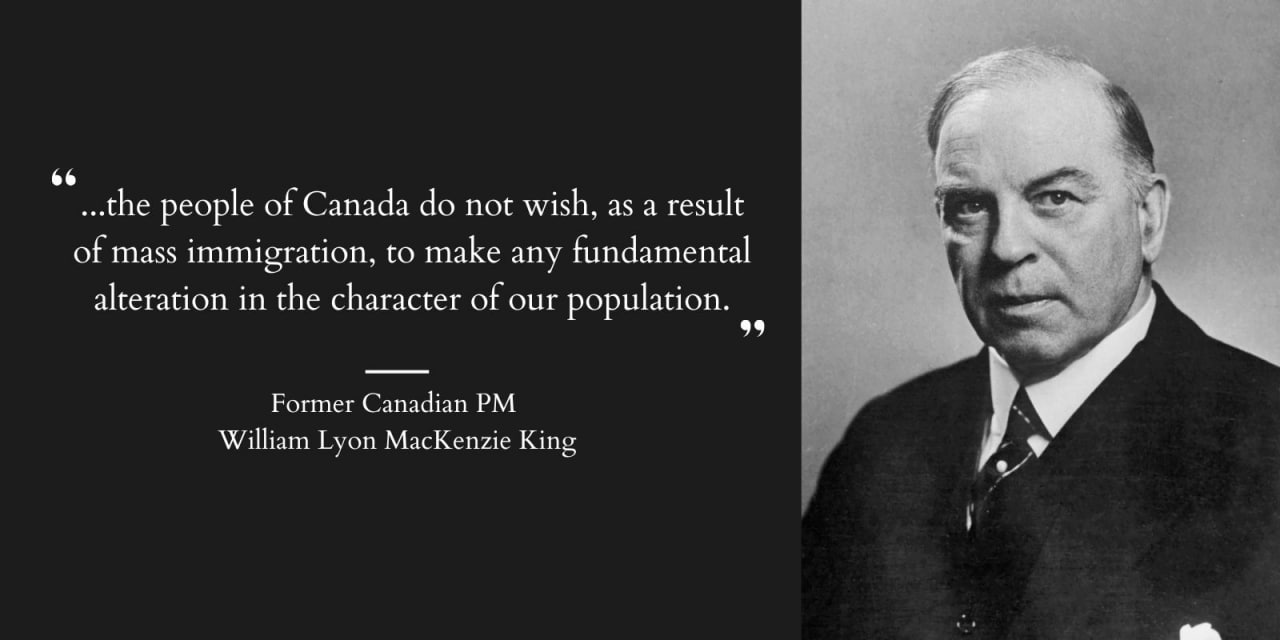
John Carter reports on “the largest gathering of Canadian nationalists in generations”

Canadian Red Ensign 1921-1957
Having been peripherally involved in party politics in Canada since the mid 1970s, I hope you’ll forgive my occasional bout of cynicism about getting political change in this country through peaceful means … the long comfortable decades under the US nuclear umbrella has allowed Canadian political parties to get ever more unserious and willing to pretend that taking a two-and-a-half generations-long vacation from the world of realpolitik has been somehow our birthright. I love my adopted homeland and it is distressing to see how easily the Liberal propagandists (supported by the state-funded relic media) can get elbow-flapping choruses of Canadian boomers to chant the slogans and blandly accept the grand theft from their children and grandchildren without a blush of shame.
John Carter says there may still be hope that enough Canadians have recognized the awful situation we’re in and are willing to do what’s necessary to change our collective ways and get back onto a path of constructive nationalism rather than the tame opposition of the current Conservative Party:
I don’t want to overstate things, but I think this was an historic moment.
It was also a hell of a ride.
The Dominion Society was founded barely over a year ago, and rapidly exploded to over three thousand members across the country. It is a peaceful and explicitly non-partisan political advocacy group dedicated to advancing the cause of remigration within Canadian civil society. So far its activities have consisted mainly of selling branded merchandise, putting up posters, cleaning up parks, rallies to oppose Canadian towns from tearing down statues of Sir John A MacDonald and Samuel de Champlain, and a whole lot of social media campaigns.
To anyone in possession of some shred of sanity, all of this would seem to be entirely unobjectionable and non-threatening. To the Canadian government, which long ago released its hold on the last tenuous threads of sanity, this is a five-alarm political fire. They are, it seems, terrified of the Dominion Society to the point of hysteria.
Until recently the Canadian media – which by virtue of a generous state funding apparatus is de facto state media – has for the most part done its best to ignore the Dominion Society, treating it as an irrelevant collection of disgruntled kids who aren’t worth reporting on. That isn’t to say that the political class was not aware of DomSoc. Their founder, Daniel Tyrie, showed up at the Conservative Party conference several months ago with a number of supporters, trolling the Conservative Party of Canada with a big “Conserve What?” sign outside the front door of the venue, showing a picture of CPC leader Pierre Poillievre wearing a Sikh temple hat during one of his many ethnic pandering junkets. The CPC very much noticed this, and were not impressed.
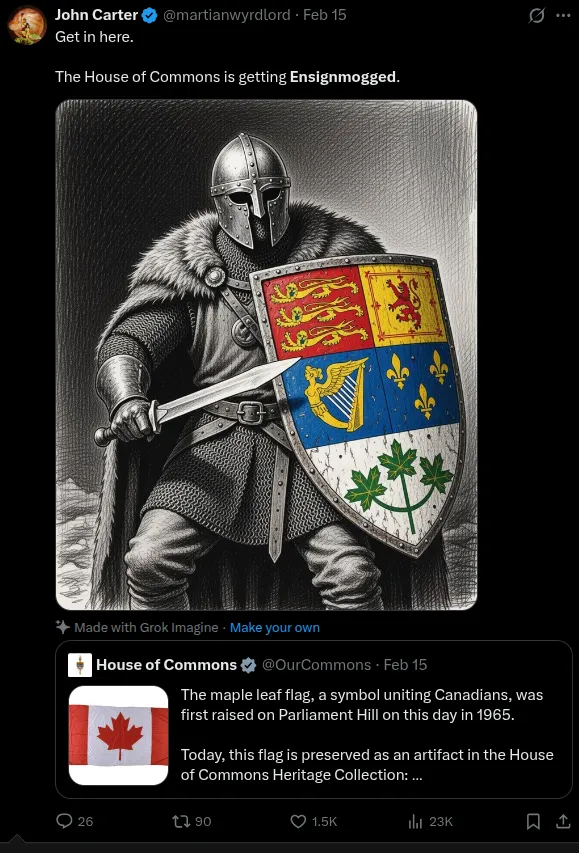
Since then Tyrie and his supporters have sparred with various CPC politicians on X, ratioing them on a fairly regular basis. On February 15th, the Flag Day that marks the 1965 transition from the original Canadian flag to the Maple Leaf, the House of Commons account got thoroughly ensignmogged by a swarm of Canadian nationalists declaring that the Red Ensign was their real flag.
Seriously, just look at the replies and quote tweets. An unending sea of red ensigns.
The flag day ensignmogging was a remarkable eruption of nationalist energy, and it’s very difficult to imagine that the Canadian government has not noticed the sudden popularity of the Red Ensign and the Canadian shield as symbols of Canadian nationalism. This use of these discarded symbols makes Canadian politicians palpably anxious. They have spent many decades patiently erasing Canada’s past in order to socially engineer the wild colonials into the universal economic subject, and the revival of ethnically particular medieval heraldry signals something stirring within the deep recesses of the mass psyche. The natives are restless. Old and terrible gods are awakening.
The question of course is what they can do about that. So far the answer has been “not much that matters”. It would be one thing if the Dominion Society was a bad optics skinhead cult called the White Reich Front or something, brandishing sonnenrads on their shield walls as they formed up for street battle with Trantifa. This would be easily dealt with as something obviously frightening and foreign. But the Dominion Society is none of these things. It is named the Dominion Society, as in the Dominion of Canada – Canada’s official, full name, being a Dominion of the British Crown. Its symbolism draws upon Canada’s own traditional symbolism, symbols that are indeed still quietly used by the Canadian government itself, and it is therefore quite impossible for the regime to characterize DomSoc as something frightening and foreign on aesthetic grounds alone. Worse still, DomSoc is very smart about how it operates. They don’t march through the streets shouting and getting in fights: they’re polite and friendly, focusing on media activism and political pressure campaigns. Their messaging stays strictly within legal boundaries. Their over-arching goal is direct and simple: to popularize the concept of remigration, normalizing it as a topic in the national conversation, such that voters will begin spontaneously raising the issue with politicians: “If we can bring people in, why can’t we send them back? Planes fly in any direction.”

September 2, 2026
Americans’ notorious disinterest in learning foreign languages
Malevitus points out some of the sensible reasons most Americans don’t learn how to speak other languages … and why it makes perfect sense for this situation:
There’s a common complaint about Americans online that goes something like this: “Americans are so dumb. They only know one language, most of the rest of the world is at least bilingual. Why can’t they learn to speak another language?”
To be fair, we Yankees are a pretty monolingual bunch. Only about 20% of Americans speak a language other than English, and for those that do, its mostly because they’re immigrants or children of immigrants. That doesn’t compare favorably to Western Europe, where the majority of adults can speak at least one foreign language (guess which one?)
This is often brought up in the long list of America Bad™ talking points. It’s yet another example of American idiocy. “Europeans can master four languages while Americans are too stupid to master one.” This is pretty much pure copium.
The American Empire
The world we live in is an American world. Since at least the 1990’s (and arguably since the 1940’s), the US has been the undisputed economic and cultural hegemon of the world. Americans don’t learn French or German for the same reason that a Roman in 100 AD would balk at learning Gaulish or Illyrian. Provincials learn the imperial tongue, not the other way around.
For your average non-Anglophone, learning English opens up opportunities in international business, makes it easier to keep up with news from the imperial core, and lets you talk to people around the world (who learned English for all the same reasons you did). For your average American, speaking not-English is a cool trick that takes 600+ hours to learn.
As with any respectable empire, the culture of the periphery is downstream of the core. The influence is largely unidirectional. A typical Frenchman has probably seen Avatar and Titanic. A typical American has definitely not seen Bienvenue chez les Ch’tis or La Grande Vadrouille. The world is buying our blue jeans and listening to our pop music.

[NR: Emphasis mine.]
August 31, 2026
QotD: India, “coasting on inertia”?
Moreover, if I happened to witness a crime … well, that wasn’t going to happen. I’d make sure of it. Pro wrestling referees got nothing on me. But if somehow I did get roped into an investigation, I was going to flee to the nearest Western embassy and hole up like Julian Assange. As with the Tubmans-in-the-passport thing, this is not because I condone or encourage crime. I really hope they find the guy whodunit, and nail his balls to the wall … in the abstract. But in the concrete, my main concern is that Officer Friendly-ji will have much less paperwork, and far more business opportunities, by pinning it on the burra sahib, so sahib — that would be me — is making his pasty pale ass scarce.
This is not a blanket condemnation of the Indian police. Rather, it’s an acknowledgement of reality. India is a huge country of over a billion people, in which there are at least 30 major languages (= “spoken by over a million people”) and a thousand minor ones. There are at least six major religions, the adherents of which are always bickering with each other. Even granting that every single national official in India has the wisdom of Solon, how the hell are they supposed to pass laws that mean anything under those conditions?
The administration of “justice”, then, devolves to the lowest common denominator in the localities. About which I know nothing, which makes me a nice fat target, so … yeah. How many dolla dolla bills to make this go away, Inspector?
Severian, “Friday Mailbag”, Founding Questions, 2022-07-22.
August 28, 2026
“Single mother households produce the worst results for children”
Spaceman Spiff does that thing with data where you point out the most unpalatable results from a given set of statistics and place it front and centre:
Any mention of Cofnas by academics or the media comes with an obligatory dismissal of his work as “controversial” or “far-right”. It is often labelled as “pseudo-science”.
Yet if critics were confident in their position, that the research is incorrect, they would not react as they do.
This is easy to illustrate with a fake example. Imagine research into another sensitive area, female behaviour.
We can draw conclusions based on the research that will anger feminists in much the same way research into the heritability of intelligence and behavioural patterns within distinct groups angers most of academia.
One stark observation dominates our view, in everything we can measure, from mental health to life success, single mother households produce the worst results for children.
The literature is crystal clear.
With a wide variety of measurable outcomes, including life quality, criminality and recidivism, adjustment to society, academic achievement, material success, and mental health issues, the best results are produced by two-parent households closely followed by single-father households.
Single-mother households trail far behind on virtually everything we value. Being raised by a single mother is detrimental to the wellbeing of children compared to other options.
This is reflected in the historical record too. Females gaining custody of children after divorce is a recent novelty. In the Victorian era the father usually retained custody. Women were seen as too emotionally unstable to raise children alone. They needed the strong presence of a father.
One really damning factoid to emerge from crime statistics is most infanticide is committed by women, not men. Of children killed by their parents it is almost unheard of for the father to murder his own children. In some 98 percent of cases it is the mother.
We can use these observations to reach a sensible conclusion.
Single mothers should not be allowed to raise their own children.
Trashing the research not the researchers
Our conclusion is not very good. Academics would find it easy to challenge. This process follows a predictable course.
The first stage is to examine the papers and point out their flaws. What studies show these outcomes? What variables were measured? How were they measured?
Then there are the definitions. What do we really mean by life outcomes? Success is a subjective concept at best. Even something nominally objective like incarceration rates are complex with many variables of which the childhood environment is only one.
What other factors were measured? Were there control groups? What about sample sizes? How many people did they track? Many papers reach bold conclusions with small sample sizes. Which leads to the next question, has anyone replicated this finding? The replication scandal is well documented in multiple academic disciplines; one-off studies no one can reproduce, even quite famous experiments that have entered popular culture.
The quality of the studies is often assessed first because if they are flawed this inevitably damages the credibility of any conclusions drawn.
As for our conclusion, that children should always be taken from single mothers, even widowed women, this is not supported even with the evidence outlined above. Studies would need to demonstrate fostered or adopted children did better than those raised by a widowed mother, an unlikely proposition and just one alternative view possible from the evidence.
Importantly, serious critics would generally avoid motive except as a last resort. Sexism, misogyny and hatred of women may be there in a hypothesis that paints women in a negative light, but compared to challenging the research and its foundations, speculating about motive is weak and too easy to dismiss.
Jumping straight to perceived hate or bigotry, particularly when it makes the accusers look morally superior, is a tell.

August 27, 2026
Women and power
Sara the Editor (that is, not Sarah Hoyt the SF author and Instapundit co-blogger) posted this on Substack Notes a couple of weeks ago before the Lindsay Clancy trial began, but it discusses some of the things that have become common topics of interest since then:
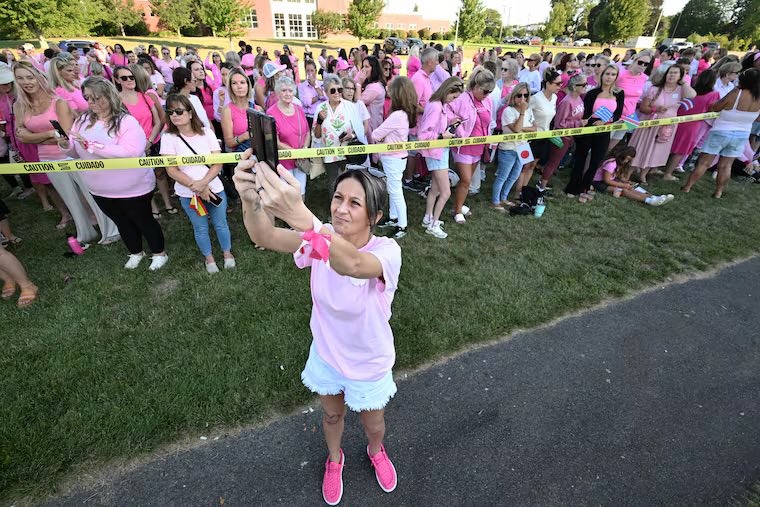
Pink-clad supporters of Lindsay Clancy
Photo from Aged Well
Women are weak, and that’s why they’re evil.
Women are never taught how to restrain their own power. This wasn’t bred into them, either. A woman never had to grapple with what every man faces at some time in his life: the realization that he can easily overpower and hurt a significant portion of the population, including women, children, and the elderly.
Men are taught not to do this wantonly, and if they do, we used to execute them. So we’ve been actively breeding it out of men.
Women are more valuable in terms of childbearing and bore little risk to society as long as men had the right to raise his own hand against a violent woman.
Women can only abuse children, old women, and crippled men. And they do, frequently, unless they fear repercussions for it.
Now women have political power. Now they have access to weapons that are small, light, and easy for a weakling to wield. They can now easily abuse men, and the men will sit there and take it, because they dare not defend themselves and are terrified of the woman-worshipping state police force, a mercenary army of cucks and degraded white knights.
Why would you expect a creature who never had to grapple with power to suddenly wield it with virtue?
You wouldn’t.
Every believable story where random people get superpowers gets one core thing right: the former weaklings are the most vengeful. They can’t wait to make the strong whimper at their feet.
This is literally every feminist ever. They say it out loud. They are razing the world with their newfound powers. Because women were never virtuous, just incapable of evil at scale.
Just look what they did when mass murder was put within female reach.
The oceans of infant blood that women have spilled in the last hundred years dwarfs every death caused by men in every war throughout all of recorded history. And yet feminists, they sit on that pile of tiny skulls lecturing men about how evil they are because they have more innate physical strength.
Do not fear the strong. Fear the ones who have become strong overnight.
They have all the spite and the will to spread their own misery.
More specifically dealing with the phenomena of women publicly proclaiming their support for a woman who deliberately murdered her own children:

This week was a pretty extreme wake-up call on the state of women online.
We learned that there are a shockingly large number of women who not only identify with a child murderer, but are ostentatiously, publicly performing that identification: posting videos of themselves sobbing while clutching infants, captioned “Same, Lindsay”.
They’re posting AI videos of Lindsay Clancy — a woman who sent her husband on an errand so that she could strangle their three children to death — receiving the warm embrace of the Sisterhood. Some are even running the “no uterus, no opinion” playbook but for actual infanticide. (I will not post examples, they’re easy to find.)
Clearly, this is not a feeling about which they are furtive or ashamed. It is baffling to imagine them setting up their camera so that they can publicly “break down”, Just Like Lindsay, to an audience of millions.
[…]
What these women are thinking is: “being a mom is Seriously Super Hard, and I am being Super Brave, look how Brave I’m being.”
That’s really all it is. The best defense you can make of this behavior is that it is sincerely, completely superficial and self-involved.
A social media hysteria has given them moral and social permission to complain in maximally dramatic terms, and to participate in a chorus of mutual validation.
There’s an echo in the “I choose the bear” discourse from a few months back.
Millions of women claimed that they would rather be alone in a room with a bear than alone with a man — and men responded with shock, in the mistaken belief that women were saying that they would actually literally rather be alone in a room with a bear.
This was not helped by the fact that many women, in the interest of making their point more vividly, said, “You’re not hearing me — I literally actually would rather be alone in a room with a literal bear and I’m not kidding”.
These women mean what they say, but not in the way that you mean things when you say them.
One of the emotional engines of this controversy is the perception that Lindsay Clancy was “crying out for help” and was “failed by the system” — that she wasn’t Heard or Taken Seriously.
But of course, her situation was being taken as seriously as such a situation could possibly be taken. There was a small army of doctors and therapists (and her husband, and a nanny) actively monitoring her.
If she had expressed a desire or plan to kill her children, they would have been immediately removed from her custody — but she didn’t.
The reason psychiatrists don’t institutionalize people or snatch their children when they report feeling depressed — or even when they report having certain categories of scary thoughts — is that they want people to speak up when they’re having trouble.
The only intervention that would have stopped this is for someone to suspend her parental rights or institutionalize her, with no judicable evidence (across a battery of clinical encounters) that she intended to harm her kids.
Obviously, these thousands of women are not actually suggesting that they are literally, actively experiencing what Lindsay Clancy experienced, or actually demanding the only intervention that would have made any sense (to have their children confiscated by the state.)
Maybe it’s waste of time to spell out that these demands have no practical content, but whatever: they have no practical content. Women are Using Language Differently. They want to Feel Heard. It’s Not About the Nail.
On her Substack, Janice Fiamengo helpfully points out that western cultures have always had a more lenient view of female murderers of their own children:
Do any of these advocates care about the principles of justice? Do they believe in equality before the law? Are they concerned with the possibility that a not guilty verdict in Clancy’s trial will encourage other unhappy mothers to kill their children? (Mothers are already, according to U.S. government data, the most frequent perpetrators of child homicide, see p. 65).
It seems not. The primary impulse is to see Lindsay Clancy and, by extension, all unhappy mothers as the true victims now and forever, never to be held responsible for any bad act, deserving of boundless sympathy.
Perhaps there has never been a case that illustrated women’s incoherent morality so clearly.
But it is not, alas, a new thing, and men in the west have tolerated and furthered it for centuries. In his 1913 book The Fraud of Feminism, British barrister Ernest Belfort Bax described, with his characteristic wit, how the female criminal is “surrounded by a halo of injured innocence”, “convinced of the maliciousness of her accusers” and of her own lack of responsibility (89-90).
Bax showed that nineteenth-century criminal law had great difficulty conceiving of and punishing female violence. Where there was any doubt as to a woman’s guilt, juries were reluctant to convict; and even where there was no reasonable doubt, they were eager to find mitigating circumstances such as temporary insanity, victimhood, or male coercion to justify leniency.
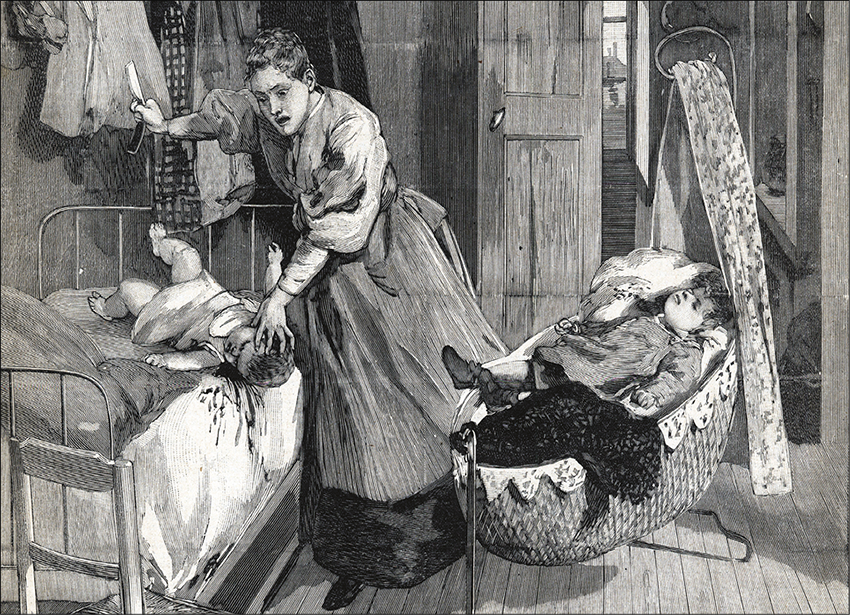
A now-famous Philadelphia case involved a mother, Harriet Vaughn (variously spelled Vaughan), who had murdered her newborn baby within hours of its birth in 1868, and was championed by her feminist supporters as a wronged innocent. The severely beaten dead baby, which Vaughn had attempted to conceal under her bed after crushing its skull with a blunt instrument, was hardly mourned at all (for a full account, see Sarah Barringer Gordon, “Law and Everyday Death: Infanticide and the Backlash against Woman’s Rights after the Civil War” in Lives in the Law).
Although Vaughn was convicted of murder and sentenced to death by hanging — a highly unusual sentence in that no woman had been hanged in Philadelphia since 1737 — her plight almost immediately became a cause célèbre, with advocates rallying to her defence. Elizabeth Cady Stanton, leader of the American feminist movement, spent months agitating on Vaughn’s behalf. In the pages of The Revolution, the feminist newspaper she ran with her associate Susan B. Anthony, Stanton portrayed Vaughn as a sexually-abused maiden, and a loving but desperate mother forced to kill her child because she had no other options. She described her as “a poor, ignorant, friendless and forlorn girl who had killed her new-born child because she knew not what else to do with it” (Stanton, “Infanticide”, The Selected Papers of Elizabeth Cady Stanton and Susan B. Anthony, p. 158).
None of this was founded in fact — Vaughn herself did not claim she had been raped and there were many institutions for foundlings in Philadelphia where she might have left her baby — but it was a familiar sentimental narrative guaranteed to stir indignation against the sentence.
Members of the Working Women’s Association of Philadelphia held a mass rally on Vaughn’s behalf, visited Vaughn in prison, and petitioned the Pennsylvania Governor for her pardon, which was granted in May of 1869. Released from prison, Vaughn left Philadelphia for her birthplace of England and was heard from only once more, when she wrote some months later to request the $300 that she had heard feminists had raised for her.
Sympathy for infanticidal, especially unwed, mothers was widespread in nineteenth-century English-speaking countries, where the killing of babies was “an unsavoury but surprisingly common feature of life” (Constance Backhouse, Petticoats and Prejudice, p. 113). Law Professor Sarah Gordon reports that “In 19th century Philadelphia, thousands of dead newborns were found in alleys, ash heaps, privies, rivers, and so on”. Professor of History Ann R. Higginbotham gives examples from 19th century London to show that “juries were extraordinarily reluctant to convict women accused of murdering their illegitimate infants”, often out of sympathy for the women’s difficult circumstances (Sin of the Age: Infanticide and Illegitimacy in Victorian London, p. 329).
August 25, 2026
QotD: “… and called it macaroni”
I don’t know whether you need much in the way of background, but since some of you seem to enjoy the “inside baseball” stuff … History, as an academic discipline, has always suffered from a “source base” problem. We deal with artifacts; more specifically with documents. If it ain’t written down … see what I mean? This is why whoever-it-was wasn’t wrong when he said that History is just the biographies of Great Men. It’s the biographies of the best-documented men, anyway. I’m exaggerating for effect, obviously, but you see what I mean.
So when, in the Seventies, we had the “cultural turn“, a whole new series of techniques had to be developed to expand the source base. Some of those were good and necessary. Others … well, Wiki quotes Frederic Jameson, one of the most prominent early-90s obfuscators (Indie band name?):
The very sphere of culture itself has expanded, becoming coterminous with market society in such a way that the cultural is no longer limited to its earlier, traditional or experimental forms, but it is consumed throughout daily life itself, in shopping, in professional activities, in the various often televisual forms of leisure, in production for the market and in the consumption of those market products, indeed in the most secret folds and corners of the quotidian. Social space is now completely saturated with the image of culture.
Translated from the PoMo, it’s your standard, tiresome stuff about “critique”. Culture just IS Capitalism, which IS Consumerism, blah blah blah, you know the drill. It’s tedious, but it’s not entirely wrong — what people “consume” (in the egghead sense, not the biomechanical sense) can give us important clues about their world. So long as you avoid the teleological temptation (didn’t they tour with EVC?) of attributing everything to “Capitalism”, you can do good work.
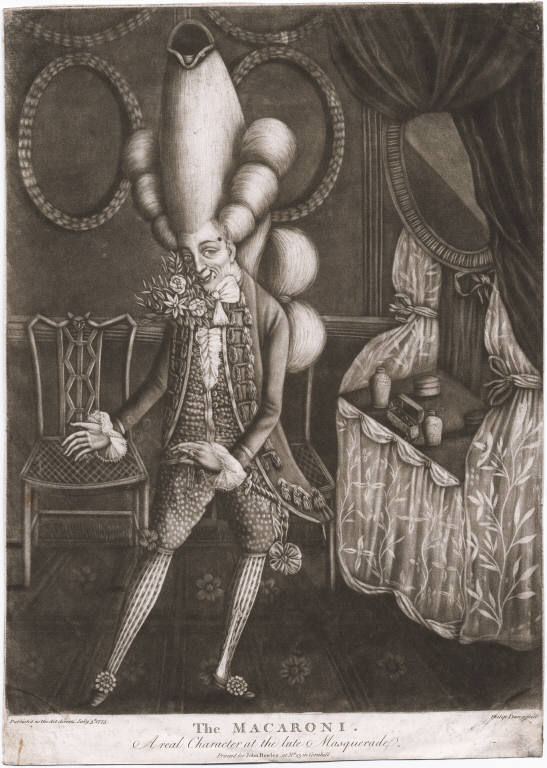
The “problem” with recent history is that the “centers of cultural production” do seem to be identifiable, and so are their motives. They are “Madison Avenue” and “to make money”, respectively, and so it’s easy — and profitable!! — to do the tiresome PoMo CultMarx thing. The further back into The Past you go, though … well, consider this:
As you can see from the caption, that style is called “macaroni” — like from the old song “Yankee Doodle,” which the Colonials appropriated in an early example of “owning the insult.” Wiki sez:
Stereotypically, men in the macaroni subculture dressed, spoke, and behaved in an unusually epicene and androgynous manner. The term “macaroni” pejoratively referred to a man who “exceeded the ordinary bounds of fashion” in terms of high-end clothing, fastidious eating, and gambling. He mixed Continental affectations with his British nature …
… The macaronis became seen in stereotyped terms in Britain, being seen as a symbol of inappropriate bourgeois excess, effeminacy, and possible homosexuality – which was then legally viewed as sodomy. At the time, homosexuality was frowned upon, and was even punishable by death. Many modern critics view the macaroni as representing a general change in 18th-century British society such as political change, class consciousness, new nationalisms, commodification, and consumer capitalism.
You see the typical “critical” blah blah blah there at the end, and it’s not wrong, just tedious, predictable, and tediously predictable. It’s also much harder to find a “purpose” for this behavior. It’s easy to do for the modern analogue of the macaroni, the hipster […] which Wiki documents extensively, because of course they do, it’s right there underneath “macaroni”. But the whole “culture industry” thing wasn’t there yet in the 18th century, so it might actually be down to an individual person. It’d be theoretically possible to find “the first macaroni” — it was the Marquis de Whatever, and he decided to dress like that because reasons, and all the best people decided to copy him, also because reasons, and that’s pretty much all your “cultural turn” can do, because that’s the only documentation we have.
Since we here are not bound by the canons of scholarship, however, we can speculate. I want to focus on this bit about macaronis:
In the 18th century, wealthy young British men traditionally took a trip around Europe upon their coming of age, known as the Grand Tour. Italy was a key destination of these tours. During their trip, many developed a taste for maccaroni, a type of pasta little known in Britain then, and so they were said to belong to the Macaroni Club, founded in 1764 by those returning from the Grand Tour. They would refer to anything that was fashionable or à la mode as “very maccaroni”.
That’s Information Velocity, preindustrial-style. They had to go there personally — or, at the very least, have access to the in-house journals of those who did:
The song “Yankee Doodle” from the time of the American Revolutionary War mentions a man who “stuck a feather in his hat and called it macaroni”. Dr. Richard Shuckburgh was a British surgeon and also the author of the song’s lyrics; the joke which he was making was that the Yankees were naive and unsophisticated enough to believe that a feather in the hat was a sufficient mark of a macaroni.
In America, only a select few persons would have access to that kind of thing, because only a few would move in those circles.
Go back a bit further, and cultural trends are far less traceable, but “centers of cultural production” are much easier to find, in one specific sense: They’re monasteries. And there you have a group which speaks a common language — extremely rare in the Middle Ages — is literate (ditto), and has something close to, if not caloric surplus, then at least “chronic caloric sufficiency”, I guess we’ll have to call it. Monks worked hard in the Middle Ages, by our standards, but not as hard as the peasantry. They were well-fed, or at least consistently fed, in a way the peasantry weren’t.
In other words, whatever Information Velocity existed in the Middle Ages, they had it. They made a virtue out of circulating books, and all those books were in a common tongue. Since they also produced books — indeed, were pretty much the only ones who did — they were also, by definition, au courant with whatever the high fashions were, because they illustrated the books that were such a crucial part of the aristocracy’s gift-giving culture.
Severian, “Monastic Vices”, Founding Questions, 2026-01-13.
August 23, 2026
QotD: “I found a million dollar baby in a five and ten cent store”
I once asked a friend in the French music biz how the song went over there. I hummed him the tune and he sang me the French lyrics and, although I can’t recall any of them, I remember they were entirely different from the English words. It’s not just the five-and-ten that’s hard to translate or the million dollar baby. But the concept of finding the latter inside the former is also very American. There are a ton of Mitteleuropean operettas in which the prince or duke or count wanders into the streets in disguise and falls in love with a serving wench, but the serving wench usually turns out to be a Countess or Margravine or some such also wandering around in disguise. Even the British are prone to this syndrome (Spring In Park Lane, etc). But in an American song the shop girl is a genuine shop girl, and she’s still a million dollar baby. That’s what makes it American.
In the Sixties, by the way, you could have found a future billion dollar baby in a five and ten cent store: Sam Walton, founder of Wal-Mart, got his start in retail as a franchisee at a Ben Franklin’s, founded in 1920 by the Butler brothers, who’d been in the five-and-dime business since the 1870s. I’m not saying “I Found a Million Dollar Greeter in the Big Box Store at the Strip Mall on the Edge of Town” would be as big a hit, but there is an historical continuity from the Butlers to Wal-Mart.
Mark Steyn, “I Found a Million Dollar Baby (in a Five and Ten Cent Store)”, Steyn Online, 2020-10-25.
August 21, 2026
This is something we genuinely need today
Plus, as Kate at Small Dead Animals often points out “Mischief is important“:
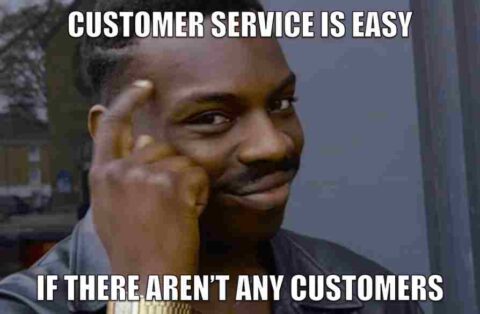
In one of the only three management books anyone should bother to read — and everyone should read the three — Robert Townsend says that a CEO should, while on the road, try phoning his own company. Try the helpline and see how far he gets. Try calling his own office. Sure, you should end up with the Executive Secretary who then directs it to the right person but sometimes that correct person is going to be you. Say, Warren Buffett calling to make you rich by buying the company and thus crystallising all your stock options and RSUs.
This is a lesson that has been forgotten. From a Guardian list of things government should pass laws to make happen:
Force companies to put a phone number on their homepage
You’ve got a problem with a company and you want to get it sorted – and then you realise you cannot find a number for it anywhere. There are communications companies that have no “contact us” link anywhere to be seen, and energy companies that send you all round the houses looking for a way to get in touch.
One of the recurring themes of Guardian Money readers’ problems is the struggle to find someone to help when something goes wrong. Clearly, once you have published a phone number, you need staff at the other end answering the phone and offering some joined-up thinking, so this is only the start of the solution – but at least customers would not feel like companies were trying to hide from them.
This does not work as there is no guarantee that anyone will answer the call.
We’ve also that basic point that Burke and his Little Platoons can — and often do — solve problems better than government. So, here’s the pitch for that private sector service.
We set up a database of the home and work and mobile phone numbers — emails too — of the management of companies. Most importantly, the board of directors. If the company is owned by private equity — say — then the General Partners of the PE company.
Obviously, if a company has a helpline, which people answer, then all of that information stays private to us. If a company does not then we publish it as a page saying these are the contact numbers for that company. Say, Evri, the delivery people. The board members get their numbers and email publicly revealed. As I recall it they’re PE as well so some number of GPs over in the US also start getting aggrieved calls from Lesser Wallop about non-delivery. Not that any Septic would be able to understand Ms. Aggrieved of Lesser Wallop but it’s the instance of the call that matters. Evri is used as an example for a bit of looking around a few months back seemed to reveal that they had no UK phone number at all. Thus the directors it will be.
The top management of companies that do not provide a helpline — nor answer the one they claim to have — will have the customer complaints calls directed toward them. This will, of course, rapidly mean the opening of a useful customer complaint line that people actually answer. Those making that £250k a year as the board member of whatever do not want to be talking to Ms. Aggrieved of Lesser Wallop. Therefore phone calls from Ms. Aggrieved will lead to the creation of a useful customer services department.
At which point, of course, we take the board members’ phone numbers down and job done. But, clearly, we keep monitoring to ensure that those service times don’t then decline.
Make the bastards who make the decisions suffer the consequences of those decisions. Works this does, really, it works.
Now, there will be some who say that government can do that. Why use the Little Platoons when a law can simply be passed?
Which is to miss a basic philosophic point, which is that we should only use government when we, ourselves, cannot do it. Government is for when the Little Platoons cannot achieve it. Letters of Marque are lovely things but biffing the Frenchies is better done with a Royal Navy. Assuming we still had one of course. RNLI, on the other hand, works better without government than it would with.
But much more than that. For who are the worst at providing a contact number that works? Why, that would be government, wouldn’t it? Anyone ever tried to ‘phone HMRC? Quite.
Batman as a modern Sisyphus
I don’t normally post much about comic book characters, because my interest in comic books lasted from about 1965 to 1975 … a very different era than most of the comic books of today (I’m sure it’s considered tantamount to a hate crime to refer to them as “comic books” by a significant number of long-time fans). Here, Devon Eriksen explains why the Batman character is a modern rendition of the Greek hero Sisyphus and his eternal punishment in the underworld:

Batman, the fictional character, does not embrace the Batman Fallacy because he is written as stupid. He’s obviously intended to be very intelligent.
But the many, many authors of this character have always agreed that he must have this one critical blind spot.
Why?
So the story can continue.
See, if Batman kills the Joker, or turns him over for execution, the story, or at least a popular villain, is over. No more Joker stories.
So the character of Batman must be created in the image of Sisyphus… always struggling against the manifestation of the problem, but never able to address the root cause.
All of Batman’s victories must be against the Joker’s latest scheme, not the Joker himself. He must forever be playing defense, making heroic efforts merely to maintain things as they are, like the Red Queen running as fast as she can just to stand still.
This is how the Joker, a man of no special resources or talents, whose sole advantage is utter disregard for law, empathy, or human life, can be a challenging foe for a billionaire genius superathlete with an endless array of technologies and skills.
He can simply generate schemes forever. He doesn’t have to win always, or even often. Because every one of his victories is real and has permanent consequences, and every one of his defeats is temporary, pending a rematch.
Batman, by his very nature, can never stop the Joker, only slow him down.
If Batman were a different character, if he were willing to, say, throw the Joker out of a helicopter over a vast body of water, then the story would eventually end, because pretty soon the setting would no longer need Batman.
And no doubt on that day, there would be a great deal of whinging over whether throwing the Joker out of a helicopter was a “human rights abuse”, as if the Joker himself were not a walking, talking human rights abuse to begin with.
But Batman can never win, and never stop fighting, because he refuses to go on the offensive and remove his enemies from play.
This post is not about Batman.

QotD: The Amish
The basic organizational unit of Amish society — after the extended family, which is vital and often includes three generations under one roof — is the “church district”, a community of twenty-five to forty families who live within a short buggy-ride of one another. The leaders of the district are chosen by lot from among the married men, and each is governed by an Ordnung, an unwritten set of rules laying down expectations for behavior. It’s this Ordnung that contains the restrictions on technology and lifestyle that we typically associate with the Amish, covering everything from what color you can paint your barn (one group insists on red because white would be too worldly) to whether you can use mechanical milking machines. The church revisits their Ordnung every six months or so to see if it needs updating — one group had originally approved walkie-talkies for communication while hunting, but then discovered boys were using them to flirt with girls and decided to ban them. Church districts with similar Ordnungs are “in fellowship”, and a cluster of districts in full fellowship with one another are an “affiliation”. (A “settlement”, like the Holmes County Settlement, is a cluster of geographically contiguous districts regardless of affiliation.)
Importantly, few of these restrictions are based on the idea that the banned technology or behavior is wrong in and of itself: for instance, every Ordnung forbids a baptized Amish adult to own a car, but boys from some Amish families have cars for a while in their teens and all but the most conservative affiliations will pay someone else to drive them if they need to go farther than their buggy can take them. Or to put it another way, nobody thinks the English are bad people for driving cars — they just think we’re not Amish.
So if an Ordnung mostly isn’t meant to keep you from doing intrinsically evil things, like murder and adultery and blasphemy, what is it for? How do you decide what to allow? What are you optimizing for when you design it?
Two things, mainly, though they’re not neatly separated. The first and most important role of the Ordnung is engendering the virtue the Amish call Gelassenheit. There’s not a perfect English translation for the German,1 but Hurst and McConnell describe it as a spirit of “selflessness, humility, or meekness”, a subordination of self to community. Amish scholar2 Donald Kraybill wrote that Gelassenheit is meant to develop a “yielded self” that “stands in contrast to the bold, aggressive individualism of modern [English] culture”. Thinking too highly of yourself, or trying to outdo others, are failures of Gelassenheit, but they’re hard to avoid when you have to market your personal #brand or compete in the marketplace. Unmechanized agriculture, on the other hand, was very good at nurturing Gelassenheit: a farmer is necessarily aware of his dependence on natural forces beyond his control, which keeps him humble. Nowadays the Amish worry that shifts way from their traditional lifestyle will “foster the notion that the worker controls his or her work and life”, which might “breed an attitude of self-sufficiency, even arrogance” that is antithetical to their values.
The concern for Gelassenheit shows up particularly in Amish approaches to childrearing. Where English society values self-expression, intellectual curiosity, and individual accomplishment, Amish parents rank obedience and self-control as the most desirable qualities in children. (More than half of the parents the authors surveyed put “being interested in how and why things happen” at the bottom of their list.) They also report that teachers at Amish schools tend to be “preoccupied (to our eyes) with minor aspects of misbehavior that signaled nonparticipation in the group or lack of obedience to authority”. All of this carries through into the workplace, too: the Amish generally think white collar workers are “out to make the big bucks” and that their jobs are be difficult or impossible to undertake with a “meek spirit”. So if you can’t farm (and increasingly you can’t), the Amish think your work should be something near home that uses your hands, allows your family to participate, and contributes directly to your community. No arguments here that building dashboards to give executives deeper insight into critical business functions leads to the more efficient allocation of global capital and lifts all boats; they want you to make food or furniture or something.
The Ordnung‘s second goal is to separate believers from the broader world. This is partly a legacy of the Anabaptist experience of persecution, partly a response to Biblical passages like Romans 12:2’s warning not to “be conformed to this world”, and partly a protective measure against a world that isn’t interested in Gelassenheit, but the dualism between Amish and “English” is a vital part of what it means to be Amish. Of course, it’s impossible to clearly differentiate between things that promote a particular mindset/virtue and things that mark you out as different: the distinctive Amish “plain dress“, for instance, both limits opportunities for vanity and marks out the wearer as, well, kind of a weirdo. (There’s sometimes also a sub-goal of separation from other Amish affiliations — one Amish man is quoted saying, “The only reason the Old Order doesn’t have rubber wheels [on their buggies] is because the New Order did it first”.)
Jane Psmith, “REVIEW: An Amish Paradox, by Charles E. Hurst and David L. McConnell”, Mr. and Mrs. Psmith’s Bookshelf, 2025-12-15.
- And they mean something different by it than Heidegger does!
- Okay, this one is a Mennonite scholar of the Amish.
August 12, 2026
QotD: The art of admitting our mistakes
The painting below by Paul Cézanne demands our consideration. It cannot be passively observed. The glassy patch of water in the lower right-hand corner is where the painting – “Reflections in the Water” – gets its name. Our eyes are naturally drawn to the thick tree on the bank whose ghost is captured on the surface of the pond where the foliage gives way, but really it is the slim sapling, unreflected, unbroken, rising boldly along the canvas’s left edge, that is the true subject of this piece. It is a triumph of subtlety and nerve.
Except that I’m wrong. I’ve been looking at the painting on its side and forming a completely inaccurate impression. Oh well. I’m probably not the first. There is an unconfirmed story that this painting by Cézanne was hung sideways for thirty-one years in London’s National Gallery. The origin of this gossip is from the economist Oswald Toynbee Falk (1879–1972), who lays the blame at the feet of one of its trustees, John Hugh Smith, exactly the kind of person who would in those days have had a hand in such decisions. I can find no corroboration of the story, but I do hope it’s true.
Of course, an establishment as prestigious as the National Gallery would be unlikely to admit to such a galloping blunder. And anyway, as I’ve said, the sideways version has much to recommend it. If there’s a moral to this story, it’s surely that once we commit to an error of thinking for too long it can be mortifying to correct ourselves, particularly if public humiliation is to be the outcome.
It strikes me that the culture war is largely characterised by groups of intelligent people investing in delusional ideas with such gusto that to backtrack would be a kind of social death. One might sooner teach a mule to moonwalk than persuade a celebrity who has championed gender identity ideology to admit that human beings cannot change sex. After demonising women for insisting on single-sex spaces, making excuses for the medicalisation of healthy children, and encouraging the dismantling of gay rights – all in the name of progress – it must be tremendously difficult to admit that it was all for nothing.
For many, the response to being corrected is simply to deny there was any mistake at all and to double down. This is certainly the position of the Green Party, whose representatives are now wholeheartedly wedded to the absurd proposition that human beings have an innate gendered soul that can be misaligned from their body. Their supporters are even congratulating them for their doggedness in the face of reason and evidence, so there is no incentive to course-correct.
Andrew Doyle, “The art of admitting our mistakes” ($), Andrew Doyle, 2026-05-08.

August 9, 2026
QotD: Spoilers — threat or menace?
It turns out this may not be control freakery. How wonderful to think that I have been waiting years for science to rebrand my worst qualities as skills. Apparently, people who like spoilers are just trying to regulate their emotional response. We are not monsters, but only putting on a cardigan before the storm.
Those who hate spoilers also want control, but theirs is driven by a desire to preserve suspense. They want to receive information in the sequence designed by the storyteller. My own spoiler-seeking is also a form of control, although it works differently. I want the major facts early, so I can relax into the texture of the story rather than sit there like a meerkat scanning the horizon for emotional catastrophe.
So we are all control freaks, just wearing different cardigans.
Spoiler alerts began as a civilized courtesy. If someone on a bus was halfway through a book, it was not considered the done thing to lean across and announce the ending like a deranged town crier. There were rules. Perhaps not that many. But there were some.
Now the spoiler alert has become a moral siren. One can’t discuss a film, television show, podcast, documentary, memoir, cake reveal, or episode of Bluey without issuing a warning so elaborate that it requires its own stationery. People now approach plot discussion like bomb disposal experts. One innocent mention of a character’s demise, and the online village square bursts into flames. On “The Good Ship Murder” Facebook page, for instance, someone posts, “Can’t believe they killed Pierce”, and within seconds the spoiler militia descends.
Admins should delete this spoiler.
People might not have seen it yet.
Can’t believe you’ve posted a spoiler…You can almost hear the sirens. Somewhere, a moderator is reaching for a lukewarm tea and wondering how a cozy murder show has turned into the fall of Saigon.
Nicole James, “Tell Me Who Dies So I Can Relax”, The Freeman, 2026-05-07.


