Quotulatiousness

October 18, 2019

“Angels Calling” – Trench Warfare – Sabaton History 037 [Official]

Filed under: History, Media, Military, WW1 — Tags: , , , — Nicholas @ 06:00

Sabaton History
Published 17 Oct 2019

Trench Warfare was the reality for countless soldiers fighting on the the fronts of World War One. It was a hell on earth. Soldiers had to endure mud, cold, stench of decaying bodies, endless artillery and gas barrages and enemy raiding parties. The Sabaton Song “Angels Calling” is about daily life on the frontlines of The Great War.

Support Sabaton History on Patreon: https://www.patreon.com/sabatonhistory

Listen to Attero Dominatus (where “Angels Calling” is featured):
CD: http://bit.ly/AtteroDominatusStore
Spotify: http://bit.ly/AtteroDominatusSpotify
Apple Music: http://bit.ly/AtteroDominatusAppleMusic
iTunes: http://bit.ly/AtteroDominatusiTunes
Amazon: http://bit.ly/AtteroDominatusAmzn
Google Play: http://bit.ly/AtteroDominatusGooglePlay

Check out the trailer for Sabaton’s new album The Great War right here: https://www.youtube.com/watch?v=HCZP1…

Listen to Sabaton on Spotify: http://smarturl.it/SabatonSpotify
Official Sabaton Merchandise Shop: http://bit.ly/SabatonOfficialShop

Hosted by: Indy Neidell
Written by: Markus Linke and Indy Neidell
Directed by: Astrid Deinhard and Wieke Kapteijns
Produced by: Pär Sundström, Astrid Deinhard and Spartacus Olsson
Creative Producer: Joram Appel
Executive Producers: Pär Sundström, Joakim Broden, Tomas Sunmo, Indy Neidell, Astrid Deinhard, and Spartacus Olsson
Post-Production Director: Wieke Kapteijns
Maps by: Eastory
Edited by: Iryna Dulka
Sound Editing by: Marek Kaminski

Eastory YouTube Channel: https://www.youtube.com/channel/UCEly…
Archive by: Reuters/Screenocean https://www.screenocean.com
Music by Sabaton.

Sources:
National Army Museum
National Library of Scotland
Bibliothèque nationale de France
Wellcome Images
Sleeping soldiers courtesy of FORTEPAN/Komlós Péter
Crosshair by DTDesign from the Noun Project
Colorized photos by Alexander Vedel Christensen
IWM: Q 69986, Q 45584, Q 6420, Q 6419, Q 33350, Q 745, Q 6421, Q 24579, Q 10685, Q 445, Q 32420, Q 517, Q 65065, Q 69983, Q 79501, Q 9333, E(AUS) 572, E(AUS) 1497, Q 6969

An OnLion Entertainment GmbH and Raging Beaver Publishing AB co-Production.

© Raging Beaver Publishing AB, 2019 – all rights reserved.

From the comments:

Sabaton History
2 days ago
What? The Sabaton History special editions of EVERY album? Nooo.. Really? Sounds awesome! And.. How can I get those? … As a reward for supporting Sabaton History on Patreon? Get out of here! .. Oh.. I should head over to https://www.patreon.com/sabatonhistory to check it out? Gotcha! Cheers!

Hong Kong

Filed under: Britain, China, Government, History, Liberty — Tags: , , , — Nicholas @ 05:00

David Warren on how Hong Kong got to be Hong Kong:

The motto of the resistance in Hong Kong is on my lips much lately, though often I am not applying it to Hong Kong. Nor am I not. I look at this “Oriental entrepôt” (as we used to say before political correctness), where once I lived for a couple of months, from a great and widening distance. The people there are quite another generation from that which I remember; of course they seem much younger. The idea of the inhabitants of Hong Kong nearly closing the city with demonstrations, week after week, was not formerly possible to imagine. But their enthusiasm for the personal freedom they once enjoyed (under the aegis of British imperialism and colonialism, descending from opium wars), hardly surprises me.

The British approach was finally, live and let live; but it had an administrative basis. From the 1950s, Hong Kong was an experiment. What would happen if they deregulated almost everything, and cut taxes to match? If they consciously de-politicized the colonial administration? If they shrank police functions to what was needed only to direct traffic, and defeat crime? The result was, as ever, unprecedented prosperity, but more: a people who forgot the habit even of kow-towing to men “dress’d in a little brief authority.”

People were transformed, from indifferent parts in a rusting machine, to free agents. (Unfortunately, in a broader view, prosperity also kills, as people use their freedom only for material gain, and a new jackboot state grows around the need to protect against the consequences.)

Hong Kong is a city now of seven million souls. It has, as it had, economic and social classes — plenty of them — yet the present “troubles” have nought to do with class. Opposition to the Communist government is as broad as it was in all ex-Soviet states, as we discovered when the Berlin Wall fell, and nearly discovered across China in the moment of Tiananmen. Rebellion, to start, is an urban phenomenon; it begins with a sudden collective sense that “we have the numbers.” The fear, upon which all tyrannical regimes depend, evaporates. What happens next is anyone’s guess, except, we can know the regime is doomed.

2019 Hong Kong anti-extradition law protest on 16 June, captured by Studio Incendo from Flickr.
Photo via Wikimedia Commons

The State of the US is Depressing | BETWEEN 2 WARS I 1933 Part 2 of 3

Filed under: Economics, History, USA — Tags: , , , , , — Nicholas @ 04:00

TimeGhost History
Published 17 Oct 2019

The American economy is in a state of despair. Mass unemployment and poverty sweep the lands. In 1933, a new President is elected, promising to change things for the better. His name is Franklin D. Roosevelt.

Join us on Patreon: https://www.patreon.com/TimeGhostHistory

Subscribe to our World War Two series: https://www.youtube.com/c/worldwartwo…

Hosted by: Indy Neidell
Written by: Francis van Berkel and Spartacus Olsson
Directed by: Spartacus Olsson and Astrid Deinhard
Executive Producers: Bodo Rittenauer, Astrid Deinhard, Indy Neidell, Spartacus Olsson
Creative Producer: Joram Appel
Post-Production Director: Wieke Kapteijns
Research by: Francis van Berkel
Edited by: Wieke Kapteijns
Sound design: Marek Kaminski

Colorized pictures by Norman Steward, Daniel Weiss and Joram Appel.

Sources:

A TimeGhost chronological documentary produced by OnLion Entertainment GmbH.

From the comments:

TimeGhost History
12 minutes ago (edited)
If you’re new here, you might not be familiar with Indy Neidell and his other work. Not only are we doing “Between Two Wars”, on the events and years leading up to World War Two (of which this video is a part), also we’re covering World War Two in realtime week-by-week, exactly 79 years after it all happened. We have now entered the second year of the war. If you haven’t already, check out the World War Two Channel for what maybe one day will become the most complete account of The Second World War: https://www.youtube.com/c/worldwartwo

Cheers,
Joram

Colonel Daniel Stepaniuk’s one-man campaign to wipe out (some) religious observance in the Militia

Filed under: Cancon, Military, Religion — Tags: , , , , — Nicholas @ 03:00

Christie Blatchford on the oddly partial actions of the officer in charge of more than a dozen Ontario militia regiments as far as religion is concerned:

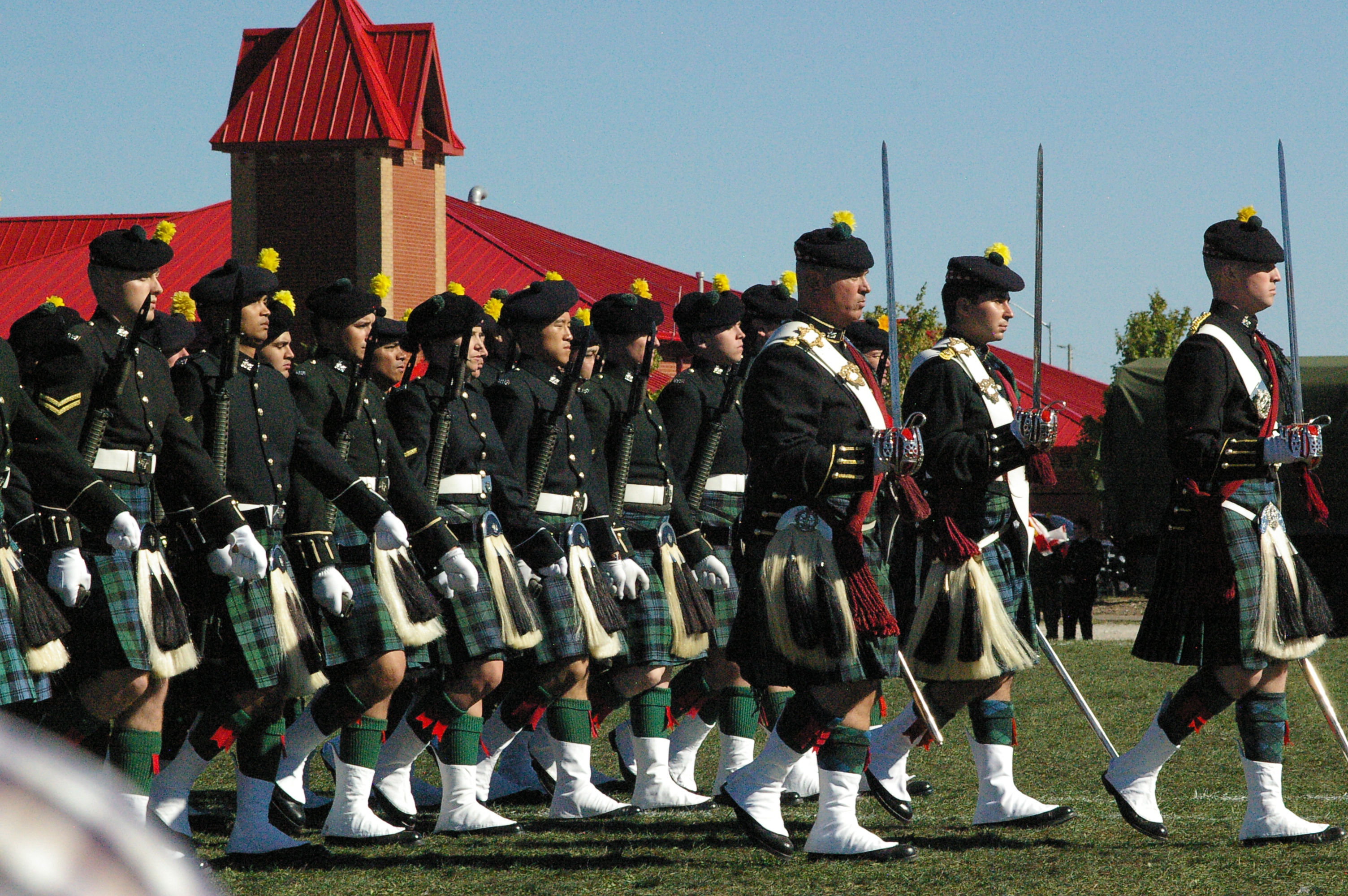
The Lorne Scots (Peel, Dufferin and Halton Regiment) on parade in Brampton, Ontario on 24 September, 2016.
Photo by Nicholas Russon.

An army brigade commander has told the 14 Ontario reserve regiments under his charge that they must cancel any “church parade” they have planned.

Despite a lack of complaints about the parades, which see soldiers march to their regimental church, Col. Daniel Stepaniuk urged his commanding officers to stop participating in “any event where the primary purpose is liturgical, spiritual or religious … even if the service is non-denominational.”

A custom in the Canadian Army since the time of Confederation, the parades aren’t as common as they once were, though many units still have at least one a year, often tied to Remembrance Day ceremonies.

[…]

First of all, there is the glaring contradiction with Stepaniuk’s harsh stand on church parades and a parade that happened in Toronto last April.

A group of soldiers — I counted between 15 and 20 — were issued weapons, allowed to march in their military uniforms and were escorted by an armoured vehicle in the annual Khalsa parade for Canada’s Sikh community. It is considered a holy day.

The soldiers were from the Lorne Scots, one of Stepaniuk’s reserve units based in Brampton. The CO of the unit said at the time that he signed off on the weapons only after his commander (that would presumably be Stepaniuk, or perhaps the brigadier-general above him) approved the soldiers’ participation.

So weapons worn at a Khalsa Day parade good, though against the rules (The Canadian Armed Forces Manual of Drill and Ceremonial), according to army spokeswoman Karla Gimby.

But soldiers going anywhere near a church, bad, and against rules five years old that no one cared to enforce until now.

But most of all, in such small incremental strikes, does Canadian history and tradition lose strength.

7 Brutal Days for the Kriegsmarine – Battle for Norway

Filed under: Britain, Germany, History, Military, WW2 — Tags: , , , — Nicholas @ 02:00

iChaseGaming
Published on 9 Sep 2019

The first few days of Operation Weserübung, the invasion of Norway, cost the Kriegsmarine‘s surface fleet dearly. While the invasion and occupation was successful the German Navy would be hampered for the remainder of the war.

♥ Connect with me ♥
Discord: https://discord.gg/ichasegaming
Twitch: http://www.twitch.tv/ichasegaming
Twitter: https://twitter.com/iChaseGaming

♦ Become my Patron at https://www.patreon.com/iChaseGaming

To contact me via e-mail send it to chasegamingtv@gmail.com

QotD: England has become the Mother Hive

In 1908, Rudyard Kipling published a short story called “The Mother Hive”. In this, the bees in a hive decide to drop all outmoded ideas of hierarchy and to make everyone equal. This includes the right of workers to eat royal jelly and to mate with the drones. In the spreading chaos that results, traditionalist dissidents are first shunned and then murdered. Eventually, the bee keeper looks into the hive, and sees the empty honeycombs and the horribly deformed offspring of the workers. His response is to poison all the bees.

Now, something like this has happened in England. In the past few generations, the whole of national life has been taken over by the cultural Marxists. They run government and the administration, and the law, and education and the media, and business too. They have imposed on us a nasty hegemonic discourse. Cultural Marxism is ultimately to be traced to European thinkers like Antonio Gramsci and Louis Althusser and the Frankfurt School. But this has come to England in American clothing. It has prestige because it was taken up by the American universities.

In America, however, the progress of cultural Marxism has been resisted, or slowed, by a strong religious right and by a written constitution that it is taking a long time to subvert. Here, we have no religious right, nor an entrenched constitutional law. In the past, freedom and common sense were safeguarded by an hereditary land-owing aristocracy and gentry. These ran the country, and did much to determine its moral tone. During the twentieth century, they were marginalised and then eliminated from government. They remain as a class — still very rich — but the tacit deal since at least the 1940s has been that they will be left alone, so long as they keep out of politics. Government has been left to middle class lefties. The effect followed the cause only after several generations. But here it is.

It may be interesting for you, as foreigners, to learn an answer to the implied question in the title of this speech. But it is essential for the English to think about the question and its answers. You see, like both the Germans and the Russians, we have had a revolution. Unlike them, we have had no obviously revolutionary event. The Russians had the storming of the Winter Palace and the murder of their Royal Family. The Germans were utterly defeated in 1945. Their cities were bombed flat. Their country was occupied and divided. Every German knows either that German history came to an end in 1945, or at least that a new chapter in German history had begun.

We do not have that awareness, and it would be useful for us to understand, even so, that we are living in a state of revolution. England has become the Mother Hive.

Sean Gabb, “A Nation of Sheep: Understanding England and the English”, Libertarian Enterprise, 2017-09-23.

October 17, 2019

Pro Tips for Tool Hunting at Flea Markets

Filed under: Tools, Woodworking — Tags: , — Nicholas @ 04:00

Rex Krueger
Published 16 Oct 2019

More video and exclusive content: http://www.patreon.com/rexkrueger
Get plans, t-shirts, and hoodies: http://www.rexkrueger.com/store
See all the stuff you can get at a big show: https://www.youtube.com/watch?v=dm435…
(more…)

England in 1550 was a remarkably unpromising location for the later industrial revolution

Filed under: Britain, Economics, Europe, History — Tags: , , , , , , — Nicholas @ 03:00

Anton Howes, in his investigations on the Industrial Revolution looks back in time to see where or even if England deviated from the rest of Europe in ways that made the revolution possible, thinks he’s located the crucial time:

If a peaceful extraterrestrial visited the world in 1550, I often wonder where it would see as being the most likely site of the Industrial Revolution – an acceleration in the pace of innovation, resulting in sustained and continuous economic growth. So many theories about why it happened in Britain seem to have a sense of inevitability about them, but our extraterrestrial visitor would have found very few signs that it would soon occur there. There were many better candidates, on a multitude of metrics.

[…]

But England in 1550 was by global standards quite poor. Historical GDP per capita measures are notoriously difficult to obtain, even for some countries in the twentieth century let alone the sixteenth. The historical GDP per capita of England – by far the most studied region – is still hotly debated among economic historians. Nonetheless, according to the most recent collection of estimates – the Maddison project’s database of 2018 – in 1550 our extraterrestrial visitor would have been much more interested in Belgium. England at that stage lagged behind almost all of the areas for which we have estimates: Holland, Spain, Italy, Sweden, and France. In 1600, it was behind Portugal and India. Here are the figures in 2011 dollars; the colours are by row:

Such estimates should of course be taken with a hefty boulder of salt. (Note, also, that these particular figures, called “CGDPpc”, are something of an innovation by the team compiling the Maddison Project Database – they use multiple benchmarks to improve how we compare countries’ relative incomes in any particular year, which comes at the cost of not being able to compare their growth rates, for which there are separate figures. In other words, you should read the figures by row, not by column.) But it is worth noting that the more recent research on historical GDP per capita, finally filling in some details for regions other than England and Holland, often results in those other countries seeming richer in the sixteenth and seventeenth centuries. The more we know, the more the traces of an early English divergence seem to disappear.

Even without access to such statistics, however, our visitor would have noticed that in the mid-1550s England suffered severe food shortages. Indeed, the threat of famine would be present right up until the beginning of the eighteenth century: there was a major famine in the north of England in 1649, and even a famine in the 1690s that killed between five and fifteen percent of Scotland’s population. Britain would one day become perhaps the first famine-free region, but that did not occur until much later, when innovation had already begun to accelerate. It may even have been its result.

And England in 1550 was not just poor; it was also weak. If our visitor thought, as some historians do, that conquest and exploitation were essential for future growth, then it was Spain that had the major overseas empire, followed by Portugal. England in 1550 had no colonies in the New World, and its attempts to found them all failed until the seventeenth century, by which stage the Dutch and French had also begun to extend their own empires too. It was not until the eighteenth century that Britain began to exceed them.

American Eagle Lugers

Filed under: Germany, History, Military, USA, Weapons — Tags: , , , — Nicholas @ 02:00

Forgotten Weapons
Published on 1 Dec 2014
Dissent This
Sold for $14,950 (9mm fat barrel) and $9,775 (7.65mm test trials).

Many people are aware of the .45 caliber Lugers made for US military field trials — but far fewer people realize that Lugers were both tested by the US military and sold commercially several years prior to the .45 tests.

In 1900, the US military put several hundred 7.65mm Luger pistols into field trials with both infantry and cavalry units. These pistols were marked with a large and elaborate American eagle crest, in an attempt by DWM to enhance the gun’s appeal to Americans. A similar tactic was used in production of Lugers for Swiss sale, with a large Swiss cross (and it worked well).

After complaints about the small caliber of the early 1900 Lugers, DWM developed the 9mm Parabellum cartridge, and attempted to sell them commercially in the US (and elsewhere). A small batch were also purchased for further military testing.

http://www.forgottenweapons.com

Theme music by Dylan Benson – http://dbproductioncompany.webs.com

QotD: IKEA humans

Filed under: Education, Politics, Quotations, USA — Tags: , , — Nicholas @ 01:00

Therefore, to be precise, the class of people of whom I am speaking are “cosmopolitan” neither in the idealized nor in the demonized sense of the word. They neither bridge deep social differences in search of the best in human experience, nor debase themselves with exotic foreign pleasures. Rather, they have no concept of foreignness at all, because they have no native traditions against which to compare. Indeed, the very idea of a life shaped by inherited custom is alien to our young couple. When Jennifer and Jason try to choose a restaurant for dinner, one of them invariably complains, “I don’t want Italian, because I had Italian last night.” It does not occur to them that in Italy, most people have Italian every night. For Jennifer and Jason, cuisines, musical styles, meditative practices, and other long-developed customs are not threads in a comprehensive or enduring way of life, but accessories like cheap sunglasses, to be casually picked up and discarded from day to day. Unmoored, undefined, and unaware of any other way of being, Jennifer and Jason are no one. They are the living equivalents of the particle board that makes up the IKEA dressers and IKEA nightstands next to their IKEA beds. In short, they are IKEA humans.

Samuel Biagetti, “The IKEA Humans: The Social Base of Contemporary Liberalism”, Jacobite, 2017-09-13.

October 16, 2019

Making a Scrub Plane – Convert your Stanley | Paul Sellers

Filed under: Tools, Woodworking — Tags: , , , — Nicholas @ 04:00

Paul Sellers
Published 25 Jul 2014

Scrub planes are not exclusively used to mill wood to the required dimensions; they are also ideal for hogging off large amounts of wood in everyday woodworking situations.

In this video, Paul Sellers walks you through the steps to customise a basic No.4 Bailey pattern plane into a versatile and fully functional scrub plane, which will probably become one of your favourite plane additions. One great advantage about using a smoothing plane as a scrub plane is that it’s not irreversible; you can simply load it with a regular, un-fettled cutting iron again, and you can continue using the same plane as a smoothing plane.

To find out more about Paul Sellers and the projects he is involved with visit http://paulsellers.com

M3 Halftrack: Strength & Weaknesses (featuring Chieftain)

Filed under: History, Military, USA, WW2 — Tags: , , — Nicholas @ 02:00

Military History not Visualized
Published on 4 Sep 2019

Sponsored by World of Tanks! Register here ► https://tanks.ly/2zrfzsF to receive a T-127 Premium Tank, 500 Gold and 7 days Premium access with the code TANKTASTIC. Applicable to new users only.

In this video Nicholas “The Chieftain” Moran and I talk about strength & weaknesses of the M3 Halftrack, we also compare it to the German Sdkfz 251 Halftrack.

Special thanks to WW2 Armor for helping with the interview and providing an excellent backdrop, be sure to check out their sites here:

WW2 Armor Channel: https://www.youtube.com/channel/UChM-…
WW2 Armor Homepage: http://ww2armor.org/

Chieftain’s Channel: https://www.youtube.com/channel/UCp4j…

D-Day Ohio: https://www.ddayohio.us/

https://www.militracks.nl

https://www.oorlogsmuseum.nl/en/home/

Thank you to vonKickass for helping with the thumbnail.

»» SUPPORT MHV ««
» paypal donation – https://paypal.me/mhvis
» patreon – https://www.patreon.com/mhv
» subscribe star – https://www.subscribestar.com/mhv

» SOURCES «

von Senger und Etterlin, F. M.: Die Panzergrenadiere. Geschichte und Gestalt der mechanisierten Infanterie 1930-1960. J. F. Lehmans Verlag: 1961, München.
amazon.de (affiliate): https://amzn.to/2KNTB9J

Chamberlain, Peter; Doyle, Hilary: Encyclopedia of German Tanks of World War Two. Revised Edition. Arms & Armour: London, UK, 1999.
amazon.com (affiliate link): https://amzn.to/2Zz2ZlD
amazon.de (affiliate link): https://amzn.to/343naf5

Spielberger, Walter; Doyle, Hilary Lous, Jentz, Thomas L.: Halbkettenfahrzeuge des deutschen Heeres
amazon.de (affiliate): https://amzn.to/2KDFrpP
Spielberger: Halftracked Vehicles of the German Army 1909-1945 (Spielberger German Armor and Military Vehicle)
amazon.com (affiliate): https://amzn.to/2IeHwdr

Doyle, David: The Complete Guide to German Armored Vehicles. Skyhorse Publishing: New York, USA, 2019.
amazon.com (affiliate link): https://amzn.to/34dIEWS
amazon.de (affiliate link): https://amzn.to/2HvrytC

» DISCLAIMER «
As an Amazon Associate I earn from qualifying purchases.

Als Amazon-Partner verdiene ich an qualifizierten Käufen.

Come for the interesting profile of the M3, stay for the amusing asides on modelling trains and AFVs.

QotD: Childhood fears of nuclear armageddon

Filed under: History, Humour, Quotations, USA — Tags: , , , , — Nicholas @ 01:00

When I was a kid I was terrified of the End of the World. Kids heard things; older kids who’d read that ridiculous end-times tract, The Late Great Planet Earth said it foretold a struggle between the “bear” and the “eagle” and we all knew what that meant. One summer at Bible Camp I asked one of the pastors if this bear-eagle end-of-the-world stuff was true, and he said “we know not the day or the time.” You know, I thought, but you just won’t tell us.

It was 1968. On the night before the last day of camp, a counselor named Charlie Brown interrupted our sunset meeting by the shores of White Bear Lake to tell us the news: Russia had launched their missiles and they would destroy America before the night was out. It was time to get right with God.

Silence; crickets; small sobs. I’m sure no one thought much about Jesus right then. We thought about Mom and Dad and Spot and our room, where we really, really wanted to be right now, with the familiar smell of the goldfish bowl, and —

Charlie Brown guided us through some prayers. We all said Amen, and I’m sure for some it was the least heartfelt Amen we’d ever said. Then Charlie Brown said he had made up the story. Russia hadn’t launched the missiles. But what if they had? Were we right with Jesus?

Back at the barracks we were quiet and unnerved. No one wanted to go to sleep. No one wanted to talk, either. Finally John Larson, the bunkhouse bully, broke the silence. He was the mean kid. He was the one who tormented me at home, and had bothered me at camp. Nelson Muntz without the charm. John Larson expressed his simple wish to stab Charlie Brown in the stomach.

A dozen little Lutheran campers nodded in the dark: ya sure, you betcha.

James Lileks, The Bleat, 2003-09-11.

October 15, 2019

The Tide Is Turning – Russian Civil War Fall 1919 I THE GREAT WAR 1919

Filed under: History, Military, Russia — Tags: , , , , , , — Nicholas @ 04:00

The Great War
Published 14 Oct 2019

Support 16 Days in Berlin: https://realtimehistory.net/indiegogo

The White Russian advance on Moscow comes to a crashing end as the Red Army manages to turn the tide of the Russian Civil War in Fall 1919.

» SUPPORT THE CHANNEL
Patreon: https://www.patreon.com/thegreatwar
Merchandise: https://shop.spreadshirt.de/thegreatwar/

» SOURCES
Figes, Orlando. A People’s Tragedy. The Russian Revolution (London: The Bodley Head, 2017 [1996]).
Mawdsley, Evan. The Russian Civil War (New York: Pegasus Books, 2005).
Smele, Jonathan. The “Russian” Civil Wars 1916-1926 (London: Hurst, 2015).
Sumpf, Alexandre. “Russian Civil War,” in 1914-1918 online. International Encyclopedia of the First World War. https://encyclopedia.1914-1918-online.
Engelstein, Laura. Russia in Flames (Oxford University Press, 2017).

»CREDITS
Presented by: Jesse Alexander
Written by: Jesse Alexander
Director: Toni Steller & Florian Wittig
Director of Photography: Toni Steller
Sound: Toni Steller
Editing: Toni Steller
Mixing, Mastering & Sound Design: http://above-zero.com
Maps: Daniel Kogosov (https://www.patreon.com/Zalezsky)
Research by: Jesse Alexander
Fact checking: Florian Wittig

Channel Design: Alexander Clark
Original Logo: David van Stephold

A Mediakraft Networks Original Channel

Contains licensed material by getty images
All rights reserved – Real Time History GmbH 2019

Looking past October 21st

Filed under: Cancon, Politics — Tags: , , , , , — Nicholas @ 03:00

Jay Currie has already wasted his vote at the advanced polls (the same way I’m going to waste mine come election day), and now he’s considering what our parliament will look like on October 22nd (here’s a hint … we both know our guy isn’t going to be PM):

On October 22 we’re going to wake up to a politically very different Canada assuming that JT is unable to win a majority. The first thing which will change is Trudeau’s position. He could be Mr. Dressup with a majority but in a minority position – assuming he can form a government at all – his Teflon coating will have worn off. It is just possible that the bought and paid for Canadian media will rouse itself from its slumber and begin to ask slightly harder questions.

The second thing which will change is that third, fourth and even fifth parties will matter. For Trudeau to form a government he will need at least the NDP’s support and, perhaps, the Greens. To get that he is going to have to buy into a lot of nonsense which will be extremely bad for the country. The Liberals have plenty of idiotic policy but they don’t hold a candle to either the NDP or the Greens for economically useless virtue signalling.

Scheer would have an easier time of it in a minority position. His only possible ally would be the Bloc and while the Bloc wants to break up Canada they are financially sound and not nearly as eager as the NDP or the Greens for open borders and looney carbon taxes.

The key thing to remember is that regardless of who forms the government, that government is not going to last very long. In a sense, this election is about the next, more decisive, election. If Trudeau loses as big as he looks to be doing the Liberal Party will be looking for another leader. If Scheer ekes out a workable minority he will be looking to call an early election (in the face of the idiotic Fixed Terms act we have saddled ourselves with) to crush that new leader.

For Singh, especially if he picks up seats as well as popular vote, the election will cement his place as the NDP leader and silence the people who are talking about his unelectability. Lizzie May will be hailed as an emerging force in Canadian politics if she manages to pick up a couple more seats on Vancouver Island and, I suspect, that is exactly what she is going to do. (Old, white, retired, rich people just love a party committed to never changing anything.)

And what about Max? Obviously, he needs to hold his own seat. Which may be tough but I think he will pull through. I very much doubt he will win any other seats for a variety of reasons having nothing to do with Max or his policies. New parties take a while to gain traction. For Max, the biggest issue is how he does in the popular vote. Sitting at 1% is not going to cut it, but pop up over 4% and the table changes. Anything beyond that and Max will be the election night story.

« Newer PostsOlder Posts »

Powered by WordPress