Quotulatiousness

October 21, 2019

“On Monday Canadians will have a choice between five left-of-centre social-democratic parties”

Except for Maxime Bernier’s invisible-to-the-mainstream-media PPC, the other parties contesting today’s election are all remarkably similar except for the colour of their signs and the mediocrity of their leaders:

As Mrs Thatcher used to say, first you win the argument, then you win the vote. So not engaging in any serious argument has certain consequences. John Robson puts it this way:

    As Canada’s worst election ever staggers toward the finish line, a theme has finally emerged. Despite the best efforts of the party leaders to say nothing coherent or true at any point, we know what it’s about. Everyone is running against the Tories. Including the Tories. Makes you wonder what they’re so afraid of.

On Monday Canadians will have a choice between five left-of-centre social-democratic parties: the crony left (Liberals), the hard left (NDP), the eco-left (Greens), the secessionist left (Bloc) and the squish left (Conservatives). The only alternative to the crony-hard-eco-secessionist-squish social-justice statism on offer is a disaffected Tory, Maxime Bernier. John Robson again:

    Bernier may be an imperfect human being and a flawed politician. It happens. But whatever his blemishes, his party exists because the Tories abandoned their beliefs and their base long before 2017 on every important conservative issue from free markets to traditional social values to strong national defence.

A billboard in Toronto, showing Maxime Bernier and an official-looking PPC message.
Photo from The Province – https://theprovince.com/opinion/columnists/gunter-berniers-legitimate-position-on-immigration-taken-down-by-spineless-billboard-company/wcm/ecab071c-b57d-4d93-b78c-274de524434c

M Bernier would like to rethink immigration policy, but that makes him a racist so he shouldn’t be allowed in the debates because, per John Tory, while he’s free to rent the Scotiabank Arena, public buildings such as the CBC studios have a “higher responsibility”.

It’s a good thing for the other guys that Bernier was snuck in to a couple of debates because otherwise they’d be running against an entirely mythical beast — a red-meat conservative behemoth stomping the land for which there’s less corroborating evidence than of Justin in blackface but which is nevertheless mysteriously threatening to steamroller your social-justice utopia into the asphalt. Ah, if only that were true: I hope voters in the Beauce will return Max, and I hope our small band of readers in Longueuil-Saint Hubert will persuade their neighbours to turn out for our pal Ellen Comeau; but this is not shaping up as a breakthrough night for the People’s Party.

Nevertheless, sans Max, what’s left? Virtue-Dancing With The Stars: Elizabeth May says Trudeau wants to eliminate CO2 completely, but not until 2030! Justin Trudeau says that Scheer didn’t believe in gay marriage before 2005! Jagmeet Singh says that May’s selling out to the billionaires by promising to balance the budget by 2047, whereas he won’t balance the budget ever! Yves-François Blanchet says Singh’s ten-point plan to eliminate bovine flatulence by last Tuesday is too little too late compared to the Bloc’s plan to reduce Canada’s carbon footprint by declaring Quebec independent … oh, wait, sorry, that was almost an intrusion of something real: I meant “by declaring Quebec fully sovereign when it comes to jurisdiction over selecting its own pronouns for the door of the transgender bathroom: je, moi, mon …”

And at that point in the debate Lisa LaFlamme moves on to the next urgent concern of Canadian voters: Are politicians’ aboriginal land acknowledgments too perfunctory? Should they take up more time at the beginning of each debate? Say, the first hour or two?

John Robson argues that all five candidates are running against proposals that no one’s proposing because deep down inside they know that lurking somewhere out there is not a mythical right-wing Bigfoot but mere prosaic Reality, which sooner or later will assert itself. I’m not so sure. I think it’s more an enforcing of the ground rules, a true land acknowledgment that public debate can only take place within the bounds of this ever shriveling bit of barren sod. Those who want to fight on broader turf – such as M Bernier – cannot be permitted to do so.


The French Resistance – was it of any use to anyone?

Filed under: France, Germany, History, Military, WW2 — Tags: , , , — Nicholas @ 02:00

Lindybeige
Published on 19 October 2016

Who organised the French Resistance? Did it ever do much?
Support me on Patreon: https://www.patreon.com/Lindybeige

I had planned to say a lot more, but this should be long enough. In take one, which I had to ditch because my sound recorder packed in half-way through it (but I didn’t notice, so carried on), I talked quite a bit about Wing Commander F.F.E. Yeo-Thomas AKA “The White Rabbit” who did a lot of organising the French Resistance, and I was also planning to talk about “R.A.F. blackmail sabotage” but perhaps that will come out in another video another day. Probably not, though. Never mind – sixteen minutes should be long enough for anyone.

Many of the figures I quote were fresh in my mind because I had just read them in Dadland by Keggie Carew. Another influential book on this video was The White Rabbit about Wing Commander FFE Yeo-Thomas.

Lindybeige: a channel of archaeology, ancient and medieval warfare, rants, swing dance, travelogues, evolution, and whatever else occurs to me to make.

▼ Follow me…

Twitter: https://twitter.com/Lindybeige I may have some drivel to contribute to the Twittersphere, plus you get notice of uploads.

website: http://www.LloydianAspects.co.uk

QotD: Poverty versus relative poverty

Filed under: Britain, Economics, Media, Quotations — Tags: , , , — Nicholas @ 01:00

A family-of-four who live on a council estate in Southampton were given a taste of a different life by swapping with a millionaire couple from Wiltshire for a week. The Leamon and the Fiddes families are participants in a new series of Channel 5’s Rich House, Poor House, which sees a family from the richest ten per cent of British society swap homes (and lives) with a family from the poorest ten per cent.

However, viewers took to Twitter to insist that Andy and Kim Leamon and their two children from Southampton who have £170 a week to spend on food, clothes and socialising after paying their mortgage and bills are certainly not struggling.

It’s not, by local standards, exactly great riches, to be sure. But that is £2,210 of disposable income per person per year. That’s on the fringes of the top 30% of all global incomes. 70% or so are poorer.

Note again, this is their disposable income, after housing, bills and taxes, the global income number is before all of that. Or, as we might also put it, this is unimaginable riches by global or historical standards.

Tim Worstall, “Well, yes, there’s a point here”, Tim Worstall, 2017-10-20.

October 20, 2019

Chamfering the Plinth | Dovetail Box Project #17 | Free Online Woodworking School

Filed under: Tools, Woodworking — Tags: , , — Nicholas @ 06:00

Matt Estlea
Published 16 Oct 2019

In this video, I show you how to chamfer the plinth safely and accurately.

Get my favourite Medium Shoulder Plane here:
https://bit.ly/2kD1R2k

Want to know more about how I work with companies? This short article explains everything in full detail:
https://www.mattestlea.com/affiliate-…

Want to learn more about the rest of my tools? My profile on Kit lists each and every one of my tools and why I chose them:

https://kit.com/MattEstlea

_________________________________________________________________

Support what I do by becoming a Patron! This will help fund new tools, equipment and cover my overheads. Meaning I can continue to bring you regular, high quality, free content. Thank you so much for your support! https://www.patreon.com/mattestlea

Don’t want to commit to a monthly direct debit but still want to help out? That’s fine!
You can make a one time donation here: https://www.paypal.me/MattEstlea
You can donate us biscuits here: https://amzn.to/2WOl1UR
_________________________________________________________________
BUY THE WOODWORKING BIBLE HERE:
– UK: https://goo.gl/X8ZzSF
– US: https://goo.gl/UDqWf3
– CA: https://goo.gl/31jBxj
_________________________________________________________________

My name is Matt Estlea, I’m a 23 year old Woodworker from Basingstoke in England and my aim is to make your woodworking less s***.

I come from 5 years tuition at Rycotewood Furniture Centre with a further 1 year working as an Artist in Residence at the Sylva Foundation. I now teach City and Guilds Furniture Making at Rycotewood as of September 2018.

I also had 5 years of experience working at Axminster Tools and Machinery where I helped customers with purchasing tools, demonstrated in stores and events, and gained extensive knowledge about a variety of tools and brands.

During the week, I film woodworking projects, tutorials, reviews and a viewer favourite ‘Tool Duel’ where I compare two competitive manufacturers tools against one another to find out which is best.

I like to have a laugh and my videos are quite fast paced BUT you will learn a lot, I assure you.

Lets go make a mess.

The conspiracy theorists appear to have been right about this one – “Project Cactus”

Filed under: Cancon, Media, Politics — Tags: , , , — Nicholas @ 05:00

Maxime Bernier and the PPC would have had a tough time getting much attention in this election campaign anyway, but the Laurentian Elite were apparently scared enough to sponsor underhanded actions to keep him and his party out of the debates and on the defensive on social media:

Warren Kinsella’s Daisy Group consulting firm was behind a social media campaign to put the People’s Party of Canada on the defensive and keep leader Maxime Bernier out of the federal leaders’ debates, according to documents provided to CBC News.

The documents outline the work done by several employees of Daisy on behalf of an unnamed client. A source with knowledge of the project told CBC News that client was the Conservative Party of Canada.

The plan was first reported Friday night by the Globe and Mail.

According to a source with knowledge of the project, who spoke to CBC News on condition they not be named, the objective of the plan, dubbed “Project Cactus,” was to make the Conservative Party look more attractive to voters by highlighting PPC candidates’ and supporters’ xenophobic statements on social media.

The source added that Daisy employed four full-time staffers on Project Cactus at one time.

Kinsella is a lawyer, anti-racism activist and former Liberal strategist who has been a vocal critic of Liberal Leader Justin Trudeau.

[…]

In a statement to CBC News on Friday, the executive director of the PPC said “It hardly comes as a surprise that the Conservative Party of Canada would be behind such disgraceful and cowardly tactics.”

“As our Leader Maxime Bernier stated when he left the CPC and repeated on numerous occasions since then, they are ‘morally and intellectually corrupt.’ And today, this story proves it without a doubt,” Johanne Mennie said in an email.

USA enters WW2 in 1940?! – WW2 – 060 – October 19, 1940

Filed under: Britain, Germany, History, Italy, Military, USA, WW2 — Tags: , , , , — Nicholas @ 04:00

World War Two
Published 19 Oct 2019

The World War seems to get bigger and bigger as Italy plans to invade Greece and the USA takes a stance.

Join us on Patreon: https://www.patreon.com/TimeGhostHistory
Or join The TimeGhost Army directly at: https://timeghost.tv

Follow WW2 day by day on Instagram @World_war_two_realtime https://www.instagram.com/world_war_t…
Join our Discord Server: https://discord.gg/D6D2aYN.
Between 2 Wars: https://www.youtube.com/playlist?list…
Source list: http://bit.ly/WW2sources

Written and Hosted by: Indy Neidell
Produced and Directed by: Spartacus Olsson and Astrid Deinhard
Executive Producers: Bodo Rittenauer, Astrid Deinhard, Indy Neidell, Spartacus Olsson
Creative Producer: Joram Appel
Post-Production Director: Wieke Kapteijns
Research by: Indy Neidell
Edited by: Iryna Dulka
Map animations: Eastory

Colorisations by Norman Stewart and Julius Jääskeläinen https://www.facebook.com/JJcolorization/

Eastory’s channel: https://www.youtube.com/channel/UCEly…
Archive by Screenocean/Reuters https://www.screenocean.com.

A TimeGhost chronological documentary produced by OnLion Entertainment GmbH.

Disruptive, theatrical “protests” are coming to the end of their usefulness

Filed under: Britain, Environment, Politics — Tags: , , , — Nicholas @ 03:00

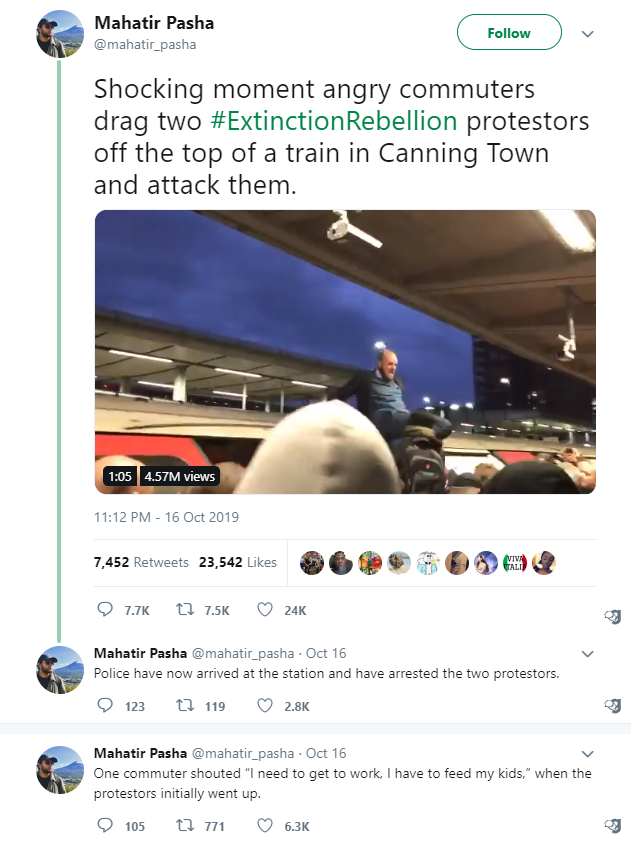
As I’ve said in comments on a few posts at other sites, the people who stage “protests” that block access to roads, railway stations, public buildings, and hospitals depend on the reactions of the people being mild, civilized, calm, and peaceful. But the more often these sorts of antics are performed, the thinner that veneer of civilization gets worn. At some point, and sooner than the organizers may realize, the veneer is gone and instead of peaceful commuters you’re disrupting, it’s a mob … and mobs don’t obey civilized rules like “thou shalt not kill”:

Those two were lucky that there was still some restraint being felt by the commuters. But it’s a clear warning sign that may not be attended to:

Extinction Rebellion, though it professes to be anti-Establishment, embodies the left-liberal values of the current Establishment hegemony.

That]s why rarely, if ever, will you hear anyone in government criticising Extinction Rebellion’s ideology, only its methods.

Then again, as one Conservative Brexiteer once told me, you can only fight a war on so many fronts. “Of course I know the whole climate change thing is bollocks,” he said – or words to that effect. “But I can only marshal my forces for one major battle at a time and that battle right now is Brexit.”

That’s how politicians have to think, it’s the nature of politics. Even the great Donald Trump has to play by these rules: look, for example, at how he has chickened out of having a red-team/blue-team scientific debate on global warming.

Happily, though, ordinary people are not constrained by such rules. There comes a point where they simply say to themselves:

    “Sod this for a game of soldiers. I really don’t care whether what I’m about to do is wise or expedient or even legal, come to that. I’m just sick to the back teeth of what’s happening to my country. It’s wrong. It feels wrong. And if the system that is supposed to look after the interests of decent, law-abiding, productive citizens will no long protect the interests of decent, law-abiding, productive citizens then I guess I’ll have to take the law into my own hands.”

Which is exactly what happened at Canning Town Station in the East of London this week.

For months, on and off, Extinction Rebellion activists have been playing havoc with the lives of ordinary people who thought the law was supposed to protect them and their livelihoods from the kind of direct action that Extinction Rebellion and its apologists keep reassuring us is peaceful and in our best interests.

Grudging tolerance has gradually given way to a simmering sense of injustice: “How can it be”, ordinary folk have started to wonder, “that these privileged wanktards with their pointless degrees in Environmental Sciences and Advanced Poi are free to build pyramids at Oxford Circus and block Westminster Bridge when if I tried it I’d get myself chucked in jail?”

That simmering sense of injustice is now erupting into acts of rebellion — real rebellion, not Extinction Rebellion’s state-protected faux-rebellion — like the one in Canning Town Station.

Something very similar is happening with people’s feelings about Brexit: “How can it be right that we live in democracy which refuses to honour a popular vote? Surely honouring a popular vote is the most basic requirement. And if it doesn’t do that, then democracy has failed and we need to start looking at other ways of making our feelings known.”

Webley Model 1904

Filed under: Britain, History, Military, Weapons — Tags: , , , — Nicholas @ 02:00

Forgotten Weapons
Published on 24 Feb 2015

Sold for $109,250.

The Model 1904 was basically the first working automatic pistol made by Webley (there was a 1903 toolroom experiment, but it didn’t really work). Like all the Webley automatic that would follow, it was designed by William Whiting. The 1904 was the company’s first effort at making a semiautomatic sidearm for the British military, so it was chambered for the .455 cartridge (a special rimless version made by Kynoch, after early experiments using the .455 rimmed revolver ammunition caused lots of problems stacking in magazines). It is a rather huge handgun, and uses a short recoil mechanism with two separate locking blocks. This particular one is s/n 23 – very few were made before it was rejected in military trials and Webley redirected its efforts toward smaller commercial pistols.

http://www.forgottenweapons.com

Theme music by Dylan Benson – http://dbproductioncompany.webs.com

QotD: Why Orwell wrote Nineteen Eighty-Four

Filed under: Britain, History, Politics, Quotations — Tags: , , , , — Nicholas @ 01:00


Many thanks for your letter. You ask whether totalitarianism, leader-worship etc. are really on the up-grade and instance the fact that they are not apparently growing in this country and the USA.

I must say I believe, or fear, that taking the world as a whole these things are on the increase. Hitler, no doubt, will soon disappear, but only at the expense of strengthening (a) Stalin, (b) the Anglo-American millionaires and (c) all sorts of petty führers of the type of de Gaulle. All the national movements everywhere, even those that originate in resistance to German domination, seem to take non-democratic forms, to group themselves round some superhuman führer (Hitler, Stalin, Salazar, Franco, Gandhi, De Valera are all varying examples) and to adopt the theory that the end justifies the means. Everywhere the world movement seems to be in the direction of centralised economies which can be made to “work” in an economic sense but which are not democratically organised and which tend to establish a caste system. With this go the horrors of emotional nationalism and a tendency to disbelieve in the existence of objective truth because all the facts have to fit in with the words and prophecies of some infallible führer. Already history has in a sense ceased to exist, ie. there is no such thing as a history of our own times which could be universally accepted, and the exact sciences are endangered as soon as military necessity ceases to keep people up to the mark. Hitler can say that the Jews started the war, and if he survives that will become official history. He can’t say that two and two are five, because for the purposes of, say, ballistics they have to make four. But if the sort of world that I am afraid of arrives, a world of two or three great superstates which are unable to conquer one another, two and two could become five if the führer wished it. That, so far as I can see, is the direction in which we are actually moving, though, of course, the process is reversible.

As to the comparative immunity of Britain and the USA. Whatever the pacifists etc. may say, we have not gone totalitarian yet and this is a very hopeful symptom. I believe very deeply, as I explained in my book The Lion and the Unicorn, in the English people and in their capacity to centralise their economy without destroying freedom in doing so. But one must remember that Britain and the USA haven’t been really tried, they haven’t known defeat or severe suffering, and there are some bad symptoms to balance the good ones. To begin with there is the general indifference to the decay of democracy. Do you realise, for instance, that no one in England under 26 now has a vote and that so far as one can see the great mass of people of that age don’t give a damn for this? Secondly there is the fact that the intellectuals are more totalitarian in outlook than the common people. On the whole the English intelligentsia have opposed Hitler, but only at the price of accepting Stalin. Most of them are perfectly ready for dictatorial methods, secret police, systematic falsification of history etc. so long as they feel that it is on “our” side. Indeed the statement that we haven’t a Fascist movement in England largely means that the young, at this moment, look for their führer elsewhere. One can’t be sure that that won’t change, nor can one be sure that the common people won’t think ten years hence as the intellectuals do now. I hope they won’t, I even trust they won’t, but if so it will be at the cost of a struggle. If one simply proclaims that all is for the best and doesn’t point to the sinister symptoms, one is merely helping to bring totalitarianism nearer.

You also ask, if I think the world tendency is towards Fascism, why do I support the war. It is a choice of evils — I fancy nearly every war is that. I know enough of British imperialism not to like it, but I would support it against Nazism or Japanese imperialism, as the lesser evil. Similarly I would support the USSR against Germany because I think the USSR cannot altogether escape its past and retains enough of the original ideas of the Revolution to make it a more hopeful phenomenon than Nazi Germany. I think, and have thought ever since the war began, in 1936 or thereabouts, that our cause is the better, but we have to keep on making it the better, which involves constant criticism.

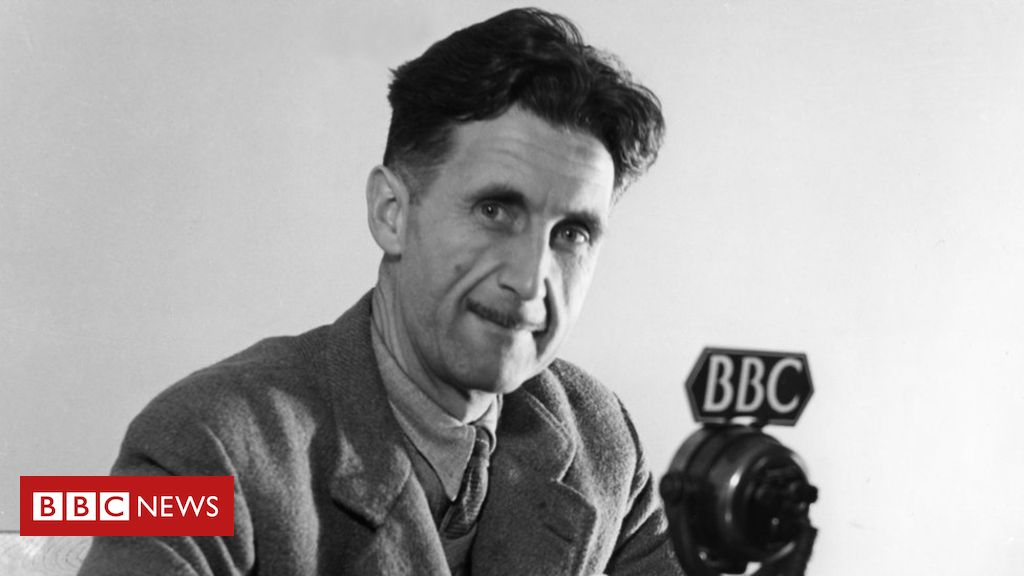
George Orwell, responding to a letter from Noel Willmett, 1944-05-18.

October 19, 2019

“[T]he really important thing about literary prizes isn’t to facilitate arguments among booklovers … it’s to sell books”

Filed under: Books — Tags: — Nicholas @ 08:50

Splitting this year’s Booker Prize between Margaret Atwood’s The Testaments and Bernardine Evaristo’s Girl, Woman, Other goes against the whole idea of the prize:

The joy of a big literary prize – and they don’t come bigger than the Booker – is in the years when the winner is unusual or unheard of, or perhaps just a book that your customers, in whatever part of the world you happen to be working in, are less interested in, is watching it take off. I really yearned to be back at any of my old shops the day after Anna Burns’ Milkman won.

It’s a particular joy if it is an underappreciated author with a large back catalogue. One of the nicest things about working at a bookshop, in my experience, was when regulars would tell you they had really enjoyed the book they read last week, and asking if there was anything comparable in stock – and being able to watch their eyes light up when you could reveal that, yes, in fact, there are in fact seven other books by Bernardine Evaristo for them to read.

[…]

What the judges seem not to have appreciated is that the really important thing about literary prizes isn’t to facilitate arguments among booklovers (though I will happy fight anyone who doesn’t think it is a travesty that Do Not Say We Have Nothing, one of the best novels I have read, was shortlisted for the Booker and the Women’s Prize and won neither). It’s to sell books, whether they be the crime novels’ Gold Dagger Award, the scientifically-focused Wellcome Trust Prize, or the Champions League of book prizes, the Booker itself.

The reality is that splitting the prize has two consequences: the first is that the story becomes the judges and their self-indulgence and self-regard rather than the books involved; the second is that inevitably, the attention will be focussed on the justly famous Margaret Atwood not on Evaristo.

[…]

When I was lucky enough to be asked to be a judge for the Baillie Gifford, the non-fiction equivalent of the Booker, while we ultimately picked the fantastic and gripping Chernobyl by Serhii Plokhy entirely on merit, I never forgot that we were handing out a prize that would change its author’s life, and give bookshops like the ones I worked at a boost, too.

While there was no chance of us doing something so silly as to split our prize, because we were chaired brilliantly and capably by the Economist‘s Fiammetta Rocco, in the event of an absolute tie you of course pick the less well-known author and the less-well known book.

Because if you cannot do that – if you lack the basic intelligence and empathy to understand why that’s what your job is a prize judge – then frankly you ought not to be judging a prize.

H/T to Colby Cosh for the link.

Churchill Was a Drunk… or Was He? – Doped WW2 Leaders Part 2

Filed under: Britain, History, Politics, Wine, WW2 — Tags: , , — Nicholas @ 06:00

World War Two
Published 17 Oct 2019

Winston Churchill was one of the most influential figures of World War Two. But as a heavy drinker he must have been under influence of constant drunkenness, right?

Watch Part 1 about Hermann Göring here: https://youtu.be/8H7arcUi7zQ

Join us on Patreon: https://www.patreon.com/TimeGhostHistory
Or join The TimeGhost Army directly at: https://timeghost.tv

Follow WW2 day by day on Instagram @World_war_two_realtime https://www.instagram.com/world_war_t…
Join our Discord Server: https://discord.gg/D6D2aYN.
Between 2 Wars: https://www.youtube.com/playlist?list…
Source list: http://bit.ly/WW2sources

Hosted by: Indy Neidell
Written by: Francis van Berkel
Produced and Directed by: Spartacus Olsson and Astrid Deinhard
Executive Producers: Bodo Rittenauer, Astrid Deinhard, Indy Neidell, Spartacus Olsson
Creative Producer: Joram Appel
Post Production Director: Wieke Kapteijns
Research by: Francis van Berkel
Edited by: Michal Drzewiecki
Map animations: Eastory
Sound design: Marek Kaminski

Colorisations by Norman Stewart and Julius Jääskeläinen https://www.facebook.com/JJcolorization/

Eastory’s channel: https://www.youtube.com/channel/UCEly…
Archive by Screenocean/Reuters https://www.screenocean.com.

Sources:
– IWM: A 11590
– Wine and whiskey icons by Made by Made, papers icon by Pauline, Breakfast icon by shashank singh, Champagne icons by Made by Made and Jenie Tomboc, Heart icon by Sophia Bai, alcohol icon by Flatart, beef icon by Igé Maulana, Beer by Valeriy, Cheese by Erin Agnoli, red wine by sasha willins, Brandy by NAS, all – the Noun Project
– Royalty free music of Bensound

A TimeGhost chronological documentary produced by OnLion Entertainment GmbH.

From the comments:

World War Two
22 hours ago (edited)
We make an effort to approach history as unbiased as possible. The result is what we think is a balanced videos on Churchill’s alcohol (ab)use. For those of you who are new here, we are following World War Two Week by Week, in which we do pay a lot of attention to all those smaller but still significant events. If you would like to watch the series, make sure to subscribe and to click here to start watching from episode one: https://www.youtube.com/watch?v=3-A1gVm9T0A&list=PLsIk0qF0R1j4Y2QxGw33vYu3t70CAPV7X

Cheers,
The TimeGhost team.

Auberon Waugh’s wine book has been republished

Filed under: Books, Britain, Humour, Wine — Tags: — Nicholas @ 05:00

It’s reviewed along with another book on Waugh by Henry Hitchings in the Times Literary Supplement:

“Looking back over my career to date, and at all the people I have insulted, I am mildly surprised that I am still allowed to exist”, wrote Auberon Waugh in 1980. For the remaining twenty-one years of his life he took pleasure in adding to his list of victims. Feminism and AIDS were bracketed together as “plagues”, ramblers were “semi-uniformed thugs”, the “lower classes” appeared “ugly, boring, humourless and desperately conceited”, and the female delegates at a Labour Party conference struck him as “either hunch-backed or hairy-legged or obviously lesbian”. It’s natural to associate such views with an age now pretty remote. But Waugh was born in the same year as John Cleese and Margaret Drabble; he was younger than Jilly Cooper and Vanessa Redgrave, John Prescott and David Dimbleby. Were he still alive, he would not yet be eighty.

[…]

A lot has changed since the period that Waugh on Wine covers. The British mass market is no longer in the grip of a “depraved” taste for semi-sweet wine. The drinkers he has in mind when he refers solecistically to “the hoi polloi” do not exhibit a “passion for filth” by favouring cheap Teutonic gut-rot. Pink champagne is easy to find, and Chianti is no longer the preserve of nurses hosting dinners in fifth-floor flatshares in Fulham. A large proportion of the most sought-after French wines now end up in Chinese cellars. The globalization of demand has stretched prices. When Waugh complains about the cost of 1982’s most rarefied clarets, he proposes as an alternative Château Léoville-Las Cases at £9 a bottle; anyone thinking of laying down its 2018 counterpart will have to find around twenty-five times that amount.

The durability of a few of Waugh’s claims is hard to assess. For instance, do the “semi-professional poules de luxe on the fringes of café society” continue to disappoint their admirers by failing to serve good vintage port? Yet much remains as it was. Dry white Bordeaux still doesn’t have a great following in Britain. Neither, more regrettably, do the best German wines. It is true that in America “only obvious alcoholics drink anything like as much as the ordinary English professional”. The British still go on holiday to France and return full of hyperbolic enthusiasm for some local plonk that they have been inspired to import in large quantities – only to find, once it arrives in Blighty, that it is no more potable than the contents of a fish tank. There is a certain prescience, too, in Waugh’s remark that the best wines are, increasingly, beyond English pockets “shrunk by the growing indolence, incompetence and indiscipline of our island race”.

Waugh writes entertainingly about the social life of the drinker: “A tremendous amount of unnecessary suffering goes on under the name of Liebfraumilch“. An enterprising young wine merchant is portrayed as someone who “in earlier times, might have spread terror among the fat galleons of the Spanish main”. He shies away from no quarrel: with greedy producers, covetous investors “who treat fine wine like rare postage stamps”, and wine merchants who spew out empurpled hype. Oddly, though, he clings to the belief that people choose wine in order to impress their friends, not to gratify their own palates, and he likes to pretend that perplexity exists where in fact there is none – “Aperitifs are not to be confused with aperients, which are laxatives designed to open the bowels”.

[…] Reflecting later on the effects of his “camped up” approach to writing about wine, he provided what could be taken as an epitaph for an entire stratum of maverick journalism: “I am not sure that it helps much, but it is more amusing to read”.

H/T again to Colby Cosh for the link.

Remy: Horrifying Tweets Resurface

Filed under: Humour, Media — Tags: , , , — Nicholas @ 04:00

ReasonTV
Published 17 Oct 2019

Remy returns to the news desk to bring you what passes for journalism these days.

Written and Performed by Remy.
Music tracks mastered by Ben Karlstrom.
Produced and Edited by Austin Bragg.

LYRICS:

Trudeau denies the report. Ed?
A rough week for Canada’s first black prime minister. Thanks, Tim.

A problem long posed, now finally an answer
A cure has been found to a rare form of cancer.
We’ll tell you who found it, what he thinks this means,
And dig up some tweets from his early teens.

Plus the Good Samaritan, whose quickness and breadth
Saved a family of four from a fiery death.
We’ll ask how he did it, how he made it in time,
And why he tweeted this back in 2009.

Uh, Ed? Yes, Tim. Forgive the defiance
But I think we should focus on the news part, the science
And not what they tweeted back when they were 10
The science, hmm. I’ll try it again.

Archaeologists have unearthed a series of tweets
Made by this local hero when he was 13.
Will this middle-school tweet soon mean his demise?
Our report might just win the Pulitzer Prize.

Pulitzer Prize? In what? Scrolling down?
We found immature things immature people wrote down.
Our country’s at war and that’s the story we sought?
War coverage, yes—I’ll give it a shot.

This Navy SEAL unit is now under fire
For a series of tweets, we’ll take our magnifier
And pay no attention to how their recent life’s been
And tell you what you should think that says about them.

Says about them? What’s it say about us?
That the first thing we do after someone’s discussed
Is comb through their childhood looking for dirt.
OK, I can do this, I assure you I’m cured.

Well she’s the first woman to serve on the board
Of our town’s city council—and she just signed an accord.
We’ll comb through the details of what she did write
And through years of her tweets in hopes of wrecking her life.

OK, see, I hate this, this is just what we do
Make things controversial for clicks and for views.
When we’re covering news, should our first thought each time
Be “Let’s find what they tweeted back when they were nine”?

Finally, millions can now walk thanks to his prosthesis
But a hateful hand signal when he was a fetus
Leads many to now question what he promotes.
We’ll toss him in a well and see if he floats.

Wood is Like Straws | Paul Sellers

Filed under: Tools, Woodworking — Tags: , , — Nicholas @ 02:00

Paul Sellers
Published on 19 Sep 2019

Paul has been explaining grain and structure to thousands of students through the years and the best way he found was to show wood as straws.

It brings tremendous clarity to your work and the working of wood when you imagine your material firstly, as unidirectional straws reaching up from the earth to the light and warmth of the sun and then with a twist, dip and bend to encompass its branches and the influences of prevailing winds. This video takes you on such a journey to clarify what we rely on as our material.

Want to learn more about woodworking? See https://woodworkingmasterclasses.com or https://commonwoodworking.com for step-by-step videos, guides and tutorials. You can also follow Paul’s latest ventures on his woodworking blog at https://paulsellers.com/

QotD: Writing to length

Filed under: Education, Media, Quotations — Tags: , , — Nicholas @ 01:00

Having spent a good deal of my life writing short pieces on serious subjects for newspapers and magazines, I’ve learned from experience to write organically short – that is, to write a five-hundred-word draft of a five-hundred-word piece instead of writing a thousand-word draft and cutting it in half. Not only does this reduce waste motion, but the finished product is almost always better. When you write a long piece and chop it down to size, it tends to read … well, choppily.

So why do inexperienced authors write long? I suspect it’s because they assume that they’ll get only one chance to impress the editor, which causes them to empty their bag of tricks every time they write a piece. (This reminds me of another of my critical commandments: Don’t tell everything you know.) Flashiness is a sin of youth. The older and more self-assured a writer is, the more likely he is to appreciate the virtues of simplicity and economy.

I don’t know whether it’s possible to teach this lesson to young writers. The older I get, the more I wonder whether anything can be taught to anyone. Still, I did my best to get it across to my students, and I like to think that at least some of them were paying attention.

Terry Teachout, “To the point”, About Last Night, 2007-06-01.

« Newer PostsOlder Posts »

Powered by WordPress