Quotulatiousness

January 23, 2021

Innovation is infectious … you catch it from other innovators

Filed under: Britain, History, Technology — Tags: , — Nicholas @ 05:00

An interesting notion on how people innovate or invent is discussed in Anton Howes’ latest Age of Invention newsletter:

… my research on the Industrial Revolution has yielded a general model of how to think about it.

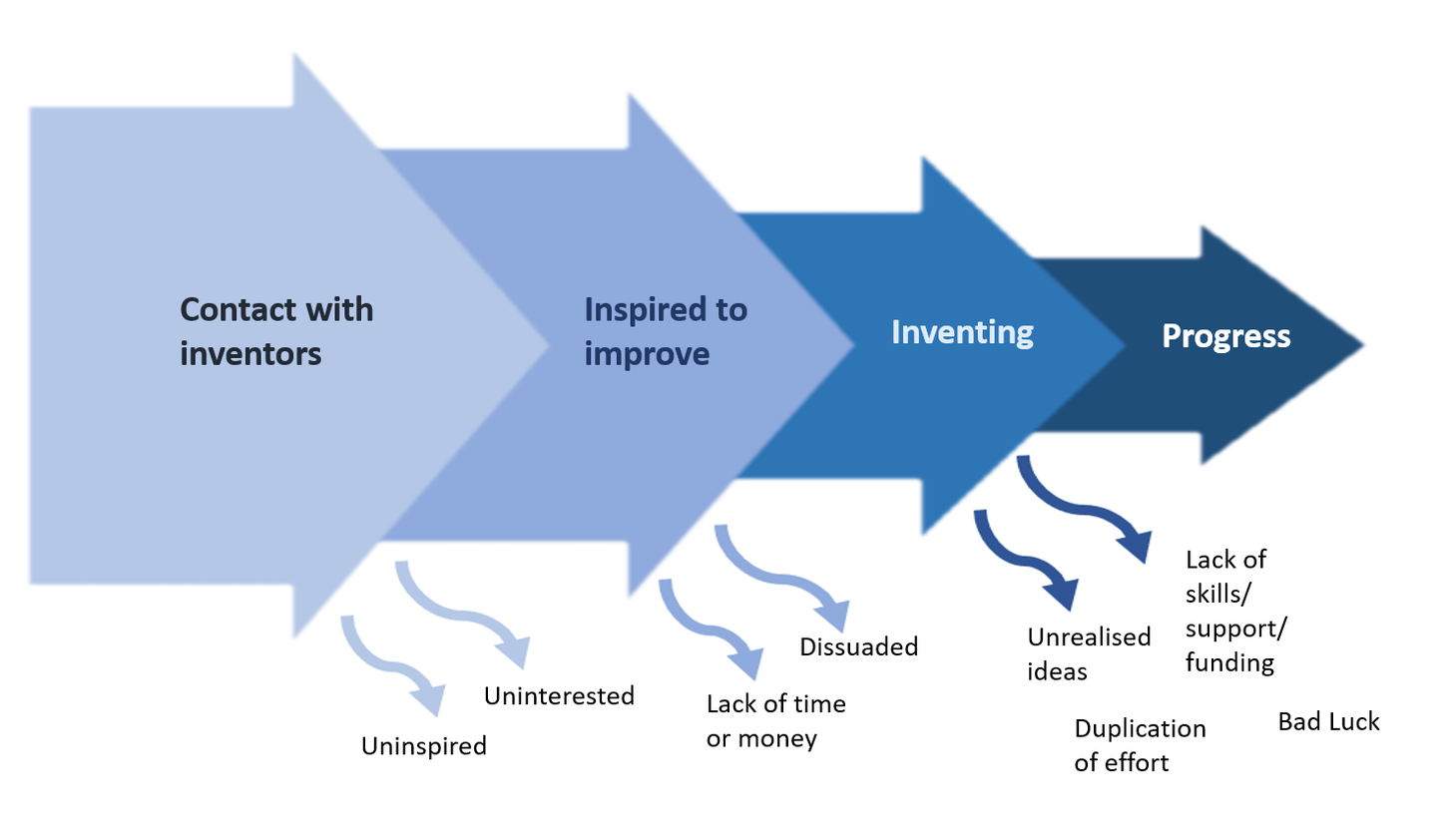
Core to the model is the observation that innovation spreads from person to person. It is a mentality, that we pick up from others. Of my sample of inventors, active c.1550-1850, the vast majority of them had had some kind of contact with an inventor before inventing anything themselves. So far, I’ve found evidence of that contact for about 83% of them, and for the remainder we frankly know next to nothing about them anyway. On the balance of probability, I suspect that all inventors had and continue to have such prior contact, even if the evidence has been lost to the mists of time.

Supposing I’m right about this — and there’s also more recent evidence from the largest and most detailed ever study of modern American inventors to support it — then such exposure to an inventor is the ultimate cause of innovation. Everything else we worry about when promoting innovation, from funding to intellectual property rights, or from education to social acceptance, is in a sense downstream of it.

Absent any exposure to inventors, people simply don’t become inventors. Knowing about invention as an activity is a necessary precondition to becoming an inventor yourself. The vast majority of people never innovate, for the very simple reason that it never occurs to them to do so. People are faced with problems all the time, but they generally have all sorts of pre-existing responses to them. Famine? The millennia-old response was to tighten belts or starve. Not to try to innovate with agricultural techniques. Trade route collapse? The millennia-old response was to take the hit, or try to shift to other familiar markets. Not to try to send ships into the icy unknown. As I’ve noticed time and time and time again, necessity is not the mother of invention. It only appears that way in retrospect — it’s when faced with a crisis that pre-existing inventors step forth to solve problems in ways they had already been investigating. Without them, there would be no such innovative response. Crises have an effect on the direction of invention — that is, on what problems people identify and then try to solve — but not on its underlying supply.

But this is not to say that exposure to an inventor is sufficient. Supposing you do meet an inventor. Your contact might be too fleeting to have an impact, or you might not be predisposed to be inspired by them. You might lack curiosity, or be distracted by some other preoccupation. Or perhaps the inventor you met might not be an especially inspiring person. Some people are simply more interesting than others. So from an initial spring of people who come into contact with inventors, we can immediately narrow the flow of new inventors down to those for whom such exposure actually had an impact.

But we then have to narrow it down further. Of the people who have met an inventor and been inspired by them, some might be distracted by other activities, or be dissuaded by social barriers, or lack the resources to tinker around with things, whether it be money or time.
History Summarized: Atlantic Exploration

Overly Sarcastic Productions
Published 22 Jan 2021

So you just conquered Iberia, and you’re wondering where to go from here? It’s a more common conundrum than you might think. Consider: a big wooden floaty house that goes splish-splash in the Atlantic Ocean. Anyway, this is a video about Portuguese and Spanish (erm, Castilian) exploration in the Atlantic during the 1400s. Please note my deliberate decision to Nope on out at the turn of the 1500s.

This topic was requested by our longtime patron Antonio Juarez! Thank you Antonio for supporting our work and helping to provide entertaining educational content.

SOURCES & Further Reading: Ornament of the World by Maria Rosa Menocal; lectures from Great Courses Plus “1571: Spain, Portugal Encircle the Globe” by Donald J. Harreld, “Renaissance and Exploration: New Horizons” by Jennifer McNabb, “Portugal’s Great Leap Forward” by “Vejas Gabriel Liulevicius”

TRACKLIST: “Scheming Weasel (faster version),” “Monkeys Spinning Monkeys”, “Local Forecast – Elevator” Kevin MacLeod (incompetech.com)
Licensed under Creative Commons: By Attribution 4.0 License
http://creativecommons.org/licenses/b…

Our content is intended for teenage audiences and up.

PATREON: https://www.Patreon.com/OSP

PODCAST: https://overlysarcasticpodcast.transi…

DISCORD: https://discord.gg/osp

MERCH LINKS: http://rdbl.co/osp

OUR WEBSITE: https://www.OverlySarcasticProductions.com
Find us on Twitter https://www.Twitter.com/OSPYouTube
Find us on Reddit https://www.Reddit.com/r/OSP/

Scott Alexander returns

Filed under: Media — Tags: , — Nicholas @ 03:00

Having been driven from his original blog due to a doxxing threat from a New York Times reporter, Scott Alexander has resumed his public blogging, this time on Substack:

Welcome to Astral Codex Ten! Some of you are probably veterans of my old blog, Slate Star Codex. Others may be newbies wondering what this is all about.

I’m happy to finally be able to give a clear answer: this is a blog about ṛta.

Ṛta is a Sanskrit word, so ancient that it brushes up against the origin of Indo-European languages. It’s related to English “rationality” and “arithmetic”, but also “art” and “harmony”. And “right”, both in the senses of “natural rights” and “the right answer”. And “order”. And “arete” and “aristos” and all those other Greek words about morality. And “artificial”, as in eg artificial intelligence. More speculatively “reign” and related words about rulership, and “rich” and related words about money.

(also “arthropod”, but insects creep me out so I’ll be skipping this one)

The dictionary defines ṛta as “order”, “truth”, or “rule”, but I think of it as the intersection of all these concepts, a sort of hidden node at the center of art and harmony and rationality and the rest. What are the laws of thought? How do they reveal themselves, at every level, from the flow of electricity through the brain to the flow of money through the global economy? How can we cleave to them more closely, for our own good and the good of generations still to come?

In practice, articles (another ṛta relative!) here tend to focus on reasoning, science, psychiatry, medicine, ethics, genetics, AI, economics and politics. The political posts sometimes stray into choppy waters, and I have immense sympathy for people who are sick of that and prefer to pass.

As with most Substack blogs, it’s a subscriber-supported effort with limited public posts available to non-paying subscribers (like me).

How .22LR Ammo is Made

Filed under: Business, USA, Weapons — Tags: , , — Nicholas @ 02:00

Lucky Gunner Ammo
Published 16 Apr 2020

We were offered a rare glimpse into Federal’s rimfire plant in Anoka, MN to watch how .22 LR ammunition is made. We all know the basic components involved — each cartridge consists of a case with primer, propellant, and a bullet. Watching them all come together on a massive scale with a choreographed dance of modern automated machinery is a surprisingly gratifying experience.

Special thanks to our friends at Federal Ammunition and Vista Outdoor for the invitation!

Support our channel. Buy ammo from Lucky Gunner!

QotD: “Genetics is interesting as an example of a science that overcame a diseased paradigm”

Filed under: Health, Media, Quotations, Science — Tags: , , , , — Nicholas @ 01:00

This side of the veil, instead of looking for the “gene for intelligence”, we try to find “polygenic scores”. Given a person’s entire genome, what function best predicts their intelligence? The most recent such effort uses over a thousand genes and is able to predict 10% of variability in educational attainment. This isn’t much, but it’s a heck of a lot better than anyone was able to do under the old “dozen genes” model, and it’s getting better every year in the way healthy paradigms are supposed to.

Genetics is interesting as an example of a science that overcame a diseased paradigm. For years, basically all candidate gene studies were fake. “How come we can’t find genes for anything?” was never as popular as “where’s my flying car?” as a symbol of how science never advances in the way we optimistically feel like it should. But it could have been.

And now it works. What lessons can we draw from this, for domains that still seem disappointing and intractable?

Turn-of-the-millennium behavioral genetics was intractable because it was more polycausal than anyone expected. Everything interesting was an excruciating interaction of a thousand different things. You had to know all those things to predict anything at all, so nobody predicted anything and all apparent predictions were fake.

Modern genetics is healthy and functional because it turns out that although genetics isn’t easy, it is simple. Yes, there are three billion base pairs in the human genome. But each of those base pairs is a nice, clean, discrete unit with one of four values. In a way, saying “everything has three billion possible causes” is a mercy; it’s placing an upper bound on how terrible genetics can be. The “secret” of genetics was that there was no “secret”. You just had to drop the optimistic assumption that there was any shortcut other than measuring all three billion different things, and get busy doing the measuring. The field was maximally perverse, but with enough advances in sequencing and computing, even the maximum possible level of perversity turned out to be within the limits of modern computing.

(This is an oversimplification: if it were really maximally perverse, chaos theory would be involved somehow. Maybe a better claim is that it hits the maximum perversity bound in one specific dimension)

Scott Alexander, “The Omnigenic Model As Metaphor For Life”, Slate Star Codex, 2018-09-13.

January 22, 2021

Canada’s Governor General resigns, avoiding dragging the Queen into another Canadian political drama

Filed under: Cancon, Government — Tags: , , — Nicholas @ 05:00

Colby Cosh notes in Thursday’s NP Platformed newsletter:

The Right Honourable Julie Payette, 29th Governor General of Canada (October 2, 2017 – January 21, 2021).

When NP Platformed saw Robert Fife’s Globe and Mail report this morning, our thought was that leaking the news of the report’s completion was an obvious political manoeuvre. (You know how a fife works: put some wind in it, and it will play a tune for you.)

Even a prime minister as callow as the current one would not want to try firing a governor general, which would require the personal intervention of the Queen. This would be a failure in itself, a blot on Canada’s copybook, even if the PM had the support of other parliamentary parties.

As hours passed, the thought naturally occurred to us: why should Payette be making anyone wait for some written report anyway? We know she has sometimes balked at most of the easily identifiable parts of her job, including travel to ceremonies and (for heaven’s sake) giving royal assent to legislation. Hired to be a dynamic female STEM mascot (for a Liberal government, sort of), she somehow degenerated, with unseemly speed, into an immured princess from a fairy tale, evidently driven half-mad by some faerie spell.

The main job, the essence of the governor general gig, is to be above suspicion, like Caesar’s wife in the proverb. The mere whisper of abusiveness or of clownish behaviour involving public funds ought to have been enough to settle things, possibly with a convenient health excuse. (If she offers one now, it can only provoke snide laughter.) The vicereine is, in our system of government, the passage through which national honours flow from the sovereign. The mention of “honour” in connection with this Governor General was becoming mighty awkward. She should have our thanks for doing the right thing today.

Japan’s Only Pacific “Ally” – Phibun’s Thailand – WW2 Biography Special

Filed under: History, Japan, Military, Pacific, WW2 — Tags: , , , , , , — Nicholas @ 04:00

World War Two
Published 21 Jan 2021

Thailand’s prime minister and de-facto dictator Plaek Phibunsongkhram imported European fascism, nationalism and militarism to his country. But when Japan’s threat to South-East Asia became imminent, Phibun didn’t know what to do. His story is one of utter indecisiveness and opportunism.

Join us on Patreon: https://www.patreon.com/TimeGhostHistory
Or join The TimeGhost Army directly at: https://timeghost.tv

Follow WW2 day by day on Instagram @ww2_day_by_day – https://www.instagram.com/ww2_day_by_day
Between 2 Wars: https://www.youtube.com/playlist?list…
Source list: http://bit.ly/WW2sources

Hosted by: Indy Neidell
Written by: Joram Appel
Director: Astrid Deinhard
Producers: Astrid Deinhard and Spartacus Olsson
Executive Producers: Astrid Deinhard, Indy Neidell, Spartacus Olsson, Bodo Rittenauer
Creative Producer: Maria Kyhle
Post-Production Director: Wieke Kapteijns
Research by: Joram Appel
Edited by: Miki Cackowski
Sound design: Marek Kamiński
Map animations: Eastory (https://www.youtube.com/c/eastory)

Sources:
IWM HU 675
Portrait of Plaek Phibunsongkhram, courtesy of 冯銮披汶 https://commons.wikimedia.org/wiki/Fi…
From the Noun Project: people by ProSymbols, tick by akash k

Soundtracks from the Epidemic Sound:
Johannes Bornlof – “Deviation In Time”
Philip Ayers – “Trapped in a Maze”
Rannar Sillard – “March Of The Brave 4”
Fabien Tell – “Last Point of Safe Return”
Johannes Bornlof – “The Inspector 4”
Farrell Wooten – “Blunt Object”

Archive by Screenocean/Reuters https://www.screenocean.com.

A TimeGhost chronological documentary produced by OnLion Entertainment GmbH.

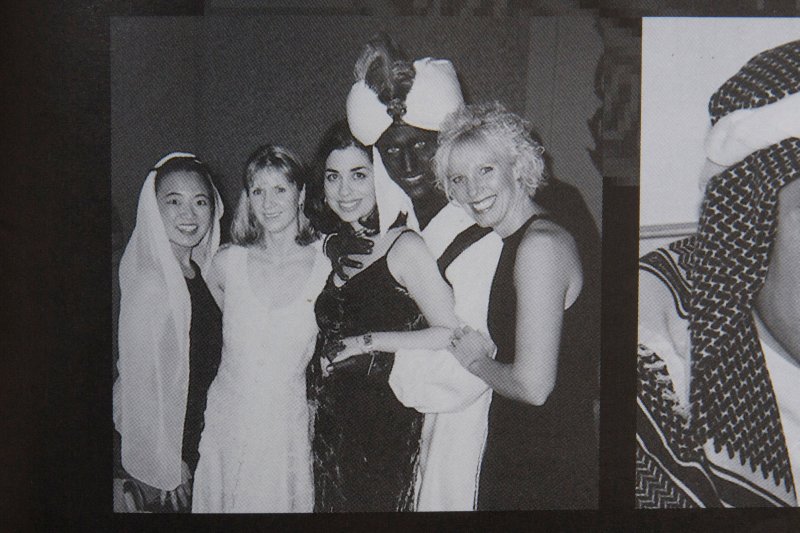
Hypocrisy is bad (for mere humans) but ostentatious hypocrisy is reserved for the powerful

Filed under: Government, Media, Politics — Tags: , , , — Nicholas @ 03:00

David Warren notes the two very different kinds of hypocrisy on display during these fallen days:

Justin Trudeau with dark makeup on his face, neck and hands at a 2001 “Arabian Nights”-themed party at the West Point Grey Academy, the private school where he taught.
Photo from the West Point Grey Academy yearbook, via Time

Hypocrisy is often dismissed as a humdrum moral vice; rather as pæderasty, or buggery, or commissioning abortions: things considered very grave in the past, but now quite acceptable among progressive persons. One feels almost cruel, or envious, to criticize the adept hypocrite. How dare we try to withdraw the air in which he lives and breathes? “Zero tolerance” is directed at more serious vices, such as having wrong opinions, or voting Republican.

As Paul Valéry said, “Power without abuse loses its charm,” and when, for instance, a governor who proclaims crippling Batflu restrictions is seen ignoring them, he is outraged. His critics are his opponents, he reasons; they really ought to be investigated first!

A milder, general criticism is sometimes made, about the lifestyles of the rich and famous. How is it that prominent environmentalists burn so much jet fuel in their travels from one conference to another, at the world’s most lavish resorts? Shouldn’t they go about in sackcloth and ashes, as they tell us to do?

This is to misunderstand their hypocrisy. We assume they are motivated by greed, and the love of pleasure, the way we would be. But why must it be piled on so thick? Many a jetsetter hardly uses the jacuzzis. He takes a quick shower, because he has another aeroplane to catch.

Yes, most people are attracted to the sumptuous, but in a fine and private way. They rarely encourage the paparazzi, or wish to be watched over their fences and walls. They hire security, to scare trespassers away. Servants, up to a point, must be endured, but in the past they could be ignored, the way we ignore appliances. I may not have a toaster, but I do have a stove, and could swear that it is staring at me. But it was manufactured in the 1960s, so I needn’t fear it has an Internet connexion. And besides, if it did, it wouldn’t be reporting to the tabloids, but to technical staff. We try to ignore them, at least so long as we can pretend they are equivalent to our maids and butlers.

Shooting the M3A1 Grease Gun

Filed under: History, Military, USA, Weapons, WW2 — Tags: , , , , — Nicholas @ 02:00

Forgotten Weapons
Published 9 Mar 2018

The M3 (and its followup improved M3A1 model) was the United States’ answer to the high cost and manufacturing complexity of the Thompson submachine gun. The M3 “Grease Gun” (because really, that is what it looks like) was a very inexpensive weapon with a stamped and welded receiver and only a few milled parts. It also had the slowest rate of fire of any World War 2 submachine gun at about 450 rounds/minute. Its weight, compactness, and controllability made it almost universally preferred over the Thompson, at least by soldiers who had to carry and fight with either of them.

The Grease Gun is reputedly extremely controllable because of its low rate of fire, but this is my first time to actually try shooting one. Will it live up to that reputation?

http://www.patreon.com/ForgottenWeapons

Cool Forgotten Weapons merch! http://shop.bbtv.com/collections/forg…

If you enjoy Forgotten Weapons, check out its sister channel, InRangeTV! http://www.youtube.com/InRangeTVShow

Contact:
Forgotten Weapons
6281 N Oracle #36270
Tucson, AZ 85704

QotD: The enclosure movement, in historical fact and in Marxist imagining

Filed under: Britain, Economics, History, Quotations — Tags: , , , , , — Nicholas @ 01:00

Consider, for example, that the tenfold increase [in the population of London] was in the period before the expropriative parliamentary enclosures of Marxist legend, when state fiat was used to deny smaller farmers their ancient, customary rights to use the land near their villages. While the very first of these enclosure acts appeared as early as 1604, parliamentary enclosure only really got going from the mid-eighteenth century. Instead, for the period in question, enclosure happened in a piecemeal way, with the open fields gradually dissolving as farmers exchanged or sold their tiny strips of land, over time amalgamating them into larger, privately controlled plots. With ownership concentrated in fewer and fewer hands, it became relatively easy to gain the unanimity needed to suspend common rights. The process played out in myriad ways all over the country, sometimes with amicable agreement and voluntary exchange, sometimes with ruthless monopolising of the land, with the already-large owners systematically buying out their neighbours. In some cases it involved the consolidation of existing arable land, in others it meant the conversion of forest, heath, marsh, or fen — the traditional “wastes”, to which the poorer villagers might have had various customary rights to gather firewood for fuel, or to graze their cattle, or to hunt for small game — into land that could be used for farming or pasture.

How this process played out all depended on extremely specific, local conditions. But on the whole it was slow — piecemeal enclosure had been happening to varying degrees since at least the fourteenth century. It’s hard to see how such a sporadic and piecemeal process could have led to such consistently and increasingly massive numbers flocking specifically to London. Indeed, the fact that they singled out London as their target suggests that this narrative might have it back-to-front. Some economic historians argue that it was the prospect of higher wages in the ever-growing metropolis that induced farmers to leave the countryside in the first place, selling up or abandoning their plots to those they left behind. Rather than enclosure pushing peasants off the land and into the city, London’s specific pull may instead have thus created the vacuum that allowed the remaining farmers to bring about enclosure. Otherwise, why didn’t the peasants simply flock to any old urban centre? The second-tier cities like Norwich or Bristol or Exeter or Coventry or York would all have been far less dangerous.

Anton Howes, “London the Great”, Age of Invention, 2020-10-20.

January 21, 2021

Fallen Flag — the New York Central System (part 2)

Filed under: History, Railways, USA — Tags: , , , , — Nicholas @ 03:00

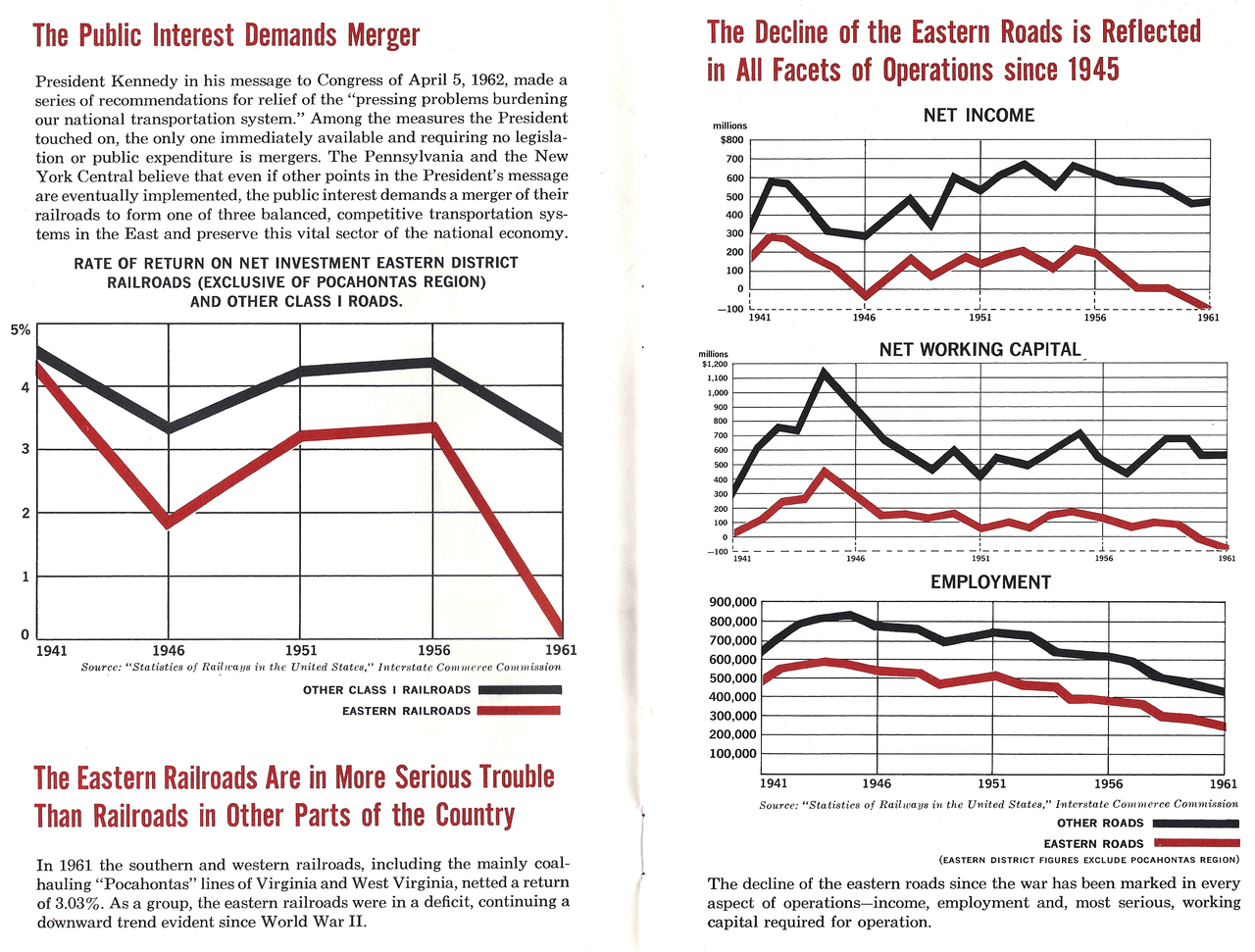
This month’s Classic Trains fallen flag feature is the history of the New York Central System by George Drury (part 1 is linked here). The New York Central was one of the biggest and most economically powerful American railways for over a century before the postwar boom turned into the economic disaster of the 1960s and 70s, as passengers and freight switched from rail to road — partly thanks to the taxpayer-funded Interstate Highway System — and air and the decline of northeastern heavy industry and mining hit the established eastern railroads very hard:

The New York Central System was the largest of the eastern trunk systems from the standpoint of mileage and second only to the Pennsylvania in revenue. It served most of the industrial part of the country, and its freight tonnage was exceeded only by the coal-carrying railroads. In addition it was a major passenger railroad, with perhaps two-thirds the number of passengers as the Pennsylvania, but NYC’s average passenger traveled one-third again as far as Pennsy’s. NYC did not share as fully in the post-World War II prosperity because of rising labor costs, material costs, and an expensive improvement program, especially for passenger service.

During 1946–47 Chesapeake & Ohio purchased a block of NYC stock, becoming the road’s largest stockholder. Robert R. Young gained control of the Central and became its chairman in 1954 as part of a maneuver to merge it with C&O. One of his first acts was to put Alfred E. Perlman in charge of the NYC.

Under Perlman NYC slimmed its physical plant, reducing long stretches of four-track line to two tracks under centralized traffic control, and developed an aggressive freight marketing department. At the same time NYC’s passenger operations were de-emphasized. On December 3, 1967, just before NYC and Pennsy merged, the Central reduced its passenger service to a skeleton, combining its New York–Chicago, New York–Detroit, New York–Toronto, and Boston–Chicago services into a single train and dropping all train names (including that of the legendary 20th Century Limited) except for, curiously, that of the Chicago–Cincinnati James Whitcomb Riley.

The Central’s archrival was the Pennsylvania Railroad. West of Buffalo and Pittsburgh the two systems duplicated each other at almost every major point; east of those cities the two hardly touched. Both had physical plant not being used to capacity (NYC was in better shape); both had a heavy passenger business; neither was earning much money. In 1957 NYC and Pennsy announced merger talks.

The initial industry reaction was utter surprise. Every merger proposal for decades had tried to balance the Central against the Pennsy and create two, three, or four more-or-less-equal systems in the east. Traditionally PRR had been allied with Norfolk & Western and Wabash; NYC with Baltimore & Ohio, Reading, and maybe the Lackawanna; and everyone else swept up with Erie and Nickel Plate. Tradition also favored end-to-end mergers rather than those of parallel roads.

Planning and justifying the merger took nearly ten years, during which time the eastern railroad scene changed radically, in large measure because of the impending merger of NYC and PRR: Erie merged with Lackawanna, C&O acquired control of B&O, and N&W took in Virginian, Wabash, Nickel Plate, Pittsburgh & West Virginia, and Akron, Canton & Youngstown.

Tradition aside, though, the New York Central and the Pennsylvania merged on Feb. 1, 1968 to form Penn Central.

Pages 1-2 from the July 1962 publicity booklet produced by the Penn-Central Merger Information Committee to inform the public on issues concerning their proposed merger. This pages shows various statistics showing Eastern railroads in decline.
Wikimedia Commons.

“A horse with no name” cover in Latin (BARDCORE) Original song by America

Filed under: Media — Tags: , , — Nicholas @ 02:00

the_miracle_aligner
Published 20 Oct 2020

“Oh no Consul White, the Parthians found us!”
&
Oh, Crassus you doink. You, I don’t care about but why did you have to drag Publius down with you 😢 NEVER FORGET MAY 6th 53 B.C

Original by @America – Topic: https://www.youtube.com/watch?v=oIYgs…

BIG shoutout to @Canticles Please go check out his covers NOWWW!!!
https://www.youtube.com/user/theyoung…

Another BIIIG shoutout to @Juan Necessarium PLEASE go and support his work too yao
https://www.youtube.com/channel/UCQ8O…

Wanna follow me?
https://open.spotify.com/artist/4y9XM…
https://twitter.com/KholeJa
https://www.instagram.com/the_miracle…

Source of the BG: https://en.wikipedia.org/wiki/Publius…

This was a really fun one to do. As always thank you so much for all the support people. I am edging closer and closer to 100K subs 🙂 Got my special coming, it’ll be a pleasant surprise. Leave a like if ya liked it, and if you haven’t subscribed yet, please consider doing so 🙂

Take care my lovelies and until we meet again.

Consider supporting the channel, I know what I do ain’t much but its honest work ❤: https://www.patreon.com/the_miracle_a…

Here be the lyrics, all credits goes to Juan

In prima itineris parte
Omnia vitae intuebar.
Erant plantae, aves, saxa et res
Arena, colles et orbes.
Primum quod vidi musca bombans fuit
Et caelum sine ulla nube.
Calor magnus et tellus sicca
Sed aer soni plenus erat.

Eremum transii vectus sine nomine equo
Mihi placuit pluviam nullam pati.
In eremo, tuum nomen recordaris,
Nam nemo adest quin te ullo modo vexet.

Post duos dies sub eremi sole (DUos DIes)
Pellis mea iam rubebat,
Post tres dies in gaudio illius loci,
(loCI)
Antiqui fluminis alveum vidi.
Et quod narrabat de flumine antea vivo
Me maximopere contristavit.
(maxiMOpere CONtrisTAvit)

Eremum transii vectus sine nomine equo,
Mihi placuit pluviam nullam pati.
In eremo, tuum nomen recordaris,
Nam nemo adest quin te ullo modo vexet.

Post novem dies, equum liberavi,
Cum eremus mare factus sit.
Erant plantae, aves, saxa et res,
Arena, colles et orbes.
Sub mari enim vita certe floret
Sed id eremus videtur supra.
Sub urbibus cor terra factum iacet,
Sed homines amorem nullum dabunt.

Eremum transii vectus sine nomine equo
Mihi placuit pluviam nullam pati.
In eremo, tuum nomen recordaris,
Nam nemo adest quin te ullo modo vexet.

#America #Latin #Bardcore

QotD: The Laurentian Elite and the “new Canada” of the 1960s

The Patriot Game captures a unique characteristic, and problem, with Canadian conservatism. Lots of Canadian conservatives really don’t like Canada all that much. Brimelow is right to suggest that the contemporary Canadian identity is very much a creation of the Liberals and the New Class, and this isn’t one that conservatives feel all that comfortable with. What this has done is create a powerful anti-Canadian impulse in portions of the conservative movement.

Because the Liberals were so successful in creating this new identity, conservatives, especially Western conservatives (understandably) felt alienated in this new Canada. Brimelow gave some intellectual heft and crafted a coherent theory around why conservatives felt this way.

The broader narrative Brimelow, and others, put forward is that Canada’s British heritage was central to our identity and sense of who we are, but that this identity was destroyed by the Liberals who then built a new one in their own image. In the 1960s, Canadian Liberalism became self-consciously post-British, and the 1960s really do represent an approximate decade in which the “old Canada” died and a “new Canada” was born. The 1960s weren’t just a time of social change, they marked the end of the British Empire, the start of the Quiet Revolution, and of course most symbolically saw the replacement of the Red Ensign with the Maple Leaf flag. The battles between Diefenbaker and Pearson (and Pierre Trudeau) work as a stand in for the divide between old British Canada and new Liberal Canada.

Ben Woodfinden, “True North Patriotism and a Distinctly Canadian Conservatism”, The Dominion, 2020-10-20.

January 20, 2021

“Canada Post … is not to act as the censor of mail or to determine the extent of freedom of expression in Canada”

Filed under: Cancon, Law, Liberty, Politics — Tags: , , , — Nicholas @ 05:00

Colby Cosh on a recent incident in Regina where a Canada Post employee took it upon himself to act as a local censor for people on his delivery route:

Today’s idiot of the day is not, perhaps surprisingly, the Regina postman who got suspended for refusing to deliver the Epoch Times, the oddball anti-communist newspaper that’s affiliated with China’s persecuted Falun Gong religious movement. Don’t get us wrong: Ramiro Sepulveda is clearly a bit of a nitwit. He seems to believe that a newspaper founded by commie-hating Chinese-Americans is designed to provoke hatred toward “Asian communities in North America.”

Sepulveda didn’t want to deliver free copies of the Times to non-soliciting customers because it “spits lies.” Perhaps regrettably, the strong reaction by Canada Post means that our junk mail, quite a lot of which consists of boastful missives from politicians, is not destined to be fact-checked and aggressively suppressed by the corporation’s rank and file.

Sepulveda was properly punished for not doing his job. And Canada Post used the opportunity to promote its content-neutrality as an agent of the state, although it did not quite dare to use the phrase “statutory monopoly.” In a statement to the broadcasters who reported on Sepulveda’s off-piste personal fact-checking, the agency said: “Canada Post is obligated to deliver any mail that is properly prepared and paid for, unless it is considered non-mailable matter. The courts have told Canada Post that its role is not to act as the censor of mail or to determine the extent of freedom of expression in Canada.”

They might have added that access to the mail has been denied to individuals for spreading hatred only a handful of times in the history of the country; this, too, is as it ought to be, and it is certainly not postal employees who ought to be improvising such bans. Ideally, all postmen would be doing their best not to create the suspicion that they are eyeballing what is sent to our homes with the intention of ringing up a reporter and causing a fuss. Say what you like about these poor toilers: most of them never give us any reason to doubt their discretion.

Hitler Never Gave the Order – So Who Did? – WW2 Special

Filed under: Europe, Germany, History, Military, WW2 — Tags: , , , , , — Nicholas @ 04:00

World War Two
Published 19 Jan 2021

The structure of decision-making in the Nazi Party and the German government is clouded in ambiguity and implicit power-structures. We explore how this leads to a rat-race, resulting in an endless spiral of irrational decisions and violence.

Join us on Patreon: https://www.patreon.com/TimeGhostHistory
Or join The TimeGhost Army directly at: https://timeghost.tv

Follow WW2 day by day on Instagram @ww2_day_by_day – https://www.instagram.com/ww2_day_by_day
Between 2 Wars: https://www.youtube.com/playlist?list…
Source list: http://bit.ly/WW2sources

Written by: Joram Appel and Spartacus Olsson
Hosted by: Spartacus Olsson
Director: Astrid Deinhard
Producers: Astrid Deinhard and Spartacus Olsson
Executive Producers: Astrid Deinhard, Indy Neidell, Spartacus Olsson, Bodo Rittenauer
Creative Producer: Maria Kyhle
Post-Production Director: Wieke Kapteijns
Research by: Joram Appel
Edited by: Iryna Dulka
Sound design: Marek Kamiński
Map animations: Eastory (https://www.youtube.com/c/eastory)

Colorizations by:
– Dememorabilia – https://www.instagram.com/dememorabilia/
– Olga Shirnina, a.k.a. Klimbim – https://klimbim2014.wordpress.com/
– Julius Jääskeläinen – https://www.facebook.com/JJcolorization/

Sources:
– Yad Vashem 4331_15, 7283-146, 48AO4

Soundtracks from the Epidemic Sound:
– Philip Ayers – “Ominous”
– Howard Harper-Barnes- “Underlying Truth”
– Craft Case – “Secret Cargo”
– Rannar Sillard – “Split Decision”
– Farrell Wooten – “Mystery Minutes” (STEMS INSTRUMENTS)
– Jon Bjork – “For the Many” (STEMS INSTRUMENTS)
– Philip Ayers – “Trapped in a Maze”

Archive by Screenocean/Reuters https://www.screenocean.com.

A TimeGhost chronological documentary produced by OnLion Entertainment GmbH.

« Newer PostsOlder Posts »

Powered by WordPress