
The Korean War by Indy Neidell
Published 9 Sep 2025The Battle of Bloody Ridge comes to its end, having very much earned its name. One issue the UN is really having though, is with replacement troops. They don’t have the training or experience that the war requires. And yet, a new offensive to test them further is just around the corner.
Chapters
00:00 Intro
00:53 Recap
01:22 Problems With New Troops
04:36 Company C Attacks
06:09 Operation Talons
07:32 Operation Minden
08:19 Flying Aces
08:57 San Francisco Conference
14:13 Summary
14:28 Conclusion
(more…)
September 10, 2025
The Korean War Week 64: Inexperienced UN Recruits Face Disaster – September 9, 1951
Comments Off on The Korean War Week 64: Inexperienced UN Recruits Face Disaster – September 9, 1951
September 9, 2025
MG38: Colt’s Interwar Water-Cooled Machine Gun
Forgotten Weapons
Published 7 May 2025After World War One, Colt was the sole owner of license to produce Browning machine guns. With production tooling well established from the war, the company set about looking for international sales. The water cooled .30 caliber (the M1917 in US service, essentially) was designated the Model 1919 Automatic Machine Gun. In 1931, it was renamed the MG38, although basically the same gun as in 1919. It had a few distinctions from the US military pattern, including:
- Manual safety on the backplate
- Self-contained recoil spring
- Large water fill and drain fittings, identical to the ones used on Colt’s .50 caliber guns
- Slightly different top cover latch
Colt offered the guns with lots of options and features, including a variety of calibers (basically any modern rifle cartridge of the time), flash hiders, lightened anti-aircraft bolts, and spade grips (guns sold with spade grips were designated MG38B). From 1919 until commercial production ceased in January 1942, Colt had sold 2,720 water-cooled Brownings in total. Most went to South America in 7.65mm, with Argentina being the single biggest buyer.
Full video on the Browning M1917:
• Browning M1917: America’s World War O…
(more…)
Comments Off on MG38: Colt’s Interwar Water-Cooled Machine Gun
September 7, 2025
Long before the “Bad Orange Man”, there was “T.R.”
In the Coolidge Review, Amity Shlaes points out some strong similarities between Donald Trump’s career and that of the Bull Moose himself, Theodore Roosevelt:
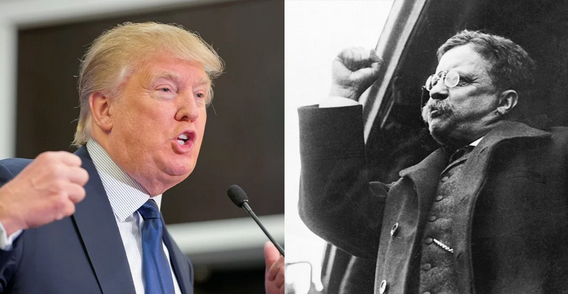
Though a century apart—TR served from 1901 to 1909 — these two chief executives have favored the same modus operandi: using unpredictability to amass power. And the record of Theodore Rex, as Edmund Morris titled his TR biography, bodes ill for both the economy and the Republican Party.
The Trump-TR Parallels
But to the similarities. They start, for both men, pre–White House. As Trump did, TR staged his pre-presidential efforts as much with an eye to public recognition as to sustained reform or strengthening institutions.
Whenever TR stumbled, he pivoted to a new venture and publicized it like mad, though the medium in those days was the printed word, not season after season on The Apprentice. Before the cognoscenti had even absorbed the meaning of the young Roosevelt’s humiliating fourth-place score in a key 1886 New York City mayoral contest, for example, TR was off to the Badlands, memorializing his ranching experiences in dispatches and books such as Ranch Life and the Hunting Trail.
As Trump does, TR routinely alienated GOP grandees, circumventing them to get ahead. As Trump has, TR skillfully cultivated the media — so skillfully that members of Congress were left trying catch up with whatever shifts in public opinion resulted from the politician’s press alliances. TR’s Rupert Murdoch was the widely syndicated William Allen White of Kansas’s influential Emporia Gazette. TR’s equivalent of Fox News was the New York Journal, whose owner, William Randolph Hearst, drummed a steady beat of support when Roosevelt called for war against Spain.
Today, Murdoch must be scratching his head over what his showcasing Trump has wrought, especially now that Trump decided to sue both Murdoch and his Wall Street Journal. White, too, found that he had second thoughts about his decision to back TR: “Roosevelt bit me and I went mad,” White reportedly told a colleague.
[…]
BULLY
The occupant of what he labeled the Bully Pulpit — “bully” as in “excellent” — proved a literal bully as well.
As president, TR perpetually unnerved fellow Republicans, pivoting back to domestic politics. As Trump has, TR cast his campaigns in moral terms rather than economic ones. Where Trump launched his tariff war, TR made war against trusts, large combinations of companies. Relying more on whim than statute, Roosevelt segregated trusts into “good trusts” and “bad trusts”.
TR targeted an invincible-looking industry that, in those days, mattered as much as the interstate highways, or the internet, do today: railroads. James Hill’s Great Northern Railway took over a struggling competitor, Northern Pacific. Roosevelt asked Hanna what he made of the combined entity, Great Northern Securities. Hanna replied that it was “the very best thing possible for the future of the whole Northwest territory”. Roosevelt nonetheless sicced the Justice Department on the Great Northern.
J. Pierpont Morgan, a participant in the beleaguered deal, called on the president to inquire, as desperate steel importers these days do from time to time, whether their attorneys might work out the matter behind the scenes.
No.
Next, the disconcerted Morgan asked whether other investments of the House of Morgan might be assailed. Roosevelt’s reply captures the chill of arbitrary leadership. The administration would not go after the other Morgan companies, he said — unless “they have done something we regard as wrong”.
As Edmund Morris reports in Theodore Rex, to observers such as French ambassador Jules Jusserand, Roosevelt seemed “more powerful than a king”. That power suited many voters fine, which is why Roosevelt won so headily when he ran for office on his own in 1904.
Of course TR, like Trump, occasionally supported laws that aligned with his impulses. One example is the Elkins Act of 1903, which made it illegal for railroads to charge different freight rates for different customers. This shallow effort to achieve market “fairness” deprived the railroads of a standard business tool: the ability to provides discounts to those who buy the product in larger quantities. Shares in railroads promptly dropped more than 20 percent, a shift that undermined TR’s premise of railroad invincibility.
Comments Off on Long before the “Bad Orange Man”, there was “T.R.”
QotD: Generation X
… But Sailer’s right about Klosterman’s ability to grasp the obvious about Gen X. For instance:
The concept of “selling out” — and the degree to which that notion altered the meaning and perception of almost everything — is the single most nineties aspect of the nineties. The complexity, nuance, and application of the term sellout was both ubiquitous and impossible to grasp. Nothing was more inadvertently detrimental to the Gen X psyche.
Or, as I like to put it, we were so obsessed with “authenticity” that we took as our guru an exquisitely sensitive longhaired goof who fronted a band named after spooge. […] But Klosterman does have genuine insights sometimes:
The detail always noted in remembrances of the Bronco chase is the throngs of bystanders cheering for Simpson as the car rolled down the freeway, congregating on overpasses and holding makeshift cardboard signs proclaiming, “The Juice Is Loose”. It seemed perverse then and still seems perverse now. Yet this can also be understood as the primordial impulse of what would eventually drive the mechanism of social media: the desire of uninformed people to be involved with the news, broadcasting their support for a homicidal maniac not because they liked him, but because it was exhilarating to participate in an experience all of society was experiencing at once.
Sailer thinks that’s clever and perceptive, and I agree. Too bad you have to read some masturbatory bullshit about Zima to get to it.
Sadly, he doesn’t take that out a step (or, at least, he doesn’t get quoted doing so in Sailer’s review). Here’s Klosterman’s verdict on why Gen X, for all its faults, wasn’t so bad:
The enforced ennui and alienation of Gen X had one social upside: Self-righteous outrage was not considered cool, in an era when coolness counted for almost everything. Solipsism was preferable to narcissism. The idea of policing morality or blaming strangers for the condition of one’s own existence was perceived as overbearing and uncouth. If you weren’t happy, the preferred stance was to simply shrug and accept that you were unhappy.
True enough, but look: Of all the things that made the Boomers so fucking insufferable, right near the top was their utter inability to let go of their youth. Instead of seeing Forrest Gump as a metaphor so unsubtle, an anvil to the head seems sneakier, they thought it was a lighthearted celebration of a simpler, more innocent time. We knew better. Since they couldn’t let go of their youth, we made “being old and jaded long before our time” into our signature thing.
But where, my fellow alterna-dudes, is that attitude now, when it matters? We’re in the same position in 2022 as our parents were in 1992: Staring down the barrel of middle age, teeing off on life’s back nine, pick your metaphor. It’s time to put away childish things. Grow the fuck up already, the way we wish our parents would’ve done for us back in 1992. Instead, we’re letting our lunatic children smear their pathologies all over what’s left of America, because … ?
I know why Klosterman does it: That’s what they pay him for. What’s our excuse?
Severian, “A Meta-Review”, Founding Questions, 2022-02-24.
Comments Off on QotD: Generation X
September 6, 2025
Unique British Crankfire .58 Morse Manual Machine Gun
Forgotten Weapons
Published 30 Apr 2025This is a really interesting piece with a mostly unknown origin. It was manufactured in the UK (the barrel was deemed Enfield-made by former Royal Armouries curator Herb Woodend) and is chambered for the .58 Morse centerfire cartridge. The date of production is unknown. It uses a gravity-feed magazine and fires via hand crank. Turning the crank cycles the bolt forward and back, not completely unlike a Maxim gun but without the automatic operation. It came out of a small Canadian museum in the 1950s, but its provenance before that is unknown.
(more…)
Comments Off on Unique British Crankfire .58 Morse Manual Machine Gun
September 5, 2025
QotD: Hillary Clinton in the White House
Among the military who served in the White House and the professional White House staff, the Clinton administration was infamously known for its lack of professionalism and courtesy, though few ever spoke about it. But when it came to rudeness, it was Hillary Clinton who was the most feared person in the administration. She set the tone. From the very first day in my assignment.
When I first arrived to work in the White House, my predecessor warned me. “You can get away with pissing off Bill but if you make her mad, she’ll rip your heart out.” I heeded those words. I did make him mad a few times, but I never really pissed her off. I knew the ramifications. I learned very quickly that the administration’s day-to-day character, whether inside or outside of DC, depended solely on the presence or absence of Hillary. Her reputation preceded her. We used to say that when Hillary was gone, it was a frat party. When she was home, it was Schindler’s List.
In my first few days on the job, and remember I essentially lived there, I realized there were different rules for Hillary. She instructed the senior staff, including me, that she didn’t want to be forced to encounter us. We were instructed that “whenever Mrs. Clinton is moving through the halls, be as inconspicuous as possible”. She did not want to see “staff” and be forced to “interact” with anyone. No matter their position in the building. Many a time, I’d see mature, professional adults, working in the most important building in the world, scurrying into office doorways to escape Hillary’s line of sight. I’d hear whispering, “She’s coming, she’s coming!” I could be walking down a West Wing hallway, midday, busier than hell, people doing the administration’s work whether in the press office, medical unit, wherever. She’d walk in and they’d scatter. She was the Nazi schoolmarm and the rest of us were expected to hide as though we were kids in trouble. I wasn’t a kid, I was a professional officer and pilot. I said “I’m not doing that”.
There was also a period of time when she attempted to ban military uniforms in the White House. It was the reelection year of 1996, and she was trying to craft the narrative that the military was not a priority in the Clinton administration. As a military aide, carrying the football, and working closely with the Secret Service, I objected to that. It simply wasn’t a matter of her political agenda; it was national security. If the balloon went up, the Secret Service would need to find me as quickly as possible. Seconds matter. Finding the aide in military uniform made complete sense. Besides, what commander in chief wouldn’t want to advertise his leadership and command? She finally relented because the Secret Service weighed in.
The Clintons are corrupt beyond words. Hillary is evil, vindictive, and profane. Hillary is a bitch.
Buzz Patterson, Twitter, 2025-05-17.
September 4, 2025
Net Zero targets and Britain’s ever-declining car industry
At the Foundation for Economic Education, Jake Scott charts the decline of the British auto manufacturing centres and the government’s allegiance to its Net Zero programs:

Custom image by FEE
Britain was once a giant of car manufacturing. In the 1950s, we were the second-largest producer in the world and the biggest exporter. Coventry, Birmingham, and Oxford built not just cars, but the reputation of an industrial nation; to this day, it is a source of great pride that Jaguar–Land Rover, a global automotive icon, still stands between Coventry and Birmingham. By the 1970s, we were producing more than 1.6 million vehicles a year.
Today? We have fallen back to 1950s levels. Last year, Britain built fewer than half our peak output—800,000 cars, and the lowest outside the pandemic since 1954. Half a year later, by mid-2025, production has slumped a further 12%. The country that once led the automotive revolution is now struggling to stay afloat, and fighting to remain relevant.
This is why the news that BMW will end car production at Oxford’s Mini plant, shifting work to China, is so damning, bringing this decline into sharp focus. The Mini is not only a classic British car; Alec Issigonis’s original design made it an international icon. For decades, the Mini has been the bridge between British design flair and foreign investment. Its departure leaves 1,500 jobs at risk at a time when the government is desperate to fuel growth and convince a wavering consumer market that there is no tension between industrial production and Net Zero goals.
It’s a bitter reminder that we in Britain have been here before: letting an industrial crown jewel slip away.
The usual explanations will be offered: global competition, exchange rates, supply chains. All true, in the midst of a global trade war that is heating up and damaging major British exports. But such a diagnosis is incomplete. The truth is that Britain’s car industry is being squeezed by a mix of geopolitical realignment and government missteps.
The car industry has become the frontline of a new trade war. Washington has already moved aggressively to shield its own firms: the Inflation Reduction Act offers vast subsidies for US-made EVs and batteries, an unapologetic attempt to onshore production, and something that became a flashpoint of tension in Trump’s negotiation with the EU in the latest trade deal. On the production side, the Act has poured billions into US manufacturing: investment in EV and battery plants hit around $11 billion per quarter in 2024.
Ripples have been sent across the world in the US’s wake: Europe, faced with a flood of cheap Chinese EVs, has imposed tariffs of up to 35% after an anti-subsidy investigation. Talks have even turned to a system of minimum import prices instead of tariffs. Unsurprisingly, China has threatened retaliation against European luxury marques, while experts warn the tariffs may slow the EU’s green transition by raising prices.
This is no longer a free market: cars are treated as strategic assets, the 21st-century equivalent of shipbuilding or steel. Whoever controls the supply chains, particularly for EV batteries and the mining of lithium, controls not only the future of the industry but an important lever of national power.
The results are visible. In July 2025, Tesla’s UK sales collapsed nearly 60%, while Chinese giant BYD’s deliveries quadrupled. Europe responded by talking up new tariffs. Britain did nothing. In this asymmetric contest, our market risks becoming a showroom for foreign producers — subsidizing both sides of the trade war without defending our own.
Comments Off on Net Zero targets and Britain’s ever-declining car industry
September 3, 2025
The Korean War Week 63: The Battle of Bloody Ridge – September 2, 1951
The Korean War by Indy Neidell
Published 2 Sep 2025The South Koreans have won their fight northeast of the Punchbowl, but not that far away the Battle of Bloody Ridge is earning its name, with casualties rising into the thousands for both sides.
Chapters
00:41 Recap
01:11 A ROK Success
01:47 Bloody Ridge
06:17 Soviet Reinforcements
07:08 Operation Strangle
11:06 Summary
11:45 Conclusion
13:37 Call to Action
(more…)
Comments Off on The Korean War Week 63: The Battle of Bloody Ridge – September 2, 1951
September 2, 2025
2 September, 1945 marked the formal end to the Second World War
On The Conservative Woman, Henry Getley notes the 80th anniversary of the formal surrender of Japan to the United Nations forces represented by Douglas MacArthur on board the battleship USS Missouri:
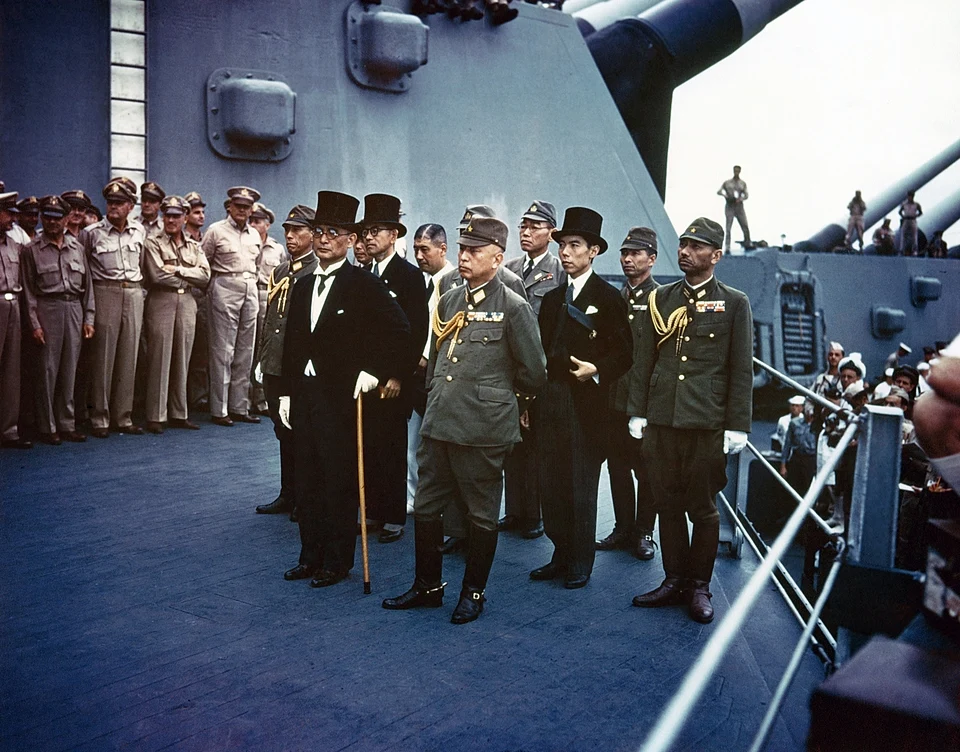
Representatives of the Japanese government on the deck of USS Missouri before signing the surrender documents, 2 September 1945.
Naval Historical Center Photo # USA C-2719 via Wikimedia Commons
ON September 2, 1945 – 80 years ago today – General Douglas MacArthur, Supreme Commander for the Allied Powers, accepted Japan’s formal surrender in a ceremony aboard the US battleship Missouri in Tokyo Bay. Then with the words “These proceedings are closed”, he brought the Second World War to an end.
That final sentence, broadcast worldwide by radio, came five years and 364 days after the global conflict started. Germany invaded Poland on September 1, 1939, but Britain – followed by France – did not declare war on Germany until September 3.
Six years later, on his enforced retirement, MacArthur told the US Congress: “I still remember the refrain of one of the most popular barrack ballads which proclaimed most proudly that ‘old soldiers never die, they just fade away'”.
Now, with the 80th anniversary of the war’s end, Britain’s old soldiers, sailors, marines and airmen have indeed faded away. At the war’s peak, 3.5 million men served in the Army, 1.2 million in the RAF and almost one million in the Royal Navy. Today, fewer than 8,000 veterans of those fighting forces are thought to be left. Most will be 98 or older.
It’s a striking thought for those of us who were brought up in the immediate post-war years. As I recalled in an earlier TCW blog, back in those days almost everyone’s father, uncle or brother had served in the military in some capacity.
The men we kids saw going to work in the offices, shops and factories of Civvy Street were the unsung heroes of the River Plate, Dunkirk, the Battle of Britain, the Battle of the Atlantic, the Arctic Convoys, the Western Desert, Italy, Normandy, Arnhem, the Rhine, Imphal, Kohima, the jungles of Malaya and Burma and many other battles large and small.
Being interested in military history, I was lucky enough to have become friends with several veterans of the Second World War, all sadly no longer with us. They were without exception the finest of men – modest, generous, good-humoured, gentlemanly. All had been at the sharp end in battle, but the last thing any of them would have called himself was a hero. They shared their memories with me reluctantly, anxious not to be thought they were “shooting a line” – that is, exaggerating or boasting. I was honoured and humbled to have known them.
Their passing reminded me that while the war was obviously seared into the very being of those who had experienced it, we of the first post-war generation inherited a lot of what you might call its folk memories and thus it loomed large in our perceptions.
Comments Off on 2 September, 1945 marked the formal end to the Second World War
Too much empathy can be more dangerous than too little
Spaceman Spiff explains why boundaries matter, in so many different areas of modern life:

Empathy is a virtue many strive to demonstrate. But few will discuss its downsides. Why it is not universally good or useful. How it can be misdirected.
In some situations it is lethal. It can reflect a suicidal urge we now see in Western nations.
Much empathy in society is in fact sentimentality, which is dangerous. Sentimental ideas about mixing cultures, elevating poor performers through quotas, or tinkering with traditional gender roles have real world effects.
With such an emphasis on empathy, which many think of as niceness, we overlook the need for boundaries to maintain a functioning society.
This is the issue at the heart of much that is damaging us today.
Individual rights
We live in an era that champions individual rights to an almost autistic degree. This is a product of Western liberalism, which now seems to be entering its terminal phase as its effects ultimately destroy what made Western societies strong.
Since an individual’s rights trump everything we cannot easily enforce boundaries our ancestors could take for granted. Try challenging a gay pride parade or transgender material in schools on the grounds of public decency and the least you can expect is to lose your job.
Profound changes have happened just in the last few decades and all in the name of individual rights. The erosion of boundaries on behaviour is one of the most visible aspects of this.
Physical boundaries
The concept of boundaries is almost universal and spans everything from the mundane to the spiritual.
Most countries recognize the right to private property and inherent within this is the notion of boundaries. My car is mine and no one else’s, for example.
This is applied to our homes and gardens. These are ours and defendable from theft. Ultimately this in turn includes a neighbourhood or locale, even a region or state. All these things have visible boundaries that demarcate where they begin and end.
Most famously this applies to national borders, a traditional form of boundary in use for thousands of years. Failing to enforce this barrier is national suicide. The world is not like us and if it comes to us we will look like the world in return. Borders keep the barbarians out.
Everyone instinctively grasps these kinds of boundaries. We close our windows and have locks on our doors because of this understanding.
Using boundaries to exclude others feels natural.
Cultural boundaries
Less explicitly visible are cultural boundaries, often transmitted via tradition and convention. We have spent the last century attacking many of these as old fashioned, with little pause to consider why tradition emerges in the first place.
Marriage between men and women. Complementary gender roles. Sexual mores kept private. The sanctity of childhood, its innocence protected from intrusion.
As we removed constraints in the name of progress we destroyed much of the glue that held our societies together. We are now watching things unravel as people marry less and produce fewer children. We see widespread mental illness and anguish as the few basic certainties of life are destroyed in the name of progress.
People don’t know who or what they are when cultural boundaries are deleted. Women, men, natives, newcomers, the working class. Who are we really without some certainties in life?
Comments Off on Too much empathy can be more dangerous than too little
September 1, 2025
Who Killed Pakistan’s First Prime Minister, Liaquat Ali Khan? – W2W 42
TimeGhost History
Published 31 Aug 2025October 1951: Pakistan’s first Prime Minister is gunned down on stage, and the world is left asking — who ordered his death? Was it the British, the Americans, or his own allies in Pakistan? Dive deep into a tangled web of espionage, conspiracy, and Cold War politics as we follow the murder mystery that set the course for South Asia’s future.
(more…)
Comments Off on Who Killed Pakistan’s First Prime Minister, Liaquat Ali Khan? – W2W 42
QotD: The Ivy League
The Ivies are now what they’ve pretty much always been — the equivalent of those Higher Party Academies in Moscow. They’re finishing schools for the Apparat. Oh sure, you can probably find a graduate of Ohio State or some such place at Quantico or Foggy Bottom … but I promise you, he hears about it every single day of his life. If they don’t actually teach classes called “How to be a Toady in the DOJ” and “Catching a Senator’s Farts” at Dartmouth, they might as well.
Take your Basic College Girl, make her unisex, crank her up way past eleven on meth and steroids, and that’s the typical Ivy League grad. And they all go directly into Government. Just in case you still cherished some vague hope we could vote our way out of this, remember that guys like Robert McNamara and McGeorge Bundy were the absolute best the Ivy League has produced in the modern era. The Democratic People’s Republic of Vietnam says hi!
Severian, “First Mailbag of the New Year”, Founding Questions, 2022-01-07.
Update, 2 September: Welcome, Instapundit readers! Please do have a look around at some of my other posts you may find of interest. I send out a daily summary of posts here through my Substack – https://substack.com/@nicholasrusson that you can subscribe to if you’d like to be informed of new posts in the future.
August 31, 2025
Didn’t we once have “conflict of interest” rules for politicians?
It’s become a commonplace that politicians leave office vastly wealthier than they went in, far in excess of their official salaries. Once upon a time, even though it probably still happened, the fat cats managed to stay below the event horizon with their ill-gotten gains. Today, they no longer care if you find out that this or that senator has consistently beaten the market on their investments during their entire time in office. After all, what are you going to do about it, punks? Maybe something like this:

Paul and Nancy Pelosi, 16 February, 2022.
Detail of a photo by Amos Ben Gershom via Wikimedia Commons.
The original research was on how Senators seem to make 12% annually. That’s, erm, a lot.
Markets — something that always comes as a surprise to politicians — react:
American lawmakers are so consistently successful that a flurry of new platforms and apps now compile filing data from US politicians as a key input in strategies for retail investors and even hedge funds.
The number of people using these so-called “copy trading” strategies has exploded. Tens of thousands of Americans now follow and imitate trades made by members of Congress, and they are making millions of dollars in the process.
OK, what fun, eh?
Even more fun would be Megan McArdle’s suggestion, that the CongressThieves must announce that they intend to trade an hour before they do so that everyone else can front run them.
Because, you know, Ms. Pelosi:
She beat every single hedge fund last year.
But there’s something even more fun:
Dub launched in March 2024 as America’s first regulated brokerage to offer copy trading accounts to mimic politicians and star traders.
“It’s been absolutely insane in terms of growth,” says Steven Wang, the founder and chief executive who dropped out of his freshman year at Harvard to build the platform. Today, it has 1.5 million users across America.
Of the $100m or so invested across Dub, nearly $23m is in its Pelosi tracker account. Since its launch in early 2024, its paper gains are 172pc.
Stock prices do not move “because”. Interest rates change, profits go up, or down, or tariffs or … stock prices change because people buy and or sell more of them. That may be in reaction to those other things but the actual price movement is that buy and sell stuff.
Which means that if we copy Nancy’s trades — after she’s done them — then we’re making money for Nancy. Because we are piling in our weight of money into a position she already holds.
Which, when you think about it, is really pretty shitty. Sure, it’s nice to make money ourselves by trading upon that congressional information. But there is that very, very, heavy cost of making Ms. Pelosi even richer as a consequence.
Comments Off on Didn’t we once have “conflict of interest” rules for politicians?
Military-Issue Colt Model 1839 Paterson Revolving Rifle
Forgotten Weapons
Published 23 Apr 2025The first rifle made in Sam Colt’s Paterson NJ factory was the 1837 “ring lever” rifle. These were rather fragile and underpowered and while they were used successfully in the First Seminole War, they needed improvement. Colt set about doing this with his 1839 pattern, which was more robust and more powerful. It had six chambers of .525″, with much greater powder capacity than the first Colt revolving rifles. A total of about 950 were made before the Paterson company failed in 1842, and nearly 700 of those were military sales. The US War Department bought 360 (including this example), the Republic of Texas bought 300, and the State of Rhode Island bought 46 — the rest were sold to private companies or individuals. Despite its improvements, though, the 1839 revolving rifle was still not a mature design and was not successful enough to keep Colt in business.
Colt 1837 Ring-Lever Rifle: Sam Colt’s Paterson No1 Model Carbine
Colt 1847 Walker Revolver: 1847 Walker Revolver: the Texas Behemoth
(more…)
Comments Off on Military-Issue Colt Model 1839 Paterson Revolving Rifle
August 30, 2025
Canada’s economy is going the wrong way
The latest figures show the US economy growing by 3.3% while Canada’s shrank by 1.6% in the same period. It’s bad news for Canadians, except those like Prime Minister Mark Carney who have the bulk of their investments in the United States (91% for Carney, according to various sources). On X, Dan Knight explains what is happening:
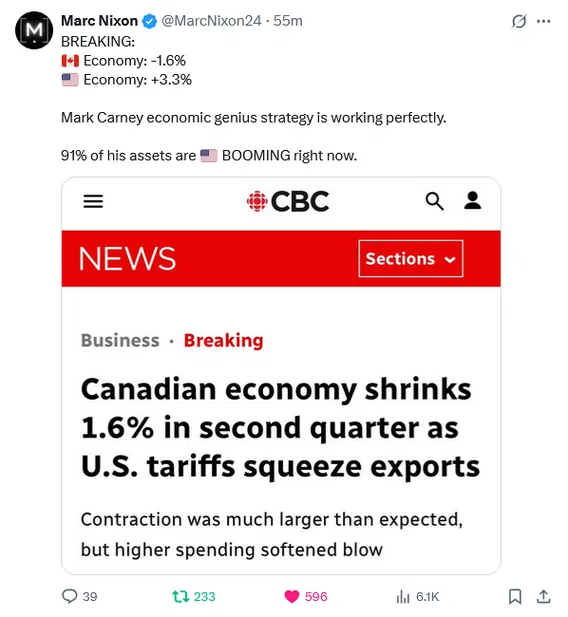
Canada’s economy just shrank. That’s the headline. In the second quarter of 2025, real GDP fell 0.4%. On a per-person basis, it was the same. Canadians are poorer than they were three months ago. That’s not speculation. That’s Statistics Canada’s official number.
So, here’s what happened. The government and its media allies spent the spring bragging that the Canadian economy “grew” in the first quarter of 2025. Real GDP was up half a percent. Sounds good, right? But if you read the fine print, if you look at the numbers it wasn’t real growth at all. It was panic.
Exporters rushed to push product into the United States before tariffs came down. Automakers. Machinery producers. Parts suppliers. They all jammed as much across the border as they could, knowing the window was closing. That sugar high showed up in the Q1 GDP number. It made the economy look like it was humming along.
Then the tariffs hit. And in the second quarter, the bottom fell out. Exports collapsed down 7.5% overall. Passenger cars and light trucks? Down nearly 25%. Machinery and equipment? Down 18.5%. Travel services? Down 11%. The result: GDP fell 0.4%. On a per-capita basis, it was exactly the same. Canadians are literally poorer than they were three months ago.
This is the story you’re not hearing: Q1 wasn’t proof of a healthy economy. It was proof of a desperate one. Businesses scrambling to get ahead of trade barriers, because they knew Ottawa wasn’t going to stop them. Q1 was fake growth, and Q2 was the crash.
Meanwhile, households are spending more, saving less, and wages are barely moving up just 0.2%, the slowest since 2016 outside of COVID. Corporate profits are falling. Government revenues are down since the carbon tax was lifted. And Ottawa’s answer? Spend more. Borrow more. Pretend it’s all fine.
So the question is simple: if this is what “growth” looks like under Mark Carney’s Liberal government front-loaded exports, collapsing investment, rising debt what does the next quarter look like?
On her Substack, Melissa Lantsman says that the economic situation in Canada is discouraging investors from putting money into Canadian companies:
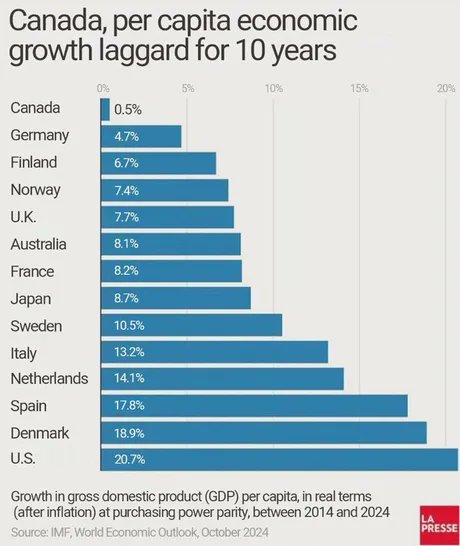
You don’t need to be a foreign investor to see that putting your money into Canada is not a winning move.
Recently, Statistics Canada reported “strong foreign divestment in Canadian shares” across many sectors, including energy, mining, and manufacturing. At the same time, Canadian buyers also moved their money stateside, purchasing $13.4 billion of foreign securities in just one month.
If this were a small, short-term blip, it would be easy to dismiss it as market noise or an aberration. But that’s not the case: Statistics Canada found four consecutive months of net divestment from the Canadian economy, adding up to $62 billion in lost capital.
And that’s not to mention that every year since 2015 has seen more Canadian investment going abroad than foreign investment coming here. For those keeping track, this is the fastest rate of divestment in Canada since the Great Recession.
What does this all mean?
From an investor’s point of view, there’s no sugar-coating it. Canada is, simply put, an unattractive place to invest hard-earned cash. People making financial decisions for the future don’t have confidence in the Canadian economy to make them money.
From a government’s point of view, it should mean alarm bells ringing left, right, and centre. Lower investment in Canada translates into lower productivity, fewer employment opportunities, less government revenue, and a weaker Canadian dollar, leaving us all worse off.
But why is this happening in the first place?
According to the C.D. Howe Institute, the culprits are familiar: high taxes, regulatory barriers, policy uncertainty, and anti-growth mindsets that penalize success and demonize the private sector.
Anyone who has been paying attention for the last ten years knows that’s exactly what’s been happening. Nothing says “Welcome to Canada” to investors quite like a hike in the capital gains tax at the last minute, chaos at the CRA, multi-year project approval processes, and the highest deficits on record.
And anyone serious about fixing the problem would do the exact opposite of what the last government did. But when your new government is the same as the old one, it’s hard to believe Canadians will get the bold economic transformation this country desperately needs.


