
The Korean War by Indy Neidell
Published 19 May 2026Mark Clark is the new UN Commander and will run the war in Korea, replacing Matt Ridgway, who leaves for Europe to take over NATO Command. The Koje-Do POW camp situation is resolved, but is a black eye for the UN, as are the allegations that the US has been practicing germ warfare in Korea and Manchuria, backed up by “confessions” from captured American airmen.
00:00 Intro
01:13 Recap
01:29 Demand and Response
05:35 What Went Wrong at Koje-Do?
12:06 Germ Warfare?
13:55 Mark Clark
15:45 ROK and Ammunition
19:53 Philippine Raids
21:16 Summary
21:28 Conclusion
22:09 Call to Action
May 20, 2026
The Korean War Week 100: Mark Clark in Command – May 19, 1952
Comments Off on The Korean War Week 100: Mark Clark in Command – May 19, 1952
Canadian politics can be bad for your mental health
As a rule of thumb, the more you pay attention to Canada’s political circus, the worse your state of mental health becomes, IMO anyway. On a more serious note, David Clinton got curious about a recent Manhattan Institute project tracing American mental health trends:

Image from The Audit
The Manhattan Institute’s research into the confluence of mental health trends and political leanings in the U.S. generated buzz a while back. Among other things, they discovered that, as of the 2021-22 school year, liberal students were 13-17 percent more likely to seek mental health treatment than their conservative peers. That’s a frightening gap.
I was curious to know if there’s anything like that going on here in Canada. And it turns out that there’s excellent public-facing data waiting for us to drop by and help ourselves. The most recent published version of the Canadian Election Study (CES) dates back to the period around the 2021 federal election — the full dataset from 2025 isn’t yet available.
There were 20,968 respondents in total in the CES survey data from 2021. Having now spent a couple of happy hours with the results, this looks like an excellent representation of Canadian society. The questions go both deep and wide.1
I was able to directly address the political angle to all this using responses to one core question. Participants were asked to situate themselves on a political “scale where 0 means the left and 10 means the right”.
I classified anyone who responded with a number higher than 6 as “far right”, and responses less than 4 were tagged “far left”. The far left cohort had 4,927 members, while there were just 3,891 people in the far right. Those numbers are easily large enough to make distinctions potentially statistically meaningful.
Anxiety
I explored both far right and far left cohorts for how accurately the words “anxious” and “easily upset” applied to them. A response of seven indicates a self-assessment of extreme anxiety, while zero would be Big-Lebowski-level calm.
The average for the right-coded group was 3.47, while those on the left rated themselves 3.88.
Overall Mental Health
Respondents were asked to rate their mental health in relation to their peers where “1” indicates excellent mental health and “5” indicates poor mental health. A total of 3,878 from the far right responded and 3,263 from the far left. The average of all responses on the right was 2.02 (standard deviation: 0.876859) and from the left, 2.32 (0.926268).
- In fact, the average survey took two hours and twenty five minutes to complete! I’m definitely glad they didn’t ask me.
I mentioned the other day that the US was fully justified in “pausing” their participation in the Permanent Joint Board on Defence due to the Canadian government’s continued delinquence on military matters (and Prime Minister Carney’s blatant desire to tweak American noses while neglecting joint interests with the United States. At The Line, Matt Gurney says this won’t be the only tangible sign of American impatience with our ongoing fecklessness:
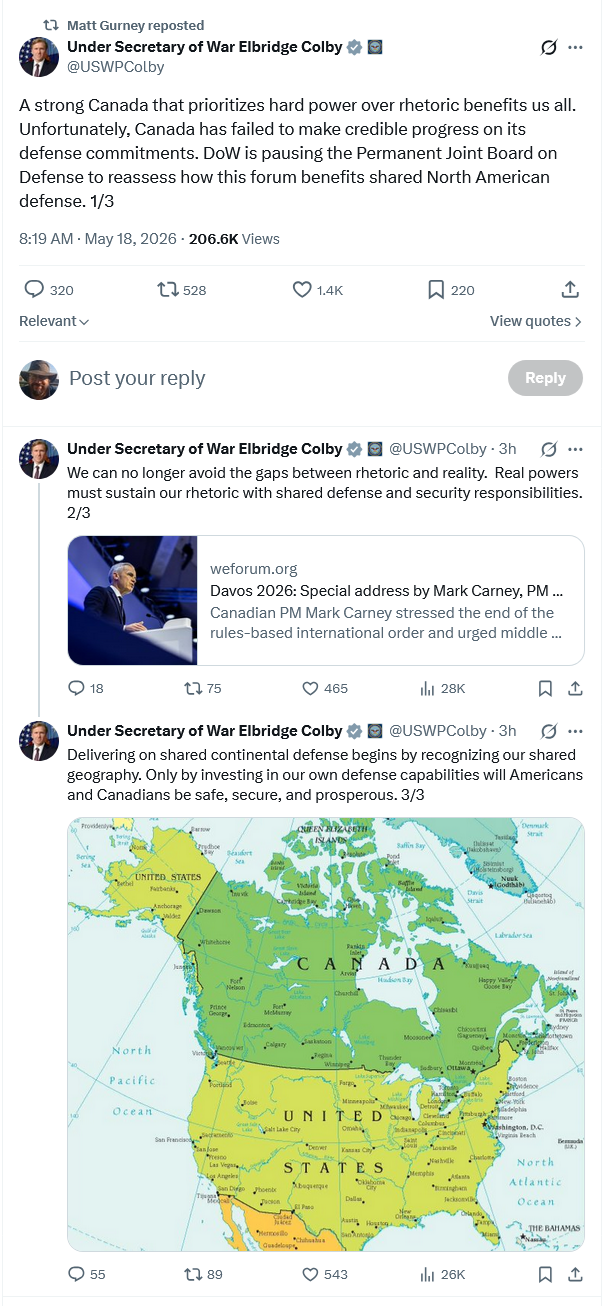
As I posted on social media when sharing this: “This is another gentle reminder to the f*ckwits in the Canadian government that they are playing with existential fire when they work to actively piss off our American allies.”
First of all, and this will annoy the Elbows Uppers to no end, the undersecretary’s comments are, fundamentally, accurate. Canada has indeed massively underinvested in defence and has also prioritized rhetoric over reality. I completely understand why Canadians hate admitting this — I hate admitting this. Having your flaws pointed out to you by someone you dislike is always a mortifying experience. But I’ve spent almost two decades writing about the very things Colby is pointing out — Canada has allowed its military capability to atrophy to a point, as I noted just a week ago in an episode of On The Line, where we’ll need many years and untold billions of dollars just to rehabilitate the armed forces. Expanding them and adding capabilities will be a whole other level of investment. This is why Canada’s recent major announcements on defence, though good and welcome, are also not enough — it will take a long time and even more money to actually repair what we have allowed to rot.
The other half of what Colby identified is also, alas, accurate. While we were massively underfunding defence and allowing core capabilities to wither and die, or while just totally missing the bus on transformational military developments (hello, drones!), Canada did indeed talk a lot about the rules-based international order and the role of middle powers and punching above our weight and all the rest. Canada focusing on rhetoric instead of reality is, alas, a fair criticism.
Many U.S. administrations called us out on this. We ignored them. Donald Trump is unique in how viciously he is prepared to exploit our weakness, but he’s hardly the first to have noticed it and called us out on it. I carry no water for MAGA or Trump, but they’ve got us dead to rights on this one. The bad orange man didn’t let the navy rust out, repeatedly defer the fighter jet replacement and hobble the army with non-serviceable equipment and recruiting and procurement systems that were actually quite awful at both those things.
We did those things. We did it to ourselves. Colby is simply possessed of the gall to bluntly call us out on our failures, in a way that Canadians aren’t accustomed to and aren’t going to enjoy.
So that’s part of it. But it’s also worth asking why the U.S. is doing this, and especially why they’re doing it now.
Part of it, probably, is just sincere frustration with us. As noted above, Colby’s remarks are accurate. But the timing is interesting. The CUSMA renegotiation deadline looms in early July And in Colby’s remarks, do I detect a whiff of the art of the deal?
The Carney government has made, and continues to make, plenty of announcements about plans, and potential deals, and future capabilities, and so on … but the Americans can’t help but notice that little is actually being done despite all the sound and fury on the PR side. Canada belatedly reached the long-agreed-upon 2% of GDP target for military spending, but most of it was a bookkeeping exercise of moving existing costs onto the Department of National Defence budget (the Canadian Coast Guard and parts of Veterans Affairs) but not much improved in Canada’s actual defence capabilities.
Comments Off on Canadian politics can be bad for your mental health
QotD: “Gilded Age” Robber Barons didn’t have access to what even working-class Americans have now
Where Marx really went wrong was — and I know this sounds flip, but I’m as serious as cancer — being born in 1818. He lived his entire miserable life in a world where “labor” really was a physical thing. The richest robber baron of the Gilded Age lived a far different life, materially, than the poorest serf-in-all-but-name working in his factories …
… but the robber baron knew he needed the serfs. Their relationship was purely dialectical. Without his factory hands, no robber baron. And in a strange but very real way, the higher up the food chain your Gilded Age robber baron went, the more he was dependent on his serfs for his lifestyle. J.P. Morgan is usually credited as being the first guy to become a Robber Baron purely through finance. Carnegie, Rockefeller, all those guys had most of their wealth in financial instruments, of course, but those financial instruments rested on control of a physical product — Carnegie Steel, Standard Oil.
I’m probably being unfair to Jay Cooke, the Michael Milken of his day, but since more people have heard of J.P. Morgan let’s roll with it. Even though Morgan’s wealth was entirely on paper — he was nothing but a securities trader — his lifestyle utterly depended on a battalion of servants. In a very real way, you yourself, right now, live much better than J.P. Morgan did in his heyday. And not just because you have aspirin, antibiotics, and air conditioning, three taken-for-granted things ol’ J.P. would’ve given half his kingdom for. But because you have more time. If you’re hungry, you can open the fridge or the microwave and have all the food you need in a matter of minutes.
J.P. couldn’t. J.P. had to deploy an army of servants every time he wanted a snack, and those servants were constrained by things like “availability of ice” and “when is the fishmonger at his stall”. You’re hungry at 2am, you jump in your car and get some Taco Bell. It takes ten minutes. J.P.’s hungry at 2am and it’s tough titty, J.P., your ass is going hungry. Because even though you’re the richest man in the world and have legions of manservants at your beck and call, Taco Bell just isn’t there. Even if someone had had the brilliant idea to create a Gilded Age Taco Bell, it still would’ve taken hours:
Wake up the manservant. Wake up the groom and stableboy. Hell, wake up the horse, then saddle the horse, ride to the drive thru window … which in this case means “the house of the guy who runs Gilded Age Taco Bell”. At which point he has to fire up the oven, start pounding the tortillas, send his own legion of valets and stableboys and whatnot out to get the refried beans …
And that’s the other thing, J.P. — you’d best not pull that shit too often, because those people know where you live. Not only do they know where you live, they live with you. Literally under the same roof. You want to sleep easy? You’d best not beat the servants too often, buddy.
There’s only so much “class consciousness” one can develop in that world. Oh yeah, J.P. thought of himself as one of the Masters of the Universe, there’s no denying that. But J.P. lived in what was still a brutally physical world, in a way we PoMo people really can’t grasp. If you can’t imagine what it would take to get some Gilded Age Taco Bell, maybe geography will do the trick. Ever seen Gangs of New York? Even if you haven’t, you’ve probably heard the name “Five Points”. The worst slum in America in the 19th century, and 19th century American slums were world class …
That was right down the street from Wall Street. Literally. I am not in any way joking, and if I’m exaggerating a little for effect when I say “J.P. could’ve hit Five Points with a five iron from his swanky digs on Central Park West”, I promise you I’m not exaggerating much. You can look it up for yourself. The main reason the Union rushed troops straight from the Gettysburg battlefield, and no-shit shelled parts of the city with gunboats, during the Draft Riots was because Five Points (et al) was right fucking there, and they might’ve gotten it into their heads to lynch a few Masters of the Universe. Rich man’s war, poor man’s fight, right? Let’s see how you like it, you bankster bastards …
The PoMo “information economy” removes all that. The other day I joked about colleges like Bennington and Goucher. I cracked some jokes, yeah, but I wasn’t really joking. Those places aren’t for us. Wall Street is still a physical location, but it might as well be on the dark side of the moon for all any of us have access to it. J.P. couldn’t beat the servants too hard, or too often. The modern equivalent of J.P. isn’t even aware that he has servants. He just clicks on a website, and stuff appears at his door. Like magic. Hell, it IS magic for all he knows, and he surely doesn’t care, because all that shit is his by right. He went to Bennington, after all. He has achieved full class consciousness.
All of which suggests, of course, that while Marx was wrong about the end state — the State will not, in fact, wither away — he might well have been right about the solution to the “contradictions of capitalism”, if you follow me. And if that makes me some kind of godless pinko Commie subversive, well … I’ve been called worse by better.
Anybody got the lyrics to La Marseillaise in English?
Severian, “On Losing the Cold War”, Founding Questions, 2022-07-02.
Update, 21 May: Welcome, Instapundit readers! Have a look around at some of my other posts you may find of interest. I send out a daily summary of posts here through my Substack – https://substack.com/@nicholasrusson that you can subscribe to if you’d like to be informed of new posts in the future.
May 18, 2026
Isoroku Yamamoto – the admiral and the postwar legend
Big Serge examines the popular memory of Japanese admiral Isoroku Yamamoto, the architect of Japan’s early naval war successes against the United States from 1941 onwards, contrasting the postwar image with the man himself:
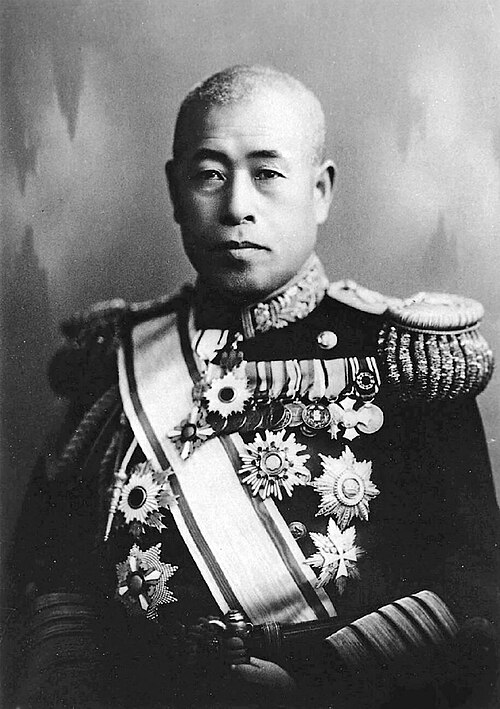
Admiral Isoroku Yamamoto, Commander-in-Chief of the Imperial Japanese Navy’s Combined Fleet.
Photo from the National Diet Library via Wikimedia Commons.
Japanese leadership in the Second World War enjoys noticeably lower name recognition than their German counterparts. Most people with a cursory knowledge of the war know the core German leadership group around Hitler — Himmler, Goering, Goebbels, Speer, and perhaps Heydrich and Bormann — and the all-star lineup of German generals like Rommel, Manstein, and Guderian. In contrast, the only particularly notorious member of Japan’s nebulous leadership group is General Hideki Tojo, who served as Prime Minister for most of the war and became the centerpiece defendant in the postwar trial. As far as Japanese commanders go, the list of name-brand personnel has but a single entry: Isoroku Yamamoto.
Yamamoto’s life and career present a fascinating trajectory that shapes a particular, sympathetic view of the man. A veteran of the Russo-Japanese War, he spent much of his 30’s in the United States, studying at Harvard and serving as naval attache in Japan’s Washington embassy. He therefore had a first hand understanding of America’s industrial depth, and was famously pessimistic about Japan’s prospects in a a war against the United States. “Anyone who has seen the auto factories in Detroit and the oil fields in Texas”, he argued, “knows that Japan lacks the power for a naval race with America”. In one of his more famous and widely recited (though often badly translated) remarks about a war with the United States, he told Prime Minister Fumimaro Konoe in September 1940:
If I was told that I had to do it, then you will certainly observe the Navy going all out for half a year to a year. However, I do not hold conviction about the outcome after 2-3 years.
This quote certainly seems remarkably prescient, in light of Japan’s initial wave of operational successes, which slowly faded away as American combat power ramped up. Far more famous still is his remark, after the attack on Pearl Harbor, that Japan had “awakened a sleeping giant, and filled him with terrible resolve”.
All of this shapes the perception of Yamamoto as a quasi-tragic figure who understood that Japan was unlikely to defeat the United States in the Pacific War, counseled against the conflict, and then dutifully tried to play a losing hand as well as he could once war had been thrust upon him against his own advice. Yamamoto was furthermore a critic of the Japanese Army’s war in China and a particularly vocal opponent of the Tripartite Pact with Germany and Japan, lending credence to the idea that he was war-averse.
This is the Yamamoto of American popular memory, and indeed of a great deal of Japanese postwar writing: a sort of samurai Cassandra, too perceptive and cosmopolitan for the militarist regime he served, a man who fired the opening shot of the Pacific War with a heavy heart and no illusions.
It is certainly true that Yamamoto had an appropriately pessimistic assessment of Japan’s prospects in an extended conflict with the United States. What is less often appreciated is that Yamamoto did not, on the basis of this assessment, conclude that Japan ought not to fight. He concluded instead that, if Japan was going to fight, it had to fight differently — with greater boldness, more risk, and an aggressive search for a decisive stroke. He did not spend the eighteen months before Pearl Harbor advocating for peace. He spent them designing what was, on balance, the single most aggressive operational scheme that was possible — and then only barely — within Japan’s kinetic parameters.
This is the critical distinction between Yamamoto-the-man and the Yamamoto of postwar hagiography. He was not a pacifist, reluctant or otherwise. He was a Japanese naval officer of strong patriotic conviction, deeply committed to his service and his nation, who happened to understand the arithmetic of industrial war better than most of his colleagues. Notwithstanding his appreciation for America’s vast industrial base, he shared a broader Japanese disdain for American martial proclivities, dismissing American naval officers as a club of “golfers and bridge players”. His understanding of the United States did not produce pacifism. It produced, rather, a particular kind of operational philosophy — one which held that Japan’s best hope in a war with the United States was to front-load its risk-taking, to achieve a string of dramatic early victories that would either compel American negotiation or, failing that, push the eventual American counter-offensive as far into the future as possible. In either case, the operational prescription was the same: bold, high-risk operations aimed at decisive results.
Comments Off on Isoroku Yamamoto – the admiral and the postwar legend
The American Civil War was “two armed mobs chasing each other around the country, from which nothing could be learned”
Ben Duval looks at the implications of the quote above (attributed to Moltke the Elder) and shows that there were indeed lessons to be learned from that conflict:
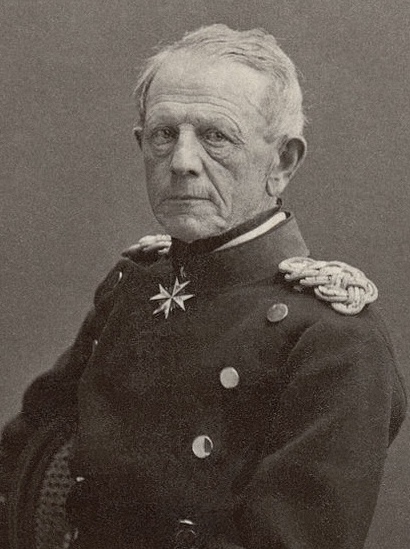
Chief of the Prussian General Staff Helmuth von Moltke the Elder (1800-1891).
Photo by Carl Günther via Wikimedia Commons.
A famous, if apocryphal, quote attributed to Moltke dismissed the American Civil War as “two armed mobs chasing each other around the country, from which nothing could be learned”. There were certainly lessons to be learned — it could hardly be otherwise in so long and intense a conflict. The war showcased many new technologies on a large scale, including rail and telegraph, while the growing accuracy of firearms showed the growing importance of field fortifications in pitched battle. It also gave witness to many expedients and innovations, including the first known employment of indirect fire (although that would take much longer to be appreciated).
Nevertheless, the readiness with which Moltke’s spurious quote was accepted is suggestive of fundamental differences between Europe’s large professional armies and the hastily-raised volunteers that fought for both North and South. The Civil War saw a mobilization of unprecedented scale, expanding from a pre-war regular army of 15,000 to a total of nearly 2 million at its peak.
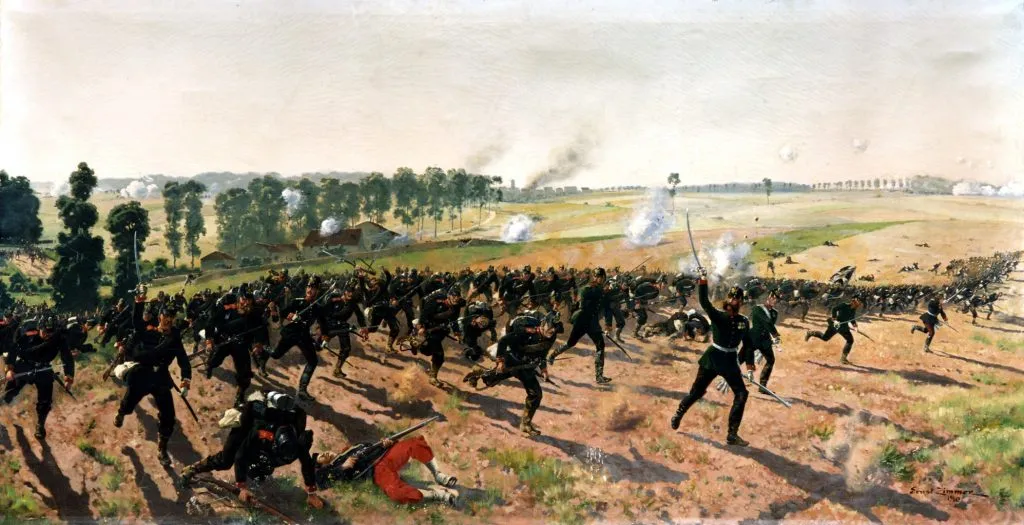
At some critical battles, like Antietam, many regiments had mustered bare weeks before. At best, these soldiers could handle their weapons reasonably well; large-scale maneuvers in the heat of combat were out of the question. Even long-serving formations did not have much of a chance to redress these deficiencies, as demonstrated by the disjointed conduct of Pickett’s Charge. What immediate lessons could the Prussian and French, efficiently maneuvering under fire at Gravelotte or Mars-la-Tour, have learned from Civil War armies?
Prussian attack at Gravelotte on 18 August 1870.
Lessons at the Right Level
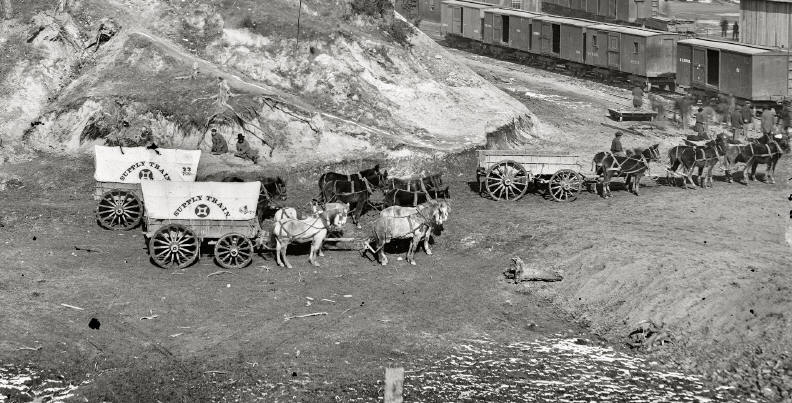
Perhaps not much at the tactical level, but there was plenty to be learned at the operational. Never before had railroads been employed at such scale to shift troops within and between theaters; nor the telegraph, which was used to coordinate such movements. Efficient logistical services allowed both sides to undertake bold maneuvers involving massive numbers of troops (it is noteworthy how many generals had previous experience working for railroad companies, and how many more went on to high management or board positions after the war).
Union supply wagons loading up at a railhead.
But the point also holds more broadly, beyond the particular technical specialties of 1860s America. Whenever tactics alone cannot suffice—either because both sides are extremely skilled, as in the First World War, or because organizational breakdowns rule out more complex maneuvers — decisive action can by default only occur at the operational level. This was an essential point in Saladin the Strategist. Muslim and Crusader armies, through long experience fighting each other, had developed unique fighting styles tailored to blunt each other’s edges: barring a fluke, decision could only be won through some higher-level maneuver.
In such cases, the fighting capabilities of an army matter less in any absolute sense than in their ability to effect a particular operational scheme. Tactical proficiency is but one variable among many, and not necessarily the most important. Whether a general is dealing with poorly-trained militia or long-serving professionals, it is above all their relative odds that factor into his calculations.
Comments Off on The American Civil War was “two armed mobs chasing each other around the country, from which nothing could be learned”
Withdrawing the Black Jack Brigade from Europe
Depending on your point of view, President Trump’s sudden decision to withdraw a US Army brigade from Europe is either Trump having a temper tantrum yet again or part of an overall plan to reduce US deployment to allied nations who should be able to pay for their own defence. On the social media site formerly known as Twitter, InfantryDort discusses the formation being relocated back to the continental United States:

1st Cavalry Division, 2nd Brigade – “The Black Jack Brigade”
There’s a lot of drama around Black Jack brigade being ordered back to the U.S. from Europe.
I was in that unit on that same mission from 2019-2020.
We deployed, did training there, went to a CTC. I’ll be honest, it was the most fun I’ve probably had in the Army.
But after the initial training and the CTC rotation, we didn’t do much.
Played a lot of softball. BBQs. PT. Some drinking. Mostly just working on keeping people out of trouble.
It was kind of like being back at Fort Hood, but in Germany.
I suppose one could argue that the simple act of us being there made all the difference. I don’t know. That was above my level.
But I couldn’t help but think then, as I do now, that there are better ways to keep one’s adversaries at bay.
To say nothing of the fact that I do believe we have been a crutch to Europe for too long. Everyone seems to forget that Europe as a whole, dwarfs the GDP of Russia. A country who is barely richer than Italy.
You accomplish nothing providing security for people who refuse to do it themselves.
What are we supposed to do? Defend them forever? Permanently?
What has it gotten us? Europe, by all accounts, has taken advantage of our security blanket and prioritized making a socialist hellscape.
A socialist hellscape that has become their chief export. So the very act of remaining there in force is enabling the destruction of the western world.
Our relationship with those people DEMANDS revisiting in my view. Because whatever good will we generated after the end of the Second World War has dried up.
The free flow of money from us to them has also dried up.
It’s very telling how others treat you when you stop doing things for them. This isn’t mutual respect. It’s been little more than bribery.
And I’m all for keeping our Armored brigades right here, building readiness.
And not running them into the ground for little gain.
There is an age old adage that says you must help yourself before you can help others. Prudence demands that for our country right now.
America first. America always.
May 17, 2026
Why the US Invaded Iraq
Real Time History
Published 21 Nov 2025The US invasion of Iraq was the culmination of several developments that started at the end of the Gulf War in 1991. In 2002, the Bush administration used the excuse of Weapons of Mass Destruction (WMDs) and claimed links between Saddam Hussein and al Qaeda to justify the invasion.
(more…)
Comments Off on Why the US Invaded Iraq
May 16, 2026
The failure of Operation Crossbow in 1943-45
Timing is everything in war — well, if not everything, it’s extremely important. An example was the development delays for the German V-1 and V-2 systems that kept them from being a potentially devastating weapon against the Anglo-American invasion forces on D-Day. Secretary of Defense Rock explains why allied air attacks to suppress the German launch sites were an almost unmitigated failure:

German A4 or V-2 replica at Peenemünde
Photo from Wikimedia Commons.
Two campaigns separated by 50 years — the Anglo-American CROSSBOW campaign against German V-weapons in 1943–1945 and the “Great Scud Chase” of Desert Storm in 1991 — suggest that what is happening over Iran today is not a deviation from the norm but simply a repeat of it. As Colonel Mark Kipphut argued in his 1996 study comparing the two campaigns, the failure to internalize CROSSBOW’s lessons was itself one of the reasons those same failures were repeated in 1991; the present campaign against Iran suggests we might still not have learned them.1
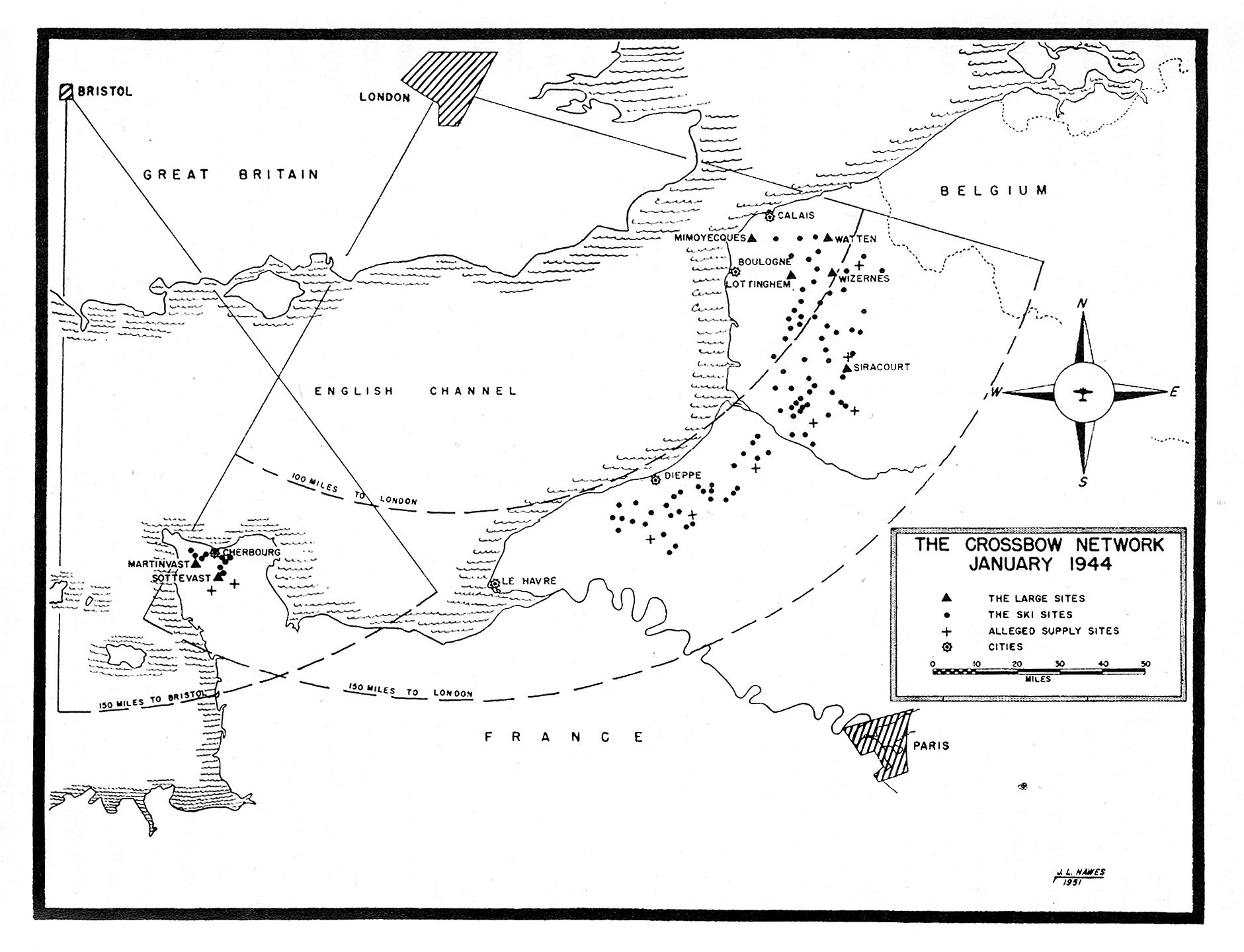
The first lesson of CROSSBOW is that fixed infrastructure is easy to destroy and that adversaries do not stay fixed for long. British intelligence had received “reliable and relatively full information” on German long-range weapons as early as November 1939 two months into the war.2 It wasn’t till four years later, in 1943, that Allied photo-reconnaissance first identified the German “ski-sites” in northwestern France, named for the curious shape of one of the buildings on each launcher complex.3 Within weeks, the U.S. Strategic Bombing Survey would later report, ninety-six sites had been cataloged, and a sustained bombing offensive against them had begun. Of these ninety-six sites, no more than two were ever used operationally.4 On its face, this was a complete victory. Allied airpower had, by direct attack, denied the Luftwaffe permanent launching infrastructure before the V-1 campaign could begin.5
The Germans drew the obvious conclusion. The Survey noted that during the period of the Allied counterattack, the Germans developed methods for launching V-1s and V-2s from small, inconspicuous sites that required minimal engineering work and freed firing operations from the elaborate sites originally planned.6 These were the “modified sites”, first photographed on April 26, 1944, which were well camouflaged, dependent largely on prefabricated buildings, of which more than sixty had been identified before the first V-1 was launched in England in mid-June.7 The “modified sites”, the Survey concluded plainly, were “heavily bombed without marked effect on the scale of effort”.8
Kipphut, working from the same primary documents, formalizes the consequence as a two-phase division of the campaign. CROSSBOW I, running from April 1943 to early June 1944, was a qualified success: it delayed the start of V-weapon attacks by an estimated three to six months and so allowed OVERLORD to proceed before the full weight of Hitler’s missile arsenal could be brought to bear.9 Eisenhower himself wrote that had the Germans perfected the weapons six months earlier, the invasion of Europe would have been “exceedingly difficult, perhaps impossible”, and that a sustained V-weapons attack on the Portsmouth-Southampton embarkation area could have caused OVERLORD to be written off entirely.10 CROSSBOW II, however, the campaign to suppress launches once they had begun, was in Kipphut’s assessment a “dismal failure”; despite thousands of sorties against more than 250 targets in the critical summer of 1944, the Germans averaged just over 80 launches per day, and German sources contend they never failed to launch on account of either Allied air attack or weapons shortages.11
A World War II map shows the two areas where the Germans were setting up their secret “V” weapons to bombard England (right, center). These are the areas in which the Royal Air Force and 8th Air Force heavy bombers concentrated their bombs in order to knock out the weapons — part of the pre-invasion plan. This event was given the operational code name Crossbow during World War II. The grouping (left, center) is the site of the Invasion of Normandy.
The implications for Allied resource allocation were severe. Between the beginning of May 1943 and the end of March 1944, nearly 40% of Allied reconnaissance sorties over Europe were devoted to supporting CROSSBOW, with those planes taking more than 1.25 million photographs and service members preparing more than 4 million prints for study and analysis.12 Over the course of the campaign, U.S. and British air forces flew approximately 68,913 sorties against CROSSBOW targets and dropped roughly 136,789 tons of munitions.13 During the thirteen-month peak period from August 1943 to August 1944, the joint strategic-bomber effort absorbed 13.7% of its sorties and 15.5% of its tonnage on V-weapon targets.14 By the autumn of 1944 and into the winter, RAF Fighter Command devoted 79% of its offensive sorties to CROSSBOW.15 Eisenhower, faced with the apparent failure of CROSSBOW II to suppress the launches that began on D-Day plus seven, directed that V-weapon suppression take priority over all other Allied air operations, including direct support to the Normandy lodgment and the Combined Bomber Offensive.16
That bombing, which failed against the dispersed V-2 launch sites, was almost overdetermined. The Survey concluded bluntly that after the initial Allied success, the firing sites for V-2s were small, well camouflaged, and made poor targets for bombers.17 No comparable problem arises with a factory complex. The V-2 launcher, like the modified V-1 ramp, was small, mobile, and concealable, and the strategic-bomber instrument was designed and procured to flatten large, stationary targets. In the end, Kipphut notes, silencing the V-weapons required ground forces to overrun the launch sites.18
- Mark E. Kipphut, “Crossbow and Gulf War Counter-Scud Efforts: Lessons from History”, Counterproliferation Paper No. 15 (Maxwell AFB, AL: USAF Counterproliferation Center, February 2003), 1–3. Originally published in Airpower Journal, Winter 1996.
- Wesley Frank Craven and James Lea Cate, eds., The Army Air Forces in World War II, vol. 3, Europe: Argument to V-E Day: January 1944 to May 1945 (Chicago: University of Chicago Press, 1951), 89.
- United States Strategic Bombing Survey, V-Weapons (Crossbow) Campaign, Military Analysis Division, 2nd ed. (Washington, D.C., January 1947), 5–6.
- Ibid, 6.
- Craven and Cate, eds., have a full chapter on the operational history of CROSSBOW, 84-106.
- Ibid, 2.
- Ibid, 6.
- Ibid, 6.
- Kipphut, 7–8.
- Dwight Eisenhower, Crusade in Europe (New York: Doubleday, 1948), 260, quoted in Kipphut, 5.
- Kipphut, “Crossbow and Gulf War Counter-Scud Efforts”, 8, citing Phillip Henshall, Hitler’s Rocket Sites (New York: St. Martin’s Press, 1985), 187.
- Craven and Cate, eds., 89.
- Kipphut, “Crossbow and Gulf War Counter-Scud Efforts”, 8
- USSBS, “V-Weapons (Crossbow) Campaign”, 28.
- USSBS, “V-Weapons (Crossbow) Campaign, 28”; Kipphut, 8–9.
- Kipphut, 5.
- USSBS, “V-Weapons (Crossbow) Campaign”, 7
- Kipphut, 10.
Comments Off on The failure of Operation Crossbow in 1943-45
May 15, 2026
The good news: kids are drinking a lot less! But there’s also bad news …
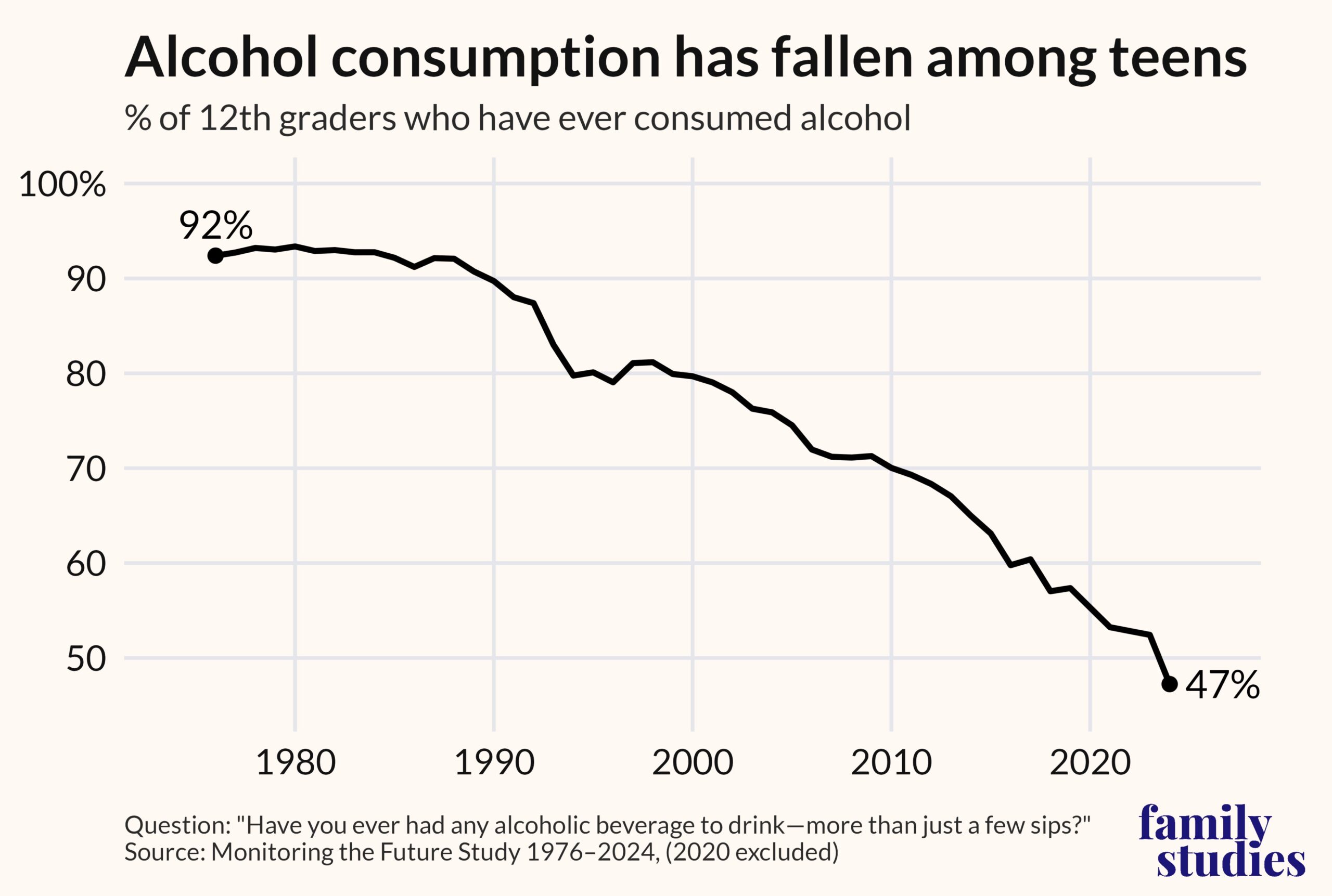
The good news seemed to be that teenage drinking was dropping fast. Fewer underage drinkers, happier teenagers, right? Not so fast …
⚡️The deeper signal is youth risk did not disappear.
It migrated inward.
Teen drinking fell because the old physical world of adolescence got dismantled. Alcohol belonged to a social ecosystem: unsupervised time, cars, parties, local jobs, malls, basements, boredom, flirting, older siblings, house gatherings, and the chaotic peer world where teenagers learned who they were by colliding with other people in real space.
That ecosystem was replaced by phones, surveillance, parental tracking, algorithmic entertainment, social anxiety, online status games, and a much thinner physical commons.
So the surface looks healthier. Fewer kids drinking. Fewer kids using weed. Fewer kids doing reckless things in public.
The hidden layer looks worse. The young are less reckless because they are less socially embodied. Less initiation. Less unsupervised friction. Less courage-building. Less embarrassment and recovery. Less real dating. Less independence. Less contact with the physical world before adulthood demands it.
The old teenage world produced damage, stupidity, alcohol abuse, pregnancy risk, fights, accidents, and bad decisions. No need to romanticize it. But it also produced social reps. It forced young people through discomfort. It made them practice attraction, rejection, conflict, reputation, risk, repair, and status in the open.
The new world suppresses visible risk while increasing invisible fragility.
That is the trade.
A teenager can avoid drinking, avoid parties, avoid sex, avoid driving, avoid real confrontation, avoid rejection, avoid shame, avoid danger, and still arrive at 23 emotionally underbuilt. Cleaner behavior does not automatically mean stronger formation.
This is why the marriage chart and the teen drinking chart are the same story at different stages. People are not suddenly failing to pair in adulthood. The whole pathway into embodied adulthood has been slowing for years before marriage even becomes the question.
The real truth: society solved part of the teen vice problem by shrinking the arena where teenagers become adults.
It took away the dangerous commons and replaced it with controlled isolation.
The result is safer kids with weaker initiation into real life.
Comments Off on The good news: kids are drinking a lot less! But there’s also bad news …
“One of the most iconic pictures of WWII” – the seen and the unseen, USN edition
CDR Salamander posts an iconic US Navy photo from late 1944, showing the unparalleled naval might of the American efforts against Japan. But, as with Bastiat’s famous economic essay, there are the obvious things we see and the important but unseen things that matter just as much:
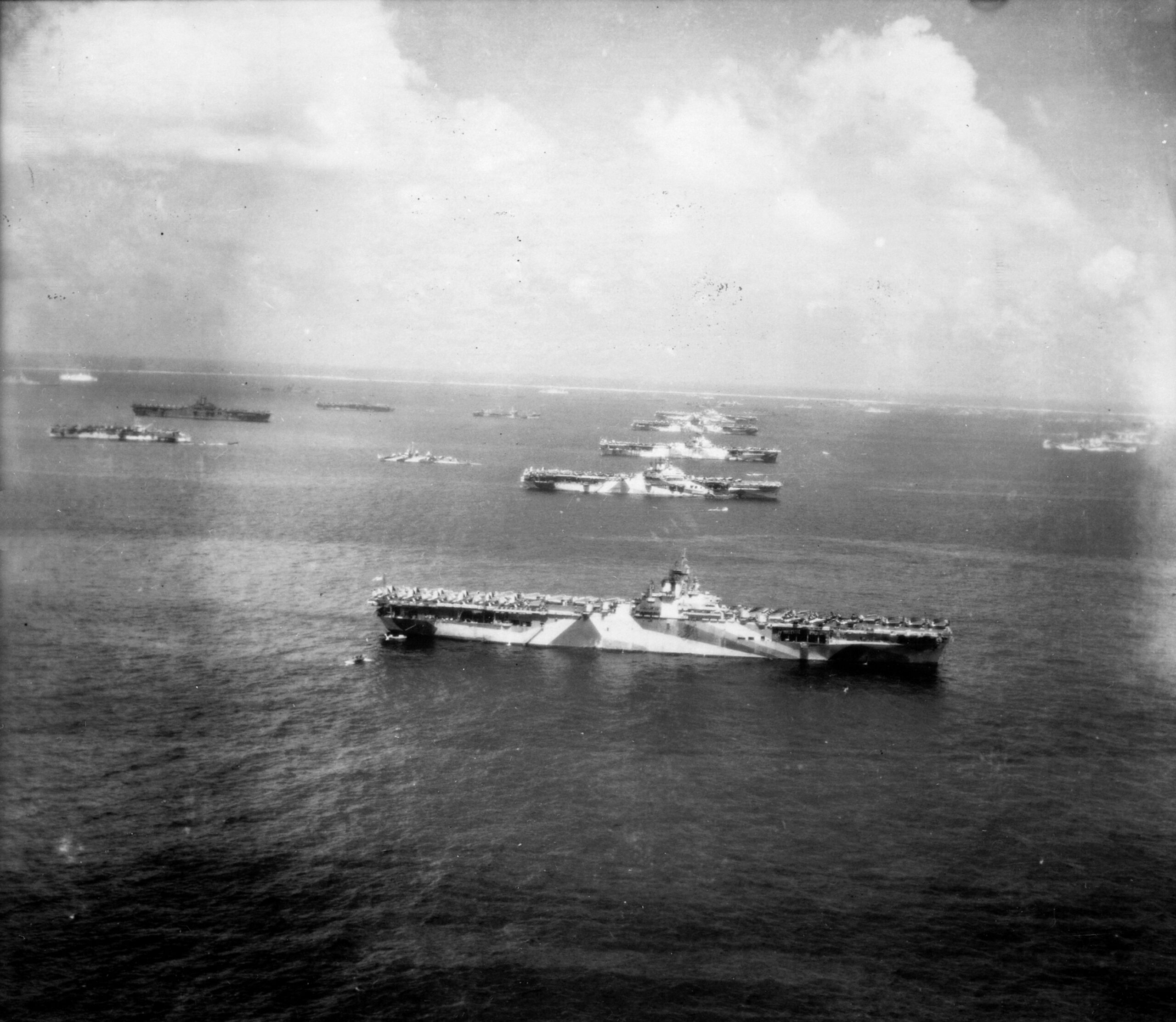
Murderers’ Row. Ulithi anchorage, December 8th, 1944. Just three years after the attack on Pearl Harbor.
One of the most iconic pictures of WWII.
The carriers are (from front to back): USS Wasp (CV-18), USS Yorktown (CV-10), USS Hornet (CV-12), USS Hancock (CV-19) and USS Ticonderoga (CV-14).
The oldest of those ships, Yorktown, was only 19 months old. The youngest, Hancock, was commissioned only a little under eight months earlier. All were laid down and took from a bit under three to a bit under four years to build.
Just a year prior, the US Navy was so short of aircraft carriers, it had to borrow a carrier from the Royal Navy.
At first glance, it appears to be a flex of American naval power at flood tide — the aircraft carrier’s unassailable invincibility manifest — and it is. However, when you dig deeper, it has a more important story. It gives a warning. It informs us today, if we are willing to listen.
It isn’t about the power of being the world’s greatest shipbuider, that we were. It isn’t about an unequalled ability to project national will across the Pacific like no nation ever has in human history, which it is.
No. That isn’t what it tells us that is most important.
As we have done more than once over the last two decades, we’re taking a holder of a front row seat on the Front Porch and CDR Salamander Plank Owner Sid’s comments, in this case from yesterday, and bringing it to a standalone post.
Most of this post is his. The insight certainly is.
The actual story this picture tells is much more sobering, right there in plain sight, but you can’t see it.
The reality is that on the day this picture was taken, the Fast Carrier Task Force (TF 38/58) was down an entire Task Group from where it started two months earlier.
USS Franklin (CV-13) was severely damaged on 27 OCT by kamikaze and had to return [to] CONUS for repairs.
USS Belleau Wood (CVL-24) was severely damaged in the same attack.
USS Princeton (CVL-23) was sunk on 24 OCT by a Judy dive bomber.
USS Essex (CV-9) had a devastating hit by a kamikaze on 24 NOV followed by a disabling machinery casualty requiring a trip back to CONUS for repairs.
USS Enterprise (CV-6) departed a few days earlier for repairs in Pearl Harbor.
All the carriers in this picture had been damaged to varying degrees. Damage that today would require a trip to the yard to fix, like the absent Enterprise and Essex.
For example Ticonderoga (fourth Essex in the line from the bottom) would take damage to her radar waveguides in January. That could not be repaired forward and she would have to return to Bremerton as well.
Comments Off on “One of the most iconic pictures of WWII” – the seen and the unseen, USN edition
May 14, 2026
“Trust is the most scarce thing in the media landscape right now”
As with a lot of cultural upheavals, I’m a bit behind the curve on this one, so let Ted Gioia give you the state of play in “Rick Beato Versus the NY Times“:

Fifteen days ago, the New York Times published its list of the 30 greatest living American songwriters. Since then, all hell has broken loose in the music world. And in the last 48 hours, that Hades just got a lot hotter.
I’d been one of the 250 “music insiders” surveyed by the Times for the article — so the day after the list was published I shared my ballot here.
I was unhappy with the results, as were many other music fans. But that might have been the end of the story. Surveys are always a bit dodgy — but what can you do about it?
Then I took time to learn about the Times methodology and was even more dismayed. In fact, I was miffed.
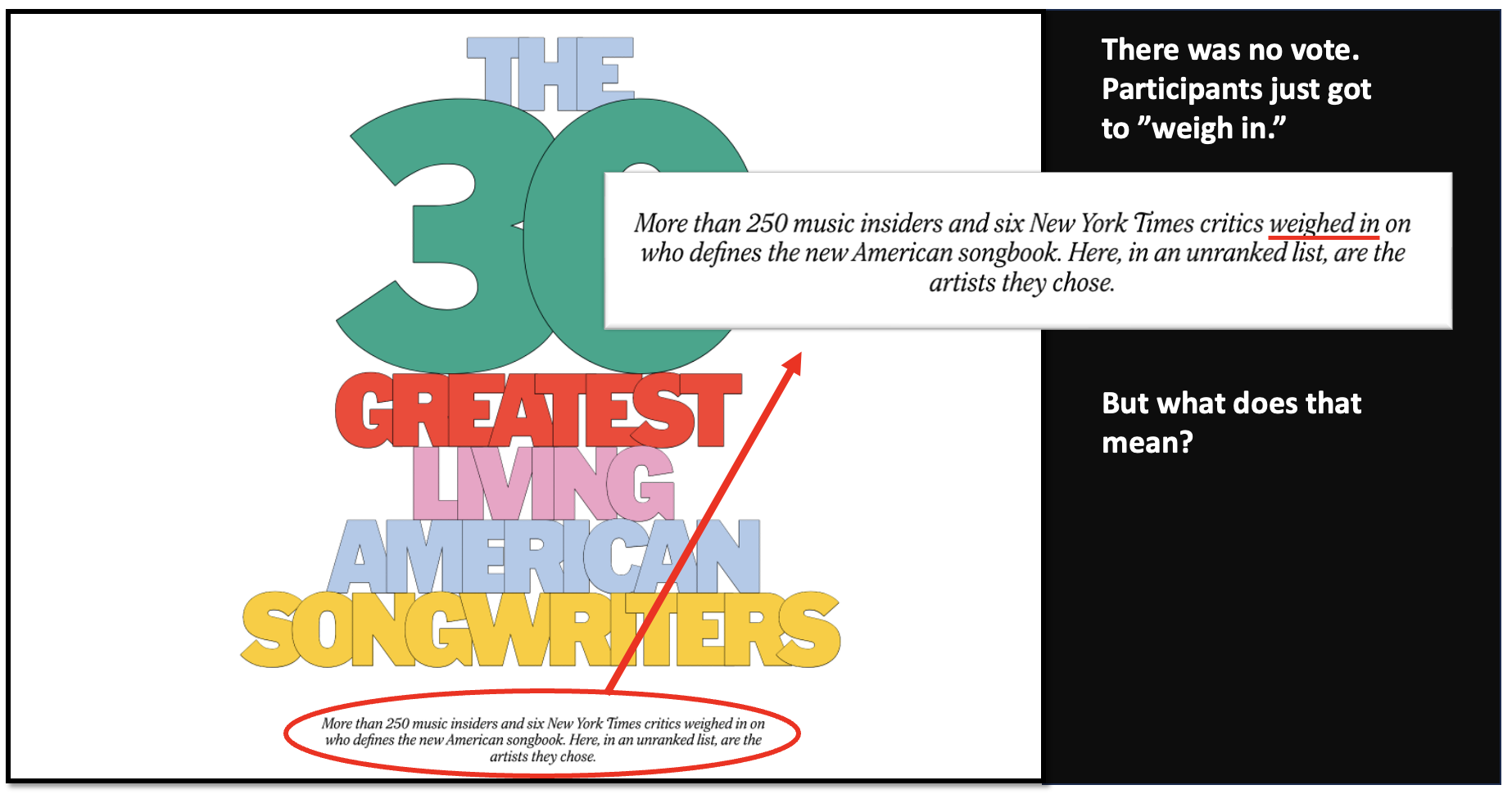
I assumed that I was voting for the songwriters who would be included in the list. But I now see that the experts consulted by the Times only got to make nominations. The final 30 names were chosen by six New York Times music critics.
There never was a real vote. The Times got the results it wanted internally — the insiders made the final call. But the way they explained it to their readers was intentionally vague.
In small print, readers were told that industry experts “weighed in” — whatever that means.
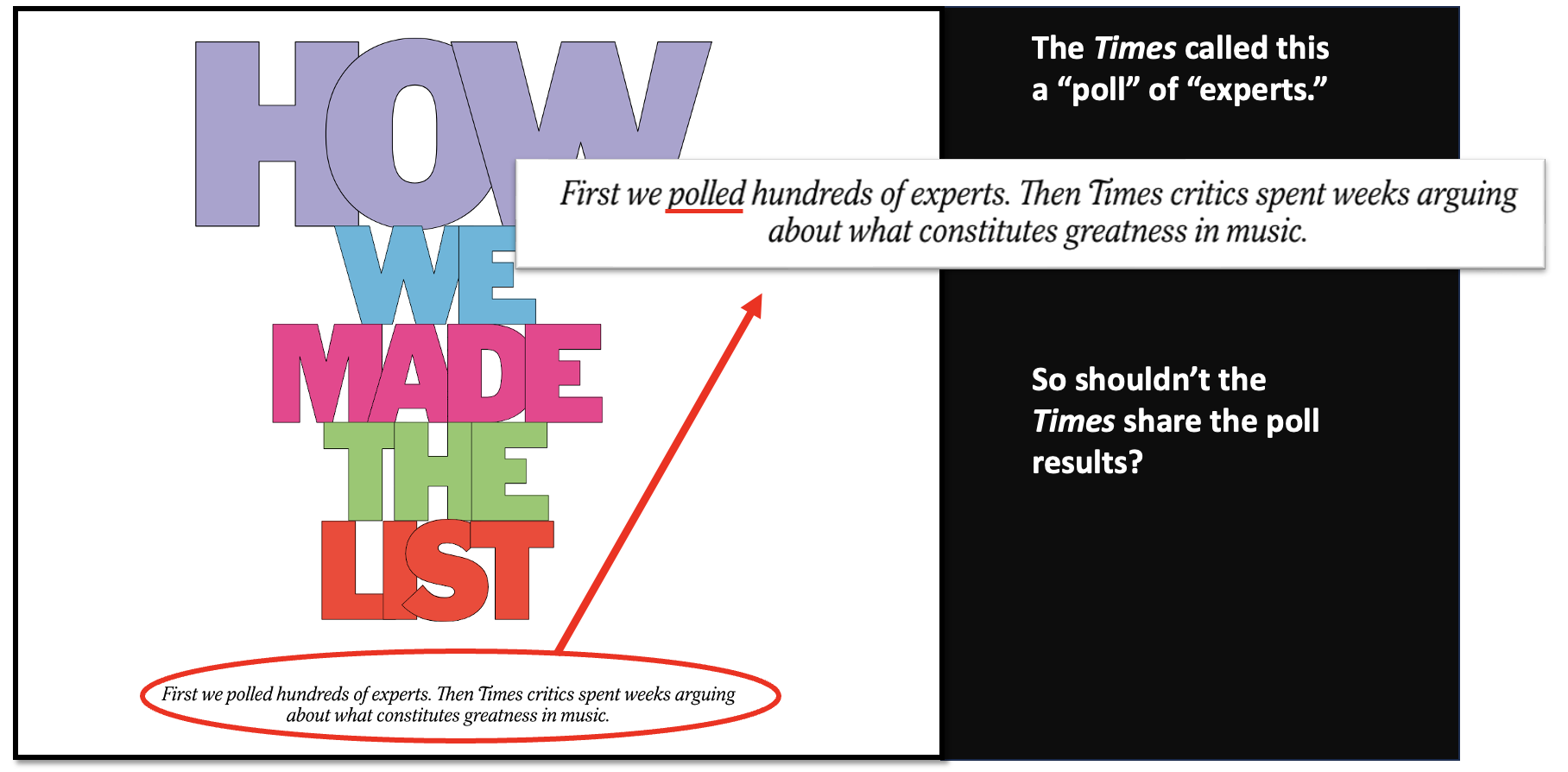
Readers were invited to click on a link to learn “how we made the list”. But even here, the Times served up fuzzy language.
If you kept on reading, you eventually learned the truth. The Times took the verdict of the “experts” and then “ran it through a filter”. The survey was just a “starting point”. The actual top thirty was decided via a “conversation” among its internal team.
Huh?
The Times did share a few ballots, and even this small sample made clear how different the final list was from the survey of experts. That would be embarrassing for the Times under the best of circumstances, but especially so in the current environment — when that same newspaper has repeatedly expressed outrage about voter suppression and attempts to subvert democracy.
If the Times really believes in the importance of voting and standing by results, why doesn’t it just share the actual ballot count?
Even so, this all might have been forgotten. But last Friday, the Times made the mistake of releasing a video entitled “In Defense of the NYT ‘Greatest Songwriters’ List“.
Here members of the inside team came across as smug, maybe even contemptuous, in responding to music fans who reached out to them. At one juncture, a Times critic laughs at a comment from a reader — simply for saying that he went to the Berklee College of Music. Then he continues to chuckle and smirk as he reads the rest of the reader’s comment, before finally throwing it on the floor.
This music lover had made the mistake of defending Billy Joel. For a serious critic at the Times, that is apparently very funny.
Comments Off on “Trust is the most scarce thing in the media landscape right now”
Lynching
On the social media site formerly known as Twitter, Tom Kratman shares some thoughts on lynching:
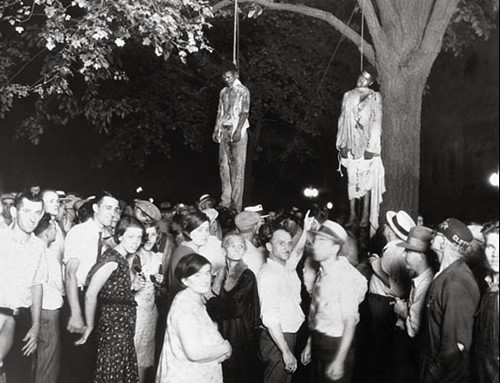
“1930 Lynching” by e-strategyblog.com is licensed under CC BY 2.0 
 .
.
So, in honor of the white liberal idiots (Lord, forgive us our redundancies) and black race grifters, who seem to infest X, some old thoughts on lynching:
So I was musing on lynching. It occurred to me that merely because someone was lynched it does not necessarily follow that they were either innocent, nor that the lynching was improper or wrong. Of course, we think of it, or most of us do, today, as being a purely racist phenom, applied entirely to innocent black folks. Neither of those is true.
I think we can divide lynching into several different levels and levels of legitimacy.
1. In a place of high crime where the law does not exist. In this case, yes, of course, do what you must to preserve life, liberty, and property, to protect your friends, neighbors, and family.
2. In a place of high crime where the law exists but has become purely notional, where criminals are not generally pursued, tried, convicted, or punished, and where this is no real hope for improvement. In this case, too, lynching is likely legitimate, for two reasons, the ones set out above and, further, to humiliate the arms of the law and the political branches into doing their jobs.
3. In a place where the law exists, where criminals are pursued, tried, and convicted, things become murkier. Note that I left off “punished”. In this case, I would argue, the law has become as ineffective as #2, above. Parts of California under Soros-supported prosecutors, I am looking at you. On the whole, in these places, I would suggest that lynching has at least some legitimacy.
4. Illegitimate lynching starts where the law is operative, and largely works, but where people — and this is where black folks tend to come in — are both impatient and want to terrorize some folks into general acquiescence. I am thinking here of people dragged from jail, after conviction, and put to death. It’s been done to both whites and blacks, but more to blacks.
This is wrong both because of the terrorizing aspect AND because you have just, from the perspective of those same black folks, changed matters into something highly analogous to #1, above, the law doesn’t apply to or defend them, so of course they can legitimately engage in self-help.
5. The least legitimate form, indeed, it is totally illegitimate, is when the law works, but people just want to engage in self-help, largely for the reasons in #4, and without there ever being an indictment, presentation of evidence, conviction, or anything but a mob operating with a mob’s IQ, which is roughly that of a none-too-bright earthworm.
There are some odd nuances here. For example, take someone with diplomatic immunity who kills your child. I have no answer, yet, for this, but, as a practical and personal matter, have to say that I would personally hunt the son of a bitch down and have lumber and nails handy.
May 13, 2026
A quick look at the race to be the next governor of California
Chris Bray somehow seems to find the election coverage by a multi-decade veteran Los Angeles Times political reporter to be, dare I say, lacking just a little objectivity and honest analysis:

Robin Abcarian has been a professional journalist for four decades, mostly at the Los Angeles Times. She’s spent her adult life writing about politics. So go read her column about the last gubernatorial debate in California. Here’s how it opens:
What am I looking for in a new California governor?
Like a big chunk of the state’s voters, I’m not exactly sure.
You can already tell you’re in the hands of an experienced professional. There aren’t really any big issues or anything in California right now, so how would you zero in on something you would want from someone who wants to lead the state’s executive branch, right? It’s all just a shrug and a guess.
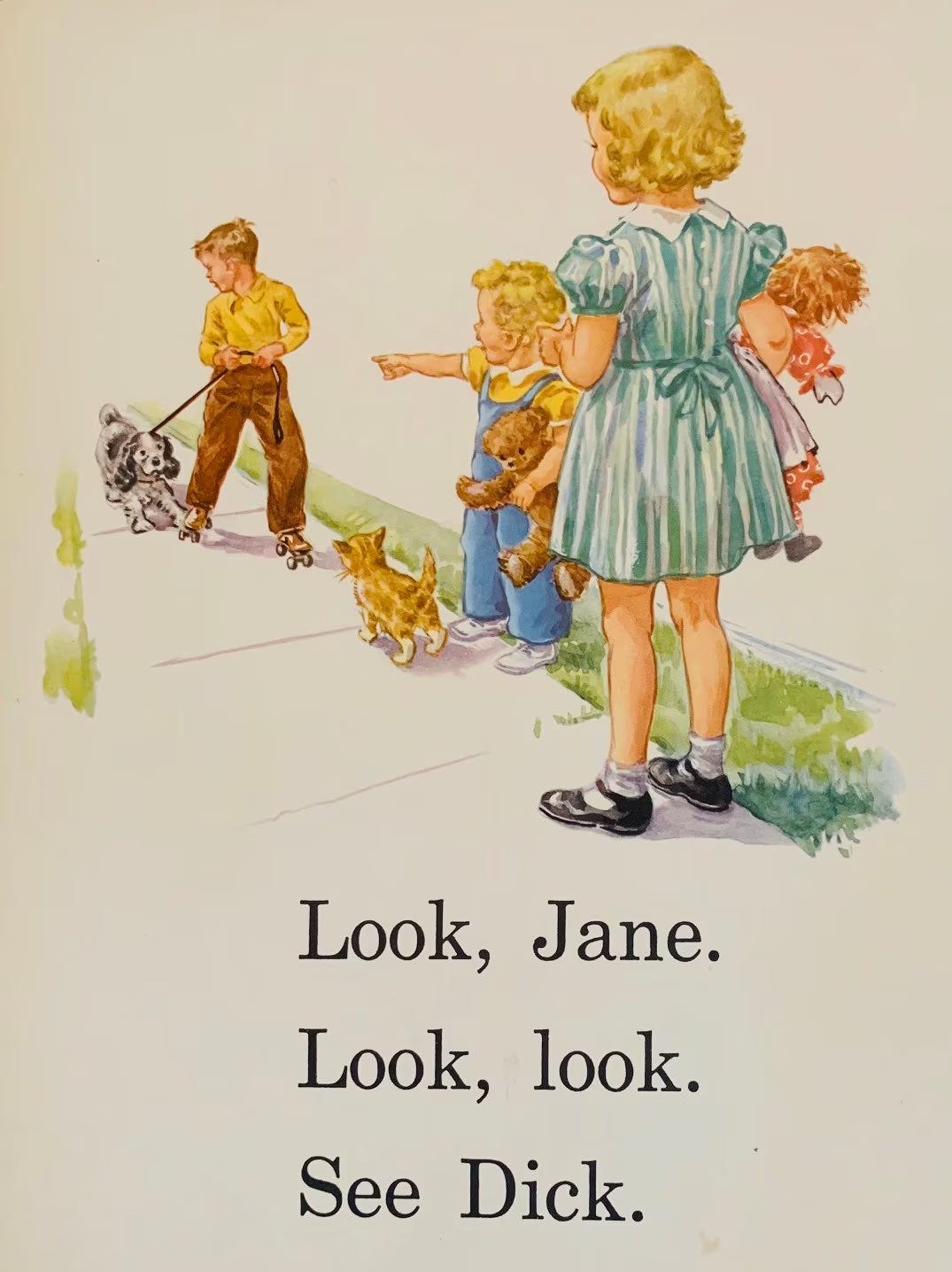
Then she recites: This candidate said X, and this other candidate said Y. And she tells you which of the recited things she likes: I like X. I do not like Y. She doesn’t analyze or argue or contextualize: she just says I like that one and I do not like that one. The effect is that you’re watching someone wander barefoot through a field of statements and either make “ooooh, pretty” sounds or “ick, yucky” sounds with a kind of vibration from her brain stem. Billy likes blue balloons, they are pretty. Becky loves pink balloons, they are even prettier! She can’t explain any of it, though she attempts some explainy noises, and then it gets worse:
I know who I don’t like, though.
Every time I see Republican Riverside County Sheriff Chad Bianco, with his Tom Selleck mustache, I can’t help thinking he should play a lawman on TV.
- Should Chad Bianco become the governor of California?
- He has a mustache
CHAD BIANCO WISHES TO BE THE GOVERNOR BUT ACTUALLY HE APPEARS TO BE VERY MASCULINE THINK ABOUT IT
Have I mentioned that Robin Abcarian has a graduate degree in journalism? You can see how her education sharpened her mind.
She adds that Bianco has said some deeply disturbing and disqualifying things, and then she gives an example: “A lack of affordable housing has nothing to do with homelessness, Bianco has said repeatedly”. Gasp!
Instead, outrageously, he claims that homelessness has something to do with “drugs and mental illness”.
It is very bad to say this. Why is it very bad to say this? She doesn’t explain, but it’s very bad to say it. Homeless people are all just fine, and they would immediately be okay if you just gave them a house, because the whole crisis is just affordability. Drugs and homelessness!?!? In CALIFORNIA!?!?!? What are you even talking about!?!?
This woman is a journalist in Los Angeles, where you can experience psychotic episodes in the street next to an encampment by driving to lunch.
By the way, this video of homeless people on Skid Row smoking fentanyl right next to the LAPD’s Central Division station? I drove over there this afternoon, and yes. Open drug dealing, drug overdoses, ambulances running day and night, bodies in the street, police station.
Let’s have a look at Abcarian’s analysis of Katie Porter, whose marriage quite notoriously ended with her husband accusing her of once expressing an (apparently frequent) rage by dumping a boiled pot of mashed potatoes on his head, part of a pattern of what he described as an abusive relationship. Abcarian:
“I’ve always liked Porter and her famous white board. I don’t believe snapping at your staff or a reporter is disqualifying, and I’m glad she’s been able to joke about the leaked video that damaged her campaign.”
I like Katie Porter. She is nice. People say she yells a lot, but that is okay. She makes jokes about when she yells at people who work for her. That is funny! She is funny and nice.
Decades on the payroll of a major American newspaper. Will a candidate be an effective governor? “I’ve always liked Porter.” Thanks for your analysis, Robin.
And then finally, big finish, watch how aggressively obtuse this person is. Just watch. It’s a gold medal performance.
First she discusses the attacks on Democratic frontrunner Xavier Becerra. The other candidates are criticizing him because “on his watch at HHS, the Office of Refugee Resettlement lost track of 85,000 migrant children”. Abcarian acknowledges what happened next, when “many of the minors, mostly teenage boys, were exploited by sponsors, who illegally put them to work in various factories, food processing plants and as roofers”. So she has explicitly discussed migration as a source of human trafficking and exploitation.
Then she says that Tom Steyer won her heart by promising to shut down ICE and prosecute ICE agents. Here’s Abcarian’s complete discussion of the way she feels about Steyer promising not to enforce immigration laws: “Could it be I’m falling in love?”
- Unmanaged migration across borders is human trafficking and exploitation, often of children
- My uterus is a little gushy over this candidate who says he’ll block the enforcement of immigration laws and shut down the agency that enforces immigration laws
Does she notice that she did this? Does she notice the one-two punch of talking about tens of thousands of minors trafficked across the border to be exploited and then the immediate wine aunt pivot to this ooh-he’s-so-cute swooning about Dreamy Tom Steyer promising to not let anyone enforce immigration laws?
My position regarding the high-cultural-status AWFL and biologically male pseudo-AWFL, in media and politics and academia and NGOs, is that none of them notice themselves at all. They have noises that they’re been trained to make, and they make the noises. Warm and wonderful unhoused neighbors. Warm and wonderful trans kids. Warm and wonderful immigrants. They have categories that they purr about, because one purrs about those categories or else one is a Trump person who belongs in a trailer park. It’s been purely automatic for years and years.
Comments Off on A quick look at the race to be the next governor of California
The Korean War Week 99: The War’s Most Humiliating Crisis – May 12, 1952
The Korean War by Indy Neidell
Published 12 May 2026The world turns it’s eyes to the UN POW camp at Koje-Do island when the Communist POWs in one of the compounds kidnap the Camp Commandant, an American General no less, and issue demands that they say must be met before his release. Can this be settled diplomatically, or is the army going in in force?
00:00 Intro
00:54 General Dodd Kidnapped
04:09 Koje-Do Phase Two
07:04 Dodd on Trial
13:18 The POWs Demands
18:30 Summary
19:03 Conclusion
19:54 Call to Action
Comments Off on The Korean War Week 99: The War’s Most Humiliating Crisis – May 12, 1952
“The dark genius of bureaucracy”
Auto-translation on the social media site formerly known as Twitter has brought some posts from Brivael Le Pogam to my attention, like this one:
The Invisible Cemetery
Milton Friedman said a phrase that should haunt every European legislator for the rest of their life. On the FDA, he said this: there is overwhelming evidence that they have caused more deaths through delayed approvals than they have saved through early approvals.
Read it twice. More deaths from excessive caution than lives saved by caution.
And no one sees it. That’s the dark genius of bureaucracy.
Bastiat theorized the principle 175 years ago. “What is seen and what is not seen.” The economist, he said, is not distinguished from the bad economist by the ability to see the immediate effect of a decision. Everyone sees that. He is distinguished by the ability to see the invisible effects, the delayed ones, the ones diffused across the entire population.
The self-driving car is the perfect example. And it’s playing out right before our eyes.
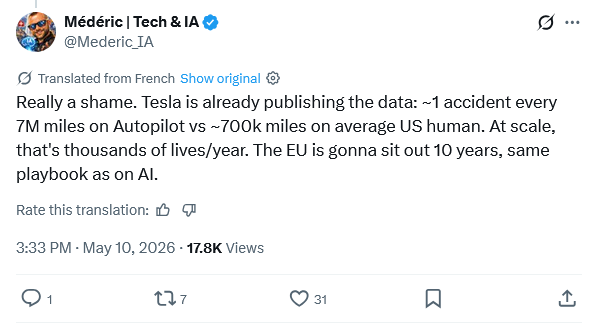
Tesla publishes the numbers. One accident every 7 million miles in Autopilot. One accident every 700,000 miles in the average American human. Autopilot is, at this stage, ten times safer than a human. And it’s only getting better, with every release.
Now France. 3,200 deaths on the roads in 2024. 91% involve human error. Speed, alcohol, fatigue, distraction. If we deployed a self-driving car ten times safer tomorrow, we’d divide the carnage by ten. We’re talking about 2,800 lives a year. Over ten years, 28,000 people. The equivalent of an average French town that disappears, because no one pressed the right button in Brussels.
You’ll never see them. No newspaper will headline: “Today, 8 people died because the self-driving car is banned in Europe”. No parliamentary commission will investigate. No bureaucrat will be fired. Those deaths will go in the “road fatality” box. We’ll run moving campaigns with their photos on 4×3 billboards. We’ll say it’s sad, that’s life.
Meanwhile, the first accident of a self-driving car will be front-page news in every paper for three weeks. The regulator will summon the manufacturers. NGOs will call for preventive bans. Deputies will write op-eds. The minister will decree a moratorium.
Five visible deaths will outweigh, in the media and political balance, five thousand invisible deaths. That’s the iron law of bureaucracy. The bureaucrat who authorizes something that goes wrong loses their career. The bureaucrat who bans something that would have saved thousands of lives is never troubled. No one holds them accountable for the deaths they could have prevented. They don’t exist in their statistics. They don’t exist in their trial.
Friedman had identified the exact mechanism: when a regulator errs on the side of laxity, their victims have names, faces, families, lawyers. When they err on the side of caution, their victims are anonymous, scattered, statistical, ghosts. The structure of incentives makes over-regulation rationally inevitable. And the invisible cemetery grows, generation after generation.
Europe is going to sit out 10 years on the self-driving car, just as it sat out on AI, as it sat out on genetic engineering, as it sat out on fourth-generation nuclear. Every time, the same playbook. Precaution, moratorium, ethics committee, white paper, directive, transposition. And every time, behind the curtain of words, deaths that appear in no official statistics.
These are deaths. Not opportunity costs. Not “economic losses”. Human beings who were alive and who died because an innovation that could have saved them was delayed by people whose literal job it is.
That’s what needs to be built, and it’s probably the most important political project of the century that’s opening. A system for accounting for invisible deaths. A registry of the cemetery that no one sees.
For every regulation, every moratorium, every preventive ban, we should be able to produce a signed, dated, quantified estimate of the human cost in lives of the decision. Not direct effects. Delayed effects, indirect ones, statistical ones. How many deaths per year caused by banning a technology that works elsewhere.
Imagine. On the desk of the European commissioner about to sign a moratorium on the self-driving car, a document: “Central estimate, 2,800 deaths per year for the duration of the moratorium. High-end range, 4,100. Low-end range, 1,900. Source: comparative analysis Tesla Autopilot vs. human average, NHTSA and ONISR data, public and audited method.”
On the desk of the European deputy who will vote on the AI Act: “Central estimate, 38 billion euros in lost GDP, 240,000 jobs not created, X deaths per year due to delays in AI medical diagnostics, Y deaths per year due to delays in deploying autonomous drones for medical delivery in rural areas.”
Today, we sign blindly. We sign without cost. We sign with a clear conscience because the deaths we cause are anonymous and the lives we protect have faces. That’s what needs to be broken.
A bureaucracy is an institution that operates without being held accountable for the invisible consequences of its decisions. As long as invisible deaths are not counted, bureaucracy is mechanically, structurally, inevitably a machine for producing deaths it will never see.
Europe isn’t losing a technological battle. It’s filling a cemetery. Year after year. And no one wears mourning. No one lays flowers. No one knows they’re there.
Friedman saw them before everyone else. Bastiat before him. Williams after him. And each posed the same question, which echoes like an accusation through the centuries: who weeps for the deaths we didn’t see coming?
That’s the work ahead of us. Making the invisible cemetery visible. Accounting for it. Auditing it. Publishing it. Confronting every bureaucrat, every day, with the exact list of lives that their signature takes with it.
Before the list becomes ours.
Comments Off on “The dark genius of bureaucracy”


