
Television is the great propaganda weapon of the liberal democratic state, so it is a useful window into the thinking of the oligarchs. Movies and television shows still have to attract an audience, so they are usually the trailing edge of whatever the oligarchs are trying to impose on society, but the ads are a different matter. They are the leading edge of the latest Progressive fads. They know people will not abandon a show or movie just because the ads are offensive.
That’s what makes the ads a useful window into the black soul of our rulers. The ad makers are all from the ruling class. Look at the team photo of an ad agency and it looks like the faculty of an Ivy League college. There may be a little color in there for show, but otherwise it is all men with small hats and people who still write “Episcopalian” when asked about their religion. The advertising agencies that produce these ads are the special forces of the Judeo-Puritan ruling class.
The Z Man, “Turn Off, Tune Out and Drop Out”, The Z Blog, 2020-09-04.
May 13, 2026
QotD: The advertising business
May 12, 2026
Indian Pudding – America’s Forgotten Dessert
Tasting History with Max Miller
Published 18 Nov 2025Rather unattractive, but delicious, molasses and cornmeal baked pudding with whipped cream
City/Region: United States of America
Time Period: 1829Indian pudding, a perfect marriage of new world and old world cooking, resulted from British colonists making familiar foods with the ingredients that were available to them in America. Without access to wheat flour, they used cornmeal to make their beloved boiled puddings, and by the time this recipe came around in 1829, there were baked versions as well.
While an admittedly unattractive dish, it is absolutely delicious. The molasses really comes through, but it has none of the bitterness, leaving an almost caramelly flavor.
This dish has fallen out of favor and can usually only be found in New England, but I think it should make a comeback. If you’re planning on serving it for Thanksgiving (which I plan on doing), then I recommend presenting it dressed up with whipped cream to make it, if not pretty, then more palatable-looking.
(more…)
May 11, 2026
“We’ve entered the pre-violence rhetorical phase of the classic communist cycle”
You have to have noticed that progressives all seem to have recently decide en masse that we need to liquidate eliminate expropriate the billionaire class. It’s been done in the past, and modern progressives seem to be unable to spot the pattern, even as they work hard to bring it back to life by constantly scapegoating the wealthy (machine translated from Brivael Le Pogam’s original French post):
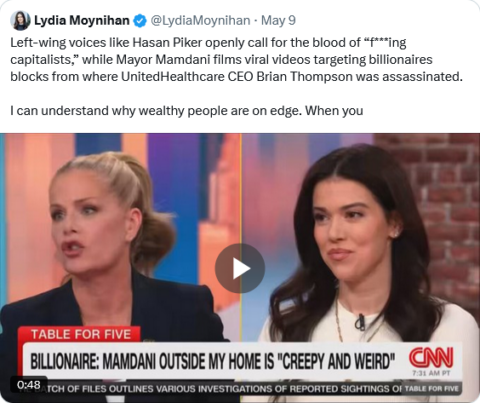
Lydia is putting her finger on something that no one wants to name clearly: we’ve entered the pre-violence rhetorical phase of the classic communist cycle.
The script is documented, archived, and it repeats itself identically for a century. Before every mass massacre carried out in the name of Marxism, there are always 5 to 15 years of public designation of a category of people as “the enemy to be taken down”. Not a debate on public policies. Not a critique of inequalities. A methodical dehumanization of an entire class.
In the USSR in the 1920s, it was the kulaks. Lenin wrote as early as 1918 that it was necessary to “exterminate the kulaks as a class”, an expression repeated word for word by Stalin ten years later. Result: 4 million peasants deported, several million dead in the Holodomor.
In Maoist China, it was the landlords and “class enemies”. Mao orchestrates public “struggle sessions” where neighbors, children, former employees are forced to denounce, humiliate, and beat. Tally from the land reform alone: 1 to 2 million executions, not counting what follows.
In Cambodia, it was the “new people”: city dwellers, intellectuals, people wearing glasses. Khmer Rouge propaganda designated them for years as parasites before massacring them. 1.7 million dead in 4 years.
Now look at what’s happening in the United States in 2026.
Hasan Piker, who reaches millions of young men on Twitch, speaks openly of the “blood of f***ing capitalists”. Not in 1968 in a Trotskyist cell, in 2026 on the platform most watched by 18-25 year olds.
Zohran Mamdani, elected mayor of New York, films viral videos in front of billionaires’ buildings, exactly where Brian Thompson, CEO of UnitedHealthcare, was assassinated last year by Luigi Mangione. The latter was turned into a pop icon by a part of the American left in less than 48 hours. T-shirts, fan art, romanticization of the murderer.
This isn’t “political passion”. It’s phase 1 of the protocol. The public designation of a category of humans as legitimately hateable, followed by the valorization of those who take action.
The “normal” reaction of a healthy democracy should be the immediate social and professional isolation of these voices. What’s happening: they top podcast charts, they’re elected officials, and they get favorable media coverage.
History doesn’t stutter. It copy-pastes. And the first victims are always surprised to discover, too late, that the speech they found “a bit excessive but oh well” was actually the clear warning that a pit was being dug for them.
Lydia is right to say it. And she’ll be even more right in five years when we reread these tweets.
And more:
And if you’re reading this thinking, “This doesn’t concern me, I’m not a billionaire”, stop for two seconds and really think about it.
Because that’s exactly what the Russian peasants told themselves in 1918 when people started talking about the “bourgeois”. They applauded, or they looked the other way. It wasn’t their problem. They weren’t rich.
Ten years later, they were called kulaks. And “kulak“, in Stalinist practice, meant any peasant who owned one more cow than his neighbor, who had dared to hire a seasonal worker, who had a slightly better-kept barn. 4 million deported. Several million dead.
That’s exactly what the small Chinese shopkeepers told themselves in 1949, when Mao went after the “great landowners”. Not their problem. They just ran a little store. Five years later, they too were classified as “class enemies”, stripped of everything, publicly humiliated, sometimes beaten to death by their own neighbors.
That’s exactly what the Cambodian schoolteachers told themselves in 1970, when the Khmer Rouge talked about “urban exploiters”. Not their problem. They barely earned enough to live on. In 1975, knowing how to read was enough to sign your death warrant.
The communist mechanism NEVER stops at the ultra-rich. Never. It’s a historical law as solid as gravity.
Why? Because fundamentally, the communist doesn’t hate wealth. He hates individual emancipation. He hates the very idea that a man can build something that belongs to him, decide his own life, refuse the collective. Private property isn’t an economic detail to him — it’s the metaphysical enemy. Because someone who owns something is someone who can say no.
So if you have an apartment you spent 15 years paying off, you’re concerned. If you have a small business, a shop, a sole proprietorship, you’re concerned. If you have a savings plan, a bank book, stocks, you’re concerned. If you have a family home in the provinces, you’re concerned. If you work hard to pass something on to your kids, you’re at the top of the next lists.
Billionaires are just the first course. Always. Because there are few of them and they’re easy to point out. They’re the appetizers for the machine. The main course, historically, is you.
And meanwhile, a lot of people read threads like this, nod their heads, and don’t share. Don’t comment. Don’t take a stand. Out of fear of being labeled “right-wing”, “reactionary”, “too political on LinkedIn”. Out of comfort. Out of social cowardice.
Know that this silence has a precise historical cost. Every time a society has tipped into this madness, it did so because the reasonable majority stayed silent too long, thinking it would all blow over on its own.
It never blows over on its own.
The History of SPI: Part 1 / Simulations Publications Inc. / Wargaming History
Legendary Tactics
Published 18 Dec 2025Remember the golden age of wargaming? This is THE definitive history of SPI (Simulations Publications, Inc.), one of the most influential publishers in tabletop gaming. From its groundbreaking magazine Strategy & Tactics to iconic titles like War in the East, StarForce, and Terrible Swift Sword, SPI reshaped what board wargames could be — and built a passionate community along the way.
This is Part 1, where we delve into the origins of SPI and Strategy & Tactics Magazine, and the people and games that were part of it.
(more…)
May 9, 2026
M1E5 Experimental Paratrooper Garand
Forgotten Weapons
Published 17 Dec 2025In January 1944 men of the 93rd Infantry Division field-modified an M1 to give it a shorter (18″) barrel, and the rifle was sent back to the US and tested by the Infantry Board. The idea was that a rifle like this might be of use to paratroopers, being more powerful than the M1A1 Carbine they were already using. The job of exploring the idea was given to John Garand at Springfield Armory, and he began work that same month.
One example was made in the spring of 1944, using an underfolding stock designed by Garand (for which he received a patent in 1949). It was 5″ shorts and 1.2 pounds lighter than a standard M1, but exhibited excessive blast and concussion. The initial design used the folding stock with a traditional grip, and this was found uncomfortable (no surprise there). The rifle was refitted with a rather odd steel pistol grip, but this was also not a great solution. By this time testing found the whole thing undesirable and it went no farther.
Thanks to the Springfield Armory National Historic Site for giving me access to this truly unique specimen from their reference collection to film for you! Don’t miss the chance to visit the museum there if you have a day free in Springfield, Massachusetts: https://www.nps.gov/spar/index.htm
(more…)
QotD: Morality and taxation
This has always been this way since America has had income taxes. There is endless court precedent. You pay what you legally owe. That’s it. If you pay less than you legally owe, then the government will fine or imprison you. If you pay more than you legal owe, the government will laugh and laugh, because you are an idiot, and you deserve to be poor.
Every single person who barks about how somebody else should be paying more? They themselves are paying the minimum they can get away with. As they should. As should you.
I remember when I was taking my first tax class back in college. This class was all accounting majors by this point. At the beginning of the semester the professor (who’d had a long career as a tax guy) gave us an imaginary family as our clients and had us do their taxes. One kid didn’t take advantage of all the obvious deductions for his clients. When the professor asked why, the kid said some mushy thing about how he didn’t think it was FAIR to keep that money from the government … Holy shit. The professor ripped this kid a new asshole. HOW DARE YOU!?! IT IS NOT THE GOVERNMENT’S MONEY! IT IS YOUR CLIENT’S MONEY. YOU OWE THEM YOUR BEST! IT IS YOUR SACRED DUTY TO SAVE THEIR MONEY! YOU DISGUST ME AND YOU SHOULD NEVER BE A CPA!
That class was one of my favorites.
Basically, you pay what you owe, no more, and anyone who claims otherwise is full of shit.
Larry Correia, “No, You Idiots. That’s Not How Taxes Work – An Accountant’s Guide To Why You Are A Gullible Moron”, Monster Hunter Nation, 2020-09-28.
May 8, 2026
QotD: North Vietnamese intelligence failures in the Tet Offensive
… and it didn’t happen, because they, the North Vietnamese, had faulty intel.
The Americans suffered from the “intel to order” problem too, of course, which we in the civilian world call “telling the boss what he wants to hear”. But the NVA had it much worse, since that’s a much greater structural problem among Commies. Indeed, the Americans got at least one high-level defector during Tet — a lieutenant colonel I think — who only defected because the units he was supposed to command in the “general uprising” didn’t exist. They were purely paper fantasies, straight out of some commissar’s head.
And that’s what made [US Army military analyst Joseph] Hovey’s report so easy to dismiss. Hovey himself said it — it looks like they’re planning to do X, Y, and Z, but that would only make sense if they’re making a big mistake about the balance of forces. The US had pretty good intel on the ARVN and the political mood of South Vietnam. But they for some reason assumed that the NVA had basically the same information, so all of the NVA’s calls for a general uprising — which the NVA absolutely meant, and indeed were counting on — were easy for US analysts to dismiss as mere propaganda.
Severian, “Book Rec: Tet, Intelligence Failure”, Founding Questions, 2022-06-30.
May 7, 2026
Tu-144 Concordeski – Speed, Spies and Failure
HardThrasher
Published 4 May 2026In great secrecy, in 1963 the USSR set about making aviation history with the world’s first Supersonic Transport (SST). In 1968, five months before Concorde, the Tu-144 became the first passenger jet to break the sound barrier. But it was a white elephant that crashed on multiple occasions, killed hundreds and flew for just a matter of months after over a decade of development. It was, perhaps the first of a string of failures that brought down the Soviet Union.
00:00 – 11:06 – Introduction and Background
11:07 – 23:10 – The Decision is made to build
23:10 – 35:31 – And then it got worse — how everything fell apart
35:32 – 39:10 – The En Crashening — From First Flight to Constant Crashes
39:11 – 48:49 – Enter the KGB — What role did spies play
49:22 – End – Like, Subscribe, Join the Patreon
(more…)
QotD: The loss of male spaces led to today’s epidemic of male loneliness
Places where men showed up without an agenda. Where conversation happened sideways, not face-to-face. Where no one asked men to perform vulnerability, explain themselves, or justify their presence.
Those places didn’t disappear because men rejected connection. They disappeared because our culture decided male-only spaces were no longer acceptable. And once they were gone, men were told that their resulting loneliness was a personal failure.
There has been a noticeable shift in recent months. A growing number of articles now
acknowledge male loneliness and even gesture toward men’s emotional needs. On the surface, this looks like progress — and in one narrow sense, it is. For decades, male loneliness was either ignored or mocked.But many of these pieces commit the same quiet betrayal.
After briefly acknowledging that men are lonely, many articles abandon subtlety altogether and place responsibility squarely on men themselves. Men don’t open up enough. Men don’t try hard enough. Men don’t build friendships properly. Men resist emotional growth.
What is missing is the most obvious factor of all: our culture systematically dismantled the spaces where men and boys once formed friendships.
Men Did Not “Forget” How to Connect, They Lost the Places Where Connection Happened
Male friendships have never primarily formed through structured emotional disclosure. They formed through shoulder to shoulder shared activity, regular presence, and low-pressure companionship. Men bonded by working alongside one another, not by facing one another across a table and “processing”.
For generations, this happened naturally in male-only spaces:
- Service clubs
- Fraternal organizations
- Trade guilds and apprenticeships
- Male sports leagues
- Scout troops
- Men’s religious groups
- Informal gathering places like barbershops and workshops
These environments weren’t about exclusion. They were containers — places where boys learned how to be men from men, and where adult men maintained connection without self-consciousness or surveillance.
Now consider what has happened.
- Barbershops are co-ed and transactional.
- Service clubs are now largely co-ed, and the informal freedoms that supported male bonding in male-only environments have largely disappeared.
- Community sports are co-ed or heavily regulated.
- Even the Boy Scouts are co-ed.
One by one, male spaces disappeared — not because men abandoned them, but because our culture increasingly viewed male-only environments as suspicious, outdated, or morally problematic.
The Asymmetry No One Wants to Name
At the same time male spaces were dismantled, female-only spaces proliferated.
- Women-only gyms are accepted.
- Women-only scholarships are celebrated.
- Women-only commissions exist at every level of government.
- Women-only networking events, parking, subway cars, retreats, and support groups are commonplace.
“Women-only” is understood as necessary, protective, and empowering.
“Men-only”, by contrast, is treated as exclusionary at best and dangerous at worst.
The result is an unspoken rule that everyone knows but few admit:
Women may gather without men. Men may not gather without women.
This is not equality. It is a double standard — and it has consequences.
Tom Golden, “The Quiet Lie Behind Male Loneliness”, Men Are Good, 2026-01-05.
May 6, 2026
The Korean War Week 98: No Peace at Panmunjom – May 5, 1952
The Korean War by Indy Neidell
Published 5 May 2026At the end of last week the UN presented a peace package proposal to the Communists at the peace talks, but that package has been rejected. The only issue still left to clear up is that of POW repatriation, but that seems insurmountable, at least for the time being. In the field, there are ambushes, skirmishes, and night patrols, but still no larger scale actions, and the temperature at Koje-Do POW camp continues to rise and rise, perhaps nearing a boiling point.
00:00 Intro
01:34 Recap
02:09 The Package Rejected
03:58 Night Patrols
08:32 The Fighting
14:13 Koje-Do
15:58 Summary
16:15 Conclusion
Carney panders to the Euro elites and his TDS-afflicted base
On the social media site formerly known as Twitter, Ben Woodfinden explains Prime Minister Mark Carney’s constant pandering on the international stage:
The average voter won’t care, but the more Carney lays out his worldview the more the contradictions and incongruences in his thinking (or lack of sincerity) become apparent.
In his famous Davos speech he said “we actively take on the world as it is, not wait around for a world we wish to be”. But the way he talks about and sees Europe does not fit this, and this statement is bizarre.
We should absolutely be pursuing closer ties to Europe, but it is delusional if he actually believes the new international order will be “rebuilt out of Europe”.
Europe for all its grand aspirations cannot even defend Ukraine by itself and without American help. Europe would need something like 300,000 additional troops and €250 billion a year in extra defence spending just to deter Russia without the Americans.
NATO’s own Secretary General told the European Parliament in January that Europe “cannot at the moment provide nearly enough of what Ukraine needs to defend itself today, and to deter tomorrow”, and that without American weapons “we cannot keep Ukraine in the fight. Literally not.” Rutte told European lawmakers that anyone who thinks Europe can defend itself without the US should “keep on dreaming”. Four years into the most serious land war on the continent since 1945 and this is where we are. That is not a continent about to anchor a new international order.
The world order is quickly is reorganising, yes. But around a US-China axis, not Brussels. The eurozone is forecast to grow 0.9% this year. China at 4.5%. China accounts for roughly 30% of global growth, Europe’s share of global GDP keeps shrinking. Europe is just one of many players. Again if you take Carney seriously here, it’s silly. Build closer ties with Europe yes but do not believe this is the next superpower.
But I suspect this is actually just another sign that Carney is good at politics — he knows exactly what the Davos crowd, his boomer base and media admirers want to hear and he is very good at giving it to them. Flattery has done him enormous favours in European capitals. But telling European elites the future runs through them is not realism, it is the opposite of realism. It is telling people what they want to hear, not the truth.
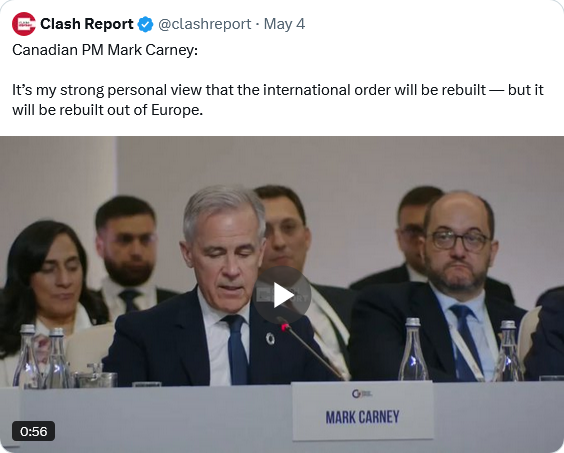
L. Wayne Mathison also comments on Carney’s profound europhiliac positions:
Europe is not the model. It is the warning label.
High regulation. Weak growth. Expensive energy. Soft defence. Endless bureaucracy.
America built. Europe managed. America innovated. Europe regulated.
And Carney wants Canada rebuilt “out of Europe”?
No thanks. Canada needs strength, productivity, energy, defence, and sovereignty, not Brussels-style decline with better catering.
May 5, 2026
Seattle’s Mayor to wealthy residents: “Bye!”
I’ve heard many people praise Seattle as a great place to live with lots of amenities and a fantastic setting. Like a lot of places with those kinds of attractions, it also has a political scene that leans strongly to the left, as Mayor Katie Wilson recently highlighted:

“Seattle Skyline” by Atomic Taco is licensed under CC BY-SA 2.0 

 .
.
Seattle’s socialist Mayor Katie Wilson has a message for prosperous people leaving Washington over the state’s soaring tax burden. “Bye!” she says with a laugh, to cheers from a largely progressive audience. Entrepreneurs and investors will certainly take that comment into account as they consider where to live and do business. We can be sure of that fact because recent research further supports the commonsense idea that people often leave high-tax states in search of lower tax bills.
Goodbye, Wealthy People!
Wilson’s comments came during an April 16 discussion about “The New Progressives” as part of Seattle University’s Conversations series. Wilson and King County Executive Girmay Zahilay fielded a series of questions by host Joni Balter and graduate student Ari Winter.
Asked about major companies leaving or threatening to leave over Seattle’s and Washington’s escalating tax burden, Zahilay acknowledged that “everything is a tradeoff” and “of course I think taxes can make companies make decisions about staying or leaving”. You wouldn’t necessarily want to live under his policies, but he sounds like he understands that his decisions may drive people out and impose costs on the community.
Wilson, a self-described “socialist“, was presented with a follow-up question by Winter. She was asked, “do you still think progressive taxes are an easy and promising solution?”
Wilson responded that it was “very, very exciting to see the billionaire tax pass the legislature” and described her history of advocating for higher taxes. She then cut to the heart of her response.
“I think the claims that millionaires are going to leave our state are, like, super overblown. And if, you know, the ones that leave, like, bye!” she said with a wave and a snicker. The audience at the university event joined in with whoops and applause.
Wilson may want to practice her goodbyes. Fisher Investments moved from Washington to Texas to escape a new capital gains tax. Starbucks is building a corporate hub in Tennessee and moving jobs there, largely over tax concerns. Billionaire Jeff Bezos fled the state for Florida, also motivated by taxes.
“Jeff Bezos sold about $15 billion in stocks before the new law took effect, potentially saving over $1 billion in taxes”, the Washington Policy Center’s Chris Corry noted. “Moving his primary residency to Florida would ensure that any future stock sales would not be subject to the excise tax.”
Tech giant Microsoft criticized Washington’s tax environment and threatened to move jobs elsewhere.
May 4, 2026
QotD: Saint Hillary
Kelly was the most relentlessly savage chronicler of the Clinton administration, and of the Clintons personally, but his opening shot was so subtle you had to squint to see what he was doing. In a long feature story that appeared in the New York Times Magazine in May of 1993 under the that’s-not-a-compliment title, “Saint Hillary”, Kelly very quietly mocked Hillary as a preening know-it-all who didn’t know much of anything. He wrote that she represented “the message of the preacher”, with a way of speaking that delivered a stream of moral lectures, as if she had the authority and the wisdom to direct others in the act of moral reconstruction. If you click on the link and read the whole story, you’ll want to watch for the transitional paragraph, the switch from mostly description to mostly derision. It begins with the words, “It is at this point that some awkward questions arise”. Next paragraph: “If it is necessary to remake society, why should Hillary Rodham Clinton get the job?”
It becomes less kind from there. Kelly described a meeting between Hillary Clinton and the progressive Jewish editor and activist Michael Lerner, who (Kelly says) offered a vision of “unintentionally hilarious Big Brotherism”. And then: “The reason Lerner’s proposals for the application of the politics of meaning focus so heavily on bureaucratic irrelevancies is the same reason Mrs. Clinton is struggling still with words”. Self-delusion, unawareness of political realities, hard-headed self-importance, unaware bumbling in an unearned sense of certainty. A moralizer, but not moral, unwise but committed to the appearance of wisdom.
Remember, this story appeared in 1993, in the opening months of the Clinton presidency. Michael Kelly was opening a political era with a dismissal, rolling his eyes at the Clinton project as it began. “Saint Hillary”, they called it. The New York Times used to publish things like this.
Chris Bray, “Saint Hillary the Bluntly Obtuse”, Tell Me How This Ends, 2026-01-30.
Update, 5 May: Welcome, Instapundit readers! Have a look around at some of my other posts you may find of interest. I send out a daily summary of posts here through my Substack – https://substack.com/@nicholasrusson that you can subscribe to if you’d like to be informed of new posts in the future.
May 3, 2026
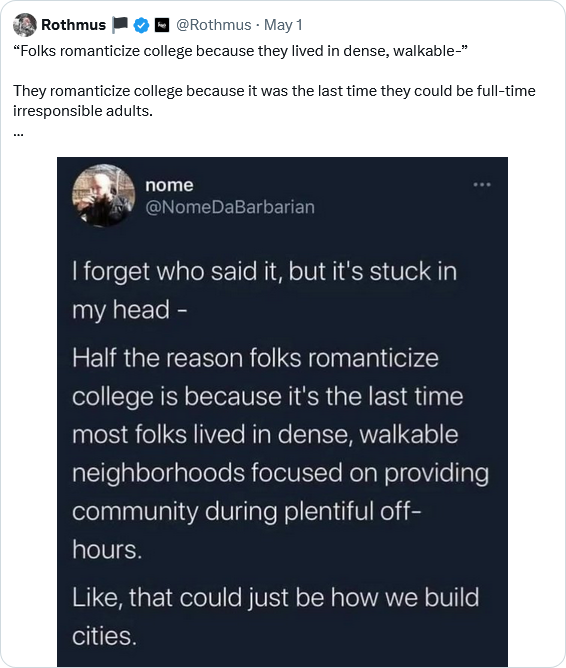
Reasons people romanticize their college experience
On the social media site formerly known as Twitter, Devon Eriksen responds to comments about people wanting the world to be like they remember their time at college:
People romanticize college because for four years of their lives they:
1. Had all the rights of adults but none of the responsibilities.
2. Lived in a closed community with sealed borders that kept out low IQs and anti-socials.
3. Were young, energetic, healthy, and attractive.
4. Were thrown together with a bunch of similar people who had no predefined power- or need-based relationship with them, which is how friendships form.
This last is the important one, especially as fertility rates decline.
People with children transition to making friends with other parents of children in the same age group, because events and networks centered around those children throw them together with other parents in the same way.
But childless people have few or no opportunities to make friends after college. So they are left with a slow dwindling circle of college based relationships, remembering the days when it was all easy, and they weren’t so isolated, and they didn’t have to work so hard.
Couple that with having to complete with infinity immigrants in the job market, so they can pay taxes to support infinity boomers and government bureaucrats, while being passed over for the best jobs and careers in favor of infinity DEI incompetents, who they also have to support …
Well, for a lot of people born into what was once the American middle class, college was their first and last experience of an adult life wherein they weren’t being systematically and deliberately routed into the formation of a new underclass.
A special form of underclass who are still expected to be productive enough to materially support all the non-producing people who were positioned as their social superiors despite being their intellectual inferiors.
So, yeah, they wish they could go back to college.
Is anyone surprised by this?
May 2, 2026
“… a New York Times bestseller!”
I thought this was well-known years ago, but it still apparently surprises people to learn that the famous New York Times bestseller list is … not actually in any way a valid measurement of book popularity and sales:
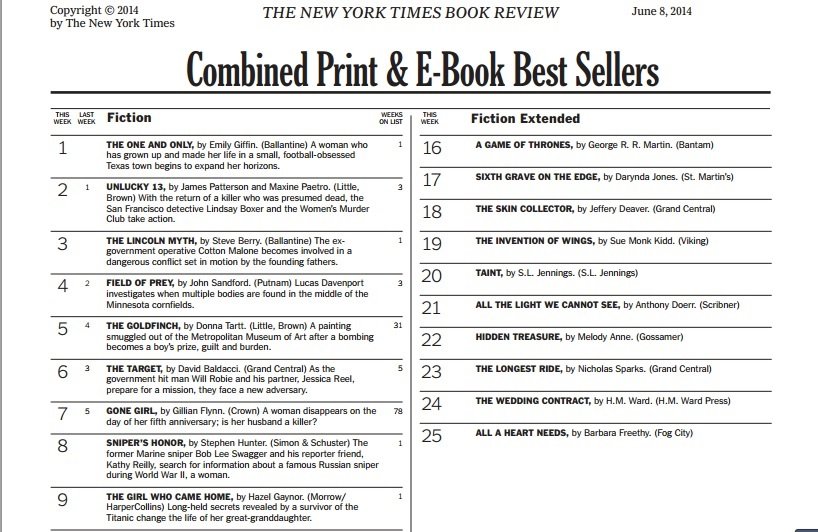
For those of you not familiar with the total scam that is the NYT bestseller list, as a NYT bestseller myself, it’s utter bullshit. It’s not an actual list of bestsellers. It’s “curated editorial”.
As in, stuff they like gets on there, and stuff they don’t like doesn’t. Or stuff they like places higher, and stuff they don’t like but obviously sells too much to deny its a bestseller gets on there lower.
I still tell people I’m a NYT bestseller because most regular normies think that actually means something impressive, and it’s just quicker to say that to establish that you’re a certain level. Within the actual publishing industry its fairly meaningless and everybody knows it.
In reality I made it on there a couple of times early on in my career before they realized who I am and what I’m into (the totally wrong politics, loudly!), because then it was like a post it note got stuck on the wall there saying FUCK THIS GUY, because after that no matter how many copies I sold, even if I was mud stomping half their list in actual sales, I wasn’t getting on there ever again.
Everybody is aware of this scam. The key to getting on the list is the NYT wanting to promote you. They don’t actually track all book sales. They track certain “reporting stores” (which are supposed to be secret but we all know how they are). But then the NYT takes whatever reality is and massages it to fit their narrative.
It isn’t just to keep wrong thinking pariahs like me off there either. I’ve got friends who are apolitical or even mildly liberal who still make the list, but who get bumped down a bunch of spaces from what they should be because there’s somebody else with a new book out the NYT wants to fluff.
Even when the NYT isn’t putting its finger on the scale, it also only measures velocity, as in how many books sold that week. So if you sell 20k copies that week, but never sell another book again, you’re a bestseller. But a guy who sells 1k copies a week every week for an entire year, is not.
Also, I don’t know if it is still this way, because I quit paying attention to what makes the NYT list years ago after I understood what a joke it was, but it was only for physical books, not ebooks, not audio. And there are authors who crush it in ebook who sell very few physical copies in stores. I don’t know if this is still the case on what they claim to track or not today.
So basically it is a biased list of what one small part of the industry sells in a short period of time that the NYT then tweaks to ignore reality if they feel like it anyway. And this isn’t just my opinion as a disgruntled former NYT bestseller, this has gone to court. Authors have sued the NYT which is where the “editorial” thing comes from.
This gets some attention periodically when somebody really famous raises a stink about it. A couple years ago it was Elon. Before that it was Mike Rowe. Etc. But then regular people all forget and go back to thinking the NYT‘s bestseller list isn’t as full of shit as everything else the NYT does.


