Quotulatiousness

November 28, 2025

Social media isn’t completely a depressing waste of time

Filed under: Media, Politics, Technology, USA — Tags: , , , , , , — Nicholas @ 03:00

On the social media site formerly known as Twitter, Devon Eriksen reacts to a political hack who wants to impose regulations on social media that would allow him to shut down people who criticize him and other swamp creatures:

We all know what’s really going on here.

Utah senator John Curtis, and other political hacks like him, are getting their boomer asses handed to them on social media.

They long for the days of television, when they could control the narrative by having a cozy relationship with the networks, and so they could lie to you without fear of contradiction by some autist named @DataRepublican whose existence is solely defined by her full-time hobby of sniffing out lying dirtbags.

So they want to pass a bunch of laws to make the internet behave like television. To filter it all through a set of major website choke-points that they can control by threatening the corporate entities that run them.

Long, complicated, and vaguely defined liability laws are a tool to do that.

Basically what they do is allow John Curtis to put any website out of business if people say mean things about him on it, such as pointing out that he looks like some kind of deranged and malevolent goblin that just crawled out of a swamp.

The problem he has right now is that when I say stuff like that on Twitter, I’m the one who said it.

Not Twitter.

There’s nothing he can do to me. Because even if I get hit by a unmarked sedan tomorrow in a totally unrelated accident, there’s a million more people like me who are only too happy to point out that John Curtis looks like a deranged and malevolent goblin that just crawled out of a swamp.

So he wants legal tools to punish Twitter for what I said.

So how does he go about that? What is a deranged and malevolent goblin, with a “business management” degree, and a history of changing political parties when convenient, to do?

Why, muddy the waters with vague platitudes about “safety”, of course.

Except we’ve heard that song before, and we’re not interested. So let us laugh at him, remind him that he looks like a deranged and malevolent goblin that just crawled out of a swamp, and mock until he goes back to doing what he normally does, which is shilling for the “Fairness For High Skilled Immigrants Act”.

And then we can eventually replace him with someone who cares about fairness to actual fucking Americans.

Update, 29 November: Welcome, Instapundit readers! Please do have a look around at some of my other posts you may find of interest. I send out a daily summary of posts here through my Substackhttps://substack.com/@nicholasrusson that you can subscribe to if you’d like to be informed of new posts in the future.

November 27, 2025

Lack of talent is no obstacle to music success … even before Auto-Tune

Filed under: History, Media, Technology, USA — Tags: , , , , , — Nicholas @ 05:00

One of the reasons I like Ted Gioia’s Substack is that even when I’m not overly interested in the topic of any particular post, I usually learn something:

I’ve tried to identify the turning point — the moment when the rules changed. By my measure it happened one night in 1958.

Let’s revisit that fateful day …

One Friday evening in 1958, record producer George Avakian sat down in front of his TV set, and watched an episode of the popular detective show 77 Sunset Strip. This chance incident would have surprising ramifications in the music business for decades to come.

A few minutes into the episode, the record producer decided that one of the actors on the show looked and talked like a rock star. His name was Edd Byrnes and he played a hipster character named Kookie.

Kookie parked cars at a Hollywood nightclub in the show, and acted very cool. He had the right look and said witty hipster-ish things. The TV audience loved him, especially younger viewers.

Check Kookie out and decide for yourself.

There was just one tiny problem. Byrnes wasn’t a musician.

But Avakian didn’t worry about this. “I was sure that kids would like his talk and his looks, especially a way he had of looking out of the corner of his eye,” he later recalled. “And — the real clincher for his popularity with kids — parents would loathe him.”

They didn’t have Auto-Tune back then, but studio engineers had a few tricks to fix vocal imperfections. They knew how to splice together different takes, or make slight alterations in tape speed.

But when Byrnes did an audition for the label, it was bad. It was scary bad. This promising rock star had no sense of pitch. He had no range. He couldn’t even stay in rhythm with his accompanist.

No technology could fix this mess.

Record producer Avakian was no fool. During an illustrious career, he worked with Louis Armstrong, Duke Ellington, Miles Davis, Dave Brubeck, Sonny Rollins, and Keith Jarrett, among others. He had collaborated with genius, and now he had someone on the opposite end of the spectrum.

Maybe this situation is commonplace nowadays, but back in 1958 the record business believed in something called musical talent. Avakian’s bold decision to ignore that variable marks a historic moment in our culture.

Anybody else would have walked away from this looming disaster. They would have feared not just commercial failure but a tainted reputation. You don’t want to be the exec to greenlight a recording by somebody with zero musical ability.

But in a moment of brilliant insight, Avakian decided that Kookie didn’t need to sing, he could just rap. Of course, rapping wasn’t even a concept back in those days. But it sorta existed without a name. Deejays at radio stations often introduced a song by speaking in a hip tone of voice over the intro to a song.

Kookie would do the same. He would speak or rap his part, while somebody else did the actual singing. Connie Stevens, another Hollywood talent with the right look — and a slightly better voice — could handle the actual vocals.

Carney – “Who cares?”

Filed under: Business, Cancon, Economics, Government, Media, Politics, USA — Tags: , , — Nicholas @ 03:00

On the social media site formerly known as Twitter, Melanie in Saskatchewan reacts to Prime Minister Mark Carney’s shrugging-off the economic concerns of ordinary Canadians with a casual “Who cares?”

Dear @MarkJCarney

“Who cares?”

That’s what you actually said when asked when you last bothered talking to Trump about the tariffs that are currently body-slamming Canadian jobs.

“Who cares? … It’s a detail.”

Really Mark? Let’s meet some of those “details”, Prime Minister.

The single mom juggling three gig jobs because the factory that used to pay her mortgage “paused investment” and then paused her entire livelihood: she’s just a detail.

The Windsor autoworker whose night shift got cancelled forever while you were busy perfecting your thoughtful squint for the cameras: tiny detail.

The steelworker in Hamilton burning through EI while the mill runs skeleton crews and you call the carnage a “temporary adjustment”: just a little detail.

The small-shop owner deciding which of her three employees to fire this month because 25% tariffs turned her cross-border contracts into suicide notes: who cares, right? Detail.

The rail worker staring at empty tracks where trains full of Canadian auto parts and steel used to roll: super minor detail.

The Saskatchewan electrician watching Nutrien build its next billion-dollar terminal in Washington State instead of BC because at least the Americans aren’t at war with their own economy: I guess that’s barely worth mentioning.

The welders and millwrights being told the next big plants are going up in Ohio and Texas, not Ontario or Alberta, because Canada’s too busy arguing about jurisdiction to actually fight for work: pfft, details.

The family parked on gurneys in an ER hallway at 3 a.m. because we never trained enough doctors and now the ones we have are bolting: honestly, who has time for that detail?

All those kids with degrees doing DoorDash because private-sector job growth is wheezing and every company is frozen waiting for the next Trump tweet or Trudeau shrug: whatever, details.

You flew around the world taking heroic photos, sold us “Team Canada”, bragged you were the adult who could handle Trump, and the second a reporter asks when you last actually picked up the damn phone to fight for Canadian jobs, you smirk and say “Who cares?”

Message received, loud and clear.

Those people I mentioned above? They care.

Every single one of them cares when the shift vanishes, the mortgage renews, the mill goes quiet, the doctor quits, the plant gets built south of the border, and their kids ask why Mom’s crying at the kitchen table again.

But you don’t care.

And the worst part? You didn’t even bother to lie about it.

You lied to every single Canadian to get elected, yet you don’t care.

Well Mark … we sure as hell do care.

And you WILL care.

When your greasy grifting ass is voted to the curb and we undo all the harm you’ve caused Canadians to fatten your coffers. You cant stand living in Canada and can’t wait to move back to the UK … remember?

We sure will.

Just watch us.

Sincerely,
One of the millions of Canadians tired of being your rounding error.

Melanie in Saskatchewan

Also published on her Substack.

Apparently even the most detached of politicians can occasionally be persuaded to acknowledge an unforced error:

November 26, 2025

The Korean War Week 75: Insurgency Behind The Lines! – November 25, 1951

Filed under: China, History, Military, USA — Tags: , , , , — Nicholas @ 10:01

The Korean War by Indy Neidell
Published 25 Nov 2025

While there is no battle action this week, there is still a lot of fighting, as the UN forces must constantly watch their backs against the thousands of guerrillas in the hills of South Korea. At the truce talks, the Communist side accepts the UN proposal for a demarcation line — Item 2 on the agenda — but for it to be valid the other three items remaining on the agenda must be dealt with within 30 days, which seems very optimistic to most. There is also the question of post-armistice inspections teams; are they a good idea? Or will they simply provide the other side with much-needed actionable intelligence?

Chapters
00:00 Intro
00:45 Recap
01:08 Guerilla Actions
03:19 Hanley’s Numbers
05:37 The Demarcation Line
08:04 Inspection Teams
10:36 Ridgway’s Opinion
12:06 The Agenda
12:48 Summary
13:04 Conclusion
13:57 Call to Action
(more…)

The RCAF needs either F-35s or Gripens … not both

Filed under: Cancon, Europe, Government, Military, USA, Weapons — Tags: , , , , , , — Nicholas @ 05:00

Although the Trump provocations are a unique situation for the Royal Canadian Air Force to find itself dealing with, the long-delayed decision on what the replacement for our current CF-18 fleet can’t be realistically put off for much longer. The government has committed to paying for the first 16 aircraft of an 88-plane order, but many pundits are crying out for the government to cancel the remaining portion of the order and instead purchase different aircraft … the leading contender being the Swedish Gripen. This might be the worst of all worlds for the RCAF, in needing to support two different airframes with zero parts compatibility. This two-fleet “solution” would make life much more difficult for RCAF training and logistics, but it’d be a performative eLbOwS uP to Trump, so there’s a strong chance it’ll happen despite military and economic reality. Bryan Moir makes the argument for the Gripen on his Substack:

Mark Carney loves the big phrases. “Build Canada strong.” “Rewire the economy.” “Generational investments.”

It’s good branding. But slogans don’t build nations — decisions do. And right now, one decision matters more than the rest:

Will Canada assemble the Saab Gripen fighter on Canadian soil — or will we lock ourselves into permanent military dependence through the F-35?

Let’s start with the truth no one in Ottawa wants to say out loud.

The F-35 is a 56% aircraft in a 100% environment.

The F-35 fleet’s mission-capable rate sits at 55–56%. That means a country buying 16 aircraft can expect maybe eight airborne on a good day. Eight jets to defend the Northwest Passage, the Arctic archipelago, and a coastline longer than Russia’s.

This isn’t speculation; it’s physics, logistics, and accounting.

Meanwhile, the United States fields 54 F-35s at Eielson AFB in Alaska — backed by billions in supporting infrastructure: software hubs, spares depots, rapid part cycling, and multiple layers of maintenance and training.

They can sustain the F-35 in the Arctic.

Canada cannot.

And pretending that we can — or worse, pretending that it doesn’t matter — is not national defence. It’s denial.

Gripen was designed for the world Canada actually lives in.

Gripen’s core design features are the ones Canada pretends the F-35 also has:

  • Cold-weather resilience
  • Short runway and road-base operations
  • Minimal crew requirements
  • Quick turnarounds
  • Low maintenance footprint
  • Sovereign sustainment

Gripen isn’t just compatible with Canada.

It was built for countries whose geography forces them to be independent.

QotD: Racism and social justice

Filed under: Media, Politics, Quotations, USA — Tags: , , , , , , — Nicholas @ 01:00

A definitive proof of the evil of social “science” is that — faced with the real problem of racism — it has come up with the insane idea of racist post mortem justice; demanding that living white people compensate living black people for what some dead white people did to some dead black people. If you question the logic of this then — boom — you confirm the whole crooked theory because it’s your “privilege” that blinds you to its truth. It’s like the ducking stool as a test for witchcraft. Guilty or not, you’re done for. Oh and by the way, you can’t just ignore this piffle and quietly get on with your harmless life because “white silence is violence”.

This very American problem is poisoning the world through the dominance of US popular culture and the influence of the wealthy US universities. On this side of the Pond we have our own problems. We really don’t need a whole raft of America’s too. But white privilege is such a wonderful tool for creating and exploiting division that our leftists can’t leave it be. It’s a social A-bomb just lying there waiting to be detonated.

The Left is an immoral political movement. It seeks to divide. It seeks to promote hatred between classes and other groupings in society in order to create problems that can only be “solved” by employing legions of leftists with no otherwise marketable skills to direct us to the “correct” path. The extent to which it’s already achieved its real, unstated aim of creating a well-paid cadre of apparatchiks is visible in the present pandemic. The only jobs that are safe are of those employed by the state and rewarded by reference to almost anything other than economic contribution. Those thus paid for are “essential workers.” Those who pay for them are not. Anyone who points this scam out is monstered by a leisured army of social “scientists” and their graduates in the media — also paid for by us “inessential” saps.

Judge them by the outcomes of their policies and governance and the theorists and politicians of the Left are clear failures. The squalor in which poor black Americans live is almost invariably presided over by them just as a Labour council in Britain is a promise of continued poverty for all but its apparatchiks. If the poor are your voters, the more poverty the better. If the oppressed are your voters, the more (real or imagined) oppression the merrier.

The perfect symbol of Leftist politicians in this respect is the character of Senator Clay Davis in The Wire — perhaps the greatest TV show ever made and (among many other marvellous things) a searing indictment of American racial politics. It’s a show that couldn’t be made today because it reeks of white privilege. By the way, the fact that this concept would have prevented The Wire being made is by itself a small proof that it’s a wicked one.

Tom Paine, “Checking my privilege”, The Last Ditch, 2020-06-02.

November 24, 2025

QotD: Talking like a Marxist, living like a Maharaja

Filed under: Education, India, Quotations, USA — Tags: , , , , , , — Nicholas @ 01:00

Don’t worry, this isn’t a post about Epstein. Or, really, honey pots of any kind, and especially not gay ones. But even though “how fucking obvious should it have been to Mr. VIP that he was probably being set up for blackmail etc?” is a rhetorical question, rhetorical questions have answers … and in this case, I really believe the answer tells us something about Our Insect Overlords.

My google-fu isn’t strong enough to come up with this particular piece of Pop Culture Kayfabe (didn’t they once open for Exploding Vagina Candle?), but I saw some comedian, my old tired brain says Dave Chappelle though it probably wasn’t, talking about how hard it must’ve been to be Prince’s personal assistant. So much of that job would boil down to “trying to convince your boss that the impossible is, in fact, impossible”.

Along the lines of “No, Prince, I can’t arrange for you to ride a giraffe around Central Park. For one thing, it’s 3am, all the zoos are closed …”

It was funny at the time, but considerably less so now, because Our Betters are really like that now. And they’re ALL like that. I’m pretty sure I told y’all about the time I fixed the toilet at a faculty party. It was in this beautiful “restored” Victorian house (“restored” meaning “it has all the most ostentatiously expensive Victorian ephemera, with all the most ultra-modern conveniences”). The toilet wouldn’t stop running if you flushed it without following this elaborate handle-jiggling procedure that they’d discovered over weeks of trial and error, then carefully wrote down and taped to the top of the tank. Due to scheduling conflicts they weren’t able to get the “restoration” specialist out there to look at it for another month or so …

I’m nobody’s idea of a plumber, but even I can recognize it when the little chain loops around the plug and keeps the float from rising all the way. So I finished my business, took the lid off the tank, unwrapped the chain, and told my hosts to go ahead, it’s “fixed” now. Carefully explaining what I did and why. You don’t even need a regular plumber, let alone some period-specialist interior decorator, I told them. Just … unloop the chain. Takes five seconds. Costs nothing.

They, and everyone else at the party, were aghast. Not at my mastery of the arcane details of plumbing, but that I’d fixed something. You know, with my hands. With that one little act — something so simple, it’d need to be ten times more complicated to even qualify as “basic plumbing” — I’d excommunicated myself from The Anointed. It’s just not done, old sock — we’re afraid you’re no longer our sort. Only Dirt People “fix” things.

That’s their mental world. Z Man used to talk about having worked for a Congressman as a kid, and having to mow the guy’s lawn. For whatever reason the lawn service didn’t make it on the day of some soiree, and none of the guy’s staffers — the very best and brightest, Ivy League grads all — could figure out how to start the mower. They’d never done it before. They’d never even seen it done.

If that’s the world you live in, is it any surprise they fall for the honey pot?

In their world, things just … happen. Electricity comes from the wall socket (remember Pete Buttigieg actually saying that, re: EVs? I can’t seem to find a clip for some reason, but I’m sure it happened). Food comes from the store. Indeed, it doesn’t even come from the store, it comes from the fridge.

You probably think I’m joking, but I’ve seen it at close range. Indeed I’ve experienced it myself, in India, where one simply doesn’t live without servants. Yes, in the very best Colonel Blimp style. It’s not a race thing, it’s a class thing — you will grievously offend your university sponsors, without whom no work can be done in-country, by not living in “middle class” style while you’re there. Which means they hook you up with servants; you tell them where you’re staying (and of course you follow their suggestions; you do not browse the classifieds in Delhi or Mumbai), and pretty soon Choti just … shows up.

N.b. that “Choti” isn’t her personal name. It’s a nickname, a pretty demeaning one — it literally means “shorty”. Little girl. Imagine you have some random chick coming into your house to do all your shopping and cleaning and laundry for you, and that’s what you call her, to her face: “Some chick”. Because they’re all called that.

At first it’s extremely uncomfortable … and then it’s really, really, really fucking nice. Hungry? Don’t worry about it — you just tell Choti what time you expect to be home for dinner, and it’ll be there. You just step out of your clothes wherever, and leave them there — they’ll be back tomorrow, laundered and pressed and folded and there in the drawer. Need to go somewhere? If you’re in a real hurry you can go down to the street and grab an autorickshaw — they’re everywhere — but if you want to arrive in style (which is to say, not drowning in your own sweat, because it’s 100 degrees out and autorickshaws don’t have air conditioning), you call a car.

How much does all this cost? Don’t worry about it. No, really — don’t worry about it. Don’t ask. For one thing, it’s impolite — yes yes, of course all Indian university people are not just Marxists, but usually batshit insane Naxalites, by which I mean they’re batshit by Academic Marxist standards. If you think that stops them from exploiting the poor Chotis of the world like the most obnoxious maharaja, then you, my friend, need to find another blog; you obviously don’t grok the first thing about Leftism.

But more important even than the social element is the fact that Indian currency is worthless. Don’t worry about it, because it’s a rounding error. I am not independently wealthy, and academic grants are not generous (except when you get a shitload of them, and launder the fuck out of them, which is what several big important University offices are designed to do … but individual grants are not generous, usually). It’s just that the exchange rate is like 200 : 1. Have you ever heard the terms “lakh” and “crore“? In India, cars, for example, are priced in lakhs and crores. If your Mercedes-Benz costs one crore rupees — that’s 10 million — then whatever you’re paying Choti doesn’t even qualify as a few pennies per day; Sally Struthers weeps.

(Anyone else remember those ads? The Christian Children’s Fund; they were everywhere in the 80s. Wonder what happened to it? Those ads seem to have been completely scrubbed from YouTube, although of course my google-fu is weak).

See what I mean? All that — cooking, cleaning, bespoke meals, car service, etc. etc. — “costs” what amounts to a handful of Monopoly money (like all Third World countries, India makes their currency look like toucan vomit.

Yep, all with the same picture of Gandhi-ji on the front).

Trust me: after a certain point, you really don’t worry about it. Everybody with me? And yes, I know I sound like a complete dick right about now — that’s the point. You end up acting like a dick, even when you try not to, because you can’t not. I mean that quite literally. You would insult everybody — your sponsors, Choti, the butcher, the baker, and the candlestick maker — if you tried to do any of this yourself. It’s not done. And because it’s not done, you have no idea what anything really costs; you don’t even have any idea how to start finding out.

In short, and in the simplest possible terms: For any reasonable value of it, if you want it, you just tell a guy, and it appears.

That’s the world they live in. Now, it’s important to note that I didn’t try this with, uhhhh, outcall massage services and the like. Nor hard drugs. But I don’t doubt that I could’ve made that happen, with very little effort — I assume you just tell your driver, the way (I’ve heard) it’s done here, with cabbies and so forth. Or you just go down to the liquor store. Despite their prudish public image, Indians drink like fish; they just don’t buy it themselves. They send their guy for that (the male version of Choti, colloquially known as “Raju”, although for whatever reason that is an insult, where “Choti” isn’t). If you go down to the liquor store personally, you’ll be the only guy there who isn’t a version of Raju, so you’ll be spoiled for choice. I assume all you have to do is pick a Raju, flash him a discreet handful of Monopoly money, and let him take care of it.

Severian, “I Love the Honey Pot!”, Founding Questions, 2025-08-18.

November 22, 2025

Democrats may come to regret their “refuse illegal orders” messaging

Filed under: Bureaucracy, Government, USA — Tags: , , , , , — Nicholas @ 04:00

Many current and former military folks ridiculed the Democrats for their sudden discovery of the right (and obligation) to refuse illegal orders … which has been part of western military doctrine since the end of World War Two. I poked some fun at them as well, but J.D. Tuccille points out that it’s a weird stance for the party that is always fully in favour of government agents’ maximizing their powers:

I favor government employees defying orders and sabotaging the instruments of the state as much as the next libertarian (well, maybe a little more). But I suspect the Democratic lawmakers urging members of the military and the intelligence community to “refuse illegal orders” haven’t entirely thought through their positions. While their advice is commendable so far as it goes, as officials of a political party known for its expansive view of the role of government their words are likely to come back and bite them on their collective asses. It’s hard to imagine them being so enthusiastic about a reboot of this message directed at the Bureau of Alcohol, Tobacco, Firearms, and Explosives (ATF), Environmental Protection Agency (EPA), and IRS agents under a Democratic administration.

Lawmakers Say: Refuse Illegal Orders

In a video message released this week, Democratic Sens. Elissa Slotkin of Michigan and Mark Kelly of Arizona, and Reps. Chris Deluzio of Pennsylvania, Maggie Goodlander of New Hampshire, Chrissy Houlahan of Pennsylvania, and Jason Crow of Colorado, introduce themselves with emphasis on their past roles in the military and intelligence agencies.

“We want to speak directly to members of the military and the intelligence community,” they say. “We know you are under enormous stress and pressure right now. Americans trust their military, but that trust is at risk. This administration is pitting our uniformed military and intelligence community professionals against American citizens. Like us, you all swore an oath to protect and defend this Constitution. And right now, the threats to our Constitution aren’t just coming from abroad, but from right here at home.”

That’s a nice lead-in. Then we get to the heart of the message: “Our laws are clear. You can refuse illegal orders. You can refuse illegal orders. You must refuse illegal orders. No one has to carry out orders that violate the law or our Constitution.”

Stirring stuff. And accurate. Referencing a Vietnam War-era atrocity, retired General Philip M. Breedlove, former Supreme Allied Commander in Europe, told NewsNation regarding the video, “Since My Lai, the way we have interpreted this is, as a combatant, as a military officer, you are not obligated, not obligated, to carry out an illegal or an immoral order. You simply refuse the order.”

[…]

Take Advice to Refuse Illegal Orders Seriously, and Apply It Universally

So, if we’re to take seriously — and I believe we are well-advised to do so — the six Democratic lawmakers’ advice that “no one has to carry out orders that violate the law or our Constitution,” there are interesting implications for our political culture. That’s because much of what the federal government does on a daily basis flouts constitutional protections and offends human decency.

So, how would Slotkin and Kelly, and Deluzio, Goodlander, Houlahan, and Crow, respond to campaign a few years from now under the next Democratic administration urging ATF and IRS agents, federal regulators, and general workers to refuse orders? How would they treat an attempt to recruit more whistleblowers like Manning and Edward Snowden?

Don’t get me wrong, I think the advice the lawmakers offer is praiseworthy. But I look forward to seeing it applied universally and becoming a permanent feature of our dealings with government. I suspect that likelihood hasn’t occurred to those six legislators, but thanks to them for showing the way.

In counterpoint to my original take on the issue, on the social media site formerly known as Twitter, Cynical Publius expresses his belief that the Democrats are actually encouraging disobedience to legal orders that they happen to dislike:

I’m not sure I’ve ever been angrier at Democrats than I am right now.

As a career Army officer, I take this latest nefarious chicanery from these filthy Congressional Democrat veterans quite personally,

It is loathsome and disgusting. You know, I know, they know and even their brainwashed acolytes know that what they are REALLY doing is encouraging active duty service members to refuse to follow lawful orders under the guise of pretending the orders are “unlawful”.

What these Democrat filth are doing is encouraging a form of military coup where service members get to decide not to do things they disagree with politically by pretending those otherwise lawful things are “unlawful”.

This is the greatest threat to US internal stability since the last time Democrats started a civil war. A military ruled by politics is no military at all. Instead, it is a group of armed thugs akin to the South American military juntas of the 1970s.

I cannot overstate what an extreme threat this situation is to our nation.

This is a precursor to civil war, initiated and deliberately created by traitorous elected officials hiding behind the honor of the uniform they once wore but now disgraced.

I have never been angrier.🤬

Why did the US Enter WW1?

The Great War
Published 11 Jul 2025

In early 1917, the United States was still neutral in the First World War. Meanwhile, German leaders were getting desperate — if they couldn’t find a way to break the war of attrition on the Western Front, the Allies would probably defeat them. The result was multiple gambles that staked everything on a quick victory with the risk of drawing the US into the war.
(more…)

November 21, 2025

“You too can be a Tactical Espionage Dollar-Store Hobo for less than $1000”

Filed under: Books, Military, Technology, Tools, USA, Weapons — Tags: , , — Nicholas @ 05:00

At Anarchonomicon, Kulak is at it again … this time it’s a long, long post about how to manage “James Bond tricks” without a “James Bond budget”.

I have now seen 5+ different spy films, In which a CIA or MI6 spy has to breach a chainlink fence. An ordinary chainlink fence.

There’s barb or razor wire up top that prevents our hero from just climbing it … So he or she has to breach it. And on FIVE SEPARATE OCCASIONS … I have seen the goofiest inventions in the world come out. $10,000 super-spy wrist watches with hidden lasers in them, super-secret hairpins with scissors in them made of magic cutting alloys, aerosol sprays that instantly oxidize and rust out a massive section of solid steel fencing (don’t breathe that spray) allowing the spy to just push out a Wile E. Coyote style hole of fencing …

Completely over-designed over-specific insanity that’d cost thousands of dollars, and would basically instantly betray the CIA or MI6 was behind the breach …

Of course no sane human being would ever use those techniques even if they existed. The one semi-plausible breech I’ve seen is in Fight Club Ed Norton and Brad Pitt toss a rug over the razor wire surrounding a medical facility so they can climb the fence … but even this strikes me as profoundly unideal … Would you really want to PLAN on risking nasty lacerations climbing OVER razor wire? That seems more like a desperate break-out trick. Not a Break-in trick.

Of course this is all insane because BREACHING A FENCE is maybe the most SOLVED problem out there, 80% of people reading this already have the tools to do it.

You just use wirecutters or a multitool. Ideally creating a single vertical slit so you can crawl through without the breach being visible unless you look very closely. (be sure to fold the slit back as you crawl so you don’t cut yourself on the jagged edges.

Often the crappiest $15 Chinese Multi-tool is up for the task (although test it out on a random fence on a walk before you gamble on it).

(Note that a “Leatherman” is just a good make of multitool, and outperforms even larger wire-cutters … Your cheepo crappy surplus multi-tool will take more elbow grease (if it works, test it))

Almost everything on the pop-culture side of the tactical world is like this … There’s an obsession with ultra-expensive James Bond scifi inventions that double as a luxury brand to match your tuxedo … When in reality the cheapest rusty junk from your granddad’s tool shed probably gives you vastly more capability.

And even In the world of prepping, tacticool influences, camping, modern combat, and all matters “survival”, “guerilla”, and “outdoors adventure” there’s an intense focus on expensive kit.

All your favorite influencers are sponsored by various product sellers, and half the reason people watch them is for the vicarious or personal thrill of collecting expensive Gucci kit and showing off their rare or designer rifles and Military Artifacts.

Most will assemble load-outs, rigs, and rifles, far less as a preparation for disaster or war, or an exercise in capability expansion, and more as an artistic expression, fashion statement, or historical exercise … Whether they will admit it or not most of the people who buy Yugoslavian combat webbing, or archaic experimental 80s rifles meant for an upcoming war in the scifi future of 2005 have more in common with historical reenactors than they might care to admit … They just chose wars that didn’t happen towards the end of the cold war, instead of The American Revolution, 1812, or the Civil War.

It’s astrology for boys!

As such one could be forgiven for believing that the great wars of the 21st century to come, and the Urban Battlefield that much of the world is quickly becoming, is a “pay to win” combat-zone. And that unless one has close to 100,000 dollars for body Armour, thermal vision, night vision, precision optics, gucci rifles, and all manner of overpriced gadgets and gizmos that they are simply screwed in any 21st century conflict.

This is not the case. Indeed in some cases it is almost the opposite: given how mass surveillance defines the modern battlefield, there’s a lot of kit I wouldn’t want to use just for risk of dropping it and the Glowies tracking down the only 10-20 people who’ve ordered Czechoslovakian Mag-Pouches via NSA copies of online transaction records, or by just calling the 3 sellers who ever had them.

Put simply Skill, knowledge, resourcefulness, and a more than abundant paranoia are more overpowered than almost anytime since the neolithic period … Basic resourcefulness, daring, courage, B-Grade high-school shop-class craftiness, low level chemistry knowledge, basic boy-scout skills, physical fitness (tall order I know), and a nigh primitivist obsession with the pre-computer way of doing things … Is sufficient to achieve a shocking level of capability and inflict an extraordinary level of damage in any near-future conflict, tyrannical regime, or low intensity resistance.

The most important kit in any future conflict isn’t free. But it is near free.

Available at shockingly low prices from dollar-, convenience-, hardware-, surplus-, grocery-stores, and pawn shops … The necessary equipment and capabilities to fight a high impact Guerilla Campaign are available in almost any town of 20,000 almost anywhere in the western world.

Sadly in spite of being largely legal throughout most of the US and not a few odd other countries (assuming one navigates the proper tax stamps and legal statements) I will not be presenting a guide on how to manufacture black-powder, explosives, firearms, or more exotic weaponry … This is all largely trivially covered by Chemistry Youtube in a level of detail I could never hope to match and with a level of responsibility and maturity far beyond my juvenile imagination, and with a level of expertise and experience I cannot pretend to … Seriously! Chemistry/explosive Youtube is really cool, Some of this stuff is should be taught in schools, so historically relevant and useful is it.

If one Navigates to my Earlier “Warlord’s Reading List” you’ll find many listed works (not least published by the US, Canadian, British, and Swiss Governments) that give detailed guides to the manufacture of explosives, chemical weapons, rocket weapons, improvised firearms, homemade flamethrowers, etc … All from other publishers that I can gesture at without exposing me to legal risk and most of them largely available online in PDF form, or from Amazon, and sometimes from the governments themselves.

The EU (with NATO) as a substitute empire

Filed under: Europe, Government, History, Military, USA — Tags: , , , , — Nicholas @ 04:00

On his Substack, Lorenzo Warby discusses the European Union (and its essential military support, NATO) as an imperial subsitute in a post-imperial age:

Historian Timothy Snyder makes an argument in various lectures and on his Substack that what became the EU was a replacement for empire. I think he is right, but not in the way he suggests. Prof. Snyder holds that what became the EU is an economic replacement because he appears to believe that empire was economically beneficial to their metropole economies.

This seems clearly wrong. Every maritime imperial metropole got richer after it lost its empire. This is true whether they were part of what became the EU or not: the obvious example of the latter being Japan and its dramatic postwar economic success after being stripped of its empire and devastated by American bombing. For the economies of all the former maritime-empire states, access to the US market, and the US-led maritime order, was much more valuable, and way cheaper, than empire.

It is not clear that even Britain made a “profit” from its Empire, once you consider military and administrative costs. Portugal had the largest maritime empire — relative to the size of its metropole — for longest and is the poorest country in Western Europe. Compare that to rather wealthier land-locked Switzerland, which never had an empire.

Empires are what states do.1 It is foolish to presume that any particular state action is beneficial to those that a state rules. Having an empire increases the power of state, and the opportunities within the state apparat. That is more than enough to motivate territorial imperialism, whether by land or by sea.

Conspicuous absences

A conspicuous absence from Prof. Snyder’s analysis of what-became-the-EU is NATO. There are a lot of regional economic cooperation organisations around the word. None of them are remotely as integrated as the EU because none of them have the equivalent of NATO.

In order to pool sovereignty within the EU, states first have to have their territorial sovereignty guaranteed. This guarantee is precisely what NATO provides.

The post-Versailles European order of 1919-1939 was unstable because it interspersed between Germany and the Soviet Union a series of small states that the victors of 1914-1918 could not readily reach. NATO has two huge advantages that the nation-states of Eastern Europe did not have in the 1919-1939 period — NATO is a geographically contiguous alliance and it includes the United States. The purpose of NATO, in the famous words of its first Secretary-General, being:

    to keep the Soviet Union out, the Americans in, and the Germans down.

In other words, the purpose of NATO was to provide a comprehensive solution to the structural weakness of the 1919-1939 Versailles order. A solution that the countries of Eastern Europe availed themselves of as soon as they could.2

The other conspicuous absence from Prof. Snyder’s analysis of the EU as a substitute to empire is Oceania. His analysis is deeply “(North) Atlantic”. It looks much less impressive from a Pacific perspective.

Japan was a maritime empire which lost the Second World War. It did not join anything like the EU. Australia gave up its (small) maritime empire. It also did not join anything like the EU. Both are very much postwar economic success stories. Participating in the maritime order with good internal institutional structures was enough: no other substitute for empire was needed for economic success.


  1. The Conquistadors were a mixture of private adventurers and state agents, but their conquests were incorporated by the imperial Spanish state. The use of corporations as instruments of imperial expansion — most famously the Dutch and British East India Companies — was an unusual feature of European imperialism, but such companies were licensed by their state and their territorial holdings were eventually fully incorporated as state possessions.
  2. For all sorts of reasons, we should distinguish between the postwar order of 1945-1991 and the post Cold War order of after 1991. So much of contemporary madness only really got underway in the 1990s.

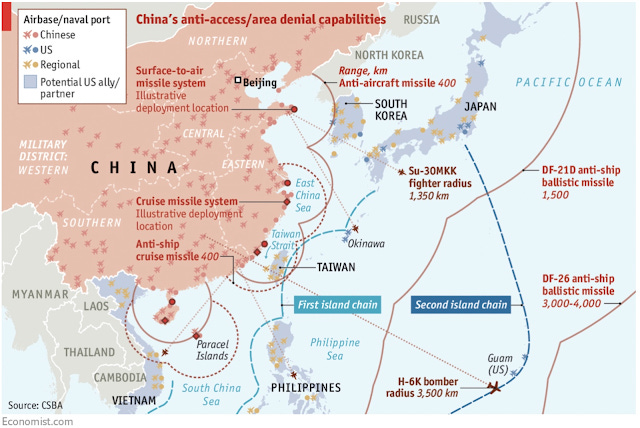
The “spat” between China and Japan is far more important than western media are reporting

Filed under: China, Japan, Media, Military, Pacific, USA — Tags: , , , , , — Nicholas @ 03:00

Claire Berlinsky explains why we should be paying far more attention to what our media are treating as a minor diplomatic spat as Beijing reacts furiously to the new Japanese PM’s comments:

You need to see the Chinese media today to get a feel for this. Front pages of the relevant organs are devoted to frothing in fury at Japan. They’re rectifying bad thoughts like a house on fire.

Here’s why I’m worried by this. Both the Chinese- and Japanese-language press are treating this as a major diplomatic incident. (In English, it’s mostly being described as “a row” or “spat” — then back to Trump and Epstein.) Let me walk you through what it looks from Beijing and Tokyo, with help from ChatGPT on the translations.

The trigger was a comment in by the new Japanese prime minister, Sanae Takaichi. She told a parliamentary committee that a Taiwan contingency involving the use of force might constitute a “sonritsu kiki jitai” (a “survival-threatening situation” — I think we’d use the phrase “existential threat”) for Japan under its 2015 security laws, and justify the exercise of collective self-defense, using Japan’s self-defense forces.

Beijing exploded. China summoned the Japanese ambassador in Beijing for a formal démarche, and it allowed the PRC consul general in Osaka, Xue Jian, to post a (now-deleted) tweet calling for her decapitation—”that dirty head that trespassed should be cut off, are you ready?” The Xue Jian post has, of course, become a media event of its own. Beijing issued a travel advisory urging Chinese citizens to avoid Japan, and told students to “carefully reconsider” study plans. It stepped up coast-guard activity near the Senkakus, and cancelled the Xi–Takaichi bilateral at the G20.

But this arid account doesn’t begin to convey the way the Chinese and Japanese media are talking about this. The Chinese coverage is nothing short of hysterical. To read the Party-line outlets, you’d think Takaichi had just ordered the immediate re-invasion of Manchuria. Her comment, they said, was an evidence of a “dangerous rightward turn” in Japanese politics. They’re calling it a “sky-collapsing opening“, accusing her of “reckless ranting” and tearing up the China-Japan relationship.

The headline in a widely circulated China Daily article:”If China and Japan go to war, Japan will be destroyed“. They found the inevitable panel of “peace-loving international friends” — including Okinawan peace activists and pro-PRC overseas Chinese — to denounce Takaichi as the reincarnation of “Japanese militarism”. The peace activists dutifully warned that the Japanese people would be “dragged into catastrophe” by their government. A CNR column accuses her of “brazen provocation”, and claims that “Taiwan compatriots are also outraged” at the prospect of Taiwan being turned into a battleground between China and a “militaristic” Japan.

The Party line: Taiwan is a “settled” internal issue; any talk of Japanese collective self-defense in the Strait is aggression and a “serious violation” of the post-1945 order. Takaichi represents “unrepentant militarism.” Chinese pieces quote her opponents at length to argue that “sober Japanese elites” are deploring her recklessness. Chinese-language coverage of the travel advisory is not treating it as a minor consular notice. They’re claiming it’s the first coercive step.

In Japan, this is front-page foreign policy news, not a minor gaffe. Mainichi ran an editorial saying, more or less, that Takaichi’s words were legally consistent with the 2015 security laws, but prime ministers should be more discrete about hypothetical military contingencies and show more prudence. Opposition figures are saying she “went too far” and threw the relationship into “a very grave state”. They called it “frivolous” for a commander-in-chief to talk so specifically about use-of-force scenarios.

On the other hand, there’s clearly a domestic constituency that sees this as long overdue. Some in her party see any hint of retraction as “weakness toward China”, and they’re praising her for drawing a firm line on Taiwan. (The coverage about whether to expel Xue Jian is divided: His post was a death threat, obviously, but the Foreign Ministry seems reluctant to escalate this further.)

TV explainers are reminding viewers that the 2015 security legislation already contemplated a Taiwan contingency — what’s new is that the prime minister has now said this out loud. And a prime minister with an openly revisionist profile — that’s definitely new.

So there’s a lot of signaling going on. Beijing is signaling to its own public: “We’ll never again let Japanese militarism threaten China. The Party is the bulwark against a repeat of the 1930s.” To Tokyo: “We’ll punish any step toward military involvement in the Strait, first with economic coercion — then worse. We are not kidding about this.” To the wider region and Washington: “Japan is a destabilizer — this woman isn’t right in the head. If things go wrong in the Taiwan Strait, blame Tokyo. Remember Pearl Harbor.”

Update, 23 November: Welcome, Instapundit readers! Please do have a look around at some of my other posts you may find of interest. I send out a daily summary of posts here through my Substackhttps://substack.com/@nicholasrusson that you can subscribe to if you’d like to be informed of new posts in the future.

November 20, 2025

Military necessity and the “right to repair”

Over the last few decades, more and more companies have been discovering the financial wonders available to them if they separate the items they sell from the ability to repair those items … so you buy a widget but if it breaks, you have to pay the manufacturer to get it fixed. You have no option to fix it yourself — even if you have the technical know-how and the necessary tools — nor can you find a cheaper alternative, because the manufacturer has blocked any possible competition to their often highly profitable scam revenue stream. It’s bad enough in the civilian marketplace, where consumers are demanding the “right to repair” from legislators because the cost and inconvenience are far too high.

Now imagine you are onboard a US Navy ship in the western Pacific and some critical piece of technology breaks down … but you can’t fix it yourself because the manufacturer sells repair services and will have to be paid to send out a civilian repair crew with the necessary tools and parts. No need to imagine it: it’s the situation the US military is finding itself in more and more often:

If you want to get an otherwise reserved and laconic farmer to get excited and talkative about a subject, ask them about the issue of “right to repair“.

    … Wilson and others accuse John Deere of blocking farmers and everyday mechanics from fixing equipment without going through John Deere dealers. Although the company doesn’t prohibit users from fixing equipment themselves, the lawsuit claims it locks users out of repairs because of the limited access to software that only dealerships can access. The lawsuit says that makes most fixes nearly impossible. A lot like cars, the farming equipment is equipped with sensors. The John Deere tractors, for instance, run on firmware that is necessary for basic functions, according to the lawsuit. If something is wrong with the equipment, a code will appear on a display monitor inside the machine. The suit says interpreting the error codes on tractors, for instance, requires software that “Deere refuses to make available to farmers”.

    Right-to-repair advocates say the digitization of agricultural equipment — with its various computers and sensors — has made self-repair almost impossible, forcing farmers to depend on the manufacturers. Wilson, for example, said he has to rely on his local John Deere dealership, which he said takes longer and charges more than an independent repair worker.

    … a pending lawsuit the Federal Trade Commission filed Jan. 15 claims the company falls short of that promise. The complaint accuses it of unlawful business practices that have “inflated farmers’ repair costs and degraded farmers’ ability to obtain timely repairs”.

    “I would have some farmers close to tears recalling the time they lost a whole harvest because they weren’t able to fix their own tractor and weren’t able to go to a local repair shop,” said former FTC Chair Lina Khan, who helped launch the suit.

OK, it is bad enough to have to wait as through time and experiencing a degrading quality of harvest to repair your tractor … but what if instead of Mother Nature, you have to deal with 50,000 screaming Chinamen?

Senator Tim Sheehy (R-MT) is trying to get ahead of this problem.

    U.S. defense contractors have launched a lobbying and public relations blitz to defeat a provision in the Senate-passed NDAA that would set strict new rules for how the Pentagon accesses their intellectual property.

    The issue is among the last unresolved matters facing House and Senate negotiators who aim to reconcile before December the House and Senate fiscal 2026 NDAAs.

    The Senate’s so-called right-to-repair provision states that the Pentagon may not, with certain exceptions, enter into a contract unless the deal requires the company to provide the government with the data needed to operate and sustain the equipment.

    That data means a lot to the contractors because it is worth many billions of dollars over time. To a servicemember it also means a lot: Being able to fix a weapon can mean the difference between life and death. And the cost of such repairs is a major driver of defense budget growth, experts have long said.

These are the same defense primes who are spending billions of dollars on stock buybacks, and already have a track record of contract maintenance that is not impressive.

Update, 21 November: Welcome, Instapundit readers! Please do have a look around at some of my other posts you may find of interest. I send out a daily summary of posts here through my Substackhttps://substack.com/@nicholasrusson that you can subscribe to if you’d like to be informed of new posts in the future.

C-130 Hercules Progress Report (1955)

Filed under: History, Military, Technology, USA — Tags: , , , — Nicholas @ 02:00

Charlie Dean Archives
Published 24 Jul 2014

C-130 Hercules Progress Report (1955) – Department of the Air Force. This film is a Lockheed Aircraft report covering C-130 production; fatigue, structural, temperature and environmental tests; cargo and transport capability demonstration; and the development of ski-wheels. The film also shows a C-130 takeoff, flight and landing.

CharlieDeanArchives – Archive footage from the 20th century making history come alive!

November 19, 2025

US Democrats issue clarion call to the military: “You must refuse illegal orders”

Filed under: Government, Law, Military, USA — Tags: , , , , — Nicholas @ 05:00

Well, thank goodness that someone remembers Nuremberg! Apparently President Trump has been issuing illegal orders to the US Army, Navy, and Air Force, and these brave legislators are putting their careers — and even their lives — on the line to defend democracy. I’m unaware of what these specific orders may be, but as Chris Bray points out, he’s the Bad Orange Man so pretty much anything he orders must be illegal:

Note what they don’t say. They say that the American military is being “pitted against” their own countrymen, and they say to servicemembers that “you can refuse illegal orders …”

… they don’t say, even once, even in a pretty clear hint, precisely what illegal orders Trump has issued. He’s being vaguely bad, so you don’t have to obey him. The serious version would look like this: On [date here], the President of the United States ordered [unit name] to enter [place name] for the purpose of [specific action], and that order violated [explicit citation of US Code]. They mushmouth around a set of feelings-signals about Mean Orange Something, but they never quite manage to spit it out. What’s the illegal order anyone is supposed to disobey, and what makes it illegal? News reports suggest that they mean to refer to the boat strikes, but click on that link if you want to see more vagueness and weak hinting.

This is exactly what the Catholic bishops just did in their own stupid virtue performance, the precise mark of an absence of seriousness in a coven of drama queens, as they declared that they’re very concerned about questions that have arisen regarding certain situations involving immigrants. More mush from the wimps. Donald Trump is very bad, because mumble mumble mumble. Be precise and clear, or be silent.

This is an age of unseriousness, and here’s another heaping plate of it. Soldiers, you don’t have to obey the orders of your military superiors if you feel that they, that they, uh, oh hey look at the time anyway I have to go. It’s passive-aggressive bad girlfriendspeak as politics. I guess if you feel like you have to obey, that’s fine. No, it’s fine! I’m not mad! Let’s just go to dinner!

We want to speak directly to members of the military, but we don’t actually have anything to say. Just, you know, disobey the president. Small thought, not a big deal.

High school drama club president Elissa Slotkin has been banging on this drum in an especially insistent way, as she holds town hall meetings with veterans who mumble their own vague slogans about Trump bein’ against the Constitution real hard and stuff.

But all of their descriptions are stupid. Sending a few hundred National Guard troops to a city of hundreds of thousands of people with narrow orders about protecting federal facilities and personnel or patrolling to deter violence isn’t military conquest of the population or the militarization of all law enforcement. The hyperbole renders the argument insane. Related, the veterans in Slotkin’s video talk about the “systematic removal” of military leaders, and the “purge of the generals”. The US military has over 800 flag officers; the Trump administration has removed about 15. There’s a desperate stupidity to all of this panic-mongering that just renders it deeply tiring.

Actual servicemembers will be familiar with the rhetorical style of the shithouse lawyer, the idiot in the barracks who tells you that akshully they can’t order you to do that, it’s totally illegal.

You should just tell your drill sergeant that you refuse! He can’t even do nothin’ about it! He’ll just back right down!

« Newer PostsOlder Posts »

Powered by WordPress