
BBC Archive
Published 17 Jun 2023Russian moon landings, week long traffic jams, a workforce replaced by automation and above all, too much leisure time!
These are just some of the bold predictions made in Don Haworth’s 1963 BBC “mockumentary” Time on Our Hands – a remarkable film which projects the viewer a quarter of a century into the future.
Imagine how the futuristic inhabitants of 1988 — a society freed from the shackles of endless hard work — might reflect on the way people live and work in 1963. Its aim is to look back at the extraordinary, almost unbelievable, events of the intervening 25 years — referred to as “the years of the transformation”.
“This Buoyant programme could be repeated a dozen times and still intrigue, delight and disturb me”
Dennis Potter, Daily Herald TV critic, 1963This footage is compiled of excerpts from Time On Our Hands, a faux-documentary film by Don Haworth.
Originally broadcast 19 March, 1963.
June 19, 2023
1963: Mockumentary Predicts The Future of 1988 | Time On Our Hands | Past Predictions | BBC
Patterns of incompetence
In Palladium, Harold Robertson says that complex systems that we all depend on will not have the resilience to survive our society-wide failure of competence:

Graphic for Rhode Island College’s Office of Diversity, Equity and Inclusion.
At a casual glance, the recent cascades of American disasters might seem unrelated. In a span of fewer than six months in 2017, three U.S. Naval warships experienced three separate collisions resulting in 17 deaths. A year later, powerlines owned by PG&E started a wildfire that killed 85 people. The pipeline carrying almost half of the East Coast’s gasoline shut down due to a ransomware attack. Almost half a million intermodal containers sat on cargo ships unable to dock at Los Angeles ports. A train carrying thousands of tons of hazardous and flammable chemicals derailed near East Palestine, Ohio. Air Traffic Control cleared a FedEx plane to land on a runway occupied by a Southwest plane preparing to take off. Eye drops contaminated with antibiotic-resistant bacteria killed four and blinded fourteen.
While disasters like these are often front-page news, the broader connection between the disasters barely elicits any mention. America must be understood as a system of interwoven systems; the healthcare system sends a bill to a patient using the postal system, and that patient uses the mobile phone system to pay the bill with a credit card issued by the banking system. All these systems must be assumed to work for anyone to make even simple decisions. But the failure of one system has cascading consequences for all of the adjacent systems. As a consequence of escalating rates of failure, America’s complex systems are slowly collapsing.
The core issue is that changing political mores have established the systematic promotion of the unqualified and sidelining of the competent. This has continually weakened our society’s ability to manage modern systems. At its inception, it represented a break from the trend of the 1920s to the 1960s, when the direct meritocratic evaluation of competence became the norm across vast swaths of American society.
In the first decades of the twentieth century, the idea that individuals should be systematically evaluated and selected based on their ability rather than wealth, class, or political connections, led to significant changes in selection techniques at all levels of American society. The Scholastic Aptitude Test (SAT) revolutionized college admissions by allowing elite universities to find and recruit talented students from beyond the boarding schools of New England. Following the adoption of the SAT, aptitude tests such as Wonderlic (1936), Graduate Record Examination (1936), Army General Classification Test (1941), and Law School Admission Test (1948) swept the United States. Spurred on by the demands of two world wars, this system of institutional management electrified the Tennessee Valley, created the first atom bomb, invented the transistor, and put a man on the moon.
By the 1960s, the systematic selection for competence came into direct conflict with the political imperatives of the civil rights movement. During the period from 1961 to 1972, a series of Supreme Court rulings, executive orders, and laws — most critically, the Civil Rights Act of 1964 — put meritocracy and the new political imperative of protected-group diversity on a collision course. Administrative law judges have accepted statistically observable disparities in outcomes between groups as prima facie evidence of illegal discrimination. The result has been clear: any time meritocracy and diversity come into direct conflict, diversity must take priority.
The resulting norms have steadily eroded institutional competency, causing America’s complex systems to fail with increasing regularity. In the language of a systems theorist, by decreasing the competency of the actors within the system, formerly stable systems have begun to experience normal accidents at a rate that is faster than the system can adapt. The prognosis is harsh but clear: either selection for competence will return or America will experience devolution to more primitive forms of civilization and loss of geopolitical power.
H/T to Theophilus Chilton for the link.
June 16, 2023
QotD: Sailing ships in the real world versus sailing ships in Rings of Power
There are a bazillion ways to rig a ship (a lot of them with really fun names), but all sails function in one of two basic ways. First it’s worth noting every ship operates in both a “true wind” (the direction the wind is actually blowing) and an apparent wind, which is the combination of the true wind with the direction the ship is sailing and its speed; the apparent wind is what matters for sail dynamics because that’s the wind that the sails experience. If a ship is sailing at 8 knots and the wind is moving at 12 knots, but the ship and the wind are moving in the same direction, the apparent wind the ship experiences is just 4 knots. On the other hand, if the wind speeds remain the same but we have the same ship moving perpendicular to the wind, the apparent wind is going to actually be 14.4 knots and come from a direction between the ship’s heading and the wind’s source.
Square sails, which are rigged perpendicular to the direction of the ship work by having the wind strike the sail and pile up into it, which creates a high pressure zone behind the sail (because all of the air, blocked by the sail, is “stacking up” there) and a low pressure zone in front of the sail, which pushes the ship forward, technically a function of aerodynamic drag. The upside is that square sails can produce a lot of power, which is handy for big, heavy ships, especially in areas with predictable and favorable winds (such as the Atlantic trade winds). The downsides are two: on the one hand, top speed is limited because the faster the ship goes, the lower the apparent wind on the sails, which in turn reduces how much they can push the ship. On the other hand, square sails only work if the ship is moving in more-or-less the same direction as the wind is, within about 60 degrees or so (so the ship has a c. 120 degree range of movement relative to the wind). Moreover, for square sails to work, the air hitting them from behind needs to be substantially confined by their shape; this is why square sails are made to billow outward into an arcing shape as the wind hits them, instead of being held taught and fully flat against the mast.
Triangular or lateen or fore-and-aft sails work on a different principle. They are arranged parallel to the direction of the ship (that is, fore-and-aft of the mast, thus the term) and want to also be close to parallel to the wind (both square and triangular sails can, in some configurations, be moved around the mast to a degree to get an ideal direction to the wind). The way they work is that the wind hits the sail on its edge and the air current splits around the sail, but not evenly; the sail is turned so that the back side takes more wind, causing the sail to billow out, creating a wing-like shape when viewed from above. That in turn acts exactly like a wing, creating a high pressure zone behind the sail and a low pressure zone in front of the sail and thus generating aerodynamic lift as the wind passes over the surface (rather than pressing up behind it) the same way that an airplane’s wings keep it in the air. The clever part about this is that the lift generated doesn’t have to be in the same direction the wind is going, so a ship using these kinds of sails can move up to within around 45 degree of the wind (sailing “close hauled” – a ship rigged like this thus has a much larger 270 degree range of motion relative to the wind). Also – as noted above – depending on the ship’s “point of sail” (direction of movement relative to the wind), accelerating may not decrease the wind’s apparent speed (because you may not be sailing directly away from it), and so triangular sails often function better in light winds, sailing into the wind, and at very high speeds (but they provide less power for large, heavy ships sailing with the wind). And again, there is a lot of complexity in terms of the different functions of these types of sails, but we’re really just trying to make a fairly simple point here so everyone please forgive the simplification.
And that’s it: all sails work on one of those two principles (at any given time); the point in discussing this is to note that we’re dealing not with aesthetics here but with objects that need to interact in fairly fundamental ways with aerodynamics and so have shapes that are dictated by that function (and also, sails are cool). You can combine those two principles in a lot of exciting ways to create different “rigs” with different sailing qualities, but you those principles are your options – you cannot create some other kind of sail which works on different principles. Indeed, most of the more complex sailplans of larger ships use a combination of square and lateen sails, but each sail in the plan must be using one of these two principles; there are no other options.
And those of you looking back at what these ships [in Rings of Power] look like may have already guessed the problem here. These are clearly square-rigged ships; the sails are all perpendicular to the ship’s direction and the sail shape is symmetrical over the keel (that is, same shape on the port and starboard) and are unable to be angled in any event. But every single sail has a gigantic hole in the center because of the split mast. So the air you want to build up behind the sail is instead flowing through the hole between the masts. The sails even angle slightly, curling backwards at their outer edges channeling the air towards the gaps. But that air flowing through the gaps is going to lessen (not remove, but substantially lesson) the pressure differential over the sail which will cut the drag the sails generate which will make the ship much slower.
What is worse is that between the two masts and between the foremast and the bowsprit, the ships mount additional secondary sails. Now in a rig-plan that made any sense, these would be triangular sails in both shape and principle (e.g. gaff-rigged sails incorporated into a square-rig sailing pattern common for full rigged ships as well as staysails between the masts or between the foremast and the bowsprit, also common for full rigged ships), but the designers here have only managed one of those two things. The sails are triangular in shape, but are positioned perpendicular to the wind direction and then symmetrically matched. That means they both do nothing with the wind moving through that center channel we’ve created, but also their triangular shape is entirely useless because they’re functioning on drag instead of lift.
It’s not that this sail plan wouldn’t work: the big sails would create at least some aerodynamic drag which would push the ship forward. But this is a sail plan which would work much more poorly than a far more basic plan with just a single central mast mounting a single very large square sail. You could even keep the exotic junk-style sail supports (they’re called battens; everything on sailing ships has a funny name) if you wanted and just make the ships junk-rigged! Or, if you want a lot of fancy sails which aren’t in square shapes, you could go with a multi-masted dhow or xebec sail plan which would give you lots of overlapping triangular sails and also fit the Mediterranean/Roman vibe you were going for.
Moreover, while these sails aren’t square shaped, this is a pure “square sail” ship rig, which for ocean-going ships ostensibly used by great mariners is awful. Square sails only work well when running before the wind: they “tack” (zig-zagging from one close-hauled point of sail to another to climb up the wind) really poorly; some pure square-rigged ships cannot tack at all without the assistance of rowers. That’s is part of the reason why “full rigged” square-sailed age of sail ships nevertheless had triangular sails in gaff-rigging or as stay-sails or what have you, to enable the ship to tack effectively (the fancy term for this is how “weatherly” a ship is: how able it is to sail close to the wind; weatherlyness also depends on hull shape and a host of other factors). With a pure square-sail setup, these ships can only go in the direction of the wind, which is going to make it impossible to use them effectively as ocean-going ships because the prevailing winds on the ocean are very consistent: they will almost always be blowing the same way, which means these ships can sail out, but then can’t sail back. In short these ocean-going mariners have ships which cannot go on the oceans.
And of course this has been a theme of these posts but please, showrunners: when you are doing the visual design for a fantasy-historical society, you are not going to outsmart centuries of professional shipwrights with a brainstorming meeting and some concept art. So instead of trying to show that the Númenóreans are great mariners (“the sea is always right!”), which is the point of giving their super-cool ships so much screentime and is an essential thing to establish about their society, by making up a ship design that is going to end up invariably being much worse than historical designs, just go adopt a historical design that was successful. For my part, I’d have probably contrasted traditional Elven ships with a single sail-type (probably square) on a single mast with the advanced Númenóreans using lots of lateen sails.
That said, the fact that the Númenórean ships are terrible is fine because frankly, I wouldn’t want to sail to this battle either.
Bret Devereaux, “Collections: The Nitpicks of Power, Part III: That Númenórean Charge”, A Collection of Unmitigated Pedantry, 2023-02-03.
June 11, 2023
Rewriting the well-worn story of how the steam engine was invented
In the latest Age of Invention newsletter, Anton Howes pushes back against the story we’ve been telling for over 200 years about how the steam engine came to be:

3D animation of an aeolipile or Hero’s engine.
Animation by Michael Frey via Wikimedia Commons.
The standard pre-history of the steam engine goes a little like this:
- There were a few basic steam-using devices designed by the ancients, like Hero of Alexandria’s spinning aeolipile, which are often regarded as essentially toys.
- Fast forward to the 1640s and Evangelista Torricelli, one of Galileo’s disciples, demonstrates that vacuums are possible and the atmosphere has a weight.
- The city leader of Magdeburg, Otto von Guericke, c.1650 creates vacuums using a mechanical air pump, and is soon using atmospheric pressure to lift extraordinary weights. This sets off a spate of experimentation by the likes of Robert Boyle, Robert Hooke, Christiaan Huygens, and Denis Papin, to create vacuums under pistons.
- As a result of the new science of vacuums, by the 1690s and 1700s the mysterious Thomas Savery and especially the Devon-based ironmonger Thomas Newcomen are able to develop the first commercially practical engines using atmospheric pressure. Steam engine development continued from there.
This is the narrative that had become set in the 1820s, if not earlier, and has been repeated with many of the same names and dates by book after book after book ever since. It’s a narrative that I have even repeated myself.
But, as I only recently discovered, atmospheric pressure and vacuums were actually being exploited long before Torricelli was even born, by people who believed that vacuums were impossible and had no concept of atmospheric pressure. Devices very much like Savery’s, which exploited both the pushing force of expanding hot steam and the sucking effect of condensing it with cold — what we now know to be caused by atmospheric pressure — were being developed far earlier.
I began to give a more accurate account of the development of the atmospheric engine in a detailed three-part series on why the steam engine wasn’t invented earlier (see parts I, II, III, which give more detail and the references). But I haven’t put it all together in one easily digestible place, and since writing I’ve continued to discover even more. So here’s a rough sketch summarising what really happened, based on everything I’ve found so far […]
The development of the atmospheric engine was thus significantly longer and more complicated than the traditional narrative suggests. Far from being an invention that appeared from out of the blue, unlocked by the latest scientific advancements, it started to take shape from decades and centuries of experiments and marginal improvements from a whole host of inventors, active in many different countries. It’s a pattern that I’ve seen again and again and again: if an invention appears to be from out of the blue, chances are that you just haven’t seen the full story. Progress does not come in leaps. It is the product of dozens or even hundreds of accumulated, marginal steps.
May 31, 2023
Alvin Toffler may have been utterly wrong in Future Shock, but I suspect his huge royalty cheques helped soften the pain
Ted Gioia on the huge bestseller by Alvin Toffler that got its predictions backwards:
Back in 1970, Alvin Toffler predicted the future. It was a disturbing forecast, and everybody paid attention.
People saw his book Future Shock everywhere. I was just a freshman in high school, but even I bought a copy (the purple version). And clearly I wasn’t alone — Clark Drugstore in my hometown had them piled high in the front of the store.
The book sold at least six million copies and maybe a lot more (Toffler’s website claims 15 million). It was reviewed, translated, and discussed endlessly. Future Shock turned Toffler — previously a freelance writer with an English degree from NYU — into a tech guru applauded by a devoted global audience.
Toffler showed up on the couch next to Johnny Carson on The Tonight Show. Other talk show hosts (Dick Cavett, Mike Douglas, etc.) invited him to their couches too. CBS featured Toffler alongside Arthur C. Clarke and Buckminster Fuller as trusted guides to the future. Playboy magazine gave him a thousand dollar award just for being so smart.
Toffler parlayed this pop culture stardom into a wide range of follow-up projects and businesses, from consulting to professorships. When he died in 2016, at age 87, obituaries praised Alvin Toffler as “the most influential futurist of the 20th century”.
But did he deserve this notoriety and praise?
Future Shock is a 500 page book, but the premise is simple: Things are changing too damn fast.
Toffler opens an early chapter by telling the story of Ricky Gallant, a youngster in Eastern Canada who died of old age at just eleven. He was only a kid, but already suffered from “senility, hardened arteries, baldness, slack, and wrinkled skin. In effect, Ricky was an old man when he died.”
Toffler didn’t actually say that this was going to happen to all of us. But I’m sure more than a few readers of Future Shock ran to the mirror, trying to assess the tech-driven damage in their own faces.
“The future invades our lives”, he claims on page one. Our bodies and minds can’t cope with this. Future shock is a “real sickness”, he insists. “It is the disease of change.”
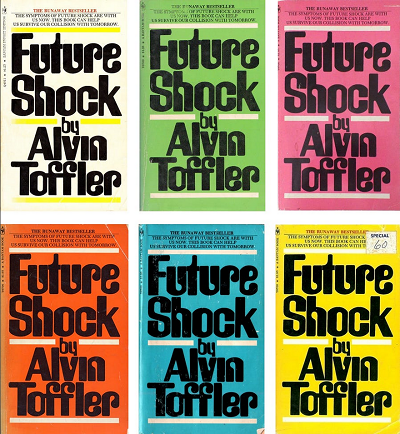
As if to prove this, Toffler’s publisher released the paperback edition of Future Shock with six different covers — each one a different color. The concept was brilliant. Not only did Future Shock say that things were constantly changing, but every time you saw somebody reading it, the book itself had changed.
Of course, if you really believed Future Shock was a disease, why would you aggravate it with a stunt like this? But nobody asked questions like that. Maybe they were too busy looking in the mirror for “baldness, slack, and wrinkled skin”.
Toffler worried about all kinds of change, but technological change was the main focus of his musings. When the New York Times reviewed his book, it announced in the opening sentence that “Technology is both hero and villain of Future Shock“.
During his brief stint at Fortune magazine, Toffler often wrote about tech, and warned about “information overload”. The implication was that human beings are a kind of data storage medium — and they’re running out of disk space.
May 30, 2023
It might be time to consider getting a home generator … while you still can
J.D. Tuccille in today’s The Rattler newsletter suggests that if you’ve been considering getting a generator to power your house in case of blackouts, now might be a good time:

The regulatory body that oversees the nation’s power grid cast a bit of a chill over the coming warm months when, in mid-May, it cautioned that the country might not generate enough electric power to meet demand. Coming after multiple warnings from regulators, grid operators, and industry experts that enthusiasm for retiring old-school “dirty” generating capacity is outstripping the ability of renewable sources to fill the gap, the announcement is a heads-up to Americans that they may want to make back-up plans for a power grid growing increasingly unreliable. It’s also a reminder that green ideology is no substitute for the ability to flip a switch and have the lights come on.
Unreliable Energy
“NERC’s 2023 Summer Reliability Assessment warns that two-thirds of North America is at risk of energy shortfalls this summer during periods of extreme demand,” the North American Electric Reliability Corporation, a nominally non-governmental organization with statutory regulatory powers, noted May 17. “‘Increased, rapid deployment of wind, solar and batteries have made a positive impact,’ said Mark Olson, NERC’s manager of Reliability Assessments. ‘However, generator retirements continue to increase the risks associated with extreme summer temperatures, which factors into potential supply shortages in the western two-thirds of North America if summer temperatures spike.'”
This is not the first time we’re hearing that the power grid isn’t up to meeting demand for electricity. Nor is it the first time we’re told that renewable sources such as wind and solar are coming online more slowly than power-generation capacity based on fossil fuels is being retired.
Dwindling Power Plants
“The United States is heading for a reliability crisis,” Commissioner Mark C. Christie of the Federal Energy Regulatory Commission (FERC) told the Senate Committee on Energy & Natural Resources during a May 4 hearing. “I do not use the term ‘crisis’ for melodrama, but because it is an accurate description of what we are facing. I think anyone would regard an increasing threat of system-wide, extensive power outages as a crisis. In summary, the core problem is this: Dispatchable generating resources are retiring far too quickly and in quantities that threaten our ability to keep the lights on. The problem generally is not the addition of intermittent resources, primarily wind and solar, but the far too rapid subtraction of dispatchable resources, especially coal and gas.”
The federal Energy Information Administration foresees almost a quarter of coal generating capacity being retired by the end of the decade — a process already in progress. Just this month it announced “the United States will generate less electricity from coal this year than in any year this century.” Non-hydropower renewables are the only generating capacity sources really seen growing in the short-term.
In February of this year, PJM Interconnection, which manages grid operations in much of the eastern United States, warned of “increasing reliability risks … due to a potential timing mismatch between resource retirements, load growth and the pace of new generation entry.”
QotD: The technical flaws of modern cameras
Theodore Dalrymple, “The Grand Illusion”, Taki’s Magazine, 2017-08-19.
May 27, 2023
The true purpose of the Great Exhibition of 1851
In the latest Age of Invention newsletter, Anton Howes considers the “why” of the 1851 Great Exhibition:

The Crystal Palace from the northeast during the Great Exhibition of 1851, image from the 1852 book Dickinsons’ comprehensive pictures of the Great Exhibition of 1851
Wikimedia Commons.
Ever since researching my book on the history of the Royal Society of Arts, I’ve been fascinated by the Great Exhibition of 1851, which they initiated. Like most people, I had once assumed that the exhibition was just a big celebration of Victorian technological superiority — a brash excuse to rub the British Industrial Revolution in the rest of the world’s faces. But my research into the origins of the event revealed that it was almost the opposite. Far from being a jingoistic expression of superiority, it was actually motivated by a worry that Britain was rapidly losing its place. It was an attempt to prevent decline by learning from other countries. It was largely about not falling behind.
Industrial exhibitions already had a long history in 1851, as a crucial weapon in other countries’ innovation policy arsenals. They were used by countries like France in particular — which held an exhibition every few years from 1798 — as a means of catching up with Britain’s technology. This sounds strange nowadays, when the closest apparent parallels are vanity projects like the Millennium Experience, the recent controversial “Festival of Brexit” that ended up just being a bunch of temporary visitor attractions all over the country, and glitzy mega-events like the World’s Fairs. But the World’s Fairs, albeit notional successors to the Great Exhibition, have strayed very far from the original vision and purpose. They’re now more about celebration, infotainment and national branding, whereas the original industrial exhibitions had concrete economic aims.
Industrial exhibitions were originally much more akin to specialist industry fairs, with producers showing off their latest products, sort of combined with academic conferences, with scientists demonstrating their latest advances. Unlike modern industry fairs and conferences, however, which tend to be highly specialised, appealing to just a few people with niche interests, industrial exhibitions showed everything, altogether, all at once. They achieved a more widespread appeal to the public by being a gigantic event that was so much more than the sum of its parts — often helped along by the impressive edifices that housed them. The closest parallel is perhaps the Consumer Electronics Show, held since 1967 in the United States. But even this only focuses on particular categories of industry, and is largely catered towards attendees already interested in “tech”. Industrial exhibitions were like the CES, but for everything.
The point of all this, rather than just being an event for its own sake, was to actually improve the things on display. This happened in a number of ways, each of them complementing the other.
Concentration generated serendipity. By having such a vast variety of industries and discoveries presented at the same event, exhibitions greatly raised the chances of serendipitous discovery. A manufacturer exhibiting textiles might come across a new material from an unfamiliar region, prompting them to import it for the first time. An inventor working on a niche problem might see the scientific demonstration of a concept that had not occurred to them, providing a solution.
Comparison bred emulation. Producers, by seeing their competitors’ products physically alongside their own, would see how things could be done better. They could learn from their competitors, with the laggards being embarrassed into improving their products for next time. And this could take place at a much broader, country-wide level, revealing the places that were outperforming others and giving would-be reformers the evidence they needed to discover and adopt policies from elsewhere.
Exposure shattered complacency. The visiting public, as users and buyers of the things on display, would be exposed to superior products. This was especially effective for international exhibitions of industry, of which the Great Exhibition was the first, and simulated an effect that had only ever really been achieved through expensive foreign travel — by being exposed to things they hadn’t realised could already be so much better than what they were accustomed to, consumers raised their standards. They forced the usual suppliers of their products to either raise their game or lose out to foreign ones.
May 15, 2023
Paul Wells – “Unworkable and swiftly-disavowed tinpot dictatorship is, statistically, one of the least damaging forms of tinpot dictatorship”
Paul Wells follows up last week’s rather disturbing report that the Liberal Party’s big gathering in Ottawa extruded a resolution to get “The Government” to work toward forcing journalists (and those peasant bloggers like Paul Wells) to only publish things that the sources informing it could be “traced” by that same authority:
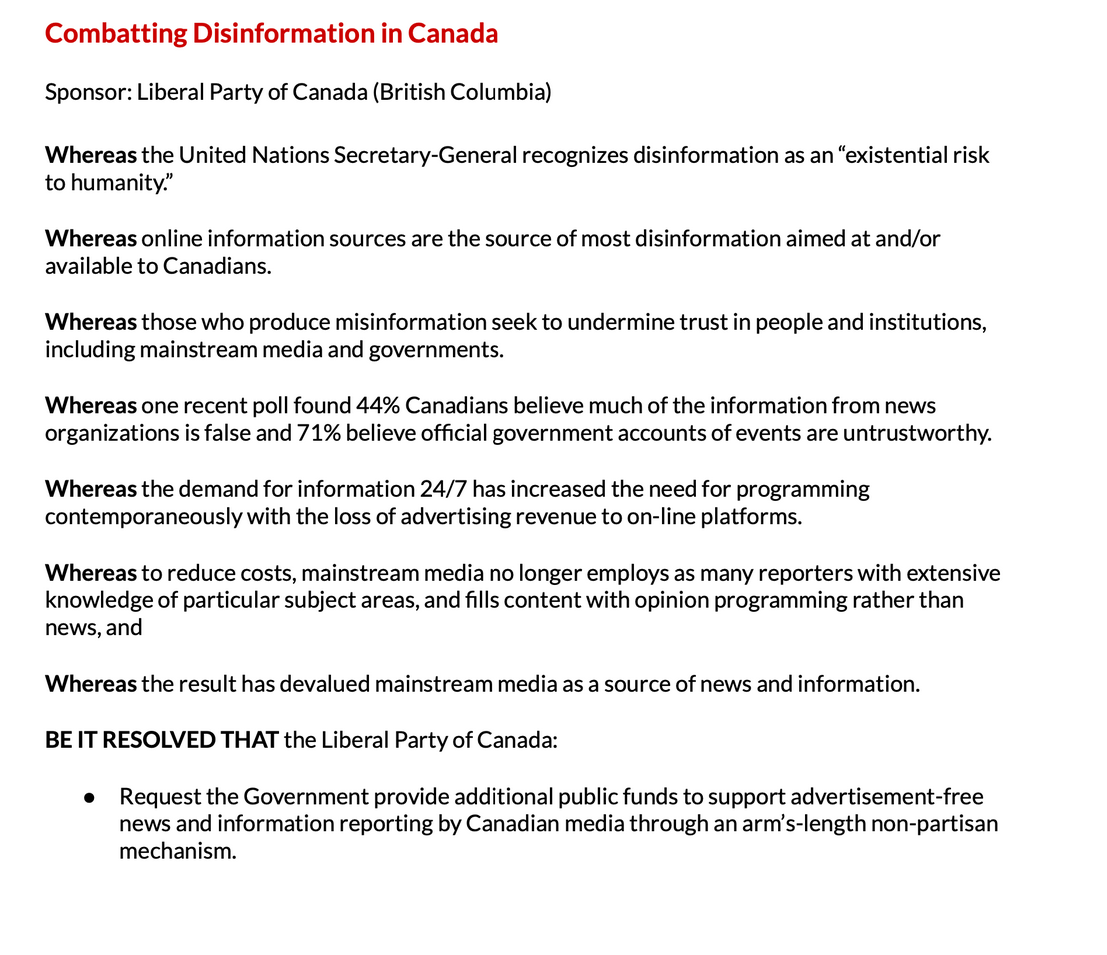
Last Friday I wrote about a policy resolution at the big Liberal Party of Canada national convention that was, in my opinion, bad. This was the resolution that would have the party “request the government explore options” to “hold on-line information sources accountable” by requiring that they “limit publication only to material whose sources can be traced”.
How do you limit publication to traceable sources? I have to assume you clear the sources. “This resolution has no meaning,” wrote I, “unless it means I would be required to clear my posts through the federal government, before publication, so the ‘traceability’ of my sources could be verified.”
Some people disagreed, but I had a hard time getting them to describe what it could mean if it wasn’t what I thought. I was careful to note that party conventions aren’t binding on governments. Commenters sympathetic to the Trudeau government latched onto all the this-might-mean-nothing language, the stuff about “request” and “explore options.” At their convention, a tiny minority of registered Liberal delegates attended a “policy workshop” at which nothing was debated. Amid considerable confusion about where these resolutions were in the party’s own process — Althia Raj covered it on Twitter; go look if you like — this resolution became party policy with no discussion at all. That was on Saturday.
On Tuesday, Justin Trudeau went before reporters and said no Liberal government would ever implement this Liberal policy. Other cabinet ministers followed suit, and one MP who didn’t benefit from the counsel of the Monday-morning issues-management call had a rougher time executing the U-turn.
Look, I think the amount of self-inflicted ballistic damage to the government’s own foot here is minor. Unworkable and swiftly-disavowed tinpot dictatorship is, statistically, one of the least damaging forms of tinpot dictatorship.
But I want to let everyone in on a secret of my journalism, and indeed of most journalism: Criticism of politicians is often advice to politicians. I actually don’t spend a lot of time hoping governments and opposition parties will keep pursuing self-destructive and country-destructive choices indefinitely. I always hope a bit of mockery, especially pre-emptive mockery, will help inform their choices. If it stings when Wells writes it, it might sting worse when everyone is saying it.
Ministers of the Crown who didn’t need to wait for the Monday-morning issues-management meeting to tell them what to think could have spent the weekend thinking for themselves. They might even have invited their own staffs, riding executives, and Liberals at large to think for themselves. A dozen or so hardy souls, out of 3,500 registered delegates, might then have showed up to the policy workshop willing to debate.
“Uh, Paragraph Two looks hinky. How would a government enforce that?”
“Well, it doesn’t apply to reputable journalists.”
“Great, thanks. Remind me who decides who’s reputable? Any thought on who’ll be making those calls once we’re no longer in government?”
Maybe somebody would have added a friendly amendment. “For greater clarity, nothing in this paragraph impinges …”
I can even imagine a cabinet minister showing up for those floor debates and influencing the party’s direction single-handed. I’ve seen it happen in other parties. But I had Liberal friends over the weekend explain to me that no such thing ever happens. Fine, it’s your funeral. Basically we’re watching a party choose between two different models of public-policy deliberation:
OPTION 1: Smart people think and talk.
OPTION 2: Everybody in the party defends rickety thinking until it blows up in their faces.
I’m not kidding when I tell you most people in political communications would defend Option 2. We’re living in a time that values message over thinking. But folks can’t say I didn’t warn them.
May 13, 2023
What was the First Modern War?
Real Time History
Published 12 May 2023The question about the first modern war has caused lively debates among historians and YouTube comment sections alike. In this video we take a look at a few candidates and some arguments why they are or aren’t modern wars.
(more…)
May 9, 2023
How to destroy an industry with one simple trick
Ted Gioia on the precipitous rise and calamitous decline of the clickbait journalism model:
I was going to call this story the “tragedy of American journalism”. But when you dig into the details, it’s more a farce.
Let’s start with act one of this comedy. I could almost begin anywhere, but I picked an especially ridiculous case study — just wait until you learn the reason why.
Did that catch your attention?
It was supposed to. And I learned that from a now (mostly) forgotten website called Upworthy.
Almost exactly 10 years ago, Upworthy was “the fastest growing media site of all time”, according to Fast Company. They had turned news into a science. Upworthy was the future of journalism.
“Upworthy is known for its use of data to drive growth, testing up to 16 different headlines for a single story,” enthused that bright-eyed reporter for Fast Company. The end result was headlines so irresistible, millions of people clicked on them.
Here are some examples:
- A Gorgeous Waitress Gets Harassed By Some Jerk. Watch What Happens Next.
- A Teacher Ran to a Classroom to Break Up a Fight, but What She Found Was the Complete Opposite.
- It’s Twice The Size Of Alaska And Might Hold The Cure For Cancer. So Why Are We Destroying It?
- If You Could Press A Button And Murder Every Mosquito, Would You? Because That’s Kinda Possible.
You get the idea. The headline is in two parts — and it’s just a come-on. You have no idea what the article is about until you click on the link.
That was the whole point. But just wait until you learn the problem with this.
Facebook and other social media sites eventually discovered that people clicked on these links, but didn’t spent much time with the Upworthy articles — and rarely gave them likes and shares.
The stories just weren’t very good — and certainly not as interesting as the headlines. So the algorithms started to punish clickbait articles of this sort.
The Upworthy empire collapsed as quickly as it had risen.
In retrospect, the problem with this gimmicky strategy is obvious. If you trick people into clicking on garbage, your metrics are impressive for a few months. But eventually people can smell the garbage without even clicking on it.
There’s also a deeper reason for this collapse — which I’ll get to in a moment. And it helps us understand the current problems with journalism. But first we need to look at a couple more case studies.

May 6, 2023
The federal Liberals want even more control over the internet
Paul Wells notes that a policy proposal at the Liberal conference this week indicates just how much the Liberal Party of Canada wants to control free expression on the internet:
Here on the 2023 Liberal convention’s “Open Policy Process” page are links to “Top 20 Resolutions” and “Fast-Tracked Resolutions”. The latter go straight to the plenary floor, the former go through a smaller preliminary debate and, if they pass, then on to the plenary. These things move fast because, in most cases, Liberals are paying only listless attention to the discussions. Policy is for New Democrats. Well, I mean, it used to be.
But sometimes words have meaning, so this morning I’m passing on one of the Top 20 Resolutions, from pages 12 and 13 of that book. This one comes to us from the British Columbia wing of the party.
It’s in two screenshots simply because it spreads across two pages. This is the entire resolution.
BC Liberals want “on-line information services” held “accountable for the veracity of material published on their platforms” by “the Government”. The Government would, in turn, “limit publication only to material whose sources can be traced”.
This resolution has no meaning unless it means I would be required to clear my posts through the federal government, before publication, so the “traceability” of my sources could be verified. I don’t suppose this clearance process would take too much more time than getting a passport or a response to an access-to-information request. Probably only a few months, at first. Per article.
After publication, “the Government” would hold me accountable for the veracity of my material, presumably through some new mechanism beyond existing libel law.
I’m not sure what “the Government” — I’m tickled by the way it’s capitalized, like Big Brother — would have made of this post, in which I quote an unnamed senior government official who was parked in front of reporters by “the Government” on the condition that he or she or they not be named. But by the plain meaning of this resolution, I would not have to wonder for long because that post would have been passed or cleared by the Government’s censors before publication, and I’m out of recourse if that process simply took longer than I might like.

May 5, 2023
May 4, 2023
QotD: Gesamtkunstwerk
As I said, that’s awfully heavy for an album whose most famous song asks how can you have any pudding if you don’t eat your meat, but it’s nonetheless an accurate description of what Roger Waters was trying to do with the integrated concept album / movie / stage show. Whether or not he knew he was attempting a Gesamtkunstwerk in the full Wagnerian sense is immaterial, as is the question of whether or not he succeeded. Nor does it matter if The Wall is any good, musically or cinematically or lyrically.* The point is, he gave it one hell of a go … and nobody else has, even though these days it’d be far, far easier.
Consider what a band like Rush in their prime would’ve done with modern technology. I’m not a musician, but I’ve been told by people who are that you can make studio-quality stuff with free apps like Garage Band. Seriously, it’s fucking free. So is YouTube, and even high-quality digital cameras cost next to nothing these days, and even laptops have enough processor power to crank out big league video effects, with off-the-shelf software. I’m guessing (again, I’m no musician, let alone a filmmaker), but I’d wager some pretty good money you could make an actual, no-shit Gesamtkunstwerk — music, movie, the whole schmear — for under $100,000, easy. You think 2112-era Rush wouldn’t have killed it on YouTube?
I take a backseat to no man in my disdain for prog rock, but I have a hard time believing Neal Peart and the Dream Theater guys were the apex of rock’n’roll pretension. I realize I’ve just given the surviving members of Styx an idea, and we should all be thankful Kilroy Was Here was recorded in 1983, not 2013, because that yawning vortex of suck would’ve destroyed all life in the solar system, but I’m sure you see my point.** Why has nobody else tried this? Just to stick with a long-running Rotten Chestnuts theme, “Taylor Swift”, the grrl-power cultural phenomenon, is just begging for the Gesamtkunstwerk treatment. Apparently she’s trying real hard to be the June Carter Cash of the New Millennium™ these days, and hell, even I’d watch it.***
The fact that it hasn’t been attempted, I assert, is the proof that it can’t be done. The culture isn’t there, despite the tools being dirt cheap and pretty much idiot proof. Which says a LOT about the Current Year, none of it good.
* The obvious comment is that Roger Waters is no Richard Wagner, but that’s fatuous — even if you don’t like Wagner (I don’t, particularly), you have to acknowledge he’s about the closest thing to a universal artistic genius the human race has produced. It’s meaningless to say that Roger Waters isn’t in Wagner’s league, because pretty much nobody is in Wagner’s league. And philistine though I undoubtedly am, I’d much rather listen to The Wall than pretty much any opera — I enjoy the symphonic bits, but opera singing has always sounded like a pack of cats yodeling to me. I’m with the Emperor from Amadeus: “Too many notes.”
** If you have no idea what I’m talking about, then please, I’m begging you, do NOT go listen to “Mr. Roboto.” Whatever you do, don’t click that link …
… you clicked it, didn’t you? And now you’ll be randomly yelling “domo arigato, Mister Roboto!!” for days. You’ll probably get punched more than once for that. Buddy, I tried to warn you.
*** Anthropological interest only. I know I’m in the distinct minority on this one, but she never turned my crank, even in her “fresh-scrubbed Christian country girl” stage. Too sharp featured, and too obviously mercenary, even back then.
Severian, “More Scattered Thoughts”, Rotten Chestnuts, 2020-10-13.
April 23, 2023
From the Encyclopedia Britannica to Wikipedia
In the latest SHuSH newsletter, Ken Whyte recounts the decline and fall of the greatest of the print encyclopedias:

I remembered all this while reading Simon Garfield’s wonderful new book, All the Knowledge in the World: The Extraordinary History of the Encyclopedia. It’s an entertaining history of efforts to capture all that we know between covers, starting two thousand years ago with Pliny the Elder.
The star of Garfield’s show, naturally, is Encyclopedia Britannica, which dominated the field through the nineteenth and twentieth centuries. By the time of its fifteenth edition in 1989, the continuously revised Britannica was comprehensive, reliable, scholarly, and readable, with 43 million words and 25,000 illustrations on a half million topics published over 32,640 pages in thirty-two beautifully designed Morocco-leather-bound volumes. It was the greatest encyclopedia ever published and probably the greatest reference tool to that time. It was sold door-to-door in the US by a sales force of 5,000.
Just as the glorious fifteenth edition was going to press, Bill Gates tried to buy Encyclopedia Britannica. Not a set — the whole company. He didn’t want to go into the reference book business. He believed that the availability of a CD-ROM encyclopedia would encourage people to adopt Microsoft’s Windows operating system. The Britannica people told Gates to get stuffed. They were revolted by the thought of their masterpiece reduced to an inexpensive plastic bolt-on to a larger piece of software for gimmicky home computers.
Like the executives at Blockbuster, the executives at Britannica eventually recognized the threat of digital technology but couldn’t see their way to abandoning their old business model and their old production standards and the reliable profits that came with large sets of big books. CD-ROMs seemed to them like a child’s toy.
Even as more of life moved online and the company’s prospects for growth dwindled, the Britannica executives could still not get their heads around abandoning the past and favoring a digital marketplace. They figured that their time-honored strategy of guilting parents into buying a shelf of books in service of their kids’ education would survive the digital challenge, not recognizing that parents would soon be assuaging their guilt by buying personal computers for their kids.
By the time Britannica brought out an overly expensive and not-very-good CD-ROM version of its encyclopedia in 1994, Gates had launched Encarta based on the much inferior Funk & Wagnalls. It might not have been the equal of the printed Britannica, but with its ease of use and storage, its much lower price point, and its many photos and videos of the Apollo moon landing and spuming whales, Encarta made a splash. It was selling a million copies a year in its third year of production — a number that no previous encyclopedia had come close to matching.
As it turned out, Britannica‘s last profitable year was 1990 when it sold 117,000 bound sets for $650 million and a profit of $40 million. With the launch of Encarta, its annual sales were reduced to 50,000 sets and it was laying off masses of employees.
Encarta‘s own life was relatively short. It closed in 2009, at which point it was selling for a mere $22.95. The world now belonged to Wikipedia.


