
Polyus
Published 16 Jul 2021The Canadair CL-215 is the most successful flying boat amphibian since the second world war. Its multi-role capabilities range from aerial spraying, search and rescue, cargo service, to its most notable role, as a water bomber. It has the most outstanding performance of any aerial fire fighting platform. Starting production in the late 1960s, it continued production in several forms through ownership by Bombardier and later by Viking Air. The latter is currently developing the exciting next generation CL-515 First Responder with deliveries expected in 2024.
(more…)
July 20, 2023
Water Bombing Workhorse That Keeps On Evolving; the story of the Canadair CL-215, 415, and 515
Comments Off on Water Bombing Workhorse That Keeps On Evolving; the story of the Canadair CL-215, 415, and 515
July 19, 2023
Infohazards on the internet of lies lead us into the clutches of “egregores”
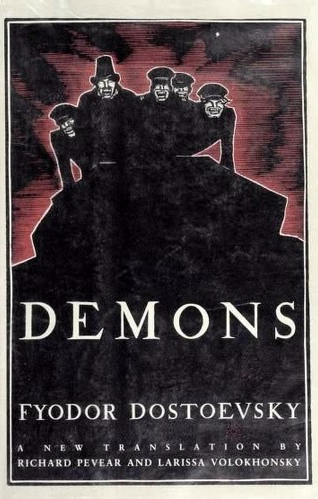
The latest review at Mr. and Mrs. Psmith’s Bookshelf from John Psmith, is on the 1872 novel Demons by Fyodor Dostoevsky”. I didn’t read the post immediately, as Russian literature and I aren’t even nodding acquaintances. I should have remembered that both of the Psmiths have an amazing ability to tell you a lot more than a “review” would normally contain, and this one certainly lived up to expectations, including a brief discussion of philosopher Charles Taylor’s ideas about pre-modern versus modern concepts of the self. Most pre-modern cultures believed in external influences having disproportional impact on the person, while most modern cultures believe the influences arise internally within the mind. Most pre-modern cultures also feared the self could be taken over, or possessed, by malevolent external entities, ideas, or thoughts:
Dostoevsky obligingly gives us a character who’s clearly possessed in exactly this sense — a dissolute nobleman around whom the various radical conspiracies swirl. He is, simultaneously, a subversion of the brooding Byronic hero archetype that was so popular in 19th century European literature, and an eerie anticipation of the modern concept of the serial killer. How did he get this way? Remember the modern view of our desires is that they come from within us, and indulging them leads to inner harmony. But the older and truer view is that they can come from outside, force their way into our skulls through an opening, set their hooks in our brains, lay their eggs. These fledgling desires start out small and weak, but to indulge them is to feed them, grow them, until they take over their host and move its mouth and limbs around like a puppet. In this sense the porn addict, the drug addict, and the rage addict are all alike: sensual dissipation gets boring eventually, and you need harder and harder stuff to feel the same thrill, until one day you reach for something so hard you lose yourself forever.
The Dostoevskian twist to all this is that the proto-serial killer is far more sympathetic, and ultimately more redeemable, than the revolutionaries. The radicals’ motivations spring from the same emotional source as his, theirs are just sublimated into politics, which is why the form of the dystopia doesn’t really matter to them, all that matters is that there be a boot stomping on a human face. The sexual sadism of the serial killer is unflinchingly portrayed as less disordered and less socially destructive than its political equivalent and, ultimately, as rather basic. It’s actually quite easy to miss all of this because it’s so deeply at odds with modern sensibilities. Not just “serial killers are better than communists actually,” but also “serial killers are really pretty boring actually,” and all from the guy who just invented serial killers.1
But what if the radicals aren’t sublimating anything at all? What if there’s another kind of demon, another kind of infohazard, another kind of meme, which rather than infecting or possessing individuals, instead tries to do that to entire societies? Such a being might still work through individuals, the way a Haitian voodoo spirit speaks through a chwal, but here the individual puppet is not a target, but rather an instrument or a transmission vector. The internet jargon for such a being is an “egregore,” and you’ve encountered them before: the bizarre fad that sweeps through a middle school class like a wildfire, the war fever that grips a nation and turns it overnight into a basket of bloodthirsty lunatics. Dance crazes, viral TikTok challenges, internet-mediated mental illnesses. There’s a classic Futurama gag involving the Brain Slug Party, but the real joke is that every party is the Brain Slug Party, they’re all egregores. Have you ever spoken with somebody who had hashtags in their Twitter bio? If you looked carefully, you may have seen the slender, silvery proboscis emerging from the back of their neck and vanishing into the ether. If you listened carefully, you may have heard the alien metallic clacking of the egregore’s mandibles, as it sent messages down that tube for the meat puppet to vocalize.
Sometime in the mid-19th century, an egregore was born in the Russian Empire. It went by a thousand different names — among them: anarchism, communism, nihilism, democracy. What’s that? Those four ideologies are completely opposed to one another? That’s the entire point! It wasn’t actually any of those things, it was an egregore, its true name was something like Melkhorbalai or Uztaa-Binoreth. It wore those other names like skins when it was convenient to do so, which is why in the real life history of 19th century Russia we see countless examples of individuals switching between communism, anarchism, and democracy like they were flavors of ice cream.
The egregore wanted none of these things: it wanted to grow, to spread, to manifest itself into this reality. Madly, it willed destruction, and the more destruction it caused the stronger it got, and the easier further destruction became, a runaway exothermic reaction endlessly feeding on itself. So the reformist zeal of the 1840s became Nechayev’s insane nihilism of the 1870s, then the even more insane terrorism of 1900-1917 with which I opened this review, until finally, strengthened by half a century of blood sacrifice, that rough beast slouched towards St. Petersburg to be born. The trauma of that birth ripped apart first Russia, then Europe, then it almost ate the rest of the world too.
Could anything have stopped it sooner? In Dostoevsky’s story there’s one character who tries lamely to stand in the way of the swirling, coalescing, immaterial malevolence. He is a reactionary, a newly-freed former serf,3 and (like Dostoevsky himself) a repentant former revolutionary. He’s young and hip, but has old and edgy views, a perfect stand-in for online “trads”. Given Dostoevsky’s own views it would be easy to make him the hero of the story, but Dostoevsky is too great a writer for that, and instead makes him a pathetic LARPer:
“I only wanted to know, do you believe in God, yourself?”
“I believe in Russia … I believe in her orthodoxy … I believe in the body of Christ … I believe that the new advent will take place in Russia … I believe …” Shatov muttered frantically.
“And in God? In God?”
“I … I will believe in God.”
How great a description is that of all the crusader-avatar twitter accounts named “DeusVult1571”? Imagine one of them blubbering: “I believe in based aesthetics … I believe in Western civilization … I believe in the Hajnal line … I believe …” Ah, but do you believe in God? Probably some of them do, but for many others it’s a pose, or a meme, or a philosophical premise that they must accept in order to turn the rest of the brand they’ve assumed into a self-consistent whole.2 For these, the god they worship is just another egregore — one small and weak for now, less threatening perhaps than some others, but feed it, let it grow, and see how fast it turns on you.
The other force that could have resisted the growing darkness is the parents’ generation, the liberals of 1848, Turgenev’s boomers. We already know how that turned out in real life, but while Dostoevsky didn’t live to see it happen, he had these peoples’ number. Once so bold in condemning their government and sneering at their civilization, they are suddenly timid in the face of their children, terrified of being seen as uncool or conservative or just not with it. That’s a good way to raise a psycho, and Dostoevsky more than hints that everything which follows is ultimately their fault. And it’s a bad way to face down an egregore. Doing that requires boldness and … well:
“But this is premature among us, premature,” he pronounced almost imploringly, pointing to the manifestoes.
“No, it’s not premature; you see you’re afraid, so it’s not premature.”
“But here, for instance, is an incitement to destroy churches.”
“And why not? You’re a sensible man, and of course you don’t believe in it yourself, but you know perfectly well that you need religion to brutalise the people. Truth is honester than falsehood …”
“I agree, I agree, I quite agree with you, but it is premature, premature in this country…” said Von Lembke, frowning.
“And how can you be an official of the government after that, when you agree to demolishing churches, and marching on Petersburg armed with staves, and make it all simply a question of date?”
“Premature, premature”, is what the useless normies will bleat when our own radicals are blowing up Mt. Rushmore and pulling down statues of George Washington. Who are these radicals? I have no idea what the egregore will call itself this time. It doesn’t matter. Its true name sounds to human ears like a high-pitched mechanical screeching and clicking, a sound calculated to drive men mad, and to drive madmen into making it real.
1. I’m told that the internet jargon for this is an “unbuilt trope.”
2. Dostoevsky positions a former serf as the defender of “Holy Russia,” Orwell suggests that if there is hope it lies in the proles, Bismarck believed the poor would serve as a reactionary bulwark against liberalism, and MAGA believes that various dispossessed and subaltern groups will keep America great. Are they all correct? No. They’re all wrong. The lower classes have no special compass for political or religious truth, they’re just almost definitionally slightly behind the times. When an egregore is rapidly accumulating strength, they’re likely to oppose it out of inertia, but they’re as vulnerable as anyone to its blandishments, and will just as vigorously defend the new thing once it has taken over.
3. Look, I have a lot of sympathy for these guys. Like the Russian radicals of the 1870s, they correctly observe that there’s something insane and rotten about our society, but unlike those radicals they’re attracted to something that’s really out there and really true and good. “Fake it til you make it” is not the worst strategy ever invented for securing a mature and authentic faith in a supreme being. But once you’re in that state, there’s a clock running, your time is limited, there are other things out there in the night, attracted by the smell of lost and receptive souls.

Comments Off on Infohazards on the internet of lies lead us into the clutches of “egregores”
July 18, 2023
Seaplanes? How 1940s. No, we’re seeking to “leverage emerging technologies” instead
CDR Salamander wonders about a modern need for military sea rescue capability that the US Navy filled with flying boats and seaplanes during the Second World War, then supplemented with helicopters during Korea and Vietnam. For ocean search-and-rescue in a combat environment in the present or near future, what are the USN’s plans?
I will be the first person to admit that good, well-meaning, and informed people can disagree with seaplanes in general or the US-2 specifically, but they have to engage the conversation. Directly argue the requirement or offer realistic alternatives.
This does neither. If anything is demonstrates the narrowness of thought and fragility of substance used in opposition.
What an patronizingly toxic stew that answer is. I highly doubt Lung typed out that answer himself, so my commentary below is not directed at him personally, but … and it is what comes after the “but” that counts — but at the three-digit J or N code that extruded that from the random acquisitions professional statement subroutine from ChatGPT.
Let’s give that answer a full Fisking;
- “The Indo-Pacific operational environment has evolved significantly since World War II”:
Let me check my WWII Pacific chart, my Vietnam War era globe, and GoogleEarth … and … no. The geography has not changed. The distances have not changed. The requirement of thousands of years to take and hold territory or eliminate your enemy from access to it has not changed. All the little islands, regardless of what Al Gore and John Kerry say, are still there. As we are seeing in the Russo-Ukrainian War, a million PPT slides saying so does not change the fundamentals of war.
Sentence one is invalid.
- “The employment of seaplanes today would not meet the operational demands and current threat scenario.”
Is there an operational demand for us to rescue downed airmen and to be able to reach remote islands without airfields? Yes. Does your “current threat scenario” run from Northern Japan through to Darwin, Australia? Yes.
Sentence two is invalid.
- “However, we support the continuous development of new and innovative solutions that may provide solutions to logistical challenges.”
So, you define “new” as something that only exists on PPT slides? By “continuous development” you mean never matures as a design that goes into production. By “innovative” you mean high on technology risk. Undefined program risk. Unknown design risk. No known production line or remote estimate to IOC, much less FOC when we know that the next decade is the time of most danger of the next Great Pacific War.
Sentence three is irresponsible and professionally embarrassing given the history of transformational wunderwaffe this century.
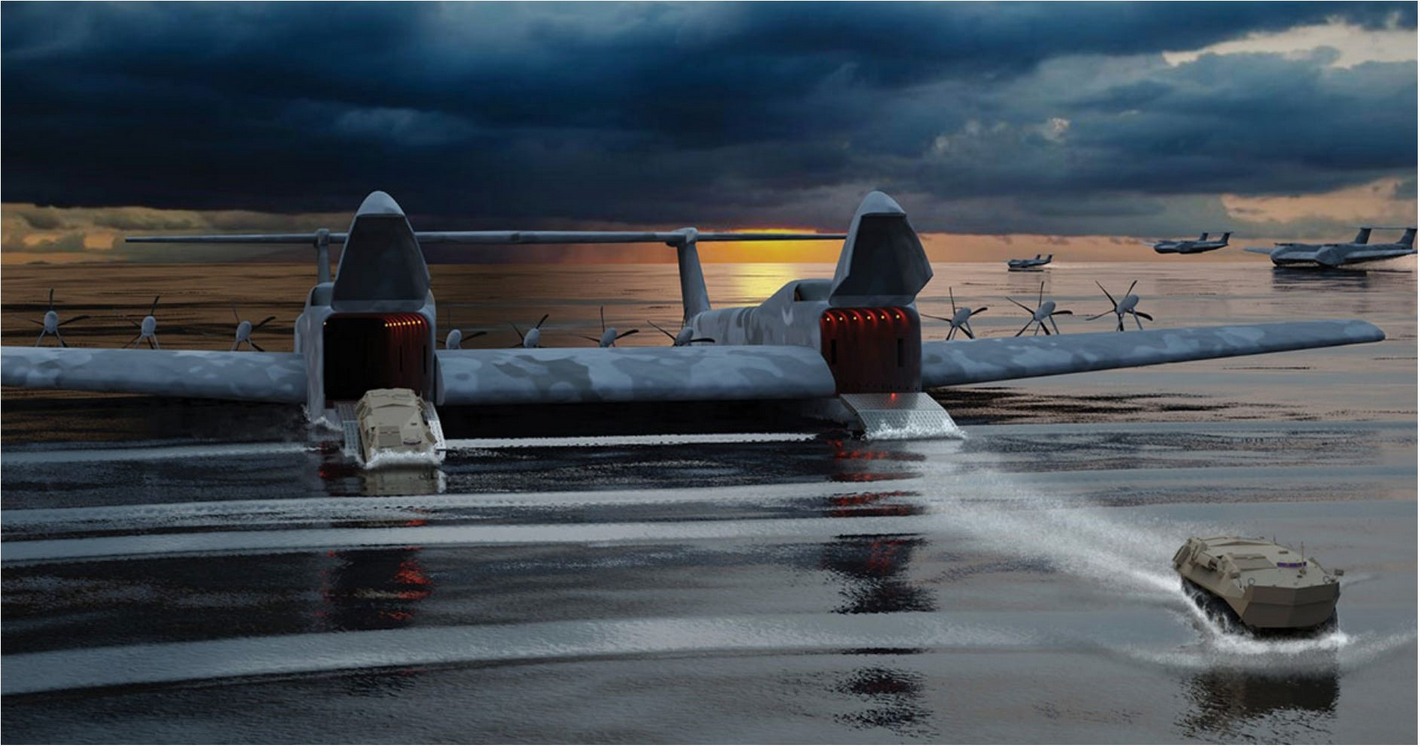
- “As an example, DARPA’s Liberty Lifter X-Plane seeks to leverage emerging technologies that may demonstrate seaborn strategic and tactical lift capabilities.”
Well, goodness, we will have to micro-Fisk this gaslighting horror show of a sentence. To start with, they are talking about either this from General Atomics;
… that could only be used on a very few select beaches under ideal weather in a completely permissive environment and could only be used for one specific mission and nowhere any possible hostile aircraft or ground forces. Also looks like we’d need a whole new engine and a small town’s worth of engine mechanics to maintain the maintenance schedule on those engines.
Then we have this offspring of an accidental mating of the Spruce Goose with the Caspian Sea Monster idea from Aurora Flight Sciences;
I give the odds of either one of those taking to the air prior to 2035, if ever, on par with a return of the submarine LST of Cold War fame (deck gun not included).
Let’s get back to the wording of that dog’s breakfast of a final sentence. Feel slimy reading it? You should;
- “seeks to leverage” — that is just a way of saying, “hope in magic beans.” Gobbledegook.
- “emerging technologies” — oh, you mean something that hasn’t left the computer, white board, or PPT slide.
- “that may demonstrate” — so, even if our magic beans managed to fuse unobtainium with Amrita, we’re not really sure if the strip mining of strange blue creatures’s holy sites and drilling holes in the soft pallet of whale-like thing will result in something of use.
- “strategic and tactical lift capabilities” — I’m sorry, an eight or ten-engined aircraft that any goober with a 1960s-era iron-sighted RPG-7 could target at maximum range is going do anything “tactical” — especially at the expected price of those things and the resulting precious few that wind up displacing water. Oh, and you admit that it will only be used for cargo, so it can’t do the full range of possible missions the US-2 can … just cargo. On just a few beaches that are fully surveyed ahead of time. At the right tide. In the right weather. In a 100% safe and permissive environment.
- The final sentence is a caricature.
Rep. Austin Scott (R-GA) should feel at least mildly insulted by this reply. It was a serious question given a canned answer that, slightly modified, could have been provided at any time in the last quarter century by the lethargically complacent maintainers of the suboptimal habits of the mistakingly entitled acquisitions nomenklatura


Comments Off on Seaplanes? How 1940s. No, we’re seeking to “leverage emerging technologies” instead
July 14, 2023
QotD: Resolving “disagreements” on Wikipedia
I keep telling anybody who’ll listen, anytime the subject comes up: Always go to the Wikipedia talk page when you do your “researching” on Wikipedia! Take what you read in the main article with a huge grain of salt if you find a big back-and-forth melee going on in the talk page, for you can take it to the bank that if there’s a disagreement going on between conservative and liberal editors, it will be “resolved” by way of the liberal editors locking the article down after they’ve made sure to get the last word in. Which means what you’ve just read is mostly nothing but pure bovine product. If you’re gleaning this information for any kind of actual purpose, it goes without saying that this is something you should know. Information is meaningless without the “meta data”; without context.
And if there isn’t anything going on back there at all, you should probably still take the main article with a grain of salt because you might be reading a bunch of “everybody knows” gibberish without too much thought behind it.
M.K. Freeberg, “Latest Wikipedia Talk Page Mess: Socialism”, Rotten Chestnuts, 2012-12-01.
Comments Off on QotD: Resolving “disagreements” on Wikipedia
July 10, 2023
QotD: Liberal and conservative views on innovation
A debate on the merits of change between these two psychological profiles helps guarantee that change benefits society instead of ruining it. Conservatives act as gatekeepers enforcing quality control on the ideas of progressives, ultimately letting in the good ones (like democracy) and keeping out the bad ones (like Marxism). Conservatives have often been wrong in their opposition to good ideas, but the need to win over a critical mass of them ensures that only the best-supported changes are implemented. Curiously, when the change in question is technological rather than social, this debate process is neutered. Instead, we get “inevitablism” — the insistence that opposition to technological change is illegitimate because it will happen regardless of what we want, as if we were captives of history instead of its shapers.
This attitude is all the more bizarre because it hasn’t always been true. When nuclear technology threatened Armageddon, we did what was necessary to limit it to the best of our ability. It may be that AI or automation causes social Armageddon. No one really knows — but if the pessimists are right, will we still have it in us to respond accordingly? It seems like the command of the optimists to lay back and “trust our history” has the upper hand.
Conservative critics of change have often been comically wrong — just like optimists. That’s ultimately not so interesting, because humans can’t predict the future. More interesting have been the times when the predictions of the critics actually came true. The Luddites were skilled artisans who feared that industrial technology would destroy their way of life and replace their high-status craft with factory drudgery. They were right. Twentieth century moralists feared that the automobile would facilitate dating and casual sex. They were right. They erred not in their predictions, but in their belief that the predicted effects were incompatible with a good society. That requires us to have a debate on the merits — about the meaning of the good life.
Nicholas Phillips, “The Fallacy of Techno-Optimism”, Quillette, 2019-06-06.
Comments Off on QotD: Liberal and conservative views on innovation
July 5, 2023
Why Engineers Can’t Control Rivers
Practical Engineering
Published 4 Apr 2023💧 The unintended consequences of trying to change the course of rivers
(more…)
Comments Off on Why Engineers Can’t Control Rivers
July 4, 2023
It’s not “bullying” for corporations to act in their own (and their shareholders’) best interests
The weekly round-up from The Line editors wasn’t happy reading for fans of the Canadian mainstream media:
The Canadian government approached this as if it was “Big Tech” who were reaping all the rewards … when in fact it was the Canadian media companies getting most of the benefit from the arrangement. No wonder “Big Tech” chose to take their bat and ball and go home.
There are two major items up for consideration, and we’ll deal with each in turn. The first is a proposed merger between Postmedia and the Torstar/Metroland newspapers. The second, and most significant, news item, is that following on Meta/Facebook’s decision to stop featuring news on its feeds, Google is promising to drop the Google News Showcase feature, and to stop surfacing Canadian news links on its search feeds. All of this is in response to C-18, the Online News Act.
This law is trying to force Facebook and Google to compensate news organizations for the links that appear on their platforms; so the companies reacted in an entirely predictable way after the bill received Royal Assent last week — they announced they are going to absent themselves from the scope of the bill by no longer providing those links.
The government, its supporters, and many in the media itself reacted to this announcement with the same inane bluster that has come to dominate the conversation around this byzantine and poorly conceived bill. The Liberals promised to stand up to “Big Tech”; and the media organizations that pinned their survival on milking this new revenue stream are now accusing Google et al. of “bullying”. We at The Line don’t consider this rhetoric to be rational or in good faith. We are annoyed — we are horrified — by these companies’ decisions, but we understand them.
Both Facebook and Google made it clear that C-18 was untenable from a business point of view; they both warned that they would consider pulling news links in response. From Big Tech’s perspective, the decision-making tree is real simple here: does the revenue generated by news outweigh the potential uncapped financial liability that C-18 would present? Further, would complying with C-18 in Canada present a greater risk to the company globally if the bill were replicated in larger media markets? Or are the companies better off to withdraw from a low-priority market pour encourager les autres. We can scream about the evils of Big Tech all we want, but ultimately, these are just math conversations.
No one ought to be surprised that the math didn’t go our way. But almost everyone was. Because — and there’s no nice way to say this — this country’s media industry is both painfully parochial and embarrassingly self-important. For people whose job it is to understand and explain the world to Canadians, it often astonishes us at how incompetent we are at understanding and explaining that world to ourselves. Canadian journalists have an unshakeable faith in our vocation; we genuinely believe that our work is a vital service to democracy. Therefore the fruits of that labour — the news content — must be valuable to the digital platforms that we now depend upon to distribute it. This is why many in the industry were so unshakeably convinced that Facebook and Google were bluffing during the course of C-18. Incredibly, many seem to remain convinced that Big Tech will capitulate to their demands for capital, even now. To quote this old gem: “It is difficult to get a man to understand something, when his salary depends on his not understanding it”.
The flaw in this reasoning ought to be apparent, yet the industry lacks the digital savvy to understand the risk it is courting. “What about Bing, amiright?” Denial and self-importance are now sucking Canadian journalism straight into the maw of an existential crisis. To lose Facebook is a major set back; to lose Google is death.
The thing our colleagues and peers need to come to terms with is that Canadian journalism just isn’t that important in the global scheme of things. Facebook and Google aren’t out to get us — they are indifferent to us. Canadian news comprises a small and un-lucrative segment of even Canadian traffic flows. And Canada is a mid-tier market, at best. Optics aside, global tech oligopolies simply don’t lose very much by cutting us off. Facebook and Google are in the business of advertising, not journalism. They share neither our self regard, nor our democratic mandate; as a result, there is no internally coherent reason for them to take losses in order to save our industry. We just don’t matter to them.
On her Substack, Tasha Kheiriddin doesn’t blame Google for the impending destruction of what’s left of mainstream Canadian media:
The funeral has begun. The pyres are lit; the mourners are weeping. RIP, Canadian media industry, we hardly knew ye. Between mergers, acquisitions, closures, and layoffs, you didn’t stand a chance. And then came Bill C-18.
The legislation, passed last week, compels internet behemoths Meta and Google to compensate Canadian news outlets in exchange for featuring links to their content. Bill C-18 is modeled on an Australian law that saw the two tech giants enter into financial arrangements with media outlets in that country. Here in Canada, the Parliamentary Budget Office estimates similar deals could produce annual revenues of $329 million, a juicy sum for the cash-strapped news business.
Instead, Meta and Google announced that they would no longer include Canadian news links. Rather than reap a profit, Canadian media companies now face the prospect of far fewer eyeballs on screens – and the decimation of their ad revenue. Meta also cut its funding to CN2i, the Coopérative nationale de l’information indépendante, which supports six print publications, including La Presse, further damaging media companies’ bottom line.
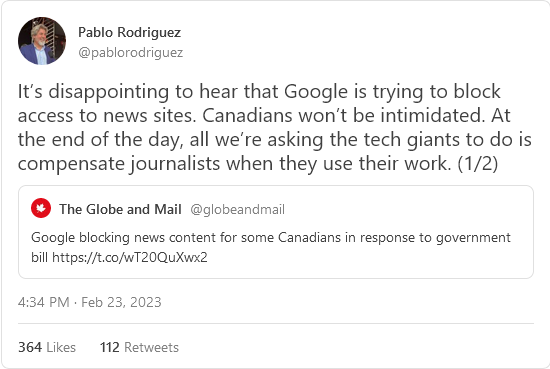
Cue the sound of “Taps” and political outrage. Heritage Minister Pablo Rodriguez had this to say:
Big tech would rather spend money to change their platforms to block Canadians from accessing good quality and local news instead of paying their fair share to news organizations … This shows how deeply irresponsible and out of touch they are, especially when they make billions of dollars off of Canadian users.
No, this shows how deeply out of touch the government is with the business model of these companies – and with internet technology in general.
Comments Off on It’s not “bullying” for corporations to act in their own (and their shareholders’) best interests
July 3, 2023
Nuclear power
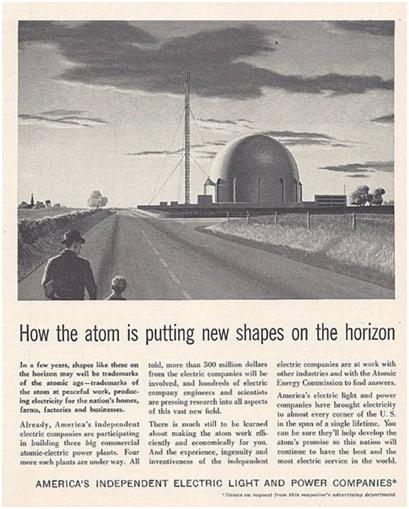
One of the readers of Scott Alexander’s Astral Codex Ten has contributed a review of Safe Enough? A History of Nuclear Power and Accident Risk, by Thomas Wellock. This is one of perhaps a dozen or so anonymous reviews that Scott publishes every year with the readers voting for the best review and the names of the contributors withheld until after the voting is finished:
Let me put Wellock and Rasmussen aside for a moment, and try out a metaphor. The process of Probabilistic Risk Assessment is akin to asking a retailer to answer the question “What would happen if we let a flaming cat loose into your furniture store?”
If the retailer took the notion seriously, she might systematically examine each piece of furniture and engineer placement to minimize possible damage. She might search everyone entering the building for cats, and train the staff in emergency cat herding protocols. Perhaps every once in a while she would hold a drill, where a non-flaming cat was covered with ink and let loose in the store, so the furniture store staff could see what path it took, and how many minutes were required to fish it out from under the beds.
“This seems silly — I mean, what are the odds that someone would ignite a cat?”, you ask. Well, here is the story of the Brown’s Ferry Nuclear Plant fire, in March 1975, which occurred slightly more than a year after the Rasmussen Report was released, as later conveyed by the anti-nuclear group Friends of the Earth.
Just below the plant’s control room, two electricians were trying to seal air leaks in the cable spreading room, where the electrical cables that control the two reactors are separated and routed through different tunnels to the reactor buildings. They were using strips of spongy foam rubber to seal the leaks. They were also using candles to determine whether or not the leaks had been successfully plugged — by observing how the flame was affected by escaping air.
The electrical engineer put the candle too close to the foam rubber, and it burst into flame.
The fire, of course, began to spread out of control. Among the problems encountered during the thirty minutes between ignition and plant shutdown:
- The engineers spent 15 minutes trying to put the fire out themselves, rather than sound the alarm per protocol;
- When the engineers decided to call in the alarm, no one could remember the correct telephone number;
- Electricians had covered the CO2 fire suppression triggers with metal plates, blocking access; and
- Despite the fact that “control board indicating lights were randomly glowing brightly, dimming, and going out; numerous alarms occurring; and smoke coming from beneath panel 9-3, which is the control panel for the emergency core cooling system (ECCS)”, operators tried the equivalent of unplugging the control panel and rebooting it to see if that fixed things. For ten minutes.
This was exactly the sort of Rube Goldberg cascade predicted by Rasmussen’s team. Applied to nuclear power plants, the mathematics of Probabilistic Risk Assessment ultimately showed that “nuclear events” were much more likely to occur than previously believed. But accidents also started small, and with proper planning there were ample opportunities to interrupt the cascade. The computer model of the MIT engineers seemed, in principle, to be an excellent fit to reality.
As a reminder, there are over 20,000 parts in a utility-scale plant. The path to nuclear safety was, to the early nuclear bureaucracy, quite simple: Analyze, inspect, and model the relationship of every single one of them.
Comments Off on Nuclear power
July 2, 2023
If you were trying to destroy trust online, you’d use the playbook currently in use by all the major players
Ted Gioia calls it the “Information Crap-pocalypse”:
People keep telling me that we’re living on an Information Superhighway. But that’s not true.
The flow of information today is more like a river. A very polluted river.
Folks have been dumping their crap into our information flows for a long, long time. Big corporations and institutions are the worst offenders — they actually get rich by polluting our data streams. But individuals are adding to the raw sewage too.
Some of them do it just for kicks.
It’s gotten worse lately. A whole lot worse. Just look at the polluted streams of information in your own life, and try to find a single safe space where the data stream is fresh and clean.
Some of us have stopped even trying.
This is how the Information Age ends, and it’s happening right now.
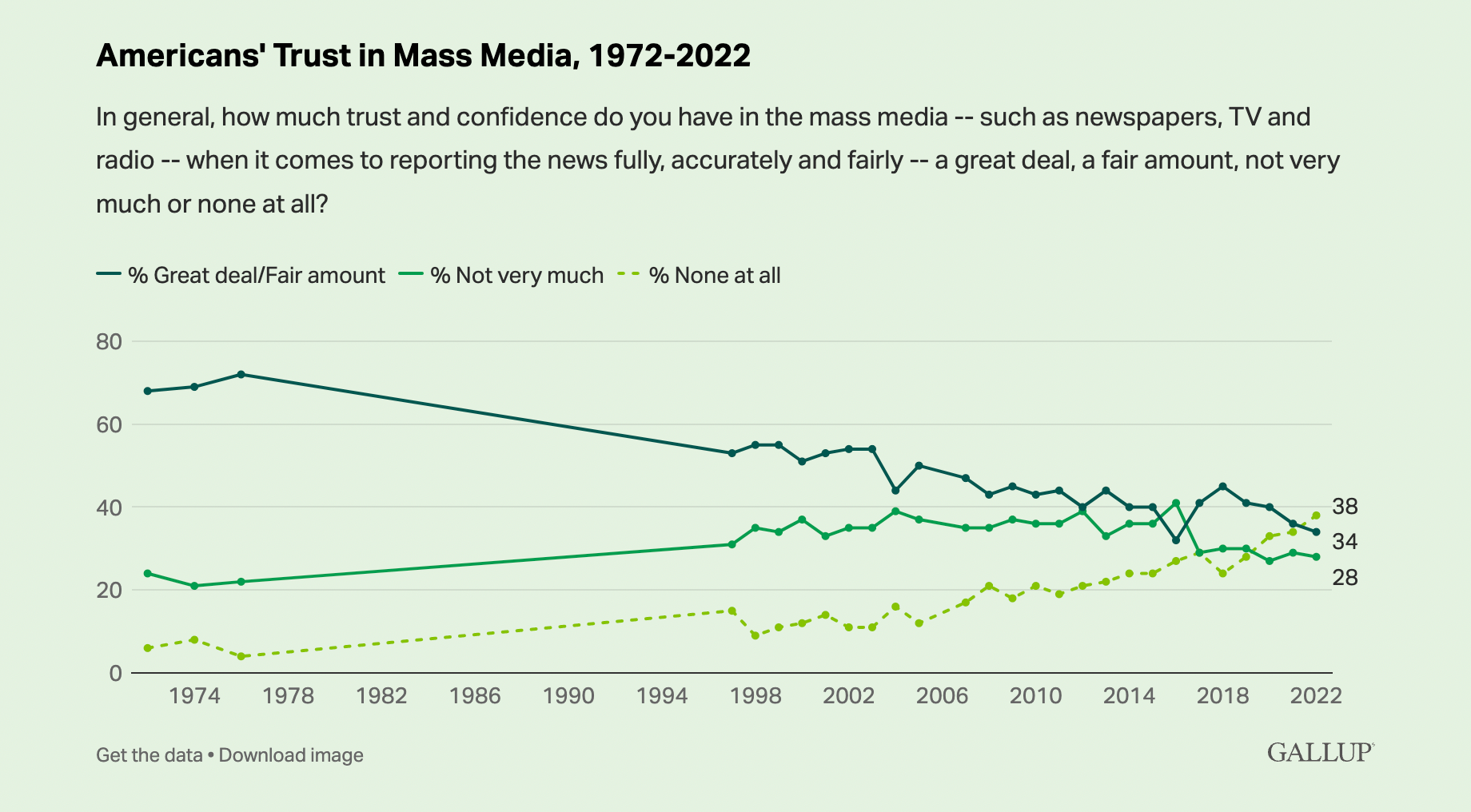
In the last 12 months, the garbage infows into our culture have increased exponentially. As a result, nothing is harder to find now than actual information — which I define as “knowledge based on demonstrable or reliable facts”.
The result is a crisis of trust unlike anything seen before in modern history.
We are bypassing the Web 3.0 we were promised — which was supposed to deliver trust-based systems and validation tools. Instead we’ve gone straight to Web 4.0, which is like the worst kind of Wild West Web. Outlaws and desperados contol all the data highways and byways. Trust and reliability are scarcer than gold nuggets.
Do you think I’m exaggerating?
Let me ask you a question. If your job was to destroy access to reliable information in our society, how would you do it?
You would start with the 30 steps outlined below.
Comments Off on If you were trying to destroy trust online, you’d use the playbook currently in use by all the major players
July 1, 2023
The Trudeau plan to eliminate Canada from the internet is going great!
Wait, you mean that wasn’t the plan? It must have been, if you judge the plan by the amazing results:

The damage caused by the government’s Bill C-18 continues to grow as Meta has started to cancel its existing agreements with Canadian publishers. The move should not as a surprise since any deals that involve facilitating access to news content would bring the company into the legislative framework and mandate payments for links. Indeed, Meta said earlier this week that its 18 existing deals “did not have much of a future“. When this is coupled with a reported “impasse” between the government and Google over its approach to Bill C-18, the risks to the Canadian media sector look increasingly dire.
This was entirely foreseeable, yet Canadian Heritage Minister Pablo Rodriguez never seemed to take the risks seriously. It raises the question of whether the government developed estimates of the cost of its legislation if Meta and Google chose to comply by stopping news sharing or linking. While there were estimates for the benefits of new deals that ran into the hundreds of millions of dollars, did it conduct a risk assessment of the economic costs that would come from Internet companies exiting the news market in Canada?
There are obviously costs that extend far beyond the economics that include reduced access to news, increased prominence of low quality news sources, harm to the Canadian Internet, and the reputational damage to a government that handled this about as incompetently as possible. But from a pure economic perspective, the risks were always understated as they extended beyond just the value of increased traffic to publishers from the links they were themselves posting. Both Google and Meta have deals with Canadian publishers reportedly worth millions of dollars. As Meta’s step to begin cancelling deals suggests, those agreements are unlikely to survive the decision to exit news in Canada.
And of course, Google doesn’t want to set any kind of precedent by accepting a shakedown from any two-bit hoodlum country like Canada:
The worst case scenario for Canadian Heritage Minister Pablo Rodriguez, the Canadian news sector, and the Canadian public has come to pass: Google has announced that it will block news links in Canada in response to the mandated payment for links approach established in Bill C-18. The decision, which the company says will be implemented before the law takes effect, will cover search, Google News, and Google Discover. The decision – which government seemingly tried to avoid with last minute discussions with Google executives after it became apparent that the risks of exit were real – will have lasting and enormously damaging consequences for Canadians and represents a remarkable own-goal by Rodriguez who has managed to take millions away from the news sector and left everyone in a far worse position than if he had done nothing at all.
If you’re in any way interested in Canadian government … machinations … when it comes to digital policy, you really should be following Michael Geist‘s reporting. He’s been doing a great job and deserves the support.
June 29, 2023
When “flashy” became “constantly flashing”, the user experience got significantly worse
Scott Alexander on the irritating advance of meaningless flashing elements on so many web pages where they serve no real purpose, but successfully generate anger in their users:
Everyone hates flashing banner ads, but maybe they’re a necessary evil. Creators want money, advertisers demand a certain level of visibility for their ad buys, maybe sites are willing to eat the cost in user goodwill. Fine. But what’s everyone else’s excuse?
A few days ago I needed to look up an obscure point of Jewish law, as you do, and found this Jewish law website:
The background toggles every few seconds between a picture of a rabbi and a picture of … a different rabbi? There’s no conceivable benefit to this and it makes it almost impossible to concentrate on the text.
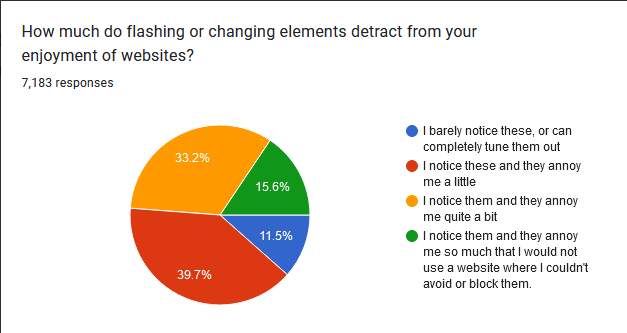
I used to think I must be the only person who worried about this; maybe it was a weird OCD thing. But I asked about it on the ACX survey …
… and 88% of people find them at least a little annoying! 16% of people go all the way, and say they wouldn’t use a website that has them!
Yet websites have been adding them to more and more parts of the user experience. Most aren’t as blatant as the Jewish law site, but they’re still there.

Comments Off on When “flashy” became “constantly flashing”, the user experience got significantly worse
June 28, 2023
“I’ll forgive Dartnell for not writing ‘Lest Darkness Fall’ For Dummies“
Jane Psmith reviews The Knowledge by Lewis Dartnell, despite it not being quite what she was hoping it would be:
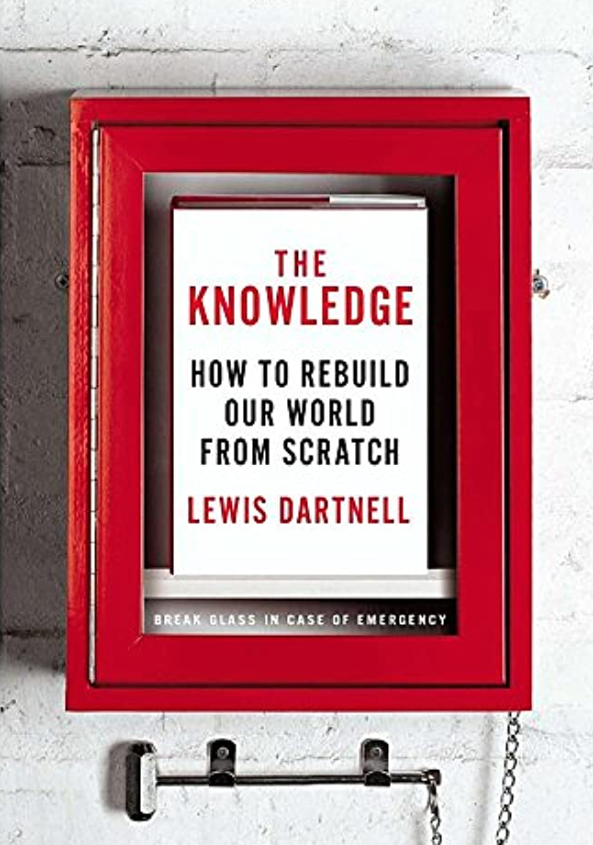
This is not the book I wanted to read.
The book I wanted to read was a detailed guide to bootstrapping your way to industrial civilization (or at least antibiotics) if you should happen to be dumped back in, say, the late Bronze Age.1 After all, there are plenty of technologies that didn’t make it big for centuries or millennia after their material preconditions were met, and with our 20/20 hindsight we could skip a lot of the dead ends that accompanied real-world technological progress.
Off the top of my head, for example, there’s no reason you couldn’t do double-entry bookkeeping with Arabic numerals as soon as you have something to write on, and it would probably have been useful at any point in history — just not useful enough that anyone got really motivated to invent it. Or, here, another one: the wheelbarrow is just two simple machines stuck together, is substantially more efficient than carrying things yourself, and yet somehow didn’t make it to Europe until the twelfth or thirteenth century AD. Or switching to women’s work, I’ve always taken comfort in the fact that with my arcane knowledge of purling I could revolutionize any medieval market.2 And while the full Green Revolution package depends on tremendous quantities of fertilizer to fuel the grains’ high yields, you could get some way along that path with just knowledge of plant genetics, painstaking record-keeping, and a lot of hand pollination. In fact, with a couple latifundia at your disposal in 100 BC, you could probably do it faster than Norman Borlaug did. But speaking of fertilizer, the Italian peninsula is full of niter deposits, and while your revolutio viridis is running through those you could be figuring out whether it’s faster to spin up a chemical industry to the point you could do the Haber-Bosch process at scale or to get to the Peruvian guano islands. (After about thirty seconds of consideration my money’s on Peru, though it’s a shame we’re trying to do this with the Romans since they were never a notably nautical bunch and 100 BC was a low point even for them; you’ll have to wipe out the Mediterranean pirates early and find Greek or Egyptian shipwrights.) And another question: can you go straight from the Antikythera mechanism to the Jacquard machine, and if not what do you need in between? Inquiring minds want to know.3
But I’ll forgive Dartnell for not writing “Lest Darkness Fall” For Dummies, which I’ll admit is a pretty niche pitch, because The Knowledge is doing something almost as cool.4 Like my imaginary book, it employs a familiar fictional conceit to explain how practical things work. Instead of time travel, though, Dartnell takes as his premise the sudden disappearance (probably plague, definitely not zombies) of almost all of humanity, leaving behind a few survivors but all the incredible complexity of our technological civilization. How would you survive? And more importantly, how would you rebuild?
1. I read the Nantucket Trilogy at an impressionable age.
2. Knitting came to Europe in the thirteenth century, but the complementary purl stitch, which is necessary to create stretchy ribbing, didn’t. If you’ve ever wondered why medieval hosen were made of woven fabric and fit the leg relatively poorly, that’s why. When purling came to England, Elizabeth I paid an exorbitant amount of money for her first pair of silk stockings and refused to go back to cloth.
3. Obviously you would also need to motivate people to actually do any of these things, which is its own set of complications — Jason Crawford at Roots of Progress has a great review of Robert Allen’s classic The British Industrial Revolution in Global Perspective that gets much deeper into why no one actually cared about automation and mechanization — but please allow me to imagine here.
4. Please do not recommend How To Invent Everything, which purports to do something like this. It doesn’t go nearly deep enough to be interesting, let alone useful. You know, in the hypothetical that I’m sent back in time.
June 24, 2023
The Most Reliable and Versatile Sub-orbital Rockets Ever Made; the Black Brant Sounding Rockets
Polyus
Published 31 Aug 2018The Black Brant series of sounding rockets was a great success and a proud contribution to the global race for space. While not as glamorous as an orbital rocket, the Black Brants helped scientists from around the globe research and better understand the Aurora and the Earth’s ionosphere.
(more…)
Comments Off on The Most Reliable and Versatile Sub-orbital Rockets Ever Made; the Black Brant Sounding Rockets
QotD: The plight of miners in pre-industrial societies
In the ancient Mediterranean, the clear testimony of the sources is that mining was a low-status occupation, one for enslaved people, criminals and the truly desperate. Being “sent to the mines” is presented, alongside being sent to work in the mills, as a standard terrible punishment for enslaved people who didn’t obey their owners and it is fairly clear in many cases that being sent to the mines was effectively a delayed death sentence. Diodorus Siculus describes mining labor in the gold mines of Egypt this way, in a passage that is fairly representative of the ancient sources on mining labor more generally (3.13.3, trans Oldfather (1935)):
For no leniency or respite of any kind is given to any man who is sick, or maimed, or aged, or in the case of a woman for her weakness, but all without exception are compelled by blows to persevere in their labours, until through ill-treatment they die in the midst of their tortures. Consequently the poor unfortunates believe, because their punishment is so excessively severe, that the future will always be more terrible than the present and therefore look forward to death as more to be desired than life.
It is clear that conditions in Greek and Roman mines were not much better. Examples of chains and fetters – and sometimes human remains still so chained – occur in numerous Greek and Roman mines. Unfortunately our sources are mostly concerned with precious metal mines and those mines also seem to have been the worst sorts of mines to work in, since the long underground shafts and galleries exposed the miners to greater dangers from bad air to mine-collapses. That said, it is hard to imagine working an open-pit iron mine by hand, while perhaps somewhat safer, was any less back-breaking, miserable toil, even if it might have been marginally safer.
Conditions were not always so bad though, particularly for free miners (being paid a wage) who tended to be treated better, especially where their labor was sorely needed. For instance, a set of rules for the Roman mines at Vipasca, Spain provided for contractors to supply various amenities, including public baths maintained year-round. The labor force at Vipasca was clearly free and these amenities seem to have been a concession to the need to make the life of the workers livable in order to get a sufficient number of them in a relatively sparsely populated part of Spain.
The conditions for miners in medieval Europe seems to have been somewhat better. We see mining communities often setting up their own institutions and occasionally even having their own guilds (for instance, there was a coal-workers guild in Liege in the 13th century) or internal regulations. These mining communities, which in large mining operations might become small towns in their own right, seem to have often had some degree of legal privileges when compared to the general rural population (though it should be noted that, as the mines were typically owned by the local lord or state, exemption from taxes was essentially illusory as the lord or king’s cut of the mine’s profits was the taxes). It does seem notable that while conditions in medieval mines were never quite so bad as those in the ancient world, the rapid expansion of mining activity beginning in the 15th century seems to have coincided with a loss of the special status and privileges of earlier medieval European miners and the status associated with the labor declined back down to effectively the bottom of the social spectrum.
(That said, it seems necessary to note that precious metal-mining done by non-free Native American laborers at the order of European colonial states appears to have been every bit as cruel and deadly as mining in the ancient world.)
Bret Devereaux, “Iron, How Did They Make It? Part I, Mining”, A Collection of Unmitigated Pedantry, 2020-09-18.
Comments Off on QotD: The plight of miners in pre-industrial societies
June 21, 2023
Was Starship’s Stage Zero a Bad Pad?
Practical Engineering
Published 20 Jun 2023Launchpads are incredible feats of engineering. Let’s cover some of the basics!
Unlike NASA, which spends years in planning and engineering, SpaceX uses rapid development cycles and full-scale tests to work toward its eventual goals. They push their hardware to the limit to learn as much as possible, and we get to follow along. They’re betting it will pay off to develop fast instead of carefully. This video compares the Stage 0 launch pad to the historic pad 39A.
(more…)
Comments Off on Was Starship’s Stage Zero a Bad Pad?


