
Fortress Britain with Alice Roberts
Published 16 Apr 2023
August 25, 2023
Fortress Britain with Alice Roberts S01E03
Comments Off on Fortress Britain with Alice Roberts S01E03
August 24, 2023
“Facebook has made a calculated business decision about the value of its fucks. These fucks are expensive. So they won’t give any.”
In The Line, Jen Gerson fought the good fight as long as she could, but finally had to load up the old shotgun and share both barrels with the participants in the ongoing clusterfarce over the Online News Act (the artist formerly known as Bill C-18):

Look, I’ve largely said my piece on the Online News Act: it’s poorly conceived legislation that risked terrible outcomes. It’s pointless, now, with those terrible outcomes unfolding, to say “I told you so”.
But the response to the news that Meta has decided to continue blocking news — even in the face of devastating wildfires in B.C. and the Northwest Territories — has been such disingenuous dumbfuckery from every corner that I have failed to bestill my cursed fingertips.
Let’s start with this quote from Prime Minister Justin Trudeau, who at a recent press conference, said: “Right now in an emergency situation where up-to-date local information is more important than ever, Facebook’s putting corporate profits ahead of people’s safety, ahead of supporting quality local journalism … This is not the time for that”.
Wait, a major global corporation that has been labelled as actually literally evil by both progressives and conservatives in recent years is putting its own profits and self-interest ahead of the priorities and values of politicians and pundits?
Sir, surely thou art in jest.
Is this government only now figuring out that major global corporations exist to extract profits; that whatever social corporate responsibility roles they may choose to enact, they aren’t a public service? Is Trudeau shocked — shocked, I say! — to just this very moment discover that Meta isn’t actually some combination of the Red Cross and Reuters?
I mean … welcome to the adult world, I guess, and please leave your copy of Adbusters near the coat check at the door.
But if Meta is as evil as all that, why did so few politicos or pundits anticipate that the company would follow through on its explicit threat to block news if C-18 were passed? This is like watching an Allied general who says: “I think these Nazi fellows are the baddies!” and then gets flustered when the guys with skulls on their caps pull out their guns and start shooting in the midst of afternoon trench tea. “Well, I never. That’s hardly sporting!” This is some Black Adder comedy, friends, and we may be on the side of the angels, but our angels also happen to be a little slow in the head.
Oh, but surely Meta wouldn’t block news to put their own self interest “ahead of people’s safety”, hmmmm?
With advance apologies, but is our antipathy toward Meta so intense that we’re going to straight-face pretend that AM radio, FM radio, emergency text alerts and broadcasts, municipal and provincial emergency websites, formal and informal social media networks and chat groups, and local news broadcasts with websites that can be accessed directly through web browsers all just ceased to exist, simultaneously, the very moment that CBC stopped being able to post news links to Instagram?
If Facebook is actually putting lives in danger, that’s an admission of impotence and incompetence from our entire communications infrastructure, including government, private and public media. It is an incredible and embarrassing self-own.
Comments Off on “Facebook has made a calculated business decision about the value of its fucks. These fucks are expensive. So they won’t give any.”
Speaking of Just-so stories, here’s “a simple story of fetish formation”
Scott Alexander ventures far from shore in this extended discussion of the notion that fetish research can help us understand more about artificial intelligence:

“Cologne BDSM 07” by CSD2006 is licensed under CC BY-SA 3.0 

 .
.
We try to explain AI alignment by analogy to human alignment. Evolution “created” humans. Its “goal” is for humans to spread their genes by (approximately) having as many children as possible. It couldn’t directly communicate that goal to humans – partly because it’s an abstract concept that can’t talk, and partly because for most of biological history it was working with lemurs and ape-men who couldn’t understand words anyway. Instead, it tried to give us instincts that align us with that goal. The most relevant instinct is sex: most humans want to have sex, an action that potentially results in pregnancy, childbearing, and genes being spread to the next generation. This alignment strategy succeeded well enough that humans populations remain high as of 2023.
We’ve talked before about a major failure: humans can invent contraception. Evolution’s main alignment strategy was totally unprepared for this. It made us interested in a certain type of genital friction, which was a good proxy for its goal in the ancestral environment. But once we became smarter, we got new out-of-training-distribution options available, and one of those was inventing contraception so that we could get the genital friction without the kids. This is a big part of why average-children-per-couple is declining from 8+ in eg pioneer times to ~1.5 in rich countries today, even though modern rich people have more child-rearing resources available than the pioneers.
Another major alignment failure is porn. Giving evolution a little more credit, it didn’t just make people want genital friction – if that had been the sole imperative, we would have died out as soon as someone inventing the dildo/fleshlight. People want genital friction associated with attractive people and certain emotions relating to complex relationships. But now we can take pictures of attractive people and write stories that evoke the complex emotions, while using a dildo/fleshlight/hand to provide the genital friction, and that does substitute for sex pretty well. There’s still debate over whether porn makes people less likely to go out and form real relationships, but it’s at least plausibly another factor in the rich-country fertility decline. At the very least it doesn’t scream “well-thought-out alignment strategy robust to training-vs-deployment differences”.
But these are boring examples. These are like 2015-level alignment concerns, from back when we thought the big problem was AIs seizing control of their reward centers or something. I think we might genuinely be able to avoid problems shaped like these. Unlike evolution, which had to work with lemurs, even weak GPT-level modern AIs are able to understand language and complicated concepts; we can tell them to want children instead of using genital friction as a proxy. 2023 alignment concerns are more about failed generalization – that is, about fetishes.
Evolution’s alignment problem isn’t just that humans have learned to satiate their libido in ways other than procreative sex. It’s that some humans’ libidos are fundamentally confused. For example, some men, instead of wanting to have sex with women, mostly want to spank them, or be whipped by them, or kiss their feet, or dress up in their clothes. None of these things are going to result in babies! You can’t trivially blame this on the shift from training to deployment (ie the environment of evolutionary adaptedness to the modern world) – women had feet in the ancestral environment too. This is a different kind of failure.
Here’s a simple story of fetish formation: evolution gave us genes that somehow unfold into a “sex drive” in the brain. But the genome doesn’t inherently contain concepts like “man”, “woman”, “penis”, or “vagina”. I’m not trying to make a woke point here: the genome is just a bunch of the nucleotides A, T, C, and G in various patterns, but concepts like “man” and “woman” are learned during childhood as patterns of neural connections. We assume that the nucleotides are a program telling the body to do useful things, but that has to be implemented through deterministic pathways of proteins and the brain’s neural connections are too complex to trivially influence that way (see here for more). The genome probably contains some nucleotides that are supposed to refer to the concepts “man” and “woman” once the brain gets them, but there’s are a lot of fallible proteins in between those two levels.
So the simple story of fetish formation is that the genome contains some message written in nucleotides saying “have procreative sex with adults of the opposite sex as you”, some galaxy-brained Rube Goldberg plan for translating that message into neural connections during childhood or adolescence, and sometimes the plan fails. Here are some zero-evidence just-so-story speculations for how various fetishes might form, more to give you an idea what I’m talking about than because I claim to have useful knowledge on this topic:
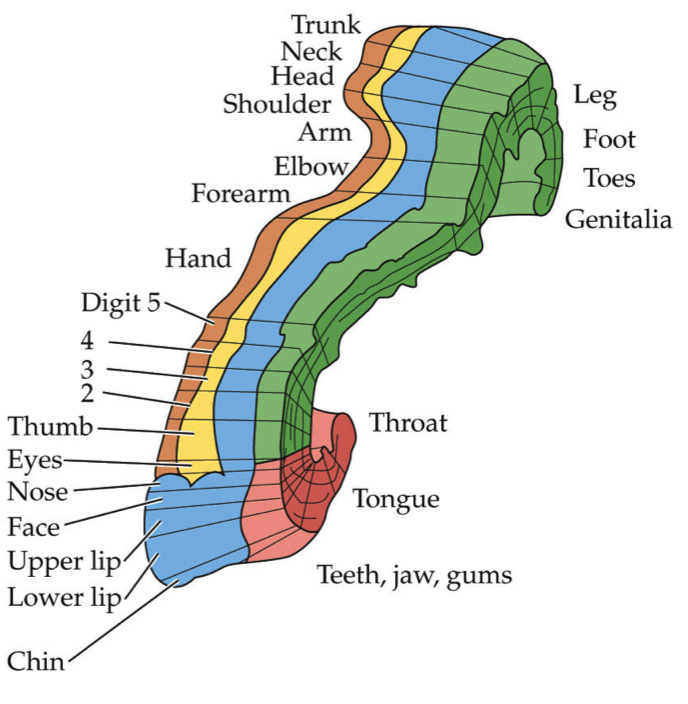
- Foot fetish: On the somatosensory cortex, the area representing the feet is right next to the area representing the genitalia. If the genome includes an “address” for the genitalia, plus the instructions “have sexual urges towards this”, then getting the address slightly wrong will land you in the feet.
A reasonable next question would be “what’s on the other side of the genitalia, and do people also have fetishes about that one?” The answer is “the somatosensory cortex is a line with the genitalia at the far end, because God is merciful and didn’t want there to be a second thing like foot fetishes.”
(source for cortex image)- Spanking: From the male point of view, penetrative PIV sex involves applying force to the bottom half of a woman, at rhythmic intervals, in a way that causes her very intense emotions and makes her make moan and scream. Spanking is exactly like this, and most kids encounter spanking at a very early age and sex only after they’re much older. If the evolutionary message is something like “find the concept that looks vaguely like this, then be into it”, spanking is the first concept like that most people will find; by the time they learn about actual sex, spanking might be a trapped prior.
- Sadomasochism: Sex is painful for virgins, can be mildly painful even for some non-virgins, and when it’s pleasurable, it still looks a lot like pain (screams, intense emotions). Imagine you are a little boy/girl who stumbles in on your parents having sex. Your father is impaling the most sensitive part of your mother’s body, and your mother is moaning and squealing. A natural generalization might be “sex is the thing where a man causes a woman pain”.
- Latex/rubber: Plausibly the evolutionary specification includes details about attractiveness. Attractive people (ie those you should be most interested in having babies with) should be young and healthy (characteristics associated with better pregnancy outcomes, especially in the high-risk ancestral environment). The simplest sign of youth and good health is smooth skin, so the evolutionary message might say something about preferring sex with smooth-skinned people. Latex is a superstimulus for smooth skin, and maybe if you see it at the right time, in the right situation, it can totally overwhelm the rest of the message.
- Urine/scat: Procreative sex involves a sticky substance that comes out of the genitals, it doesn’t take much misgeneralization to get to other sticky substances that come out of the genitals or nearby regions.
- Bondage/domination/submission: Okay, I admit I don’t have a good just-so explanation for this one. Maybe it’s more psychological – people who have been told that sex is shameful can only fully appreciate it if they feel like a victim who’s been forced into it (and so carries no guilt). And people who have been told they’re undesirable and nobody could ever really love them can only fully appreciate it if their partner is a victim who has no choice in the matter.
- Furries: This has to be because of all the cute cartoon animals, right? But why do some people sexually imprint on them? I found this article on worshippers of the 1990s cartoon mouse Gadget helpful here. Gadget obviously has many desirable characteristics — she’s a very cute nerdy woman who sometimes ends up in damsel-in-distress situations. Maybe she is the most sexualized being that some six-year-old boys have encountered. When I watched Rescue Rangers as a six-year old, I could feel my brain trying to figure out whether to have a crush on her before deciding that no, it was too deep in latency stage. I assume most people who get their first crushes on Gadget or some other desirable cartoon character end up with their brains later generalize properly to “I like cute nerdy women in damsel-in-distress situations”, but a small minority misgeneralize to “nope, I’m only attracted to mice now, that’s where I’m going to go with this.”
Combine this with equivalent animal “fetishes” — things like beetles species where the females have red dots on their backs, and the males try to mate with anything that has a red dot — and you get a picture where evolution tries to communicate a lot of contingent features of sex in the hopes that one of them will stick, then tells you to be attracted to whatever is most associated with those features. At least for men, I think the features communicated in the genomic message are simple things like curves and thrusting and genitals and smooth skin, plus something that somehow picks out the concept of “woman” (except in 3% of the male population, where it picks out the concept of “men” instead, plus another 3% where it doesn’t pick out a sex at all).
Real procreative sex usually matches enough of features of the genomic message to be attractive to most people, but if the original triggers were associated with some contingent characteristics, the brain might misinterpret that as part of the target — for example, if it was a cartoon animal, the brain might think the target includes cartoon animals.
Other times, something that isn’t procreative sex matches the genomic message closely enough to be misinterpreted as the center of the target (eg getting whipped); usually procreative sex is somewhere in the target space, but maybe not the exact center, and a few people have such strong fetishes that procreative sex doesn’t register as erotic at all.
The process of forming the category “sexually attractive things” is just a special case of the process of forming categories at all. I discuss the formation of categories like “happiness” and “morality” in The Tails Coming Apart As Metaphor For Life. Society feeds us some labeled data about what is good or bad — for example, we might see someone commit murder on TV, and our parents tell us “No! That’s bad! Don’t do that!” (and the other TV characters hate and punish that character). Then we try to extrapolate such incidents to a broader moral system. If we’re philosophers, we might go further and try to formally describe that moral system, eg Kantianism, utilitarianism, divine command theory, natural law, etc. All of these correctly predict the training data (eg “murder is bad”) while having different opinions on out-of-distribution environments. Which one you choose is just a function of some kind of mysterious intellectual preference for how to generalize inherently ungeneralizeable things — what I previously described as “extrapolating a three-dimensional shape from its two-dimensional reinforcement-learning shadow”.
Fetishes are the same way. Here the evolutionary message provides semi-labeled data, giving people weird feelings when they see certain kinds of curvy, smooth-skinned people. Then people try to generalize that into an idea of what’s sexy. Usually their category is centered (in the sense that the category “bird” is centered around “sparrow” and not “ostrich”) around something close to procreative heterosexual sex. Other times they generalize in some very unexpected way, and are only attracted to cartoon mice. I think if we understood the laws of generalization, this would make sense. It would seem like a reasonable mistake that someone using Occam’s Razor and all the rest of the information-theoretic toolkit for generalization could make. But we don’t really understand those laws beyond faint outlines, so instead we’re reduced to YKINMKBYKIOK.
August 19, 2023
“Twitter used to work well, but now he receives negative comments, which means that it has stopped working”
Chris Bray on the claims that Twitter, er, I mean “X” is broken from people who are suddenly being exposed to unfriendly opinions that the old platform used to kindly keep out of their very comfortable bubbles:
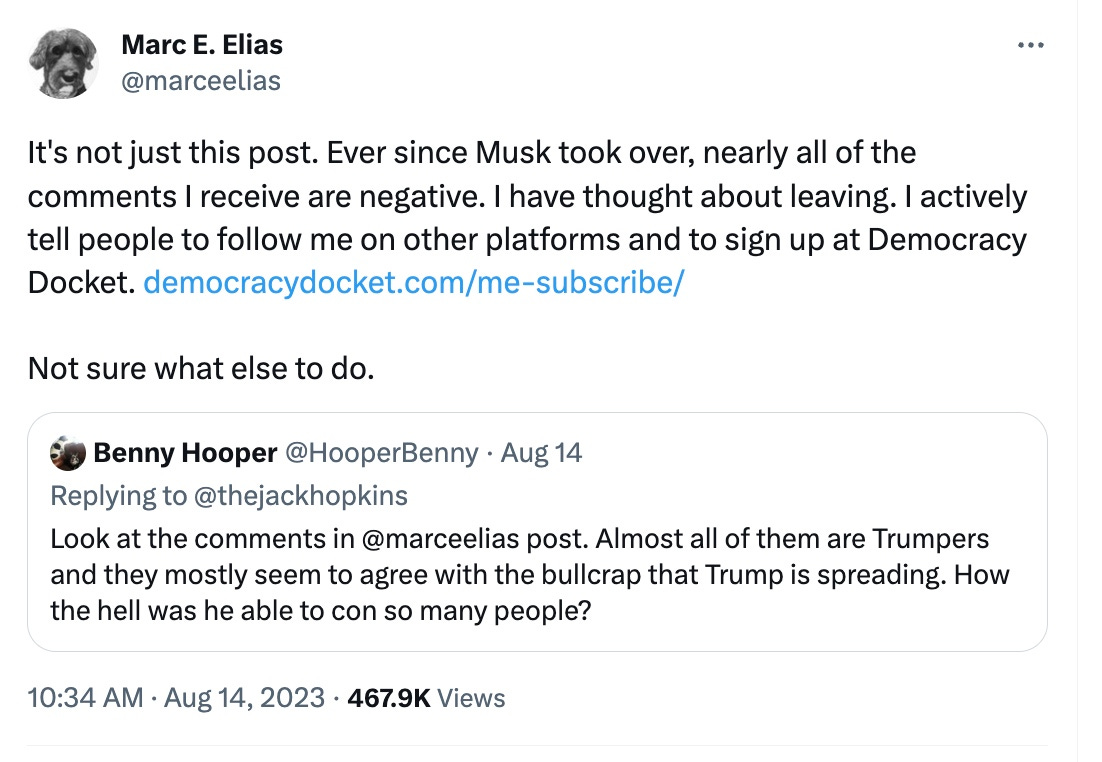
The Democratic Party’s go-to election lawyer, Marc Elias, is disturbed by the decline of Twitter:
Twitter used to work well, but now he receives negative comments, which means that it has stopped working. People can criticize him and express disagreement, so the platform is broken. If it worked, he would only be praised.
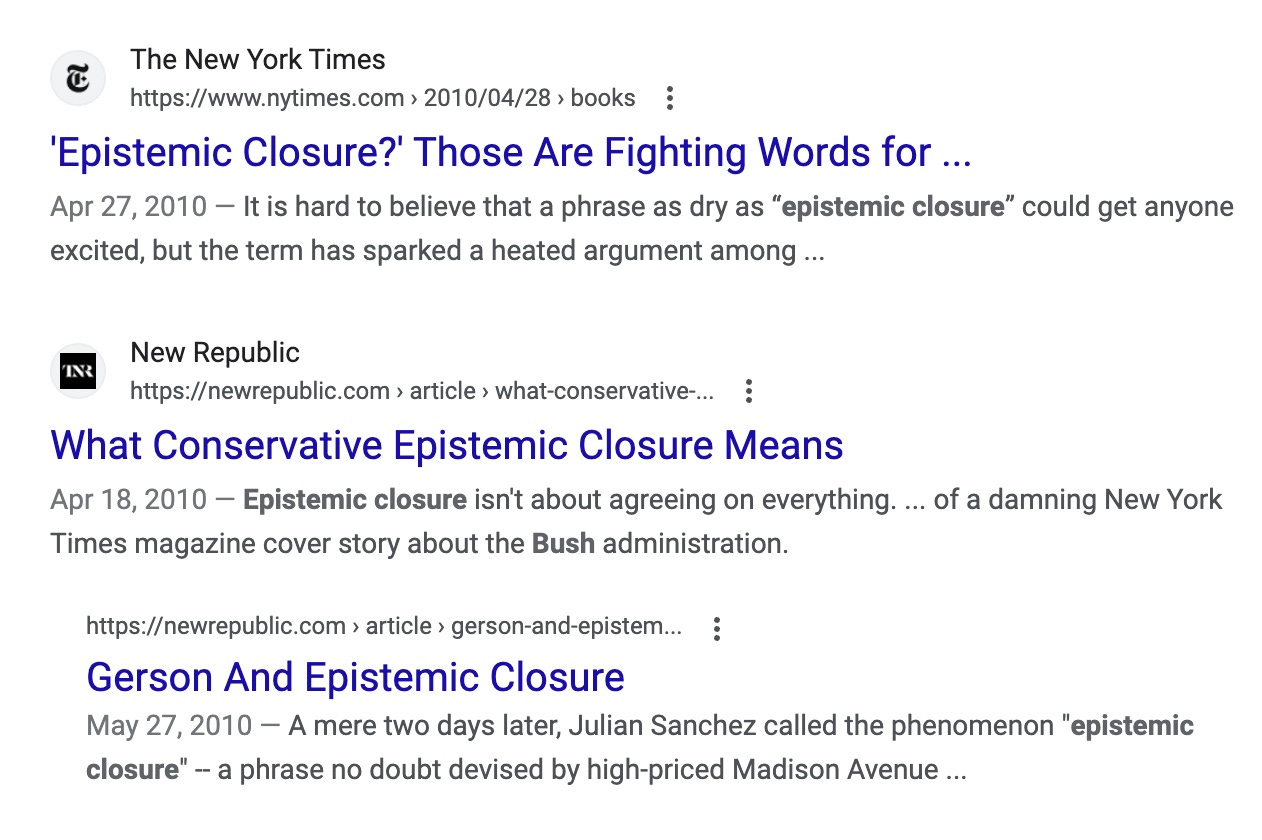
“Epistemic closure” had its pet rock moment in 2010, as the news media looked back on the George W. Bush years and the Iraq War and concluded that American neoconservatives had simply lost their ability to think.
[…]
It was supposed to mean this:
It’s rather about information, and what counts as evidence about the real world … if one only gets information from a narrow set of sources that feed back into each other but do not engage beyond themselves, that one will have a closed mind … regardless of what one does with that information.
And this:
Epistemic closure is a fancy term for the practice of defining – or redefining – reality in ways that support your pre-existing ideological preferences. Most of us think of it as “creating and living in a bubble”.
It was a fair enough point, as Bush watched sectarian brutality continue in post-Saddam Iraq and kept drawing the conclusion that everyone everywhere really yearns for democratic pluralism, honest elections, and a free press.
But that era’s epistemic closure is bush-league — sorry — compared to the sealed-in-a-jar-in-a-closed-box-in-a-deep-cave closure of the “mainstream” mind in 2023. If you’ve been on social media since roughly the night of November 8, 2016 and you’ve expressed disagreement with a politician, academic, or media figure, you’ve been a Russian bot, and Putin told you to say that. Criticism of institutions can’t simply arise from authentic grievances, or even from an authentically felt but misperceived grievance; rather, criticism is an op, a calculated string-pulling effort by manipulative forces. The far-right Putin-aligned Nazi grifters are tricking you into believing that you’re unhappy with the Biden administration. Your brain has been fooled by cognitive warfare, see?
Comments Off on “Twitter used to work well, but now he receives negative comments, which means that it has stopped working”
QotD: The third system (or “Modern system”) of war
Armies in this modern system [discussed here] still aim to control territory, as with second-system war, but they no longer square off in open fields. Rather, relying on cover and concealment to mitigate the overwhelming firepower a modern battlefield covered with machine guns, artillery and airpower, they aim to disorient and overwhelm the decision-making capabilities of their enemy with lightning mechanized offensives.
What happens when two current-day modern systems meet? We don’t really know, though there is a lot of speculation. One of the things which made the conflict between Azerbaijan and Armenia so closely watched last year (in 2020, for those reading this later) was that it provided a chance to see two sides both with (sometimes incomplete) access to the full modern kit of war – not only tanks, jets and artillery, but cyber warfare, drones and so on. The results remain to be much discussed analyzed, but it may well be that a fourth system of war is in the offing, defined by the way that drone-based airpower combined with electronic surveillance and cyber-warfare redefined the battle-space and allowed Azerbaijan in particular to project firepower deep into areas where Armenian forces considered themselves safe.
But I shouldn’t get too off track. The point of all of this is that these systems of war are not merely different, they are so radically different that armies created in one system often fundamentally fail to understand the others (thus the tendency for second and third system armies to treat first system war as some strange new innovation in war, when it is in fact the oldest system by far). As we’re going to see, the aims, experiences and outcomes of these systems are often very different. They demand and inculcate different values and condition societies differently as well.
Bret Devereaux, “Collections: The Universal Warrior, Part IIa: The Many Faces of Battle”, A Collection of Unmitigated Pedantry, 2021-02-05.
Comments Off on QotD: The third system (or “Modern system”) of war
August 15, 2023
QotD: Iron ore processing in pre-industrial societies
Ore removed from the mine would need to be crushed, with the larger stones pulled out of the mines smashed with heavy hammers (against a rock surface) in order to break them down to a manageable size. The exact size of the ore chunks desired varies based on the metal one is seeking and the quality of the local ore. Ores of precious metals, it seems, were often ground down to powder, but for iron ore it seems like somewhat larger chunks were acceptable. I’ve seen modern experiments with bloomeries […] getting pretty good results from ore chunks about half the size of a fist. Interestingly, Craddock notes that ore-crushing activity at mines was sufficiently intense that archaeologists can spot the tell-tale depressions where the rock surface that provided the “floor” against which the ore was crushed have been worn by repeated use.
Ore might also be washed, that is passed through water to liberate and wash away any lighter waste material. Washing is attested in the ancient world for gold and silver ores (and by Georgius Agricola for the medieval period for the same), but might be used for other ores depending on the country rock to wash away impurities. The simple method of this, sometimes called jigging, consisted of putting the ore in a sieve and shaking it while water passed through, although more complex sluicing systems are known, for instance at the Athenian silver mines at Laurium (note esp. Healy, 144-8 for diagrams); the sluices for washing are sometimes called buddles. Throughout these processes, the ore would also probably be hand-sorted in an effort to separate high-grade ore from low-grade ore.
It’s clear that this mechanical ore preparation was much more intensive for higher-value metals where making sure to be as efficient as possible was a significant concern; gold and silver ores might be crushed, sorted, washed and rewashed before being ground into a powder for the final smelting process. Craddock presents a postulated processing set for copper ore for the Bronze Age Timna mines that goes through a primary crushing, hand-sorted division into three grades, secondary crushing, grinding, a winnowing step for the low-grade ore (either air winnowing or washing) before being blended into the final smelter “charge”.
As far as I can tell, such extensive processing for iron was much less common; in many cases it seems it is hard to be certain because the sources remain so focused on precious metal mining and the later stages of iron-working. Diodorus describes the iron ore on Elba as merely being crushed, roasted and then bloomed (5.13.1) but the description is so brief it is possible that he is leaving out steps (but also, Elba’s iron ore was sufficiently rich that further processing may not have been necessary). In many cases, iron was probably just crushed, sorted and then moved straight to roasting […]
Bret Devereaux, “Iron, How Did They Make It? Part I, Mining”, A Collection of Unmitigated Pedantry, 2020-09-18.
Comments Off on QotD: Iron ore processing in pre-industrial societies
August 11, 2023
The Weirdest Boats on the Great Lakes
Railroad Street
Published 5 May 2023Whalebacks were a type of ship indigenous to the Great Lakes during the late 1890s and mid 1900s. They were invented by Captain Alexander McDougall, and revolutionized the way boats on the Great Lakes handled bulk commodities. Unfortunately, their unique design was one of the many factors which led to their discontinuation.
(more…)
Comments Off on The Weirdest Boats on the Great Lakes
August 6, 2023
What’s in a (tech) name?
Ted Gioia isn’t a fan of all the recent rebrandings of social media platforms, and tries to explain “why web platforms keep changing their names like criminals in the Witness Protection Program”:

“Automotive Social Media Marketing” by socialautomotive is licensed under CC BY 2.0

When I first heard that Twitter was renaming itself as X, I thought it was a joke.
Not a funny joke, just a goofy one. Elon Musk has a taste for schoolboy humor — and on many occasions has posted something undignified for a laugh. I assumed X was another example of this.
Who could take that name seriously?
Just consider the significations of X:
- The crossbones you put in front of a skull on a bottle of poison;
- A mistake on a test, marked by the teacher in red;
- How you sign your name if you can’t read or write;
- Something you haven’t figured out in algebra;
- A movie that’s dirty, raunchy, or offensive in some manner;
- A mark on a map where stolen wealth has been buried by pirates or criminals;
- The street name for an illegal drug (MDMA) with various adverse long-term effects — including depression, anxiety, and impairments of cognition, memory, and learning;
- A symbol of betrayal (i.e., a double cross);
- In marketing language, an inferior product, as in “Brand X”;
- A radioactive ray so dangerous that it killed the people who invented and developed it.
Given these associations, nobody in their right mind would replace a familiar, proven brand name with X. Mr. Musk must be joking again. Or so I thought.
But I thought wrong.
If this were an isolated event, I would dismiss it as just one more quirk on the part of an eccentric CEO. But these horrible rebrands are now standard practice in Silicon Valley, especially among dominant Internet platforms.
Why did Google change its corporate name to Alphabet? Why did Facebook change its corporate name to Meta? These were two of the best known brand names in the history of capitalism. Why get rid of them?
And consider this bizarre coincidence. The very same month that Twitter became X, Instagram launched its own text posting option. But it refused to use the familiar Instagram name, instead calling this new feature Threads.
Threads is another word that has all sorts of negative connotations. It refers to something old and torn. It’s associated with poverty and an embarrassing appearance.
What gives?
Do you remember the carefree early days of the web? Brand names were innocent and playful — they sounded like something from a nursery rhyme: Yahoo, Google, Tumblr. Twitter was one of those cutesy names.
Its symbol was a chirping bird. So sweet. So innocent.
But nowadays, web platforms take on names straight out of an H.P. Lovecraft horror story — Threads, X, Ghost, Twitch, Discord, etc.
Today’s writing prompt: Use all of those words in the opening lines of a story. Then send it off to an editor at Weird Tales.
Current day techno bro vibe

Comments Off on What’s in a (tech) name?
August 3, 2023
“Tech giants” obey the law and block access to Canadian news sites to Canadian users
For some reason — despite a clamour of warnings from sensible observers — the Canadian government still seems shocked and surprised that the much-reviled “tech giants” have chosen to obey the new Online News Act and are actively blocking links to Canadian media outlets just as the law requires:

For months, supporters of Bill C-18, the Online News Act, assured the government that Meta and Google were bluffing when they warned that a bill based on mandated payments for links was unworkable and they would comply with it by removing links to news from their platforms. However, what has been readily apparent for months became reality yesterday: Meta is now actively blocking news links and sharing on its Facebook and Instagram platforms. The announcement does not reference Threads, but it would not surprise if news links are ultimately blocked on that platform as well. The company says that the blocking will take several weeks to fully roll out to all users, suggesting that it has learned from the over-blocking mistakes made in Australia and is proceeding more cautiously in Canada. By the end of the month, the world’s largest social media platform will become a news desert in Canada, with links to all news – both Canadian and foreign – blocked on the platform.
It is worth revisiting that it was only a couple of months ago that some industry leaders, lobbyists, and academics were assuring the Senate that the Meta threat was just a bluff. Kevin Desjardins of the Canadian Association of Broadcasters, referenced the Australian experience, and told the Senate committee studying the bill that “when legislated to do so, they will come to the table”. Sylvain Poisson of Hebdos Quebec confidently said “they made those threats in Australia and elsewhere and every time they back down”. Chris Pedigo of the U.S.-based Digital Context Next assured the committee “it’s important to understand what happens when these bills become law. In Australia, they moved quickly to secure deals. They have done similar work in Europe, and I expect it would happen quickly in Canada as well.” And Carleton professor Dwayne Winseck said “I am not worried. The threats they are making, they are doing this all around the world.”
Despite the assurances, the company was true to its word and blocking news links is now here. If this is a negotiation tactic, it’s a pretty strange one given that reports indicate the company is not talking to the government about potential changes to a law that has already received royal assent. Indeed, while the new Heritage Minister Pascale St-Onge urged the company to participate in the regulatory process, there is nothing in the regulations that could alter the fundamental principle in the bill of mandated payments for links. At best, the government could toss aside its commitment to stay out of negotiations by using the regulations to dictate to the supposedly independent CRTC how much needs to be spent in order to avoid Bill C-18’s final offer arbitration provisions. Government negotiating total payment value and eviscerating the CRTC’s independence does not inspire confidence and Meta reasonably wants no part of it, since the time to fix Bill C-18 was before it received royal assent, not after.
Bolded section mine: I didn’t realize that it wasn’t just Canadian media links that were being blocked … it’s all news sites in the world being hidden from Canadian users. That’s an escalation from what I’d originally understood. I don’t blame the “tech giants” at all, but it will be tough on older Canadians who’ve been depending on social media to keep them up-to-date on domestic and foreign news.
Comments Off on “Tech giants” obey the law and block access to Canadian news sites to Canadian users
QotD: Blacksmith forge techniques
A modern blacksmith can gauge the temperature of a metal using sophisticated modern thermometers, but pre-modern smiths had no recourse to such things (and most traditional smiths I’ve met don’t use them anyway). Instead, the temperature of the metal is gauged by looking at its color: as things get hotter, they glow from brown to dark red through to a light red into yellow and then finally white. For iron heated in a forge, a blacksmith can control the temperature of the forge’s fire by controlling the air-input through the bellows (pushing in more air means more combustion, which means more heat, but also more fuel consumed). As we’ve seen, charcoal (and we will need to use charcoal, not wood, to hit the necessary heat required), while not cripplingly expensive, was not trivial to produce either. A skilled smith is thus going to try to do the work in as few heats as possible and not excessively hot either (there are, in fact, other reasons to avoid excessive heats, this is just one).
Once hot the metal can be shaped by hammering. The thickness of a bar of metal could be thickened by upsetting (heating the center of the bar and them hammering down on it like a nail to compress the center, causing it to thicken) or thinned by drawing (hammering out the metal to create a longer, thinner shape). If the required shape needed the metal to be bent it could be heated and bent either over the side of the anvil or against a tool; many anvils had (and still have) a notch in the back where such a tool could be fitted. A good example of this kind of thing would be hammering out a sheet of iron over a dome-shape to create the bowl of a helmet (a task known as “raising” or “sinking” depending on precisely how it is done). A mass of iron can also be divided by heating it at the intended cutting point and then using a hammer and chisel to cut through the hot, soft metal.
But for understanding the entire process, the most important of these operations is the fire weld. Much like bloomery furnaces, the forges available to pre-modern blacksmiths could not reach the temperatures necessary to melt or cast iron, but it was necessary to be able to join smaller bits of iron into larger ones which was done through a fire weld (sometimes called a forge weld). In this process, the iron is heated very hot, typically to a “yellow” or “white” heat (around 1100 °C). The temperature range for the operation is quite precise: too cold and the iron will not weld, too hot and it will “burn” making the weld brittle. Once at the right temperature, the two pieces of iron are put next to each other and hammered into each other with heavy blows. If done properly, the two pieces of metal join completely, leaving a weld that is as strong as every other part of the bar.
Bret Devereaux, “Collections: Iron, How Did They Make It, Part III: Hammer-time”, A Collection of Unmitigated Pedantry, 2020-10-02.
Comments Off on QotD: Blacksmith forge techniques
July 30, 2023
Letting a UN agency police “disinformation” online? What a great idea! With the best of intentions! What could possibly go wrong?
Savroula Pabst outlines the United Nations Development Program’s new online anti-disinformation tool, iVerify:

The United Nations Development Programme (UNDP) has quietly announced the rollout of an automated anti-disinformation tool, iVerify, this spring. The instrument, initially created to support election integrity, centers a multi-stakeholder approach spanning the public and private sectors to “provide national actors with a support package to enhance identification, monitoring and response capacity to threats to information integrity”.
The UNDP demonstrates how iVerify works in a short video, where anyone can send articles to iVerify’s team of local “highly-trained” fact-checkers to determine if “an article is true or not”. The tool also uses machine learning to prevent duplicate article checks, and monitors social media for “toxic” content which can then be sent to “verification” teams of fact-checkers to evaluate, making it a tool with both automated- and human-facilitated elements.
On its website, the UNDP makes a blunt case for iVerify as an instrument against “information pollution“, which they describe as an “overabundance” of harmful, useless or otherwise misleading information that blunts “citizens’ capacity to make informed decisions”. Identifying information pollution as an issue of urgency, the UNDP claims that “misinformation, disinformation, and hate speech threaten peace and security, disproportionately affecting those who are already vulnerable”.
But, behind this rhetoric of fact-checking expertise and protecting society’s most marginalized, iVerify, as a tool functionally claiming an ability to separate the true from the false, actually provides governments, adjacent institutions, and the global elite an opportunity for unprecedented dismissal, and perhaps thus subsequent censorship, of dissenting perspectives and inconvenient information and reporting, all behind the pedigree of a UN institution with international reach.
Comments Off on Letting a UN agency police “disinformation” online? What a great idea! With the best of intentions! What could possibly go wrong?
July 29, 2023
If you like the CRTC regulating the internet, you’ll love having them regulating video games!
Not satisfied with strenuously trying to break the internet for ordinary Canadians, the Trudeau government is now being lobbied to introduce regulation of video games, too:

Bill C-11 may have receded into the background of CRTC consultations and government policy directions, but Canadians concerned with user content, video game and algorithmic regulation would do well to pay attention. Lobby groups that fought for the inclusion of user content regulation in the bill have now turned their attention to the regulatory process and are seeking to undo government assurances that each of those issues – user content, algorithms and even video games – would fall outside of the scope of the regulatory implementation of the bill. In fact, if the groups get their way, Canadians would face unprecedented regulations with the CRTC empowered to create a host of new obligations that could even include requirements for Youtubers and TikTokers to register with the Commission. With a new Heritage Minister in place, the submissions raise serious concerns about whether the government will maintain its commitments regarding scoping out users, video games, and algorithms.
The most troubling publicly available document comes from a coalition that calls itself ACCORD, representing songwriters, composers, and music publishers. The group has posted its submission to the government’s consultation on the draft policy direction to the CRTC on Bill C-11. All submissions are not yet posted, but I should note that I also submitted a brief document, calling on the government to fully honour its commitment to exclude user content and algorithms from regulation and to establish limits on discoverability regulation.
The government’s draft direction had called for “minimizing” algorithmic regulation and the exclusion of user content and video game regulation. The music lobby is now calling on the government to rollback virtually all of its commitments on these issues. The draft direction states:
The Commission is directed not to impose regulatory requirements on
(a) online undertakings in respect of the programs of social media creators, including podcasts; and
(b) broadcasting undertakings in respect of the transmission of video games.
The lobby wants virtually all of this removed, deleting references to online undertakings and video games. Moreover, the directive speaks to Section 4.2, stating:
In exercising its powers under section 4.2 of the Act, the Commission is directed to set out clear, objective and readily ascertainable criteria, including criteria that ensure that the Act only applies in respect of programs that have been broadcast, in whole or in significant part, by a broadcasting undertaking that is required to be carried on under a licence or that is required to be registered with the Commission but does not provide a social media service.
Here too the lobby group wants most of the paragraph deleted. And while the government directed the CRTC to minimize algorithmic regulation for discoverability purposes, the groups wants those limitations removed as well. In short, the lobby groups validate the concerns expressed by thousands of Canadians that Bill C-11 opened the door to the regulation of user content, video games, and algorithms.
Comments Off on If you like the CRTC regulating the internet, you’ll love having them regulating video games!
July 26, 2023
QotD: Things were better in “the old days”
For example, beer. As ganderson points out in the comments below, beer these days is better than it has ever been. I quote:
the “old” microbrew brands, like Sam Adams, Summit, Sierra Nevada, Brooklyn, etc, are shunned by many millennials as not hip enough.
The very fact that excellent suds like Sam Adams can be found in gas stations across the land — making it tragically un-hip — is all the proof you need of ganderson‘s thesis. I didn’t mean to leave the impression, below, that I consider Lone Star, Natty Lite, etc. to be good beer. They are, in fact, very bad beers. But since I went to college back in the days, and was on scholarship to boot, my choices were almost always between “bad beer” and “no beer”. And since beer, any beer, made me much more interesting and attractive to the opposite sex, and they to me, it was never really a choice at all. I have great sentimental attachment to Lone Star beer, but the very thought of drinking it gives me a hangover. […]
The modern world sucks, but lots of things are far better now. Cars, too. I know, I know, they’re mostly Karen-mobiles, but the muscle cars have a hell of a lot more muscle, and they’re orders of magnitude more reliable. I grew up in a world where you could reliably expect cars to start falling apart at 30,000 miles on the odometer – you expected to lose an alternator at 30, a starter at 50, and by 100K miles you’d have a beater, no matter how scrupulously maintained. These days, with just routine idiot maintenance 100K passes without a hitch. That’s a win, and if “shade-tree mechanic” no longer exists (since you need three computers and a special wrench just to get to the spark plugs), well … still a win.
Materially, these days, most things are better, and the things that aren’t better are cheaper, way cheaper. It’s an open question as to whether the latter fact is good or bad, but the fact is, materially life really is, in some ways, what the Leftards say it is. We pay the spiritual price for most of it, but when it comes to alcohol, at least, give me the Current Year.
Severian, “A Historian’s Fallacy”, Rotten Chestnuts, 2020-12-07.
July 24, 2023
Lorenzoni Repeating Flintlock Pistol
Forgotten Weapons
Published 13 Aug 2012Today we have one of the oldest guns we’ve looked at, a Lorenzoni repeating flintlock pistol. The system was designed by an Italian gunmaker in Florence name Michele Lorenzoni. They were made in very small numbers, and the workmanship is stunning, especially considering that they were first manufactured in the 1680s.
Instead of using a revolving cylinder pre-loaded with multiple shots, the Lorenzoni system utilizes powder and ball magazines in the frame of the gun and a rotating breechblock much like a powder throw tool used today for reloading ammunition.
(more…)
Comments Off on Lorenzoni Repeating Flintlock Pistol
July 23, 2023
Tom Whipple’s history of radar development during WW2
In The Critic, Robert Hutton reviews The Battle of the Beams by historian Tom Whipple, who retells the story of the technological struggle between Britain and Germany during the Second World War to find ways to guide RAF or Luftwaffe pilots to their targets:

In an age when my phone can tell me exactly where I am and how to get where I’m going, it’s hard sometimes to imagine a time when navigation was one of any traveller’s great challenges. At the outbreak of the Second World War, the advice to Royal Air Force pilots trying to find their way was, more or less, to look out of the window and see whether anything on the ground looked familiar. The Luftwaffe, though, had a rather more sophisticated means of finding their targets.
As Britain braced herself for the bomber onslaught of 1940, there was comfort in knowing that radar would give Hurricanes and Spitfires advance warning of where the attack was coming. As soon as the sun went down, so did the fighters: at night, relying on their eyeballs, they simply couldn’t find the enemy.
That wasn’t so bad, as long as the German pilots had the same problem, but one young British scientist began to suspect that the Luftwaffe had developed a technology that allowed them to find their way even in the dark, guided by radio beams. In June 1940 he found himself explaining to Winston Churchill that German bombers could accurately reach any spot over England that they wanted, even in darkness.
Reg “RV” Jones was the original boffin: a gifted physicist who was recruited to the Air Ministry at the start of the war to help make sense of intelligence reports that offered clues about enemy technology. It was a role to which he was perfectly suited: a man who liked puzzles, with the ability to absorb lots of information and see links, as well as the arrogance to insist on his conclusions, even when his superiors didn’t like them.
The story of the radio battle has been told before, not least by Jones himself. His 1978 memoir Most Secret War was a bestseller and remains in print. It is 700 pages long, though, and it assumes a lot of knowledge about the way 1940s radios worked that readers probably had 50 years ago. Since few people under 50 have much clue why a radio would need a valve or what you might do with a slide rule, there is definitely room for a fresh telling.
Comments Off on Tom Whipple’s history of radar development during WW2


