Train of Thought
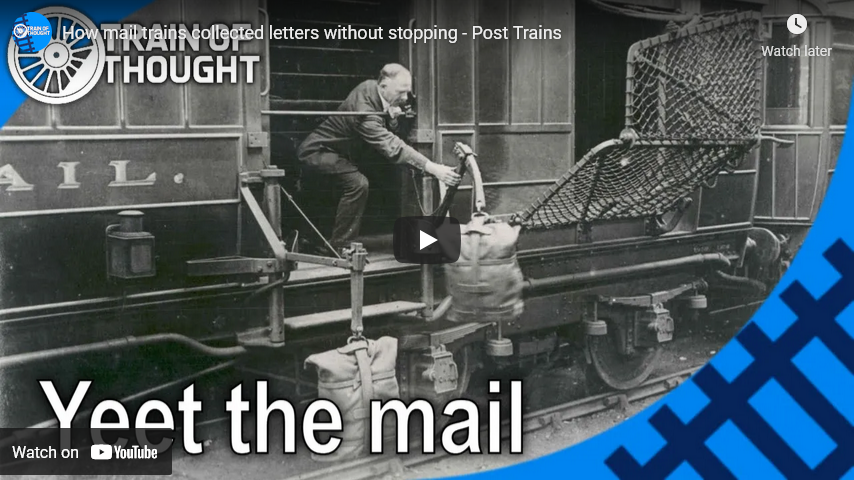
Published 3 Dec 2021In this video, we take a look at how post trains would collect and deliver mail without the need to stop, mostly by yeeting the post out of the train
This video falls under the fair use act of 1976.

Train of Thought
Published 3 Dec 2021In this video, we take a look at how post trains would collect and deliver mail without the need to stop, mostly by yeeting the post out of the train
This video falls under the fair use act of 1976.
 This month’s Classic Trains fallen flag feature is the Milwaukee Road (MILW) by George Drury. As with most major US railways, the Milwaukee Road was a long-term collection of different railway lines, some merged for obvious economic benefit and others taken over to reduce competition, but the first of the components that eventually evolved into the Milwaukee Road system was the 1847 Milwaukee and Waukesha Railroad. This line was incorporated to connect the Wisconsin city of Milwaukee to the river traffic along the Mississippi River, and the corporate name was changed even before construction began to the Milwaukee and Mississippi Railroad to more adequately convey the purpose of the line. The first segment opened in November 1850 connecting Milwaukee and Wauwatosa, a distance of five miles, then to Waukesha a few months later, then to Madison, but not extending all the way to the river at Prairie du Chien until 1857.
In that year, another of the frequent financial crises of the era struck and the company struggled on for two years, but eventually went into receivership in 1859. New owner the Milwaukee and Prairie du Chien Railroad took possession in 1861. After the Civil War, the company was merged with the Milwaukee and St. Paul and in 1874 the combined railroad became known as the Chicago, Milwaukee and St. Paul with the completion of a new line connecting with Chicago.
In the next few years the road built or bought lines from Racine, Wis., to Moline, Ill.; from Chicago to Savanna, Ill., and two lines west across southern Minnesota. The road reached Council Bluffs, Iowa, across the Missouri River from Omaha, in 1882, and reached Kansas City in 1887. In 1893 the CM&StP acquired the Milwaukee & Northern, which reached from Milwaukee into Michigan’s upper peninsula.
In 1900 the Chicago, Milwaukee & St. Paul was considered one of the most prosperous, progressive, and enterprising railroads in the U.S. Its lines reached from Chicago to Minneapolis, Omaha, and Kansas City. Secondary lines and branches covered most of the area between the Omaha and Minneapolis lines in Wisconsin, Iowa, and Minnesota. Lines covered much of eastern South Dakota and reached the Missouri River at three places in that state: Running Water, Chamberlain, and Evarts. Except for the last few miles into Kansas City and operation over Union Pacific rails from Council Bluffs to Omaha, the Missouri River formed the western boundary of the CM&StP. (“Milwaukee Road” as a name or nickname did not come into use until the late 1920s; “St. Paul Road” was sometimes used as a nickname, but the railroad’s advertising used the full name).
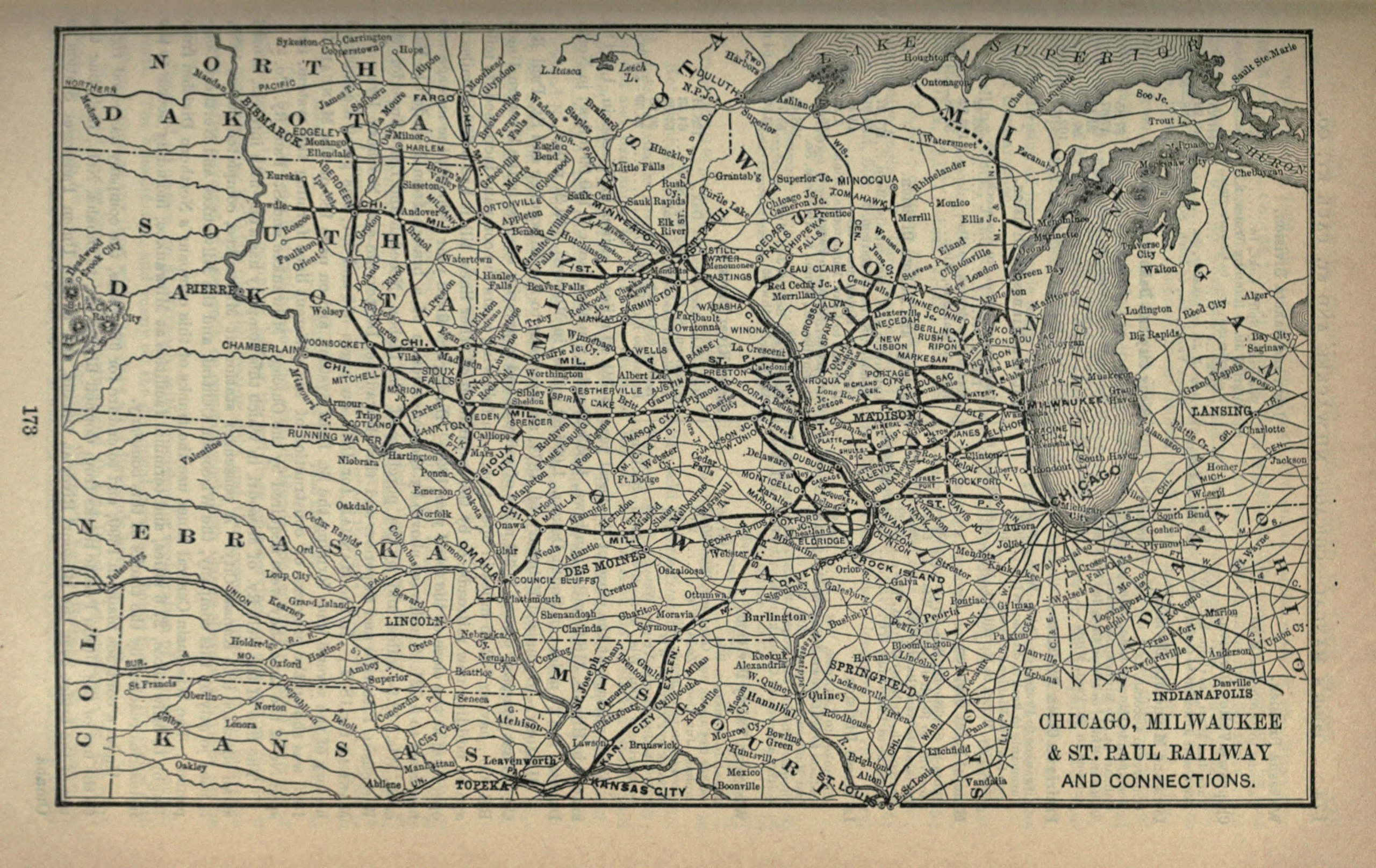
The Chicago, Milwaukee and St. Paul Railway in 1893.
Poor’s Manual of the Railroads of the United States via Wikimedia Commons.
The battle over control of the Northern Pacific and the Burlington in 1901 made the Milwaukee Road aware that without its own route to the Pacific it would be at its competitors’ mercy. At the same time the Milwaukee Road was experiencing a change in its traffic from dominance by wheat to a more balanced mix of agricultural and industrial products. Arguments against extension westward included the possibility of the construction of the Panama Canal and the presence of strong competing railroads: Union Pacific, Northern Pacific, and Great Northern. Arguments for the extension banked heavily on the growth of traffic to and from the Pacific Northwest.
In 1901 the president of the Milwaukee Road dispatched an engineer west to estimate the cost of duplicating Northern Pacific’s line. His figure was $45 million. Such an expenditure required considerable thought; not until November 1905 did Milwaukee’s board of directors authorize construction of a line west to Tacoma and Seattle.
In 1905 and ’06 the Milwaukee Road incorporated subsidiaries in South Dakota, Montana, Idaho, and Washington. The Washington company was renamed the Chicago, Milwaukee & Puget Sound Railway, and it took over the other three companies in 1908. It was absorbed by the CM&StP in 1912.
The extension began with a bridge across the Missouri River at Mobridge, 3 miles upstream from Evarts, S.D. Roadbed and rails pushed out from several points into unpopulated territory. The work went quickly, and the road was open to Butte, Mont., in August 1908.
Unfortunately for the Milwaukee, the Pacific extension was much more expensive to build than the initial estimates (it jumped from $45 million in the 1901 survey to $60 million in 1905), eventually weighing down the company books with $257 million in debt and worse, the traffic estimates for the new line turned out to be wildly optimistic. The difficulties of operating steam locomotives across the extension in winter pushed the railway toward electrification as an efficiency and cost-saving move. Beginning in 1914, sections of the line were converted to overhead catenary power until a total of 645 route-miles were being operated with electric locomotives, reportedly saving the company over a million dollars per year.
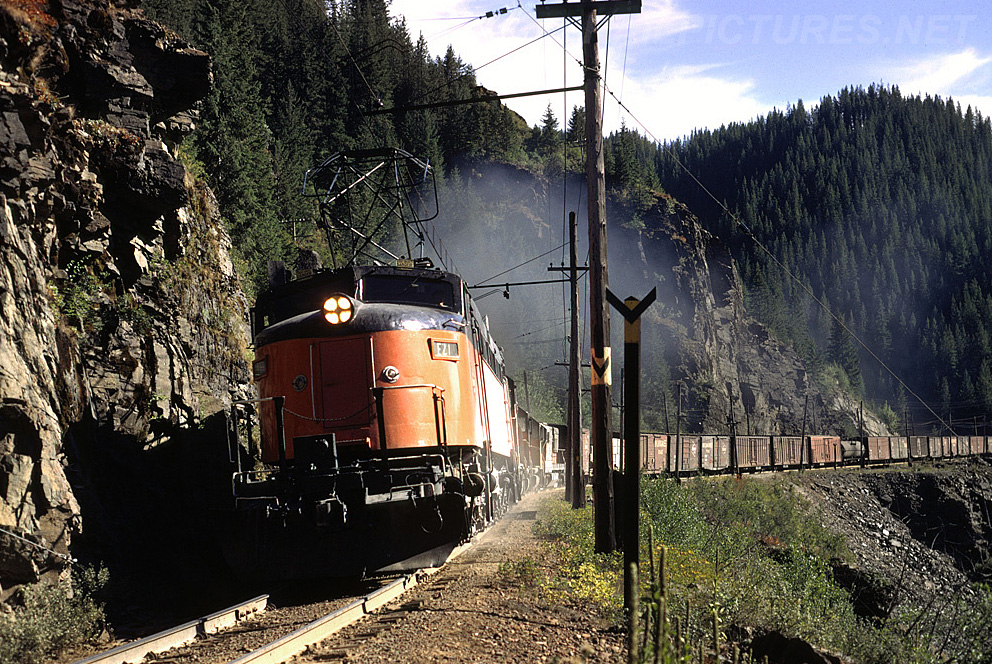
A Milwaukee “Little Joe” electric locomotive hauling a freight train along the Pacific extension in 1941. The “Little Joe” locomotives were originally built for the Soviet Union in the late 1940s but the US government cancelled the export license as relations with the Soviets deteriorated and the Cold War escalated. The Milwaukee Road bought 12 of the 20 from General Electric for $1 million during the Korean War.
Wikimedia Commons.
Despite the savings through electrification, the Pacific extension drove the company into bankruptcy in 1925, re-emerging as the Chicago, Milwaukee, St. Paul and Pacific Railroad, but the new company also had to declare bankruptcy during the Great Depression. Trustees ran the railroad for ten years until renewed civilian traffic after World War 2 allowed normal operations to resume. As with most North American railroads, the good times didn’t last and by the late 1950s, the Milwaukee’s management were looking for a merger partner to help cut costs and shed unprofitable branch lines. Unlike the rival merger of of Northern Pacific, Great Northern, Burlington Route, and the Spokane, Portland and Seattle Railway into Burlington Northern, the ICC blocked a merger between the Milwaukee Road and the Chicago and North Western. The ICC also blocked a later application for the Milwaukee to be included in the Union Pacific/Rock Island merger.
With declining business, deferred maintenance issues on most lines, and some self-induced financial issues caused by selling off rolling stock and leasing it back (which exacerbated car shortages leading to further reductions in business), the company had no funds to replace the failing “Little Joe” locomotives on the Pacific extension, so electrification was abandoned in 1974. George Drury sums up the mistakes that led to the end:
Over the decades, the road’s management had made too many wrong decisions: building the Pacific Extension, not electrifying between the two electrified portions, purchasing the line into Indiana, and in the 1960s choosing Flexivans (containers with separate wheels/bogies that required special flatcars) instead of conventional piggyback trailers.
After several money-losing years in the early 1970s, the Milwaukee voluntarily entered reorganization once again on December 19, 1977. The major result of the 1977 reorganization was the amputation of everything west of Miles City, Mont., to concentrate on what became known as the “Milwaukee II” system linking Chicago, Kansas City, Minneapolis-St. Paul, Duluth (on Burlington Northern rails from St. Paul), and Louisville (but no longer Omaha).
By 1983 the Milwaukee’s system consisted of the Chicago–Twin Cities main line; Chicago–Savanna–Kansas City; Chicago–Louisville (almost entirely on Conrail and Seaboard System rails), Milwaukee–Green Bay; New Lisbon–Tomahawk, Wis.; Savanna–La Crosse, along the west bank of the Mississippi; Marquette to Sheldon, Iowa, and Jackson, Minn.; Austin, Minn.–St. Paul; and St. Paul–Ortonville, Minn., plus a few branches.
Three roads vied for what remained of the Milwaukee: the Chicago & North Western, financially none too solid itself; Canadian National subsidiary Grand Trunk Western, with an eye toward creating a route between eastern and western Canada south of the Great Lakes; and Canadian Pacific subsidiary Soo Line.
One of my worst and most embarrassing failures as a journalist was my attempt to interview Harold Macmillan, the former British prime minister. It happened on a train near Cambridge. He was 83. I was 26. He physically fought me off, declaring in a quavering voice, “I don’t want to be interviewed; I’m much too old for that sort of thing,” as he jabbed fiercely (and quite painfully) at me with his gnarled walking stick.
Too old? Just a few years later that same wily showman drove a memorable stiletto into Margaret Thatcher’s ribs, using the same falsely quavering voice to attack her policy of selling off national assets. But I remember the humiliating occasion of my failed interview for another reason. Macmillan was able to drive me away partly because he was occupying an entire first-class compartment, reserved for him personally, on the London express. Compartments — oh, how I miss them — had sliding doors, which cut them off from the rest of the train. You could even pull the blinds down between you and the corridor. They could be marvelous private spaces for all kinds of purposes on long journeys. But you had to be lucky to get one to yourself. Once the ex-premier had driven me out, he was safe.
But Macmillan (who in those days had not given into vanity and accepted a peerage) did not have to be lucky. He had once been a director of the Great Western Railway, which had been taken into state ownership in the 1940s. So to the end of his life (in compensation for his lost power) he possessed a magical shiny token called a Gold Pass. This entitled him to free first-class travel, without limit, on any train in Great Britain. It was even rumored that it gave him the power to have trains stopped for him at stations where they did not normally halt. I often thought I would rather have such a pass than be prime minister.
Peter Hitchens, “Why I Love Trains”, First Things, 2020-07-16.
Around the beginning of the 20th century, New York investors led by J. P. Morgan gained control, and in 1903 installed Charles S. Mellen as President. Charles Francis Murphy’s New York Contracting and Trucking company was awarded a $6 million contract in 1904 to build rail lines in the Bronx for the New York, New Haven, and Hartford Railroad. An executive at the railroad said the contract was awarded to avoid friction with New York City’s Tammany Hall political machine. In response to this contract, the New York State Legislature amended the city’s charter so that franchise-awarding power was removed from the city council and given to the Board of Estimate and Apportionment, which only recently became defunct in 1989. Morgan and Mellen achieved a complete monopoly of transportation in southern New England, purchasing other railroads and steamship and trolley lines. More than 100 independent railroads eventually became part of the system before and during these years, reaching 2,131 miles at its 1929 peak. Substantial improvements to the system were made during the Mellen years, including electrification between New York and New Haven. […] Morgan and Mellen went further and attempted to acquire or neutralize competition from other railroads in New England, including the New York Central’s Boston and Albany Railroad, the Rutland Railroad, the Maine Central Railroad, and the Boston and Maine Railroad. But the Morgan-Mellen expansion left the company overextended and financially weak.
In 1914, 21 directors and ex-directors of the railroad were indicted for “conspiracy to monopolize interstate commerce by acquiring the control of practically all the transportation facilities of New England.”
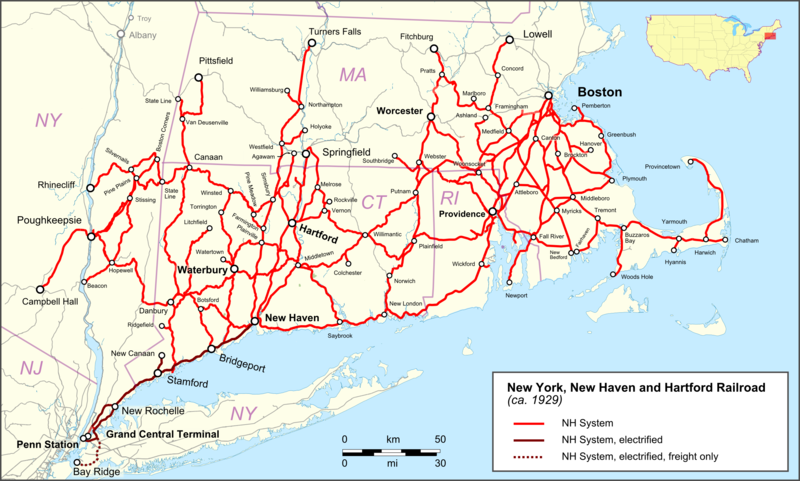
J.W. Swanberg carries on the story of the railroad’s woes during and after the First World War:
The New Haven was a financial powerhouse at the start of the 20th century, but from 1903 to 1913, the road was driven to near bankruptcy under President Charles S. Mellen and financier J.P. Morgan. One gain in this period, though, was control of the Central New England Railway, which included the Hudson River bridge at Poughkeepsie, N.Y., and the link to Maybrook and nearby Campbell Hall. This was New Haven’s gateway to the west, also served by trunk lines Erie; New York, Ontario & Western; and bridge lines Lehigh & Hudson River and Lehigh & New England.
World War I government control and the Roaring 1920s boom times saved the New Haven, but not enough to survive the Great Depression, and bankruptcy came in 1935. World War II traffic allowed recovery and rebuilding, but soon all was lost by mismanagement and bankruptcy came again in 1961. The postwar New Haven faced not only highway and airline competition but also the almost total erosion of New England’s heavy industrial base. Just a shell of the once-mighty railroad was forced into a reluctant Penn Central on Jan. 1, 1969.
One of the line’s claim to fame was the early electrification program the New Haven embarked on in 1907:
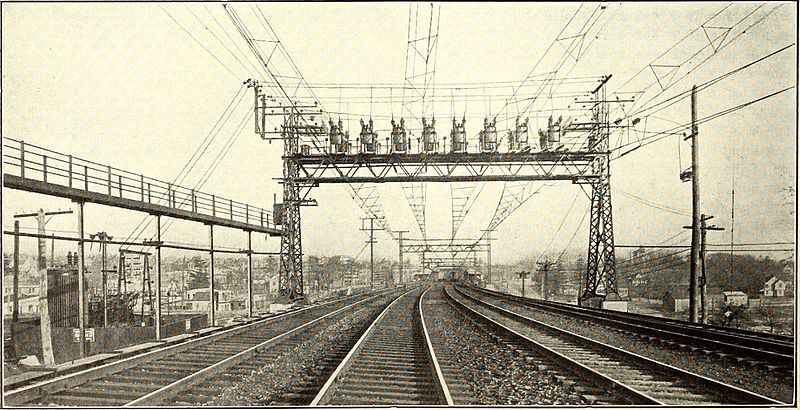
“View of Typical Sectionalizing Bridge, Auto-Transformer Installation and Cable Runway May 2, 1914.”
Photo and original caption from Electric Railway Journal via Wikimedia Commons.
The New York, New Haven and Hartford Railroad pioneered electrification of main line railroads using high-voltage, alternating current, single-phase overhead catenary. It electrified its mainline between Stamford, Connecticut, and Woodlawn, New York, in 1907, and extended the electrification to New Haven, Connecticut, in 1914. While single-phase AC railroad electrification has become commonplace, the New Haven’s system was unprecedented at the time of construction. The significance of this electrification was recognized in 1982 by its designation as a National Historic Engineering Landmark by the American Society of Mechanical Engineers (ASME).
[…]
The New Haven’s system was extended across the Hell Gate Bridge to the New York Connecting Railroad upon the line’s construction. The system of electrification was an extension of the New Haven’s revised 11/22 kV autotransformer architecture. The original electrification extended from the New Haven’s main line, across the Hell Gate Bridge, to the Bay Ridge yard. The line south of Bowery Bay Junction was de-electrified in the 1950s. The line between New Rochelle and the Harold Interlocking was transferred to Amtrak in 1976 upon dissolution of Penn Central. The electrification system continued to be controlled as a portion of the ex-New Haven system until the 1987 conversion to 60 Hz operation.
When the New Haven main line was converted by Metro-North to 60 Hz operation, the Amtrak Hell Gate line was also converted, but as an isolated system powered from the Van Nest substation. Control of the catenary system was transferred from Cos Cob to the Load Dispatcher at New York Penn Station. Although conversion occurred subsequent to the PRR-era electrification, Amtrak substation numbers 45-47 were assigned for consistency with the rest of the PRR numbering scheme.
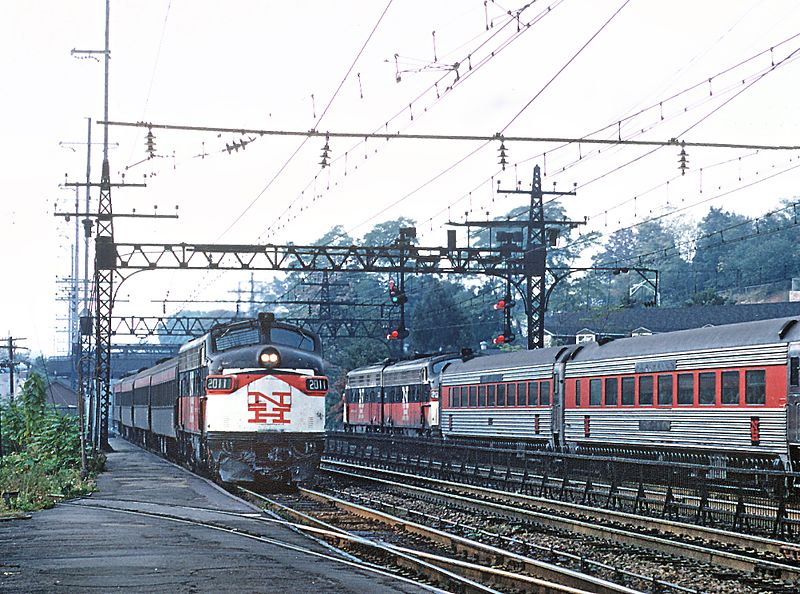
New Haven dual-power diesel-electric FL9 locomotive 2011 with train #138, a NYC – Pittsfield train, at South Norwalk, CT on October 13, 1968. The stub of the former branch to the docks is in the foreground.
Photo by Roger Puta via Wikimedia Commons.
Ruairidh MacVeigh
Published 27 Feb 2021Hello again! 😀
Back to trains, and for this week we discuss one of Britain’s most audacious but ultimately futile projects to revitalise the network in the wake of World War II. However, rather than undertaking a comprehensive rebuild of the network, British Railways was short-changed time and again, ultimately resulting in a facelifted but largely unchanged system that dated back to the Victorian era, though it was much smaller and crippled by far more debt than ever before.
This video was actually a suggestion from an American viewer, who was curious as to why British Rail had such a vast array of diesel locomotives during its early years. 🙂
All video content and images in this production have been provided with permission wherever possible. While I endeavour to ensure that all accreditations properly name the original creator, some of my sources do not list them as they are usually provided by other, unrelated YouTubers. Therefore, if I have mistakenly put the accreditation of “Unknown”, and you are aware of the original creator, please send me a personal message at my Gmail (this is more effective than comments as I am often unable to read all of them): rorymacveigh@gmail.com
The views and opinions expressed in this video are my personal appraisal and are not the views and opinions of any of these individuals or bodies who have kindly supplied me with footage and images.
If you enjoyed this video, why not leave a like, and consider subscribing for more great content coming soon.
Thanks again, everyone, and enjoy! 😀
References:
– Railways Archive (and their respective sources)
– RMWeb (and their respective sources)
– Wikipedia (and its respective references)
Forgotten Weapons
Published 18 May 2021http://www.patreon.com/ForgottenWeapons
https://www.floatplane.com/channel/Fo…
Cool Forgotten Weapons merch! http://shop.forgottenweapons.com
Only days ahead of the French Army in April 1945, Ott-Helmuth von Lossnitzer and about 250 Mauser engineers and technicians fled Oberndorf with the core of Mauser’s new projects. They had the drawings, components, and gages for guns like the new StG-45 assault rifle, MK214 aircraft cannon, and Volkspistol and they were headed for an impregnable series of tunnels in the Austrian Alps to carry on the war. In a story that is absolutely worthy of film adaptation they scrounged a series of locomotives, dodged P47 Thunderbolt attacks, and went careening through the Alps with about 2 dozen boxcars of the most important prototype guns in the German arsenal.
Of course, the idea of continued resistance was a complete fantasy. When it did finally arrive in Ötztal, the Mauser refugees found all the tunnels already occupied by other groups with the very same idea. So they basically made camp and waited for American forces to arrive. The train was found by a British-American CIOS (Combined Intelligence Objective Subcommittee) party, the engineers were all questioned, and the train contents packed up for shipment to the UK and US. Ott-Helmuth von Lossnitzer himself emigrated to the US as part of Operation Paperclip, where he worked for Springfield Arsenal for many years until retiring in 1968 and then living in Wisconsin until his passing in 1989.
For anyone interested in this story, I highly recommend Lossnitzer’s oral recollections compiled into book form by Leslie Field and Bas Martens – ISBN 9789081737807. It is out of print now, but you may be able to find it on the secondary market.
Much more accessible is the reprinting of the original CIOS report on Mauser published by Peter Dallhammer (whom you may recall from his Textbook of Pistol Technology and Design). This is a 360-page treasure trove of details on Mauser’s ongoing R&D in 1945, and it is available on Amazon:
https://amzn.to/2RrnNgTContact:
Forgotten Weapons
6281 N. Oracle 36270
Tucson, AZ 85740
Biographics
Published 23 Mar 2020Check out Brilliant: https://brilliant.org/biographics
Check out Business Blaze: https://www.youtube.com/channel/UCYY5…
This video is #sponsored by Brilliant.
TopTenz Properties
Our companion website for more: http://biographics.org
Our sister channel TopTenz: https://www.youtube.com/channel/UCQ-h…
Our Newest Channel about Interesting Places: https://studio.youtube.com/channel/UC…Credits:
Host – Simon Whistler
Author – Morris M.
Producer – Jennifer Da Silva
Executive Producer – Shell HarrisBusiness inquiries to biographics.email@gmail.com
Source/Further reading:
Oxford National Dictionary of Biography: https://www.oxforddnb.com/view/10.109…
Interesting podcast on his life: https://www.bbc.co.uk/programmes/b04n…
Britannica: https://www.britannica.com/biography/…
History Today: https://www.historytoday.com/archive/…
The Thames Tunnel: https://www.smithsonianmag.com/histor…
The atmospheric railway: https://www.theguardian.com/science/t…
SS Great Britain accident: https://www.ssgreatbritain.org/about-…
The Western Pacific company magazine Mileposts included this historical snippet in their 50th anniversary issue (courtesy of the Western Pacific Railroad Museum):
Virgil Bogue had become George Gould’s consulting engineer and recalling his surveys for the Union Pacific in the ’80’s, recommended Beckwourth Pass and the Feather River route. Remembering also an unhappy experience he had once had in locating any other road, only to find the whole route plastered with mining claims of dubious mineral value but through which rights of way must be negotiated, he advised Gould to form a “mining company” first. Accordingly the North California Mining Company was organized and soon nearly 600 placer claims were staked out, blanketing the entire proposed route across the mountains.
Gould turned the job over to the Denver and Rio Grande and its president, E.T. Jeffery, sent a field party under H.H. Yard west to locate the line. It was all top secret. The transit men and stake artists were forbidden even to let their wives know where they were. Letters could only be exchanged through the Denver office of the railroad. Two California corporations, the Butte and Plumas Railway and the Indian Valley Railway, were set up to be the figureheads.
[…]
George Gould still remained completely out of the picture and denied all connection with the project. Although he financed the new surveying parties that were immediately sent out to make the final location, he was forced, in the interests of this secrecy, to keep the Rio Grande engineers in the field as well. The absurd result was two hostile groups struggling to outwit each other and often on the point of exchanging pot shots, though both were actually on the same payroll.
After much chicanery and effort, the railway’s right of way through the Feather River Canyon, the next historically significant fight was securing access to the waterfront along San Francisco Bay, where the legal department of the Southern Pacific believed they had an ironclad monopoly of all the potentially useful access routes to salt water:
… the S.P. was fully confident that it would have but little difficulty in isolating the Western Pacific from a practical outlet on the Bay. The Santa Fe, only a few years before, had built its ferry slip way up at Point Richmond rather than attempt to crack the S.P. stronghold. Bartnett, after a hard struggle against the older railroad’s influence, did secure a small site on the mudflats of the Oakland Estuary. It would have made a miserably cramped ferry terminal but, from all appearances, the WP promoters had concluded it was the best they could do. Harriman’s forces sneered and relaxed. Gould’s were just beginning. Every move was carefully rehearsed and logistics figured to the last detail.
As the Oakland tidelands had gradually been filled in, the Government had extended the banks of San Antonio Estuary with rock quays called “training walls” in order to prevent silt from washing into the Oakland inner harbor channel. A dredger was often necessary to prevent the formation of a bar at the entrance of the channel. This dredger became the Trojan horse of the Gould attack.
On the night of January 5, 1906, the Western Pacific forces under Bartnett struck.
With 200 workmen and 30 guards armed with carbines and sawed-off shotguns, he used the dredging company as a front, and seizing the north training wall, began feverishly to lay a rough track. Most of the guards took up positions at the shore end of the U. S. training wall and maintained them night and day. Laborers snatched their sleep in shelter tents on the wave-washed rocks and the WP commissary department fed them. Scows rushed more rails and ties across the Bay to the end of the wall. Soon there was a mile of track on top of the rock wall.
Of course the Southern Pacific did not quietly accept this outrageous trespassing on domains it had held undisputed for more than half a century. Its legal department, fairly in convulsions, was whipping out the necessary papers for immediate appeal to the law. This was exactly what Bartnett had told Gould would happen and exactly what they both desired. For the courts, as Bartnett had felt sure they would, held that the Southern Pacific title to the waterfronts had not progressed westward with the shoreline as the tidelands and marshes had been filled in, but was valid only to the low tide line of 1852. The S.P.’s “waterfront” therefore was by now well inland, and the new marginal land surrounding it was the property of the city.
The city government was duly grateful to the new railway for almost literally liberating the city’s shoreline from the grip of the Southern Pacific. With most of the legal complications (and paramilitary solutions) out of the way, construction of the full line began in earnest, as Arthur L. Lloyd picks up the story:
Construction started in Salt Lake City. The line would be all 90-lb. rail and have no curve exceeding 10 degrees. To keep to the 1-percent maximum grade, the full-circle Williams Loop was built between Massack and Spring Garden, Calif., and another partial one, Arnold Loop, west of Wendover, Nev.
Work also went from Oakland eastward, and the last spike marking completion was driven on the bridge over Spanish Creek at Keddie, Calif., on Nov. 1, 1909. There was no ceremony. Section foreman Leonardo de Tomasso, age 25, did the honors with a standard steel spike. Arthur Keddie was still around, though. He rode WP’s first passenger train, and he spoke from the Plumas County Courthouse steps in Quincy, Calif., on Nov. 21, 1910.
WP was dispatched completely by train orders and timetable; its only block signals were on the paired track between Weso (Winnemucca) and Alazon (Wells) in Nevada, where eastbound WP and Southern Pacific trains used WP, while both roads’ westbounds used SP.
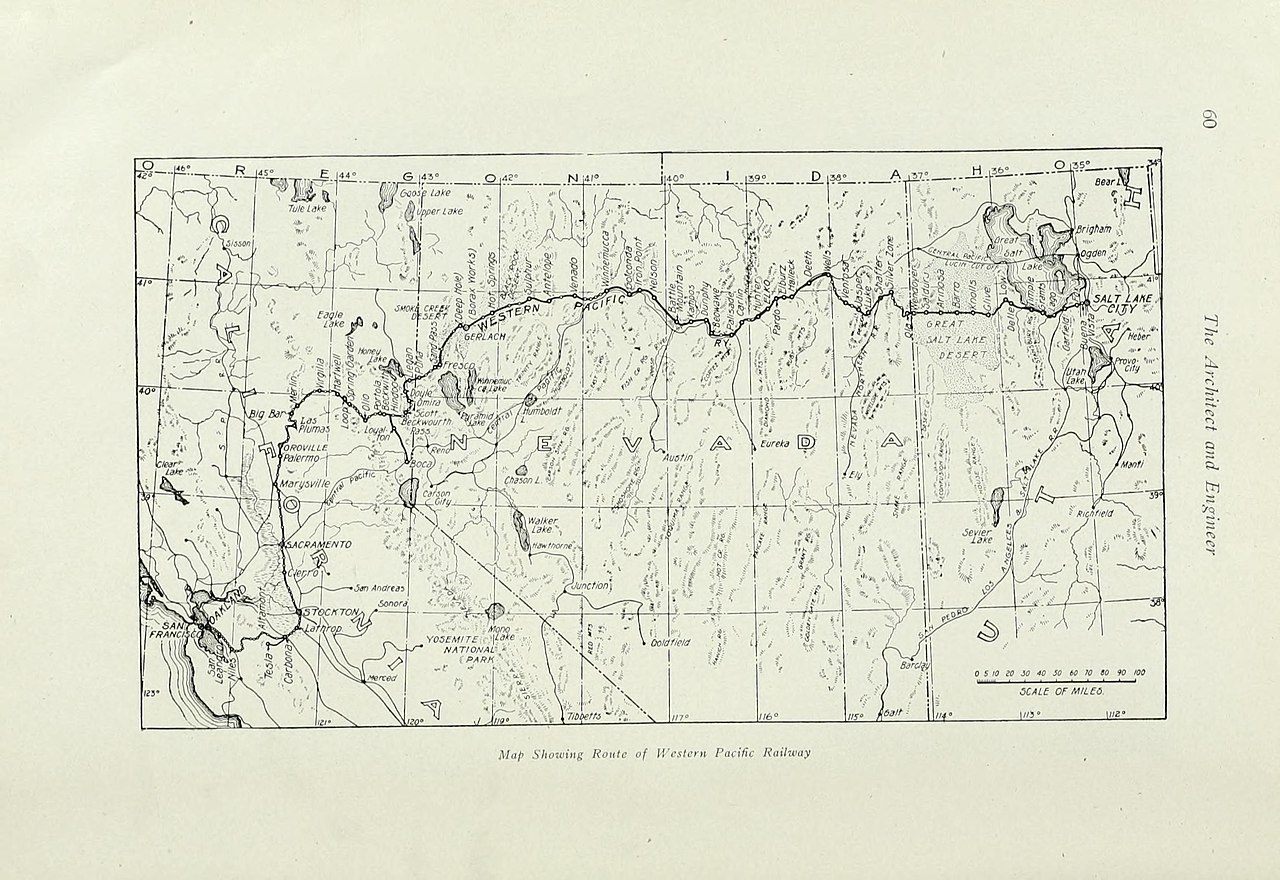
Route map of the Western Pacific, published in The Architect & Engineer of California and the Pacific Coast, 1905.
WP’s map was simplicity itself, highlighted by a main line from San Francisco Bay to Salt Lake City and a connection with the Rio Grande. The branch to Bieber, Calif., completed in the 1930s, connected to a Great Northern line.
realtimehistory
Published 30 Jun 2021Support Glory & Defeat: https://realtimehistory.net/gloryandd…
Welcome to the first primer episode for Glory & Defeat. In this first primer episode we will take a broad look at the industrial revolution and the emerging new ideologies of the 19th century: Communism and Nationalism.
» OUR PODCAST
https://realtimehistory.net/podcast – interviews with historians and background info for the show.» LITERATURE
Hobsbawm, Eric: The long nineteenth century. 3 Bände. London 1962-1987Kugler, Martin: “Fehleinschätzungen der Menschheit”, in: Die Presse v. 28.2.2010. o.S
Osterhammel, Jürgen: Die Verwandlung der Welt. Eine Geschichte des 19. Jahrhunderts. München 2009
Bruckmüller, Ernst et. al. (ed.): Putzger. Historischer Weltatlas. Berlin 2001
Staas, Christian: “Im Schatten der Schlote”, in: Geo Epoche Nr. 30. Die industrielle Revolution. 2008. S. 72-85
Bischoff, Jürgen: “Vorwärts durch Raum und Zeit”, in: Geo Epoche Nr. 30. Die industrielle Revolution. 2008. S. 56-71
» SOURCES
Engels, Friedrich: Die Lage der arbeitenden Klasse in England. Leipzig 1845» OUR STORE
Website: https://realtimehistory.net»CREDITS
Presented by: Jesse Alexander
Written by: Cathérine Pfauth, Prof. Dr. Tobias Arand, Jesse Alexander
Director: Toni Steller & Florian Wittig
Director of Photography: Toni Steller
Sound: Above Zero
Editing: Toni Steller
Motion Design: Philipp Appelt
Mixing, Mastering & Sound Design: http://above-zero.com
Maps: Battlefield Design https://www.battlefield-design.co.uk/
Research by: Cathérine Pfauth, Prof. Dr. Tobias Arand
Fact checking: Cathérine Pfauth, Prof. Dr. Tobias ArandChannel Design: Battlefield Design
Contains licensed material by getty images
All rights reserved – Real Time History GmbH 2021
Christian Wolmar, Engines of War: How Wars Were Won & Lost on the Railways, 2010.
In The Critic, Jonathan Glancey sings the praises of the steam locomotive designs and liveries of the pre-nationalization Great Western Railway:
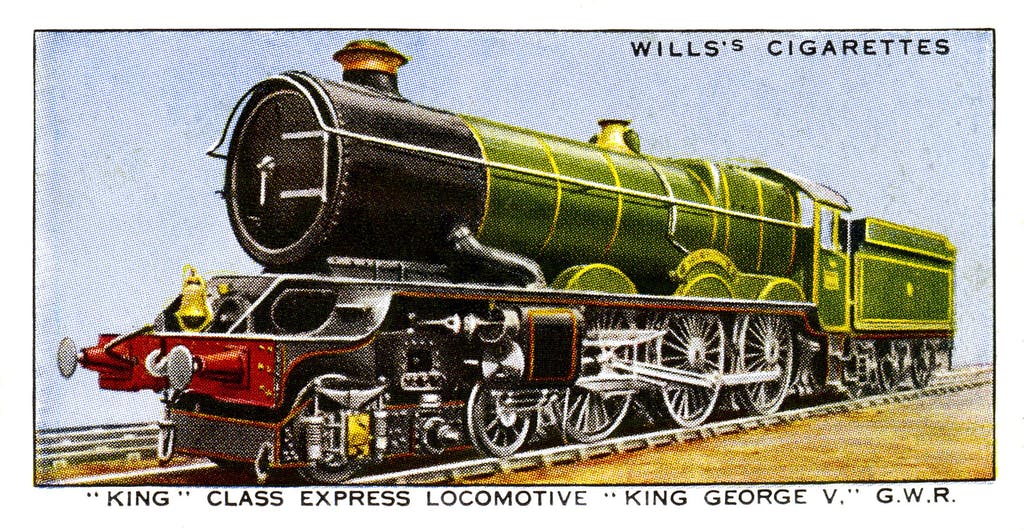
The greatest of all Great Western Railway locomotives were the King Class 4-6-0s. From 1927, and for more than 30 years, they headed principal express trains from Paddington to Bristol, Plymouth, South Wales and the West Midlands with power, precision and truly regal style.
In a livery of lined dark green with copper-capped chimneys, brass safety valve covers, and names emblazoned above their driving wheels, the Kings led long chocolate and cream-coloured trains through landscapes they enhanced in days of both private and public ownership. Together with their less powerful shed-mates — Castles, Halls, Granges and Manors — these puissant machines breathed “Great Western” with every beat of their crisp exhausts.
In the beginning, the Kings were to have been Cathedrals, an appropriate name for locomotives representing a concern that, incorporated in 1835 and engineered by Isambard Kingdom Brunel, was revered by many employees, passengers and most enthusiasts as something more akin to a religion than a mere railway. Its engineering was progressive, and yet its corporate identity (what today’s marketing jargoneers would call its “brand”) retained a gloriously ecclesiastical and slightly old-fashioned air throughout the railway’s life.
Sir William Stanier, a Great Western engineer who moved from Swindon to the LMS at Crewe and then to the chairmanship of Power Jets in the Second World War, was asked by Cuthbert Hamilton Ellis, a writer on railways, “whether there was some nameless cabal at Swindon which ruled the styling of a Great Western locomotive” from the latest 1940s designs back through the Edwardian Saints and Stars to engines of the 1880s designed by William Dean. Stanier smiled and exclaimed: “Dean? Gooch! [the GWR’s first locomotive engineer]. It was traditional.”
The tradition lives on. In 2015, today’s Great Western Railway — an operation owned by the multi-national FirstGroup — adopted a handsome dark green livery, created by the design agency Pentagram, that reaches back to the Kings and, by association, all the way to Gooch and Brunel.
The new look was sung as if from the Great Western’s “Ancient and Modern” hymn book of design. In a privatised railway world of largely gimcrack style and branding, with all too many trains looking as if their design inspiration has been that of sports shoes or the packaging of sweets such as Refreshers, the Great Western re-introduced gravitas, continuity and regional sensibility to the way its trains looked.
This is something those in charge of the newly announced Great British Railways (GBR) should think about carefully as this new public body takes over the national railway infrastructure in 2023, its remit including corporate identity. While its name is, perhaps, rather too close to Little Britain’s Great British Air, the possibility of it exercising a civilising influence over the design of our trains is there. A national design standard and identity could yet be created that speak of the unity of the British railway network and its diversity in the same breath.
Illinois Central Herald from a 1937 Passenger timetable.
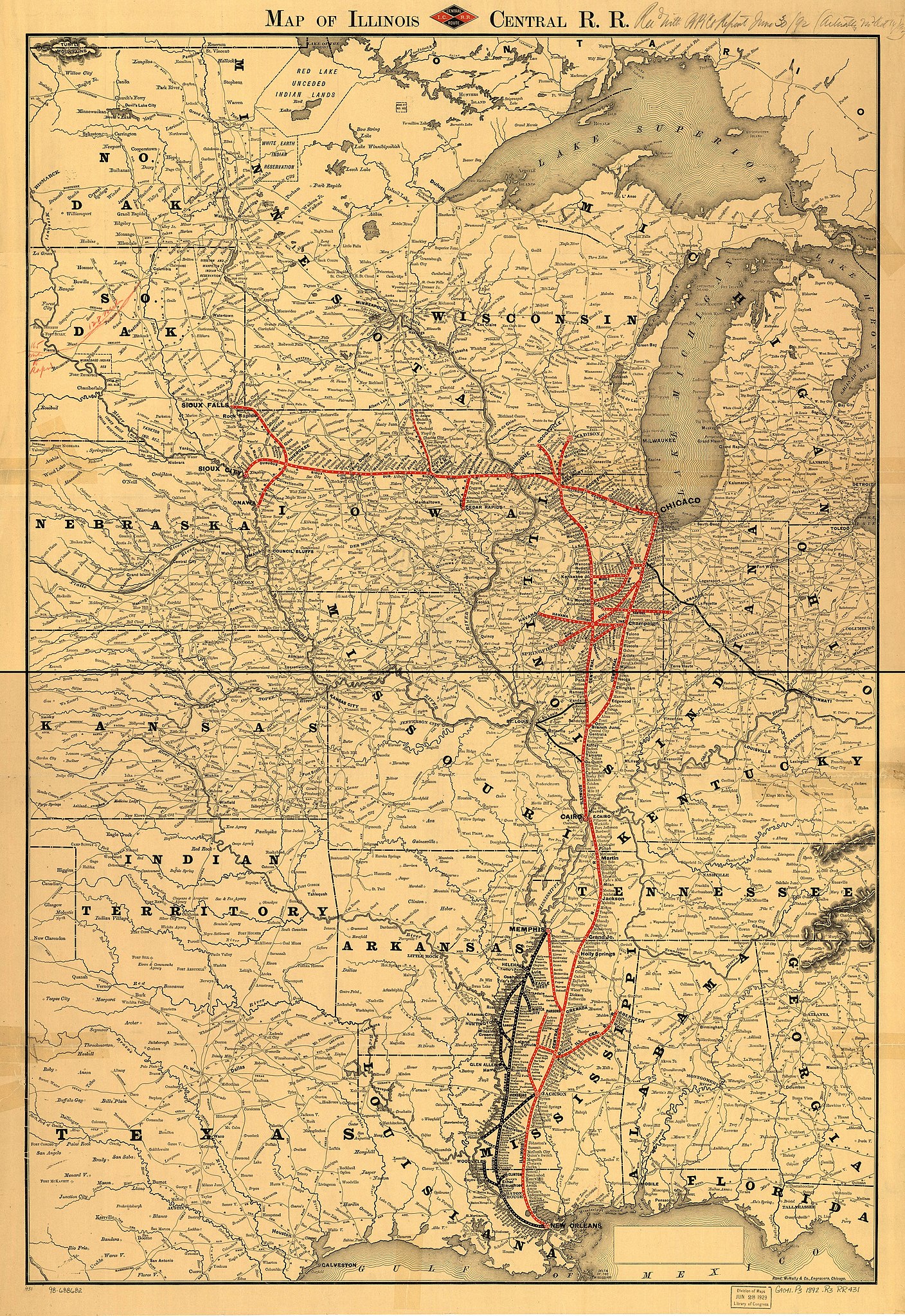
The IC (nicknamed the “Main Line of Mid-America”) was originally incorporated in 1836 to build a rail connection from Cairo to Galena with a branch to Chicago, but didn’t receive federal support until 1850 and the company was finally granted a charter in 1851. The IC was the first “land grant” railroad in the United States, and prominent Illinois politicians were deeply involved in the railroad (Senator Stephen Douglas and future President Abraham Lincoln). The line was completed in 1856 and the “branch” to Chicago rapidly became the busiest portion of the line. After the Civil War, the IC expanded out of Illinois into Iowa and then by acquisition and consolidation eventually reached Louisville, Kentucky and New Orleans, Louisiana with many branches and secondary lines throughout the eastern half of the Mississippi valley. In the 1880s, the IC also expanded north and west, reaching locations in Wisconsin, South Dakota, and Nebraska by the end of the century.
During the 1880s, the IC came under the control of E.H. Harriman and as a result were one of the railroads that were involved in the union actions that ran from 1911 until 1915. The IC and the other Harriman-controlled railways had existing contracts with the individual trade unions representing workers on each line, but the unions hoped to force the railways to recognize a “System Federation” of the separate unions that would negotiate as a single unit. The IC refused and hired strikebreakers to fill the positions vacated by striking union members — including many African-American men who would not normally have been allowed to work in those positions on southern railways. Sporadic violence in 1911 and 1912 resulted in the deaths of at least 12 men and 30 others were killed in a steam locomotive boiler explosion in San Antonio, Texas. It was generally seen as a failure by mid-1912, but the strike didn’t formally end until 1915. The unions tried again in 1922 in the Great Railroad Strike, which was an even larger attempt by the unions to operate as a single bargaining unit, and another ten people were killed during the conflict but it lasted only a couple of months and failed to achieve its aims.
Although the major portions of the system were in place by World War 1, there were some additional lines added through to the 1960s, merging or acquiring control of lines like the Yazoo & Mississippi Valley, the Gulf & Ship Island, the Chicago, St. Louis & New Orleans, the Alabama & Vicksburg, and the Vicksburg, Shreveport & Pacific. George Drury picks up the story in mid-century:
In the 1950s and early ’60s IC purchased several short lines: former interurban Waterloo, Cedar Falls & Northern (jointly with the Rock Island through a new subsidiary, Waterloo Railroad); Tremont & Gulf in Louisiana; Peabody Short Line, a coal-hauler at East St. Louis, Ill.; and Louisiana Midland.
In 1968 Illinois Central acquired the western third — Nashville to Hopkinsville, Ky. — of the Tennessee Central when that financially ailing line was split among IC, Louisville & Nashville, and Southern.
Illinois Central Gulf
Illinois Central and parallel Gulf, Mobile & Ohio merged on August 10, 1972, to create the Illinois Central Gulf Railroad, a wholly owned subsidiary of Illinois Central Industries. GM&O was a likely merger partner for Illinois Central, as it was a north-south railroad through much the same area as IC. As part of the merger, ICG took over three Mississippi lines: Bonhomie & Hattiesburg Southern; Columbus & Greenville; and Fernwood, Columbia & Gulf.
The north-south lines of ICG’s map resembled an hourglass. Driving across Mississippi or Illinois from east to west, you could encounter as many as eight ICG lines. The former IC system converged at Fulton, Ky., and the former GM&O main line was less than 10 miles west of Fulton at Cayce.
[…]
On Feb. 29, 1988, the railroad changed its name back to Illinois Central, having divested itself of nearly all the former GM&O routes it acquired in 1972, when it added “Gulf” to its name. At the end of 1988 the Whitman Corp. (formerly IC Industries) spun off the railroad, which then dropped “Gulf” from the name, and in August 1989 control of the railroad was gained by the Prospect Group, which formerly controlled spinoff MidSouth Rail.
IC managers eventually turned their eyes west, to the Chicago, Central & Pacific, which it had sold in 1985. It saw CC&P’s route as a source of grain traffic and perhaps a way to get some of the coal moving east from Wyoming. In June 1996 IC purchased the CC&P. The line remains active.
In February 1998 Canadian National Railway agreed to purchase the IC, creating a 19,000-mile railroad. CN absorbed IC in July 1999, and IC lost its own identity within the CN system.
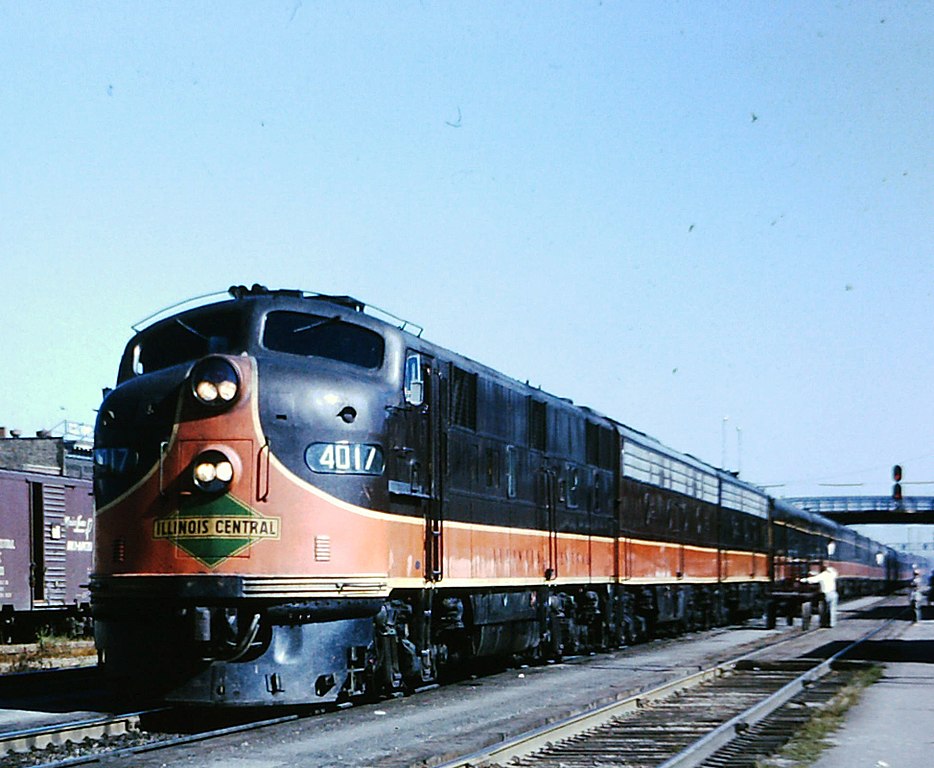
The Illinois Central’s City of New Orleans at Kankakee, Illinois in August, 1964. The train is led by EMD E7 #4017.
Photo by Lawrence and David Barera via Wikimedia Commons.
MOS6510 Models
Published 29 May 2020Airfix Catalogue 1962 Page by Page — The Very First Catalogue
We turn back time and go through the very first Airfix Model kit Catalogue one page at a time. 1962 was the year of the first edition Catalogue of Airfix Constant Scale Construction Kits. Filled with 135 kits — planes, trains and automobiles the norm, with figures trackside OO/HO constant scale. There is lots in here to look at and enjoy.
As you flip through the pages of this Airfix Catalogue, you will see details of over 135 constant scale plastic construction kits. From the photographs and brief descriptions you will get an idea of the look and size of the finished models. Not until you begin to build them, however, will you feel the excitement and satisfaction of creating miniature exact scale models of famous fighter planes, tanks and ships. So put this video on HD 1080p and make it full screen … sit back and enjoy this catalogue page by page
If you liked the video you can buy me a coffee here
https://www.buymeacoffee.com/mos6510Music credit : Music by @ikson -alive https://youtube.com/ikson
Find me on
Twitter : https://twitter.com/MOS6510YT
instagram : https://www.instagram.com/mos6510yt/
Reddit : https://www.reddit.com/r/Scalemodelclub/
Discord : https://discord.gg/e8dp3SGInformation on kits was researched using https://www.scalemates.com plus other websites and forums found on the internet
Links below are affiliated and i will get a small commission which help keep the channel in models
Buy Airfix kits here https://www.tagserve.com/clickServlet…
Tools….
Hardcastle 9 Drawer Red Lockable Topchest Tool Box https://amzn.to/32BjwJ2TaoTronics LED Desk Lamp, 5 Lighting Modes with 7 Brightness Levels, Touch Control, USB Charging Port, https://amzn.to/2Ts3D3k
Smart Weigh SWS600 Elite Pocket Sized Digital Scale https://amzn.to/2vgD5uc
Buy The Humbrol Workstation Bundle here https://amzn.to/2o0aLIr
I get all my Tamiya supplies from http://elementgames.co.uk/?d=10388
Small Acrylic Caddie For Paints, Glues Brushes https://ebay.us/60PFMj
Tweezers I use are https://amzn.to/37B7UXQ
Sprue Cutters
Tamiya 74035 – https://amzn.to/36wqhfP
Plato Model 170 – https://amzn.to/37th0pTHobbyZone Paint Stand / Rack 36mm They fit Tamiya Paints and other paints under 36mm diameter. https://amzn.to/38JgEw7
26mm version https://amzn.to/2NhMIQL
41mm version https://amzn.to/2I1naTC
Other Racks Here https://amzn.to/2Q2qK6g0:01 Airfix Catalogue 1962
0:05 Airfix catalog 1962,
0:10 first edition airfix catalogue,
0:31 Vintage airfix catalog,
0:32 vintage airfix catalogue,
0:33 the very first airfix catalog,
the very first airfix catalogue,
constant scale plastic construction kits,
airfix first edition 1962,
catalogue design of airfix constant scale construction kits,
Airfix aircraft series 2,
Airfix scale model kits catalogue,
1:00 airfix first ever catalogue,
1:15 airfix catalog,
1:20 airfix catalogue
2:20 airfix old catalogue
 This month’s Classic Trains fallen flag feature is the Central Railroad of New Jersey (CNJ) by Peter Brill. The first of the two original lines that merged to become the CNJ was granted a charter as the Elizabethtown and Somerville Railroad to create a connection from Elizabeth, New Jersey to Somerville, including a ferry into New York City. The charter was dated 9 February, 1831 and the line was completed in 1842. The Somerville and Easton received a charter in 1847 to connect the existing Elizabethtown line to Easton, Pennsylvania and the new connecting line was leased by the Elizabethtown and Somerville in 1848 and then purchased outright in 1849. The combined railroads merged as the Central Railroad of New Jersey in February of that year.
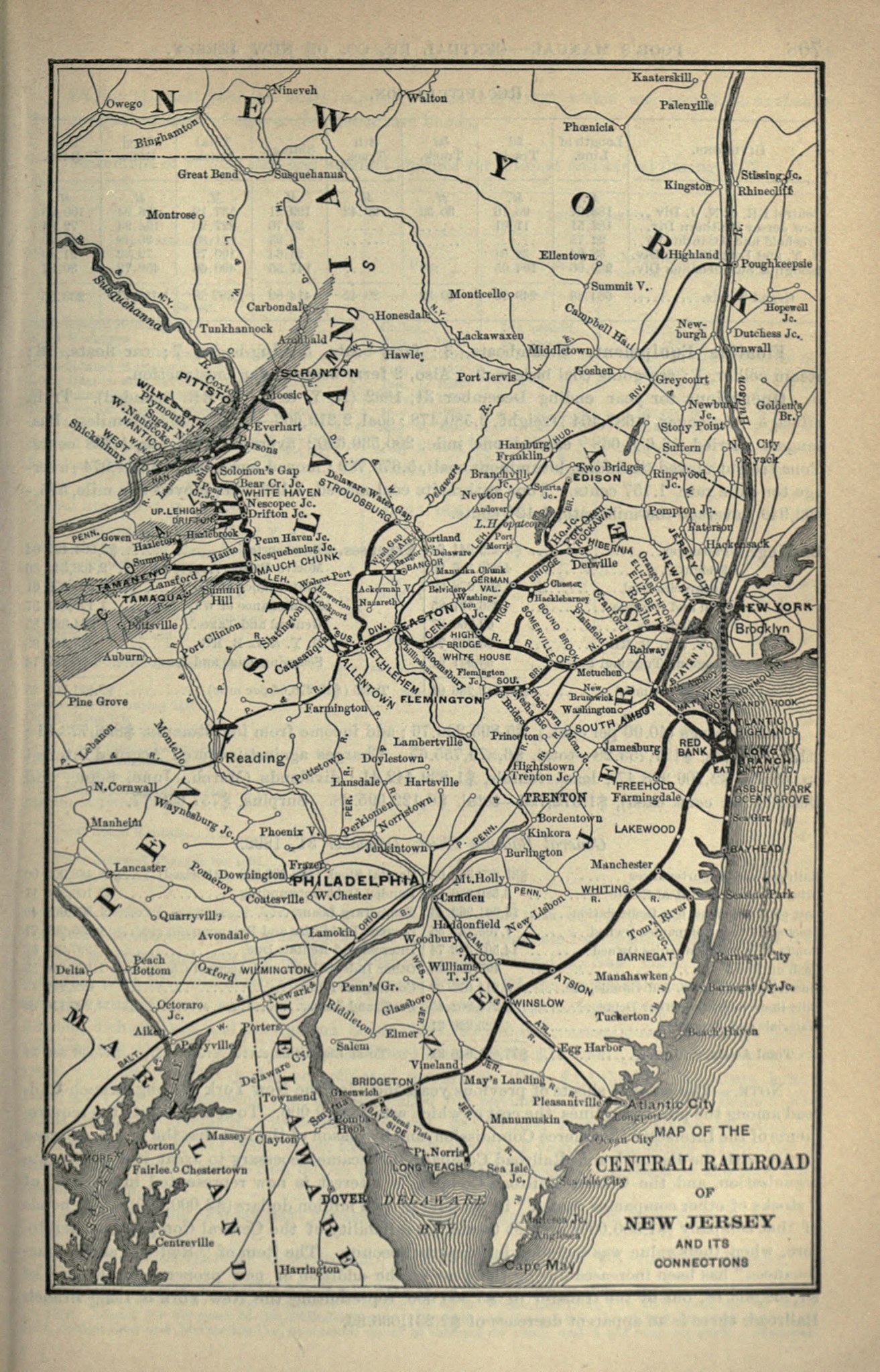
Map of the extent and connections of the Centrail Railroad of New Jersey in 1893.
Poor’s Manual of the Railroads of the United States via Wikimedia Commons.
Click to see full-size image.At its peak, the Central Railroad of New Jersey, the self-proclaimed “Big Little Railroad”, operated only about 700 route-miles, but in keeping with its densely populated region, totaled over 1,900 miles of track, two-thirds in New Jersey. CNJ’s Central Division extended from Jersey City to Phillipsburg, on the Delaware River. The Lehigh & Susquehanna Division (later Central Railroad of Pennsylvania, then the Penn Division) went west from Easton, Pa., to Allentown, then north to Wilkes-Barre and Scranton. The Southern Division, from Red Bank to Bridgeton/Bayside, was reached from Elizabethport via CNJ’s Perth Amboy Branch and the New York & Long Branch.
Although “little” in geographic span — it’s just 191 miles from Jersey City to Scranton — CNJ was “big” in traffic density. Between Jersey City and Raritan, 35 miles of commuter territory, four to six main tracks handled 300 daily commuter trains carrying 35,000 riders plus local freights, longer-distance passenger and freight trains, and, east of Bound Brook Junction, through Baltimore & Ohio/Reading traffic from Philadelphia and beyond.
[…]
CNJ’s evolution from tidewater connection to competing anthracite road coincided with LV [Lehigh Valley] and DL&W [Delaware, Lackawanna & Western] developing their own routes to New York Harbor. CNJ originally based its Pennsylvania operations in Mauch Chunk (now called Jim Thorpe). Narrow-gauge “lokies” worked the Wanamie Colliery on the Nanticoke Branch until 1967, and CNJ hauled the anthracite to Ashley’s Huber Breaker. In 1892, Central States Dispatch, a fast freight route on B&O, Western Maryland, RDG [Reading], CNJ, Lehigh & Hudson River, and New Haven, commenced via Allentown Yard.
In 1893, America’s first automatic, motor-operated semaphore signal was installed on CNJ at Black Dan’s Cut east of Phillipsburg. Installation of twin McMyler car dumpers at Pier 18 in Jersey City in 1919 created CNJ’s foremost destination for anthracite and bituminous coal into the 1960s. In 1925, what is regarded as America’s first successful commercial diesel locomotive, CNJ 1000, a 300 h.p. box-cab, began a 27-year assignment at Bronx Terminal. The bridge over Newark Bay was replaced in 1926 by a 1.4-mile, 4-track, 2-span, lift-type drawbridge. In the 1930s, one of the country’s most modern traffic control towers was installed at Elizabethport to control the convergence of the multi-track Central Division main with the Newark and Perth Amboy branches. E’port also hosted CNJ’s main shops.
Two Blue Comet consists, Packard blue with gold lettering and window bands of Jersey cream, in 1929 introduced luxury coach service at no extra charge between Jersey City and Atlantic City. Later that year, The Bullet debuted similar service between Jersey City and Wilkes-Barre. Specially painted Pacifics handled both: royal and Packard blue with gold striping and lettering for the Comet and dark olive with gold striping and chromium trim for The Bullet. The latter ran only two years, but the Comet lasted until 1941.
CNJ entered a 10-year bankruptcy in 1939 while controlled by the Reading, which in turn was controlled by B&O. During World War II, the German submarine menace diverted eastbound oil products from tanker to tank car, and CNJ delivered up to 1,000 loads a day, half the New York area’s requirement, until pipelines were built. In 1944 CNJ became “Jersey Central Lines” and adopted the Statue of Liberty emblem.
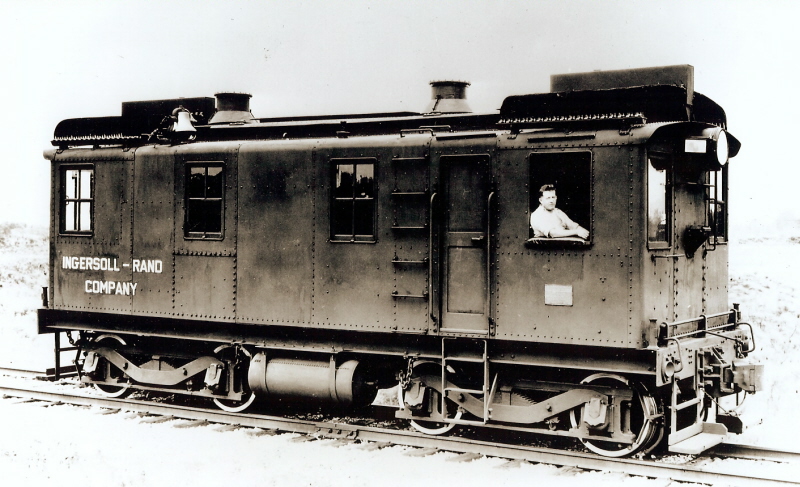
Builder’s photo of CNJ 1000, the first diesel-electric switch engine built by ALCO in conjunction with Westinghouse for the electrical equipment and Ingersoll-Rand for the prime mover. Built 1924 and sold to CNJ in 1928. This unit was retired from active service in 1957.
Wikimedia Commons.
In The Critic, Brice Stratford looks at the British government’s “nationalization if necessary, but not necessarily nationalization” scheme to once again reform Britain’s passenger railway network:
Astonishing scenes this week, whereby the Tory government announces a White Paper to re-nationalise the railways. The union bosses and Guardianistas who have called for such policy for decades immediately decided that actually it’s a terrible idea, or that this doesn’t count as re-nationalising because it’s the Conservatives doing it, or that calling the new entity “Great British Railways” just because it will run Great Britain’s railways is so offensive that the entire project should be called off. It’s all very tribal, and very silly, and very 2021, alas.
Of course, the Department for Transport (DfT) is still afraid of admitting that this is in fact renationalisation, as to do so would be to rile up certain elements of the Right, and to admit what we all know: that their generations-long experiment in railway privatisation has been a failure. Today we have a service which is overpriced, unreliable, and generally an unpleasant and ineffective experience from start to finish.
The postwar Labour government included railway nationalization in its many, many reforms to the economic life of Britain and in 1948 the remaining railway systems were unified as British Railways. By the 1960s, the system was losing money at a high rate of speed, so Dr. Beeching was called upon to recommend how to put the railway if not into profit then at least into a much more acceptable rate of loss:
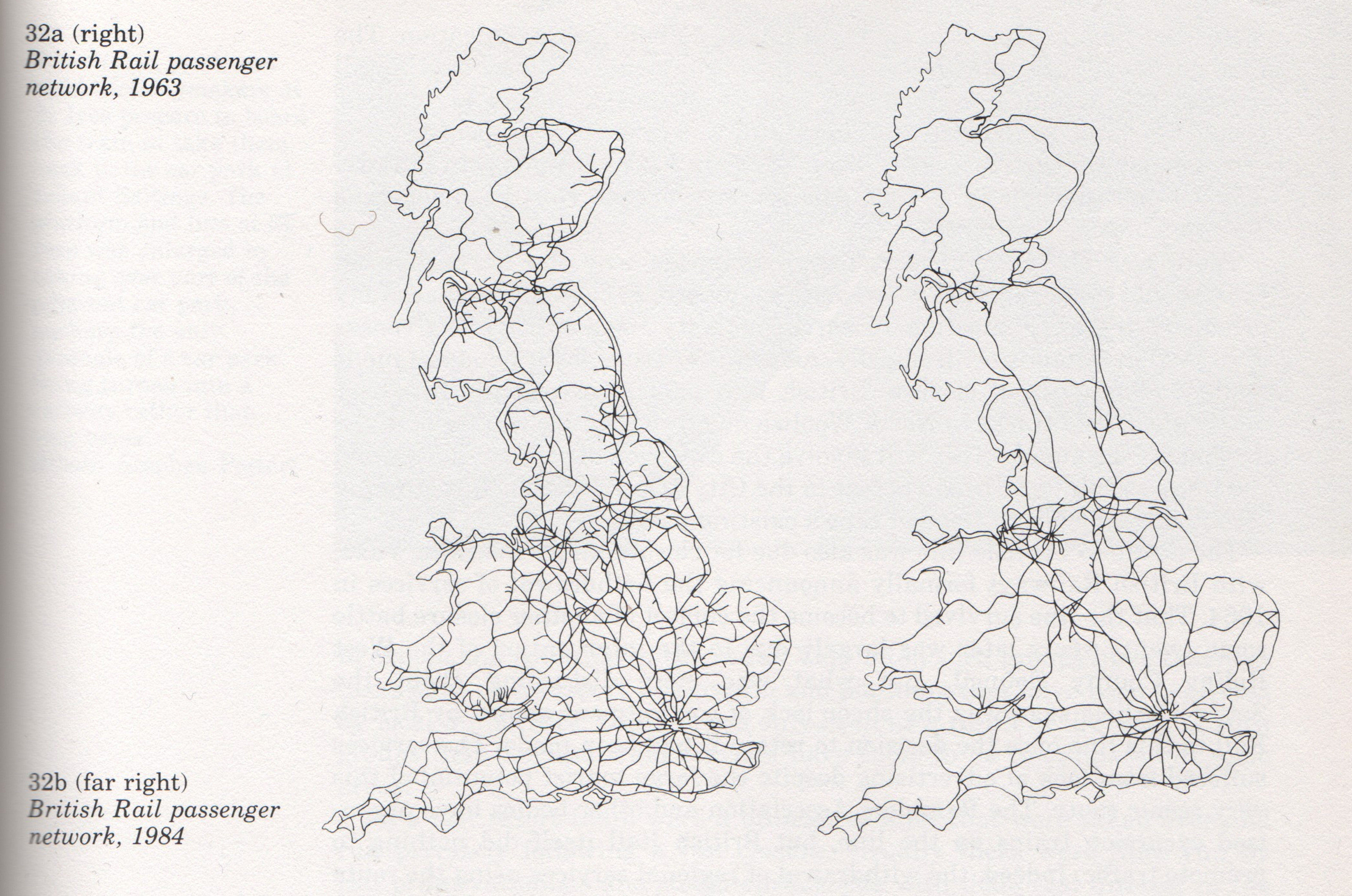
Maps originally from Losing Track by Kerry Hamilton and Stephen Potter (1985), by way of Is Your Journey Really Necessary?, 2012-12-31.
https://isyourjourneyreallynecessary.wordpress.com/2012/12/31/nice-work-if-you-can-get-there/
Click map to enlarge.
The aim of the Beeching cuts, which followed on from a pair of reports written by Dr Richard Beeching in 1963 and 1965 for the British Railway Board (of which he was Chair), was to turn the loss-making British railways network into a profitable enterprise. Prioritising this profitability over all else, he proposed axing about a third of Britain’s then 7000 railway stations, removing passenger service from around 5000 route miles, and cutting 70,000 jobs over three years. The moves were highly controversial, and though they certainly saved money, the social consequences were extensive and the scars remain visible today.
As a consequence of the cuts, Britain became over-reliant on car travel, and over the 1970s and 80s town planners gutted the experientially human-scale city centres in service of this newly favoured road transport. We still very much feel the consequences of the Beeching axe today, whereby a rail journey between neighbouring cities is often only possible by zigzagging up to London and back down again, and public transport between rural communities is limited to one bus service every hour or two in the morning and mid-afternoon, which crawls along at a testudinian pace, further isolating and atrophying the scattered settlements that once were happy, thriving homes.



Powered by WordPress