Classic Vehicle Channel
Published 19 Apr 2020


Classic Vehicle Channel
Published 19 Apr 2020
In Palladium, Brian Balkus wonders why American can’t build anything any more:
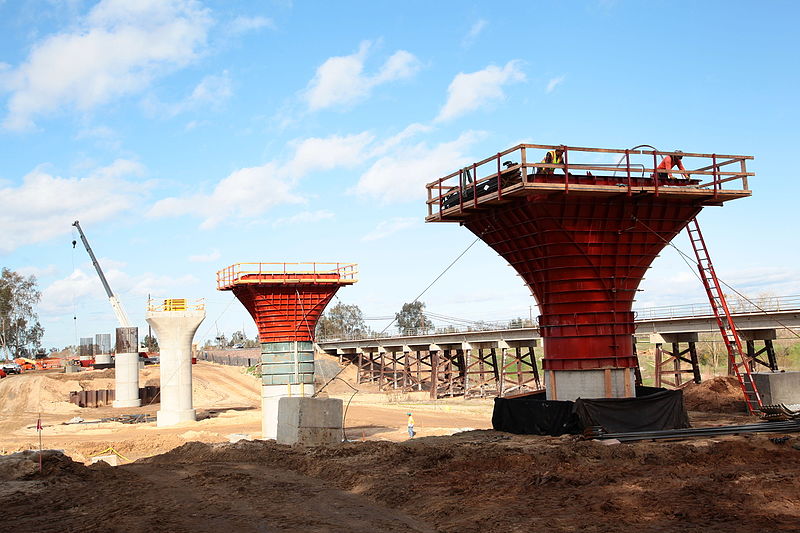
Construction of the Fresno River Viaduct in January 2016. The bridge is the first permanent structure being constructed as part of California High-Speed Rail. The BNSF Railway bridge is visible in the background.
Photo by the California High-Speed Rail Authority via Wikimedia Commons.
Sepulveda’s cost and schedule overrun aren’t even the worst of it. Just as unattainable as a shortened commute is the Californian dream of building a bullet train that could take you from Los Angeles to San Francisco in under three hours. In 2008, a year before the Sepulveda project began, the state tried to turn this dream into a reality after voters approved a 512-mile high-speed rail (HSR) project. Amid failing overseas wars and financial crises, at the time it could’ve become a symbol of renewal not just for California but the entire country. Instead, it came to exemplify a dysfunctional government that lacks the capacity to build.
At the time California began accelerating the development of its HSR system it only had 10 employees dedicated to overseeing what was the most expensive infrastructure project in U.S. history. It ended up 14 years (and counting) behind schedule and $44 billion over budget. Incredibly, the state has not laid a single mile of track and it still lacks 10 percent of the land parcels it needs to do so. Half of the project still hasn’t achieved the environmental clearance needed to begin construction. The dream of a Japanese-style bullet train crisscrossing the state is now all but dead due to political opposition, litigation, and a lack of funding.
Despite its failure, the HSR project inaugurated the U.S.’s megaproject era. Once a rare type of project, by 2018 megaprojects comprised 33 percent of the value of all U.S. construction project starts. An alarming number of these have spiraled out of control for many of the same reasons that killed the California bullet train. The decade that followed the financial crisis was a kind of inflection point in the industry; this was when construction projects became noticeably worse and when the long-term implications could no longer be ignored. One of the most cited studies of the U.S.’s declining ability to build reviewed 180 transit megaprojects across the country, revealing that today, U.S. projects take longer to complete and cost nearly 50 percent more on average than those in Europe and Canada.
Having joined Kiewit in 2010, I witnessed these changes first-hand. I have since moved on, but have remained in the broader industry, including working on what are called “strategic pursuits” — the process by which companies compete for megaprojects. This experience has provided insight into the mechanics of how these projects are awarded and why they so frequently fail.
Even if the construction had proceded close to schedule, the economic justification for California’s high speed rail line was never strong … and it’s unlikely the service would have come close to breaking even. It almost certainly would have added significant ongoing costs to Californian taxpayers, and due to the nature of high speed rail services, been effectively a subsidy from working-class Californians to the laptop elites of Los Angeles and the San Francisco Bay area.
All of that, however, are merely additional reasons to believe the project was doomed from inception. Broadly speaking, all major infrastructure projects in the United States are struggling with paperwork and compliance requirements mostly driven by state and federal environmental regulations passed with the best possible intentions (as the saying goes):
Sepulveda’s numerous lawsuits and stakeholder conflicts are an example of a phenomenon that can be traced back to the passage of the National Environmental Policy Act (NEPA) in 1969. NEPA mandates developers to provide environmental impact statements before they can obtain the permits necessary for construction on huge swathes of infrastructure.
Shortly following the passage of NEPA, California’s then-governor Ronald Reagan signed the California Environmental Quality Act (CEQA) into law, which required additional environmental impact analysis. Unlike NEPA, it requires adopting all feasible measures to mitigate these impacts. Interest groups wield CEQA and NEPA like weapons. One study found that 85 percent of CEQA lawsuits were filed by groups with no history of environmental advocacy. The NIMBY attitude of these groups has crippled the ability of California to build anything. As California Governor Gavin Newsom succinctly put it, “NIMBYism is destroying the state”.
It is also destroying the U.S.’s ability to build nationally. The economist Eli Dourado reported in The New York Times that “per-mile spending on the Interstate System of Highways tripled between the 1960’s and 1980’s.” This directly correlates with the passage of NEPA. If anything, the problem has gotten worse over time. Projects receiving funding through the $837 billion stimulus plan passed by Congress in the aftermath of the financial crises were subject to over 192,000 NEPA reviews.
The NEPA/CEQA process incentivizes the public agencies to seek what is often termed a “bulletproof” environmental compliance document to head off future legal challenges. This takes time, with the average EIS taking 4.5 years to complete. Some have taken longer than a decade. A cottage industry of consultants is devoted to completing these documents, earning themselves millions in fees.
In the free-to-cheapskates portion of this Paul Wells essay, he shows why it’s the weirdos, the whackos, and the cheerleaders who get political parties to pander to them and the hair-not-on-fire, steady-as-they-go, non-freaking-out normies who get ignored:
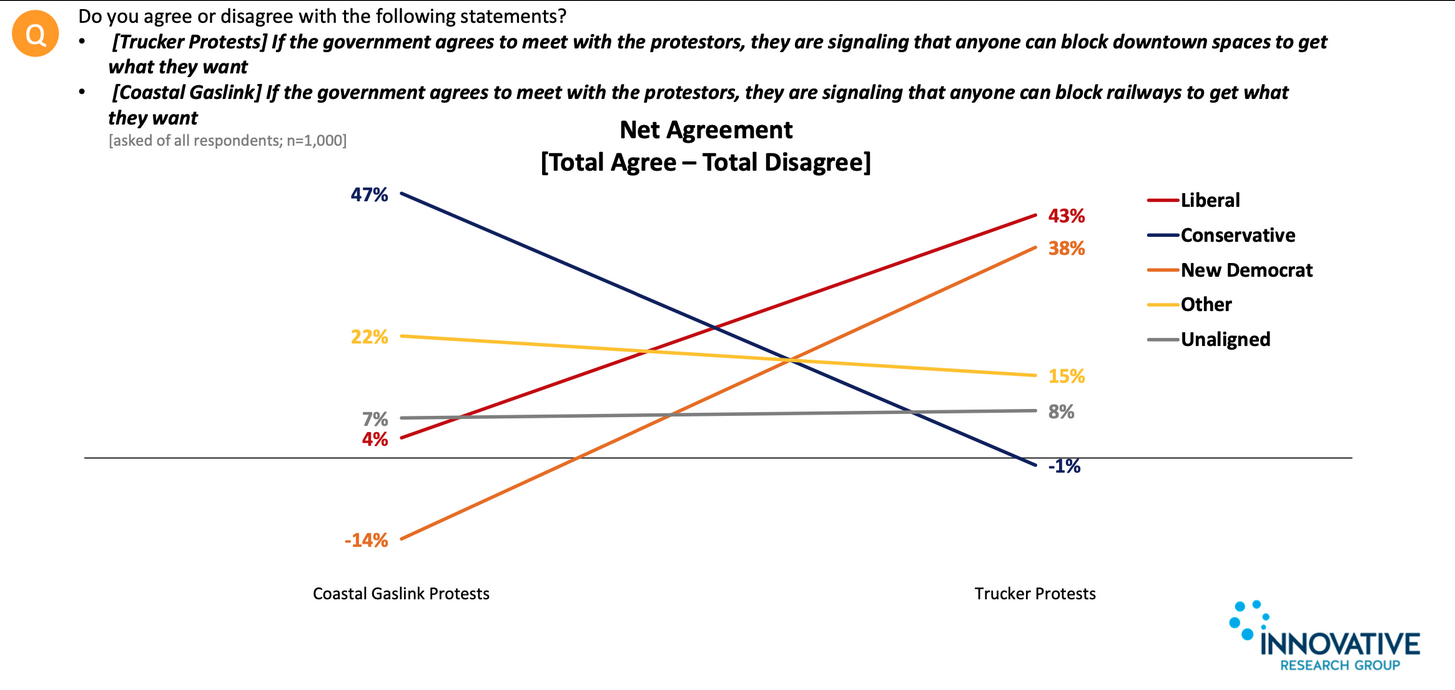
This graph is the best illustration of Canadian politics I’ve seen this year. It comes from Greg Lyle, the pollster who runs Innovative Research Group. He published it in February when downtown Ottawa was full of trucks. It takes some explaining, but we have time today.
On the left are results from a poll Lyle did in 2020. Rail blockades and protests had flared up across Canada, in support of Wet’suwet’en hereditary chiefs who opposed the Coastal GasLink pipeline project. One of the questions Lyle asked in 2020 was, Do you agree or disagree that “If the government agrees to meet with the protestors, they are signaling that anyone can block railways to get what they want”?
On the right are results from a poll Lyle did two years later, in March of this year. Agree/disagree, “If the government agrees to meet with the protestors, they are signaling that anyone can block downtown spaces to get what they want”?
[…]
In addition to NDP, Liberal and Conservative supporters, Lyle tracked opinions of people who support other parties. That’s the yellow line above. It’s nearly useless, a jumble of Green, People’s Party, Bloc Québécois and who knows what else.
But he also tracked responses of people who didn’t express support for any political party. That group’s responses didn’t swing at all between 2020 and 2022. That’s the black line above. Does meeting protesters encourage protests? Sure, on balance, a bit, these non-aligned voters said in 2020 (net +7%). People like them said the same thing in 2022 (net +8). Call this group the people who don’t freak out.
Now. Who gets heard in our politics? It goes without saying that the people in political parties, including the people in governments formed by political parties, are partisan. Liberals will tend to be on that upward-sloping red line in our graph. But what’s more important is that these days, only the people on the steeply-sloping partisan lines pay for our politics.
Since 2011, individual donors are the only source of funds for Canadian federal political parties. Corporate and union donations were eliminated in 2006. Public per-vote subsidies were eliminated in 2011. Today the only way I can pay my political party’s bills is if I can persuade lots of people like you to give me many small sums of money. And the people on that nice, even-keel, non-sloping black line in our graph? The people who don’t view every sparrow that falls as a little morality play about their heroes and the villains they face? Those people will never give anyone a dime. It’s the people who mood-swing wildly — who think our gang is great and their gang is the demon — who can be provoked into donating, again and again, until they max out for the year, and then again starting in January.
Irving Gerstein, the Conservative Party’s chief fundraiser under Stephen Harper, explained all of this in a 2013 column by Ken Whyte that stands as one of the most important documents for understanding our times: “Message creates momentum creates money.” Parties that reside permanently on the sloping lines of a Greg Lyle poll — that think, talk and act like their most fervent supporters — are able to separate those people from their money. Parties that exit the slope for the level meadows of moderation go nowhere.
Classic Vehicle Channel
Published 29 Jan 2021This film, part of the Look At Life series explores the various ways folk put old disused items of transport back into use. Fascinating archive of engines and rolling stock being cut up for scrap and factory footage of the “new” diesel locomotives being assembled. We take a glimpse into the lives of people upcyling railway memorabilia, steam wagons and rollers and there’s great footage of a Wynns Pacific transporting a steam locomotive to a museum.
Timeline – World History Documentaries
Published 15 May 2019Travel journalist Simon Calder takes a journey from across the south of England — by bike, rail and car. In this documentary film, Simon explores the legacy of the Beeching railway cuts. He examines the arguments for reopening some of the branch lines axed in the 1960s.
It’s like Netflix for history … Sign up to History Hit, the world’s best history documentary service, at a huge discount using the code ‘
TIMELINE‘ —ᐳ http://bit.ly/3a7ambuYou can find more from us on:
https://www.instagram.com/timelineWH
This channel is part of the History Hit Network. Any queries, please contact owned-enquiries@littledotstudios.com
Thomas Walker-Werth contrasts the different experiences of California and Florida in trying to build new passenger railway services:
When the Federal Government ordered the construction of the Interstate Highway System in the 1950s and 1960s (at a cost to taxpayers of roughly $580 billion in 2022 dollars), it all but killed America’s privately operated passenger railroads. Since then, rail travel in America has mostly consisted of government-subsidized Amtrak services of deteriorating quality that amble across the country, catering to a niche market of leisure travelers and those with no other options. On the busy Northeast Corridor between Boston and Washington D.C. there is still enough demand to operate a busy, profitable service, but elsewhere Amtrak’s services are too slow, inconvenient, and infrequent to effectively compete with highways and airlines.
But with gas prices rising and traffic congestion strangling many American cities, passengers, investors, and government planners are all reconsidering railroads. Several new projects have sprung up across the country, aiming to link major cities a few hundred miles apart, where a train might provide a more convenient journey than a plane, car, or bus. Some of these projects are led by state governments, others by private companies. The contrast between the two is dramatic. To illuminate that difference, compare the government-run California High Speed Rail project with Brightline, a new private rail system in Florida.
Approved in 2008, California High Speed Rail (CHSR) was expected to deliver a 520-mile two-track, electrified high-speed railway on an all-new route between Los Angeles and San Francisco by 2029. Fourteen years later, CHSR is now only expected to have a 171-mile single-track section between Madera and Bakersfield will be operational by 2030. Meanwhile the project’s cost has ballooned to $80 billion from an original budget of $33 billion, and costs are expected to rise further to $100 billion, or triple the original budget.
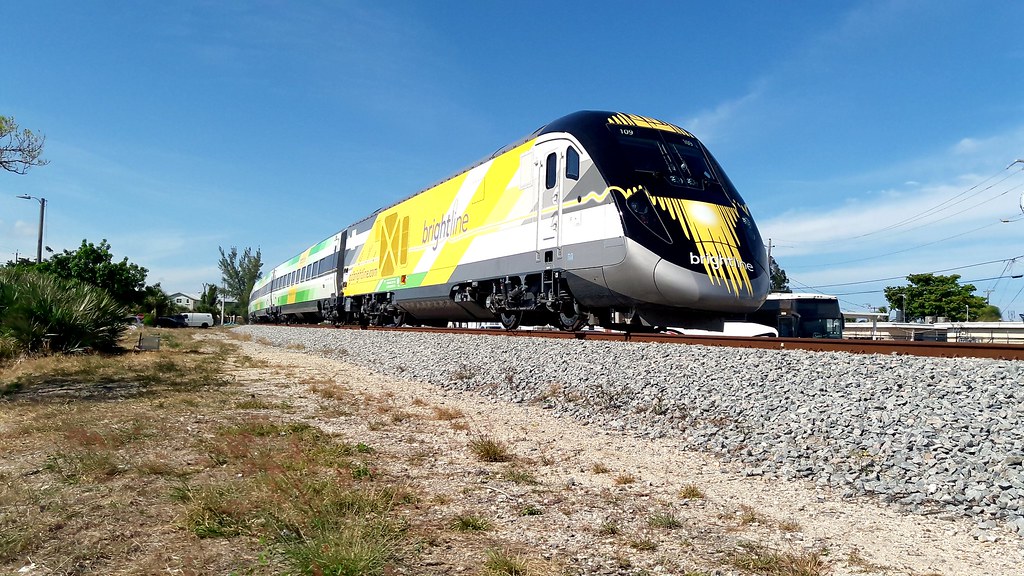
Meanwhile in Florida, a very different kind of passenger railroad is already up and running. Brightline was launched in 2012 by the Florida East Coast Railway, a private freight railroad. Unlike CHSR, Brightline mostly uses existing routes, removing the need to acquire (or appropriate) large amounts of land. Instead of building the whole line before beginning any passenger services (as CHSR is doing), Brightline began construction on a 70-mile section from Miami to West Palm Beach in 2014 and opened it to passengers in 2018. This meant that Brightline already had an operational, revenue-producing service before embarking on the 170-mile northward extension to Orlando Airport. That extension is expected to open in 2023, and the entire project will cost about $1.75 billion, raised through private financing.
This equates to about $7.3 million per mile for Brightline, compared to $153.8 million per mile for CHSR (using the current $80 billion budget). Why will CHSR cost at least twenty times more per mile than Brightline? How has Brightline managed to deliver a high-speed intercity passenger rail system within ten years whereas CHSR needs twenty-two years to deliver an incomplete, scaled-down version of its original plan? Much of the answer comes down to the fundamental nature of public works projects such as CHSR.
This isn’t quite a fair apples-to-apples comparison between Brightline and CHSR, as Brightline’s services will have to interact with freight trains on conventional rails while CHSR — if ever completed — will be a separate line hosting only CHSR’s own high-speed passenger trains. Brightline’s trains will probably not have the theoretical top speed that CHSR is intended to use, as the physical plant of rail lines intended for mixed-use traffic will limit the speeds due to signalling, traffic density and braking distances of the respective types of trains.
Train of Thought
Published 26 Nov 2021In this video, we take a look at the tragedy of The General and how, what is now considered a classic of the silent era, was panned by audiences upon its release. Yes, I have been watching a lot of Buster Keaton films recently, how can you tell.
The General (Give it a watch): https://youtu.be/iHlBMKtgPOA
Please subscribe for more
This video falls under the fair use act of 1976
travelfilmarchive
Published 12 Nov 2008An educational film about train travel in the 1950s. To purchase a clean DVD or digital download of this film for personal home use or educational use contact us at questions@archivefarms.com. To license footage from this film for commercial use visit: www.travelfilmarchive.com
First, consider the last time you were on a passenger train. Add up the weight of all the folks in your car. Do you think they weighed more or less than the car itself? Unless you were packed into a subway train with Japanese sumo wrestlers, the answer is that the weight of the car dwarfs that of the passengers it is carrying. The average Amtrak passenger car apparently weighs about 65 tons (my guess is a high speed rail car weighs more). The capacity of a coach is 70-80 passengers, which at an average adult weight of 140 pounds yields a maximum passenger weight per car of 5.6 tons. This means that just 8% of the fuel in a passenger train is being used to move people — the rest goes into moving the train itself.
Now consider a freight train. The typical car weighs 25-30 tons empty and can carry between 70 and 120 tons of cargo. This means that 70-80% of the fuel in a freight train is being used to move the cargo.
Now you have to take me on faith on one statement — it is really hard, in fact close to impossible, to optimize a rail system for both passengers and freight. In the extreme of high speed rail, passenger trains required separate dedicated tracks. Most rail systems, even when they serve both sorts of traffic, generally prioritize one or the other. So, if you wanted to save energy and had to pick, which would you choose — focusing on freight or focusing on passengers? Oh and by the way, if you want to make it more personal, throw in a consideration of which you would rather have next to you on crowded roads, another car or another freight truck?
This is why the supposedly-green folks’ denigrating of US rail is so crazy to me. The US rails system makes at least as much sense as the European system, even before you consider that it was mostly privately funded and runs without the subsidies that are necessary to keep European rail running. Yes, as an American tourist travelling in Europe, the European rails system is great. Agreed. I use it every time I go there. I have to assume that this elite tourist experience must be part of why folks ignore the basic science here.
Warren Meyer, “A Reminder: Why the US Rail System Is At Least as Good As the European System if You Care About Energy Use”, Coyote Blog, 2018-05-25.
Tom Scott
Published 15 Nov 2021The Lorenbahn, the Lüttmoorsiel-Nordstrandischmoor island railway, is famous for the tiny, private trains that take residents to and from the mainland. But that’s not why it was built: and it’s got a more useful purpose as well.
Thanks to everyone from Landesbetrieb für Küstenschutz, Nationalpark und Meeresschutz Schleswig-Holstein, and to the islanders, for all your time and patience!
Camera operator: Richard Bielau
Producer: Maximilian Thesseling of Klein Aber https://kleinaber.de/I’m at https://tomscott.com
on Twitter at https://twitter.com/tomscott
and on Instagram as tomscottgo
Train of Thought
Published 29 Oct 2021It’s close to Halloween, so lets have a look at a railway built to transport a very macabre type of cargo … the recently deceased …
Please subscribe for more
This video falls under the fair use act of 1976
If you’re interested in a bit more than is covered in the video, here’s a post from 2013 discussing this railway.
Ruairidh MacVeigh
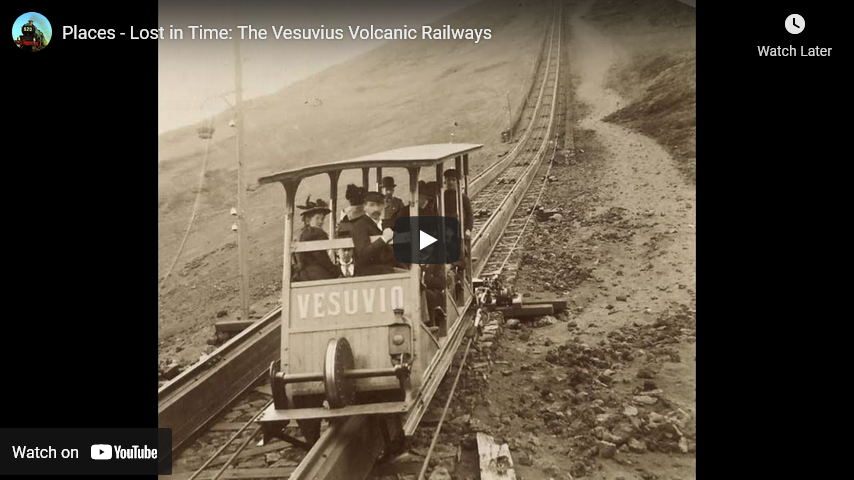
Published 23 Oct 2021Hello, and welcome back to Places – Lost in Time, a series that looks back on the tale of places and locations that existed within living memory or photographic record, but are now lost to the pages of history.
In perhaps one of the most unlikely of places, among the world’s most popular funicular railways once existed on the slopes of Mount Vesuvius, arguably the most dangerous volcano in the world. However, despite the inherent risk of putting a major tourist attraction on its slopes, the Vesuvius funicular railway, and the corresponding mountain railway, were among the biggest visitor magnets in Italy during the late 1800s and early 1900s, but sadly the forces of nature wouldn’t allow this unusual feature to stay in situ for long.
All video content and images in this production have been provided with permission wherever possible. While I endeavour to ensure that all accreditations properly name the original creator, some of my sources do not list them as they are usually provided by other, unrelated YouTubers. Therefore, if I have mistakenly put the accreditation of “Unknown”, and you are aware of the original creator, please send me a personal message at my Gmail (this is more effective than comments as I am often unable to read all of them): rorymacveigh@gmail.com
The views and opinions expressed in this video are my personal appraisal and are not the views and opinions of any of these individuals or bodies who have kindly supplied me with footage and images.
If you enjoyed this video, why not leave a like, and consider subscribing for more great content coming soon.
Thanks again, everyone, and enjoy! 😀
References:
– Thomas Cook Archive (and their respective references)
– Wikipedia (and its respective references)
Train of Thought
Published 22 Oct 2021In this video, we take a look at how a British holiday camp managed to help save some very rare express engines, possibly by accident …
This video falls under the fair use act of 1976
Tom Scott
Published 27 Sep 2021In Darmstadt, Germany, there’s the Eisenbahnbetriebsfeld: a model railway connected to actual railway signalling equipment, so that controllers can learn without putting any real trains in danger. I got to learn the very basics.
■ More about the railway (in German): https://www.eisenbahnbetriebsfeld.de/Camera: Moritz Janisch
Producer: Marcel Fenchel https://www.fenchel-janisch.de
Editor: Isla McTearWith thanks to Deutsche Bahn and DB Training, AKA Bahn, the Institut für Bahnsysteme und Bahntechnik at TU Darmstadt, and all the team at the Eisenbahnbetriebsfeld!
I’m at https://tomscott.com
on Twitter at https://twitter.com/tomscott
and on Instagram as tomscottgo
 This month’s Classic Trains fallen flag feature is the Chicago Great Western Railroad (CGW) by H. Roger Grant. Not being over-familiar with the US Midwest, while I’d heard of this railway I had no real background knowledge about it. The earliest charter was granted to the Chicago, St. Charles & Mississippi Airline in 1835, but no construction took place under the original management and the charter rights were passed on to the Minnesota and North Western Railroad (M&NW) in 1854. Actual construction of the line did not begin until 1884, connecting St. Paul, Minnesota with Dubuque, Iowa. The M&NW was taken over by the Chicago, St. Paul & Kansas City Railroad under the control of Alpheus Beede Stickney, a St. Paul businessman. By 1892, when the system adopted the Chicago Great Western name, there were routes to Omaha, Nebraska, St. Joseph, Missouri and Chicago.
The Panic of 1907 ended Stickney’s control of the railway and it ended up in the hands of J.P. Morgan:
Even though Stickney had imaginatively assembled a Midwestern trunk line, he ultimately lost his railroad. The brief but severe Bankers’ Panic of 1907 threw CGW into receivership, a fate the company had avoided during the much more severe Panic of 1893. The nation’s financial wizard, J.P. Morgan, took control, and in 1909 a reorganized Chicago Great Western Railroad made its debut. Morgan wisely placed Samuel Morse Felton in charge, because the new president excelled as a railroad manager. His greatest triumph before joining the Great Western had been to turn the Chicago & Alton into a profitable property.
[…]
The Felton years in Chicago Great Western railroad history resulted in a rehabilitated physical plant. Changes in rolling stock caught the attention of thousands of on-line residents. In 1910, for example, CGW purchased 10 Baldwin 2-6-6-2 Mallets (“Snakes”, as employees called them), and the road’s own shop forces at Oelwein, Iowa, rebuilt three F-3 class 2-6-2s (CGW had 95 total Prairie types) into three more 2-6-6-2s. Unfortunately, these giants did not work out, and in 1916 the Baldwins were sold to the Clinchfield and the homebuilds were rebuilt into 4-6-2s. In the Mallets’ place appeared reliable yet powerful 2-8-2s, of which CGW owned 35.
The railroad became a leader in the use of gasoline and later diesel motive power. Before World War I CGW assembled a small fleet of McKeen motor cars, knife-nosed “wind-splitters” that replaced steam-powered branchline and local trains. Its 1924 gas-electric car M-300 was the first unit of any type sold by the Electro-Motive Co., and it helped replace steam on trains 3 and 4 on the 509-mile Chicago–Omaha run. In 1929 CGW remodeled three McKeens to make up a deluxe gas-electric train, the Minneapolis–Rochester (Minn.) Blue Bird. CGW was mostly satisfied with its pioneering internal-combustion equipment.
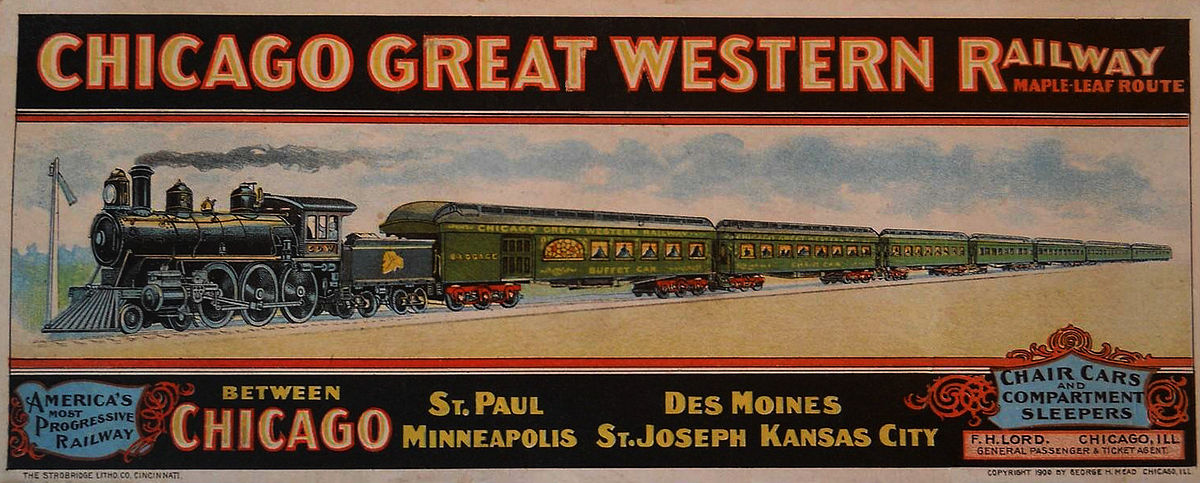
1906 advertising blotter for the Chicago Great Western Railroad’s passenger trains.
Wikimedia Commons.
CGW’s independent life came to an end in the same era as a lot of small to medium sized railways disappeared into corporate mergers, take-overs, or bankruptcy:
Being a small road in an era when competitors were expanding through mergers led to the corporate demise of the CGW. Saying that shareholders “must be protected”, the board sought a partner. Although the expectation was union with KCS or perhaps the Soo Line, the aggressive Chicago & North Western, headed by resourceful Ben W. Heineman, made an acceptable proposal, and in 1968 Chicago Great Western Railroad history ended with it becoming a Fallen Flag.
C&NW operated CGW switchers and F units for a short time, and assimilated Great Western’s only second generation diesels — eight GP30s and nine SD40s, all painted in the final solid “Deramus red” seen also on KCS and Katy — into the yellow fleet.
Although for a short time much of the former Great Western maintained its identity as C&NW’s Missouri Division, that operating organization ended and its lines started to disappear. By the 1980s much of the trackage had been retired, and at the start of the 21st century only about 145 miles remained. Survivors include portions of the main lines in Iowa (Mason City to the Fort Dodge area; Oelwein–Waterloo; and a leg into Council Bluffs); the Cannon Falls (Minn.) branch; and terminal trackage around South St. Paul, Minn., and just west of Chicago.



Powered by WordPress