
World War Two
Published 18 Jan 2023There is a second war raging on the Eastern Front. From the huge expanses of no man’s land behind the German lines, Moscow’s battle-hardened and well-armed partisan bands are waging a Rail War in support of Red Army offensives. But every successful mission brings down the wrath of the genocidal Axis war machine.
(more…)
January 19, 2023
The Partisan War Behind the Frontlines – WW2 Documentary Special
Comments Off on The Partisan War Behind the Frontlines – WW2 Documentary Special
January 3, 2023
1943 in Numbers – WW2 Special
World War Two
Published 1 Jan 2023This war is massive. Our chronological coverage helps give us an understanding of it, but sometimes statistics help us understand the bigger picture.
(more…)
Comments Off on 1943 in Numbers – WW2 Special
December 3, 2022
QotD: Mantetsu and the Kwantung Army
When the Japanese decided to become a modern power, they consciously chose to emulate American business practices. But these were the business practices of the Gilded Age, so Japanese businesses ran in a way that would have the most hardened Robber Baron drooling — horizontal integration, vertical integration, trusts, combines, mergers, the works.
Thus the South Manchuria Railway Corporation, originally contracted to develop a defunct line in a disputed territory, soon developed into a full-spectrum enterprise. Pretty much all heavy industry in the Japanese areas of Manchuria were divisions of Mantetsu. But since all the heavy industry depended on mines, and transportation, and food and housing for workers, and banks, and schools for the workers’ children, etc., pretty soon Mantetsu ran all of that, too. By the late 1920s, you could argue that Mantetsu was almost its own country.
It even had its own army, and that’s where things get really interesting.
The Kwantung Army was the security force assigned to the South Manchuria Railway Zone. The Japanese weren’t stupid; they knew the perils of independent commands far from home, and they rotated units through with some regularity. Nonetheless, the command staff remained fairly stable over the years … and so did Mantetsu’s.
The Japanese weren’t stupid, but they were people, and people being people, soon enough the lines between the Kwantung Army and Mantetsu began to blur. And since the lines between Mantetsu, the Imperial Army, and the government were already pretty blurry, pretty soon the concerns of one became the concern of all. (Nor was the Navy left out, though I’m not discussing them in order to keep it simple. They were up to their eyeballs in Mantetsu, too, because warships need lots of steel and steel comes from Manchuria).
A small but highly committed and totally ideologized faction developed inside the Kwantung Army. Several, in fact, and one of them (the Imperial Way faction) attempted an actual coup d’etat in 1936. It was put down, and the Imperial Way faction dissolved (in theory), but the problem of an intensely ideologized officer corps remained. Long story short, you had a small group of highly ideologized officers garrisoning a remote province pulling the entire Empire into big, unwinnable wars.
One could make the case that World War II in the Pacific was ultimately caused by about fifteen or twenty guys in the Kwantung Army.
That’s overly reductionist, but it highlights the huge problem with organizations slipping the leash. In theory, there was a clear chain of command, and even the head of the Kwantung Army was a down it a ways — he was subordinate to the Army Council, which was subordinate to the War Minister, who was subordinate to the Parliament, who were subordinate to the Emperor. In theory, lots of people could’ve sacked Gen. Araki, or his mini-me Ishiwara Kanji (a lieutenant colonel through most of it). Equally in theory, Mantetsu had no say in any of it — the Kwantung Army was a formation of the Imperial Japanese Army, not Mantetsu’s private security force.
But in reality, Mantetsu was so wired in to the Japanese government that in a lot of cases, it was the government. But not always, because the same could be said about the Army, and the Navy, both of which were also wired into Mantetsu up to the very top (or vice versa, your choice). And Mantetsu had their Media arm, of course, as did the Army and Navy …
What all this boiled down to, then, was a power vacuum. I know, that seems weird, but a skilled bureaucratic infighter like Ishiwara never lacked for groups to play against each other. The Army and Navy would oppose on principle any move that seemed to aggrandize the other, neither could go against Mantetsu (and neither could control it), and all had to pay at least lip service to the civilian government. Because of this, real power fell to whomever had the balls to grab it …
… which was the officer corps of the Kwantung Army. They assassinated at least two Manchurian warlords, staged a number of false flag attacks on their own positions, and generally got up to however you say “standard issue Juggalo fuckery” in Japanese, up to and including a full-scale war with China.
Severian, “Slipping the Leash”, Founding Questions, 2022-08-27.
Comments Off on QotD: Mantetsu and the Kwantung Army
November 19, 2022
QotD: Canada from the American Revolution to the Riel Rebellion
Unfortunately, as the Revolutionary and Napoleonic wars unfolded, the British could not resist the temptation to employ their mastery of the high seas to impose blockades and harass the shipping of neutral powers. The young United States did not have the military force to deter such treatment, and in 1812 those countries went to war. Canada was the blameless focal point of most of the fighting. Canada with the continuing solidarity of the French-Canadians, was able to mount a very solid defense. The many thousands of recently arrived Americans did not support the United States and the generous policy of enticing settlement from the United States was completely vindicated. There were pressures to expel them, monitor them, disqualify them from holding local offices and positions. But it was soon agreed that they could become citizens after eight years of residency. This affected about 40 percent of English-Canadians and this must count as another very successful chapter in Canada’s early record of respect for civil and human rights.
As reasonably successful wars do, considerable national sentiment was created and encouraged by the successful joint struggle to avoid American occupation. Out of these experiences came increased ambitions for democratic self-rule in domestic matters as the British and Americans enjoyed, instead of autocratic rule by British governors. Canada’s position was complicated by the fact that it could not agitate for home rule too energetically or the British would lose patience and sell Canada to the United States for cash or other territory or for a comprehensive alliance. Outright rebellion was not an option for Canada as it had been for the Americans, as the United States would seize Canada if it were not under British protection.
The Canadian solution for agitating but not completely exasperating Great Britain was the Gilbert and Sullivan rebellions of 1837 led by William Lyon Mackenzie in Ontario and Louis-Joseph Papineau in Québec. The Ontario uprising was just a rowdy group of malcontents who became disorderly and were easily chased off, and the French-Canadian group were essentially pamphleteers, though there were some exchanges of fire and small rebel and military units marched to and fro in poor winter weather. A total of about 300 people died, there were 14 executions and 92 people were transported as prisoners to Australia. The rebel leaders fled but were eventually pardoned and returned.
There was enough commotion to get Britain’s attention, but the loyalty of most of the population gratified the British, and they determined to put things right. London sent the well-known reformer Lord Durham to Canada in 1840 to make recommendations. After a year of research by a couple of biased examiners, Durham came to the insane conclusion that the source of Canadian discontent was that the French-Canadians wanted to be relieved of the intolerable burden of being French. Durham proposed uniting Upper and Lower Canada and assumed that the slight resulting English majority would assimilate the French in about 10 years. Of course, this was precisely what the French feared, and the English-Canadians had no desire for it either. But after several years of rearguard action by British governors, the movement for autonomous government succeeded, after the 25-year-old Queen Victoria sent Lord Elgin to Canada as governor to give the Canadians what they wanted. Elgin and Robert Baldwin and Louis-Hippolyte LaFontaine achieved this and secularized a great deal of territory owned by the principal churches so that they could be more easily settled and made the principal universities officially nondenominational. These were again great and non-violent steps in the civil rights of Canadians who now numbered over two million people.
All of North America was now walking on eggshells over the immense problem of American slavery. Slavery was abolished throughout the British Empire in 1834. In practice, there had not ever been more than a couple of hundred slaves in Canada, apart from the natives enslaving each other. Slaves had been imported to the southern states because of their efficiency at harvesting tropical crops such as cotton, so Canada was effectively spared that horrible institution, because of its climate more than its virtue. Canada consistently had a fine record in accepting about 40,000 fugitive slaves that reached the Canadian border in the thirty years before the U.S. Civil War. The leading American anti-slavery advocates Harriet Tubman and John Brown, and Josiah Henson, the model for the chief character in Harriet Beecher Stowe’s novel Uncle Tom’s Cabin, which sold an unheard-of two million copies in the 1850s, all lived in Canada for years. There were at least 11 black Canadian doctors who were fugitive slaves or sons of fugitive slaves who served in the Union Army in the Civil War, and the white Canadian anti-slavery activist, Dr. Alexander Ross, at the request of President Lincoln, assisted in breaking up a Confederate spy ring in Montréal. Escaped slave Joseph Taper, of St. Catharine’s, wrote this letter back to his former and still putative owner in 1839: “I now take this opportunity to inform you that I’m in a land of liberty, in good health … In the Queen’s dominions, man is as God intended he should be; all are born free and equal, not like the southern laws, which put man on a level with brutes. All the coloured population is supplied with schools. My boy Edward, who will be six years next January, is now reading and I intend keeping him at school until he becomes a good scholar. My wife and self are sitting by a good comfortable fire, happy, knowing that there are none to molest us or make us afraid. God save Queen Victoria.”
As many as 40,000 Canadian volunteers served in the Union Army in the Civil War and Canada was thanked on several occasions by President Lincoln for infiltrating Confederate exile organizations. This was an issue in which all Canadians were united and is a legitimate matter of national pride.
The next major civil rights challenge that Canada had to face was that of the Métis — the mixed white and indigenous people on the Great Plains of Canada. The territory of the natives had been steadily reduced by white settlement and the nutritious content of their diet had been reduced by the heavy depletion of the herds of plains Buffalo. There were also many other grievances and undoubtedly a number of violations of the Indian treaties and of the Indian Act and a flamboyant Metis lawyer, Louis Riel, led an uprising on the western plains in 1878. This was eventually suppressed with little violence, as Prime Minister John A. Macdonald dispatched an adequate military force under Field Marshal Garnet Wolseley, Gilbert and Sullivan’s “very model of the modern major general”. Riel fled to the U.S. and the Canadian government made a number of useful concessions to the aggrieved natives. But in 1885, Riel returned and led a rebellion in northwest Saskatchewan. At the same time, the Canadian Pacific Railway ran out of money and was about to flounder into bankruptcy. Macdonald brilliantly sent Canadian forces West on the railway and they surprised and defeated the insurgents and captured Riel. By emphasizing the railway’s role in saving the country (as Riel was making both annexationist and secessionist noises), Macdonald won passage of a bill to finance completion of the railway. Macdonald also gave the natives the right to vote and rewarded his allies among the native leaders. However, he created a lasting grievance by allowing the execution of Riel. Although 15 people died in the uprising, he should have commuted the sentence for insanity — Louis Riel was delusional.
Conrad Black, “Canada’s excellent history of civil and human rights”, New English Review, 2022-08-18.
Comments Off on QotD: Canada from the American Revolution to the Riel Rebellion
October 24, 2022
Another bombed city – war still not ended – October 23, 1943 – WAH 083
World War Two
Published 23 Oct 2022Trainload after trainload arrives at the slave and murder factories in Auschwitz, and a Fürstin is created in Kassel, while the United Nations War Crimes Committee UNWCC is formed.
(more…)
Comments Off on Another bombed city – war still not ended – October 23, 1943 – WAH 083
October 2, 2022
What is a Bopper Car?
Lake Superior Railroad Museum & NS Scenic Railroad
Published 5 Jun 2020Railroads came up with lots of great ideas to make things more efficient. Many of those ideas, like bottled water, and the red carpet, are part of our daily lives … as we have shown you in previous episodes.
Today, we talk about an idea that sounded good, but didn’t work out: The Bopper Car. A combination of hopper car and box car. Only a few were made, and the remaining ones were donated to the Lake Superior Railroad Museum. Today they’re used as storage for many of the shop’s parts.
(more…)
Comments Off on What is a Bopper Car?
September 23, 2022
Is This Atlanta Streetcar “The Worst Transit Project of All Time”?
ReasonTV
Published 22 Sep 2022Transit ridership, especially rail, has collapsed post-pandemic, but the Atlanta BeltLine Coalition says now is the time to take federal dollars and build a $2.5 billion streetcar.
Full text and links: https://reason.com/video/2022/09/22/i…
—
Twenty-three years ago, Atlanta-native and architecture and urban planning student Ryan Gravel had an experience that opened his mind to what urban living could be.“My senior year I spent abroad in Paris and lived without a car for a year and traveled by train everywhere,” says Gravel. “And within a month of arriving, I had lost 15 pounds. I was in the best shape of my life because I was walking everywhere, and the role of the physical city was made clear to me in a way it really had never been before.”
For his Georgia Tech master’s thesis, Gravel sketched out a plan to make Atlanta more like Paris. He proposed redeveloping the land along the city’s historic rail lines to create a 22-mile loop called the Atlanta BeltLine. He proposed turning the city’s abandoned industrial areas and single-family home neighborhoods into business districts and walking trails. And he proposed connecting downtown to the rest of the city all with a new train running along the entire Atlanta BeltLine.
“I never imagined we would actually do it,” says Gravel.
But they did — for the most part. Cathy Woolard, who was president of the Atlanta City Council, read Gravel’s thesis and decided to use it as a blueprint to remake much of the city. Today, the Atlanta BeltLine is a walking and biking trail, parts of which are bordered by retail and condos.
But one piece of Gravel’s grand vision didn’t get built: The train.
Today, Gravel runs a co-working and event space along the BeltLine, which also serves as a gathering place for urbanists interested in making Atlanta less dependent on cars. He says that the train line is essential for improving city life.
“In those early days, when we built the movement behind the [BeltLine] project, it was around transit,” says Gravel.
The three COVID relief bills set aside $69 billion in federal funding for local transit agencies to operate and add to their transportation systems, meaning that Atlanta might finally get its train—with many American taxpayers who will never step foot on it picking up much of the tab.
Many American cities have used federal money in the past to build rail transit lines that suffer from dismal ridership, that are expensive to maintain, and that are a major drain on their budgets.
(more…)
Comments Off on Is This Atlanta Streetcar “The Worst Transit Project of All Time”?
September 13, 2022
Down the Line – A look into the legacy of the cuts made to the rail network by Doctor Beeching (2008)
Kevin Birch
Published 29 Jul 2013Joe Crowley meets the people who battled to save their local railway lines in the South of England in the 1960’s.
First aired on BBC One 26th October 2008
Comments Off on Down the Line – A look into the legacy of the cuts made to the rail network by Doctor Beeching (2008)
September 6, 2022
Scotland’s AMAZING Jacobite Steam Train
Dylan’s Travel Reports
Published 4 Dec 2020An amazing day out on West Coast Railways’ iconic Jacobite steam train from Fort William to Mallaig and back, part of the stunning West Highland Line!
Date of Travel: 21 October 2020
Class of Travel: First Class
Rolling Stock: LMS Stanier Class 5 4-6-0/Mk1
Cost of Ticket: £133.75 ($176.10, €150; price for 2 people)
Origin: Fort William, United Kingdom (Scotland)
Destination: Mallaig, United Kingdom (Scotland)
*Currency conversions correct as of 09/11/2020 to nearest $/€0.05
(more…)
Comments Off on Scotland’s AMAZING Jacobite Steam Train
August 9, 2022
July 25, 2022
Stalin, Hitler, and Churchill – Architects of Death – WAH 070 – July 24, 1943
Comments Off on Stalin, Hitler, and Churchill – Architects of Death – WAH 070 – July 24, 1943
July 22, 2022
Inventing historical connections with slavery where they don’t exist
In Quillette, David Foster recounts the story from the National Museum of Wales which effectively fabricated a connection to the slave trade as part of their politically correct performative “decolonization” efforts:
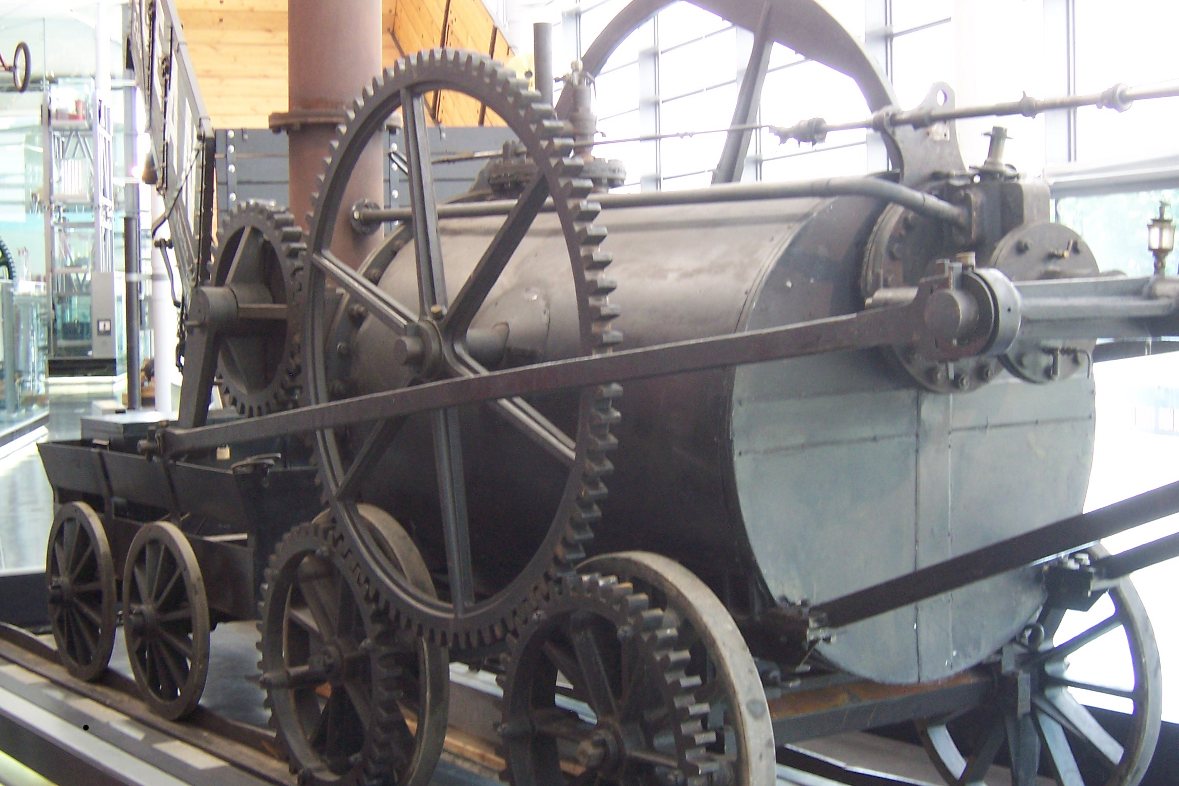
A replica of Richard Trevithick’s 1802 steam locomotive at the National Waterfront Museum in Swansea.
Photo by Chris55 via Wikimedia Commons.
In March, Britain’s Daily Telegraph and GB News channel both reported that the National Museum of Wales would be relabelling a replica of the first steam-powered locomotive, unveiled by its Cornish inventor Richard Trevithick in 1804. Trevithick had no links to slavery, but the amendment has apparently been included anyway as part of the museum’s commitment to “decolonizing” its collection. In a statement defending what it described as the addition of “historical context”, the museum said: “Although there might not be direct links between the Trevithick locomotive and the slave trade, we acknowledge the reality that links to slavery are woven into the warp and weft of Welsh society.” The statement continued:
Trade and colonial exploitation were embedded in Wales’ economy and society and were fundamental to Wales’ development as an industrialised nation. As we continue to audit the collection, we will explore how the slave trade linked and fed into the development of the steam and railway infrastructure in Wales.
[…]
When a society compulsively disrespects its historical accomplishments — when it obsessively seeks to turn every good thing into a bad thing — the outlook for that society is bleak. It destroys social cohesion, and sends the wrong kind of message to actual and potential opponents. The matter of the steam locomotive display in Wales may seem minor, and certainly trivial when compared with the appalling events in Ukraine or the threat of Iranian nuclear weapons. But it is not.
The behavior of the museum administrators in Wales is of a piece with other contemporary symptoms, such as the eagerness within influential circles in the US to embrace the conclusions of the New York Times‘s revisionist 1619 project. It is part of the politicization of everything. Science, technology, and art cannot — indeed, must not — be appreciated simply on the grounds of beauty, utility, or truth; everything must be reduced to race, gender, and other academically and media-approved categories of analysis.
Trends such as these have real-world implications, including the growth and decline of nations and their relative power. Writing in 1940, C.S. Lewis, warned about the dangers of what he called the National Repentance Movement, which focused on the need to apologize for Britain’s sins (thought to include the Treaty of Versailles) and to forgive Britain’s enemies.
Certainly, the British State had done many bad things during its long and eventful history — as well as many good things. But the excessive focus on its sins was part of a phenomenon manifested in a 1933 motion debated at the Oxford Union: “This House will under no circumstances fight for King and country”. To the Nazis and the Imperial Japanese, attitudes like these indicated that aggression would not meet much resistance. They also informed a policy of appeasement.
Liberals and progressives (as they call themselves) claim to be greatly concerned with physical sustainability of resources and ecosystems. But they are too eager to undercut the social sustainability of their own societies and the physical infrastructures on which those societies depend, however fond they may be of repeating the word “infrastructure”.
Comments Off on Inventing historical connections with slavery where they don’t exist
July 21, 2022
The Railrodder (1965)
NFB
Published 15 May 2015This short film from director Gerald Potterton (Heavy Metal) stars Buster Keaton in one of the last films of his long career. As “the railrodder”, Keaton crosses Canada from east to west on a railway track speeder. True to Keaton’s genre, the film is full of sight gags as our protagonist putt-putts his way to British Columbia. Not a word is spoken throughout, and Keaton is as spry and ingenious at fetching laughs as he was in the old days of the silent slapsticks.
Directed by Gerald Potterton – 1965
Comments Off on The Railrodder (1965)
July 11, 2022
British Transport Films: Elizabethan Express (1954)
mikeknell
Published 6 May 2014This 1954 documentary is uploaded in a couple of places, but here it is without breaks and in the correct aspect ratio. One of the classic railway films.
Comments Off on British Transport Films: Elizabethan Express (1954)
July 6, 2022
Decapitating the French Resistance – WAH 066 – June 26, 1943
World War Two
Published 5 Jul 2022The Gestapo deals a devastating blow to French Resistance, and in Bengal, British India the famine is only getting worse.
(more…)
Comments Off on Decapitating the French Resistance – WAH 066 – June 26, 1943


