Little Car
Published 27 Feb 2020Hornby Railways is a British model railway brand. Its roots date back to 1901, when founder Frank Hornby received a patent for his Meccano construction toy. The first clockwork train was produced in 1920. In 1938, Hornby launched its first 00 gauge train. In 1964, Hornby and Meccano were bought by their competitor, Tri-ang, and sold on when Tri-ang went into receivership. Hornby Railways became independent again in the 1980s, and became listed on the London Stock Exchange, but due to recent financial troubles, reported in June 2017, is presently majority owned by turnaround specialist Phoenix Asset Management.
The script for this video comes from Wikipedia:
https://en.wikipedia.org/wiki/Hornby_…
If you find issues with the content, I encourage you to update the Wikipedia article, so everyone can benefit from your knowledge.To get early ad-free access to new videos, or your name at the end of my videos, please consider supporting me from just $1 or 80p a month at https://www.patreon.com/bigcar
#hornby #hornbyrailways
March 18, 2021
The Hornby Story
March 16, 2021
The horrors of British & US Logistics in WW2
TIK
Published 15 Mar 2021The Allies may have had a lot of resources, manpower and industry, but that didn’t mean that their logistics weren’t inefficient or a disorganized mess. Today, we’re going to look at how the British railways were disaster during WW2, how the Americans ran out of fuel on the way to Germany, and why Montgomery called the planning for the invasion of Sicily a “dog’s breakfast”.
⏲️ Videos EVERY Monday at 5pm GMT (depending on season, check for British Summer Time).
The thumbnail for this video was created by Terri Young. Need graphics? Check out her website here https://www.terriyoungdesigns.co.uk/
– – – – –
📚 BIBLIOGRAPHY / SOURCES 📚
Dunn, W. The Soviet Economy and the Red Army, 1930-1945. Praeger Publishers, 1995.
Garvey, J. Operation Husky: The Untold Story of the logistics of the Sicily Invasion. Farm Publications, Kindle 2019.
Hazlitt, H. Economics in One Lesson: The Shortest & Surest Way to Understand Basic Economics. Three Rivers Press, 1979.
MacDonald, J. Supplying the British Army in the Second World War. Pen & Sword Military, Kindle 2020.
Molony, C. The Mediterranean and Middle East, Volume V, The Campaign in Sicily 1943 and The Campaign in Italy 3rd September 1943 to 31st March 1944. The Naval & Military Press LTD 2004, first published in 1973.
Wolmar, C. Fire & Steam: How the Railways Transformed Britain. Atlantic Books, Kindle 2007.British Government, Railways Act 1921, https://www.legislation.gov.uk/ukpga/…
Full list of all my sources https://docs.google.com/spreadsheets/…
– – – – –
⭐ SUPPORT TIK ⭐
This video isn’t sponsored. My income comes purely from my Patreons and SubscribeStars, and from YouTube ad revenue. So, if you’d like to support this channel and make these videos possible, please consider becoming a Patreon or SubscribeStar. All supporters who pledge $1 or more will have their names listed in the videos. For $5 or more you can ask questions which I will answer in future Q&A videos (note: I’m behind with the Q&A’s right now, and have a lot of research to do to catch up, so there will be a delay in answering questions). There are higher tiers too with additional perks, so check out the links below for more details.
https://www.patreon.com/TIKhistory
https://www.subscribestar.com/tikhistoryThank you to my current supporters! You’re AWESOME!
– – – – –
ABOUT TIK 📝
History isn’t as boring as some people think, and my goal is to get people talking about it. I also want to dispel the myths and distortions that ruin our perception of the past by asking a simple question – “But is this really the case?”. I have a 2:1 Degree in History and a passion for early 20th Century conflicts (mainly WW2). I’m therefore approaching this like I would an academic essay. Lots of sources, quotes, references and so on. Only the truth will do.
This video is discussing events or concepts that are academic, educational and historical in nature. This video is for informational purposes and was created so we may better understand the past and learn from the mistakes others have made.
March 15, 2021
Loaded For War — The Santa Fe Railroad In World War II
PeriscopeFilm
Published 24 May 2020Want to support this channel and help us preserve old films? Visit https://www.patreon.com/PeriscopeFilm
Visit our website www.PeriscopeFilm.comSanta Fe presents, Loaded for War. This WWII era color film presents the power of the Santa Fe railroad. While speaking of the mighty effort the trains and its myriad workers achieved during wartime, the footage is all modern and in color. The film does a great job of showing how integral our railroad system has been to the growth of these United States. “With grateful appreciation to the Office of Defense Transportation, the Army, Navy, Maritime Commission, and the shipping and traveling public, for the cooperation and genuine understanding which has made the service record here presented possible …” The film opens with a steam locomotive bearing down on the camera 1:03. The narrator speaks as the train crosses a trestle 1:10. News headlines of December 7, 1941 11:25. Steam and diesel locomotives are transformed into machines of war 1:40. Smoke fills a train yard as trains enter and are washed 2:08. A train signal shows a green light 2:25. Workers are seen in the factory 2:36. Civilians exit trains volunteering for service 2:45. A telegram is shown stating that the trainmen should, “move all available equipment to military stations without delay” 2:54. Four locomotives are shown 3:03. Crews are assigned and men work double shifts 3:45. Rail equipment is loaded by military personnel, ready to move 4:13. Flatcars are loaded with tanks and military trucks 4:52. Divisions of fighting men aboard the trains 5:09. The tanks roll down the tracks on flatcars 5:35. The wheels of war are rolling 6:14. The day by day mass movement of freight is shown at the train yard 6:48. Trains crossing country on railroad tracks 7:40. Trains service the shipyards as men work building military ships 8:00. A ship is launched 8:15. Cattle and pigs are delivered throughout the 48 states 8:37. Potatoes are tilled in the field with heavy equipment 9:00. Oranges are picked and packed in southern states 9:13. Military bombers soar through the air 9:23. Heavy machinery workers in the factories 9:48. Factories and men building artillery shells 9:55. Tanks roll off the product line and onto the railroad tracks 10:10. Locomotive struggles up a hill 10:25. Miners and their lamp hats head down the tunnels by rail 10:38. Oil fields are shown 11:15. Oil is loaded onto railway tankers 11:38. Machines digging the copper mines 12:08. The big diggers pick up 8 cubic yards of copper at a time 12:18. The railroad moves the copper to the smelters 12:31. Sulfur mines using forced steam 12:50. Sulfur is moved by train to the gunpowder makers 13:25. Logging industry is served with the railroads 14:00. Cotton and scrap metal industries are also served by rail 14:18. Old cars are being called back into use for the war effort 15:30. Locomotive number 3723 comes out of retirement by the trainmen 15:48. Various train parts are marked and taken away for repair or replacement 16:07. Men work in factories with fine-tuned machines to retool and refine old parts for new use 16:26. Old firebrick is removed and replaced 16:43. Acetylene torches are used inside the huge boilers 16:49. Huge wheels are cleaned and dipped and sprayed ready for use 17:08. Heat is used to expand the metals 17:18. Locomotive number 3723 is fully refurbished and ready for the tracks 18:05. All types of equipment need to be refurbished for the war effort 18:46. The men use heat and molten metal to reshape old parts for new use 19:00. Gears are ground with precision 19:13. The railroads motto, “let’s keep ‘em rolling” 19:24. The men work on building new track 19:35. Men using hammers to straighten out tracks 19:53. The towermen, bridge crews, conductors, station men, ticket men, dispatchers, signalmen and to the other thousands of men – give the railroad men their due 20:44. Women are also an integral part of the success of the railroad 21:07. The women work in offices but also in factories with heavy machinery and molten metal 21:21. Two women wash down a train 21:30. The wheels of war are rolling 21:40. Military men march in unison 21:47. Train caboose pulls away from the camera 22:52. A flag with 8057 turns into the American flag and waves in the breeze 23:06. The End. Santa Fe.
We encourage viewers to add comments and, especially, to provide additional information about our videos by adding a comment! See something interesting? Tell people what it is and what they can see by writing something for example: “01:00:12:00 — President Roosevelt is seen meeting with Winston Churchill at the Quebec Conference.”
This film is part of the Periscope Film LLC archive, one of the largest historic military, transportation, and aviation stock footage collections in the USA. Entirely film backed, this material is available for licensing in 24p HD, 2k and 4k. For more information visit http://www.PeriscopeFilm.com
March 13, 2021
The Paperback Revolution
The History Guy: History Deserves to Be Remembered
Published 12 Mar 2021Sponsored by Blinkist. The first 100 people who go to https://www.blinkist.com/thehistoryguy are going to get unlimited access for one week to try it out. You’ll also get 25% off if you want the full membership.
Today, the most popular book format in the world is not a traditional hardcover book, nor an ebook, but a paperback — a format that changed the what, how, when and how much the world reads. It is history that deserves to be remembered.
This is original content based on research by The History Guy. Images in the Public Domain are carefully selected and provide illustration. As very few images of the actual event are available in the Public Domain, images of similar objects and events are used for illustration.
You can purchase the bow tie worn in this episode at The Tie Bar:
https://www.thetiebar.com/?utm_campai…All events are portrayed in historical context and for educational purposes. No images or content are primarily intended to shock and disgust. Those who do not learn from history are doomed to repeat it. Non censuram.
Find The History Guy at:
Patreon: https://www.patreon.com/TheHistoryGuy
Please send suggestions for future episodes: Suggestions@TheHistoryGuy.netThe History Guy: History Deserves to Be Remembered is the place to find short snippets of forgotten history from five to fifteen minutes long. If you like history too, this is the channel for you.
Awesome The History Guy merchandise is available at:
teespring.com/stores/the-history-guyScript by THG
#history #thehistoryguy #Books
March 5, 2021
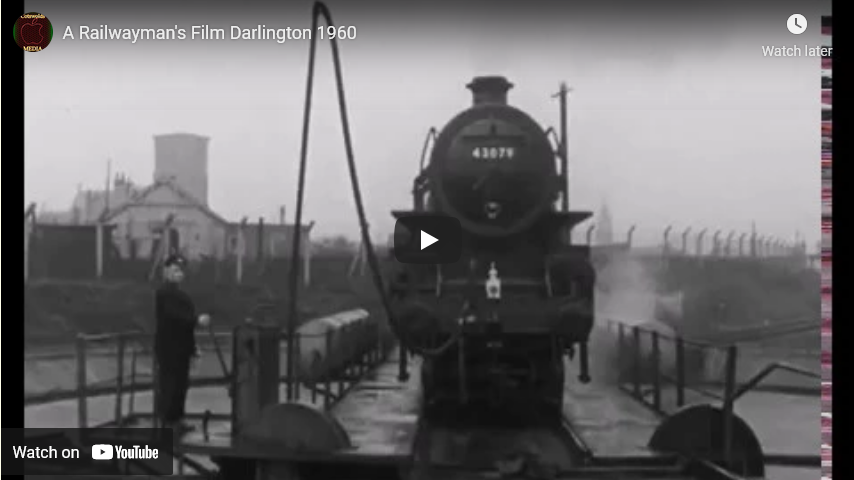
The Way We Live – A Railwayman’s Film Darlington 1960
March 4, 2021
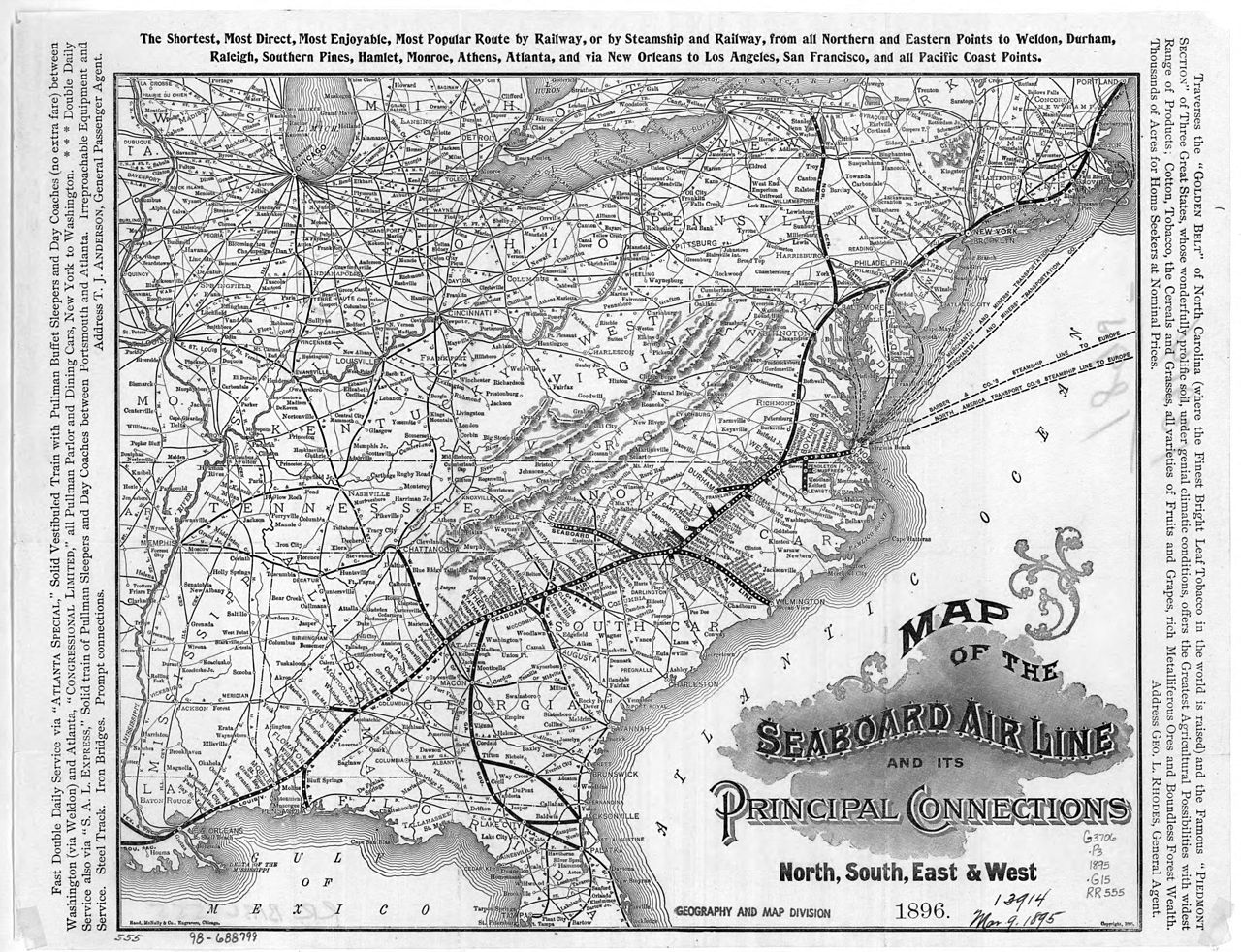
Fallen Flag — the Seaboard Air Line Railroad

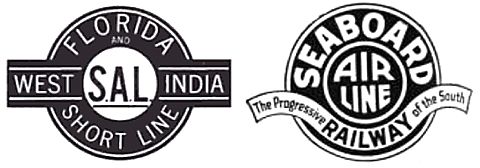
Seaboard Air Line logos used in print advertising, circa 1900 (left) and 1916 (right).
Wikimedia Commons.
This month’s Classic Trains fallen flag feature is the Seaboard Air Line by Larry Goolsby. The railroad’s earliest antecedent was originally chartered in 1832 to build a rail line from Portsmouth, Virginia to Weldon, North Carolina, a port on the Roanoke River which flows into Albemarle Sound. The Portsmouth & Roanoke began operation in 1834 and changed its name to the Seaboard & Roanoke around 1838 after several financial reorganizations and refinancing efforts. In 1837, the first passenger fatalities in US railroad history occurred in a head-on collision between a eastbound lumber train hit the westbound passenger train from Portsmouth on 11 August. Three young women were killed in the accident, all members of the Ely family.
Along with most other railroads in the Confederate states, Virginian and North Carolinian railroads were seriously damaged physically in the fighting and became political footballs during the Reconstruction Era. In the 1880s, the Seaboard and Roanoke was one of several railroads merged to form the Seaboard Air Line Railway which extended from Virginia to Georgia. The name Seaboard Air Line was in use well before the legal merger as a marketing device to help attract traffic.
The “Air Line” name was often used by railroads of the period to denote a route supposedly “as straight as the crow flies.” It was a reasonably direct run from Portsmouth to Weldon, but the Air Line label would be more than hype when in the 1880s Seaboard acquired a line linking Hamlet and Wilmington, N.C., which included a 79-mile tangent track, longest in the U.S.
As the 19th century closed, the SAL system came under control of a group led by John Skelton Williams, who added a line from Richmond, Va., to Weldon, and acquired the Florida Central & Peninsular, transforming what had been a Portsmouth–Atlanta carrier into a north-south line. In 1900, the various SAL roads were incorporated as Seaboard Air Line Railway with its coastal main line from Richmond going through Raleigh, Columbia, and Savannah to Jacksonville and Tampa.
While the World War II years strained SAL’s resources the railroad shouldered the load with new EMD FTs, secondhand steam engines from Western Maryland and Chicago & North Western, and installation of block signals and centralized traffic control over large portions of its main line. Wartime income helped the carrier emerge from receivership in 1946 as Seaboard Air Line Railroad.
High-profile wrecks, several involving passenger trains, spurred quick postwar completion of the signaling and modernization campaign. SAL’s earliest CTC installation had started south from Richmond in 1941. By the early 1950s, signals covered most mainline mileage, keeping the operation competitive with its double-tracked neighbor Atlantic Coast Line.
Seaboard added more streamlined cars from Budd in 1947 and lightweight sleepers from several builders beginning in 1949. The Silver Star name was given to what had been a second section of the Meteor, and the two “Silver Fleet” members held down the first-class New York–Florida trade. The Silver Comet was added to the New York–Birmingham route. Seaboard continued to maintain its premier trains to high standards into the 1960s, proudly calling itself “The Route of Courteous Service.” The Meteor and Star names survive on Amtrak’s New York–Miami route.
As with so many North American railways after World War II, the Seaboard faced stiff competition not only from direct competitors like the Atlantic Coast Line, but also from trucks diverting freight onto the interstate highway system but also from airlines whisking its passengers more rapidly to holiday destinations in Florida. The economic situation was clear in the mid-1950s and Seaboard applied for government approval to merge operations with rival Atlantic Coast in 1958, but did not get through the legal obstacle course until 1967 when the merger was formalized as the new Seaboard Coast Line Railroad.
February 18, 2021
Fallen Flag — The Newfoundland Railway

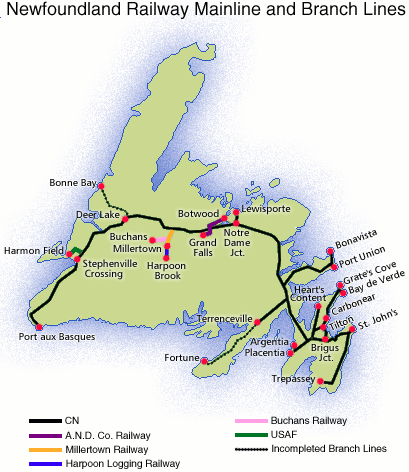
Newfoundland played a pivotal role in World War II during the Battle of the Atlantic and as a staging point for ship convoys and aircraft movements. Construction of Allied bases and the associated movement of personnel resulted in a railway traffic surge. A British and Canadian airfield grew near the main line at Gander, and the United States also exploited Newfoundland’s relative proximity to Europe. The two largest American installations were a naval base at Argentia — site of the 1941 shipboard meeting between President Roosevelt and Prime Minister Churchill — and Harmon Field, an Air Force base on the west coast at Stephenville. Rail traffic was a barometer of wartime pressures; between 1941 and 1943, NR’s passenger count rose from 223,000 to 500,000; freight tonnage also doubled. So important was the line to American military interests that the U.S. government allocated $2 million of “lend-lease” funds for locomotive and car construction.
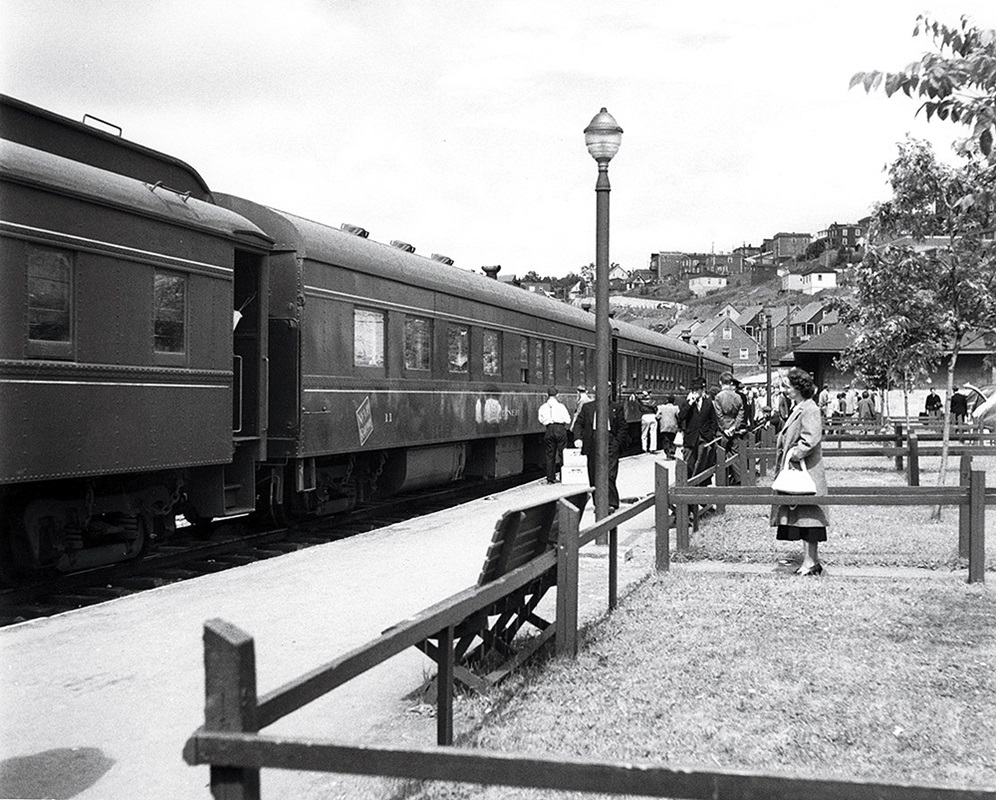
Newfoundland Railway’s Overland Limited (a.k.a. the “Newfie Bullet”) calls at Corner Brook in 1948, the year before CN took over.
Canadian National photo via Classic TrainsAlthough the war brought profits and a revitalized equipment roster, the railway was not immune from the conflict’s brutality. On October 14, 1942, the Port aux Basques–North Sydney (N.S.) ferry Caribou was torpedoed and sunk by a German submarine. Of 237 passengers and crew on board, 136 perished.
Canadian National control
Newfoundland’s 1949 entry into Canada saw responsibility for much of the transport infrastructure assumed by the Canadian government, whose Canadian National Railways was charged with the management and operation of the railway, as well as coastal steamship services and the ferry link to Nova Scotia. The federal government agreed to subsidize the operations. Despite wartime profits and some postwar rebounds, though, the railway had been and would continue to be a chronic money-loser.
Newfoundland Railway was exclusively steam-powered for all but the final seven months of its pre-Confederation existence, as GE 47-ton center-cab diesels 5000–5002 arrived in August 1948. The last new NR locomotives were class R-2-d Mikados 324–329, built by Montreal and delivered just weeks before Confederation. They became the youngest steam locomotives, by five years, on the entire CNR. In all, four 4-6-0s, a 2-8-0, 10 4-6-2s, and 30 2-8-2s were conveyed to CN.
[…]
Well into the 1960s, the railway provided the only land link spanning Newfoundland. When the first road across the island opened as part of the Trans-Canada Highway in late 1965, it triggered an irreversible shift of traffic off the railway. In the highway’s first 15 years, the percentage of island freight handled by train dropped by more than half. More than 24 hours — double the road time — was required for the St. John’s–Port aux Basques rail trip, and that was if the trains ran on time, a spotty prospect especially in winter.
Passengers benefitted from CN’s continued investment in rolling stock, although the non-air-conditioned fleet couldn’t provide mainland comfort levels. The principal pre-Confederation passenger train was the overnight Overland Limited. CN renamed it Caribou in 1950, a fitting tribute to the ferry lost in 1942. To most folks, though, the train was known from the war onward as the “Newfie Bullet,” a wry reference to its leisurely schedule (daily in summer, triweekly the rest of the year). Although CN buses replaced the “Bullet” in July 1969, mixed trains kept serving isolated mainline points and the Carbonear, Bonavista, and Argentia branches.
From the Wikipedia entry on the post-abandonment fate of the line:
The former Newfoundland Railway station in St. John’s now hosts the Railway Coastal Museum. Numerous towns across the island have preserved railway equipment on display.
With few exceptions, the roadbed now forms the T’Railway Provincial Park rail trail. Until 2005, the Trinity Loop Amusement Park operated a miniature train, one of the few remaining places on Newfoundland with tracks still in place. The park closed down and was abandoned in 2005 due to lack of interest. Since then, all of the buildings have been heavily vandalized and Hurricane Igor washed away part of the park, including a large section of the rail bed. Local railway fans have been pushing government to retain the park as an historic site but officials have expressed little interest.
Some rolling stock was converted to a narrower gauge of 914 mm (3 ft) and sold to the White Pass & Yukon Route (WP&YR) railway, which reopened for service in 1988. Gravel cars used by WP&YR are still painted in CN orange; unconfirmed information indicates that some Newfoundland passenger cars were converted into passenger cars of vintage appearance for WP&YR.
January 26, 2021
The brief and inglorious life of Penn Central
In City Journal, Nicole Gelinas recounts the tale of the fateful merger of two great American railroad systems that lasted just long enough to support massive financial chicanery before descending into inevitable bankruptcy:
More than 50 years on now, the spectacular collapse of the Penn Central railroad in 1970 is little remembered today, but its legacy is still with us — not so much as a warning, but as a prelude: to New York City’s own near-bankruptcy in the 1970s; to four decades of financial engineering, beginning in the 1980s; to the 2001 Enron downfall; to the 2008 financial crisis and its “too big to fail” bailouts — and yes, even to the public discontent that elected President Donald Trump.
As America emerged from World War II, most people would have laughed at the idea of the nation’s two premier freight and passenger railroads, the Pennsylvania and the New York Central, going broke in a quarter-century’s time. By design, the Pennsy and the Central were not fierce competitors but complementary “frenemies” that had long agreed not to undercut one another’s monopoly profits. From Massachusetts to Missouri, the two railroads dominated freight and passenger travel in the northeast quarter of the United States, with nearly 21,000 miles of track between them.
Yet even as America built its powerhouse postwar economy, the railroads struggled. As Joseph R. Daughen and Peter Binzen write in The Wreck of the Penn Central, their cult-classic chronicle of the Penn Central’s demise, during the war the then-separate railroads had been running their equipment 24 hours a day to transport troops and supplies, leaving them with “worn-out” equipment.
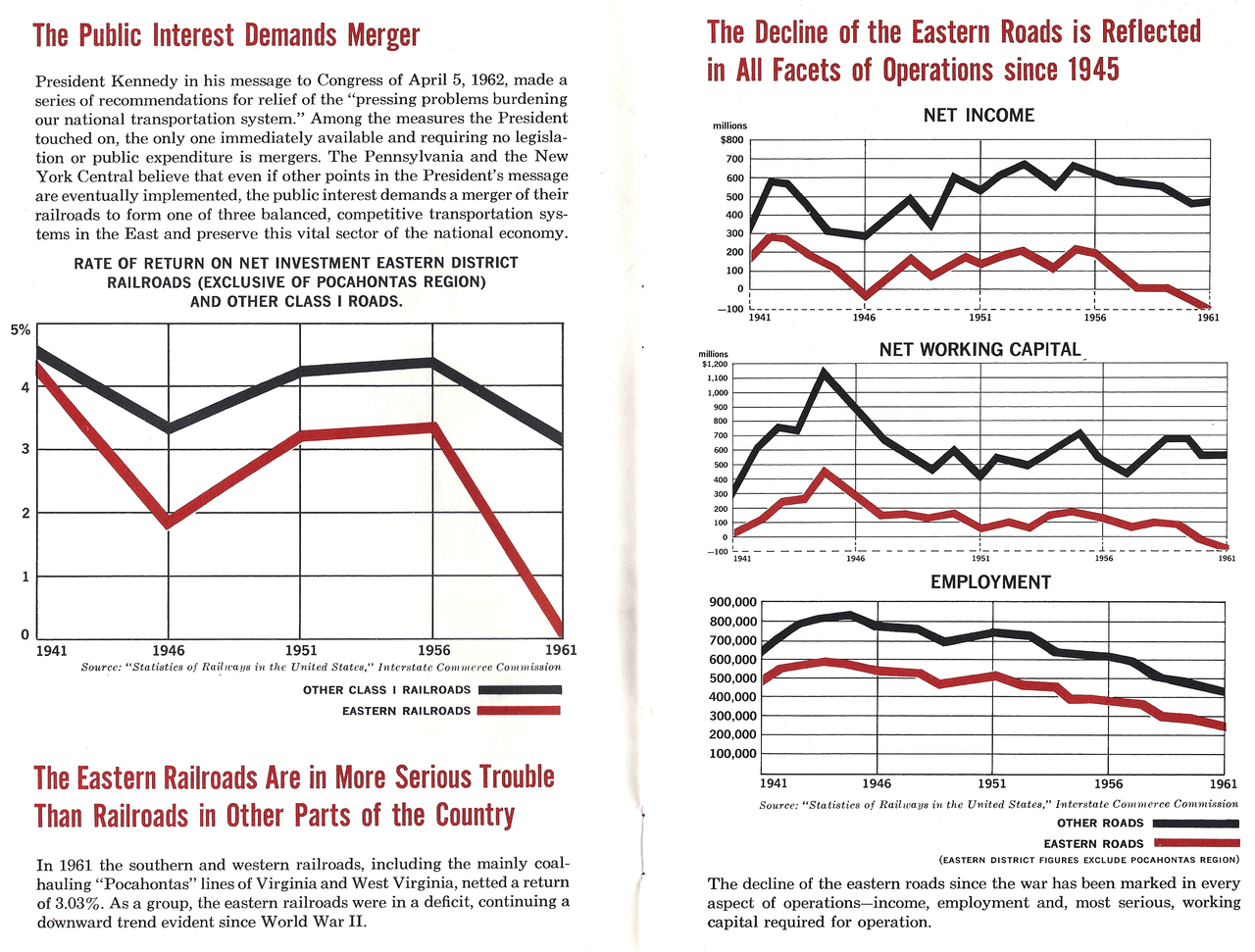
In the fifties and sixties, moreover, new competitive pressures prevented them from catching their breath. Trucks competed with the railroads for freight hauling via the new, free highways the nation was building. Commuter-rail passengers moved to the highways as well, while long-haul rail passengers took to the skies. The railroads’ decline accelerated in the sixties, partly because of the collapse of northeast manufacturing.
In 1962, the two companies decided to merge. But railroading was one of the most heavily regulated industries in the United States, so the merger took six years, as it wound its way through multiple levels of public approval for the creation of the 100,000-worker, 100,000-shareholder, 100,000-creditor behemoth. Meantime, government-set rates already fell short of the railroads’ long-term costs.
The combined entity that would become the Penn Central made significant concessions to win political support for the merger, including no-layoff pledges that would hamper its ability to cut spending and a promise to take on the independent (and chronically insolvent) New York, New Haven, and Hartford passenger railroad.
After the merger, the railroads discovered that they had incompatible computer systems, which threw railyards into chaos and angered customers. The Penn Central’s three top officials, too, were incompatible. They “scarcely spoke to one another,” write Daughen and Binzen. Stuart Saunders, the board chairman, was a political guy. Alfred Perlman, the president, was a trains guy. These different outlooks could have complemented each other, but personalities got in the way. Rounding out this dysfunctional triumvirate was Penn vet David Bevan, the top financial official, perpetually “angry and humiliated” at not being picked for the top job.

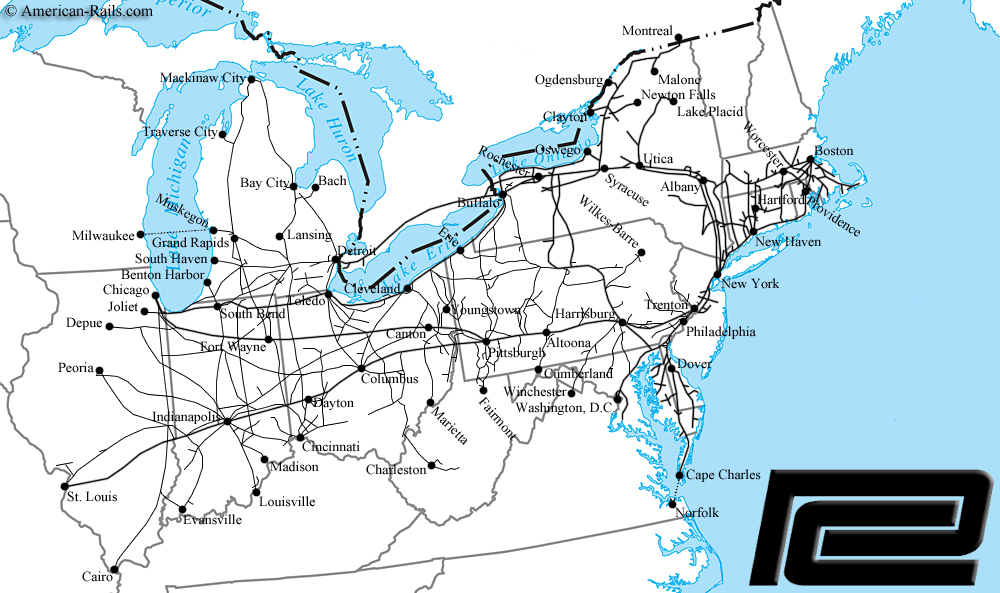
Penn Central route map from us.leforum.eu
http://us.leforum.eu/t1355-Photos-du-Penn-Central-PC.htm
H/T to Ed Driscoll at Instapundit, who also posted this video the combined entity put together to celebrate the merger:
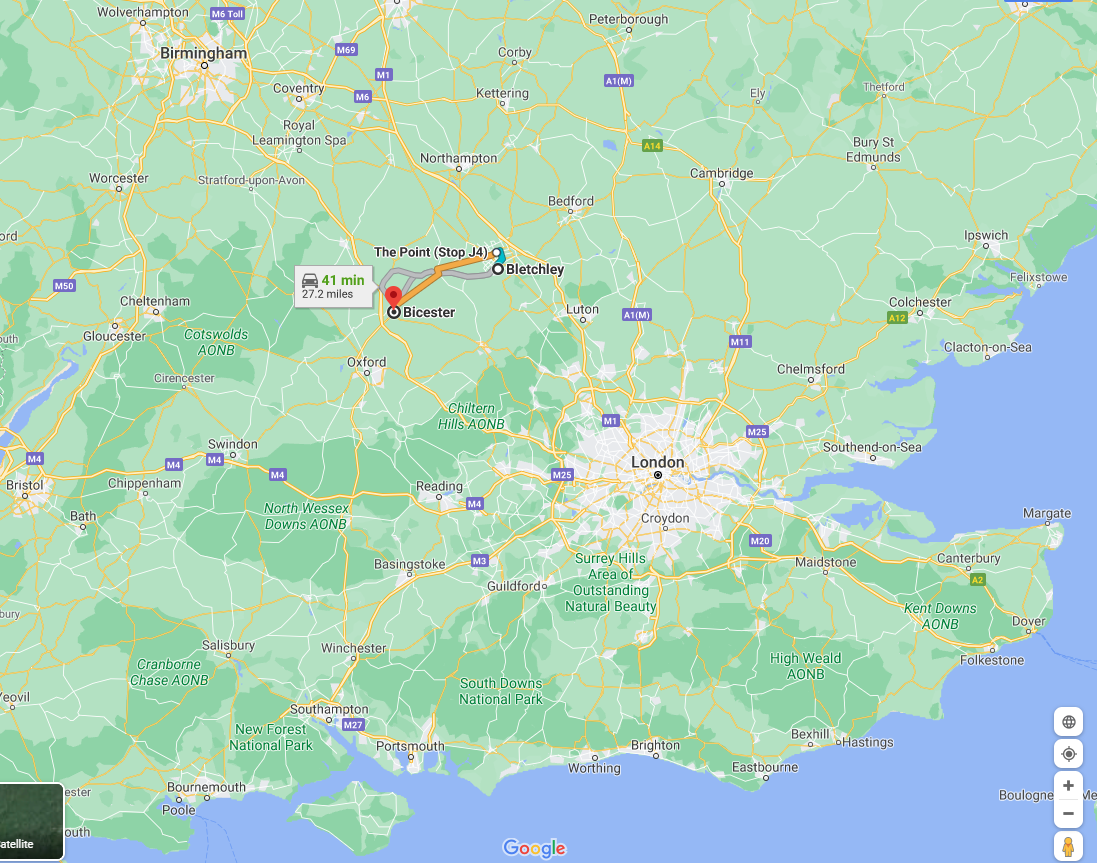
£760m to connect Bicester and Bletchley? That’s … very spendy
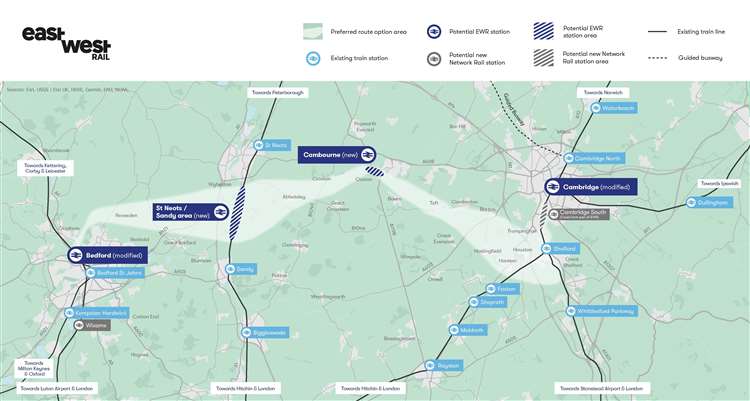
At the Continental Telegraph, Tim Worstall looks at the economic case for building the East-West railway line — in “reverse Beeching” style — to connect Oxford and Cambridge:
The cash from the Department of Transport will be used to lay track along a disused railway line between Bicester and Bletchley, in Buckinghamshire, with services beginning in 2025.
Excuse me? £760m to link Bicester and Bletchley? Other than the fact that that is £50m/mile, which should be the cost of rail lines made from crushed Faberge eggs and unicorn hair, how many people want to travel between Bicester and Bletchley by train? That’s roughly £10K/person in those small towns. OK,that then extends to Oxford, but that allows around 30,000 more people to go by train to Oxford. Which is not a particularly busy commuter metropolis anyway.
The aim is to complete the whole project by the end of the decade, according to the government minister overseeing it.
2 miles per year? Are they going to use canals and horses like Brunel?
[…]
Elsewhere, the new railway will shorten journey times between routes outside of London. Travellers from Oxford for example, will no longer have take a train into the capital and back out again to reach Milton Keynes, but could travel there via Bicester.
Again, what’s the demand for this? How many people want to do this, and would it be cheaper to just hire some chauffeurs to drive each passenger in a Ferrari from Bicester to where they want in Milton Keynes? I doubt it will be any quicker than a car because this only gets you to Bletchley, and then you have to get off a train to get to Milton Keynes, and then get where you want in Milton Keynes.
This used to be an active railway corridor before the Beeching cuts in the 1960s, which slashed a lot of uneconomic branch lines from British Rail’s network. If the land wasn’t sold off, then it’s just a matter of re-laying the track and ensuring that any existing bridges, embankments and drainage culverts are still capable of handling the renewed rail traffic. It seems unlikely that the mere engineering aspects of the project would require several hundred million pounds to complete, so perhaps there are some land issues that need to be re-acquired to allow the railway to become active again.
January 21, 2021
Fallen Flag — the New York Central System (part 2)

The New York Central System was the largest of the eastern trunk systems from the standpoint of mileage and second only to the Pennsylvania in revenue. It served most of the industrial part of the country, and its freight tonnage was exceeded only by the coal-carrying railroads. In addition it was a major passenger railroad, with perhaps two-thirds the number of passengers as the Pennsylvania, but NYC’s average passenger traveled one-third again as far as Pennsy’s. NYC did not share as fully in the post-World War II prosperity because of rising labor costs, material costs, and an expensive improvement program, especially for passenger service.
During 1946–47 Chesapeake & Ohio purchased a block of NYC stock, becoming the road’s largest stockholder. Robert R. Young gained control of the Central and became its chairman in 1954 as part of a maneuver to merge it with C&O. One of his first acts was to put Alfred E. Perlman in charge of the NYC.
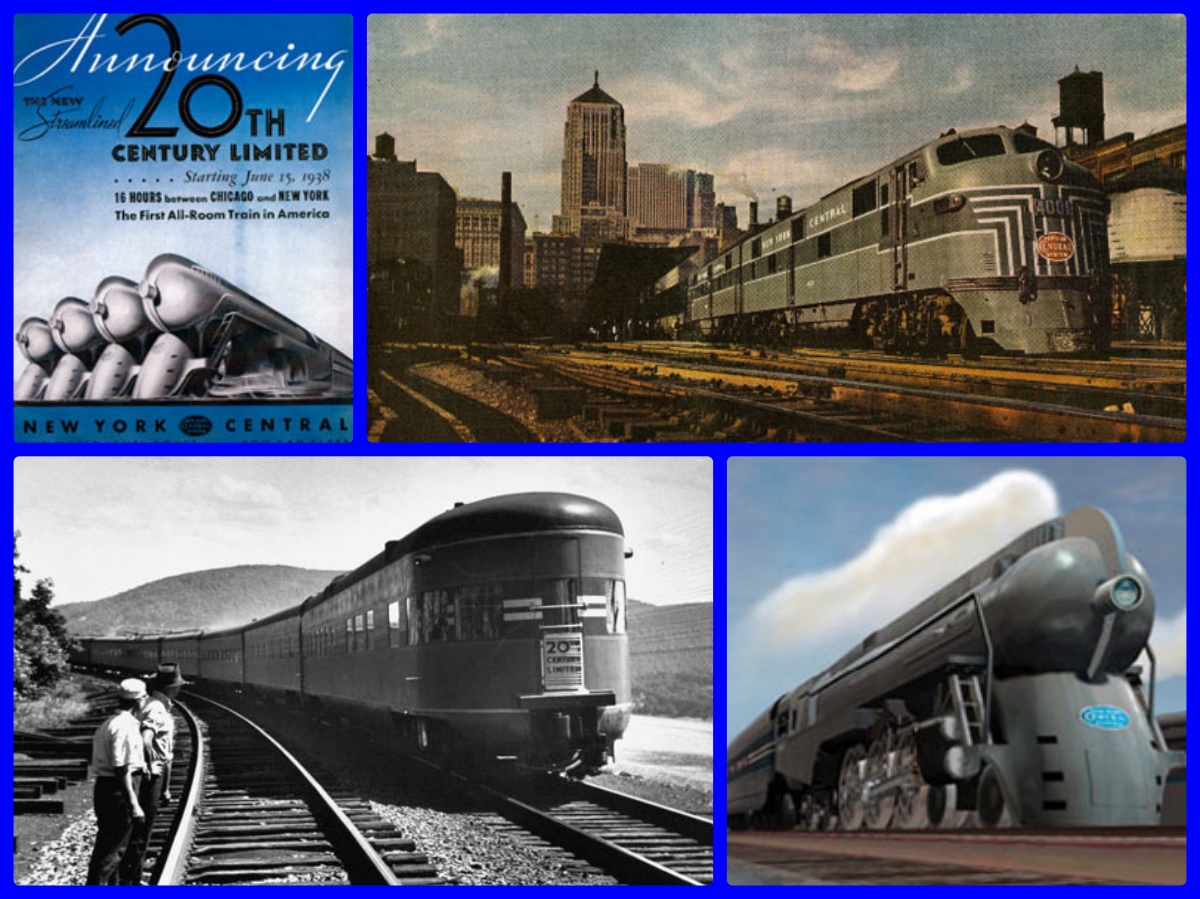
Under Perlman NYC slimmed its physical plant, reducing long stretches of four-track line to two tracks under centralized traffic control, and developed an aggressive freight marketing department. At the same time NYC’s passenger operations were de-emphasized. On December 3, 1967, just before NYC and Pennsy merged, the Central reduced its passenger service to a skeleton, combining its New York–Chicago, New York–Detroit, New York–Toronto, and Boston–Chicago services into a single train and dropping all train names (including that of the legendary 20th Century Limited) except for, curiously, that of the Chicago–Cincinnati James Whitcomb Riley.
The Central’s archrival was the Pennsylvania Railroad. West of Buffalo and Pittsburgh the two systems duplicated each other at almost every major point; east of those cities the two hardly touched. Both had physical plant not being used to capacity (NYC was in better shape); both had a heavy passenger business; neither was earning much money. In 1957 NYC and Pennsy announced merger talks.
The initial industry reaction was utter surprise. Every merger proposal for decades had tried to balance the Central against the Pennsy and create two, three, or four more-or-less-equal systems in the east. Traditionally PRR had been allied with Norfolk & Western and Wabash; NYC with Baltimore & Ohio, Reading, and maybe the Lackawanna; and everyone else swept up with Erie and Nickel Plate. Tradition also favored end-to-end mergers rather than those of parallel roads.
Planning and justifying the merger took nearly ten years, during which time the eastern railroad scene changed radically, in large measure because of the impending merger of NYC and PRR: Erie merged with Lackawanna, C&O acquired control of B&O, and N&W took in Virginian, Wabash, Nickel Plate, Pittsburgh & West Virginia, and Akron, Canton & Youngstown.
Tradition aside, though, the New York Central and the Pennsylvania merged on Feb. 1, 1968 to form Penn Central.
January 7, 2021
Fallen Flag — the New York Central System
This month’s Classic Trains fallen flag feature is the first part of the history of the New York Central System by George Drury. The New York Central was one of the biggest and most economically powerful American railways for over a century before the postwar boom turned into the economic disaster of the 1960s and 70s, as passengers switched from rail to road and plane and the decline of northeastern heavy industry and mining hit the established eastern railroads very hard:
The New York Central was a large railroad, and it had several subsidiaries whose identity remained strong, not so much in cars and locomotives carrying the old name but in local loyalties: If you lived in Detroit, you rode to Chicago on the Michigan Central, not the New York Central; through the Conrail era and even now, the line across Massachusetts is still known as “the Boston & Albany.”
The streamlined steam locomotive New York Central Hudson No.5344 “Commodore Vanderbilt”, leaving Chicago’s LaSalle Street station pulling the NYC’s premier passenger traing, the 20th Century Limited, 22 February 1935.
Photo originally copyrighted International News Photos (copyright not renewed) via Wikimedia CommonsThe system’s history is easier to digest in small pieces: first New York Central followed by its two major leased lines, Boston & Albany and Toledo & Ohio Central; then Michigan Central and Big Four (Cleveland, Cincinnati, Chicago & St. Louis). By the mid-1960s NYC owned 99.8 percent of the stock of Michigan Central and more than 97 percent of the stock of the Big Four. NYC leased both on Feb. 1, 1930, but they remained separate companies to avoid the complexities of merger.
In broad geographic terms, the NYC proper was everything east of Buffalo plus a line from Buffalo through Cleveland and Toledo to Chicago (the former Lake Shore & Michigan Southern). NYC included the Ohio Central Lines (Toledo through Columbus to and beyond Charleston, W.Va.) and the Boston & Albany (neatly defined by its name). The Michigan Central was a Buffalo–Detroit–Chicago line and everything in Michigan north of that. The Big Four was everything south of NYC’s Cleveland–Toledo–Chicago line other than the Ohio Central.
The New York Central System included several controlled railroads that did not accompany NYC into the Penn Central merger. The most important of these were (with the proportion of NYC ownership in the mid-1960s):
- Pittsburgh & Lake Erie (80 percent)
- Indiana Harbor Belt (NYC, 30 percent; Michigan Central, 30 percent; Chicago & North Western, 20 percent; and Milwaukee Road, 20 percent)
- Toronto, Hamilton & Buffalo (NYC, 37 percent; MC, 22 percent; Canada Southern, 14 percent; and Canadian Pacific, 27 percent).
[…]
The New York & Harlem Railroad was incorporated in 1831 to build a line in Manhattan from 23rd Street north to 129th Street between Third and Eighth avenues (the railroad chose to follow Fourth Avenue). At first the railroad was primarily a horsecar system, but in 1840 the road’s charter was amended to allow it to build north toward Albany. In 1844 the rails reached White Plains and in January 1852 the New York & Harlem made connection with the Western Railroad (later Boston & Albany) at Chatham, N.Y., creating a New York–Albany rail route.
The towns along the Hudson River felt no need of a railroad, except during the winter when ice prevented navigation. Poughkeepsie interests organized the Hudson River Railroad in 1847. The railroad opened from a terminal on Manhattan’s west side all the way to East Albany. By then the road had leased the Troy & Greenbush, gaining access to a bridge over the Hudson at Troy. (A bridge at Albany was completed in 1866.)
By 1863 Cornelius Vanderbilt controlled the New York & Harlem and had a substantial interest in the Hudson River Railroad. In 1867 he obtained control of the New York Central, consolidating it with the Hudson River in 1869 to form the New York Central & Hudson River Railroad.
Vanderbilt wanted to build a magnificent terminal for the NYC&HR in New York. He chose as its site the corner of 42nd Street and Fourth Avenue on the New York & Harlem, the southerly limit of steam locomotive operation in Manhattan. Construction of Grand Central Depot began in 1869. The new depot was actually three separate stations serving the NYC&HR, the New York & Harlem, and the New Haven. Trains of the Hudson River line reached the New York & Harlem by means of a connecting track completed in 1871 along Spuyten Duyvil Creek and the Harlem River (they have since become a single waterway). That was the first of three Grand Centrals.
The Wikipedia page on the New York Central includes a good overview of the decline of the railway:
The New York Central, like many U.S. railroads, declined after the Second World War. Problems resurfaced that had plagued the railroad industry before the war, such as over-regulation by the Interstate Commerce Commission (ICC), which severely regulated the rates charged by the railroad, along with continuing competition from automobiles. These problems were coupled with even more formidable forms of competition, such as airline service in the 1950s that began to deprive NYC of its long-distance passenger trade. The Interstate Highway Act of 1956 helped create a network of efficient roads for motor vehicle travel through the country, enticing more people to travel by car, as well as haul freight by truck. The 1959 opening of the Saint Lawrence Seaway adversely affected NYC freight business. Container shipments could now be directly shipped to ports along the Great Lakes, eliminating the railroads’ freight hauls between the east and the Midwest.
The NYC also carried a substantial tax burden from governments that saw rail infrastructure as a source of property tax revenues – taxes that were not imposed upon interstate highways. To make matters worse, most railroads, including the NYC, were saddled with a World War II-era tax of 15% on passenger fares, which remained until 1962, 17 years after the end of the war.
Robert R. Young: 1954–1958
In June 1954, management of the New York Central System lost a proxy fight in 1954 to Robert Ralph Young and the Alleghany Corporation he led.Alleghany Corporation was a real estate and railroad empire built by the Van Sweringen brothers of Cleveland in the 1920s that had controlled the Chesapeake and Ohio Railway (C&O) and the Nickel Plate Road. It fell under the control of Young and financier Allan Price Kirby during the Great Depression.
R.R. Young was considered a railroad visionary, but found the New York Central in worse shape than he had imagined. Unable to keep his promises, Young was forced to suspend dividend payments in January 1958. He committed suicide later that month.
Alfred E. Perlman: 1958–1968
After Young’s suicide, his role in NYC management was assumed by Alfred E. Perlman, who had been working with the NYC under Young since 1954. Despite the dismal financial condition of the railroad, Perlman was able to streamline operations and save the company money. Starting in 1959, Perlman was able to reduce operating deficits by $7.7 million, which nominally raised NYC stock to $1.29 per share, producing dividends of an amount not seen since the end of the war. By 1964 he was able to reduce the NYC long-term debt by nearly $100 million, while reducing passenger deficits from $42 to $24.6 million.Perlman also enacted several modernization projects throughout the railroad. Notable was the use of Centralized Traffic Control (CTC) systems on many of the NYC lines, which reduced the four-track mainline to two tracks. He oversaw construction and/or modernization of many hump or classification yards, notably the $20-million Selkirk Yard which opened outside of Albany in 1966. Perlman also experimented with jet trains, creating a Budd RDC car (the M-497 Black Beetle) powered by two J47 jet engines stripped from a B-36 Peacemaker bomber as a solution to increasing car and airplane competition. The project did not leave the prototype stage.
Perlman’s cuts resulted in the curtailing of many of the railroad’s services; commuter lines around New York were particularly affected. In 1958–1959, service was suspended on the NYC’s Putnam Division in Westchester and Putnam counties, and the NYC abandoned its ferry service across the Hudson to Weehawken Terminal. This negatively impacted the railroad’s West Shore Line, which ran along the west bank of the Hudson River from Jersey City to Albany, which saw long-distance service to Albany discontinued in 1958 and commuter service between Jersey City and West Haverstraw, New York terminated in 1959. Ridding itself of most of its commuter service proved impossible due to the heavy use of these lines around metro New York, which government mandated the railroad still operate.
Many long-distance and regional-haul passenger trains were either discontinued or downgraded in service, with coaches replacing Pullman, parlor, and sleeping cars on routes in Michigan, Illinois, Indiana, and Ohio. The Empire Corridor between Albany and Buffalo saw service greatly reduced with service beyond Buffalo to Niagara Falls discontinued in 1961. On December 3, 1967, most of the great long-distance trains ended, including the famed Twentieth Century Limited. The railroad’s branch line service off the Empire Corridor in upstate New York was also gradually discontinued, the last being its Utica Branch between Utica and Lake Placid, in 1965. Many of the railroad’s great train stations in Rochester, Schenectady, and Albany were demolished or abandoned. Despite the savings these cuts created, it was apparent that if the railroad was to become solvent again, a more permanent solution was needed.
December 28, 2020
The Tiny Monorails That Once Carried James Bond
Tom Scott
Published 21 Sep 2020The Roadmachines Mono-Rail may have been the only truly useful, fit-for-purpose monorail in the world. Of the hundreds that were built, most were never meant for passengers. But they did carry a couple of famous people in their time, including a certain secret agent…
Thank you to the staff and volunteers at the Amberley Museum – Harry and Gerry in particular – for running the monorail specially, and letting me film! The Amberley Museum is a massive industrial heritage museum in the South Downs, and you can find out more about them here: https://www.amberleymuseum.co.uk/
There are lots more videos of Amberley’s rail vehicles at the volunteers’ channel here: https://www.youtube.com/channel/UCMHT…
My research is heavily based on David Voice’s Mono-Rail: The History of the Industrial Monorails Made By Road Machines Ltd., Metalair Ltd and Rail Machines Ltd, ISBN 1874422877, available from Adam Gordon Books: http://www.ahgbooks.com/index.php/pro…
Thanks to Derry Faux-Nightingale for the initial idea!
The Tanat Valley Railway in Nantmawr is the home for the Richard Morris collection, more than seventy surviving Roadmachines Mono-Rails: https://www.tanatvalleyrailway.co.uk/…
Also a helpful resource:
https://www.irsociety.co.uk/Archives/…I’m at https://tomscott.com
on Twitter at https://twitter.com/tomscott
and on Instagram as tomscottgo
December 17, 2020
Fallen Flag — the Ann Arbor Railroad
This month’s Classic Trains featured fallen flag is the Michigan-based Ann Arbor Railroad which operated rail services from Toledo, Ohio to Elberta and Frankfort, Michigan, along with lake ferry service across Lake Michigan to Manitowoc and Kewaunee, Wisconsin and Menominee and Manistique in Michigan’s Upper Peninsula. Robert I. Warrick provides an outline of the history of the line:

Ann Arbor No. 1, built in 1892 by Craig Shipbuilding Co. in Toledo, Ohio. She was destroyed in a fire on March 7, 1910 at Manitowoc, Wisconsin.
Photo from Bowling Green State University via Wikimedia Commons.
The Ann Arbor Railroad was as much a steamship line as a railroad. Built from Toledo, Ohio, northwest to Frankfort, Mich., it existed for one reason — to move freight in car ferries across Lake Michigan to bypass Chicago. From 1910 to 1968, “the Annie” operated 320 car ferry route-miles versus 292 miles of railroad. AA was at the forefront of car ferry design and innovation, from the first wooden-hulled vessels to the most advanced car ferry to ever sail Lake Michigan.
During the 1940s, up to six ferries made the round trip from Boat Landing, as AA called its yard in Elberta on the south side of Frankfort harbor, to two Wisconsin and two Michigan Upper Peninsula ports. The boats ran year-round on a tight schedule, timed to match with three pairs of scheduled Toledo freights, where AA interchanged with five trunk lines. Well-kept 2-8-2s powered those short, fast trains across AA’s rolling profile until 1950, when Alco FA2s took over.
[…]
The Eastern mergers of the 1960s ultimately doomed the old Ann Arbor. As planning for Penn Central went on, the Norfolk & Western merged with Wabash, Nickel Plate, and two smaller roads in 1964. N&W wanted no part of the Ann Arbor and its costly ferries, so AA was foisted off on DT&I, which was profitable by the 1960s.
With ICC approval, DT&I took over the Ann Arbor on August 31, 1963, and soon replaced the tired FA2s with 10 GP35s, riding on Alco trucks and painted in DT&I orange with large “Ann Arbor” lettering. DT&I’s GPs often mixed with the Annie’s.
DT&I had ferry Wabash refitted, changed her name to City of Green Bay, and loaned AA $2.5 million to rebuild Ann Arbor No. 7. The railroad renamed No. 7 Viking, lengthened it, installed four EMD 2,500 h.p. 567 diesels. But even with the bigger boats, capacity remained an issue as car sizes increased. AA was losing money. First the ferry route to Manistique, Mich. (and AA subsidiary Manistique & Lake Superior), was discontinued, then the one to Menominee, Mich.
Ann Arbor’s fate was sealed. A firm was hired to liquidate Pennsylvania Company assets, including AA and DT&I. Ann Arbor defaulted on the loan for the Viking on November 1, 1972, and filed for bankruptcy on October 15, 1973, leading to AA’s inclusion with other bankrupts in the Regional Rail Reorganization Act of 1973 that resulted in Conrail.
QotD: Light rail systems are almost always an upper middle class boondoggle
What we can see here is exactly what Randall O’Toole of Cato has been saying for years — that light rail projects tend to actually hurt total transit use as they scavenge resources from other modes, like buses. This is because light rail costs so much more to move a passenger, both in terms of capital investment and operating cost, so $X shifted from buses to rail reduces total system capacity and ridership substantially. We have seen this in Phoenix, as light rail costs have forced closing or reduced services in a number of bus routes, with obvious results in the ridership numbers.
[…]
The problem with light rail (and the reason it is popular with government officials) is that it is an upper middle class boondoggle. There can be no higher use of transit than to provide mobility to poorer people who can’t afford reliable automobiles. Buses fulfill this goal better than any mode of transit. They are flexible and can reach into many corners of the city. The problem with buses, from the perspective of government officials, is that upper middle class people don’t like to ride on them. They like trains. So the government builds hugely expensive trains for these influential, wealthier voters. Since the trains are so expensive, the government can only build a few routes, so those routes end up being down upper middle class commuting corridors. As the costs mount for the trains, the bus routes that serve the poor and their dispersed commuting destinations are steadily cut.
Warren Meyer, “Phoenix Light Rail Fail, 2019 Update”, Coyote Blog, 2019-11-13.
December 12, 2020
Trains and Oil | California History [ep.8]
The Cynical Historian
Published 4 Jul 2019After a long hiatus, here is the return of the History of California series. For those who haven’t seen the previous episodes, here’s the playlist: https://www.youtube.com/playlist?list…
Today we’re going over the history of transcontinental railroads, monopolistic practices, and crude oil production in California.
————————————————————
references:
eds. Richard Francaviglia and David Narrett, Essays on the Changing Images of the Southwest (Arlington: University of Texas at Arlington, 1994). https://amzn.to/2JwNiHkWilliam H. Goetzmann, Army Exploration in the American West, 1803-1863, new ed. (1959; Lincoln: University of Nebraska, 1979). https://amzn.to/2K8tslY
Paul Sabin, Crude Politics: The California Oil Market, 1900-1940 (Berkeley: University of California Press, 2005). https://amzn.to/2W16gtt
Jules Tygiel, The Great Los Angeles Swindle: Oil, Stocks, and Scandal During the Roaring Twenties (Berkeley: University of California Press, 1996). https://amzn.to/2ASH7Z0
Richard White, Railroaded: The Transcontinentals and the Making of Modern America (New York: W.W. Norton, 2011). https://amzn.to/2zkURO3
————————————————————
Support the channel through PATREON:
https://www.patreon.com/CynicalHistorianLET’S CONNECT:
Discord: https://discord.gg/Ukthk4U
Twitter: https://twitter.com/Cynical_History
————————————————————
Wiki: The history of the Southern Pacific stretches from 1865 to 1998. For the main page, see Southern Pacific Transportation Company; for the former holding company, see Southern Pacific Rail Corporation. The Southern Pacific was represented by three railroads. The original company was called Southern Pacific Railroad, the second was called Southern Pacific Company and the third was called Southern Pacific Transportation Company. The third Southern Pacific railroad, the Southern Pacific Transportation Company, is now operating as the current incarnation of the Union Pacific Railroad.The story of oil production in California began in the late 19th century. In 1903, California became the leading oil-producing state in the US, and traded the number one position back-and forth with Oklahoma through the year 1930. As of 2012, California was the nation’s third most prolific oil-producing state, behind only Texas and North Dakota. In the past century, California’s oil industry grew to become the state’s number one GDP export and one of the most profitable industries in the region. The history of oil in the state of California, however, dates back much earlier than the 19th century. For thousands of years prior to European settlement in America, Native Americans in the California territory excavated oil seeps. By the mid-19th century, American geologists discovered the vast oil reserves in California and began mass drilling in the Western Territory. While California’s production of excavated oil increased significantly during the early 20th century, the accelerated drilling resulted in an overproduction of the commodity, and the federal government unsuccessfully made several attempts to regulate the oil market.
————————————————————
Hashtags: #history #California #trains #oil