Quotulatiousness

September 1, 2024

The supermarket master plan to defeat the “far right” in Germany

There are elections ongoing in the German states of Thüringen and Saxony, and the polls show that the “far right” Alternative für Deutschland is potentially going to get 30% of the votes, which would give them more representation in those states than any of the other parties. Panic and hysteria have set in not only among the politicos and the mainstream media, but even among some businesses:

In Germany, all political parties have a colour. The Christian Democratic Union and the Christian Social Union are black, the Social Democratic Party is red, the liberal Free Democratic Party are yellow and the evil fascist Alternative für Deutschland are blue. This coming Sunday, Thüringen and Saxony will hold state elections, and the blue AfD are leading the polls in both states with about 30% support. This has a lot of people very, very upset. Most of them are merely upset with the AfD, but some psychologically unstable people have allowed their anger to embrace the colour blue more generally, because there can be no limits when it comes to resisting the evil antidemocratic forces of fascism.

Among the new sworn enemies of the blue band of the visible electromagnetic spectrum are the marketing team at Germany’s largest supermarket corporation, the Edeka Group. A few days ago, this supermarket chain, whose own logo strangely enough is primarily blue …

… ran an ad in Die Zeit and the Frankfurter Allgemeine Zeitung explaining “WHY BLUE IS NOT ON OFFER AT EDEKA”.

That wall of text in the middle reads as follows:

    Yellow bananas, red tomatoes, green lettuce, purple grapes, orange carrots, pink dragon fruit … EDEKA’s fruit and vegetable department is full of colourful diversity. Or is it?

    If you look closely, there’s one colour you won’t see: blue. And that’s no coincidence. Because blue food is nature’s way of warning us: ‘Watch out! I could be harmful!”

    Evolution has taught us that blue is not a good choice.

    And speaking of choices: Blue is not only the natural enemy of a healthy diversity of fruit and vegetables. In Germany, “the blues” are also the biggest threat to our diverse society.

    So let’s read the warning signs correctly ahead of the state elections in Saxony, Thüringen and Brandenburg in September – and ensure that we can live together in harmony. Because we love diversity.

For those wondering whether Edeka have decided to cease selling fascist blue fruits like blueberries, there is a helpful note down in the corner:

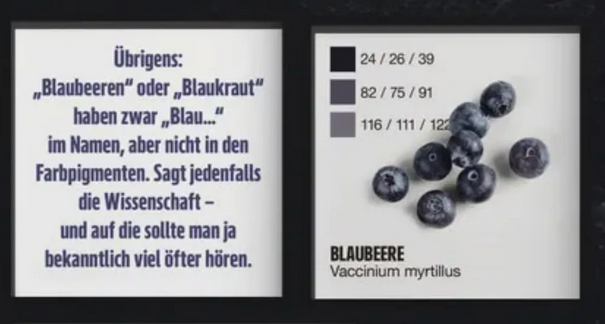
There we learn that, while “‘Blueberries’ or ‘Blue cabbage'” may have “‘blue’ in their names”, their “colour pigments” are not blue. This is “at least what Science tells us – and as we know you should always listen to Science more”. Nothing about this is remotely obnoxious; indeed, if current-year Germany needs anything, it is more blind platitudinous calls to Follow the Science – particularly when it comes to exonerating innocent fruits and vegetables from suspicion of blue fascism.

August 31, 2024

Kamala deigns to speak to the loyal, pantingly eager sycophantic press … briefly

Filed under: Media, Politics, USA — Tags: , , , — Nicholas @ 05:00

At Spiked, Brendan O’Neill seems somehow underwhelmed by Kamala Harris and Tim Walz descending from Olympus to grace poor mortals as they appeared on CNN on Thursday night for their first big media appearance:

Yesterday, finally, the kween deigned to engage with her subjects. Yes, Kamala Harris did her first sit-down media interview since replacing Joe Biden on the Democratic presidential ticket nearly 40 days ago. For more than a month she’d maintained a monarchical distance from the grubby presses, flat-out refusing a one-to-one with any of its probing hacks. Now she’s relented and had an exclusive chat with CNN’s Dana Bash. The end result? Only one word will do, and it’s a word normally aimed at the other side: weird.

Seriously, can we talk about this shitshow? It is hands down the oddest “first big interview” I’ve seen with a candidate for high office. It took place at Kim’s Cafe in Savannah, Georgia and none of it made sense. Even the lighting was off – it’s the first time I’ve seen Kamala look bad. The angles were all wrong, meaning Harris, the supposed colossus of joy who will transform America, looked scrunched and tiny between Tim Walz and Ms Bash. And what was VP pick Walz even doing there? Chaperoning? “Strong, Capable Woman Asks Man To Come With Her To Job Interview In Case They Ask Any Hard Questions”, quipped the Babylon Bee.

They had no worries on that front. There were no hard questions. The ass-kissage was off the scale. Bash didn’t only give Harris easy questions – she gave her the answers, too. The most extraordinary moment was when she gently prodded Harris on her flip-flopping over policy. Finally, I thought, a tricky query. But then she told Harris what to say. “Is it because you have more experience now and you’ve learned more about the information?”, she wondered. The way Harris’s face lit up when she was handed this oven-ready excuse for her chameleon-like politics – even in the bad lighting you could see her glee at CNN’s servility to the Kamala cause.

A more objective broadcaster – hell, a kid with a camera fresh out of journalism school – would have dragged Harris for her vagueness. She issued flat platitudes. She engaged in Orwellian gobbledygook about how her policies might have changed but her “values” haven’t – eh? She spoke in tongues about climate change – it’s “an urgent matter to which we should apply metrics that include holding ourselves to deadlines around time”, she said, like a schoolkid padding out an essay with superfluous adjectives. And Bash just sat there, smiling. Maybe everyone in DC speaks like this?

Some of Harris’s volte-facing really is extraordinary. She once said she would ban fracking, now she says she won’t. And how on Earth did she go from comparing US Immigration and Customs Enforcement (ICE) to the KKK and saying “an undocumented migrant is not a criminal” to now saying we must sternly enforce our nation’s borders? “I think the most important and most significant aspect of my policy perspective and decisions is my values have not changed”, she said. There’s that padding again. Sixteen words in that sentence are unnecessary. And the remaining five – “My values have not changed” – are not true.

QotD: Celebrity activism

Filed under: Media, Politics, Quotations — Tags: , , , — Nicholas @ 01:00

It was never a practical project to silence the acting profession. These people are famous. Having acquired their fame, they then want to use their fame to do good, and in the process to become even more famous. This is only natural, especially when you consider that doing good and being heroic is what, according to the entertainments these people spend their lives making and acting in, life is all about. Trying to stop famous actors from expressing what they consider to be virtuous and heroic opinions in public is like trying to stop the wind from blowing or the sea from being wet.

Brian Micklethwait, “Minnie Driver and the changing meaning of goodness”, Samizdata, 2005-08-01.

August 30, 2024

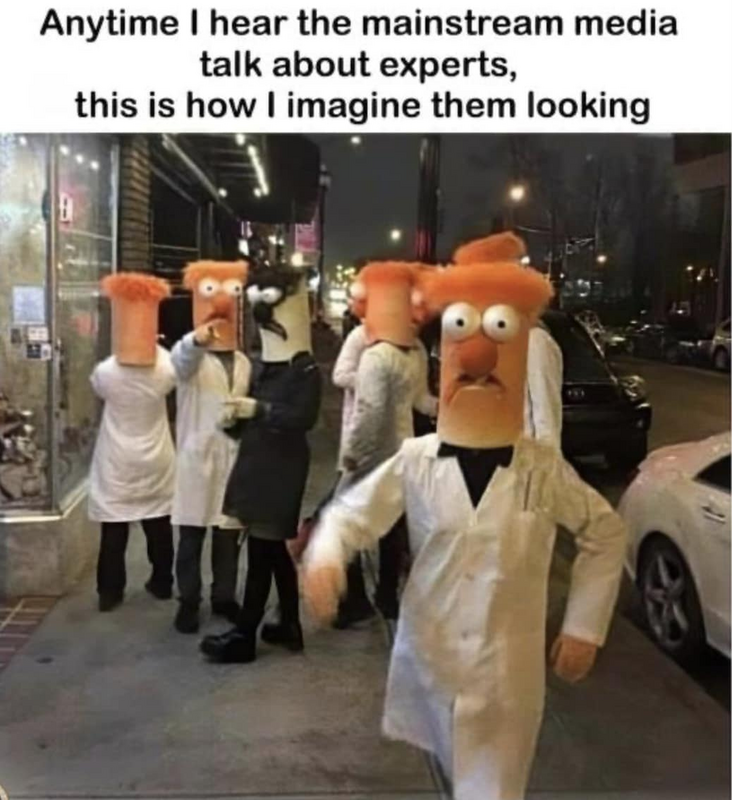
Experts are concerned that criticism of experts will weaken their role in our political system

In the National Post, Geoff Russ dares to imply that the experts are not the divinely inspired superior beings with unfailing wisdom about any and all issues:

So-called “experts” have weakened Canada’s political discourse far more than Pierre Poilievre ever has. Journalist and author Stephen Maher recently penned a column in the Globe & Mail titled, “By slamming experts, Pierre Poilievre and his staff are degrading political debate”.

Maher is an even-handed journalist, and his column should not be written off as the scribblings of a Liberal partisan. What his column misses is how the term “expert” has been abused, and the degree to which “experts” have thoroughly discredited themselves in recent years.

Poilievre’s criticisms of the “experts” would not resonate if they lived up to the title bestowed upon them.

For example, the Doug Ford government’s decision to close 10 safe injection sites after implementing a ban on such facilities located near schools and child-care centres. The closures were lamented by “experts” trotted out by the CBC as putting peoples’ lives at risk.

The safe injection sites slated to be shut down are near schools and daycares, and there is demonstrable proof that crime rises near these sites wherever they are located.

Derek Finkle recently wrote that the critiques of the closures levelled by selected “experts” failed to note how community members had been threatened with rape, arson, and murder since the injection site in his Toronto neighbourhood had been opened.

These are reasonable grounds for a government to reconsider whether they should allow drug-use, supervised or not, to proliferate in neighbourhoods where families reside.

For all their alleged expertise, many “experts” seem unwilling to actually investigate what is happening on the ground, and often give plainly bad advice altogether, and this goes back decades.

The “experts” failed to predict the 2008 financial crisis, they said the risk to Canadians from the coronavirus was low in early 2020, and they failed to prevent runaway inflation after the worst of it had subsided.

Was it not the “experts” who asserted that arming and funding of Ukraine prior to Vladimir Putin’s invasion in 2022 was a bad idea? After the invasion began, was it not the “experts” who confidently predicted Putin’s army would conquer the whole of Ukraine in a matter of days, and not be bogged down in a years-long conflict that would reshape global trade?

The truth is that we live in a worse-off world because of the advice and predictions of “experts”.

Two-Tier Keir’s “mask off” moment(s)

Millennial Woes presents a disturbingly long summary of British Prime Minister Keir Starmer’s responses to popular non-violent protests:

The situation in Britain now is so perverse that, if you could convey it to people from a century ago, I think they, after getting over the disbelief and astonishment and accepting that this really was true, would assume it could not possibly have come about by chance. Whatever their complaints about the Britain of 1900, they wouldn’t have believed it capable — on its own — of the degeneration we have seen. They would insist that it must have been wickedly subverted, every failsafe removed, and entire systems of governance, culture and morality repurposed, made to achieve the opposite of their purported function.

I hardly need list the symptoms of this, but for the sake of posterity …

  • The control nexus (of which the government is merely one node) ships massive numbers of unassimilable foreigners into the country against the repeatedly expressed wishes of the natives, and in clear violation of their best interests.
  • Natives who complain about this are hounded, doxed, demonised, made unemployable, and often imprisoned.
  • Their children are systematically indoctrinated by fiction media to accept their dispossession. They are encouraged to despise the “bigoted” attitudes of their parents and grandparents, and to loathe their nation’s history. The boys are encouraged to idolise non-native men. The girls are encouraged to race-mix with them.
  • Teachers deliver the same indoctrination in the classroom — in every classroom. You won’t be allowed to become a teacher unless you voice enthusiasm for such things. Alternative views have been eradicated from the classroom and the lecture hall.
  • Natives are systematically disadvantaged in numerous sectors of education and employment.
  • Natives are demonised in fiction and news media while non-natives are made to look wonderful.
  • The mass sexual abuse of native children by non-natives is systematically down-played by news media, who shift discussion to false “equivalents”.
  • Natives’ history is systematically distorted in education and fiction media.
  • The very existence of the natives, as a group, and their ownership of their homeland, are systematically denied by education, fiction media, news media, and phoney “science”.
  • The police do whatever they are told to do, kneeling for the participants in one riot, hunting down the participants in a different riot.
  • Judges pass obviously outrageous prison sentences upon certain people, for blatantly political reasons. These people are denied bail and pressured to plead guilty for fear of sentences even more outrageous. All of this is to send a message to other people: “don’t dare complain or the same will happen to you”.
  • The media rushes to concoct fake narratives about events, to keep the public misinformed.
  • A so-called “charity”, which is heavily linked to the government and the civil service, seeks to indoctrinate the young and ruin the lives of “troublemakers”, and actively aids the government in concocting fake narratives in order to control public thought and direct events.
  • Fake news from such Establishment agents is forgiven, fake news from the Establishment’s enemies is answered with threats of prosecution.
  • The media “memory hole” stories of appalling violence by non-natives, explain away such incidents with talk of mental illness, tell natives “don’t look back in anger”, and at all costs defend the suicidal ideologies that make such incidents possible.
  • The prisons are emptied of rapists, child molesters and murderers so that troublesome natives can be assigned their cells. They are placed alongside non-natives who might well be violent to them, and journalists gloat about it.
  • The slaughtering of three little girls by a non-native is dismissed by the Prime Minister, who says “it doesn’t matter” that the rioting was a response to this outrageous crime, which was enabled by the outrageous government policies that the natives have been complaining about for decades. Their shock, their trauma, their resentment, their dignity, their pain… “doesn’t matter”. This is in stark contrast with how he reacted to Black people rioting several years before.
  • The natives’ freedom of speech is continually undermined, one government after another actively seeking to erode it further.
  • Not one single organisation is fighting for the wellbeing, rights or interests of the natives.
  • Any political party that would do anything about any of this is refused the right to stand in elections, debanked, demonised and, in most cases, destroyed.

Any one of these examples would, in itself, be cause for great alarm. The whole lot together indicate a society that is not just largely, not just fundamentally, but wholly opposed to the continued existence of its native population. To underline: British society is actively perpetrating the destruction of the native British people.

It has been said that the ruthless authoritarian response of the fledgling Starmer government to this summer’s (White) riots is a “mask off” moment for the Labour Party. Others have called it a “mask off” moment for the British Establishment, which transcends the particular party in office. Indeed, things that didn’t happen under the Conservatives have suddenly happened under Labour; things that one would more neatly associate with the former have instead happened under the latter. That can only mean either that the Labour Party has utterly lost its sense of itself, or that the particular party in office simply doesn’t matter, because the Establishment abides.

I think, in fact, all of these statements are true. It has been a “mask off” moment for the Labour Party, and for Keir Starmer himself, and for the Establishment which enables and directs them. The Labour Party has lost its sense of itself — or, to put it less romantically, has been completely repurposed. And the Establishment does abide; no matter which party is in office, things only ever evolve in one direction. And after all, while Starmer’s behaviour casts a bad light on him, he is only Prime Minister in the first place because the Establishment wanted him, not someone who might have reacted to these riots in a different manner. (Boris Johnson is good at stoking war abroad, but not so willing to stoke it at home.)

But in the end it doesn’t really matter. We don’t need to pin the blame on Starmer, Labour, the British Establishment or Davos; they are all one and the same miasma. Yes, the Conservative Party might have reacted differently to the riots, so to some extent we can blame Labour’s ideology or Starmer’s personality, but the pendulum is kept swinging for a reason. One empty suit is shifted out, another is shifted in. Each one might be enthusiastically on-board with the agenda or compelled to go along with it, this being the only variance. And thus the Establishment abides, always getting what it wants against the wishes of the natives, and always degrading and dispossessing them.

August 29, 2024

How activists used lawfare to force the Boy Scouts to go woke (and then go broke)

Filed under: Law, Liberty, Media, Politics, USA — Tags: , , , , — Nicholas @ 04:00

A guest post from Cole Noble at Postcards From Barsoom discusses how progressive organizations and political activists have managed an immense take-over of the great outdoors, not least of which were the legal and political efforts to force the Boy Scouts of America to accept gay scouts and scout masters:

[…] This entertainment ecosystem, increasingly infested with culture warriors, also started chipping away at the longstanding prestige of organizations like the BSA [Boy Scouts of America]. Depicting someone as a scout became a kind of character development shorthand, signalling them as uncool.

The targeting wasn’t incidental; the existence of the pre-centennial BSA was a serious problem for the ruling class. Their organization’s commitment to values-based conservation served as living proof that going along with society’s adoption of critical theory was completely optional. If the BSA was free to refuse the push, others might start getting ideas.

Lawfare was inevitable.

In 2000, the United States Supreme Court heard Boy Scouts of America v. Dale. In one corner you had James Dale, an avowed gay rights activist, co-president of the Rutgers University Lesbian/Gay Alliance, and outspoken advocate for gay teens having gay role models. In the other, you had the BSA, who didn’t want someone like Dale around its young, impressionable members.

The BSA won, but there was blood in the water. Culture warriors circled back around, this time employing social pressure. They tried to make their demand sound as reasonable as possible: drop the policy against openly gay members. Just one teeny tiny rule. What’s the point anyway? It’s outdated. No real sense keeping it, right?

Smart members of the program clocked this Trojan Horse from miles away. Alas, the organization’s leadership did not. Possessing both the physique and fortitude of rice pudding, they caved, capitulated, and acquiesced some more — agreeing to an ever-escalating series of demands that hollowed out the once-proud group into an empty vessel for The Current Thing(TM).

The Boy Scouts of America is now all-inclusive! Not just to gay scouts and leaders, but girls too. In a show of solidarity with Black Lives Matter after the riots of 2020, a mandatory DEI merit badge has replaced camping as a requirement to attain the once coveted rank of Eagle Scout.

Let’s not forget the Scout Masters now left to deal with teens using the program’s overnight trips as cover for hookups.

Oh, and they went bankrupt.

The organization agreed to a 2.5 billion dollar settlement over tens of thousands of sex abuse cases perpetuated by adult men, against underage boys.

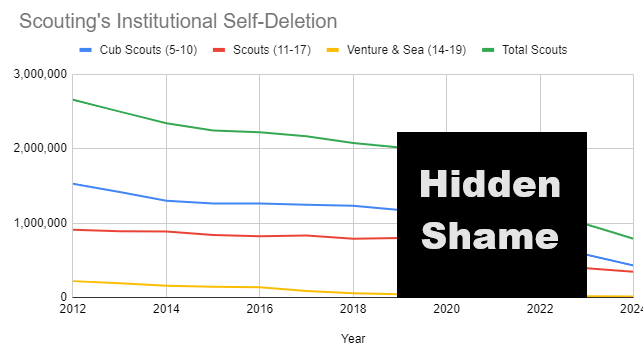
(data compiled from the BSA’s publicly available annual reports)

Rather than bolster ranks, adopting DEI cost the organization more than 1 million members.

The BSA – sorry, Scouting America1 – didn’t publish annual membership reports from 2020 to 2022, I imagine out of embarrassment. During this time, the Mormons, who used Scouting as a youth program for its boys, took their 400,000 members, and their money, and left.

[…]

Scouting was one of, if not the last bastion of quasi-unstructured outdoor activities. While the death of free-range childhood seems to be commonly understood, there is some debate about the precise cause.

Whatever your opinion on the matter, regime journalists shoulder enormous responsibility for eroding societal trust and inspiring mass paranoia through sensational reporting. Former latchkey kids became hysterical helicopter parents, petrified of letting their children out of sight.

Playing outside became a heavily supervised affair, usually relegated to fenced-in backyards with locking gates.

Kids have been robbed of the experiences that could lead them to develop an organic appreciation for outdoor recreation, and groomed into a hypersexualized version of early adulthood. All the while, the institutions which once taught conservation and virtue now serve as apparatuses of critical theory.


    1. They changed their name in May of 2024, after 114 of being the Boy Scouts. Since they’re no long the Boy Scouts, this is at least honest.

Cole’s own Substack is Quandary Magazine, which you should check out if you’re generally interested in the great outdoors.

August 28, 2024

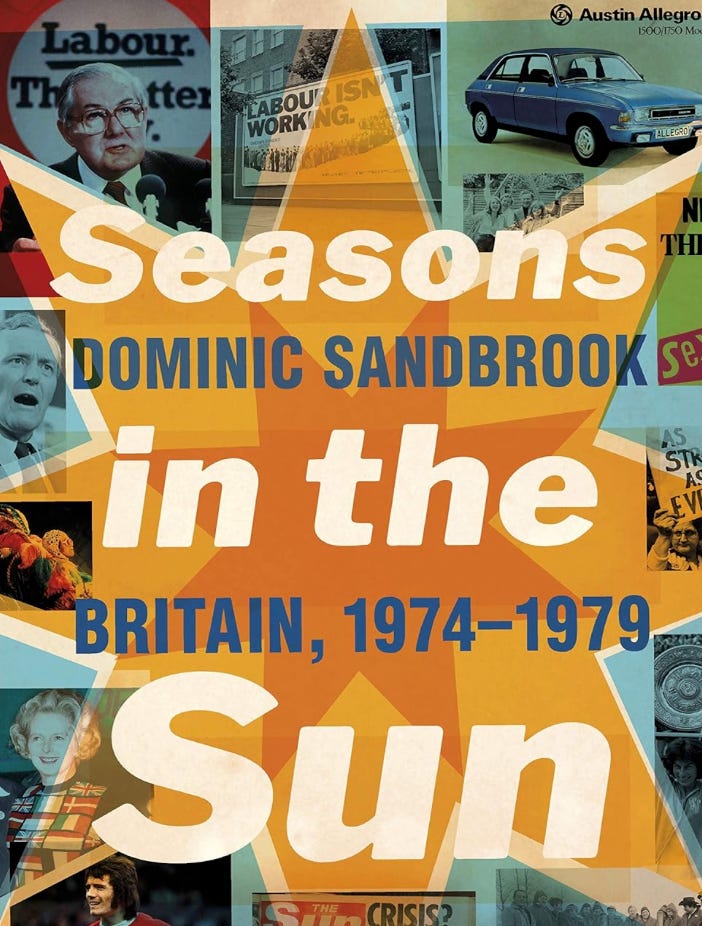
1974 – Britain’s nadir

Filed under: Books, Britain, Economics, History, Media, Politics — Tags: , , , , , — Nicholas @ 05:00

In the second part of Ed West‘s appreciation of Dominic Sandbrook’s Seasons in the Sun, Britain was described as “sliding, sinking, shabby, dirty, lazy, inefficient, dangerous, in its death throes, worn out, clapped out, occasionally lashing out” by Margaret Drabble in her 1977 novel The Ice Age, and it certainly seems to fit the bill quite well:

The Times reported in October of that year that London’s West End was in a “sorry state”, with parts of Shaftesbury Avenue and Charing Cross Road “in the sort of condition that, in Birmingham or Manchester, would qualify them for wholesale slum clearance”.

Journalist Clive Irving wrote that London had become “a semi-derelict slum”, a city blighted by “tacky porno shops, skin movies, pinball arcades, and toxic hamburger joints” while “behind neon facades the buildings are flaking and unkempt”.

The capital had lost a million and a half people since its peak in 1939, and would continue its decline for another decade. Whitehall Mandarin Ronald McIntosh declared that “London is evidently losing population quite heavily [and] services are steadily deteriorating, and nobody seems to have the least idea of how to deal with it”.

The country as a whole was haemorrhaging people, and in 1975 its population fell for the first time since records began. In the spring of 1974 applications for emigration to Canada went up 65 per cent, while New Zealand even felt compelled to put restrictions on people fleeing the old country.

Doctors in particular were leaving in droves, and recruitment agency Robert Lee International estimated that the number of professionals wanting to move abroad rose by 35% in just six months, from January and July 1975. Interest was keenest among engineers, accountants, scientists and teachers.

Many high earners were fleeing excessive tax rates, so punitive that even the Bond producer Albert R Broccoli left to make the iconic British movies elsewhere, and Moonraker would be filmed in France.

Gone were the days of the Swinging Sixties; instead, the London of George Smiley was “the city of the Sex Pistols and The Sweeney, not the Beatles and The Avengers; a city of tramps and hooligans, hustlers and muggers, the downtrodden and the disappointed, haunted by the deadly figure of the IRA bomber”.

Britain’s second city was in an even worse state. During Wilson’s first term Birmingham had been hailed as “the most go-ahead city in Europe”. Now the Times admitted it looked like a “large and chaotic building site”.

Travel writer Jonathan Raban described Southampton’s Millbrook estate as “a vast, cheap storage unit for nearly 20,000 people”. The country’s increasing problem with crime, hooliganism, graffiti and drug addiction meant that residents wouldn’t even hang their clothes in communal areas, for fear of theft.

The great architectural feats of the post-war era were beginning to look like a miserable failure, and none more so than the utopian social housing schemes, which had often entailed destroying closely-knit and organic communities in overcrowded and run-down – but rescuable – terraced housing.

Christopher Brooker visited Keeling House in Bethnal Green and found “its concrete cracked and discolouring, the metal reinforcement rusting through the surface, every available inch covered with graffiti”. Here was the story of modern Britain, “the bright, anticipated dream followed by a seedy, nightmarish reality”.

The National Theatre’s Peter Hall visited the New York Juilliard School and upon return home “found it depressing to compare it with our own already run-down, ill-maintained South Bank building”.

“The English apparently no longer care enough about material surroundings,” he wrote: “They even seem to take a positive pleasure in defiling them.”

H.R. McMaster dishes on Trump’s first term in office

In Reason, Liz Wolfe covers some of the head-scratchers former National Security Advisor H.R. McMaster revealed about working for Donald Trump:

Donald Trump addresses a rally in Nashville, TN in March 2017.
Photo released by the Office of the President of the United States via Wikimedia Commons.

What might a second Trump White House be like? In his new book, At War with Ourselves: My Tour of Duty in the Trump White House, Lt. Gen. H.R. McMaster, who served as national security adviser to Donald Trump (for one year), characterizes Oval Office meetings as “exercises in competitive sycophancy” where advisers would greet him with lines like “your instincts are always right” or “no one has ever been treated so badly by the press”.

Trump, meanwhile, would come up with crazy concepts, and float them: “Why don’t we just bomb the drugs?” (Also: “Why don’t we take out the whole North Korean Army during one of their parades?”)

This is one man’s account, of course. McMaster’s word should not be taken as gospel, and some of his frustration might stem from his dismissal, or his foreign-policy prescriptions being at times ignored by his boss. But it’s a somewhat revealing look behind the curtain at policy-setting in a White House helmed by an especially mercurial commander in chief, who “enjoyed and contributed to interpersonal drama in the White House and across the administration”.

It also shows how quickly Trump fantasies have percolated through the Republican Party, namely the “let’s just bomb Mexico to get rid of the cartels” line, which Trump has been toying with since roughly 2019 (or possibly more like 2017, after he chatted with Rodrigo Duterte, former president of the Philippines, who had promised to kill 100,000 drug traffickers during his first six months as president). A few years prior, in 2015, he had suggested that Mexico was sending rapist and drug-traffickers across the southern border, and that we’d need to build a wall between the two countries, but it wasn’t until nine American citizens were killed in Mexico that Trump trotted out the idea of declaring cartels foreign terrorist organizations and using military might to eradicate them.

Trump’s line from 2019 has now become standard fare, notes The Economist: The Republican primary debates included lots of tough talk on Mexico, specifically on the bombing front, with Florida Gov. Ron DeSantis claiming he’d send special forces down there on Day One. Right-wing think tanks have embraced the messaging, with articles headlined “It’s Time to Wage War on Transnational Drug Cartels”. Taking cues from other members of her party, Georgia Rep. Marjorie Taylor Greene asked why “we’re fighting a war in Ukraine, and we’re not bombing the Mexican cartels”. Whether it’s economic protectionism (10 percent across-the-board tariffs, with 60 percent tariffs imposed on Chinese imports) or Mexico-bombing, Trump has near-magical abilities to get other members of his party to accept something previously regarded as absurd.

August 27, 2024

Was 1974 the worst year in British politics or just the worst year so far?

I wasn’t in the UK in 1974 (although I did spend a couple of dystopian weeks there in January 1979), so I don’t know from personal experience just how bad things were, but as Ed West considers Dominic Sandbrook’s very informative social history Seasons in the Sun, he certainly helps make a strong case for it:

One of my favourite moments from reading Fever Pitch as a teenager was the passage where Nick Hornby and a friend bunk off school to watch Arsenal play West Ham, a game which was being held on a weekday afternoon because there wasn’t enough electricity for the floodlights. Britain was enduring a three-day week due to the energy crisis, and assuming the ground would be empty, Hornby is stunned to find it packed with 60,000 people, all skiving off work, and he recalls his hypocritical juvenile disgust at the idleness of the British public.

The scene encapsulates the comic crapness of that period, one that many of us have enjoyed laughing at with the recent Rest is History series on 1974. I began reading Sandbrook’s book Seasons in the Sun afterwards, from where the material for the series was drawn; the early chapters comprise a highly entertaining account of what he described on the podcast as “the worst year in British politics”. Reassuring, perhaps, for those of us inclined towards pessimism, although to paraphrase Homer Simpson, perhaps it was only the worst year so far.

Nineteen-seventy-four saw two elections, the first of which ended in a hung parliament, with Labour as the largest party, and the second with Harold Wilson winning with a majority of 3. These were fought between parties led by exhausted leaders who had run out of ideas, with a third, the Liberals headed by Jeremy Thorpe, soon to be notorious as a dog killer. Britain had declined from the richest country on the continent to one of the poorest in western Europe, and its economy seemed to be falling apart.

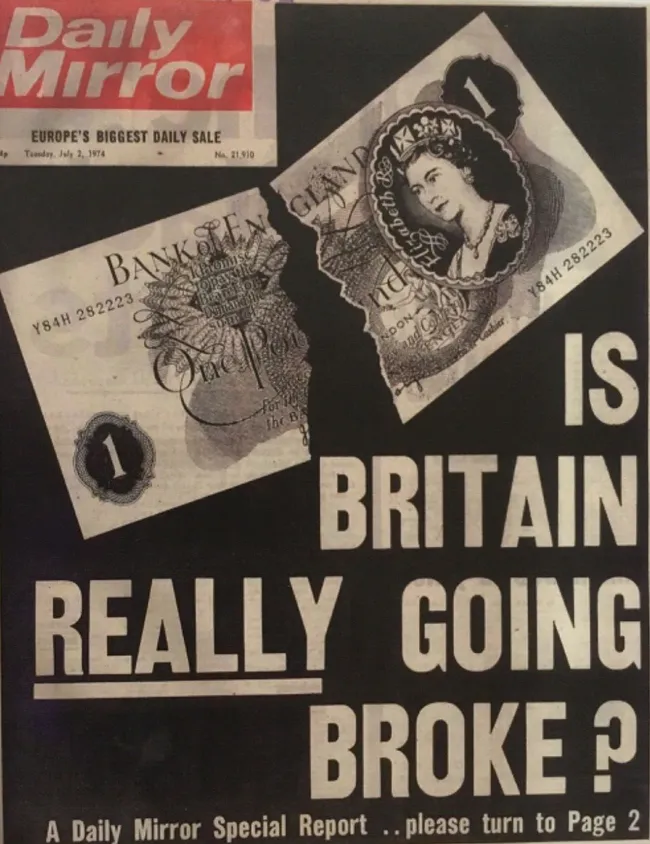
During his troubled four years in office Edward Heath had called a state of emergency several times, culminating in ration cards for petrol and power restrictions. In 1973 Heath had “told his Chancellor, Anthony Barber, to go for broke”, Sandbrook writes: “It was one of the greatest economic gambles in modern history: while credit soared and the money supply boomed, Heath hoped to keep inflation down through an elaborate system of wage and price controls”. By October that year, “his hopes were unravelling at terrifying speed”.

The “Barber boom” led to “house prices surging by 25 per cent in just six months, the cost of imports rocketing and Britain’s trade balance plunging deep into the red”. Yet just a week after Heath had published details of his “Stage Three” incomes policy, “the Arab oil exporters in the OPEC cartel announced a stunning 70 per cent increase in the posted price of oil, punishing the West for its support for Israel. It was a devastating blow to the world economy, but nowhere was its impact greater than in Britain.”

The stock market lost a quarter of its value in just a month, while by January 1974 share prices had fallen by almost half in under two years. Just before Christmas, the government cut spending by 4 per cent, and Labour’s Shadow Chancellor, Denis Healey, “warned his colleagues that Britain stood on the brink of an ‘economic holocaust'”. Nine out of ten people told a Harris poll that “things are going very badly for Britain” and nearly as many foresaw no improvement in the coming year. They turned out to be correct.

Amid trouble with the National Union of Mineworkers, in November 1973 “Heath announced his fifth state of emergency in barely four years. Floodlighting and electric advertising were banned; behind the scenes, the government began printing petrol ration cards. As the railwaymen voted to join the miners in pursuit of higher pay, it seemed that Britain was sliding into darkness. Offices were ordered to turn down their thermostats, while the BBC and ITV were banned from broadcasting after 10.30 at night. On New Year’s Day, with fuel supplies running dangerously low, the entire nation went on a three-day working week.” Happy days.

Britain as the modern Panopticon

Filed under: Britain, Government, Media, Politics — Tags: , , , , — Nicholas @ 04:00

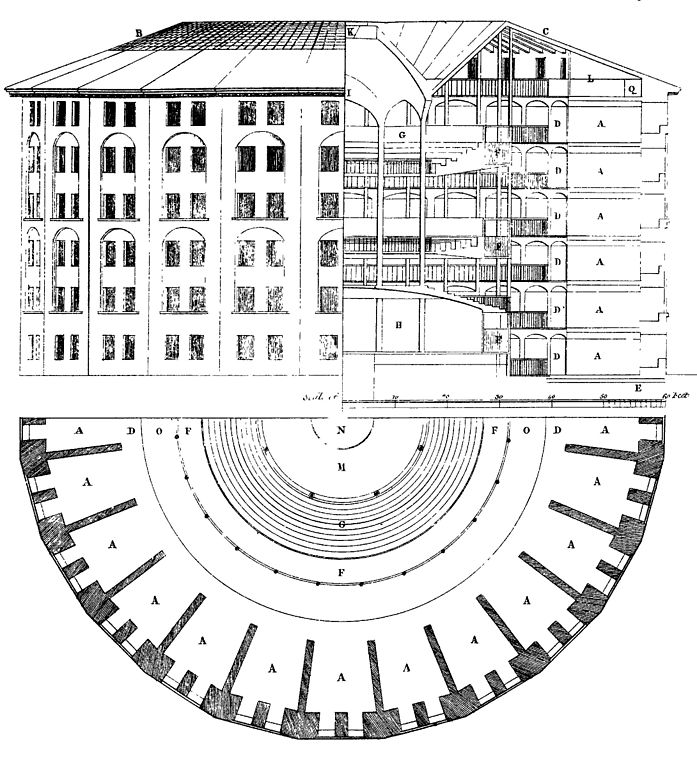
Jeremy Bentham proposed a new kind of prison in the 1700s, one where all of the prisoners in their cells were under constant observation by the guards. What sounds like a horrific way to live to any sensible rational person seems to have a fascinating appeal to the kind of micromanaging, busybody control freak who runs for office in British politics today:

An illustration of Jeremy Bentham’s Panopticon prison.
Drawing by Willey Reveley, 1791.

In Britain authorities use cameras to monitor private individuals in real time. They track cars using number plate software, and human beings using facial recognition software and analysis of gait.

The rationale for these intrusive measures is to prevent illegal activity as well as recording crimes for use in trials.

This troubles many since it places unsupervised control mechanisms in the hands of politicians and authorities increasingly out of touch with the interests of the majority.

Full-spectrum surveillance

The British Government has recently threatened to use this surveillance technology to clamp down on “extremists”.

Currently that means anti-immigration protestors, although there is provision for “anti-establishment” protestors too.

There is much Britain’s political class will not tolerate in the people who elevate them to power.

They have promised to relentlessly hound detestables using advanced spy technology, principally facial recognition software. This is specifically designed to identify individuals and track their movements in real time.

None of this has been requested by the public, and polls reflect considerable unease, particularly with facial recognition software, a powerful tool few are comfortable with.

Advocates of surveillance claim this erosion to our privacy is a necessary step to tackle crime. Cameras enable the police and authorities to identify criminals as well as detect and record the crimes they commit.

To the casual observer it sounds plausible and even reasonable. We won’t be using it to spy on you, only them. It has some public benefits.

This seems like a workable idea. So why is it so useless at stopping a very visible crime?

August 26, 2024

David Friedman – “my fargroup … are being attacked by my outgroup. My enemy’s enemy …”

I’m much of David Friedman‘s opinion on the candidates for both the Democratic and Republican parties in the current US presidential election … and I also find myself leaning more toward Trump even though his re-election would almost certainly be worse for Canada:

Donald Trump, surrounded by Secret Service agents, raises his fist after an attempt on his life during a campaign speech in Butler, PA on 13 July, 2024.

My opinion of the election is “a plague on both your houses”. Kamala Harris is an extreme representative of an ideology I have opposed for most of my life. Donald Trump has three major positions on two of which, immigration and trade, he manages to be even worse than his opponent. While I have some sympathy for his views on the third — I have been arguing against an interventionist foreign policy for something over fifty years now — I do not trust him to execute a consistent and competent alternative. His disinterest in whether what he says is true, extreme even for a politician, I find offensive.

That is my intellectual view of the matter. It is not my emotional view. Reading news stories and observing the effect on my feelings, I note that I am reacting like a Trump partisan. Poll results that look good for him make me happy, poll results that look bad for him make me sad. Accounts of outrageous statements by Trump or Vance I ignore — I don’t expect them to tell the truth. Accounts of demagoguery by Harris or Waltz arouse feelings of indignation. If Harris wins I will feel disappointed. If Trump wins I will feel relieved, at least until the first outrageous thing he does.

The explanation of my inconsistent reaction is provided by Scott Alexander in “I Can Tolerate Anything Except The Outgroup“, one of the best of his many good essays. In it he points out that someone’s outgroup, the group for whom he feels and expresses strongly negative views, is typically made up not of people distant from him, geographically and intellectually, but of people close. The outgroup of the Nazis was not their Japanese allies or the Chinese the Japanese were fighting, it was German Jews, people with the same language and, in most respects, the same appearance and culture. The outgroup of American leftists is not Muslim fundamentalists but American conservatives.

Conservatives have doubts about gay marriage. Muslim fundamentalists view homosexual intercourse as a capital offense.1 American conservatives would like their schools to be more tolerant of creationism. Muslim fundamentalists want their schools to teach the truth of Islam. And yet, when conservatives criticize Muslims, leftists defend them. When Muslims kill Jews and Jews respond by killing Muslims, it is the Muslims that the American leftists support, the Jews that they blame — although Israelis have much more in common, ideologically as well as culturally, with American leftists than Palestinians do.

    We think of groups close to us in Near Mode, judging them on their merits as useful allies or dangerous enemies. We think of more distant groups in Far Mode – usually, we exoticize them. Sometimes it’s positive exoticization of the Noble Savage variety (understood so broadly that our treatment of Tibetans counts as an example of the trope). Other times it’s negative exoticization, treating them as cartoonish stereotypes of evil who are more funny or fascinating than repulsive. Take Genghis Khan – objectively he was one of the most evil people of all time, killing millions of victims, but since we think of him in Far Mode he becomes fascinating or even perversely admirable – “wow, that was one impressively bloodthirsty warlord”. (Scott Alexander, “Post-Partisanship Is Hyper-Partisanship“)

Conservatives are the leftists’ outgroup, Muslims their far group. The far group can be ignored; large parts of the world are more sexist and more racist than any part of America but invisible to progressives campaigning against sexism and racism. The far group can even be supported, at least if the outgroup is attacking it. My enemy’s enemy is my friend. Muslim fundamentalists. Hamas.

Kamala Harris is an American leftist. American leftists are my outgroup. Trump and Vance are American populists. I disagree with their views, in some cases more than I disagree with the views of American leftists, but I have nothing against them, just as I have nothing against believing Catholics or Orthodox Jews or Black Muslims or believers in Christian Science.

Trump and his movement are my fargroup. They are being attacked by my outgroup. My enemy’s enemy …


    1. In some times and places Muslim culture has been tolerant of homosexuality; there are two famous medieval essays on the relative attractions of homosexual and heterosexual intercourse and quite a lot of poetry celebrating homosexual love. But the religious doctrine, which fundamentalists take seriously, holds homosexuality to be forbidden.

August 25, 2024

“Does your vote count?” or how to set up an automatic vote-generation scheme

Elizabeth Nickson on recent reporting about voting scams in various US states:

After engineer and data scientist Kim Brooks worked on cleaning the voter rolls in Georgia for a year, she realized she was on a stationary bicycle. She’d clear a name for various reasons, dead, felon, stolen ID, living at a seasonal campground for twenty years, duplicate, moved out of state, 200 years old, etc., and back it would come within a month. At that juncture she realized that a program within the Georgia voter registration database was methodically adding back fake names.

She looked deeper. For new registrants, the culprit was principally Driver’s Services creating new registrations and in this case, the manufacturer was a person, or persons. Within the government office, someone was stealing names and duplicating, even tripling that person’s vote and then forging their signature. Sometimes it was someone who just died, or a teacher who had no voting record. In the case of a nurse who died in 2022 with three registrations, she was registered to vote in two counties, and all three of her voted in the 2022 election and the 2024 primary. Each signature was slightly different, the last three letters spelled, ly, ley, and lley

This operation works under AVR, or automatic voter registration, and is being used to register migrants. They will not vote, but their names have been entered into the Voter Registration database when they apply for a driver’s license and their vote will be voted for them. I imagine that this is repeating something everyone knows, but the borders are open for precisely this reason, so the Democrat/RINO machine can steal their votes. By the way, the process for advancing permanent residency has been cut from 11 months to two.

In 2020, twenty states used operation AVR. Of those, Trump lost 18.

That’s because there are registration fraud rings, as identified in the Arabella doc. and in the work of Omega4America. This worked well in Michigan, where, according to Captain Seth Keshel, who is one of the leads on this fight, believes that Trump likely got 576,443 more votes than were counted and won Michigan by 8.5%.

Every state is host to a dozen or more NGO’s which do nothing but fill out ballots for the faked registrants. Peter Bernegger’s team in Wisconsin has video of NGO functionaries doing just that in Wisconsin in 2020 at 1 am, early morning after Election Day.

    Michigan has two million more registered voters than they should have. 83.5% of the state is registered to vote but only 77.9% is over 18. – Seth Keshel

Seth works with demographic trends and does detailed statistical analysis; travelling almost ceaselessly to teach Americans how to stop the cheat. AVR was launched in Michigan, after Trump’s win in 2016. By 2020 there were 547,460 net new registrants in Michigan. Today, more voters are registered to vote than there are people old enough to vote. Keshel:

Per Keshel’s analysis, the Democrats and RINOs are frantically operating a dying political coalition which began to shift hard after Obama’s performance in his first four years, when not only did nothing change for the working class, it worsened. Democrat registrations in Michigan collapsed to the point where the Dems lost 16,000 as of 2016. Enter AVR and boom, 500+K new registrants.

Woke libraries

Filed under: Australia, Books, Britain, History, Politics — Tags: , , , , , — Nicholas @ 03:00

Frank Furedi on the already well-advanced plan to turn public libraries into safe spaces for progressive indoctrination:

“Robarts Library” by mattclare is licensed under CC BY 2.0 .

In recent times, the Library has become the target of what I characterise in my new book, as The War Against The Past. The current project of dispossessing Western society of its historical legacy has gained a powerful influence over the institutions of culture. That is why the Library – a repository of the knowledge and wisdom gained through the past – has become the target of cultural vandalism.

The promoters of the culture war in the Library often justify their action on the ground that their target is not so much the past – but the “racist past”. This is the argument used by the Government backed supporters of a campaign in Wales who wish to reorganise libraries along the lines of anti-racist principles. These racially obsessed cultural warriors insist that Libraries throughout Wales must embrace the goal of becoming anti-racists if the devolved Labour government’s pledge to “eradicate” systemic racism by 2030 would be realised. To ensure that libraries and the “racist” buildings holding their collection are cleansed of the sin of “whiteness”, a £130,000 project designed to indoctrinate local librarians in “critical whiteness studies” has been devised.

The project of racial indoctrination pursued in Wales warns that staff training sessions will be necessary to ensure that libraries align with anti-racist principles. However, it insists that such training sessions should not take place in buildings with a “racist past”. From the standpoint of the authors of the document proposing “critical whiteness studies”, many buildings housing libraries must be avoided because they serve as symbols of racism. Do they presume that the buildings in question can contaminate members of the public with the racist plague? Or are they merely interested in tearing down the walls of racist buildings in order to rebuild them as temples to the doctrine of decolonization?

In a world, where the racialisation of every dimension of life has acquired its own imperative, it was only a matter of time before buildings became demonised as racist. There is now a veritable literature authored by academic racial entrepreneurs who insist that buildings can be racist. One enthusiastic social scientist supporting this thesis offers numerous “examples of buildings being racist”. The racialisation of building and the material properties used in their construction has acquired the character of a veritable fetish. “Concrete, steel and glass buildings are ‘racist'” is the title of one contribution on this subject.

The Welsh Government appears to be consumed by the quest of ridding its nations of racist buildings. As far back as 2021 it published an audit of all such buildings as well as, schools, streets, statues and pubs that it regarded as the product of Wales’ racist past. In effect almost any building, street name or pub whose name was linked with a historical figure was by definition racist. Gone are the days when a pub is allowed to call itself Admiral Nelson or the Duke of Wellington.

The policy of renaming a building, street or a statue is bad enough. What is far worse is when a library is forced to subordinate its book collection to the imperative of racialization. In the name of ridding the book shelves of their “whiteness” and “racist past”, a library becomes a target of officially sanctioned cultural vandalism.

Throughout the Anglosphere. Cultural vandalism is justified on the ground of settling scores with colonialism, racism or white supremacy. For example, school libraries in Australia have removed “outdated and offensive books on colonialism” from their collection[v]. The purge of a school library in Melbourne was guided by Dr Al Fricker, a Dja Dja Wurrung man and expert in Indigenous education with Deakin University. In the course of auditing all 7000 titles on its library shelves. Fricker showed little nostalgia towards the collection. He stated that some of the books removed were almost 50-year-old and were “simply gathering dust anyway”. He stated that “we wouldn’t accept science books being that old in the library, so why do we accept other non-fiction books to be that old, because nothing is static”.

There is something truly disturbing about the idea that a library ought to rid itself of old non-fiction books. In my discipline of sociology that would mean ridding libraries of the 19th century pioneers of the field. In effect the call to reject old non-fiction books constitutes the annihilation of the intellectual legacy of the social sciences and the humanities.

August 24, 2024

How the CIA eventually got Patrice Lumumba assassinated

Filed under: Africa, Politics, USA — Tags: , , , , , , , — Nicholas @ 05:00

The CIA decided early on that the first democratically elected Prime Minister of the Democratic Republic of the Congo was being controlled by their Soviet opponents and needed to be killed:

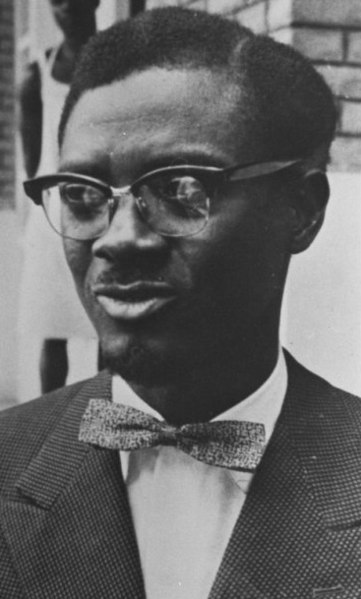
Patrice Émery Lumumba, first Prime Minister of the Democratic Republic of the Congo on 27 December 1960.
Unknown photographer

I’m still making my way through David Talbot’s 2015 book The Devil’s Chessboard, a history that explores the life of CIA Director Allen Dulles and the sordid history of the agency.

There are too many grisly anecdotes to recount showing how the CIA was involved in unlawful and unethical acts all over the world, but one that sticks out was the book’s treatment of Patrice Lumumba, an African nationalist who served as the first prime minister of the Democratic Republic of the Congo before he was killed in 1961 — with a shove from the CIA.

Lumumba was a thorn in the side of the agency, and his left-leaning politics led CIA officials to believe he was a stooge for the USSR (he wasn’t, as the CIA later admitted). So it was determined that Lumumba had to go—one way or the other.

First, a coup was arranged to have the democratically-elected Lumumba, who was demanding full independence for the Congolese people, removed from office and placed under arrest. To this end, the CIA tapped a young military colonel named Joseph Mobutu, who was friendly with Belgian intelligence (the Congo had long been under Belgian colonial rule) and would go on to rule for decades until he was ousted himself in a 1997 rebellion.

Then the CIA began exploring options to eliminate the popular Lumumba. Being the CIA, a single method was not chosen. Instead, various methods were explored to take out the Congolese leader and multiple people were tapped, including a pair of hitmen the agency had hired from Europe’s criminal underworld.

Talbot explains how the CIA equipped one of these cutthroats with a tube of poisoned toothpaste. Why toothpaste? Because one Dr. Ewen Cameron, at the behest of the CIA, had analyzed Lumumba and noted his immaculate white teeth. This led him to suggest a simple way to eliminate the troublesome leader: poison his dental products.

“In the end, the CIA did not go through with the toothpaste plot,” writes Talbot, “apparently deciding that poisoning a popular leader while he was under UN protective custody in his own house would be too flagrant a deed—one that, if traced back to the agency, would lead to unpleasant international repercussions.”

Instead, days before the inauguration of John F. Kennedy, the CIA arranged to have Lumumba chartered off on a plane to Katanga, a province that had broken from the Congo and was ruled by factions hostile to Lumumba.

This all but sealed Lumumba’s fate, CIA officials later testified.

“I think there was a general assumption, once we learned that he had been sent to Katanga, that his goose was cooked,” CIA station chief James Devlin, who helped orchestrate Lumumba’s fall, quipped to the Church Committee years later.

Devlin was right. During his flight to Katanga, Lumumba was beaten to a pulp. Then he was driven by jeep to a farm and beaten by members of rival political factions. The men, Talbot makes clear, had clear ties to US and Belgian intelligence.

“Eventually he was killed, not by our poisons, but beaten to death, apparently by men who had agency cryptonyms and received agency salaries,” said CIA agent John Stockwell, who was sent to the Congo in the aftermath of the assassination.

The Soviets managed a propaganda win out of the CIA’s clumsy wet work, renaming the Peoples’ Friendship University of the USSR (primarily used for training non-Soviet citizens from “fraternal socialist” and “unaligned” nations in Marxist-Leninist views) to the Patrice Lumumba Peoples’ Friendship University.

August 23, 2024

Woman with three multi-million dollar homes tells the rest of us we need to cut back our expectations

Filed under: Media, Politics, USA — Tags: , , , , — Nicholas @ 04:00

Sometimes it’s hard not to be cynical:

We often use the word “need” a little more than we probably should. We need to go see this movie when it’s in the theater or we need to get that new gadget. Often, we use it to describe a very strong desire, and I get it.

I mean, I do it too.

The truth is that our needs are much more basic than that. We need clothing, food, shelter, etc.

And that worries me because Michelle Obama thinks that taking more than we absolutely need is a problem.

    I can’t even …

    Yesterday I wrote about how shamelessness is a superpower, and I have to say that it is a wonder to behold.

    As the Democrats gather in Chicago to experience the religious ecstasy of being surrounded by each other and sniffing their own farts, they are treated to speeches from elite hypocrites who pretend to be perfectly normal people.

    Last night was the ol’ HOPENCHANGE shtick, with Michele and Barack Obama babbling on about things they don’t believe while Obama sycophants babble on about how their “spiritual voids” were filled by the Lightbringer.

    An emotional high point was, apparently, Michelle’s speech in which she blathered on about how very normal her family was and how they were egalitarians who were suspicious of rich people.

To be accurate, she said, “suspicious of people who took more than they need”.

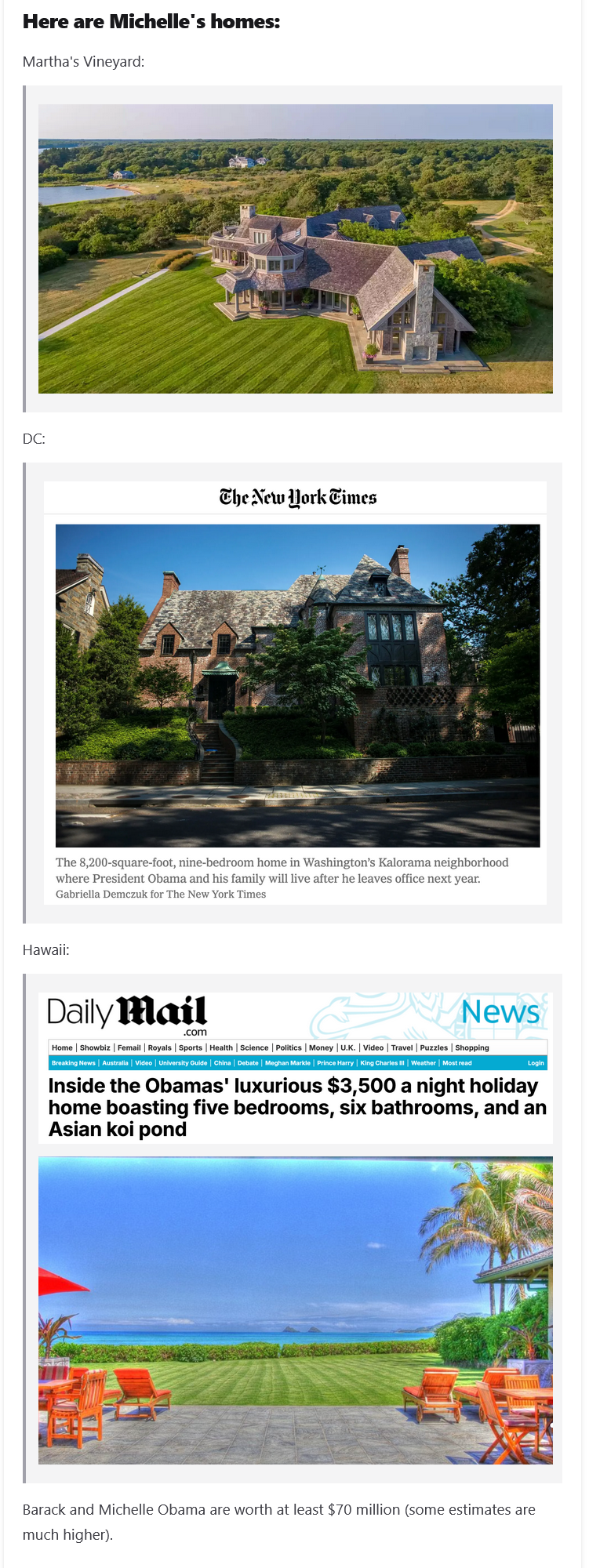
I find this fascinating because, well, the Obamas own three homes. The least amount they paid for a home was $1.65 million, and that was in 2005.

I’m always amazed at how people who spend their lives working in the public sector and for non-profits can amass so much wealth, but apparently, that’s just what they need.

Let’s understand that most of us are living with far more than we absolutely need to survive. We also have a lot of things that simply provide comfort, such as smartphones, televisions, computers, and so on.

So if we’re to be suspicious of people who took more than they need, should we be skeptical of the person looking back at us in the mirror?

Who decides what one needs? To what level are we ascribing the term “need” anyway?

Does anyone need $750,000 for an hour-long speech?

« Newer Posts — Older Posts »

Powered by WordPress