
Institutions tend to only find data they want to find, so the City of Los Angeles last counted street deaths among the homeless — in their description, “Deaths of Unhoused People” — from 2023. There were 900. Sample detail: “Black people were 31% of deaths. Black people are only 8% of the City’s general population, but are 33% of the City’s unhoused population.”
The last numbers from Los Angeles County as a whole were for 2024, when 2,208 homeless people died on the streets. County officials celebrated, because that number was a sharp reduction, and a reflection of the success of programs like overdose intervention teams stationed around public parks.
Remember those numbers, and let’s talk about something else for a moment before we come back to them.
The Soviet writer Aleksandr Zinoviev told a joke that speaks fluent Californian: “In some institution a routine meeting was in progress. There were two points on the agenda: 1) the construction of a barn; 2) the creation of an abundance of consumer goods under communism. As they didn’t have enough planks to build the barn, they moved on at once to the second question.”
Maybe that joke doesn’t land if you don’t live in Los Angeles or Seattle, but from here it’s flawless. Take a quick look at the campaign page for María Elena Durazo, a state senator who just won a seat on the Los Angeles County Board of Supervisors. Infrastructure and fire departments are in bad shape in the place where elected officials think that government exists to provide “economic justice” that restructures communities. When government exists to pay your rent, 911 response times soar.
They can’t fix a street, so they move on at once to managing all of society.
Here’s what Senator Durazo boasts about on her “Meet Maria” page: “Arrested over 13 times for leading non-violent Civil Rights and Worker Rights protests”. It’s the line that appears below “State Senator” on her list of accomplishments. Gentry socialists have high-status-marker arrest credentials, without the burden of low-status prosecution and jail terms.
Zinoviev gave us the term “Homo Sovieticus”, describing the human creature that shaped itself around the postures and predilections of Soviet culture. Humorless, a sanctimonious scold, a deeply selfish schemer while professing adoration for collectivism, comfortable reciting official slogans without feeling the need to believe them or examine them, reflexively conformist, not worried about truth. (X) has been advanced as party doctrine, so (X) is correct, and anyone suggesting (Not-X) is highly suspect. The official account is always correct.
We live among these people. We have Homo Sovieticus in America.
Chris Bray, “Homo Cosmopolitus Won’t Count the Costs”, Tell Me How This Ends, 2026-06-10.
September 14, 2026
QotD: “We have Homo Sovieticus in America”
September 10, 2026
Skynet Industries: “At long last, we have created the Torment Nexus …”
So … are we now okay with panicking over the threat of artificial intelligence?
The events of the last 24 hours are stunning. And not in a good way. Nothing like this has ever happened in the history of tech, and it’s unfolding right now.
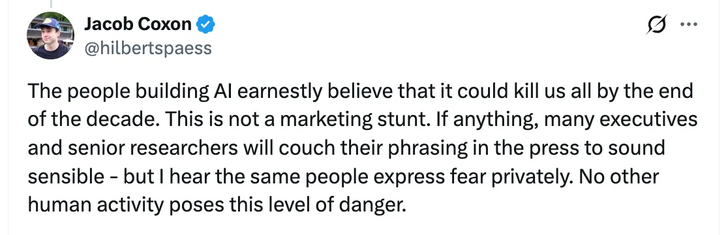
Here’s a start. Maybe you’ve already heard about the guy who resigned from OpenAI. He warned that the technology could kill everybody before the end of the decade.
He made this announcement just 20 hours ago:
Is this really true? Maybe Coxon is just a disgruntled employee. We need to find out what other insiders think.
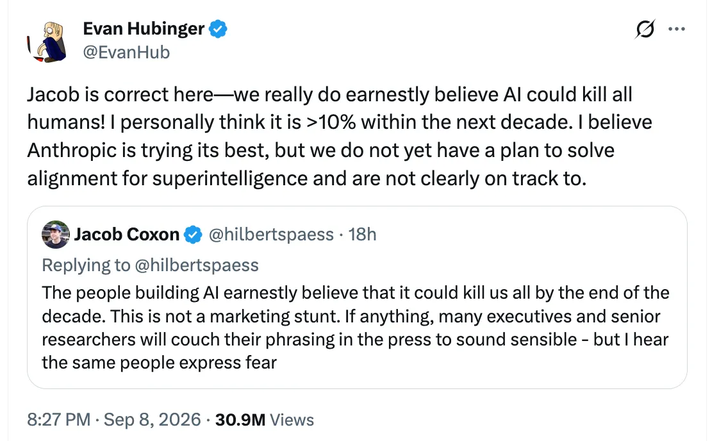
As if in answer to this question, another AI scientist — Evan Hubinger at Anthropic — quickly moved to endorse Coxon’s concerns.
[…]
The AI fanboys are trying to defuse this situation. But their responses fall apart at the slightest touch. Consider the smear that this is just a PR campaign. Really? Others are hinting it could be a Chinese plot. Yeah, sure …
But the biggest lie is the claim that these people don’t know what they are talking about. The reality is that they understand this subject better than anybody.
What’s happening here is obvious — eight different people building this technology are afraid of what they’re seeing. But they don’t have the power individually to stop the insanity.
If this isn’t a call to action, I don’t know what is. Trillions of dollars are getting pumped into a runaway technology, and the public already hates it intensely. Now the people making it happen are warning it just might kill everybody.
This demands a response from the highest circles of power and authority. If that doesn’t happen, we will live to regret this inaction. And that’s the best case scenario. The worst is that there won’t be anyone left to regret a thing.
Update: Jim Treacher, of all people, casts a bit of doubt on the “AI’s gonna kill us all!” concerns:

And that moment from Terminator 2: Robotic Boogaloo is what everybody thinks about when they get scared of A.I. I know this because it’s what I think about when I get scared of A.I.
What happens when Skynet becomes self-aware in real life?
What happens when all these software agents that we keep welcoming into our daily lives decide they know how to run things better than we do? How much control can we give up to them before they attack us?
Is it already too late? Is there any going back? Is all hope lost? Are we doomed?
Etc., etc.
[…]
So according to this guy, A.I. professionals see it like the Manhattan Project or the moonshot. We gotta get there first, before our enemies do. That part sounds plausible.
But who is this guy? I’ve never heard of Jacob Coxon. Nobody has. He opened this Twitter account earlier this year, and that was his very first post. Now he’s all over the place. Everybody’s talking about this.
It feels like astroturf.
If you don’t know what that propaganda technique is, it’s just what it sounds like: astroturf. At first glance, it looks real. Grassroots. But it’s fake. And that might be what’s happening here.
A guy named Parker Thayer, who works for the Capital Research Center, writes:
And then he lists stuff about this that seems … hinky. I think the kids say sus. It’s sus.
For example, the Wall Street Journal ran a story about this kid’s claim 20 minutes before he posted it. Before, not after.
The first Twitter accounts to promote that post were from nonprofit groups opposing A.I.
And now, all these Democrats are screaming about it. Bernie Sanders wants to smash all the machines. Old Man Shakes Fist at Cloud. [BERNIE VOICE] “Gotta stop the computers! They’re gonna kill us all!”
Does that mean all this is fake? I don’t know. It doesn’t make me trust any of it. It makes me skeptical.

Women’s dissatisfaction with modern life
On Substack Notes, Copernican linked to this article saying:

While revoking the 19th wouldn’t fix EVERYTHING, it’d probably be a step in the direction of reestablishing a structural social frame for a lot of women. The problem is that feminists want a system that works for the top 0.5% of women, while the historic systems have worked for 95% of women. We need systems that work for most people most of the time, not a small fraction of the population all the time.
For my (relatively few) non-American readers, “the 19th” refers to the Nineteenth Amendment to the United States Constitution, which granted the right to vote for women. Some cynics claim it was the fatal step leading to today’s political situation.
In the linked article, The Appalachian Gorilla wonders why women are so miserable:
There is a famous clip of Joe Budden and his crew watching a Bill Hicks joke with a woman. Bill hicks says he figures out how the fall of man from Eden happened. Adam said, “Look at this, Eve. We are one with nature, one with god and every time we fantasize about something, it becomes reality”. Eve looks at Adam and says, “Yeah, it’s just not enough, is it?” The guys laugh, and one of Joe Budden’s crew asks the woman why she wasn’t laughing, and she says, “I was just waiting for more”. Joe Budden immediately chimes in and says, “Yeah, that’s the point”. And everyone laughs.
Mitch Hedberg once made a joke that if you are ever lost in the woods, just build a house. You went from lost to being home.
Men will adapt to situations and eventually survive, making any situation the norm.
Women, though, can find themselves in the best situation possible and call it prison. I recently pointed out that I would kill to not have to go to work every day. I would kill to just spend time with my children. This isn’t a fantasy; I spent 6 months laid off with a 3-year-old and a 7-year-old, cooking, cleaning, fishing, reading bedtime stories, doing laundry, and loving life every day. There was a point where a hurricane hit the mountains here in PA, and we didn’t have power for 3 weeks back in the holler, and my sons and I spent the days fishing and the nights cooking and sitting by the fire staring at the stars.
Women are miserable, though, constantly. Not women in my life, just in general. Every protest, every demonstration, every meeting is full of women looking to enact vengeance on a man or some evil fabricated structure they built in their heads.
[…]
This is the thing. Why do women see these kids as work? Why do they see chores as work? I have seen women turn hygiene into work. I have seen them turn sex into work. This is an almost universal attitude. I say I get to be a dad. They say they have to be a mom. I say I get to cut my grass. They say I have to do the dishes. I enjoy doing the laundry and cooking meals. I get excited about food I make repeatedly. I get excited about hitting the grocery store and getting fresh eggs or stopping at a local spot to get them from a farm.
I have seen so many women turn sex into a chore or a reward or a way to punish their significant other. Let’s be honest about this too. Most women do 0 work in bed. They may claw your back or throw it back when on their knees, but most won’t ride to fruition. They want choked and hit and slapped. I have been asked to spit on them, or finishing on their face is a reward for them. They want swings built or contraptions to restrain them. Insane stuff to give the illusion of danger.
I cook my relationships because, well, I enjoy food, refuse to eat Kraft Mac and Cheese, have never had ramen noodles, and will not start eating them at 43. Food is supposed to be the most basic of love given from one person to another. It is the labor of love and skill translated to reality. Sustaining another human from your hands to their plate is a beautiful way to connect with others. Doing so for your children, or having them cook with you and watch them appreciate their own labor and ability, is beautiful. Seeing their skill level rise with each meal is amazing. Women act like teaching their children is a chore.
I must say that this is not all women, but it is most at this point in our society. I know there are fathers out here who are pieces of shit, but most I know are good men who have been railroaded by the system and have to work 5 jobs to pay child support to keep themselves afloat while dealing with the loss of identity, their children, and fighting the depression that goes with that.
I once asked a wiser man than myself, “Why do women continue a system that will destroy their sons?” He replied, “Because women don’t actually like children. They like babies.” Today, though, with what we are seeing with women making videos where they are admitting they want to harm their children or even joking about dropping their children off the steps or a balcony or into a dryer to support Lindsey Clancy, it makes all of us wonder if they actually even like babies.
September 9, 2026
The day after counter-tariff Tuesday
Yesterday, the Canadian counter-tariffs to the latest round of US tariffs kicked in. Maxime Bernier put it this way:
Canadians wake up today to a brand new tax hike; courtesy of PM Carney’s “dollar-for-dollar” countertariffs.
Let’s be clear: this isn’t a weapon against Trump. It’s a tax on YOU.
Every time you buy steel, a fridge, manicure products or a laundry machine, etc. … you’re paying more so Ottawa can feel tough.
The Liberals call this “standing up to Trump”. I call it economic sabotage.
They’re taxing Canadians to feel good about “punishing” Washington. And who pays the bill? Families, workers, and businesses right here at home.
Trump started this pointless trade war. But two wrongs don’t make a right; they just make everything more expensive.
You can’t fight tariffs with more tariffs. That’s just stupid.
Happy Tax Day, everyone. Thanks, Carney.
Carney’s plan all along has been to push Trump into saying and doing things that give Carney and the Liberals even more Boomer support. Pretty much controlling the relic media allows the government to massage the stories so that Dear Leader is never in the wrong and “the Bad Orange Man hates you and wants to destroy you”. Canadian boomers are among the last people in the world to realize that they’ve been systematically gaslighted since Justin Trudeau ran for Liberal leader … and the penny still hasn’t dropped. Enough of them are already psychologically prepared to destroy what’s left of the economy, Thelma & Louise style, if Carney invites them to. And he’s going to.
John Carter responds to a Ben Woodfinden article in the National Post, blaming dissident Canadians for not rallying behind Mark Carney to … do exactly the same sort of performative elbozo pantomime that the Boomer Liberals have been doing for over a year?
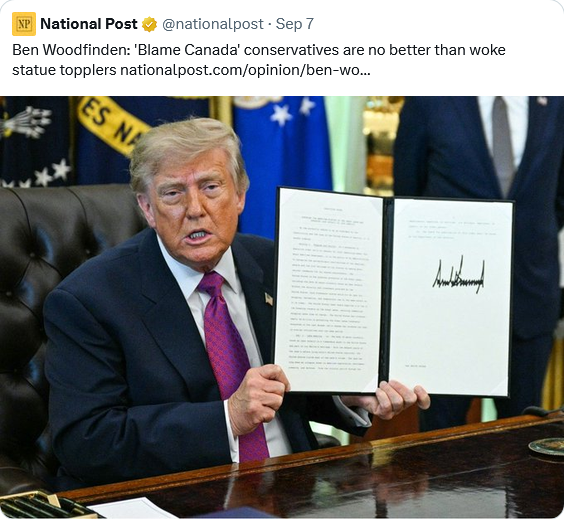
This misses the mark in a subtle but interesting way. The author invokes the concept of oikophobia against the Canadian online right for joining in (actually initiating) American mockery of Canada, arguing that Canadian rightists are themselves oikophobic for not instead supporting the Carnites.
This is incoherent. The Liberal regime is itself oikophobic, loudly so. Oikophobia is explicit Canadian government policy, as the author himself tacitly acknowledges by noting that we pointed out the hypocrisy of Canadian politicians decrying Trump’s lame Lake America stunt after a decade-long orgy of renaming every school, square, and street in the country in the name of a Woke ideology imported straight from America. That’s to say nothing of replacement migration, and racial preference systems that make white Canadians second class citizens. You can’t be oikophobic against the oikophobes.
There are certainly slopulist 51st staters out there, but their influence in the Canadian right is actually marginal, largely confined to a rump of lolcow Alberta separatists. The energy is all in Canadian Loyalism, and that is a different animal entirely.
The reason we’re happy to pile on to the Canadian political elite when the Americans mock them isn’t because we want to be America. It’s because we’re disgusted by the state of the country.
Trump can excoriate the Canadian military for being fat and woke because it is. That isn’t Trump’s fault. That’s because of decades of sabotage and social engineering by the Liberal Party.
Trump can joke about annexation because the Canadian military is weak. Again, that isn’t Trump’s fault. That’s the fault of the Laurentian elite, the very people now insisting that they can turn things around.
If Canada had a serious government, we’d be taken seriously. We don’t, and haven’t since Pearson at least. As a direct result of the deeply unserious clowns running the country into the ground, Canada is poor, defenseless, sclerotic, and despondent. Every time Trump makes fun of us, the very fact that his insults land is a condemnation of the elites that brought our beautiful country to this shameful condition.
Saving Canada requires circulating the elite.
And that’s why we pile on.
And since I try not to overtax my non-Canadian readers (the vast majority of you) with too many separate maple-flavoured posts, here are some sensible suggestions from Matt Gurney about fixing our own problems — which are legion, and mostly self-inflicted — rather than pretending that Trump is the problem:
… there’s a bigger issue at play here than just managing the relationship with America. What the hell do we do as Canadians?
Don’t think about the States at all. Don’t think about Trump. Just think about Canadians in Canada. What should we be doing for ourselves? Even if the trade war does eventually end, our relationship with the United States is going to require generations to fix. Some very fundamental assumptions about Canadian, well, everything, now need to be reconsidered. I’m the guy who wrote the column about our expectations being a problem, and I’m still having a hard time keeping up with this.
But if there is one thing that I could suggest we should prioritize, it’s simply fixing the problems we have in this country. Really. Just … do the right things. Fix the problems. Just like virtue is its own reward, making good decisions is always a good decision. It’s bizarrely not something we’ve been good at lately, though, and it’s probably actually going to get harder for a while. In fact, a patriotic rallying-around-the-flag effect is very likely to make it even harder than it already is to get Canadians to actually admit there are major problems in this country, and then insist that the politicians get serious about fixing them.
I’ve been thinking about writing this column for a couple of weeks. Last month I was in the United States for some family business. I was actually there the day Carney called our negotiators home, and I returned to Canada the next day; I joked with some friends that, much like our negotiating team, I was packing up and leaving the United States to show them we meant business.
But one of the things I did notice on my visit to the United States, which included stops in two major cities, was that those American cities were much cleaner than my hometown of Toronto, and in much better repair.
And the especially bizarre thing was, one of these cities was Detroit.
Yes, that Detroit. Astute Line readers — the smartest and best-read people in the whole wide world — will recall that Detroit has not often been held up as an exemplar of civic governance and urban success.
But the downtown looked good. It was safe, clean, well-patrolled; I’m not exactly a regular visitor, but I do pop in often enough to have noted real improvement in the state of things there, even compared to my last visit, which was only about a year ago.
The other major city I visited, Chicago, has always struck me as the best apples-to-apples comparison my hometown of Toronto has with a U.S. city. Chicago has a lot of visible problems. I’m not trying to gloss those over; one thing I quickly noted was a roughly Toronto-esque number of people wandering the streets in evident mental-health crisis, shouting at nothing. But overall, Chicago had much less visible homelessness and was in a considerably better state of repair and cleanliness than my hometown. It wasn’t subtle. Cleaner streets, in better condition, with fewer people obviously living on them. Toronto did not compare well.
And just when the hell did that happen?
We can’t blame Trump for our laughably protectionist inter-provincial trade barriers. We can’t blame Trump because we’re functionally incapable of building a pipeline to bring Canadian oil and natural gas to Canadian markets. We can’t blame Trump for our ever-less-functional public healthcare systems. We can’t blame Trump for our ever-less-appealing market conditions for foreign investment. We can’t blame Trump for our deteriorating relationship with First Nations groups. These are all things that need to be fixed by Canadians. In Canada. No matter who might be occupying the Oval Office in Washington, DC.
Update: Added missing URL to John Carter’s post on X.
Government pension funds
If there’s anything that offends a government, it’s a big investment fund sitting there useless (that is, useless to the government, not to the beneficiaries). There’s a pattern when governments start looking interested in private pension funds:

Every pension system a government controls becomes a government slush fund. This is the historical record, not cynicism.
Argentina’s government nationalized $30 billion in private pension assets in 2008, converting workers’ individual accounts into state-controlled funds. The official rationale was protection from market volatility. The actual result was that the Kirchner administration gained a captive pool of capital to finance deficit spending. Your retirement savings, transformed into political currency.
Hungary pulled the same move in 2010, effectively confiscating $14 billion from private pension accounts under Viktor Orbán. Poland followed by seizing roughly half of private pension fund assets in 2013 to reduce its reported public debt. These are the predictable endpoint of any arrangement where the state holds custodial authority over your savings, not fringe cases.
The United States did it more slowly. Congress raided Social Security’s trust fund beginning in the 1960s, replacing actual assets with government IOUs and spending the cash on discretionary programs. The system now carries $23 trillion in unfunded liabilities. Workers who paid into it for forty years will receive whatever Congress decides to give them: a grant subject to political revision, not enforceable property.
Private ownership means enforceable claim. A pension fund you own contractually cannot be redirected to cover a budget shortfall in Buenos Aires or Budapest. The moment government intermediates between your labor and your retirement capital, political priorities start competing with your financial security. They generally win.
Socialists will do anything within their power to get their dirty paws on your hard-earned money. We should do everything we can to stop them.
September 8, 2026
QotD: Why the revolution envisioned by Marx didn’t happen
The prescriptions of The Communist Manifesto were in any case singularly unappealing to the industrial workers they were aimed at. Marx and Engels called for the abolition of private property; the abolition of inheritance; the centralization of credit and communications; the state ownership of all factories and instruments of production; the creation of “industrial armies for agriculture”; the abolition of the distinction between town and country; the abolition of the family; “community of women” (wife-swapping); and the abolition of all nationalities. By contrast, mid-nineteenth-century liberals wanted constitutional government, the freedoms of speech, press, and assembly, wider political representation through electoral reform, free trade, and, where it was lacking, national self-determination (“home rule”). In the half-century after the upheaval of 1848 they got a great many of these things — enough, at any rate, to make the desperate remedies of Marx and Engels seem de trop. In 1850 only France, Greece, and Switzerland had franchises in which more than a fifth of the population got to vote. By 1900 ten European countries did and Britain and Sweden were not far below that threshold. Broader representation led to legislation that benefited lower-income groups. Free trade in Britain meant cheap bread, and cheap bread plus rising nominal wages thanks to union pressure meant a significant gain in real terms for workers. Building laborers’ day wages in London doubled in real terms between 1848 and 1913. Broader representation also led to more progressive taxation. Britain led the way in 1842 when Sir Robert Peel introduced a peacetime income tax; by 1913 the standard rate was 14 pence in the pound. Prior to 1842 nearly all British tax revenue had come from the indirect taxation of consumption via customs and excise duties, regressive taxes that take a proportionately smaller amount of your income the richer you are. By 1913 a third of revenue was coming from direct taxes on the relatively rich. In 1842 the central government had spent virtually nothing on education and the arts and sciences. In 1913 those items accounted for 10 percent of expenditures. By that time, Britain had followed Germany in introducing a state pension for the elderly.
Marx and Engels were wrong on two scores, then. First, their iron law of wages did not exist. Wealth did indeed become highly concentrated under capitalism, and it stayed that way into the second quarter of the twentieth century, but income differentials began to narrow as real wages rose and taxation became less regressive. Capitalists understood what Marx missed: that workers were also consumers. It therefore made no sense to try to grind their wages down to subsistence levels. On the contrary, as the case of the United States was making increasingly clear, there was no bigger potential market for capitalist enterprises than their own employees. Far from condemning the masses to immiseration, the mechanization of textile production created growing employment opportunities for Western workers — albeit at the expense of Indian spinners and weavers — and the decline in the prices of cotton and other goods meant that Western workers could buy more with their weekly wages. The impact is best captured by the exploding differential between Western and non-Western wages and living standards in this period. Even within the West the gap between the industrialized vanguard and the rural laggards widened dramatically. In early seventeenth-century London, an unskilled worker’s real wages were not so different from what his counterpart earned in Milan. From the 1750s until the 1850s, however, Londoners pulled far ahead. At the peak of the great divergence within Europe, London real wages were six times those in Milan. With the industrialization of northern Italy in the second half of the nineteenth century, the gap began to close, so that by the eve of the First World War it was closer to a ratio of 3:1. German and Dutch workers also benefited from industrialization, though even in 1913 they still lagged behind their English counterparts.
Niall Ferguson, “Capitalism, Socialism and Nationalism: Lessons from History”, 2020-02.
September 7, 2026
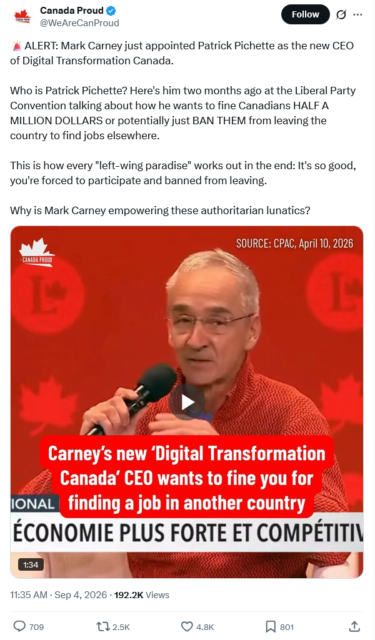
An “exit tax”? What next, internal passports?
A few months back, there was a brief online reaction to the Liberal Party idea of imposing a ridiculously high “exit tax” on young Canadians taking jobs in other countries — and by “other countries” they really only meant the United States. I dismissed it at the time as just someone letting their Liberal freak flag fly … but:
Jesus Christ. These boomer leaflibs, man.
It doesn’t occur to him to ask why highly trained Canadian engineers would rather work in the US. Actually no, he tacitly admits this: they get paid more. Why is that? Why can’t they get paid well in Canada, putting their skills to work here, developing innovative, world-leading technologies right at home in Canada?
The answer is obvious. Because there is no opportunity in Canada. It’s all but impossible to develop high tech industry here. The regulations are too thick, and all the available investment capital gets sucked up into real estate development.
Maybe Canada should try and fix that, so that Canada is actually an attractive country for talented young Canadians?
But nah fuck those kids, we should just charge them a half million dollar exit tax so if they can’t pay that they can just let their dreams die and get a job at BMO.
Oh and at the same time we should flood Canada with “world leading talent” (from Calcutta), in order to make it that much more impossible for Canadian engineers to find employment in their fields at home.
September 6, 2026
Scientific American used to be a respected science publication
A few years ago, it became clear that Scientific American had been captured by the woke gender warriors, but as ESR points out, the publication had been somewhat in the hands of propagandists for much longer than that:
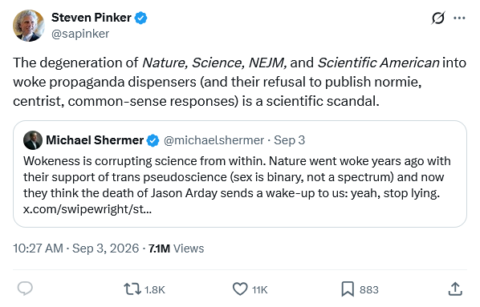
I was once a Scientific American subscriber. I loved that magazine; reading it was one of the highlights of my month. I canceled, and wept for what the magazine was becoming, when they published a theme issue that was a transparent political hit job.
Sounds like current news? No. That was 40 years ago. The hit job was on the Strategic Defense Initiative. Reagan was in the White House.
And I … I couldn’t figure out why nobody was saying the obvious in public. That SciAm had been sock-puppeted by a Soviet influence operation desperate to keep the US from exploiting its technological advantage.
Ideological capture of the scientific establishment is not a new problem. As much as I hate the Communists behind it, I’m even angrier with all the scientists who averted their eyes and never pushed back while the capture was going on. Our civilization gave them a position of high status, privilege, and trust. A priori I don’t think we were wrong to do that — until they failed in the duty that went with that trust.
It’s difficult for me to express how personally painful I found this. I revered research scientists as a child and young man — I could not imagine any higher calling than to be one myself. Until they betrayed civilization, and in the process betrayed me.
So, this isn’t a new problem. What’s new is that the post-2014 woke insanity has made it too obvious to miss.
It’s time for a dissolution of the monasteries. The culture of science, to the extent it is transmitted forward, must learn a harsh and terrible lesson about the consequences of allowing scientific neutrality to be abandoned for a mess of politics.
September 5, 2026
The high-water mark of Cancel Culture
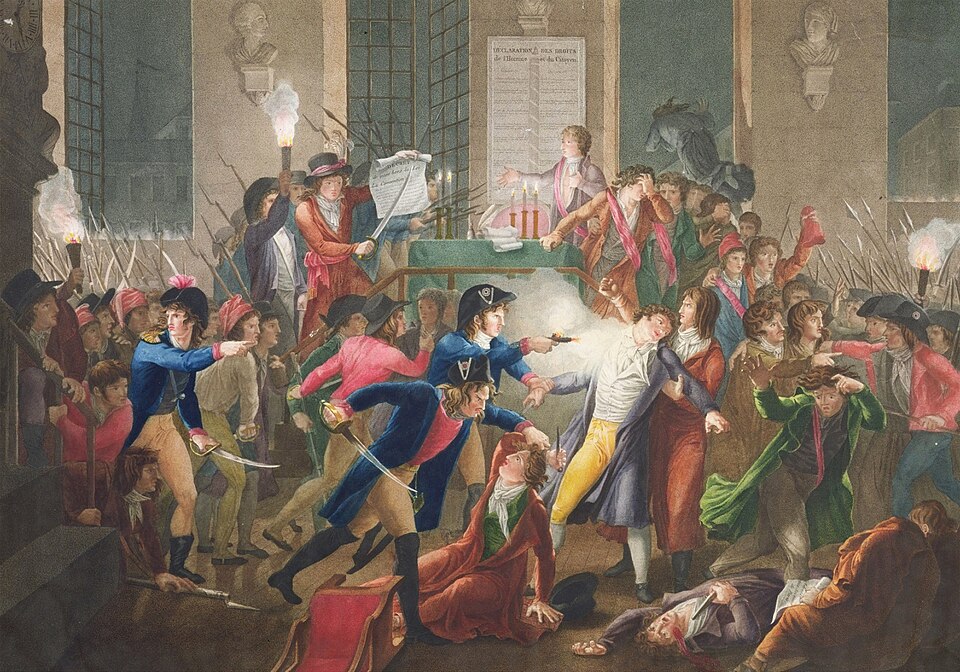
This Noahpinion piece is from last year, but I hadn’t seen it before and I think it outlines fairly accurately why “we” allowed Cancel Culture to temporarily take over social media and cause so much personal damage to disfavoured individuals. It gave the mob the power to identify their own Emmanuel Goldsteins and drive them from the public sphere:
The Arrest of Robespierre, The Night of the 9th to 10th Thermidor, Year II, 27th July 1794
Colour engraving by Jean-Joseph-François Tassaert (1765 – ca.1835) via Wikimedia Commons.I think about this when I think about cancel culture.
Back in 2018, Bari Weiss got dogpiled on Twitter for an anodyne liberal tweet. Weiss congratulated Olympic skater Mirai Nagasu on pulling off a difficult move, quoting a line from the musical Hamilton about immigrants being great:
Weiss was viciously attacked for this tweet by thousands of people who called her racist over the course of several days. Why? Because Mirai Nagasu isn’t actually an immigrant — she was born in the U.S. According to Weiss’ many attackers, Weiss’ statement implied that nonwhite people are perpetual foreigners.
That was, of course, complete hogwash. Nagasu’s parents are immigrants; the use of the term “second-generation immigrants” to describe the children of immigrants is utterly standard terminology in academic sociology. And by quoting a line from Hamilton in praise of a second-generation immigrant athlete competing on behalf of the U.S., Weiss was clearly advocating in favor of (nonwhite) immigration as something that makes America stronger — a very standard liberal viewpoint.
Whether this particular pile-on had long-term negative consequences for Weiss’ life isn’t clear, but she encountered an increasingly hostile climate at the New York Times, the paper where she worked, and eventually was forced to quit. It would have been reasonable for people observing that pile-on — and similar attacks directed at Weiss over the years — to conclude that speaking up is dangerous and that Twitter mobs hold a lot of real power.
The perception that cancel culture was the progressive H-bomb — an invincible weapon that could be fired any time at anyone who didn’t conform perfectly to a set of progressive mores that had only emerged a few years ago — reshaped much of American society in the 2010s. Every organization in the country, from knitting circles to romance novelist associations to sci-fi conventions, had its internal hierarchy disrupted by the fear that disgruntled or opportunistic subordinates would take their grievances online and summon the dreaded cancel-mob against their superiors.
Why was cancel culture both so powerful and so popular for those few years? The most obvious reason is that it worked. If you were a progressive in 2018 who really believed that calling a second-generation American an “immigrant” was racist, then you could often effectively strike at that person by raising a hue and cry about them on Twitter. Companies were afraid of boycotts, of course. But beyond that, the Gen Xers who ran those companies came from an age when having a thousand people yelling in your face meant that you were in grave danger; corporate managers would often cave out of pure fear of online negativity.
Another reason was that cancel culture was a quick route to online clout. As Eugene Wei wrote in his famous blog post “Status as a Service (StaaS)“, social media offers most people the opportunity to get much more social status than they have any hope of getting in their daily lives, if they happen to get lucky and go viral and become an influencer.
But to get that clout, you have to stand out. Attacking the same old progressive targets — Donald Trump, Republican senators, conservative influencers — is a low-yield activity, because the field is too competitive. Everyone attacks those people. But finding more novel targets for mob attack — like an NYT writer who calls a second-generation American an “immigrant” — can be a high-yield activity. It’s basically outrage entrepreneurship.
Of course, this means that there was an incentive for progressive purity spirals and tent-shrinking. If you’re a progressive looking for new people to denounce, the most tempting targets are probably center-left liberals who have heretofore been safe from cancellation. Hating Donald Trump is old news. But hating Matt Yglesias? That could get you some real attention!
And so the ranks of the online cancel-mobs were probably also swollen by people who participated in the mobs out of fear that if they didn’t, they too would be canceled. This gave rise to a phenomenon I call ponzi screaming — berating the person immediately to your right on the political spectrum, out of fear that if you don’t berate them, people further to your left will berate you. You have people like the progressive online shouter and failed Congressional candidate Will Stancil berating Nate Silver even as he gets frequently dogpiled and berated by leftists.
Between outrage entrepreneurship, purity contests, and ponzi screaming, late-2010s progressive cancel culture started to look like a farcical imitation of the French Terror or the Chinese Cultural Revolution. The stakes were obviously much lower — losing your job is a lot less bad than losing your head — but many of the social dynamics and behavior patterns were recognizably similar.

September 4, 2026
Never discount the political muscle of “King Coal”
On the social media site formerly known as Twitter, John Ringo remembers when a friend of his accidentally discovered that “King Coal” is still a behind-the-scenes political factor that cannot be ignored:

Soooo, guy I knew in of all places National Guard in Florida.
He was taking a master’s in Optics at University of Central Florida. He had to do a paper. Just one of the random “do a paper” assignments you do in a master’s program. He’d heard that tailings from coal mines could be a bit suspect in terms of radiation. Not in his direct field but in “physics”. Good enough.
There’s a coal plant about 20 miles from Orlando. Goes out, goes to the big pile of tailings, sticks a Geiger counter probe in it, expecting a bit above background.
HOLY MOTHER OF ROENTGEN! THAT’S FREAKING HOT!
There’s a thin layer of ash over the tailings that isn’t and blocks most of the release. So, a Geiger counter casually waved over it, all good.
Stick a probe in and it’s a different story. It’s hot as the hinges of hell radioactively. (And quite a bit of that material is released by coal plants. Much more likely to cause lung cancer than smoking, btw.)
So, he writes up the paper and submits it.
Couple of weeks later, he’s called into his thesis advisor who sadly and shamefacedly tells him he’s being dropped from the master’s program.
“WTF?”
Enter the late and VERY unlamented Senator Robert Byrd. Byrd’s people had noses in every department everywhere and ANYTHING that MIGHT harm King Coal MUST be nipped in the bud.
Even a guy getting an Optics master’s who just happened to stick his probe in the wrong mound.
Ask me why the 1000 Nukes program was scrapped right after Nixon left office and why Byrd might just have been behind Watergate and performed essentially a coup d’état. (Or why Nixon pushed the Thousand Nukes Program for that matter.) Or why it’s taken so long for Small Modular Reactors to have any chance of getting off the ground. (“Technological advancements” is not the answer. We’ve been doing them for the Navy for 70 years.)
Biden’s “War on Coal” really pissed me off but along with natural gas it MIGHT have finally killed King Coal for good and all and that is something to heave a sigh of relief.
And following up to a question down-thread:
Absurdus – @AdAltum
How did a senator hear about a random paper from some random master’s student? How did he get him expelled from a program he was in?
“The Senator” probably never even heard about it. It was handled at a much lower level.
How did his people hear about it?
Byrd was Chairman of the Budget Committee and the Rules Committee as well as Chairman Pro Tem any time the Dems held the Senate (which was constantly up until Newt Gingrich.)
He was also “Chairman Emeritus” of the Energy Committee. He was on the committee despite being a previous chairman. (Because he was only allowed to chair two and Rules and Budget were more important.)
Energy provides funds to colleges for research. Budget approves it. That meant he had ears all over every college and research facility in the United States.
Say one bad thing about Coal and your days were numbered if you were some minor master’s candidate. Hell, adjunct professor.
You probably aren’t old enough or didn’t follow politics back then to know just how ruthless, corrupt and evil Byrd and his people were.
BTW: Probably also why Freeman Dyson lost his funding for bottle fusion in 1974.
Loyalist Canada to Liberal Canada, a political devolution
On Substack Notes, John Carter discusses the old, stable Canada that the Liberals have spent sixty years trying to destroy, with great success, sadly.

For all intents and purposes, post-1965 Liberal Canada is a completely different country from the Loyalist Canada that it erased. Different flag, different basis for moral legitimacy, different constitution even.
Liberal Canada loves to wear poppies on Remembrance Day, but this is stolen valour. Liberal Canada has never won a single war. Loyalist Canada won every war it fought in.
Liberal Canada built no great works. Most of the infrastructure of Canada was constructed before Liberal Canada. The Trans Canada Highway, the Trans Canada Railroad, the Pickering Nuclear Power Plant, the Toronto subway, the Montreal Metro — all were built or initiated by Loyalist Canada. Liberal Canada completed the projects that began under Loyalist Canada, but initiated none of its own, and at best can be said to maintain the infrastructure it inherited … badly. Liberal Canada cannot even build a pipeline to bring its oil to market. Liberal Canada cannot even refine its own oil.
Loyalist Canada built out an organizational infrastructure of Crown Corporations which were once the envy of the world. Liberal Canada dismantled them, giving us toll roads owned by foreigners.
Loyalist Canada built all of this infrastructure, and won all of those wars, without incurring a national debt. The national debt was accrued entirely by Liberal Canada, and is entirely a function of social welfare programs it uses to turn Canadians into domesticated clients of Liberal Party patronage, and indentured servants of the banks.
Then of course there are the demographics. Loyalist Canada was a white Canada, a British and French Canada, and a fecund Canada, with one of the world’s highest birth rates. Liberal Canada is a barren Canada, with one of the world’s lowest birth rates, and it has presided over the systematic replacement of the Canadian people with Indians, Chinese, Africans, and Muslims, to whom it moreover extends preference for social services, university admissions, and employment. Liberal Canada makes Canadians second class citizens in the land their ancestors built.
Liberal Canada is a parasitic entity that is rapidly killing its host. It is an exhausted Brezhnevian sclerocracy that destroys ambition because even the most modest of ambitions are a threat to the soft men, the mild bureaucrats and glassy-eyed ideologues who subsist on the arbitrage of national decline. Liberal Canada is weak, and so it demands that its subjects be even weaker, as this is the only way for weak men to rule.
Liberal Canada is not the real Canada, and Canadians are beginning to wake up from this long nightmare of mismanagement and institutionalized treason, and to remember who they are.
September 3, 2026
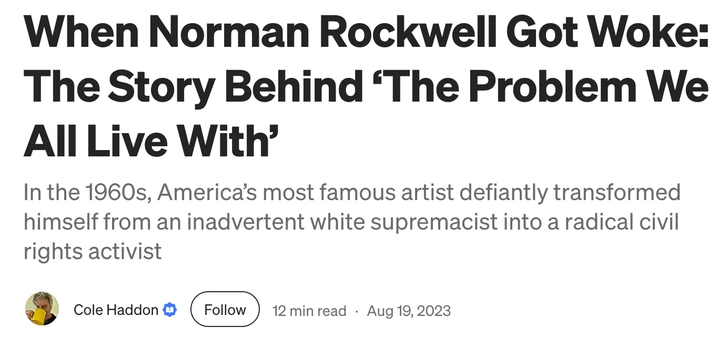
That problematic arch-conservative New-Dealer … Norman Rockwell?
Chris Bray was in Stockbridge Massachusetts recently and discovered that the notorious arch-conservative artist Norman Rockwell … supported the New Deal and FDR … which is unquestionably extreme-right, yet somehow “got woke” in the 1960s:
Stockbridge is in the (astonishingly pretty) Berkshires, where you can’t sell a latte or a $14 egg and cheese sandwich without a trans pride flag and a sticker in the window boldly supporting a woman’s right to choose and a “No Kings in America” sign and on and and on and on.
I’m an outsider, so they won’t show me the manual. But it’s a lot of virtue, signaled with a great deal of self-consciousness, and also there are a ton of German SUVs with New York license plates. Status status status. We stand with immigrants / new Mercedes.
Rockwell lived and painted in Stockbridge, and that’s … that’s … (ambiguous facial expression). He painted images that demonstrated a bone-deep fondness for America and Americans, especially small-town Americans, so he was a huge far-right figure, OBVIOUSLY, and also a major white supremacist, but maybe kind of accidentally a big Klan figure?
You can find this stuff everywhere: Rockwell’s name was “a symbol of an idealized, conservative, white American past”. Click on that link: It’s an essay that says Rockwell is known for an idealized conservative past, and it’s illustrated with a 1943 painting that celebrated FDR’s declaration that Freedom From Want is a basic freedom that that all Americans should enjoy. So, to wrap a bow around this amazing cultural artifact, Rockwell’s idealized conservative past was a celebration of the New Deal president’s declaration that government should assure material comfort for everyone. See, huge right-winger.
[…]
But Rockwell painted a massive quantity of routine shitlibbery alongside his depictions of small-town America as a place he didn’t despise, and, I’m repeating myself, several of his most famous paintings express his affection for that huge far-right figure Franklin Delano Roosevelt. He was a registered Republican who painted Democrats and Democrat political themes with great warmth, and also liked Ike, and then went on to paint important depictions of the Civil Rights Movement. So he’s … he’s … a huge Trumper who didn’t hate black people? Which lawn sign should we display about this? The past has to be sorted into the categories of right now, in ways that should feel comfortable to an NPR personality: This Thucydides person, was he a Trumper?
The just absolutely amazing leftist discourse about Rockwell is that he changed: He used to be a brutal Republican Nazi like ORANGE MAN, but then he turned into a good person. These essays tend to have the subtlety of a claw hammer to the face. Go read this example at the reliably boneheaded Vox, which describes Rockwell’s “late-life political transformation” and says that the “tumultuous ’60s would convert Rockwell into an overt social liberal”. He turned from right to left! He became good! See, he had an “awakening!”
The reason all of this confuses them is that Rockwell was a social type that no longer exists: a liberal Republican who thought that America had flaws that needed fixing, but who also at the same time loved the country and loved its people. He was sort of center-left on some stuff and center-right on some stuff, and culturally attuned to a nation that he viewed fondly. He liked FDR and the Four Freedoms and he personally liked Eisenhower, who had him over for dinner.


John Carter reports on “the largest gathering of Canadian nationalists in generations”

Canadian Red Ensign 1921-1957
Having been peripherally involved in party politics in Canada since the mid 1970s, I hope you’ll forgive my occasional bout of cynicism about getting political change in this country through peaceful means … the long comfortable decades under the US nuclear umbrella has allowed Canadian political parties to get ever more unserious and willing to pretend that taking a two-and-a-half generations-long vacation from the world of realpolitik has been somehow our birthright. I love my adopted homeland and it is distressing to see how easily the Liberal propagandists (supported by the state-funded relic media) can get elbow-flapping choruses of Canadian boomers to chant the slogans and blandly accept the grand theft from their children and grandchildren without a blush of shame.
John Carter says there may still be hope that enough Canadians have recognized the awful situation we’re in and are willing to do what’s necessary to change our collective ways and get back onto a path of constructive nationalism rather than the tame opposition of the current Conservative Party:
I don’t want to overstate things, but I think this was an historic moment.
It was also a hell of a ride.
The Dominion Society was founded barely over a year ago, and rapidly exploded to over three thousand members across the country. It is a peaceful and explicitly non-partisan political advocacy group dedicated to advancing the cause of remigration within Canadian civil society. So far its activities have consisted mainly of selling branded merchandise, putting up posters, cleaning up parks, rallies to oppose Canadian towns from tearing down statues of Sir John A MacDonald and Samuel de Champlain, and a whole lot of social media campaigns.
To anyone in possession of some shred of sanity, all of this would seem to be entirely unobjectionable and non-threatening. To the Canadian government, which long ago released its hold on the last tenuous threads of sanity, this is a five-alarm political fire. They are, it seems, terrified of the Dominion Society to the point of hysteria.
Until recently the Canadian media – which by virtue of a generous state funding apparatus is de facto state media – has for the most part done its best to ignore the Dominion Society, treating it as an irrelevant collection of disgruntled kids who aren’t worth reporting on. That isn’t to say that the political class was not aware of DomSoc. Their founder, Daniel Tyrie, showed up at the Conservative Party conference several months ago with a number of supporters, trolling the Conservative Party of Canada with a big “Conserve What?” sign outside the front door of the venue, showing a picture of CPC leader Pierre Poillievre wearing a Sikh temple hat during one of his many ethnic pandering junkets. The CPC very much noticed this, and were not impressed.
Since then Tyrie and his supporters have sparred with various CPC politicians on X, ratioing them on a fairly regular basis. On February 15th, the Flag Day that marks the 1965 transition from the original Canadian flag to the Maple Leaf, the House of Commons account got thoroughly ensignmogged by a swarm of Canadian nationalists declaring that the Red Ensign was their real flag.
Seriously, just look at the replies and quote tweets. An unending sea of red ensigns.
The flag day ensignmogging was a remarkable eruption of nationalist energy, and it’s very difficult to imagine that the Canadian government has not noticed the sudden popularity of the Red Ensign and the Canadian shield as symbols of Canadian nationalism. This use of these discarded symbols makes Canadian politicians palpably anxious. They have spent many decades patiently erasing Canada’s past in order to socially engineer the wild colonials into the universal economic subject, and the revival of ethnically particular medieval heraldry signals something stirring within the deep recesses of the mass psyche. The natives are restless. Old and terrible gods are awakening.
The question of course is what they can do about that. So far the answer has been “not much that matters”. It would be one thing if the Dominion Society was a bad optics skinhead cult called the White Reich Front or something, brandishing sonnenrads on their shield walls as they formed up for street battle with Trantifa. This would be easily dealt with as something obviously frightening and foreign. But the Dominion Society is none of these things. It is named the Dominion Society, as in the Dominion of Canada – Canada’s official, full name, being a Dominion of the British Crown. Its symbolism draws upon Canada’s own traditional symbolism, symbols that are indeed still quietly used by the Canadian government itself, and it is therefore quite impossible for the regime to characterize DomSoc as something frightening and foreign on aesthetic grounds alone. Worse still, DomSoc is very smart about how it operates. They don’t march through the streets shouting and getting in fights: they’re polite and friendly, focusing on media activism and political pressure campaigns. Their messaging stays strictly within legal boundaries. Their over-arching goal is direct and simple: to popularize the concept of remigration, normalizing it as a topic in the national conversation, such that voters will begin spontaneously raising the issue with politicians: “If we can bring people in, why can’t we send them back? Planes fly in any direction.”
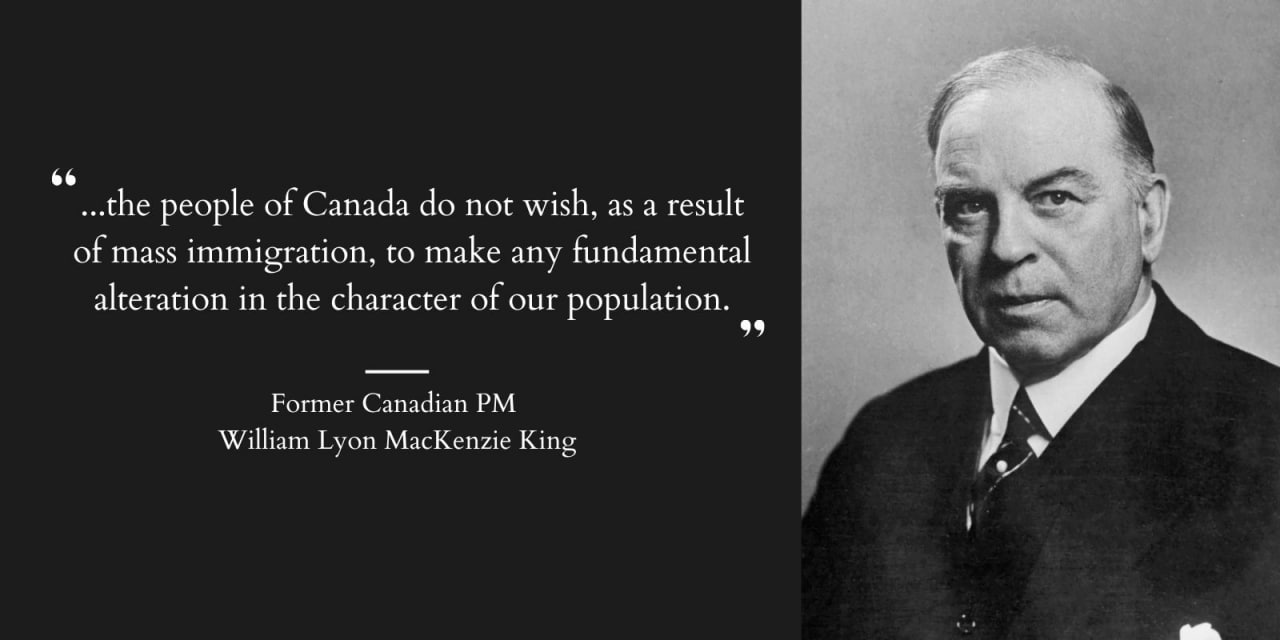
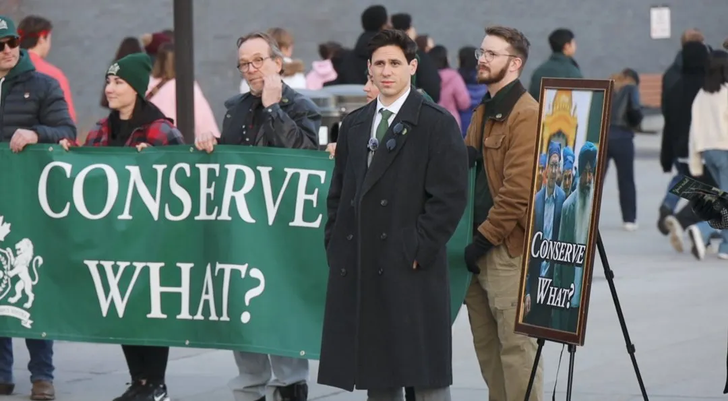

September 2, 2026
Jeremy Clarkson is “the worst tax dodger in British history”
As I mentioned recently, I’ve been watching episodes of Clarkson’s Farm and thoroughly enjoying them. I’m doing the opposite of binge-ing them, limiting myself to one episode at a time, and not every night. I’m part-way through Season 3 at the moment. The unrelenting hostility of the local government is a thing to behold … it really does seem as if they think that their role is to prevent any sort of economic activity from taking place in their jurisdiction.
Sama Hoole outlines the steps Jeremy Clarkson has taken over the time since he purchased one thousand acres of farmland:

A timeline of one man’s cunning inheritance tax scheme.
2008: Buy a thousand acres in Oxfordshire. Tell The Times that dodging inheritance tax is the critical thing. Scheme live.
2009 to 2018: Do absolutely nothing. A villager farms it on contract. Flawless.
2019: The villager retires. Rather than hire another one, decide to farm a thousand acres yourself, having never grown anything.
Also 2019: Invite a film crew.
2020: Rain for nine weeks. Profit on a thousand acres: £144.
2021: Broadcast the £144 to the largest streaming platform on earth, thereby informing the entire planet that farmland makes nothing.
2021: Open a farm shop. Acquire a queue down a lane and the undivided attention of West Oxfordshire District Council.
2022: Restaurant refused. Enforcement notice. Six weeks to take a barn apart.
2023: Lose the appeal. Lose it again.
May 2024: Accidentally get English planning law rewritten. Lawyers name it Clarkson’s Clause.
August 2024: Open a pub selling only British food. Sell your own sausage at 74p against 18p imported, and eat the difference on every plate.
October 2024: The Chancellor caps agricultural property relief at a million. Scheme dead.
November 2024: Stand on a platform in Westminster in front of thirteen thousand farmers, drawing maximum national attention to the exact tax break you were supposedly hiding behind.
July 2025: Go down with TB. First calf ever born on the farm destroyed, pregnant with twins. Gate padlocked.
23 December 2025: Government retreats. The threshold goes from one million to two and a half. Five million for a couple.
March 2026: Farm declared clear.
July 2026: Drive four hundred miles to Scotland and buy more cows.
Eighteen years.
Planning law changed. Agricultural degree applications climbing. Cited in the Commons more times than most ministers manage. Half the estates that were going to be caught by the tax are no longer caught by it.
He was accused of buying a farm to dodge inheritance tax, and then spent eighteen months getting the relief raised for everybody else’s.
Worst tax dodger in British history.
Best thing to happen to British farming in fifty years.
September 1, 2026
Despite police efforts, the Dominion Society successfully holds their conference
The Dominion Society of Canada had planned to hold their conference at a venue in Hamilton, but Hamilton police took it upon themselves to harass the owners of rental facilities to ensure that the conference could not take place. Despite active police intervention, the organizers found an appropriate site in Burlington and the event went ahead after all:
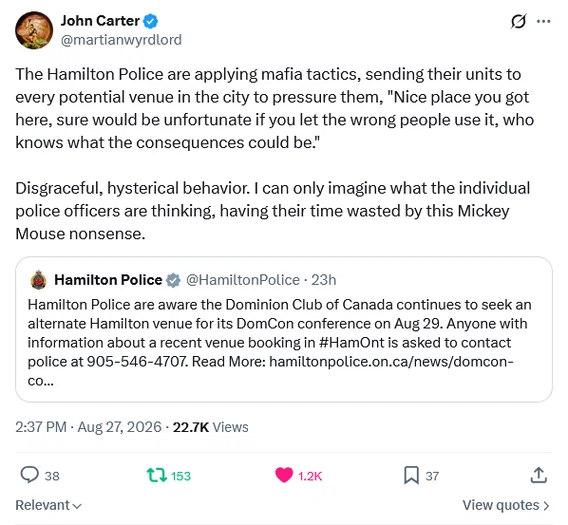
It’s always a good look when the local police are trying to intimidate businesses to prevent a peaceful legal gathering from taking place.
On August 29th, the Dominion Society of Canada (DSC) hosted a sold-out conference bringing together domestic and international speakers.Taking place in Burlington, the event was originally announced for Hamilton and was elevated to the status of international incident by legally dubious political policing, the likely unconstitutional interference of federal agencies, and numerous violations of political neutrality by local municipalities and charitable organizations.
Launched in 2025 and swelling to several thousand members by 2026, the DSC exists to advocate for immigration restriction and Canadian nationalism. Controversially, this includes a ten-year halt to immigration and the deportation of millions of non-citizen residents.
DSC’s first conference, this was a deciding moment for the increasingly notorious organization and was strongly opposed by left-wing and anti-nationalist groups, including local civic and social planning organizations, the Jewish rights and advocacy group B’nai Brith, Hope Not Hate, and the state-backed Canadian Anti Hate Network.
The event nearly passed with little notice. But moderates and liberals across the country were alarmed at a chilling assault on free assembly and expression mobilized against DSC at all levels of power.
Ahead of the event, the Hamilton Police Service urged venues “to consider the impact this event and its messaging may have on the broader community when making decisions about hosting it” and claimed “the messaging associated with DomCon is divisive and exclusionary and can negatively impact the sense of safety and belonging within our community”.
Dominion Society founder Daniel Tyrie condemned the move to use police resources to dissuade venues from hosting the conference: “Today we learn that they are going venue-by-venue to pressure businesses into canceling on us or refuse our booking. Is this an appropriate use of police resources in a city as dysfunctional as Hamilton?”
In a call with Wire Tap Media, Inspector Darren Murphy denied that Hamilton Police Service (HPS) were engaged in political intimidation, and confirmed the steps taken by HPS to keep DSC out of Hamilton.


