Quotulatiousness

May 24, 2026

QotD: Historians, past and present

Filed under: Books, Europe, History, Politics, Quotations — Tags: , , , — Nicholas @ 02:00

The average ancient historian led troops, tutored a prince, governed a province, advised a king, made a fortune, fell from favor, was exiled, and buried 7 of their 10 children. The average modern historian passed a few tests then wrote a book on their laptop next to their cat. And worse, they all passed the same tests at the same institutions. And they all wrote the same statements on their applications to get into those institutions. And while attending those institutions, they all adopted the same opinions. Anyone who did otherwise was filtered out before they could become a professor with a publishing deal. Everything is like this now.

Meanwhile Xenophon was an Athenian student of Socrates who joined a Greek mercenary group that marched 1000 miles into Persia to overthrow the King of Kings on behalf of the King’s brother. When the King’s brother died and the group’s commanders were all killed by Persian treachery, he led the troops 1000 miles home himself while being constantly harried by hostile armies. He then tried to establish a colony on the Black Sea, survived a mutiny, raided the Thracians, fought for the Spartans, was exiled by Athens, and settled down to manage an estate and write it all up.

Contrast Xenophon with Mary Beard, who studied at Cambridge and now teaches at Cambridge. She holds the same opinions as everyone else at Cambridge. She’s remarked before that, “I actually can’t understand what it would be to be a woman without being a feminist”. This seems like a peculiar failing for an ancient historian. After 9/11, she wrote an article saying that many people thought “the United States had it coming”, and that “world bullies, even if their heart is in the right place, will in the end pay the price”. That caused some controversy on the world stage, but earned her a promotion at Cambridge. I don’t know if she’s ever talked publicly about religion or democracy or climate change or immigration, but I could tell you exactly what she thinks about these things anyway. So why would you bother reading what she thinks about Rome? The answers are just as predictable.

Roman Helmet Guy, “New Books Aren’t Worth Reading”, Atlas Press, 2026-01-13.

May 23, 2026

A referendum? In our Alberta? There they go!

Filed under: Cancon, Media, Politics — Tags: , , — Nicholas @ 05:00

I hope Jen Gerson will forgive my hubristic use of “our Alberta” in my headline, as there’s at least a possibility that at the end of this process, Alberta won’t be “ours” any more:

So I guess we’re doing this, eh?

I mean, of course Alberta is holding a secession referendum. It’s Alberta; the province that consistently exhibits the inverse of one of Paul Wells’ most-famed Rule of Politics. To wit: “1: For any given situation, Canadian politics will tend toward the least exciting possible outcome”.

Okay, well. Yeehaw, I guess. Alberta hits different.

I suppose I’ll be doomed to die here — everywhere else would be boring by comparison.

For those who have not yet been fully read in: In a speech on Thursday that can only be described as a rhetorical onion of bad faith and gaslighting, Smith called for a secession referendum based on Forever Canadian leader Thomas Lukaszuk’s successful petition, which was intended to rally support of federalists ahead of an expected pro-secession petition. Lukaszuk’s question proceeded to the legislature, while the separatist Stay Free Alberta attempt was subsequently quashed in the courts.

Smith will continue to appeal that ruling and in order to stay ahead of the judicial process will now hold a non-binding secession vote in October based on the successful federalist petition. Except the actual question won’t be based on Lukaszuk’s exact wording, but will rather be something both novel and maybe able to pass judicial review.

The imminent question now to be posed to us reads: “Should Alberta remain a province of Canada or should the Government of Alberta commence the legal process required under the Canadian Constitution to hold a binding provincial referendum on whether or not Alberta should separate from Canada?”

So we’ll have a referendum on having another binding referendum. This, as far as I can tell, will please neither federalists nor separatists. It will increase the odds that an initial vote to leave Canada will pass if voters regard it as a harmless protest exercise; this will thus ensure that secession remains a live feature of Alberta politics for the foreseeable future.

Yes, I know this is confusing.

The trick is just don’t think about it too much. If you haven’t been following since at least March, you’ll never get fully caught up now. Just feel it out. If you get the sense that you are swimming in the surreality of an episode of Veep, you probably have it about right.

I can’t even give you ordinary political analysis, anymore. We just have to imagine that we’re all trapped in an improbable soap opera we can’t shut off, hostage to terrible over-actors whose intentions and actions only make sense to those of us who have been religiously following every B-rate plot twist for years. I’m waiting for a demonic talking puppet named Timmy to roll into town on the back of a Ford F150 driven by a malevolent witch who casts love spells and curses in order to triangulate a never-ending high school drama populated by bored corporate memo takers and Calgary School dorks who decided politics was the highest and best use of their short time on this God-given earth.

They could have started a soup kitchen, or taken up diamond painting from those kits they sell at Michael’s, but nah. It’s this.

So here we are. Staring down the barrel of a referendum that has a higher chance of securing a thin majority than anyone seems to realize, even if it is very unlikely to lead to a legal separation of the province. Either way, simply holding the vote opens the whole country up to an unpredictable cauldron of economic and political consequences, in addition to God-knows what foreign interference. It’s so goddamn crazy, the plot would get rejected for a one-man YouTube shorts series.

And all of this because Danielle Smith is beholden to an emboldened and committed political base of separatists that has threatened to blow up her leadership and her party if she doesn’t hold a secession vote. Meanwhile, the moderates in caucus are proving to be something less than profiles in moral courage. Only two, Matt Jones and Nate Horner, noted opponents of holding a vote, seem willing to speak up, and both of them resigned on Wednesday. Everyone else is either cowed, indifferent, or a separatist too lacking in integrity to say so outright in public.

The UCP has become a party of snivelling, weak little thieves who operate by night.

May 22, 2026

Achtung! Achtung! Extremely extreme extreme-right alert! Achtung! Achtung!

Filed under: Germany, Media, Politics — Tags: , , , , , — Nicholas @ 05:00

Shocking and dreadful news from democratic Germany comes to us from eugyppius, as the extremely extreme extreme-right Hitler Nazi Fascist party continues to soar in the polls, signalling existential danger for “Our Democracy”, just like the 1930s all over again:

Last Saturday, INSA published a nationwide poll that caused immense disquiet among the defenders of Our Democracy because it showed Alternative für Deutschland a whole seven fat points ahead of the centre-right Union parties. That beastly Evil Fascist Nazi Hitler AfD had never polled so strongly before and had also never clocked such a large lead over the Union before.

Suddenly 1933 was that much closer, and this made the Defenders of Our Democracy uncomfortable. Thus there ensued a lot of hand-wringing and panic and motivated reasoning about how this poll might just be an outlier and also too leftoid conspiracy theories that INSA because reasons and as part of a nefarious plot might be cooking the numbers to make AfD look stronger than they actually are.

People stopped saying things like that when Forsa, another polling operation, published their own nationwide survey three days later, which had the AfD at 28% with a six-point lead over the CDU …

[…]

The establishment received their latest shit sandwich this morning, in the form of yet another INSA survey – this time a state poll – showing that the AfD in the Free State of Saxony with 42% support, against a badly weakened CDU at 21%:

These numbers are very close to a recent poll of Sachsen-Anhalt. Together, these polls show that the AfD is on track to achieve outright parliamentary majorities across multiple East German states in the coming years. Basically, we’re looking at a preference cascade, as the press turns on a badly weakened Pigeon Chancellor Friedrich Merz, voters move their support to the only CDU alternative in view, and AfD support thereby becomes socially normalised – which draws still more voters towards the party in turn. Who knows when it will end, or if any of these alienated voters can ever be won back from Evil Nazi Hitler Fascism to Our Democracy, or how the Union can hope to survive the tectonic shifts that are already moving the ground beneath them.

These and other imponderables have driven our political establishment to the brink of psychosis. The CDU have responded to their impending doom by publishing a defamatory 36-page pamphlet screeching that the AfD are “Detrimental to democracy”, “Anti-Semitic” and “Nationalist”. The screed reads like it was written by a pinched schoolmarm and portions of it are very likely legally actionable, mainly because they contain straight-up unadulterated lies. The document raised eyebrows across Germany because its hysterical, desperate tone is so out of character for the staid, unimaginative propagandists of the Union. They must really be losing their minds over there in the CDU.

May 21, 2026

Evaluating the Boomers’ complaints from the Zoomers’ point of view

Filed under: Cancon, Economics, Media, Politics, USA — Tags: , , , — Nicholas @ 06:00

As a dirt-poor boomer (or Generation Jones-er as some term us extra-late boomers), I don’t have a lot of sympathy for others in my age cohort who complain about their kids and grandkids not getting ahead when they’re occasionally back in Canada from their second or third extended exotic foreign vacation since before the snow fell last fall. (It’s been more than a decade since the last time we were able to take any kind of vacation … and that was just a week’s driving holiday to South Carolina.) The Zoomers (and Millennials, and even some of the Gen X’ers) have valid complaints that the boomers generally are not capable of understanding, as John Carter explains:

I’m going to have a little rant, here, so I’ll start by emphasizing: Not All Boomers. Look, my mother is a boomer, and I love her dearly, in large part because she represents the opposite of so many boomer stereotypes. Many of you reading this are boomers; I know this because you’re in the comments, writing some of the best comments, you can ask anyone, the very best comments, everyone says it, it’s true. I know full well that much of what follows doesn’t apply to you, because you’re the good ones, the exceptional ones, the few, the proud So, please, do not take any of this personally.

With that said.

The shouting match broke down along the expected lines. Boomers – including spiritual boomers – loudly agreed with O’Leary’s remarks. If you only spend $2 a day on lunch, they insisted, the resulting $26 a day that you save adds up to $9490 a year; after 5 years, you’ve got the down payment for a $250,000 house. Checkmate, you financially illiterate layabouts!

Zoomers, millennials, and Gen-X replied that $250,000 will get you a leaky shack in rural Arkansas with black mold in the unfinished basement; that by the time you save up the money for the down-payment, that shack will be going for $500,000; that recent immigrants receive government assistance to get onto the property ladder (along with preferential employment) and so do not have to spend years of their lives saving up at all. Disaffected youth (and these days, that is just ‘the youth’) generally heaped scorn on the idea that it’s even possible to save in this economy, or that there’s anything worth saving. “If you live on instant noodles and margarine sandwiches for twenty years, you too, my son, can one day afford a van down by the river.”

As an aside, isn’t it incredible how fashion has barely changed since Chris Farley did this skit on SNL back in 1993? Stuck culture is everywhere.
Image and caption from Postcards from Barsoom

I can see both sides of this. I tend to live frugally myself, not so much because I consider it virtuous but out of simple necessity. Throughout my 20s and 30s I was a career student living paycheck-to-paycheck, as a result of which I became very accustomed to cooking my meals and buying only what’s necessary. I’ve never once used DoorDash or Uber Eats. I buy my clothing at thrift stores, only purchase a new laptop once every decade or so, and have somehow managed to avoid racking up much in the way of debt … and by ‘somehow’ I mean that I’ve never owned a house or a car, partly because I changed continents too regularly to make such big-ticket purchases practical or necessary, but mostly because I couldn’t afford them. Even finishing my doctorate did not really bring anything you could call prosperity in its wake: my first position was for the princely some of just over USD30,000 per year. By the time I reached the median national income in my late 30s, I’d gotten so accustomed to frugal living that money started piling up in my account just because I had no idea what to do with it, and little inclination to spend it because I was honestly just happy to not have to worry about budgeting to make rent. That turned out to be very helpful when DEI came for my career track; I lived on those savings for a couple of years after.

[…]

There was a famous Stanford experiment called the Marshmallow Test which measured time preference in young children. A child would be left in a room with a single marshmallow on the table. They were of course free to eat the marshmallow, the experimenter would tell them, but if they didn’t, then later on they would get a second marshmallow. Children with high time preference – meaning that they strongly prefer the immediate reward to the hypothetical future reward – would cram the marshmallow into their candy-holes without a second thought. Children with low time preference – meaning that they value the future at a similar or even higher level to the present – would patiently wait, and be rewarded with a second marshmallow. These children were then followed, and it was demonstrated that the children with low time preference demonstrated better life outcomes: they maintained higher grades, were less likely to fall into debt, were less likely to develop drug addictions, were less likely to get pregnant before marriage, were less likely to get fat, and so on. All of which makes sense. The capacity to endure present pain – by studying, dieting, working out, what have you – in order to obtain a better future outcome is obviously going to be linked to better outcomes.

How would a smart kid react if the experimenter failed the marshmallow test?

For instance, say the experimenter simply lied. There was no second marshmallow; the child waited for nothing. Or, even worse, the first marshmallow was snatched away, and replaced with two marshmallows, each one half the size of the original? Or a third the size? Here are your two marshmallows, sucker, joke’s on you. What would the results be if, after this experience, the children were tested a second time? I don’t know if such an experiment has ever been conducted, but the outcome is not hard to guess. Every single one of the children, whether they’d passed the marshmallow test the first time or not, would scarf down the marshmallow the moment it was in front of them.

The capacity for low time preference may be largely innate, but whether it expresses or not is entirely a function of social trust. In order to defer gratification for a greater future reward, one must believe that there is a reasonably high chance of that reward manifesting. The less likely the future reward becomes, the more steeply a rational actor will discount the future.

I don’t want to minimize the hardships that boomers endured when they were young. Boomers worked hard, and they didn’t enjoy the same conveniences that we enjoy now. They fought in the Vietnam War (well, about 3% of them), they spent most of their lives under a nuclear sword of Damocles, they suffered through the oil shock and stagflation in the 70s, they were punished by double-digit interest rates in the early 80s, and they spent their working lives trying desperately to stay one step ahead of the skyrocketing inflation that was unleashed when Bretton-Woods fell apart and the last vestigial support of the gold standard was kicked out from under the brrrring money printer.

But, despite all of that drama, the one thing boomers could generally rely upon was that – so long as thermonuclear annihilation was averted – things would generally get better. Technology would advance. Working conditions would get safer. The special effects in movies would become more convincing. Houses would get larger. Cars would get nicer. Air conditioning would get quieter. The environment would get cleaner. Society would become more just. The world would become freer and safer for democracy. And so on and so forth. Baby boomers have enjoyed a charmed life such as no other generation has known: free of major wars, full of technical wonders, in which whatever difficulties you might endure now, you could generally count on the future being a better place. For the boomer, deferred gratification always had a payoff.

For the zoomer – and the millennial, and generation X – this has simply not been the case. After 9/11 a police state panopticon settled over society. The 2008 real estate crash pulled the rug out from under the millennials, after which real-estate got ZIRPed to the Moon. Mass immigration pumped real estate demand further, while undercutting wages and rendering public spaces steadily more alienating, unpleasant, and dangerous. Black Lives Matter immolated quaint notions of racial harmony. DEI threw young white men, their careers, their futures, and their unborn children to the wolves. COVID stole two years from young people’s lives so that old people could feel safe from the coof. Now, AI^2 (Artificial Intelligence + Actual Indians) means that the only thing the young expect in their future is gig work in the sex trade industry (until robots take that, too).

Enoch Powell, from would-be Viceroy to “Little Englander”

Filed under: Britain, Government, History, Politics — Tags: , , , , , , — Nicholas @ 04:00

Niccolo Soldo discusses the early career of Enoch Powell and an earlier speech than the famous “Rivers of Blood” speech that took his own party to task for failings in the Imperial decline after World War 2:

AI-generated image from Fisted by Foucault

I’ve been on a bit of an Enoch Powell kick lately, and I’m not exactly sure as to why. Best known for his “Rivers of Blood” speech, in which he warned the UK about the dangers of mass migration, Powell was both an iconoclast and an eccentric, something that the British used to produce in spades.

Think about it; as a boy of the age of six, he would finish books and then collect his parents and give them a presentation on what he learned. His teen years were focused on the Classics, and translating(!) them into English. So adept was he at this that by the time he got to Trinity College at Cambridge, he entered into every Classics competition that existed at the time, and won each and every single one during his first year. When the University’s Dean and his wife invited him for a private supper, he had the temerity to politely refuse their offer, insisting that he had work to do (more translations). He became a Professor of Greek at the ripe old age of 25.

A devoted Nietzschean, Powell dreamed of becoming Viceroy of India, and he took the first opportunity to volunteer to serve his country in the war. His rise through the ranks was nothing short of incredible: Lieutenant-Colonel by 1942, and Brigadier (One-Star General) by the end of WW2. The man was the living embodiment of a 19th century German Romantic, albeit an English one at that. So thoroughly English was he that he could barely conceal his anti-Americanism, a trait that would surface from time to time over the course of decades. And yes, English, not British. Although today feted by immigration-restrictionists across the UK, his nationalism was what is known as “Little Englander”. Adding to the eccentricity, the turn away from Empire by the UK shortly after WW2 saw Powell do much the same: from golden dreams of being appointed Viceroy of India, to transforming into a Little Englander, adamant that it protect and retain all of what he felt were its best traits and characteristics, rejecting that which did not conform to this modus operandi.

It’s this overnight transformation that most piques my interest in his character because it is somewhat unique for a person of a very conservative nature to immediately accept such a dramatic shift in conditions and insist that the best must be made of it. “Empire is over. Let’s put it to bed, and let’s get on with it”, are words that are far, far beneath Powell’s level of erudition, but they do accurately describe his course correction.

Explaining why more men are “opting out”

Filed under: Business, Education, Health, Media, Politics, USA — Tags: , , , , , — Nicholas @ 03:00

On Substack, Bettina Arndt shows some of the reasons why men are less and less willing to commit — not just to relationships, but to huge swathes of what we used to call “adult life”:

The warning signs have been there for decades. Back in 1983, American author Barbara Ehrenreich wrote a powerful book — The Hearts of Men: American Dreams and the Flight from Commitment — arguing that a male revolt was underway. Since the 1950s, she suggested, men had begun rebelling against the breadwinner ethic — inspired by Playboy culture, the counterculture, and a desire for personal freedom. They were rejecting the cultural ideology that had shamed them into tying the knot and becoming a good provider, lest they be seen as immature, irresponsible, and less than a real man.

Ehrenreich understood that marriage was the mechanism by which society harnessed male productivity. Remove the shame, and the yoke comes off.

Forty years on, the yoke has disappeared. In April 2026, the American male labour force participation rate hit its lowest level since records began in the 1940s, according to the US Bureau of Labor Statistics. One in three American men — roughly 33% — were not working or actively looking for work. The overall male participation rate for men aged 16 and over stood at just 67%, down from 73.5% two decades ago and from 87% in the postwar years when Ehrenreich’s story begins.

The trend is not confined to America. Australian men’s workforce participation has fallen from around 79% in 1978 to approximately 71% today (see below), while similar declines — though less dramatic than in the United States — have occurred in the UK and Canada.

[…]

If you want to understand why men are voting with their feet, you need to look not just at what marriage now costs them — and the costs are severe — but at what it delivers. Increasingly, what it delivers is a pretty dud deal.

The modern woman: a prospectus.

  • They are the most miserable, anxious, and insecure cohort in living memory — hardly great marriage material.
  • Most married women go off sex — and the husband who objects is seen as the problem.
  • Many women don’t actually like men very much. The more educated she is, the higher the contempt.
  • They’ve gone full throttle left — and three quarters of college-educated women won’t even date a man who votes differently.
  • They’ve rigged the education system and colonised corporate and institutional life, turning universities and workplaces into man-repellent factories.
  • Yet their hypergamy (desire to marry up) is still running hot. Despite outnumbering men in education and careers, they demand a tall, equally high-status unicorn.
  • The modern female threat-detection system is hyperactive. Almost any male behaviour — silence, opinions, jokes, breathing — gets flagged as a red flag.
  • They’re extremely well-versed in the lucrative economics of divorce, including a well-timed false allegation to eliminate tedious shared parenting.

What rational man reads this list and thinks: yes, that’s exactly what’s been missing from my life?

May 20, 2026

The seax as an English ethno-national equivalent to the kirpan

As most will know, the UK government has been steadily working to prevent UK citizens from carrying weapons of any time … except the religious exception for Sikhs to carry the kirpan, which is part of their faith. John Carter claims that the case for the Saxons to carry the seax is at least as strong:

Infamously, as one of its many assaults upon British tradition – the latest of which is the end of jury trials, a right Englishmen have enjoyed since the Magna Carta – the decline’s managers disarmed the British people. The right of (Protestant) Englishmen to keep and bear arms was enshrined in the Glorious Revolution’s 1689 Bill of Rights. The Second Amendment of the American Constitution’s Bill of Rights is essentially a reiteration of this ancient right of Englishmen; indeed, one of the complaints of the revolutionary colonists was that their rights as Englishmen were not being respected by the English crown. The right to bear arms was first expressed in the 1689 Bill of Rights, but its origin is much older, in the ancient Germanic understanding that a free man is an armed man, and that only slaves are prohibited the means of assuring their personal security. Britain’s managerial regime spent the twentieth century patiently gnawing away at the right to bear arms. It began its assault with licensing requirements in 1920, finally escalating to absolute bans following the 1988 Hungerford massacre and the 1996 Dunblane massacre.

As with all of its petty oppressions, the excuse for banning firearms has always been public safety, which the Yookish regime claims to prize much more highly than public liberty, which it does not claim to prize at all, that being the only honest thing about it. The sincerity of these invocations of safety is rendered dubious by the simultaneous premium Westminster, Whitehall, Number 10 Downing, and Buckingham Palace place upon the uninterrupted mass importation of humanoid dross from the most violently dysfunctional countries on the planet, which (notably) started in earnest at almost exactly the same time that the British people were disarmed.

It was not enough to take away the tools of self-defence. The principle of self-defence was also effectively eliminated: if a private citizen injures or kills a criminal in the course of defending himself against criminal predation, he will be charged as a criminal himself. The British people are expected to outsource their personal defence to police who refuse to defend them, in a country to which their government deliberately imports as many dangerous men as it can. Notably, defence against dangerous men of diversity is particularly frowned upon, because this is racist; indeed, even to complain about diversity danger is treated as a worse crime than rape, robbery, assault, or murder. The Yookay arrests more people for speechcrime than any other country on the planet.

Since firearms are banned, Britain’s criminal element has turned to knives, leading to a long-standing hysteria over knife crime. “Zombie-style knives” and “ninja swords” were banned in 2024 and 2025, while online knife sales now require 2-step age verification. There have even been calls to ban knives with sharp points, which would present certain challenges to the culinary arts. Meanwhile the stop-and-search policies intended to control knife crime on the streets are routinely derided as racist, as it is (surprise!) overwhelmingly young black men who are caught with concealed knives, which of course they conceal because their intent is to use them in the commission of robbery, assault, and murder. Which the British people are not permitted to defend themselves from, and which the Yookish police refuse to do anything about.

All of this raises the question of why, precisely, Digwa was walking around with a big knife.

The answer to this is that Digwa is a Sikh, and Sikhs have a special carve-out for the kirpan, a ceremonial knife which their religion mandates they carry with them at all times, as (if I understand correctly) a symbol of resistance to oppression and their readiness to always be prepared to defend the weak from injustice. Symbolic or not, the kirpan is a very real knife, with a very real edge.

The special religious dispensation granted Britain’s Sikhs is merely the most visible double-standard when it comes to keeping weapons. We saw another example during the Southport riots, when large numbers of Muslims turned out on the streets with machetes. Rather than arresting the lot of them (which the Yookish authorities couldn’t do, as they were busy filling the prisons with British protesters), the law enforcement officers on the scene advised them to hide their weapons in their mosque, which out of respect for the delicate sensibilities of the vibrant Islamic community the police would certainly never even dream of searching. One wonders just how many mosques are hiding caches of weapons.

Unlike the benevolently blind eye the Yookish authorities cast upon their treasured Muslims, however, the Sikh exemption is actually written into law.

As the Nowak case broke across social media a few days ago, a lot of people called for an end to this double standard. If whites are disarmed, then everyone else should be as well. There should be no special treatment on account of their heathen gods.

This is an understandable position, but I think it’s the wrong one. It is the thought pattern of The Raped.

Rather than wanting to drag Sikhs down to the subbasement of slavish cuckery into which they’ve been pressed, Anglo-Saxons should instead demand that they, too, be allowed to arm themselves.

The Sikh argument is that their faith requires that they be armed at all time.

The Saxon argument is similar to the Sikh, but if anything it is even more fundamental.

The name Saxon derives from the seax, the characteristic short sword carried by the Germanic invaders who made England their home in the 5th century. “Saxon” literally means “the sons of the knife”, “the people of the blade”, or “the swordsmen”.

The very identity of our tribe is intertwined with privately held armaments. This is pre-political; it’s pre-religious; for the Saxon, armaments are an identitarian symbol that goes to the very core of what a Saxon is. To remove the seax from the Saxon is to strip him of his identity. Which, of course, is the avowed goal of the Fabian social engineers who have laboured for generations to reconstitute the definite form of the Anglo-Saxon into a pliable mush of generic, vaguely-defined, ahistorical, and universally extensible “values” that no Anglo-Saxon had even heard of until five minutes ago.

The same principle obviously applies to knife crime. Criminals are opportunistic predators. They avoid hard prey. There’s profit in jacking up easy meat to get a free iPhone, but not so much in getting stabbed into fresh meat yourself. If every Saxon wore a seax, street crime would very rapidly become a non-issue.

Of course, from the perspective of the Yookish governing apparat, the powerlessness of its subjects against criminal predation is quite an insignificant price to pay in exchange for ensuring the powerlessness of the autochthonous helotry against the apparat itself. If anything it’s a bonus. The regular humiliation of being forced to endure low-level criminality encourages a feeling of helplessness. The rainbow communists will therefore never “allow” the Saxon to rearm himself.

But what if the Saxon wore the seax without permission?

May 19, 2026

“That is not diplomacy. That is national self-harm wearing a lanyard.”

Filed under: Cancon, China, Economics, Europe, Government, Media, Politics — Tags: , , , , — Nicholas @ 04:00

On the social media site formerly known as Twitter, L. Wayne Mathison responds to a post about the Canadian government’s amazing nonchalance about protecting Canada’s sovereignty:

Canadians voted in a federal election, not in a referendum to turn the country into a Davos policy lab with a maple leaf sticker slapped on the front.

The line “we will never be the 51st state” is easy politics. Most Canadians agree. But then the same elbozos turns around and flirts with every other form of sovereignty dilution they can find.

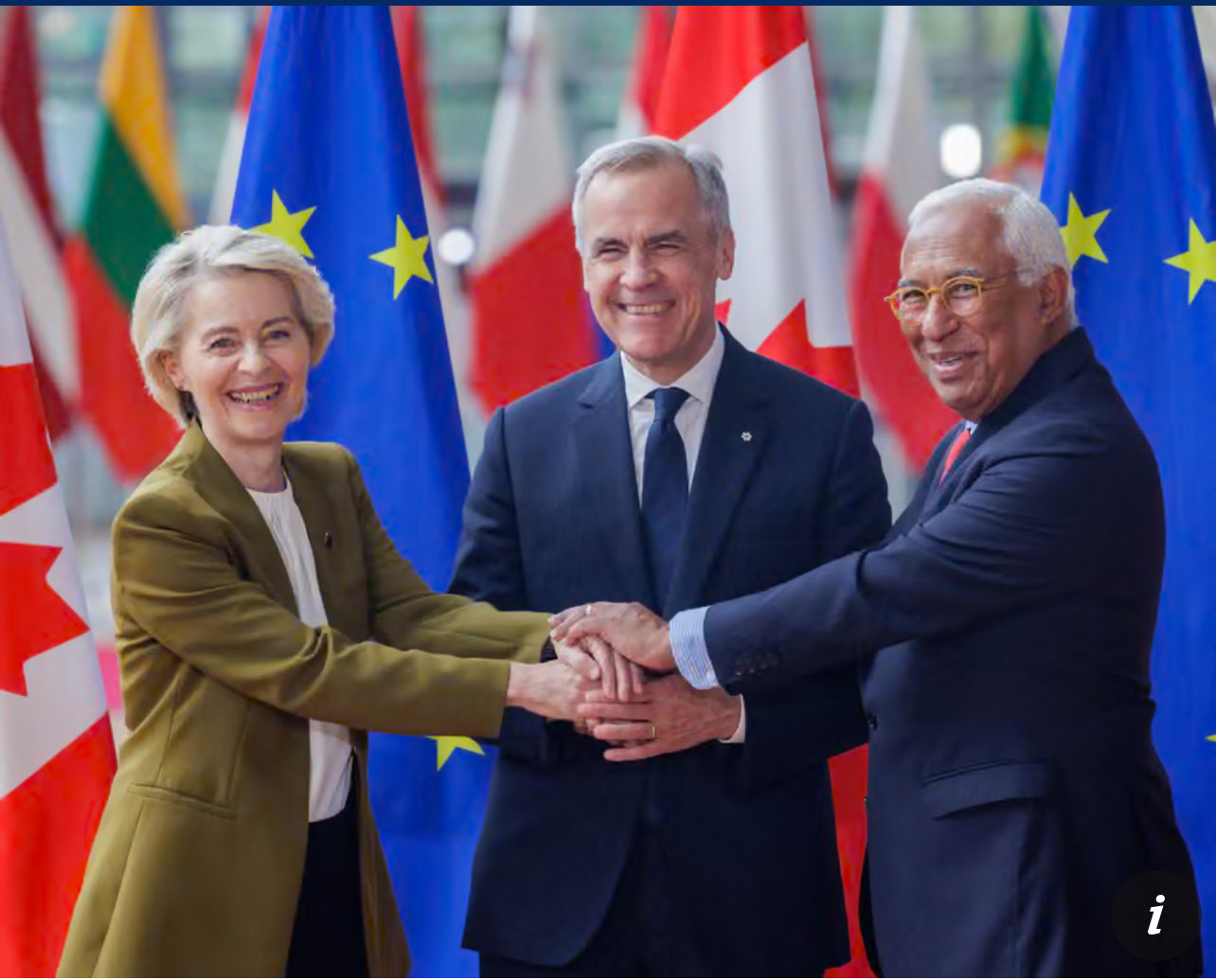
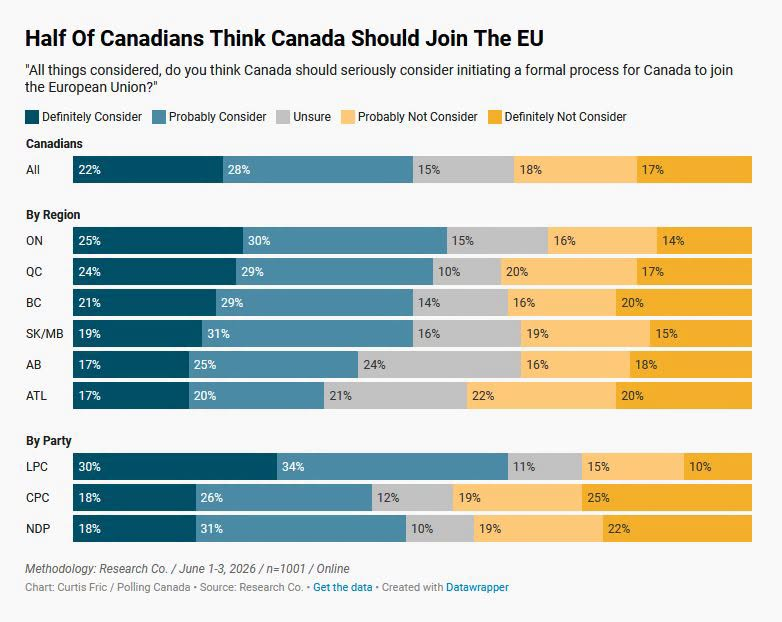
Join the EU? Canada is not in Europe. Geography still matters, apparently. Joining the EU would mean importing another layer of bureaucracy, regulation, courts, trade rules, and political obligations from people Canadians cannot remove from office. That is not independence. That is outsourcing control with better stationery.

Give China influence over resources? That is even worse. A serious country protects strategic assets: energy, minerals, food, ports, telecom, data, and critical infrastructure. You do not hand leverage over your future to an authoritarian state and then call yourself sophisticated. That is not diplomacy. That is national self-harm wearing a lanyard.

The real issue is this:

Canada’s elites love sovereignty when it means rejecting America.

They seem much less interested in sovereignty when it means resisting Brussels, Beijing, the UN, global finance, or climate bureaucrats.

So the question is fair:

Who voted for Canada to stop acting like a country?

Not Canadians. Not directly.

This is elite mission creep. They run on patriotism, then govern like national borders are an administrative inconvenience.

Other items that popped up in the news over the weekend included the United States Department of War announcing that they will be “pausing” their participation in the Permanent Joint Board on Defence, a US-Canadian body that has been continuously operating since 1940 when US President Franklin Delano Roosevelt and Canadian Prime Minister William Lyon Mackenzie King established it in a meeting in Ogdensburg, New York. Is this a big deal? Some people certainly think so:

In a bit of a sudden, surprise move, Under Secretary of War Elbridge “The Biggest Cheese” Colby has announced on X of all places that the Unites States would be pausing participation in the Permanent Joint Board on Defence, the Oldest and most Foundational node of the Canada-US security partnership.

[…]

As we all know, on August 17, 1940, U.S. President Franklin D. Roosevelt and Canadian Prime Minister William Lyon Mackenzie King met in a railway car in Ogdensburg, New York. They issued the Ogdensburg Declaration, an agreement to create a joint board to study sea, land, and air defense problems.

For over 80 years the PJBD has serves as one of the major intersects of the Canada-US relationship. It has been the forum where we have been able to engage and work collaboratively on matters of National Security, Continental Defence, and Critical Infrastructure.

Obviously, given how late it is for me, I sadly can’t dive head first into things. However, I did wanna get something out there. It’s no doubt a very petty move to make, part of a long line of petty moves between everyone in the last year. The pressure is obviously there to push Canada along, and the inclusion of the Prime Ministers Davos speech by Colby should go as a sign to one of the areas that is troubling the current administration.

Trying to apply pressure through such acts though isn’t something that I think will be successful. Granted, being a bit of a dick and doing petty shit in hopes of manipulating opinions, only for it to backfire due to a general miscalculation, is something this Administration does on the regular, and so I can’t be surprised to see it done here.

Nor is it surprising for the performative PM and his government to be utterly blindsided when one of their petty performances triggers a strong negative reaction from the United States.

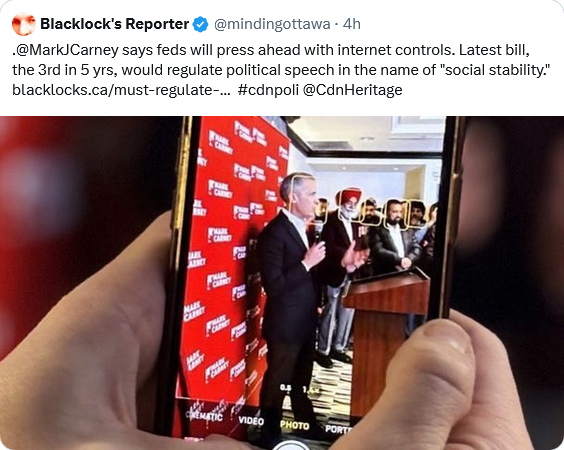
Another issue that the Liberals in Ottawa seem to think both uncontroversial and straightforward is one of their batch of anti-civil-liberties bills before Parliament, in this case Bill C-22, which the US Congress considers to be a dangerous attempt to control US companies who do business in Canada:

The government’s plans for lawful access have gone off the rails. In recent days, Signal has warned it would pull out of the Canadian market rather than comply with Bill C-22. Windscribe, the Toronto-headquartered VPN provider, has said it would relocate its headquarters out of Canada and NordVPN has warned it would consider following suit. Apple and Meta have both raised public concerns about the bill’s effect on encryption and cybersecurity. The Canadian Chamber of Commerce, the Cybersecurity Advisors Network, civil liberties groups, and a long line of legal and security experts have all called for changes. The chairs of the U.S. House Judiciary and Foreign Affairs Committees have written to Public Safety Minister Gary Anandasangaree warning that the bill threatens U.S. national security and the integrity of cross-border data flows. Even the bill’s own oversight body, the National Security and Intelligence Review Agency, has told the SECU committee it does not have the access it needs for effective oversight. If the government thought it could push through the bill largely unnoticed, it has been proven painfully wrong as there are now trade frictions with the U.S., the prospect of leading companies exiting the Canadian market, and weaker cybersecurity protections for ordinary users.

[…]

The bill nominally protects against the worst outcome through a systemic vulnerability safeguard, which says that core providers are not required to comply with a regulation if compliance would require the introduction or maintenance of a systemic vulnerability. But the safeguard falls apart on careful reading. First, the term “systemic vulnerability” lacks specificity in the statute, which means the government could define encryption and vulnerability narrowly enough to hollow out the protection. Second, Sections 5(5) and 7(5) state that providers are not required to comply where doing so would result in a systemic vulnerability, but Sections 12 and 13 unconditionally require compliance with orders and provide that orders prevail over inconsistent regulations. The net effect is that providers are stuck with contradictory provisions in a system shrouded in secrecy and which could lead to the weakening of security systems. That is why Signal, Windscribe, NordVPN, Apple, Meta, the Canadian Chamber of Commerce, the Cybersecurity Advisors Network, and the U.S. Congress are raising the alarm.

The best approach to address these risks is to go back to the drawing board on Part 2 of the bill. Committee hearings should be extended to ensure that the long list of expert witnesses, industry voices, and international counterparts who have asked for changes receive a full hearing. Further, real amendments should be on the table that better balance law enforcement needs with Canadians’ privacy rights. Failure to do so will result in some of the world’s most privacy-protective services exiting the market, leaving behind a law that is vulnerable to constitutional challenge with millions of Canadians facing genuine privacy and cybersecurity risks.

May 17, 2026

French contributions to the development of wokeness

Brivael Le Pogam offers an apology to the west for France being so significant in the philosophical and political effluvia of 1968 for setting the conditions in which wokeness was born:

Protesters gathered in the Place du Capitole in Toulouse, 11 or 12 June, 1968.
Photo by André Cros (1926-2021) via Wikimedia Commons.

I want to offer my apologies, on behalf of the French, for giving birth to French Theory (which in turn gave birth to the worst of all ideological monstrosities: wokism).

We gave the world Descartes, Pascal, Tocqueville. And then, in the intellectual ruins of post-1968, we gave Foucault, Derrida, Deleuze. Three brilliant men who forged, in the elegance of our language, the ideological weapon that today paralyzes the West.

We must understand what they did. Foucault taught that truth does not exist, that there are only power relations disguised as knowledge. That science, reason, justice, the medical institution, the school, the prison, sexuality — everything is merely a staging of domination. Derrida taught that texts have no stable meaning, that every signifier slips away, that every reading is a betrayal, that the author is dead and the reader reigns supreme. Deleuze taught that we should prefer the rhizome to the tree, the nomad to the sedentary, desire to the law, becoming to being, difference to identity.

Taken individually, these are debatable theses. Combined, exported, and popularized, they form a system. And that system is a poison.

For here’s what happened. These texts, unreadable in France, crossed the Atlantic. The departments of Yale, Berkeley, and Columbia absorbed them in the 1980s. They found there a soil that did not exist among us: American Puritanism, its racial guilt, its obsession with identity. French Theory married this substratum, and the child of that union is called wokism.

Judith Butler reads Foucault and invents performative gender. Edward Said reads Foucault and invents academic postcolonialism. Kimberlé Crenshaw inherits the framework and invents intersectionality. At every step, the matrix is French: there is no truth, there is only power, so every hierarchy is suspect, every institution is oppressive, every norm is violence, every identity is constructed and thus negotiable, every majority is guilty.

That’s how three Parisian philosophers, who probably never imagined their practical consequences, provided the operating software to an entire generation of activists, university bureaucrats, HR managers, journalists, and legislators. That’s how we ended up with a civilization that no longer knows how to say whether a woman is a woman, whether its own history is worth defending, whether merit exists, whether truth can be distinguished from opinion.

It’s shit for one simple reason, and it must be stated calmly. A civilization stands on three pillars: the belief that there exists a truth accessible to reason, the belief that there exists a good distinct from evil, the belief that there exists a heritage to be transmitted. French Theory set out to dynamite all three. Not out of malice. Out of intellectual play, fascination with suspicion, hatred of the bourgeoisie that had nurtured them. But the result is there. An entire generation learned to deconstruct and never learned to build. An entire generation knows how to suspect and no longer knows how to admire. An entire generation sees power everywhere and beauty nowhere.

I apologize because we French bear a particular responsibility. It’s our language, our universities, our publishers, our prestige that gave this nihilism its chic packaging. Without the legitimacy of the Sorbonne and Vincennes, these ideas would never have crossed the ocean. We exported doubt the way others export weapons.

What is being built now, in Silicon Valley, in AI labs, in startups, in workshops, in all the places where people still make things instead of deconstructing them — that is the response. A civilization is rebuilt by builders, not by commentators. By those who believe that truth exists and is worth devoting oneself to. By those who embrace a hierarchy of the beautiful, the true, the good, and are not ashamed to transmit it.

So, forgive us. And back to work.

Auto-translated by the social media site formerly known as Twitter from the original French post.

May 16, 2026

Canada’s imaginary “immigration consensus”

An informative post from earlier this year, showing how the much-talked-about “immigration consensus” was never any more than an expression of Laurentian Elite luxury belief:

Ever since immigration became a hot issue, it has become fashionable to say that “Trudeau broke Canada’s immigration consensus”. But this “consensus” was based on a false narrative that is easily disproved with data.

UNHEARD VOICES

Until about 10 years ago, I had also believed that there was an “immigration consensus” in Canada. But once my life in Canada had settled down enough for me to have the mental space to dabble in public debates online, I came across an opposing view. An Indian immigrant who was then working as editor for an English language community newspaper in the GTA wrote often about opinion polls showing a fairly high level of opposition to high immigration. His name is Pradip Rodrigues. I corresponded with him via email, and later we became friends.

What struck me at the time was that the lone voice talking about these polls was himself an immigrant. Some years later, I came across an article in [the] Vancouver Sun by journalist Douglas Todd, saying that Indo-Canadians in the Vancouver region were unhappy with the large influx of international students [from] India. Given how much value the Progressives (which category most of the MSM is a part of) put on “lived experience”, the reporting by Pradip and Mr. Todd should have attracted urgent attention.

But because the mess being created by excessive immigration hadn’t reached crisis levels by then, these voices went unheard. At best, they were preaching to the choir, and at worst, they were accused of racism (or, in the case of Pradip, “internalized racism”). Smart people see beforehand the problems that are coming and take steps to avert them. People of average intelligence attend to problems after they have occurred. Fools keep denying that problems have occurred, and it always takes a full-blown crisis to get them to accept that they have a problem on their hands – at which point they segue effortlessly to blaming others for the problems. We see this in many policy areas in Canada, and immigration is one of the most salient examples of this shortcoming in Canadian society.

RAISON D’ETRE

No politician will ever tire of saying that “Canada needs immigration to boost our economy”. An ancillary statement is that “immigrants pay taxes that support Canada’s social programs”. But as I showed in my article “Immigration Does NOT Increase Prosperity“, the inflation-adjusted compounded average growth rate (CAGR) in per capita GDP fell by a precipitous 84% between 1970 and 2021, ending up at an anemic 0.67% in the decade ending in 2021:

Clearly, the capacity of Canadians – long-time residents and newcomers alike – to “boost Canada’s economy” and “pay (more) taxes that support the social programs” has been eroded almost to zero. It is worth pondering how, in spite of clear signs evidenced by data, the exact opposite narrative could prevail over such a long period, and how so many people subscribed to it. This is as if Abraham Lincoln’s sage statement that “You can fool some people all the time, or all the people for some time, but not all the people all the time” was held in abeyance in Canada from 1970 onwards – or is that the case?

Not all of the people, but enough of the boomer generation who were raised with the constant drumbeat of propaganda from the Liberals — Canada’s “Natural Governing Party”, as they liked to refer to themselves — and now that most of them are comfortably retired, they seen no reason to rock the boat, even when their own children and grandchildren tell them how bad Canada has become since their prime.

“Do not expect a quick fix or some magical solution”

Filed under: Government, Media, Politics — Tags: , , , — Nicholas @ 03:00

On the social media site formerly known as Twitter, Eve Chipiuk points out that it’ll take more to get our governments out of the habit of kicking the can down the road than just change of faces at the top:

Parliament Hill in Ottawa.
Photo by S Nameirakpam via Wikimedia Commons.

No one said it would be easy. Nothing worth fighting for ever is.

Fighting powerful institutions is what I have done my entire life. It is not easy, but it is worth it because you know what is at stake.

This is also not a new problem. History has repeated this pattern before. “The first panacea for a mismanaged nation is inflation of the currency; the second is war. Both bring a temporary prosperity; both bring a permanent ruin. But both are the refuge of political and economic opportunists.” — Ernest Hemingway

Most do not want to give up an inch of their power or control because many have built their identity, influence, and livelihoods around those systems. Some have convinced the public that they know what is best for everyone else better than citizens know for themselves. Yet all you have to do is look around to see the lie. We are not better when people are divided, angry, fearful, and distracted, turning on each other instead of asking harder questions about the institutions and incentives driving the problems in the first place.

And if good people stop standing up, asking questions, and pushing back when something is wrong, those institutions only become more powerful and less accountable. That has been happening for a long time, which is exactly why many systems are so entrenched and disconnected from the people they are supposed to serve.

History repeatedly shows that when governments and institutions avoid addressing deeper structural problems, they rely on temporary measures, slogans, fear, distractions, and promises of quick fixes to maintain stability and public support. But eventually reality catches up, and and ordinary people bear the cost.

So do not expect a quick fix or some magical solution. Democracy, accountability, and freedom require informed citizens willing to stay engaged, stay principled, ask difficult questions, and do the hard work necessary to protect them.

Because in the end, what is more important to fight for than freedom, accountability, and the society we leave behind for future generations?

May 15, 2026

“This is what luxury-belief failure looks like”

Filed under: Cancon, Media, Politics — Tags: , , , — Nicholas @ 03:00

L. Wayne Mathison reacts to a pair of smarmy politicians congratulating one another in the House of Commons to the echoes of the trained seals clapping in the background:

This photo has the stink of Ottawa self-congratulation all over it.

Two suited insiders shaking hands while the room applauds, as if Canadians are supposed to mistake ceremony for competence. The whole scene screams managed success: the smiles, the poppies, the polished wood, the clapping loyalists in the background. Very official. Very staged. Very pleased with itself.

And that is the problem.

This is what luxury-belief failure looks like in picture form: people with secure salaries, protected pensions, communications teams, and zero personal exposure to the damage their policies create, congratulating each other for “building Canada” while ordinary Canadians are buried under housing costs, taxes, debt, inflation, weak productivity, and a government that thinks another announcement is the same thing as a result.

The photo says: “We are proud of what we’ve done.”

The Canadians with a brain say: “That’s exactly the problem.”

For over a decade now, the Canadian government has devoutly believed that appearances matter far more than reality, and conducts all of its operations with PR at the very tip-top of the priority list. If it will look really good on camera, it’s much more likely to get done … for Ottawa values of “done”. That usually means a big flashy announcement with whatever quick background props can be conjured up, followed by little or no actual work. Often the same thing will be re-announced multiple times in different places over an extended period of time, still with little else taking place. This is how Canada’s lost decade (and counting) has gone. And Liberal boomer voters love every performative second of it.

May 13, 2026

A quick look at the race to be the next governor of California

Chris Bray somehow seems to find the election coverage by a multi-decade veteran Los Angeles Times political reporter to be, dare I say, lacking just a little objectivity and honest analysis:

Robin Abcarian has been a professional journalist for four decades, mostly at the Los Angeles Times. She’s spent her adult life writing about politics. So go read her column about the last gubernatorial debate in California. Here’s how it opens:

    What am I looking for in a new California governor?

    Like a big chunk of the state’s voters, I’m not exactly sure.

You can already tell you’re in the hands of an experienced professional. There aren’t really any big issues or anything in California right now, so how would you zero in on something you would want from someone who wants to lead the state’s executive branch, right? It’s all just a shrug and a guess.

Then she recites: This candidate said X, and this other candidate said Y. And she tells you which of the recited things she likes: I like X. I do not like Y. She doesn’t analyze or argue or contextualize: she just says I like that one and I do not like that one. The effect is that you’re watching someone wander barefoot through a field of statements and either make “ooooh, pretty” sounds or “ick, yucky” sounds with a kind of vibration from her brain stem. Billy likes blue balloons, they are pretty. Becky loves pink balloons, they are even prettier! She can’t explain any of it, though she attempts some explainy noises, and then it gets worse:

    I know who I don’t like, though.

    Every time I see Republican Riverside County Sheriff Chad Bianco, with his Tom Selleck mustache, I can’t help thinking he should play a lawman on TV.

  1. Should Chad Bianco become the governor of California?
  2. He has a mustache

CHAD BIANCO WISHES TO BE THE GOVERNOR BUT ACTUALLY HE APPEARS TO BE VERY MASCULINE THINK ABOUT IT

Have I mentioned that Robin Abcarian has a graduate degree in journalism? You can see how her education sharpened her mind.

She adds that Bianco has said some deeply disturbing and disqualifying things, and then she gives an example: “A lack of affordable housing has nothing to do with homelessness, Bianco has said repeatedly”. Gasp!

Instead, outrageously, he claims that homelessness has something to do with “drugs and mental illness”.

It is very bad to say this. Why is it very bad to say this? She doesn’t explain, but it’s very bad to say it. Homeless people are all just fine, and they would immediately be okay if you just gave them a house, because the whole crisis is just affordability. Drugs and homelessness!?!? In CALIFORNIA!?!?!? What are you even talking about!?!?

This woman is a journalist in Los Angeles, where you can experience psychotic episodes in the street next to an encampment by driving to lunch.

By the way, this video of homeless people on Skid Row smoking fentanyl right next to the LAPD’s Central Division station? I drove over there this afternoon, and yes. Open drug dealing, drug overdoses, ambulances running day and night, bodies in the street, police station.

Let’s have a look at Abcarian’s analysis of Katie Porter, whose marriage quite notoriously ended with her husband accusing her of once expressing an (apparently frequent) rage by dumping a boiled pot of mashed potatoes on his head, part of a pattern of what he described as an abusive relationship. Abcarian:

“I’ve always liked Porter and her famous white board. I don’t believe snapping at your staff or a reporter is disqualifying, and I’m glad she’s been able to joke about the leaked video that damaged her campaign.”

I like Katie Porter. She is nice. People say she yells a lot, but that is okay. She makes jokes about when she yells at people who work for her. That is funny! She is funny and nice.

Decades on the payroll of a major American newspaper. Will a candidate be an effective governor? “I’ve always liked Porter.” Thanks for your analysis, Robin.

And then finally, big finish, watch how aggressively obtuse this person is. Just watch. It’s a gold medal performance.

First she discusses the attacks on Democratic frontrunner Xavier Becerra. The other candidates are criticizing him because “on his watch at HHS, the Office of Refugee Resettlement lost track of 85,000 migrant children”. Abcarian acknowledges what happened next, when “many of the minors, mostly teenage boys, were exploited by sponsors, who illegally put them to work in various factories, food processing plants and as roofers”. So she has explicitly discussed migration as a source of human trafficking and exploitation.

Then she says that Tom Steyer won her heart by promising to shut down ICE and prosecute ICE agents. Here’s Abcarian’s complete discussion of the way she feels about Steyer promising not to enforce immigration laws: “Could it be I’m falling in love?”

  1. Unmanaged migration across borders is human trafficking and exploitation, often of children
  2. My uterus is a little gushy over this candidate who says he’ll block the enforcement of immigration laws and shut down the agency that enforces immigration laws

Does she notice that she did this? Does she notice the one-two punch of talking about tens of thousands of minors trafficked across the border to be exploited and then the immediate wine aunt pivot to this ooh-he’s-so-cute swooning about Dreamy Tom Steyer promising to not let anyone enforce immigration laws?

My position regarding the high-cultural-status AWFL and biologically male pseudo-AWFL, in media and politics and academia and NGOs, is that none of them notice themselves at all. They have noises that they’re been trained to make, and they make the noises. Warm and wonderful unhoused neighbors. Warm and wonderful trans kids. Warm and wonderful immigrants. They have categories that they purr about, because one purrs about those categories or else one is a Trump person who belongs in a trailer park. It’s been purely automatic for years and years.

“Electoral authoritarian” regimes

Filed under: Europe, Germany, Government, Law, Liberty, Media, Politics — Tags: , , , , — Nicholas @ 05:00

eugyppius points out that the reflexive descriptions of the former Hungarian prime minister Viktor Orbán’s government as “electoral authoritarian” fail to note just how authoritarian the rest of the EU’s national governments have become:

this description of an “electoral authoritarian” regime applies far more aptly to Germany than to Hungary. What did Orbán do, defund a few NGOs? meanwhile our police, intelligence agencies & state media have all collaborated for years to keep the opposition out of power.

And after some harumphing from the cheap seats, he followed up with:

Various people are clapping back at this, so let me tell you what is happen in liberal democratic non-authoritarian Germany:

– Getting raided by police, charged with speech crimes, etc. because you post online is a professional risk, I personally know various people to whom this has happened and I live my life with a bunch of opsec annoyances for the day it happens to me.

– State media coordinates with intelligence agencies to smear and harass not only the political opposition but their prominent supporters, for example by doxxing them, getting them fired, subjecting them to harassment.

– The state funds a vast “civil society” network of violent street thugs to intimidate the political opposition and also anybody identified by state-sanctioned ops like those detailed in the above item. Opposition party congresses, other events routinely disrupted by coordinated civil society protests, where the local population is sympathetic (as in many east German venues) they bus in protesters from the west and the big cities to create the necessary atmosphere.

– Domestic intelligence agencies use espionage methods to surveil and compromise the political opposition; among other things they pay informants, tap telephones, read emails, and so on. We’ve had various indications that materials gathered in these operations are then used for state media smear campaigns.

– Yes, domestic intelligence openly coordinates with state media and certain private media elements too. Various aspects of political coverage in Germany are staged by secretive unelected bureaucrats.

– Procedural rules, other laws are routinely changed in ad hoc ways to disadvantage political opposition, though we haven’t had any outright gerrymandering like in the US so that means Our Democracy is safe. 👍

And:

I’m sure I’m forgetting some things. I’ve spent years documenting this shit on my blog and literally none of the present Hungary hyperventilators have ever given the slightest shit. Orbán was a guy who observed the Euro freak show as it is manifested in countries like Germany and tried in a kind of inept half-hearted way to imitate this machine from the right, the results were ridiculous and transparent and like 25% as effective as what the German state gets up to but nevertheless all these clowns confronted with a hint of their own methods started shrieking about FaSciSm.

QotD: The advertising business

Television is the great propaganda weapon of the liberal democratic state, so it is a useful window into the thinking of the oligarchs. Movies and television shows still have to attract an audience, so they are usually the trailing edge of whatever the oligarchs are trying to impose on society, but the ads are a different matter. They are the leading edge of the latest Progressive fads. They know people will not abandon a show or movie just because the ads are offensive.

That’s what makes the ads a useful window into the black soul of our rulers. The ad makers are all from the ruling class. Look at the team photo of an ad agency and it looks like the faculty of an Ivy League college. There may be a little color in there for show, but otherwise it is all men with small hats and people who still write “Episcopalian” when asked about their religion. The advertising agencies that produce these ads are the special forces of the Judeo-Puritan ruling class.

The Z Man, “Turn Off, Tune Out and Drop Out”, The Z Blog, 2020-09-04.

« Newer PostsOlder Posts »

Powered by WordPress