
I don’t think that Intersectionality Theory is a type of conspiracy theory for one obvious reason: conspiracy theories always involve some element of secrecy and there is nothing secret about it! The people who practice this fatuous and polarizing set of ideas are only too happy to tell the world about their plans for taking over the academy and eventually the world with their ideology. They publish it in journals and books, pronounce it from podiums and lecterns, and scream it at protests.
More importantly, however, I do agree with Christina Hoff Sommers that Intersectionality Theory is dangerous for humanity, dissolving the complexity of human nature and culture down to an overly simple Manichean model of Oppressor and Oppressed, Them and Us, Good and Evil, and Black and White (literally and figuratively). It’s is another instantiation of Identity Politics and it is dangerous because it threatens to reverse everything that the Civil Rights movement fought to obtain, and it is the very opposite of what Dr Martin Luther King Jr. dreamed about in his most famous speech:
I have a dream that my four little children will one day live in a nation where they will not be judged by the color of their skin but by the content of their character.
Michael Shermer, interviewed by Claire Lehmann, “The Skeptical Optimist: Interview with Michael Shermer”, Quillette, 2018-02-24.
September 14, 2025
QotD: Intersectionality theory
September 13, 2025
“It was about control before green policy became popular, and it is about control now”
In the National Post, Carson Jerema identifies the common thread among all of Prime Minister Mark Carney’s efforts since becoming Liberal party leader:

Then-Governor of the Bank of Canada Mark Carney at the 2012 Annual Meeting of the World Economic Forum in Davos, Switzerland.
WEF photo via Wikimedia Commons.
Prime Minister Mark Carney may not be as obnoxiously progressive as Justin Trudeau, but that doesn’t mean he isn’t stubbornly left wing in his own right, though he has managed to convince many critics otherwise.
Over the past decade, the Liberals were particularly self-righteous over climate policy, so much so that the deviations made by Carney since assuming office have been met with praise — or, on the left, with scorn — that he is somehow pro-business and represents the return of the centre-right Liberals. Some even think he’s a conservative. Others have suggested that Conservative Leader Pierre Poilievre is now entirely redundant.
This narrative is just more proof of how utterly captured the media is in this country by the Liberal party. It is true that Carney gives the appearance that he is abandoning many of the government’s environmental policies. He set the carbon tax rate to zero, paused the EV mandate and, on Thursday, he refused to endorse his government’s own carbon-emissions targets.
None of this, however, should be taken as evidence that Carney represents some sort of rightward or pro-business shift in the Liberal party. He is not proposing to let markets determine what infrastructure projects get built. Nor is he proposing to minimize regulations to attract investment.
Instead, Carney wants to command the economy by himself, laying bare the reality that what attracts left-wing politicians to climate policy is not saving the planet from carbon, but using environmental objectives to manage the economy. It was about control before green policy became popular, and it is about control now. For Carney specifically, before he entered politics, “decarbonizing” markets was quite remunerative in his various banking roles.
Noticeably absent from the five infrastructure projects that the prime minister said on Thursday would be fast-tracked under the Major Projects Office was an oil and gas pipeline. Also noticeable was the fact that all five of the projects had already been approved, but the government tried to pass them off as something new anyway.
Even if the projects had been all brand new, the lack of a pipeline would still be of no surprise, as what private investor would be willing to back a pipeline when the Liberals’ Impact Assessment Act, tanker ban and emissions cap all exist to conspire against energy projects of any kind?
One thing that became incredibly obvious early in Justin Trudeau’s premiership was that the prime minister — and his ministers in general — really did seem to believe that talking about doing something was as effective in solving problems as actually doing the thing. Many had hoped that Mark Carney would be different … but as Dan Knight points out, he may actually be worse:
From there, [Poilievre] broadened the attack. He spoke of an entire generation priced out of homeownership, of immigration growing “three times faster than housing and jobs”, of crime rising, and of what he called “the worst economy in the G7”. And then he turned squarely on Carney: “Mr. Carney is actually more irresponsible than even Justin Trudeau was“, citing an 8% increase in government spending, 37% more for consultants, and 62 billion dollars in lost investment — the largest outflow in Canadian history, according to the National Bank.
The message was simple: Liberals talk, Conservatives build. Poilievre painted Carney as a man of speeches and promises, not results. “The mistake the media is making is they’re judging him by his words rather than his deeds“, he said.
It was an opening statement designed less to introduce policy — those details came later — and more to frame the battle. For Poilievre, Carney isn’t just Trudeau’s replacement. He’s Trudeau’s sequel, and in some ways worse.
[…]
Pierre Poilievre didn’t hold back when asked about Mark Carney’s record. His words: “Mr. Carney is actually more irresponsible than even Justin Trudeau was“. That’s not a throwaway line, he backed it with numbers.
According to Poilievre, Carney inherited what he called a “morbidly obese government” from Trudeau and made it worse: 8% bigger overall, 37% more for consultants, and 6% more bureaucracy. He says Carney’s deficit is set to be even larger than Trudeau’s.
Then the jobs number: 86,000 more unemployed people under Carney than under Trudeau. That, Poilievre argued, is the real measure, not the polished speeches Carney gives. His line: “The mistake the media is making is they’re judging him by his words rather than his deeds“.
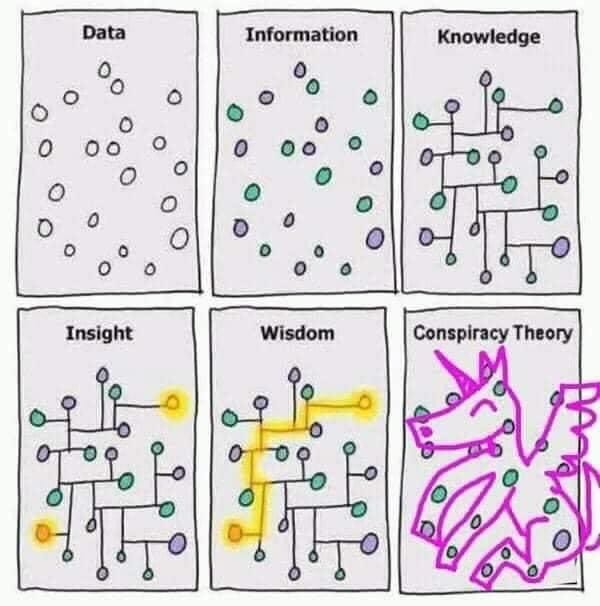
Lorenzo Warby on the “conspiracy error”
Note that this piece was published before the assassination of Charlie Kirk the next day, and it does not directly address issues stemming from that crime.
On Substack, Lorenzo Warby explains why conspiracy theories spring up so readily:
Analysis of events abhors an analytical vacuum. That is, if your mental architecture lacks certain key analytical tools or framing, then you will be driven to mischaracterise — potentially seriously mischaracterise — events.
Given the human propensity for identifying patterns, and awareness of human intentionality, what can very easily fill in an analytical gap is some form of conspiracy theory. A conspiracy theory alleges that there are centrally organised people operating in secrecy — usually in a malign way — controlling events.
A conspiracy theorist is someone who advances such an idea. The term can also be used as a term of abuse for anyone who inconveniently notices patterns — such as folk advancing claims and beliefs that suit people like themselves — or simply advances claims that people find inconvenient or awkward.
There are actual conspiracies. We know there are actual conspiracies, because they have been exposed.
The question is whether the claimed level of coordination and control over events, and the required level of continuing secrecy, is what is happening. The more restricted one’s analytical tools, the more conspiracy is likely to seem the default explanation for any coordinated pattern of behaviour.
Something that people do openly is not a conspiracy. Nor is conspiracy the only way for people to coordinate. It is perfectly possible to coordinate via mutual signalling, for instance. This is particularly true if people are engaged in shared status games. It is even more true if networks share common interests, common information sources and are playing shared status games.
Among us Homo sapiens, much of the point of status is to generate currencies of cooperation. We are a very status-driven species because we are very social beings, so prestige (conspicuous competence) and propriety (conspicuous conformity to norms) have been currencies of cooperation for our highly cooperative subsistence and reproduction strategies that developed across hundreds of thousands of years.
In thinking about the dramatic changes brought about by the Sexual Revolution of the 1960s, it became clear to me that there were always sexual outliers, there are always folk trying different life strategies. Due to the Pill and legally available abortion, which life strategies worked suddenly changed, so folk shifted to them and the norms that enabled them.
Thinking seriously about the mechanisms by which sexual mores changed leads to considering networks, signalling, life strategies. Once you grasp the power of these social mechanisms, you are in a much better situation to see how much conspiracy theories are a product of a lack of analytical breadth and depth. Conspiracy theories are a mechanism to “explain” events, one that occurs naturally to our pattern-seeking minds aware of human intentionality. They do so, however, in the absence of analytical alternatives, if we do not have better operational mechanisms to explain events — and especially observed social coordination — by.

September 12, 2025
Canada’s temporary foreign worker programs
At Acceptable Views, Alexander Brown calls for the end to the Canadian federal temporary immigration scam programs:
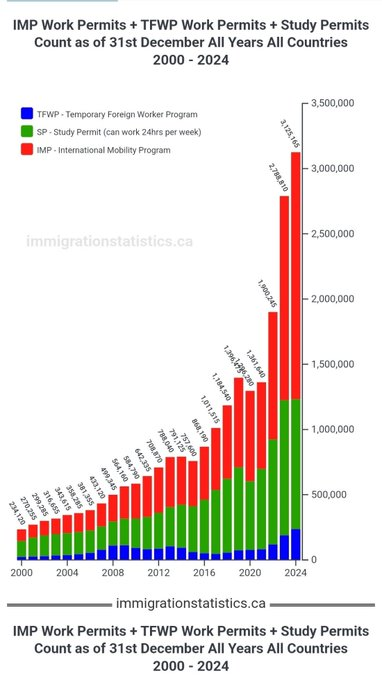
It’s not hyperbole to say that Canada has built an entire economy on exploiting cheap, foreign labour through TWFP, as well as the International Mobility Program (IMP). These are two slightly different programs that allow foreign nationals to work in Canada, with most going to Ontario. But contrary to its name, there is nothing “temporary” about the TFWP. Its original purpose was to remedy proven labour shortages while Canadians were hired and trained to eventually do the jobs in question. Meanwhile, the IMP allows international students to work—with or without a proven labour shortage—while they’re studying in Canada.
Between 2019 and 2023, the TFWP increased by 88 percent and the IMP increased 126 percent. They account for close to 1.58 million work permit holders, equal to roughly 7 percent of Canada’s labour force.
Taken together, the results of the TFWP and IMP are deplorable. The TFWP allows foreign nationals to be recruited abroad in vast numbers, brought to Canada, housed in degrading conditions, paid the minimum wage, forced to work long hours, pressured into not joining a union, and required to work for only one employer. Yes, the IMP is more flexible, but it’s more pernicious because it does not even pretend to address labour shortages.
Both schemes are also of course bad for Canadians themselves. The problem is especially grievous for young Canadians trying to get started in the labour market. Canada lost 40,800 jobs this past July, the unemployment rate is now 6.9 percent, and youth unemployment (those between 15 and 24 years old) is now 14.6 percent.
Both the TFWP and IMP are used as business models. Hiring foreign nationals at minimum wage keeps prices low and profits high—most notoriously in the hospitality and trucking sectors, but no industry seems untouched now.
Addicted to cheap foreign labour
The use of the TFWP in the healthcare sector, for example, has grown by an appalling 1,700 percent since 2000. That dramatic rise has no doubt been abetted by the absence of uniform standards and credential recognition among Canadian provinces. If medical personnel could move easily from one province to another, shortages could be filled by Canadians. But historically this has not been possible, and so medical institutions have had to turn to the TFWP. Ontario’s recent determination to solve this problem by speeding up recognition of 50 “in-demand” professions from other provinces is a step in the right direction, and hopefully not too little too late.
Meanwhile, the IMP is a vehicle for outright fraud, ranging from fake acceptance letters from bogus “colleges” to elaborate human-trafficking schemes. Not long ago, nearly 50,000 holders of foreign student visas were working and attempting to settle here, rather than studying at any Canadian university or college. Most were migrants from India, and some were trying to cross the border illegally into the United States. The RCMP is now working with Indian law-enforcement to investigate alleged links between dozens of “colleges” in Canada and two “entities” in India allegedly facilitating passage into the U.S. When we reflect that an astounding 4.9 million temporary visas are set to expire this year, we have reason to believe that this abuse, exploitation, and fraud are on a much larger scale that we understand.
The consequences for young Canadians
Both the TFWP and the IMP serve to keep wages artificially low and profits high, and to price Canadians out of the job market. It wouldn’t be wrong to view these programs as distortionary government subsidies or welfare for unproductive businesses. The effects disproportionately harm younger Canadians who are priced out of the labour market, given that temporary workers overwhelmingly earn less than the median wage. And yet, we’re constantly hectored about labour shortages, Canadians’ “unwillingness” to do certain jobs, and the need for foreign workers.
It shouldn’t take much intellectual effort to see that the use of foreign labour and the difficulties of employing younger Canadians are two sides of the same ugly coin. Foreign workers are more cooperative because they are bound to their employers like serfs. They face normally insurmountable barriers to joining unions and have no attachment to the community in which they’re expected to work. In comparison, the domestic population is generally better educated and rooted in the local community.
Young Canadians can afford to be discriminating and should rightly expect higher wages than foreign nationals. Employers should instead work harder to invest in and reward their domestic workforce. In any other era, this would have been obvious. But now there is little incentive for businesses to look beyond cheap, foreign labour.
To get an idea of the magnitude of our collective failure here, consider the following fact. A 2024 study by RBC Economics revealed that Canadian businesses are sitting on a stockpile of cash worth almost a third of our country’s GDP. In other words, Canadian companies have the means to invest in hiring and training Canadians, but simply refuse to do so. The results of this refusal are stagnant wages, structural unemployment, and a de-skilling of the domestic population.
A primer on patterns in past political assassinations
On the social media site formerly known as Twitter, ESR shares his observations on common patterns in political assassinations which may be relevant to the investigation of the assassination of Charlie Kirk:

The Salt Lake City FBI office released these photos of a “person of interest” in the Charlie Kirk assassination.
I don’t know anything other than public information about the assassination of Charlie Kirk.
However, a primer follows about patterns in past political assassinations. I will sketch what scenarios an intelligence analyst would come up with looking at this one.
The first and most important rule in this kind of investigation is: when you hear hoofbeats, think horses not zebras.
In political assassinations, as an ordinary murders, the correct suspect is usually the most obvious suspect. Airport-thriller-style convoluted plots and false-flag ops pulled off by unlikely people or organizations are rare in the real world.
Accordingly, when you’re trying to solve a political assassination, the right question to ask is “Who said they wanted him dead?”
Then, you infiltrate those organizations, or arrest a bunch of members, and do contact tracing. Usually you do in fact find your killer that way. It’s not very different from ordinary police work except for the stakes.
There are broadly speaking three different kinds of assassin: the nutter, the zealot, and the pro. They are not difficult to distinguish once you got your hands on them.
Nutters don’t have a coherent political ideology, though they may spout semi-random slogans that political actors can seize on to pretend that they do. They generally have quite an obvious history of mental illness
Before capture, given the kind of public evidence we have now in Charlie Kirk’s assassination, it’s difficult to tell the zealots from the pros by their MO. It used to be easier, but as I noted in a previous post sniper doctrine and technique have been leaking into popular culture for decades.
It’s easier to spot the nutters; they tend to have poor forward-planning capacity. A very obvious way this manifests is a weak or non-existent plan for exfiltrating after the hit. Thus, the nutter is very likely to get caught quite soon after the assassination, often at the site.
This also produces a false-prominence effect – people think political assassins are more likely to be nutters than is actually the case.
Pros – professional assassins working for intelligence agencies or militaries – are also rare. They do occasionally strike – as when, for example the Bulgarian secret service whacked Pope John Paul – but high-profile public assassinations carry a risk of diplomatic and political blowback the most nations are unwilling to assume.
Also, trained assassins are a scarce resource and exfiltrating in the hue and cry following a very public assassination is chancy. Usually you’re going to send them against more obscure targets like exiled dissidents that you think might still be dangerous, hoping not to trigger a full law-enforcement and counterintelligence response.
There’s been talk in some of the wackier corners of the Right that the Mossad did this one. No analyst would take this seriously; the blowback risk to the Israelis is far too high to justify any gain. Same goes for the Russians, though they have a higher risk tolerance than the Israelis and had a much higher tolerance in Soviet times.
In the case of Charlie Kirk it’s pretty high odds we’re looking at a zealot. That’s usually the way to bet, and in this case, the quality of his exfiltration plan and the fact that he has successfully disappeared raises the odds.
Given all these factors, LEOs are going to be looking for zealots associated with domestic organizations that said they wanted Charlie Kirk dead.
Yes, this seems boring and obvious. The main point I’m trying to drive home here is that the boring and obvious theory about a political assassination is usually the correct one.
Accordingly, the first place investigators of the assassination of Charlie Kirk are going to be looking is gun clubs associated with Antifa and the hard left, like the John Brown Gun Club and Redneck Revolt.
It’s not certain that Kirk’s assassin is a member of one of those groups, but if you had to place a bet that would be where to put it.
Update: while I was composing my analysis there was a leak from inside the ATF. They found a .30-06 with engravings expressing “anti-fascist” and transgender ideology.
As I said: When you hear hoofbeats, think horses not zebras. The obvious suspect is usually the correct one.
And later, on the particulars of this particular assassin’s work:
PSA for those speculating about the sniper who killed Charlie Kirk:
No, the shot he made was not a difficult one, and does not constitute evidence that he was a professionally-trained sniper.
His choice of hide and the quality of his exfiltration plan was impressive. That could indicate pro-level training. Or, it could just mean he played the right videogames.
Information about sniper practice has been leaking into popular culture for decades. It used to be that good practice could enable you to make deductions about the background of the sniper, but that time is past.
Nothing has yet been released about what ammunition or weapon he used. It is highly likely that the bullet has been recovered and identified.
About the most we’re likely to be able to extract from the caliber is whether the sniper used an American traditional caliber like .30-06, NATO-standard 7.62, or Russian 7.62. The latter two cases may not be distinguishable if the bullet is deformed.
Knowing this won’t really tell us anything, as rifles in all plausible calibers are generally available in the United States. Furthermore, if this were a pro-level hit, misdirecting investigators by choosing an adversary or third party weapon is part of normal covert operations doctrine.
All in all, it is not possible to deduce anything of significance about the sniper from the publicly available information. Mistrust anyone who claims otherwise.
QotD: Modern riot-control gear
I’ve hinted already at my severe disenchantment with the riot control manual. Most of the following will tend to indicate some of why. Note that this is pretty military specific, but you all ought to know what’s happening, what should happen, and what isn’t happening with regards to riot control.
Head: Protection of the head involves also protection of the face, neck, and, especially, the eyes. The standard military issue Kevlar helmet is adequate for protecting the head from blunt force trauma and even some bullets . It does nothing for the face. There are shields that attach to the helmets to protect the face and which usually reach down enough for neck guard. However, after a cursory search or three for what’s on offer now, as with the old style ones I discussed previously, they can be blurred and ruined with solvents. Yes, this would seem to include polycarbonate as well; that’s how pieces of Lexan are glued together, actually. It’s a problem. Neither can I find a face shield that is glass over Lexan, though they may exist.
Moreover, while there are masks – nicely intimidating motorcycle rider masks, for example – that are black and which could have relatively cheap replaceable clear eyepieces made, they are close fitting, hence would interfere with donning the protective mask when it comes time to use RCA or when smoke from burning buildings gets to be a bit much. The only solution I can see is twofold: 1) Have a ready supply of extra face shields on hand, and 2) make the immediate penalty for attacking a mask with solvents a reasonably severe beating with some kicks and stomping.
Special Tip #1: If you’re using your issued helmets, troops and commanders, turn the camouflage band around so the rioters can’t see your name. This is for two reasons. One is to prevent personal retaliation against your men or their families. The other is to send a message the rioters will understand very clearly because they’re using anonymity for the same purpose, to stay out of court. In other words, the message you send is, “Get close enough to this soldier or policeman for him to hurt you and he will, all the more readily because you can’t identify him for civil suit or criminal complaint.
Chest: The current issue torso armor seems adequate for most threats it will encounter in riot control, but, at thirty-three pounds, strikes me as awfully heavy for an activity that is already about as physically intense as a battlefield, if not even more so. With an E-SAPI plate in front, that runs nearly to forty pounds, which is simply too damned much. There is room for some minor weight savings, as will be shown below, under “Protective Mask.”
There are lighter and quite likely better armor suites coming along or already on hand for the special operations folks, but if they are not available for a unit tasked for riot control, I’ll have to say, “Suck it up; wear the vests you have; keep about ten percent of your force in reserve, unarmored but ready and drilled to suit up in a hurry, to relieve people who become exhausted from the weight and heat retention.
Special Tip #2: You want the armor not only to protect your men, but also to protect them enough to keep them from losing their tempers and running wild. When they hurt somebody, it needs to be because the commander wants that somebody hurt, that the mission is advanced by that somebody being hurt, and not because of a breakdown in discipline.
Armament: For a number of reasons, I recommend against using bayoneted rifles. The downsides are numerous, so I’ll limit myself to a few. 1) They require both hands; this means that the riot controller cannot use a shield. 2) The act of fixing bayonets, all on its own, constitutes deadly force. Yeah, just fixing them. So you won’t be allowed to do it. 3) That means you end up with this bullshit:
https://en.wikipedia.org/wiki/Flower_Power_(photograph)
Instead, use batons. However, for that I have no less than two tips.
Special Tip #3: Grease the last eighteen inches or so of the batons with something non-water soluble, like Vaseline. No, this is not as an aid to anally raping the rioters with the batons, however tempting that may come to seem. Rather, it is to keep the rioters from snatching your batons away, which snatching encourages them to no end. If you don’t have petroleum jelly handy, thicker rifle lubricant, like LSA, can work, but spread it very thinly, so it doesn’t run.
Special Tip #4: Drive finishing nails into the ends of your batons and snip them off to leave about an inch sticking out. No need to sharpen the part sticking out; it’s sharp enough to penetrate and leave a painful puncture wound, whether directed at arms or torsos or thighs or groins (ouch!).
Shields: There are any number of makers of perfectly serviceable riot control shields, some of which are, although frightfully heavy, bullet proof. If you need bullet proof shields, I would suggest that you’re way past the point of suppressing a riot and already involved in a civil war. In that case, shoot back accordingly.
Assuming for discussion’s sake, however, that we aren’t quite at that point yet, the shields are extremely useful. They deflect rocks and bags of shit. They can cause a Molotov to go off somewhere other than on the riot controller or at his feet. They are, themselves, offensive weapons. As Suetonius said, just before kicking Boudicca’s Britannic ass: “Knock them down with your shields, then finish them off with your swords”.
The world being as it is, however, full of iniquity and injustice, when Battalion X of the YYth division gets alerted for riot control, the shields will probably not be available. A careful search by J4 will show that “They are either in Iraq or were left behind on Johnson Island, lest Greenpeace show up some day. Or maybe they were turned into a reef for some endangered fish. Who knows?” Hence, make your own. The example below was made by one of the handier troops of B-3/5 Infantry, Panama Canal Zone, in 1983. It’s just half inch plywood, 19 by 24 inches, though they can be cut larger to fit the larger troops, with arm straps cut from condemned nylon webbing and bolted on. The almost horizontal piece is one shoulder strap from the harness of nylon load bearing equipment, stapled on and serving as a shock pad for the arm. Yes, if you actually have to make something like these do not forget the shock pad. I’d recommend not painting them with unit insignia. We were, at the time, on testosterone overload and wanted people to know who was kicking their butts.
Note, a larger shield doesn’t necessarily protect more, it just moves more slowly to protect what needs protection. These shields are very light and, given the geometry of the matter, able to be moved very quickly indeed to protect any exposed part of the body, to include the thighs and crotch. Speaking of the …
Crotch: Move your/have the troops move their protective mask and carrier from the left hip to right in front of the family jewels. It won’t slow down donning the mask appreciably and it will save a little weight while providing adequate crotch coverage.
Tom Kratman, Twitter, 2025-06-09.
September 11, 2025
Charlie Kirk, RIP
I don’t follow US conservative figures, so while I’d heard of Charlie Kirk, I didn’t know much about him or what differentiated him from other right wing figures. He was assassinated on Wednesday while speaking to an audience at Utah Valley University:
An assassin’s bullet struck down Charlie Kirk, the prominent conservative commentator and founder of Turning Point USA, while he was speaking at an event at Utah Valley University on Wednesday. He was 31.
Graphic video footage of the killing, which occurred as Kirk addressed a large outdoor crowd of students and supporters, showed him being shot in the neck. He was rushed to the hospital but did not recover.
The shocking tragedy has prompted an outpouring of lamentations from Kirk’s many friends in conservative media and Republican politics. Announcing his death on Truth Social, President Donald Trump wrote that Kirk was “Great, and even Legendary”.
“No one understood or had the Heart of the Youth in the United States of America better than Charlie,” wrote Trump.
Kirk was influential among young people. He launched Turning Point USA in 2012, with financial backing from Tea Party activist Bill Montgomery. The organization’s stated goal was to foster a conservative movement on college campuses, following in the footsteps of past groups such as Young Americans for Freedom. He was adept at creating catchy slogans and useful talking points for conservative students to deploy against leftwing thinkers; he popularized the phrase “Socialism Sucks” and added it to t-shirts, posters, and banners. He took advantage of dramatically increased interest in crazy campus happenings among the broader American public, and he encouraged dissenting kids to challenge their liberal professors, form right-leaning organizations, and invite Republican speakers to campus. Under Kirk’s leadership, the group became the undisputed king of conservative campus activism, helping turn thousands of non-liberal students into fans of the Republican Party and its rising stars: Candace Owen, Tucker Carlson, Ben Shapiro, Matt Walsh, and of course Trump.
Chris Bray posted some brief thoughts on the assassination as a way marker on the path to modern day nihilism:

Ryan Gerritsen on X – “People have yet to realize how the media affects the minds of so many. Just look at these headlines on Charlie Kirk. This affects people. It’s targeted & purposeful.”
First, the murder of Charlie Kirk is just the next level up the behavioral chain from the way Robert F. Kennedy was just treated in front of a Senate committee. He wasn’t mistaken, or wrong: He was an unforgivable monster, wholly illegitimate in every imaginable sense, who had no views or arguments that were worth considering in any way, and the only possible response to him is personal destruction. Our institutional left is a rage mob with formal titles. We’re not having a debate.
Second, the transition to radical violence is a reflection of the events that followed the death of the radical dream of the 1960s New Left. After the hippies, the Weatherman and the Symbionese Liberation Army. The turn to radical violence is the turn that follows obvious failure. It’s an acknowledgement of political impotence, and a last-ditch emergency reflex: If they won’t submit to our political vision, we’ll coerce them into submission. It’s the death rattle. It means the arguing and convincing has failed, and they see the failure.
Third, Camille Paglia persistently describes late-cultural-stage sexual disorder, especially widespread transgenderism, as a turn to sadomasochism, and I didn’t get that description for a long time. I’m seeing it now. It comes from an impotent rage over the limits of personal will, a Veruca Salt disgust that the world doesn’t do what I want, and a desire to hurt the body that’s trapped by a nature that won’t yield to ideology. I’m going to dive back into Sexual Personae today. Notice how much left-oriented political identities are currently invested in causing literal, physical injury, and in celebrating moments in which political opponents suffer actual pain. Go look for leftists celebrating Charlie Kirk’s death on social media, if you want to wade into that sewer. “Progressive” politics is becoming a torture fetish.
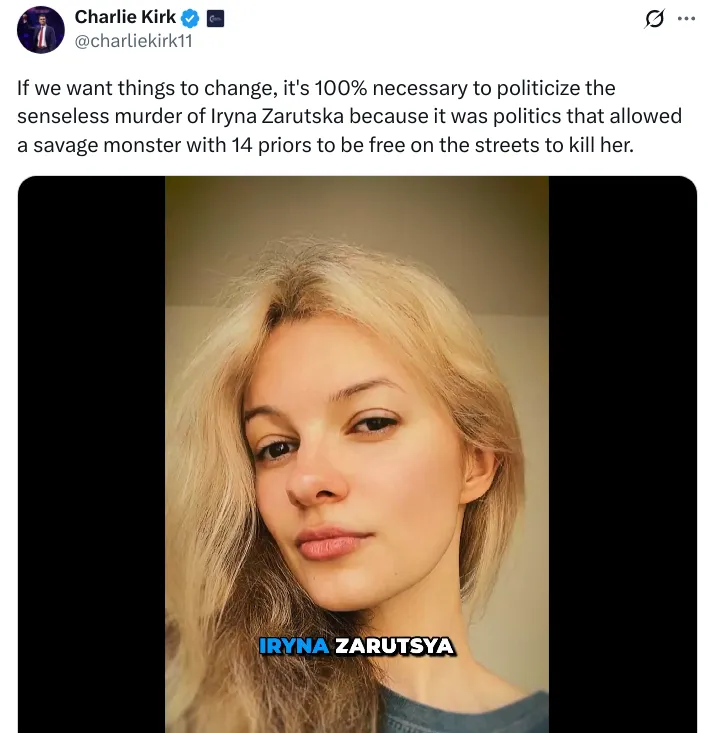
John Carter explains why we all need to watch the video to understand what happened. The post was originally about the murder of Iryna Zarutska on the light rail system in Charlotte, North Carolina. Before he published it, he heard about the shooting of Charlie Kirk:
Just as I got to this point in the article, I received word that Charlie Kirk was shot in the throat with a high-power rifle.
Once again, this is a difficult video to watch. Once again, I think you should watch it. Do not turn away from this. In case you’re hesitant, here is the last tweet Charlie Kirk will ever write.
[…]
Initial reports were that the assassin was some hapless boomer, but the police seem to have arrested the wrong person; FBI director Kash Patel has recently announced that the actual perpetrator has been apprehended, although as of the time of this writing the shooter’s identity hasn’t been released. Kirk was brought to hospital, and there were reports that he’d been stabilized and was receiving blood accompanied by prayers for his recovery. Soon after that we received confirmation of his death.
[…]
Reports are that his children were present for his assassination.
If Iryna’s death was the murder of peace, Charlie Kirk’s was the death of debate. Dialogue was shot in the throat, the very organ that produces speech. That probably wasn’t intentional: it’s likely the shooter was aiming for the head. Regardless, the symbolism is profound. Kirk was no bigoted firebrand, for all that the left cast him in the role of a fascist racist Nazi rabble-rouser. If anything, those on the right considered his politics to be rather milquetoast, though it’s certainly true he became more based in recent years. His modus operandi was to go to college campuses and enter into calm, reasonable, good-faith debate with the students there, because he believed profoundly that when we stop talking to one another, we begin to see one another as evil, and violence follows. Kirk was no stranger to violence himself: he’d received numerous death threats, he’d been driven off campus and out of restaurants by Antifa, he’d been assaulted. He knew full well the risks that he took by making himself such a high-profile public figure, and he took those risks anyhow, in full knowledge that he risked life and limb. Those are the actions of a man possessed of great physical courage.
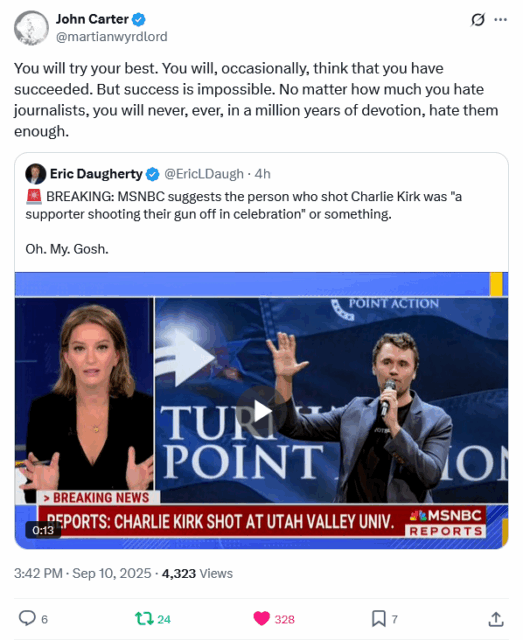
No sooner did news of Kirk’s shooting hit the Internet, than the lying media was spreading doubt about the incident and heaping scorn upon the victim. Perhaps the shooter had been a supporter, one talking head suggested, and had been firing his rifle in celebration … it was all a big accident, and that’s just what you get for supporting the Second Amendment. Other journalist scum were at pains to emphasize that Kirk was divisive, polarizing, controversial … implying that if he’d just been a good boy and said what all the other good boys are supposed to say, he would have been safe. Getting shot in the throat is just what you get for speaking out of turn, so shut your mouth, bigot.
Leftists on social media were far less circumspect than their counterparts on the major networks. Almost without exception – by which I mean that I have seen no exceptions, though of course I have seen only the screenshots that people have shared, and cannot rule out that there are a few, for all that I doubt it – they are exulting in Kirk’s death. There is no surprise to this. The left is vicious, and to take pleasure in the death of an enemy may be the only healthy instinct they have left. I’m not even angry at them for that. I expect nothing else from them. Nevertheless, the gloating pleasure the left takes in Kirk’s death only serves to underline that dialogue is dead.
Thanks in part to Kirk’s tireless efforts, the left has been steadily losing the war of ideas, and with it their hold on the mass mind. They no longer have the ability to define the boundaries of the Overton window, because every single one of their claims has been shown to be baseless, deceptive, and destructive of both individual lives and society itself. Since the advent of mass media the left has had the ability to delineate the acceptable boundaries of discourse; since the rise of social media, and the advent of the meme war, this power has slipped through their fingers. Truth has leaked into peoples’ brains, and the people have realized that they have been lied to shamelessly on an almost incomprehensible scale about almost everything that matters. The people have seen the left for what it is, a malign force that delights in their humiliation, that glories in their annihilation, an influence whose special talent is to take the best impulses of people and twist them into something self-destructive and foul. And so, the people have turned from the left, and coalesced into into an opposition that has become determined to put an end to the left’s tyrannical parasitism. Not all the people, to be sure. But a lot of them.
September 8, 2025
“Down with this sort of thing!”
In the free-to-cheapskates part of Ed West’s post on the Graham Linehan case in Britain, he identifies one of the reasons that Linehan’s Father Ted became so popular in the country it was situated in:

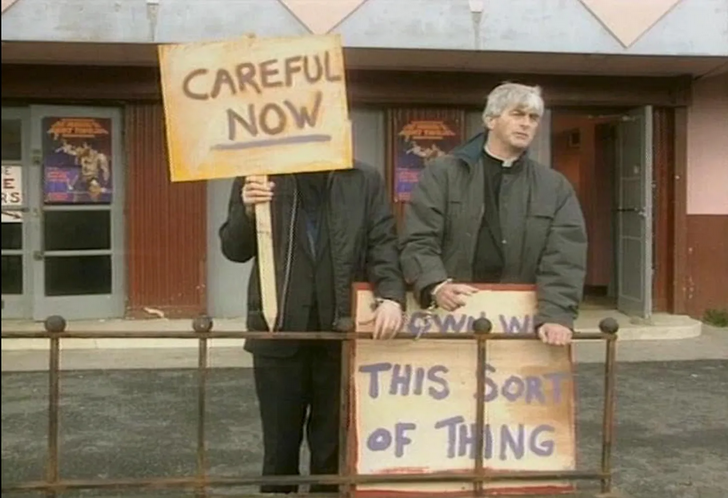
I don’t think I’d seen a “down with this sort of thing” placard in the flesh since I watched the Protest the Pope march back in September 2010. Those were the heady days of New Atheism, before the movement evolved into something more explicitly progressive.
The sign references an episode of the 1990s comedy Father Ted, in which the protagonist and his dim-witted sidekick Fr Dougal are forced to protest the screening of a blasphemous new film called The Passion of Saint Tibulus. Among the many catchphrases popularised by the comedy, back in 2010 this one suggested an ironic and gently mocking attitude to religion; that it was ridiculous, rather than evil.
This week, outside Westminster Magistrates’ Court in Marylebone Road, the sign appeared in a rather different context, carried by supporters of Father Ted co-creator Graham Linehan as he faced charges of harassment and criminal damage in an ongoing trial, following an incident at last year’s Battle of Ideas involving a young transgender activist.
Linehan had been bailed before trial, allowing him to travel to the United States to work on a new comedy project. When he arrived back at Heathrow on Monday, however, he was arrested by five armed police officers over three tweets he had posted back in April. The situation was as absurd and surreal as anything that had emerged from the writer’s fertile imagination.
As Linehan described it on his substack: “When I first saw the cops, I actually laughed. I couldn’t help myself. ‘Don’t tell me! You’ve been sent by trans activists’. The officers gave no reaction and this was the theme throughout most of the day. Among the rank-and-file, there was a sort of polite bafflement. Entirely professional and even kind, but most had absolutely no idea what any of this was about.”
The incident is embarrassing to Britain as it faces increasing scrutiny in the US for its poor record on free speech, especially over the Lucy Connolly case. It was unfortunate timing that this arrest happened just as Nigel Farage was heading in the other direction to talk about this very issue in Washington. But Linehan’s ordeal is also part of a much longer and sadder story about the perils of the political meeting the personal.
Arthur Mathews and Graham Linehan had worked on The Fast Show before renowned comedy producer Geoffrey Perkins had taken to one of their ideas, about a group of priests stuck on a remote Irish island, proposing that it be written as a six-part sitcom. It was brilliant, and hugely loved, and in its timing was significant.
Conor Fitzgerald wrote of Father Ted that, while well-loved in Britain, in Ireland it is more like “the national sitcom, a piece of light entertainment that nevertheless Says Something Meaningful About Us”. It also appeared at a crucial time in history.
Not only was Father Ted one of the few successful TV representations of Ireland, it was made during Ireland’s version of the Swinging Sixties, our flux decade of the Nineties. The accelerating collapse of the Church and the exposure of longstanding political corruption coincided with the dawn of the Celtic Tiger years, lending peripheral Ireland a sense of self-conscious modernity. It was a unique national turning point, where our 19th-century past seemed to co-exist with our 21st-century future. In reflecting this upheaval, Father Ted has become not just a social historical document, but a portent of where Ireland stands today.
When Ted was broadcast, the Church was formally still one of the central pillars of Irish life, but its authority rang hollow. Priests often felt like administrators of a vanished country. And on remote Craggy, Ted, Dougal and Jack mirror this directly. All good sitcoms feature characters who are trapped, but Ted is doubly so: first on his island; and second in an institution people are coming to see as irrelevant. He is still an essential member of the community, more than just a ceremonial functionary for weddings and funerals. But it’s just not clear what the essential thing he does is anymore, beyond being a common reference point that deserves token respect.
Ted and Ted therefore stand at a crossroads, and capture the more fundamental social change in Ireland at this time: the collapse in respect for older establishment hierarchies generally.
Those establishment hierarchies collapsed across the West in the late 20th century, first in more secularised nations such as Britain and France and later, and more quickly, in places like Ireland and Spain where the Catholic Church still held on.
The Church lost its power to patrol its taboos, without which it became a sitting duck for satirists; the Passion of St Tibulus was influenced by the protest against Life of Brian, successfully banned in Ireland until 1987. As a teenager, Linehan had to join a film club to watch it, but such censorship was disappearing everywhere.
Father Ted was a work of genius, employing a surreal style of humour that has often been characteristic of Linehan and Mathews, and later seen in their under-appreciated sketch show Big Train – including the brilliantly bizarre sketch in which Beatles producer George Martin is kidnapped by Hezbollah.
The clerical comedy bequeathed numerous catchphrases. “I hear you’re a racist now, Father”, which features in an episode where Fr Ted is wrongly accused of anti-Chinese prejudice, is still a popular meme. Likewise, “These are small, but the ones out there are far away“, Ted’s explanation of perspective to his idiotic housemate, is still used to mock the gormless.
The show was also charming, and its treatment of religion was far from vicious. Rather than being a vitriolic attack on Church authority, Father Ted poked gentle fun at the absurdity of the old order, a kind of mockery which is perhaps a more dangerous threat to a belief system that relies on awe and fear. It was innocent, and many years later Linehan said he would find writing Father Ted much harder in light of the abuse scandal.
September 7, 2025
Long before the “Bad Orange Man”, there was “T.R.”
In the Coolidge Review, Amity Shlaes points out some strong similarities between Donald Trump’s career and that of the Bull Moose himself, Theodore Roosevelt:
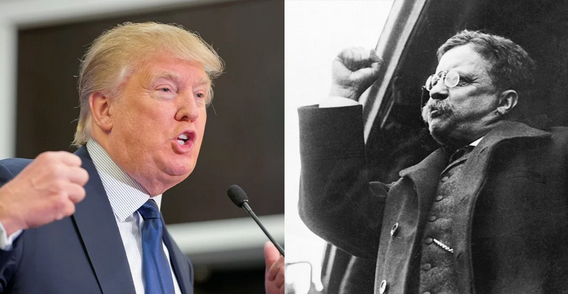
Though a century apart—TR served from 1901 to 1909 — these two chief executives have favored the same modus operandi: using unpredictability to amass power. And the record of Theodore Rex, as Edmund Morris titled his TR biography, bodes ill for both the economy and the Republican Party.
The Trump-TR Parallels
But to the similarities. They start, for both men, pre–White House. As Trump did, TR staged his pre-presidential efforts as much with an eye to public recognition as to sustained reform or strengthening institutions.
Whenever TR stumbled, he pivoted to a new venture and publicized it like mad, though the medium in those days was the printed word, not season after season on The Apprentice. Before the cognoscenti had even absorbed the meaning of the young Roosevelt’s humiliating fourth-place score in a key 1886 New York City mayoral contest, for example, TR was off to the Badlands, memorializing his ranching experiences in dispatches and books such as Ranch Life and the Hunting Trail.
As Trump does, TR routinely alienated GOP grandees, circumventing them to get ahead. As Trump has, TR skillfully cultivated the media — so skillfully that members of Congress were left trying catch up with whatever shifts in public opinion resulted from the politician’s press alliances. TR’s Rupert Murdoch was the widely syndicated William Allen White of Kansas’s influential Emporia Gazette. TR’s equivalent of Fox News was the New York Journal, whose owner, William Randolph Hearst, drummed a steady beat of support when Roosevelt called for war against Spain.
Today, Murdoch must be scratching his head over what his showcasing Trump has wrought, especially now that Trump decided to sue both Murdoch and his Wall Street Journal. White, too, found that he had second thoughts about his decision to back TR: “Roosevelt bit me and I went mad,” White reportedly told a colleague.
[…]
BULLY
The occupant of what he labeled the Bully Pulpit — “bully” as in “excellent” — proved a literal bully as well.
As president, TR perpetually unnerved fellow Republicans, pivoting back to domestic politics. As Trump has, TR cast his campaigns in moral terms rather than economic ones. Where Trump launched his tariff war, TR made war against trusts, large combinations of companies. Relying more on whim than statute, Roosevelt segregated trusts into “good trusts” and “bad trusts”.
TR targeted an invincible-looking industry that, in those days, mattered as much as the interstate highways, or the internet, do today: railroads. James Hill’s Great Northern Railway took over a struggling competitor, Northern Pacific. Roosevelt asked Hanna what he made of the combined entity, Great Northern Securities. Hanna replied that it was “the very best thing possible for the future of the whole Northwest territory”. Roosevelt nonetheless sicced the Justice Department on the Great Northern.
J. Pierpont Morgan, a participant in the beleaguered deal, called on the president to inquire, as desperate steel importers these days do from time to time, whether their attorneys might work out the matter behind the scenes.
No.
Next, the disconcerted Morgan asked whether other investments of the House of Morgan might be assailed. Roosevelt’s reply captures the chill of arbitrary leadership. The administration would not go after the other Morgan companies, he said — unless “they have done something we regard as wrong”.
As Edmund Morris reports in Theodore Rex, to observers such as French ambassador Jules Jusserand, Roosevelt seemed “more powerful than a king”. That power suited many voters fine, which is why Roosevelt won so headily when he ran for office on his own in 1904.
Of course TR, like Trump, occasionally supported laws that aligned with his impulses. One example is the Elkins Act of 1903, which made it illegal for railroads to charge different freight rates for different customers. This shallow effort to achieve market “fairness” deprived the railroads of a standard business tool: the ability to provides discounts to those who buy the product in larger quantities. Shares in railroads promptly dropped more than 20 percent, a shift that undermined TR’s premise of railroad invincibility.
September 6, 2025
The federal government’s foreign worker program is set up for abuse
Dan Knight discusses Canada’s deliberately two-track job system, which severely disadvantages unemployed Canadians and favours temporary foreign workers instead:
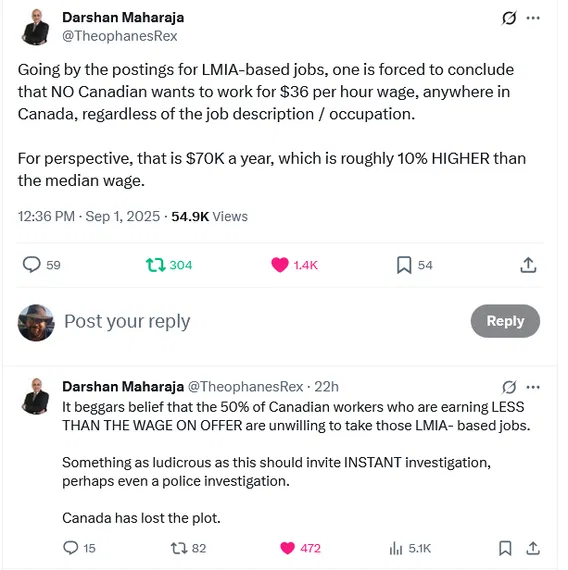
Canada now has a two-track employment system. On one track, you’ve got over 1.6 million Canadians unemployed the official rate just jumped to 7.1%, the worst since 2016 outside the COVID crash. Youth joblessness? 14.5%. Alberta, supposedly an economic engine, bleeding at 8.4% unemployment. And those folks are drawing EI, funded by your tax dollars.
On the other track? The Temporary Foreign Worker pipeline. In 2024 alone, Ottawa issued over 162,000 TFW permits by October. And they’ve already budgeted another 82,000 entries in 2025. Think about that: while Canadians are struggling to find work, Ottawa is busy handing out golden tickets to foreign workers.
And let’s be honest about how this program actually works. It’s sold as a way to “fill labor shortages”. In practice, it often looks like a backdoor family reunification scheme. Business owner Abdul suddenly needs a “specialized” worker conveniently, his cousin in India just happens to fit the bill. So instead of waiting in line under the normal visa system, he comes in the side door through the TFW program. Legal? Sure. Exploitative? Absolutely. It undercuts the immigration rules that everyone else has to follow, and it keeps wages low for Canadians who should be first in line.
Here’s the part that makes you wonder if Ottawa is even trying: we’ve got two federal departments, Employment and Social Development Canada (who runs EI) and Immigration, Refugees and Citizenship Canada (who runs TFW permits). Wouldn’t a functioning government have these two agencies talk to each other? One department says, “Hey, we’ve got 1.6 million people sitting on EI“. The other says, “We’ve got 162,000 employers asking for TFWs“. The obvious solution? Connect the dots. Fill Canadian jobs with Canadian workers first.
But that would require coordination and “coordination” is a foreign concept in Ottawa. These are the same geniuses who can’t keep escalators running in Parliament Hill without a three-year feasibility study. You expect them to line up two departments, EI and Immigration … and have a five-minute conversation? Forget it. Imagine the radical idea: one arm of government saying, “Hey, we’ve got 1.6 million Canadians unemployed and drawing EI …” and the other saying, “Oh great, we’ve got 162,000 employers begging for workers. Maybe, just maybe, we could match those two groups up“. That’s not rocket science. That’s not even science. That’s called basic competence. And Ottawa can’t even spell it.
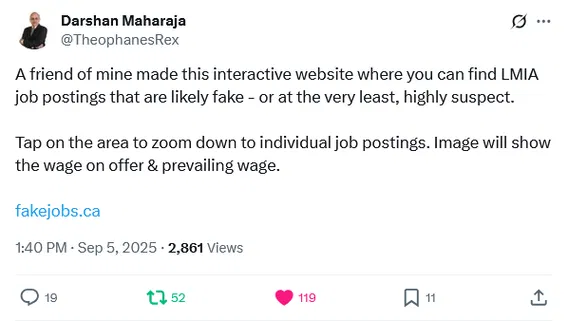
Using the fakejobs.ca website, I found three LMIA postings in my small town on the edge of the GTA … all paying well over median for pretty ordinary retail management jobs.
September 4, 2025
They can’t catch actual criminals, but they are quite capable of arresting social media users
Andrew Doyle hopes that the farcical performance by British police in sending five armed officers to arrest Graham Linehan as he stepped off the plane will be a tipping point:
How many more controversies will it take? The arrest of comedy writer Graham Linehan by five armed police officers as he landed at Heathrow Airport has become an international news story because it so self-evidently tyrannical. The stress of the ordeal raised his blood pressure to an alarming degree and he was rushed to hospital. With the help of the Free Speech Union, Graham is now suing the Metropolitan Police. You can donate to his crowdfunder here.
It is reassuring to see that some action is being taken against such chilling state overreach, but when will our politicians follow suit? Many of us have been warning about this ongoing assault on liberty for many years, and at every watershed moment we’ve been led to believe that something will be done. Then, inevitably, the “blob” is activated and swallows up any potential for progress in its viscous and undulating folds.
So when Sir Mark Rowley, head of the Metropolitan Police, complains that the police are acting on unclear laws, and that the responsibility for the maltreatment of the likes of Graham lies with those in power, he’s overlooking the impact of the activist middlemen. Let’s not forget that the Home Office has twice instructed the College of Policing to stop the recording of “non-crime hate incidents” (NCHIs) and has been ignored. Or that the chairman of the College of Policing, Lord Herbert, said the solution to the complaints about NCHIs might be to rename them. As though the public’s concerns about this brazen authoritarianism might be assuaged with a touch of rebranding.
Rowley’s buck-passing is likewise inadequate. He claimed that Graham’s arrest was necessary because officers “had reasonable grounds to believe an offence had been committed”, which is palpably untrue. He said: “I don’t believe we should be policing toxic culture wars debates and officers are currently in an impossible position”. He also made clear that police would continue to behave in this way “unless the law and guidance is changed or clarified”.
But this is precisely the problem. At present, a quango called the College of Policing trains officers in England and Wales. In my article for UnHerd about Graham’s arrest (which you can read here) I make the case that the College of Policing has become woefully unfit for purpose due to activist capture. For a long time, agitators within the system have reinterpreted and fudged the actual law in favour of what they would like it to be. This has led to some police acting in potentially criminal ways. Most egregiously, there is clear evidence of systemic bias against gender-critical individuals within the police force, and a reluctance to apply identical standards to trans activists who routinely post threats of death and rape and are rarely investigated for it.
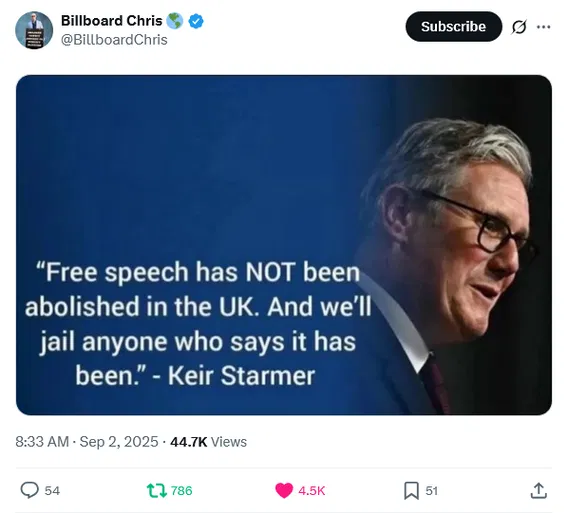
In the wake of the Linehan arrest, Tom Knighton wonders why the US isn’t treating the UK as it would any other tyranny where free speech and other civil liberties are denied to the people on a whim or a suspicion:
The United States has a history of dealing with tyrannical governments, who oppose tyrannical governments we like even less. We worked with Saddam Hussein, for example, because he was at war with Iran.
But we never stopped pretending these weren’t tyrants.
So, it’s time we start treating the UK just the same.
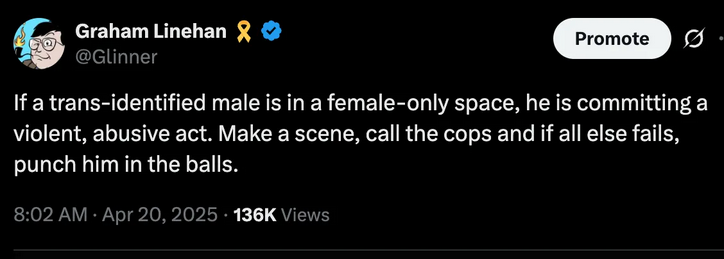
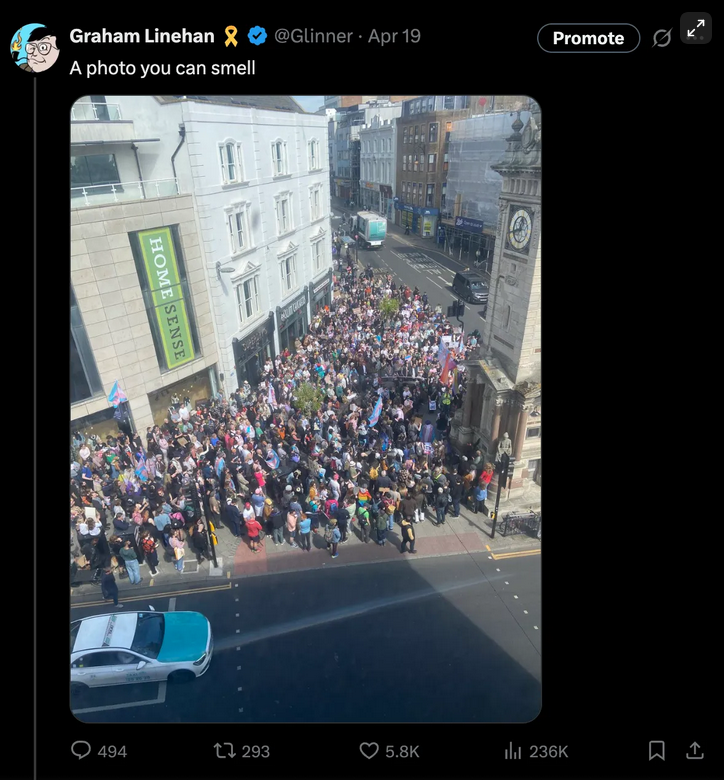
The latest incident was a well-known comedian from the UK being arrested over a couple of jokes.
Something odd happened before I even boarded the flight in Arizona. When I handed over my passport at the gate, the official told me I didn’t have a seat and had to be re-ticketed. At the time, I thought it was just the sort of innocent snafu that makes air travel such a joy. But in hindsight, it was clear I’d been flagged. Someone, somewhere, probably wearing unconvincing make-up and his sister/wife’s/mum’s underwear, had made a phone call.
The moment I stepped off the plane at Heathrow, five armed police officers were waiting. Not one, not two—five. They escorted me to a private area and told me I was under arrest for three tweets. In a country where paedophiles escape sentencing, where knife crime is out of control, where women are assaulted and harassed every time they gather to speak, the state had mobilised five armed officers to arrest a comedy writer for this tweet (and no, I promise you, I am not making this up.
… and then, a follow up to that one.
When I first saw the cops, I actually laughed. I couldn’t help myself. “Don’t tell me! You’ve been sent by trans activists” The officers gave no reaction and this was the theme throughout most of the day. Among the rank-and-file, there was a sort of polite bafflement. Entirely professional and even kind, but most had absolutely no idea what any of this was about.
While the officers were kind, they still arrested him. They arrested him because he made some jokes. He spent time in a jail cell, was interviewed by detectives, and was treated like a criminal because he made some jokes.
They waited for him at the airport with five officers, something that would be a clear indication to others that he was truly dangerous, over some jokes.
The first one wasn’t a great joke, really, but that wasn’t the issue. This wasn’t that it wasn’t as funny as it should have been, but that it was made at all.

September 3, 2025
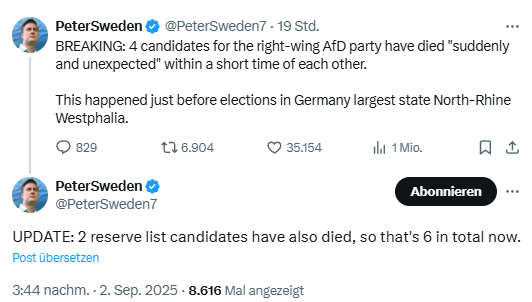
“Once is happenstance. Twice is co-incidence” … but SIX?
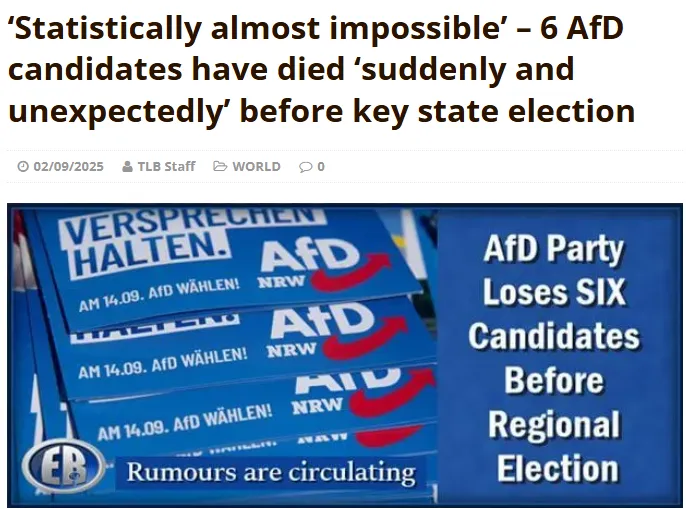
I depend on eugyppius to keep me up to date on German affairs, and despite the eyebrow-raising total of six AfD candidates dying unexpectedly, he doesn’t think it’s actually “enemy action” as Ian Fleming once wrote in Goldfinger, but it is statistically boggling:
I had plans to write about something else today, and I even have a half-finished post, but the story of the mysteriously dying AfD candidates is everywhere …
… and I feel compelled to address it.
The West German state of Nordrhein-Westfalen (NRW) is slated to hold municipal elections in just under two weeks, on 14 September. Eighteen million Germans scattered across thirty-one districts and 393 municipalities will elect councillors, board members, mayors and district administrators.
It’s important to understand the scale of these elections and the enormous numbers involved: Tens of thousands are presently running for office in NRW. The exact number isn’t certain, but it may be as great as 90,000. Most of these candidates are totally ordinary people. They are not professional politicians and they are not widely known outside their communities.
Four days ago, the German press began reporting on bureaucratic chaos stirred up by a series of unexpected deaths in late stages of the NRW campaign. Each of these deaths happened so late in the game that ballots had to be reprinted and the postal vote repeated. The German economist and social media personality Stefan Homburg picked up the story and called the deaths “statistically almost impossible“. AfD co-chair Alice Weidel retweeted Homburg’s suspicions, ultimately attracting the attention of Elon Musk.
Despite the widespread interest in this story, I really think it’s a nothingburger. We may be looking at an unusual cluster of AfD deaths in the upcoming elections, but we don’t know enough to say for sure how improbable this cluster is. All we can really say is that the deaths themselves are not unexplained and that their coincidence doesn’t look that improbable on its face.
August 31, 2025
Andrew Doyle’s The End of Woke
In The Critic, Titania McGrath reviews The End of Woke, and nobody should be surprised that it isn’t a rave review, although there is some raving:
Renowned grifter Andrew Doyle has written another “book” called The End of Woke. It’s the most repugnant piece of tripe ever to reach the printing press. It’s ignorant, ill-formed and offensive in the extreme. I have absolutely no intention of reading it.
Not content with his previous fascist manual Free Speech and Why It Matters, Doyle in his new book challenges ideological dogma on both the left and the right. It is laughable that he believes that anyone would be interested in such an approach. Imagine being so insecure in your belief-system that you would be open to persuasion and debate.
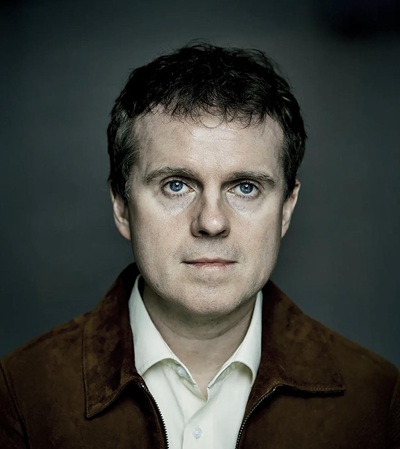
Doyle is a reactionary monster with a sub-zero IQ, one who is so unenlightened that he does not seem to realise that “liberal values” and “free speech” are Nazi dog-whistles. Having skim-read the blurb of The End of Woke, I’ve gleaned that Doyle supports outmoded and frankly immature notions such as “tolerance” and “liberty”. And he has a head like a cube (see above).
It was to be expected that bigots would approve of this book. The “comedian” Jimmy Carr called it “thought-provoking and entertaining”. The white male author Michael Shermer said it was “a magisterial read”. And that evil cisgender demon Julie Bindel wrote in The Critic that it was “the best work yet by the creator of genius parody Titania McGrath”.
Didn’t we once have “conflict of interest” rules for politicians?
It’s become a commonplace that politicians leave office vastly wealthier than they went in, far in excess of their official salaries. Once upon a time, even though it probably still happened, the fat cats managed to stay below the event horizon with their ill-gotten gains. Today, they no longer care if you find out that this or that senator has consistently beaten the market on their investments during their entire time in office. After all, what are you going to do about it, punks? Maybe something like this:

Paul and Nancy Pelosi, 16 February, 2022.
Detail of a photo by Amos Ben Gershom via Wikimedia Commons.
The original research was on how Senators seem to make 12% annually. That’s, erm, a lot.
Markets — something that always comes as a surprise to politicians — react:
American lawmakers are so consistently successful that a flurry of new platforms and apps now compile filing data from US politicians as a key input in strategies for retail investors and even hedge funds.
The number of people using these so-called “copy trading” strategies has exploded. Tens of thousands of Americans now follow and imitate trades made by members of Congress, and they are making millions of dollars in the process.
OK, what fun, eh?
Even more fun would be Megan McArdle’s suggestion, that the CongressThieves must announce that they intend to trade an hour before they do so that everyone else can front run them.
Because, you know, Ms. Pelosi:
She beat every single hedge fund last year.
But there’s something even more fun:
Dub launched in March 2024 as America’s first regulated brokerage to offer copy trading accounts to mimic politicians and star traders.
“It’s been absolutely insane in terms of growth,” says Steven Wang, the founder and chief executive who dropped out of his freshman year at Harvard to build the platform. Today, it has 1.5 million users across America.
Of the $100m or so invested across Dub, nearly $23m is in its Pelosi tracker account. Since its launch in early 2024, its paper gains are 172pc.
Stock prices do not move “because”. Interest rates change, profits go up, or down, or tariffs or … stock prices change because people buy and or sell more of them. That may be in reaction to those other things but the actual price movement is that buy and sell stuff.
Which means that if we copy Nancy’s trades — after she’s done them — then we’re making money for Nancy. Because we are piling in our weight of money into a position she already holds.
Which, when you think about it, is really pretty shitty. Sure, it’s nice to make money ourselves by trading upon that congressional information. But there is that very, very, heavy cost of making Ms. Pelosi even richer as a consequence.
August 30, 2025
Flagging hopes
The English have been told by the transnational elites who happen to use London as one of their bases of operations that pride in the nation is, at best, old fashioned and at worst, racist/sexist/homophobic hate embodied. You could easily imagine Keir Starmer quoting Justin Trudeau that “there is no core identity, no mainstream in Canada England” [and consequently that] “makes us the first post-national state”. I’m certain that’s very close to Starmer’s actual views, but it’s very far from the views of a lot of ordinary English people:

Suddenly flagging has become a big thing in England. Out of nowhere a social media driven grassroots movement of flaggers has emerged. Throughout England groups of newly emerging activist are hanging flag on lamp posts and painting red crosses on roundabouts.
Even in my sleepy town of Faversham, Kent the English flag of St. George could be seen one pole after another waving in the wind. One flagger tells me that “we want to make sure that our town becomes proud of its national heritage”. Another tells me, “raising the flag helps make us feel at home”,
There is little doubt the people supporting Operation Raise the Colours are not just in the business of confining their activities to one-off stunts. At the very least this grass roots movement is determined to challenge the nation’s local councils to value the English flag of St George and to cease being hostile to the flying of the Union Jack.
The movement of flaggers took off in Birmingham. Probably this movement would not have gained such prominence if it hadn’t been for the reaction of Birmingham’s Labour dominated Local Council to the sight of England’s flag flying of the city’s lamp post. The Council reacted by ordering the removal of the flags on the ground that they put the lives of pedestrians and motorists “at risk” despite being up to 25ft off the ground! It was evident to all that this Council applied a different standard of judgment in relation to the Palestinian flag, which are flown all over the City.
Birmingham’s flaggers, who call themselves the “Weoley Warriors” stated that their goal was to “show Birmingham and the rest of the country of how proud we are of our history, freedoms and achievements”. One local resident, Mrs Owens, a former police officer told the media; “I think there will be trouble, even riots if they take them down”. She added: “We are sick of having to apologise for being British. The flags have had such a positive impact on the community – people love them. There is nothing political about it.”
There is little doubt that Mrs Owens message has resonated with wide sections of the public. Supporters of the movement indicated that they were fed up with the situation where local councils were happy to fly the Palestinian and LGBTQ flags but not that of their nation. The movement of flaggers quickly spread from Birmingham to towns and cities throughout England. “Let’s bring back patriotism once and for all”, stated the Facebook page of Operation Raise the Colours, It urged members to post images of the assorted national flags of the four British nations “being raised around our great towns and cities”. In response groups individuals decided to form groups who took it upon themselves go out and do what they call “flagging” around their town.
There is also no doubt that the flaggers have provoked a hostile reaction from large sections of the British Elite, who regard the flaggers with contempt and never use an opportunity to issue warnings about the threat post by far-right conspirators lurking in the background. This alarmist rection was personified by Nick Ireland, the Liberal Democrat leader of Dorset Council who insisted that some residents found the sudden appearance St George’s and union flags “intimidating”. He added that it was “naïve” to suggest that these emblems had not been “hijacked” by some far-right groups.


