Quotulatiousness

August 30, 2025

German politicians in Cologne come up with a bold strategy … let’s see if it pays off for them

Filed under: Europe, Germany, Media, Politics — Tags: , , , — Nicholas @ 04:00

Whenever I think I’ve got a vague idea of what’s going on in German politics, eugyppius can be counted upon to show me I still don’t have the first clue:

“German flag” by fdecomite is licensed under CC BY 2.0 .

From BILD:

    Bizarre muzzling agreement in Cologne’s local election campaign!

    The CDU, SPD, Greens, FDP, Die Linke, and Volt have signed an agreement initiated by the Cologne Round Table for Integration to refrain from speaking negatively about migration during the election campaign …

    In consequence: the only relevant party in the Cologne campaign that will address the negative aspects of migration is the AfD.

That’s right:

Everybody from the rebranded ex-communists in Die Linke to the centre-right Christian Democratic Union have agreed to give Alternative für Deutschland a political monopoly over the most important issue of our era ahead of municipal elections in Cologne on 28 September.

Specifically, the dumbass signatories have agreed “to respect the diversity of our society”; “to promote … tolerance and peaceful coexistence among people of different origins, cultures, and religions”; “not to campaign at the expense of people with a migrant background”; “not to stir up prejudice” and “not to blame migrants and refugees for negative social developments such as unemployment or threats to domestic security”. They have done this because it makes them feel warm and fuzzy inside even though it is plainly and objectively retarded.

Should any signatory violate this agreement, the other signatories can cry to teacher by contacting designated “arbitrators”, in this case the chairman of the Cologne Catholic Committee or the superintendent of the Cologne Protestant Church Association. These people will then … I don’t know, have a sad and the tell the press about it, I guess.

Amusingly, the CDU already stand accused of violating the agreement for circulating flyers in which they critique state plans to establish a 500-spot refugee intake centre in Cologne. Their transgression has given the spokesman of the Cologne Round Table for Integration – the excessively named Wolfgang Uellenberg-van Dawen – occasion to publish the following fatwa press release […]

Canada’s economy is going the wrong way

Filed under: Cancon, Economics, Government, Media, Politics, USA — Tags: , , , — Nicholas @ 03:00

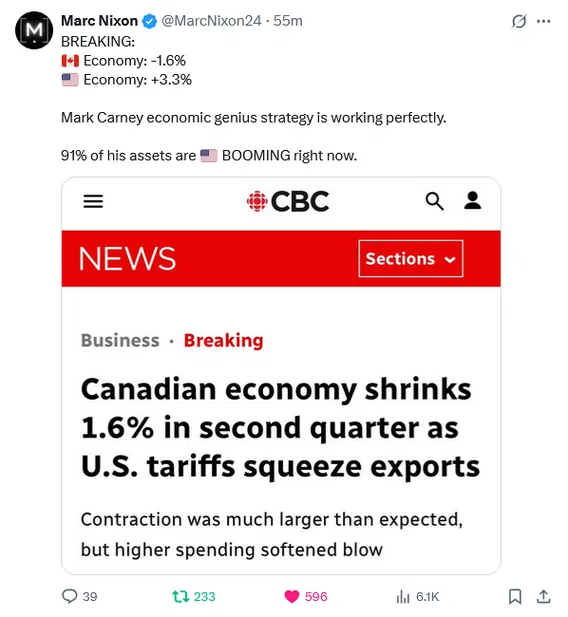
The latest figures show the US economy growing by 3.3% while Canada’s shrank by 1.6% in the same period. It’s bad news for Canadians, except those like Prime Minister Mark Carney who have the bulk of their investments in the United States (91% for Carney, according to various sources). On X, Dan Knight explains what is happening:

Canada’s economy just shrank. That’s the headline. In the second quarter of 2025, real GDP fell 0.4%. On a per-person basis, it was the same. Canadians are poorer than they were three months ago. That’s not speculation. That’s Statistics Canada’s official number.

So, here’s what happened. The government and its media allies spent the spring bragging that the Canadian economy “grew” in the first quarter of 2025. Real GDP was up half a percent. Sounds good, right? But if you read the fine print, if you look at the numbers it wasn’t real growth at all. It was panic.

Exporters rushed to push product into the United States before tariffs came down. Automakers. Machinery producers. Parts suppliers. They all jammed as much across the border as they could, knowing the window was closing. That sugar high showed up in the Q1 GDP number. It made the economy look like it was humming along.

Then the tariffs hit. And in the second quarter, the bottom fell out. Exports collapsed down 7.5% overall. Passenger cars and light trucks? Down nearly 25%. Machinery and equipment? Down 18.5%. Travel services? Down 11%. The result: GDP fell 0.4%. On a per-capita basis, it was exactly the same. Canadians are literally poorer than they were three months ago.

This is the story you’re not hearing: Q1 wasn’t proof of a healthy economy. It was proof of a desperate one. Businesses scrambling to get ahead of trade barriers, because they knew Ottawa wasn’t going to stop them. Q1 was fake growth, and Q2 was the crash.

Meanwhile, households are spending more, saving less, and wages are barely moving up just 0.2%, the slowest since 2016 outside of COVID. Corporate profits are falling. Government revenues are down since the carbon tax was lifted. And Ottawa’s answer? Spend more. Borrow more. Pretend it’s all fine.

So the question is simple: if this is what “growth” looks like under Mark Carney’s Liberal government front-loaded exports, collapsing investment, rising debt what does the next quarter look like?

On her Substack, Melissa Lantsman says that the economic situation in Canada is discouraging investors from putting money into Canadian companies:

You don’t need to be a foreign investor to see that putting your money into Canada is not a winning move.

Recently, Statistics Canada reported “strong foreign divestment in Canadian shares” across many sectors, including energy, mining, and manufacturing. At the same time, Canadian buyers also moved their money stateside, purchasing $13.4 billion of foreign securities in just one month.

If this were a small, short-term blip, it would be easy to dismiss it as market noise or an aberration. But that’s not the case: Statistics Canada found four consecutive months of net divestment from the Canadian economy, adding up to $62 billion in lost capital.

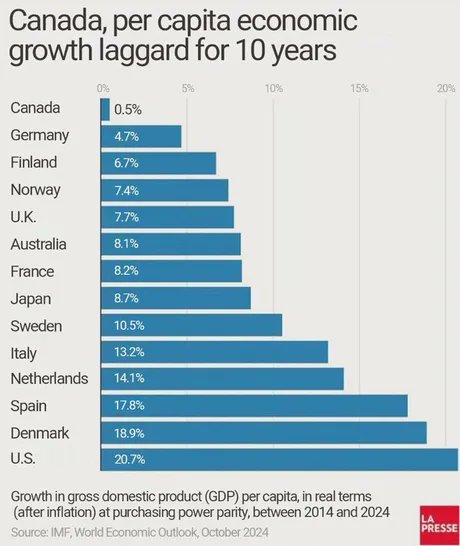
And that’s not to mention that every year since 2015 has seen more Canadian investment going abroad than foreign investment coming here. For those keeping track, this is the fastest rate of divestment in Canada since the Great Recession.

What does this all mean?

From an investor’s point of view, there’s no sugar-coating it. Canada is, simply put, an unattractive place to invest hard-earned cash. People making financial decisions for the future don’t have confidence in the Canadian economy to make them money.

From a government’s point of view, it should mean alarm bells ringing left, right, and centre. Lower investment in Canada translates into lower productivity, fewer employment opportunities, less government revenue, and a weaker Canadian dollar, leaving us all worse off.

But why is this happening in the first place?

According to the C.D. Howe Institute, the culprits are familiar: high taxes, regulatory barriers, policy uncertainty, and anti-growth mindsets that penalize success and demonize the private sector.

Anyone who has been paying attention for the last ten years knows that’s exactly what’s been happening. Nothing says “Welcome to Canada” to investors quite like a hike in the capital gains tax at the last minute, chaos at the CRA, multi-year project approval processes, and the highest deficits on record.

And anyone serious about fixing the problem would do the exact opposite of what the last government did. But when your new government is the same as the old one, it’s hard to believe Canadians will get the bold economic transformation this country desperately needs.

August 27, 2025

Operation Raise the Colours

Filed under: Britain, Liberty, Media, Politics — Tags: , , , , — Nicholas @ 03:00

Gawain Towler on the groundswell of quiet patriotic display in England, against the active attempts by local governments to suppress any and all flag-waving or even flag-flying by the plebs:

It was a seemingly innocuous tweet during the 2014 Rochester and Strood by-election that exposed a deep cultural rift. Emily Thornberry, then Labour’s shadow attorney general, a paragon of establishment elite thought, posted a photo of a terraced house in Strood adorned with multiple St George’s Cross flags, a white van parked outside.

No caption, just “Image from #Rochester”. To Thornberry, the image spoke for itself: a symbol of backward, flag-waving patriotism, the domain of the “white van man” she and her metropolitan peers presumably viewed with quiet derision. She expected her audience to share the contempt, to chuckle at the vulgarity of overt Englishness. But the backlash was ferocious. The public saw snobbery, a sneering dismissal of ordinary lives. Thornberry resigned from the shadow cabinet that day, rebuked by Ed Miliband for disrespecting hardworking families. I played a modest role in that storm, forwarding the tweet to Guido Fawkes and The Sun, which amplified the outrage and forced the reckoning.

That episode, now over a decade old, feels eerily prescient as I contemplate the “raising the flag” phenomenon sweeping Britain in recent weeks. What began as scattered acts of defiance has blossomed into a nationwide movement: St George’s Crosses and Union Jacks hoisted on lampposts, motorway bridges, and public spaces from Birmingham’s Shard End to Tower Hamlets in east London, Southampton to Brighton, and even Cannock. Roundabouts painted red and white, zebra crossings marked with the cross, symbols of England asserting themselves in the urban landscape. Last night I cycled through London’s Labour stronghold of Lambeth, and road markings have been transformed with the St George’s Cross, a quiet but bold reclamation in one of London’s most diverse boroughs. Dubbed “Operation Raise the Colours” by organisers (though it is hard to describe the phenomenon as organised), it has seen thousands of flags raised, with fundraising efforts like Birmingham’s £16,000 drive sustaining the effort. I support this gentle uprising, for it breathes life into symbols long marginalised. Yet I acknowledge the disquiet it stirs: in a polarised society, such displays can evoke unease, linked in some minds to far-right agitation or the riots of summer 2024, that and deeper darker memories of NF marches in the 1970s.

Why is this happening now? The timing aligns with the anniversary of last year’s Southport tragedy and ensuing unrest, where misinformation, both from the state and other bad actors, fuelled anti-immigration protests that spiralled into violence. Many participants frame it as a response to “two-tier policing”, swift crackdowns on native demonstrations while pro-Palestinian marches proceed with apparent leniency. It’s a broader reclamation of national pride amid economic stagnation, unchecked migration, and a sense of cultural dilution. For the overlooked, those Thornberry’s tweet mocked, this is a way to say, “We belong here”. and stronger yet, but uncontroversial in any other land than our own, “This is our land”.

It’s contemplative defiance: not riots, but ribbons of red and white asserting identity in a nation where Englishness often feels like an afterthought.

August 24, 2025

The Supreme Court of British Columbia has detonated a legal mine under all of Canada’s established property titles

Filed under: Cancon, History, Law, Politics — Tags: , , , — Nicholas @ 05:00

Conrad Black discusses just how much the Supreme Court of British Columbia’s decision on First Nations land claims in BC will undermine established property rights across the entire country:

A map shows the Cowichan title lands outlined in black. (B.C. Supreme Court) Photo by B.C. Supreme Court

The decision earlier this month by the Supreme Court of British Columbia that the Cowichan tribes hold title over federal, city, and private land in Richmond B.C. that enjoys a higher legal status than the fee simple ownership of the current proprietors is outrageous but may have some positive consequences. The decades and $7 billion that have been spent or pledged for what is called the “reconciliation” process, has finally hit a stone wall. The almost universal desire to be fair to Indigenous people and where appropriate to compensate them for inequitable treatment, has finally collided with the entrenched economic rights and interests of every owner of real property in Canada, including those of Indigenous ancestry.

Inexplicable latitude has been granted to the thickening population of crusaders for indigenous rights. Even the NDP government of British Columbia, which has been pathologically addicted to prostrating itself at the feet of anyone or anything purporting to champion any definition of the Indigenous interest, was reduced to monosyllabic waffling by the court decision brought down by Justice Barbara Young. Premier David Eby’s office declared an ambition to continue seeking a negotiated resolution of the conflict between Aboriginal rights and common law rights of affected property owners, (including the municipal, provincial, and federal governments-of $100 billion of property in Richmond B.C. that is directly affected by the decision).

This is an understandable ambition, but in the circumstances, his government might have pressed the negotiations over the six years that this case has been litigated. Our judiciary has been addicted to truckling to almost any Indigenous claim, on the restricted occasions when the federal and provincial governments have even had the temerity to conduct a defense against them. Now the taxpayers’ negotiating position has been tanked by this ludicrous decision, which is being appealed.

If courts with authority for the whole country were to come to similar judgments, and we cannot doubt that activists will continue to push on an open door and quite rightly take all they can get, then every property title deed in the country is compromised, including the Houses of Parliament. There were only approximately 200,000 native people in all of what is now Canada when the French and British explorers and settlers came here starting at the end of the 15th century. Yet the implication of this ruling is that they legitimately owned all of Canada and that in the patchwork of numbered treaties and other agreements following absorption of the politically organized parts of Canada into the British Empire at the end of the Seven Years War in 1763, ancient and undocumented Aboriginal rights took precedence over any subsequent real estate law allocations of property rights under the common or civil law systems that gradually spread across Canada.

Given the activist preferences of courts across the country, we can expect to see similar cases pop up everywhere, as First Nations sensibly try to strike while the iron is hot and lay claim to as much of the real estate of Canada as the courts will let them … which might well be the entire land mass plus fishing rights.

August 23, 2025

“Trump … sees transshipment and nearshoring as sneaky workarounds”

Filed under: China, Economics, Government, Politics, USA — Tags: , , , — Nicholas @ 05:00

At the Foundation for Economic Education, Jake Scott explains Donald Trump’s latest anti-trade moves:

President Donald Trump’s executive order of July 31st, effective August 7th, has upended global trade dynamics in a single stroke. Slapping a 40% tariff on all “transshipped goods” — products rerouted through third countries to dodge US duties — this is merely the natural development of his evolving protectionist agenda.

Just a week after the order, the move is a clear shot at China’s sprawling manufacturing empire, which has long exploited methods like transshipment and “nearshoring” to skirt American tariffs in general, and Trump’s tariff policies in particular.

While applied globally, China stands to take the biggest hit (and likely already is), with its vast factory networks and knack for rerouting goods through Southeast Asia, Mexico, and beyond. This isn’t just a tariff hike; it’s a calculated escalation in Trump’s ongoing crusade to reshape US trade policy and the global economy in the United States’ favor. But ripple effects that bruise consumers are already visible — and this move is likely to strain relationships with key allies as well.

The new tariffs build on Trump’s first-term strategy — so extensive that it now has a Wikipedia entry — when he wielded America’s economic heft like a sledgehammer to renegotiate or smash trade deals he deemed unfair. Back then, Chinese firms sidestepped US tariffs by setting up shop in countries like Vietnam and Mexico, funneling goods through these hubs to mask their origins.

This nearshoring strategy buoyed many economies that had pre-existing arrangements with the United States or were treated more favorably than China, such as Canada and Latin American nations. It is also seen as a natural part of globalization: shipping parts from where they are constructed (like China), assembling them in developing nations (like Mexico), and then exporting to high-value markets (like the United States). Nearshoring has a long history, but the fragility of extended global supply chains was exposed in the Covid pandemic; since then, manufacturers have sought to mitigate their damage.

The US trade deficit with China (roughly $295 billion) has long been a sore point for Trump, who sees transshipment and nearshoring as sneaky workarounds. The 40% duty on these goods, layered atop existing tariffs, aims to plug this loophole. As Stephen Olson, a former US trade negotiator, noted in the New York Times, China will likely view this as a direct attempt to “box them in”, potentially souring already tense talks.

Another Bud Light moment: Cracker Barrel gets rid of the cracker

Filed under: Business, Media, Politics, USA — Tags: , , — Nicholas @ 03:00

I haven’t been to the United States for more than a decade — not for political reasons, just for financial ones … I haven’t had the money to travel since 2015 — so it’s at least that long since I visited a Cracker Barrel. On our usual driving holidays, we’d stop somewhere like a Cracker Barrel to get a big breakfast to tide us over to our next destination a few hundred miles further down the road. I’d heard that the food quality had dropped after Covid, but I can’t confirm that from personal experience. Here’s ESR’s take on the latest rebranding that has riled up the online commentariat and apparently tanked the company’s stock price:

Today I’m here to talk about why I dislike Cracker Barrel, but dislike the Cracker Barrel rebrand even more.

My first reaction to the outpouring of social-media sentimentality about the destruction of CB’s comfortable old-timey ambience was to stare and wonder if these boosters had gone entirely out of their minds.

Yes, CB was designed to evoke a sort of folk memory of what rural country stores used to be like. But it’s, at best, a gigantized, commoditized, kitschy simulacrum of what they were — Hee Haw as filtered through the mind of an urban-corporate bugman.

Exhibit A for this is the gauntlet you have to run through to get to the food — gift shops that are unrivaled for the utter tastelessness and worthlessness of the cheesy crap on their shelves.

Once you get to the food, well … they serve a decent breakfast. Everything else is bland, homogenized slop.

And yet, I find that I dislike the rebranded look and feel even more. Because at least CB as it was gestured feebly in the direction of something authentic and American. The new look strips out all those vestiges — it has all the character of a generic airport lounge.

If you’re reading this and getting hot under the collar because I’ve impugned an experience that has sentimental value for you … look, I get it, okay? Old CB wasn’t designed for me, nor for anybody else who can unironically describe themselves as urbane, sophisticated cosmopolitans. But in its own pastiched way it had value, value which is now being destroyed.

Certainly the stock market thinks so. CB’s share price has been dropping like a rock — the rebrand is a failure even by corporate-bugman standards.

If the chain needed saving, the right thing to do would have been to double down on the attractive parts. Keep the local memorabilia on the walls, improve the menu, turn down the wince-inducing tackiness of the gift shop. Make it more like the mythical olden days, not less.

But no. Because the CEO is an idiot. I’ve been on a corporate board of directors and I’m here to confirm that if CB’s doesn’t convene an emergency meeting to fire her before the end of the week they are not doing their job.

August 22, 2025

QotD: “White fragility”

Filed under: Books, Media, Politics, Quotations, USA — Tags: , , , — Nicholas @ 01:00

White fragility is the sort of powerful notion that, once articulated, becomes easily recognizable and widely applicable … But stare at it a little longer and one realizes how slippery it is, too. As defined by [White Fragility author Robin] DiAngelo, white fragility is irrefutable; any alternative perspective or counterargument is defeated by the concept itself. Either white people admit their inherent and unending racism and vow to work on their white fragility, in which case DiAngelo was correct in her assessment, or they resist such categorizations or question the interpretation of a particular incident, in which case they are only proving her point. Any dissent from “White Fragility” is itself white fragility. From such circular logic do thought leaders and bestsellers arise. This book exists for white readers. “I am white and am addressing a common white dynamic,” DiAngelo explains. “I am mainly writing to a white audience; when I use the terms us and we, I am referring to the white collective”. It is always a collective, because DiAngelo regards individualism as an insidious ideology. “White people do not exist outside the system of white supremacy,” DiAngelo writes, a system “we either are unaware of or can never admit to ourselves”. … Progressive whites, those who consider themselves attuned to racial justice, are not exempt from DiAngelo’s analysis. If anything, they are more susceptible to it. “I believe that white progressives cause the most daily damage to people of color,” she writes. “[T]o the degree that we think we have arrived, we will put our energy into making sure that others see us as having arrived …” … It is a bleak view, one in which all political and moral beliefs are reduced to posturing and hypocrisy.

Carlos Lozada, “White fragility is real. But ‘White Fragility’ is flawed,” Washington Post, quoted by Ann Althouse, 2020-06-19.

August 21, 2025

QotD: Computer models

Filed under: Economics, Government, Media, Politics, Quotations, Technology — Tags: , , , — Nicholas @ 01:00

Should some sort of post-mortem ever be conducted on the catastrophic failure of all computer models, it will be done with the help of a computer model, that will cost billions in whatever currency to assemble. It will show the need for more computer studies. And therefore, it will be catastrophically wrong.

But note: for 100 dollars or negotiable, I will produce a minority report that will explain everything, infallibly. I will not preview the report in this Idlepost, however, because it might be worth money to me.

Aw, heck. Since I am rich beyond the dreams of avarice, let me just go ahead and blow all the beans. Let me recklessly tell gentle reader why computer models are always mistaken.

It is because their makers decide the result, before they design the model.

This does not mean they are self-interested phanatics, consciously preying on the gullibility of a drooling, ignorant public; although usually it does. For even if, by disposition, they are lofty, objective types, they will need, objectively, a lofty budget to perform a “credible” study. This means they must beg huge sums of money, and this will only be available from a source with an unhealthy interest in the result.

You see, the problem has nothing to do with computers. Even among humans, the phenomenon of “garbage in, garbage out” is well attested. The intention of following the evidence where it leads, is transient. I should think only a saint could sustain it, for longer than he could hold his breath under water.

David Warren, “A note on sternutation”, Essays in Idleness, 2020-06-19.

August 20, 2025

“All politics is local” … except when it isn’t

Filed under: Economics, Europe, Government, Media, Politics — Tags: , , , , — Nicholas @ 05:00

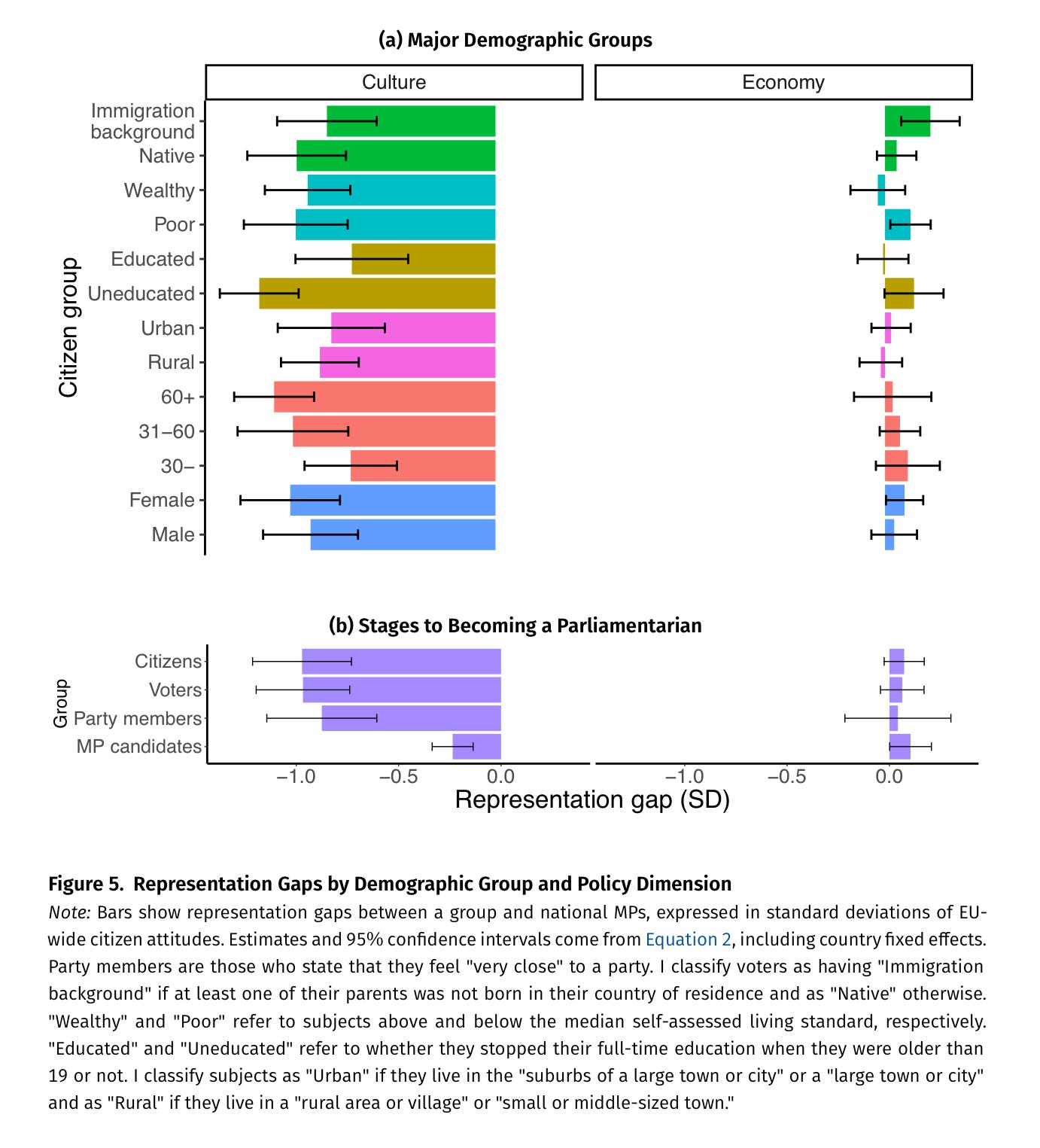
Lorenzo Warby on a recent study of the vast chasm between what European voters want in areas like crime and immigration and what their elected representatives want:

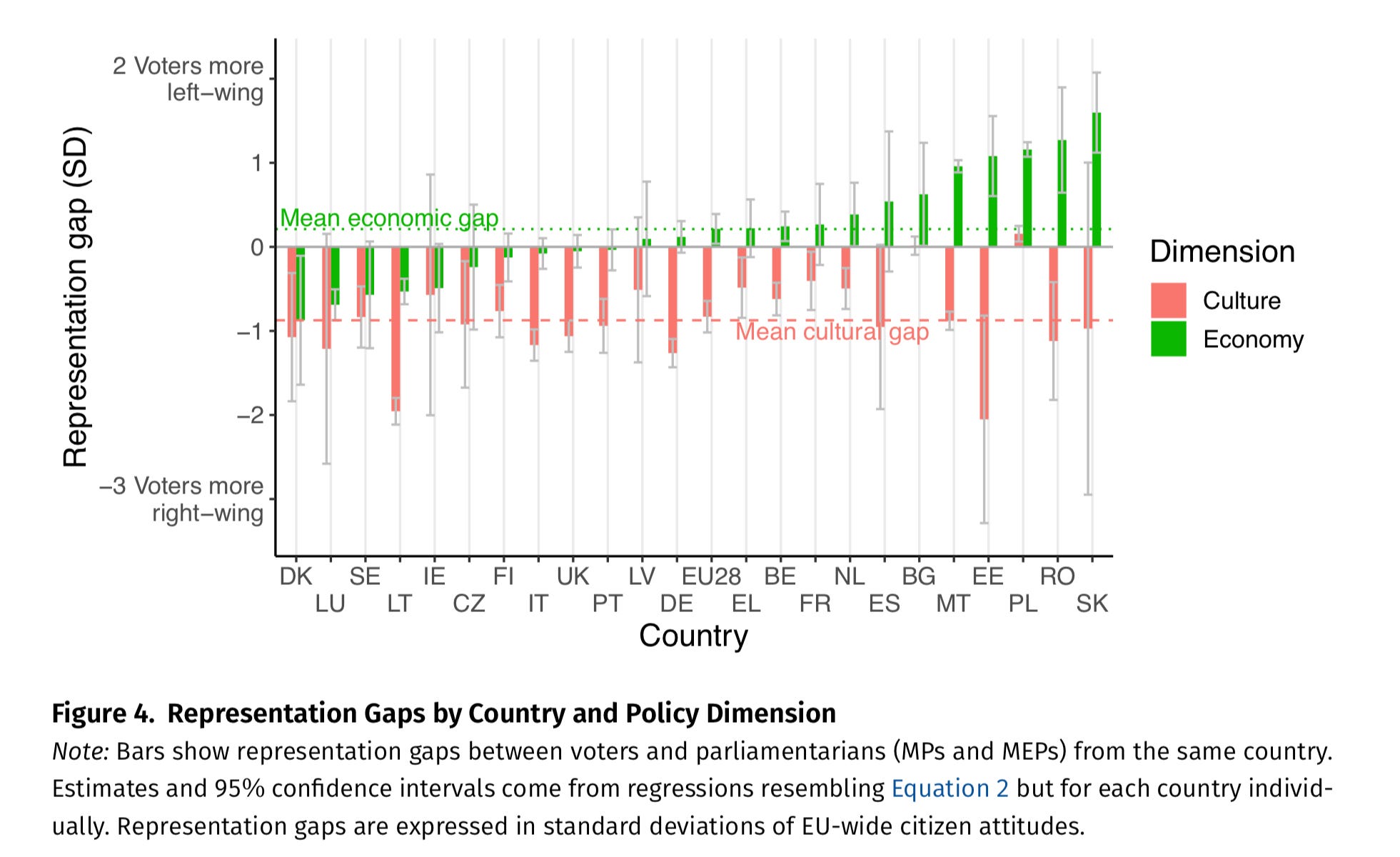
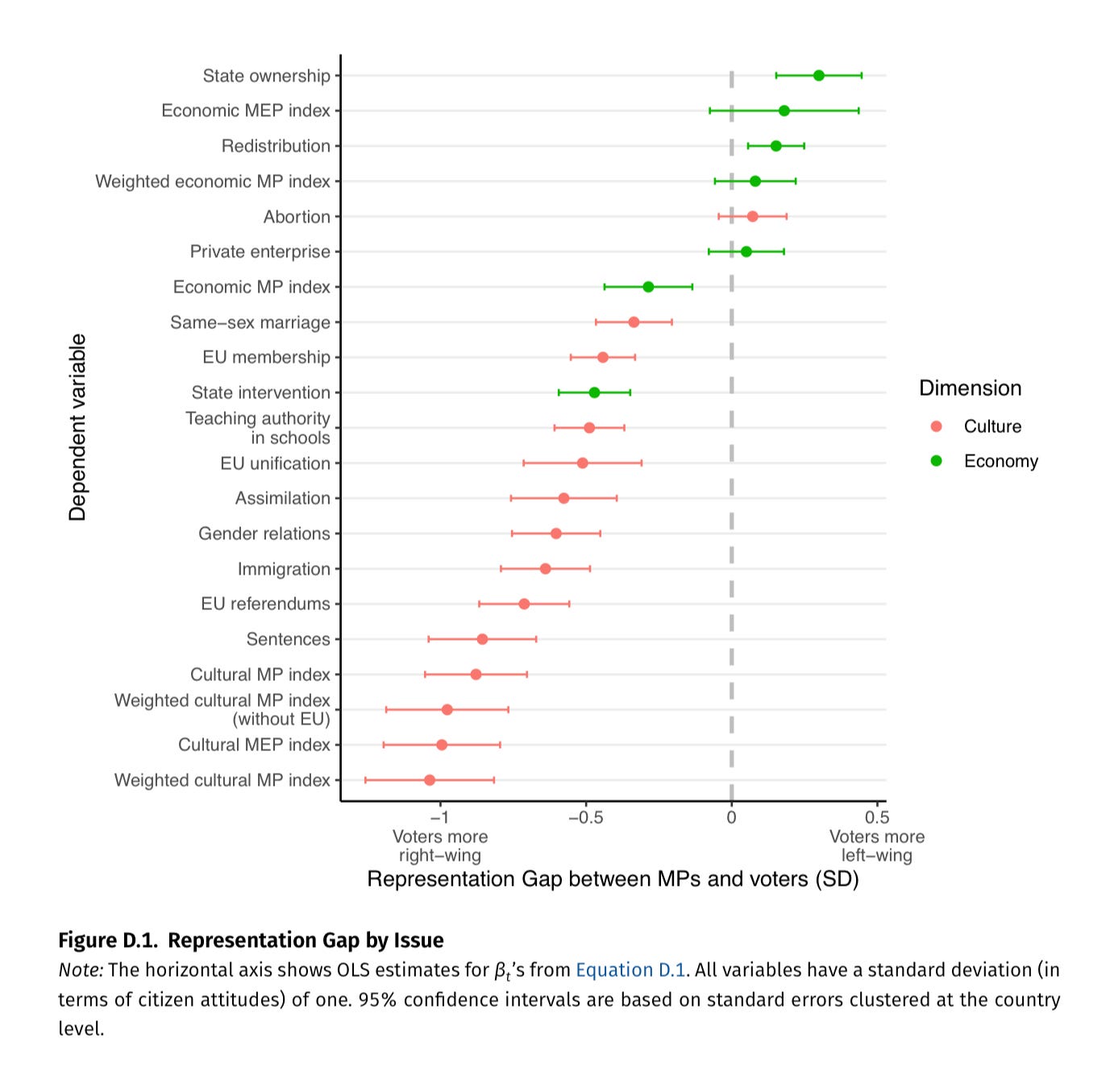
Economist Laurenz Guenther has performed the very useful exercise of quantifying how unrepresentative the views of European politicians are of their voters on cultural issues, such as crime and immigration. This is not true of economic issues, where the views of politicians tend to be quite representative of their voters.

In the case of economic issues, in some countries the politicians are more pro-market (“right”) then their voters, in others they are more dirigiste (“left”) than their voters, in others still they are very similar to their voters. There is simply no consistent pattern, and the average gap between voters and politicians across European countries on economic issues is fairly small.

With cultural issues, such as crime and immigration, we get a very different pattern. There, politicians are consistently more socially liberal (“left”) than their voters and by a considerable margin. While education levels explain some of this difference, they do not explain very much, as politicians are significantly more socially liberal than even university-educated voters.

Moreover, politicians are unrepresentative even of their own Party members/base on cultural issues and, again, in being much more liberal than their core supporters. There is some factor or factors specific to being a contemporary politician that systematically separates them out from voters on cultural issues yet does not operate with economic issues.

Veteran politician Tip O’Neill famously said that all politics is local. This is particularly true of cultural issues such as crime and immigration, where the effects vary wildly by location. This is much less true of economic issues, which are much more economy-wide in their operation.

There are various features we can identify here. First, executive function(s) — including such features as patience (aka time horizon) — varies between people and is highly heritable. Localities that have lots of people with poor executive function operate very differently from those where it is very much normal for people to have strong executive function.

As the combination of physical robustness and weak executive function predicts criminal behaviour, this has a great deal to do with why crime varies so dramatically by locality. This is especially as crime is very much a power law phenomenon, where a small minority of (overwhelmingly) men commit the vast majority of violent crimes.

Source – Wikimedia Commons.

It also means that people who have spent their lives in social milieus full of people with high executive function can have little or no sense of what happens when one has to deal with weak executive function folk. This is the people unlike me problem that so bedevils contemporary politics and commentary.

California’s ever-receding High Speed Rail dream

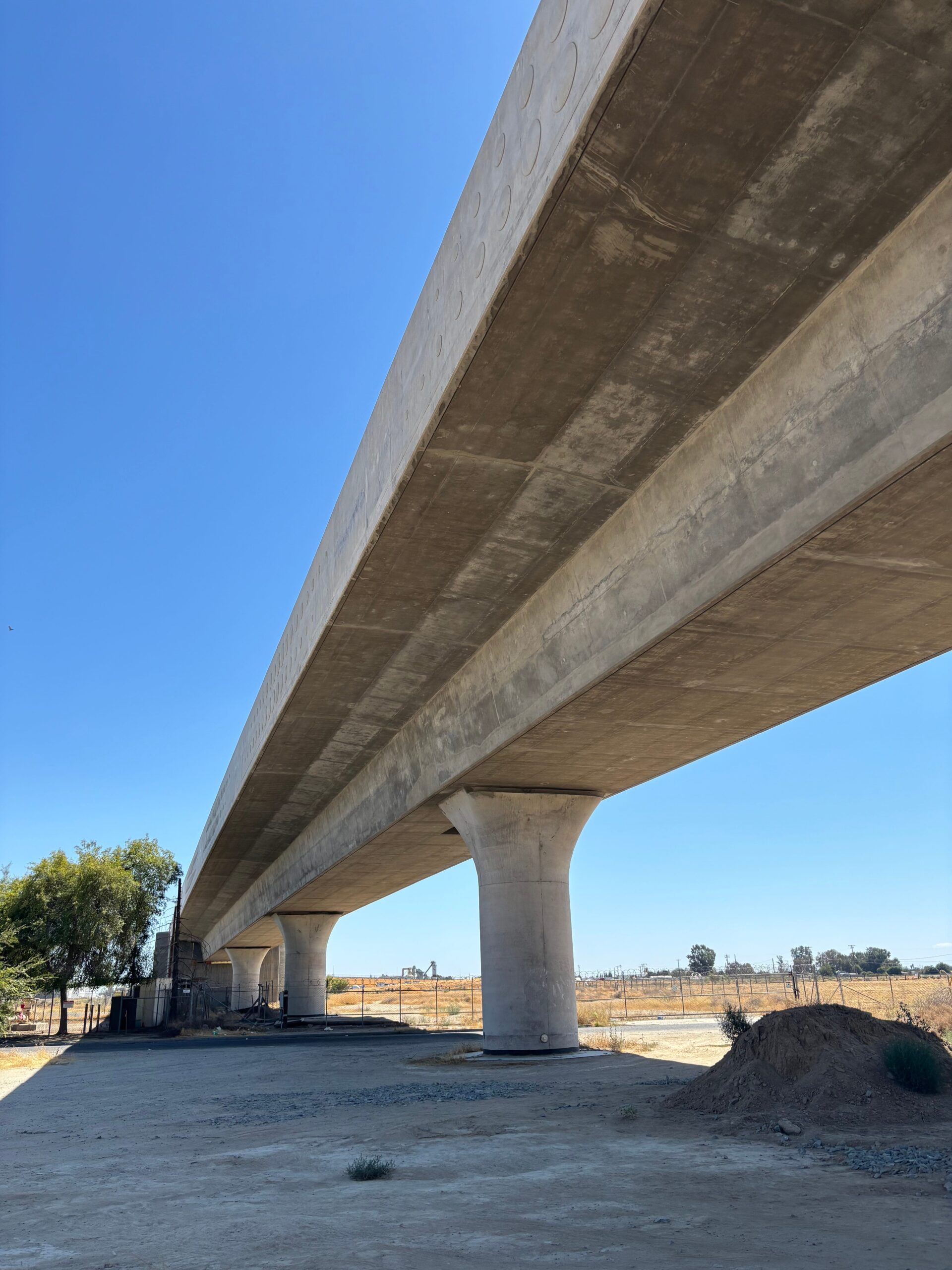
Chris Bray provides an on-the-ground update of California’s ultra-expensive high speed rail project which still has yet to deliver a single passenger from one station to another after nearly 20 years of funding:

Start with a description: “In 2008, California voters approved $9.95 billion of state bond funding as seed money to build an 800-mile high-speed rail (HSR) network connecting Los Angeles and San Francisco, and the Central Valley to coastal cities, at speeds of up to 220 miles per hour, with an expected completion date of 2020.”

Construction started in 2015. Pause for a moment and really notice the date.

Ten years later, the project has consumed $18 billion, and an effort to connect Los Angeles and San Francisco has turned into a much more modest “Phase One” plan to connect the cities of the Central Valley, well east of the coast. The modest declared cost of the proposed LA-to-SF bullet train now looks like this for the much shorter line: “a cost range of $89 billion to $128 billion.” The Trump administration has declined to provide more federal funding for the project, but California is suing to try to keep the federal spigot open.

[…]

Famously, the California High-Speed Rail Authority has been posting pictures of its huge construction successes on social media:

See, that’s … almost a whole rail line for a bullet train. Obviously!

So!

If you ever find yourself in Fresno, and I sincerely hope you don’t, the structures that have been built for “high-speed rail” are surprisingly easy to access. There are several places where those structures aren’t fenced in or guarded. At all. […] So when you see this:

…it’s not that hard to just head up onto the thing. It’s also very dangerous, legally dubious, and something you definitely shouldn’t do. Since it’s an elevated construction site, there are a lot of places without guardrails where you can just fall off the thing, and it’s a long way down.

Everyone see this part: Don’t go up there. It’s dangerous. You can fall and die. […] But if you were to climb up onto the thing, which you absolutely should never do, you would see a whole bunch of this:

That’s a section at the northern end of Fresno, looking south.

Of course, California isn’t the only jurisdiction struggling to complete big infrastructure projects: Toronto’s long-awaited Crosstown LRT project got started in 2007 and still has no confirmed completion date, although a faint possibility exists that a portion of the line may open later in 2025.

QotD: Most “mass movements” really do need that “vanguard” to start moving

Filed under: History, Politics, Quotations — Tags: , , , , , , — Nicholas @ 01:00

Let us stipulate that Socialism’s appeal to the proles is “I offer you a good time”. Orwell takes this as read, but it also follows from the premises laid out earlier in the essay. Orwell equates “ease, security and avoidance of pain” with “comfort, safety, short working-hours, hygiene, birth-control and, in general, common sense”. The Commies explicitly promise the proles those things; he could’ve lifted that phrase straight from the Webbs’ most doe-eyed propaganda leaflet.

And yet, as Orwell knows better than anyone, the proles can’t do it on their own. You really do need a vanguard of the proletariat. As Orwell himself notes, Hitler was backed by the big industrialists, and if you really want to needle the eggheads in your life, point out how quickly and thoroughly the German professors knuckled under […] They couldn’t wait to lick his jackboots, any more than his British and American colleagues could wait to kiss Stalin’s ass. They called themselves a “workers’ party”, but in the early days [German fascists] were almost exclusively found among the dueling fraternities – and professors! — of the German university system.

In other words, maybe the proles don’t need nothin’ but a good time, like the old song says, but though the proles are the “mass” of “mass movement”, the “movement” part gets started considerably higher up the social ladder … that is, with guys like Orwell. Guys who know, deep in their bones, that there’s more to life than hygiene, short working hours, birth control, etc. Because he’s one of the great prose stylists, it’s not as apparent in Orwell, but in lesser hands than his you can smell the contempt dripping off every sentence an egghead writes about the proles …

It’s not that the proles want hygiene, birth control, etc. It’s what they need. What they deserve, when you come right down to it, because that’s what you do with livestock — keep ’em clean and well fed, and of course control their breeding. You could take the most purple passage of “animal rights” eco-lunacy and set it side by side with the Webbs’ Soviet Communism: A New Civilization, and see no difference at all. Sure, every aspect of our lives is managed for us by Our Betters, but at least we’re free range!

Severian, “Bonfire of the Vanities II”, Founding Questions, 2021-12-29.

August 19, 2025

Bad laws in Canada must be challenged in court

Filed under: Bureaucracy, Cancon, Government, Law, Media, Politics — Tags: , , , , — Nicholas @ 05:00

At Rigid Thinking, Damian Penny says — and I wholeheartedly agree — that it’s a good thing for laws to be challenged in the courts, but especially when it’s called an “emergency”:

[Retired Canadian veteran Jeff] Evely, with the help of some conservative/libertarian-ish legal organizations, plans to challenge the woods ban in court as a violation of the Canadian Charter of Rights and Freedoms. This is not a popular position here in Nova Scotia (in online discussions, the phrases “Maple MAGA” and the venerable “American-style” come up a lot) and I am not sure he’ll be successful.

But, honestly, I give him credit for trying. In fact, I’d argue his Charter challenge is win-win for everyone in Nova Scotia, whether one supports, opposes or remains indifferent to the policy.

That’s not despite the pressing emergency posed by the forest fire threat, but because of it.

When we’re faced with a crisis, that’s precisely when governments are tempted to seize as much power and authority as possible – and, more importantly, when the public is more inclined to go along with it.

Hence, Trudeau I imposing War Measures Act provisions during the 1970 October crisis, the PATRIOT Act debate after 9/11, COVID-19 restrictions during the pandemic, Trudeau II using the Emergencies Act when the “Freedom Convoy” set up shop in downtown Ottawa, and now Premier Houston (whom I support, despite some misgivings about this issue) using sweeping measures to tramp down the forest fire risk.

And sometimes such powers are justified under the circumstances. Even self-professed libertarians will admit as such when the emergency is something they’re personally worried about, and when a leader from the “good” team is in power.1

But they aren’t always justified. And governments definitely can’t be trusted to handle such power responsibly the longer the “emergency” goes on.


  1. The rise of Trump has allowed many “libertarians” to reveal themselves as authoritarians, but that’s for another post.

August 18, 2025

Canada’s state-subsidized media now seem to see their job as pro-government PR

Filed under: Cancon, Government, Liberty, Media, Politics — Tags: , , , , , — Nicholas @ 05:00

At The Rewrite, Peter Menzies considers the state of Canadian media in how they reported on the Maritime provinces’ draconian policies during the ongoing wildfire season:

Screencaptured image of one of the August 2025 wildfires in the Maritimes from Global News via The Rewrite

There will always be conflicts between collective rights and individual liberties. One is valuable in ensuring there is order in society, which is important. The other is necessary to maintain freedom, which lots of people live without but is nevertheless desirable. When there’s too much freedom, people look for politicians who will restore order. When there is too much order, people rebel and demand freedom (see everything from the French Revolution to the Freedom Convoy).

Traditionally, those inclined to the order side if the ledger have been viewed as conservatives while “liberals” have led the fight for individual freedom manifest in the civil rights movement, the emancipation and advancement of women, freedom of speech, etc. that are now viewed as fundamental to the maintenance of a modern, liberal democracy.

But as Pete Townsend wrote a little more than half a century ago, the parting on the left is now the parting on the right (and the beards have all grown longer overnight). Journalists tend to lean left, which means their traditional opposition to the imposition of order has been replaced by a collectivist tendency to sympathize with those imposing it. It is left to the newsroom minorities on the right to carry the torch for individual liberties.

To wit, this CBC story on Nova Scotia’s wild fire-induced ban — enforced with a $25,000 fine until Oct. 15 — on walking anywhere in the woods was oblivious to the impact on personal freedom. Never crossed their minds. When the issue was raised on social media, Twitter journos took up the cause. Stephen Maher dismissed individual liberty concerns as fringe views and maintained that the restrictions could be justified as “reasonable” limitations of Charter rights. While the Globe and Mail‘s editorial board called the Nova Scotia move “draconian”, Globe columnist Andrew Coyne nevertheless wondered “How the hell did the right to walk in the woods of Nova Scotia during a forest fire emergency get elevated into the right’s latest cultural obsession?”

It was left to commentators such as Marco Navarro-Genie to point out the intellectual flaccidity fueling parts of the collectivist argument when New Brunswick followed Nova Scotia’s lead and NB Premier Susan Holt said this:

    Me going for a walk in the woods is gonna cause a fire. I can understand why people, uh, think that that’s, that’s. That’s ridiculous. But the reality is, it’s not that you might cause a fire, it’s that if you’re out there walking in the woods and you break your leg, we’re not gonna come and get you because we have emergency responders that are out focused on a fire that is, uh, threatening the lives of New Brunswickers.

That, believe it or not, was a good enough explanation for the collectivist thinking in most mainstream newsrooms.

If journalism is to be useful in defending democracy, those involved in it need to be intellectually equipped to understand the stakes. And their first instinct must be to treat the suppression of liberty as a serious issue whenever the powerful indulge in it at the expense of the powerless. That doesn’t mean liberty should always trump order (traffic lights are eminently reasonable). But it does mean that journos should demand that politicians justify their actions rather than simply helping them explain them to the Great Unwashed. To do otherwise is to fail.

QotD: Dostoevsky’s Demons can be read as “one long, savage parody of Fathers and Sons“

Filed under: Books, History, Politics, Quotations, Russia — Tags: , , , , , — Nicholas @ 01:00

To understand what happens next [in Dostoevsky’s Demons], it helps to have read some Turgenev. His most famous work, Fathers and Sons, is of a piece with the most lurid boomer fantasies. The basic plot is that there are some genteel Russian liberals, good New York Times readers, people with all the right views. Their kids come back from college and are espousing all this weird stuff: stuff about white fragility and transgenderism and boycotting Israel, stuff that makes their nice liberal parents extremely uncomfortable. But it’s okay, you see? The kids magnanimously realize that their parents were once cool revolutionaries too, and the parents make peace with the fact that the kids are just further out ahead than they are, and everybody feels good about themselves because if the kids have seen far, it’s only by standing on the shoulders of giants. The important thing to understand is that everything about this plot is identity validation wish-fulfillment for the boomer liberal parents (like Turgenev himself). It’s the political equivalent of that YouTube genre where Gen Z Afro-American kids rock out to Phil Collins.

The macro-structure of Demons mirrors this so closely, you can almost read the book as one long, savage parody of Fathers and Sons.1 The sunny opening section is a satire of the boomer liberals, and the big vibe shift part way in is their kids coming back from college. But that’s where things go off the rails. In this book, the next generation shares their parents’ anti-religious and anti-monarchist attitudes, but unlike in Fathers and Sons, the kids in Demons are disgusted by the hypocrisy and cowardice of their genteel liberal parents, and eager to plunge Russia into a hyper-totalitarian nightmare. The exact contours of that nightmare are something they frequently argue about and change their minds over, but they can all agree that it will need to begin with an enormous mountain of skulls, and that their town is as good a place as any to start.

Dostoevsky’s other works put individuals front and center, his stories have unbelievably rich characterization (Nietzsche once said that Dostoevsky was the greatest psychologist to ever live), because for Dostoevsky the very highest stakes, the most important questions in the world, were about the damnation or salvation of individual souls. But Demons is different: here the characters all blur together, their names are disgorged to you in a never-ending torrent, and only a few of them are distinctive in any way.2 How could Dostoevsky think these people don’t matter? It’s because they aren’t real people anymore. It’s because they’re possessed. Their brains have been scooped out and all you can see in their eyes is a writhing mass of worms. Their ideas and ideologies have hollowed them out and are wearing their skins as suits.

But what if the ideas don’t matter either? It’s easy to interpret the second half of Demons as a novel of ideas, but it really isn’t. Your first clue is that the ideas are just so goofy. There’s one guy who thinks that by killing himself he will become God (don’t ask, it’s Dostoevsky, man). Another has written a book with ten chapters, explaining how “Beginning with the principle of unlimited freedom I arrive at unlimited despotism”, and proposing a method of brainwashing for reducing ninety percent of humanity to a mindless “herd”. Yet another thinks that everything can be solved by killing one hundred million people, but laments that even with very efficient methods of execution this will take at least thirty years.3 My own favorite might be the guy who refuses to explain what his system is, but just smugly declares that since everybody is going to end up following it eventually, it’s pointless for him to explain it.

John Psmith, “REVIEW: Demons, by Fyodor Dostoevsky”, Mr. and Mrs. Psmith’s Bookshelf, 2023-07-17.


  1. Further evidence for this reading: the book contains a character, the great writer “Karmazinov”, who is a straightforward expy of Turgenev himself.
  2. That said if you do need to keep track of them, this alignment chart made by some genius on the internet is a pretty handy guide: link.
  3. This one probably seems less funny after the 20th century than it did when Dostoevsky wrote it.

August 17, 2025

To replace a people, first you need to induce guilt and self-hate

On his Substack, Frank Furedi discusses just how negatively the British establishment views the national flag and those uncultured boors who display it:

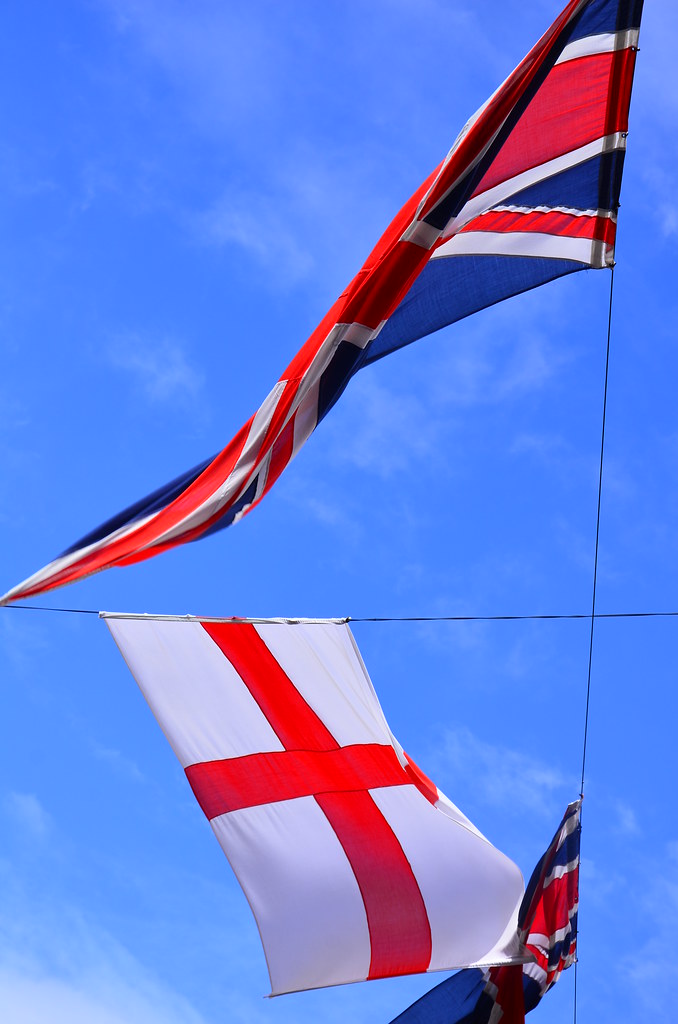
“Union Jacks and crosses of St George” by Ben Sutherland is licensed under CC BY 2.0 .

First a confession. I am not a serial flag-waver. In fact, one of the features of British history that I always appreciate is that its people possessed so much confidence about itself that it did not see the need for ostentatious displays of patriotism and flag waving. However, today matters are different. The nation’s cultural and political elites regard the Union Jack and the St George’s Cross — the flag of England — with embarrassment and studied contempt. Today many British institutions would rather fly the Palestinian flag or the LGBTQ+ or of Ukraine than flags that bear the nation’s symbols. Outwardly pride in Britain is in danger of being displaced by the sentiment of self-loathing.

Foreign observers are often surprised by the relative absence of Britain’s flag in public spaces. As one such observer noted recently, in Oxford Pride flags are outnumbered the Union Jack “by at least fifty to one”. He noted that the “next day in London, I saw Pride flags all about, with the Union Jack reserved for tourist sites like the Tower of London, which also sported Pride flags”.

In fact, the British Establishment’s reaction towards England’s flag is often communicated through the sentiment of ridicule and hatred. This sentiment has been embraced by local councils, particularly ones that are under the influence of Labour and the Lib Dems. Many of them feel entitled to prevent these flags from being displayed. Most recently the Birmingham’s Labour dominated council has ordered the removal of Union and St George’s flags from lamp posts in this city. The Council announced its decision to remove the flag on the ground that they put the lives of pedestrians and motorists “at risk” despite being up to 25ft off the ground! Needless to say, the Council applies a different standard of judgment when it comes flying the Palestinian flag, which are flown all over the City. Presumably this flag does not constitute a danger to motorists and pedestrians.

In Birmingham, Britain’s second largest city flying the flag of the nation is regarded by local officialdom as a risk to safety.

The British Establishment feels contempt towards not only Britain’s flags but also towards the people who enthusiastically identify with them with patriotic pride. An incident involving Emily Thornberry, Labour MP for Islington South, in November 2014 captures well the contempt that significant sections of the British political class have towards the symbolic displays of patriotism. During a by-election campaign in Rochester, she posted a photo of a house displaying three St George’s flags, with a white van parked outside, and accompanied it with the arch caption, “Image from #Rochester”. The implication of her post was that those who decorated their house with the flags of England were a legitimate target of disdain. Since they were obviously morally inferior to her superior kind there was no need for a caption explaining this on her post.

Millennial Woes discusses how the contempt of the elites for the British people is leading to increasing possibility of civil unrest … or worse:

The short answer as to “why?” is that, even in mid 2025 when many people are sensing a mood developing, the government is still doing all the things that are bringing that mood about. They have no reverse gear. Despite their rhetoric, they are not reducing immigration and are certainly not doing mass deportation. In addition we have learned that, for years, they have been covertly propagandising us. Meantime the hate speech laws which muzzle us are still in force and being strengthened. Recently, the Online Safety Act came into force and the very next day numerous internet platforms had to start censoring content. We can literally see our oppression increasing in real-time. And even now, they want more. Always, we feel the government trying to stop us talking about its abuse of us. (Even as I type these words, I am aware that they could get the police raiding my home and seizing my devices.)
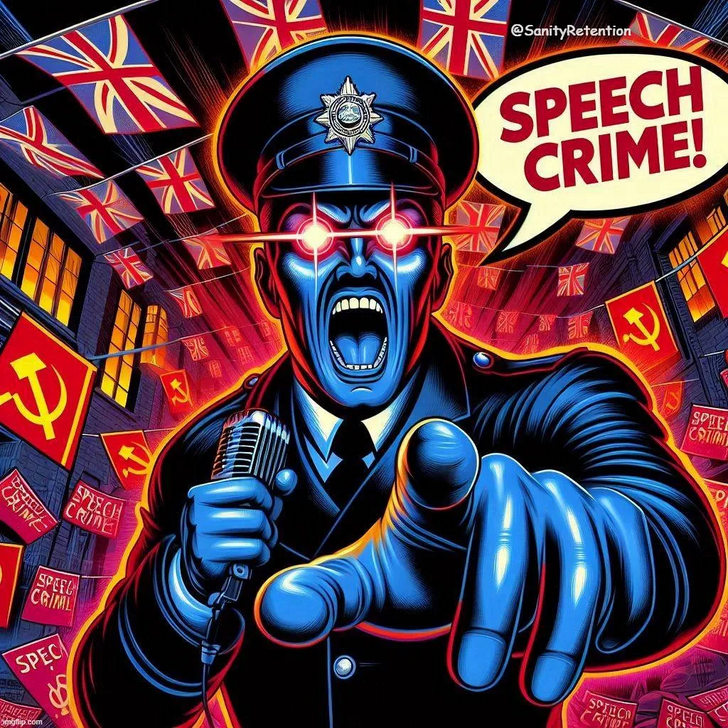
Image from Millennial Woes

The same is true in the media. This morning I heard that the BBC are making a high-profile drama about 11th Century Britain in which a key historical figure will be played by a Black actor. Our news media is still biased in favour of mass immigration at any cost. Adverts are still full of black-man-white-woman couples. It is relentless.

In business, White people are handicapped by preferential treatment for non-whites in employment, business loans and career opportunities. A few days ago I got an advert on YouTube featuring a business consultant woman who defiantly said “at the end of the day, diversity is the key to success”. Middle-class White people habitually work against each other and their group interests, causing personal failure and burning resentment for many of their ethnic kin.

It doesn’t actually matter whether the people who perpetuate all of this truly “believe” in it. What matters is that they are prepared to behave as if they do. The incentives have taken on a life of their own, become self-perpetuating, making alternatives almost illegal and certainly a guarantor of “social death” and “professional death”. Even with all the evidence that diversity is bad, nobody in the professional class will dare to speak against it because, even now, that would be the end of their career. And so the poisoning continues.

In short, I feel that my country’s mainstream is working constantly against my ethnic group surviving. Furthermore I see no end in sight for this ethnic sabotage.

And many other people think the same – more and more all the time, in fact. This is why they are getting ever more angry.

Among young people there are more reasons still, economic pressures which mean they can’t get on the property ladder and build the security to start a family. That is immensely frustrating for a lot of energetic young adults, and they haven’t got (haven’t been able to get) much to lose. When a society doesn’t facilitate this most basic desire in people, it should expect upheaval.

However, against this backdrop of oppression, dysfunction and madness, the main catalyst for civil unrest will be something much more concrete: refugees sexually assaulting White women and children. Such crimes are now occurring every day. Unfortunately, there is no reason why they will lessen in frequency. (I will not endanger myself further by explaining why. Everyone knows.)

And it is the fact that, indeed, “everyone knows” which makes civil unrest inevitable. It isn’t just spergs, theorycels, doomers, basement-dwellers and politics or race science obsessives any more; it’s the apolitical working-class who just want a decent chance at life. When they believe their own government is denying them that, it is inevitable that they will “rise up”. It is only a question of when, where, how and how many.

It has been pointed out that, during covid, the public didn’t “rise up”. But I say this was because, despite the restrictions and the perversity of that situation, throughout it people were still comfortable. Most importantly, they didn’t feel their children were in danger. That is the key thing. Dangers that never attended raising a child in Britain thirty years ago are now ubiquitous, even if you live in a nice middle-class town.

Update, 18 August: Welcome, visitors from Instapundit. Please do have a look around at other posts you may find of interest. I send out a daily summary of posts here through my Substack – https://substack.com/@nicholasrusson that you can subscribe to if you’d like to be informed of new posts in the future.


« Newer Posts — Older Posts »

Powered by WordPress