
The Social War coincided with the beginning of Rome’s wars with Mithridates VI of Pontus – the last real competitor Rome had in the Mediterranean world, whose defeat and death in 63 BC marked the end of the last large state resisting Rome and the last real presence of any anti-Roman power on the Mediterranean littoral. Rome was not out of enemies, of course, but Rome’s wars in the decades that followed were either civil wars (the in-fighting between Rome’s aristocrats spiraling into civil war beginning in 87 and ending in 31) or wars of conquest by Rome against substantially weaker powers, like Caesar’s conquests in Gaul.
Mithridates’ effort against the Romans, begun in 89 relied on the assumption that the chaos of the Social War would make it possible for Mithridates to absorb Roman territory (in particular the province of Asia, which corresponds to modern western Turkey) and eventually rival Rome itself (or whatever post-Social War Italic power replaced it). That plan collapsed precisely because Rome moved so quickly to offer citizenship to their disgruntled socii; it is not hard to imagine a more stubborn Rome perhaps still winning the Social War, but at such cost that it would have had few soldiers left to send East. As it was, by 87, Mithridates was effectively doomed, poised to be assailed by one Roman army after another until his kingdom was chipped away and exhausted by Rome’s far greater resources. It was only because of Rome’s continuing domestic political dysfunction (which to be clear had been going on since at least 133 and was not a product of the expansion of citizenship) that Mithridates lasted as long as he did.
More than that, Rome’s success in this period is clearly and directly attributable to the Roman willingness to bring a wildly diverse range of Italic peoples, covering at least three religious systems, five languages and around two dozen different ethnic or tribal identities and forge that into a single cohesive military force and eventually into a single identity and citizen body. Rome’s ability to effectively manage and lead an extremely diverse coalition provided it with the resources that made the Roman Empire possible. And we should be clear here: Rome granted citizenship to the allies first; cultural assimilation only came afterwards.
Rome’s achievement in this regard stands in stark contrast to the failure of Rome’s rivals to effectively do the same. Carthage was quite good at employing large numbers of battle-hardened Iberian and Gallic mercenaries, but the speed with which Carthage’s subject states in North Africa (most notably its client kingdom, Numidia) jumped ship and joined the Romans at the first real opportunity speaks to a failure to achieve the same level of buy-in. Hannibal spent a decade and a half trying to incite a widespread revolt among Rome’s Italian allies and largely failed; the Romans managed a far more consequential revolt in Carthage’s North African territory in a single year.
And yet Carthage did still far better than Rome’s Hellenistic rivals in the East. As Taylor (op. cit.) documents, despite the vast wealth and population of the Ptolemaic and Seleucid states, they were never able to mobilize men on the scale that Rome did and whereas Rome’s allies stuck by them when the going got tough, the non-Macedonian subjects of the Ptolemies and Seleucids always had at least one eye on the door. Still worse were the Antigonids, whose core territory was larger and probably somewhat more populous than the ager Romanus (that is, the territory directly controlled by Rome), but who, despite decades of acting as the hegemon of Greece, were singularly incapable of directing the Greeks or drawing any sort of military resources or investment from them. Lest we attribute this to fractious Greeks, it seems worth noting that the Latin speaking Romans were far better at getting their Greeks (in Southern Italy and Campania) to furnish troops, ships and supplies than the Greek speaking (though ethnically Macedonian) Antigonids ever were.
In short, the Roman Republic, with its integrated communities of socii and relatively welcoming and expansionist citizenship regime (and yes, the word “relatively” there carries a lot of weight) had faced down a collection of imperial powers bent on maintaining the culture and ethnic homogeneity of their ruling class. Far from being a weakness, Rome’s opportunistic embrace of diversity had given it a decisive edge; diversity turned out to be the Romans’ “killer app”. And I should note it was not merely the Roman use of the allies as “warm bodies” or “cannon fodder” – the Romans relied on those allied communities to provide leadership (both junior officers of their own units, but also after citizenship was granted, leadership at Rome too; Gaius Marius, Cicero and Gnaeus Pompey were all from communities of former socii) and technical expertise (the Roman navy, for instance, seems to have relied quite heavily on the experienced mariners of the Greek communities in Southern Italy).
Like the famous Appian Way, Rome’s road to empire had run through not merely Romans, but Latins, Oscan-speaking Campanians, upland Samnites, Messapic-speaking Apulians and coastal Greeks. The Romans had not intended to forge a pan-Italic super-identity or to spread the Latin language or Roman culture to anyone; they had intended to set up systems to get the resources and manpower to win wars. And win wars they did. Diversity had won Rome an empire. And as we’ll see, diversity was how they would keep it.
Bret Devereaux, “Collections: The Queen’s Latin or Who Were the Romans, Part II: Citizens and Allies”, A Collection of Unmitigated Pedantry, 2021-06-25.
October 29, 2024
QotD: The Roman Republic after the Social War
October 20, 2024
Debunking the “Muslims saved the Graeco-Roman legacy” intellectual urban legend
In my weekly set of recommendations from Substack there was a link to A History of Mankind‘s debunking of what is described as an “intellectual urban legend”:
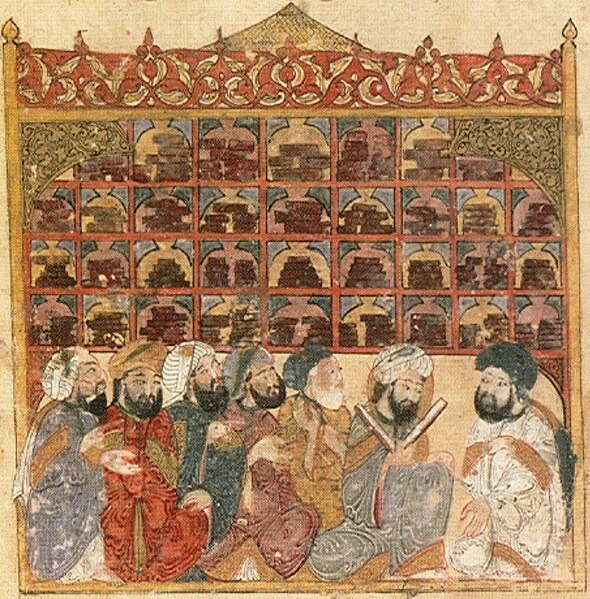
Islamic scholars at an Abbasid library in Baghdad.
Illustration by Yahyá al-Wasiti from 1237 via Wikimedia Commons.
Among the most popular of those legends, there’s one that can be summarized as “Arab scholars and translators saved the books of Graeco-Roman antiquity from being destroyed by the Christians and/or forgotten”. This a surprisingly widespread view. I’ve lived in several countries, and heard versions of this legend, often told in very simple terms over somewhat complicated drinks, from well-educated people often working in academia or the financial sector (which makes more sense than it appears — I’ve worked in the financial sector myself, and people there are highly educated as a rule).
I’ve even heard scholars (normally not Medievalists) express this view, and I’ve read views to this effect in multiple occasions. Just Google “did the arabs save graeco-roman books” and look at the top results, if you don’t believe me. Lots of well-educated people believe this, not to speak of history enthusiasts all over the Internet.
However, the truth is that Arab translators had only a modest impact on the transmission of Graeco-Roman texts to modern times. There are various reasons that explain this, but first let me provide some clarity on why Baghdad’s Medieval “House of Wisdom” — oft-cited, correctly, as the center of the Abbasid-era translation movement inasmuch as there was one — is one of history’s most misunderstood institutions.
The House of Wisdom functioned as a state library with a focus on the transcription and storage of manuscripts, and their translation to the court’s main language, Arabic. Based on a similar library patronized by the Sasanian emperors and staffed with some of its personnel from about the 8th century, the House of Wisdom employed Christian Greek speakers – very few Muslims spoke or read Greek fluently in this era and others, particularly Arabs – as well as Muslim and Zoroastrian Arabic or Syriac speakers who worked to translate and disseminate work.
[…]
Just to give a final touch of class to these absurd claims, Abu Sahl added the detail that the Greeks, dunces as they all are, forgot to actually steal many Iranian books, and simply memorized the contents before they torched them, so the actual Greek copies of Iranian greats are, by necessity, inferior versions diluted by the Greeks’ faulty memory.
Some Muslim scholars later came up with a new wrinkle that Byzantines were poor keepers of their own treasures, and their books were eaten by insects, as the bibliographer Al-Nadim (932-995) wrote in a second- or third-hand anecdote about some guy who visited Constantinople and was sad to see some ancient temple filled with neglected books, later widely quoted, and included in his Index of 987. The same Al-Nadim transmits from someone “trustworthy” that the Byzantines burned fifteen loads of books by Archimedes, which never happened.
Abdullah Ibn-abi-Zayd (922–998), a prolific North African writer on Islamic law, came up with a wrinkle for this wrinkle: that the Byzantine emperor gathered books and hid them in a secret building to prevent heresy among potential readers; and when Yahya, a prominent Bamarkid Persian in the Abbasid court, heard of the repository he asked if he could borrow the texts. The emperor agreed on the condition that they were never returned, so that they would never hurt the delicate Christian feelings of his subjects.
Others with less experience of the Christian West, like the Egyptian Arab Ibn Ridwan (988-1061), claimed that ancient sciences were forgotten there, and only survived in the Ummah because of the supreme wisdom and care displayed by Al-Mamun and their successors. Ridwan’s fable showing just how obscurantist and dumb Christians are proved particularly successful, being often retold with the kind of reverence typically reserved for hadiths:
The history of medicine begins with a brief account of the development in antiquity from Asclepius to Galen. After Galen, the community of the Christians emerged from and prevailed over the Greeks. The Christians considered it a fault to study intellectual matters and their kings cast away the care for medicine and failed to take care of its students. So its students ceased to commit themselves to the toilsome study of medicine and found reading Hippocrates’ and Galen’s works too tedious; thus, it fell into disorder and its condition worsened. Then came Oribasius, after the Christian kings’ lack of interest in the instruction [of medicine] was firmly rooted … When none of the kings any longer felt the desire to promote the teaching [of medicine] and the people found Hippocrates’ and Galen’s works on it too tedious and tended to compendia and abridgments, the most prominent Alexandrian physicians, afraid that the art would vanish altogether, asked those kings to retain the teaching [of medicine] in Alexandria and [to allow] only twenty books on medicine to be read, sixteen from Galen’s and four from Hippocrates’ works … The teaching stood on shaky ground until al-Ma’mun ‘Abd-Allah ibn-Harun al-Rashid became caliph, who revived and spread it and favored excellent physicians. But for him, medicine and other disciplines of the ancients would have been effaced and obliterated just as medicine is obliterated now from the lands of the Greeks, which had been most distinguished in this field.
I should also mention that it wasn’t just the Graeco-Romans who the Abbasid-era Muslims ripped off in bulk. The fact that Indian numerals came to be known in Europe as “Arabic” numerals, and chess was widely, and wrongly, believed to be an Arabic invention, gives an idea about the impact that Caliphate scholars had as synthesizers and popularizers of scientific knowledge.
Indeed, when the Iranian Al-Khwarizmi (780-850), head of the House of Wisdom from around 820, published the earliest Arabic text on Indian numerals, he chose a title of disarming honesty: “Addition and subtraction according to the Indian calculation”. Such honesty was rarely imitated by Al-Khwarizmi’s successors.
I think you are probably getting the gist of how the story about the Muslim salvage of Graeco-Roman antiquity came about, and was later embraced by every Atheist writer in the West, so that he or she could have nice laughs at the expense of those barbarian fools who never washed themselves, the Christians.
October 7, 2024
A grim anniversary
In the National Post, Barbara Kay notes the anniversary of the Hamas attacks along the Gaza-Israeli border that killed many Israeli civilians and led to the still-ongoing captivity for hundreds more:

One year on, Jews in the West have had time to process the primary shock of Hamas’s pogrom in southern Israel and the secondary shock of hateful blowback against Israel and Jews worldwide. We learned in a span of hours that where lethal antisemitism is concerned, “never again” was for us a mere objective, not a guarantee against those consumed by a mission of “again and again and again”.
But should we have been so surprised? Gaza was riddled with tunnels, their sole purpose to prepare for a war of extermination against Jews. The West’s intellectual “tunnels” have been operating in plain sight for many years. Under the aegis of “Israel Apartheid Week” and the Boycott, Divestment, Sanctions (BDS) movement, vicious anti-Zionism has been a campus fixture since 2001, when the World Conference against Racism in Durban, South Africa erupted into a “festival of hate” against Jews. After decades of aggressive Israel-bashing, Palestinians have been elevated throughout western educational systems to the summit of intersectional victimhood. Those indoctrinated in this hierarchy over the last 25 years consider it a duty and a virtue to demonize Zionism as an original historical sin. October 7 popped the cork on that long-seething volcano.
Throughout the past year, we’ve seen hostage posters vandalized, Jewish schoolchildren bullied, Jewish-owned businesses attacked, Jewish neighbourhoods tormented, Jewish institutions burned and shot at. Downtowns are routinely plagued by foul-mouthed protesters shrieking mantras that call for Israel’s elimination. University campuses have tolerated long-term encampments, Judenrein except for Jews who earn their laissez-passer with a denunciation of Israel.
It’s getting worse. On Saturday in Toronto, a demonstration featured Hezbollah flags, banners extolling violence against Israel and portraits of the (recently eliminated) Hezbollah leader and arch-terrorist Hassan Nasrallah. Last Sunday in Montreal, a band of black-garbed protesters attacked Concordia University and smashed several downtown store windows. During a foot chase, one even threw Molotov cocktails in the direction of police, an ominous escalation.
More ominous in my opinion: Post-October 7, we saw the emergence at rallies and on western social media of the image of a Jewish star being dumped into a trash can accompanied by the words “Keep the world clean” — for years a meme favoured by Hamas, inspired by the Nazis.
The Nazis used the image and words in their propaganda to normalize the idea that Jews, like vermin, were a hygiene threat requiring drastic action to preserve the nation’s health. That such messages are tolerated in the public forum points to a growing acceptance of outright eradicationist antisemitism as a “respectable” opinion to hold, even among supposedly enlightened people in fields such as mental health, as evidenced by anti-Zionist blacklists targeting Jewish members of the profession.
October 4, 2024
QotD: Farmers and slaves in ancient Mesopotamia
Scott Alexander, “Book Review: Against The Grain“, Slate Star Codex, 2019-10-15.
October 3, 2024
Middle East situation – “There are really two international delusions we are seeing in play”
CDR Salamander on the situation in the Middle East as we come up on the one-year anniversary of the Hamas terrorist attacks on Israeli civilians on the border between Israel and Gaza:

“Israeli flag, Tel Aviv, Star of David” by Tim Pearce, Los Gatos is licensed under CC BY 2.0 
 .
.
Less than a week since the invasion of Israel from Gaza and the resulting pogrom that witnessed the largest one day murder, rape, kidnapping and tortures of Jews since World War Two — it is clear that Israel has decided that it was finally time to reset and repair the damage from decades of bad international theory and delusion.
There are really two international delusions we are seeing in play, one Israel has more control over, one has yet to be fully revealed to be the folly it is.
You can see the threads heading back decades earlier, but the first delusion hit its peak during the Clinton Administration in the 1990s, the withdrawal from the Southern Lebanon security zone in 2000, and finished its summit with Israel’s withdrawal from Gaza in 2005.
The delusion was that The Smartest People in the Room™ in DC, New York, Brussels, and Tel Aviv could, if they talked enough, wished enough, and said nice things to each other enough, would find a way to get the various Palestinian. Hope, wishes, and a mistaken trust in international organizations convinced Israel to give peace a chance.
Peace had a chance, and it culminated on October 7th, 2023.
Now, it appears, Israel will take the world as it is, not as it and others wished it to be. The key part of “this world” that some schools of international security affairs for decades have refused to recognize is the common, evil thread connecting them all: The Islamic Republic of Iran.
Gaza
Hamas was always a proxy for Iran. It could not have been able to be the threat it was without two things: 1) Iran; 2) UN. There can be no returning to the world of October 6th, 2023.
Whatever status Gaza winds up having in the future, it will not be like the past. While there remains much hard work to be done in Gaza, the hardest military part is done. It will be pacified thoroughly, and then the really hard part — what will happen to the population and territory of Gaza — will have to be worked out.
Egypt wants nothing to do with it. The Arab nations have already let it be known they don’t want that radicalized population, and Israel cannot let another Hamas like governance take over that strip of land that points in to Israel like a dagger.
It appears that Israel is following a variation of my COA-A I posted four days after last year’s attacks. The bitter fruit of a half-century of bad theory will have to be fixed, somehow.
Lebanon
From its birth as a Shia militia boosted by Iran, Hezbollah has, even more than Hamas, been a proxy for Iran. Only vaguely connected to the Palestinian cause, it has simply become an advanced military force for Iran’s Islamic Revolutionary Guard Corps.
For a year, well over 60,000 Israeli citizens have been internally displaced from their homes in Northern Israel due to unending rocket attack from Hezbollah in Southern Lebanon. As they rightfully focused on the war in Gaza, (as President Lincoln advised, “One war at a time“), Israel took the blows with minimal response until the last few weeks.
The formerly Christian led government of Lebanon cannot police their own nation, and have not been able to for decades, and the UN is more of a problem than a solution, Israel will have to take steps to secure her own safety.
Like the Gaza situation, this will create problems down the road because the hostile population is not going anywhere. That is an issue for later. For now, the rockets must stop.
September 28, 2024
Lebanon is no longer a nation … it’s a parasitized husk operated by Iran’s proxies
In UnHerd, Tom McTague explains why there can be no “settlement” of the South Lebanon problem, because Lebanon ceased functioning as an independent state and is now largely controlled by Hezbollah, which means it’s indirectly controlled by Iran:
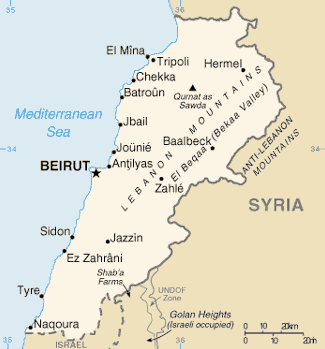
[…] A similar assessment was made about Lebanon, a country without a functioning state or economy and at the mercy of Iran’s colonial army, Hezbollah. This, also, was a situation that was thought to be containable — even as Iran exploited the anarchic chaos of Iraq and Syria to supply its proxy with enough weapons to devastate Israel.
The central conceit of the Abraham Accords was that, irrespective of Hamas, Hezbollah and the occupation of the West Bank, once the Israel-Saudi axis was formed, Iran could be pushed back and contained without direct American involvement. But, then, the depth of Hamas’s murderous brutality on 7 October shattered that assumption, leaving not only a traumatised and vulnerable Israel, but also a traumatised and vulnerable Western order forced to confront the stark realities of the Middle East.
Today, Lebanon is a dead state, eaten alive by Hezbollah’s parasitic power. The scale of the catastrophe in the country is hard to comprehend, much of it caused by the disruptive nature of Syria’s civil war. Since its neighbour’s descent into anarchic hell, some 1.5 million Syrians have sought refuge in Lebanon — a tiny country with a population of just 5 million. But, more fundamentally, with Hezbollah fighting to protect Bashar al Assad, the opposing countries — led by Saudi Arabia — began withdrawing funds from Lebanese banks. This sparked a financial crisis that left Lebanon with no money for fuel.
By spring 2020, the country had defaulted on its debts, sending it into a downward spiral which the World Bank in 2021 described as among “the top 10, possibly top three, most severe crises globally since the mid-nineteenth century”. Lebanon’s GDP plummeted by around a third, with poverty doubling from 42% to 82% in two years. At the same time, the country’s capital, Beirut, was hit by an extraordinary explosion at its port, leaving more than 300,000 homeless. By 2023 the IMF described the situation as “very dangerous” and the US was warning that the collapse of the Lebanese state was “a real possibility”.
With Iranian support, however, Hezbollah created a shadow economy almost entirely separate from this wider collapse. It could escape the energy shortages, while creating its own banks, supermarkets and electricity network. Hezbollah isn’t just a terrorist group. It is a state within a state, complete with a far more advanced army. “They may have plunged Lebanon into complete chaos, but they themselves are not chaotic at all,” as Carmit Valensi, from the Institute for National Security Studies at Tel Aviv University, told the Jerusalem Post.
Then came 7 October, after which Hezbollah tied its fate to that of the Palestinians, promising to bombard Israel with rockets until the war in Gaza was brought to a close. We have witnessed the frightening scale of its power over the past year, its bombardment forcing some 100,000 Israelis from their homes in Galilee to the safety of the Israeli heartlands around Tel Aviv. For the first time since modern Israel’s creation, the land where Jews are able to live in their own state has shrunk; the rockets are a daily reminder of the country’s extraordinary vulnerability, threatened on all sides by states who actively want it removed from the map — even from history itself. The pretence that the Palestinian and Lebanese questions could be contained, ignored or bypassed as part of a wider grand strategy to contain Iran has been shattered.
September 26, 2024
Why Three Arab Nations Lost the Six-Day War Against Israel
Real Time History
Published Jun 5, 2024In just six days in 1967 Israel managed to decisively defeat Egypt, Jordan and Syria in the Six Day War. In the process they expand the territory they control with the Golan Heights, Sinai, the West Bank, and Gaza.
(more…)
September 25, 2024
The Life and Times of Xerxes
seangabb
Published Jun 10, 2024An occasional lecture for our Classics Week, this was given to provide historical background for a lecture from the Music Department on Handel’s opera “Serse” (1738).
Books by Sean Gabb: https://www.amazon.co.uk/kindle-dbs/e…
His historical novels (under the pen name “Richard Blake”): https://www.amazon.co.uk/Richard-Blak…
If you have enjoyed this lecture, its author might enjoy a bag of coffee, or some other small token of esteem: https://www.amazon.co.uk/hz/wishlist/…
September 21, 2024
“This might be the greatest asymmetrical attack in human history”
Terrorist organizations in the Middle East always have to be aware of the risk of coming to the attention of Israel accidentally, and they’ve suffered losses whenever their operations have been prematurely exposed. The attack on Hezbollah’s communications infrastructure is, as Phil A. McBride says in The Line, “something genuinely new in warfare”:

The attack on Hezbollah’s communications through exploding pagers, radios, and other electronic devices triggered a cascade of instant memes.
Detonating the pagers and other devices would have been a relatively easy thing to do (to the extent that any of this was easy!), since it’s obvious that Israel had already penetrated the pager network, and Hezbollah’s communications generally, before the devices were even deployed. Once Israel was confident that they’d put all the devices into the right hands, they simply sent a message — remember, these devices are all intended to receive telecommunications — that somehow triggered the explosions we saw. I don’t know if the explosives did all the damage, or if the batteries were somehow overloaded as well. What is clear is that the explosions were enough to kill, injure and maim people who were directly holding the devices, but not much more. Videos posted online show people suddenly dropping to the ground in agony after their device explodes in their hands, pockets or backpacks, but people in their immediate vicinity are unharmed.
Again, none of this is easy, but if one is looking to remotely detonate a bomb, it helps when the bomb it intended to literally receive incoming communications.
[…]
That covers the pagers and two-way radios, but what about the other various items that exploded? While almost everything electronic you can buy these days has internet/wireless capability, Hezbollah went through a lot of trouble to be as disconnected from the internet as possible. I can only assume they wouldn’t have connected a device meant to read the fingerprints of terrorists trying to enter a safe house to the internet, where a Mossad hack is a constant threat. This means that any other device that exploded not only had explosive charges installed, but also a radio capable of receiving a remote detonation command. The most efficient approach would have been to tune those radios to the same frequencies used by Hezbollah’s two-way radios to minimize the infrastructure needed to pull off what was already an insanely complex operation, but we will need more information to even begin to understand that part of Israel’s plan.
And let’s talk about the plan. The level of sophistication for such an operation cannot be understated. Everything that we’ve seen over the last few days indicates a complete and total breakdown of Hezbollah’s internal security. Israel managed to intercept and infiltrate both their primary and backup communications networks before they were even deployed, as well as a swath of other electronic equipment, and turn them into bombs.
It has been said that communication is the most important component of any military system, but I don’t think anyone had ever thought of actually weaponizing the opposition’s communications infrastructure itself before now. This is something genuinely new in warfare.
September 12, 2024
QotD: The collapse of early civilizations in Mesopotamia
Robert Adams, whose knowledge of the early Mesopotamian states is unsurpassed, expresses some astonishment at the Third Dynasty of Ur (Ur III), in which five kings succeeded one another over a hundred-year period. Though it too collapsed afterward, it represented something of a record of stability.
Scott thinks of these collapses not as disasters or mysteries but as the expected order of things. It is a minor miracle that some guy in a palace can get everyone to stay on his fields and work for him and pay him taxes, and no surprise when this situation stops holding. These collapses rarely involved great loss of life. They could just be a simple transition from “a bunch of farming towns pay taxes to the state center” to “a bunch of farming towns are no longer paying taxes to the state center”. The great world cultures of the time – Egypt, Sumeria, China, whereever – kept chugging along whether or not there was a king in the middle collecting taxes from them. Scott warns against the bias of archaeologists who – deprived of the great monuments and libraries of cuneiform tablets that only a powerful king could produce – curse the resulting interregnum as a dark age or disaster. Probably most people were better off during these times.
Scott Alexander, “Book Review: Against The Grain“, Slate Star Codex, 2019-10-15.
September 8, 2024
Ancient sources
In writing history from the early modern period onward, it’s a common problem to have too many sources for a given event so that it’s the job of the historian to (carefully, one hopes) select the ones that hew closer to the objective truth. In ancient history, on the other hand, we have so few sources to rely upon that it’s a luxury to have multiple accounts of a given event from which to choose:
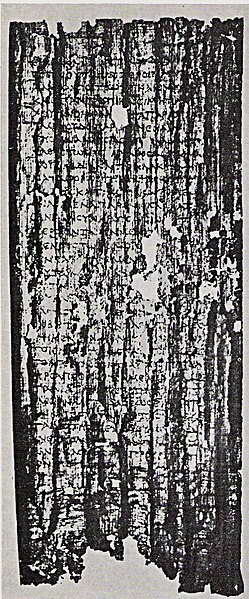
Unrolled papyrus scroll recovered from the Villa of the Papyri.
Picture published in a pamphlet called “Herculaneum and the Villa of the Papyri” by Amedeo Maiuri in 1974. (Wikimedia Commons)
We used to play this game in graduate school: find one, lose one. Find one referred to finding a lost ancient text, something that we know existed at one time because other ancient sources talk about it, but which has been lost to the ages. What if someone was digging somewhere in Egypt and found an ancient Greco-Roman trash dump with a complete copy of a precious text – which one would we wish into survival? Lose one referred to some ancient text we have, but we would give up in some Faustian bargain to resurrect the former text from the dead. Of course there is a bit of the butterfly effect; that’s what made it fun. As budding classicists, we grew up in an academic world where we didn’t have A, but did have B. How different would classical scholarship be if that switched? If we had had A all along, but never had B? For me, the text I always chose to find was a little-known pamphlet circulated in the late fourth century by a deposed Spartan king named Pausanias. It’s one of the few texts about Sparta written by a Spartan while Sparta was still hegemonic. I always lost the Gospel of Matthew. It’s basically a copy of Mark, right down to the grammar and syntax. Do we really need two?
What would you choose? Consider that Homer’s Iliad and Odyssey are only two of the poems that make up the eight-part Epic Cycle. Or that Aristotle wrote a lost treatise on comedy, not to mention his own Socratic dialogues that Cicero described as a “river of gold”. Or that only eight of Aeschylus’s estimated 70 plays survive. Even the Hebrew Old Testament refers to 20 ancient texts that no longer exist. There are literally lost texts that, if we had them, would in all likelihood have made it into the biblical canon.
The problem is more complex than the fact that many texts were lost to the annals of history. Most people just see the most recent translation of the Iliad or works of Cicero on the shelf at a bookstore, and assume that these texts have been handed down in a fairly predictable way generation after generation: scribes faithfully made copies from ancient Greece through the Middle Ages and eventually, with the advent of the printing press, reliable versions of these texts were made available in the vernacular of the time and place to everyone who wanted them. Onward and upward goes the intellectual arc of history! That’s what I thought, too.
But the fact is, many of even the most famous works we have from antiquity have a long and complicated history. Almost no text is decoded easily; the process of bringing readable translations of ancient texts into the hands of modern readers requires the cooperation of scholars across numerous disciplines. This means hours of hard work by those who find the texts, those who preserve the texts, and those who translate them, to name a few. Even with this commitment, many texts were lost – the usual estimate is 99 percent – so we have no copies of most of the works from antiquity.1 Despite this sobering statistic, every once in a while, something new is discovered. That promise, that some prominent text from the ancient world might be just under the next sand dune, is what has preserved scholars’ passion to keep searching in the hope of finding new sources that solve mysteries of the past.
And scholars’ suffering paid off! Consider the Villa of the Papyri, where in the eighteenth century hundreds, if not thousands, of scrolls were discovered carbonized in the wreckage of the Mount Vesuvius eruption (79 AD), in a town called Herculaneum near Pompeii. For over a century, scholars have hoped that future science might help them read these scrolls. Just in the last few months – through advances in computer imaging and digital unwrapping – we have read the first lines. This was due, in large part, to the hard work of Dr. Brent Seales, the support of the Vesuvius Challenge, and scholars who answered the call. We are now poised to read thousands of new ancient texts over the coming years.
[…]
Now let’s look at a text with a very different history, the Hellenica Oxyrhynchia. The Hellenica Oxyrhynchia is the name given to a group of papyrus fragments found in 1906 at the ancient city of Oxyrhynchus, modern Al-Bahnasa, Egypt (about a third of the way down the Nile from Cairo to the Aswan Dam). These fragments were found in an ancient trash heap. They cover Greek political and military history from the closing years of the Peloponnesian War into the middle of the fourth century BC. In his Hellenica, Xenophon covers the exact same time frame and many of the same events.2 Both accounts pick up where Thucydides, the leading historian of the Peloponnesian War (fought between Athens and Sparta in the fifth century BC), leaves off.
While no author has been identified for the Hellenica Oxyrhynchia, the grammar and style date the text to the era of the events it describes. This is a recovered text, meaning it was completely lost to history and only discovered in the early twentieth century. Here, the word discovered is appropriately used, as this was not a text that was renowned in ancient times. No ancient historians reference it, and it did not seem to have a lasting impact in its day. What is dismissible in the past is forgotten in the present. The text is written in Attic Greek. This implies that whoever wrote the Hellenica Oxyrhynchia must have been an elite familiar enough with the popular Attic style to replicate it, and likely intended for the history to equal those of Thucydides and Xenophon. There were other styles available to use at the time but Attic Greek was the style of both the aforementioned historians, as well as the writing style of the elite originating in Athens. Any history not written in Attic would have been seen as inferior. Given that the Hellenica Oxyrhynchia was lost for thousands of years, it would seem our author failed in his endeavor to mirror the great historians of classical Greece.
The Hellenica Oxyrhynchia serves as a reminder that the modern discovery of ancient texts continues. Many times, these are additional copies of texts we already have. This is not to say these copies are not important. Such was the case of the aforementioned Codex Siniaticus, discovered by biblical scholar Konstantin von Tischendorf in a trash basket, waiting to be burned, in a monastery near Mount Sinai in Egypt in 1844. Upon closer examination, Tischendorf discovered this “trash” was in fact a nearly complete copy of the Christian Bible, containing the earliest complete New Testament we have. One major discrepancy is that the famous story of Jesus and the woman taken in adultery – from which the oft-quoted passage “let he who is without sin cast the first stone” originates – is not found in the Codex Sinaiticus.
Yet, sometimes something truly new to us, that no one has seen for thousands of years, is unearthed. In the case of the Hellenica Oxyrhynchia, no one seemingly had looked at this text for at least 1,500 years, maybe more. This demonstrates that there is always the possibility that buried in some ancient scrap heap in the desert might be a completely new text that, once published for wider scholarship, greatly increases our knowledge of the ancients.
How does this specific text increase our knowledge? Bear in mind that before this period of Greek history, we have just one historian per era. Herodotus is the only source we have for the Greco-Persian Wars (480–479), and the aforementioned Thucydides picks up from there and quickly covers the political climate before beginning his history proper with the advent of the Peloponnesian War in 431 BC. But Thucydides’s history is unfinished – one ancient biography claims he was murdered on his way back to Athens around 404 BC. Many doubt this, citing evidence that he lived into the early fourth century BC. Either way, his narrative ends abruptly. Xenophon picks it up from there, and later we get a more brief history of this period from Diodorus, who wrote much later, between 60 and 30 BC. While describing the same time frame and many of the same events, these two sources vary widely in their descriptions of certain events. In some cases, they make mutually exclusive claims. One historian must have got it wrong.
For centuries, Xenophon’s account was the preferred text. That is not to say Diodorus’s history was dismissed, but when the two accounts were in conflict, Xenophon’s testimony got the nod. This was partially because Xenophon actually lived during the times he wrote about, whereas Diodorus lived 200 years after these events in Greek history. Consider if there were two conflicting accounts of the Battle of Gettysburg from two different historians: one actually lived during and participated in the war, while the other was a twenty-first century scholar living 150 years after the events he describes. They disagree on key elements of the battle. Who do you believe? This was precisely the case with Xenophon and Diodorus. Yet, once the Hellenica Oxyrhynchia was published, it corroborated Diodorus’s history far more than that of Xenophon, forcing historians to reconsider their bias toward the older of the two accounts.
1. You can find a list of texts we know that we have lost at the Wikipedia page “Lost literary work“.
2. “Oxyrhynchus Historian”, in The Oxford Companion to Classical Literature, ed. MC Howatson (Oxford University Press, 2011).
September 4, 2024
British Foreign Secretary David Lammy indulges himself with a Trudeau-esque bit of geopolitical posturing
In Spiked, Brendan O’Neill outlines the British government’s odd choice of timing to announce suspension of (some) arms shipments to Israel:
Bereft of vision, the modern politician is obsessed with “optics”. Which makes foreign secretary David Lammy’s announcement this week that the UK will be suspending some arms exports to Israel all the more surreal. The optics of withholding weapons from the Jewish State the day after we discovered that its enemy is so ruthless it will happily murder young Jews in cold blood are atrocious. Did not one functionary in the Foreign Office think to raise his or her hand and say: “Sir, should we at least wait until the bodies of those six Israeli hostages are cold before we shame and punish the nation they came from?”
This goes way beyond optics, of course. It is more than a failure of spin. It is a failure – a colossal, unforgivable one – of morality. As the bodies of the six slain Jews found in one of Hamas’s hellish lairs in Rafah were being transported back to a grief-stricken Israel, our government took action not against the Islamist extremists who carried out this unutterable atrocity, but against the nation that suffered it. Mere hours after the discovery of an act of fascistic savagery, our government handed a propaganda victory to the fascists by dragging Israel’s name through the mud. What were they thinking? Shameful doesn’t cover it.
Mr Lammy has said around 10 per cent of arms sales to Israel will be suspended. Thirty out of 350 arms-exports licences will be cancelled, primarily affecting parts for fighter jets, helicopters and drones. The reason for this smug, haughty smackdown of the Jewish State? Because there’s a “clear risk”, said Lammy, that such equipment will be used to “commit or facilitate a serious violation of international humanitarian law”. Big talk from a politician who noisily supported the West’s imperial bombardment of Iraq that led to the deaths of hundreds of thousands of civilians and the widescale torture and rape of prisoners.
Many are damning Lammy’s partial embargo as gesture politics. “What is the point?”, headlines wonder. Denying Israel a few parts for planes won’t make much difference, some moan. For the frothing Israelophobes of the iffy left, nothing less than a complete arms embargo will do. They want not one gun to go to crazy Israel. If only there was a word to describe people who agitate morning, noon and night for the disarming of a Jewish nation that recently suffered the worst act of anti-Semitic violence since the Holocaust.
The obsession with the partial nature of Lammy’s reprimanding of Israel misses the point. What the Foreign Office has just done is huge – and profoundly troubling. Sure, it won’t make much of a dent in Israel’s ability to fight Hamas, but it will cast aspersions on Israel’s fight against Hamas. It won’t militarily weaken Israel’s war on the pogromists that slaughtered more than a thousand of its people on 7 October, but it might morally weaken that war with its sly implication that there’s a criminal element to this crusade against Hamas’s army of anti-Semites. The partial arms embargo is indicative of something far more unsettling: a solidarity embargo as Britain slowly but surely turns its back on the Jewish nation.
August 27, 2024
Was 1974 the worst year in British politics or just the worst year so far?
I wasn’t in the UK in 1974 (although I did spend a couple of dystopian weeks there in January 1979), so I don’t know from personal experience just how bad things were, but as Ed West considers Dominic Sandbrook’s very informative social history Seasons in the Sun, he certainly helps make a strong case for it:

One of my favourite moments from reading Fever Pitch as a teenager was the passage where Nick Hornby and a friend bunk off school to watch Arsenal play West Ham, a game which was being held on a weekday afternoon because there wasn’t enough electricity for the floodlights. Britain was enduring a three-day week due to the energy crisis, and assuming the ground would be empty, Hornby is stunned to find it packed with 60,000 people, all skiving off work, and he recalls his hypocritical juvenile disgust at the idleness of the British public.
The scene encapsulates the comic crapness of that period, one that many of us have enjoyed laughing at with the recent Rest is History series on 1974. I began reading Sandbrook’s book Seasons in the Sun afterwards, from where the material for the series was drawn; the early chapters comprise a highly entertaining account of what he described on the podcast as “the worst year in British politics”. Reassuring, perhaps, for those of us inclined towards pessimism, although to paraphrase Homer Simpson, perhaps it was only the worst year so far.
Nineteen-seventy-four saw two elections, the first of which ended in a hung parliament, with Labour as the largest party, and the second with Harold Wilson winning with a majority of 3. These were fought between parties led by exhausted leaders who had run out of ideas, with a third, the Liberals headed by Jeremy Thorpe, soon to be notorious as a dog killer. Britain had declined from the richest country on the continent to one of the poorest in western Europe, and its economy seemed to be falling apart.
During his troubled four years in office Edward Heath had called a state of emergency several times, culminating in ration cards for petrol and power restrictions. In 1973 Heath had “told his Chancellor, Anthony Barber, to go for broke”, Sandbrook writes: “It was one of the greatest economic gambles in modern history: while credit soared and the money supply boomed, Heath hoped to keep inflation down through an elaborate system of wage and price controls”. By October that year, “his hopes were unravelling at terrifying speed”.
The “Barber boom” led to “house prices surging by 25 per cent in just six months, the cost of imports rocketing and Britain’s trade balance plunging deep into the red”. Yet just a week after Heath had published details of his “Stage Three” incomes policy, “the Arab oil exporters in the OPEC cartel announced a stunning 70 per cent increase in the posted price of oil, punishing the West for its support for Israel. It was a devastating blow to the world economy, but nowhere was its impact greater than in Britain.”
The stock market lost a quarter of its value in just a month, while by January 1974 share prices had fallen by almost half in under two years. Just before Christmas, the government cut spending by 4 per cent, and Labour’s Shadow Chancellor, Denis Healey, “warned his colleagues that Britain stood on the brink of an ‘economic holocaust'”. Nine out of ten people told a Harris poll that “things are going very badly for Britain” and nearly as many foresaw no improvement in the coming year. They turned out to be correct.
Amid trouble with the National Union of Mineworkers, in November 1973 “Heath announced his fifth state of emergency in barely four years. Floodlighting and electric advertising were banned; behind the scenes, the government began printing petrol ration cards. As the railwaymen voted to join the miners in pursuit of higher pay, it seemed that Britain was sliding into darkness. Offices were ordered to turn down their thermostats, while the BBC and ITV were banned from broadcasting after 10.30 at night. On New Year’s Day, with fuel supplies running dangerously low, the entire nation went on a three-day working week.” Happy days.
August 17, 2024
“The notion of a pre-existing Palestinian state is a modern fabrication that ignores the region’s actual history”
Debunking some of the common talking points about the Arab-Israeli conflicts down to the present day:
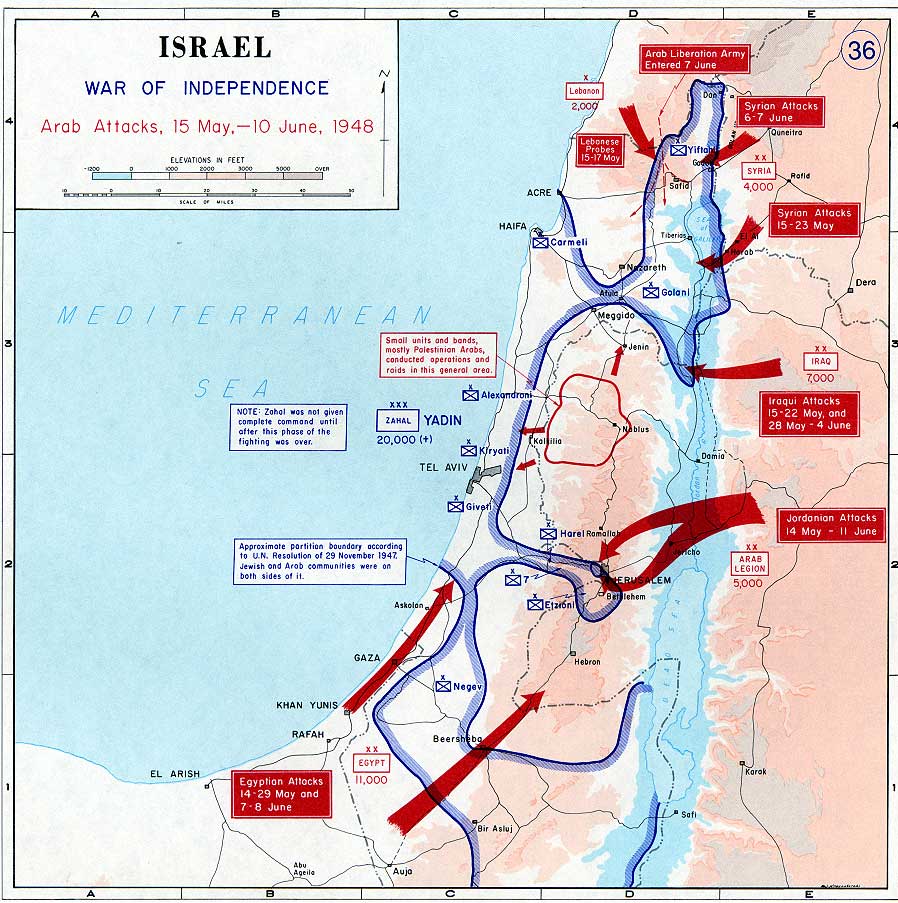
Arab attacks in May and June 1948.
United States Military Academy Atlas, Link.
Before Israel declared independence in 1948, the region now known as Israel, the West Bank and the Gaza Strip was part of the British Mandate for Palestine, which was established by the League of Nations after the fall of the Ottoman Empire in the First World War.
Under Ottoman rule, the area was divided into various administrative districts, with no distinct political entity known as “Palestine”. The concept of a Palestinian national identity emerged in the 20th century, largely in response to the Zionist movement and increased Jewish immigration in the area.
However, there was never a Palestinian state, flag or anthem. The notion of a pre-existing Palestinian state is a modern fabrication that ignores the region’s actual history.
The modern State of Israel’s legitimacy is rooted in international law and global recognition. On Nov. 29, 1947, the United Nations General Assembly passed Resolution 181, known as the “Partition Plan”, proposing two states — one Jewish and one Arab.
The Jewish community accepted the plan, demonstrating a willingness to compromise for peace. However, the Arab states rejected it, refusing to recognize any Jewish state, and instead launched a military assault on Israel following its declaration of independence on May 14, 1948.
Another pervasive myth is the “Nakba” or “catastrophe”, narrative, which claims that Palestinians were forcibly expelled by Israel in 1948. This version omits the critical context that it was the Arab nations that invaded Israel, causing many Arabs to be expelled or flee their homes.
Rather than absorbing the displaced population, the surrounding Arab countries kept them in refugee camps, using them as pawns to pressure Israel. Organizations like UNRWA perpetuated this situation, keeping Palestinians in limbo rather than encouraging their integration into their host countries. This contrasts sharply with how other refugee populations have been handled, where integration and resettlement are the norm.
The land referred to as “Palestine” has always been inherently Jewish. The Jewish people have maintained a continuous presence there for thousands of years, long before Islam or the Arab conquests.
August 3, 2024
QotD: Grain farming and the rise of organized states
But you can tax grain farmers! You can assign them some land, and come back around harvest time, and there will be a bunch of grain just standing there for you to take ten percent of. If the grain farmer flees, you can take his grain without him. Then you can grind the grain up and have a nice homogenous, dense, easy-to-transport grain product that you can dole out in measured rations. Grain farming was a giant leap in oppressability.
In this model, the gradual drying-out of Sumeria in the 4th millennium BC caused a shift away from wetland foraging and toward grain farming. The advent of grain farming made oppression possible, and a new class of oppression-entrepreneurs arose to turn this possibility into a reality. They incentivized farmers to intensify grain production further at the expense of other foods, and this turned into a vicious cycle of stronger states = more grain = stronger states. Within a few centuries, Uruk and a few other cities developed the full model: tax collectors, to take the grain; scribes, to measure the grain; and priests, to write stories like The Debate Between Sheep And Grain, with immortal lines like:
From sunrise till sunset, may the name of Grain be praised. People should submit to the yoke of Grain. Whoever has silver, whoever has jewels, whoever has cattle, whoever has sheep shall take a seat at the gate of whoever has Grain, and pass his time there
And so the people were taught that growing grain was Correct and Right and The Will Of God and they shouldn’t do anything stupid like try to escape back to the very close and easily-escapable-to areas where everyone was still living in Edenic plenty.
… turns out lots of people in early states escaped to the very close and easily-escapable-to areas where everyone was still living in Edenic plenty. Early states were necessarily tiny; overland transportation of resources more than a few miles was cost-prohibitive; you could do a little better by having the state on a river and adding in water transport, but Uruk’s sphere of influence was still probably just a double-digit number of kilometers. Even in good times, peasants would be tempted to escape to the hills and wetlands; in bad times, it started seeming crazy not to try this. Scott suggests that ancient Uruk had a weaker distinction between “subject” and “slave” than we would expect. Although there were certainly literal slaves involved in mining and manufacturing, even the typical subject was a serf at best, bound to the land and monitored for flight risk.
Scott Alexander, “Book Review: Against The Grain“, Slate Star Codex, 2019-10-15.


