
The Tank Museum
Published Apr 13, 2024Two tanks designed to fight each other in Northern Europe would face each other during the Iran-Iraq war in 1981. On one side, the British built Chieftain MBT. On the other, the Soviet-built T-62.
In this video, we examine what happened during Operation Nasr to find out which tank came out on top …
00:00 | Intro
01:19 | Meet the Tanks
02:15 | The T-62
03:26 | The Chieftain
06:21 | From Paper to the Battlefield
09:25 | The Outcome and Findings
(more…)
July 24, 2024
Chieftain V T-62 | Operation Nasr, Iran – Iraq War, 1981
Comments Off on Chieftain V T-62 | Operation Nasr, Iran – Iraq War, 1981
July 23, 2024
Claim – “Everybody wants Gaza’s gas”
Tim Worstall explains why the popular idea that it’s demand for the natural gas reserves that sit under Palestine that is driving much of the situation in the Middle East is utter codswallop:

“Oil Platform in the Santa Barbara Channel, California” by Ken Lund is licensed under CC BY-SA 2.0 

 .
.
So we’ve a big thing about how all this fighting in Gaza is really about fossil fuels. @JamesMelville seems to think it’s true:
“Everybody wants Gaza’s gas.”
Oil and gas reserves – that’s the real proxy war in the Middle East.
This video provides a really succinct summary of the situation.
This “really succinct” summary includes the idea that the invasion of Iraq was all about access to that country’s oil. Which is very silly indeed. Before the war people paid Iraq for the oil. During the war people paid Iraq for the oil. After the war people are paying Iraq for the oil. The war hasn’t changed Iraq’s oil price — the global oil price has changed it, but not the war — and so the effect of the war upon access to Iraq’s oil has been, well, it’s been zero.
No, it’s not possible to then go off and say that Iraq wouldn’t sell to Americans and that’s why or anything like that. The US didn’t buy much Middle East oil anyway — mainly West African instead. But more than that, this is idiocy about how commodity markets work.
This is something we can test with a more recent example. So, there are sanctions on Russian oil these days over Ukraine. Western Europe, the US, doesn’t buy Russian oil. Russia is still exporting about what it used to. Because it’s a commodity, oil is.
What’s happening is that the Russian oil that used to come to Europe now goes to — say — India. And the Far East, or Middle East, whatever, oil that used to go to India now comes to Europe (the US is now a net exporter itself). Because that’s what happens with commodities. The very name, commodity, means they are substitutable. So, if one particular source cannot sell to one particular user then there’s a bit of a reshuffle. The same oil gets produced, the same oil gets consumed, it’s just the consumption has been moved around a bit and is now by different people. The net effect of sanctions on Russian oil has been, more or less, to increase the profits of those who run oil tankers. Ho Hum.
We’re also treated to the revelation that the US wants everyone to use liquefied natural gas because the US is the big exporter of LNG (well, it’s one). Therefore the US insists that Israel must develop the LNG fields off Gaza. Which is insane. If you’re an exporter you don’t want to start insisting on the start up of your own competition. The US demanding that the LNG not be produced at all would make logical sense but that’s not how conspirazoid ignorance works, is it? It has to be both a conspiracy and also a ludicrous one.
And a third claim. That this natural gas off Gaza is really worth $500 billion. That’s half a trillion dollars. We’ve looked at this value of gas off Gaza claim before and it’s tittery. $4 billion (that’s four billion, not five hundred billion) might be a reasonable claim and that’s just not enough to go to war over.
Comments Off on Claim – “Everybody wants Gaza’s gas”
July 10, 2024
After 1177 B.C.
Jane Psmith reviews the follow-on book from Eric Kline’s bestseller about the Bronze Age Collapse, After 1177 B.C.: The Survival of Civilizations:
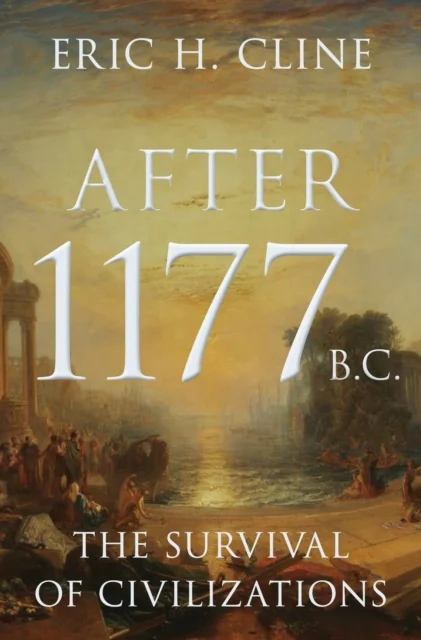
Sometime around 1150 BC, the dense network of politically, economically, and culturally interdependent states around the eastern Mediterranean collapsed. In 2014, GWU archaeologist Eric Cline wrote a book about it. And then, surprisingly, it became a bestseller.
Okay, maybe it’s not that much of a surprise: most people can recognize an obvious historical analogy when it hits them over the head, and the globalized1 state system of the Late Bronze Age has extremely clear parallels to the modern day. An interconnected and cosmopolitan world? Centralized state bureaucracy? High-level diplomacy between ruling elites? A technologically complex civilization enabled by extensive international trade along lengthy and elaborate supply chains? Well, gosh, that seems remarkably familiar. An audience that had just weathered a global financial crisis (and, later, a global pandemic) was perfectly poised to appreciate Cline’s exploration of the fragility of complex systems. No wonder it sold! (A copy entered the Psmith household in early 2020 for, uh, obvious reasons.)
Cline’s basic argument in the book was that the Collapse was due not to any single cause but to a “perfect storm” of calamities: drought and accompanying famine, earthquake, internal rebellion, external invasion. These were all problems that the civilizations of the Bronze Age Mediterranean had faced and survived in the past, but under their combined onslaught the most fragile parts of the system at last began buckle. When one society disintegrated, its sudden absence from the interconnected global economy became a new stressor on its surviving neighbors — until at last, domino-like, the whole thing came down.2 It would be decades, or in some places centuries, before the standard of living returned to anything like its previous level, and it would be nearly five hundred years before an international system as complex and sophisticated as the world of the Late Bronze Age emerged.
Now, a decade after his original book, Cline has a sequel exploring what happened after the Collapse. Which civilizations were able to rebound to something approaching their former glory, which barely managed to limp along into the Iron Age, and which vanished into the sands of time? And, more importantly, why?
This is a much more difficult story to tell. The original 1177 B.C. spent much of its page count on the zenith of Bronze Age civilization, the 15th through 13th centuries BC, to explain what it was that did the collapsing. It’s a sweeping tale, full of wonderful stories and fascinating digressions into the historicity of the Trojan War (yes) and the Exodus (not archeologically substantiated) as well as being a compelling portrait of a complicated set of societies. Cline’s narrative darts from Egypt to Assyria to the Aegean to the Hittites, treating each in turn as he moves forward through time towards what we all know is coming.
But chronological framing is impossible for the sequel. There is, definitionally — there can be — no grand narrative of regional divergence after the fall of a “world-system“. The fate of Mesopotamia is no longer linked to that of Greece; there are no more Cretan envoys in New Kingdom tomb reliefs, no more battles between the Hittite Great King and the wanax of a Mycenaean palatial center, no more Uzbek tin shipwrecked off the coast of Anatolia. Once the ties are cut, each story must stand alone, and accordingly Cline gives each region its own chapter.
Alas, this is a lot less fun to read.
1. For sufficiently small values of “globe”. But larger than you might expect!
2. The revised 2021 edition apparently gives a larger role to climate factors, especially the 3.2kya megadrought, but that’s not the one I read and anyway the other elements were still present.
Comments Off on After 1177 B.C.
July 5, 2024
“Private property rights? How do they work?” (U of T students, probably)
In The Line, Josh Dehaas rounds up the concept of private property rights for the University of Toronto students (and non-student antisemitic fellow occupiers) who have been squatting for Palestinian terrorists on university property for the last while:
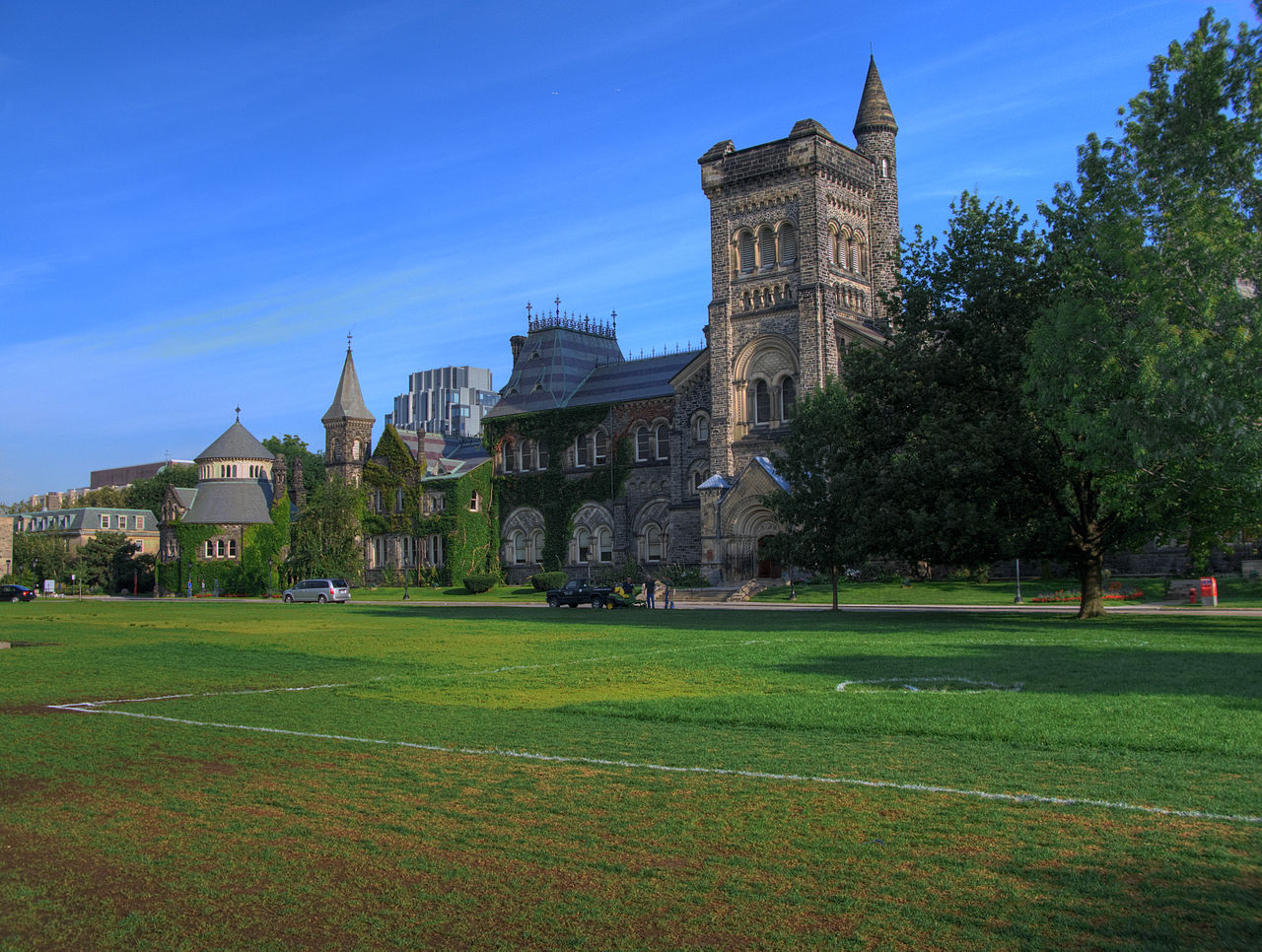
University College, University of Toronto, 31 July, 2008.
Photo by “SurlyDuff” via Wikimedia Commons.
After Justice Koehnen delivered his ruling Tuesday ordering the occupiers to dismantle the People’s Circle for Palestine at the University of Toronto, one of the protesters accused the school of hypocrisy.
“It’s quite interesting that a university that claims to practice decolonization is falling back on this claim of private property,” master’s student Sarah Rasikh told a journalist on the day before the students began taking down their tents.
“U of T and the Court more specifically is quite literally telling Indigenous students to leave and get off of their own land,” she added.
Rasikh has a point, sort of.
As someone who did law school relatively recently, I can attest that many university professors are downright hostile to the concept of private property. They commonly claim that all of Canada belongs to Indigenous people and that Indigenous peoples don’t believe in private property. Rather, they believe in “sharing”. Decolonization therefore requires that land be treated communally, or so the theory goes. University administrators who pay lip service to the concept of decolonization shouldn’t be surprised when students try to turn theory into action.
Thankfully the law still protects private property rights. Students who didn’t get taught how that works by their professors ought to give Justice Koehnen’s decision a read.
As Justice Koehnen explained, “in our society we have decided that the owner of property generally gets to decide what happens on the property”.
“If the protesters can take that power for themselves by seizing Front Campus, there is nothing to stop a stronger group from coming and taking the space over from the current protesters,” he went on. “That leads to chaos. Society needs an orderly way of addressing competing demands on space. The system we have agreed to is that the owner gets to decide how to use the space.”
“If it is not the owner who gets to determine what happens on the property it will become a brutal free-for-all,” Justice Koehnen added.
Comments Off on “Private property rights? How do they work?” (U of T students, probably)
The shameful Canadian coda to Operation Craven Bugout in Kabul
As if there wasn’t already enough to be ashamed about in Canada’s part in the shambolic retreat from Kabul in August of 2021, yet more discreditable actions have come to light recently:
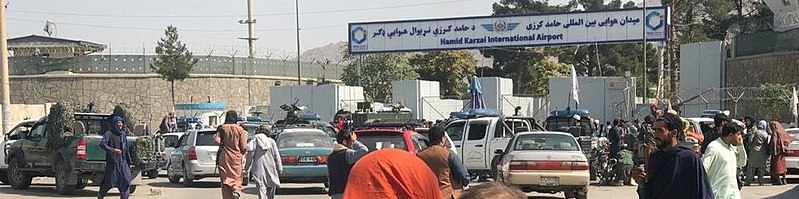
On the second day of the Taliban’s rule in Kabul, the front of Hamid Karzai International Airport was crowded with people trying to travel abroad, but were stopped by Taliban militants, 17 August, 2021.
Public domain image from VOA via Wikimedia Commons.
Last week it came to light through the reporting of Steven Chase and Robert Fife at the Globe and Mail that the then-minister of national defence, Harjit Sajjan, directed the Canadian Armed Forces (CAF) to divert resources during the evacuation of Afghanistan to assist Afghan Sikhs and Hindus leave the collapsing state. What is important to emphasize is how another group, the interpreters and other individuals who directly assisted the Canadian mission, were treated before, during, and after the mission—as well as the shambolic nature of how the evacuation effort unfolded.
Rather than this affair just being a story about a single minister allegedly influencing a poorly planned evacuation for his own partisan interests, the entire episode suggests something more banal and disgraceful about Canada’s foreign policy, both before the crisis and in response. Even in the years and months leading up to the fall of Kabul in August 2021, at nearly every turn the government sought to avoid any responsibility to assist interpreters and others until it became politically untenable to continue that policy.
At the same time, policy amendments were made to assist the Afghan Sikh and Hindu population—a group with strong domestic political backing here in Canada. Indeed, further reporting from Fife and Chase has revealed that Afghan Sikh sponsors even donated to Sajjan’s riding association during the evacuation campaign. Overall, it was these partisan considerations held across the governing Liberal Party that influenced the outcome of events in the retreat from Afghanistan, with terrible consequences for those people who needed Canada’s help the most.
It is important to start by explaining why the Afghan interpreters have become such a focus for many within Canadian society. These individuals put their lives at unimaginable risk to help Canada’s mission in the belief that they were helping to build a better Afghanistan. It explains why so many Canadian Armed Forces members and other individuals who worked in Afghanistan have been so vocally committed to bringing these individuals out of the country.
While Afghan interpreters have commanded the greatest attention in the public’s view since the fall of Kabul, it is a bit misleading to focus solely on them. Local aid workers who undertook program delivery for the government were in many ways as essential for Canada’s objectives as translators, and just as exposed to blowback. They were often the public face for socially liberal programs in a deeply conservative Afghan society and constantly faced retribution for their actions. Thus it is more accurate to use the government of Canada’s collective terminology for these individuals: former locally engaged staff.
They often quite literally put their lives on the line to help Canada’s cause, yet when they needed us most, the government refused to prioritize their aid, effectively abandoning them.
Comments Off on The shameful Canadian coda to Operation Craven Bugout in Kabul
July 1, 2024
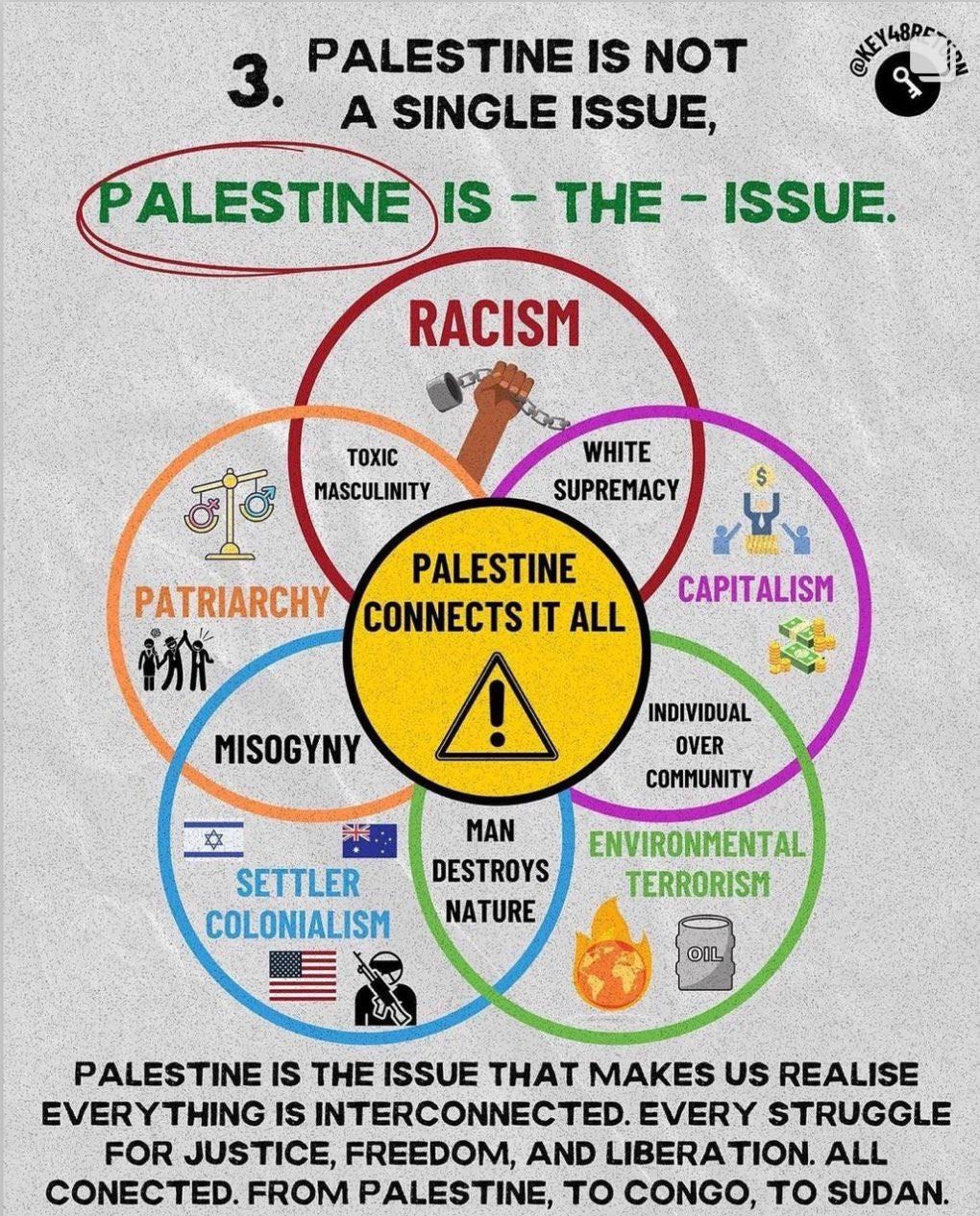
Welcome to the “Omnicause” (aka “the Fatberg of Activism”)
Helen Dale first encountered the Omnicause as a university student council member:
For my sins — in 1991 — I spent a year on the University of Queensland Student Union Council. Yes, I was elected, which means I was a volunteer. It ranks up there among the more pointless activities I’ve undertaken. I was 19, that’s my excuse.
Because I’m conscientious, I took it seriously. I turned up to the monthly meetings. I researched the motions to be debated and voted on in advance. I tried to say not-stupid-things when I thought it was worth making a comment. One side benefit: I learnt meeting procedure.
I also had my first encounter with the Omnicause.
Every single student union council meeting had a Palestine motion, sometimes more than one. These were long, detailed, and competently drafted. They routinely dominated more typical student union fare: budgetary allocations to fix the Rec Club roof, say, or complaints about tuition fees. I wondered what the union’s employed secretarial staff thought of typing up and then photocopying pages upon pages of tedious detail about Middle Eastern geopolitics. I remember picking up copies of both minutes and agendas and boggling at the amount of work involved.
There, in miniature — in sleepy meetings in hot rooms where dust particles danced in stray sunbeams as those of us reading law or STEM subjects tried to make sense of it all — was the Omnicause we now see in campuses all over the developed world. My earliest memories of it involve Aboriginal activists describing Australia as a “settler-colonial state” which had been “invaded” — just like Israel. Australia also had no right to exist.
During one meeting, a Palestine-obsessive buttonholed an engineering student known for his commitment to conservation, bending his ear about the Nakba. I misunderstood the exchange, and congratulated my Greens fellow councillor on recruiting a new party member.
“I’m not sure we want her,” he said. “She doesn’t know or care about the environment, just this Israel thing.”
Already, in 1991, the infant Omnicause had learnt to crawl. It was possible to see — albeit dimly — what would happen to genuine conservationists as single-issue lunatics took over their movement and rotted its political party from within. Darren Johnson — whom I’d call a “Green Green” — and his cri de coeur captures the process well:
Terrible haircut I know, but here’s me in the Hull Daily Mail running for the Green Party in 1990. I stood on a platform of male rapists in female prisons, hormone drugs for 10yos and rebranding women as uterus-owners. No, don’t be silly, it was housing, environment & poll tax.
Darren Johnson, recall, was the UK Green Party’s former principal speaker, its first-ever London councillor, twice its London mayoral candidate, and is a former chair of the London Assembly.
The Omnicause: what writer Hadley Freeman calls “the fatberg of activism”. This is a genuine flyer, by the way. I admit to suspecting the work of Mole at the Counter, General Boles, Famous Artist Birdy Rose, or Burnside Not Tosh — so I checked.
The Greens in both Australia and the UK have become a vector for much of the worst nonsense: trans and Gaza and chucking orange paint around an art gallery near you have displaced saving the Fluffy Antechinus1 or improving biodiversity, quite apart from anything else. Trans, in my view, is also part of the Omnicause, albeit a junior partner. Like Palestine, it’s capable of colonising major political movements focussed on something else entirely, as this (justifiably angry) supporter of Scottish independence points out.
1. This animal does not exist, although the Antechinus does.
Comments Off on Welcome to the “Omnicause” (aka “the Fatberg of Activism”)
June 26, 2024
Lord Balfour
Arthur Lord Balfour, Conservative Prime Minister from 1902 to 1905, is perhaps best known for the Balfour Declaration issued during World War 1 that established the formal goal of an independent homeland for the Jews in the Holy Land. Who was he? Barbara Kay’s essay originally published in the Dorchester Review was recently reposted at Woke Watch Canada:
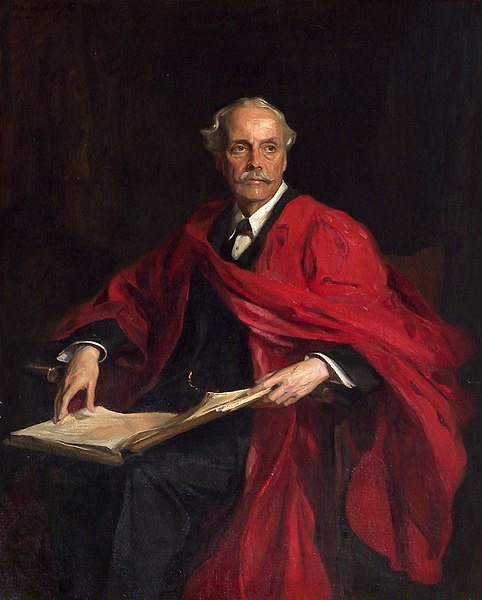
“Arthur James Balfour, 1st Earl of Balfour, KG, OM, PC, Prime Minister and Philosopher” portrait in oil by Philip de László, 1914.
From the Trinity College collection via Wikimedia Commons.
Why was the aristocrat Lord Balfour, the social antithesis of this humble Jew from the Pale of Russia, so taken with Weizmann’s vision that he was willing to expend political capital and exert so much effort to see it realized? Who was Balfour? What was he?
Arthur James Balfour was born at his family seat, Whittingehame, in East Lothian, the “granary of Scotland”. A forebear had made a fortune in India in military materials, so he was financially secure for life, and socially connected at the highest levels.
Having lost his father when he was 7, Balfour was lucky in his mother, a strong-willed and educated woman who, according to Mrs Dugdale, inculcated the idea of duty as “the uncompromising foundation of his character”. He attended Eton and Cambridge, where he was described by a friend as “a man of unusual philosophy and metaphysics”, who could hold his own with the Dons (professors), “some of them men of undoubted genius”. He was devoted to his extended family, and much beloved by his nieces and nephews.
In his essay “Arthur Balfour: a Fatal Charm”1 cultural critic Ferdinand Mount cites “nonchalance” as Balfour’s defining trait. Legendarily indolent, he rarely rose before 11 a.m., claimed never to read newspapers, and disdained the ritual schmoozing of fellow backbenchers expected by his peers in the Members’ Smoking Room. Mount says he was “indifferent to what his colleagues, the public or posterity thought of him or his policies”.
This loftiness — echoed in his unusual physical height — was perceived as admirable or maddening according to the observer and circumstances. Churchill said of him: “He was quite fearless. When they took him to the Front to see the war, he admired the bursting shells blandly through his pince-nez. There was in fact no way of getting to him.”
His self-sufficiency was no act. Sports-mad, he skipped lunch with the Kaiser to watch the Eton and Harrow cricket match, and when in Scotland might play two full rounds of golf a day (his handicap of 10 was better than P. G. Wodehouse and about the same as thriller writer Ian Fleming’s).
Balfour sounds from my description so far as if he was something of a playboy, but that is a very partial portrait. He was also known as “Bloody Balfour” for his readiness to endorse police action and his apparent indifference to their cost.
The Irish loathed him. In 1887 he became personal secretary for Ireland under his uncle, Lord Salisbury, just in time to enforce the Coercion Act against the volatile Irish Land League. Indeed, Balfour’s parliamentary critic William O’Brien saw him as a man who harboured a “lust for slaughter with a eunuchized imagination” who took “a strange pleasure in mere purposeless human suffering, which imparted a delicious excitement to his languid life”.
One hopes this accusation of actual sadism is an exaggeration of Balfour’s indubitable detachment. Yet indifference to human life is certainly not an uncommon charge laid against intellectuals for whom ideas loom larger in their claims to attention than the fate of those beyond their particular tribes.
For balance, we have Barbara Tuchman’s assessment:
Balfour had a capacious and philosophical mind. Words to describe him by contemporaries are often “charm” and “cynicism”. He had a profound and philosophic mind, he was lazy, imperturbable in any fracas, shunned detail, left facts to subordinates, played tennis whenever possible, but pursued his principles of statecraft with every art of politics under the command of a superb intelligence.
Fortunately for his temperament, Balfour’s life circumstances had landed him at the centre of a genuinely intellectual circle. His brothers in-law, for example, were Lord Rayleigh, who became head of the Cambridge Laboratory and won the Nobel Prize for Physics, and Henry Sidgwick, the Cambridge philosopher who with his wife Elaine Balfour founded Newnham College.
Politically, Balfour enjoyed both dramatic success and dramatic failure. He led the Unionist Party longer than anyone before him since Pitt the Younger. And he was a minister longer than anyone else in the 20th century, including Winston Churchill. Balfour was the only Unionist who was invited to join Asquith’s first war cabinet, and continued as foreign secretary after the coup that brought Lloyd George to power.
As Churchill put it: “He passed from one cabinet to the other, from the prime minister who was his champion to the prime minister who had been his most severe critic, like a powerful, graceful cat walking delicately and unsoiled across a rather muddy street”.
One of Balfour’s teachers at Eton described him as “fearless, resolved and negligently great”. On the other hand, Mount tells us, “indecisiveness” was his bane. He would stand paralyzed in the mezzanine of his London home agonizing over which of the matching staircases to descend by. He could love — the great love of his life died after an unreasonably long engagement — but, allegedly too staggered by the loss of his almost-fiancée, he never married.2 He could not be pinned down politically on many issues, a matter of great frustration to his colleagues, and this cost him dearly. As Mount notes, his charm was indisputable, “but more than charm he would not give” and “in the end, the charm is all that remains.”
Balfour fought three general elections as party leader and lost them all. His premiership lasted less than four years and ended in a Liberal landslide in 2006, a great electoral humiliation in making him the only prime minister in the 20th century to lose his own seat. He did not seem greatly to repine at the rejection, though, and it is thanks to the loss that he had time to further his education on the Zionist movement.
1. Mount, Ferdinand, English Voices (2016), pp 358 ff.
2. One suspects that even if May Lyttleton had lived, Balfour would have avoided marrying her on some pretext or other. There is no evidence that Balfour was a closeted homosexual, but he may have been asexual. He enjoyed an “amitié amoureuse” with (married) Mary Elcho for 30 years involving little or nothing in the way of sex, after which she wrote to him, “I’ll give you this much, tho, for although you have only loved me little, yet I must admit you have loved me long”.
Comments Off on Lord Balfour
June 24, 2024
History Summarized: Augustus Versus Antony
Overly Sarcastic Productions
Published Apr 6, 2018Now that Caesar’s assassins are out of the picture, which would-be dictator will defeat the other to become the sole-ruler of Rome? In today’s episode of “How Long Before There’s Another Civil War?”: Not a lot … honestly not a very long time … BUT THEN WE GET THE ROMAN EMPIRE WOOOOOOOOO~~~
Comments Off on History Summarized: Augustus Versus Antony
May 29, 2024
A visit to failure pier
CDR Salamander has some advice for any US congresscritter with a spine (unfortunately, that probably means none of them):
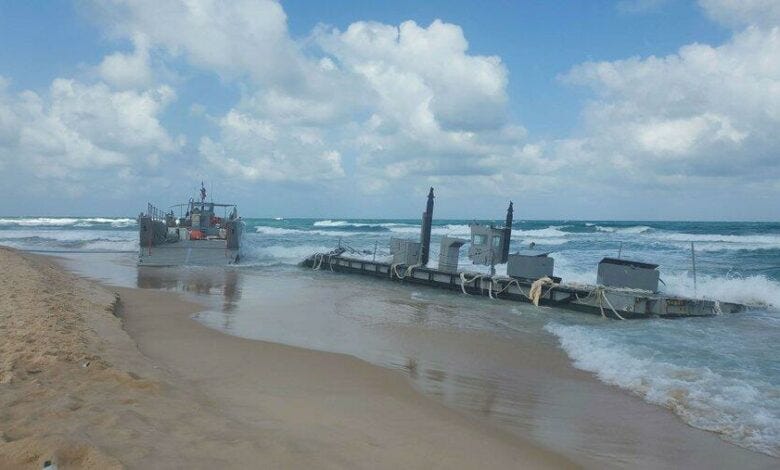
This old operational planner has one bit of advice to Congress in their role of having oversight of the Executive Branch; subpoena the Decision Brief for the Gaza pier operation.
This was on the lowest of low scale of military operations, Humanitarian Assistance/Disaster Response. There is little to nothing classified about any of this rump of a capability. Call in member of the Joint Staff who were involved in this planning — and I would prefer if you could find a few terminal O5/6 to testify as well. You might actually enjoy some candor.
The Commander’s Intent, the Higher Direction and Guidance, the Planning Assumptions, the Constraints and Restraints, the Critical Vulnerability analysis, etc. It is all there. If not, the Chairman of the Joint Chiefs of Staff and the Secretary of Defense should tell the American people to their face.
This is a larger issue than anything happening in that impossible corner of the globe. Over the weekend, we saw yet more indications of an empire in decline deteriorating from bad to pathetic.
From the time the first load came off the pier, the aid barely made it past 300 meters until it disappeared into Hamasistan.
I’ll go ahead and tap the sign;
[…]
Generally this latest act in this other-end-of-the-Med-from-the-Greeks tragedy that has unfolded in front of everyone. As we saw at the top at Ashkelon Beach, first some ancillary bits floated over to Israel as the Eastern Mediterranean reminded everyone it is at the eastern end of a big sea with weather and waves and stuff.
We then found out that three soldiers were injured in a forklift accident. Just to add insult to injury, as the locals laughed, it appears more of the business end decided to try to make it to Haifa on its own.
[…]
I’m not sure how you scatter Army property all over the Eastern Med without a boot getting dry, but maybe I’m wrong. Gaza is lava, and all.
Empires don’t often die in a blaze of glory, no. More often than not they end in simpering apologies and excuses from poor leaders putting the wrong people in positions they have no place being, and when they fail — there is no accountability.

Comments Off on A visit to failure pier
May 18, 2024
The plight of Greek refugees after the Greco-Turkish War
As part of a larger look at population transfers in the Middle East, Ed West briefly explains the tragic situation after the Turkish defeat of the Greek invasion into the former Ottoman homeland in Anatolia:

“Greek dialects of Asia Minor prior to the 1923 population exchange between Greece and Turkey. Evolution of Greek dialects from the late Byzantine Empire through to the early 20th century leading to Demotic in yellow, Pontic in orange, and Cappadocian in green. Green dots indicate Cappadocian Greek speaking villages in 1910.”
Map created by Ivanchay via Wikimedia Commons.
While I understand why people are upset by the Nakba, and by the conditions of Palestinians since 1948, or particular Israeli acts of violence, I find it harder to understand why people frame it as one of colonial settlement. The counter is not so much that Palestine was 2,000 years ago the historic Jewish homeland – which is, to put it mildly, a weak argument – but that the exodus of Arabs from the Holy Land was matched by a similar number of Jews from neighbouring Arab countries. This completely ignored aspect of the story complicates things in a way in which some westerners, well-trained in particular schools of thought, find almost incomprehensible.
The 20th century was a period of mass exodus, most of it non-voluntary. Across the former Austro-Hungarian, Russian and Ottoman empires the growth in national consciousness and the demands for self-determination resulted in enormous and traumatic population transfers, which in Europe reached its climax at the end of the Second World War.
Although the bulk of this was directed at Germans, the aggressors in the conflict, they were not the only victims – huge numbers of Poles were forcibly moved out of the east of the country to be resettled in what had previously been Germany. The entire Polish community in Lwów, as they called it, was moved to Wrocław, formerly Breslau.
Maps of central and eastern Europe in the 19th century would have shown a confusing array of villages speaking a variety of languages and following different religions, many of whom wouldn’t have been aware of themselves as Poles, Romanians, Serbs or whatever. These communities had uneasily co-existed under imperial rulers until the spread of newspapers and telegraph poles began to form a new national consciousness, usually driven by urban intellectuals LARPing in peasant fantasies.
This lack of national consciousness was especially true of the people who came to be known as Turks; the Balkans in the late 19th century had a huge Muslim population, most of whom were subsequently driven out by nationalists of various kinds. Many not only did not see themselves as Turks but didn’t even speak Turkish; their ancestors had simply been Greeks or Bulgarians who had adopted the religion of the ruling power, as many people do. Crete had been one-third Muslim before they were pushed out by Greek nationalists and came to settle in the Ottoman Empire, which is why there is still today a Greek-speaking Muslim town in Syria.
This population transfer went both ways, and when that long-simmering hatred reached its climax after the First World War, the Greeks came off much worse. Half a million “Turks” moved east, but one million Greek speakers were forced to settle in Greece, causing a huge humanitarian crisis at the time, with many dying of disease or hunger.
That population transfer was skewed simply because Atatürk’s army won the Greco-Turkish War, and Britain was too tired to help its traditional allies and have another crack at Johnny Turk, who – as it turned out at Gallipoli – were pretty good at fighting.
The Greeks who settled in their new country were quite distinctive to those already living there. The Pontic Greeks of eastern Anatolia, who had inhabited the region since the early first millennium BC, had a distinct culture and dialect, as did the Cappadocian Greeks. Anthropologically, one might even have seen them as distinctive ethnic groups altogether, yet they had no choice but to resettle in their new homeland and lose their identity and traditions. The largest number settled in Macedonia, where they formed a slight majority of that region, with many also moving to Athens.
The loss of their ancient homelands was a bitter blow to the Greek psyche, perhaps none more so than the permanent loss of the Queen of Cities itself, Constantinople. This great metropolis, despite four and a half centuries of Ottoman rule, still had a Greek majority until the start of the 20th century but would become ethnically cleansed in the decades following, the last exodus occurring in the 1950s with the Istanbul pogroms. Once a mightily cosmopolitan city, Istanbul today is one of the least diverse major centres in Europe, part of a pattern of growing homogeneity that has been repeated across the Middle East.
But the Greek experience is not unique. Imperial Constantinople was also home to a large Jewish community, many of whom had arrived in the Ottoman Empire following persecution in Spain and other western countries. Many spoke Ladino, or Judeo-Spanish, a Latinate language native to Iberia. Like the Greeks and Armenians, the Jews prospered under the Ottomans and became what Amy Chua called a “market-dominant minority”, the groups who often flourish within empires but who become most vulnerable with the rise of nationalism.
And with the growing Turkish national consciousness and the creation of a Turkish republic from 1923, things got worse for them. Turkish nationalists and their allies murdered vast numbers of Armenians, Greeks and Assyrian Christians in the 1910s, and the atmosphere for Jews became increasingly tense too, with more frequent outbursts of communal violence. After the First World War, many began emigrating to Palestine, now under British control and similarly spiralling towards violence caused by demographic instability.
Comments Off on The plight of Greek refugees after the Greco-Turkish War
Antisemitism is far from a new problem
Andrew Doyle on some of the historical relics of antisemitism in European history down to today’s revived fascism of the left:
In his memoir Hitch-22, Christopher Hitchens considered “why it is that anti-Semitism is so tenacious and so protean and so enduring”. Many of us in the west have grown complacent, assuming that the horrors of the Holocaust would prevent this ancient prejudice from re-emerging. But as the conflict between Israel and Hamas escalates, few of us can be in any doubt that antisemitism has once again goose-stepped into the spotlight.
Of course, criticism of the Israeli government and its military strategy is entirely legitimate. So too is our profound concern for the innocents of Gaza and the many thousands of non-combatants who are losing their lives. But there is no denying the explicit anti-Jewish hatred that has accompanied these discussions in certain quarters. Criticise Israel all you like, but don’t try to tell me that Monday night’s daubing of the Shoah memorial in Paris with handprints of red paint was anything other than antisemitic.
Social media has opened our eyes to the prevalence of such sentiments. The other day I posted a link to my Substack piece about the Eurovision Song Contest on that hellsite now known as X. My focus in the article was on the narcissism of the “non-binary” performers, but one feminist activist decided to make it all about Israel. Underneath my post, she added an image of Eden Golan, the Israeli entry to the competition, with bloodstains photoshopped onto her dress. She went on to dismiss the victims of the October 7 pogrom as “silly ravers” and to blame the massacre on the IDF. Whatever else one might say about such views, it is clearly evidence of a complete absence of basic humanity.
This is sadly not uncommon. Recently we have seen protesters openly supporting Hamas, or even praising its acts of barbarism. A new poll has found that 63% of students currently protesting at US universities have at least some sympathy for Hamas. There have been overtly antisemitic statements, and Jews have been harassed on campus. It has been reported that at Columbia University, one protester cried out “We are Hamas” while another shouted at a group of Jewish students: “The 7 October is about to be every fucking day for you. You ready?” These are the very people who have spent the last few years calling anyone who dissents even slightly from their worldview a “fascist”, and yet they are blind to actual fascism when it emerges within their own ranks.
All of this has taken me by surprise, which perhaps reveals the extent of my naivety. Antisemitism is nothing new, and has assumed myriad and outlandish forms over the centuries. Our own country has not been immune; Jews were deported from England in 1290, only to be readmitted in 1656. Before then, only those who had converted to Christianity were allowed to remain; specially, they were able to reside at the Domus Conversorum in London, established by Henry III in 1232. Anti-Jewish sentiments were reignited by a plot to poison Elizabeth I in 1594, which was blamed on her physician Roderigo Lopes, a Portuguese man of Jewish ancestry who was executed for treason. This is the context in which the forced conversion of Shylock at the end of Shakespeare’s The Merchant of Venice ought to be understood.
Unpleasant myths about Jews have abounded throughout history, some of which still linger in Islamic regimes and the darker crannies of the internet where neo-Nazis gather to wallow in their bile. The poisoning of wells by Jews was thought to have initiated the Black Death epidemic in 1348. This notion was still pervasive by the time Christopher Marlowe wrote his play The Jew of Malta in 1589 (consider Barabas’s mass extermination of an entire convent of nuns by means of “a precious powder”, or his boastful claim: “Sometimes I go about and poison wells”).

Comments Off on Antisemitism is far from a new problem
May 13, 2024
Roman Legions – Sometimes found all at sea!
Drachinifel
Published Feb 2, 2024Today we take a quick look at some of the maritime highlights of the new special exhibition at the British Museum about the Roman Legions:
https://www.britishmuseum.org/exhibit…
(more…)
Comments Off on Roman Legions – Sometimes found all at sea!
May 10, 2024
Table Manners in the Ottoman Empire – Acem Pilaf
Text from https://www.tastinghistory.com/recipes/ottomanpilaf:
At an Ottoman banquet, you were only ever meant to eat a few bites of each dish that was brought out (having more was seen as being greedy). But there was no danger of leaving the table hungry, as there could be upwards of dozens of dishes. To European visitors, the order that the dishes were brought out in made no sense. Cakes could be brought out between meat courses, a rich pastry brought out after fish, and fowl after chocolate cake. Amidst this seeming chaos, pilaf was always the last dish served.
Let’s address the elephant in the room and state that yes, the pilaf is supposed to come out layered and all in one piece, but mine did not. Ottoman dishes were meant to be not only flavorful, but beautiful as well. That being said, even if you mold yours in a separate container like I did, it is still delicious (and quite nice looking). The warm spices are a wonderful and unusual combination with the lamb (at least to my palate), and there is a fantastic array of textures.
“Chop a piece of good mutton into small pieces, place them in a pot … add one or two spoonfuls of fresh butter and after frying, take the cooked meat from the pot with a hand strainer. Finely chop three or four onions and fry them, then put the roasted meat on top. Then add plenty of pistachios, currants, cinnamon, cloves, and cardamom on top. After that, according to the old method, one measure of washed Egyptian rice. Add two measures of cold water without disturbing the rice, add sufficient salt, then close the lid of the pot and cover it thoroughly with dough. Boil it slowly on coals and when the water is absorbed, take the cover off, and turn the contents out of the pan onto a dish so it comes out intact. This makes a Pilaw that is very pleasing to the sight, and exceedingly pleasant to the taste.”
— Melceü’t-Tabbâhîn, 1844
Comments Off on Table Manners in the Ottoman Empire – Acem Pilaf
May 9, 2024
How the First World War Created the Middle East Conflicts
The Great War
Published Dec 8, 2023The modern Middle East is a region troubled by war, terrorism, weak and failed states, and civil unrest. But how did it get this way? The map of today’s Middle East was mostly drawn after the First World War, and the war that planted many of the seeds of conflict that still plague Israel, Palestine, Iraq, Syria and even Iran today.
(more…)
Comments Off on How the First World War Created the Middle East Conflicts
May 8, 2024
The nonsensical “right of return” debate
George Monastiriakos explains why he should have the right of return to his ancestral homeland:
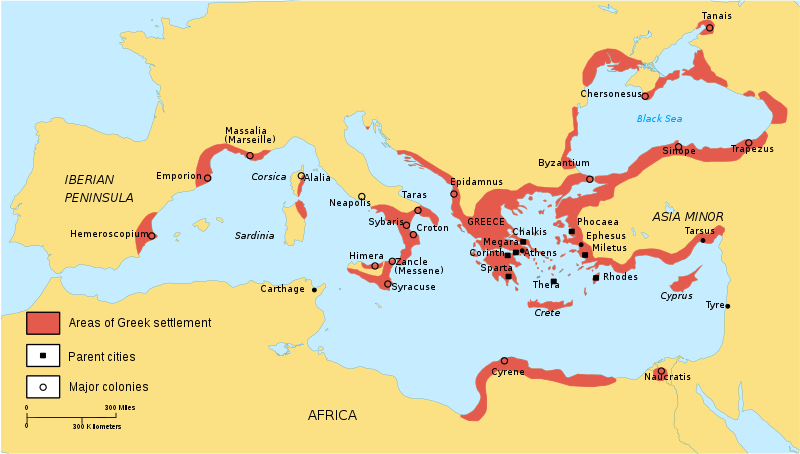
Greek colonization in the Archaic period.
Map by Dipa1965 via Wikimedia Commons.
My family hails from a small Greek village in Anatolia, in modern day Turkey, but I have unfortunately never been to my ancestral homeland because I was born a “refugee” in Montreal. Living in the “liberated zone” of Chomedey, Que., one of the biggest Greek communities in Canada, is the closest I’ve ever felt to my beloved Anatolia.
The Republic of Turkey does not have a legal right to exist. It is an illegitimate and temporary colonial project built by and for Turkish settlers from Central Asia. My ancestors resided on the Aegean coast of Asia Minor for thousands of years before the first Turks arrived on horseback from the barren plains of Mongolia. I will never relinquish my right to return to my ancestral homeland.
If you think these assertions are ridiculous, it’s because they are. I copied them from the shallow, even childish, anti-Israel discourse that’s prevalent on campuses in the United States and Canada, including the University of Ottawa, where I studied and now teach. I am a proud Canadian citizen, with no legal or personal connection to Anatolia. I have no intention, or right, to return to my so-called ancestral homeland. Except, perhaps, for a much-needed vacation. Even then, my stay would be limited to the extent permitted by Turkish law.
The Second Greco-Turkish War concluded with the Treaty of Lausanne in 1923. Among other things, this agreement finalized the forced displacement of nearly one-million Ottoman Greeks to the Kingdom of Greece, and roughly 500,000 Greek Muslims to the newly formed Republic of Turkey. This ended the over 3,000 years of Greek history in Anatolia, and served as a model for the partition of British India, which saw the emergence of a Hindu majority state and a Muslim majority state some two decades later.
With their keys and property deeds in hand, my paternal grandmother’s family fled to the Greek island of Samos, on the opposite side of the Mycale Strait at a nearly swimmable distance from the Turkish coast. While they practised the Greek Orthodox religion and spoke a dialect of the Greek language, they were strangers in a foreign land with no legal or personal connection to the Kingdom of Greece.
The Great War channel produced an overview of the Greco-Turkish War of 1919-1923 that resulted in the vast human tragedy of the expulsion of ethnic Greek civilians from Anatolia and ethnic Turkish civilians from mainland Greece here.
Comments Off on The nonsensical “right of return” debate


