
Before men were lonely, there were places.
Places where men showed up without an agenda. Where conversation happened sideways, not face-to-face. Where no one asked men to perform vulnerability, explain themselves, or justify their presence.
Those places didn’t disappear because men rejected connection. They disappeared because our culture decided male-only spaces were no longer acceptable. And once they were gone, men were told that their resulting loneliness was a personal failure.
There has been a noticeable shift in recent months. A growing number of articles now
acknowledge male loneliness and even gesture toward men’s emotional needs. On the surface, this looks like progress — and in one narrow sense, it is. For decades, male loneliness was either ignored or mocked.But many of these pieces commit the same quiet betrayal.
After briefly acknowledging that men are lonely, many articles abandon subtlety altogether and place responsibility squarely on men themselves. Men don’t open up enough. Men don’t try hard enough. Men don’t build friendships properly. Men resist emotional growth.
What is missing is the most obvious factor of all: our culture systematically dismantled the spaces where men and boys once formed friendships.
Men Did Not “Forget” How to Connect, They Lost the Places Where Connection Happened
Male friendships have never primarily formed through structured emotional disclosure. They formed through shoulder to shoulder shared activity, regular presence, and low-pressure companionship. Men bonded by working alongside one another, not by facing one another across a table and “processing”.
For generations, this happened naturally in male-only spaces:
- Service clubs
- Fraternal organizations
- Trade guilds and apprenticeships
- Male sports leagues
- Scout troops
- Men’s religious groups
- Informal gathering places like barbershops and workshops
These environments weren’t about exclusion. They were containers — places where boys learned how to be men from men, and where adult men maintained connection without self-consciousness or surveillance.
Now consider what has happened.
- Barbershops are co-ed and transactional.
- Service clubs are now largely co-ed, and the informal freedoms that supported male bonding in male-only environments have largely disappeared.
- Community sports are co-ed or heavily regulated.
- Even the Boy Scouts are co-ed.
One by one, male spaces disappeared — not because men abandoned them, but because our culture increasingly viewed male-only environments as suspicious, outdated, or morally problematic.
The Asymmetry No One Wants to Name
At the same time male spaces were dismantled, female-only spaces proliferated.
- Women-only gyms are accepted.
- Women-only scholarships are celebrated.
- Women-only commissions exist at every level of government.
- Women-only networking events, parking, subway cars, retreats, and support groups are commonplace.
“Women-only” is understood as necessary, protective, and empowering.
“Men-only”, by contrast, is treated as exclusionary at best and dangerous at worst.
The result is an unspoken rule that everyone knows but few admit:
Women may gather without men. Men may not gather without women.
This is not equality. It is a double standard — and it has consequences.
Tom Golden, “The Quiet Lie Behind Male Loneliness”, Men Are Good, 2026-01-05.
May 7, 2026
QotD: The loss of male spaces led to today’s epidemic of male loneliness
May 6, 2026
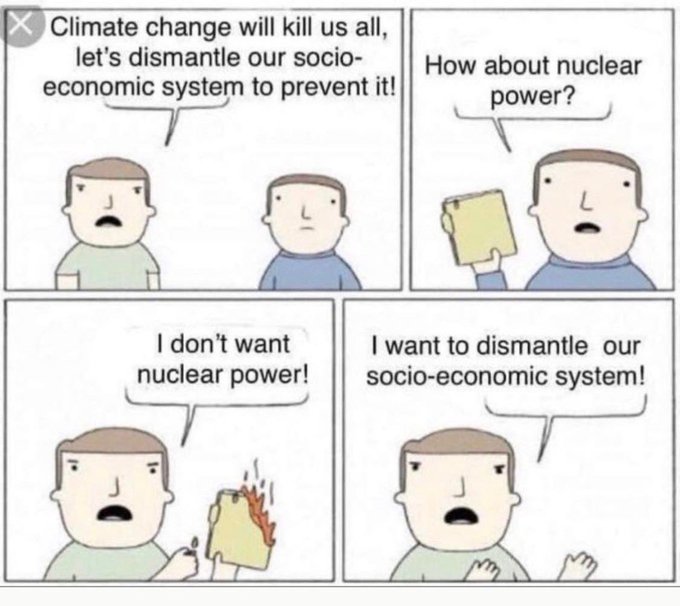
“I don’t want a solution, I want to dismantle our socio-economic system!”
On his Substack, Christopher Snowden explains how “public health” is just another of the many, many anti-capitalist branches of progressive belief:
Some people don’t really want to solve problems. They want to change the world for other reasons. That was the argument I made in Not Invented Here last year, a multi-author IEA publication that essentially elaborated on this meme …
One example is obesity, which we are told can only be tackled by fundamentally changing the food environment, banning advertising, taxing more products and demonising “Big Food”. None of this has ever actually worked anywhere. We do, however, now have GLP-1 drugs that work wonders for many people.
Plenty of “public health” academics are notably resistant to “fat jabs” because what they really want is to fundamentally change the food environment, ban advertising, tax more products and demonise “Big Food”.
Take this article from three self-described “public health scholars” in JAMA Health Forum, for example. They object to obesity being framed as a “a disease requiring individual treatment” because, they say, it undermines public support for government action. They even complain that “medical societies consistently argue that we do need to both prevent and treat obesity” because treatment — i.e. losing weight — is something that individuals can do for themselves. Moreover, studies have shown that when the public hear about people losing weight on their own initiative, they are less likely to support population-wide policies such as food taxation.
Broadcasting a “we need to do both” message, it turns out, is a counterproductive communications strategy for addressing the obesity epidemic. Studies message-testing obesity narratives find that public support for government action is highest when obesity is framed as the result of food industry manipulation and addresses toxic food environments.
The authors don’t seem particularly interested in whether this narrative is true. The main thing is that it can “build support for addressing upstream drivers of the obesity epidemic”. They conclude that medical professionals should stop talking about GLP-1 drugs in public and bang on about “BiG fOoD” instead.
While we acknowledge that public and media discourse often expect clinicians to comment on treatment efficacy and emergent therapies, in an ideal world, the medical community would move discussions about GLP-1 drugs targeting causes of individual cases in-house, while using its credibility and authority publicly to amplify much needed political discussions about the root causes of increasing obesity incidence.
This messaging should include concrete policy proposals targeting unhealthy food environments shifting the debate toward the structural causes of the obesity epidemic, such as World Health Organization–recommended sugar taxes and other policies that would effectively reverse the rise in ultraprocessed food production, marketing, and consumption and, importantly, the corporate power that has so far prevented governments from enacting these policies.
You can see why they are worried about fat jabs. The drugs work by giving people artificial willpower and prove that if obese people simply eat less food they will stop being obese. It has nothing to do with advertising, price, availability or “corporate power”.
From the perspective of the authors, these drugs are a threat, but what exactly is their perspective? The first author, Luc Hagenaars, has written a lot about sugar taxes which he compiled for his PhD thesis. He also worked at the Dutch Ministry of Health in the early 2020s when the Netherlands was undergoing its anti-liberal counter-revolution. Last year, he wrote an article titled “The Ozempic Era Could Shift Blame for Obesity From Individuals to Commercial Food Systems” which made exactly the opposite argument to the one he is making here.
Update, 8 May: Welcome, Instapundit readers! Have a look around at some of my other posts you may find of interest. I send out a daily summary of posts here through my Substack – https://substack.com/@nicholasrusson that you can subscribe to if you’d like to be informed of new posts in the future.
Carney panders to the Euro elites and his TDS-afflicted base
On the social media site formerly known as Twitter, Ben Woodfinden explains Prime Minister Mark Carney’s constant pandering on the international stage:
The average voter won’t care, but the more Carney lays out his worldview the more the contradictions and incongruences in his thinking (or lack of sincerity) become apparent.
In his famous Davos speech he said “we actively take on the world as it is, not wait around for a world we wish to be”. But the way he talks about and sees Europe does not fit this, and this statement is bizarre.
We should absolutely be pursuing closer ties to Europe, but it is delusional if he actually believes the new international order will be “rebuilt out of Europe”.
Europe for all its grand aspirations cannot even defend Ukraine by itself and without American help. Europe would need something like 300,000 additional troops and €250 billion a year in extra defence spending just to deter Russia without the Americans.
NATO’s own Secretary General told the European Parliament in January that Europe “cannot at the moment provide nearly enough of what Ukraine needs to defend itself today, and to deter tomorrow”, and that without American weapons “we cannot keep Ukraine in the fight. Literally not.” Rutte told European lawmakers that anyone who thinks Europe can defend itself without the US should “keep on dreaming”. Four years into the most serious land war on the continent since 1945 and this is where we are. That is not a continent about to anchor a new international order.
The world order is quickly is reorganising, yes. But around a US-China axis, not Brussels. The eurozone is forecast to grow 0.9% this year. China at 4.5%. China accounts for roughly 30% of global growth, Europe’s share of global GDP keeps shrinking. Europe is just one of many players. Again if you take Carney seriously here, it’s silly. Build closer ties with Europe yes but do not believe this is the next superpower.
But I suspect this is actually just another sign that Carney is good at politics — he knows exactly what the Davos crowd, his boomer base and media admirers want to hear and he is very good at giving it to them. Flattery has done him enormous favours in European capitals. But telling European elites the future runs through them is not realism, it is the opposite of realism. It is telling people what they want to hear, not the truth.
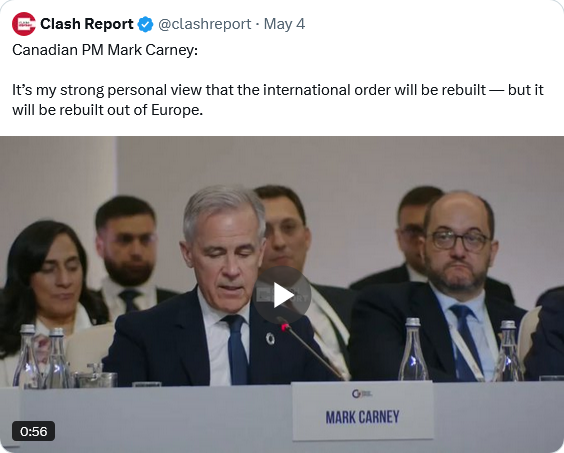
L. Wayne Mathison also comments on Carney’s profound europhiliac positions:
Europe is not the model. It is the warning label.
High regulation. Weak growth. Expensive energy. Soft defence. Endless bureaucracy.
America built. Europe managed. America innovated. Europe regulated.
And Carney wants Canada rebuilt “out of Europe”?
No thanks. Canada needs strength, productivity, energy, defence, and sovereignty, not Brussels-style decline with better catering.
QotD: Deskilling society through AI
Just like in the first one, we’ve figured out how to use machines to do a broad swathe of things people used to do, swapping energy and capital in for human labor. And just like in the first one, the output isn’t necessarily better (in fact, it’s often worse), but it’s so much cheaper in terms of human time and thought and effort that the quality almost doesn’t matter. Sometimes that’s wonderful: if you desperately need to put a roof for your barn right this moment, it’s a blessing to be able to slap on some corrugated tin instead of going to the effort of thatching. When you have to write your seventeenth letter to the insurance company explaining that no, they really ought to be covering this, it’s a relief to hand the composition off to Claude instead. But do that too much and you forget how to do it yourself — or more plausibly, you never learn.
The greatest risk of AI is probably “we all get turned into paperclips”, or maybe “someone uses it to design a novel and incredibly fatal pathogen”, but the most certain risk — the one that’s already here, at least on the edges — is a great deskilling. Just as the mechanization of physical labor lost us all those traditional skills that Langlands describes, the ability to automate cognitive tasks undermines their acquisition in the first place. Why pay any attention at all to word choice and metaphor and prosody when ChatGPT can churn out that essay in a few seconds? Why worry about drafting a convincing email when you’re pretty sure your recipient is just going to ask Grok for a summary?1 Why learn to code when a machine can do it faster?
I was recently informed that someone — “not anyone you know, Mom, someone at another school” — used ChatGPT to write his essay about the causes of the Civil War. This was obviously deeply upsetting to the congenital rule-follower who reported it to me, on account of THAT’S CHEATING (you must imagine this in the whiniest she-touched-my-stuff voice possible), but it was a good teachable moment — for me, if not for the history teacher at another school. What’s the point of an essay about the causes of the Civil War, anyway? It can’t be that the teacher wants to know the answer: she can find a dozen books on the topic if she cares to look, each more cogent and thorough than anything a middle-schooler is likely to produce.2 Heck, even the Wikipedia article will probably give her a better understanding. And if it’s not for the teacher’s benefit, it’s certainly not for the benefit of any other audience, since as soon as the essay is marked and graded it’ll probably be crumpled up and tossed into the recycling bin. No, it’s for the kid.
The point of writing an essay about the causes of the Civil War is not to have an essay about the causes of the Civil War, it’s to undergo the internal changes effected by the process of thinking through, planning, drafting, and editing the darn thing. Writing forces you to put your thoughts in order, to shape whatever mass of inchoate ideas is bouncing around in your head into something clear and reasoned you can pin to the page. The thinking is the hard part; putting words to it is simple by comparison. (This book review began life as about seven hundred words of stream-of-consciousness riffing, with only the vaguest kind of structure. When I experimentally pasted it into an LLM and asked for an essay, the result was terrible.) But even the putting of words is a valuable skill: what’s the right tone here? What’s the right word? Do I want to say “writing forces you to” or “when you write you have to”? How do they feel different? Asking a machine to do this for you is like bringing a forklift to the gym.
Of course, that kid who had ChatGPT write his essay was almost certainly thinking of the assignment not as one small step in the alchemical process of self-transformation that is education but as basically equivalent to an appeal letter to the insurance company: just another dumb hoop you have to jump through in your interactions with a vast impersonal machine that doesn’t particularly want to grind you to dust but wouldn’t mind it either. And since this was at another school, he might not even be wrong. Maybe the teacher was just pasting the rubric and the essays back into ChatGPT and asking it to assign a grade.3
But there’s an even bigger problem than lying about who (or what) has done the work, which is lying about whether the work has been done at all. LLMs make lying very easy indeed. Yes, yes, sometimes they hallucinate and tell you things that are patently untrue, and that’s a bigger danger for students and other people who don’t have the background to notice when something seems off — this is all true, but it’s not what I mean.
LLMs, when working exactly as intended, enable human falsehood — because our society relies on written records as proof of work. Until recently that was fine, because writing down lies actually used to be pretty hard: putting together a convincing false report from scratch — maintenance records for the airplane you’re about to board, say, or a radiologist’s report on your brain scan — was almost as time-consuming as actually checking the things that were supposed to checked and then documenting them, and the liar had to spend the whole time aware of their own dishonesty. (Not that this stops everyone, of course.) But now that it takes about two clicks to generate an inspector’s report for the house you’re considering buying, or the pathologist’s findings in your biopsy, how much are you going to trust that they actually looked?
LLMs can be useful tools,4 but all tools change what we make and how we make it. It’s often a good tradeoff! Sure, each individual example of simplification and automation in the name of efficiency is a tiny bit of alienation, removing the maker from the making, but it’s also a gift of time we can spend on other things: I couldn’t write this if I also had to sew my family’s clothes and wash our laundry by hand. And yet those bits pile up, and once it becomes possible to exist in the world without really needing to come into contact with it, once you can get by without ever really needing to make anything, some people just won’t. And that’s terrible! Being entirely without cræft — never bringing mind-body-soul into harmony with one another and then using them to master the world — means missing out on something deeply human.
Jane Psmith, “REVIEW: Cræft, by Alexander Langlands”, Mr. and Mrs. Psmith’s Bookshelf, 2025-03-24.
- All the “AI written/AI read” communication begins to resemble Slavoj Zizek’s perfect date:
“So my idea of a perfect date is the following one. We met. Then I put, she puts her plastic penis dildo into my … “stimulating training unit” is the name of this product. Into my plastic vagina. We plug them in and the machines are doing it for us. They’re buzzing in the background and I’m free to do whatever I want and she. We have a nice talk; we have tea; we talk about movies. What can be — we paid our superego full tribute. Machines are doing — now where would have been here a true romance. Let’s say I talk with a lady, with the lady because we really like each other. And, you know, when I’m pouring her tea or she to me quite by chance our hands touch. We go on touching. Maybe we even end up in bed. But it’s not the usual oppressive sex where you worry about performance. No, all that is taken care of by the stupid machines. That would be ideal sex for me today.”
- Well, okay, most of them.
- See footnote one again.
- Personally I’ve found them useful in three cases: (1) when I’m blanking on how to begin an email I will occasionally ask for a draft, which inevitably makes me so mad about how bad it is that I immediately rewrite it in a way that doesn’t suck; (2) when it’s Sunday night and I need a picture of a Japanese man in a business suit and a samurai helmet for a book review going up in the morning; and (3) when I can’t figure out the right search term for my question. (Turns out it was “sigmatic aorist”. Thanks, Claude.)
May 5, 2026
Seattle’s Mayor to wealthy residents: “Bye!”
I’ve heard many people praise Seattle as a great place to live with lots of amenities and a fantastic setting. Like a lot of places with those kinds of attractions, it also has a political scene that leans strongly to the left, as Mayor Katie Wilson recently highlighted:

“Seattle Skyline” by Atomic Taco is licensed under CC BY-SA 2.0 

 .
.
Seattle’s socialist Mayor Katie Wilson has a message for prosperous people leaving Washington over the state’s soaring tax burden. “Bye!” she says with a laugh, to cheers from a largely progressive audience. Entrepreneurs and investors will certainly take that comment into account as they consider where to live and do business. We can be sure of that fact because recent research further supports the commonsense idea that people often leave high-tax states in search of lower tax bills.
Goodbye, Wealthy People!
Wilson’s comments came during an April 16 discussion about “The New Progressives” as part of Seattle University’s Conversations series. Wilson and King County Executive Girmay Zahilay fielded a series of questions by host Joni Balter and graduate student Ari Winter.
Asked about major companies leaving or threatening to leave over Seattle’s and Washington’s escalating tax burden, Zahilay acknowledged that “everything is a tradeoff” and “of course I think taxes can make companies make decisions about staying or leaving”. You wouldn’t necessarily want to live under his policies, but he sounds like he understands that his decisions may drive people out and impose costs on the community.
Wilson, a self-described “socialist“, was presented with a follow-up question by Winter. She was asked, “do you still think progressive taxes are an easy and promising solution?”
Wilson responded that it was “very, very exciting to see the billionaire tax pass the legislature” and described her history of advocating for higher taxes. She then cut to the heart of her response.
“I think the claims that millionaires are going to leave our state are, like, super overblown. And if, you know, the ones that leave, like, bye!” she said with a wave and a snicker. The audience at the university event joined in with whoops and applause.
Wilson may want to practice her goodbyes. Fisher Investments moved from Washington to Texas to escape a new capital gains tax. Starbucks is building a corporate hub in Tennessee and moving jobs there, largely over tax concerns. Billionaire Jeff Bezos fled the state for Florida, also motivated by taxes.
“Jeff Bezos sold about $15 billion in stocks before the new law took effect, potentially saving over $1 billion in taxes”, the Washington Policy Center’s Chris Corry noted. “Moving his primary residency to Florida would ensure that any future stock sales would not be subject to the excise tax.”
Tech giant Microsoft criticized Washington’s tax environment and threatened to move jobs elsewhere.
Orwell: “It would probably not be beyond human ingenuity to write books by machinery”
In the portion above the paywall, Matt Johnson discusses Orwell’s career as we face an unending deluge of writing “assisted” by AI or even entirely created by AI:

In the introduction to his 1991 book Orwell: The Authorised Biography, Michael Shelden distinguishes his approach from that of Bernard Crick’s George Orwell: A Life, published a decade earlier. While Crick’s volume offered the most complete portrait of Orwell available at that point, Shelden argues that it’s too dull and impersonal — a flood of facts that bury Orwell’s singular, idiosyncratic personality. Shelden observes that Crick “relies heavily on the notion that facts speak for themselves if presented in enough detail”. So he attempts to provide a more intimate account of Orwell’s life: “A writer’s character and personal history influence what he writes and how he writes it. And the more we know about him, the better we are able to appreciate his work.” After all, “Books are not written by machines in sealed compartments”.
But we have now entered an era in which books can, in fact, be written by machines in sealed compartments. Large language models (LLMs) generate billions of words a day and are increasingly capable of producing long, structured, and sophisticated texts. While Orwell could not have foreseen the AI revolution, he predicted that synthetic text could someday replace human writing. In his 1946 essay “The Prevention of Literature”, he observes: “It would probably not be beyond human ingenuity to write books by machinery”. Although he doesn’t linger on this possibility, he laments the depersonalisation and mass production of writing already underway in the 1940s, and these arguments are just as applicable to AI-generated writing today.
Orwell expressed an almost eerie sensitivity to the ways in which literary ability — and even the quality of thought — can decline alongside a growing reliance on automated writing processes. For example, he cites radio features “commonly written by tired hacks to whom the subject and the manner of treatment are dictated beforehand”. The writing itself was “merely a kind of raw material to be chopped into shape by producers and censors”. His experience dealing with the pressures of working in a strictly controlled corporate environment at the BBC during wartime undoubtedly left him with this impression. He also cites “innumerable books and pamphlets commissioned by government departments” created in the same industrial manner.
Orwell’s scrutiny of the “machine-like” creation of “short stories, serials, and poems for the very cheap magazines” holds up particularly well today. In an uncanny anticipation of the process by which millions of users now produce creative content with AI, he writes:
Papers such as the Writer abound with advertisements of Literary Schools, all of them offering you readymade plots at a few shillings a time. Some, together with the plot, supply the opening and closing sentences of each chapter. Others furnish you with a sort of algebraical formula by the use of which you can construct your plots for yourself. Others offer packs of cards marked with characters and situations, which have only to be shuffled and dealt in order to produce ingenious stories automatically.
“The Prevention of Literature” was published around the time Orwell began work on Nineteen Eighty-Four, and it shows. Winston Smith’s job in the Ministry of Truth is to rewrite historical documents to match Party propaganda. He deletes “unpersons” from old news stories and ensures that recorded events always line up with the latest party line, all with the help of his speakwrite dictation machine. He dumps original documents into the Memory Hole for incineration. In the essay, Orwell moves from a discussion of increasingly robotic forms of literary production to the role this shift could play in a totalitarian state:
It is probably in some such way that the literature of a totalitarian society would be produced, if literature were still felt to be necessary. Imagination — even consciousness, so far as possible — would be eliminated from the process of writing. Books would be planned in their broad lines by bureaucrats, and would pass through so many hands that when finished they would be no more an individual product than a Ford car at the end of the assembly line.
In some ways, Orwell’s bleak prophecies would turn out to be more accurate than he could have imagined. The idea that human thought would be replaced by an “algebraical formula” and that consciousness would be eliminated from the writing process is now a reality on a vast scale (though the question of whether consciousness will emerge from AI systems remains open). But Orwell filtered his predictions about the future of writing through his fixation on state power and the possible emergence of a “rigidly totalitarian society”, and this led him astray. In such a society, Orwell assumed that “novels and stories will be completely superseded by film and radio productions”. To the extent that people would want to keep reading, “perhaps some kind of low-grade sensational fiction will survive, produced by a sort of conveyor-belt process that reduces human initiative to the minimum”. He concluded: “It goes without saying that anything so produced would be rubbish”.
Restore Britain’s proposal for illegal migrant detention centres
On the Restore Britain Substack, the party lays out its proposal for locating detention centres for illegal migrants, in response to Nigel Farage’s vindictive desire to punish voters in constituencies that “voted the wrong way”:

Reform want to vindictively target Brits in potential Green constituencies to make a point and house illegals next to them — that is their choice. But I don’t believe that we have time for this petty nonsense.
A Restore Britain Government will not abandon residents of those constituencies who have a Green MP elected on 25% of the vote. That is not fair, and more importantly — it is not efficient.
Restore Britain will focus on solving the problem, in the most ruthlessly efficient manner possible. Objective number one is quite clear — remove the illegal migrant population.
That is not going to be completed through vengeful gimmicks.
We won’t punish hardworking British men and women because their neighbours voted Green.
We need a serious, systematic approach utilising the current state apparatus at first in order to rapidly scale our removal capabilities — our deportation paper goes into great detail about how to achieve this.
This an incredibly complicated task. Removing two million plus illegal migrants will not be done overnight. It will not be done through deliberately choosing less efficient options to take revenge on constituencies who did not vote for us. We don’t have time for this petty nonsense.
It is a mammoth challenge — it would be one of the biggest state policy implementations ever.
We would construct detention facilities where they are most efficient, most secure, and most practical to operate — not based on shitty political point-scoring, but on what actually works and on what actually will remove these illegals on a timescale the British people expect.
Because the aim is clear.
To detain, process and remove those who have entered this country illegally, and to do so at scale. Millions will go.
May 4, 2026
Chief Narcissist of the Supreme Court of Canada
On the social media site formerly known as Twitter, David Knight Legg explains why the Chief Justice should recuse himself from deliberation on an upcoming Supreme Court case involving the Freedom Convoy 2022:
Canada’s Chief Justice Richard Wagner has installed a lifelike bronze bust of himself in our highest court.
It should be called “Narcissus Canadiannus”
– There is no precedent for something this vulgar in the history of the Court. It should be taken down. Richard fancies himself.
– Richard also fancies his own opinion on things. He violated legal due process and the Court’s reputation by publicly accusing the Convoy — who protested backwards federal Covid policies that were soon dropped — of “anarchy” and “hostage taking”.
Now that the Convoy’s freedom of speech, assembly and due process rights have been asserted by lower courts the Supreme Court has to consider the appeal of the federal govt and weigh the rights of citizens against the decision of the federal government to impose the Emergencies Act to suspend those rights.
Wagner’s lack of judicial discretion in the first instance makes his recusal from such an important rights-defining case important because it signals not just fairness in the content of the decision but in the way the decision gets reached by the highest Court.
He has already shown his bias. Any decision against the convoy poisons the integrity of the Court if he remains present.
But Richard — the man with the bust of himself in our Court — doesn’t imagine himself under the law he imposes on others. He hasn’t completed any graduate work in law or published any academic work in law, philosophy or jurisprudence so it’s hard to know how he justifies himself in these matters.
Ironically, he has a reputation for warning others — including those far more qualified in formal jurisprudence than he is — not to critique Canadian judges like himself or their (increasingly bizarre and politicized) decisions.
But, from the Magna Carta onwards, Richard should know that in law as in politics dissent is democracy.
The dissent of the Convoy and the growing critique of Richards own bizarre behaviour and inability to articulate a judicial philosophy is exactly what’s needed to save Canada — and the Court’s reputation as a place where justice — not the ego of the Justices — is at stake.
Richard should recuse himself. And remove that vulgar bust from the Supreme Court.
#SCC #RuleOfLaw


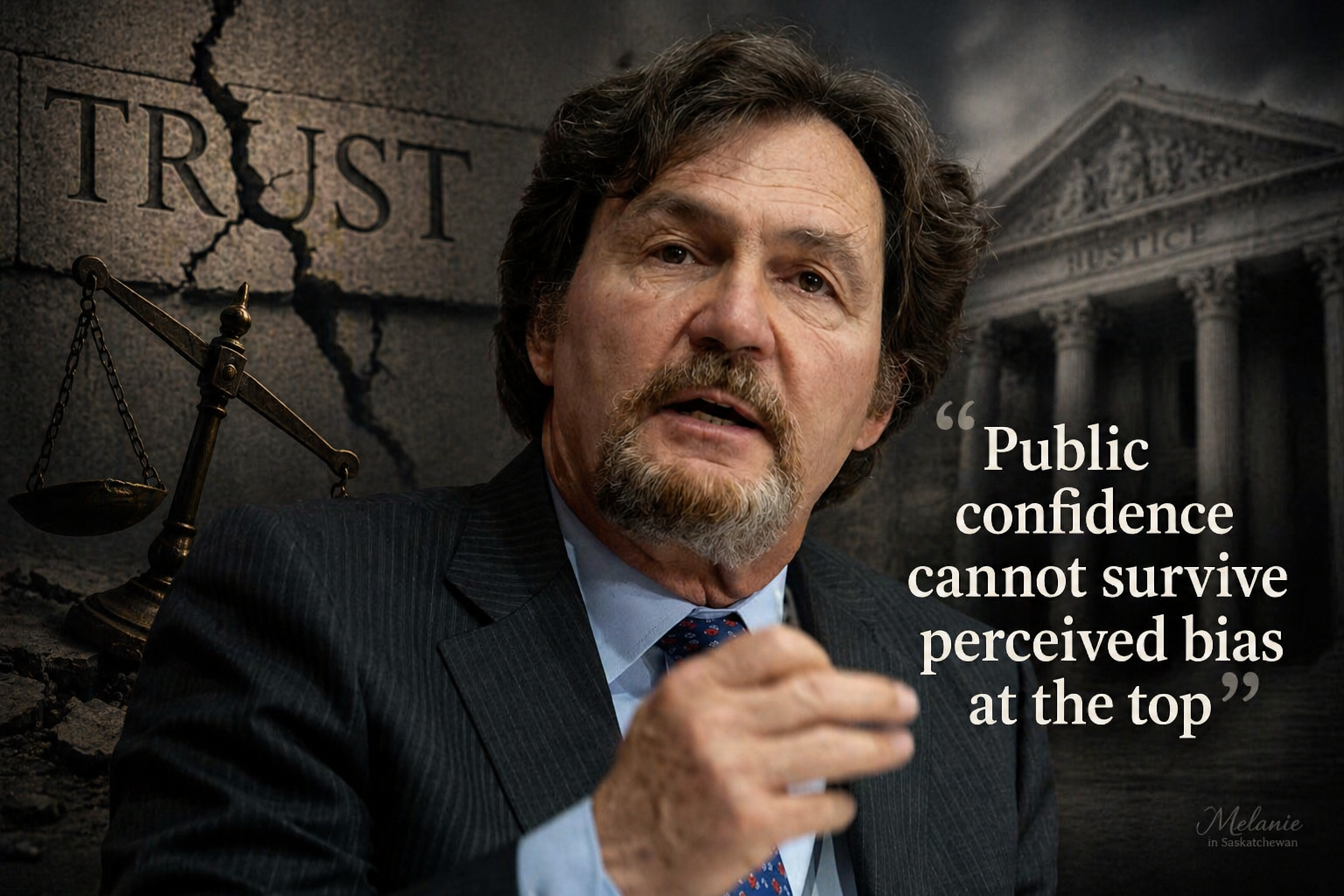
Melanie in Saskatchewan also has concerns, expressed as an open letter to the Chief Justice:
To Chief Justice Richard Wagner,
Your refusal to recuse yourself from the Emergencies Act appeal, as reported in the National Post, is not a demonstration of judicial confidence. It is a failure of judgment at a moment that demanded restraint.
Image from Melanie in Saskatchewan
You have justified your decision on the basis that your prior public comments did not address the specific legal questions before the Court. That argument may satisfy a narrow, technical reading of judicial conduct. It does not satisfy the standard Canadians are entitled to expect from the Chief Justice of the Supreme Court.
The governing principle is not whether you commented on the precise statutory interpretation of the Emergencies Act. It is whether a reasonable and informed person would conclude that your previously expressed views could influence your assessment of the case.
You publicly characterized the convoy as the “budding start of anarchy”, described residents as being “taken hostage”, and spoke in terms that conveyed clear condemnation of the events and participants. Those were not neutral observations. They were judgments about the nature, legitimacy, and perceived threat posed by the very situation now under review.
This appeal is not a retrial. It does not exist to rehear evidence or relitigate the convoy as though the past can be reset. Appellate review in Canada is focused on whether the law was correctly interpreted and properly applied to established facts, with significant deference given to the findings already made by the lower courts.
That distinction matters.
[…]
As Chief Justice, you are not merely a participant in this case. You are the steward of the reputation of the Supreme Court of Canada itself. That reputation rests not on assertions of impartiality, but on decisions that demonstrate it beyond reasonable doubt. In choosing not to recuse yourself under these circumstances, you have not strengthened that reputation. You have placed it at risk, at a time when public confidence in national institutions is already fragile. The damage may not be immediate, but it is real, and it is yours to own.
QotD: Saint Hillary
Kelly was the most relentlessly savage chronicler of the Clinton administration, and of the Clintons personally, but his opening shot was so subtle you had to squint to see what he was doing. In a long feature story that appeared in the New York Times Magazine in May of 1993 under the that’s-not-a-compliment title, “Saint Hillary”, Kelly very quietly mocked Hillary as a preening know-it-all who didn’t know much of anything. He wrote that she represented “the message of the preacher”, with a way of speaking that delivered a stream of moral lectures, as if she had the authority and the wisdom to direct others in the act of moral reconstruction. If you click on the link and read the whole story, you’ll want to watch for the transitional paragraph, the switch from mostly description to mostly derision. It begins with the words, “It is at this point that some awkward questions arise”. Next paragraph: “If it is necessary to remake society, why should Hillary Rodham Clinton get the job?”
It becomes less kind from there. Kelly described a meeting between Hillary Clinton and the progressive Jewish editor and activist Michael Lerner, who (Kelly says) offered a vision of “unintentionally hilarious Big Brotherism”. And then: “The reason Lerner’s proposals for the application of the politics of meaning focus so heavily on bureaucratic irrelevancies is the same reason Mrs. Clinton is struggling still with words”. Self-delusion, unawareness of political realities, hard-headed self-importance, unaware bumbling in an unearned sense of certainty. A moralizer, but not moral, unwise but committed to the appearance of wisdom.
Remember, this story appeared in 1993, in the opening months of the Clinton presidency. Michael Kelly was opening a political era with a dismissal, rolling his eyes at the Clinton project as it began. “Saint Hillary”, they called it. The New York Times used to publish things like this.
Chris Bray, “Saint Hillary the Bluntly Obtuse”, Tell Me How This Ends, 2026-01-30.
Update, 5 May: Welcome, Instapundit readers! Have a look around at some of my other posts you may find of interest. I send out a daily summary of posts here through my Substack – https://substack.com/@nicholasrusson that you can subscribe to if you’d like to be informed of new posts in the future.
May 2, 2026
“… a New York Times bestseller!”
I thought this was well-known years ago, but it still apparently surprises people to learn that the famous New York Times bestseller list is … not actually in any way a valid measurement of book popularity and sales:
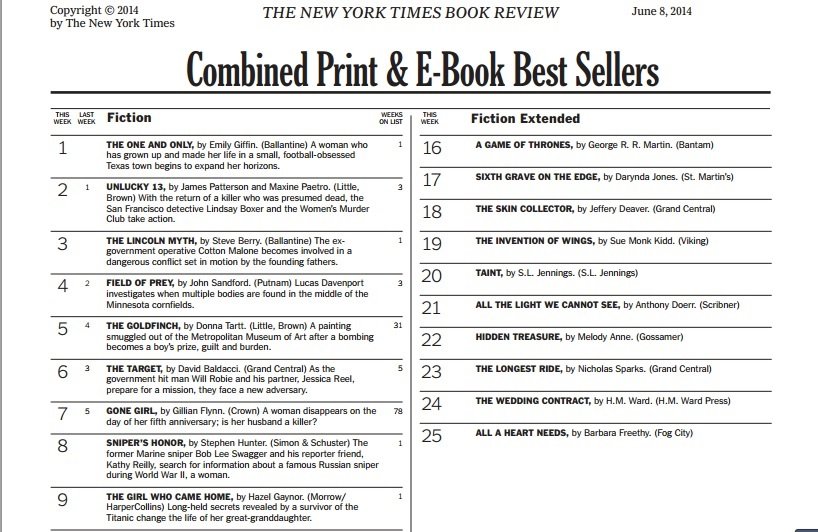
For those of you not familiar with the total scam that is the NYT bestseller list, as a NYT bestseller myself, it’s utter bullshit. It’s not an actual list of bestsellers. It’s “curated editorial”.
As in, stuff they like gets on there, and stuff they don’t like doesn’t. Or stuff they like places higher, and stuff they don’t like but obviously sells too much to deny its a bestseller gets on there lower.
I still tell people I’m a NYT bestseller because most regular normies think that actually means something impressive, and it’s just quicker to say that to establish that you’re a certain level. Within the actual publishing industry its fairly meaningless and everybody knows it.
In reality I made it on there a couple of times early on in my career before they realized who I am and what I’m into (the totally wrong politics, loudly!), because then it was like a post it note got stuck on the wall there saying FUCK THIS GUY, because after that no matter how many copies I sold, even if I was mud stomping half their list in actual sales, I wasn’t getting on there ever again.
Everybody is aware of this scam. The key to getting on the list is the NYT wanting to promote you. They don’t actually track all book sales. They track certain “reporting stores” (which are supposed to be secret but we all know how they are). But then the NYT takes whatever reality is and massages it to fit their narrative.
It isn’t just to keep wrong thinking pariahs like me off there either. I’ve got friends who are apolitical or even mildly liberal who still make the list, but who get bumped down a bunch of spaces from what they should be because there’s somebody else with a new book out the NYT wants to fluff.
Even when the NYT isn’t putting its finger on the scale, it also only measures velocity, as in how many books sold that week. So if you sell 20k copies that week, but never sell another book again, you’re a bestseller. But a guy who sells 1k copies a week every week for an entire year, is not.
Also, I don’t know if it is still this way, because I quit paying attention to what makes the NYT list years ago after I understood what a joke it was, but it was only for physical books, not ebooks, not audio. And there are authors who crush it in ebook who sell very few physical copies in stores. I don’t know if this is still the case on what they claim to track or not today.
So basically it is a biased list of what one small part of the industry sells in a short period of time that the NYT then tweaks to ignore reality if they feel like it anyway. And this isn’t just my opinion as a disgruntled former NYT bestseller, this has gone to court. Authors have sued the NYT which is where the “editorial” thing comes from.
This gets some attention periodically when somebody really famous raises a stink about it. A couple years ago it was Elon. Before that it was Mike Rowe. Etc. But then regular people all forget and go back to thinking the NYT‘s bestseller list isn’t as full of shit as everything else the NYT does.
Cancelled chancellor?
The German Chancellor’s future looks unhappy, and eugyppius notes that even the lapdog mainstream media outlets who praised him last year are now publishing calls for his ouster:

German Chancellor Friedrich Merz, 5 May 2025.
Photo by Sandro Halank for Wikimedia Commons.
Merz has always been just some loser. He’s a third-rate talentless politician and in this much like his predecessor, Olaf Scholz. Both are mere caricatures, what happens when you mimeograph overmuch the last century’s tired political styles. These kinds of chancellors will continue to exist only so long as they can be sold to the geezers of the Federal Republic’s care homes by the amateurish marketing campaigns of a complicit state media as the incarnation of far-sighted competence and (more importantly) bourgeois respectability.
Early in 2025, Merz had the chance to seize a measure of power for himself and make facts. He could have forged a deal with Alternative für Deutschland on the most important questions, established a minority government and set about force-marching the obese German state through necessary reforms. It might’ve torn his party apart, he might’ve failed, there would’ve been a huge fight, but whatever happened nobody would ever forget Chancellor Merz. Instead, the Pigeon Chancellor let a lot of deranged Antifa street protesters and screeching women with parareligious concerns about atmospheric carbon dioxide concentrations dissuade him from the only reasonable path. Instead of making history, he chose to spend the first year of his chancellorship making the Social Democrats fat and happy at the expense of the nation. Most don’t even hate Merz, because hate like love has to be be earned. He inspires nothing more than mildly scornful indifference.
Everyone who was not a complete idiot knew that Merz’s mad coalition with the Social Democrats could never work. Yet the man has been lionised in the international press and even in centre-right domestic papers like the Frankfurter Allgemeine Zeitung as a serious reformer. These people told us Merz would rebuild the Bundeswehr, reduce insane social spending, impose fiscal discipline, solve the migroid problem and restore economic growth. Even if the leftoid half of the German establishment press didn’t embrace all these myths, they nevertheless worked hard to make Merz seem presentable, serious and viable. He was worth a shot, he would do his best, and after the crazy Scholz years Germany was back on solid footing.
Now, in the the space of about two weeks, the entire myth of Chancellor Merz has collapsed. Major papers that used to defend his government and praise his prospects are suddenly saying it’s over. They’re writing front-page editorials in the spirit of stuff I was posting here over a year ago. Merz appears at town-hall meetings where he gets asked how he’s made life better in Germany and before he can answer the audience just laughs at his stupid ass. His coalition partners say he’s doing a terrible job. Back-benchers from his own party are calling his political strategy a failure to his face and leaking it afterwards to the press so everyone knows what they said.
Still worse, people from the Chancellery are talking to the tabloids. They’re explaining that Merz’s government has been hanging by a thread since at least last December; that his party thinks he’s a pushover whom the SPD constantly manipulates; that often Merz just absorbs the opinions of whatever person he last talked to and so his handlers have to limit his contacts to keep him from going off-message in insane ways; that Merz is now almost totally isolated, having burned through most of his close confidants; and that nobody has any solutions or ideas and increasingly everybody doubts that the Chancellor has the talents to save himself.
Progressives instinctively side with the “oppressed” side of any argument
On the social media site formerly known as Twitter, Devon Eriksen responds to a posted talking point:
Someone once observed that in any conflict, leftists will always side with whichever demographic causes the most social harm.
This creates a hierarchy, with White men (the primary civilization-builders) at the bottom, and third-world Muslims at the top.
Here’s why how this works.
In a healthy society, people who build civilization are revered, and people who cause social harm are despised. And there is a hierarchy that runs in the opposite order, with respect and resources going to those who serve civilization.
This creates a natural opportunity for power-hungry subversives. They can recruit each layer of this hierarchy by exploiting their resentment against those above them. All they must do is frame their merit-based status as unearned “privilege”.
White women were recruited to leftism by stoking their resentment of White men, and promising elevation above them.
What the White women were not told is that they would be placed beneath everyone else.
Often literally.
Black people were recruited by exploiting their resentment of Whites … but they weren’t told that every benefit they received would eventually be taken away and given to third world immigrants.
Homosexuals were promised elevation above the “breeders” (because children are needed for civilization, and sodomy is not), but no one told them that the trannies would rule over them.
And no one told the trannies that Muslim community would be allowed to segregate and oppress them far more brutally than the most ardent of White bigots.
The most brutal irony of all is that all of these groups who are recruited to fight for leftism end up far more brutally oppressed that they ever were by mainstream prosocial White society.
Because natural civilizational hierarchies are based on contribution.
There’s a certain amount of prejudice which exists because people can reason inductively, but if you are a mixed race lesbian engineer who can actually who build useful shit, then it’s at least possible for people to eventually overcome their surprise, and break you off a nice house in the suburbs and some forbearance wherein people don’t really talk about the real relationship between you and your “roommate”.
Under leftism inverted hierarchies, you have no such chance.
Sure, during the transitional phase you’ll be elevated for being a mixed-race lesbian, regardless of whether you can do anything useful or not. But then, the Muslims will be allowed to throw you off a roof when it’s time to pander to them, in turn.
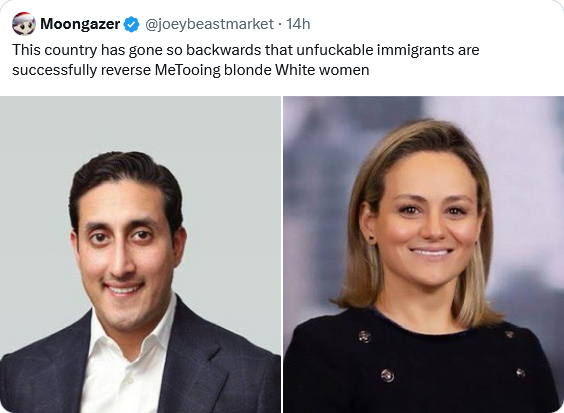
This White (or White-passing) woman probably voted straight democrat and cheered for “MeeeeeeeeeeeeeeeeeeeeeeToo”, to avenge her resentment against White men in general. She probably never dreamed that she would, in turn, not only be thrown under the bus, but that she would be targeted by the precise same weapons her sisters were given to unseat White men with.
And @jk_rowling found out in vivid, larger-than-life detail what happens to White feminists when the left has a new darling to cater to, who can be used to unravel some still-intact piece of civilization.
You see, by the early 21st century, the left had no more use for White feminists, because everything the left wanted to use them to destroy was already destroyed. Women were already spending their twenties and thirties on cubicle jobs and abortions, instead of marriages and children. The workforce was already doubled, and the price of labor had already crashed. Fertility rates were already dropping, and people were already marrying late, or never.
It was time to recruit a new wrecking ball, to turn against some other corner of the edifice of order, and the price of that was easy to pay … just confiscate everything you once gave them, and give it to the trannies instead.
The actual bodies of the White feminists (as well as all other women, and their daughters), could be used again, sold out to third world men who want to rape them, all by simply turning a blind eye.
And the best perk of all of this is that they’ll still vote for you.
Because reversing course requires admitting a mistake.
May 1, 2026
We are much more Brave New World than 1984
Culturally, we had lots of warning from George Orwell and Aldous Huxley about their future — our present — and while we have had some success avoiding what Orwell feared for us, we’ve had much less success avoiding a Brave New World culture:
As the curtain of totalitarianism descended across much of the globe, in the mid-twentieth century, the Western intellectual class pointed to George Orwell’s 1984 as a blueprint for societal ruin.
I’m sure many of you are familiar with Orwell’s magnum opus, but for those who don’t know the gist: Orwell envisioned a dystopian future governed by a panoptic state, where an externally imposed oppression would ruthlessly strip humanity of its autonomy, its history, and its capacity for critical thought.
It is a great novel and many believe it was prophetic (I certainly believe parts of it ring true), but, as the cultural critic Neil Postman astutely observed in his foreword to Amusing Ourselves to Death, it was not Orwell but Aldous Huxley, author of Brave New World, who accurately mapped the specific destiny of the modern collapse.
Huxley recognised a far more insidious threat:
What Orwell feared were those who would ban books. What Huxley feared was that there would be no reason to ban a book because there would be no one who wanted to read one.
No “Big Brother” is required to deprive a populace of its cognitive liberty. He foresaw a society that would come to adore the very technologies that undid its capacity to think.
Where Orwell feared those who would ban books, Huxley feared there would eventually be no reason to ban a book, for there would be no one left who wanted to read one. Where Orwell feared the truth would be actively concealed, Huxley feared it would be drowned in an endless sea of irrelevance. Ultimately, Orwell feared that what we hate will ruin us, while Huxley feared that what we love will ruin us.
[…]
The Collapse of Literacy in the Intellectual Elite
The symptoms of this cognitive counter-revolution are visible not only in the general populace but at the very apex of the educational system, signalling a crisis that threatens the reproduction of the intellectual class itself. Over the past decade, professors at elite academic institutions have sounded the alarm regarding a precipitous and bewildering decline in student literacy. In a widely discussed exposition in The Atlantic, Nicholas Dames, a professor of Columbia University’s required Literature Humanities course since 1998, noted that his undergraduate students, the supposed academic elite of the nation are now “bewildered by the thought of finishing multiple books a semester“.1
Two decades ago, Dames’s classes effortlessly engaged in sophisticated, week-to-week analyses of lengthy texts like Jane Austen’s Pride and Prejudice and Fyodor Dostoevsky’s Crime and Punishment. Today, the landscape is unrecognisable. In 2022, a first-year student confessed to Dames that during her entire tenure at a public high school, she had never been required to read a single book cover-to-cover.2 Instead, her education consisted of excerpts, isolated poems, and fragmented news articles. This is a systemic failure; middle and high schools have largely ceased assigning whole books, breaking them down into easily digestible, context-free fragments to accommodate dwindling attention spans. High-achieving students can still decode words, but they struggle to muster the sustained attention or cognitive ambition required to immerse themselves in substantial texts. As technology provides instant gratification, the sustained labor of reading feels deeply unnatural to a generation raised on screens.
This anecdotal evidence from the highest echelons of the academy is overwhelmingly corroborated by a mountain of empirical data. The decline in sustained reading and linguistic proficiency is measurable and accelerating.


Spain joins the awkward squad
At The Conservative Woman, Bepi Pezzulli outlines a few ways that the Spanish government is moving in quite different directions than their NATO allies and fellow EU members:

Torre del Oro (Tower of Gold) – Calle Almirante Lobo, Seville – Spanish flag” by ell brown is licensed under CC BY-SA 2.0 .
Spain’s Prime Minister Pedro Sánchez wants the privileges of alliance without the duties of one. Madrid remains in Nato, hosts critical American military infrastructure, and speaks the language of Atlantic solidarity – but only when convenient. On the central strategic questions of the age – Russia, Israel, and the wider Western posture in the Mediterranean – it increasingly behaves like a spoiler. What is troubling is that Spain is not merely posturing: it is rewriting its entire conception of statecraft, treating alliance as a shield, hostility as leverage, and strategic ambiguity as a governing doctrine.
When Washington needed alignment, Sánchez offered obstruction. When Israel faced existential war, Madrid offered moral lectures. When the West sought energy discipline against Moscow, Spain found room for Russian gas. All while preserving the old imperial obsession with Gibraltar and extracting advantages from London over the Rock.
Spain has discovered the pleasures of consequence-free hostility. That needs to end.
Anti-Americanism with diplomatic immunity
Sánchez has carefully cultivated the old European left’s anti-American reflexes: Nato when subsidised, moral neutrality when sacrifice is required. His government publicly resisted support for American military operations linked to Iran escalation and signalled clear reluctance to facilitate use of Spanish bases such as Rota and Morón for operations that might implicate Madrid politically. The message was unmistakable: American security guarantees are welcome but strategic co-operation is negotiable. The rhetoric matched the policy. “No to war” was not merely a slogan for domestic consumption. Sánchez is deliberately positioning Spain as the righteous dissenter against Washington’s harder strategic line.
At the same time, Spain maintained substantial imports of Russian gas well into the European sanctions era. While pipeline politics consumed Brussels, Madrid benefited from a convenient moral distinction: condemning Moscow loudly while continuing commercial accommodation where useful. The formal sanctions architecture left open some loopholes, and Spain was happy to live inside them.
An ally that profits from ambiguity while others bear the strategic burden is not an ally in the full sense. As US War Secretary Pete Hegseth noted, “An alliance cannot be ironclad if in reality or perception it is seen as one-sided”.
From criticism of Israel to open diplomatic hostility
On Israel, Sánchez has moved beyond criticism into active diplomatic confrontation. Recognition of Palestine was presented as humanitarian principle. In practice, it rewarded maximalism at the worst possible moment. Madrid helped transform October 7 from a terrorist massacre demanding strategic clarity into another European seminar on Israeli restraint. Spain became one of the loudest governmental amplifiers of the anti-Zionist campaign in Western Europe. Ministers normalised rhetoric that blurred the distinction between criticism of Israeli policy and systematic delegitimisation of the Jewish state itself. Arms restrictions followed. Then diplomatic actions. Symbolism became policy.
Gibraltar: Madrid’s imperial nostalgia
Spain’s sanctimony would be easier to tolerate if it were not paired with its own colonial fixation. For decades, Madrid has pursued sovereignty claims over Gibraltar with theological persistence. Brexit offered a fresh opening. With Brussels behind it, Spain extracted a remarkably favourable negotiating posture over the future relationship of the Rock with both the European Union and the United Kingdom. London, in the hands of the most Europhile government in recent history, conceded far more than many British voters imagined when they heard the word “sovereignty”. Spain never abandoned the long game. It simply learned to play it through institutions until a weaker opponent appeared. Madrid insists Gibraltar is unfinished history. Fair enough: is it not time then to conclude the same about Ceuta and Melilla?
“Second Dawn”, Childhood’s End, and the Nuclear Age
Feral Historian
Published 5 Dec 2025A quick look at two Arthur C. Clarke stories from the early 1950s that pair well as allegories for the still-new Cold War fears of the time.
00:00 Intro
03:03 Psychics and Nukes
03:37 “Second Dawn”
09:13 The Phileni
11:50 New World, New DangersAudio note: On the previous vid (Riddick) I used some new tools for post-processing the audio. It was much cleaner, removed almost all the noise … and the response has been entirely negative. It seems people don’t miss the wind and the birds until they’re gone. So I’m back to the old approach of using essentially raw sound.
EDIT: If you’re not seeing a link to the old Childhood’s End video on the pop-up card or the end screen, here’s the link. • Childhood’s End (Youtube Copyright Edit)
🔹 Patreon | patreon.com/FeralHistorian
🔹 Ko-Fi | ko-fi.com/feralhistorian
🔹 and Merch! | feral-shop.fourthwall.com
Still plugging Ninti’s Gate
🔹 amazon.com/dp/B0CYXH9BWD


