
World War Two
Published Jan 10, 2026Adolf Hitler and the Nazi Party are forced to hit the campaign trail yet again for yet another round of elections. All this campaigning has seriously drained their finances, so they expect it to do some real good. Unfortunately for them, the November elections are very disappointing for the Nazi Party, and they lose a lot of seats in the Reichstag. Adolf Hitler is still demanding that President Hindenburg make him Chancellor, but the President still refuses time and again, although Hindenburg does have his hands full with two other Chancellors — Franz von Papen and Kurt von Schleicher, and their endless political intriguing.
(more…)
January 11, 2026
Nazis Are the Big Losers – Rise of Hitler 26, October-December 1932
Comments Off on Nazis Are the Big Losers – Rise of Hitler 26, October-December 1932
QotD: The limits of foreign policy realism
Longtime readers will remember that we’ve actually already talked about “realism” as a school of international relations study before, in the context of our discussion of Europa Universalis. But let’s briefly start out with what we mean when we say IR realism (properly “neo-realism” in its modern form): this is not simply being “realistic” about international politics. “Realism” is amazing branding, but “realists” are not simply claiming that they are observing reality – they have a broader claim about how reality works.
Instead realism is the view that international politics is fundamentally structured by the fact that states seek to maximize their power, act more or less rationally to do so, and are unrestrained by customs or international law. Thus the classic Thucydidean formulation in its most simple terms, “the strong do what they will, the weak suffer what they must”,1 with the additional proviso that, this being the case, all states seek to be as strong as possible.
If you accept those premises, you can chart a fairly consistent analytical vision of interstate activity basically from first principles, describing all sorts of behavior – balancing, coercion, hegemony and so on – that ought to occur in such systems and which does occur in the real world. Naturally, theory being what it is, neo-realist theory (which is what we call the modern post-1979 version of this thinking) is split into its own sub-schools based on exactly how they imagine this all works out, with defensive realism (“states aim to survive”) and offensive realism (“states aim to maximize power”), but we needn’t get into the details.
So when someone says they are a “foreign policy realist”, assuming they know what they’re talking about, they’re not saying they have a realistic vision of international politics, but that they instead believe that the actions of states are governed mostly by the pursuit of power and security, which they pursue mostly rationally, without moral, customary or legal constraint. This is, I must stress, not the only theory of the case (and we’ll get into some limits in a second).
The first problem with IR Realists is that they run into a contradiction between realism as an analytical tool and realism as a set of normative behaviors. Put another way, IR realism runs the risk of conflating “states generally act this way”, with “states should generally act this way”. You can see that specific contradiction manifested grotesquely in John Mearsheimer’s career as of late, where his principle argument is that because a realist perspective suggests that Russia would attack Ukraine that Russia was right to do so and therefore, somehow, the United States should not contest this (despite it being in the United States’ power-maximizing interest to do so). Note the jump from the analytical statement (“Russia was always likely to do this”) to the normative statement (“Russia carries no guilt, this is NATO’s fault, we should not stop this”). The former, of course, can always be true without the latter being necessary.
I should note, this sort of “normative smuggling” in realism is not remotely new: it is exactly how the very first instances of realist political thought are framed. The first expressions of IR realism are in Thucydides, where the Athenians – first at Corinth and then at Melos – make realist arguments expressly to get other states to do something, namely to acquiesce to Athenian Empire. The arguments in both cases are explicitly normative, that Athens did not act “contrary to the common practice of mankind” (expressed in realist dog-eat-dog terms) and so in the first case shouldn’t be punished with war by Sparta and in the latter case, that the Melians should submit to Athenian rule. In both cases, the Athenians are smuggling in a normative statement about what a state should do (in the former case, seemingly against interest!) into a description of what states supposedly always do.
I should note that one of my persistent complaints against international relations study in political science in general is that political scientists often read Thucydides very shallowly, dipping in for the theory and out for the rest. But Thucydides’ reader would not have missed that it is always the Athenians who make the realist arguments and they lost both the arguments [AND] the war. When Thucydides has the Melians caution that the Athenians’ “realist” ruthlessness would mean “your fall would be a signal for the heaviest vengeance and an example for the world to meditate upon”2 the ancient Greek reader knows they are right, in a way that it often seems to me political science students seem to miss.
And there’s a logical contradiction inherent in this sort of normative smuggling, which is that the smuggling is even necessary at all. After all, if states are mostly rational and largely pursue their own interests, loudly insisting that they should do so seems a bit pointless, doesn’t it? Using realism as a way to describe the world or to predict the actions of other states is consistent with the logical system, but using it to persuade other states – or your own state – seems to defeat the purpose. If you believe realism is true, your state and every other is going to act to maximize its power, regardless of what you do or say. If they can do otherwise than there must be some significant space for institutions, customs, morals, norms or simple mistakes and suddenly the air-tight logical framework of realism begins to break down.
That latter vision gives rise to constructivism (“international relations are shaped by ideology and culture”) and IR liberalism (“international relations are also shaped by institutions, which can bend the system away from the endless conflict realism anticipates”). The great irony of realism is that to think that having more realists in power would cause a country to behave in a more realist way is inconsistent with neo-Realism which would suggest countries ought to behave in realist ways even in the absence of realist theory or thinkers.
In practice – and this is the punchline – in my experience most “realists”, intentionally or not, use realism as a cover for strong ideological convictions, typically convictions which are uncomfortable to utter in the highly educated spaces that foreign policy chatter tends to happen. Sometimes those convictions are fairly benign – it is not an accident that there’s a vocal subset of IR-realists with ties to the CATO Institute, for instance. They’re libertarians who think the foreign policy adventures that often flew under the banner of constructivist or liberal internationalist label – that’s where you’d find “spreading democracy will make the world more peaceful” – were really expensive and they really dislike taxes. But “we should just spend a lot less on foreign policy” is a tough sell in the foreign policy space; realism can provide a more intellectually sophisticated gloss to the idea. Sometimes those convictions are less benign; one can’t help but notice the realist pretensions of some figures in the orbit of the current administration have a whiff of authoritarianism or ethnocentrism in them, since a realist framework can be used to drain imperial exploitation and butchery of its moral component, rendering it “just states maximizing their power – and better to be exploiter than exploited”.
One question I find useful to ask of any foreign policy framework, but especially of self-claimed realist frameworks is, “what compromise, what tradeoff does this demand of you?” Strategy, after all, is the art of priorities and that means accepting some things you want are lower priority; in the case of realism which holds that states seek to maximize power, it may mean assigning a high priority to things you do not want the state to do at all but which maximize its power. A realism deserving of the name, in applied practice would be endlessly caveated: “I hate, this but …” “I don’t like this, but …” “I would want to do this, but …” If a neo-realist analysis leads only to comfortable conclusions that someone and their priorities were right everywhere all along, it is simply ideology, wearing realism as a mask. And that is, to be frank, the most common form, as far as I can tell.
That isn’t to say there is nothing to neo-realism or foreign policy realists. I think as an analytical and predict tool, realism is quite valuable. States very often do behave in the way realist theory would suggest they ought, they just don’t always do so and it turns out norms and expectations matter a lot. Not the least of which because, as we’ve noted before, the economic model on which realist and neo-realist thinking was predicted basically no longer exists. To return to the current Ukraine War: is Putin really behaving rationally in a power-maximizing mode by putting his army to the torch capturing burned out Ukrainian farmland one centimeter at a time and no faster? It sure seems like Russian power has been reduced rather than enhanced by this move, even though realists will insist that Russia’s effort to dominate states near it is rational power-maximizing under offensive realism.
Bret Devereaux, “Fireside Friday, June 27, 2025 (On the Limits of Realism)”, A Collection of Unmitigated Pedantry, 2025-06-27.
- Thuc. 5.89.
- Thuc. 5.90.
Comments Off on QotD: The limits of foreign policy realism
January 10, 2026
A Short Tour of Roman London
Scenic Routes to the Past
Published 19 Sept 2025The ruins of Londinium – London’s Roman predecessor – are not spectacular. But they are extremely interesting …
0:00 Introduction
0:40 City walls
1:47 St. Magnus the Martyr
2:26 Monument to the Great Fire
3:12 Leadenhall Market
4:10 London Mithraeum
6:19 Bank of England
7:08 Guildhall Amphitheater
8:14 The Gherkin
Comments Off on A Short Tour of Roman London
January 9, 2026
The Official American Boy Scout Rifle: Remington 4-S
Forgotten Weapons
Published 15 Aug 2025The scouting concept exploded into the American culture after 1907, with a multitude of local, regional, and national organizations setting up in the years before World War One. Among these was the American Boy Scouts, founded by William Randolph Hearst. In 1913 they adopted the Remington 4-S as their official rifle, a .22 Short caliber rolling block. It was initially sold directly and exclusively to Scouts for $5, although it was quickly added to the general Remington catalog.
This rifle was intended to be used for both target shooting and also military style drill. To that end, it had military-style furniture, a stacking swivel, and a bayonet lug with miniature bayonet. About 1500 of these were made in 1913, which was the only year of production. In 1914, probably having failed to make the hoped-for sales numbers, Remington renamed the gun the “Military Model” to expand its sale beyond just the American Boy Scouts.
Oh, and note that this was not the Boy Scouts of America! The ABS would have a series of legal fights with the BSA over naming rights, which the BSA finally won in the early 1920s. The ABS was never a very large organization, and it faded away entirely in the 1920s. The BSA opted not to have an official rifle, as it was shying away from firearms at the time after a couple well-publicized shooting accidents.
(more…)
Comments Off on The Official American Boy Scout Rifle: Remington 4-S
January 8, 2026
WW1: The War Begins… | EP 1
The Rest Is History
Published 25 Aug 2025Following the declaration of war in 1914, how did the outbreak of the First World War unfold? What were the earliest military engagements of this terrible, totemic event? Who were its key political players and how did they respond? What was the attitude to the war in Germany? Were the allies unified from this early stage, or were they suspicious and frozen by indecision? And, how did the Germans, with the mightiest army in all the world, make its move on “plucky little” Belgium?
Join Dominic and Tom as they launch into one of the most consequential events of all time: the outbreak of the First World War.
00:00 – Germany: from peaceful nation to war machine
02:30 – Introduction to WWI series: scope and importance
04:16 – Was Germany uniquely responsible for the war? Historians’ debate
06:12 – Fear versus aggression: German motivations
06:46 – The July Crisis: Sarajevo, blank cheque, Kaiser’s holiday, Austrian ultimatum
08:08 – Helmuth von Moltke the Younger: personality, melancholy, moustaches
12:01 – Germany’s strategic weakness: encirclement fears, manpower and GDP
13:45 – The Schlieffen Plan explained
18:06 – Von Moltke panics
19:00 – Kaiser signs mobilization order; emotional scene in Berlin
22:53 – The problem of Belgian neutrality and Britain’s obligations
23:47 – British cabinet debates: how far into Belgium would justify war?
25:04 – German ultimatum to Belgium: demands for railways and fortresses
26:14 – Belgium rejects ultimatum; King Albert’s defiance
27:59 – “A scrap of paper”: German gaffe fuels British propaganda
28:35 – King Albert’s speech to parliament: “Determined at any cost”
29:52 – Total War Rome (Creative Assembly)
30:37 – German invasion begins
36:18 – German reprisals in Belgium
50:00 – Comparisons with Allied conduct in Ireland, colonies, and elsewhere
50:47 – The Leuven library fire: destruction of manuscripts, global outrage
52:12 – Germany’s reputation collapses: admired culture turned to “barbarism”
53:28 – Fall of Brussels: German army enters the capital
(more…)
Comments Off on WW1: The War Begins… | EP 1
QotD: Canned food and the early days of the Raj
You might even miss something culturally. For instance, there’s an entire sub-subdiscipline called “Food and Foodways”, and it’s not as silly as it sounds. Canned food was an important part of British cultural life in the Raj, for instance. File it under “Women Ruin Everything” — once it got safe enough for ladies to have a reasonable chance of surviving East of Suez, the awesome freewheeling decadence of the “White Mughals” period was replaced by dour, dowdy Victorian bullshit. Every summer the “fishing fleet” pulled into Calcutta harbor, disembarking scads of ugly British girls with a Bible in one hand and a can of spotted dick in the other, determined to snag the highest-ranking ICS man they could and, in the process, turn India into another boring suburb of Edinburgh. Anglo-Indian cookbooks are full of recipes for horrid British glop straight out of cans, and if you routinely got really, really sick from eating spoiled stuff, well, hard cheese, old chap! Heaven forbid you eat the delicious, nutritious, climate-optimized cuisine that was literally right there …
If you want to argue that the Indian Army fought so many border wars just to get away from sour, hectoring memsahibs and their godawful tinned slop, I’m not going to stop you.
Anyway, the point is, IF you are conversant enough with the relevant technical stuff, it occurs to me that you can get a snapshot of embedded cultural assumptions by looking at a period’s characteristic or representative technology.
Severian, “Assumption Artifacts”, Founding Questions, 2024-04-30.
Comments Off on QotD: Canned food and the early days of the Raj
January 7, 2026
The Korean War Week 81: Ridgway Admits the UN is Little Threat! – January 6, 1952
The Korean War by Indy Neidell
Published 6 Jan 2026The year may have changed, familiar faces come and go, but some things remain the same. The POW issue continues to dominate and frustrate armistice talks, the fear of an expanded war in Asia re-emerges, and the snow remains cold. The war found no end and no pause in either 1950 or 1951, but third time’s the charm, surely?
00:00 Intro
00:29 Recap
01:24 Britain and the US
06:49 The US Proposal
10:57 The Slave Trade?
12:12 Summary
13:35 Conclusion
(more…)
Comments Off on The Korean War Week 81: Ridgway Admits the UN is Little Threat! – January 6, 1952
More anti-anti-boomer discussion from Scott Alexander
I linked to Scott’s original article last month and thanks to the interest it generated (and perhaps my clickbait-y headline) it got linked at Instapundit thanks to Sarah Hoyt. Scott got a lot of feedback on his post and shares some of that here:
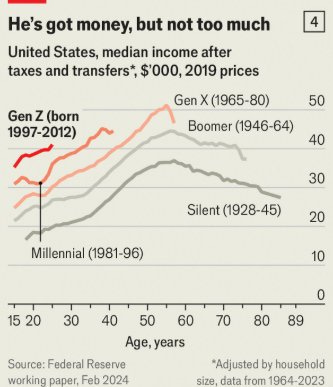
“… Millennials and Generation Z have more money (adjusted for inflation ie cost-of-living, and compared at the same age) than their Boomer parents, to about the same degree that the Boomers exceeded their own parents. This is good and how it should be. The Boomers have successfully passed on a better life to their children”
First, I wish I’d been more careful to differentiate the following claims:
- Boomers had it much easier than later generations.
- The political system unfairly prioritizes Boomers over other generations.
- Boomers are uniquely bad on some axis like narcissism, selfishness, short-termism, or willingness to defect on the social contract.
Anti-Boomerism conflates all three of these positions, and in arguing against it, I tried to argue against all three of these positions — I think with varying degrees of success. But these are separate claims that could stand or fall separately, and I think a true argument against anti-Boomerists would demand they declare explicitly which ones they support — rather than letting them switch among them as convenient — then arguing against whichever ones they say are key to their position.
Second, I wish I’d highlighted how much of this discussion centers around disagreements over which policies are natural/unmarked vs. unnatural/marked.
Nobody is passing laws that literally say “confiscate wealth from Generation A and give it to Generation B”. We’re mostly discussing tax policy, where Tax Policy 1 is more favorable to old people, and Tax Policy 2 is more favorable to young people. If you’re young, you might feel like Tax Policy 1 is a declaration of intergenerational warfare where the old are enriching themselves at young people’s expense. But if you’re old, you might feel like reversing Tax Policy 1 and switching to Tax Policy 2 would be intergenerational warfare confiscating your stuff. But in fact, they’re just two different tax policies and it’s not obvious which one a fair society with no “intergenerational warfare” would have, even assuming there was such a thing. We’ll see this most clearly in the section on housing, but I’ll try to highlight it whenever it comes up.
I’m in a fighty frame of mind here and probably defend the Boomers (and myself) in these responses more than I would in an ideal world.
[…]
1: Top Comments I Especially Want To Highlight
…
Sokow writes:
[The anti-Boomer] take has been imported in part from the EU + the UK where the pension system is not the same. https://en.wikipedia.org/wiki/State_Pension_(United_Kingdom)#Pensions_Act_2007
There is a lot of similar things in France that I could dig up, such as all attempts to tax benefits being defeated.
Many Europeans chimed in to say this, including people whose opinions I trust.
I find this pretty interesting. We all know stories of American opinions infecting Europeans, like how they’re obsessed about anti-black racism, but rarely worry about anti-Roma racism which is much more prevalent there. I’d never heard anyone argue the opposite — that the European discourse is infecting Americans with ideas that don’t apply to our context — but it makes sense that this should happen. I might write a post on this.
Kevin Munger (Never Met A Science) writes:
Hating Boomers (and talking about hating Boomers) is uninteresting and I agree morally dubious.
But it is *emphatically* false that “Boomers were a perfectly normal American generation”. They have served far more terms in Congress than any generation before or since (and we currently have the oldest average age of elected officials in a legislative body IN THE WORLD other than apparently Cambodia), they have dominated the presidency (look up the birthdate of every major party candidate since the 2000 presidential election…), they controlled the commanding heights of major companies, cultural institutions (especially academica).
They are a historically *unique* generation, for three intersecting reasons: 1. They are a uniquely large generation 2. they came of age as the country and its institutions were maturing 3. they are sticking around because of increased longevity. These are analytical facts, and they produce what I call “Boomer Ballast” — a concentration of our societies resources in one, older generation that increases the tension we are experiencing from technological innovation. Our demography is pulling us towards the past, the internet is pulling us into the future, and this I think is the major source of the anti-Boomer frustration.
On the specifics of social security and why we might think Boomers have played things to their advantage (not bc they’re specifically evil but bc they have the political power to do so) — the key thing is that they have prevented forward-thinking politicians from fixing the inevitable hole in social security that comes from our demographic pyramid. It would have been relatively painless to increase the rate or incidence of the social security payroll tax at any point in the past 25 years, the looming demographic cliff was obvious and the increased burden could’ve been shared more equally. Instead, they prevented reforms and all of the fiscal pain from demographic shifts will be borne by younger generations.
I agree this is a strong argument, and part of why I think it’s helpful to separate the three points I mentioned at the beginning.
RH writes:
We [Boomers] did [vote for ourselves to pay higher taxes and get fewer benefits]. My lifetime SS benefits will be 20-25 percent less than they would have been under previous law, and I voted for that. My SS tax rate went up itself, and has been well over 15% since the changes took effect, and the cap on earned income subject to that went up a lot. And I voted to accept all that because it was projected to be sufficient.
Then the immigrant haters decided we needed fewer workers in the country, or at least fewer paying SS taxes, so they slowed legal immigration and pushed illegals into the underground economy, so they don’t pay taxes to support social security. And social security is going to get whacked again, plus the evils the SS system was intended to alleviate — people too old to work and too poor to live — will return.
I think this says something profound about politics. The problem is less that there’s some group of people who don’t believe in fairness, but that fairness is very hard to calculate.
Suppose RH is right (I haven’t checked), and that Social Security would be sustainable with lots of immigration. Then whether Boomers are paying “their fair share” or not depends on whether immigration is good or bad (a hard question!), and on whether we think of high vs. low immigration as the natural unmarked state of the universe (such that immigration opponents must “own” closed borders and compensate the losers), and on what kind of compensation the losers from closed borders deserve.
Someone else commented by saying we could solve all of these problems without inconveniencing either the Boomers or the young by just increasing taxes on a few ultra-rich people. The ultra-rich could reasonably say they didn’t create this problem and it’s unfair to tax them for it. But so could the Boomers and the young! So whose “fair share” is it?
Comments Off on More anti-anti-boomer discussion from Scott Alexander
Red Star: The Dawn of Soviet Sci-Fi
Feral Historian
Published 15 Aug 2025Soviet science fiction is a long winding road and it starts with Alexander Bogdanov’s Red Star. Let’s start down that road.
00:00 Intro
03:15 Introducing Martian Socialism
06:35 Tektology
10:03 Crafting Communism
15:08 Mars Has Problems
19:06 Old Man of the Mountain
20:32 The Engineer Menni
(more…)
Comments Off on Red Star: The Dawn of Soviet Sci-Fi
January 6, 2026
The “developing world” is not poor because the “rich countries” looted them
On the social media site formerly known as Twitter, Lauren Chen reacts to an emotive claim that the Third World is poor only because of the exploitation of their resources by the First World:

People often say that the developing world is poor because the Western world colonized them and stole their resources.
The truth, however, is that over the past century, the developing world has, for the most part, shown that they are completely incapable of harnessing their own resources. They are not poor because we stole from them. They are poor because they do not know how to run and administer their own countries, resources be damned.
Take Venezuela. The world’s largest oil reserves mean nothing if you have a corrupt communist as your leader. People will actually be starving and trying to eat zoo animals while you sit on trillions of dollars in resources!
Africa is another example. Europeans left behind farmland, trains, roads, and mines in Africa. What happened to it all?
It’s not that all of a sudden, the Africans started running things like anti-colonialist activists had envisioned at the time. No, no.
All the infrastructure fell into disrepair and/or was stripped down and looted. They were literally handed fully functioning, completed supply chains for resource extraction, and basically unlimited wealth, but they couldn’t manage the simple upkeep.
Now, the defense for Africa might be that “The Europeans didn’t teach the Africans how to manage any of this! It’s not the Africans’ fault they couldn’t run it independently! They were never trained!”
But my brother in Christ, the Europeans DID try to train locals for management! Obviously it would have been easier to have at least some locals in administration, rather than having to import an ENTIRE workforce, but efforts to find African talent were largely unsuccessful.
Don’t believe me? Just look at the different outcomes in Hong Kong and Singapore when compared to Africa. In East Asia, Europeans often did work with locals in administrative and management capacities. When colonialism ended, Hong Kong and Singapore were able to manage themselves. Not the case with Africa.
Now, none of this is to say that colonialism is good. People have the right to self-rule and self-determination. However, the idea that colonialism and resources extraction are responsible for the developing world’s ongoing poverty? That is quite simply a crock of shit.
Comments Off on The “developing world” is not poor because the “rich countries” looted them
Woodworking was WORK. What happened?
Rex Krueger
Published 5 Jan 2026Patrons saw this video early: / rexkrueger
Join the Mailing List: http://eepurl.com/g3rkmv
Take a course: https://www.rexkrueger.com/courses
Compass Rose Toolworks: https://www.compassrosetools.com/
Get my woodturning book: http://www.rexkrueger.com/book
Get My Book, Everyday Woodworking: https://amzn.to/3oyjC0E
Follow me on Instagram: @rexkrueger
Comments Off on Woodworking was WORK. What happened?
Typhoid Mary’s Deadly Ice Cream
Tasting History with Max Miller
Published 15 Jul 2025Fresh peach ice cream frozen in a mold garnished with sliced peaches and peach puree
City/Region: United States of America
Time Period: 1877Mary Mallon, born in 1869, was a cook for wealthy families, but she’s better known for being the first person found to be an asymptomatic carrier of typhoid fever. While most food was cooked to a temperature that kills the typhoid-causing bacteria, the families that employed Mary loved her peach ice cream.
While ice cream that has eggs in it is cooked, and there’s no way to know what kind Mary made, I opted for a recipe from the time for American style ice cream that has no eggs and isn’t cooked. Whichever ice cream base Mary used, she put cut up fresh peaches into it, which certainly could have carried the bacteria.
Gruesome inspiration for this recipe aside, the ice cream is really good. There’s a ton of fresh peach flavor, and you can make it as sweet or not as you like. The slices of peach inside the ice cream were very cold and kind of froze my mouth, so you could try cutting them up into smaller pieces to avoid the brain freeze I got.
Peach Ice-Cream
Mix a quart of cream with a cupful of sugar and four tablespoons of sherry. Add four cupfuls of peaches mashed fine and sweetened to taste, and freeze.
— Everyday Desserts by Olive Green (Myrtle Reed), 1911
Comments Off on Typhoid Mary’s Deadly Ice Cream
January 5, 2026
International law is more like International “law”
On the social media site formerly known as Twitter, Konstantin Kisin points out that calling it “International Law” gives it a semi-mythic quality that it absolutely does not deserve:
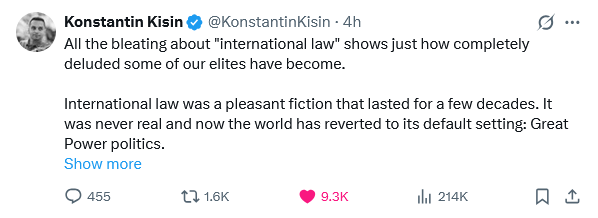
All the bleating about “international law” shows just how completely deluded some of our elites have become.
International law was a pleasant fiction that lasted for a few decades. It was never real and now the world has reverted to its default setting: Great Power politics.
This is why, as a strong Ukraine supporter, I have never talked about international law or called Putin’s attack an “illegal invasion”.
Laws are based on submission to an overarching authority backed by force. There is no such international authority and even if you view the UN as one, it does not have the ability to use force against those who violate “international law” other than against small countries with weak militaries.
When the US attacked Iraq, the UN did nothing.
When Russia invaded Ukraine, the UN did nothing.
If China invades Taiwan tomorrow, the UN will do nothing.If you cannot enforce a law, it’s not a law.
I do not support Ukraine because naughty Vlad broke the rules. I support Ukraine because it’s not in OUR interest in the West to have Russia marauding its way through friendly countries on the borders of Europe. It’s in our interest for us to be as strong as possible and for our adversaries to be as weak as possible.
President Trump is a realist and a pragmatist. He sees through the fictions other “leaders” cling to.
A good leader advances the national interests of his country. If more Western leaders did this, our civilisation would be in a much better place.
I commented on another post that,
For a lot of people (Canadian Liberals and American Democrats in particular), the invocation “international law” has a mesmerizing effect on their ability to reason [insert usual disclaimer that if they could foresee the results of their enlightened beliefs, they wouldn’t be progressives]. They seem to have a quasi-religious belief in the UN as if it were some kind of God-given supergovernment that is always right and must always be obeyed. “World opinion” might as well be the hand of God to them, so any time the legacy media can portray the US (and Trump in particular) as going against “world opinion” they want to get out the sackcloth and ashes … or sack a city and turn it into ashes, whichever comes first.
vittorio analyzes the default position of most progressives on the social media site formerly known as Twitter:
most political issues nowadays can be explained by understanding that american leftists dont have positions, they have oppositions.
their entire belief system is defined by negation of whatever the right supports. this is why portland chants “free maduro” while actual venezuelans celebrate in the streets. they’re not pro-venezuelan or pro democracies, or pro tyrant, or pro maduro, they’re simply anti-american-right.
they’ve outsourced their worldview to institutional narratives for so long that genuine self-reflection would require questioning everything. for them it’s much easier to just oppose. the beliefs arent coherent because they were never meant to be coherent. they only need to signal tribal membership, and leftist membership is gained by opposing the right.
trump does X? the left screams and cries because they wanted Y
trump does Y? the left screams and cries and riots because even if they said they wanted Y, what they meant is that X was the way to go
trump cures cancer? they’ll argue that the cancer cells are alive have a right of free determination
trump saves lives? they’ll protest because somehow those lives didn’t matter and should have been ended
no coherent word model. no logic. pure opposition
at some point you just have to stop engaging with it as if it’s a real political position. it’s not. it’s aesthetic opposition wearing the costume of ideology
As Severian at Founding Questions often remarks, progressives’ core belief is The Great Inversion: “whatever is, is wrong”.
Bingo Bobbins makes the case that “International law is fake and gay”:
Was this operation necessary? Was Maduro really a “narcoterrorist”? I admit that I haven’t really been following all the drama with Venezuela recently, but my intuition is that Maduro was probably accepting bribes to look the other way with regards to drug trafficking, rather than being directly involved. And sure, he was a socialist dictator but there’s plenty of those around. The US doesn’t go and topple dictators unless there is a perceived US interest in doing so.
What Maduro was actually doing was cozying up to China. In fact, he had just finished a meeting with some Chinese ambassadors hours before Delta Force snatched him up by the scruff. This was actually a warning to China not to mess around in our hemisphere. The Trump administration is re-establishing the Monroe Doctrine, or, as he recently called in a press conference, “The Donroe Doctrine“. As far as I can see, this is completely in keeping with my preferred Vitalist Foreign Policy.
You can agree or disagree with this show of force, but please don’t whine to me about “International Law”. International Law is fake and gay. I certainly don’t care that the Trump administration “targeted a political leader”. This is the complaint being leveled by many leftists in regard to the operation. Really, this is just because leftists are anti-American third-worldists, and they are filled with butthurt because “their guy” lost. But, let’s examine this “rule” of not being allowed to target a countries rulers, because it’s particularly ridiculous.
If you have a problem with a specific country, who do you really have a problem with? You have a problem with that country’s leaders, since they are the ones making the decisions. Why wouldn’t you target the leaders? The only reason is that all the leaders from all the countries got together and agreed that they wouldn’t target each other. They would rather resolve their differences by throwing cannon fodder at each other, while keeping themselves off the table. And sure, I understand why that is great for them, but not why it would be great for me (or you).
Of course, the CIA has been ignoring this “international law” for decades, but they’ve been doing it in a very effeminate way, skulking about the world, funding Color Revolutions and clandestinely arming insurgent groups in order to subvert existing regimes. The Donroe Doctrine is much better. Imagine if the Trump administration had tried to handle Maduro the way the Obama administration tried to handle Assad. Fund a decades long civil war, accidentally establish a caliphate, fight a war against said caliphate, facilitate the deaths of tens of thousands of Christians, all to have an even worse dictator eventually rise to power.
Update, 6 January: Welcome, Instapundit readers! Please do have a look around at some of my other posts you may find of interest. I send out a daily summary of posts here through my Substack – https://substack.com/@nicholasrusson that you can subscribe to if you’d like to be informed of new posts in the future.
Interdynamic MP-9 SMG: Origin of the TEC-9
Forgotten Weapons
Published 13 Aug 2025The story of the Tec-9 begins with a Swedish company called Interdynamic AB and their designer Göran Lars Magnus Kjellgren designing a cheap and simple submachine gun for military use. It found no interested clients, and so the company decided to market it in the United States as a semiautomatic pistol. Kjellgren moved to the US in 1979, anglicized his name to George Kellgren, and founded Interdynamic USA with a partner, Carlos Garcia.
The pair produced a few dozen MP-9 submachine guns in 1982 (they were all transferrable, as this was before 1986) as well as a semiauto open bolt version called the KG-9 (Kellgren-Garcia). About 2500 of the KG-9s were made before later in 1982 the ATF determined that it was a machine gun, and they had to redesign it as a closed bolt semiauto, which they named the KG-99. At about this point Kellgren decided to move on to other plans, and he sold his interest in the company to Garcia, who formed a new company called Intratec. Kellgren used the proceeds to start Grendel a few years later.
(more…)
Comments Off on Interdynamic MP-9 SMG: Origin of the TEC-9
QotD: Nitpicking the opening battle in Gladiator (2000)
The iconic opening battle, set in the Marcomannic Wars (166-180) during the reign of Marcus Aurelius (r. 161-180) dominates the pop-cultural reference points for the Roman army in battle and you can see its heavy influence in things like how the Total War series presents Roman armies (particularly in trailers and other promotional material). Students and enthusiasts alike will often cite this sequence as the thing which sparked their interest in the Roman army. It is hard to overstate how pervasive its influence is in the public imagination of what the Roman army, particularly of the imperial period, was like, especially as its style is imitated by later pop culture works.
Which is why it is so unfortunate that it is such a deceptive historical mess. This sequence in particular is a banner example of what I’ve termed elsewhere the “perils of historical verisimilitude“, the habit of historically based popular-culture works including what we might think of as fake signifiers of research, things that seem historically grounded rather than being historically grounded, as a way to cheaply cash in on the cachet that an actually grounded representation gets.
Gladiator actually provides a perfect metaphor for this: its main character’s name. Russell Crowe proudly informs us he is, “Maximus Decimus Meridius”, a name that certainly sounds suitably Roman, picking up the three-part name with that standard second declension -us ending. It sounds like it could be a real name – if you didn’t know Latin you would probably assume that it could be a real Roman name. But, as we’ve noted, it isn’t a Roman name and in fact gets nearly all of the Roman naming conventions wrong: Roman names are ordered as praenomen, nomen and cognomen, with the nomen indicating one’s gens (“clan” more or less) and the praenomen selected from just a couple dozen common personal names. Decimus is one of those two-dozen common praenomina (which also means it is never going to show up as the name of a gens), so it ought to go first as it is actually his personal name. Meanwhile Maximus (“the greatest”) is very much not one of those roughly two-dozen praenomina, instead being always cognomen (essentially a nickname). Finally Meridius isn’t a Latin word at all (so it can’t be a praenomen personal name nor a cognomen nickname),2 meaning it has to be the nomen (referencing a fictive gens Meridia). Every part of his name is wrong and it should read Decimus Meridius Maximus.
It sounds just right enough to fool your average viewer, while being entirely wrong. It is “truthy” rather than true – verisimilitudinous (like truth), rather than veristic (realistic, true).
In the case of Gladiator‘s opening battle scene, the attention is on creating verisimilitude (without fidelity, as we’ll see) in the visual elements of the sequence and only the visual elements. The visual representation of a Roman army – the equipment in particular – is heavily based on the Column of Trajan (including replicating the Column’s own deceptions) and since that is the one thing a viewer can easily check, that verisimilitude leads a lot of viewers to conclude that the entire sequence is much more historically grounded than it is. They take their cues from the one thing they can judge – “do these fellows wear that strange armor I saw on that picture of a Roman column?” – and assume everything is about as well researched, when in fact none of it is.
Instead, apart from the equipment – which has its own deep flaws – this is a sequence that bears almost no resemblance to the way Roman armies fought and expected to win their battles. The Roman army in this sequence has the wrong composition, is deployed incorrectly, uses the wrong tactics, has the wrong theory of victory and employs the wrong weapons and then employs them incorrectly. Perhaps most importantly the sequence suggests an oddly cavalry-and-archer focused Roman army which is simply not how the Romans in this period expected to win their battles.
Now I want to be clear here that this isn’t a review of the film Gladiator (2000) or my opinion in general on the film. To be honest, unlike the recent sequel, I enjoy Gladiator even though it is historical gibberish. So I am not telling you that you aren’t “allowed” to like Gladiator, but rather simply that, despite appearances, it is historical gibberish, particularly this opening scene, which I often find folks who are aware the rest of the film is historical gibberish nevertheless assume this opening scene is at least somewhat grounded. It is not.
Bret Devereaux, “Collections: Nitpicking Gladiator’s Iconic Opening Battle, Part I”, A Collection of Unmitigated Pedantry, 2025-06-06.
- I’d think its only real rival for prominence would be Spartacus (1960).
- If you are wondering, “but then were does our word “meridian” come from, the answer is from Latin meridies, meaning “midday”.
Comments Off on QotD: Nitpicking the opening battle in Gladiator (2000)


