
Tasting History with Max Miller
Published 29 Jul 2025Mastic stew with black rice, spices, and lamb, garnished with cilantro
City/Region: Mongol Empire | China
Time Period: 1330The grandson of Genghis Khan, Kublai Khan doubled the size of the largest land empire the world had ever known by conquering China. We actually know quite a bit about the foods that fueled his empire-expanding efforts. Shortly after his death, Yinshàn zhèngyào, or The Proper and Necessary Things for the Emperor’s Food and Drink, was written, and its recipes include ingredients from across Kublai Khan’s vast empire.
The mastic in this stew is a resin from the mastic tree in the Mediterranean, and it has a bitterness along with cedar or pine notes. I really like it in sweet things, but there is no sugar in this dish. The stew is aromatic and smells of cardamom and cinnamon, but they don’t come through in the flavor. The bitterness of the mastic and the lamb dominate the dish, but Kublai Khan was eating this dish to invigorate his chi, so maybe the flavor didn’t matter as much.
I used black rice, or forbidden rice, so named because supposedly it was only eaten by the emperor and his court for much of Chinese history, and it makes the stew a deep purple. You can use long grain white or brown rice, which will make for a lighter colored dish.
Nourishes, warms the middle and grants chi. Leg of mutton, five tsaoko cardamoms, 2 ch’ien cinnamon, one half sheng chickpeas, mash and remove the skins. Boil the ingredients together to make a soup, strain it. Cut up the meat and set aside. Add 2 ho of cooked chickpeas, 1 sheng of aromatic rice, 1 ch’ien of mastic. Mix well with a little salt. Add chopped meat and cilantro.
— Yinshàn zhèngyào by Hu Sihui, 1330
January 20, 2026
Feeding the Great Mongol Khan
QotD: The rise of Eugenics
The term “eugenics” only entered the lexicon in the 1870s. I want to say it was Francis Galton who coined it. Galton was one of those guys like T.H. Huxley (“Darwin’s Bulldog”) who made “Darwinism” into a substitute religion. “Eugenics”, then, was another scheme of secular salvation — the “scientific management” of the human population, no different, really, from Marxism in politics or Taylorism in business. That was the Gilded Age for you, but the point is, even though the term “eugenics” was new in 1870-ish, eugenic-type arguments were being made decades before. Antebellum defenders of the “Peculiar Institution”, for instance, made more-Galton-than-Galton arguments all the time: As modern life is inevitably trending towards greater mechanization, financialization, and integration, the human subtypes that can’t biologically handle those conditions will inevitably die out, unless …1
But then a funny thing happened. Twice, actually. The first one was the triumph of the Puritan fanatics in the Unpleasantness of 1861-5. Because they were certified Goodpeople (certified by themselves it goes without saying), and because their worldview triumphed through force of arms, they gave themselves a blanket indulgence to peddle the most repulsive kind of “scientific racism”. They just dropped the “racism” part and doubled down on the “scientific”. They called it first “Darwinism”, then “eugenics”, but the upshot of both was that they gave themselves the right, duty, and of course pleasure of pruning the human garden (to use one of their favorite metaphors).
All those mandatory sterilization laws, the kind of “three strikes and you’re permanently out” crime reduction measures we can only dream of? It wasn’t conservatives pushing those. It was Proggies. Sane deal with the “Fitter Family Contests” that proliferated in the US right up to WWII.
We didn’t get that stuff from [Hitler; he] got it from us.
And that was the second thing, of course — all the Nazis’ nonsense about a “master race” […] They would, could, and did point out that what they were doing was in no way different from the stuff agonizingly self-righteous American Proggies were pushing every single day — as the Nazis saw it, they […] merely had the courage of their convictions. St. Margaret Sanger of the Holy Coat Hook, for instance, looked forward to blacks dying out thanks to her abortion activism. As the Nazis saw it, they were just cutting out the middleman.
Severian, “On Duties”, Founding Questions, 2022-04-07.
- Many people made this argument, but Josiah Clark Nott defended it at greatest length, if you’re interested in that odd little branch of American intellectual history. Anthropologists try very hard to be the #wokest people on the planet (even other eggheads find them obnoxious, if you can imagine), so it’s fun to needle them with the history of their field — y’all know the so-called “American School” of anthropology was dedicated almost entirely to justifying slavery, right?
Update, 21 January: Welcome, Instapundit readers! Have a look around at some of my other posts you may find of interest. I send out a daily summary of posts here through my Substack – https://substack.com/@nicholasrusson that you can subscribe to if you’d like to be informed of new posts in the future.
January 19, 2026
King Tiger V2 – Inside The World’s Oldest Tiger II
The Tank Museum
Published 26 Sept 2025King Tiger V2. It’s the oldest surviving King Tiger in the world. And it’s also the only King Tiger that survives with the unusual pre-production turret. This has, in the past, been referred to as the “Porsche Turret”. But why? And why did they change the turret on later models?
There are many misconceptions and rumours about this tank – the most common of which that the turret was built by Porsche. It wasn’t. How did it end up on this tank? Well, that’s a bit of a confusing story, but it was basically down to Krupp and Henschel working on a winning design.
The production of King Tiger would begin with three prototypes: V1, V2 and V3 – and the V stands for Versuchs, the German word for trial. V1 was a mild steel prototype that was used for demonstrations, and V3 was used as an engine test rig. V2, however, was retained for testing by Henschel and was captured by the US Army before being handed over to the British.
V2 left Germany in one piece, but by the time it reached Bovington in 1952 a number of parts had gone astray – most notably, the gearbox! King Tiger V2 is now a star of The Tank Museum’s collection, and the team have now begun to assess whether a restoration might be possible…
00:00 | Introduction
02:37 | Is it a Porsche?
06:15 | Krupp Gets Lucky
12:52 | V2: Today and Tomorrow
17:34 | V2: The Future
(more…)
QotD: Epaminondas and the defeat of Sparta at Leuctra
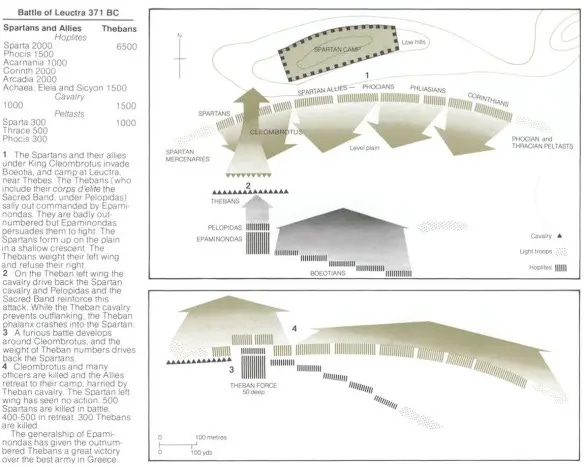
Epaminondas led a smaller force (some 6,000 to Sparta’s 11,000, though historians debate the exact numbers) to a field in front of a Boeotian village called Leuctra. The Battle of Leuctra would not only mark the beginning of centuries of Spartan decline, but also change the way Greek armies battled all the way through the conquests of Alexander the Great.
How did Epaminondas do it? How could he upend the mighty Spartan empire with a force barely half the size? The answer lay in resource allocation, patience, and 300 extremely important gay men.
If you had the misfortune of fighting against a Spartan army in the last few centuries BCE, you had to contend with a phalanx of hoplites. Thousands of men would align shoulder to shoulder, stick out their shields and spears, and push. You probably had a phalanx of your own, but against the Spartan line, you stood no chance.
Epaminondas didn’t have the numbers to directly contend with the Spartan phalanx, but he did have a specific elite force: the Sacred Band of Thebes. The Sacred Band was made of 300 hand-picked warriors paired off into homosexual couples. The idea was that lovers would fight more fiercely for each other.
Instead of a futile effort to out-push a force half their size, the Boeotians overloaded one side. They put a majority of their force on the left side, thinning out the right. They advanced this overloaded left wing before the weaker right wing, hoping to win before the Spartans could fully engage.
The Boeotian left wing, led in part by the Sacred Band, broke through the Spartan line. With enemy forces charging the side and rear, the Spartans quickly routed. When the dust settled, Epaminondas inflicted upon the Spartans one of the most decisive blowouts in Greek history.
Diagram courtesy of WarHistory.org
Over 1,000 Spartans perished in the Battle of Leuctra, including their king and military leader Cleombrotus. The Boetians lost around a hundred, but exact estimates are hard to come by. By anyone’s estimate, their casualties paled in comparison. Sparta’s military reputation would never recover, and the next 200 years marked an era of Spartan decline.
Epaminondas didn’t invent the phalanx. In fact, it’s unclear who really did. There is evidence of a similar strategy in Sumer over 2,000 years earlier. It’s a fairly basic idea — everyone hold your shields together and push. But Epaminondas did advance the strategy. Others would continue to innovate on Epaminondas’ “oblique” advance, up to and including Alexander the Great.
Luke Brown, “Pushing Tush Is Ancient Technology”, Wide Left, 2025-10-13.
January 18, 2026
Who Will Be Chancellor? – Rise of Hitler 27, January 1933
World War Two
Published 17 Jan 2026Back to monthly coverage for this month, because too much is happening in Germany just now. Franz Von Papen meets with Adolf Hitler as 1933 gets going, both of them scheming against Chancellor Kurt von Schleicher. Could they possible form a coalition government with a majority of the Reichstag? Can they even trust each other? Also, who is this von Ribbentrop character? And what’s up with President Hindenburg’s son Oskar? So much going on this month, and when it all reaches its head … just … wow!
(more…)
OSS Lockpick Pocketknife for Secret Intelligence Operatives
Forgotten Weapons
Published 23 Aug 2025In early 1944, the Office of Strategic Services purchase 1,000 specialized pocketknives made by Schrade. Instead of regular blades and tools, these were lock picking knives, with one small blade, three different picks, and two rakes. Able to easily pass as a normal pocketknife on casual inspection, nearly all of them were issued out to OSS Secret Intelligence agents across the European, Mediterranean, and Far Eastern theaters of operation. Today only a few are known to survive …
OSS Equipment Catalog from Headstamp Publishing:
https://www.headstamppublishing.com/p…CIA Equipment Catalog from Headstamp Publishing:
https://www.headstamppublishing.com/p…
(more…)
January 17, 2026
Everything you need to know about art deco
Dezeen
Published 29 Apr 2025To mark the centenary of art deco’s debut, Dezeen features editor Nat Barker rounds up everything you need to know about art deco.
In this video produced by Dezeen Studio, Dezeen explores the history and context of the movement, and the most notable characteristics of the style.
Art deco was a design movement that rose to prominence in the 1920s and 30s. Its origins are often disputed, but most agree that art deco’s entrance on to the world stage took place 100 years ago, at the Exposition Internationale des Arts Décoratifs et Industriels Modernes in Paris.
#artdeco #designhistory
QotD: The introduction of tanks on the western front did not break the trench stalemate
In theory, a good tank ought to be effectively immune to machine-gun fire, able to cross trenches without slowing and physically protect the infantry (who could advance huddled behind the mass of it), all while bringing its own firepower to the battle. Tracked armored vehicles had been an idea considered casually by a number of the pre-war powers but not seriously attempted. The British put the first serious effort into tank development with the Landship Committee, formed in February of 1915; the first real tanks, 49 British Mark I tanks, made their first battlefield appearance during the Battle of the Somme in 1916. Reliability proved to be a problem: of the 49 tanks that stepped off on the attack on September 15th, only 3 were operational on the 16th, mostly due to mechanical failures and breakdowns.
Nevertheless there was promise in the idea that was clearly recognized and a major effort to show what tanks could do what attempted at Cambrai in November of 1917; this time hundreds of tanks were deployed and they had a real impact, breaking through the barbed wire and scattering the initial German defenses. But then came the inevitable German counter-attacks and most of the ground taken was lost. It was obvious that tanks had great potential; the French had by 1917 already developed their own, the light Renault FT tank, which would end up being the most successful tank of the war despite its small size (it is the first tank to have its main armament in a rotating turret and so in some sense the first “real” tank). This was hardly an under-invested in technology. So did tanks break the trench stalemate?
No.
It’s understandable that many people have the impression that they did. Interwar armored doctrine, particularly German Maneuver Warfare (bewegungskrieg) and Soviet Deep Battle both aimed to use the mobility and striking power of tanks in concentrated actions to break the trench stalemate in future wars (the two doctrines are not identical, mind you, but in this they share an objective). But these were doctrines constructed around the performance capabilities of interwar tanks, particularly by two countries (Germany and the USSR) who were not saddled with large numbers of WWI era tanks (and so could premise their doctrine entirely on more advanced models). The Panzer II, with a 24.5mph top speed and an operational range of around 100 miles, depending on conditions, was actually in a position to race the train and win; the same of course true of the Soviet interwar T-26 light tank (19.3mph on roads, 81-150 mile operational range). Such tanks could have radios for coordination and communication on the move (something not done with WWI tanks or even French tanks in WWII).
By contrast, that Renault FT had a top speed of 4.3mph and an operational range of just 37 miles. The British Mark V tank, introduced in 1918, moved at only 5mph and had just 45 miles of range. Such tanks struggled to keep up with the infantry; they certainly were not going to win any race the infantry could not. It is little surprise that the French, posed with the doctrinal problem of having to make use of the many thousands of WWI tanks they had, settled on a doctrine whereby most tanks would simply be the armored gauntlet stretched over the infantry’s fist: it was all those tanks could do! The sort of tank that could do more than just dent the trench-lines (the same way a good infiltration assault with infantry could) were a decade or more away when the war ended.
Moreover, of course, the doctrine – briefly the systems of thinking and patterns of training, habit and action – to actually pull off what tanks would do in 1939 and 1940 were also years away. It seems absurd to fault World War I era commanders for not coming up with a novel tactical and operational system in 1918 for using vehicles that wouldn’t exist for another 15 years and yet more so assuming that they would get it right (since there were quite a number of different ideas post-war about how tanks ought to be used and while many of them seemed plausible, not all of them were practical or effective in the field). It is hard to see how any amount of support into R&D or doctrine was going to make tanks capable of breakthroughs even in the late 1920s or early 1930s (honestly, look at the “best” tanks of the early 1930s; they’re still not up to the task in most cases) much less by 1918.
Bret Devereaux, “Collections: No Man’s Land, Part II: Breaking the Stalemate”, A Collection of Unmitigated Pedantry, 2021-09-24.
January 16, 2026
WW1: The Slaughter Starts | EP 2
The Rest Is History
Published 28 Aug 2025What was Britain’s first military move following the outbreak of the First World War? Where did the French launch their initial attack on the Germans? Whose army was the biggest and best of all the participants in the war? And, what unfolded at the pivotal Battle of the Ardennes in August 1914, on the frontiers of France, between the Germans and the French, and what would be the consequences of the outcome for the war as a whole?
Join Dominic and Tom as they discuss, in riveting, unsparing detail, the dramatic early engagements of the First World War, and the bloody Battle of Ardennes.
00:00 Who was Aubrey Herbert? The MP offered the throne of Albania
02:24 Expectations of WW1: catastrophe foretold
04:50 Britain’s war council: should the BEF go to France?
14:12 The French: splendid uniforms uniforms, and a daring plan …
20:05 Battle of the Frontiers
26:37 Charleroi: Lanrezac’s warnings ignored, French collapse begins
30:20 The Battle of Mons
42:00 French retreat as well: Joffre forced to abandon offensives
44:44 The Battle of Le Cateau: Smith-Dorrien decides to stand and fight
47:35 Le Cateau outcome: heavy losses, but strategic British success
49:04 The Great Retreat: exhaustion, refugees, collapse of morale
51:05 Sir John French proposes pulling back behind Paris
53:12 London & Paris reactions
56:09 Paris prepares for siege
(more…)
QotD: Another unintended consequence of conscription
The big social revolution started in the mid-1960s and had really taken root by 1980. I don’t mean drugs and shagging around I mean a proper social revolution. The British working classes no longer took what they were being told by the poshoes as being true. Questions, as we might put it, were being asked.
My theory, backed up by reality and all the obvious facts of the case, is that as all young men had spent two years being run by the poshoes up front and directly therefore no one believed the poshoes any more. Actual experience, see?
National Service led to the downfall of the posh classes. Simply because direct exposure to said posh was always going to do that.
This is not just a jeu d’esprit. I really do insist that Britain’s social revolution was driven by conscription. Being told to jump by some chinless 6 months out of Eton is going to do that.
Tim Worstall, “National Service Led To The Uppity Proles Of the 1960s”, It’s all obvious or trivial except …, 2025-10-14.
Update, 17 January: Welcome, Instapundit readers! Have a look around at some of my other posts you may find of interest. I send out a daily summary of posts here through my Substack – https://substack.com/@nicholasrusson that you can subscribe to if you’d like to be informed of new posts in the future.
January 15, 2026
Pauly/Roux Pistols: The First Self-Contained Cartridges
Forgotten Weapons
Published 22 Aug 2025Samuel Pauly is the largely unrecognized father of the modern self-contained cartridge. In 1808 he patented a cartridge with a metal base that held a priming compound and attached to a paper or metal cartridge body holding powder and projectile. He followed this with an 1812 patent for a gun to fire the cartridges. What makes Pauly’s original system particularly interesting is that he did not use mechanical percussion (ie, hammer or striker) to ignite the primer compound, but rather a “fire pump”. A spring loaded plunger compressed air on top of the primer, heating it enough to detonate the compound in the same way that a diesel engine works. This was not a commercially successful system, though, and Pauly left Paris for London in 1814.
Pauly’s shop was taken over by Henri Roux, who continued making guns under the Pauly name while also improving the cartridges. These two pistols were made around 1820 and use a Roux cartridge with a mechanical striker hitting the primer compound in a Pauly-style cartridge case.
For more information, I recommend Georg Priestel’s free book Jean Samuel Pauly, Henri Roux, and Successors – Their Inventions From 1812 to 1882 available here:
https://aaronnewcomer.com/document/je…
(more…)
January 14, 2026
The Korean War Week 82: Ridgway’s Nuclear Warning! – January 13, 1952
The Korean War by Indy Neidell
Published Jan 13, 2026Operation Strangle, to destroy enemy logistical capability with air power, has been in progress for months now, and yet the enemy is still able to bring up men and supplies, and even slowly stockpile them for possible future offensives. The UN position now is that should there be an armistice, and should the other side break its terms, retaliation would be broader and would include actions against Communist China, but will the UN have the force to do such retaliation? That is the question.
00:00 Intro
00:44 Recap
01:09 POW Issues
03:30 The Airfields
08:29 UN Declaration
10:15 Operation Strangle
14:13 Summary
14:35 Conclusion
15:25 Call To Action
(more…)
QotD: Bill Clinton, proto-PUA
Most men I knew, even most Boomer and Generation Jones men, were put off by Bill Clinton. We all instinctively knew he was a weasel, even if we couldn’t quite articulate why. But oh how the soccer moms loved him! He was the pudgy marching band dork they’d actually settled for, carrying on like the Alpha Chad they still knew, in their secret hearts, they were hot enough to snag. What appeared to men (and what actually was) narcissism and braggadocio, looked like caddish swagger to soccer moms. But in actual fact he was just a nerd who’d learned Game ahead of its time, and that’s how he governed …
[Funny how none of the “Game” gurus recognized this. I guess I can’t blame them, since I just now realized it myself, but then again I don’t pimp myself out as some kind of Master Pickup Artist. Instead of aping Tom Cruise and Daniel Craig and those guys, the “Game” crowd should’ve been studying Bill Clinton. That’s what Game can do for you, boys, and yeah, I know you’ve got your sights set a little higher than Monica, but for pete’s sake, the man was President of the United States. He cigar-banged the entire electorate. That’s some serious Game].
Severian, “Friday Mailbag”, Founding Questions, 2022-04-08.
NR: In case “PUA” has fallen sufficiently out of current use — as it probably deserves — here’s a useful overview of the Pick Up Artist jargon by Kim du Toit from 2017.
Update, 15 January: Welcome, Instapundit readers! Have a look around at some of my other posts you may find of interest. I send out a daily summary of posts here through my Substack – https://substack.com/@nicholasrusson that you can subscribe to if you’d like to be informed of new posts in the future.
January 13, 2026
The History of SPAM
Tasting History with Max Miller
Published 22 Jul 2025Sliced SPAM layered with cream cheese filling, sliced and served with potato salad and tomatoes
City/Region: United States of America
Time Period: 1951SPAM. The iconic canned meat product. Beloved by some, reviled by others, SPAM was buoyed by a very successful marketing blitz by the Hormel company starting in the 1930s. There were radio and magazine ads, The Hormel Girls (a singing group), and recipes.
I’m not the biggest fan of SPAM, and this recipe turned out way too salty for me. If you want to make the historical recipe, go ahead and follow it, but I would personally opt for the reduced sodium SPAM and cut out the salt in the cream cheese mixture. If you like SPAM, definitely try this out! It’s super flavorful, but it’s just not to my taste.
Tender, pure-pork SPAM joins with a zesty cream cheese mixture for memorable eating. Serve for supper or lunch — or as a noteworthy appetizer.
SPAM ‘n’ Cheese Ribbon Loaf
Cut in 8 slices……1 whole SPAM
Mix together……1 (3-oz.) package cream cheese (softened with a little milk)
1 tsp. lemon juice
1 tsp. grated onion
1 tbsp. minced parsley
1/4 tsp. salt
Spread between……slices of SPAM
Chill……4 hours (or longer; overnight if desired). Slice and serve. Good with deviled eggs or potato salad.Economical all-meat buy! No bone, no waste. SPAM is all meat … juicy pork shoulder and mild, tender ham, with Hormel’s unequalled seasonings.
— Hormel advertisement, 1951


