
World War Two
Published 8 Jun 2024The plans to invade the Japanese Home Islands in the fall grow ever more concrete, with the main issue being not just how to transport men by the millions around the world, but where to put them once they get there. On land the fight continues in Okinawa and the Philippines, and at sea the American fleet is savaged by a typhoon for the second time in six months.
Chapters
00:34 Recap
01:22 The Allied Control Commission
02:29 Okinawa
03:50 The War in the Philippines
06:22 Halsey and another typhoon
09:13 Operation Downfall
19:07 Summary
19:24 Conclusion
20:28 Dedication to Donald Wilson Round
(more…)
June 9, 2024
Operation Downfall: 2 Million Men to Invade Japan – WW2 – Week 302 – June 8, 1945
Comments Off on Operation Downfall: 2 Million Men to Invade Japan – WW2 – Week 302 – June 8, 1945
Men In Armour (1949) – The origins and operation of tanks
FWD Publishing
Published Feb 18, 2024Lengthy documentary made in 1949 about the men and tanks of the Royal Armoured Corps (RAC).
Comments Off on Men In Armour (1949) – The origins and operation of tanks
QotD: The biological importance of salt to humans
… regardless of whether it was used in agriculture, for preservation, or for cooking, salt was also essential. The human body is constantly losing salt through sweat, and to a certain extent urine, but it tries to keep the blood’s salt concentrations maintained at a certain level. So as the blood loses salt, the body also ejects water to adjust. Ironically, as you lose salt your body responds by drying you out. Without constantly replacing the salt in your body — which is only ever stored for a couple of days at a time — you will at first feel fatigued and a little breathless, but increasingly weak and debilitated, as though sapped of all energy. The slightest exertion would start to bring on cramps, then problems with your heart and lungs, as your body continually shed water. If these did not kill you — and they probably would — you would essentially die through desiccation. The process would be all the faster if you became ill, rendering even the slightest dehydrating fever or bout of diarrhoea utterly lethal.1
A population deprived of salt was thus one that was weaker and more prone to disease — and at a time when the vast majority of the economy’s energy supply came from the straining of muscle, both human and animal, that weakness in effect meant a severe energy shortage. Although the main fuels for muscle power were carb-heavy grains like wheat, rye, oats, and rice, the indispensable ingredient to getting the most out of these grains was salt — just as how nuclear power uses uranium as its fuel, but also requires a suitable neutron moderator. A population deprived of salt would quite literally be more lethargic and sluggish, making it less productive and poorer too.
Salt’s unique properties made it a serious tool of state. In 1633 king Charles I’s newly-appointed Lord Deputy for Ireland, Baron Wentworth, advised controlling its salt supply as a way to make the Irish utterly economically dependent on England. Given salt was “that which preserves and gives value to all their native staple commodities” — herrings, butter and beef — then “how can they depart from us without nakedness and beggary?” Salt would be a method of control, and a profitable one too, being “of so absolute necessity” that it could be sold to the Irish at inflated prices without much dampening demand: salt “must be had whether they will or no, and may at all times be raised in price”.2 Much like economists today, Wentworth saw revenue-raising potential in taxing goods with such unresponsive or “inelastic” demand.
Wentworth’s scheme to control the Irish never came to be. But a great many other countries did choose to tax it. Given a minimum amount of salt had to be consumed by absolutely everyone, monopolising its sale — and levying what was effectively a tax by inflating the price well above the costs of importing or producing it — could function as kind of indirect poll tax, levied more or less per head of both people and livestock, but without any of the administrative hassle of taking and maintaining an accurate census in order to impose such a tax directly.
When compared to other necessities like grain, salt did not need to be traded in especially large quantities either, meaning that its supply could be monopolised with relative ease. And it could not be produced everywhere. Salt tended to be lacking the further you got from the sea coast, unless there happened to be some relatively rare inland sources like salt lakes, brine springs, or rock salt mines. And it could even be lacking on the sea coast where it was either too humid or too cold to get salt cheaply by evaporating seawater using the sun, or where there was insufficient fuel for boiling the brine. These places were thus prone to being charged inflated prices, while the states that controlled places where the costs of production were low — in warmer and drier climes where the salty water of coastal marshes could cheaply be evaporated using only the heat of the summer sun — could extract especially large monopoly profits from the difference. The revenue from controlling solar salt thus became the basis of many kingdoms, some unusually powerful republics, and even empires.
Anton Howes, “The Second Soul”, Age of Invention, 2024-03-08.
1. Roy Moxham, “Salt Starvation in British India: Consequences of High Salt Taxation in Bengal Presidency, 1765 to 1878”, Economic and Political Weekly 36, no. 25 (2001): p.2270–74.
2. George O’Brien, The Economic History of Ireland in the Seventeenth Century (Maunsel and Company Limited, 1919), p.244, which has the transcription of Wentworth’s proposal
Comments Off on QotD: The biological importance of salt to humans
June 8, 2024
Battlefield Normandy – The battles for Norrey, Bretteville & Putot
The AceDestroyer
Published Jun 27, 2019Hello, welcome to The AceDestroyer and welcome to the third and final episode of the Battlefield Normandy Series. In this episode we follow the Canadians defending Putot-en-Bessin, Bretteville-L’Orgueilleuse and Norrey-en-Bessin. In the two days of heavy combat with the 12th SS Hitlerjugend, the 7th Canadian Infantry brigade managed to hold on to all three towns. Find out how in this episode …
(more…)
Comments Off on Battlefield Normandy – The battles for Norrey, Bretteville & Putot
QotD: Teaching military history
At the same time, in the context of the discipline of history, this complaint is patently absurd. No Roman historian has ever bought garum at the market with sestertii, nor voted in the Roman comitia centuriata, or any experienced any of a nearly infinite number of the daily activities of life in ancient Rome. The same is obviously fundamentally true of literally any history that takes place before living memory. The closest we can ever come is something like experimental archaeology, trying out historical methods and objects and while that method is an important tool, especially for the pre-modern period, it is far from the only way to do history and not necessarily the best. So of course historians study things they have no personal experience of. That’s what history is.
Teaching military history to students either bound for the military or who have military experience is actually one of the most rewarding things I have gotten to do as an academic. In this sense I have been remarkably fortunate in a lot of my teaching, which has been at large state universities in North Carolina and Florida. Both states are well above the United States population-adjusted average for the percentage of veterans in the state and I get the sense that – though I have no hard data on this (so I may be wrong) – veterans tend to matriculate through public universities at higher rates than at smaller private liberal arts college. Moreover, every university I have taught at this far has a significant ROTC program.
Consequently, I am pretty accustomed to having both veterans back from abroad in my class, as well as students who expect to commission at the end of their college experience, along with some students who are active-duty military personnel while they are taking my classes. This is especially true (no surprise) in military history classes, as one might guess. It was not uncommon, in a 45 or 55 student section of a Global Military History survey to have the complete military-career-cycle present (though of course the ROTC students would be commissioning as officers, while the active-duty and veteran students were enlisted personnel and that is a meaningful difference). Of course those students were then side-by-side with students who have no plans to ever be in the military.
It is true that there is sometimes a higher bar of “proving” yourself to the students in those situations before they begin to trust you (as anyone who so much as looks at me knows I have never served in a military), though I would note that the hardest students to reach in this regard have always been the ROTC students (rather than active duty or veteran students), who ironically have no more experience of combat than I do. At the same time, those students are choosing to be in your class because they think you have something to say on the topic and clearing the bar of “this guy knows what he’s talking about” has never been a real problem for me. If you know your business and show that you take the subject seriously, the matter resolves itself.
Bret Devereaux, “Collections: Why Military History?”, A Collection of Unmitigated Pedantry, 2020-11-13.
Comments Off on QotD: Teaching military history
June 7, 2024
Redeployment! – Millions of men from Europe to Asia
World War Two
Published 5 Jun 2024Now that Japan is the only Axis power still in the fight, Allied forces — especially American ones — must redeploy to prepare for the final invasion of the Japanese Home Islands. But how do you move millions of men halfway around the globe? And which ones go — veterans, new recruits, or some combination? Who decides? Where exactly do you send them to prepare too, with some many eastern ports like Manila a shambles? Let’s take a look.
(more…)
Comments Off on Redeployment! – Millions of men from Europe to Asia
Battlefield Normandy – The battle of Authie D-DAY + 1
The AceDestroyer
Published Dec 20, 2018June 7, also known as D-Day +1 marked the first battle between the Canadians and the 12th SS Panzer Division Hitlerjugend during the Normandy campaign. When the Canadians attacked Authie, the German 12th SS counterattacked and a large tank on tank battle commenced. The first encounter between the two divisions was immediately a bloody one. The battle unfortunately had a barbaric end as members of the SS murdered several Canadian POW’s in cold blood. Here’s the battle of Authie.
(more…)
Comments Off on Battlefield Normandy – The battle of Authie D-DAY + 1
June 6, 2024
The reason Germany failed on D-Day (Ft. Jonathan Ferguson)
Imperial War Museums
Published Jun 5, 2024Adolf Hitler was looking forward to D-Day. His plan was simple. Reinforce the western defences, launch a furious counterattack, and “throw the Allies back into the sea”. After that, he could turn his full strength against the Soviet Union and end the war. For Hitler, the outcome of this campaign would be decisive.
In the previous episode of our D-Day series we looked at the air battle for Normandy. This time IWM Curator Adrian Kerrison covers the fighting on land. Why were some beaches bloodier than others? Why did German counterattacks fail? And why did it take so long for the Allies to breakout?
To help us answer some of those questions we’ve brought in the Royal Armouries’ Jonathan Ferguson to look at some of the most important weapons of D-Day.
(more…)
Comments Off on The reason Germany failed on D-Day (Ft. Jonathan Ferguson)
Battlefield Normandy – The Battle of Juno Beach 6 June 1944
The AceDestroyer
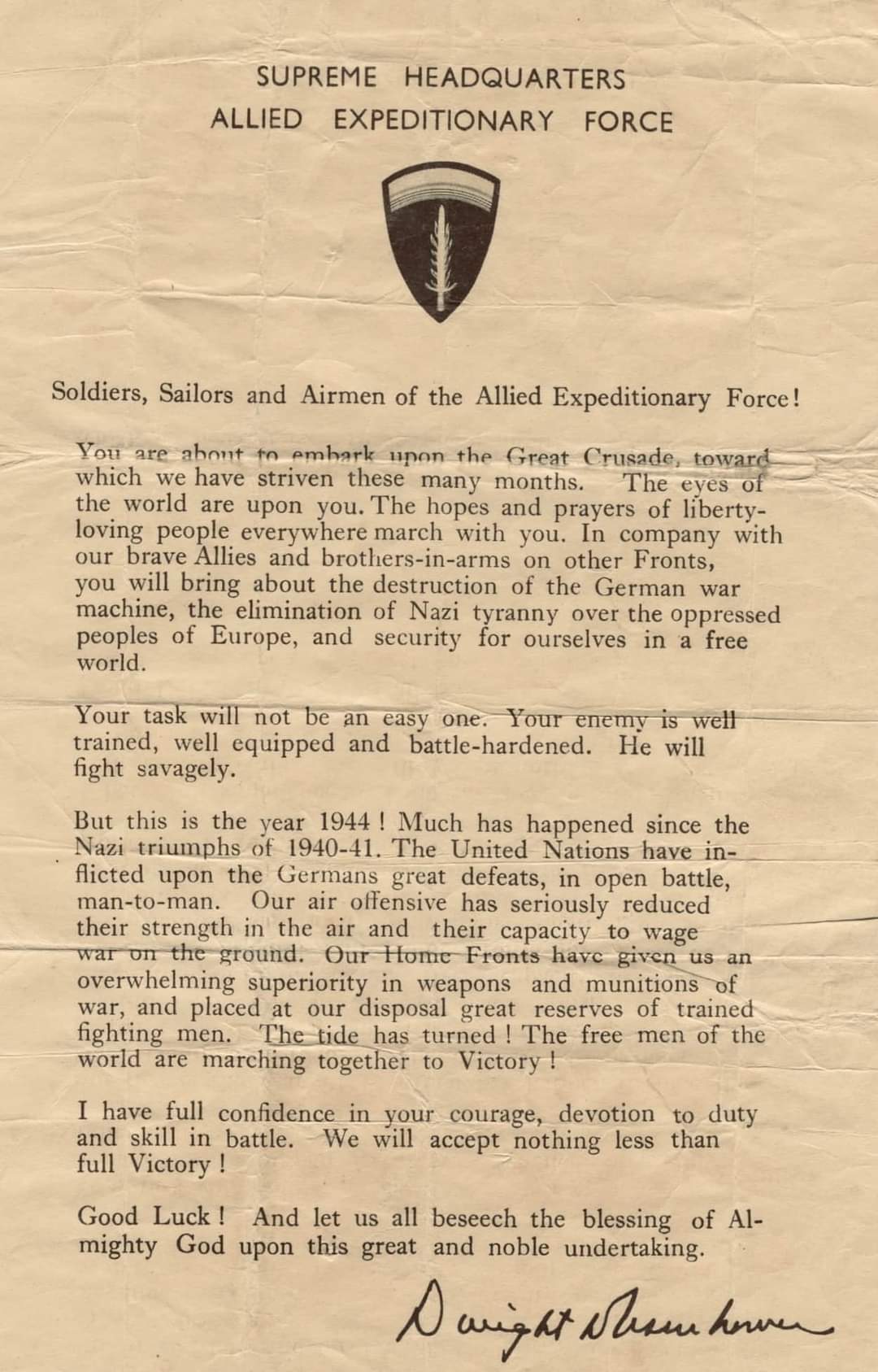
Published Nov 18, 2018Hello and welcome to the first episode of my Battlefield Normandy series. This part is all about the landings at Juno beach on June 6 1944, and what happened on the first day of the Allied landings in Normandy. In this episode we will take a look at all the landing beaches and the subsequent fighting. You can find the maps on my Facebook page. The next episode will be about the battle of Authie on June 7, when the Canadians first met the 12th SS Hitlerjugend. I hope you’ll enjoy this video and find it helpful.
(more…)
Comments Off on Battlefield Normandy – The Battle of Juno Beach 6 June 1944
QotD: Herbert Hoover as Woodrow Wilson’s “Food Dictator”
Wilson is working on the greatest mobilization in American history. He realizes one of the US’ most important roles will be breadbasket for the Allied Powers, and names Hoover “food commissioner”, in charge of ensuring that there is enough food to support the troops, the home front, and the other Allies. His powers are absurdly vast – he can do anything at all related to the nation’s food supply, from fixing prices to confiscating shipments from telling families what to eat. The press affectionately dubs him “Food Dictator” (I assume today they would use “Food Czar”, but this is 1917 and it is Too Soon).
Hoover displays the same manic energy he showed in Belgium. His public relations blitz telling families to save food is so successful that the word “Hooverize” enters the language, meaning to ration or consume efficiently. But it turns out none of this is necessary. Hoover improves food production and distribution efficiency so much that no rationing is needed, America has lots of food to export to Europe, and his rationing agency makes an eight-digit profit selling all the extra food it has.
By 1918, Europe is in ruins. The warring powers have declared an Armistice, but their people are starving, and winter is coming on fast. Also, Herbert Hoover has so much food that he has to swim through amber waves of grain to get to work every morning. Mountains of uneaten pork bellies are starting to blot out the sky. Maybe one of these problems can solve the other? President Wilson dispatches Hoover to Europe as “special representative for relief and economic rehabilitation”. Hoover rises to the challenge:
Hoover accepted the assignment with the usual claim that he had no interest in the job, simultaneously seeking for himself the broadest possible mandate and absolute control. The broad mandate, he said, was essential, because he could not hope to deliver food without refurnishing Europe’s broken finance, trade, communications, and transportation systems …
Hoover had a hundred ships filled with food bound for neutral and newly liberated parts of the Continent before the peace conferences were even underway. He formalized his power in January 1919 by drafting for Wilson a post facto executive order authorizing the creation of the American Relief Administration (ARA), with Hoover as its executive director, authorized to feed Europe by practically any means he deemed necessary. He addressed the order to himself and passed it to the president for his signature …
The actual delivery of relief was ingeniously improvised. Only Hoover, with his keen grasp of the mechanics of civilization, could have made the logistics of rehabilitating a war-ravaged continent look easy. He arranged to extend the tours of thousands of US Army officers already on the scene and deployed them as ARA agents in 32 different countries. Finding Europe’s telegraph and telephone services a shambles, he used US Navy vessels and Army Signal Corps employees to devise the best-functioning and most secure wireless system on the continent. Needing transportation, Hoover took charge of ports and canals and rebuilt railroads in Central and Eastern Europe. The ARA was for a time the only agency that could reliably arrange shipping between nations …
The New York Times said it was only apparent in retrospect how much power Hoover wielded during the peace talks. “He has been the nearest approach Europe has had to a dictator since Napoleon.”
Once again, Hoover faces not only the inherent challenge of feeding millions, but opposition from the national governments he is trying to serve. Britain and France plan to let Germany starve, hoping this will decrease its bargaining power at Versailles. They ban Hoover from transporting any food to the defeated Central Powers. Hoover, “in a series of transactions so byzantine it was impossible for outsiders to see exactly what he was up to”, causes some kind of absurd logistics chain that results in 42% of the food getting to Germany in untraceable ways.
He is less able to stop the European powers’ controlled implosion at Versailles. He believes 100% in Woodrow Wilson’s vision of a fair peace treaty with no reparations for Germany and a League Of Nations powerful enough to prevent any future wars. But Wilson and Hoover famously fail. Hoover predicts a second World War in five years (later he lowers his estimate to “thirty days”), but takes comfort in what he has been able to accomplish thus far.
He returns to the US as some sort of super-double-war-hero. He is credited with saving tens of millions of lives, keeping Europe from fraying apart, and preventing the spread of Communism. He is not just a saint but a magician, accomplishing feats of logistics that everyone believed impossible. John Maynard Keynes:
Never was a nobler work of disinterested goodwill carried through with more tenacy and sincerity and skill, and with less thanks either asked or given. The ungrateful Governments of Europe owe much more to the statesmanship and insight of Mr. Hoover and his band of American workers than they have yet appreciated or will ever acknowledge. It was their efforts … often acting in the teeth of European obstruction, which not only saved an immense amount of human suffering, but averted a widespread breakdown of the European system.
Scott Alexander, “Book Review: Hoover”, Slate Star Codex, 2020-03-17.
Comments Off on QotD: Herbert Hoover as Woodrow Wilson’s “Food Dictator”
June 5, 2024
Hollywood has been here before … and they learned nothing
Ted Gioia illustrates the mind-blowing dominance of westerns on TV and in the theatre in the 1950s and how quickly the boom was over and has never come close to recovering:
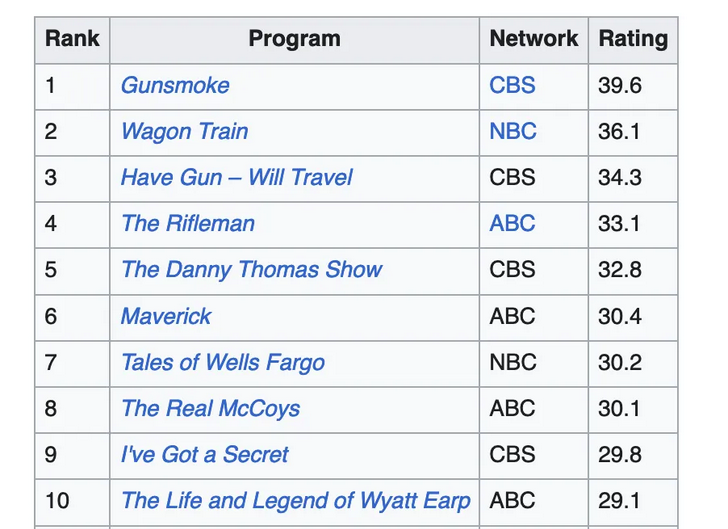
Source – https://en.wikipedia.org/wiki/Top-rated_United_States_television_programs_of_1958%E2%80%9359
Eight of the top ten shows during the 1958-59 season were westerns.
Spaceships were in the news every day back then, but on TV it was just horses — and occasionally a covered wagon. Each of the three networks was caught up in a time warp, partying like it was 1899.
Any fool could see that they were saturating the market. Yet the studios kept launching new westerns with regularity, although with less confidence, for another decade, more or less.
Back in 1955, the three US TV networks had introduced three new western-themed series — Gunsmoke, Cheyenne, and Wyatt Earp. But two years later, the networks ramped up their investment in cowboys, launching nine new westerns that fall.
And it got worse.
In 1958, these three networks introduced ten more western series. On some nights, you could watch cowboys for two hours straight on ABC. CBS and NBC also started scheduling back-to-back Wild West shows.
I need to stress that the western was already an exhausted genre long before 1960. Movie theaters had relied on cowboys as an audience draw going back at least to Broncho Billy Anderson and The Great Train Robbery (1903).
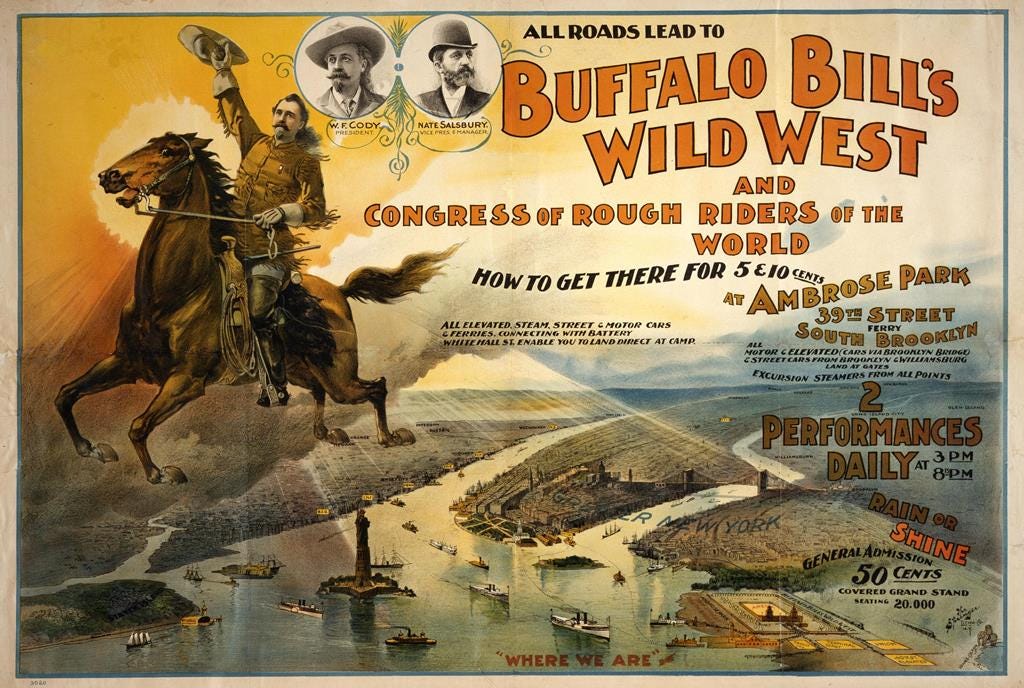
And cheap books and magazines with stories of the Wild West had already been around for decades at that point. By my measure, nostalgia for the old West dates back to the launch of Buffalo Bill’s Wild West show on May 19, 1883 in Omaha, Nebraska — four years after the invention of the gasoline engine.
Poster for Buffalo Bill’s Wild West Show — the first major cowboy nostalgia business
[…]
Younger viewers were the first to abandon the western — a telling sign, especially when you consider that, back in the 1930s, children and teens had been the core audience for the genre.
By the time Gunsmoke went off the air in 1975, the few remaining fans were old-timers — maybe the same ones who had gone to movie theaters to cheer for Roy Rogers in the 1930s. That show had been the most popular TV series in the US for four seasons in the late 1950s. But a cowboy series would never do that again.
Youngsters lost interest in westerns despite a proliferation of merchandise. During my childhood, I paid no attention to the cowboy genre — nor did any of my friends. But brand merchandise was everywhere. We could buy Gunsmoke comic books, trading cards, lunchboxes, and — of course! — toy guns, among other paraphernalia.
With the benefit of hindsight, we can see that these products did not develop the market — they merely saturated it.
Comments Off on Hollywood has been here before … and they learned nothing
What Troops Ate On D-Day – World War 2 Meals & Rations
Tasting History with Max Miller
Published May 21, 2024D-Day Scrambled Eggs and Bacon served with toast and D-Day Lemonade
City/Region: United States of America
Time Period: 1944The food in the final days leading up to D-Day was a definite improvement over the sad, dry sandwiches some soldiers had been getting. All-you-can-eat meals of steak, pork chops, sides, lemon meringue pie, ice cream, and even popcorn and candy during movie screenings kept the sequestered troops well fed. The last meal served before the landing was breakfast in the very early hours of the morning, said by many to be scrambled eggs and bacon.
This meal was made in the south of England, but the bacon was from the U.S., so American-style bacon is best here. The eggs don’t taste bad, but the texture is not like fresh scrambled eggs at all (more like tofu). The bacon is real, though, and that really saves the dish. Powdered eggs can be found online and at camping stores.
No. 749. Scrambled Eggs
Water, cold … 2 1/2 quarts (2 1/2 No. 56 dippers)
Eggs, powdered … 1 1/2 pounds (1/2 3-pound can)
Salt … To taste
Pepper … To taste
Lard or bacon fat … 1 pound (1/2 No. 56 dipper)Sift eggs. Pour 1/3 of the water into a utensil suitable for mixing eggs. Add powdered eggs. Stir vigorously with whip or slit spoon until mixture is absolutely smooth. Tip utensil while stirring.
Add salt, pepper, and remaining water slowly to eggs, stirring until eggs are completely dissolved.
Melt fat in baking pan. Pour liquid eggs into hot fat.
Stir as eggs begin to thicken. Continue stirring slowly until eggs are cooked slightly less than desired for serving.
Take eggs from fire while soft, as they will continue to thicken after being removed from heat.No. 750. Diced Ham (or Bacon) and Scrambled Eggs
Add 3 pounds of ham or bacon to basic recipe for scrambled eggs; omit lard. Fry ham or bacon until crisp and brown.
Pour egg solution over meat and fat. Stir and cook as in basic recipe. Additional fat may be needed if ham is used.
— TM 10-412 US Army Technical Manual. Army Recipes by the U.S. War Department, 1946
Comments Off on What Troops Ate On D-Day – World War 2 Meals & Rations
June 4, 2024
Snipers in World War 1
The Great War
Published Feb 9, 2024In fall 1914, the British and French armies on the First World War’s Western Front were wrestling with a problem: unseen German riflemen were picking off any man who showed himself above the trench. Something had to be done about it – and the result was the birth of the modern sniper.
(more…)
Comments Off on Snipers in World War 1
June 3, 2024
The “mass graves” moral panic at three
In the National Post, Father Raymond J. de Souza notes the almost un-noticed third anniversary of the dramatic announcement and ensuing moral panic over claims that hundreds of unmarked graves had been discovered at the site of a former Residential School in Kamloops, BC:
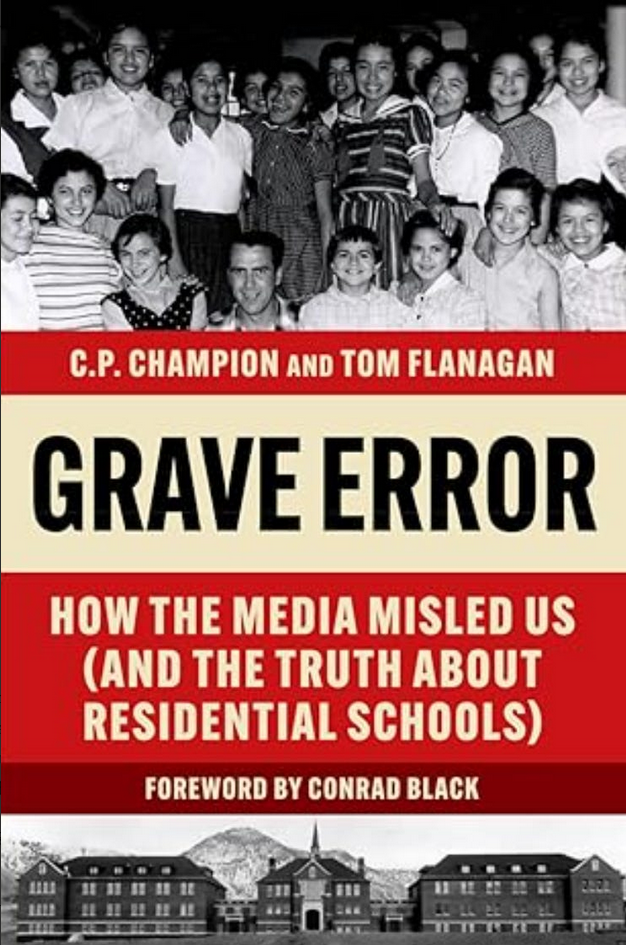
This past week marked the third anniversary of the dramatic announcement that 215 “unmarked graves” had been discovered near a former residential school in Kamloops. It was a global news story which had a significant impact in Canada. It was also a great media malpractice.
Many things were reported then that were not only not true, but had not even been claimed to be true by anyone. Recall the monstrously misleading headlines about mass murder and mass graves? For example, from the Toronto Star on 28 May 2021: “The Remains of 215 Children Have Been Found”.
Not true. No one ever claimed that remains had been found. Many people assumed that the “unmarked graves” held children, but the ground-penetrating radar employed cannot reveal if a body is in the soil, let alone whether it is a child or adult.
Tales of mass murder and mass graves produced a massive moral panic. Marches were held, symbolic children’s shoes were assembled, churches were burned and vandalized, hundreds of millions were committed to investigating further mass graves, the prime minister ordered flags at every embassy abroad and federal building at home to be lowered for nearly six months, a new federal holiday was instituted, the Catholic Church issued (another) apology and Pope Francis came to visit.
How can it now be that the anniversary of something so globally momentous passed so quietly this week?
It’s because the great media malpractice has been answered by journalists, a broader category in the digital world, who provided the effective response. It’s an inspiring David and Goliath tale of how courageous, good journalism beat out conforming, bad journalism.
We can take some pride here at the National Post, for on the first anniversary we published the remarkable reporting of Terry Glavin, who demonstrated exactly how media malpractice had produced a moral panic.
But aside from that, the work was carried out by writers — academics, reporters, amateur researchers and dogged citizens — outside of the legacy media. The story unfolded in C2C Journal, Dorchester Review, True North, Western Standard, the Frontier Centre for Public Policy and Quillette.
Last December, a single volume collecting much of this work was published: Grave Error: How the media misled us (and the truth about residential schools), edited by Christian Champion, founder and publisher of the Dorchester Review, and the well known academic and political player, Tom Flanagan, professor emeritus at the University of Calgary.
Those outlets which had perpetrated the original malpractice took a pass. The legacy media ignored the book, and Canada’s major book retailers did not sell it.
Comments Off on The “mass graves” moral panic at three


