
Tasting History with Max Miller
Published Feb 23, 2024Rich, thick, dark hot chocolate spiced with cinnamon and cardamom
City/Region: England
Time Period: 1747Up until the 19th century, the most popular way to partake of chocolate was to drink it. Aztecs drank a very bitter chocolate, and when Europeans brought it back home, they paved the way for one of the most perfect of food pairings: chocolate and sugar.
This hot chocolate is fairly dark, so feel free to add more sugar if that’s to your taste. It’s super rich and much thicker than most hot chocolates you’d get today, so you may only want to make a small amount of the drink and save the rest of the chocolate for later. The spices jump out at you, and even though mine still had a bit of grittiness from the cocoa nibs (it’s basically impossible to get it completely smooth at home), it was really, really good.
(more…)
June 3, 2024
18th Century Spiced Hot Chocolate
June 2, 2024
Japan vows to fight to the end! – WW2 – Week 301 – June 01, 1945
World War Two
Published 1 Jun 2024This week President Truman and his aides meet to discuss the use of the atomic bomb. In Japan, the Imperial government vows to fight on even as Yokohama is turned to ash by firebombing. On Okinawa, Japanese 32nd Army withdraws from the defences of Shuri Castle but there is still plenty of hard fighting left for the Americans. There are US Navy command reshuffles and the stage is set for an Allied conference in Potsdam.
Chapters
01:21 Recap
05:08 The Fight on Okinawa
08:38 The Interim Committee And The Bomb
14:02 Notes
(more…)
QotD: The Spartans do not deserve the admiration of the modern US military
The Athenian historian Thucydides once remarked that Sparta was so lacking in impressive temples or monuments that future generations who found the place deserted would struggle to believe it had ever been a great power. But even without physical monuments, the memory of Sparta is very much alive in the modern United States. In popular culture, Spartans star in film and feature as the protagonists of several of the largest video game franchises. The Spartan brand is used to promote obstacle races, fitness equipment, and firearms. Sparta has also become a political rallying cry, including by members of the extreme right who stormed the U.S. Capitol on Jan. 6, 2021. Sparta is gone, but the glorification of Sparta — Spartaganda, as it were — is alive and well.
Even more concerning is the U.S. military’s love of all things Spartan. The U.S. Army, of course, has a Spartan Brigade (Motto: “Sparta Lives”) as well as a Task Force Spartan and Spartan Warrior exercises, while the Marine Corps conducts Spartan Trident littoral exercises — an odd choice given that the Spartans were famously very poor at littoral operations. Beyond this sort of official nomenclature, unofficial media regularly invites comparisons between U.S. service personnel and the Spartans as well.
Much of this tendency to imagine U.S. soldiers as Spartan warriors comes from Steven Pressfield’s historical fiction novel Gates of Fire, still regularly assigned in military reading lists. The book presents the Spartans as superior warriors from an ultra-militarized society bravely defending freedom (against an ethnically foreign “other”, a feature drawn out more explicitly in the comic and later film 300). Sparta in this vision is a radically egalitarian society predicated on the cultivation of manly martial virtues. Yet this image of Sparta is almost entirely wrong. Spartan society was singularly unworthy of emulation or praise, especially in a democratic society.
To start with, the Spartan reputation for military excellence turns out to be, on closer inspection, mostly a mirage. Despite Sparta’s reputation for superior fighting, Spartan armies were as likely to lose battles as to win them, especially against peer opponents such as other Greek city-states. Sparta defeated Athens in the Peloponnesian War — but only by accepting Persian money to do it, reopening the door to Persian influence in the Aegean, which Greek victories at Plataea and Salamis nearly a century early had closed. Famous Spartan victories at Plataea and Mantinea were matched by consequential defeats at Pylos, Arginusae, and ultimately Leuctra. That last defeat at Leuctra, delivered by Thebes a mere 33 years after Sparta’s triumph over Athens, broke the back of Spartan power permanently, reducing Sparta to the status of a second-class power from which it never recovered.
Bret Devereaux, “Spartans Were Losers”, Foreign Policy, 2023-07/22.
June 1, 2024
So who did write Shakespeare’s plays?
Mere mortals might be tempted to answer “Well, Shakespeare, duh!”, but to the dedicated conspiracist, the obvious is never the right answer:
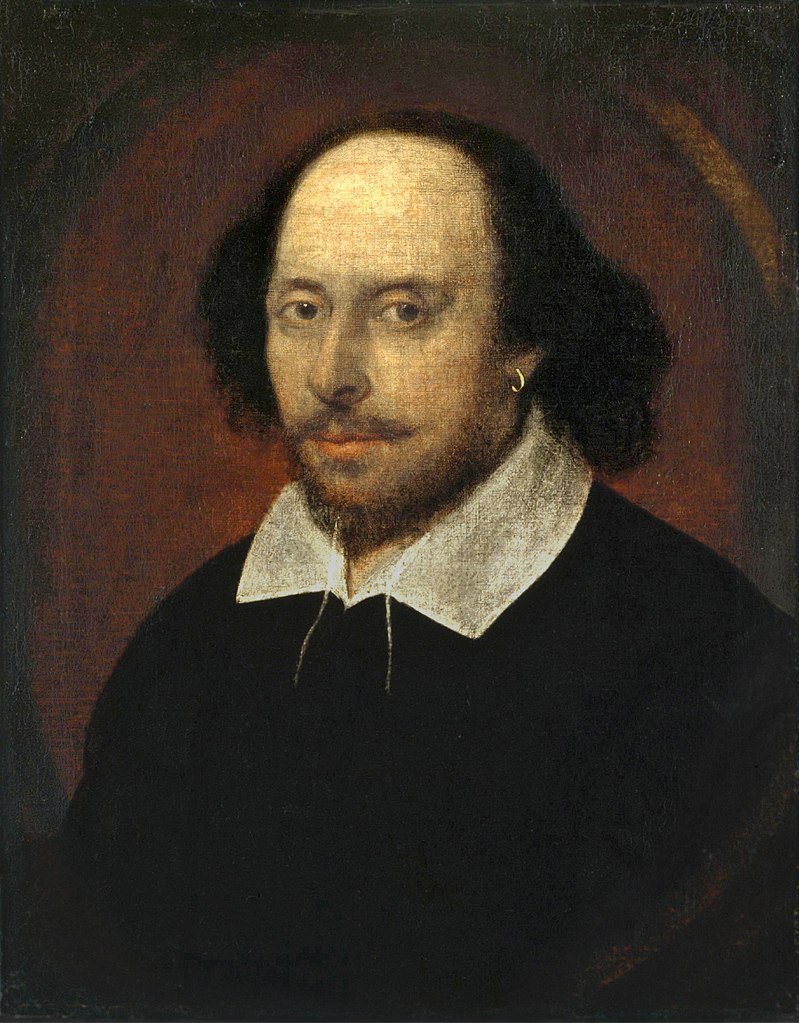
This was long thought to be the only portrait of William Shakespeare that had any claim to have been painted from life, until another possible life portrait, the Cobbe portrait, was revealed in 2009. The portrait is known as the “Chandos portrait” after a previous owner, James Brydges, 1st Duke of Chandos. It was the first portrait to be acquired by the National Portrait Gallery in 1856. The artist may be by a painter called John Taylor who was an important member of the Painter-Stainers’ Company.
National Portrait Gallery image via Wikimedia Commons.
Was Shakespeare a fraud? The American writer Jodi Picoult seems to think so. Her latest novel By Any Other Name is based on the premise that William Shakespeare was not the real author of his plays. Specifically, in her story, the poet Emilia Lanier (née Bassano) pays Shakespeare for the use of his name so that she might see her work staged at a time when female playwrights were extremely rare.
The theory that Shakespeare was a woman isn’t original to Picoult. As with all conspiracy theories relating to the bard, the “true” Shakespeare is identified as one of the upper echelons of society (although not an aristocrat, Lanier was part of the minor gentry thanks to her father’s appointment as court musician to Queen Elizabeth I). Those known as “anti-Stratfordians” – i.e., those who believe that the man from Stratford-upon-Avon called William Shakespeare did not write the plays attributed to him – invariably favour candidates who had direct connections to the court. The general feeling seems to be that a middle-class lad from a remote country town could not possibly have created such compelling depictions of lords, ladies, kings and queens.
[…]
The notion that the actor Shakespeare could have hired out his identity to Lanier, or anyone else for that matter, makes no sense if one considers the collaborative nature of the theatrical medium. Shakespeare was the house playwright for the Lord Chamberlain’s Men (the company that became the King’s Men on the accession of James I). His job was to oversee productions, to write on the hoof, to adapt existing scripts in the process of rehearsal. (This is probably why his later plays such as Henry VIII contain so many stage directions; at this point he was almost certainly residing in Stratford-upon-Avon, and so was not available to provide the necessary detail in person.) It was never simply a matter of Shakespeare dropping off his latest script at The Globe and quickly scarpering. If he was being fed the lines, it is implausible that nobody in the company would have noticed.
[…]
The theory that Shakespeare’s contemporaries – fans and critics alike – would all collude in an elaborate deception requires a full explanation. The burden of proof is very much on the anti-Stratfordians, but proof doesn’t appear to be their priority. They seem to think they know more about Shakespeare than those who actually lived and worked with him. It’s oddly hubristic.
All of this nonsense began with the Baconian theory propounded by James Wilmot in 1785 and has never gone away. The candidates are usually university educated and aristocratic: Francis Bacon, Christopher Marlowe, the Earl of Rutland, the Earl of Oxford – even Queen Elizabeth I has been proposed. The anti-Stratfordian position seems to be based on a combination of class snobbery and presentism. They assume that the middle-class son of a glover who did not attend university could not have developed the range of knowledge needed to inform his plays. They forgot, or do not know, that the grammar school education of the time would have provided a firm grounding in the classics. Shakespeare would have been steeped in Ovid, Cicero, Plautus, Terence, and much more besides. Let’s not forget that Ben Jonson, the most scholarly of all his contemporaries, didn’t go to university either.
Moreover, the plays make clear that Shakespeare was a voracious reader. The idea that one must have direct experience in order to write about a subject is very much in keeping with the obsessions of our time, particularly the notion of “lived experience” and how writers ought to “stay in their lane”.
As I’ve joked in the past, I believe the theory that Homer didn’t actually write The Iliad and The Odyssey … it was another Greek chap of the same name.
From Sic semper tyrannis to the “Non-Aggression Principle”
On Substack Notes, kulak points out that the beliefs that led to the American colonists taking up arms against King George’s government don’t expire:
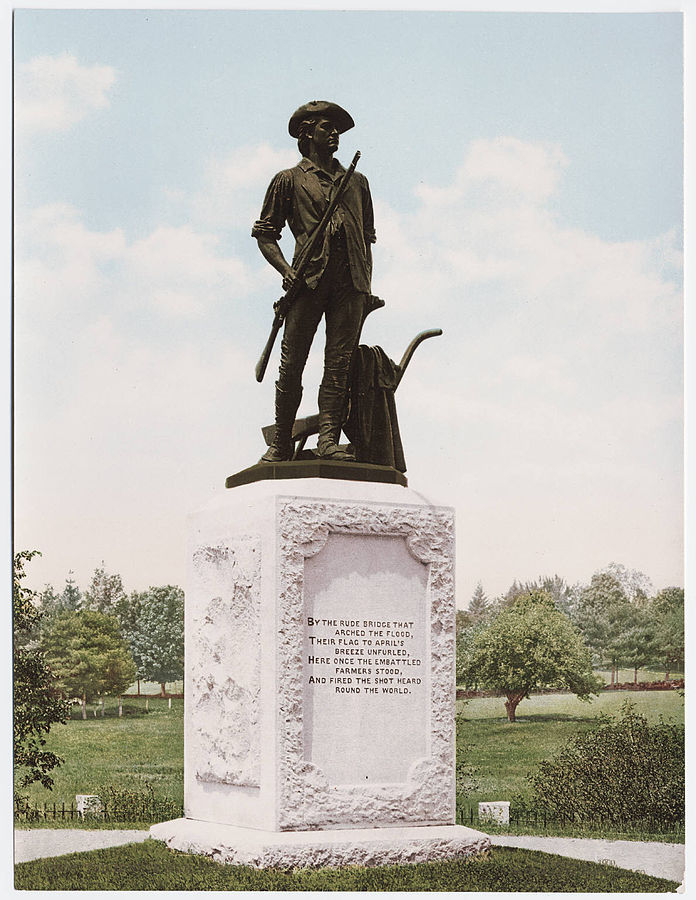
A statue idealizing the individual minutemen who would compose the militia of the United States.
Postcard image of French’s Concord Minuteman statue via Wikimedia Commons.
One of the things that drives me nuts about people who claim to subscribe to modern libertarianism (as opposed to the American Revolutionary ideology) is the claim to be “peaceful” and “antiwar”
Libertarianism isn’t antiwar. The American founding values aren’t antiwar. They never have been. It is a permanent declaration of war.
Live Free or Die
Sic Semper Tyrannis.
“Thus always to tyrants”
When does “always” end? NEVER
If those values succeed then 10,000 years from after your descendants have forgotten the name of America itself, they will be killing tyrants and carving their hearts from their chest.
Libertarianism is not “peaceful” it is a declaration that no peace shall ever exist again. That a free people will never have peace with any who’d seek to rule them. Eternal civil war against all would-be tyrants from the pettiest to the most grandiose.
The “non-aggression principle” does not state that the libertarian my never aggress against another … It states only that he may not aggress FIRST, afterwards any and all aggression, even the most disproportionate, is permitted.
“Taxation is Theft” is the claim that a tax collector or government agent paid out of taxes has the same moral status as burglar/home invader caught in your child’s bedroom. It is the claim that that those who benefit and enable the welfare programs paid out of your taxes have the same moral protection from your wrath should you gain the upper hand as a mugger actively threatening you with a gun lest you hand over your wallet.
“Taxation is Theft” necessarily justifies just as revolutionary and total a upset in the political order as “Property is Theft” did … because theft inherently is a violation of your extended person to be resisted without restriction. And just as the Communist claim of “property is theft” justified the most total and brutal wars in human history to destroy the social order (and social classes) who made “property” possible. Libertarianism and “Taxation is Theft” must necessarily justify just as extreme a charnel house to render “Taxation” impossible.
“Live Free or Die” is necessarily, and has always been a declaration of war upon those who would choose not to “live free”, or remain loyal to a tyrant or master.
The founding fathers didn’t make nice with the Loyalists who remained faithful the crown: They ethnically cleansed large portions of them equal to 4% the US population (notably the Loyalist Dutch of New York), confiscated their lands, and drove them into Canada, several mothers with babes nearly starving. Then they invaded them again in 1812. (Read Tigre Dunlop’s interviews with the survivors in Canada in “Recollections on the War of 1812”).
What Loyalists who managed to remain in the US did not regain full rights as citizens until after the war of 1812, almost 40 years after the revolution.
So if you claimed to believe in “Libertarianism” or the American Revolution, ask yourself: “Do I really believe in Liberty and the American Revolution? Or am I a just a flavor of Progressive Democrat who thinks the income tax should be slightly lower?”
Signed,
A Canadian Descended from Loyalists
I plead the Pith: a History of the Pith Helmet
HatHistorian
Published Jun 1, 2022A symbol of exploration, tropical adventure, and colonialism, the pith helmet has had a long history since its origins as the salakot, a Philippine sun hat. Through many iterations, it had become one of the most famous hats out there, a powerful part of popular imagination.
The helmets I wear in this video come respectively from a gift from a family friend (so I don’t know where it was bought, https://www.historicalemporium.com/, and Amazon.com. The red tunic comes from thehistorybunker.co.uk
Title sequence designed by Alexandre Mahler
am.design@live.comThis video was done for entertainment and educational purposes. No copyright infringement of any sort was intended.
QotD: When the chimneys rose in London
In Ruth Goodman’s telling, though, the greatest difference between coal and wood fires is the smoke. Smoke isn’t something we think much about these days: on the rare occasions I’m around a fire at all, I’m either outdoors (where the smoke dissipates rapidly except for a pleasant lingering aroma on my jacket) or in front of a fireplace with a good chimney that draws the smoke up and out of the house. However, a chimney also draws about 70% of the fire’s heat — not a problem if you’re in a centrally-heated modern home and enjoying the fire for ✨ambience✨, but a serious issue if it’s the main thing between your family and the Little Ice Age outdoors. Accordingly, premodern English homes didn’t have chimneys: the fire sat in a central hearth in the middle of the room, radiating heat in all directions, and the smoke slowly dissipated out of the unglazed windows and through the thatch of the roof. Goodman describes practical considerations of living with woodsmoke that never occurred to me:
In the relatively still milieu of an interior space, wood smoke creates a distinct and visible horizon, below which the air is fairly clear and above which asphyxiation is a real possibility. The height of this horizon line is critical to living without a chimney. The exact dynamics vary from building to building and from hour to hour as the weather outside changes. Winds can cause cross-draughts that stir things up; doors and shutters opening and closing can buffet smoke in various directions. … From my experiences managing fires in a multitude of buildings in many different weather conditions, I can attest to the annoyance of a small change in the angle of a propped-open door, the opening of a shutter or the shifting of a piece of furniture that you had placed just so to quiet the air. And as for people standing in doorways, don’t get me started.
One obvious adaptation was to live life low to the ground. On a warm day the smoke horizon might be relatively high, but on a cold damp one (of which, you may be aware, England has quite a lot) smoke hovers low enough that even sitting in a tall chair might well put your head right up into it. Far better to sit on a low stool, or, better yet, a nice soft insulating layer of rushes on the floor.
Chimneys did exist before the transition to coal, but given the cost of masonry and the additional fuel expenses, they were typically found only in the very wealthiest homes. Everyone else lived with a central hearth and if they could afford it added smoke management systems to their homes piecemeal. Among the available solutions were the reredos (a short half-height wall against which the fire was built and which would counteract drafts from doorways), the smoke hood (rather like our modern cooktop vent hood but without the fan, allowing some of the smoke to rise out of the living space without creating a draw on the heat), or the smoke bay (a method of constructing an upstairs room over only part of the downstairs that still allowed smoke to rise and dissipate through the roof). Wood smoke management was mostly a question of avoiding too great a concentration in places you wanted your face to be. The switch to coal changed this, though, because coal smoke is frankly foul stuff. It hangs lower than wood smoke, in part because it cools faster, and it’s full of sulfur compounds that combine with the water in your eyes and lungs to create a mild sulfuric acid; when your eyes water from the irritation, the stinging only gets worse. Burning coal in an unvented central hearth would have been painful and choking. If you already had one of the interim smoke management techniques of the wood-burning period — especially the smoke hood — you would have found adopting coal more appealing, but really, if you burned coal, you wanted a chimney. You probably already wanted a chimney, though; they had been a status symbol for centuries.
And indeed, chimneys went up all over London; their main disadvantage, aside from the cost of a major home renovation, had been the way they drew away the heat along with the smoke, but a coal fire’s greater energy output made that less of an issue. The other downside of the chimney’s draw, though, is the draft it creates at ground level. Again, this isn’t terribly noticeable today because most of us don’t spend a lot of time sitting in front of the fireplace (or indeed, sitting on the floor at all, unless we have small children), but pay attention next time you’re by an indoor wood fire and you will notice a flow of cold air for the first inch or two off the ground. All of a sudden, instead of putting your mattress directly on the drafty floor, you wanted a bedstead to lift it up — and a nice tall chair to sit on, and a table to pull your chair up to as well. There were further practical differences, too: because a chimney has to be built into a wall, it can’t heat as large an area as a central fire. This incentivized smaller rooms, which were further enabled by the fact that a coal fire can burn much longer without tending than a wood fire. A gentleman doesn’t have much use for small study where he can retreat to be alone with his books and papers if a servant is popping in every ten minutes to stir up the fire, but if the coals in the grate will burn for an hour or two untended he can have some real privacy. The premodern wood-burning home was a large open space where many members of the household, both masters and servants, went about their daily tasks; the coal-burning home gradually became a collection of smaller, furniture-filled spaces that individuals or small groups used for specific purposes. Nowhere is this shift more evident than in the word “hall”, which transitions from referring to something like Heorot to being a mere corridor between rooms.
Jane Psmith, “REVIEW: The Domestic Revolution by Ruth Goodman”, Mr. and Mrs. Psmith’s Bookshelf, 2023-05-22.
1. Brief ferrous metallurgy digression: aside from the rare, relatively pure iron found in meteors, all iron found in nature is in the form of ores like haematite, where the iron bound up with oxygen and other impurities like silicon and phosphorus (“slag”). Getting the iron out of the ore requires adding carbon (for the oxygen to bond with) and heat (to fuel the chemical reaction): Fe2O3 + C + slag → Fe + CO2 + slag. Before the adoption of the blast furnace, European iron came from bloomeries: basically a chimney full of fuel hot enough to cause a reduction reaction when ore is added to the top, removing the oxygen from the ore but leaving behind a mass of mixed iron and slag called a bloom. The bloom would then be heated and beaten and heated and beaten — the hot metal sticks together while the slag crumbles and breaks off — to leave behind a lump of nearly pure iron. (If you managed the temperature of your bloomery just right you could incorporate some of the carbon into the iron itself, producing steel, but this was difficult to manage and carbon was usually added to the iron afterwards to make things like armor and swords.) In a blast furnace, by contrast, the fuel and ore were mixed together and powerful blasts of air were forced through as the material moved down the furnace and the molten iron dripped out the bottom. From there it could be poured directly into molds and cast into the desired shape. This is obviously much faster and easier! But cast iron has much more carbon, which makes it very hard, lowers its melting point, and leaves it extremely brittle — you would never want a cast iron sword. (The behavior of various ferrous metals is determined by the way the non-metal atoms, especially carbon, interrupt the crystal structure of the iron. Wrought iron has less than .08% carbon by weight, modern “low carbon” steel between .05% and .3%, “high carbon” steel about 1.7%, and cast iron more than 3%.)
2. The sales of those cooking implements went on to provide the capital for further innovation: Darby’s son and grandson, two more Abrahams, also played important roles in the Industrial Revolution.
May 30, 2024
As everyone knows, it takes at least three years to find a shovel in Canada …
In Quillette, Jonathan Kay notes the third anniversary of the “mass graves” moral panic here in the utterly dysfunctional Dominion:
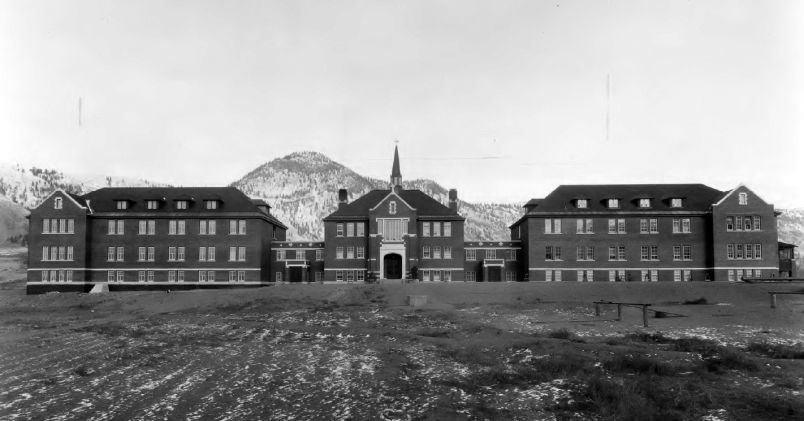
Kamloops Indian Residential School, 1930.
Photo from Archives Deschâtelets-NDC, Richelieu via Wikimedia Commons.
This week marked the third anniversary of Canada’s strange “unmarked graves” scandal — a morbid social panic that took hold of my country in late May 2021, following unverified claims that the corpses of 215 (presumably murdered) Indigenous children had been located at the site of a former school in Kamloops, British Columbia.
As I’ve already described this saga in several Quillette articles, I will not belabour the specifics (which, by now, have also been covered in the international press, as well as Canada’s National Post and Dorchester Review). Instead, this update will focus on the manner by which Canadian public figures (journalists, in particular) have tried to evade accountability for their original gullibility, as it presents an interesting case study in social psychology on a national scale.
The background here, as anyone who’s followed the story closely will know, is a genuinely shameful aspect of Canadian history — the federally funded, church-run system of residential schools established in the nineteenth century as a means to assimilate the country’s Indigenous population. In many cases, children were forced to attend boarding schools located hundreds of miles from their home reserves. Mortality rates from infectious diseases (especially tuberculosis) were tragically high, and the whole issue was properly referred to an authoritative body known as the Truth and Reconciliation Commission, which concluded that at least 3,200 children died after enrolling in residential schools. The real number might well be considerably higher.
All of this had been common knowledge in Canada for years by the time Rosanne Casimir, Chief of the Tk’emlúps te Secwépemc First Nation in Kamloops claimed to have discovered the remains of 215 Indigenous children buried on the site of the former Kamloops Indian Residential School.
In fact, she’d discovered nothing of the kind. But the Canadian media ran with the claim as if it were the proven truth. A typical headline: “Tk’emlups confirms bodies of 215 children buried at former Kamloops Indian Residential School site“.
If you don’t live in Canada, it will be hard to appreciate the national hysteria that resulted. In the press, Canada was officially anointed a nation of baby killers. Prime Minister Justin Trudeau lowered the flag on public buildings for five months. Dozens of churches were burned by arsonists in apparent acts of retribution. The word “genocide” was thrown around in casual parlance as if we were Nazi Germany or Rwanda in 1994. The Canadian Press called the discovery of these ostensible unmarked graves the 2021 “Story of the Year.”
Then the days passed, the national festival of self-laceration abated somewhat, and it began dawning on some of us that — um, wait a minute — no evidence of graves had actually been presented yet. That evidence was on its way, right?
The Bloody Birth of Socialist Yugoslavia
World War Two
Published May 29, 2024In the final months of the war, Partisan leader Josip Tito and his forces complete their conquest of Yugoslavia. They destroy Draza Mihailovic’s Chetniks and Ante Pavelic’s Croatian Independent State and they outmanoeuvre King Peter. As Tito’s forces take revenge on their vanquished foes, Socialist Yugoslavia is born in a cradle of fire and blood.
02:08 Mihailovic’s Last Roll of the Dice
04:35 Tito Aligns himself with the Soviets
07:06 Albania
08:25 Tito begins state building
10:51 Hoxha purges his enemies
12:00 The Fall of Mihailović
13:08 The End of the Independent State of Croatia
14:54 The Events at Bleiburg
17:08 The Massacres
19:41 The Birth of Socialist Yugoslavia
20:54 Conclusion
(more…)
May 29, 2024
Why Germany Lost the Battle of the Atlantic
Real Time History
Published Feb 2, 2024In March 1943, German U-boats are on the attack – they sink 108 Allied vessels that month alone. Some Allied officials fear a German victory in the Atlantic is imminent. If the Allies lose the Atlantic, Britain loses its lifeline – and maybe even the war. But by May 1943, it will be the U-boats limping home in defeat. So how, in just two months, did the U-boats go from hunters to hunted?
(more…)
May 28, 2024
Why a Tire Company Gives Out Food’s Most Famous Award
Tasting History with Max Miller
Published Feb 20, 2024Eugénie Brazier, the chef behind today’s recipe, was a culinary force to be reckoned with. She was described as “a formidable woman with a voice like a foghorn, rough language, and strong forearms”. Both of her restaurants won Michelin stars in the early 20th century, making her the first person to have six. No one else would earn six Michelin stars for 64 years.
By modern Michelin standards, this dish is pretty plain, but it’s still really good. The chicken is cooked simply in butter, and the cream sauce is absolutely fantastic. I was afraid the alcohol would overpower it, but it doesn’t. The sauce takes on a kind of floral woodiness instead of each individual alcohol’s flavor, and it’s so good.
(more…)
May 27, 2024
The Manda: Croatia’s Minimalist .50 BMG
Forgotten Weapons
Published Feb 21, 2024The Manda is a rifle that was designed for the Croatian Special Police at the beginning of the Homeland War in 1991. At that point, the Special Police (basically the SWAT teams) were basically the only really well-trained fighters in the country with combat experience. They wanted .50 BMG anti-material rifles for the war that was breaking out, and the Croatian Ministry of the Interior developed and produced the Manda for them.
Specifically, the rifle was designed by engineer Petar Vucetic (and named after his sister). Mechanically, it is a very simple rifle, with two large locking lugs, a tubular stock, M70 AK pistol grip, and a barrel made from a turned-down Browning M2 bolt with a large muzzle brake. A total of 84 were made, fitted with Leupold scopes and mounts with integrated BDC cams for use from 300 out to 1000 meters.
(more…)
QotD: The Cursus Honorum in the Roman republic
The second caution is that the cursus honorum was, for most of its history, a customary thing, a part of the mos maiorum, rather than a matter of law. But of course the Romans, especially the Roman aristocracy, take both the formal and informal rules of this “game” very seriously. While unusual or spectacular figures could occasionally bend the rules, for most of the third and second century, political careers followed the rough outlines of the cursus honorum, with occasional efforts to codify parts of the process in law during the second century, beginning with the Lex Villia in 180 BC, but we ought to understand that law and others of the sort as mostly attempting to codify and spell out what were traditional practices, like the generally understood minimum ages for the offices, or the interval between holding the same office twice.
That said, there is a very recognizable pattern that was in some cases written into law and in other cases merely customary (but remember that Roman culture is one where “merely customary” carries a lot of force). Now the cursus formally begins with the first major office, the quaestorship, but there are quite a few things that an aspiring Roman elite needs to do first. The legal requirement is that our fellow – and it must be a fellow, as Roman women cannot hold office (or vote) – needs to have completed ten years of military service (Polyb. 6.19.1-3). But there are better and worse ways to discharge this requirement. The best way is being appointed as junior officers, military tribunes, in the legions. We’ll talk about this office in a bit, but during this period it served both as a good first stepping stone into political prominence as well as something more established Roman politicians did between major office-holding, perhaps as a way of remaining prominent or to curry favor with the more senior politicians they served under or simply because military exigency meant that more experienced hands were wanted to lead the army.
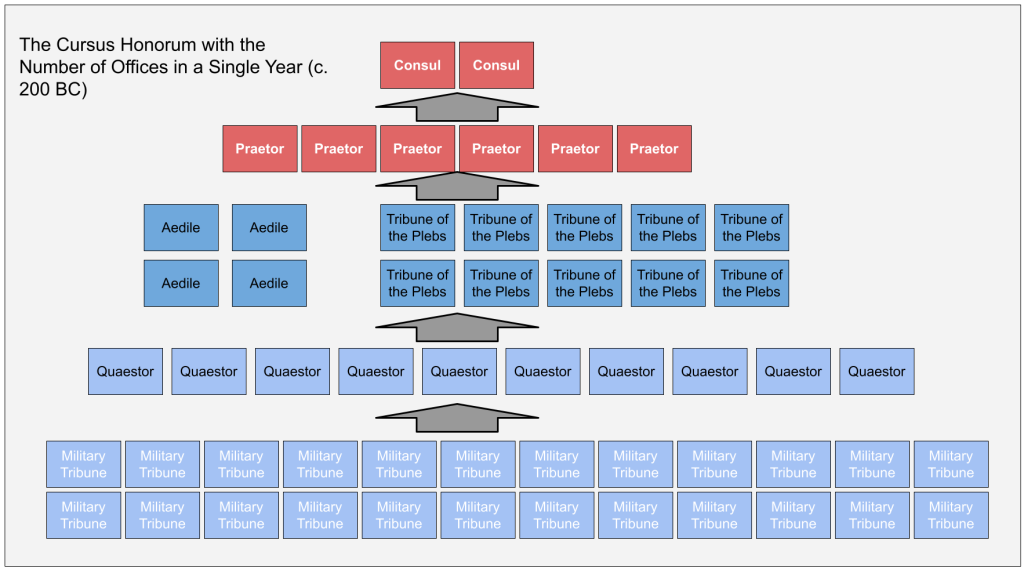
A diagram of the elected offices of the cursus honorum. Note that there were additional appointed military tribunes.
There are a bunch of other minor magistrates that are effectively “pre-cursus” offices too, but we don’t know a lot about them and they don’t seem generally to show up as often in the careers of the sort of Romans making their way up to the consulship, though this may be simply because our sources don’t mention them as much at all and so we simply don’t know who was holding them in basically any year. We’ll talk about them at the end of this set of posts, because they are important (particularly for non-elites).
I should note at the outset: all of these offices are elected annually unless otherwise noted, with a term of service of one year. You never hold the same office twice until you reach the consulship, at which point you can seek re-election, after a respectable delay (which is later codified into law and then ignored), but you may serve as a military tribune several times (this was normal, in fact, as far as we can tell).
The first major office of the cursus was the quaestorship. The number of quaestors elected grows over time. Initially just two, their number is increased to four in 421 (two assigned to Rome, one to each of the consuls) and then to six in the 260s (initially handling the fleet, then later to assist Roman praetors or pro-magistrates in the provinces) and then eight in 227. There may have been two more added to make ten somewhere in the Middle Republic, but recent scholarship has cast doubt on this, so the number may have remained eight until being expanded to twenty under Sulla in 81 BC through the aptly named lex Cornelia de XX quaestoribus (the Cornelian Law on Twenty Quaestors, Sulla being Lucius Cornelius Sulla Felix).2 It’s not clear if there was a legal minimum age for the quaestors and we only know the ages of a few (25, 27, 29 and 30, for the curious) so all we can say is that officeholders tended to hold the office in their twenties, right after finishing their mandatory stint of military service.3 Serving as a quaestor enables entrance into the Senate, though one has to wait for the next census to be added to the Senate rolls by the censors.
After the quaestorship, aspirants for higher office had a few options. One option was the office of aedile; there were after 367 four of these fellows. Two were plebeian aediles and were not open to patricians, while the two more prestigious spots were the “curule” aediles, open to both patricians and plebeians. The other option at this stage for plebeian political hopefuls was to seek election as a tribune of the plebs, of which there were ten annually, we’ll talk about these fellows in a later post because they have wide-ranging, spectacular and quite particular powers.
After this was the praetorship, the first office which came with imperium. Initially there may have just been one praetor; by the 240s there are two (what will become the praetor urbanus and the praetor peregrinus). In 227 the number increases to four, with the two new praetors created to handle administration in Sicily, Sardinia and Corsica. That number then increases to six in 198/7, with the added praetors generally being sent to Spain. Finally Sulla raises the number to eight in 81 BC. The minimum age seems to have been 39 for this office.
Finally comes the consulship, the chief magistrate of the Roman Republic, who also carried imperium but of a superior sort to the praetors. There were always two consuls and their number was never augmented. For our period (pre-Sulla) the consuls led Rome’s primary field armies and were also the movers of major legislation. Achieving the consulship was the goal of every Roman embarking on a political career. This is the only office that gets “repeats”.
Finally there is one office after the cursus honorum and that is the censorship. Two are elected every five years for an 18 month term in which they carry out the census. Election to the censorship generally goes to senior former-consuls and is one way to mark a particularly successful political career. That said, Romans tend to dream about the consulship, not the censorship and if you had a choice between being censor once or holding the consulship two or three times, the latter was more prestigious.
With the offices now laid out, we’ll go through them in rough ascending sequence. Today we’ll look at the military tribunes, the quaestors and the aediles; next week we’ll talk about imperium and the regular offices that carry it (consuls, praetors and pro-magistrates). Then, the week after that, we’ll look at at two offices with odd powers (tribunes of the plebs and censors), along with minor magistrates. Finally, there’s another irregular office, that of dictator, which we have already discussed! So you can go read about it there!
One thing I want to note at the outset is the “elimination contest” structure of the cursus honorum. To take the situation as it stands from 197 to 82, there are dozens and dozens of military tribunes, but just eight quaestors and just six praetors and then just two consuls. At each stage there was thus likely to be increasingly stiff competition to move forward. To achieve an office in the first year of eligibility (in suo anno, “in his own year”) was a major achievement; many aspiring politicians might require multiple attempts to win elections. But of course these are all annual offices, so someone trying again for the second or third time for the consulship is now also competing against multiple years of other failed aspirants plus this new year’s candidates in suo anno. We’ll come back to the implications of this at the end but I wanted to note it at the outset that even given the relatively small(ish) size of Rome’s aristocracy, these offices are fiercely competitive as one gets higher up.
Bret Devereaux, “Collections: How to Roman Republic 101, Part IIIa: Starting Down the Path of Honors”, A Collection of Unmitigated Pedantry, 2023-08-11.
1. See Lintott, op. cit. 104-5, n. 47.
2. These dates and numbers, by the by, follows F.P. Polo and A.D. Fernández, The Quaestorship in the Roman Republic (2019).
3. If you are wondering about how anyone can manage to hold the office before 27, given ten years of military service and 17 being the age when Roman conscription starts, well, we don’t really know either. The best supposition is that some promising young aristocrats seem to have started their military service early, perhaps in the retinues (the cohors amicorum) of their influential relatives. Tiberius Gracchus at 25 is the youngest quaestor we know of, but he’s in the army by at most age 16 with Scipio Aemilianus at Carthage in 146.
May 26, 2024
The Last Battles in Europe – WW2 – Week 300 – May 25, 1945
World War Two
Published 25 May 2024This week, the fighting in Europe finally comes to an end and the Allies round up more leading Nazis including Heinrich Himmler and Karl Dönitz. In Asia, the fighting continues on Okinawa even as the Japanese start pulling back. The Australians continue fighting on Tarakan, and the Chinese are victorious in western Hunan.
00:00 Intro
01:45 Fighting In Europe Ends
04:30 Notes From Europe
06:57 Japanese Begin To Withdraw On Okinawa
12:41 The Battle Of Tarakan Island
14:35 Chinese Victory In Western Hunan
18:51 Conclusion
(more…)
Evolution of The Churchill Tank | “No Damn Good”?
The Tank Museum
Published Feb 17, 2024Designed by a company that had never built a tank before with the Prime Minister, Winston Churchill, looking over their shoulders and plagued by mechanical teething troubles, the Churchill tank had unpromising beginnings. Despite this, it became one of the most successful British tanks of WW II: heavily armoured, not fast but with superb climbing ability, the Churchill served not only as a gun tank but the basis many of the specialised vehicles that helped the British and Canadian Armies ashore on D-Day.
00:00 | Intro
01:20 | History – What was needed?
03:38 | Design, Weaponry and Armour
08:44 | Up-gunned and Upgraded
13:59 | A Look Inside
17:51 | Combat Performance
20:23 | Multi-use Platform
23:10 | ConclusionThis video features archive footage courtesy of British Pathé.
#tankmuseum


