
The Tank Museum
Published Feb 17, 2024Designed by a company that had never built a tank before with the Prime Minister, Winston Churchill, looking over their shoulders and plagued by mechanical teething troubles, the Churchill tank had unpromising beginnings. Despite this, it became one of the most successful British tanks of WW II: heavily armoured, not fast but with superb climbing ability, the Churchill served not only as a gun tank but the basis many of the specialised vehicles that helped the British and Canadian Armies ashore on D-Day.
00:00 | Intro
01:20 | History – What was needed?
03:38 | Design, Weaponry and Armour
08:44 | Up-gunned and Upgraded
13:59 | A Look Inside
17:51 | Combat Performance
20:23 | Multi-use Platform
23:10 | ConclusionThis video features archive footage courtesy of British Pathé.
#tankmuseum
May 26, 2024
Evolution of The Churchill Tank | “No Damn Good”?
May 25, 2024
“Education” versus “learning”
At Astral Codex Ten, Scott Alexander discusses some of the ideas from Bryan Caplan’s book The Case Against Education:

Source here. Note deranged horizontal axis.
Education isn’t just about facts. But it’s partly about facts. Facts are easy to measure, and they’re a useful signpost for deeper understanding. If someone has never heard of Chaucer, Dickens, Melville, Twain, or Joyce, they probably haven’t learned to appreciate great literature. If someone can’t identify Washington, Lincoln, or either Roosevelt, they probably don’t understand the ebb and flow of American history. So what facts does the average American know?
In a 1999 poll, only 66% of Americans age 18-29 knew that the US won independence from Britain (as opposed to some other country). About 47% of Americans can name all three branches of government (executive, legislative, and judicial). 37% know the closest planet to the sun (Mercury). 58% know which gas causes most global warming (carbon dioxide). 44% know Auschwitz was the site of a concentration camp. Fewer than 50% (ie worse than chance) can correctly answer a true-false question about whether electrons are bigger than atoms.
These results are scattered across many polls, which makes them vulnerable to publication bias; I can’t find a good unified general knowledge survey of the whole population. But there’s a great survey of university students. Keeping in mind that this is a highly selected, extra-smart population, here are some data points:
- 85% know who wrote Romeo and Juliet (Shakespeare)
- 56% know the biggest planet (Jupiter)
- 44% know who rode on horseback in 1775 to warn that the British were coming (Paul Revere)
- 33% know what organ produces insulin (pancreas)
- 31% know the capital of Russia (Moscow)
- 30% know who discovered the Theory of Relativity (Einstein)
- 19% know what mountain range contains Mt. Everest (Himalayas)
- 19% know who wrote 1984 (George Orwell)
- 16% know what word the raven says in Poe’s “The Raven” (“Nevermore!”)
- 10% know the captain’s name in Moby Dick (Ahab)
- 7% know who discovered, in 1543, that the Earth orbits the sun (Copernicus)
- 4% know what Chinese religion was founded by Lao Tse (Taoism)
- <1% know what city the general Hannibal was from (Carthage)
Remember, these are university students, so the average person’s performance is worse.
Most of these are the kinds of facts that I would expect school to teach people. Some of them (eg the branches of government) are the foundations of whole subjects, facts that I would expect to get reviewed and built upon many times during a student’s career. If most people don’t remember them, there seems to be little hope that they remember basically anything from school. So what’s school even doing?
Maybe school is why at least a majority of people know the very basics – like that the US won independence from Britain, or that Shakespeare wrote Romeo and Juliet? I’m not sure this is true. Here are some other questions that got approximately the same level of correct answers as “Shakespeare wrote Romeo and Juliet“:
- What is the name of the rubber object hit by hockey players? (Puck, 89%)
- What is the name of the comic strip character who eats spinach to increase his strength? (Popeye, 82% correct)
- What is the name of Dorothy’s dog in The Wizard of Oz? (Toto, 80% correct)
I don’t think any of these are taught in school. They’re absorbed by cultural osmosis. It seems equally likely that Romeo and Juliet could be absorbed the same way. Wasn’t there an Academy-Award-winning movie about Shakespeare writing Romeo and Juliet just a decade or so before this study came out? Sure, 19% of people know that Orwell wrote 1984 – but how many people know the 1984 Calendar Meme, or the “1984 was not an instruction manual!” joke, or have heard of the reality show Big Brother? Nobody learned those in school, so maybe they learned Orwell’s name the same place they learned about the other 1984-related stuff.
Okay, so school probably doesn’t do a great job teaching facts. But maybe it could still teach skills, right?
According to tests, fewer than 10% of Americans are “proficient” at PIIAC-defined numeracy skills, even though in theory you need to know algebra to graduate from most public schools.
I took a year of Spanish in middle school, and I cannot speak Spanish today to save my life; that year was completely wasted. Sure, I know things like “Hola!” and “Adios!”, but I also know things like “gringo” and “Yo quiero Taco Bell” – this is just cultural osmosis again.
So it seems most people forget almost all of what they learn in school, whether we’re talking about facts or skills. The remaining pro-school argument would be that even if they forget every specific thing, they retain some kind of scaffolding that makes it easier for them to learn and understand new things in the future; ie they keep some sort of overall concept of learning. This is a pretty god-of-the-gaps-ish hypothesis, and counterbalanced by all the kids who said school made them hate learning, or made them unable to learn in a non-fake/rote way, or that they can’t read books now because they’re too traumatized from years of being forced to read books that they hate.
It’s common-but-trite to encounter people who say things like “I love learning, but I hated school” — I’ve undoubtedly said that myself many times. A weird experience was having to study a book in school that I’d already read on my own: it was like an early form of aversion therapy … here’s something you loved once, let’s make you hate it now.
Fathers of Light and Darkness – Rockets and Explosives – Sabaton History 126 [Official]
Sabaton History
Published Feb 7, 2024There are many inventors whose creations have been turned into weapons of war. A couple that really stand out are Alfred Nobel and Wernher von Braun. Today we’ll take a deep dive into their stories and the paradox of using destructive weapons for good, or creative weapons for destruction.
(more…)
May 24, 2024
Grant Hammond .32 ACP Prototype
Forgotten Weapons
Published Apr 6, 2015Grant Hammond is best known (to the extent he is known at all) for a .45 caliber pistol submitted to US military trials in 1917 and 1918. This pistol is a proof of concept prototype embodying some of the concepts that would go into the later .45 caliber pistol, and also showing some concepts that would not see further use. This .32 ACP prototype features a hybrid blow forward / blow back mechanism in which the slide uses a gas trapping system to move forward and the bolt moves backward. It also has a unique system for automatically ejecting the magazine when empty. Truly one of the most mechanically unusual pistols I have ever seen.
QotD: Our modern Puritans
Lots of revolutionaries have been obsessed with the state of their own souls, but only the Puritans have been worried about it. Skim Walzer1, then compare with Norman Cohn’s The Pursuit of the Millennium, a book I recommend without reservation. The Brethren of the Free Spirit were obsessed with the condition of their souls, too, but, crucially, they were certain that they were the Elect. All pre-Puritan millennial movements were essentially Gnostic — they, the Elect, knew the Truth, and they were the Elect because they knew the Truth. Their job was simply to tell everyone the Truth (and, inevitably, kill everyone who disagreed), and that great truth-telling / cleansing of the sinners would basically force Jesus to come back, thus ending the world.
The Puritans were something new. Translate their elaborate, Latinate prose into the parlance of our times, and they sound exactly like SJWs — at once unbearably self-righteous and cripplingly insecure. They were almost certain that they, personally, were among the Elect … but since the only infallible sign of being Saved was “an irresistible attraction to Puritanism”, they were caught in exactly the same vicious purity spiral as our modern SJWs. Who, truly, can say xzhey are #woke, when there’s always the possibility of someone, somewhere, being #woker? If you want a slightly easier passport to their heads, try Perry Miller’s The New England Mind. It was written in the 1930s, so be prepared — surprisingly little untranslated Latin, since the Puritans wrote mostly for themselves, but still fairly ornate prose.
Put it this way: The Wiki summary of Miller’s life quotes a colleague: “Perry Miller was a great historian of Puritanism but the dark conflicts of the Puritan mind eroded his own mental stability”. He died of alcoholism.
The Puritans’ saving grace, if they had one, is that they were men of the world. They had to be. Guys like Max Weber would say that those two things had a dialectical relationship — Puritanism IS “the Protestant work ethic” IS “capitalism” — but that’s not necessary for present purposes. My point is simply that the Early Modern world could only support a tiny number of professional intellectuals, and the “managerial class” was all but nonexistent. Through Cromwell and his mini-me’s in Salem gave it the old college try, it’s simply impossible to run an Early Modern government Puritan-style.
That’s obviously not the case now. We have a huge (and ever-growing) managerial class, all of whom are the most fervent Puritans. Unlike Cromwell and the boys, though, they can — and, of course, DO — live in perfect isolation from the affairs of the world they’re supposedly managing. Put simply, but not really unfairly, they live on Twitter — their carefully curated list of social media “friends” is, in a very real way, their entire world. Imagine Oliver Cromwell, Zeal-of-the-Land Busy, and Cotton Mather tweeting at each other, all day every day.
Severian, “Friday Mailbag: Civilization, the Video Game”, Rotten Chestnuts, 2021-05-21.
1. Severian may be referring to Michael Walzer’s first book The Revolution of the Saints: A Study in the Origins of Radical Politics (1965) or perhaps Regicide and Revolution (1974). Unfortunately when I saved this, I didn’t note which of Walzer’s works had been referenced earlier in the post and the original is no longer available online. Quotulatiousness regrets the omission.
May 23, 2024
The Roman Colosseum: What It Was Like to Attend the Games
Tasting History with Max Miller
Published Feb 13, 2024Like at sports events today, you could get snacks and souvenirs in and around the Colosseum in ancient Rome. There were sausages and pastries and small sweet snacks, like these dates. Not the same as modern hot dogs and soft serve, but kind of in the same spirit.
These dates are really, really good. You could grind the nuts into a fine paste, but I like the texture a lot when they’re left a little coarse. They’re very sweet from the dates and the honey, but the salt and pepper balance it so well (highly recommend the long pepper here). Definitely give these a try!
(more…)
May 21, 2024
Idi Amin would have loved MMT
Jon Miltimore talks about the economic disaster of Idi Amin’s Uganda after Amin and his predecessor decided to nationalize most big businesses in the country and then to print money to cover the government shortfalls in revenue that resulted:

Ugandan dictator Idi Amin at the United Nations, October 1975.
Detail of a photo by Bernard Gotfryd via Wikimedia Commons.
Idi Amin (1923-2003) was one of the most ruthless and oppressive dictators of the 20th Century.
Many will remember Amin from the 2006 movie The Last King of Scotland, a historical drama that netted Forest Whitaker an Academy Award for Best Actor for his depiction of the Ugandan president.
While Western media often mocked Amin, who ruled Uganda from 1971 to 1979, as a self-aggrandizing buffoon, they tended to overlook the atrocities he inflicted on his people. He murdered an estimated 300,000 Ugandans, many of them in brutal fashion. One such victim is believed to be Amin’s fourth wife, Kay, whose body was found decapitated and dismembered in a car trunk in 1974, shortly after the couple divorced.
While historians and journalists have tended to focus on Amin’s dismal record on human rights, his economic policies are atrocities in their own right and also deserve attention.
A Brief History of Uganda
Uganda, a landlocked country in the eastern part of Central Africa, received its independence from the United Kingdom on Oct. 9, 1962 (though Queen Elizabeth remained the official head of state). The nation’s earliest years were turbulent.
Uganda was ruled by Dr. Apollo Milton Obote — first as prime minister and then as president — until January 1971, when an upstart general who had served in the British Colonial Army, Idi Amin Dada Oumee, seized control and set himself up as a dictator. (The coup was launched before Amin, a lavish spender, could be arrested for misappropriation of army funds.)
Among Amin’s first moves as dictator was to complete the nationalization of businesses that had begun under his predecessor Obote, who had announced an order allowing the state to assume a 60 percent stake in the nation’s top industries and banks. Obote’s announcement, The New York Times reported at the time, had resulted in a surge of capital flight and “brought new investment to a virtual stand still”. But instead of reversing the order, Amin cemented and expanded it, announcing he was taking a 49 percent stake in 11 additional companies.
Amin was just getting started, however. The following year he issued an order expelling some 50,000 Indians with British passports from the country, which had a devastating economic impact on the country.
“‘These Ugandan ‘Asians’ were entrepreneurial, talented and hard-working people, skilled in business, and they formed the backbone of the economy,” Madsen Pirie, President of the UK’s Adam Smith Institute, wrote in an article on Amin’s expulsion order. “However, Idi Amin favoured people from his own ethnic background, and arbitrarily expelled them anyway, giving their property and businesses to his cronies, who promptly ran them into the ground through incompetence and mismanagement.”
Even as he was nationalizing private industry and expelling Ugandan Asians, Amin was busy rapidly expanding the country’s public sector.
The Ugandan economy was soon in shambles. Amin’s financial advisors were naturally frightened to share this news with Amin, but in his book Talk of the Devil: Encounters With Seven Dictators, journalist Riccardo Orizio says one finance minister did just that, informing Amin “the government coffers were empty”.
The response from Amin is telling.
“Why [do] you ministers always come nagging to President Amin?” he said. “You are stupid. If we have no money, the solution is very simple: you should print more money.”
Tribalism
Theophilus Chilton pulls up an older essay from the vault, discussing tribalism, how it likely arose, and examples of cultures that relapsed into tribalism for various reasons:
In this post, I’d like to address the phenomenon of tribalism. There can be two general definitions of this term. The first is attitudinal – it refers to the possession by a group of people of a strong ethnic and cultural identity, one which pervades every level and facet of their society, and which serves to separate (often in a hostile sense) the group’s understanding of itself apart from its neighbours. The second definition is more technical and anthropological, referring to a group of people organised along kinship lines and possessing what would generally be referred to as a “primitive” governmental form centered around a chieftain and body of elders who are often thought to be imbued with supernatural authority and prestige (mana or some similar concept). The first definition, of course, is nearly always displayed by the second. It is this second definition which I would like to deal with, however.
Specifically, I’d like to explore the question of how tribalism relates to the collapse of widely spread cultures when they are placed under extreme stresses.
There is always the temptation to view historical and pre-historical (i.e., before written records were available) people-groups which were organised along tribal lines as “primitives” or even “stupid”. This is not necessarily the case, and in many instances is certainly not true. However, tribalism is not a truly optimal or even “natural” form of social organisation, and I believe is forced onto people-groups more out of necessity than anything else.
Before exploring the whys of tribalism’s existence, let’s first note what I believe can be stated as a general truism – Mankind is a social creature who naturally desires to organise himself along communal lines. This is why cities, cultures, civilisations even exist in the first place. Early in the history of Western science, Aristotle expressed this sentiment in his oft-quoted statement that “Man is by nature a political animal” (ὁ ἄνθρωπος φύσει πολιτικὸν ζῷον). This aphorism is usually misunderstood, unfortunately, due to the failure of many to take its cultural context into account. Aristotle was not saying that mankind’s nature is to sit around reading about politicians in the newspaper. He was not talking about “politics” in some sort of demotic or operational sense. Rather, “political” means “of the polis” [” rel=”noopener” target=”_blank”>link]. The polis, in archaic and classical Greece, was more than just a city-state – it was the very sum of Greek communal existence. Foreigners without poleis were not merely barbarians, they were something less than human beings, they lacked a crucial element of communal existence that made man – capable of speech and reason – different from the animals and able to govern himself rationally. “Political” did not mean “elections” or “scandals”, as it does with us today. Instead, it meant “capable of living with other human beings as a rational creature”. It meant civilisation itself. Tribalism, while perhaps incorrectly called “primitive”, nevertheless is “underdeveloped”. It is in the nature of man to organise himself socially, and even among early and technologically backwards peoples, this organisation was quite often more complex than tribal forms. While modern cities may be populated by socially atomised shells of men, the classical view of the city was that it was vital to genuine humanity.
My point in all of this is that I don’t believe that tribal organisation is a “natural” endpoint for humanity, socially speaking. The reason tribes are tribes is not because they are all too stupid to be capable of anything else, nor because they have achieved an organisation that truly satisfies the human spirit and nature. As the saying goes, “The only morality is civilisation”. The direction of man’s communal association with man is toward more complex forms of social and governing interactions which satisfy man’s inner desire for sociability.
So why are tribal peoples … tribal? My theory is that tribalism arises neither from stupidity or satisfaction, but as a result of either environmental factors such as geography, habitability, etc. which inhibit complexification of social organisation, or else as a result of civilisation-destroying catastrophes which corrode and destroy central authority and the institutions necessary to maintain socially complex systems.
The first – environmental factors – would most likely be useful for explaining why cultures existing in more extreme biomes persist in a tribal state. For example, the Arctic regions inhabited by the Inuit would militate against building complexity into their native (i.e. pre-contact with modern Europeans) societies. The first great civilisations of the river valleys – Egypt, Mesopotamia, the Indus valley, and China – all began because of the organisation needed to construct and administer large scale irrigation projects for agriculture. Yet, the weather in the Arctic precludes any sort of agriculture, as well as many other activities associated with high civilisation such as monumental architecture and large scale trade. The Inuit remained tribal hunter-gatherers not because they were inherently incapable of high culture, but because their surroundings inhibited them from it. Likewise, the many tribal groups in the Rub’ al-Khali (the Empty Quarter of the Arabian peninsula) were more or less locked into a semi-nomadic transhumant existence by their environment, even as the racially and linguistically quite similar peoples of Yemen and the Hadramaut were developing complex agricultural and commercial cultures along the wadis.
However, I believe that the more common reason for tribalism in history is that of catastrophes – of various types, some fast-acting and others much slower – which essentially “turned the world upside down” for previous high civilisations which were affected by them. I believe that there are many examples of this which can be seen, or at least inferred, from historical study. I’ll detail five of them below.
The first is an example which would formerly have been considered to fall into the category of tribes remaining tribal because of geographical factors, but which recent archaeological evidence suggests is not the case. This would be the tribes (or at least some of them) of the Amazon jungles, especially the Mato Grosso region of western Brazil. Long considered to be one of the most primitive regions on the planet, one could easily make the argument that these tribes were such because of the extreme conditions found in the South American jungles. While lush and verdant, these jungles are really rather inhospitable from the standpoint of human habitability – the jungle itself is extremely dense, is rife with parasites and other disease-carriers, and is full of poisonous plants and animals of all kinds. Yet, archaeologists now know that there was an advanced urban culture in this region which supported large-scale root agriculture, build roads, bridges, and palisades, and dammed rivers for the purpose of fish farming – evidently the rumours told to the early Spanish conquistadores of cities in the jungle were more than just myth. This culture lasted for nearly a millennium until it went into terminal decline around 1550 AD, the jungle reclaiming it thoroughly until satellite imaging recently rediscovered it.
What happened? We’re not sure, but the best theory seems to be that diseases brought by Europeans terminated this Mato Grosso culture, destroying enough of its population that urban existence could no longer be sustained. The result of this was a turn to tribalism, a less complex form more easily sustained by the post-plague population. The descendants of this culture are the Kuikuro people, a Carib-speaking tribe living in the region, and probably also other tribes living in the greater area around the Matto Grosso. In the case of the Mato Grosso city culture, the shock of disease against which they had no immunity destroyed their population, and concomitantly their ability to maintain more complex forms of civilisation.
The conical tower inside the Great Enclosure at Great Zimbabwe.
Photo by Marius Loots via Wikimedia Commons.The second example would be that of the Kingdom of Zimbabwe, centered around its capital of “Great Zimbabwe,” designated as such so as to distinguish it from the 200 or so smaller “zimbabwes” that have been scattered around present-day Rhodesia and Mozambique. Great Zimbabwe, at its peak, housed almost 20,000 people and was the nucleus of a widespread Iron Age culture in southern Africa, and this Bantu culture flourished from the 11th-16th centuries AD before collapsing. It is thought that the decline of Zimbabwean culture was due to the exhaustion of key natural resources which kept them from sustaining their urban culture. The result, if the later state of the peoples in the area is any indicator, was a conversion to the tribal structures more typically associated with sub-Saharan Africa. The direct descendants of the Zimbabwean culture are thought to be the various tribes in the area speaking Shona, a Bantu language group with over 8 million speakers now (post Western medicine and agriculture, of course). Once again, though, we see that when conditions changed – the loss of key resource supports for the urban culture – the shock to the system led to a radical decomplexification of the society involved.

Patchett Machine Carbine Mk I: Sten Becomes Sterling
Forgotten Weapons
Published Feb 14, 2024The Patchett Machine Carbine Mk I is the predecessor to the Sterling SMG. It was developed by George William Patchett, who was an employee of the Sterling company. At the beginning of the wear, Sterling was making Lanchester SMGs, and Patchett began in 1942 working on a new design that was intended to be simpler, cheaper, and lighter than the Lanchester. He used the receiver tube dimensions from the Sten and the magazine well and barrel shroud from the Lanchester. His first prototypes were ready in 1943, but it wasn’t until early 1944 that the British government actually issued a requirement for a new submachine gun to replace the Stens in service.
The initial Patchett guns worked very well in early 1944 testing, which continued into 1945. It ultimately came out the winner of the trials, but they didn’t conclude until World War Two was over — and nothing was adopted because of the much-reduced need for small arms. Patchett continued to work on the gun, and by 1953 he was able to win adoption of it in the later Sterling form — which is a story for a separate video.
The Patchett was not used in any significant quantity in World War Two. At most, a few of them may have been taken on the parachute drops on Arnhem — there are specifically three trials guns which appear referenced in British documents before Arnhem, but are never mentioned afterwards (numbers 67, 70, and 72). Were they taken into the field? We really don’t know.
(more…)
QotD: First Nations warfare in eastern North America
Fundamentally, Lee aims in the book to lay out a complete model for Native American warfare in eastern North America (so the East Coast, but also the Great Lakes region and the Appalachian Mountains), covering both the pre-European-contact system of warfare and also how that system changes as a result of contact. In presenting this model of a “cutting-off” way of war, Lee is explicitly looking to supplant the older scholarly model, called the “skulking way of war”, which he argues has been fatally overtaken by developments in history, archaeology and anthropology. As a description of a whole system of war, Lee discusses tactics, the movement of war parties, logistics and also the strategic aims of this kind of warfare. The book also details change within that model, with chapters covering the mechanisms by which European contact seems to have escalated the violence in an already violent system, the impact of European technologies and finally the way that European powers – particularly the English/British – created, maintained and used relationships with Native American nations (as compared, quite interestingly, to similar strategies of use and control in contemporary English/British occupied Ireland).
The overall model of the “cutting-off” way of war (named because it aimed to “cut off” individual enemy settlements, individuals or raiding parties by surprise or ambush; the phrase was used by contemporary English-language sources describing this form of warfare) is, I think, extremely useful. It is, among other things, one of the main mental models I had in mind when thinking about what I call the “First System” of war.1 Crucially it is not “unconventional” warfare: it has its own well-defined conventions which shape, promote or restrict the escalation of violence in the system. At its core, the “cutting-off” way is a system focused on using surprise, raids and ambushes to inflict damage on an enemy, often with the strategic goal of forcing that enemy group to move further away and thus vindicating a nation’s claim to disputed territory (generally hunting grounds) and their resources, though of course as with any warfare among humans, these basic descriptions become immensely more complicated in practice. Ambushes get spotted and become battles, while enmities that may have begun as territorial disputes (and continue to include those disputes) are also motivated by cycles of revenge strikes, internal politics, diplomatic decisions and so on.
The book itself is remarkably accessible and should pose few problems for the non-specialist reader. Lee establishes a helpful pattern of describing a given activity or interaction (say, raids or the logistics system to support them) by leading with a narrative of a single event (often woven from multiple sources), then following that with a description of the system that event exemplifies, which is turn buttressed with more historical examples. The advantage of those leading spots of narrative is that they serve to ground the more theoretical system in the concrete realia of the historical warfare itself, keeping the whole analysis firmly on the ground. At the same time, Lee has made a conscious decision to employ a fair bit of “modernizing” language: strategy, operations, tactics, logistics, ways, ends, means and so on, in order to de-exoticize Native American warfare. In this case, I think the approach is valuable in letting the reader see through differences in language and idiom to the hard calculations being made and perhaps most importantly to see the very human mix of rationalism and emotion motivating those calculations.
The book also comes with a number of maps, all of which are well-designed to be very readable on the page and a few diagrams. Some of these are just remarkably well chosen: an initial diagram of a pair of model Native American polities, with settlements occupying core zones with hunting-ground peripheries and a territorial dispute between them is in turn followed by maps of the distribution of actual Native American settlements, making the connection between the model and the actual pattern of settlement clear. Good use is also made of period-drawings and maps of fortified Native American settlements, in one case paired with the modern excavation plan. For a kind of warfare that is still more often the subject of popular myth-making than history, this book is extremely valuable and I hope it will find a wide readership.
Bret Devereaux, “Fireside Friday, September 29, 2023 (On Academic Hiring)”, A Collection of Unmitigated Pedantry, 2023-09-29.
1. Itself an ultra-broad category with many exceptions and caveats.
May 20, 2024
The economic distortions of government subsidies
The Canadian federal and provincial governments are no strangers to the (political) attractions of picking winners and losers in the market by providing subsidies to some favoured companies at the expense not only of their competitors but almost always of the economy as a whole, because the subsidies almost never produce the kind of economic return promised. The current British government has also been seduced by the subsidies game, as Tim Congdon writes:

Former British Conservative Prime Minister Margaret Thatcher in 1983. She was in office from May 1979 to November 1990.
Photo via Wikimedia Commons.
Why do so many economists support a free market? By the phrase they mean a market, or even an economy dominated by such markets, where the government leaves companies and industries alone, and does not try to interfere by “picking winners” and subsidising them. Two of the economists’ arguments deserve to be highlighted.
The first is about the good use — the productivity — of resources. To earn a decent profit, most companies have to achieve a certain level of output to attract enough customers and to secure high enough revenue per worker.
If the government decides to give money to a favoured group of companies, these companies can survive even if they produce less, and obtain lower revenue per worker, than the others. The subsidisation of a favoured group of companies therefore lowers aggregate productivity relative to a free market situation.
In this column last month I compared the economically successful 1979–97 Conservative government with the economically unsuccessful 2010–2024 Conservative government, which is now coming to an end. In the context it is worth mentioning that Margaret Thatcher and her economic ministers had a strong aversion to government subsidies of any kind.
According to Professor Colin Wren of Newcastle University’s 1996 study, Industrial Subsidies: the UK Experience, subsidies were slashed from £5 billion (in 1980 prices) in 1979 to £0.3 billion in 1990. (In today’s prices that is from £23 billion to under £1.5 billion.)
Thatcher is controversial, and she always will be. All the same, the improvement in manufacturing productivity in the 1980s was faster than before in the post-war period and much higher than it has been since 2010. Further, one of Thatcher’s beliefs was that if the private sector refuses to pursue a supposed commercial opportunity, the public sector most certainly should not try to do so.
Such schemes as HS2 and the Hinkley Point nuclear boondoggle could not have happened in the 1980s or 1990s. They will result in pure social loss into the tens of billions of pounds and will undoubtedly reduce the UK’s productivity.
But there is a second, and also persuasive, general argument against subsidies and government intervention in industry. An attractive feature of a free market policy is its political neutrality. Because market forces are to determine commercial outcomes, businessmen are wasting their time if they lobby ministers and parliamentarians for financial aid.
Honest and straightforward tax-paying companies with British shareholders are rightly furious if they see the government channelling revenues towards other companies who have access to the right politicians and friendly civil servants. By definition, the damage to the UK’s interests is greatest if the recipients of government largesse are foreign.
May 19, 2024
Alexander III of Macedon … usually styled “Alexander the Great”
In the most recent post at A Collection of Unmitigated Pedantry, Bret Devereaux considers whether the most famous king of Macedon deserves his historic title:

Alexander the Great
Detail from the Alexander Mosaic in the House of the Faun in Pompeii, attributed to the first century BC, via Wikimedia Commons.
I want to discuss his reign with that title, “the Great” (magnus in Latin or μέγας in Greek) stripped off, as Alexander III rather than merely assuming his greatness. In particular, I want to open the question of if Alexander was great and more to the point, if he was, what does that imply about our definitions of greatness?
It is hardly new for Alexander III to be the subject of as much mythology as fact; Alexander’s life was the subject of mythological treatment within living memory. Plutarch (Alex. 46.4) relates an episode where the Greek historian Onesicritus read aloud in the court of Lysimachus – then king of Thrace, but who had been one of Alexander’s somatophylakes (his personal bodyguards, of which there were just seven at at time) – his history of Alexander and in his fourth book reached the apocryphal story of how Alexander met the Queen of the Amazons, Thalestris, at which Lysimachus smiled and asked, “And where was I at the time?” It must have been strange to Lysimachus, who had known Alexander personally, to see his friend and companion become a myth before his eyes.
Then, of course, there are the modern layers of mythology. Alexander is such a well-known figures that it has been, for centuries, the “doing thing” to attribute all manner of profound sounding quotes, sayings and actions to him, functionally none of which are to be found in the ancient sources and most of which, as we’ll see, run quite directly counter to his actual character as a person.
So, much as we set out to de-mystify Cleopatra last year, this year I want to set out – briefly – to de-mystify Alexander III of Macedon. Only once we’ve stripped away the mythology and found the man can we then ask that key question: was Alexander truly great and if so, what does that say not about Alexander, but about our own conceptions of greatness?
Because this post has turned out to run rather longer than I expected, I’m going to split into two parts. This week, we’re going to look at some of the history of how Alexander has been viewed – the sources for his life but also the trends in the scholarship from the 1800s to the present – along with assessing Alexander as a military commander. Then we’ll come back next week and look at Alexander as an administrator, leader and king.
[…]
Sources
As always, we are at the mercy of our sources for understanding the reign of Alexander III. As noted above, within Alexander’s own lifetime, the scale of his achievements and impacts prompted the emergence of a mythological telling of his life, a collection of stories we refer to collectively now as the Alexander Romance, which is fascinating as an example of narrative and legend working across a wide range of cultures and languages, but is fundamentally useless as a source of information about Alexander’s life.
That said, we also know that several accounts of Alexander’s life and reign were written during his life and immediately afterwards by people who knew him and had witnessed the events. Alexander, for the first part of his campaign, had a court historian, Callisthenes, who wrote a biography of Alexander which survived his reign (Polybius is aware – and highly critical – of it, Polyb. 12. 17-22), though Callisthenes didn’t: he was implicated (perhaps falsely) in a plot against Alexander and imprisoned, where he died, in 327. Unfortunately, Callisthenes’ history doesn’t survive to the present (and Polybius sure thinks Callisthenes was incompetent in describing military matters in any event).
More promising are histories written by Alexander’s close companions – his hetairoi – who served as Alexander’s guards, elite cavalry striking force, officers and council of war during his campaigns. Three of these wrote significant accounts of Alexander’s campaigns: Aristobulus,1 Alexander’s architect and siege engineer, Nearchus, Alexander’s naval commander, and Ptolemy, one of Alexander’s bodyguards and infantry commanders, who will become Ptolemy I Soter, Pharaoh of Egypt. Of these, Aristobulus and Ptolemy’s works were apparently campaign histories covering the life of Alexander, whereas Nearchus wrote instead of his own voyages by sea down the Indus River, the Indian Ocean and the Persian Gulf which he called the Indike.
And you are now doubtless thinking, “amazing, three contemporary accounts, that’s awesome!” So I hope you will contain your disappointment when I follow with the inevitable punchline: none of these three works survives. We also know a whole slew of other, less reliable sounding histories (Plutarch lists works by Cleitarchus, Polycleitus, Onesicritus, Antigenes, Ister, Chares, Anticleides, Philo, two different Philips, Hecataeus, and Duris) do not survive either.
So what do we have?
Fundamentally, our knowledge of Alexander the Great is premised on four primary later works who wrote when all of these other sources (particularly Ptolemy and Aristobulus) still survived. These four authors are (in order of date): Diodorus Siculus (writing in the first century BC), Quintus Curtius Rufus (mid-first cent. AD), Plutarch (early second century AD) and Arrian (Lucius Flavius Arrianus, writing in the early second century AD). Of these, Diodorus’ work, the Bibliotheca historica is a “universal history”, which of course means it is a mile wide and only an inch deep, but Book 17, which covers Alexander’s life, is intact and complete. Curtius Rufus’ work survives only incompletely, with substantial gaps in the text, including all of the first two books.
Plutarch’s Life of Alexander survives intact and is the most substantial of his biographies, but it is, like all of his Parallel Lives, relatively brief and also prone to Plutarch’s instinct to bend a story to fit his moralizing aims in writing. Which leaves, somewhat ironically, the last of these main sources, Arrian. Arrian was a Roman citizen of Anatolian extraction who entered the Senate in the 120s and was consul suffectus under Hadrian, probably in 130. He was then a legatus (provincial governor/military commander in Cappadocia, where Dio reports (69.15.1) that he checked an invasion by the Alani (a Steppe people). Arrian’s history, the Anabasis Alexandrou (usually rendered “Campaigns of Alexander”)2 comes across as a fairly serious, no-nonsense effort to compile the best available sources, written by an experienced military man. Which is not to say Arrian is perfect, but his account is generally regarded (correctly, I’d argue) as the most reliable of the bunch, though any serious scholarship on Alexander relies on collating all four sources and comparing them together.
Despite that awkward source tradition, what we have generally leaves us fairly well informed about Alexander’s actions as king. While we’d certainly prefer to have Ptolemy or Aristobolus, the fact that we have four writers all working from a similar source-base is an advantage, as they take different perspectives. Moreover, a lot of the things Alexander did – founding cities, toppling the Achaemenid Empire, failing in any way to prepare for succession – leave big historical or archaeological traces that are easy enough to track.
1. This is as good a place as any to make a note about transliteration. Almost every significant character in Alexander’s narrative has a traditional transliteration into English, typically based on how their name would be spelled in Latin. Thus Aristobulus, instead of the more faithful Aristoboulos (for Ἀριστόβουλος). The trend in Alexander scholarship today is, understandably, to prefer more faithful Greek transliterations, thus rendering Parmenion (rather than Parmenio) or Seleukos (rather than Seleucus). I think, in scholarship, this is a good trend, but since this is a public-facing work, I am going to largely stick to the traditional transliterations, because that’s generally how a reader would subsequently look up these figures.
2. An ἀνάβασις is a “journey up-country”, but what Arrian is invoking here is Xenophon’s account of his own campaign with the 10,000, the original Anabasis; Arrian seems to have fashioned himself as a “second Xenophon” in a number of ways.
Kamikazes versus Admirals! – WW2 – Week 299 – May 18, 1945
World War Two
Published 18 May 2024The kamikaze menace continues unabated, with suicide flyers hitting not one but two admirals’ flagships. There’s plenty of fighting on land, though, as the Americans advance on Okinawa and take a dam on Luzon to try and solve the Manila water crisis, but even after last week’s German surrender there is also still scattered fighting in Europe.
Chapters
01:34 The Battle of Poljana
06:32 American Advances on Okinawa
10:37 Kamikazes Versus the Admirals
13:58 The Battle for Ipo Dam
19:39 Soldiers Must Go From Europe to the Pacific
23:16 Summary
23:38 Conclusion
25:50 Call to Action
(more…)
“Alcibiades … would surely have spawned numerous Hollywood movies and novelistic treatments, had his name not been so long and complicated”
In The Critic, Armand D’Angour outlines the fascinating career of one of the great “characters” of ancient Greece, Alcibiades:
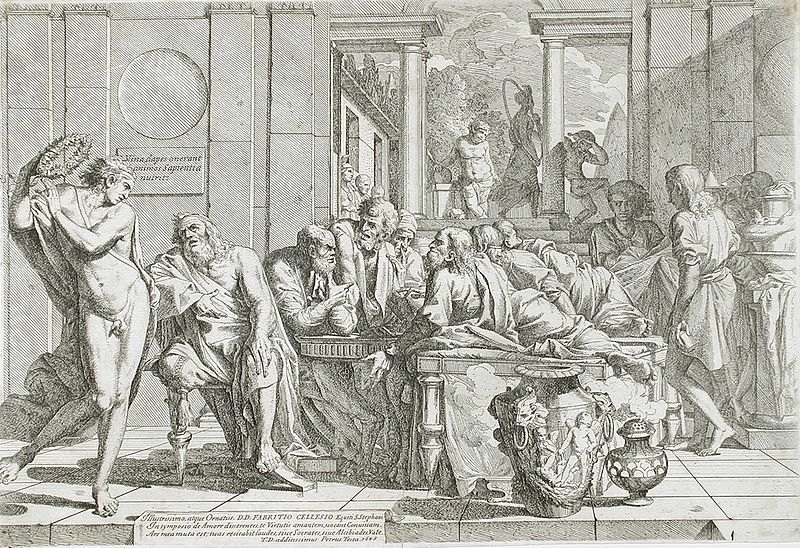
“Drunken Alcibiades interrupting the Symposium”, an engraving from 1648 by Pietro Testa (1611-1650)
Via Wikimedia Commons.
The career of the aristocratic Athenian politician, lover, general and traitor Alcibiades (c. 451–404 BC) is so well documented and colourful that it would surely have spawned numerous Hollywood movies and novelistic treatments, had his name not been so long and complicated (the standard English pronunciation is Al-si-BUY-a-deez).
His popularity, duplicity and unwavering self-regard make for ready points of comparison with modern politicians. The sheer amount of historical detail attached to his story is reflected in Aristotle’s comment in his Poetics: “Poetry is more scientific and serious than history, because it offers general truths whilst history gives particular facts … A ‘particular fact’ is what Alcibiades did or what was done to him.”
We know about “what Alcibiades did and what was done to him” from several authoritative ancient writers. The most entertaining portrayal, however, is that of the philosopher Plato (c. 425–347 BC), whose dialogue Symposium relates how Alcibiades gatecrashed a party at the home of the playwright Agathon, where several speeches had already been delivered on the theme of eros (love):
Suddenly there was a loud banging on the door, and the voices of a group of revellers could be heard outside along with that of a piper-girl. Agathon told his servants to investigate: “If they’re friends, invite them in,” he said.” If not, tell them the party’s over.” A little later they heard the voice of Alcibiades echoing in the courtyard. He was thoroughly drunk, and kept booming “Where’s Agathon? Take me to Agathon.” Eventually he appeared in the doorway, supported by a piper-girl and some servants. He was crowned by a massive garland of ivy and violets, and his head was flowing with ribbons. “Greetings, friends,” he said, “will you permit a very drunken man to join your party?”
Alcibiades proceeds to eulogise the wisdom and fortitude of his beloved mentor, the philosopher Socrates, detailing how the latter saved his life in a battle in Northern Greece in 432 BC at the start of the Peloponnesian War between Athens and Sparta, a conflict that dragged on until Athens’ defeat in 404 BC.
The prominence of Alcibiades in Platonic writings stems from his long and close relationship with Plato’s teacher Socrates. He was born in Athens to aristocratic forebears and at around the age of four lost his father Clinias, who was killed in battle in 447 BC. Along with his brother, Alcibiades entered the guardianship of Pericles, his mother’s cousin and Athens’ leading politician.
Shortly afterwards, Pericles was to take Aspasia of Miletus, a clever woman admired by Socrates, as his partner. Aspasia’s sister was married to Alcibiades the Elder, Clinias’ father, so Aspasia was Alcibiades’ great-aunt by marriage. Her acquaintance with Socrates might have been what led Pericles to appoint Socrates as a mentor for his young ward.
As a teenager Alcibiades was widely admired for his good looks and spirited personality, but he was also notorious for misdemeanours, such as when he struck a teacher for dishonouring Homer, released a bird into the Council chamber to disrupt proceedings, and paraded his dog in public with its tail docked.
Ambitious Athenians were expected to espouse a “love of honour” (philotimia), and Alcibiades displayed this to extremes. He married the daughter of a wealthy Athenian, and when she tried to divorce him because of his affairs, he lifted her bodily and carried her home through the crowded Agora.
Rush Meets LOONEY TUNES???
pdbass
Published Jan 4, 2024Remember that time Rush worked music from cartoons into one of their greatest recordings?
Digging into “La Villa Strangiato” from 1978’s Hemispheres, breaking down Geddy Lee’s wicked bass solo (and its Jazz connections) and showing you how pianist/composer Raymond Scott will always be linked to this iconic prog rock instrumental.
(more…)


