
The railroads [in the decades immediately following the U.S. civil war] saw advantages to regulation. Unstable prices, disliked by rail customers, could also be detrimental to the railroads. A recession in 1884 led to the failure of a number of railroads, and the railroads wanted to undertake pooling arrangements for their mutual profitability. Thus, the railroad industry, which was very competitive, wanted the ICC [Interstate Commerce Commission] to stabilize rates, regulate routes, and protect their profitability. Essentially, the ICC cartelized the industry, allowing it to be more profitable than it could have been in a more competitive unregulated environment.
Randy Holcombe, Liberty in Peril: Democracy and Power in American History, (2019).
February 4, 2024
QotD: American railroads and the Interstate Commerce Commission
February 3, 2024
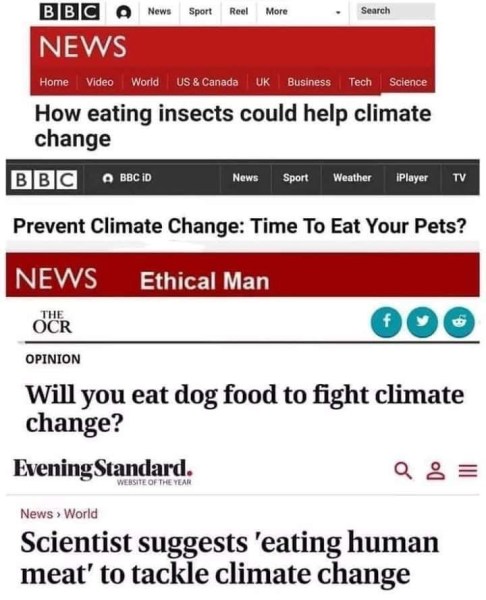
The climate alarmists long ago gave up honest scientific reporting
Tom Knighton says he used to fully buy in to the climate alarmist message, but eventually realized the fix had been in for years, especially when it came to the predictive ability of all the climate change models … as in, their total lack of predictive ability:
When Al Gore’s An Inconvenient Truth came out, I watched it. I was terrified by the world being described, and since I was still pretty liberal and sort of an environmentalist, I took it all to heart.
Over time, as my personal politics shifted, I still had concerns regarding climate change. After all, it is what it is, right?
Until I came to look deeper into the issue and the one thing that shattered my belief in the whole concept: The fact that not a single climate model has ever panned out as predicted despite pretty much none of the draconian measures we’re told we need in order to avert disaster ever coming to fruition.
Science is supposed to be predictive. If it can’t predict something in its models, then scientists need to back up and figure out what the problem is. Instead, they seemingly just keep doubling down.
[…]
Let’s be clear here, the idea of taking measurements in heat islands is freshman year stuff. There’s absolutely no way they’re unaware the effect that’s having on their readings, even as most of their instruments are subject to heat bias.
In other words, I can’t accept this is a good faith error.
No, I believe this to be malicious.
Climatology isn’t exactly a field of science that would ever be considered sexy. Before all the climate alarmism, research grants were likely few and far between. People weren’t overly worried about the climate because it simply ways.
Then scientists started screaming that we were all doomed. The end is nigh, they told us, screaming at the top of their lung and acting just shy of wearing a sandwich board in Times Square.
With that came money and prestige.
Suddenly, climatologist could get recognition and write bestselling books. They could get grants from everyone and their brother to fund their research. The thing is, they had to keep up the charade. People had to believe that we were going to die if we didn’t do something.
Maybe they actually want the draconian measures they suggest, measures that pretty much amount to going back to living in mud huts, but with solar- and wind-created electricity so we won’t need to burn wood to survive.
Or something.
February 1, 2024
Newfoundland – “We used to be a country”
In The Line, James McLeod outlines a difficult period for the Dominion of Newfoundland which ended up narrowly voting to join Canada rather than resume self-rule that they’d had up to 1934 when the Newfoundland House of Assembly abolished itself:
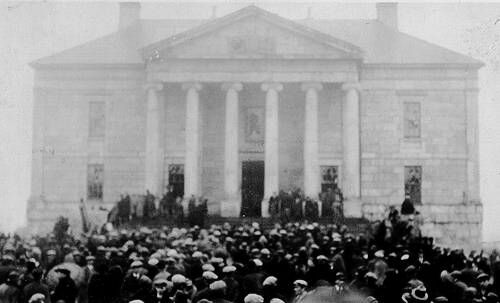
Great Riot of 1932 in front of the legislature, the Colonial Building, in Newfoundland.
Provincial Archives of Newfoundland and Labrador (Reference PANL A2-160), via Wikimedia Commons.
Before 1933, Newfoundland was proudly a dominion within the British empire. Under the Statute of Westminster, Newfoundland had the same legal status as Canada, New Zealand, South Africa and the Irish Free State.
Newfoundland was its own country. But it was a country in rough shape.
A year before the Amulree Report was published, a mob of about 10,000 people had gathered outside the Colonial Building in St. John’s. Families were living in destitution on six-cents-a-day government dole, and the government’s finance minister had just resigned and accused Prime Minister Richard Squires of personally lining his pockets with government funds.
The mob turned into a riot, which ultimately barged into the government building. Notably, the rioters briefly paused to observe a respectful silence when a brass band began playing “God Save The King”, but then they went back to rioting.
Squires fled on foot and went into hiding, and then emerged to call an election, which he lost in a landslide. During the campaign, one of his longtime allies, the prominent leader of the Fishermen’s Protective Union, openly wished for fascism.
“What is required for Newfoundland and what is most essential for the present conditions is a Mussolini,” said William Coaker.
Months later, with a new government, Newfoundland was on the verge of defaulting on its debt, and the British stepped in.
The vastly oversimplified version is that the British government was concerned that a member of the British Commonwealth defaulting on its debt could have major implications for the whole empire. So the British government bailed out Newfoundland, on the condition that a commission would be struck to investigate the island’s political and economic affairs. Lord Amulree, a British politician, was appointed as chair.
A year later, with the Dominion still teetering on the verge of bankruptcy, the Amulree Report was delivered. It contained this passage, with my emphasis added: “That it was essential that the country should be given a rest from politics for a period of years was indeed recognised by the great majority of the witnesses who appeared before us, many of whom had themselves played a prominent part in the political and public life of the Island.”
Amulree considered the possibility of some sort of national unity government, but could not get past the conclusion that, “Even if a National Government could be established on a basis which led to a suspension of political rivalry, the underlying influences which do so much to clog the wheels of administration and to divert attention from the true interests of the country would continue to form an insuperable handicap to the rehabilitation of the Island.”
In 1934, the Newfoundland House of Assembly voted itself out of existence. It was replaced by a “Commission of Government” which was just six unelected men, appointed by the British. Fifteen years later, Newfoundlanders narrowly voted to join Canada, although to this day conspiracy theories still linger about how democratic the referendum really was.
I am not a Newfoundlander, and I’m hesitant to make any sweeping statements about how Newfoundlanders relate to their own history. But for a decade, I worked as a journalist in St. John’s, covering politics and public affairs. The collapse of democratic self-rule in the 1930s still looms large in the collective identity of the province.
January 30, 2024
How did Justice Mosley manage to avoid mentioning the huge pachyderm in the room?
Donna LaFramboise on the amazing ability of people in power here in Canada to avoid noticing or acknowledging the most salient facts of a situation:
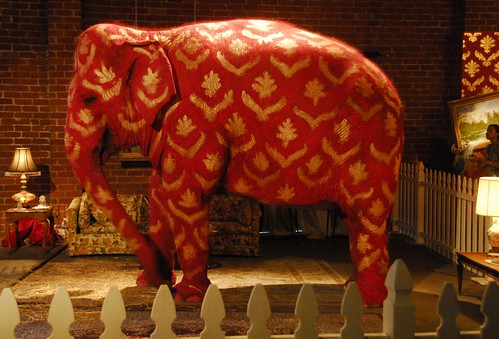


In the recent court ruling against Justin Trudeau’s use of the Emergencies Act, the elephant in the room was once again ignored.
Justice Richard Mosley is well aware that the Act is intended to be “a tool of last resort.” He says so twice in his decision, on pages 78 and 86. He also does a conscientious job of describing the arguments each side presented during various stages of the court battle.
Yet there is no indication, not even the slightest hint, that the bloody obvious received five minutes of the court’s attention: No government can claim to have exhausted all other avenues if it hasn’t even had a conversation with protesters.
It doesn’t matter who is doing the protesting, or what their cause happens to be. If you haven’t arranged a meeting, if you haven’t sat down and listened to people’s concerns, if you haven’t even tried to negotiate a resolution, it is not OK to reach for a last resort, nuclear option. That is beyond unreasonable. It is absurd.
In India, between November 2020 and November 2021, farmers protested three new pieces of agricultural legislation that were eventually repealed. Justin Trudeau publicly criticized the Indian government during that time. So let us compare and contrast.
According to the Indian Express, farmers unions called for a march to Delhi, the national capital, on November 26th and 27th. Delhi police said protesters wouldn’t be permitted to enter the city due to COVID restrictions, but the farmers came anyway. Water cannon and tear gas were used against them, but they eventually arrived in the north-west part of the capital.
On November 28th a cabinet minister “offered to hold talks with the farmers as soon as they vacate Delhi borders”. The farmers didn’t budge. The first round of talks with government took place, nonetheless, on December 3rd — a week after the Delhi protest began. Two days later, more talks took place. By December 30th, six rounds of negotiations had taken place.
In Canada, the government treated the truckers like mangy dogs rather than citizens. Not a single cabinet minister pursued dialogue. Not a single representative of the federal government met with the truckers between the time they began arriving in Ottawa on January 28th, 2022 and when police violently shut down the protest on February 18th and 19th. Get lost, peasants! was the government’s official position.
January 27, 2024
Flashpoint: Texas
Theophilus Chilton wonders if you’re ready for a full-blown Constitutional crisis:
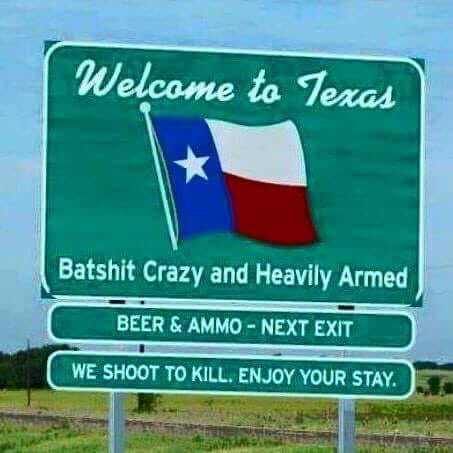
I’m sure that by now, we’re all aware of what is continuing to take place down in Texas. Far from backing down in his standoff with FedGov over the seizure of Shelby Park in Eagle Pass and subsequent expulsion of federal agents, Gov. Abbott has directed the state’s National Guard to continue interdicting illegal immigrants. Indeed, in response to the recent SCOTUS decision allowing the Feds to dismantle the razor wire Texas installed, they’ve simply installed more, in direct defiance of the wishes of the Regime. The Regime has now responded by giving Abbott and Texas an ultimatum — restore control of the park to the Federal government by the afternoon of January 26, or … well … something. Whether the governor ultimately continues to tell the Feds to get bent remains to be seen, but so far the trend is looking pretty good.
Of course, it helps that — for once — Republicans across the country have actually found a little courage to support doing what’s right. As of writing this, the Republican governors of 25 other states have all issued statements of support for Texas’ position. Hence, there are now an outright majority of states whose executives (who control their various National and State Guards) are publicly backing Texan efforts to secure our border. Many of these governors have explicitly cited the Biden administration’s continued abandonment of the federal government’s constitutional duty to protect the several states from invasion and the constitutional right of the states to act in their own defence as sovereign entities in their own right.
Needless to say, this is a constitutional crisis that would not have been conceivable even twenty years ago (well, except for this one movie that seems to have been amazingly prescient). Since 1865, the doctrine of absolute federal supremacy has been in force and the balance of power between the state and national governments has inexorably trended in Washington, DC’s favour. Occasional spurts of opposition to the contrary, most of the previous incipient talk by states about “reining in the federal government” generally proved to be all words and no action. On a few things (e.g. marijuana legalisation), the Regime allowed states to “oppose” federal policy if these were policies that the Regime wanted to change anywise but couldn’t “officially” at the federal level. But on anything that was a true Regime priority, FedGov brooked no dissent. So it is now, but the calculus has changed. What would have been impossible in 2003 is now on the verge of happening in 2023.
This all highlights the fundamental illegitimacy of our current federal government. There is no moral or legal case to be made to justify the actions of the Biden administration. The federal Constitution both enjoins the federal government to protect the states from foreign invasion (which being overrun with millions of foreigners breaking our laws most certainly counts as) and also grants the states the right to protect their own borders and sovereignty. Instead of doing this, the Biden administration has been purposefully inviting hordes of migrants to enter this country. Indeed, this is being encouraged in contravention to statutory federal law as well. Further, if Texas Attorney General Ken Paxton is correct (and he almost assuredly is), the administration has even been partnering with criminal cartels to smuggle illegals into this country. All in all, there is absolutely no justification to be credibly made for the Regime’s actions and anyone who supports them are in opposition to the Constitution, the laws, and the people of this land.
Despite the fevered ravings of various progressive “Christians” on social media, the moral argument for allowing the Regime to throw the gates open is nonsense. Indeed, the whole attempt to craft a “biblical” argument for open borders is simple-minded and ignorant of the relevant scriptural and historical context. Simply put, the Bible’s approach to “the stranger” falls into line with common ancient Near Eastern and Mediterranean modes of hospitality that were meant to “tame” the foreigner and integrate him into a society, thus preventing him from causing disruption to that society. If that couldn’t be accomplished, then the “inhospitable foreigner” was either to be expelled or eliminated. Needless to say, this applied only to individuals or small family groups — large masses of foreigners attempting to enter an ancient country would have been rightly recognised as an invasion and dealt with accordingly.
However, the illegitimacy of the current Regime and its actions alone can’t explain why the Republicans have closed ranks so precipitously. After all, Republican politicians are not exactly known for their intestinal fortitude when faced with opposition of any kind. Yet, even Northeastern moderate squishes like New Hampshire’s Chris Sununu have signed onto supporting Texas in this. Something changed that has caused the GOP, almost as a whole, to support this, either openly or tacitly.
January 26, 2024
Canada’s sooper-sekrit warship program
David Pugliese on the cone of silence the federal government seems to have pulled down over the Canadian Surface Combatant shipbuilding program as it steadily escalates in total cost to the taxpayer:

An artist’s rendition of BAE’s Type 26 Global Combat Ship, which was selected as the Canadian Surface Combatant design in 2019, the most recent “largest single expenditure in Canadian government history” (as all major weapon systems purchases tend to be).
(BAE Systems, via Flickr)
National Defence has brought in a new and unprecedented shroud of secrecy around a controversial warship project now estimated to cost taxpayers more than $80 billion.
After withholding documents for almost three years, the Department of National Defence has released nearly 1,700 pages of records that were supposed to outline specific costs and work done so far on the Canadian Surface Combatant program.
But all the details of what taxpayers have so far spent and what type of work has been done by Irving Shipbuilding for that money have been censored from the records.
“I pretty much got nearly 1,700 blank pages,” Ken Rubin said of the access to information request he filed to National Defence in April 2021 about the warship program. “I have never seen this level of secrecy or lack of accountability over a project that is costing so much.”
Rubin, an investigative researcher who has used the access law to obtain federal documents for decades, said there was not a single cost figure contained in any of the 1,700 pages. One page noted that Irving was required to perform 19 specific tasks, but all details were censored. Others pages listed numerous amendments made to the CSC program, but all details were blacked out. Information about the annual profit Irving has made so far on the CSC project is censored.
Irving declined to provide comment, referring this newspaper to National Defence.
Defence Minister Bill Blair’s office sent this newspaper a statement noting the “minister believes strongly in openness and transparency, and expects the Department of National Defence to respect the rights of Canadian citizens, permanent residents and persons or corporations present in Canada, to access records of government institutions that are subject to the Access to Information Act“.
National Defence noted in a statement that, since some of the records involved Irving Shipbuilding, government officials consulted with the firm to determine if the records contained proprietary information of the firm. Irving objected to the release of information, the department added.
But Rubin pointed out that National Defence was not required to follow Irving’s orders on what records could be released to the public. The amount of tax dollars spent on the surface combatant and how that money was being spent shouldn’t be secret, he added.
In addition, National Defence originally claimed in a statement to this newspaper that the long delay in providing the documents was because Rubin had asked for 20 years of records. But, when challenged on that claim, the department acknowledged it wasn’t true. It did not, however, provide an explanation why it had provided false information to this newspaper.
The Canadian Surface Combatant project will involve the construction of 15 warships for the Royal Canadian Navy at Irving on the east coast.
January 25, 2024
By invoking the Emergencies Act, “the government unjustifiably violated Canadians’ constitutional rights”
Andrew Lawton reports on the Federal Court decision that ruled against Justin Trudeau’s invocation of the Emergencies Act to break up the Freedom Convoy protests in 2022:

For those whose bank accounts the government froze, those who remain on trial for trumped up charges, and those who were pepper sprayed, tear gassed, or zip tied while protesting for freedom, this week’s news might be too little to late.
Even so, the aforementioned people have all been vindicated.
The Federal Court ruled Tuesday that Justin Trudeau’s invocation of the Emergencies Act – both the decision to apply it and the measures he used it to impose – were illegal.
In other words, there was no “national emergency” rising to the wartime levels intended by the act. And even if there had been, the government unjustifiably violated Canadians’ constitutional rights.
The decision was handed down, coincidentally, on the two year anniversary of the Freedom Convoy’s launch from Delta, B.C.
When Trudeau invoked the Emergencies Act, he assured Canadians that the Charter of Rights and Freedoms would be respected. His evidence was thin: the guarantee that Charter rights would be protected was seemingly predicated only on the fact that the law says Charter rights must be protected. I’d call it circular logic but even “logic” seems a bit of a stretch.
As I remarked then, if you have to pinky swear to Canadians that you’re upholding their rights, you aren’t. A well-respected judge on the Federal Court now agrees.
While the Freedom Convoy was an unprecedented demonstration (globally, not just by Canadian standards), Trudeau’s response put Canada on the map in all the wrong ways. It was condemned the world over, even by the Chinese Communist Party and Iran’s former president. Not that I put too much stock in what they think, but when you go too far for even the dictators, you should probably reassess.
The crackdown illuminated the authoritarian impulse in Canada’s “sunny ways” government. The convoy was a response to Covid restrictions, but also an increasingly divisive and vindictive approach to politics by Trudeau that vilified people based on their vaccine status and ultimately their political views.
Unfortunately for Trudeau, his denigration of convoy supporters as a “fringe minority” with “unacceptable views” ended up being taken up as a badge of honour and reclaimed by the very fringe he tried so hard to marginalize.
The court ruling is not a full exoneration of the Freedom Convoy. It’s still possible that Tamara Lich and Chris Barber could be found guilty on their mischief charges. It’s also possible that convoy organizers could lose the lawsuit filed on behalf of Ottawa residents. The decision isn’t a declaration that the convoy was a purely lawful protest, but it does say there was no “threat to the security of Canada” as per the CSIS Act, which Trudeau has spent nearly two years pretending there was.
January 21, 2024
QotD: The life-cycle of bureaucracies
Gentle reader must understand that I am not speaking only of “guvmint”, but of bureaucracy, at large. The thing is not necessarily a government department. Any big corporation will quickly show symptoms. The only difference between “public” and “private” is in longevity. A private bureaucracy will kill its host, but thanks to the power of taxation, a public bureaucracy can be long sustained. It is also backed by law and police action, which even today is more effective than mere pointless rules and regulations. The latter, however, are more nimble in expansion, and prepare the ground for law — the full spiritual stasis.
David Warren, “Austrian schoolboy”, Essays in Idleness, 2019-09-17.
January 19, 2024
Canada “as a white supremacist genocidal settler state” also somehow has an immigration problem
In The Line, Jen Gerson documents what she characterizes as a collapse of the pro-immigration consensus that has been a major part of Canadian political affairs for generations:
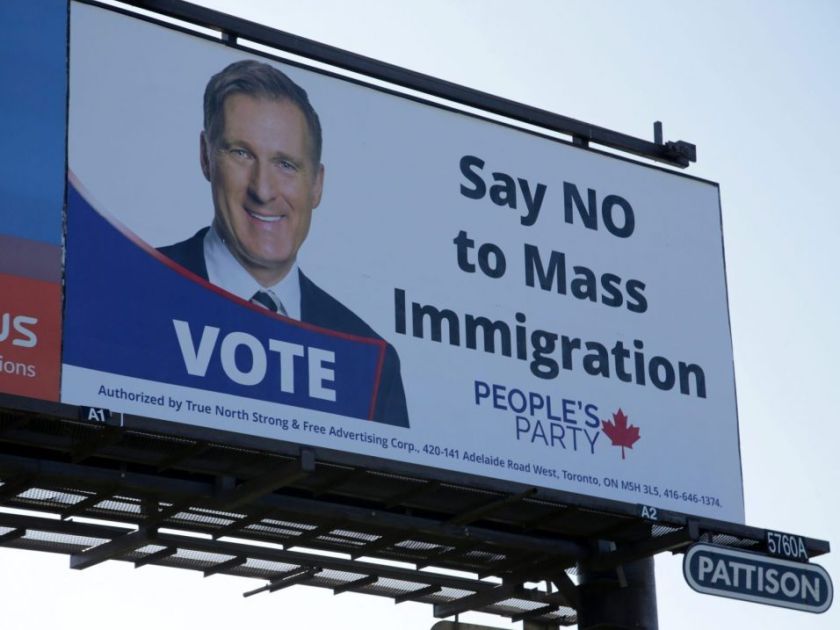
A billboard in Toronto in 2019, showing Maxime Bernier and an official-looking PPC message.
Photo from The Province.
Canada created a durable and lasting consensus on immigration by leaning on a shared national mythology: that from a colonial past, we forged a principled multicultural nation in which people from around the world are able to honour their heritage and traditions while building a prosperous and successful life for themselves and their descendants. This narrative requires that all of us — regardless of our divergent ideologies or religious views — cohere around a shared set of post-enlightenment principles: the equality of man, the rule of law, tolerance, and the rest. We take this highly abstract concept of nationhood so for granted that we’ve forgotten how historically rare it is.
This is not to say Canada ever imagined itself to have an unblemished history, but rather that this is a nation that saw itself as a fundamentally good and noble project, and therefore some place worth immigrating to, and a culture worth integrating with.
The last nine years of Liberal government have undermined that vision. Under the Trudeau Liberals, instead what we have been regularly subjected to Canada as a white supremacist genocidal settler state. And, hey, to what extent that historical reckoning is good or necessary is not for me to say: but if “Canada is bad, actually” is the starting position, by what delusion do any of us presume to perpetuate it?
A post-modern nation state that has no sense of itself, and no belief in its own inherent value, is not an experiment worth continuing, now is it? How do we expect to welcome and integrate 500,000 new Canadians annually into a corrupt national project? If “Canadian” isn’t something worth being, why should anyone sublimate their ethnic or religious grievances into this vicious national identity?
I think this is the tension that lies at the heart of this growing unease around immigration, and it’s going to be the most difficult one for the Conservatives to navigate. There will be those within the party that follow this thread directly into white grievance and conspiracies like great replacement theory, the xenophobic fear that “elites” are trying to demographically and culturally replace white people through mass migration.
I think that theory is insane, to be clear, but I’m also noticing it wend its way into politics in weird and destructive ways.
A small example: before the holidays, certain conservative social media circles were put into a state of high uproar over the construction of a 55-foot statue of the Hindu deity Hanuman on a private temple complex in Brampton.
Initially, I was baffled and confused and even a bit amused by the upset. After all, this wasn’t a publicly funded monument. It was on private property, and isn’t respect for private property a sacrosanct value for conservatives? This wasn’t rational.
The controversy was only explicable when we examine the emotional subtext of the complaints: that there was something deeply menacing about Hanuman to these people. They saw him overlooking the suburbs of Brampton with a colonial intent. (Irony abounds!) One of the most telling tweets came from one angry individual who said something to the effect: “They tore down our John A. Macdonald statues, but, sure, Hanuman is great.”
To this gentleman: the fine devout Hindus of Brampton did not tear down your John A. Macdonald statues — and I highly doubt they would any pick bones with historic or civic monuments.
We, Canadians, tore down our own statues (or allowed them to be torn down) as part of an internal process of historical reckoning. Again, immigrants are not doing anything to Canada. They are Canada, and as such, they share in this country’s problems, which are largely self created.
January 15, 2024
An alternative recruiting strategy for the US military
Theophilus Chilton suggests there’s a deeper plan for the US federal government’s blatant encouragement of mass illegal immigration across the US-Mexican border, and if true it might indicate that things are about to “get spicy”:
It genuinely is a mystery …
This move by Texas [using state resources to enforce federal border control against the will of the federal government] represents a ratcheting up of our collapse phase trend towards decentralisation. At least for now (and let’s hope Abbott has the fortitude to follow through), a state is openly defying FedGov in a non-Regime approved way that would have been unthinkable even twenty years ago. Even if FedGov wins this standoff, it presages more and more movement in that direction. The Regime is bleeding power and everyone knows it, even if they can’t afford to let on to that fact. Either way, the Regime is going to have to stop this quickly before other states start getting ideas. If they can’t, their already tarnished reputation will take a further massive hit.
So in light of this news, we saw something else on Thursday that ought to be of interest. A very odd bill has been proposed in the House of Representatives by two Democratic representatives – a bill that would ban “private military activity“. On its face this seems strange since every state in the union already does this. However, the bill, as written, is so vague that it could be interpreted to outlaw organised range shooting activities or even paintball games as “combat training”. This bill reeks of desperation because the Regime knows that its path to collapse is further along than a lot of people think and they know that “private military activity” is a very real possibility. The Regime has been accelerating to the point of no return and is trying to stifle any potential serious opposition.
Opposition to what? Well, that’s a good question. Let’s put some pieces together.
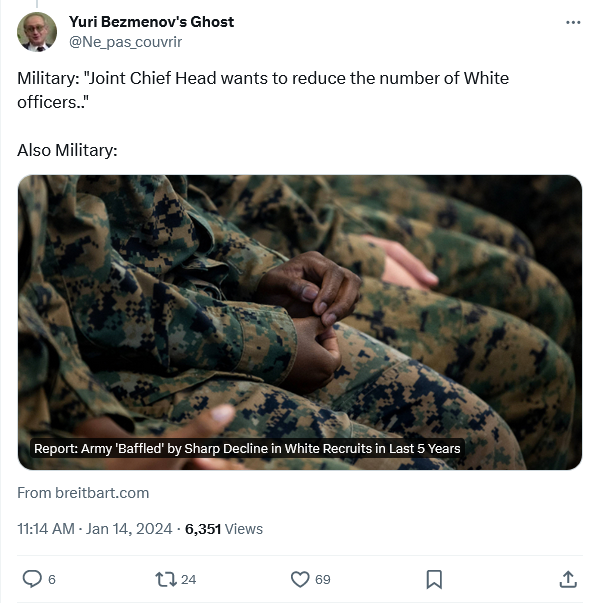
It’s no secret that the US military is facing a serious recruiting shortfall. Obviously, the current Regime has little use for the American military as it has traditionally been constituted. This is shown by the absolutely disrespectful way in which our troops are routinely treated by their own government and chain of command. Especially driving this recruitment deficiency is the huge drop in enlistment by the military’s traditional recruiting stock – rural and suburban White men from the South, the Midwest, and the Mountain West. In other words, exactly the kind of people being demonised by the new military with its DIE initiatives, rainbow flags, and trooned officer corps.
So who is going to fill the ranks? Fortuitously, we seem to have a huge flow of military aged males from all over the world crossing our border for whom the Regime has been rolling out the figurative red carpet. These are guys who probably have a lot of time on their hands. Wouldn’t it be a swell idea if we inducted all these guys into the military to make up for the lack of Heritage American interest? Indeed, history repeatedly shows that unpopular regimes typically do exactly this. They start to rely on foreign mercenary forces for a number of purposes.
Certainly, as GAE struggles to keep its steam, there may be a need to send Guatemalans and Nigerians into various Middle Eastern sandboxes to take shrapnel that Americans won’t take. After all, there will still be the vain and desperate attempts to shore up American globohomo empire in that (and other) regions. But historical, one of the main uses of foreign troops has been to try to keep your own potentially rebellious natives in line. Foreign troops have no real connexion with those whom they are suppressing and thus are willing to follow almost any orders that their paymasters give them.
However, unlike many first world countries that are under the Regime’s heel, the USA has a large body of well-armed citizens, many of whom have military training and combat experience. These guys – plus any other patriotic citizens they may be willing to help train – probably won’t take too kindly to being suppressed by foreign hirelings, something that will quickly make a lot of people’s patience run out. Say, wouldn’t it be a shame if all of these armed, trained and trainable people started organising to protect their homes, families, states, and country?
Despite all of the bravado from left-wing
January 4, 2024
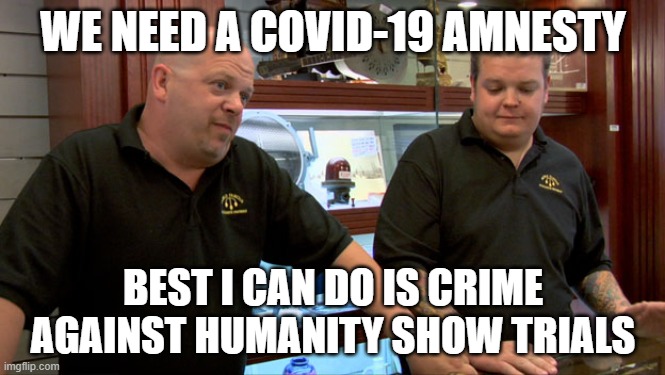
“It is difficult to understand why our politicians are not locked up for life after successful prosecution for crimes against humanity”
Part nine of Paul Weston‘s “beginner’s guide to Covid”:
Lockdown was never referred to as “lockdown” in March 2020. We were “asked” to stay at home for a few weeks, thus allowing our health services to get up to speed without being swamped. As we now know, a few weeks became months became 2021.
I simply cannot believe this was not planned. The logistics involved in keeping a country afloat after closing down the economy are extremely complicated. Months – if not years – of planning must have gone into it.
One of the strangest things about the first lockdown in the UK was the enforcement date of March 26, one week after the government declared on March 19 that Covid-19 was being downgraded from a High Consequence Infectious Disease (HCID). The reason given for the downgrade was a low mortality rate …
Anyway, the world locked down. When it became apparent the lockdowns were going to stay in place until a miracle vaccine was discovered, the governments promised us that detailed cost/benefit analyses would be conducted. They never were. But they very much should have been.
The principal reason they should is all to do with deaths. Closing down the country also meant partially closing down health services to non-Covid patients. Inculcating fear meant many people were too scared to go anywhere near a hospital. Patients with cancer and heart problems stayed away, voluntarily or involuntarily. Many died as a result.
On July 19 2020, the Daily Telegraph published an article based on Office for National Statistics figures claiming that 200,000 people could die (mid to long term) in the UK due to lockdowns. Similar figures were published in countries all around the world.
Here is a brutal truth. Governments which locked down essentially stated the following: “We are going to murder XYZ thousand people. We undertake this crime because we think we might save other people from Covid-19 deaths.”
Even more remarkably, the death rates were completely normal before lockdowns were initiated. Lockdowns were not the forced result of having to deal with large numbers of deaths. Rather, large numbers of deaths were the forced result of government-ordained lockdowns. It is difficult to understand why our politicians are not locked up for life after successful prosecution for crimes against humanity.
January 2, 2024
Nobody will like the new rules
Chris Bray points out just how bad the “new rules” are going to be … and not just for the Bad Orange Man:
The danger is that you concede an argument about a personality or an event, then find at some future point that you’ve accepted new systems and structures that are far more broadly applicable than you noticed at the moment you accepted the new rules. Everyone of every political persuasion should see the weapon on the table, because it’s going to be pointed at you and yours: libertarians, anti-war leftists, populists, paleocons, others too weird to name. Outliers. If your votes and your views fall outside an extremely narrow band of corporate-state “centrism”, what follows is about you.
So.
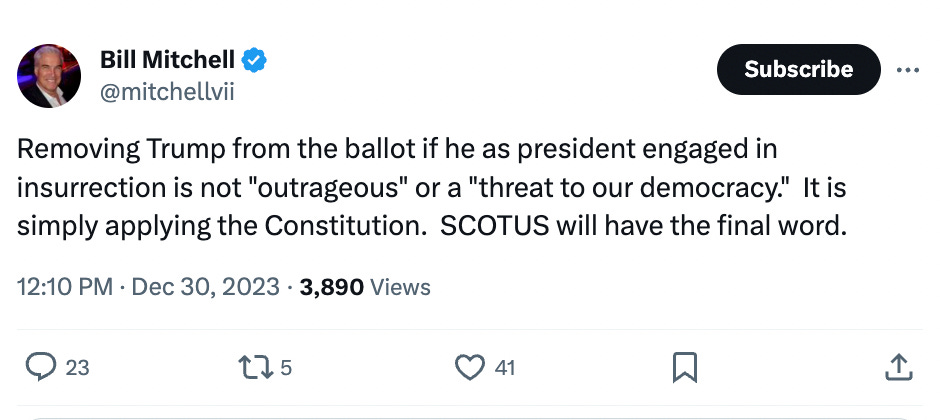
Bill Mitchell, a media figure and DeSantis supporter, doesn’t see the big deal:
The problem is that Trump is “super toxic”, so whatever. Orange Man is bad, so the things you do to Orange Man are unobjectionable. Of course you can take him off the ballot — he’s a jerk. That’s, like, the Constitution.
But the constant background music for me in these discussions is that the government of Canada construed a peaceful protest against vaccine mandates as a national emergency, on par with a foreign invasion, and started freezing bank accounts and mobilizing force for mass arrests. A “Western democracy”, hearing dissent, started turning off the dissenters’ money, which means that government took away the ability of peaceful protesters to pay for things like housing and food. The patience of the global political class for disagreement is narrowing, fast and hard. (Cf. e.g. Ardern, Jacinda.)
So see what’s happening in the United States, and see where it points. On January 6, thousands of protesters turned into maybe hundreds of rioters; many people at the Capitol were peaceful and calm, while some weren’t. Almost none were armed, none used guns, and the question of law enforcement infiltration, provocation, and entrapment remains open.
But no one published a manifesto calling for the violent overthrow of the United States government, and the crowd didn’t line up at the Capitol with rifles and homemade bombs to launch waves of armed attacks on Congress. Compare: here’s Bernardine Dohrn of the Weather Underground declaring war on the United States, and announcing on the radio that “our job is to lead white kids into armed revolution”. Find me that moment on January 6, the explicit declaration of armed revolution aimed at the destruction of the federal government. No one has been charged under the Insurrection Act because no one has violated the Insurrection Act. The “insurrection” is a political construction, not a legal case.
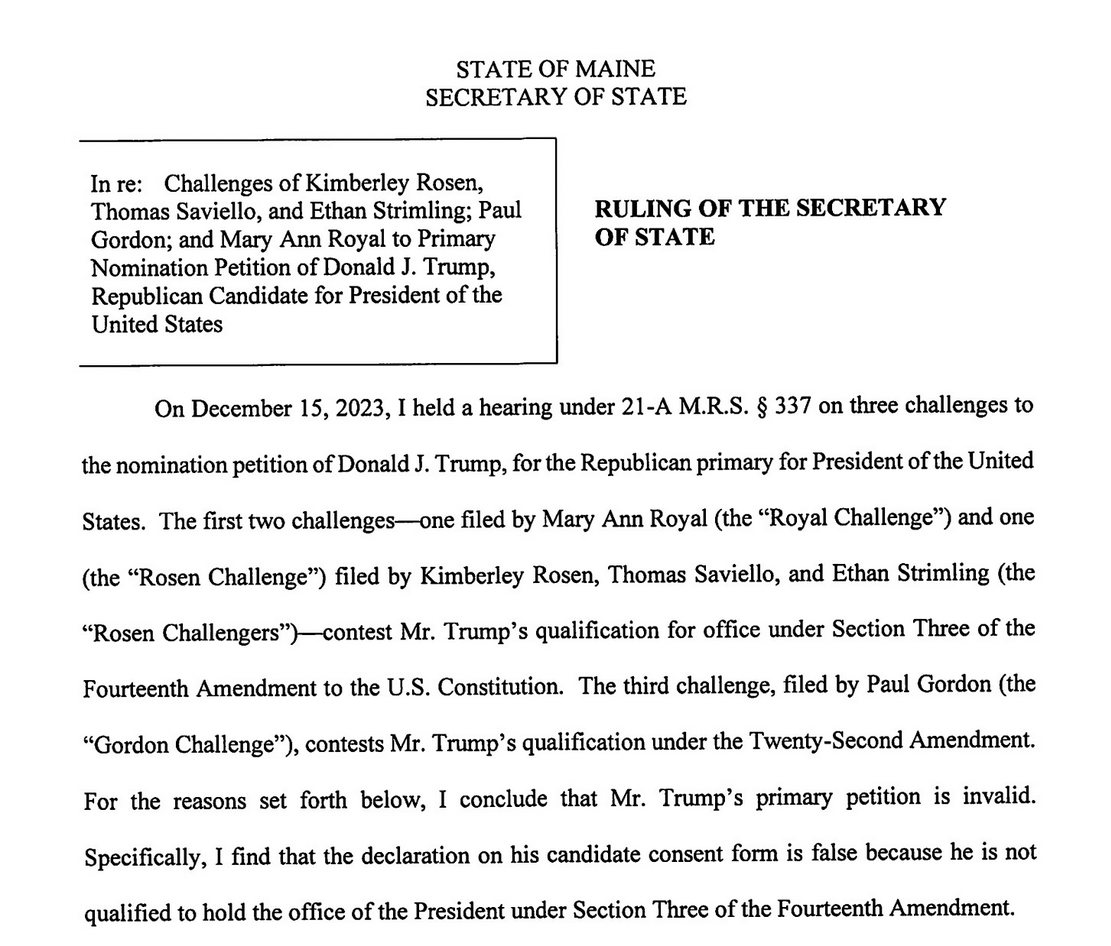
So a riot can be an “insurrection”, in the complete absence of insurrection charges and convictions, if Maine Secretary of State Shenna Bellows (D-Longhouse) feels like an insurrection happened. She can “rule” on that.
Lone officials can unilaterally declare that American citizens are ineligible for participation in elections, because the activities of [insert name of bad people here] can be politically construed as insurrectionist — in the absence of due process and a jury trial.
QotD: Cigarette smuggling and the powers-that-be
At that point, the Powers That Be were in trouble. Butt-smuggling was cutting into their projected tax revenues — tax revenues which, being governments, they’d already spent several years in advance. That’s bad.
Much worse, though, was the realization that, the more people bought their smokes off the back of a truck in Weehawken, the more those people realized that 99% of law “enforcement” is really “convincing people to voluntarily comply with the law”. As they should’ve realized from Prohibition back in the Twenties, and would soon have the opportunity to learn again with the War on Drugs, 1980-present, lifestyle laws are effectively unenforceable. Not even the most draconian techno-fascists, armed with 100% realtime surveillance, can stop people from getting high off something.
And that’s the worst knock-on effect of all, because the attempt turns “getting high” into a rebellious little thrill. You’re not just getting drunk / burning one down / smoking a Mob-supplied cigarette, you’re sticking it to The Man. If you don’t believe me, watch what happens to pot consumption in college towns once it’s fully legalized. Hint: It’s the same thing that happens to college kids’ alcohol consumption after they turn 21 — now that the cheap little thrill of being the rebel with the fake ID is gone, drinking loses a lot of its charm. Similarly, 99% of the “legalize it!” crowd’s “arguments” are just virtue signaling — they’re letting you know what rebels they are by breaking the pot laws. If you really want to cut down the consumption of intoxicants in a college town, at least, simply legalize ’em all. Your few true addicts will provide a spectacular lesson in Darwinism to the student body, but the vast majority of kids will be all but straight-edge.
Severian, “The Mob, Faux-tism, and the Ever-Rising Costs of Compliance”, Founding Questions, 2021-02-02.
December 28, 2023
“Lich and Barber … now hold the record for the longest “mischief” trial in Canadian history”
“Autonomous Truck(er)s” describes the “Lawfare Archipelago” as Justin Trudeau’s government persecutes Tamara Lich and Chris Barber for their part in organizing the Freedom Convoy movement in 2022:

It has been almost two years since Canada’s Freedom Convoy took the country, and the world, by storm. In what has been hailed around the globe as the most popular protest anywhere against the international Covid Regime, represented in Canada by the venal and vindictive Prime Minister Justin Trudeau, the Truckers of the Freedom Convoy still occupy a place as heroes to millions.
Everyone remembers how the Freedom Convoy was crushed by Trudeau’s invocation of the Emergency Measures Act, and how bank accounts were frozen, credit cards, insurance, the entire financial lives of hundreds of people that were completely shut down. The police crackdown on peaceful protesters, smashing of windows and other vandalism committed against the protesters vehicles, trampling people with horses, the beatings, the arrests; an overwhelmingly disproportionate and wholly unnecessary asymmetric response.
In December of 2023, however, a number of those truckers and their supporters are still facing adversity and punishment, including potential jail time, with ongoing court cases, and in the situation with The Coutts 4, a trial which hasn’t even started yet.
These cases are illustrative of the corruption of the Canadian political system, the media, the courts and ‘justice system’, and the subversion of some of the founding pillars of western civilization.
Canada is no longer a free country by any stretch of the imagination.
Part 1 : Tamara Lich and Chris Barber
On Thursday, November 30, just a few weeks ago, I traveled to Ottawa to take part in an interview for a documentary film being made by former CBC journalist and now freelance podcaster Trish Wood, whose working title is The Trials of Tamara Lich. Trish had stumbled upon my writings and podcasts here at Substack, and invited me on her show to discuss the situation with the Coutts men being held as political prisoners. Impressed with my work on that, as well as my history in trucking and perspectives on the deeper meaning behind the Freedom Convoy, she wanted me to appear in this documentary; I was honored to be asked and happy to oblige.
As of this writing, the trial is on Christmas break, and may, possibly resume in March 2024. It should be noted that for the primary charges that Lich and Barber are facing, in their roles as organizers of the Ottawa portion of The Convoy, a 100% peaceful protest whose only acts of violence or property damage came at the hands of the police, they now hold the record for the longest ‘mischief’ trial in Canadian history.
Given the actions of our government, perhaps it is they who should be the accused.
Chris “Big Red” Barber, a trucker from Saskatchewan who specializes in hauling oversize agricultural equipment, became one of the faces of the Freedom Convoy through his frequent TikTok videos, sharing news about the protest to his many followers online.
It is these TikTok videos that appear to be the bulk of the evidence the Crown has against Mr Barber, though sharing information on a publicly available platform seems the kind of “crime” one would expect to be prosecuted in the country where TikTok is headquartered, The People’s “Republic” of China. The basic dictatorship, we should recall, that is “admired” by Prime Minister Trudeau.
Quelle surprise, coming from Cuba’s most infamous son.
The deeply unsurprising lack of evidence on the part of the Crown is one reason why this case continues nearly two years later; Trudeau, and the Laurentian Elite by whom he was groomed for glory, cannot accept that they went way out over their skis in the gross mismanagement of Covid, and their utterly disgusting treatment of the Freedom Convoy.
An example must be made of Barber and Lich, who are both facing ten years in prison should the Crown get the convictions they desire. “Copping a Tenner”, as they used to call a trip to one of Stalin’s Gulag Camps, is quite a cost to satiate Trudeau’s latent authoritarian proclivities and his narcissistic vanity. One wonders if this is not also an effort to prove to his real constituency, the forces of global corporatism and control exemplified by WEF leader Klaus Schwab, that Trudeau will preserve the image of the brand.
The Liberals may be bad at “deliverology”, but they’re world-beaters at pouring money into black holes
Tristin Hopper explains the apparent paradox that the federal government is spending money faster than it can be printed, yet the things the government is responsible for are perennially underfunded:

From back when The Onion was allowed to be funny – https://youtu.be/JnX-D4kkPOQ
This may surprise the average Canadian given that so much of the government is noticeably threadbare and underfunded. Canadians are dying in hospital waiting rooms due to unprecedented shortages in health care. The navy’s so strapped for cash that it can only deploy one offshore patrol vessel at a time. The RCMP’s federal policing is so under-resourced that Parliamentarians are now calling it a threat to national security. And even $600 billion in cumulative debt hasn’t been enough for the Liberals to honour their 2015 campaign promise to ensure universal clean water on First Nations reserves.
It’s popular to blame all this on some easy-to-identify example of government profligacy, such as Ukraine aid, free hotel rooms for refugee claimants or Prime Minister Justin Trudeau’s noted penchant to rack up outsized travel bills. But Canada’s fiscal problems are well beyond anything like that. At the current rate of spending, the cumulative $2.4 billion in military aid that Canada has sent to Ukraine represents less than a month’s worth of new debt.
So where’s all the money going? Below, a cursory guide to how Canada is able to spend so much while seemingly obtaining so little.
Debt servicing just got way more expensive
First, an easy one: The Trudeau government borrowed an obscene amount during the COVID-19 pandemic, and with rising interest rates the treasury is getting hammered with debt-servicing costs.
As recently as 2021, interest charges on federal debt cost $20.3 billion per year. In the current fiscal year, it’s probably going to blow past $46.5 billion. Ottawa now spends about as much on debt management as it does on health care transfers to the provinces.
The phenomenon of pricier debt is not limited to Canada: Virtually every government in the world ran up record-breaking debts during COVID and are now facing the consequences. But if Canada is different, it’s that our rate of pandemic debt accumulation was at least $200 billion higher than it needed to be. And in justifying all this extra spending at the time, Trudeau argued that it was a good time to take out extra debt since “interest rates are at historic lows”.
The corporate welfare is just unbelievable
Canada has a long history of government signing over grants and bailouts to politically connected corporations. As far back as 1972, then NDP Leader David Lewis famously championed the cause of stopping Canada’s “corporate welfare bums”.
But the Trudeau government has taken corporate welfare to new heights. It was only a few years ago that Bombardier was the undisputed champion in collecting federal grants, bailouts and interest-free loans. Over 50 years, according to an analysis by the Montreal Economic Institute, Bombardier received a cumulative “$4 billion in public funds”.
In just the last calendar year, the Trudeau government has signed two subsidy agreements that would dwarf that $4-billion figure several times over. In the spring, both Stellantis and Volkswagen agreed to build EV plants in Ontario in exchange for federal subsidy packages that could cost as much as $18.8 billion (plus another $9 billion from the Ontario government).
And that new $18.8 billion liability on the books doesn’t even account for the massive ramp-up in the corporate welfare everywhere else. To name just a couple: In 2021, Air Canada got a $5.4 billion loan package. And the Trudeau-founded Strategic Innovation Fund gets about $1.5 billion per year in handouts to green energy companies.


